
Showing 51 items matching "state library of south australia."
-
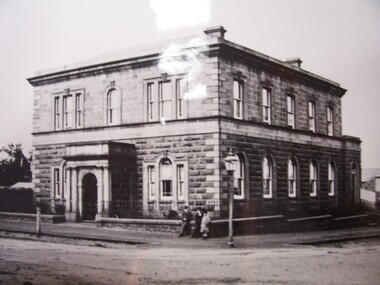 Glenelg Shire Council Cultural Collection
Photograph - Photograph - ANZ Bank, Portland, n.d
... State Library of South Australia....Back: B21766/98 (pencil, upper left). State Library of South Australia Photographic Section. Order No. ...State Library of South Australia....State Library of South Australia. ANZ Bank commerce banking Portland bluestone building Front: A.N.Z. ...State Library of South Australia.Black and white photographic reproduction of earlier photograph. Depicting 2-storey bluestone building on a corner with door in left side, framed by double columns. Lamp on street corner and three figures (children ?) leaning against iron rail fence set in bluestone base.Front: A.N.Z. (Formerly Union) Bank. Cnr Percy & Julia Streets (typed label, top centre). Back: B21766/98 (pencil, upper left). State Library of South Australia Photographic Section. Order No. A16493 (stamp, centre).anz bank, commerce, banking, portland, bluestone building -
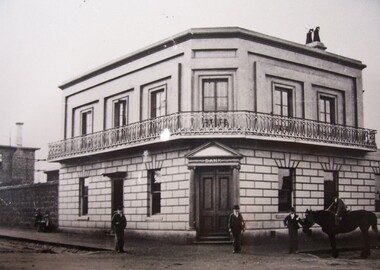 Glenelg Shire Council Cultural Collection
Photograph - Photograph - Commercial Bank, Portland, n.d
... From original in State Library of South Australia....Bank/History House (typed on white label, top centre). State Library of South Australia Photographic Section Reproduction prohibited except with the permission of the copyright holder. ...State Library of South Australia....From original in State Library of South Australia. commercial bank Portland bluestone building commerce Back: B21766/103 (pencil, upper left). ...From original in State Library of South Australia.Black and white photographic copy of earlier image. View of a bluestone building on a corner of an unpaved street. Building has two stories, a wrought iron balcony and front door set in the corner with framing columns and pediment. Three men stand in front, with another mounted on a horse.Back: B21766/103 (pencil, upper left). Bank/History House (typed on white label, top centre). State Library of South Australia Photographic Section Reproduction prohibited except with the permission of the copyright holder. Order No A16493 (stamp).commercial bank, portland, bluestone building, commerce -
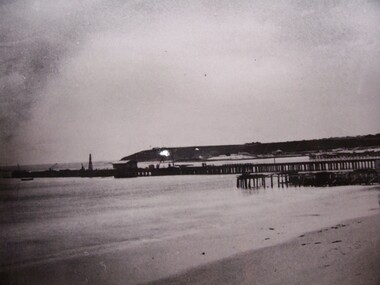 Glenelg Shire Council Cultural Collection
Photograph - Photograph/Postcard - View of Portland Harbour, View of Portland Harbour, n.d
... Front: View of Portland Harbour Back: State Library of South Australia, Photographic Section. Reproduction prohibited except with the permission of the copywirte holders. ...State Library of South Australia, Photographic Section...Front: View of Portland Harbour Back: State Library of South Australia, Photographic Section. Reproduction prohibited except with the permission of the copywirte holders. ...Displayed at History House.Black and white photo. Images shows bare Battery Point, buildings under cliff, pier with building at end , another building (Baths?) and uprights in ocean.Front: View of Portland Harbour Back: State Library of South Australia, Photographic Section. Reproduction prohibited except with the permission of the copywirte holders. Order No. A/6493 -
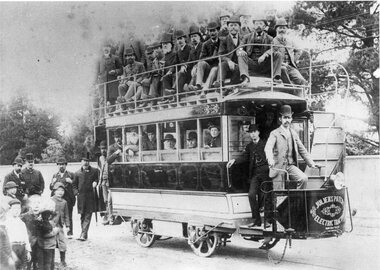 Ballarat Tramway Museum
Photograph - Black & White Photograph/s, Sep. 1888
... Black and White copy photograph of a State Library of South Australia SLSA B34583, of the Julien battery-electric tramcar on trials in Toorak Road, Melbourne; see page 27 of The Golden City and its Tramways and for the photo itself. ...In pencil "Photograph courtesy of the State Library of South Australia SLSA B 34583"...In pencil "Photograph courtesy of the State Library of South Australia SLSA B 34583" Black and White copy photograph of a State Library of South Australia SLSA B34583, of the Julien battery-electric tramcar on trials in Toorak Road, Melbourne; see page 27 of The Golden City and its Tramways and for the photo itself. ...Yields information about the trails of an alternative method of propulsion of tramcars - electric battery. Shows the vehicle while on trial in Melbourne. Shows the people involved in the trials.Black and White copy photograph of a State Library of South Australia SLSA B34583, of the Julien battery-electric tramcar on trials in Toorak Road, Melbourne; see page 27 of The Golden City and its Tramways and for the photo itself. Trails undertaken September 1888. Collected by Alan Bradley from the State Library of South Australia early 1980's. For details of the Adelaide trials - see https://commons.wikimedia.org/wiki/File:Julien%27s_Patent_battery_tram,_Henley_Beach,_9_January_1889_(SLSA_B-5468).jpg (accessed 22/8/2020). And the Oct. 1977 issue of Trolley Wire, for the construction, testing and disappearance of the tram. 3791.1 - 2nd print obtained by William F Scott on light weight paper - 2 copies2785.1 - on rear of both copies in ink "Trial run of battery electric car in South Yarra (Melbourne) on cable car tracks. 1888. The same car ran in Ballaarat shortly there after." In pencil "Photograph courtesy of the State Library of South Australia SLSA B 34583"tramways, trams, duncan fraser, battery trams, julien system, melbourne -
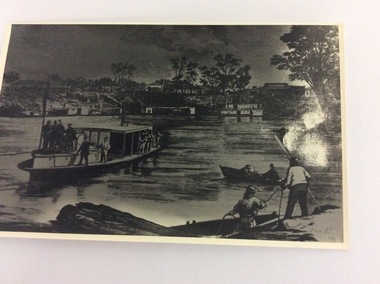 Port of Echuca
Black and white photograph of an engraving, Approximately 1970
... ...state library of south australia....It also shows that most of the crowd are males, which helped describe the role that women played in public life in the 1880's. echuca wharf susan preistley railways state library of south australia. illustrated australian news. s.s.melbourne steam packet hotel shackell's bond store st george's hall bridge hotel On the front of the photograph in the bottom right hand corner are the letters R.G. ...This is a photograph of an engraving showing the first train arriving at the Echuca Wharf on 25/09/1865. The photograph appeared in the Illustrated Australian News on 25/09/1865. It also appeared in Susan Preiestly's book, 'Echuca; A centenary history' in 1965 on page 46.. The picture is of interest because it shows the size of the wharf in 1865. It also shows all the crowds to welcome the first train. It also shows the buildings along Murray Esplanade. In the far left the Steam Packet Hotel, Shackell's Bond Store and the St George's Hall, next the The Bridge Hotel. Five large steam ships are visible, all carrying crowds of people. In the foreground is the S.S Melbourne. Two rowing boats are in the left foreground.This engraving is significant because it shows the welcoming of the first train onto the wharf. The photograph shows the size of the wharf in 1865, as well as the street scape and the vessels on the water at the wharf. There is also some activity at Evan's sawmill. There are crowds on the wharf, and lining Murray Esplanade. It also shows that most of the crowd are males, which helped describe the role that women played in public life in the 1880's. A black and white photograph of an engraving of a busy Echuca wharf scene in 1865. The first train is arriving at the wharf. There are crowds of people, and in the foreground is the S.S. Melbourne. On the front of the photograph in the bottom right hand corner are the letters R.G. (Is this the Artist's initials?) On the back of the photo, written in pencil are the words "Day first train came through to the wharf. Of interest because of buildings far left. Steam Packet 1865. From Ilustrated Australian News. 25th September 1865."echuca wharf, susan preistley, railways, state library of south australia., illustrated australian news., s.s.melbourne, steam packet hotel, shackell's bond store, st george's hall, bridge hotel -
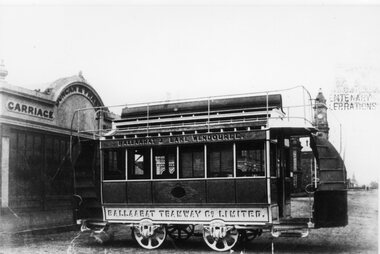 Ballarat Tramway Museum
Photograph - Black & White Photograph/s, 1887
... Black and White copy photograph of a State Library of South Australia SLSA B37169, of the Ballaarat Tramway Co horse tram pattern tramcar outside the factory or carriage works of Duncan and Fraser Adelaide. ...Collected by Alan Bradley from the State Library of South Australia early 1980's. Used in The Golden City and its Tramways - page 15. ...Yields information about the pattern tramcar, built by Duncan & Fraser in Adelaide with a view of the factory and the location behind. Shows the tramcar prior to the fitting of modesty panels.Black and White copy photograph of a State Library of South Australia SLSA B37169, of the Ballaarat Tramway Co horse tram pattern tramcar outside the factory or carriage works of Duncan and Fraser Adelaide. Has the Adelaide Town Hall in the background. Tram has the destination board (under the upper deck) "Ballaarat & Lake Wendouree". Modesty boards not fitted. Photo taken on building date - 1887. Collected by Alan Bradley from the State Library of South Australia early 1980's. Used in The Golden City and its Tramways - page 15.tramways, trams, horse tram, duncan fraser, adelaide -
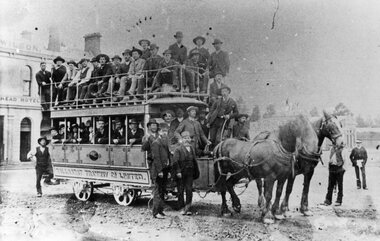 Ballarat Tramway Museum
Photograph - Black & White Photograph/s, 1887/8
... Black and White copy photograph of a State Library of South Australia SLSA B34585 of an well loaded, only male passengers on a Ballaarat Horse Tram - Grenville and Sturt St. ...Collected by Alan Bradley from the State Library of South Australia early 1980's. Used in The Golden City and its Tramways - page 28. ...Yields information about the early use of the Ballarat horse trams and condition of the roadway - lots of rocks on the road surface. Also shows an all male loading of passengers.Black and White copy photograph of a State Library of South Australia SLSA B34585 of an well loaded, only male passengers on a Ballaarat Horse Tram - Grenville and Sturt St. Two horse with many men, Wilson's Bucks Head Hotel in background. Condition of the road surface very rough - can't see the rails. Photo taken in early days, as no modesty boards on upper deck - say 1887. Possibly a trial trip. Collected by Alan Bradley from the State Library of South Australia early 1980's. Used in The Golden City and its Tramways - page 28.tramways, trams, sturt st, grenville st, bucks head hotel, horse tram -
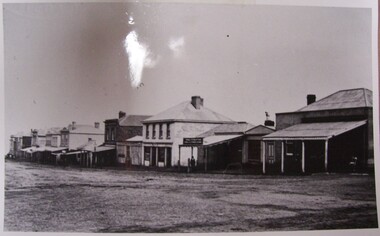 Glenelg Shire Council Cultural Collection
Photograph - Photograph - Julia Street, Portland, n.d
... Back: State Library of South Australia. Photographic Section Reproduction prohibited except with the permission of the copyright holder. ...Back: State Library of South Australia. Photographic Section Reproduction prohibited except with the permission of the copyright holder. ...Displayed at History House.Black and white photo. Looking west to east, Julia Street. First 2 buildings have verandahs and 1 chimney each. Double storey, stone building, 4 upstairs windows, 2 chimneys. Small building between 2 double storey buildings. Double storey blue stone with verandah. Small building. 4 double storey buildings.Front: Portland-Julia Street, Looking west to east. Back: State Library of South Australia. Photographic Section Reproduction prohibited except with the permission of the copyright holder. Order No. A/6493.street scene, portland street scene, photography -
 National Wool Museum
Book, Sail in the south
... "Sail in the south: a selection from the A D Edwardes Collection of shipping photographs in the State Library of South Australia"- Ronald Parsons,1975..."Sail in the south: a selection from the A D Edwardes Collection of shipping photographs in the State Library of South Australia"- Ronald Parsons,1975 Wool - transportation Export - wool Wool - transportation Export - wool W4887 656 PAR Sail in the south Book ..."Sail in the south: a selection from the A D Edwardes Collection of shipping photographs in the State Library of South Australia"- Ronald Parsons,1975W4887 656 PARwool - transportation export - wool, wool - transportation, export - wool -
 Glenelg Shire Council Cultural Collection
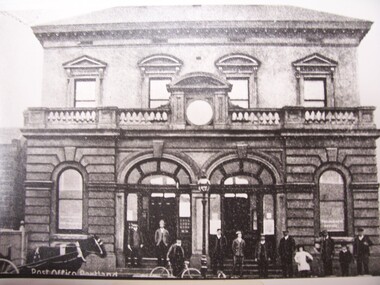
Photograph - Photograph - Post Office, Portland, n.d
... Back: B21766/98 (pencil, upper left). State Library of South Australia Photographic Section. Order No. ...Back: B21766/98 (pencil, upper left). State Library of South Australia Photographic Section. Order No. ...Black and white reproductive photograph of earlier image. People standing in front of Post Office building - double storey bluestone with decorative stone balcony.Front: Post Office, Portland (on photograph original). Portland Post Office Cnr Bentinck & Cliff Streets c1900 (built 1991) (typed label, lower centre). Back: B21766/98 (pencil, upper left). State Library of South Australia Photographic Section. Order No. A16493 (stamp, centre).portland post office -
 Ballarat Tramway Museum
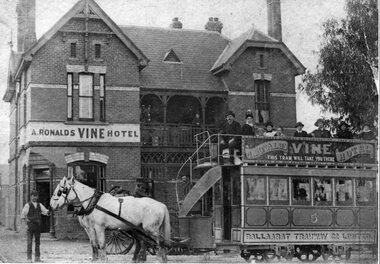
Photograph - Bromide of a b/w photograph and Black & White Photograph/s, 1890's
... Collected by Alan Bradley from the State Library of South Australia early 1980's. Used in The Golden City and its Tramways - page 29. 3792.1 - black and white photograph print of above - added 29/7/2007, ex Alan Bradley collection of photographs 5/2007....Collected by Alan Bradley from the State Library of South Australia early 1980's. Used in The Golden City and its Tramways - page 29. 3792.1 - black and white photograph print of above - added 29/7/2007, ex Alan Bradley collection of photographs 5/2007. ...Black and White scan or Bromide copy of a photograph of Ballaarat Tramway Company horse tram No. 5 outside the Vine Hotel in Macarthur St, Ballarat on the corner with Creswick Road. Has A. Ronald's Vine Hotel in the background with a Vine Hotel advertisement on the modesty board of the tramcar. Has a number of passengers, including ladies on the top deck and around the tramcar and hotel. Original of photograph from Harris House of Photography. Collected by Alan Bradley from the State Library of South Australia early 1980's. Used in The Golden City and its Tramways - page 29. 3792.1 - black and white photograph print of above - added 29/7/2007, ex Alan Bradley collection of photographs 5/2007.tramways, trams, horse trams, vine hotel, macarthur st, advertisements, tram 5 -
 Flagstaff Hill Maritime Museum and Village
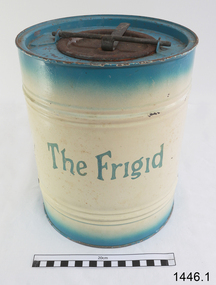
Freezer, circa 1930's
... (Reference: State Library of South Australia) ...(Reference: State Library of South Australia) A Simpson and Son was an early colonial business that has lasted well into the 20th century and the name Simpson is still associated with whitegoods. flagstaff hill warrnambool shipwrecked-coast flagstaff-hill flagstaff-hill-maritime-museum maritime-museum shipwreck-coast flagstaff-hill-maritime-village a. simpson & son limited manufacturer foundry freezer 2 quart freezer portable freezer kitchen appliance the frigid ice cream freezer ice cream maker 1930's Outside of freezer is printed in blue"The Frigid". ...This ice cream freezer, manufactured in South Australia in the 1930's, was advertised to "keep the contents of the cream compartment frozen for many hours". It was promoted for use at picnics to keep salads cool. Its design is very similar to other freezers of The Frigid name which were made in 1939; those freezers were all one colour whereas this one is blue around the top and bottom of the barrel and cream in the centre with blue/green lettering. The process of making ice cream was to pack the outer chamber full with a combination of 3 parts ice cubes of about 1 inch (2.cm) to one part coarse salt, then pour into the chamber about 1 cup of cold water. After this, the ingredients for ice cream or sorbet were poured into the inner chamber, then attach the lid and turn The Frigid freezer upside down for about 40 minutes or until the right consistency is reached. Advice as given to open the freezer every 20 minutes and stir around the contents that were frozen against the sides of the inner chamber. The ingredients for the ice cream could include cream, sugar, vanilla and eggs. The label on the box of The Frigid shows the address of A Simpson and Son to be at Pirie Street, Adelaide. This address was used as early as 1876 and later catalogues, 1931 - 1960 still show this address. Alfred Simpson and his family emigrated from England, arriving in South Australia in 1849. He had already completed his apprenticeship as a tinplate worker but he tried various other occupations, including trying out the gold mines in Victoria, before he established himself as a tinsmith in 1853. His products included many agricultural items. His son, Alfred Muller Simpson, joined the business when he turned 21. In the 1860 Simpson's products included 'explosion proof' safes. In the late 1880's A Simpson and Son manufactured munitions and mines for the war. At the time of Alfred's death in 1891, A Simpson and Son had the largest metal manufacturing plant in Australia. From 1898 the company's reputation grew from the process of enamel plating with porcelain. During the First World War, Simpsons returned to the manufacture of munitions. Alfred M. Simpson's sons (Alfred Allen, known as Allen, and Fredrick Neighbour) joined the company when they finished their schooling. Allen was also associated with the Royal Geological Society over many years and when the CT Madigan surveyed Central Australia in 1929, the Simpson Desert was named in his honour. Cape Simpson in Antarctica is also named after him due to his assistance to Douglas Mawson. A new factory was opened at Dudley Park in the 1940s and the company began the manufacture of whitegoods. In 1963 A. Simpson and Son merged with Pope Industries to form Simpson Pope Holdings. Alfred Simpson became chairman of the board of Simpson Pope Holdings. The Simpson brand, now owned by Electrolux, continues to produce a variety of household appliances. (Reference: State Library of South Australia) A Simpson and Son was an early colonial business that has lasted well into the 20th century and the name Simpson is still associated with whitegoods. Freezer, 2 quart (1.8 litre) capacity, made by A Simpson and Son Ltd, marked "The Frigid". Cylinder shaped, constructed from enamelled sheet metal, has two catches one on the base and one on top. Inner cylinder for holding contents for freezing. Slightly rusted. Freezer is inside original cardboard box with yellow label showing manufacturer details. Circa 1930'sOutside of freezer is printed in blue"The Frigid". Box includes "THE "FRIGID" FREEZER" and branded "S & S" inside a circle.flagstaff hill, warrnambool, shipwrecked-coast, flagstaff-hill, flagstaff-hill-maritime-museum, maritime-museum, shipwreck-coast, flagstaff-hill-maritime-village, a. simpson & son limited, manufacturer, foundry, freezer, 2 quart freezer, portable freezer, kitchen appliance, the frigid, ice cream freezer, ice cream maker 1930's -
 Flagstaff Hill Maritime Museum and Village
Photograph - Vessels, Sailing Ships, Circa 1910 - 1913
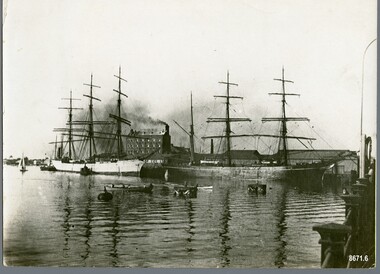
... It has been identified as the "Dimsdale" by the original owner of this photograph and by the website "Photos of the Past" which have an identical copy of the photo, however the State Library of South Australia (who also have an identical copy of the photograph) have identified the date of the photograph as 1910 and the ship as the "Ainsdale". ...It has been identified as the "Dimsdale" by the original owner of this photograph and by the website "Photos of the Past" which have an identical copy of the photo, however the State Library of South Australia (who also have an identical copy of the photograph) have identified the date of the photograph as 1910 and the ship as the "Ainsdale". ...This photograph was one of ten photographs donated to Flagstaff Hill Maritime Museum and Village by Fred Trewartha. Frederick John Fox Trewartha (Fred) was a well-known Warrnambool businessman. He was born in Beeac near Geelong in 1920 and came to Warrnambool with his family as a very young child. He was apprenticed to his father John, as a saddler and later opened his own shop on Raglan Parade. He then moved into working with tarpaulins and canvases for the trucking industry. Fred was keenly interested in photography (and was a member of the Warrnambool Cine Club), yachting and boat building. He kept his yacht moored at Port Fairy for many years and participated in sailing events locally and interstate. He also built boats with his sons. He had the opportunity to meet many older sailors and it's thought this photo (and others in the set) may have been given to him by one of these men. Fred Trewartha died in 2016 in Warrnambool. There is some conflict re the identity of the ship in the foreground of this photograph. It has been identified as the "Dimsdale" by the original owner of this photograph and by the website "Photos of the Past" which have an identical copy of the photo, however the State Library of South Australia (who also have an identical copy of the photograph) have identified the date of the photograph as 1910 and the ship as the "Ainsdale". The "Dimsdale" and the "Lobo" were recorded several times in the local shipping news as being docked at the Port of Adelaide, at the same time, during the years 1912 and 1913, whereas the "Ainsdale" wasn't in Adelaide very often but was recorded as coming in and out of the Port of Adelaide in the years 1915 and 1916. On February 25th 1916, the two ships (the "Ainsdale" and "Lobo") were both in the Port of Adelaide at the same time, but the "Ainsdale" was loading at Outer Harbor and the "Lobo" was discharging timber at Corporation Wharf. The "Ainsdale" was owned by the same firm that had owned the "Dimsdale". The Dimsdale was a three masted steel ship built in 1890 by C. J. Bigger of Londonderry. It became notorious when it struck the Wonga Shoal lighthouse near Port Adelaide on the night of 17th November 1912, destroying the structure and killing two lighthouse keepers. The accident was investigated by the Marine Board, the Coroner, the Police Court, the Admiralty Court and by the Criminal Courts of South Australia where the Captain (John Jones) was charged with manslaughter and found "not guilty". The Dimsdale was sold to a Norwegian firm and its name was changed to "Kwango". It sank in 1915 near the Magdalen Islands in the Gulf of St. Lawrence. The "Lobo" was a well known "windjammer" trading from the Port of Adelaide to other parts of the world. For a number of years it was employed in the New Zealand and Tasmanian services, after which it made several voyages to North America. It was an iron barque of 945 tons, built at Sunderland in 1877 by Osbourne, Graham and Company. On October 18th 1916, the Lobo (owned by Walter and Morris, timber merchants) was on a voyage from Parapato (Mozambique) to New York with a cargo of mango bark and ebony, when it struck rocks and ran aground 30 miles east of the Angoche River in Portuguese East Africa. A detailed account of the incident, written by Mrs Murchison (the Captains wife who was on board with her two year old son) was published in the Adelaide newspaper "The Mail" on Saturday 9th December 1916. She, and several of the crew were put in a boat early in the morning and sent away from the wreck. Several hours later, they were joined by Captain Murchison and the remainder of the crew. They were in their small open boats for several hours before landing on a small uninhabited island where they remained for several days before being picked up by another vessel and taken back to Parapato. The captain was able to obtain a position on a steamer which took him and his wife and child back to England.This photograph is significant as a record of the world wide mercantile trade Australia was engaged in at the end of the nineteenth century and beginning of the twentieth century and as a record of the dangers faced by the crews of these ships.A black and white photograph showing two large sailing ships moored at a dock. There are industrial buildings in the background (one has smoke coming from its chimney) and several smaller craft (a rowing boat, two small boats that may be tugs and a little yacht) at the side of the ships. Pylons can be seen in the water and a metal fence is in the bottom right corner. On the back of the photo the words "Ship Dimsdale" and "Bk Lobo" are written diagonally across the top left corner in pencil. A beige paper label has been attached to the top right corner with the words "Dimsdale at Port Adelaide" and "Port Adelaide Historical Society may be interested" written in black ballpoint pen."Ship Dimsdale" / "Bk Lobo" ""Dimsdale" / at Port Adelaide" "- Port Adelaide Historical /Society may be / interested"warrnambool, dimsdale, lobo, barque lobo, port of adelaide, kwango, wonga shoal lighthouse, fred trewartha, ainsdale, frederick john fox trewartha, captain john jones, windjammer, iron barque, parapato -
 Flagstaff Hill Maritime Museum and Village
Book - Birthday Book, Raphael Tuck & Sons et al, The Dickens Birthday Book, 1901-1911
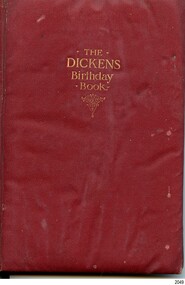
... Australia, established in 1891. His works included local scenery, architecture, and the interiors of historic buildings. Many of his pieces were bequeathed to the State Library of New South Wales. ...Australia, established in 1891. His works included local scenery, architecture, and the interiors of historic buildings. Many of his pieces were bequeathed to the State Library of New South Wales. ...Birthday Books are personal record books for names and birth dates of friends and relatives. This book includes a quote from Charles Dickens for each day of the year. The books were published in many editions, with different publishers, illustrators, covers and designs. This Dickens Birthday book was presented as a gift to fifteen-year-old Clara Skirrow on January 19th 1911, by Mr and Mrs B Watson, perhaps the 'Benji Watson' in the book, whose birthday was July 1st, 1887. The entries in the book include several with the surnames Watson and Skirrow. Interestingly, names are entered in various writing styles, perhaps because each entry was written by the person of that name, similar to an autograph book. Curiously, there are two entries for Connie Watson, one in brackets on March 16th, the other on March 23rd, without brackets. The artist, Pilford Fletcher Watson (1892-1907), was born in London. He moved to Sydney, where he became a prominent and well-established artist and a founding member of the Academy of Arts, Australia, established in 1891. His works included local scenery, architecture, and the interiors of historic buildings. Many of his pieces were bequeathed to the State Library of New South Wales. The firm, Raphael Tuck & Sons Ltd, was a printer and publisher that operated in London from 1866 to 1960. Its logo was the artist's easel, palette and brush. The firm that specialised in greeting cards and produced puzzles. It also became the world’s largest postcard publisher. In 1960, the firm amalgamated with others to become the British Printing Corporation. The fly page states that Ralph Tuck & Sons, Ltd. was the publisher to Their Majesties, the King and Queen, and Their Royal Highnesses, the Prince and Princess of Wales. This would suggest that this book was published from 1901 to 1910, when King Edward VII and Queen Alexandra, and Prince George and his wife Princess Mary were permitted to use these titles. NAMES LISTED IN THE BIRTHDAY BOOK (the museum has photographs of every entry in the book, which are available on enquiry): - January 1 Mrs J (or S) Watson January 11 Wilfred Skirrow, 1904 January 16 Elsie Watson, 1897 January 17 Elsie Hartley, 23/06/2012 [error?] January 21 Frances Victoria Haieck January 29 Annie Skirrow, 1884 February 14 Willie Illingworth February 17 Bessie Watson February 19 Mrs Butterfield, 22 Apperley Rd, Idle [UK] February 27 William Ernest Futter ? March 13 Carrie Barker March 16 Connie Watson March 19 Hilda Graham March 20 Mrs W. Illingworth March 23 Connie Watson April 5 Mrs Ruth Ann Skirrow April 6 William Dickinson Goldsbrough April 11 Norman Goldsbrough April 16 May Jessen April 19 Mrs A Dixon April 20 Mrs S Watson April 23 John Fred Stansfield, 1912 April 24 Reginald Goldsbrough May 12 Bertha Ellis May 18 Gladys McInnes May 28 Mrs Arthur Watson June 3 Jack Watson, 1910 June 10 Mr James Watmough June 18 Miss Hilda Hodgson, 1895 June 26 Sarah Atkinson, 1894 June 30 Mary A Bannister, 1896 July 1 Benji Watson, 1887 July 1 Ester Watmough, 1896 July 2 Clara Skirrow, 1896 July 2 Aunt Jinni July 2 Aunt Hannah July 10 Ellen Gertrude Connolly July 11 Violet Mathieson July 23 Hady Rogers July 26 Sarah Atkinson August 2 Allan Watson August 3 George Skirrow August 6 Thomas Skirrow August 6 Gladys Patten August 8 John Waite, 1909 August 21 Lilian Pattison, 1909 August 25 Ethel Watson, 1889 August 25 Evellyn Goldsbrough September 4 Miss Frances Barker September 12 Ernest Hartley, 1888 September 14 Harry Stansfield, 1895 September 20 Harry Padgett September 25 Leslie Watson September 26 Florrie Wise, 1896 September 27 Dorothy Watson, 1909 October 1 Madge Ferrier October 3 Elizabeth Padgett, 1896 October 5 Violet Altridge, 1895 October 13 Elsie Hodgson, 1893 October 18 Arthur Watson October 21 Emily Bradshaw November 14 Mr A Dixon December 27 Laura Hartley, 1890 December 29 Arther Skirrow, 1894 December 29 Dolly GrahamThis early 20th-century Birthday Book is significant for containing quotes by the famous writer Charles Dickens. It is also connected to the popular and prolific publisher and printer, Raphael Tuck & Sons Ltd, and the renowned illustrator and artist, Pilford Fletcher Watson. Ownership of a rare and beautifully presented book like this indicates the value placed on keeping records of family and friends, and remembering their birthdays, in the early 1900s. The book is highly significant for the entries of local family names, some with birth dates. Book: small book with padded maroon leather hard cover and embossed with gold text on cover and spine; cover also has a gold motif. The pages include coloured illustrations, sketches, and lines for personal entries. The first pages are about Charles Dickens. Title: The Dickens Birthday Book, with six illustrations in Colour by P. Fletcher-Watson Publisher: Raphael Tuck & Sons Ltd, Britain Printed in England 1901-1910 Artist: P. Fletcher-Watson This padded red leather hardcover book has embossed gold text on the front cover and spine. The six colour illustrations throughout the book were by artist P. Fletcher-Watson; one is a portrait of Dickens. Each day has a quote from Charles Dickens' works and blank lines below. The drawing on the fly page depicts a stone building with side pillars and a logo in the centre of the horizontal beam. It has a gift inscription for Clara Skirrow on January 19th, 1911. There are handwritten entries under many of the dates, some include years that range from 1884 to 1912, and one includes an address in the U.K.. Embossed on cover and spine: “The DICKENS Birthday Book” Handwritten in black ink: "From Mr & Mrs B. Watson / To Clara Skirrow / With Best wishes / January 19th 1911" Illustration on fly page: Logo [artist's palette, brush and easel] Publisher information: “Raphael Tuck & Sons Ltd, London, Paris, Berlin, New York, Montreal,” “Publishers to their Majesties the King and Queen, and T.R.H. the Prince and Princess of Wales” “Printed in England” Handwritten entries with names, some dates, and one address. flagstaff hill, flagstaff hill maritime museum and village, warrnambool, maritime museum, maritime village, great ocean road, shipwreck coast, birthday book, p. fletcher-watson, raphael tuck & sons ltd, 1901-1910, illustrated, 19-01-1911, mr & mrs b. watson, clara skirrow, red cover, british printing corporation, king and queen and trh prince and princess, king edward vii and queen alexandra, antique book, rare book, atkinson, bannister, barker, bradshaw, butterfield, connolly, dixon, ellis, ferrier, futter, goldsbrough, graham, hartley, hodgson, illingworth, jessen, mathieson, mcinnes, padgett, patten, pattison, rogers, stansfield, waite, watmough, watson, wise, dickens birthday book, charles dickens, dickens quotes, skirrow -
 Federation University Historical Collection
Book, Art Decoration Ornaments
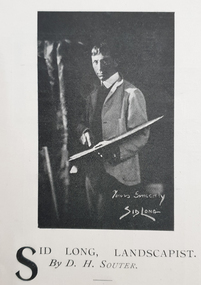
... ballarat technical art school ballarat technical art school library bank of australasia mount kosciusko siry henry parkes pyrmont bridge maori ancient egypt julian ashton st andrew'e cathedral sydney edmond thomas blacket sydney university comisariat stores circular quay the rocks w. lister-lister sydney domestic architecture james barnet john horbury hunt sidney long maori art wall decoratoni paperhangings australian stained glass art and architecture stamped metalwork w.c. piguenit australian architecture rose bay convent chapel australian posters pottery cyril blacket bookbinding new south wales state library architecture oxford st sydney'tom roberts repousse sydney harbour bridge john longstaff women painters the great pyramid of egypt skyscraper comes to new south wales melbourne hospital plans governor bligh electric illumination Black cloth covered book with leather spine. ...Black cloth covered book with leather spine. Colour illustrationsballarat technical art school, ballarat technical art school library, bank of australasia, mount kosciusko, siry henry parkes, pyrmont bridge, maori, ancient egypt, julian ashton, st andrew'e cathedral sydney, edmond thomas blacket, sydney university, comisariat stores circular quay, the rocks, w. lister-lister, sydney domestic architecture, james barnet, john horbury hunt, sidney long, maori art, wall decoratoni, paperhangings, australian stained glass, art and architecture, stamped metalwork, w.c. piguenit, australian architecture, rose bay convent chapel, australian posters, pottery, cyril blacket, bookbinding, new south wales state library architecture, oxford st sydney'tom roberts, repousse, sydney harbour bridge, john longstaff, women painters, the great pyramid of egypt, skyscraper comes to new south wales, melbourne hospital plans, governor bligh, electric illumination -
 Federation University Historical Collection
Letter, Ballarat School of Mines Correspondence, 1895, 1895
... South Central Gold Mining Company...Mining...Geelong Technical College...Geelong Technical School...State Library of Victoria...Library of Victoria...E.F. Pittman...Australian Museum...Alfred Meller...E. Whatman...University of Sydney...Richard Benham...Art Gallery of South Australia...Hornsby Ballarat School of Mines letter card J.A> Bickford Daylesford South Central Gold Mining Company Mining Geelong Technical College Geelong Technical School State Library of Victoria Library of Victoria E.F. Pittman Australian ...A number of letters clipped together with a brass split in. * Rock Specimen from J. Hornsby, Clunes * Bendigo School of Mines Letterhead from G. A. Thomas * J.A. Bickford, Daylesford * Geelong Technical College * Library of Victoria * Australian Museum Letterhead from S. Sinclair * University of Sydney Letterhead from H.L. Barff, Librarian * Library, Museum and Art Gallery of South Australia letterhead * Library, Museum and National Gallery and Victoria * Central Gold Mining Company by John Dunlop * SMB Students asking the Council to strenuously attempt to retain the services of Professor Krause ( Signed by about 70 students) * SMB staffmembers asking the Council to strenuously attempt to retain the services of Professor Krause ( Signed by Dawbarn, Dawson, Daniel Walker. W.E. Bennett, Kerr, Henry J. Hall) * Correspondence from Ferdinand Krause * Telegram from R.T. Vale * Queensland Museum letterhead * Stawell Technical College and School of Mines from W. Matthews j. hornsby, ballarat school of mines, letter card, j.a> bickford, daylesford, south central gold mining company, mining, geelong technical college, geelong technical school, state library of victoria, library of victoria, e.f. pittman, australian museum, alfred meller, e. whatman, university of sydney, richard benham, art gallery of south australia, national gallery of victoria, j.j. lanigan, ferdinand krause, j. flegeltaub, william reid, j.h. crittenden, james gibson, c.j. sayle, f.h. hollway, theo willaims, j. sutherland, p. flegeltaub, maurice hamburger, s. marrow, f. kittelty, a. don, a. bell, james a. gilchrist, j. ronaldson, e. stuck, w.j. whyte, ernest leggo, percy learmonth, kaboonga mining company, smeaton, g. alec thornsol, alex gilfillan, geologist, thomas j. hart, alfred hodgkinson, george t. clarke, a.w. pratt, walter fieder, w. macdonald, queensland museum, r.h. walcoth, stawell school of mines, stawell technical college, stephen richards, martin ford, b. herold, george w. gallagher, broomfield, j. money, smythesdale, john law, great western, mordaunt hall, eight hour procession, model locomotive, arthur kildahl, g. seymour, mt lyell, e.h. parry, d. grassy, aurora gold mining co, j. broomfield, burbury, dawburn, eustace m. weston, english and austrakuab copper co, martin gardiner, william little, david gracey -
 Flagstaff Hill Maritime Museum and Village
Book, Australia in the War of 1939-1945 South-West Pacific Area-First Year Kokoda to Wau
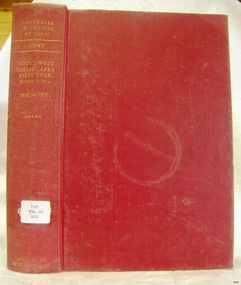
... library and its significance is enhanced by the survival of an original collection of many volumes. The Warrnambool Mechanics' Institute’s publication collection is of both local and state significance. warrnambool shipwrecked-coast flagstaff-hill flagstaff-hill-maritime-museum maritime-museum shipwreck-coast flagstaff-hill-maritime-village shipwrecked-artefact book pattison collection warrnambool library warrnambool mechanics’ institute ralph eric pattison corangamite regional library service warrnambool city librarian mechanics’ institute library victorian library board warrnambool books and records warrnambool children’s library great ocean road Australia in the War of 1939-1945 South-West Pacific Area-First Year Kokoda to Wau Australia in the War of 1939-1945 Australian War Memorial Dudley McCarthy Label on spine cover with typed text PAT 994.04 AUS Pastedown front endpaper has sticker from Warrnambool Public Library Front loose endpaper has a sticker from Corangamite Regional Library Service Australia in the War of 1939-1945 South-West Pacific Area-First Year Kokoda to Wau This volume describes the fighting on land in the South-West Pacific from mid -1942 to March 1943 Author: Dudley McCarthy Publisher: Australian War Memorial Date: 1959 Australia in the War of 1939-1945 South-West Pacific Area-First Year Kokoda to Wau Book ...This book is from the ‘Pattison Collection’, a collection of books and records that was originally owned by the Warrnambool Mechanics’ Institute, which was founded in Warrnambool in 1853. By 1886 the Warrnambool Mechanics’ Institute (WMI) had grown to have a Library, Museum and Fine Arts Gallery, with a collection of “… choice productions of art, and valuable specimens in almost every branch and many wonderful national curiosities are now to be seen there, including historic relics of the town and district.” It later included a School of Design. Although it was very well patronised, the lack of financial support led the WMI in 1911 to ask the City Council to take it over. In 1935 Ralph Pattison was appointed as City Librarian to establish and organise the Warrnambool Library as it was then called. When the WMI building was pulled down in 1963 a new civic building was erected on the site and the new Warrnambool Library, on behalf of the City Council, took over all the holdings of the WMI. At this time some of the items were separated and identified as the ‘Pattison Collection’, named after Ralph Pattison. Eventually the components of the WMI were distributed from the Warrnambool Library to various places, including the Art Gallery, Historical Society and Flagstaff Hill. Later some were even distributed to other regional branches of Corangamite Regional Library and passed to and fro. It is difficult now to trace just where all of the items have ended up. The books at Flagstaff Hill Maritime Village generally display stamps and markings from Pattison as well as a variety of other institutions including the Mechanics’ Institute itself. RALPH ERIC PATTISON Ralph Eric Pattison was born in Rockhampton, Queensland, in 1891. He married Maude Swan from Warrnambool in 1920 and they set up home in Warrnambool. In 1935 Pattison accepted a position as City Librarian for the Warrnambool City Council. His huge challenge was to make a functional library within two rooms of the Mechanics’ Institute. He tirelessly cleaned, cleared and sorted a disarrayed collection of old books, jars of preserved specimens and other items reserved for exhibition in the city’s museum. He developed and updated the library with a wide variety of books for all tastes, including reference books for students; a difficult task to fulfil during the years following the Depression. He converted all of the lower area of the building into a library, reference room and reading room for members and the public. The books were sorted and stored using a cataloguing and card index system that he had developed himself. He also prepared the upper floor of the building and established the Art Gallery and later the Museum, a place to exhibit the many old relics that had been stored for years for this purpose. One of the treasures he found was a beautiful ancient clock, which he repaired, restored and enjoyed using in his office during the years of his service there. Ralph Pattison was described as “a meticulous gentleman whose punctuality, floorless courtesy and distinctive neat dress were hallmarks of his character, and ‘his’ clock controlled his daily routine, and his opening and closing of the library’s large heavy doors to the minute.” Pattison took leave during 1942 to 1945 to serve in the Royal Australian Navy, Volunteer Reserve as Lieutenant. A few years later he converted one of the Museum’s rooms into a Children’s Library, stocking it with suitable books for the younger generation. This was an instant success. In the 1950’s he had the honour of being appointed to the Victorian Library Board and received more inspiration from the monthly conferences in Melbourne. He was sadly retired in 1959 after over 23 years of service, due to the fact that he had gone over the working age of council officers. However he continued to take a very keen interest in the continual development of the Library until his death in 1969. The Pattison Collection, along with other items at Flagstaff Hill Maritime Village, was originally part of the Warrnambool Mechanics' Institute’s collection. The Warrnambool Mechanics’ Institute Collection is primarily significant in its totality, rather than for the individual objects it contains. Its contents are highly representative of the development of Mechanics' Institute libraries across Australia, particularly Victoria. A diversity of publications and themes has been amassed, and these provide clues to our understanding of the nature of and changes in the reading habits of Victorians from the 1850s to the middle of the 20th century. The collection also highlights the Warrnambool community’s commitment to the Mechanics’ Institute, reading, literacy and learning in the regions, and proves that access to knowledge was not impeded by distance. These items help to provide a more complete picture of our community’s ideals and aspirations. The Warrnambool Mechanics Institute book collection has historical and social significance for its strong association with the Mechanics Institute movement and the important role it played in the intellectual, cultural and social development of people throughout the latter part of the nineteenth century and the early twentieth century. The collection of books is a rare example of an early lending library and its significance is enhanced by the survival of an original collection of many volumes. The Warrnambool Mechanics' Institute’s publication collection is of both local and state significance. Australia in the War of 1939-1945 South-West Pacific Area-First Year Kokoda to Wau This volume describes the fighting on land in the South-West Pacific from mid -1942 to March 1943 Author: Dudley McCarthy Publisher: Australian War Memorial Date: 1959Label on spine cover with typed text PAT 994.04 AUS Pastedown front endpaper has sticker from Warrnambool Public Library Front loose endpaper has a sticker from Corangamite Regional Library Servicewarrnambool, shipwrecked-coast, flagstaff-hill, flagstaff-hill-maritime-museum, maritime-museum, shipwreck-coast, flagstaff-hill-maritime-village, shipwrecked-artefact, book, pattison collection, warrnambool library, warrnambool mechanics’ institute, ralph eric pattison, corangamite regional library service, warrnambool city librarian, mechanics’ institute library, victorian library board, warrnambool books and records, warrnambool children’s library, great ocean road, australia in the war of 1939-1945 south-west pacific area-first year kokoda to wau, australia in the war of 1939-1945, australian war memorial, dudley mccarthy -
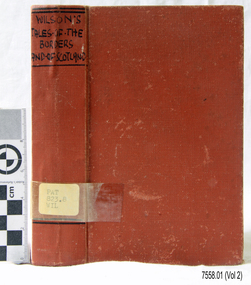 Flagstaff Hill Maritime Museum and Village
Book, Wilsons Tales of the Borders and of Scotland Vol 2
... South Wales. The similarities and differences between the small number of collections that have survived can provide further insights into how the people of Victoria in general, and Warrnambool in particular, constructed a civic culture of adult learning to foster an informed citizenry. The Warrnambool Mechanics' Institute publication collection is of both local and state significance. The Warrnambool Mechanics' Institute Collection is primarily significant in its totality, rather than for the individual objects it contains. Its contents are highly representative of the development of Mechanics' Institute libraries across Australia ...This item is from the ‘Pattison Collection’, a collection of books and records that was originally owned by the Warrnambool Mechanics’ Institute, which was founded in Warrnambool in 1853. By 1886 the Warrnambool Mechanics’ Institute (WMI) had grown to have a Library, Museum and Fine Arts Gallery, with a collection of “… choice productions of art, and valuable specimens in almost every branch and many wonderful national curiosities are now to be seen there, including historic relics of the town and district.” It later included a School of Design. Although it was very well patronised, the lack of financial support led the WMI in 1911 to ask the City Council to take it over. In 1935 Ralph Pattison was appointed as City Librarian to establish and organise the Warrnambool Library as it was then called. When the WMI building was pulled down in 1963 a new civic building was erected on the site and the new Warrnambool Library, on behalf of the City Council, took over all the holdings of the WMI. At this time some of the items were separated and identified as the ‘Pattison Collection’, named after Ralph Pattison. Eventually the components of the WMI were distributed from the Warrnambool Library to various places, including the Art Gallery, Historical Society and Flagstaff Hill. Later some were even distributed to other regional branches of Corangamite Regional Library and passed to and fro. It is difficult now to trace just where all of the items have ended up. The books at Flagstaff Hill Maritime Village generally display stamps and markings from Pattison as well as a variety of other institutions including the Mechanics’ Institute itself. RALPH ERIC PATTISON Ralph Eric Pattison was born in Rockhampton, Queensland, in 1891. He married Maude Swan from Warrnambool in 1920 and they set up home in Warrnambool. In 1935 Pattison accepted a position as City Librarian for the Warrnambool City Council. His huge challenge was to make a functional library within two rooms of the Mechanics’ Institute. He tirelessly cleaned, cleared and sorted a disarrayed collection of old books, jars of preserved specimens and other items reserved for exhibition in the city’s museum. He developed and updated the library with a wide variety of books for all tastes, including reference books for students; a difficult task to fulfil during the years following the Depression. He converted all of the lower area of the building into a library, reference room and reading room for members and the public. The books were sorted and stored using a cataloguing and card index system that he had developed himself. He also prepared the upper floor of the building and established the Art Gallery and later the Museum, a place to exhibit the many old relics that had been stored for years for this purpose. One of the treasures he found was a beautiful ancient clock, which he repaired, restored and enjoyed using in his office during the years of his service there. Ralph Pattison was described as “a meticulous gentleman whose punctuality, floorless courtesy and distinctive neat dress were hallmarks of his character, and ‘his’ clock controlled his daily routine, and his opening and closing of the library’s large heavy doors to the minute.” Pattison took leave during 1942 to 1942 to serve in the Royal Australian Navy, Volunteer Reserve as Lieutenant. A few years later he converted one of the Museum’s rooms into a Children’s Library, stocking it with suitable books for the younger generation. This was an instant success. In the 1950’s he had the honour of being appointed to the Victorian Library Board and received more inspiration from the monthly conferences in Melbourne. He was sadly retired in 1959 after over 23 years of service, due to the fact that he had gone over the working age of council officers. However he continued to take a very keen interest in the continual development of the Library until his death in 1969. WARRNAMBOOL PUBLIC LIBRARY The Warrnambool Mechanics’ Institute (WMI) was formed by a voluntary community group in 1863, within six years of Warrnambool’s beginnings, and its Reading Room opened in 1854. The WMI operated until 1963, at which time it was one of the oldest Mechanics’ Institutes in Victoria. Mechanics’ Institutes offered important services to the public including libraries, reading rooms and places to display and store collections of all sorts such as curiosities and local historical relics. In 1886 a Museum and Fine Arts Gallery were added to the WMI and by the beginning of the 20th century there was also a billiards room and a School of Art. By this time all Mechanics’ Institutes in country Victoria had museums attached. Over the years the Warrnambool Mechanics’ Institute Library was also known as the Warrnambool Public Library the Warrnambool Library and the Free Library. Early funding from the government was for the “Free Library”. The inscription in a book “Science of Man” was for the “Warrnambool Public Library”, donated by Joseph Archibald in 1899. Another inscription in the book “Catalogue of Plants Under Cultivation in the Melbourne Botanic Gardens 1 & 2, 1883” was presented to the “Warrnambool Library” and signed by the author W.R. Guilfoyle. In 1903 the Warrnambool Public Library decided to add a Juvenile Department to library and stock it with hundreds of books suitable for youth. In 1905 the Public Library committee decided to update the collection of books and added 100 new novels plus arrangements for the latest novels to be included as soon as they were available in Victoria. In July 1911 the Warrnambool Council took over the management of the Public Library, Art Gallery, Museum and Mechanics’ Institute and planned to double the size of the then-current building. In 1953, when Mr. R. Pattison was Public Librarian, the Warrnambool Public Library’s senior section 10,000 of the 13,000 books were fiction. The children’s section offered an additional 3,400 books. The library had the equivalent of one book per head of population and served around 33 percent of the reading population. The collection of books was made up of around 60 percent reference and 40 percent fiction. The library was lending 400 books per day. In 1963 the Warrnambool City Council allocated the site of the Mechanics’ Institute building, which included the Public Library, Museum and Art Gallery, for the new Municipal Offices and the Collections were dispersed until 1971. The Warrnambool Library took over the Mechanics’ Institute Library’s holdings on behalf of the Warrnambool City Council. Since the closure of the Warrnambool Mechanics’ Institute the exact location and composition of the original WMI books and items has become unclear. Other materials have been added to the collection, including items from Terang MI, Warrnambool Court House and Customs House. Many of the books have been identified as the Pattison Collection, named after the Librarian who catalogued and numbered the books during his time as Warrnambool Public Librarian in the time before the Mechanics’ Institute closed. It seems that when Warrnambool became part of the Corangamite Regional Library some of the books and materials went to its head office in Colac and then back to Warrnambool where they were stored at the Art Gallery for quite some time. Some then went to the Warrnambool Historical Society, some stayed at the Art Gallery and some were moved to Flagstaff Hill Maritime Village. The various stamps and labels on the books held at Flagstaff Hill show the variety of the collection’s distribution and origin. The books in the collection at Flagstaff Hill Maritime Village date from the 1850’s to the late 1950’s and include rare and valuable volumes. Many of the books are part of the “Pattison Collection” after the Warrnambool’s Public Librarian, Mr. R. Pattison. The Pattison Collection, along with other items at Flagstaff Hill Maritime Village, was originally part of the Warrnambool Mechanics' Institute’s collection. The Warrnambool Mechanics’ Institute Collection is primarily significant in its totality, rather than for the individual objects it contains. Its contents are highly representative of the development of Mechanics' Institute libraries across Australia, particularly Victoria. A diversity of publications and themes has been amassed, and these provide clues to our understanding of the nature of and changes in the reading habits of Victorians from the 1850s to the middle of the 20th century. The collection also highlights the Warrnambool community’s commitment to the Mechanics’ Institute, reading, literacy and learning in the regions, and proves that access to knowledge was not impeded by distance. These items help to provide a more complete picture of our community’s ideals and aspirations. The Warrnambool Mechanics Institute book collection has historical and social significance for its strong association with the Mechanics Institute movement and the important role it played in the intellectual, cultural and social development of people throughout the latter part of the nineteenth century and the early twentieth century. The collection of books is a rare example of an early lending library and its significance is enhanced by the survival of an original collection of many volumes. The Warrnambool Mechanics' Institute’s publication collection is of both local and state significance. The Warrnambool Mechanics' Institute Collection is primarily significant in its totality, rather than for the individual objects it contains. Its contents are highly representative of the development of Mechanics' Institute libraries across Australia, particularly Victoria. A diversity of publications and themes has been amassed, and these provide clues to our understanding of the nature of and changes in the reading habits of Victorians from the 1850s to the middle of the 20th century. The collection also highlights the Warrnambool community’s commitment to the Mechanics’ Institute, and to reading, literacy and learning in the regions, and proves that access to knowledge was not impeded by distance. These items help to provide a more complete picture of our community’s ideals and aspirations. As with many Mechanics' Institutes in Australia, the one which operated in Warrnambool was established and overseen for many years by key individuals associated with the development of the city itself. The WMI publication collection is historically significant because of its association with local people, places and the key historical themes in the development of Warrnambool of rural development, industry, farming, education, and community. The collection documents and illustrates the changing interests, focus and tastes of Victorians, especially those in regional cities. Generally the individual items in the collection are not particularly rare, as examples of all probably exist in other public collections in Victoria. It is primarily because there are so very few surviving Mechanics' Institute collections in Victoria, which lends this overall collection its significance. Many items in the WMI Collection have the potential to support further research, both as individual objects and through the collection in its entirety. This material is significant for its ability to assist in the interpretation of the history of the area and adds to the general understanding of the development of the township. Many components of the WMI publication collection complement and reinforce the Flagstaff Hill Maritime Museum Collection, the Warrnambool Art Gallery Collection, and that in the Warrnambool Historical Society, and also contribute to a clearer understanding of the original Warrnambool Mechanics' Institute collections. This will greatly enhance the appreciation of the few surviving Mechanics' Institute collections across Victoria, and also in New South Wales. The similarities and differences between the small number of collections that have survived can provide further insights into how the people of Victoria in general, and Warrnambool in particular, constructed a civic culture of adult learning to foster an informed citizenry. The Warrnambool Mechanics' Institute publication collection is of both local and state significance. The Warrnambool Mechanics' Institute Collection is primarily significant in its totality, rather than for the individual objects it contains. Its contents are highly representative of the development of Mechanics' Institute libraries across Australia, particularly Victoria. A diversity of publications and themes has been amassed, and these provide clues to our understanding of the nature of and changes in the reading habits of Victorians from the 1850s to the middle of the 20th century. The collection also highlights the Warrnambool community’s commitment to the Mechanics’ Institute, and to reading, literacy and learning in the regions, and proves that access to knowledge was not impeded by distance. These items help to provide a more complete picture of our community’s ideals and aspirations. As with many Mechanics' Institutes in Australia, the one which operated in Warrnambool was established and overseen for many years by key individuals associated with the development of the city itself. The WMI publication collection is historically significant because of its association with local people, places and the key historical themes in the development of Warrnambool of rural development, industry, farming, education, and community. The collection documents and illustrates the changing interests, focus and tastes of Victorians, especially those in regional cities. Generally the individual items in the collection are not particularly rare, as examples of all probably exist in other public collections in Victoria. It is primarily because there are so very few surviving Mechanics' Institute collections in Victoria, which lends this overall collection its significance. Many items in the WMI Collection have the potential to support further research, both as individual objects and through the collection in its entirety. This material is significant for its ability to assist in the interpretation of the history of the area and adds to the general understanding of the development of the township. Many components of the WMI publication collection complement and reinforce the Flagstaff Hill Maritime Museum Collection, the Warrnambool Art Gallery Collection, and that in the Warrnambool Historical Society, and also contribute to a clearer understanding of the original Warrnambool Mechanics' Institute collections. This will greatly enhance the appreciation of the few surviving Mechanics' Institute collections across Victoria, and also in New South Wales. The similarities and differences between the small number of collections that have survived can provide further insights into how the people of Victoria in general, and Warrnambool in particular, constructed a civic culture of adult learning to foster an informed citizenry. The Warrnambool Mechanics' Institute publication collection is of both local and state significance. (This Statement of Significance is quoted from the Significance Assessment : Warrnambool Mechanics’ Institute Book Collection at Flagstaff Hill Maritime Museum, February 2009, by Annette Welkamp, Cultural Connections, for Delise Oldfied, FHMV) References Juvenile Department in Warrnambool Public Library In August 1903 The Age newspaper reported in its Warrnambool news section that “With the object of discouraging boys from reading literature of the “penny dreadful” class, the committee of the local public library has decided to open a juvenile department and to stock it with hundreds of suitable books attractive to the youthful mind.” 100 new novels added to Warrnambool Public Library Shelves In November 1905 The Argue newspaper’s Warrnambool news section announced “The committee of the Public Library is bringing the collection of books more up to date. It has recently added 100 new novels to the shelves, and arrangements have been made for a supply of the latest novels immediately they arrive in the state.” Warrnambool Town Council takes over Mechanics’ Institute, Art Gallery, Public Library, Museum – and will double the building’s size In 1912 The Age reported in its Warrnambool news section “Considerable improvements are being effected by the town council in the most picturesque part of Liebig Street. Between the fire brigade station and the mechanics’ institute and art gallery a vacant block of land is being transformed a garden for carpet bedding and flowering plants. The council, which recently took over the control of the art gallery, public library, museum and mechanics’ institute, is doubling the size of the substantial stone building containing these institutions. The new building will contain a supper room for use in conjunction with functions in the town hall, adjoining, and a new reading room.” Mr Pattison, Public Librarian, says Library has a book per head of population In 1953 The Age reported an interview with the Public Librarian, Mr. R. Pattison, who said “Warrnambool has an insatiable thirst for reading. And its reading recipe contains a strong dash of fiction – 73 percent of it. Fiction makes up 10,000 of the 13,000 books in the senior section of the public library. That works out at a book per head of population. Warrnambool today is really book minded. This city has an almost insatiable thirst for knowledge as well as fiction. We’re lending 400 books a day. We supply 33 percent of the reading population of Warrnambool.” The reporter goes on to say “Warrnambool Public Library also has an ultra-modern children’s section of 3,400 books, open to every boy and girl attending school in Warrnambool. Mr Pattison hopes to show travel-talk films and install a radiogram in the children’s section “later on”. But it won’t disturb adult reading next door because the junior section is sound proof. “ Mechanics’ Institutes and Museums Mechanics’ Institutes were important sites for collecting in country Victoria … Warrnambool … all had museums attached to Mechanics’ Institutes before the end of the twentieth century” Warrnambool Mechanics’ Institute Ms Tierney said FHMV holds the collection of the Warrnambool Mechanics’ Institute in three different locations on its site. “The Mechanics’ Institute opened in 1871, was demolished in the 1960s and was one of the oldest in Victoria. “FHMV intends to create a new storage area and bring the collection together in one place which will greatly facilitate access and research. “The collection consists of books and archives dating from the 1850s to 1959s. “Some of the books are rare and valuable but it is unclear as to their relevance to the history of Warrnambool or Victoria,” Ms Tierney said. Warrnambool TAFE History South West TAFE has a long and proud history of providing technical and specialist education, with links back to the formation of the Mechanic’s Institute in 1853. Warrnambool Art Gallery’s History The Warrnambool Art Gallery began in 1886 when retired police officer Joseph Archibald opened its doors in a building behind the mechanics institute in Liebig Street. The Gallery began with an eclectic mix of artworks and museum curios. Before long Archibald mobilised public support and paid for a new gallery annex. Loans and grants allowed the Gallery collection to grow with significant early acquisitions by French, German, and Belgian artists, which were less expensive than British works. Despite its enthusiastic start the economic downturn of the 1890s brought the Collection to a halt. In 1910 the Council took control of the Mechanics Institute and ran the Gallery there until 1963 when the building was allocated for municipal offices. The Collection was dispersed on loan to galleries in Shepparton and Hamilton and not reunited until 1971. In 1986 the Gallery’s Centenary year, a permanent home was built next to the ‘Civic Green’ and named in memory of one its champions Sir Fletcher Jones O.B.E. 2016 Warrnibald Entries Joseph Archibald established the Warrnambool Museum and Art Gallery in 1886 while his son Jules Francois Archibald founded the Archibald Prize through his bequest of 1919. His aim was to foster portraiture, as well as support artists, and perpetuate the memory of great Australians. Wilsons Tales of the Borders and of Scotland Vol 2 Revised by Alexander Leigthon Publisher: William P Nimmo Label on spine has typed text PAT 823.8 WIL Front pastedown endpaper has sticker from Warrnambool Public Library Front loose endpaper has a stamp from Corangamite Regional Library Service warrnambool, shipwrecked-coast, flagstaff-hill, flagstaff-hill-maritime-museum, maritime-museum, shipwreck-coast, flagstaff-hill-maritime-village, shipwrecked-artefact, book, warrnambool mechanics’ institute, pattison collection, warrnambool library, ralph eric pattison, warrnambool city librarian, mechanics’ institute library, victorian library board, warrnambool books and records, warrnambool children’s library, wilsons tales of the borders and of scotland vol 2, alexander leigthon -
 Flagstaff Hill Maritime Museum and Village
Book - Captain James Cooks Voyages Including aditional Anthology of Explorers Journals, Captain James Cook, Captain Cook's Voyages Round The World, 1790
... Beddie was a prominent Australian librarian and bibliographer at the Mitchell Library in Sydney now the State Library of New South Wales. ...Beddie was a prominent Australian librarian and bibliographer at the Mitchell Library in Sydney now the State Library of New South Wales. ...This specific printing of Captain Cook's voyages is a fascinating piece of late 18th-century provincial book history. This is a rare 18th-century provincial English edition. In the definitive reference work for Cook collectors M. K. Beddie’s Bibliography of Captain James Cook this exact printing is catalogued and recognised globally as Beddie No. 44. It was issued as a multi-volume set, typically bound in three thick octavo volumes or sometimes split into four. Rather than just copying the standard London texts, this specific edition is an expansive compilation. It includes Cook's three major voyages alongside supplementary accounts of the era, such as Captain Furneaux’s journals, Commodore Phipps’s expedition to the North Pole and, notably, Governor Arthur Phillip’s historic voyage to Botany Bay and the establishment of the Port Jackson colony.Captain Cook's Voyages Round The World Author: Captain James Cook Editor: M. K. Beddie. Publisher: Matthew Brown, Newcastle Upon Tyne. (At Bible Shop the Fresh Market) Date: 1790 Brown plain leather hardcover badly spotted. The spine has a Library label with an inscription.non-fictionThis specific printing of Captain Cook's voyages is a fascinating piece of late 18th-century provincial book history. This is a rare 18th-century provincial English edition. In the definitive reference work for Cook collectors M. K. Beddie’s Bibliography of Captain James Cook this exact printing is catalogued and recognised globally as Beddie No. 44. It was issued as a multi-volume set, typically bound in three thick octavo volumes or sometimes split into four. Rather than just copying the standard London texts, this specific edition is an expansive compilation. It includes Cook's three major voyages alongside supplementary accounts of the era, such as Captain Furneaux’s journals, Commodore Phipps’s expedition to the North Pole and, notably, Governor Arthur Phillip’s historic voyage to Botany Bay and the establishment of the Port Jackson colony.flagstaff hill, warrnambool, shipwrecked coast, flagstaff hill maritime museum, maritime museum, shipwreck coast, flagstaff hill maritime village, great ocean road, book, pattison collection, warrnambool library, warrnambool mechanics’ institute, ralph eric pattison, corangamite regional library service, warrnambool city librarian, mechanics’ institute library, victorian library board, warrnambool books and records, warrnambool children’s library, captain cooks voyages round the world, james cook -
 Orbost & District Historical Society
photograph, H.M.S. Rattlesnake, leaving Port Essington 1846-1849 BY STANLEY, OWEN
... They produced a visual record of 19th century contact between Europeans and the indigenous people of Northern Australia and New Guinea in an album which contains the original of this copy. It is held in the Mitchell Library in Sydney." (ref. State Library New South...They produced a visual record of 19th century contact between Europeans and the indigenous people of Northern Australia and New Guinea in an album which contains the original of this copy. It is held in the Mitchell Library in Sydney." (ref. State Library New South ..."The marine Hydrographers of the British Admiralty wanted desperately to chart a safe passage through the Great Barrier Reef and the gap between the northern tip of Australia and Papua New Guinea, which would open up the new colony to the East Indies trade. They commissioned the Rattlesnake, a 28 gun frigate of the Royal Navy, whose captain was a keen amateur artist and whose name, Owen Stanley, was given to the mountain ranges of PNG. After the passage out, Stanley brought aboard Oswald Brierly, later to be the marine painter to Queen Victoria, and together these men made two voyages through the Great Barrier Reef, painting and sketching all the while. They produced a visual record of 19th century contact between Europeans and the indigenous people of Northern Australia and New Guinea in an album which contains the original of this copy. It is held in the Mitchell Library in Sydney." (ref. State Library New South Wales) Sir Oswald Brierly, a young marine artist, arrived in Sydney in 1842 on the yacht Wanderer. Settling at the whaling station of Boyd Town in Twofold Bay, he painted extensively and left a vivid account of the whaling life during the five years he spent there. However it was the open sea and adventure that lead Brierly to accept a position on the HMS Rattlesnake as shipboard artist. This item is associated with the anchor of the The Rattlesnake. This anchor is in the main street of Orbost in front of what was once the museum.This is a copy of a picture of the H.M.S. Rattlesnake at sea with a canoe of Aborigines rowing towards it.h.m.s.-rattlesnake brierly-oswald stanley-owen -
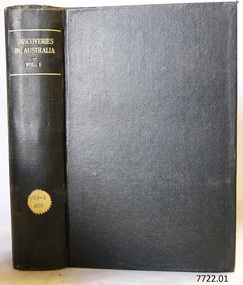 Flagstaff Hill Maritime Museum and Village
Book, Discoveries in Australia Vol 1
... South Wales. The similarities and differences between the small number of collections that have survived can provide further insights into how the people of Victoria in general, and Warrnambool in particular, constructed a civic culture of adult learning to foster an informed citizenry. The Warrnambool Mechanics' Institute publication collection is of both local and state significance. warrnambool shipwrecked-coast flagstaff-hill flagstaff-hill-maritime-museum maritime-museum shipwreck-coast flagstaff-hill-maritime-village shipwrecked-artefact great ocean road book warrnambool library warrnambool mechanics’ institute mechanics’ institute library victorian library board warrnambool books and records warrnambool children’s library discoveries in australia vol 1 captain owen stanley j lort stokes hms beagle Label on spine cover with typed text 919.4 AUS Pastedown front endpaper has sticker from Warrnambool Public Library Inside Fly paper has sticker from Warrnambool Mechanics Institute and Free Library Discoveries in Australia Vol 1 With an account of the Coasts and Rivers. ...WARRNAMBOOL'S MECHANICS' INSTITUTE Warrnambool's Mechanics' Institute (or Institution as it was sometimes called) was one of the earliest in Victoria. On 17th October 1853 a meeting was held where it was resolved to request the Lieutenant Governor of the Colony to grant land for the erection of a Mechanics' Institutes building. A committee was formed at the meeting and Richard Osburne chaired the first meeting of this committee. The land on the North West corner of Banyan and Merri Streets was granted but there were no funds to erect the building. The Formal Rights of the Warrnambool Mechanics' Institute's encompassed its aims and these were officially adopted in1859; "This Institution has for its object the diffusion of literary, scientific, and other useful knowledge amongst its members, excluding all controversial subjects, religious or political. These objects are sought to be obtained by means of a circulating library, a reading room, the establishment of classes, debates, and the occasional delivery of lectures on natural and experimental philosophy, mechanics, astronomy, chemistry, natural history, literature, and the useful and ornamental arts, particularly those which have a more immediate reference to the colony." The Warrnambool Mechanics' Institute opened its first reading room in November1884 in the National School building at the corner of Banyan and Timor Streets. The Institute was funded by member subscription, payable on a quarterly, half yearly or yearly basis. Samuel Hannaford, the Manager of the Warrnambool Bank of Australasia, was the first Honorary Secretary of the Mechanics' Institutes, and an early President and Vice-President. He also gave several of the early lectures in the Reading Room. Another early Secretary, Librarian and lecturer was Marmaduke Fisher, the teacher at the National School. Lecture topics included The Poets and Poetry of Ireland', 'The Birth and Development of the Earth', 'The Vertebrae - with Remarks on the pleasures resulting from the study of Natural History' and 'Architecture'. In 1856 the Reading Room was moved to James Hider's shop in Timor Street, and by 1864 it was located in the bookshop of Davies and Read. In the 1860's the Mechanics' Institute struggled as membership waned but in 1866, after a series of fund raising efforts, the committee was able to purchase land in Liebig Street, on a site then called Market Square, between the weighbridge and the fire station. A Mechanics' Institute building was opened at this site in August 1871. The following year four more rooms were added to the main Reading Room and in 1873 the Artisan School of Design was incorporated into the Institute. The same year Joseph Archibald established a Museum; however it deteriorated when he was transferred to Bendigo in 1877. In 1880, with Archibald's return to Warrnambool, the Museum was re-established, and in 1885 a new building was built at the back of the Institute to accommodate the re-created School of Design, the Art Gallery and the Museum. In 1887 the Museum section was moved to the former court house in Timor Street (for some time the walls of the building formed part of the TAFE cafeteria but all is now demolished)). In 1911 the Museum was transferred back to the original building and the management of the Mechanics' Institute was handed over to the Warrnambool City Council. The Museum and Art Gallery became one and housed many fine works of art, and the Library continued to grow. The building was well patronised, with records showing that at the beginning of the 20th century there were between 500 and 800 visitors. During World War One the monthly figures were in the thousands, with 3,400 people visiting in January 1915. The Museum was a much loved Institution in Warrnambool until the contents of the Museum and Art Gallery were removed to make room for the Warrnambool City Council Engineers' Department. The contents were stored but many of the items were scattered or lost. When the original building was demolished the site became occupied by the Civic Centre, which included the new City Library. (The library was temporarily located in the old Palais building in Koroit Street.) In the process of reorganisation the Collection was distributed amongst the community groups: -The new City Library took some of the historic books and some important documents, historic photographs and newspapers. -The Art Gallery kept the 19th Century art collection and some of the artefacts from the museum. -The Historic Society has some items -The State Museum has some items -Some items were destroyed -Flagstaff Hill Maritime Village has old newspapers, Government Gazettes, most of the Mechanics' Institute Library, ledgers and documents connected to the Mechanics' Institute Library, some framed and unframed art works and some photographs. The Warrnambool Mechanics' Institute Library book collection is deemed to be of great importance because it is one of the few collections in an almost intact state, and many of the books are now very rare and of great value WARRNAMBOOL PUBLIC LIBRARY The Warrnambool Mechanics’ Institute (WMI) was formed by a voluntary community group in 1863, within six years of Warrnambool’s beginnings, and its Reading Room opened in 1854. The WMI operated until 1963, at which time it was one of the oldest Mechanics’ Institutes in Victoria. Mechanics’ Institutes offered important services to the public including libraries, reading rooms and places to display and store collections of all sorts such as curiosities and local historical relics. In 1886 a Museum and Fine Arts Gallery were added to the WMI and by the beginning of the 20th century there was also a billiards room and a School of Art. By this time all Mechanics’ Institutes in country Victoria had museums attached. Over the years the Warrnambool Mechanics’ Institute Library was also known as the Warrnambool Public Library the Warrnambool Library and the Free Library. Early funding from the government was for the “Free Library”. The inscription in a book “Science of Man” was for the “Warrnambool Public Library”, donated by Joseph Archibald in 1899. Another inscription in the book “Catalogue of Plants Under Cultivation in the Melbourne Botanic Gardens 1 & 2, 1883” was presented to the “Warrnambool Library” and signed by the author W.R. Guilfoyle. In 1903 the Warrnambool Public Library decided to add a Juvenile Department to library and stock it with hundreds of books suitable for youth. In 1905 the Public Library committee decided to update the collection of books and added 100 new novels plus arrangements for the latest novels to be included as soon as they were available in Victoria. In July 1911 the Warrnambool Council took over the management of the Public Library, Art Gallery, Museum and Mechanics’ Institute and planned to double the size of the then-current building. In 1953, when Mr. R. Pattison was Public Librarian, the Warrnambool Public Library’s senior section 10,000 of the 13,000 books were fiction. The children’s section offered an additional 3,400 books. The library had the equivalent of one book per head of population and served around 33 percent of the reading population. The collection of books was made up of around 60 percent reference and 40 percent fiction. The library was lending 400 books per day. In 1963 the Warrnambool City Council allocated the site of the Mechanics’ Institute building, which included the Public Library, Museum and Art Gallery, for the new Municipal Offices and the Collections were dispersed until 1971. The Warrnambool Library took over the Mechanics’ Institute Library’s holdings on behalf of the Warrnambool City Council. Since the closure of the Warrnambool Mechanics’ Institute the exact location and composition of the original WMI books and items has become unclear. Other materials have been added to the collection, including items from Terang MI, Warrnambool Court House and Customs House. Many of the books have been identified as the Pattison Collection, named after the Librarian who catalogued and numbered the books during his time as Warrnambool Public Librarian in the time before the Mechanics’ Institute closed. It seems that when Warrnambool became part of the Corangamite Regional Library some of the books and materials went to its head office in Colac and then back to Warrnambool where they were stored at the Art Gallery for quite some time. Some then went to the Warrnambool Historical Society, some stayed at the Art Gallery and some were moved to Flagstaff Hill Maritime Village. The various stamps and labels on the books held at Flagstaff Hill show the variety of the collection’s distribution and origin. The books in the collection at Flagstaff Hill Maritime Village date from the 1850’s to the late 1950’s and include rare and valuable volumes. Many of the books are part of the “Pattison Collection” after the Warrnambool’s Public Librarian, Mr. R. Pattison. The Pattison Collection, along with other items at Flagstaff Hill Maritime Village, was originally part of the Warrnambool Mechanics' Institute’s collection. The Warrnambool Mechanics’ Institute Collection is primarily significant in its totality, rather than for the individual objects it contains. Its contents are highly representative of the development of Mechanics' Institute libraries across Australia, particularly Victoria. A diversity of publications and themes has been amassed, and these provide clues to our understanding of the nature of and changes in the reading habits of Victorians from the 1850s to the middle of the 20th century. The collection also highlights the Warrnambool community’s commitment to the Mechanics’ Institute, reading, literacy and learning in the regions, and proves that access to knowledge was not impeded by distance. These items help to provide a more complete picture of our community’s ideals and aspirations. The Warrnambool Mechanics Institute book collection has historical and social significance for its strong association with the Mechanics Institute movement and the important role it played in the intellectual, cultural and social development of people throughout the latter part of the nineteenth century and the early twentieth century. The collection of books is a rare example of an early lending library and its significance is enhanced by the survival of an original collection of many volumes. The Warrnambool Mechanics' Institute’s publication collection is of both local and state significance. The Warrnambool Mechanics' Institute Collection is primarily significant in its totality, rather than for the individual objects it contains. Its contents are highly representative of the development of Mechanics' Institute libraries across Australia, particularly Victoria. A diversity of publications and themes has been amassed, and these provide clues to our understanding of the nature of and changes in the reading habits of Victorians from the 1850s to the middle of the 20th century. The collection also highlights the Warrnambool community’s commitment to the Mechanics’ Institute, and to reading, literacy and learning in the regions, and proves that access to knowledge was not impeded by distance. These items help to provide a more complete picture of our community’s ideals and aspirations. As with many Mechanics' Institutes in Australia, the one which operated in Warrnambool was established and overseen for many years by key individuals associated with the development of the city itself. The WMI publication collection is historically significant because of its association with local people, places and the key historical themes in the development of Warrnambool of rural development, industry, farming, education, and community. The collection documents and illustrates the changing interests, focus and tastes of Victorians, especially those in regional cities. Generally the individual items in the collection are not particularly rare, as examples of all probably exist in other public collections in Victoria. It is primarily because there are so very few surviving Mechanics' Institute collections in Victoria, which lends this overall collection its significance. Many items in the WMI Collection have the potential to support further research, both as individual objects and through the collection in its entirety. This material is significant for its ability to assist in the interpretation of the history of the area and adds to the general understanding of the development of the township. Many components of the WMI publication collection complement and reinforce the Flagstaff Hill Maritime Museum Collection, the Warrnambool Art Gallery Collection, and that in the Warrnambool Historical Society, and also contribute to a clearer understanding of the original Warrnambool Mechanics' Institute collections. This will greatly enhance the appreciation of the few surviving Mechanics' Institute collections across Victoria, and also in New South Wales. The similarities and differences between the small number of collections that have survived can provide further insights into how the people of Victoria in general, and Warrnambool in particular, constructed a civic culture of adult learning to foster an informed citizenry. The Warrnambool Mechanics' Institute publication collection is of both local and state significance. Discoveries in Australia Vol 1 With an account of the Coasts and Rivers. Explored and Surveyed during the voyage of HMS Beagle. In the years 1837-38-39-40-41-42-43. A Narrative of Captain Owen Stanley's visits to the Islands in the Arafura Sea. Author: J Lort Stokes Publisher: T & W Boone Date: 1846 Label on spine cover with typed text 919.4 AUS Pastedown front endpaper has sticker from Warrnambool Public Library Inside Fly paper has sticker from Warrnambool Mechanics Institute and Free Librarywarrnambool, shipwrecked-coast, flagstaff-hill, flagstaff-hill-maritime-museum, maritime-museum, shipwreck-coast, flagstaff-hill-maritime-village, shipwrecked-artefact, great ocean road, book, warrnambool library, warrnambool mechanics’ institute, mechanics’ institute library, victorian library board, warrnambool books and records, warrnambool children’s library, discoveries in australia vol 1, captain owen stanley, j lort stokes, hms beagle -
 Flagstaff Hill Maritime Museum and Village
Book, Discoveries in Australia Vol 2
... South Wales. The similarities and differences between the small number of collections that have survived can provide further insights into how the people of Victoria in general, and Warrnambool in particular, constructed a civic culture of adult learning to foster an informed citizenry. The Warrnambool Mechanics' Institute publication collection is of both local and state significance. warrnambool shipwrecked-coast flagstaff-hill flagstaff-hill-maritime-museum maritime-museum shipwreck-coast flagstaff-hill-maritime-village shipwrecked-artefact great ocean road book warrnambool library warrnambool mechanics’ institute mechanics’ institute library victorian library board warrnambool books and records warrnambool children’s library discoveries in australia vol 2 j lort stokes Label on spine cover with typed text 919.4 AUS Pastedown front endpaper has sticker from Warrnambool Public Library Inside Front loose endpaper has a sticker from Warrnambool Mechanics Institute Discoveries in Australia Vol 2 With an account of the Coasts and Rivers. ...WARRNAMBOOL'S MECHANICS' INSTITUTE Warrnambool's Mechanics' Institute (or Institution as it was sometimes called) was one of the earliest in Victoria. On 17th October 1853 a meeting was held where it was resolved to request the Lieutenant Governor of the Colony to grant land for the erection of a Mechanics' Institutes building. A committee was formed at the meeting and Richard Osburne chaired the first meeting of this committee. The land on the North West corner of Banyan and Merri Streets was granted but there were no funds to erect the building. The Formal Rights of the Warrnambool Mechanics' Institute's encompassed its aims and these were officially adopted in1859; "This Institution has for its object the diffusion of literary, scientific, and other useful knowledge amongst its members, excluding all controversial subjects, religious or political. These objects are sought to be obtained by means of a circulating library, a reading room, the establishment of classes, debates, and the occasional delivery of lectures on natural and experimental philosophy, mechanics, astronomy, chemistry, natural history, literature, and the useful and ornamental arts, particularly those which have a more immediate reference to the colony." The Warrnambool Mechanics' Institute opened its first reading room in November1884 in the National School building at the corner of Banyan and Timor Streets. The Institute was funded by member subscription, payable on a quarterly, half yearly or yearly basis. Samuel Hannaford, the Manager of the Warrnambool Bank of Australasia, was the first Honorary Secretary of the Mechanics' Institutes, and an early President and Vice-President. He also gave several of the early lectures in the Reading Room. Another early Secretary, Librarian and lecturer was Marmaduke Fisher, the teacher at the National School. Lecture topics included The Poets and Poetry of Ireland', 'The Birth and Development of the Earth', 'The Vertebrae - with Remarks on the pleasures resulting from the study of Natural History' and 'Architecture'. In 1856 the Reading Room was moved to James Hider's shop in Timor Street, and by 1864 it was located in the bookshop of Davies and Read. In the 1860's the Mechanics' Institute struggled as membership waned but in 1866, after a series of fund raising efforts, the committee was able to purchase land in Liebig Street, on a site then called Market Square, between the weighbridge and the fire station. A Mechanics' Institute building was opened at this site in August 1871. The following year four more rooms were added to the main Reading Room and in 1873 the Artisan School of Design was incorporated into the Institute. The same year Joseph Archibald established a Museum; however it deteriorated when he was transferred to Bendigo in 1877. In 1880, with Archibald's return to Warrnambool, the Museum was re-established, and in 1885 a new building was built at the back of the Institute to accommodate the re-created School of Design, the Art Gallery and the Museum. In 1887 the Museum section was moved to the former court house in Timor Street (for some time the walls of the building formed part of the TAFE cafeteria but all is now demolished)). In 1911 the Museum was transferred back to the original building and the management of the Mechanics' Institute was handed over to the Warrnambool City Council. The Museum and Art Gallery became one and housed many fine works of art, and the Library continued to grow. The building was well patronised, with records showing that at the beginning of the 20th century there were between 500 and 800 visitors. During World War One the monthly figures were in the thousands, with 3,400 people visiting in January 1915. The Museum was a much loved Institution in Warrnambool until the contents of the Museum and Art Gallery were removed to make room for the Warrnambool City Council Engineers' Department. The contents were stored but many of the items were scattered or lost. When the original building was demolished the site became occupied by the Civic Centre, which included the new City Library. (The library was temporarily located in the old Palais building in Koroit Street.) In the process of reorganisation the Collection was distributed amongst the community groups: -The new City Library took some of the historic books and some important documents, historic photographs and newspapers. -The Art Gallery kept the 19th Century art collection and some of the artefacts from the museum. -The Historic Society has some items -The State Museum has some items -Some items were destroyed -Flagstaff Hill Maritime Village has old newspapers, Government Gazettes, most of the Mechanics' Institute Library, ledgers and documents connected to the Mechanics' Institute Library, some framed and unframed art works and some photographs. The Warrnambool Mechanics' Institute Library book collection is deemed to be of great importance because it is one of the few collections in an almost intact state, and many of the books are now very rare and of great value. WARRNAMBOOL PUBLIC LIBRARY The Warrnambool Mechanics’ Institute (WMI) was formed by a voluntary community group in 1863, within six years of Warrnambool’s beginnings, and its Reading Room opened in 1854. The WMI operated until 1963, at which time it was one of the oldest Mechanics’ Institutes in Victoria. Mechanics’ Institutes offered important services to the public including libraries, reading rooms and places to display and store collections of all sorts such as curiosities and local historical relics. In 1886 a Museum and Fine Arts Gallery were added to the WMI and by the beginning of the 20th century there was also a billiards room and a School of Art. By this time all Mechanics’ Institutes in country Victoria had museums attached. Over the years the Warrnambool Mechanics’ Institute Library was also known as the Warrnambool Public Library the Warrnambool Library and the Free Library. Early funding from the government was for the “Free Library”. The inscription in a book “Science of Man” was for the “Warrnambool Public Library”, donated by Joseph Archibald in 1899. Another inscription in the book “Catalogue of Plants Under Cultivation in the Melbourne Botanic Gardens 1 & 2, 1883” was presented to the “Warrnambool Library” and signed by the author W.R. Guilfoyle. In 1903 the Warrnambool Public Library decided to add a Juvenile Department to library and stock it with hundreds of books suitable for youth. In 1905 the Public Library committee decided to update the collection of books and added 100 new novels plus arrangements for the latest novels to be included as soon as they were available in Victoria. In July 1911 the Warrnambool Council took over the management of the Public Library, Art Gallery, Museum and Mechanics’ Institute and planned to double the size of the then-current building. In 1953, when Mr. R. Pattison was Public Librarian, the Warrnambool Public Library’s senior section 10,000 of the 13,000 books were fiction. The children’s section offered an additional 3,400 books. The library had the equivalent of one book per head of population and served around 33 percent of the reading population. The collection of books was made up of around 60 percent reference and 40 percent fiction. The library was lending 400 books per day. In 1963 the Warrnambool City Council allocated the site of the Mechanics’ Institute building, which included the Public Library, Museum and Art Gallery, for the new Municipal Offices and the Collections were dispersed until 1971. The Warrnambool Library took over the Mechanics’ Institute Library’s holdings on behalf of the Warrnambool City Council. Since the closure of the Warrnambool Mechanics’ Institute the exact location and composition of the original WMI books and items has become unclear. Other materials have been added to the collection, including items from Terang MI, Warrnambool Court House and Customs House. Many of the books have been identified as the Pattison Collection, named after the Librarian who catalogued and numbered the books during his time as Warrnambool Public Librarian in the time before the Mechanics’ Institute closed. It seems that when Warrnambool became part of the Corangamite Regional Library some of the books and materials went to its head office in Colac and then back to Warrnambool where they were stored at the Art Gallery for quite some time. Some then went to the Warrnambool Historical Society, some stayed at the Art Gallery and some were moved to Flagstaff Hill Maritime Village. The various stamps and labels on the books held at Flagstaff Hill show the variety of the collection’s distribution and origin. The books in the collection at Flagstaff Hill Maritime Village date from the 1850’s to the late 1950’s and include rare and valuable volumes. Many of the books are part of the “Pattison Collection” after the Warrnambool’s Public Librarian, Mr. R. Pattison. The Warrnambool Mechanics' Institute Collection is primarily significant in its totality, rather than for the individual objects it contains. Its contents are highly representative of the development of Mechanics' Institute libraries across Australia, particularly Victoria. A diversity of publications and themes has been amassed, and these provide clues to our understanding of the nature of and changes in the reading habits of Victorians from the 1850s to the middle of the 20th century. The collection also highlights the Warrnambool community’s commitment to the Mechanics’ Institute, and to reading, literacy and learning in the regions, and proves that access to knowledge was not impeded by distance. These items help to provide a more complete picture of our community’s ideals and aspirations. As with many Mechanics' Institutes in Australia, the one which operated in Warrnambool was established and overseen for many years by key individuals associated with the development of the city itself. The WMI publication collection is historically significant because of its association with local people, places and the key historical themes in the development of Warrnambool of rural development, industry, farming, education, and community. The collection documents and illustrates the changing interests, focus and tastes of Victorians, especially those in regional cities. Generally the individual items in the collection are not particularly rare, as examples of all probably exist in other public collections in Victoria. It is primarily because there are so very few surviving Mechanics' Institute collections in Victoria, which lends this overall collection its significance. Many items in the WMI Collection have the potential to support further research, both as individual objects and through the collection in its entirety. This material is significant for its ability to assist in the interpretation of the history of the area and adds to the general understanding of the development of the township. Many components of the WMI publication collection complement and reinforce the Flagstaff Hill Maritime Museum Collection, the Warrnambool Art Gallery Collection, and that in the Warrnambool Historical Society, and also contribute to a clearer understanding of the original Warrnambool Mechanics' Institute collections. This will greatly enhance the appreciation of the few surviving Mechanics' Institute collections across Victoria, and also in New South Wales. The similarities and differences between the small number of collections that have survived can provide further insights into how the people of Victoria in general, and Warrnambool in particular, constructed a civic culture of adult learning to foster an informed citizenry. The Warrnambool Mechanics' Institute publication collection is of both local and state significance. Discoveries in Australia Vol 2 With an account of the Coasts and Rivers. Explored and Surveyed during the voyage of HMS Beagle. In the years 1837-38-39-40-41-42-43. A Narrative of Captain Owen Stanley's visits to the Islands in the Arafura Sea. Author: J Lort Stokes Publisher: T & W Boone Date: 1846Label on spine cover with typed text 919.4 AUS Pastedown front endpaper has sticker from Warrnambool Public Library Inside Front loose endpaper has a sticker from Warrnambool Mechanics Institutewarrnambool, shipwrecked-coast, flagstaff-hill, flagstaff-hill-maritime-museum, maritime-museum, shipwreck-coast, flagstaff-hill-maritime-village, shipwrecked-artefact, great ocean road, book, warrnambool library, warrnambool mechanics’ institute, mechanics’ institute library, victorian library board, warrnambool books and records, warrnambool children’s library, discoveries in australia vol 2, j lort stokes -
 Flagstaff Hill Maritime Museum and Village
Book, Dictionary of Australian Biography Vol 2
... South Wales. The similarities and differences between the small number of collections that have survived can provide further insights into how the people of Victoria in general, and Warrnambool in particular, constructed a civic culture of adult learning to foster an informed citizenry. The Warrnambool Mechanics' Institute publication collection is of both local and state significance. warrnambool shipwrecked-coast flagstaff-hill flagstaff-hill-maritime-museum maritime-museum shipwreck-coast flagstaff-hill-maritime-village shipwrecked-artefact great ocean road book warrnambool library warrnambool mechanics’ institute mechanics’ institute library victorian library board warrnambool books and records warrnambool children’s library dictionary of australian biography vol 2 percival serle Label on spine cover with typed text 920 SER Pastedown front endpaper has sticker from Warrnambool Public Library Dictionary of Australian Biography Vol 2 Author: Percival Serle Publisher: Angus & Robertson Date: 1949 Dictionary of Australian Biography Vol 2 Book ...WARRNAMBOOL PUBLIC LIBRARY The Warrnambool Mechanics’ Institute (WMI) was formed by a voluntary community group in 1863, within six years of Warrnambool’s beginnings, and its Reading Room opened in 1854. The WMI operated until 1963, at which time it was one of the oldest Mechanics’ Institutes in Victoria. Mechanics’ Institutes offered important services to the public including libraries, reading rooms and places to display and store collections of all sorts such as curiosities and local historical relics. In 1886 a Museum and Fine Arts Gallery were added to the WMI and by the beginning of the 20th century there was also a billiards room and a School of Art. By this time all Mechanics’ Institutes in country Victoria had museums attached. Over the years the Warrnambool Mechanics’ Institute Library was also known as the Warrnambool Public Library the Warrnambool Library and the Free Library. Early funding from the government was for the “Free Library”. The inscription in a book “Science of Man” was for the “Warrnambool Public Library”, donated by Joseph Archibald in 1899. Another inscription in the book “Catalogue of Plants Under Cultivation in the Melbourne Botanic Gardens 1 & 2, 1883” was presented to the “Warrnambool Library” and signed by the author W.R. Guilfoyle. In 1903 the Warrnambool Public Library decided to add a Juvenile Department to library and stock it with hundreds of books suitable for youth. In 1905 the Public Library committee decided to update the collection of books and added 100 new novels plus arrangements for the latest novels to be included as soon as they were available in Victoria. In July 1911 the Warrnambool Council took over the management of the Public Library, Art Gallery, Museum and Mechanics’ Institute and planned to double the size of the then-current building. In 1953, when Mr. R. Pattison was Public Librarian, the Warrnambool Public Library’s senior section 10,000 of the 13,000 books were fiction. The children’s section offered an additional 3,400 books. The library had the equivalent of one book per head of population and served around 33 percent of the reading population. The collection of books was made up of around 60 percent reference and 40 percent fiction. The library was lending 400 books per day. In 1963 the Warrnambool City Council allocated the site of the Mechanics’ Institute building, which included the Public Library, Museum and Art Gallery, for the new Municipal Offices and the Collections were dispersed until 1971. The Warrnambool Library took over the Mechanics’ Institute Library’s holdings on behalf of the Warrnambool City Council. Since the closure of the Warrnambool Mechanics’ Institute the exact location and composition of the original WMI books and items has become unclear. Other materials have been added to the collection, including items from Terang MI, Warrnambool Court House and Customs House. Many of the books have been identified as the Pattison Collection, named after the Librarian who catalogued and numbered the books during his time as Warrnambool Public Librarian in the time before the Mechanics’ Institute closed. It seems that when Warrnambool became part of the Corangamite Regional Library some of the books and materials went to its head office in Colac and then back to Warrnambool where they were stored at the Art Gallery for quite some time. Some then went to the Warrnambool Historical Society, some stayed at the Art Gallery and some were moved to Flagstaff Hill Maritime Village. The various stamps and labels on the books held at Flagstaff Hill show the variety of the collection’s distribution and origin. The books in the collection at Flagstaff Hill Maritime Village date from the 1850’s to the late 1950’s and include rare and valuable volumes. Many of the books are part of the “Pattison Collection” after the Warrnambool’s Public Librarian, Mr. R. Pattison. The Warrnambool Mechanics' Institute Collection is primarily significant in its totality, rather than for the individual objects it contains. Its contents are highly representative of the development of Mechanics' Institute libraries across Australia, particularly Victoria. A diversity of publications and themes has been amassed, and these provide clues to our understanding of the nature of and changes in the reading habits of Victorians from the 1850s to the middle of the 20th century. The collection also highlights the Warrnambool community’s commitment to the Mechanics’ Institute, and to reading, literacy and learning in the regions, and proves that access to knowledge was not impeded by distance. These items help to provide a more complete picture of our community’s ideals and aspirations. As with many Mechanics' Institutes in Australia, the one which operated in Warrnambool was established and overseen for many years by key individuals associated with the development of the city itself. The WMI publication collection is historically significant because of its association with local people, places and the key historical themes in the development of Warrnambool of rural development, industry, farming, education, and community. The collection documents and illustrates the changing interests, focus and tastes of Victorians, especially those in regional cities. Generally the individual items in the collection are not particularly rare, as examples of all probably exist in other public collections in Victoria. It is primarily because there are so very few surviving Mechanics' Institute collections in Victoria, which lends this overall collection its significance. Many items in the WMI Collection have the potential to support further research, both as individual objects and through the collection in its entirety. This material is significant for its ability to assist in the interpretation of the history of the area and adds to the general understanding of the development of the township. Many components of the WMI publication collection complement and reinforce the Flagstaff Hill Maritime Museum Collection, the Warrnambool Art Gallery Collection, and that in the Warrnambool Historical Society, and also contribute to a clearer understanding of the original Warrnambool Mechanics' Institute collections. This will greatly enhance the appreciation of the few surviving Mechanics' Institute collections across Victoria, and also in New South Wales. The similarities and differences between the small number of collections that have survived can provide further insights into how the people of Victoria in general, and Warrnambool in particular, constructed a civic culture of adult learning to foster an informed citizenry. The Warrnambool Mechanics' Institute publication collection is of both local and state significance. Dictionary of Australian Biography Vol 2 Author: Percival Serle Publisher: Angus & Robertson Date: 1949Label on spine cover with typed text 920 SER Pastedown front endpaper has sticker from Warrnambool Public Library warrnambool, shipwrecked-coast, flagstaff-hill, flagstaff-hill-maritime-museum, maritime-museum, shipwreck-coast, flagstaff-hill-maritime-village, shipwrecked-artefact, great ocean road, book, warrnambool library, warrnambool mechanics’ institute, mechanics’ institute library, victorian library board, warrnambool books and records, warrnambool children’s library, dictionary of australian biography vol 2, percival serle -
 Flagstaff Hill Maritime Museum and Village
Book, The Geography of South Australia
... The Warrnambool Mechanics' Institute Library book collection is deemed to be of great importance because it is one of the few collections in an almost intact state, and many of the books are now very rare and of great value. warrnambool shipwrecked-coast flagstaff-hill flagstaff-hill-maritime-museum maritime-museum shipwreck-coast flagstaff-hill-maritime-village shipwrecked-artefact great ocean road book warrnambool library warrnambool mechanics’ institute mechanics’ institute library victorian library board warrnambool books and records warrnambool children’s library warrnambool public library Label on spine cover with typed text RA 911.942 HOW Pastedown front endpaper has sticker from Warrnambool Mechanics Institute and Free Library The Geography of South Australia including The Northern Territory Historical, Physical, Political and Commercial Author: Walter Howchin Publisher: Whitcombe and Tombs Ltd Date: 1911 The Geography of South Australia Book ...Warrnambool's Mechanics' Institute (or Institution as it was sometimes called) was one of the earliest in Victoria. On 17th October 1853 a meeting was held where it was resolved to request the Lieutenant Governor of the Colony to grant land for the erection of a Mechanics' Institutes building. A committee was formed at the meeting and Richard Osburne chaired the first meeting of this committee. The land on the North West corner of Banyan and Merri Streets was granted but there were no funds to erect the building. The Formal Rights of the Warrnambool Mechanics' Institute's encompassed its aims and these were officially adopted in1859; "This Institution has for its object the diffusion of literary, scientific, and other useful knowledge amongst its members, excluding all controversial subjects, religious or political. These objects are sought to be obtained by means of a circulating library, a reading room, the establishment of classes, debates, and the occasional delivery of lectures on natural and experimental philosophy, mechanics, astronomy, chemistry, natural history, literature, and the useful and ornamental arts, particularly those which have a more immediate reference to the colony." The Warrnambool Mechanics' Institute opened its first reading room in November1884 in the National School building at the corner of Banyan and Timor Streets. The Institute was funded by member subscription, payable on a quarterly, half yearly or yearly basis. Samuel Hannaford, the Manager of the Warrnambool Bank of Australasia, was the first Honorary Secretary of the Mechanics' Institutes, and an early President and Vice-President. He also gave several of the early lectures in the Reading Room. Another early Secretary, Librarian and lecturer was Marmaduke Fisher, the teacher at the National School. Lecture topics included The Poets and Poetry of Ireland', 'The Birth and Development of the Earth', 'The Vertebrae - with Remarks on the pleasures resulting from the study of Natural History' and 'Architecture'. In 1856 the Reading Room was moved to James Hider's shop in Timor Street, and by 1864 it was located in the bookshop of Davies and Read. In the 1860's the Mechanics' Institute struggled as membership waned but in 1866, after a series of fund raising efforts, the committee was able to purchase land in Liebig Street, on a site then called Market Square, between the weighbridge and the fire station. A Mechanics' Institute building was opened at this site in August 1871. The following year four more rooms were added to the main Reading Room and in 1873 the Artisan School of Design was incorporated into the Institute. The same year Joseph Archibald established a Museum; however it deteriorated when he was transferred to Bendigo in 1877. In 1880, with Archibald's return to Warrnambool, the Museum was re-established, and in 1885 a new building was built at the back of the Institute to accommodate the re-created School of Design, the Art Gallery and the Museum. In 1887 the Museum section was moved to the former court house in Timor Street (for some time the walls of the building formed part of the TAFE cafeteria but all is now demolished)). In 1911 the Museum was transferred back to the original building and the management of the Mechanics' Institute was handed over to the Warrnambool City Council. The Museum and Art Gallery became one and housed many fine works of art, and the Library continued to grow. The building was well patronised, with records showing that at the beginning of the 20th century there were between 500 and 800 visitors. During World War One the monthly figures were in the thousands, with 3,400 people visiting in January 1915. The Museum was a much loved Institution in Warrnambool until the contents of the Museum and Art Gallery were removed to make room for the Warrnambool City Council Engineers' Department. The contents were stored but many of the items were scattered or lost. When the original building was demolished the site became occupied by the Civic Centre, which included the new City Library. (The library was temporarily located in the old Palais building in Koroit Street.) In the process of reorganisation the Collection was distributed amongst the community groups: -The new City Library took some of the historic books and some important documents, historic photographs and newspapers. -The Art Gallery kept the 19th Century art collection and some of the artefacts from the museum. -The Historic Society has some items -The State Museum has some items -Some items were destroyed -Flagstaff Hill Maritime Village has old newspapers, Government Gazettes, most of the Mechanics' Institute Library, ledgers and documents connected to the Mechanics' Institute Library, some framed and unframed art works and some photographs. The Warrnambool Mechanics' Institute Library book collection is deemed to be of great importance because it is one of the few collections in an almost intact state, and many of the books are now very rare and of great value. The Geography of South Australia including The Northern Territory Historical, Physical, Political and Commercial Author: Walter Howchin Publisher: Whitcombe and Tombs Ltd Date: 1911Label on spine cover with typed text RA 911.942 HOW Pastedown front endpaper has sticker from Warrnambool Mechanics Institute and Free Librarywarrnambool, shipwrecked-coast, flagstaff-hill, flagstaff-hill-maritime-museum, maritime-museum, shipwreck-coast, flagstaff-hill-maritime-village, shipwrecked-artefact, great ocean road, book, warrnambool library, warrnambool mechanics’ institute, mechanics’ institute library, victorian library board, warrnambool books and records, warrnambool children’s library, warrnambool public library -
 Flagstaff Hill Maritime Museum and Village
Book - Reference, Australian Aborigines
... South Wales. The similarities and differences between the small number of collections that have survived can provide further insights into how the people of Victoria in general, and Warrnambool in particular, constructed a civic culture of adult learning to foster an informed citizenry. The Warrnambool Mechanics' Institute publication collection is of both local and state significance. warrnambool shipwrecked-coast flagstaff-hill flagstaff-hill-maritime-museum maritime-museum shipwreck-coast flagstaff-hill-maritime-village shipwrecked-artefact book warrnambool public library australian aborigines james dawson indigenous people Label on spine with typed text RA 572.9945 DAW Front loose endpaper has a sticker from Warrnambool Public Library Australian Aborigines Has hand written "Presented to the Warrnambool Mechancis Institue and Free Library with compliments from The Author 1881" Author: James Dawson Publisher: George Robertson Date: 1881 Australian Aborigines Book Reference ...WARRNAMBOOL'S MECHANICS' INSTITUTE Warrnambool's Mechanics' Institute (or Institution as it was sometimes called) was one of the earliest in Victoria. On 17th October 1853 a meeting was held where it was resolved to request the Lieutenant Governor of the Colony to grant land for the erection of a Mechanics' Institutes building. A committee was formed at the meeting and Richard Osburne chaired the first meeting of this committee. The land on the North West corner of Banyan and Merri Streets was granted but there were no funds to erect the building. The Formal Rights of the Warrnambool Mechanics' Institute's encompassed its aims and these were officially adopted in1859; "This Institution has for its object the diffusion of literary, scientific, and other useful knowledge amongst its members, excluding all controversial subjects, religious or political. These objects are sought to be obtained by means of a circulating library, a reading room, the establishment of classes, debates, and the occasional delivery of lectures on natural and experimental philosophy, mechanics, astronomy, chemistry, natural history, literature, and the useful and ornamental arts, particularly those which have a more immediate reference to the colony." The Warrnambool Mechanics' Institute opened its first reading room in November1884 in the National School building at the corner of Banyan and Timor Streets. The Institute was funded by member subscription, payable on a quarterly, half yearly or yearly basis. Samuel Hannaford, the Manager of the Warrnambool Bank of Australasia, was the first Honorary Secretary of the Mechanics' Institutes, and an early President and Vice-President. He also gave several of the early lectures in the Reading Room. Another early Secretary, Librarian and lecturer was Marmaduke Fisher, the teacher at the National School. Lecture topics included The Poets and Poetry of Ireland', 'The Birth and Development of the Earth', 'The Vertebrae - with Remarks on the pleasures resulting from the study of Natural History' and 'Architecture'. In 1856 the Reading Room was moved to James Hider's shop in Timor Street, and by 1864 it was located in the bookshop of Davies and Read. In the 1860's the Mechanics' Institute struggled as membership waned but in 1866, after a series of fund raising efforts, the committee was able to purchase land in Liebig Street, on a site then called Market Square, between the weighbridge and the fire station. A Mechanics' Institute building was opened at this site in August 1871. The following year four more rooms were added to the main Reading Room and in 1873 the Artisan School of Design was incorporated into the Institute. The same year Joseph Archibald established a Museum; however it deteriorated when he was transferred to Bendigo in 1877. In 1880, with Archibald's return to Warrnambool, the Museum was re-established, and in 1885 a new building was built at the back of the Institute to accommodate the re-created School of Design, the Art Gallery and the Museum. In 1887 the Museum section was moved to the former court house in Timor Street (for some time the walls of the building formed part of the TAFE cafeteria but all is now demolished)). In 1911 the Museum was transferred back to the original building and the management of the Mechanics' Institute was handed over to the Warrnambool City Council. The Museum and Art Gallery became one and housed many fine works of art, and the Library continued to grow. The building was well patronised, with records showing that at the beginning of the 20th century there were between 500 and 800 visitors. During World War One the monthly figures were in the thousands, with 3,400 people visiting in January 1915. The Museum was a much loved Institution in Warrnambool until the contents of the Museum and Art Gallery were removed to make room for the Warrnambool City Council Engineers' Department. The contents were stored but many of the items were scattered or lost. When the original building was demolished the site became occupied by the Civic Centre, which included the new City Library. (The library was temporarily located in the old Palais building in Koroit Street.) In the process of reorganisation the Collection was distributed amongst the community groups: -The new City Library took some of the historic books and some important documents, historic photographs and newspapers. -The Art Gallery kept the 19th Century art collection and some of the artefacts from the museum. -The Historic Society has some items -The State Museum has some items -Some items were destroyed -Flagstaff Hill Maritime Village has old newspapers, Government Gazettes, most of the Mechanics' Institute Library, ledgers and documents connected to the Mechanics' Institute Library, some framed and unframed art works and some photographs. The Warrnambool Mechanics' Institute Library book collection is deemed to be of great importance because it is one of the few collections in an almost intact state, and many of the books are now very rare and of great value. WARRNAMBOOL PUBLIC LIBRARY The Warrnambool Mechanics’ Institute (WMI) was formed by a voluntary community group in 1863, within six years of Warrnambool’s beginnings, and its Reading Room opened in 1854. The WMI operated until 1963, at which time it was one of the oldest Mechanics’ Institutes in Victoria. Mechanics’ Institutes offered important services to the public including libraries, reading rooms and places to display and store collections of all sorts such as curiosities and local historical relics. In 1886 a Museum and Fine Arts Gallery were added to the WMI and by the beginning of the 20th century there was also a billiards room and a School of Art. By this time all Mechanics’ Institutes in country Victoria had museums attached. Over the years the Warrnambool Mechanics’ Institute Library was also known as the Warrnambool Public Library the Warrnambool Library and the Free Library. Early funding from the government was for the “Free Library”. The inscription in a book “Science of Man” was for the “Warrnambool Public Library”, donated by Joseph Archibald in 1899. Another inscription in the book “Catalogue of Plants Under Cultivation in the Melbourne Botanic Gardens 1 & 2, 1883” was presented to the “Warrnambool Library” and signed by the author W.R. Guilfoyle. In 1903 the Warrnambool Public Library decided to add a Juvenile Department to library and stock it with hundreds of books suitable for youth. In 1905 the Public Library committee decided to update the collection of books and added 100 new novels plus arrangements for the latest novels to be included as soon as they were available in Victoria. In July 1911 the Warrnambool Council took over the management of the Public Library, Art Gallery, Museum and Mechanics’ Institute and planned to double the size of the then-current building. In 1953, when Mr. R. Pattison was Public Librarian, the Warrnambool Public Library’s senior section 10,000 of the 13,000 books were fiction. The children’s section offered an additional 3,400 books. The library had the equivalent of one book per head of population and served around 33 percent of the reading population. The collection of books was made up of around 60 percent reference and 40 percent fiction. The library was lending 400 books per day. In 1963 the Warrnambool City Council allocated the site of the Mechanics’ Institute building, which included the Public Library, Museum and Art Gallery, for the new Municipal Offices and the Collections were dispersed until 1971. The Warrnambool Library took over the Mechanics’ Institute Library’s holdings on behalf of the Warrnambool City Council. Since the closure of the Warrnambool Mechanics’ Institute the exact location and composition of the original WMI books and items has become unclear. Other materials have been added to the collection, including items from Terang MI, Warrnambool Court House and Customs House. Many of the books have been identified as the Pattison Collection, named after the Librarian who catalogued and numbered the books during his time as Warrnambool Public Librarian in the time before the Mechanics’ Institute closed. It seems that when Warrnambool became part of the Corangamite Regional Library some of the books and materials went to its head office in Colac and then back to Warrnambool where they were stored at the Art Gallery for quite some time. Some then went to the Warrnambool Historical Society, some stayed at the Art Gallery and some were moved to Flagstaff Hill Maritime Village. The various stamps and labels on the books held at Flagstaff Hill show the variety of the collection’s distribution and origin. The books in the collection at Flagstaff Hill Maritime Village date from the 1850’s to the late 1950’s and include rare and valuable volumes. Many of the books are part of the “Pattison Collection” after the Warrnambool’s Public Librarian, Mr. R. Pattison The Warrnambool Mechanics' Institute Collection is primarily significant in its totality, rather than for the individual objects it contains. Its contents are highly representative of the development of Mechanics' Institute libraries across Australia, particularly Victoria. A diversity of publications and themes has been amassed, and these provide clues to our understanding of the nature of and changes in the reading habits of Victorians from the 1850s to the middle of the 20th century. The collection also highlights the Warrnambool community’s commitment to the Mechanics’ Institute, and to reading, literacy and learning in the regions, and proves that access to knowledge was not impeded by distance. These items help to provide a more complete picture of our community’s ideals and aspirations. As with many Mechanics' Institutes in Australia, the one which operated in Warrnambool was established and overseen for many years by key individuals associated with the development of the city itself. The WMI publication collection is historically significant because of its association with local people, places and the key historical themes in the development of Warrnambool of rural development, industry, farming, education, and community. The collection documents and illustrates the changing interests, focus and tastes of Victorians, especially those in regional cities. Generally the individual items in the collection are not particularly rare, as examples of all probably exist in other public collections in Victoria. It is primarily because there are so very few surviving Mechanics' Institute collections in Victoria, which lends this overall collection its significance. Many items in the WMI Collection have the potential to support further research, both as individual objects and through the collection in its entirety. This material is significant for its ability to assist in the interpretation of the history of the area and adds to the general understanding of the development of the township. Many components of the WMI publication collection complement and reinforce the Flagstaff Hill Maritime Museum Collection, the Warrnambool Art Gallery Collection, and that in the Warrnambool Historical Society, and also contribute to a clearer understanding of the original Warrnambool Mechanics' Institute collections. This will greatly enhance the appreciation of the few surviving Mechanics' Institute collections across Victoria, and also in New South Wales. The similarities and differences between the small number of collections that have survived can provide further insights into how the people of Victoria in general, and Warrnambool in particular, constructed a civic culture of adult learning to foster an informed citizenry. The Warrnambool Mechanics' Institute publication collection is of both local and state significance. Australian Aborigines Has hand written "Presented to the Warrnambool Mechancis Institue and Free Library with compliments from The Author 1881" Author: James Dawson Publisher: George Robertson Date: 1881 Label on spine with typed text RA 572.9945 DAW Front loose endpaper has a sticker from Warrnambool Public Librarywarrnambool, shipwrecked-coast, flagstaff-hill, flagstaff-hill-maritime-museum, maritime-museum, shipwreck-coast, flagstaff-hill-maritime-village, shipwrecked-artefact, book, warrnambool public library, australian aborigines, james dawson, indigenous people -
 Australian National Surfing Museum
Document, Human Impact on Australian Beaches (Results from SOS95 Beach Survey), 1/5/1996 (estimated)
... South Wales. Human Impacts was launched officially by Peter Garrett, leader of Australian rock band Midnight Oil at the Bondi Pavilion, Bondi Beach in May 1996. Human Impacts built on the success of the 1994 State Of Our Surf Report, released by the Surfrider Foundation Australia in 1994. Human Impacts was the first major report to specifically examine the environmental health of 1612 of Australia's beaches. A limited 500 copies of this report were produced, the majority of which went to education institutions, libraries ...Human Impacts on Australian Beaches was a landmark environmental study which provided a 'snapshot' of the health of 1612 beach areas around Australia. This nationwide study (which built on the success of the 1994 State of Our Surf Report) was put together by the Surfrider Foundation Australia with the support of more then 340 individuals and 70 organisations around Australia. The report was authored by surfer/environmentalist/artist Michael Legge-Wilkinson from Newcastle, New South Wales. Human Impacts was launched officially by Peter Garrett, leader of Australian rock band Midnight Oil at the Bondi Pavilion, Bondi Beach in May 1996.Human Impacts built on the success of the 1994 State Of Our Surf Report, released by the Surfrider Foundation Australia in 1994. Human Impacts was the first major report to specifically examine the environmental health of 1612 of Australia's beaches. A limited 500 copies of this report were produced, the majority of which went to education institutions, libraries, community groups and government departments. The report generated national and international media interest with the BBC London reporting on its findings in the week after its launch.Beach Environmental Report. 168 page report which examines the health of 1612 beach areas around Australia. Sepia cover featuring a photograph of endangered sanddunes at Stockton Bight, north of Newcastle. 168 pagesSepia cover, Surfrider Foundation logo on report coverbeach, surfrider foundation australia, human impacts on beaches, sos95, michael legge wilkinson, coastal development, beach pollution -
 Bendigo Military Museum
Book - ANTHYOLOGY, MILITARY MYTHS, Craig Stockings, 'ANZAC'S DIRTY DOZEN", 2012
... AUSTRALIAN MILITARY HISTORY" Publications Books Military History Anthology Soft cover book. Cover - cardboard, red colour background with white, yellow and black print on front, spine and back. Illustrated - sepia drawings from Military posters. Front - three persons, two holding rifles, one in uniform. Back - two persons, one in uniform, second holding a rifle. 335 pages - cut, plain, white colour paper. No illustrations. 'ANZAC'S DIRTY DOZEN" Book ANTHYOLOGY, MILITARY MYTHS Craig Stockings New South Publishing with State Library ...From Title Page, "ANZAC'S DIRTY/ DOZEN/ 12 MYTHS OF AUSTRALIAN MILITARY HISTORY"Soft cover book. Cover - cardboard, red colour background with white, yellow and black print on front, spine and back. Illustrated - sepia drawings from Military posters. Front - three persons, two holding rifles, one in uniform. Back - two persons, one in uniform, second holding a rifle. 335 pages - cut, plain, white colour paper. No illustrations. publications, books, military history, anthology -
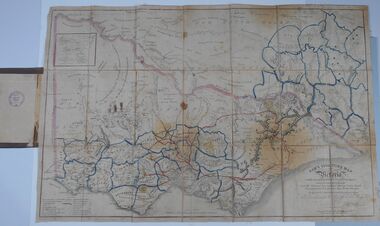 Bendigo Historical Society Inc.
Document - HARRIS COLLECTION: HAMS SQUATTING MAP OF VICTORIA, PORT PHILLIP DISTRICT, NSW
... Australian Alps are still described as 'unsurveyed country'. (State Library Victoria https://www.slv.vic.gov.au/squatting-map-victoria) MAP Victoria squatting map Folding map enclosed in burgundy cover. Map backed by cloth and bound. Rare, early map of Victoria and neighbouring Port Phillip District of New South ...Thomas Ham was a cartographer, engraver, lithographer and publisher in Victoria and Queensland. He compiled and printed several editions of his squatting map, beginning with A map of Australia Felix in 1847 and changing its title to Ham's squatting map of Victoria in 1851. The 1851 edition was accompanied by a key listing the names of all the squatters within squatting districts and counties. Later editions show the existing counties, but some areas of Gippsland and the Australian Alps are still described as 'unsurveyed country'. (State Library Victoria https://www.slv.vic.gov.au/squatting-map-victoria)Folding map enclosed in burgundy cover. Map backed by cloth and bound. Rare, early map of Victoria and neighbouring Port Phillip District of New South Wales. Written on bottom RH corner of map: Ham's Squatting Map of Victoria ( Port Phillip District, New South Wales ) carefully corrected to this date from the Colonial Government Surveys, Crown Lands, Commissioners & Explorers Maps, Private Surveys & c. Respectfully inscribed (with permission ) to His Excellency Sir Chas A. Fitz-Roy Knt, Governor of New South Wales &c &c by his Obedient Servant, The Compiler, 1851. Compiled, engraved and published by Thomas Ham, Melbourne. Proposed and original boundary ( in legend) have been coloured in in blue and pink ink ( later addition ?) Number on map show 'reference to proprietor's Printed on back of map ' J.G. AD 1852, with two cross hatched decorations and two hearts entwined. On other back panel in pencil enclosed in a drawn frame ' G.S.H., 1889, Axedale' (George Harris, Axedale, belongs in Harris Collection) Stamped in purple ink 'Royal Historical Society of Victoria, Bendigo Branch. Written 1959, 53.map, victoria, squatting map -
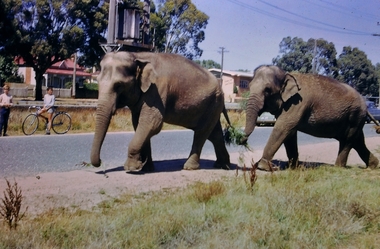 Bendigo Historical Society Inc.
Slide - Images by Arthur Pulfer, 1957-1970
... It states that 'The licence of Caralulup Hotel, near Talbot, has been surrendered, thus severing an 80 year association with the district' State Library of Victoria TOLMER GOLD ESCORT ROUTE The gold rush in New South Wales and Victoria left few able miners in South Australia. ...It states that 'The licence of Caralulup Hotel, near Talbot, has been surrendered, thus severing an 80 year association with the district' State Library of Victoria TOLMER GOLD ESCORT ROUTE The gold rush in New South Wales and Victoria left few able miners in South Australia. ...Arthur William Pulfer was born on 18 April 1918, in Bendigo, Victoria, Australia, his father, Harold Victor Pulfer, was 30 and his mother, Elsie Maud Rumball, was 26. He married Norma Stewart in Bendigo, Victoria, Australia. He died on 6 March 2001, in his hometown, at the age of 82, and was buried in the Bendigo Cemetery. ROSEVIEW 407 High Street, Golden Square Bendigo "Roseview" was designed by Godfrey Eathorne and constructed in 1939. It is one of the few Streamline Moderne houses in the Central Goldfields region, and was one of the earliest constructed in the Bendigo region. It is an outstanding example of this style of housing. It resembles an ocean liner, and reflects the emphasis on the streamlining of methods of transportation. It utilizes both flat and curved surfaces and has little external ornamentation. The use of materials such as rounded glass windows and metal window and door frames reflects an innovative approach to construction consistent with the style. "Roseview" was constructed on a large scale, with large and spacious rooms. It reflects the prominent social status and wealth of the original owner, together with the desire for a building in 'the latest' style which was sure to attract attention and prominence in the region. It has been maintained largely in original condition. CARALULUP HOTEL 'The Sun' dated January 17, 1941 on the back. It states that 'The licence of Caralulup Hotel, near Talbot, has been surrendered, thus severing an 80 year association with the district' State Library of Victoria TOLMER GOLD ESCORT ROUTE The gold rush in New South Wales and Victoria left few able miners in South Australia. Bad economic conditions saw more than 15,000 men leave the Kapunda and Burra mines by the end of 1851. Alexander Tolmer, Commissioner of Police in 1852 proposed that the gold won by South Australians should be brought back to South Australia under an escort consisting of only a few men. In March a Gold Escort was on its way back to Adelaide with almost 6,000 ounces of gold for the vaults of the Treasury Building. After this successful trip Tolmer led two other escorts before handing over his duties. A total of eighteen gold escorts were made, the last one during November and December 1853 when Inspector Wyndham was in charge. You’ll find Gold Escort Route Monuments between Meningie, Coonalpyn and Tintinara.Many images from by Arthur Pulfer copied to slides. Twenty Slides of Bendigo: 7795.5a Market Gardens - possibly North Bendigo 7795.5b North Deborah Mine photo taken from Breen Street 1958 7795.5c Laying the track to get the engine into the park, looking down Mitchell Street Bendigo 7795.5d R766 in the Victorian Railways Institute Park Railway Place Bendigo 7795.5e On the Methodist Church Steps Arnold street Bendigo 7795.5f Caralulup Hotel near Talbot Victoria 7795.5g Miner's Hut at Moliagul 7795.5h Tolmer's Gold Route Victoria to South Australia 7795.5i Basket Lunch - White Hills Botanical Gardens - St johns 100 year celebrations 7795.5j White Hills Swimming Pool February 1970 7795.5k White Hills Botanical Gardens Bendigo 7795.5l Bendigo Show Parade 1958 7795.5n Bullens Circus Bendigo February 1966 7795.5o The old Lockup Eaglehawk Bendigo September 1967 7795.5p The old Golden Gully Hotel Diamond Hill Road, Bendigo 7795.5q Roseview Pethards Home 407 High Street Golden Square Bendigo 25th March 1957 7795.5r House - possibly on the Midland Highway Epsom, Bendigo - 8 April 1955 7795.5s The Big Tree Sedgwick Road March 1972 7795.5t Kangaroo Flat Bus Lines mini bus 7795.5m The Arrival of the Cobb and Co Coach in Bendigo September 1963 7795.5n Bullens Circus Bendigo February 1966 - two elephants walking along the Bendigo Creekhistory, bendigo, james lerk collection, golden square high school, dragon loong, white hill botanical gardens, 407 high street bendigo, r766 engine, bullens circus, caralulup, moligual, bendigo show, tolmer's gold route, kangaroo flat bus lines, eaglehawk lockup, arnold street methodist church, elephants, arthur pulfer -
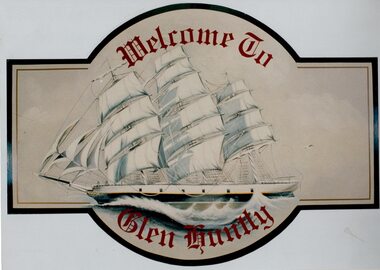 Glen Eira Historical Society
Article - GLEN HUNTLY (HISTORY OF)
... State Library Victoria. 4/3 pages taken from a website on the re-internment of graves and some social history as to the reason that the new emigrants were coming to Australia. The Article also has 7 photographs. 5/2 newspaper articles on the ‘Glen Huntly’ descendants forthcoming reunion being held on 21&22/4/1990. 6/1 article reprinted from newsletter no. 22 October 1983 on the barque ‘Glen Huntly’. Also details of passengers who died and the burial of 3 at Point Ormond. 7/1 handwritten document (unattributed) taken from ‘Migrant ships for South...State Library Victoria. 4/3 pages taken from a website on the re-internment of graves and some social history as to the reason that the new emigrants were coming to Australia. The Article also has 7 photographs. 5/2 newspaper articles on the ‘Glen Huntly’ descendants forthcoming reunion being held on 21&22/4/1990. 6/1 article reprinted from newsletter no. 22 October 1983 on the barque ‘Glen Huntly’. Also details of passengers who died and the burial of 3 at Point Ormond. 7/1 handwritten document (unattributed) taken from ‘Migrant ships for South ...This file contains 10 items about the history of Glen Huntly: 1/6 photocopied pages from ‘The History of St Kilda’ which relates to the place name Glen Huntly, and the Quarantine graves, date unknown. 2/2 photocopied pages from the ‘Sun Pictorial’ dated 13/4/1928 and 12/4/1928; relating to the state of the graves at Point Ormond and their re-internment to St Kilda Cemetery. 3/1 pen and ink sketch of graves at Point Ormond from the State Library Victoria. 4/3 pages taken from a website on the re-internment of graves and some social history as to the reason that the new emigrants were coming to Australia. The Article also has 7 photographs. 5/2 newspaper articles on the ‘Glen Huntly’ descendants forthcoming reunion being held on 21&22/4/1990. 6/1 article reprinted from newsletter no. 22 October 1983 on the barque ‘Glen Huntly’. Also details of passengers who died and the burial of 3 at Point Ormond. 7/1 handwritten document (unattributed) taken from ‘Migrant ships for South Australia 1836-1850’ by Ronald Parsons. 8/1 pamphlet commemorating the 150th anniversary of the ‘Glen Huntly’ arriving in Melbourne. It gives information about the ship, passengers, memorial in St Kilda Cemetery and upcoming descendants’ reunion. 9/1 program of commemoration events 21&22/4/1990. 10/1 piece of art work for a ‘Welcome to Glen Huntly’ sign, featuring a ship. Undated, unattributed and source unknown.‘glen huntly’, buchanan captain, fever ship, emigrants, cummins ann, st kilda cemetery, bowman mrs, caulfield, craig john, cameron miss, mcgonagle mrs, elsternwick, armstrong george, mathers james, the glen huntly pioneers memorial, jones alfred ramsey, st david’s uniting church (grange road), glen huntly, glen huntly road, lake street, glen huntly state school, glen huntly presbyterian church, south caulfield, mernda avenue, garden avenue, grange road, jenkin (boss) william, wattle avenue, chinese joss-house, smith a.w, glen huntly post office, foundation stones, king f.l, methodist church, trinity congregational church, greek orthodox church, salvation army temple, wanalta road, st anthony’s roman catholic church, st agnes’ anglican church, booran road, st david’s uniting church, el nido grove, manses, royal avenue, munster avenue, james street, rothschild street, neerim road, organs, peace memorial organ, railways, marara road, curraweena road, booran road, bambra road, rosstown railway, murray-ross william, leila road, murray-ross leila, ‘the grange’, north road, wild cherry road, ‘rosstown’, picture theatres, manchester grove, aerodrome, lord reserve, neville street, lyons street, morgan street, rosedale avenue, rifle clubs, glen huntly infant welfare centre, watson grove, rowlands drapery, drapers, bones plant nursery, nurseries, elsternwick railway station, railway stations, kooyong road, glen eira road, truganini road, rosstown sugar works, ross murray, street names, typhoid, diseases, death and dying
