
Showing 311 items matching "stockes street"
-
 Lakes Entrance Historical Society
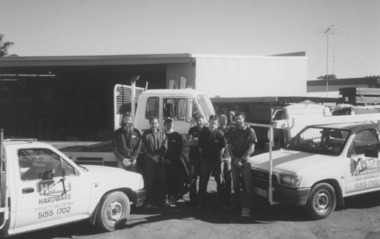
Photograph - Home Hardware, Lakes Post Newspaper, 1/11/1995 12:00:00 AM
... Opening of Home Hardware Stock Street previously East End Hardware...Colour photograph of seven Management and staff members at opening of Home Hardware Stock Street previously East End Hardware, taken in the timber yard with three delivery vehicles. ...Opening of Home Hardware Stock Street previously East End Hardware Businesses Hardware Colour photograph of seven Management and staff members at opening of Home Hardware Stock Street previously East End Hardware, taken in the timber yard with three delivery vehicles. ...Opening of Home Hardware Stock Street previously East End HardwareColour photograph of seven Management and staff members at opening of Home Hardware Stock Street previously East End Hardware, taken in the timber yard with three delivery vehicles. Lakes Entrance Victoriabusinesses, hardware -
 Lakes Entrance Historical Society
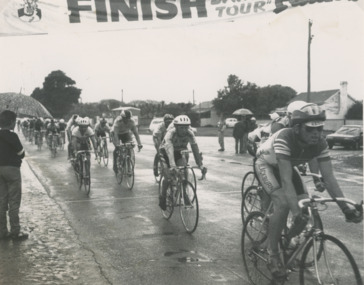
Photograph - Cycling race Lakes Entrance, Lakes Post Newspaper, 7/10/1991 12:00:00 AM
... Photo 04027.2 cyclists crossing the finish line on Roadnight Street , Stock Street on the right hand side ...Photo 04027.2 cyclists crossing the finish line on Roadnight Street , Stock Street on the right hand side ...Photo 04027.2 cyclists crossing the finish line on Roadnight Street , Stock Street on the right hand side Sports Cycling Recreation Black and white photograph taken at the final stage of Patties Lakes Cycling Tour organised by Frank Daly, shows cyclists on Roadnight Street , Stock Street on the right hand side . ...final stage of Patties Lakes Cycling Tour organised by Frank Daly, shows cyclists on Roadnight Street , Stock Street on the right hand side . Other photos 04027.1 riders in Roadknight Street Lakes Entrance approaching and crossing the finish line with Mourilyan Street on the left. Photo 04027.2 cyclists crossing the finish line on Roadnight Street , Stock Street on the right hand side Black and white photograph taken at the final stage of Patties Lakes Cycling Tour organised by Frank Daly, shows cyclists on Roadnight Street , Stock Street on the right hand side . Other photos 04027.1 riders in Roadknight Street Lakes Entrance approaching and crossing the finish line with Mourilyan Street on the left. Photo 04027.2 cyclists crossing the finish line on Roadnight Street , Stock Street on the right hand side sports, cycling, recreation -
 Port Melbourne Historical & Preservation Society
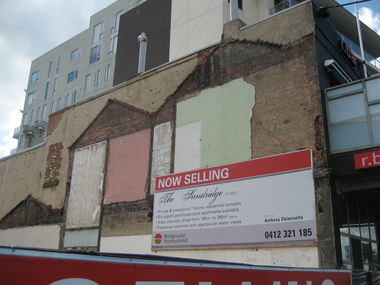
Photograph - Demolition of Sandridge Hotel, Port Melbourne, David Thompson, 2007
... ...Stockes Street...Business and Traders - Hotels Built Environment - Commercial Sandridge Hotel Freemason's Tavern Demolitions Beach Street Stockes Street Digital colour photograph of the demolition of the Sandridge Hotel on the corner of Beach and Stokes Streets showing the outline of the hotel on the next door building. ...The Freemason's Tavern was established on the corner of Beach and Stokes Streets in 1859 next to the Masonic Hall used by the Sandridge Marine Lodge No 21 at 18 Stokes Street. It became the Sandridge Hotel in the 1940s by which time the building had been remodelled in a moderne style. The Sandridge Hotel was demolished in early 2007 except for a single wall in Stokes Street that remained, propped up, before it too was demolished in March, 2007. A reconstructed 'Victorian' version of the hotel was incorporated into the apartments built on the site.Digital colour photograph of the demolition of the Sandridge Hotel on the corner of Beach and Stokes Streets showing the outline of the hotel on the next door building.business and traders - hotels, built environment - commercial, sandridge hotel, freemason's tavern, demolitions, beach street, stockes street -
 Port Melbourne Historical & Preservation Society
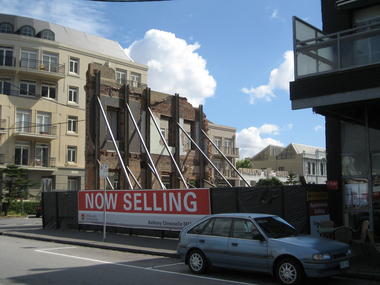
Photograph - Demolition of Sandridge Hotel, Port Melbourne, David Thompson, 2007
... ...Stockes Street...Business and Traders - Hotels Built Environment - Commercial Sandridge Hotel Freemason's Tavern Demolitions Beach Street Stockes Street Digital colour photograph of the demolition of the Sandridge Hotel on the corner of Beach and Stokes Streets showing a single wall remaining in Stokes Street. ...The Freemason's Tavern was established on the corner of Beach and Stokes Streets in 1859 next to the Masonic Hall used by the Sandridge Marine Lodge No 21 at 18 Stokes Street. It became the Sandridge Hotel in the 1940s by which time the building had been remodelled in a moderne style. The Sandridge Hotel was demolished in early 2007 except for a single wall in Stokes Street that remained, propped up, before it too was demolished in March, 2007. A reconstructed 'Victorian' version of the hotel was incorporated into the apartments built on the site.Digital colour photograph of the demolition of the Sandridge Hotel on the corner of Beach and Stokes Streets showing a single wall remaining in Stokes Street.business and traders - hotels, built environment - commercial, sandridge hotel, freemason's tavern, demolitions, beach street, stockes street -
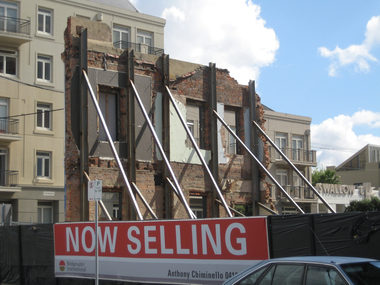 Port Melbourne Historical & Preservation Society
Photograph - Demolition of Sandridge Hotel, Port Melbourne, David Thompson, 2007
... ...Stockes Street...Business and Traders - Hotels Built Environment - Commercial Sandridge Hotel Freemason's Tavern Demolitions Beach Street Stockes Street Digital colour photograph of the demolition of the Sandridge Hotel on the corner of Beach and Stokes Streets showing a single wall remaining in Stokes Street. ...The Freemason's Tavern was established on the corner of Beach and Stokes Streets in 1859 next to the Masonic Hall used by the Sandridge Marine Lodge No 21 at 18 Stokes Street. It became the Sandridge Hotel in the 1940s by which time the building had been remodelled in a moderne style. The Sandridge Hotel was demolished in early 2007 except for a single wall in Stokes Street that remained, propped up, before it too was demolished in March, 2007. A reconstructed 'Victorian' version of the hotel was incorporated into the apartments built on the site.Digital colour photograph of the demolition of the Sandridge Hotel on the corner of Beach and Stokes Streets showing a single wall remaining in Stokes Street.business and traders - hotels, built environment - commercial, sandridge hotel, freemason's tavern, demolitions, beach street, stockes street -
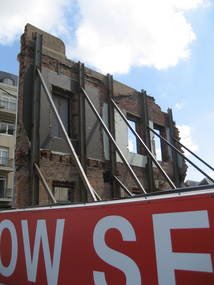 Port Melbourne Historical & Preservation Society
Photograph - Demolition of Sandridge Hotel, Port Melbourne, David Thompson, 2007
... ...Stockes Street...Business and Traders - Hotels Built Environment - Commercial Sandridge Hotel Freemason's Tavern Demolitions Beach Street Stockes Street Digital colour photograph of the demolition of the Sandridge Hotel on the corner of Beach and Stokes Streets showing a single wall remaining in Stokes Street. ...The Freemason's Tavern was established on the corner of Beach and Stokes Streets in 1859 next to the Masonic Hall used by the Sandridge Marine Lodge No 21 at 18 Stokes Street. It became the Sandridge Hotel in the 1940s by which time the building had been remodelled in a moderne style. The Sandridge Hotel was demolished in early 2007 except for a single wall in Stokes Street that remained, propped up, before it too was demolished in March, 2007. A reconstructed 'Victorian' version of the hotel was incorporated into the apartments built on the site.Digital colour photograph of the demolition of the Sandridge Hotel on the corner of Beach and Stokes Streets showing a single wall remaining in Stokes Street.business and traders - hotels, built environment - commercial, sandridge hotel, freemason's tavern, demolitions, beach street, stockes street -
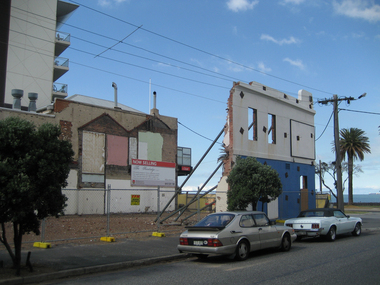 Port Melbourne Historical & Preservation Society
Photograph - Demolition of Sandridge Hotel, Port Melbourne, David Thompson, 2007
... ...Stockes Street...Business and Traders - Hotels Built Environment - Commercial Sandridge Hotel Freemason's Tavern Demolitions Beach Street Stockes Street Digital colour photograph of the demolition of the Sandridge Hotel on the corner of Beach and Stokes Streets showing a single wall remaining in Stokes Street. ...The Freemason's Tavern was established on the corner of Beach and Stokes Streets in 1859 next to the Masonic Hall used by the Sandridge Marine Lodge No 21 at 18 Stokes Street. It became the Sandridge Hotel in the 1940s by which time the building had been remodelled in a moderne style. The Sandridge Hotel was demolished in early 2007 except for a single wall in Stokes Street that remained, propped up, before it too was demolished in March, 2007. A reconstructed 'Victorian' version of the hotel was incorporated into the apartments built on the site.Digital colour photograph of the demolition of the Sandridge Hotel on the corner of Beach and Stokes Streets showing a single wall remaining in Stokes Street.business and traders - hotels, built environment - commercial, sandridge hotel, freemason's tavern, demolitions, beach street, stockes street -
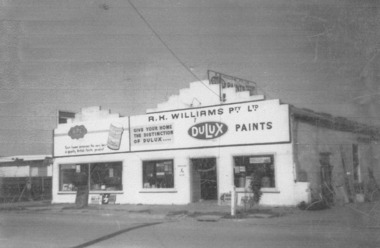 Lakes Entrance Historical Society
Photograph - Williams Hardware, Lakes Post Newspaper, 1980 c
... Black and white photograph of Ralph K Williams Hardware Stock Street, later East End Hardware Lakes Entrance Victoria...Businesses Hardware Black and white photograph of Ralph K Williams Hardware Stock Street, later East End Hardware Lakes Entrance Victoria Photograph Williams Hardware Lakes Post Newspaper ...Black and white photograph of Ralph K Williams Hardware Stock Street, later East End Hardware Lakes Entrance Victoriabusinesses, hardware -
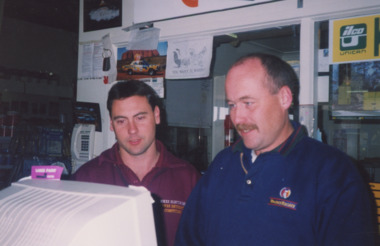 Lakes Entrance Historical Society
Photograph - Loukes, Lakes Post Newspaper, 1/08/2000 12:00:00 AM
... Colour photograph of Geoff Bassett of Loukes Electronics with Stewart Cantrill of Paint Right taken at Home Hardware of Stock Street Lakes Entrance Victoria 2000...Businesses Hardware Colour photograph of Geoff Bassett of Loukes Electronics with Stewart Cantrill of Paint Right taken at Home Hardware of Stock Street Lakes Entrance Victoria 2000 Photograph Loukes Lakes Post Newspaper ...Colour photograph of Geoff Bassett of Loukes Electronics with Stewart Cantrill of Paint Right taken at Home Hardware of Stock Street Lakes Entrance Victoria 2000businesses, hardware -
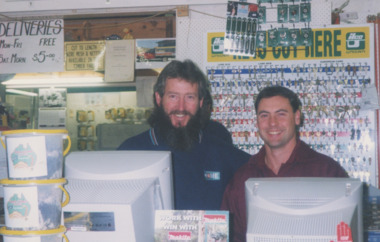 Lakes Entrance Historical Society
Photograph - Loukes, Lakes Post Newspaper, 1/08/2000 12:00:00 AM
... Colour photograph of Gordon Whelan of Home Hardware Stock Street with Geoff Bassett from Loukes Electronics updating the stores computers Lakes Entrance Victoria 2000...Businesses Hardware Colour photograph of Gordon Whelan of Home Hardware Stock Street with Geoff Bassett from Loukes Electronics updating the stores computers Lakes Entrance Victoria 2000 Photograph Loukes Lakes Post Newspaper ...Colour photograph of Gordon Whelan of Home Hardware Stock Street with Geoff Bassett from Loukes Electronics updating the stores computers Lakes Entrance Victoria 2000businesses, hardware -
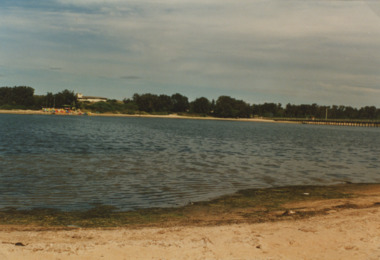 Lakes Entrance Historical Society
Photograph - Cunninghame Arm Lakes Entrance Victoria, M Fish, 1985
... Colour photograph taken from lakefront near Stock Street looking across Cunninghame Arm to the footbridge old Surf Club and paddle boats Lakes Entrance Victoria...Topography Waterways Gippsland Lakes Colour photograph taken from lakefront near Stock Street looking across Cunninghame Arm to the footbridge old Surf Club and paddle boats Lakes Entrance Victoria Cunninghame Arm Lakes Entrance Victoria Photograph Cunninghame Arm Lakes Entrance Victoria M Fish ...Colour photograph taken from lakefront near Stock Street looking across Cunninghame Arm to the footbridge old Surf Club and paddle boats Lakes Entrance Victoriatopography, waterways, gippsland lakes -
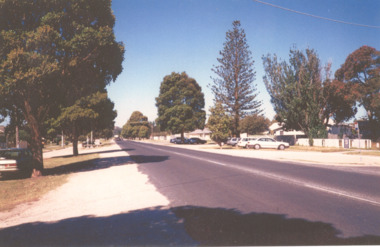 Lakes Entrance Historical Society
Photograph - Roadknight Street View, Lakes Entrance Victoria, 2000 c
... Colour photograph of Roadknight Street looking east towards Whiter Street and crossroads Mourilyan Street and Stock Street before Norfolk Pine was removed early 2000s Lakes Entrance Victoria...Avenue of Queensland brush box trees planted as memorial to John Carpenter pioneer builder of Lakes Entrance Roads and Streets Trees Engineering Colour photograph of Roadknight Street looking east towards Whiter Street and crossroads Mourilyan Street and Stock Street before Norfolk Pine was removed early 2000s Lakes Entrance Victoria Lakes Entrance Victoria Photograph Roadknight Street View ...Avenue of Queensland brush box trees planted as memorial to John Carpenter pioneer builder of Lakes EntranceColour photograph of Roadknight Street looking east towards Whiter Street and crossroads Mourilyan Street and Stock Street before Norfolk Pine was removed early 2000s Lakes Entrance Victoriaroads and streets, trees, engineering -
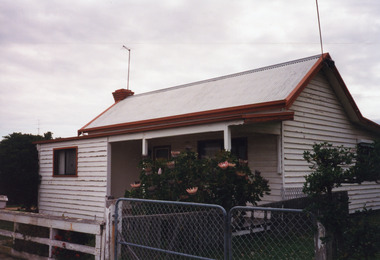 Lakes Entrance Historical Society
Photograph - Historic House 9 Stock Street, Lakes Entrance, 1999
... Historic House 9 Stock Street, Lakes Entrance, 1999...Situated at 9 Stock Street, Lakes Entrance, Victoria....Situated at 9 Stock Street, Lakes Entrance, Victoria. Photograph Historic House 9 Stock Street, Lakes Entrance, 1999 ...House typical of four roomed fisherman's cottage of early 20th Century , was home of Harry Jemmeson, fisherman, wife Lulu and family. Daughter Edith was music teacher and amateur photographer. Later resident Reynold Redenbach. House demolished, site became yard of East End Hardware / Mitre 10.Colour photograph of a four roomed timber cottage with roof of corrugated iron. Part of front veranda enclosed as extra room. Brick external chimney. Situated at 9 Stock Street, Lakes Entrance, Victoria.houses, local history -
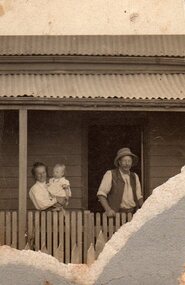 Greensborough Historical Society
Photograph - Digital image, George Stock and family 1909, 1909_
... George Stock and family 1909 (left to right) Jane Finn and son George, George William Stock. House in Main Street near bridge over river. Photographs from the collection of Peter Blackbourn, a descendant of the Chapman Stock family. ...George Stock and family 1909 (left to right) Jane Finn and son George, George William Stock. House in Main Street near bridge over river. Photographs from the collection of Peter Blackbourn, a descendant of the Chapman Stock family. ...George Stock and family 1909 (left to right) Jane Finn and son George, George William Stock. House in Main Street near bridge over river. Photographs from the collection of Peter Blackbourn, a descendant of the Chapman Stock family. Annotations to photos by Peter Blackbourn.Digital copy of black and white photograph.peter blackbourn, george willam stock, jane stock (nee finn), george stock -
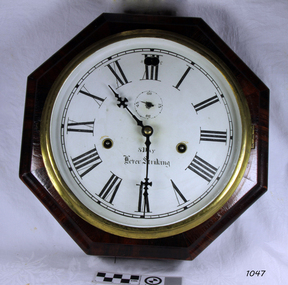 Flagstaff Hill Maritime Museum and Village
Clock, 1867-1870
... Street in New Haven. Three years later, following a fire that destroyed the Bristol plant, Jerome relocated the entire operation to Elm City factory. Enlarging the plant, the company soon became the largest industrial employer in the city, producing 150,000 clocks annually. In 1850 Jerome formed the Jerome Manufacturing Co. as a joint-stock...Street in New Haven. Three years later, following a fire that destroyed the Bristol plant, Jerome relocated the entire operation to Elm City factory. Enlarging the plant, the company soon became the largest industrial employer in the city, producing 150,000 clocks annually. In 1850 Jerome formed the Jerome Manufacturing Co. as a joint-stock ...Chauncey Jerome (1793–1868) was an American clock maker in the early to mid 19th century. He made a fortune selling his clocks, and his business grew quickly. Jerome was born in Canaan USA in 1793 son of a blacksmith and nail-maker. He began his career in Plymouth, making dials for long-case clocks where he learned all he could about clocks, particularly clock cases, and then went to New Jersey to make seven-foot cases for clocks mechanisms. In 1816 he went to work for Eli Terry making "Patent Shelf Clocks," learning how to make previously handmade cases using machinery. Deciding to go into business for himself, Jerome began to make cases, trading them to Terry for wooden movements. In 1822 Jerome moved his business to Bristol New Haven, opening a small shop with his brother Noble and began to produce a 30-hour and eight-day wooden clocks. By 1837 Jerome's company was selling more clocks than any of his competitors. A one-day wood-cased clock, which sold for six dollars had helped put the company on the map. A year later his company was selling that same clock for four dollars. The company also sold one line of clocks at a wholesale price of 75 cents and by 1841 the company was showing an annual profit of a whopping $35,000, primarily from the sale of its brass movements. In 1842 Jerome moved his clock-case manufacturing operation to St. John Street in New Haven. Three years later, following a fire that destroyed the Bristol plant, Jerome relocated the entire operation to Elm City factory. Enlarging the plant, the company soon became the largest industrial employer in the city, producing 150,000 clocks annually. In 1850 Jerome formed the Jerome Manufacturing Co. as a joint-stock company with Benedict & Burnham, brass manufacturers of Waterbury. In 1853 the company then became known as the New Haven Clock Co, producing 444,000 clocks and timepieces annually, then the largest clock maker in the world. Jerome's future should have been secure but in 1855 he bought out a failed Bridgeport clock company controlled by P.T. Barnum, which wiped him out financially, leaving the Jerome Manufacturing Co. bankrupt. Jerome never recovered from the loss. By his admission, he was a better inventor than a businessman. When Jerome went bankrupt in 1856 the New Haven Clock Company purchased the company. One of the primary benefits of Jerome purchasing New Haven in the first place was the good reputation of the Jerome brand and the network of companies that remained interested in selling its clocks. In England, Jerome & Co. Ltd. sold Jerome clocks for the New Haven company until 1904, when New Haven purchased the English firm outright. After his involvement with the New Haven Company in 1856, Jerome traveled from town to town, taking jobs where he could, often working for clock companies that had learned the business of clock making using Jerome's inventions. On returning to New Haven near the end of his life, he died, penniless, in 1868 at the age of 74. The company struggled on after Jerome's bankruptcy until after World War II, when the company endeavored to continue through disruptions caused by a takeover along with poor sales, finally having to fold its operations in 1960 a little more than 100 years after it had been founded. The item is significant as it is associated with Chauncey Jerome who had made a historic contribution to the clock making industry during the 19th century when he began to substitute brass mechanisms for wooden mechanisms in his clocks. This was said to be the greatest and most far-reaching contribution to the clock industry. Because of his discovery of stamping out clockwork gears rather than using castings, Jerome was producing the lowest-priced clocks in the world. That can only add to his significance as the major clock manufacture of the 19th century. Jerome may have made and lost, a fortune selling his clocks but was perhaps the most influential and creative person associated with the American clock business during the mid-19th century. Also, he had served his community as a legislator in 1834, a Presidential elector in 1852 and mayor of New Haven, Connecticut from 1854 to 1855.Clock, marine, in octagonal rosewood veneer case. Roman numerals to dial, has a seconds dial. 2 key-winding holes slow-to-Fast adjustment pin through dial. Small lever in lower edge of case activates a chime. "8 day, 8 inch, Lever Striking escarpment " Paper label on the back of the clock "Jerome & Co, New Haven, Conn" "Manufacturers of every variety of Office and Home Clocks and Time Pieces".flagstaff hill, warrnambool, shipwrecked-coast, flagstaff-hill, flagstaff-hill-maritime-museum, maritime-museum, shipwreck-coast, flagstaff-hill-maritime-village, clock, jerome & co, new haven, clock maker, chauncey jerome -
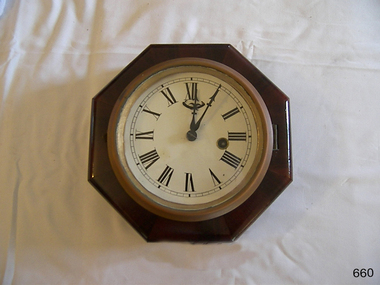 Flagstaff Hill Maritime Museum and Village
Clock, 1867-1870
... Street in New Haven. Three years later, following a fire that destroyed the Bristol plant, Jerome relocated the entire operation to Elm City factory. Enlarging the plant, the company soon became the largest industrial employer in the city, producing 150,000 clocks annually. In 1850 Jerome formed the Jerome Manufacturing Co. as a joint-stock...Street in New Haven. Three years later, following a fire that destroyed the Bristol plant, Jerome relocated the entire operation to Elm City factory. Enlarging the plant, the company soon became the largest industrial employer in the city, producing 150,000 clocks annually. In 1850 Jerome formed the Jerome Manufacturing Co. as a joint-stock ...Chauncey Jerome (1793–1868) was an American clock maker in the early to mid 19th century. He made a fortune selling his clocks, and his business grew quickly. Jerome was born in Canaan USA in 1793 son of a blacksmith and nail-maker. He began his career in Plymouth, making dials for long-case clocks where he learned all he could about clocks, particularly clock cases, and then went to New Jersey to make seven-foot cases for clocks mechanisms. In 1816 he went to work for Eli Terry making "Patent Shelf Clocks," learning how to make previously handmade cases using machinery. Deciding to go into business for himself, Jerome began to make cases, trading them to Terry for wooden movements. In 1822 Jerome moved his business to Bristol New Haven, opening a small shop with his brother Noble and began to produce a 30-hour and eight-day wooden clocks. By 1837 Jerome's company was selling more clocks than any of his competitors. A one-day wood-cased clock, which sold for six dollars had helped put the company on the map. A year later his company was selling that same clock for four dollars. The company also sold one line of clocks at a wholesale price of 75 cents and by 1841 the company was showing an annual profit of a whopping $35,000, primarily from the sale of its brass movements. In 1842 Jerome moved his clock-case manufacturing operation to St. John Street in New Haven. Three years later, following a fire that destroyed the Bristol plant, Jerome relocated the entire operation to Elm City factory. Enlarging the plant, the company soon became the largest industrial employer in the city, producing 150,000 clocks annually. In 1850 Jerome formed the Jerome Manufacturing Co. as a joint-stock company with Benedict & Burnham, brass manufacturers of Waterbury. In 1853 the company then became known as the New Haven Clock Co, producing 444,000 clocks and timepieces annually, then the largest clock maker in the world. Jerome's future should have been secure but in 1855 he bought out a failed Bridgeport clock company controlled by P.T. Barnum, which wiped him out financially, leaving the Jerome Manufacturing Co. bankrupt. Jerome never recovered from the loss. By his admission, he was a better inventor than a businessman. When Jerome went bankrupt in 1856 the New Haven Clock Company purchased the company. One of the primary benefits of Jerome purchasing New Haven in the first place was the good reputation of the Jerome brand and the network of companies that remained interested in selling its clocks. In England, Jerome & Co. Ltd. sold Jerome clocks for the New Haven company until 1904, when New Haven purchased the English firm outright. After his involvement with the New Haven Company in 1856, Jerome traveled from town to town, taking jobs where he could, often working for clock companies that had learned the business of clock making using Jerome's inventions. On returning to New Haven near the end of his life, he died, penniless, in 1868 at the age of 74. The company struggled on after Jerome's bankruptcy until after World War II, when the company endeavored to continue through disruptions caused by a takeover along with poor sales, finally having to fold its operations in 1960 a little more than 100 years after it had been founded. The item is significant as it is associated with Chauncey Jerome who had made a historic contribution to the clock making industry during the 19th century when he began to substitute brass mechanisms for wooden mechanisms in his clocks. This was said to be the greatest and most far-reaching contribution to the clock industry. Because of his discovery of stamping out clockwork gears rather than using castings, Jerome was producing the lowest-priced clocks in the world. That can only add to his significance as the major clock manufacture of the 19th century. Jerome may have made and lost, a fortune selling his clocks but was perhaps the most influential and creative person associated with the American clock business during the mid-19th century. Also, he had served his community as a legislator in 1834, a Presidential elector in 1852 and mayor of New Haven, Connecticut from 1854 to 1855.Eight day movement wall clock with Roman numerals, octagonal shaped rosewood veneered casing, hinged face with locking clip. Wound from front. Face has adjustment for Fast-to-Slow.Part paper label on back of case can just make out "Jerome" and "ight and One" probable meaning is "Eight and One Day" describing the movements operational time between winding the mechanism.flagstaff hill, warrnambool, shipwrecked-coast, flagstaff-hill, flagstaff-hill-maritime-museum, maritime-museum, shipwreck-coast, flagstaff-hill-maritime-village, clock maker, jerome & co, new haven, chauncey jerome, canaan -
 Federation University Historical Collection
Magazine, Evening Echo Historical Edition 1904, 1904
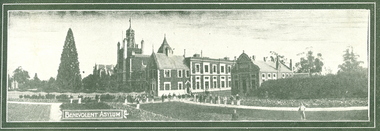
... ...sturt street without gardens...stock...03 December 1904 was the 100th anniversary of the Eureka Stockade. eureka stockade eureka ballarat hospital aborigines ames long eureka iron works cameron and sutherland william little craigs royal hotel james scobie peter lalor ballaarat old cemetery sturt street prince alfred city flour mill bridge street bakery hill orphan gong gong victoria streets pioneer ballarat school of mines mining exchange holst benevolent asylum ballarat benevolent asylum call room ballarat mining exchange sturt street without gardens stock exchange share trading stockbrokers pioneers craig's hotel craig's royal hotel Ballarat Mining Exchange Call Room Ballaarat Mechanics' Institute A special Eureka 100th anniversary magazine supplement to the Evening Echo. ...03 December 1904 was the 100th anniversary of the Eureka Stockade. A special Eureka 100th anniversary magazine supplement to the Evening Echo. The soft cover is predominately red, with many black and white images throughout. Images include Ballarat Benevolent Asylum, Ballarat Hospital and Ballarat Mechanics' Institute, Ballarat Mining Exchange Call Room, Stockbrokers.eureka stockade, eureka, ballarat hospital, aborigines, ames long, eureka iron works, cameron and sutherland, william little, craigs royal hotel, james scobie, peter lalor, ballaarat old cemetery, sturt street, prince alfred, city flour mill, bridge street, bakery hill, orphan, gong gong, victoria streets, pioneer, ballarat school of mines, mining exchange, holst, benevolent asylum, ballarat benevolent asylum, call room, ballarat mining exchange, sturt street without gardens, stock exchange, share trading, stockbrokers, pioneers, craig's hotel, craig's royal hotel, ballarat mining exchange call room, ballaarat mechanics' institute -
 Federation University Historical Collection
Book, Ballarat Illustrated : Under the Seals of the City & Town Councils, c1920
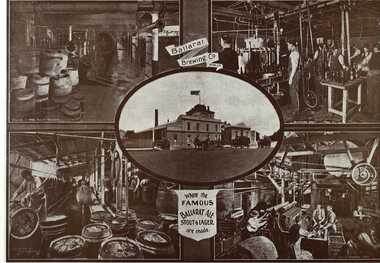
... Stock & Station Agents . Harry Davies & Co. . Views about the City . Benoit's Sun Foundry . Ballarat College (for Boys) . Wm Paterson's . Lydiard Street...Stock & Station Agents . Harry Davies & Co. . Views about the City . Benoit's Sun Foundry . Ballarat College (for Boys) . Wm Paterson's . Lydiard Street ...This book was a donation to Federation University Australia's Professor David Battersby from Vice-Chancellor Professor Scott Bowman of Central Queensland University.Soft cover. Front cover with some red. 80 pages. Back cover Plan of Ballarat Map. Photographic plates. Brief history of Ballarat and the topics photographed. . Ballarat City Municipal Chambers . The Ballarat Banking Company Limited . Art Gallery Ballarat . The Ballarat Trustees, Executors & Agency Company Limited . John MacLeod & Coy Pty Ltd . The Ballaarat Gas Coy . Ballarat's Homes . J. J. Goller & Co. . Ballarat East Views . Star Office . The Ballarat Courier . Morshead's . M. B. John Ballarat - The largest Inland Brass Foundry in Australia . Rowlands Koomah Spa . Huttons the Jewellers . Botanical Gardens Ballarat . Millers the Clothiers . Jas Smith Agricultural Machinery . Views of Lakes Learmonth & Burrumbeet . Coles & Pullum Stock & Station Agents . Harry Davies & Co. . Views about the City . Benoit's Sun Foundry . Ballarat College (for Boys) . Wm Paterson's . Lydiard Street Views . Eureka Terra-cotta & Tile Co. of Australia Limited . Churches of Ballarat . The Ballarat Woollen & Worsted Co. Ltd Sunnyside Mills . Red Shop Tea Rooms . Tyler's - Bridge Street, Ballarat . Allchin Bros Ballarat . Loreto Abbey Mary's Mount Ballarat . Brinds - Dunnstown . Ballarat Brewing Co. . Turnbridge's Arcade . Zoological Gardens Ballarat . A. Cant Plumber & Gasfitter . Interiors of some Ballarat Churches . Hugh Jones & B . W. F. Coltman . Views in Eureka Reserve . Loveland & Haslem, Moter Engineers . Public Institutions Ballarat . G. Warner & Co. Prop. Ltd . The Electric Supply Company of Victoria Limited . Ballarat East Views . Longhurst's Specialities . P. C. Thornton Proprietor Sturt St Ballarat . Cowley's Eureka Ironworks Pty Ltd . W. Owen Sports Depot & Tobacconist . Clarendon Ladies' College . Crocker's . Evening Echo Office . London Bank Chambers . Proprietors of Business . Broadbent Bros & Co. Gifted by Vice-Chancellor Professor Scott Bowman Central Queensland University, 2014.ballarat, school of mines, evening echo, john scullin -
 Flagstaff Hill Maritime Museum and Village
Soda Syphon, 1900-1930’s
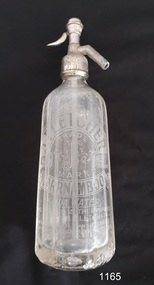
... Street, Warrnambool that was previously owned by John Davis. Fletcher operated the factory as J Fletcher, John Fletcher and Fletcher’s. He eventually sold his business and stock...Street, Warrnambool that was previously owned by John Davis. Fletcher operated the factory as J Fletcher, John Fletcher and Fletcher’s. He eventually sold his business and stock ...This soda syphon (or siphon) was distributed by John Fletcher of Warrnambool, and made by the British Syphon Mfg. Co. Ltd. of London between the 1900s-1930s. It comprises a multi-sided clear glass bottle, an internal glass tube and a metal release valve and spout on the top. It was used to dispense pressurised, effervescent soda water. It was often used as an alternative to water or added to fruit juices and cordials. The text on this bottle states that it remains the property of the retailer, John Fletcher, and must be returned to him. Customers were asked for a deposit on the bottle, which would be refunded when the bottle was exchanged or continued as the deposit on a fresh bottle. Returned bottles would be cleaned and recharged with the gas and sold again. Soda syphon are bottles, glass or metal, with a release valve and spout on the top. The valve lever on the top of the syphon, when depressed, causes the gas in the syphon to force the water up through the tube and out of the spout. The bottle’s mechanism gives the water an effervescent quality to make bubbly drinks such as sparkling mineral water, soda water and sparkling water. ABOUT JOHN FLETCHER John Fletcher bought the Union Cordial Factory in Koroit Street, Warrnambool that was previously owned by John Davis. Fletcher operated the factory as J Fletcher, John Fletcher and Fletcher’s. He eventually sold his business and stock in 1930 to Ralph Reeves, who may have continued using Fletcher’s supply of drink containers before renewing them with stock showing his own brand. The soda syphon is representative of drink containers used in the later 19th and early 20th century. It also represents the system of returnable, recyclable containers. Soda syphon (or siphon). Glass bottle, clear, multi sided, tapered from a heavy glass base to a narrower shoulder, with glass tube at centre connected to metal pump mechanism at the top. Has elaborate frosted label for J. Fletcher of Warrnambool. Made by the British Syphon Mfg. Co. Ltd. London. Bottle remains the property of John Fletcher, Warrnambool.Metal syphon has impressed "J FLETCHER" and logo "S S" in centre of two concentric circles with text between circles "BRITISH SYPHON MFG. CO. LTD. LONDON". Etched into glass "J. FLETCHER / WARRNAMBOOL", "TRADE "[stylised] F" / MARK", "SODA WATER", "THIS SYPHON IS THE PROPERTY / OF JOHN FLETCHER / WARRNAMBOOL AND CONNOT BE / AND CONNOT BE LEGALLY USED BY OTHERS / BRITISH SYPHON CO. TLD. LONDON / - - - - "flagstaff hill, warrnambool, shipwrecked coast, flagstaff hill maritime museum, maritime museum, shipwreck coast, flagstaff hill maritime village, great ocean road, john fletcher, fletcher, john fletcher of warrnambool, soda siphon, soda syphon, british syphon mfg co ltd of london, soft drinks, soda drinks -
 Federation University Historical Collection
Document, Invoice from Woodwards to the Ballarat School of Mines, 1907, 01/09/1907
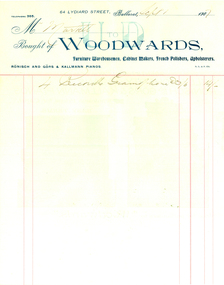
... Woodwards were at 64 Lydiard Street and were furniture warehousemen, cabinet makers, french polishers and upholsterers. They also stocked Bell and Doherty orgams and Ronisch and Gors & Kallmann pianos. ...Woodwards were at 64 Lydiard Street and were furniture warehousemen, cabinet makers, french polishers and upholsterers. They also stocked Bell and Doherty orgams and Ronisch and Gors & Kallmann pianos. ...Double sided invoice with Woodwards letterhead. Woodwards were at 64 Lydiard Street and were furniture warehousemen, cabinet makers, french polishers and upholsterers. They also stocked Bell and Doherty orgams and Ronisch and Gors & Kallmann pianos. woodwards, u to d, lydiard street, furniture, pianos, organs, keyboards -
 The Beechworth Burke Museum
Photograph, 1990s--estimated
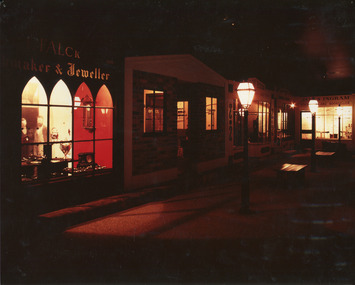
... Vale stocked a wide range of literary, historical and religious works, textbooks, periodicals and newspapers, as well as hosting a reading and writing room on Camp Street{?}. ...Taken in 1990, this photograph depicts a row of shops in Beechworth, with the shopfront of watchmaker and jewellers, William Turner and C.F. Falck, in the foreground, and newsagent and bookseller James Ingram's shop in the background.This photograph is of social significance to the Beechworth community in depicting the Street of Shops, the creation of curator, Roy Harvey, which opened in 1979 at Burke Museum. According to the Indigo Shire Council webpage for Burke Museum, this addition 'began a new period of collecting with Roy Harvey calling to the community for donations. The response resulted in an influx of material adding to the town history/ development and local identities collections. The Shops and their contents reflect another period in museology.' The historic shopfronts in this image portray those of local settlers, William Turner and CF Falck's Watchmaker and Jeweller store, and James Ingram's news agency and bookshop. William Turner was originally a goldfields official who became a commissioner on the Ovens goldfield, and later a resident warden, at times performing magisterial duties and chairing the Local Court. Charles Frederick Falck, born in Korlin, Germany, in 1833, a skilled watchmaker and jeweller, ran the jewellery business from 1862. Along with William Turner and Melbourne barrister, George Milner Stephen, he prepared a dazzling display of gems and jewellery from Beechworth for the Royal Society's Exhibition in Melbourne in 1865. This act signposted Beechworth's progress as a nineteenth-century gold rush town with a population of around 3000. In the mid-1850s, newsagent James Ingram established a newsagency and supplied papers and stationary to the goldfields. He and bookseller R.T. Vale stocked a wide range of literary, historical and religious works, textbooks, periodicals and newspapers, as well as hosting a reading and writing room on Camp Street{?}. James Ingram was a 'devoted instigator and supporter of the town's welfare institutions', who raised funds for to establish a hospital, primary school and benevolent asylum, and assisted people who'd fallen on hard times with his wife. He was also a mainstay of the early Baptist church, holding meetings in his house. He died in 1928, six weeks short of his 100th birthday. Ingram's Rock, north-west of Beechworth near where he lived in later life, was named after him. Colour rectangular photograph printed on matte photographic paper.Obverse: FALCK 1880 / maker & Jeweller/ WARDENS OFFICE/COACHING OFFICE/ EST. ??55/ ????ON HOUSE/ JAMES INGRAM/ NEWS?????? AND BOOKSELLER/ TOYS visible above shopfront in left foreground. Reverse: Catalogue item number 3305 pencilled in top right-hand corner.beechworth, beechworth historic shops, william turner, cf falck, james ingram, turner and falck watchmaker and jeweller, james ingram newsagent and bookseller, burke museum, promoting settlement, marketing and retailing, living in country towns, making regional centres, preserving traditions and commemorating, beechworth founders, victorian gold rush towns, beechworth pioneers, ingram's rock, 1860s beechworth, street of shops, roy harvey -
 Federation University Historical Collection
Pamphlet - Invitation, 17 Most Wanted, 1996
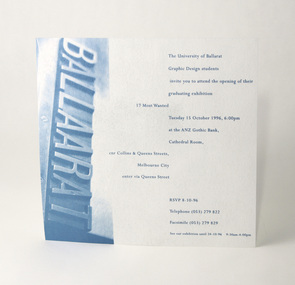
... Street, Melbourne. Exhibition opened by invitation on Tuesday 15 October 1996 at 6.00pm. University of Ballarat Federation University Graphic Design Mt Helen Campus Square format invitation to Graphic Design third year (graduating) exhibition in Melbourne on Tuesday 15 October 1996 at 6.00pm. Printed single colour offset print on a translucent 'vellum' style stock ...Separate to the combined Visual Arts exhibition held at the Mt Helen Campus, the third year graphic design exhibition ran from 15 to 24 October 1996 at the ANZ Gothic Bank, Corner Collins and Queen Street, Melbourne. Exhibition opened by invitation on Tuesday 15 October 1996 at 6.00pm.Square format invitation to Graphic Design third year (graduating) exhibition in Melbourne on Tuesday 15 October 1996 at 6.00pm. Printed single colour offset print on a translucent 'vellum' style stock.university of ballarat, federation university, graphic design, mt helen campus -
 Federation University Historical Collection
Book - Catalogue, Hype – GD/MM – Federation University Australia 2015, 2015
... Street Campus Arts Academy Callum Bennier Renee Bevan Maddie Durie Ben Hall Callum Jenkins Shannon Johnstone Mel Negri Brad O'Loughlin Jess Powell Jake Richardson Chenae Smith James Stuart Elaine Tso Laura Wright. Alistair Heighway Ben Mangan Chrissie Smith Debbie Hill Travis Price Jennifer Jones-O'Neil Jill Orr Jimmy Pasakos John McDonald Justin Weyers Luke Keys Paul Mah Peter Gaulke Peter Pilven Phillip Berry Roberta Crisci-Richardson. Promotional catalogue created by Federation University, Bachelor of Visual Arts (Graphic Design / Multimedia) third year, graduating students, 2015. 36pp full colour text pages and 4pp saddle-stitched cover, Uncoated stock ...The Hype 'zine (magazine" accompanied a projection project of the same title, projected onto the Ballarat Town Hall, Sturt Street, every night between 1 and 11 October 2015. Student names: Callum Bennier, Renee Bevan, Maddie Durie, Ben Hall, Callum Jenkins, Shannon Johnstone, Mel Negri, Brad O'Loughlin, Jess Powell, Jake Richardson, Chenae Smith, James Stuart, Elaine Tso, Laura Wright. Acknowledgments on final page. Lecturers and supporters: Alistair Heighway, Ben Mangan, Chrissie Smith, Debbie Hill, Travis Price, Jennifer Jones-O'Neil, Jill Orr, Jimmy Pasakos, John McDonald, Justin Weyers, Luke Keys, Paul Mah, Peter Gaulke, Peter Pilven, Phillip Berry, Roberta Crisci-Richardson. "A further thank you to the guidance and contribution to our final year: Ben Mangan, Peter Gaulke, Phillip Berry." Sponsors listed on final page and inside back cover.Promotional catalogue created by Federation University, Bachelor of Visual Arts (Graphic Design / Multimedia) third year, graduating students, 2015. 36pp full colour text pages and 4pp saddle-stitched cover, Uncoated stock. Cover of this version includes three unprinted circular stickers, and two printed stickers (one silver featuring word "wow?" and a fluorescent orange saying "real fake").university of ballarat, federation university, graphic design, multimedia, bachelor, degree, camp street campus, arts academy, callum bennier, renee bevan, maddie durie, ben hall, callum jenkins, shannon johnstone, mel negri, brad o'loughlin, jess powell, jake richardson, chenae smith, james stuart, elaine tso, laura wright., alistair heighway, ben mangan, chrissie smith, debbie hill, travis price, jennifer jones-o'neil, jill orr, jimmy pasakos, john mcdonald, justin weyers, luke keys, paul mah, peter gaulke, peter pilven, phillip berry, roberta crisci-richardson. -
 Federation University Historical Collection
Book - Catalogue, End. Bachelor of Communication Design 2016, 2016
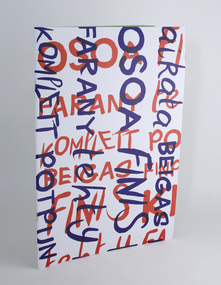
... University of Ballarat Federation University Graphic Design Multimedia Bachelor Degree Camp Street Campus Arts Academy Nathan Burke Leroy Cassar Steven Curcio Shaun Dewitte Shayla Gibson Joe Halliwell Nikki Luitjes Stephanie Martin Claudia Prendergast Adam Trethowan Cheyenne Monaghan Caitlin Wytkamp Alistair Heighway Ben Mangan Chrissie Smith Claire Blake Debbie Hill Ewen Ross Jason Grace Jimmy Pasakos John McDonald Justin Weyers Paul Mah Peter Gaulke Peter Pilven Phillip Berry Roberta Crisci-Richardson Sam Harmer Travis Price Promotional catalogue created by Federation University third year, graduating students, 2016. 24pp full colour text pages and 4pp saddle stitched cover (printed dark orange and blue), uncoated stock. ...In this catalogue / Zine, students are responding to the theme of "End". Students: Nathan Burke, Leroy Cassar, Steven Curcio, Shaun Dewitte, Shayla Gibson, Joe Halliwell, Nikki Luitjes, Stephanie Martin, Claudia Prendergast, Adam Trethowan, Cheyenne Monaghan, Caitlin Wytkamp. 12 students. Thank you to lecturers and supporters, Alistair Heighway, Ben Mangan, Chrissie Smith, Claire Blake, Debbie Hill, Ewen Ross, Jason Grace, Jimmy Pasakos, John McDonald, Justin Weyers, Paul Mah, Peter Gaulke, Peter Pilven, Phillip Berry, Roberta Crisci-Richardson, Sam Harmer, Travis Price. Thank you to final year staff, Ben Mangan, Chrissie Smith, Nicholas Mau, Peter Gaulke, Phillip Berry.Promotional catalogue created by Federation University third year, graduating students, 2016. 24pp full colour text pages and 4pp saddle stitched cover (printed dark orange and blue), uncoated stock.university of ballarat, federation university, graphic design, multimedia, bachelor, degree, camp street campus, arts academy, nathan burke, leroy cassar, steven curcio, shaun dewitte, shayla gibson, joe halliwell, nikki luitjes, stephanie martin, claudia prendergast, adam trethowan, cheyenne monaghan, caitlin wytkamp, alistair heighway, ben mangan, chrissie smith, claire blake, debbie hill, ewen ross, jason grace, jimmy pasakos, john mcdonald, justin weyers, paul mah, peter gaulke, peter pilven, phillip berry, roberta crisci-richardson, sam harmer, travis price -
 Federation University Historical Collection
Correspondence, Letters from A. Gallenkamp & Co to the Ballarat School of Mines, 1898, 1898
... Now we have [illegible] in our very large new warehouses in Sun Street, we are importing [illegible] and other glass goods in four or five times the quantity, we could store in our old place, so that we shall hold presently the August stock of glass apparatus in London, enabling us to fill orders of every size in much shorter issue. ...Now we have [illegible] in our very large new warehouses in Sun Street, we are importing [illegible] and other glass goods in four or five times the quantity, we could store in our old place, so that we shall hold presently the August stock of glass apparatus in London, enabling us to fill orders of every size in much shorter issue. ...Two hand written letters relating to orders from the Ballarat School of Mines .1) 31 March 1898 Dear Sir, In reply to your favor of 23 February we have nearly all the apparatus now ready you were good enough to order. I've [illegible] here 12 cases [illegible] fomr Robinson's goods we likely had to wait about 5 months for supply from works, the demand having been quite extraordinary this year. Ou people [illegible] are so busy with Rontgen ray tubes that we cannot get crokes ad Uranium tubes as quickly as we should like. Yours are not yet to hand, have however a promise of delivery very shortly when all goods will be ready for dispatch. Now we have [illegible] in our very large new warehouses in Sun Street, we are importing [illegible] and other glass goods in four or five times the quantity, we could store in our old place, so that we shall hold presently the August stock of glass apparatus in London, enabling us to fill orders of every size in much shorter issue. We shall not loose a day or a book so soon as we are ready with the order early in April. We beg to call your attention to fene glass listed by the [illegible] book post. Your esteemed further orders will oblige. Yours truly [Illegible] .2) 09 September 1898 Dear Sir We thank you for the favor of your order of August just received and give [illegible] attention. arriving to our ... For Reagent bottle 1757 you state no size, we will give you 250cm as the size usually order here. ... We beg to confirm our letter of 2nd inst and enclose two circulars of interest. Yours Faithfully [illegible]a. gallenkamp and co., letterhead, ballarat school of mines, frederick martell, x-ray, xray, rontgen tubes, crooks tubes, uranium tubes -
 Federation University Historical Collection
Book - Booklet, Seriously History Press et al, The Astonishing History of Ballarat Volume 2: 1856-1883, 2018
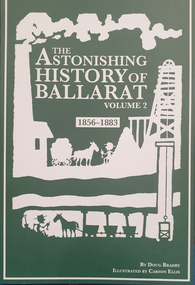
... street...powder magazine...deep leads...james oddie...mortality...statistics...shares...stock...ballarat sebastopol hill lydiard street powder magazine deep leads james oddie mortality statistics shares stock market alexander dewar old gravel pits koh-i-noor cobb corner wesleyan church henry richards caselli band of hope mine sir william don mine sites Book with greenand white cover. ...Book with greenand white cover.non-fictionballarat, sebastopol hill, lydiard street, powder magazine, deep leads, james oddie, mortality, statistics, shares, stock market, alexander dewar, old gravel pits, koh-i-noor, cobb corner, wesleyan church, henry richards caselli, band of hope mine, sir william don, mine sites -
 Flagstaff Hill Maritime Museum and Village
Functional object - Water standpipe, Langlands Bros. & Co, 1880-1893
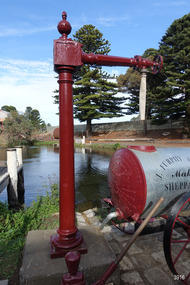
... Street, and distributed throughout the town in a system of pipes. By late 1939 a reticulated supply was installed, with the water piped in under the Otway Scheme. Standpipes are still used in modern times in rural and remote areas for homes, farms, stock, agriculture and firefighting. ...Street, and distributed throughout the town in a system of pipes. By late 1939 a reticulated supply was installed, with the water piped in under the Otway Scheme. Standpipes are still used in modern times in rural and remote areas for homes, farms, stock, agriculture and firefighting. ...This water standpipe is believed to be the only one of its kind in working order. It was originally located in Warrnambool, on the hillside at the corner of Mickle Crescent and Banyan Street, providing water for the Chinese Market Gardens below, on the flats. It was removed from this location on May 2nd, 1979, with the intention to relocate it at the new Flagstaff Hill Maritime Museum & Village. The standpipe lay in storage for years until the Warrnambool Company, Chemblast, offered to restore it for use as a working display. The display was officially opened on March 31, 2014. The water from the adjacent lake is drawn out with a hand operated water pump, and goes up into the standpipe, where flows through the canvas hose and into the top of the Furphy Farm Water Cart. The display is a visual acknowledgement of the years served by Flagstaff Hill volunteer and Friends of Flagstaff Hill Chairperson, Bob Crossman. Warrnambool’s early settlers had no water supply prior to the mid-1850s. They relied on rain water tanks, domestic wells and springs. The town experienced a huge, destructive fire in William Bateman Jnr. & Co.’s large produce store in November 1856, which highlighted the need for both a fire brigade and a good supply of water. In 1863 a volunteer fire brigade was established. In August 1880 the town celebrated the installation of its first water standpipe on the corner of Liebig and Timor streets. The water was pumped from springs at Cannon Hill through the connected pipeline to the standpipe, then distributed to households via horse and cart. Each of the licenced cart drivers were compelled by Council regulations to keep their carts full from sunset to sunrise, ready to cart water to outbreaks of fire. They received a fee for this service. In 1893 the town installed a water supply, sourced from the Merri River, stored in a reservoir basin and tower in north Liebig Street, and distributed throughout the town in a system of pipes. By late 1939 a reticulated supply was installed, with the water piped in under the Otway Scheme. Standpipes are still used in modern times in rural and remote areas for homes, farms, stock, agriculture and firefighting. Many commercial or government owned standpipes are metered, charging a fee for the quantities of water supplied. This water standpipe was made by Langlands Foundry Co. Limited, Melbourne, which was establish in 1842. It was Melbourne’s first foundry and iron shipbuilder, and one of the largest employers in Victoria at the time. Langlands was known for its high quality workmanship and wide range of goods for mining, engineering, marine, railway and other industrial uses. The company made the first cast bell, the first lamp posts in the colony, and the boiler for the first Australian train. In the 1860s it produced cast iron pipes for the Board of Works, which laid the pipes for Melbourne’s first reticulated water supply. The firm was bought by Austral Otis Co. in 1897.This water standpipe is significant historically as it is believed to be the only one of its type in working condition. The standpipe is significant for being manufactured by early colonial firm Langlands Foundry of Melbourne, which was known for high quality, cast iron products. The firm made the boiler for the first Australian train, assembled the first Australian paddle steamer and made the first Australian cast bell and lamp posts. Langlands was one of the largest employers in Victoria at the time. The standpipe is significant historically as it represents the evolution of water supply services in Australia. Standpipe; vertical cast iron water pipe, painted crimson, fixed in position, tapering inward from the round base to the rectangular joint near the finial on top. A hexagonal pipe extends at right angles from the joint, with an outlet fitting and flow-controlling wheel on the end. A length of canvas hose hangs from the outlet fitting. Inscriptions are on one face of the joint. The standpipe was made by Langlands Foundry Company of Melbourne. Embossed “LANGLANDS FOUNDRY CO. / LIMITED / ENGINEERS / MELBOURNE”warrnambool, flagstaff hill maritime museum, maritime museum, shipwreck coast, flagstaff hill maritime village, great ocean road, flagstaff hill, standpipe, stand-pipe, water standpipe, fire standpipe, firefighting equipment, water supply equipment, chinese market gardens, banyan street, liebig street, water tower, bateman’s fire, working display, water supply, town water, rural water, reticulated water, cannon hill spring, merri river, otway water, water carters, horse and cart water supply, volunteer fire brigade, langlands foundry, early melbourne, iron works, bob crossman, late 19th century water supply -
 City of Moorabbin Historical Society (Operating the Box Cottage Museum)
Document - Document, deposit receipt 1950, c1950
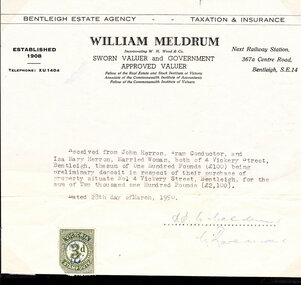
... The Marriott family were early settler market gardeners from 1878 in the area of Dendy’s 1841 Special Survey and John Herron was a descendant of Philip Jones , a chair-maker, who settled in the area of East Brighton, now Bentleigh, in 1852 pioneers early settlers brighton moorabbin bentleigh market gardeners dairyman dairy farmer jones james jones mary ann jones martha jones elizabeth ann dendy henry dendys special survey 1841 elster creek melbourne jones ethel may herron isa mary herron john tram conductor marriott m solicitors valuers taxation meldrum w real estate BENTLEIGH ESTATE AGENCY TAXATION & INSURANCE / WILLIAM MELDRUM / ESTABLISHED / 1908 Incorporating W.H.Wood & Co., Next Railway Station,/ SWORN VALUER and GOVERNMENT / APPROVED VALUER 367 a Centre Road / Bentleigh / Telephone XU 1404 / Fellow of the Real Estate and Stock Institute of Victoria / Associate of the Commonwealth Institute of Accountants/ Fellow of the Commonwealth Institute of Valuers Stamp in left bottom VICTORIA STAMP DUTY 3d with signature initials / Letter dated 28th day of March 1950 and signed SP W Meldrum / C Raveand An original paper statement of receipt issued by William Meldrum for £100 deposit paid on March 28th 1950 by Mr John Herron for purchase of the house at 4 Vickery Street Bentleigh Document Document, deposit receipt 1950 Unrecorded printer for W Meldrum, Real Estate Agent ...Mr John Herron and his wife Isa Mary Herron purchased the house at 4 Vickery Street Bentleigh in 1950 from Miss M Marriott. He was a descendant of John James an early settler dairyman in Moorabbin Shire and Miss M Marriott was a descendant of the early settler market gardeners Marriott family. Mr Herron lived there until 1989 and the house was then demolished and turned into a carpark for the busy Shopping precinct of Centre Road, Bentleigh.The Marriott family were early settler market gardeners from 1878 in the area of Dendy’s 1841 Special Survey and John Herron was a descendant of Philip Jones , a chair-maker, who settled in the area of East Brighton, now Bentleigh, in 1852An original paper statement of receipt issued by William Meldrum for £100 deposit paid on March 28th 1950 by Mr John Herron for purchase of the house at 4 Vickery Street BentleighBENTLEIGH ESTATE AGENCY TAXATION & INSURANCE / WILLIAM MELDRUM / ESTABLISHED / 1908 Incorporating W.H.Wood & Co., Next Railway Station,/ SWORN VALUER and GOVERNMENT / APPROVED VALUER 367 a Centre Road / Bentleigh / Telephone XU 1404 / Fellow of the Real Estate and Stock Institute of Victoria / Associate of the Commonwealth Institute of Accountants/ Fellow of the Commonwealth Institute of Valuers Stamp in left bottom VICTORIA STAMP DUTY 3d with signature initials / Letter dated 28th day of March 1950 and signed SP W Meldrum / C Raveand pioneers, early settlers, brighton, moorabbin, bentleigh, market gardeners, dairyman, dairy farmer, jones james, jones mary ann, jones martha, jones elizabeth ann, dendy henry, dendys special survey 1841, elster creek, melbourne, jones ethel may, herron isa mary, herron john, tram conductor, marriott m, solicitors, valuers, taxation, meldrum w, real estate -
 Greensborough Historical Society
Photograph - Digital image, Main Street Greensborough (Rose Series), 1930c
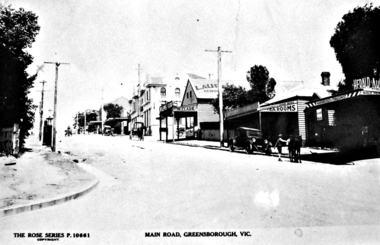
... Street Greensborough. The Tobacconist Shop on the front Right cf: Advertiser Hurstbridge 2/1/1925 page 3: W. J. Franklin Authorised News Agent Hair Dresser and Tobacconist. Best Brands of Tobacco, Cigarettes and Cigars. Billiards and Snooker. Two Alcock Tables. Golf Accessories Stocked...Street Greensborough. The Tobacconist Shop on the front Right cf: Advertiser Hurstbridge 2/1/1925 page 3: W. J. Franklin Authorised News Agent Hair Dresser and Tobacconist. Best Brands of Tobacco, Cigarettes and Cigars. Billiards and Snooker. Two Alcock Tables. Golf Accessories Stocked ..."Rose Series" postcard no P10661 Main Street Greensborough. The Tobacconist Shop on the front Right cf: Advertiser Hurstbridge 2/1/1925 page 3: W. J. Franklin Authorised News Agent Hair Dresser and Tobacconist. Best Brands of Tobacco, Cigarettes and Cigars. Billiards and Snooker. Two Alcock Tables. Golf Accessories Stocked. Main Road, Greensborough.Digital copy of black and white postcard.main street greensborough, rose series postcards -
 Greensborough Historical Society
Photograph - Digital image, John Blackbourn, 1939_
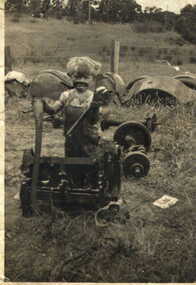
... Street. Photographs from the collection of Peter Blackbourn, a descendant of the Chapman Stock family. ...Street. Photographs from the collection of Peter Blackbourn, a descendant of the Chapman Stock family. ...John Blackbourn, born 1936; taken at corner of Old Eltham Road and Main Street. Photographs from the collection of Peter Blackbourn, a descendant of the Chapman Stock family. Annotations to photos by Peter Blackbourn.Digital copy of black and white photograph.peter blackbourn, john blackbourn
