
Showing 7 items matching "stone sink"
-
 Ballarat Heritage Services
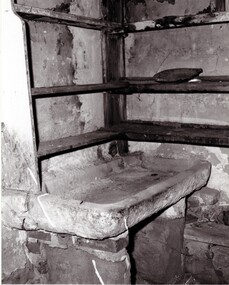
Photograph, Hand Hewn Stone Sink from the Gervasoni Homestead, c1988
... Hand Hewn Stone Sink from the Gervasoni Homestead ......Stone sink...Black and White photograph of a hand hewn stone sink from the Gervasoni Homestead. It was stolen c1990s....Hand Hewn Stone sink Gervasoni HOmestead Yandoit Creek Black and White photograph of a hand hewn stone sink from the Gervasoni Homestead. ...Black and White photograph of a hand hewn stone sink from the Gervasoni Homestead. It was stolen c1990s.hand hewn, stone sink, gervasoni homestead, yandoit creek -
 Flagstaff Hill Maritime Museum and Village
Functional object - Lead shot, Circa 1877
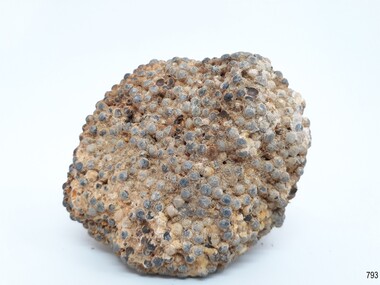
... Lead shot was already being produced in Australia at the time the Loch Ard sinking in March 1878. James Moir had constructed a 157 feet circular stone shot tower near Hobart in 1870, with a peak annual production of 100 tons of lead shot sold in 28 pound linen bags. ...Lead shot was already being produced in Australia at the time the Loch Ard sinking in March 1878. James Moir had constructed a 157 feet circular stone shot tower near Hobart in 1870, with a peak annual production of 100 tons of lead shot sold in 28 pound linen bags. ...This artifact is a sample of small caliber lead shot recovered by Flagstaff Hill divers from the wreck of the Loch Ard in 1975. Included in her diverse and valuable cargo were 22 tons of lead shot, packed in cloth bags and wooden casks. Bulk quantities of lead shot, uniformly round balls of dull grey metal ranging from 2mm “birdshot” to 8mm “buckshot”, were routinely exported to the Australian colonies. Shot was used mostly as projectiles fired from smooth bored guns to bring down moving targets such as wild ducks and small game. It was also useful as ballast, when a dense, “pourable” weight was required to fill cavities or establish volume within a measuring container. The production of consistently round spheres of lead shot required the pouring of molten metal through a sieve and then a long drop through the atmosphere to a water filled basin for final cooling and collection. This “shot tower” process was first patented by William Watts of Bristol in 1782. His calculation of a 150 feet fall was not only to form evenly spherical droplets through surface tension, but also to provide partial cooling and solidification to each shot before they hit the water below. The value of his innovation was the minimising of indentation and shape distortion, avoiding the expense of re-smelting and re-moulding the lead. Lead shot was already being produced in Australia at the time the Loch Ard sinking in March 1878. James Moir had constructed a 157 feet circular stone shot tower near Hobart in 1870, with a peak annual production of 100 tons of lead shot sold in 28 pound linen bags. However colonial demand exceeded this source of local supply. The continued strength of the market for lead shot in the Colony of Victoria prompted substantial investment in additional productive capacity in Melbourne in the next decade. In 1882 Richard Hodgson erected the 160 feet round chimney-shaped Clifton Hill shot tower on Alexandra Parade (VHR H0709) and in 1889 Walter Coop built the 160 feet square tower-shaped Melbourne Central shot tower on La Trobe Street (VHR H0067). At its peak, the Coop Tower produced 6 tons of lead shot per week, or 312 tons per annum. History of the Loch Ard: The Loch Ard got its name from "Loch Ard" a loch that lies to the west of Aberfoyle, and the east of Loch Lomond. It means "high lake" in Scottish Gaelic. The vessel belonged to the famous Loch Line which sailed many vessels from England to Australia. The Loch Ard was built in Glasgow by Barclay, Curle & Co. in 1873, the vessel was a three-masted square-rigged iron sailing ship that measured 79.87 meters in length, 11.58 m in width, and 7 m in depth with a gross tonnage of 1693 tons with a mainmast that measured a massive 45.7 m in height. Loch Ard made three trips to Australia and one trip to Calcutta before its fateful voyage. Loch Ard left England on March 2, 1878, under the command of 29-year-old Captain Gibbs, who was newly married. The ship was bound for Melbourne with a crew of 37, plus 17 passengers. The general cargo reflected the affluence of Melbourne at the time. Onboard were straw hats, umbrellas, perfumes, clay pipes, pianos, clocks, confectionery, linen, and candles, as well as a heavier load of railway irons, cement, lead, and copper. There were other items included that were intended for display in the Melbourne International Exhibition of 1880. The voyage to Port Phillip was long but uneventful. Then at 3 am on June 1, 1878, Captain Gibbs was expecting to see land. But the Loch Ard was running into a fog which greatly reduced visibility. Captain Gibbs was becoming anxious as there was no sign of land or the Cape Otway lighthouse. At 4 am the fog lifted and a lookout aloft announced that he could see breakers. The sheer cliffs of Victoria's west coast came into view, and Captain Gibbs realised that the ship was much closer to them than expected. He ordered as much sail to be set as time would permit and then attempted to steer the vessel out to sea. On coming head-on into the wind, the ship lost momentum, the sails fell limp and Loch Ard's bow swung back towards land. Gibbs then ordered the anchors to be released in an attempt to hold their position. The anchors sank some 50 fathoms - but did not hold. By this time the ship was among the breakers and the tall cliffs of Mutton Bird Island rose behind. Just half a mile from the coast, the ship's bow was suddenly pulled around by the anchor. The captain tried to tack out to sea, but the ship struck a reef at the base of Mutton Bird Island, near Port Campbell. Waves subsequently broke over the ship and the top deck became loosened from the hull. The masts and rigging came crashing down knocking passengers and crew overboard. When a lifeboat was finally launched, it crashed into the side of Loch Ard and capsized. Tom Pearce, who had launched the boat, managed to cling to its overturned hull and shelter beneath it. He drifted out to sea and then on the flood tide came into what is now known as Lochard Gorge. He swam to shore, bruised and dazed, and found a cave in which to shelter. Some of the crew stayed below deck to shelter from the falling rigging but drowned when the ship slipped off the reef into deeper water. Eva Carmichael a passenger had raced onto the deck to find out what was happening only to be confronted by towering cliffs looming above the stricken ship. In all the chaos, Captain Gibbs grabbed Eva and said, "If you are saved Eva, let my dear wife know that I died like a sailor". That was the last Eva Carmichael saw of the captain. She was swept off the ship by a huge wave. Eva saw Tom Pearce on a small rocky beach and yelled to attract his attention. He dived in and swam to the exhausted woman and dragged her to shore. He took her to the cave and broke the open case of brandy that had washed up on the beach. He opened a bottle to revive the unconscious woman. A few hours later Tom scaled a cliff in search of help. He followed hoof prints and came by chance upon two men from nearby Glenample Station three and a half miles away. In a complete state of exhaustion, he told the men of the tragedy. Tom then returned to the gorge while the two men rode back to the station to get help. By the time they reached Loch Ard Gorge, it was cold and dark. The two shipwreck survivors were taken to Glenample Station to recover. Eva stayed at the station for six weeks before returning to Ireland by steamship. In Melbourne, Tom Pearce received a hero's welcome. He was presented with the first gold medal of the Royal Humane Society of Victoria and a £1000 cheque from the Victorian Government. Concerts were performed to honour the young man's bravery and to raise money for those who lost families in the disaster. Of the 54 crew members and passengers on board, only two survived: the apprentice, Tom Pearce, and the young woman passenger, Eva Carmichael, who lost her family in the tragedy. Ten days after the Lochard tragedy, salvage rights to the wreck were sold at auction for £2,120. Cargo valued at £3,000 was salvaged and placed on the beach, but most washed back into the sea when another storm developed. The wreck of Lochard still lies at the base of Mutton Bird Island. Much of the cargo has now been salvaged and some items were washed up into Lochard Gorge. Cargo and artifacts have also been illegally salvaged over many years before protective legislation was introduced in March 1982. One of the most unlikely pieces of cargo to have survived the shipwreck was a Minton majolica peacock- one of only nine in the world. The peacock was destined for the Melbourne 1880 International Exhibition. It had been well packed, which gave it adequate protection during the violent storm. Today the Minton peacock can be seen at the Flagstaff Hill Maritime Museum in Warrnambool. From Australia's most dramatic shipwreck it has now become Australia's most valuable shipwreck artifact and is one of very few 'objects' on the Victorian State Heritage Register.The shipwreck of the Loch Ard is of significance for Victoria and is registered on the Victorian Heritage Register ( S 417). Flagstaff Hill has a varied collection of artifacts from Loch Ard and its collection is significant for being one of the largest accumulation of artifacts from this notable Victorian shipwreck of which the subject items are a small part. The collection's objects give us a snapshot of how we can interpret the story of this tragic event. The collection is also archaeologically significant as it represents aspects of Victoria's shipping history that allows us to interpret Victoria's social and historical themes of the time. Through is associated with the worst and best-known shipwreck in Victoria's history.Lead shot; a group of mixed -sized lead shot. Small 2mm shot is embedded in a sea sediment clump of concretion. Also in the group are also 5 single 2mm shot and 4 single 4mm shot that are clean and free of sediment. The shot was recovered from the wreck of the Loch Ard.Nonewarrnambool, shipwreck coast, flagstaff hill, flagstaff hill maritime village, flagstaff hill maritime museum, shipwreck artefact, lead shot, loch ard, colonial industry, melbourne shot towers, victorian metallurgy, colonial imports -
 Bendigo Historical Society Inc.
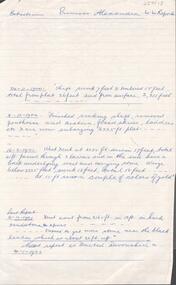
Document - PRINCESS ALEXANDRA COY & TRIBUTORS - EXTRACTS ON PRINCESS ALEXANDRA MINE
... Handwritten notes on the Princess Alexandra Mine. 24/11/1900 Shaft sunk 7 feet & timbered 15 feet total from plat 26 feet and from surface 2,311 feet. 8/12/1900 Finished sinking shaft, removed penthouse and cistern, fixed skids, ladders etc & are now enlarging 2225 ft plat. 16/2/1901 West x cut at 2285 ft. driven 17 feet, total 41 ft passed through 3 lavas and in the end have a back underlying west and carrying stone. ...DOCUMENT Gold princess alexandra coy & tributors Princess Alexandra Coy & Tributors Extracts on Princess Alexandra Mine United Devonshire MM Reports Handwritten notes on the Princess Alexandra Mine. 24/11/1900 Shaft sunk 7 feet & timbered 15 feet total from plat 26 feet and from surface 2,311 feet. 8/12/1900 Finished sinking shaft, removed penthouse and cistern, fixed skids, ladders etc & are now enlarging 2225 ft plat. 16/2/1901 West x cut at 2285 ft. driven 17 feet, total 41 ft passed through 3 lavas and in the end have a back underlying west and carrying stone. ...Handwritten notes on the Princess Alexandra Mine. 24/11/1900 Shaft sunk 7 feet & timbered 15 feet total from plat 26 feet and from surface 2,311 feet. 8/12/1900 Finished sinking shaft, removed penthouse and cistern, fixed skids, ladders etc & are now enlarging 2225 ft plat. 16/2/1901 West x cut at 2285 ft. driven 17 feet, total 41 ft passed through 3 lavas and in the end have a back underlying west and carrying stone. Winze below 2225 feet, sunk 13 feet, total 18 feet - - at 15 ft saw a couple of colours of gold. Last Report 21/12/1901 Xcut east from 2165 ft in 13 ft in hard sandstone spurs - - Expect to get more stone near the black leader which is about 20 ft up. Next report as 'United Devonshire' on 4/1/1902. Notes prepared by Albert Richardson.document, gold, princess alexandra coy & tributors, princess alexandra coy & tributors, extracts on princess alexandra mine, united devonshire, mm reports -
 Archive of Vietnamese Boat People
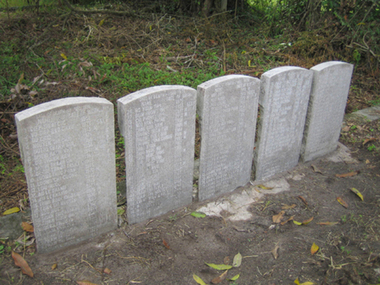
5 grave stones of the VBP mass grave in Cherang Ruku
... stones of the VBP mass grave in Cherang Ruku were built by the UN-HCR. As told by the local old man, Mr Lim at 80 years old, in 2010, who was in charge of burying these victims from the first day, he confirmed that there were 139 bodies buried by himself. It can accepted that because the name list of the boat was lost during sinking...stones of the VBP mass grave in Cherang Ruku were built by the UN-HCR. As told by the local old man, Mr Lim at 80 years old, in 2010, who was in charge of burying these victims from the first day, he confirmed that there were 139 bodies buried by himself. It can accepted that because the name list of the boat was lost during sinking ...This 5 grave stones of the VBP mass grave in Cherang Ruku were built by the UN-HCR. As told by the local old man, Mr Lim at 80 years old, in 2010, who was in charge of burying these victims from the first day, he confirmed that there were 139 bodies buried by himself. It can accepted that because the name list of the boat was lost during sinking, the name list angraved on the stones was collected by UN HCR member by interviewing the victims who could identified victims. Furthermore the dead bodies, as told by Mr Lim, were washed ashore not in one day. The local residents could not contact to report to the UN HCR many after the accident, what they could do was that they had to quicly bury the decomposed bodies. As told by vitims of the MT065, about 2 - 3 days after the accident, they were called to the beach to identify the bodies. No way they could identify the body because it was swollen and decomposed. Face and parts of the body was eaten by fish.5 grave stones of the VBP mass grave in Cherang Ruku -
 Ballarat Heritage Services
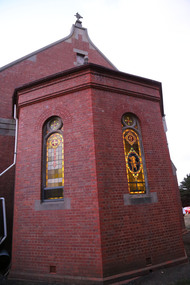
Digital photographs, L.J. Gervasoni, St Brigid's Crossley - Christmas Carols - stained glass windows night, 12/2016
... stone. Nowhere was it held in higher esteem than in these islands, and the people would always be faithful to God and His church. It was an inspira tion to go into the glorious church opened that day. It stood for loyalty and faith fulness and was a credit and a consola tion to the Bishop and people of the diocese, to the architect, and to the priests and the honest and zealous administrator of the parish. There was hope and an inspiration in that day's celebrations, and surely the Catholic faith would sink...stone. Nowhere was it held in higher esteem than in these islands, and the people would always be faithful to God and His church. It was an inspira tion to go into the glorious church opened that day. It stood for loyalty and faith fulness and was a credit and a consola tion to the Bishop and people of the diocese, to the architect, and to the priests and the honest and zealous administrator of the parish. There was hope and an inspiration in that day's celebrations, and surely the Catholic faith would sink ..."NEW CROSSLEY CHURCH. BLESSING AND OPENING CEREMONY. A lasting testimony to the faithful generosity of the Catholic community at Crossley was vouchsafed on Sunday last, when the beautiful new church of St. Brigid was formally blessed and opened, in the presence of a particularly large congregation of adherents of the Roman Catholic faith, and many supporters of the doctrines of other churches. The function was further enhanced by the presence of two noted Catholics in Dr. Higgins (Bishop of Ballarat) and Dr. Mannix (Coadjutor Archbishop of Melbourne.) Upon arrival at the church the prelates were received by a guard of honor formed by the members of the H.A.C.B. Society, and were introduced to the members of the local committee. Then his Lordship the Bishop formally blessed the exterior and interior of the building. The building is handsome and commo dious, and one that should suffice for the population of the Crossley district for many years to come. Standing upon the highest point in the vicinity it occupies a commanding position and is a prominent landmark for many miles around. At first it was intended to pull down the old church and erect the new one upon the space occupied by it, but subsequently the land adjoining was purchased, and the sacred edifice built upon it. The style of architecture is a free treatment of the Romanesque. In a short space of time the grounds and walks were transformed by working bees and made to conform to the beauty of the building. The interior is most artistic, and would be difficult to improve upon in elegance of design, while the furnishings are most appropriate, and harmonise excellently with the general scheme of decoration. It seats 400 people and in addition there is a choir gallery with a seating capacity of 60. The church is lighted with leaded Cathedral glass windows, and the front presents a pleasing appearance, the entrance porch being surmounted with a semi-Gothic window. The floor is tiled throughout. The ceilings are semi-circular in form, with beautiful designs worked in fibrous plaster. The brickwork of the structure is faced with cement, and it has a slate roof. It is undoubtedly an addition to the ecclesiastical buildings of the district, and was universally admired. The architect was Mr. A. A. Fritsch, of Melbourne, and the contractors Messrs F. and E. Deague, of North Fitzroy. On the doors being thrown open for the admission of the congregation, the seating accommodation was immediately fully taxed, and the lengthy service and sermon were listened to with the greatest interest and attention. Missa Cantata was sung, the Rev. Father Phelan, Koroit, being the celebrant. The musical arrangements were in the capable hands of Mr. Renwick, of Warrnambool, while Miss Logan presided at the organ. Mrs. Dan. Ryan was the soprano soloist, and sang Gounod's Ave Maria at the offertory very sweetly and expressively. At the consecration Rossi's Tantum Ergo was sung by Messrs Crowley and Renwick; Farmer's Kyrie Gloria and Agnus Dei and Webb's Credo were rendered during mass, and while the collection was being taken additional numbers were sung. The occasional sermon was preached by the Coadjutor Archbishop (Dr. Mannix), who based his remarks upon the Gospel for the day, St. Luke V., verses I to II, dealing with the miraculous draught of fish. On His return from Galilee Christ found that the fishermen had been toiling all night, and had caught nothing. He entered one of the ships, and addressed the multitude on shore. It was a beautiful picture, and no doubt he spoke to them about the kingdom to be established on earth. When He had finished speaking He told the fishermen to launch out into the deep. Peter said " Master, we have fished all night, and have found nothing." Still, they obeyed His command, and the nets were filled almost to breaking point. Having brought their ships to land they left everything and followed Him. In that lesson they had a symbol of God's dealing with men through the church He has established on earth. Their confidence was richly rewarded, and Christ founded His church upon those twelve Apostles. At that time the world was mostly pagan, steeped in iniquity and sin. The chosen people of God worshipped with their lips, but their hearts were far from it. When Christ wanted to estab lish His church on earth, and leave an organisation to carry on the work, did He select the most intellectual, or the most rich or powerful men? Neither did the time seem propitious. He selected twelve men who from a human point of view were quite incapable of accomplishing anything. What happened when the Jews put Him to death? The chosen twelve left Him at the critical hour, and when He came to die on the cross they were not there, but hid themselves from the hate and fury of the Jews. When the Holy Ghost came down upon them and strengthened them they became courageous and went forth at the bidding of their Master to teach all nations. Their success was not confined to the first meet ing after Pentecost, at which they made 5000 converts, but continued until the whole world had been brought into the net. It was surely a consolation to them as well as to him (the preacher), that they came from a land which of all others had been faithful to the teaching of Jesus Christ. The sons and daughters of St. Patrick had taken a great part in bringing men into the meshes of the church. It was due to the nation they belonged to that the church flourished not only in Ireland, but in England, Scotland, Ame rica, and Australia. It may have seemed hard that in the providence of God so many had to leave their homes and find a home in other lands. They had emi grated to the towns of England and Scotland, and had been the means of keeping the Catholic faith living in those places. In the United States and Canada many had made a home for themselves, and were always found faithful to God and to the true church. If to-day the Irish Catholics and Catholics of Irish des cent were taken out of the English and Scotch population there would be little left of the true Church of God. Perhaps they had not the learning of other nations. Certainly they had not the wealth of other nations, and not the power of the sword, but God was with them, and the faith they took from the old land nourished in the distant places. There was a time in Aus tralia when those opposed to God and God's Church thought they could rule Providence and make Australia a Pro testant land. They had lived to see whe ther God or His enemies are the more powerful, and the names of those who tried to stamp out the Catholic religion were forgotten, or only remembered be cause of their persecution. They had lived to see the glorious success which rested upon the Catholic Church in Aus-tralia, which the Irish people had built up stone by stone. Nowhere was it held in higher esteem than in these islands, and the people would always be faithful to God and His church. It was an inspira tion to go into the glorious church opened that day. It stood for loyalty and faith fulness and was a credit and a consola tion to the Bishop and people of the diocese, to the architect, and to the priests and the honest and zealous administrator of the parish. There was hope and an inspiration in that day's celebrations, and surely the Catholic faith would sink deeper and deeper into the people as time went on, and the progress of the last fifty years would be small as compared to the progress of the future. He congratulated the Bishop and priests who had raised that temple, and the people of Crossley upon their generosity and self-sacrifice. He prayed that the blessing of God and St. Brigid would rest upon them, their children, and their children's children. He hoped that not one of those who had received the sacrament at that church would be missing when called before the Judgment Seat, and that all would be counted into the enjoyment of eternal bliss. The Rev. Father Kerin then made a statement of the position of the finances, after which a special col lection was made towards the cost of the building. A list of subscribers of £l and upwards was read, to which Bishop Higgins contributed £250, Rev. Father Kerin £20, and the Coadjutor Archbishop £5. The amount totalled £1245 10s 7d. Pre vious donations totalled £1077 3s, and His Lordship gave an additional £250. An indebtedness of £3974 had been reduced by £1245, leaving a debit balance of £2728. The cost ot the church completed was £6250. They had broken the back of the debt, and were not frightened of it. It was also announced that the beautiful Stations of the Cross, which adorn the walls, had been donated by the following: Mr and Mrs. P. Crowe, Mr. and Mrs. T. Bushell, Mr. and Mrs. P. Gorman, Miss M. Dunne, Mr. Mugavin and Miss Mugavin, Mr. and Mrs. C. Conway, Misses A. and F. Broderick, Mr. and Mrs. Michael Hennessy, Miss K. A. M'Carthy, Mr. and Mrs. Wm. Dalton, Mrs. M. J. Greene, Mrs. and Miss K. Dwyer, Mr. and Mrs. John Mugavin, and the Rev. J. J. Manning. The new Estey organ was contributed by the school children, as the result of an enter tainment. Other donors of furnishings, etc., were Mrs. Brown, senr., (Kirkstall), and Mrs. James Maloney (Killarney), and Mrs. and Miss O'Donohue. The vestments were the gifts of Mr. and Mrs. M. Foley, of Killarney. The furnishings, carpeting, etc., of the sanctuary have been carried out by the Crossley Altar Society, of which Mrs. Jno. O'Brien is president, and Miss Mary Ryan secretary. In the course of a brief address Dr. Higgins expressed his deep indebtedness to the Coadjutor Archbishop for coming amongst them at a great sacrifice to assist in the ceremonies. He heartily thanked the people for their unbounded generosity, and congratulated priests and people upon the magnificent results of their efforts. They had an able champion in Dr. Mannix, who since coming amongst them had distinguished himself by his zeal for the church in this new land. He hoped he would be spared for many years to come to use his splendid talents in the service of the church. (Koroit Sentinel and Tower Hill Advocate, Saturday 4 July 1914, page 2)Digital images of the cathedral leadlight windowns in St Brigid's catholic Church, Crossley. st brigid's crossley, st brigid's, catholic church, catholic, church, religion, celebrations, christmas, christmas carols, carols, stained glass, window -
![Artwork, other - Deep Sinking, Bakery Hill, Ballarat 1853 [sic] 1853, S. T. Gill](/media/collectors/5f33390821ea670db8ae2a22/items/5fa1f19f161ae9159c784d51/item-media/5fcda8a7fbcaa723ace967b5/item-fit-380x285.jpg?cb=6) Bass Coast Shire Council - Robert Smith Collection
Bass Coast Shire Council - Robert Smith CollectionArtwork, other - Deep Sinking, Bakery Hill, Ballarat 1853 [sic] 1853, S. T. Gill
... English - Australian 1808 - 1880 Signed in stone Colour Lithograph S. T. Gill Artwork, other Deep Sinking, Bakery Hill, Ballarat 1853 [sic] 1853 ...English - Australian 1808 - 1880Colour LithographSigned in stone -
 Returned Nurses RSL Sub-branch
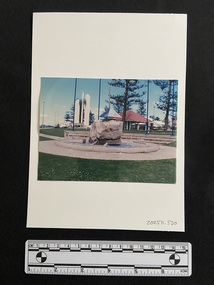
Photograph - 5.5x4 coloured photograph, 1996
... stone from Turallin near Millmerran on the Darling Downs. The bolder symbolises the ecology, the pyramid represents the spirit of those who died in the Centaur sinking and the whole effect is of flotation. ...stone from Turallin near Millmerran on the Darling Downs. The bolder symbolises the ecology, the pyramid represents the spirit of those who died in the Centaur sinking and the whole effect is of flotation. ...Centaur Memorial in Tweed Heads In Queensland. 'Memorial information: Description- A steel pyramid supported by a 15 tonne pink granite stone from Turallin near Millmerran on the Darling Downs. The bolder symbolises the ecology, the pyramid represents the spirit of those who died in the Centaur sinking and the whole effect is of flotation. The tip of the pyramid can be removed to expose an oil fuelled lamp which burns on the night of the anniversary of the sinking. Scrolls containing the names of those on board are also contained in the pyramid. A Walk of Remembrance leads from the memorial to the cliff top. The Centaur Memorial along with theUnited States Destroyer, USS Mugford Memorial were unveiled on 14 May 1993, the 50th anniversary of the sinking of the Australian Hospital Ship. The Walk of Remembrance is dedicated to the memorial of the men and women who lost their lives in the forty-one Allied and Australian Naval and Merchant ships sunk along Australia's coastline during World War Two. It is planned to place a marker in the ground adjacent to the pyramid; this marker and the point of the pyramid will align with the site of the sinking. [Taken from ANZAC Square record] Coloured photograph of a stone memorial set in a pond with a concrete edge and surrounded by small stones. The pond is on flat grassy land and behind it are stone steps for seating. In the background are trees and a pavillion.'Centaur / Memorial. / Danger Pond / Tweed Heads' [Handwritten in blue ink on the back of the photograph] 'SEP 96 05633 M8NAA' [Printed on the back of the photograph]ahs centaur memorial, centaur, war memorials, tweed heads, queensland war memorials
