
Showing 19 items matching "storage pot"
-
 Dutch Australian Heritage Centre Victoria
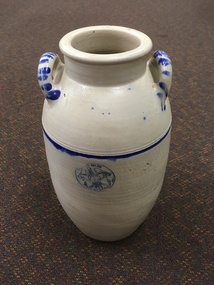
Dutch stoneware pot (Keulse pot), J.M. de Hoop & Son, 800-1900
... ...storage pot...Used for storing preserved food eg. sauerkraut. keulse pot storage pot JM de Hoop & Zoon Rotterdam. On opposite side, circular brand with Fabrieks Merk depicting hope and anchor Grey stoneware pot, amphora shape, blue ring above written inscription, two handles with blue markings. ...Voorraadpot made in Rotterdam by JM de Hoop and son. Used for storing preserved food eg. sauerkraut.Grey stoneware pot, amphora shape, blue ring above written inscription, two handles with blue markings. JM de Hoop & Zoon Rotterdam. On opposite side, circular brand with Fabrieks Merk depicting hope and anchorkeulse pot, storage pot -
 Bendigo Historical Society Inc.
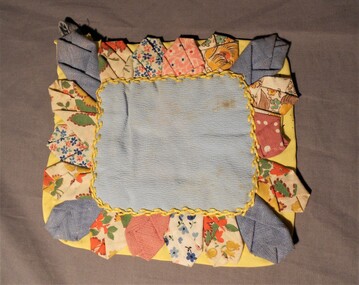
Domestic Object - MERLE HOULDEN COLLECTION: FABRIC POT HOLDER, 1940's-50's
... Food storage & preservation...fabric pot...DOMESTIC EQUIPMENT Food storage & preservation fabric pot holder Made by Merle's Grandmother Williamson. ...Square shaped pot holder. Centre panel, and back lining are made from pale blue "silky - type" (probably synthetic) fabric. This 9 X 11cm panel is surrounded by a band of yellow fabric, which also forms a binding around the edges. A blue and white check flannelette fabric forms the padding in the pot holder. Folded strips of floral cotton form a decorative band between the small and larger rectangles. This border is decorated by yellow stitchery. A fabric loop at one corner is for hanging purposes.Made by Merle's Grandmother Williamson.domestic equipment, food storage & preservation, fabric pot holder -
 Bendigo Historical Society Inc.
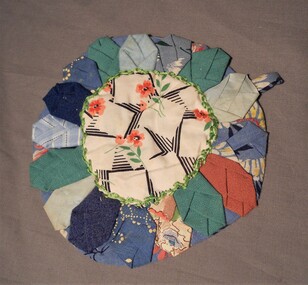
Domestic Object - MERLE HOULDEN COLLECTION: FABRIC POT HOLDER - CIRCULAR, 1940's-50's
... Food storage & preservation...fabric pot...DOMESTIC EQUIPMENT Food storage & preservation fabric pot holder- circular Made by Merle's Grangmother Williamson. ...Centre panel of floral cotton, nine cms in diameter. Surrounded by folded strips of coloured cotton fabric, forming a "flower" type design. A row of embroidery in green stranded cotton edges the centre panel. Padded in the centre, the pot holder is backed with blue floral cotton fabric, and bound with the same around the outer edge.Made by Merle's Grangmother Williamson.domestic equipment, food storage & preservation, fabric pot holder- circular -
 Flagstaff Hill Maritime Museum and Village
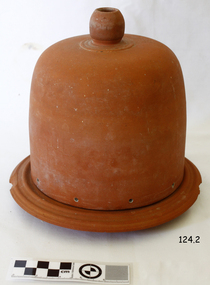
Domestic object - Terracotta Cooler Top, Ovens Pottery, c. 1890-1892
... During their short ten years of operation they produced stoneware garden urns, vases, cheese dishes, ginger beer bottles, butter coolers, water filters, wine and spirit barrels, bread plates, jugs, teapots, storage jars, pots, tiles, flower pots, spittoons, basins, bowls, demijohns, lidded crocks, pipes and bricks....During their short ten years of operation they produced stoneware garden urns, vases, cheese dishes, ginger beer bottles, butter coolers, water filters, wine and spirit barrels, bread plates, jugs, teapots, storage jars, pots, tiles, flower pots, spittoons, basins, bowls, demijohns, lidded crocks, pipes and bricks. ...The Ovens pottery operated from 1881 to1892 they had taken over H L & E pottery at Beechworth in 1888 but mounting debts forced the Ovens company to close in 1892. During their short ten years of operation they produced stoneware garden urns, vases, cheese dishes, ginger beer bottles, butter coolers, water filters, wine and spirit barrels, bread plates, jugs, teapots, storage jars, pots, tiles, flower pots, spittoons, basins, bowls, demijohns, lidded crocks, pipes and bricks.A significant item made by an early Australian pottery in Beechworth Victoria, this company made many utilitarian items for the Victorian domestic market. It gives us today a snapshot into early Australian companies that were unable to sustain manufacturing their products into the 20th century, due in part to the rising imports of cheaper items from overseas.Red terracotta butter cooler comprising, round base with ridged lip, and bell shaped, domed lid with spherical handle on topMarked "Ovens Pottery, Co Ltd, Patd 1890, Beechworth" flagstaff hill, warrnambool, shipwrecked coast, flagstaff hill maritime museum, flagstaff hill maritime village, great ocean road, cooler, terracotta cooler, utensil, kitchen ware, terracotta, food container, food preservation, butter cooler, ovens pottery -
 Lakes Entrance Historical Society
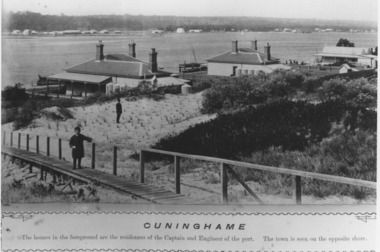
Photograph - New Works Lakes Entrance Victoria, Caire, Nicholas John
... Two houses feature chimneys with chimney pots, and storage tanks for rain water. A man is standing on re-grassed sandy area surveying scrubby natural vegetation. ...Two houses feature chimneys with chimney pots, and storage tanks for rain water. A man is standing on re-grassed sandy area surveying scrubby natural vegetation. ...'Cunninghame', the houses in the foreground are the residences of the Captain and the Engineer of the port. The town is seen on the opposite shoreBlack and white photograph of the rear view of three houses on the north side of the Hummocks, opposite Cunninghame, now Lakes Entrance. Two houses feature chimneys with chimney pots, and storage tanks for rain water. A man is standing on re-grassed sandy area surveying scrubby natural vegetation. Small boy standing on wooden path holding handrail. Lakes Entrance Victoriawaterways, topography, public utilities, houses -
 Flagstaff Hill Maritime Museum and Village
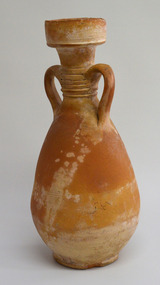
Ceramic - Amphora, mid-to-late 19th century
... storage jar...Flagstaff Hill...Maritime Museum...Maritime Village...shipwreck artefact...relic...Shipwreck Museum...pottery jar...ancient jar...Egyptian water pot...Flagstaff Hill Maritime Museum and Village Warrnambool Great Ocean Road Shipwreck Coast amphora jug Mahogany ship ancient wreck Joe O'Keefe Duncan Thermoluminescence North Africa Levy Point pottery storage jar Flagstaff Hill Maritime Museum Maritime Village shipwreck artefact relic Shipwreck Museum pottery jar ancient jar Egyptian water pot Greek jar ceramic jar mystery exotic jar mystery antique historic jug 1934 Joe O’Keefe Marshall Duncan Port Fairy 1935 1985 Marshall McKenzie Duncan Mac Duncan Duncan family 1981 Dan Madden scientific investigation scientific analysis scientific dating North African origin mid-late 19th century Marram grass Levy’s Point Pinhole patterns: [3 holes above 3 holes] opposite [3 holes above 3 holes], 1 hole] [ 1 hole above 2 holes] Amphora or jug; earthenware, orange clay with areas of cream. ...This amphora or jug has a silhouette shaped like a woman with her hands on her hips, wearing a long, flared-out skirt. The design was used in ancient Greece for pottery storage jars, the neck being narrower than the body. According to reports, this amphora was discovered in 1934 by Joe O'Keeffe, in a sand blowout, or sand hummocks, west of Levy's Point, west of Warrnambool, while he was planting marram grass for Mr Duncan. An article in the Warrnambool Standard newspaper of December 21, 1985, states that the amphora may be linked to the wooden sailing ship called the Mahogany Ship (also called the Ancient Wreck). Thermoluminescence testing indicates the relic was made in the mid-to-late 19th century, and experts suggest it was of North African origin. The presence of the amphora in the dunes, and the amphora itself, is still a mystery. The amphora was donated to Flagstaff Hill on a long-term loan by the Duncan family and displayed to the public for the first time on December 21, 1985. The exhibition continued until February 2023, when the objects on display in the Assistant Lighthouse Keepers Cottage (Shipwreck Museum) were returned to storage to rest, and the redevelopment of the Cottage began. A search for members of the Duncan Family was undertaken by Flagstaff Hill and stakeholders to resolve the loan term, but the family at that time was unknown. As such, to properly care for the amphora, it has been registered until ownership can be determined. The amphora is currently on display in the Great Circle Gallery, where members of the Duncan family recognised it and have since made contact with the museum. The amphora's presence in the hummocks remains an intriguing and tantalising mystery, yet to be solved!The amphora is significant for the mystery it holds. Its origin and connection with the local area have led to local speculation since it was discovered in 1934. Amphora or jug; earthenware, orange clay with areas of cream. The vessel has a wide mouth, a deep lip, two opposing handles between the neck and shoulder, and a bulbous body. The curved handles have a design of six bands between them. There are three rings of small dots encircling the body. The underside has concentric circles in the clay, an uneven edge and pinhole markings. The amphora is kindly on loan from the Duncan family.Pinhole patterns: [3 holes above 3 holes] opposite [3 holes above 3 holes], 1 hole] [ 1 hole above 2 holes] flagstaff hill maritime museum and village, warrnambool, great ocean road, shipwreck coast, amphora, jug, mahogany ship, ancient wreck, joe o'keefe, duncan, thermoluminescence, north africa, levy point, pottery, storage jar, flagstaff hill, maritime museum, maritime village, shipwreck artefact, relic, shipwreck museum, pottery jar, ancient jar, egyptian water pot, greek jar, ceramic jar, mystery, exotic jar, mystery antique, historic jug, 1934, joe o’keefe, marshall duncan, port fairy, 1935, 1985, marshall mckenzie duncan, mac duncan, duncan family, 1981, dan madden, scientific investigation, scientific analysis, scientific dating, north african origin, mid-late 19th century, marram grass, levy’s point -
 Flagstaff Hill Maritime Museum and Village
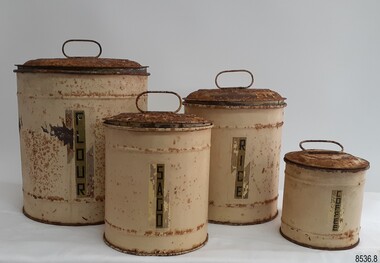
Container - Kitchen Canister set, Late 19th to early 20th century
... pots. This set of kitchen food containers is an example of colonial food storage used in a domestic setting to store and preserve dry ingredients. ...This set of kitchen dry food canisters is made of metal; each container has a different height, width and capacity. The rolled thin metal has created a strong, round design with decorative rings on the circumference. The base and close-fitting lid protect the contents from vermin and most insects, and the handle on top aids in the removal of the lid. Metal containers like these are reusable and can be re-purposed, which is advantageous when living in regional or rural areas. The type of manufacture indicates that the set was made in the late 19th to early 20th century. Gradually, colourful and attractive plastic kitchenware began to replace metalware. One of the canisters is labelled 'coffee'; coffee plants and seeds were transported from Brazil into Australia in 1788 when the First Fleet arrived although their growth was unsuccessful. However, by the 1920s, a tenth of the Australian population was drinking readily stored coffee. Large quantities of harvested grains such as maize, wheat and barley were protected from pests by being stored in airy buildings, often raised from the ground. This was an age-old practice used by civilizations such as the ancient Egyptians and early Hebrews. Smaller quantities of food for short-term use in the homes were stored in woven baskets or clay pots.This set of kitchen food containers is an example of colonial food storage used in a domestic setting to store and preserve dry ingredients. These canisters give a snapshot of early domestic life in Australia. Canister set; four cylindrical cream coloured metal canisters with domed lids that have lift-up handles on top. They are made from rolled metal and the bases and lids have a side seam. Each canister is a different size and displays a label for different contents. The adhesive labels are vertical, and a gold colour with black vertical text. The cream paint has brush strokes and small areas have exposed green paint under the cream. The insides of the bases are painted dark grey but the lids have no paint underneath. The empty canisters can fit one inside the other. Labels, in descending order: "FLOUR" "RICE" "SAGO" "COFFEE"flagstaff hill, flagstaff hill maritime museum and village, warrnambool, maritime museum, maritime village, great ocean road, shipwreck coast, canister set, kitchen storage, food storage, metal canisters, dry food storage, food packaging, kitchen container, vintage, flour, rice, sago, coffee, kitchenalia, late 19th to early 20th centuries, nesting canisters -
 Orbost & District Historical Society
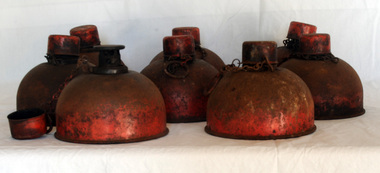
road flares, First half 20th century
... Eight kerosene smudge pot road flares - round metal bases painted red. There is a reservoir at the bottom used for kerosene storage. ...Eight kerosene smudge pot road flares - round metal bases painted red. There is a reservoir at the bottom used for kerosene storage. ...These flares were possibly used during WW11. They were used by Orbost Aero Club at Marlo from 1964 onwards for transporting patients by aerial ambulance to Melbourne. They were placed on the L.H.S. of the runway to indicate wind direction. They were superseded in the late 1970's by pilot activated lighting (PAL) switched on by incoming pilots via radio.These lamps are associated with the history of the Orbost Aero Club.Eight kerosene smudge pot road flares - round metal bases painted red. There is a reservoir at the bottom used for kerosene storage. It was lit at the top for flare.DIETZ . 51 Use Kerosene only Made in U.S.A.lighting kerosene-flares road-flares beacons marlo-airport -
 Kiewa Valley Historical Society
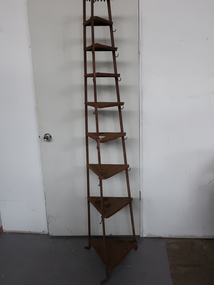
Stand - Pot Plants or Kitchen storage
... Stand - Pot Plants or Kitchen storage...pot stand...kitchen storage... stand or possibly for indoor plants. pot plants indoor plants home decoration pot stand kitchen storage Tall wooden pot stand with 9 triangular shelves spaced along it and with hooks on 2 of the 3 edges. ...Home decoration involved pots / saucepans / plates etc in the kitchen to be on display / stored and/or indoor plants displayed in a corner on the verandah. It was common for the stand to be home-made and practical.Used by a resident of the Kiewa Valley as a domestic kitchen storage stand or possibly for indoor plants.Tall wooden pot stand with 9 triangular shelves spaced along it and with hooks on 2 of the 3 edges. It has 3 wooden poles holding the shelves. The stand has previously been painted blue. Nine equilateral triangle shelves decreasing in size with height towards the top. Top has decorative cap with steel fringe. Rusty. It may have been used as a kitchen pot / saucepan / plates stand or pot plant stand.pot plants, indoor plants, home decoration, pot stand, kitchen storage -
 Kiewa Valley Historical Society
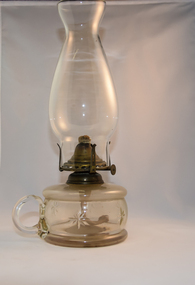
Lamp Table Kerosene, pre 1950s
... storage unit with a glass circular finger handle (similar to a ordinary cup). Formed single star like patterns (50mm apart) encircle the centre of the bowl. On top of the bowl sits the metal (brass) wick holder with a small wheel protruding out one side for adjusting the wick length(increasing or decreasing the strength(regulating) of the amount of light projected. Four prongs rise from the circular base light fixture holding the windproof and refractive glass "pot...storage unit with a glass circular finger handle (similar to a ordinary cup). Formed single star like patterns (50mm apart) encircle the centre of the bowl. On top of the bowl sits the metal (brass) wick holder with a small wheel protruding out one side for adjusting the wick length(increasing or decreasing the strength(regulating) of the amount of light projected. Four prongs rise from the circular base light fixture holding the windproof and refractive glass "pot ...This particular lamp was made for the dinner table or "parlour". This was the most effective indoor lighting before electrical lighting was introduced in the 1940's. These table lights would have still been used after this time as emergency lighting during electrical power shortages (outages). These emergency lighting lamps, including candles, were eventually replaced by battery power. The Kiewa Valley was supplied by electricity well before many other rural regions due to the State Electricity Commission constructing the Kiewa Hydro Electricity power turbines (late 1930's to mid 1950's). Petrol and diesel generators were used in other rural regions before state wide electricity was available.The significance of this kerosene lamp to the Kiewa Valley is that it provides the proof that before the Hydro electricity scheme was established in the valley, householder and commerce relied on candle/kerosene power. Although at certain times before battery and solar energy became the night time lighters the sole source of lighting was candle power and kerosene power. The supply of both however was still required by most of the population by supply from city and larger country town suppliers. This nearly fully glass made table lamp(kerosene) has a large glass bowl/basin like kerosene storage unit with a glass circular finger handle (similar to a ordinary cup). Formed single star like patterns (50mm apart) encircle the centre of the bowl. On top of the bowl sits the metal (brass) wick holder with a small wheel protruding out one side for adjusting the wick length(increasing or decreasing the strength(regulating) of the amount of light projected. Four prongs rise from the circular base light fixture holding the windproof and refractive glass "pot belly" shield. lamp table, kerosene lamp, household lighting (non electrical) -
 Bendigo Historical Society Inc.
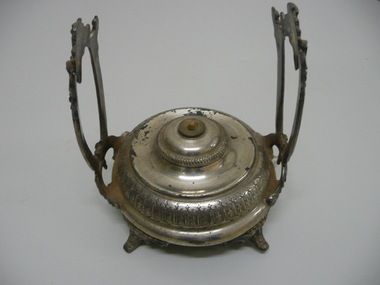
Domestic Object - WARMER BASE
... DOMESTIC EQUIPMENT Food storage & preservation warmer Warmer base for tea pot or kettle, Brittania metal stand with spirit burner insert on four small legs with 2 upright side arms embossed pattern around base. ...Warmer base for tea pot or kettle, Brittania metal stand with spirit burner insert on four small legs with 2 upright side arms embossed pattern around base.domestic equipment, food storage & preservation, warmer -
 Bendigo Historical Society Inc.
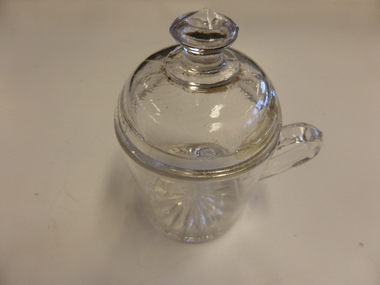
Container - GLASS HONEY POT
... DOMESTIC EQUIPMENT Food storage & preservation kitchen Small pressed glass honey pot with lid & applied handle,flower pattern impressed in base, lid has handle and spoon hole. ...Small pressed glass honey pot with lid & applied handle,flower pattern impressed in base, lid has handle and spoon hole.domestic equipment, food storage & preservation, kitchen -
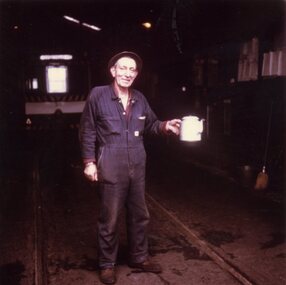 Ballarat Tramway Museum
Photograph - Colour Print, Lilian Butler, Sep. 1971
... pot within the Ballarat depot, September 1971. See Reg Item 1861 for staff photo - right hand side of the 3rd row. Listing shows Mr. Fish, but not Mr. Romeo. Item was placed in an envelope marked "Mr. E. Romeo" - retained with photograph in storage...pot within the Ballarat depot, September 1971. See Reg Item 1861 for staff photo - right hand side of the 3rd row. Listing shows Mr. Fish, but not Mr. Romeo. Item was placed in an envelope marked "Mr. E. Romeo" - retained with photograph in storage ...Possibly has a strong association with Mr. E. Fish, a SEC Ballarat depot worker.Colour print of a E. Fish, holding a tea pot within the Ballarat depot, September 1971. See Reg Item 1861 for staff photo - right hand side of the 3rd row. Listing shows Mr. Fish, but not Mr. Romeo. Item was placed in an envelope marked "Mr. E. Romeo" - retained with photograph in storage folder. Mr. Romeo was a depot employee. See Reg Item 6543.3 for the colour slide. Photo printed on Kodak Paper. Photograph by Lilian Butler?in ink on rear " Tram Depot Wendouree Parade Ballarat September 1971. With my compliments Lilian Butler"trams, tramways, sec, depot, personnel -
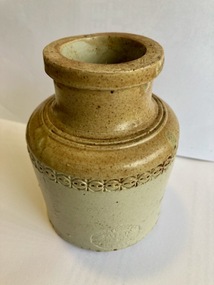 Bellarine Historical Society Museum
Ceramic - Antique Stoneware Pot, Stephan Green Imperial Potteries, circa 1830
... storage jar, bi-coloured in cinnamon and cream. Opening measures 4cm. Unusual frieze band at lower end of cinnamon section. Bears an unusual makers impression on bottom section. Slight chip on base. Also firing crack measuring 4 cm on base. Ceramic Antique Stoneware Pot ...Traditional salt-glazed stoneware pot produced by Stephen Green Imperial Potteries, Lambeth, London.They manufactured earthenware from 1828 to 1831 and stoneware from 1831 t0 1858. The pottery was located at Princes Street, Lambeth and consisted of two floors containing numerous kilns, a modelling room and a crushing mill.Potteries existed along the Thames River from Roman times between Vauxhall Bridge and Lambeth Bridge. In the eighteenth century the industry concentrated in Staffordshire. Stephen Green was one of three potteries that continued to produce pottery in Lambeth between 1828 and 1858. This pot is somewhat unique having a different mark to standard identifying a patent for double glazing and a unique frieze pattern. It thus may be an early example of stoneware from this company. Due to its unusual trade mark and frieze pattern, this is a rare example of early stoneware produced in the London area in the nineteenth century. The trade mark identifies a patent awarded for double glazing on stoneware. Produced by Stephen Green Imperial Potteries, it is a rare example of pottery for its time and location. Some sources identify it as being produced in 1830.Small earthenware/stoneware traditional salt-glazed storage jar, bi-coloured in cinnamon and cream. Opening measures 4cm. Unusual frieze band at lower end of cinnamon section. Bears an unusual makers impression on bottom section. Slight chip on base. Also firing crack measuring 4 cm on base.Slightly elliptical circle impression with the words 'Stephen Green / Patent / Double Glaze / Imperialstoneware, antique pottery -
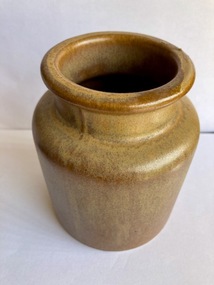 Bellarine Historical Society Museum
Ceramic - Vintage French Stoneware Mustard Pot, Armand Bizouard, 1940s
... Used in modern interior decor as a flower pot or decorative container. Example in good condition of French storage jar. ...Fairly common object produced in 1940s in France. Used in modern interior decor as a flower pot or decorative container. Example in good condition of French storage jar. Pleasing decorative appearance.Stoneware mustard jar in rich brown base colour on inside. Outside same brown base colour over-glazed with a light ochre yellow heaviest on the neck and shoulder. Base unglazed stoneware buff colour slightly indented. Indications of mould lines cutting the pot and base in half.Nonefrench pottery, food storage jars, stoneware -
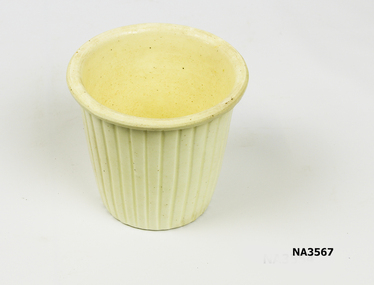 Whitehorse Historical Society Inc.
Container - Jam jar, not known
... Jar came from Bette Jones flower farm domestic items food storage & preservation Cream ceramic pot with ridged circumference Container Jam jar ...Jar came from Bette Jones flower farmCream ceramic pot with ridged circumferencedomestic items, food storage & preservation -
 Whitehorse Historical Society Inc.
Jam Pot Cover
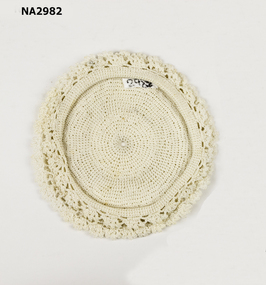
... HANDCRAFTS Crocheting or Crochet Work DOMESTIC ITEMS Food Storage & Preservation Fine cotton double crochet jam pot cover. Jam Pot Cover ...Fine cotton double crochet jam pot cover.handcrafts, crocheting or crochet work, domestic items, food storage & preservation -
 Mont De Lancey
Furniture - Commode
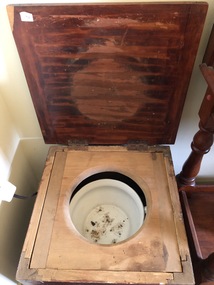
... commodes storage furniture Meakin printed on bottom of chamber pot. Bedroom commode of stained wood, with short legs and wheels, and a Meakin white enamel chamber pot inside. ...Bedroom commode of stained wood, with short legs and wheels, and a Meakin white enamel chamber pot inside.Meakin printed on bottom of chamber pot.commodes, storage furniture -
 University of Melbourne, Burnley Campus Archives
Photograph - Black and white print, Noelle Kendall (Vaughan), Potting Shed and Planting Frames May 1918, 1918
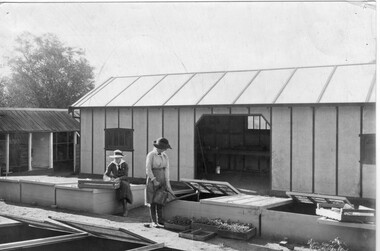
... potting shed and at left an open fronted store for seedling boxes. The cold frames in the centre were replaced by a glasshouse. The watering can held by the student was standard equipment in the nursery." Later examination by Eric Littlejohn suggests a quite different purpose for open fronted store, he recalls it being used for storage of tobacco leaf. ...potting shed and at left an open fronted store for seedling boxes. The cold frames in the centre were replaced by a glasshouse. The watering can held by the student was standard equipment in the nursery." Later examination by Eric Littlejohn suggests a quite different purpose for open fronted store, he recalls it being used for storage of tobacco leaf. female students potting shed noelle kendall (née vaughan) watering can tools equipment old nursery seedling boxes tobacco leaf storage students working outside cold frames Inscribed, "Title: Potting Shed Neg: 176." ...Original of this photo comes from the photograph album (B09.0003) of Noelle Kendall ( Vaughan, graduated 1919.) Note by T.H.Kneen 19 November 1991, "Shows potting shed and at left an open fronted store for seedling boxes. The cold frames in the centre were replaced by a glasshouse. The watering can held by the student was standard equipment in the nursery." Later examination by Eric Littlejohn suggests a quite different purpose for open fronted store, he recalls it being used for storage of tobacco leaf. Black and white photograph. 2 copies of original. 2 female students working outside the potting shed in the Old NurseryInscribed, "Title: Potting Shed Neg: 176." female students, potting shed, noelle kendall (née vaughan), watering can, tools, equipment, old nursery, seedling boxes, tobacco leaf storage, students working outside, cold frames
