
Showing 7 items matching "straight winged"
-
 Moorabbin Air Museum
Book - Aircraft recognition guides, World Aircraft Recognition Manual
... ...Straight winged...Aircraft recognition guides Aircraft classification Delta winged Swept winged Straight winged Rotary winged Illustrations & specifications of world aircraft, circa 1956 World Aircraft Recognition Manual Book Aircraft recognition guides ...Illustrations & specifications of world aircraft, circa 1956non-fictionIllustrations & specifications of world aircraft, circa 1956aircraft classification, delta winged, swept winged, straight winged, rotary winged -
 Moorabbin Air Museum
Film (item) - Vintage Aircraft DH 60 Moth VH UIU VH UMA Sir Reg Ansett (SP)
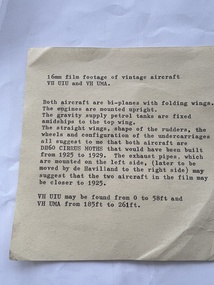
... The gravity supply petrol tanks are fixed amidships to the top wing. The straight wings, shape of the rudders, the wheels and configuration of the undercarriages all suggest to me that both aircraft are DH60 CIRRUS MOTHS that would have been built from 1925 to 1929. ...The gravity supply petrol tanks are fixed amidships to the top wing. The straight wings, shape of the rudders, the wheels and configuration of the undercarriages all suggest to me that both aircraft are DH60 CIRRUS MOTHS that would have been built from 1925 to 1929. ...See 16mm film footage of vintage aircraft VH UIU and VH UMA, Both aircraft are bi-planes with folding wings. The engines are mounted upright. The gravity supply petrol tanks are fixed amidships to the top wing. The straight wings, shape of the rudders, the wheels and configuration of the undercarriages all suggest to me that both aircraft are DH60 CIRRUS MOTHS that would have been built from 1925 to 1929. The exhaust pipes, which are mounted on the left side, (later to be moved by de Havilland to the right side) may suggest that the two aircraft in the film may be closer to 1925. VH UIU may be found from 0 to 58ft and VH UMA from 185ft to 26ift. for Description -
 Flagstaff Hill Maritime Museum and Village
Functional object - Map Calipers/ Divider, Unknown
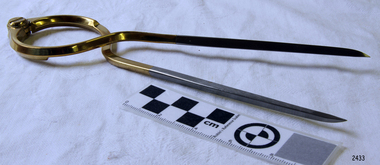
... straight legs; the caliper has curved legs. Dividers and Calipers were known to both the Greeks and Romans, though the caliper was uncommon. A divider with a circular sector, or wing...straight legs; the caliper has curved legs. Dividers and Calipers were known to both the Greeks and Romans, though the caliper was uncommon. A divider with a circular sector, or wing ...Compass, divider, and caliper are basically instruments that have two legs pivoted to each other at the top and are concerned with small-distance measurement or transfer. The compass and divider have straight legs; the caliper has curved legs. Dividers and Calipers were known to both the Greeks and Romans, though the caliper was uncommon. A divider with a circular sector, or wing, connecting the two legs was sketched in 1245, its modern counterpart is the wing divider with a thumbscrew clamp and screw for fine adjustment. Or the marine dividers used to measure the distance a vessel has travelled by transferring the vessels distance from a map with the divider and transferring that measurement to a marine ruler to mathematical calculate the distance.Item is believed to be a replica/ copy of a 19th century map calipers used in marine navigation to determine distance travelled. Item was probably purchased between 1972-1975 to add to the marine displays at Flagstaff Hill.Stainless steel dividers used in navigation charts. Top half is alloy plated. "W & HC" and "Made in England".flagstaff hill, warrnambool, shipwrecked-coast, flagstaff-hill, flagstaff-hill-maritime-museum, maritime-museum, shipwreck-coast, flagstaff-hill-maritime-village, stainless steel dividers, steel dividers, dividers -
 The Beechworth Burke Museum
Animal specimen - Australian Magpie, Trustees of the Australian Museum, 1860-1880
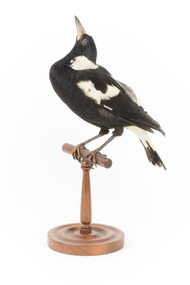
... The specimen has a large straight beak and is in an unusual pose for a magpie, compressing the white patch on the back of the neck. The beak has turned yellow where originally grey, potentially leading to a previous misidentification as a white-winged chough....This collection continues to be on display in the Museum and has become a key part to interpreting the collecting habits of the 19th century. taxidermy mount taxidermy animalia burke museum beechworth australian museum skin reynell eveleigh johns bird Australian Magpie Ornithological Ornithology white winged chough This specimen an Australian Magpie with black and white plumage over the body, mounted on a cedar stand. The specimen has a large straight ...The Australian magpie is a passerine native to Australia and southern New Guinea. Renowned for its black and white plumage and distinctive song, the Australian magpie has also established populations in New Zealand and on the Fijian island of Taveuni, where it was introduced during the 19th century. Previously classified as three distinct species, it is now recognized as a single species comprising nine subspecies. Belonging to the family Artamidae, the Australian magpie is the sole member of the genus Gymnorhina and shares its closest relation with the black butcherbird (Melloria quoyi). Unlike the Eurasian magpie, it is not part of the Corvidae family. This specimen was originally misidentified as a white winged chough and is part of a collection of almost 200 animal specimens that were originally acquired as skins from various institutions across Australia, including the Australian Museum in Sydney and the National Museum of Victoria (known as Museums Victoria since 1983), as well as individuals such as amateur anthropologist Reynell Eveleigh Johns between 1860-1880. These skins were then mounted by members of the Burke Museum Committee and put-on display in the formal space of the Museum’s original exhibition hall where they continue to be on display. This display of taxidermy mounts initially served to instruct visitors to the Burke Museum of the natural world around them, today it serves as an insight into the collecting habits of the 19th century. This specimen is part of a significant and rare taxidermy mount collection in the Burke Museum. This collection is scientifically and culturally important for reminding us of how science continues to shape our understanding of the modern world. They demonstrate a capacity to hold evidence of how Australia’s fauna history existed in the past and are potentially important for future environmental research. This collection continues to be on display in the Museum and has become a key part to interpreting the collecting habits of the 19th century.This specimen an Australian Magpie with black and white plumage over the body, mounted on a cedar stand. The specimen has a large straight beak and is in an unusual pose for a magpie, compressing the white patch on the back of the neck. The beak has turned yellow where originally grey, potentially leading to a previous misidentification as a white-winged chough.taxidermy mount, taxidermy, animalia, burke museum, beechworth, australian museum, skin, reynell eveleigh johns, bird, australian magpie, ornithological, ornithology, white winged chough -
 The Beechworth Burke Museum
Animal specimen - Diurnal Owl / Ural Owl
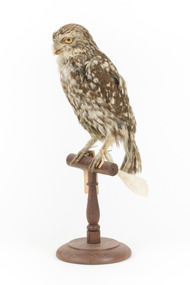
... straight and flat. There are several feathers which appear disheveled on the chest, shoulder and wing. ...straight and flat. There are several feathers which appear disheveled on the chest, shoulder and wing. ...Little owls (also known as the owl of Athena or owl of Minerva) usually prefer the warmer parts of Europe, North Africa and Asia, enjoying open country and agricultural land with high trees to swoop down upon their prey from. Their diet includes amphibians, small mammals, reptiles and insects that they also hunt from small holes in the ground. Little owls are monogamous and while they're usually solitary creatures, pairs who breed together will often stay together past breeding season. An Athene Noctua would usually be slightly smaller than this specimen. The colouring of browns and whites speckling the feathers is an accurate representation however the posture of a typical little owl would be more crouched, not so thin and tall. This specimen is part of a collection of almost 200 animal specimens that were originally acquired as skins from various institutions across Australia, including the Australian Museum in Sydney and the National Museum of Victoria (known as Museums Victoria since 1983), as well as individuals such as amateur anthropologist Reynell Eveleigh Johns between 1860-1880. These skins were then mounted by members of the Burke Museum Committee and put-on display in the formal space of the Museum’s original exhibition hall where they continue to be on display. This display of taxidermy mounts initially served to instruct visitors to the Burke Museum of the natural world around them, today it serves as an insight into the collecting habits of the 19th century.This specimen is part of a significant and rare taxidermy mount collection in the Burke Museum. This collection is scientifically and culturally important for reminding us of how science continues to shape our understanding of the modern world. They demonstrate a capacity to hold evidence of how Australia’s fauna history existed in the past and are potentially important for future environmental research. This collection continues to be on display in the Museum and has become a key part to interpreting the collecting habits of the 19th century.This Athene Nuctua (The Little Owl) is dark to medium brown with white specks all over the feathers. Large white spots are located on their wings/back. This specimen has some inconsistencies with how it has been styalised by the taxidermist. The tail curls in under itself where it should be straight and flat. There are several feathers which appear disheveled on the chest, shoulder and wing. The specimen is mounted on a wooden stand with paper and metal tags attached to the legs. Swing tag: 41. / Allied to / Diurnal Owl / Catalogue page 53 / Other tag: 31 / Strix Noctua / Holland Metal tag: 4061 /taxidermy mount, taxidermy, animalia, burke museum, beechworth, australian museum, skin, bird, owl, little owl, athene noctua -
 Bendigo Historical Society Inc.
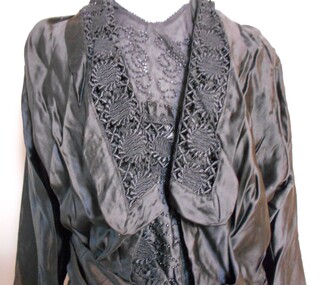
Clothing - BLACK SILK-SATIN DRESS W/LACE,CUFFS,COLLAR,AND BODICE, BEADING, 1930's
... Cut as a straight piece of fabric, a rectangular 'wing effect' at the wrist, is lightly gathered into a 13 cm deep lace cuff, fastening with two metal hooks, and hand-stitched eyes. ...Cut as a straight piece of fabric, a rectangular 'wing effect' at the wrist, is lightly gathered into a 13 cm deep lace cuff, fastening with two metal hooks, and hand-stitched eyes. ...Clothing. Black silk-satin fabric, mid-calf length dress, gathered from the waistline. A black, pleated cummerbund encircles the waist, fastening at the left side with three metal hooks, and hand stitched loops. Long set in sleeveshave a fine piping around the arm holes, and have a hand stitched neatening to finish. Shoulder seams are also piped. A long, narrow collar of lace, bound in 2.5 cm satin edging, attaches almost to the waistline-finishing just 9 cm above the waist. A 'bib front' attached at the right side to the bodice lining, attached to the eaistline, and closing on the left hand shoulder side, with metal hooks, and hand stitched loops. Bodice closes over the top with a metal press-stud. Front bodice has three tiny pleats on each shoulder seam and gathers into the waistline seam. Fine georgette fabric, backed with fine net fabric, is with tiny glass beads, and forms the top of the 'bib front'. Fine beading of tiny beads outlines the high round neck. Larger glass beads and silky lace trim the lower 'bib front'. The lg sleeves are gathered lightly at the shoulder, which isoutlined with fine piping. Cut as a straight piece of fabric, a rectangular 'wing effect' at the wrist, is lightly gathered into a 13 cm deep lace cuff, fastening with two metal hooks, and hand-stitched eyes. Sleeves are lined with fine fabric.costume, female, black silk satin dress -
 Bendigo Military Museum
Equipment - HELIOGRAPH, 1918
... Straight metal sighting rod painted khaki. Sighting circle with cross hairs at top. Adjustment screw on sides. 6. Leather wallet with metal parts for heliograph. 7. Round metal tin with lid for housing spare mirrors. Painted khaki. Two spare mirrors separated by cardboard discs. 8. Reflex mirror. Supported by semi-circular hinged holder. Mirror has a wing...Straight metal sighting rod painted khaki. Sighting circle with cross hairs at top. Adjustment screw on sides. 6. Leather wallet with metal parts for heliograph. 7. Round metal tin with lid for housing spare mirrors. Painted khaki. Two spare mirrors separated by cardboard discs. 8. Reflex mirror. Supported by semi-circular hinged holder. Mirror has a wing ...1. Brown leather case with hinged lid. Bottom rounded, lid secured with two leather straps with metal buckles. Strap keepers attached to sides and bottom. Manufacturing details stamped on one side. 2. Heliograph consisting of a mounted mirror with threaded adjustment at back. Mirror site on a spring to allow movement for sending Morse Code message. Khaki and black paint on components. Brass base threaded for attachment to tripod. 3. Metal multi tool for servicing heliograph. 4. Folding metal sighting rod. Folds into 3 sections. Sighting circle with with cross hairs at top. Painted Khaki. 5. Straight metal sighting rod painted khaki. Sighting circle with cross hairs at top. Adjustment screw on sides. 6. Leather wallet with metal parts for heliograph. 7. Round metal tin with lid for housing spare mirrors. Painted khaki. Two spare mirrors separated by cardboard discs. 8. Reflex mirror. Supported by semi-circular hinged holder. Mirror has a wing nut and thread for tightening on one side. Metal painted khaki. 9. Metal extender arm. Large circle with tightening screw on one end. Smaller hole with tightening screw on opposite end, Painted khaki.heliograph, equipment, signals, ww1
