
Showing 56 items matching "strainers"
-
 Bendigo Historical Society Inc.
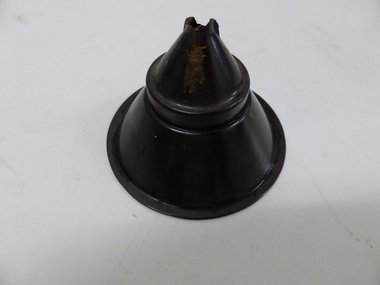
Domestic Object - BAKELITE STRAINER
... ...Strainer...Small funnel shaped brown Bakelite Peerman strainer....Peerman Strainer F/46 Patent Pending...TOOLS Multipurpose Strainer Peerman Strainer F/46 Patent Pending Small funnel shaped brown Bakelite Peerman strainer. ...Small funnel shaped brown Bakelite Peerman strainer.Peerman Strainer F/46 Patent Pendingtools, multipurpose, strainer -
 Mont De Lancey
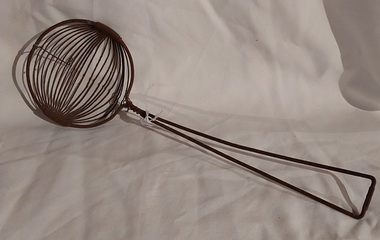
Domestic object, Ladle Strainer, c.1920's
... Ladle Strainer......Strainers...The specific "open wire" style of strainer likely emerged from the necessity for faster, more efficient drainage in cooking. ...A vintage wire cooking strainer or ladle with an open wire scoop. The long double open wire handle and scoop are made from the one piece of wire....Cooking Cooking equipment Strainers Food ladles A vintage wire cooking strainer or ladle with an open wire scoop. ...The specific "open wire" style of strainer likely emerged from the necessity for faster, more efficient drainage in cooking. It could be used for straining, canning, preserving and skimming food.A vintage wire cooking strainer or ladle with an open wire scoop. The long double open wire handle and scoop are made from the one piece of wire.cooking, cooking equipment, strainers, food ladles -
 Whitehorse Historical Society Inc.
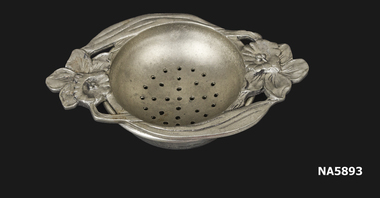
Domestic object - Tea Strainer, Seagull Pewter, C 1950's
... - Domestic, decorative tea strainer...- 2 piece (strainer & base) tea strainer - Pewter - Daffodil motif handles...- Domestic, decorative tea strainer Tea strainer Domestic object Seagull Canada Fine Pewter Erain Zinn (lead & Zinc) - 2 piece (strainer & base) tea strainer - Pewter - Daffodil motif handles Domestic object Tea Strainer Seagull Pewter ...- Domestic, decorative tea strainer- 2 piece (strainer & base) tea strainer - Pewter - Daffodil motif handlesSeagull Canada Fine Pewter Erain Zinn (lead & Zinc)tea strainer, domestic object -
 Greensborough Historical Society
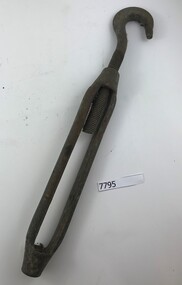
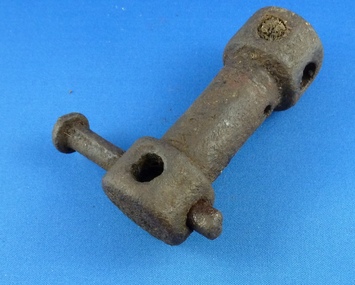
Tool - Fence Strainer, J. Angus & Co, 1900s
... Fence strainers were used to tension the wire on farm fences....Fence strainer...Fence strainers were used to tension the wire on farm fences. fence strainers farm equipment Fence strainer Tool Fence Strainer J. ...Fence strainers were used to tension the wire on farm fences.Fence strainerfence strainers, farm equipment -
 Greensborough Historical Society
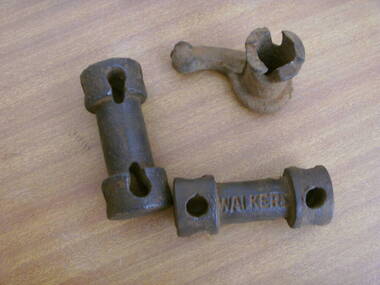
Tool - Fence Strainer, 1914c
... Fence strainers were used to tension the wire on farm fences. ...Metal fence-wire strainer. Some rust....Some rust. Tool Fence Strainer ...Fence strainers were used to tension the wire on farm fences. This strainer was used on the Partington property in Greensborough. Walkers Fence Strainers are advertised in the Tweed Daily (Murwillumbah, NSW) on Saturday 11 April 1914, page 1. A relic from Greensborough's rural past.Metal fence-wire strainer. Some rust.Stamped on side of item "WALKERS"fence strainers, partington family, farm equipment -
 Heathcote McIvor Historical Society
Fence Strainer, 1885
... Dog bone wire strainer were used in tightening vineyard trellis wires. made from cast iron, shaped like a dog bone.with teo holes at each end for wires to be pased through..."WALKERS" stamped in middle of strainer..."WALKERS" stamped in middle of strainer Dog bone wire strainer were used in tightening vineyard trellis wires. made from cast iron, shaped like a dog bone.with teo holes at each end for wires to be pased through Fence Strainer Charles Walker ...Dog bone wire strainer were used in tightening vineyard trellis wires. made from cast iron, shaped like a dog bone.with teo holes at each end for wires to be pased through"WALKERS" stamped in middle of strainer -
 Flagstaff Hill Maritime Museum and Village
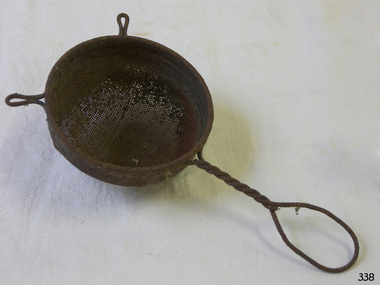
Domestic object - Strainer
... Strainer......strainer...Big name tea strainer producers, such as Tiffany and Gorham, could use fine silver to create quality, heavy, and sturdy strainers, for those who could afford it. ...Metal strainer, bowl shaped, with mesh and twisted wire handle....Domestic object Strainer ...Take a stroll through the average beverage aisle in your supermarket, and you might get the impression that tea has always come in small boxes with disposable tea bags. But before those easy to come by boxes, there was the rich and intriguing history of the tea strainer, a beautiful little tool that has helped our ancestors enjoy loose leaf tea for hundreds of years. Enjoying loose-leaf tea, and becoming familiar with this tool, can help spark an appreciation for your tea strainer and infuser collection, or simply inspire you to grow one. Documentation of tea tools such as the tea strainer appear in ancient history, the earliest models were likely made of bamboo, and later evolved into stainless steel, sterling silver, china, porcelain, silicon, and linen. During the Tang Dynasty in China, a small book called “Classic of Tea” was written describing tea utensils, and they were made to help Buddhist monks keep living things (such as small bugs) out of the drinking water. However, using a tea tool to keep run away tea leaves out of a cup did not become a cited use of the strainer until the 17th century when Dutch merchants made tea more readily available to those outside of the Chinese dynasty. British royals then increased the popularity of tea as their preferred beverage, and it was not long before a newfound fanaticism for tea in Great Britain spread to the American colonies, as did a growing demand for products that could separate loose tea leaves from liquid with ease and flair. Why did people use a strainer to separate out tea leaves in Great Britain and not in China? While the method of serving tea from a teapot with the tea loose in the pot was a practice used in both countries, the reason China may not have required a tool to remove leaves from their cup likely had to do with the types of tea leaves they were producing. The British owned tea plantations, in countries such as India, produced finer black tea leaves that did not require as much space to expand inside of a tea pot, where as the leaves prepared on the Chinese plantations would expand far more in the pot, and were therefore less likely to land or be bothersome inside a tea cup. This common approach to serving tea with smaller tea leaves required a solution to avoid ending up with a cup, and mouth, full of tea leaves. The obvious solution was a strainer basket. In the Victorian era, tea strainer baskets, similar to those still used in tea parlors today, were made to sit on top of the cup to capture the leaves when pouring the tea from a tea pot into the individual cups. Another solution was a tea-removing device called a mote spoon. Mote spoons act as search and rescue spoons to remove tea leaves from individual teacups. The tea would be brewed loose in the teapot, so any tea that ended up in the cup could be removed with a long handled spoon with holes in the spoon to remove rogue tea leaves and keep the steeped water in the cup. The handle also helped keep the teapot spout free of leaves and could help unclog any leaves trapped when pouring. Stainless steel tea strainers and tea infusers gained popularity in the late 19th century. Big name tea strainer producers, such as Tiffany and Gorham, could use fine silver to create quality, heavy, and sturdy strainers, for those who could afford it. There were many varieties of strainers at that time, but it was more likely that smaller designers who could not afford to mass-produce these quality strainers out of silver made them into unique shapes to attract consumers with lighter wallets. And borne was the tea strainer we are accustomed to today. Things took an unexpected turn for the tea strainer in the early 1900s when Thomas Sullivan, a tea merchant, shipped out tea samples in small silk bags. Customers did not realize that they were supposed to remove the tea from the bags, and instead boiled the tea, bag and all! The convenience of tossing out the leaves is obvious, and the popularity of tea bags is still seen today. Most premium bags of tea we are accustomed to today are frequently packaged loose for consumption, and when they are available in bags, the leaves are often crowded and do not have enough space to expand. While pyramid tea bags have become a more recent solution to this problem, due to the additional space at the top of the bag, enjoying a variety of quality tea is easier with a tea strainer in your arsenal. Besides, with the wide variety of strainers for your cup or pot in versatile materials such as mesh, silver, or a novelty silicone cartoon shape, loose tea can still reign supreme. Tea strainers sometimes do require more cleanup and measuring, but the experience and quality is always worth the effort. Besides, strainers also allow for mixing favorite tea blends together for an extra dose of delicious creativity! https://www.teamuse.com/article_170413.html The strainer provided the convenience of separating the tea leaves for disposal later.Metal strainer, bowl shaped, with mesh and twisted wire handle.Noneflagstaff hill, warrnambool, shipwrecked-coast, flagstaff-hill, flagstaff-hill-maritime-museum, maritime-museum, shipwreck-coast, flagstaff-hill-maritime-village, strainer -
 Tatura Irrigation & Wartime Camps Museum
Strainer - metal
... strainer...This strainer was made by Fritz Kazenwadel from empty coffee tins whilst in Camp 3....Round metal tapered strainer. The holes in the base have been punched. ...This strainer was made by Fritz Kazenwadel from empty coffee tins whilst in Camp 3. strainer kazenwadel k kazenwadel f camp 3 ww2 camp 3 Round metal tapered strainer. ...This strainer was made by Fritz Kazenwadel from empty coffee tins whilst in Camp 3.Round metal tapered strainer. The holes in the base have been punched. Handmade.strainer, kazenwadel k, kazenwadel f, camp 3, ww2 camp 3 -
 Greensborough Historical Society
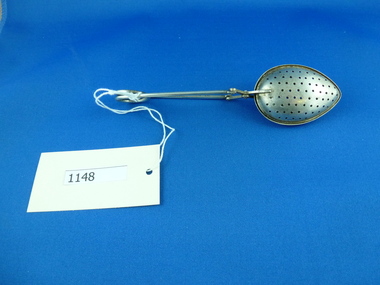
Strainer, Tea strainer, 1960c
... Strainer...Tea strainer...Tea strainer. The spring loaded handle opens the two perforated bowls into which tea is placed for infusion in a cup. ...Metal tea strainer. Spring loaded handle with perforated bowls to hold tea....Tea strainer Strainer ...Tea strainer. The spring loaded handle opens the two perforated bowls into which tea is placed for infusion in a cup. The pre-cursor to tea bags.Metal tea strainer. Spring loaded handle with perforated bowls to hold tea.tea strainers -
 Blacksmith's Cottage and Forge
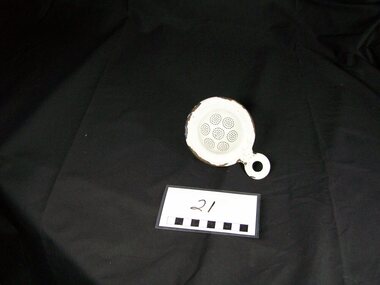
Strainer, Tea, 1920 (estimated); Approx. 1920
... ...strainer...A tea strainer is a type of strainer that is placed over or in a teacup to catch tea leaves. ...White enamel tea strainer, round in shape with flange edges, 7 small circle areas of perforations in the concave area of the utensil, a small perforated handle (same material) at one outer area of the item....A tea strainer is a type of strainer that is placed over or in a teacup to catch tea leaves. ...A tea strainer is a type of strainer that is placed over or in a teacup to catch tea leaves. When tea is brewed in the traditional manner in a teapot, the tea leaves are not contained in teabags, but rather are freely suspended in the water. As the leaves themselves may be distasteful, it is usual to filter them out with a tea strainer. Strainers usually fit into the top of the cup to catch the leaves as the tea is poured. Some deeper tea strainers can also be used to brew single cups of tea, much as teabags or brewing baskets are used - the strainer full of leaves is set in a cup to brew the tea, and then removed, along with the spent tea leaves, when the tea is ready to drink. By using a tea strainer in this way, the same leaves can be used to brew multiple cups. Tea strainer use declined in the 20th century with mass production of the tea bag, but is still preferred among connoisseurs who claim that keeping the leaves packed in a bag, rather than freely circulating, inhibits diffusion. Many assert that inferior ingredients, namely dust quality tea, are often used in tea bags. Tea strainers are usually either sterling silver, stainless steel, or china. Strainers often come in a set, with the strainer part and a small saucer for it to sit in between cups. Tea strainers in themselves have often been turned into artistic masterpieces of the silver- and goldsmith's craft, as well as rarer specimens of fine porcelain. Brewing baskets (or infusing baskets) resemble tea strainers, but are more typically put in the top of a teapot to contain the tea leaves during brewing. There is no definitive boundary between a brewing basket and a tea strainer, and the same tool might be used for both purposes. Tea strainers are also used by patients trying to pass a kidney stone. The patient urinates through the strainer, thereby ensuring that, if a stone is passed, it will be caught for evaluation and diagnosis. Source: www.wikipedia.net This item has historical significance in the evolution of Tea drinking.The Strainer being needed if a cup of tea was to be poured without tea leaves being present in the tea liquid.As Tea bags have been introduced into everyday life tea strainers are an item of the past. This particular tea strainer was an item for everyday useage.White enamel tea strainer, round in shape with flange edges, 7 small circle areas of perforations in the concave area of the utensil, a small perforated handle (same material) at one outer area of the item.domestic, kitchen, food, preparation, white, enamel, tea, strainer, beverage, perforated, utensil, round, flanges, leaves -
 Flagstaff Hill Maritime Museum and Village
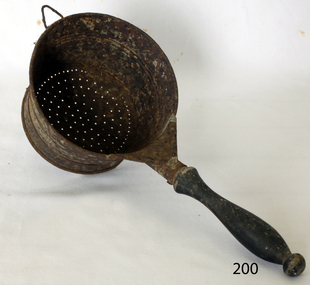
Domestic object - Colander, 1900-1920
... ...strainer...The perforated nature of the bowl allows liquid to drain through while retaining the solids inside it is sometimes also called a pasta strainer or kitchen sieve. Conventionally, colanders are made of a light metal, such as aluminum or thinly rolled stainless or plated steel, colanders are also made of plastic, silicone, ceramic, and enamelware. ...Strainer or colander, metal, with concave base and wood handle, plated metal construction with welded or folded seams. ...This item gives a snapshot into domestic life around the late 19th and early 20th centuries and the types of kitchen equipment in use. flagstaff hill warrnambool flagstaff hill maritime museum maritime museum shipwreck coast flagstaff hill maritime village great ocean road strainer food strainer seive food preparation kitchen ware None Strainer or colander, metal, with concave base and wood handle, plated metal construction with welded or folded seams. ...A colander, sieve or cullender is a kitchen utensil used to strain foods such as pasta or to rinse vegetables. The perforated nature of the bowl allows liquid to drain through while retaining the solids inside it is sometimes also called a pasta strainer or kitchen sieve. Conventionally, colanders are made of a light metal, such as aluminum or thinly rolled stainless or plated steel, colanders are also made of plastic, silicone, ceramic, and enamelware. The word colander comes from the Latin Colum meaning sieve.Early 20th century kitchen item possibly of French manufacture due to the design and shape of the bowl this design appears to have been favoured by the French around 1910 for smaller Colanders. This item gives a snapshot into domestic life around the late 19th and early 20th centuries and the types of kitchen equipment in use.Strainer or colander, metal, with concave base and wood handle, plated metal construction with welded or folded seams. Handle painted black, perforated base.Noneflagstaff hill, warrnambool, flagstaff hill maritime museum, maritime museum, shipwreck coast, flagstaff hill maritime village, great ocean road, strainer, food strainer, seive, food preparation, kitchen ware -
 Bendigo Historical Society Inc.
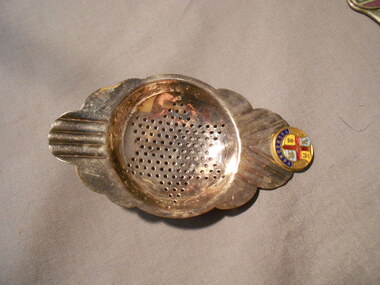
Domestic Object - TEA STRAINER, 1950's
... Star shaped pattern in bowl of strainer, marked out with the holes of the strainer. ...Star shaped pattern in bowl of strainer, marked out with the holes of the strainer. ...BHS CollectionTea strainer souvenir of Toowoomba crest on handle. Star shaped pattern in bowl of strainer, marked out with the holes of the strainer. Ridged pattern on each end- bowl of strainer in the centre. Probably EPNS, but no marking visible.PITCHER MELBephemera, mementoes, tea strainer -
 Mont De Lancey
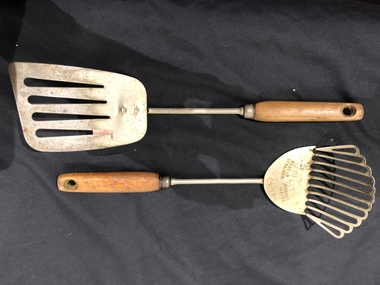
Utensils, Circa 1950's to 1960's
... "Utility Beater Masher Strainer Lifter"..."Utility Beater Masher Strainer Lifter" 2 kitchen utensils - a. Egg slide with wooden handle and b. ...Used by Donor's (Mrs. C. Doe) mother during the 1950's and 1960's 2 kitchen utensils - a. Egg slide with wooden handle and b. Utility spoon with wooden handleb. "Utility Beater Masher Strainer Lifter"kitchenware, eggslices, kitchen spoons -
 Whitehorse Historical Society Inc.
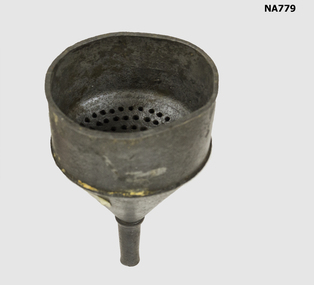
Domestic object - Strainer Funnel
... Metal funnel with strainer inside...DOMESTIC ITEMS Cooking Metal funnel with strainer inside Domestic object Strainer Funnel ...Metal funnel with strainer insidedomestic items, cooking -
Emerald Museum & Nobelius Heritage Park
Domestic object - Tea strainer
... Tea strainer with wooden handle...unknown Emerald Victoria Australia Domestic Life unknown Tea strainer with wooden handle Domestic object Tea strainer ...unknownTea strainer with wooden handleemerald, victoria, australia, domestic life, unknown -
 Whitehorse Historical Society Inc.
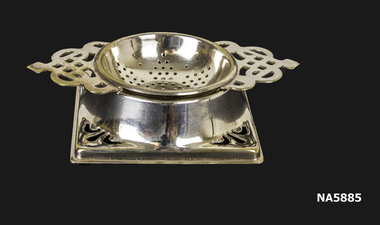
Domestic object - Tea strainer & stand, Radiant (perhaps W.R. Humphreys & Co.)?, C 1950's
... Circa 1950's - E.P.N.S. Tea strainer & stand - Base square with plain bowl & some piercing - Strainer with 2 handles (pierced)...- Example of afternoon tea equipment Afternoon tea Equipment ESPN A1 (on both pieces) Circa 1950's - E.P.N.S. Tea strainer & stand - Base square with plain bowl & some piercing - Strainer with 2 handles (pierced) Domestic object Tea strainer & stand Radiant (perhaps W.R. ...- Example of afternoon tea equipmentCirca 1950's - E.P.N.S. Tea strainer & stand - Base square with plain bowl & some piercing - Strainer with 2 handles (pierced)ESPN A1 (on both pieces)afternoon tea, equipment -
Tatura Irrigation & Wartime Camps Museum
Strainer - food, 1940's
... Small metal and fine wire mesh strainer...Made and used by internees at Camp 3 hoefer family camp 3 tatura ww2 camp 3 domestic food preparation Small metal and fine wire mesh strainer Strainer - food ...Made and used by internees at Camp 3Small metal and fine wire mesh strainerhoefer family, camp 3, tatura, ww2 camp 3, domestic, food, preparation -
Clunes Museum
Domestic object - FOOD STRAINER
... METAL FOOD STRAINER WITH BLACK WOODEN HANDLE...DOMESTIC OBJECT FOOD STRAINER METAL FOOD STRAINER WITH BLACK WOODEN HANDLE Domestic object FOOD STRAINER ...METAL FOOD STRAINER WITH BLACK WOODEN HANDLEdomestic object, food strainer -
 Mont De Lancey
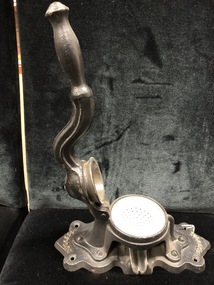
Lemon Squeezer, McMillan & Co, Circa 1911
... Cast iron lemon squeezer, with metal strainer...Juicers 'Success' Cast iron lemon squeezer, with metal strainer Lemon Squeezer McMillan & Co.. ...Cast iron lemon squeezer, with metal strainer'Success'juicers -
Emerald Museum & Nobelius Heritage Park
Domestic object - Tea strainer
... Enamelled tea strainer with handle - rusted in parts...Donated by Marg Ludecki Emerald Victoria Australia Domestic Life Gus Ryberg Enamelled tea strainer with handle - rusted in parts Domestic object Tea strainer ...Donated by Marg LudeckiEnamelled tea strainer with handle - rusted in partsemerald, victoria, australia, domestic life, gus ryberg -
 Whitehorse Historical Society Inc.
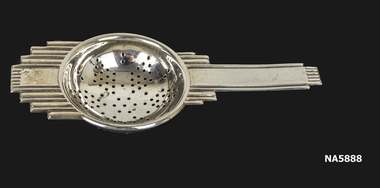
Domestic object - Tea strainer
... Silver coloured tea strainer in art deco style...Art deco Afternoon tea time Tea Strainer Afternoon tea Art deco Silver coloured tea strainer in art deco style Domestic object Tea strainer ...Art deco Afternoon tea timeSilver coloured tea strainer in art deco styletea strainer, afternoon tea, art deco -
Emerald Museum & Nobelius Heritage Park
Tool - Wire Strainer, December 1887
... Reid's Titan Wire Strainer Dec 1887 - Cast Iron...Unknown Emerald Victoria Australia Agriculture fences unknown Reid's Titan Wire Strainer Dec 1887 - Cast Iron Tool Wire Strainer ...UnknownReid's Titan Wire Strainer Dec 1887 - Cast Ironemerald, victoria, australia, agriculture, fences, unknown -
Ballarat Heritage Services
Ceramic, Bendigo Pottery Jug with strainer
... Bendigo Pottery Jug with strainer...Brown woodfired Bendigo Pottery Jug with strainer, and a lid stamped with a heart. ...Bendigo Pottery Brown woodfired Bendigo Pottery Jug with strainer, and a lid stamped with a heart. Bendigo Pottery Jug with strainer Ceramic ...Brown woodfired Bendigo Pottery Jug with strainer, and a lid stamped with a heart. bendigo pottery -
Glenelg Shire Council Cultural Collection
Functional object - Tea Strainer, n.d
... Metal tea strainer with round enamelled badge; Town of Portland Coat of Arms...souvenir souvenir of Portland tea strainer domestic item Back: 'Pitcher Melb' - impressed Metal tea strainer with round enamelled badge; Town of Portland Coat of Arms Functional object Tea Strainer Pitcher Melbourne ...Metal tea strainer with round enamelled badge; Town of Portland Coat of ArmsBack: 'Pitcher Melb' - impressedsouvenir, souvenir of portland, tea strainer, domestic item -
 Stawell Historical Society Inc
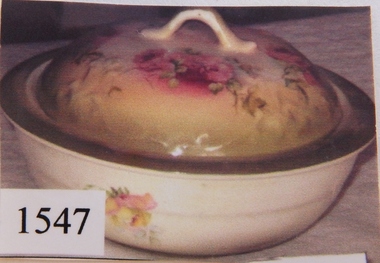
Memorabilia - Realia
... Three-piece Soap Dish. Bowl strainer and lid with handle. Cream with Green Edging...Stawell Three-piece Soap Dish. Bowl strainer and lid with handle. Cream with Green Edging Memorabilia Realia ...Three-piece Soap Dish. Bowl strainer and lid with handle. Cream with Green Edgingstawell -
Tatura Irrigation & Wartime Camps Museum
Strainer, Vegetables, 1940's
... Handmade wire vegetable strainer with long handle, curved at end, forming a hook for hanging...Made by internee at Camp 3, Tatura and used for straining vegetables strainer - vegetables hoefer family camp 3 tatura ww 2 camp 3 domestic utensils Handmade wire vegetable strainer with long handle, curved at end, forming a hook for hanging Strainer, Vegetables ...Made by internee at Camp 3, Tatura and used for straining vegetablesHandmade wire vegetable strainer with long handle, curved at end, forming a hook for hangingstrainer - vegetables, hoefer family, camp 3, tatura, ww 2 camp 3, domestic, utensils -
 Bendigo Historical Society Inc.
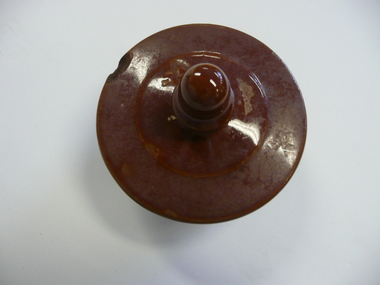
Domestic Object - BROWN EARTHENWARE LID
... Brown earthenware coffee pot lid with acorn shaped handle & six strainer holes in base....DOMESTIC EQUIPMENT Food consumption kitchen Brown earthenware coffee pot lid with acorn shaped handle & six strainer holes in base. Domestic Object BROWN EARTHENWARE LID ...Brown earthenware coffee pot lid with acorn shaped handle & six strainer holes in base.domestic equipment, food consumption, kitchen -
 Whitehorse Historical Society Inc.
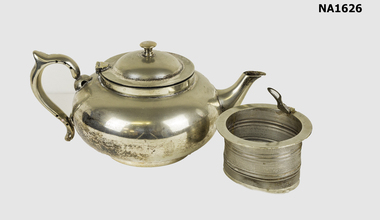
Domestic object - Teapot, c1927
... A round squat silverplated Robur teapot containing a fitted round cup shaped strainer with hinged pull for removal....PATENTED AUS 10373. 14-11-27 NZ59615 U.S AF 816-28 EPNS A round squat silverplated Robur teapot containing a fitted round cup shaped strainer with hinged pull for removal. Domestic object Teapot ...Belonged to the step-mother of Ray Standfield, husband of donor.The Robur Tea Company issued vouchers/coupons on packets of tea that could be collected and exchanged for the tea-pot when enough coupons had been saved.A round squat silverplated Robur teapot containing a fitted round cup shaped strainer with hinged pull for removal.S475 PERFECT TEA-POT, MANUFACTURED BY ROBUR TEA CO LTD. PATENTED AUS 10373. 14-11-27 NZ59615 U.S AF 816-28 EPNSdomestic items, food & drink consumption -
 Whitehorse Historical Society Inc.
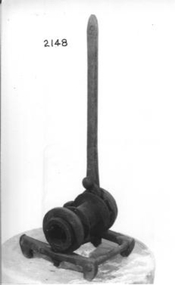
Tool - Wire Strainer
... Metal wire strainer. Round cylinder with hole in centre attached to a long shaft. ...Three sided metal piece attached. Tool Wire Strainer ...Metal wire strainer. Round cylinder with hole in centre attached to a long shaft. Three sided metal piece attached.rural industry, fencing -
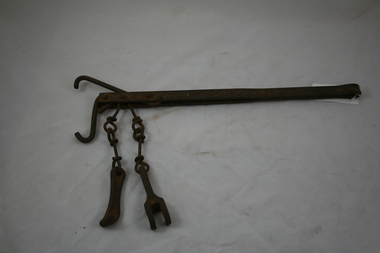 Emerald Museum & Nobelius Heritage Park
Sure Grip Wire Strainer (long chain is missing), 1917 - 1953
... The wire strainer was commonly used on Australian farming properties for putting fences up. ...Sure Grip Wire Strainers were advertised in Australia from 1917 to 1953. ...The wire strainer was commonly used on Australian farming properties for putting fences up. Sure Grip Wire Strainers were advertised in Australia from 1917 to 1953. The distinctive grips were patented in Britain in 1913 (William Swann, (spring, hook and chain manufacturer, Walsall,in England).Improvements in or relating to means for gripping wire or the like: British patent 24,520/13. 29 October 1913.Steel bar with 2 interlocking grips for fastening the wire.Corroded marking about halfway along the lever. wire strainer
