
Showing 18 items matching "stringer> elizabeth"
-
 Box Hill Historical Society
Photograph - Wattle Park High School, 26 April 1974
... ...Stringer> Elizabeth...Wattle Park High School, form 2A, taken on April 26. 1974 High schools Wattle Park High School Rogers> Simon Sims> Carolyn Cambareri> Dominic Leith> Verity Thorley> Bruce Dal> Phillip Lewis> Jennifer McKenzie> Robert Wood> Faye Doyle> Michael Loulatzis> Con Gizas> Gregory Miller> Christine Chapman> Margaret Lariccia> Angelo Fries> Stephen Gill> Gregory Armstrong> Ken Talbot> Paul Kline> Susan Shalders> Annette Blick> Robyn Defina> Deanne Butler> Ellen Stringer> Elizabeth Saultry> L Hansen> Debra Forday> Sandra Dwyer> Caron B&W photograph Photograph Wattle Park High School ...Wattle Park High School, form 2A, taken on April 26. 1974B&W photographhigh schools, wattle park high school, rogers> simon, sims> carolyn, cambareri> dominic, leith> verity, thorley> bruce, dal> phillip, lewis> jennifer, mckenzie> robert, wood> faye, doyle> michael, loulatzis> con, gizas> gregory, miller> christine, chapman> margaret, lariccia> angelo, fries> stephen, gill> gregory, armstrong> ken, talbot> paul, kline> susan, shalders> annette, blick> robyn, defina> deanne, butler> ellen, stringer> elizabeth, saultry> l, hansen> debra, forday> sandra, dwyer> caron -
Malmsbury Historical Society
Photograph (Item), Stringer Family Grave At Malmsbury Cemetery, Malmsbury ca1998
... Buildings - Malmsbury Cemetery People - "Stringer, Elizabeth Frances"...Buildings - Malmsbury Cemetery People - "Stringer, Elizabeth Frances" Stringer Family Grave At Malmsbury Cemetery, Malmsbury ca1998 Photograph Photograph ...Buildings - Malmsbury Cemetery People - "Stringer, Elizabeth Frances" -
Malmsbury Historical Society
Photograph (Item), Stringer Family Grave At Malmsbury Cemetery, Malmsbury ca1998
... Buildings - Malmsbury Cemetery People - "Stringer, Elizabeth Frances"...Buildings - Malmsbury Cemetery People - "Stringer, Elizabeth Frances" Stringer Family Grave At Malmsbury Cemetery, Malmsbury ca1998 Photograph Photograph ...Buildings - Malmsbury Cemetery People - "Stringer, Elizabeth Frances" -
 Melbourne Athenaeum Archives
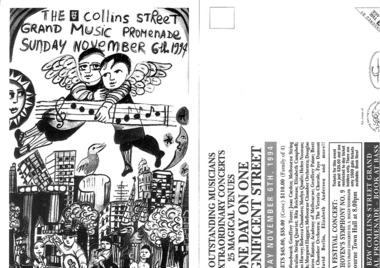
postcard Flyer, The BZW Collins Street Grand Music Promenade (Musical Variety Concert) commencing Sunday November 6th 1994
... One day on a magnificent street with: Roger Woodward, Geoffrey Tozer, Joan Carden, Melbourne String Quartet, Rita Reichman, Australian String Quartet, Elizabeth Campbell, Micheal Kieran Harvey,Rebecca Chambers, Merlyn Quaife, Helen Noonan, Jeannie Marsh, Margaret Haggart, Melbourne Chamber Orchestra, Douglas Lawrence, Spiros Rantos, Academy of Melbourne, Geofrey Paine, Brett Kelly, Haydn Chamber Orchestra, The Victorian Chorale, Faye Dumont Singers, David Berlin, Elizabeth Anderson and more ......One day on a magnificent street with: Roger Woodward, Geoffrey Tozer, Joan Carden, Melbourne String Quartet, Rita Reichman, Australian String Quartet, Elizabeth Campbell, Micheal Kieran Harvey,Rebecca Chambers, Merlyn Quaife, Helen Noonan, Jeannie Marsh, Margaret Haggart, Melbourne Chamber Orchestra, Douglas Lawrence, Spiros Rantos, Academy of Melbourne, Geofrey Paine, Brett Kelly, Haydn Chamber Orchestra, The Victorian Chorale, Faye Dumont Singers, David Berlin, Elizabeth Anderson and more ... ...Concerts were held at ten venues in Collins street grand music promenade venues:Baptist Church, St Michaels, ANZ Cathedral Room, 101 Collins Street, Kay Craddock bookshop, Georges Dining Room, Scot's Church, 161 Collins Street, the gold vaults of the Old Treasury Building. Note: It was recorded in the secretary's diary that concerts associated with the Collins Street Grand Music Promenade were held at the Melbourne Athenaeum Theatre all day on Sunday the 6th of November. This festival was organised by Greg Hocking and Peter Marks.Black and white postcard flyer Folder also contains a newspaper article, a venue program, folded poster and various letters of correspondence. One day on a magnificent street with: Roger Woodward, Geoffrey Tozer, Joan Carden, Melbourne String Quartet, Rita Reichman, Australian String Quartet, Elizabeth Campbell, Micheal Kieran Harvey,Rebecca Chambers, Merlyn Quaife, Helen Noonan, Jeannie Marsh, Margaret Haggart, Melbourne Chamber Orchestra, Douglas Lawrence, Spiros Rantos, Academy of Melbourne, Geofrey Paine, Brett Kelly, Haydn Chamber Orchestra, The Victorian Chorale, Faye Dumont Singers, David Berlin, Elizabeth Anderson and more ...the collins street grand music promenade, melbourne athenaem theatre -
 Flagstaff Hill Maritime Museum and Village
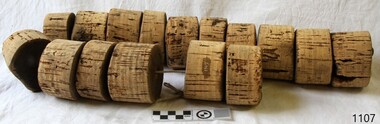
Equipment - Net Floats, 20th century
... Warrnambool Shipwreck Coast Flagstaff Hill Flagstaff Hill Maritime Museum Flagstaff Hill Maritime Village net floats cork net floats fishing fisheries fishing equipment handmade net fishing Fisheries Act Andrew Ferrier William Flett Warrnambool Breakwater Merri River Hopkins River Captain Theobald ELLEN ELIZABETH Net floats; cylindrical blocks of 16 corks threaded onto string with a hook-holding device at the end. ...These net floats are handmade from lightweight cork wood and are used for suspending fishing nets in the water. Newspaper articles dated from 1848 to 1916 mention net fishing in Warrnambool's Hopkins and Merri rivers and Lady Bay. The Melbourne Argus dated January 11, 1848, published a quote from Captain Theobald of the vessels ELLEN and ELIZABETH, made on his first visit to Warrnambool "“…Fish are very plentiful here; on Christmas day a net was thrown into the Hopkins, and, after two or three draws, a boat load of beautiful fish was obtained…” The Argus, Melbourne, Sat. 29 May 1858, forwarded from The Examiner newspaper; "Extraordinary Fish. We have been presented with a very singular fish, caught by Mr. Meek in the Hopkins [Hopkins River, Warrnambool] last week. It is about three inches long, with a slate-coloured body, and a beautiful wing on each side. It was caught with other fish at night, in a net, and its eyes shone as bright as diamonds." A method for making cork net floats mentioned, in a 15th-century book, advised cutting the corks and then burning a hole through the centre of each one with a hot iron. The prepared corks were then joined together with a horsehair line. The cork's size and the line's thickness depended on the net's weight.The net floats are an example of fishing equipment used for many centuries and still in use today. In Warrnambool net fishing was a common practice from 1848 and became a livelihood for many fishermen. Net floats; cylindrical blocks of 16 corks threaded onto string with a hook-holding device at the end. warrnambool, shipwreck coast, flagstaff hill, flagstaff hill maritime museum, flagstaff hill maritime village, net floats, cork net floats, fishing, fisheries, fishing equipment, handmade, net fishing, fisheries act, andrew ferrier, william flett, warrnambool breakwater, merri river, hopkins river, captain theobald, ellen, elizabeth -
 Flagstaff Hill Maritime Museum and Village
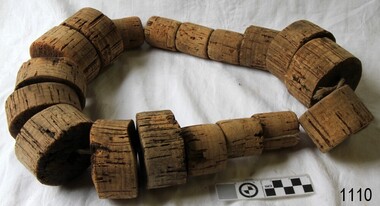
Equipment - Net Floats, 20th century
... Warrnambool Shipwreck Coast Flagstaff Hill Flagstaff Hill Maritime Museum Flagstaff Hill Maritime Village net floats cork net floats fishing fisheries fishing equipment handmade net fishing Fisheries Act Andrew Ferrier William Flett Warrnambool Breakwater Merri River Hopkins River Captain Theobald ELLEN ELIZABETH Net floats; cylindrical blocks of 18 corks of various sizes threaded onto string. ...These net floats are handmade from lightweight cork wood and are used for suspending fishing nets in the water. Newspaper articles dated from 1848 to 1916 mention net fishing in Warrnambool's Hopkins and Merri rivers and Lady Bay. The Melbourne Argus dated January 11, 1848, published a quote from Captain Theobald of the vessels ELLEN and ELIZABETH, made on his first visit to Warrnambool "“…Fish are very plentiful here; on Christmas day a net was thrown into the Hopkins, and, after two or three draws, a boat load of beautiful fish was obtained…” The Argus, Melbourne, Sat. 29 May 1858, forwarded from The Examiner newspaper; "Extraordinary Fish. We have been presented with a very singular fish, caught by Mr. Meek in the Hopkins [Hopkins River, Warrnambool] last week. It is about three inches long, with a slate-coloured body, and a beautiful wing on each side. It was caught with other fish at night, in a net, and its eyes shone as bright as diamonds." A method for making cork net floats mentioned, in a 15th-century book, advised cutting the corks and then burning a hole through the centre of each one with a hot iron. The prepared corks were then joined together with a horsehair line. The cork's size and the line's thickness depended on the net's weight.The net floats are an example of fishing equipment used for many centuries and still in use today. In Warrnambool net fishing was a common practice from 1848 and became a livelihood for many fishermen.Net floats; cylindrical blocks of 18 corks of various sizes threaded onto string.warrnambool, shipwreck coast, flagstaff hill, flagstaff hill maritime museum, flagstaff hill maritime village, net floats, cork net floats, fishing, fisheries, fishing equipment, handmade, net fishing, fisheries act, andrew ferrier, william flett, warrnambool breakwater, merri river, hopkins river, captain theobald, ellen, elizabeth -
 Flagstaff Hill Maritime Museum and Village
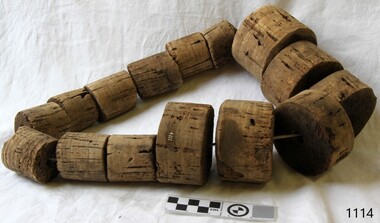
Equipment - Net Floats
... Warrnambool Shipwreck Coast Flagstaff Hill Flagstaff Hill Maritime Museum Flagstaff Hill Maritime Village net floats cork net floats fishing fisheries fishing equipment handmade net fishing Fisheries Act Andrew Ferrier William Flett Warrnambool Breakwater Merri River Hopkins River Captain Theobald ELLEN ELIZABETH Cork net floats; lengths of 15 various sized cylindrical blocks of cork threaded onto string. ...These net floats are handmade from lightweight cork wood and are used for suspending fishing nets in the water. Newspaper articles dated from 1848 to 1916 mention net fishing in Warrnambool's Hopkins and Merri rivers and Lady Bay. The Melbourne Argus dated January 11, 1848, published a quote from Captain Theobald of the vessels ELLEN and ELIZABETH, made on his first visit to Warrnambool "“…Fish are very plentiful here; on Christmas day a net was thrown into the Hopkins, and, after two or three draws, a boat load of beautiful fish was obtained…” The Argus, Melbourne, Sat. 29 May 1858, forwarded from The Examiner newspaper; "Extraordinary Fish. We have been presented with a very singular fish, caught by Mr. Meek in the Hopkins [Hopkins River, Warrnambool] last week. It is about three inches long, with a slate-coloured body, and a beautiful wing on each side. It was caught with other fish at night, in a net, and its eyes shone as bright as diamonds." A method for making cork net floats mentioned, in a 15th-century book, advised cutting the corks and then burning a hole through the centre of each one with a hot iron. The prepared corks were then joined together with a horsehair line. The cork's size and the line's thickness depended on the net's weight.The net floats are an example of fishing equipment used for many centuries and still in use today. In Warrnambool net fishing was a common practice from 1848 and became a livelihood for many fishermen.Cork net floats; lengths of 15 various sized cylindrical blocks of cork threaded onto string. warrnambool, shipwreck coast, flagstaff hill, flagstaff hill maritime museum, flagstaff hill maritime village, net floats, cork net floats, fishing, fisheries, fishing equipment, handmade, net fishing, fisheries act, andrew ferrier, william flett, warrnambool breakwater, merri river, hopkins river, captain theobald, ellen, elizabeth -
 Flagstaff Hill Maritime Museum and Village
Equipment - Net Floats, 20th century
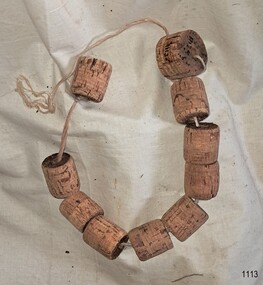
... Warrnambool Shipwreck Coast Flagstaff Hill Flagstaff Hill Maritime Museum Flagstaff Hill Maritime Village net floats cork net floats fishing fisheries fishing equipment handmade net fishing Fisheries Act Andrew Ferrier William Flett Warrnambool Breakwater Merri River Hopkins River Captain Theobald ELLEN ELIZABETH Net floats: cylindrical blocks of 10 corks threaded onto string. Equipment Net Floats ...These net floats are handmade from lightweight cork wood and are used for suspending fishing nets in the water. Newspaper articles dated from 1848 to 1916 mention net fishing in Warrnambool's Hopkins and Merri rivers and Lady Bay. The Melbourne Argus dated January 11, 1848, published a quote from Captain Theobald of the vessels ELLEN and ELIZABETH, made on his first visit to Warrnambool "“…Fish are very plentiful here; on Christmas day a net was thrown into the Hopkins, and, after two or three draws, a boat load of beautiful fish was obtained…” The Argus, Melbourne, Sat. 29 May 1858, forwarded from The Examiner newspaper; "Extraordinary Fish. We have been presented with a very singular fish, caught by Mr. Meek in the Hopkins [Hopkins River, Warrnambool] last week. It is about three inches long, with a slate-coloured body, and a beautiful wing on each side. It was caught with other fish at night, in a net, and its eyes shone as bright as diamonds." A method for making cork net floats mentioned in a 15th-century book advised cutting the corks and then burning a hole through the centre of each one with a hot iron. The prepared corks were then joined together with a horsehair line. The cork's size and the line's thickness depended on the net's weight.The net floats are an example of fishing equipment used for many centuries and still in use today. In Warrnambool net fishing was a common practice from 1848 and became a livelihood for many fishermen.Net floats: cylindrical blocks of 10 corks threaded onto string.warrnambool, shipwreck coast, flagstaff hill, flagstaff hill maritime museum, flagstaff hill maritime village, net floats, cork net floats, fishing, fisheries, fishing equipment, handmade, net fishing, fisheries act, andrew ferrier, william flett, warrnambool breakwater, merri river, hopkins river, captain theobald, ellen, elizabeth -
Dunkeld Museum Inc.
Clothing - Dress, Christening, Approximately 1870
... Elizabeth Templeton's family. This was owned and worn by a number of the earliest families in Dunkeld for the christening of their children. christening infant dress baby baptism needlework Infant's cotton christening gown. Hand made. Bodice has hand worked cotton lace across the front with three rows of pin tucks between the lace. Two frills are placed either side of the embroidered panel. The neck has a draw string ...This dress was made by Jacobina McNab for her sons in the 1870's. It was later worn by Jack and Elizabeth Templeton's family.This was owned and worn by a number of the earliest families in Dunkeld for the christening of their children.Infant's cotton christening gown. Hand made. Bodice has hand worked cotton lace across the front with three rows of pin tucks between the lace. Two frills are placed either side of the embroidered panel. The neck has a draw string which ties at the back below a row of picot lace. There is also a drawstring at the waist of the dress. Short raglan sleeves also have the two frills and a row of lace on the sleeve and the edge is finished with the same picot lace as the neckline. The skirt is very long with a panel down the centre which becomes wider as it goes down. This panel has a single frill either side of the panel. The panel is decorated with alternate self fabric frills and narrow tucks. The bottom of the dress is finished with a self fabric frill and two narrow tucks around the dress except for the area of the front panel. The skirt is tightly gathered at the waist.christening, infant, dress, baby, baptism, needlework -
 Flagstaff Hill Maritime Museum and Village
Equipment - Tooth Extractor, Late 19th - early 20th century
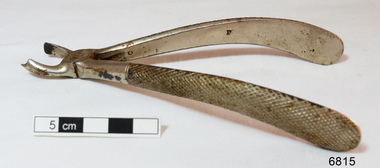
... string around the tooth and yank hard to extract the tooth. This was a much less painful and dangerous procedure than the pliers. The pliers often fractured other teeth and sometimes the jaw. The procedure was far from sterile and infection was a common problem and some people bled to death. The Renaissance and the Rise of Tooth Decay In the 1400s refined sugar was introduced into Europe but only reached the tables of the wealthy. While their betters were munching on sweets, the poorer folk suffered fewer toothaches. Queen Elizabeth...string around the tooth and yank hard to extract the tooth. This was a much less painful and dangerous procedure than the pliers. The pliers often fractured other teeth and sometimes the jaw. The procedure was far from sterile and infection was a common problem and some people bled to death. The Renaissance and the Rise of Tooth Decay In the 1400s refined sugar was introduced into Europe but only reached the tables of the wealthy. While their betters were munching on sweets, the poorer folk suffered fewer toothaches. Queen Elizabeth ...Toothaches have been with us since the evolution of teeth and extracting teeth. I wonder what poor Homo erectus did when suffering with a toothache. He probably just suffered and probably became very bad tempered. Ancient Dentistry Significant tooth decay did not appear until hunter-gatherer societies became agrarian. The change in diet included a large increase in carbohydrates which then led to tooth decay. Early man was primitive but he was also pretty smart. Some time around 8000 years ago someone in the area that is now Pakistan was using a drill to remove tooth decay. Examination of Neolithic skulls have revealed the handiwork of at least one very early dentist. A Sumerian text in about 5000 B.C. taught that the cause of tooth decay was tooth worms. Proposed cures for toothache were numerous. Early Egyptians wore amulets. An Egyptian named Hesy-Re, is known as the first dentist. Praise for his dentistry is inscribed on his tomb. Unfortunately it doesn’t delineate what he did to earn the praise. Pliny, the Elder, recommended finding a frog at midnight and asking it to take away the pain. The doctor to Emperor Claudius around 50 A.D. had his toothache patients inhale smoke produced by scattering certain seeds on burning charcoal and then rinsing the mouth with hot water. This was to expel the tooth worms. On the more practical side Aristotle and Hippocrates both wrote about the treatment of tooth decay. A primitive forceps was used for extracting teeth. Some dentists at that time were able to weave wire in the teeth to stabilize loose teeth. Medieval Torture From about 500 A.D. to 1100 A.D. monks were well educated and well trained and did some of the surgical procedures of the time. Barbers handled the rest of the operations, especially blood letting and tooth extractions. In 1163 the Pope put a stop to all surgeries by monks and the field was left open to the barbers. Barbers were, after all, very skilled with knives and razors. In fact, the barber pole, red and white spiraling stripes, is a symbol of the blood letting; red for blood. white for bandages. In the 1300s a Barbers’ Guild was established which divided the barbers into two groups: those with the skills and training to do procedures and those who were relegated to blood letting and tooth extractions. Pliers from a blacksmith’s foundry were the only device available. Barbers would often go to fairs and advertise painless tooth pulling. A shill in the audience would come on the stage, feigning severe toothache. The barber would pretend to extract tooth, pulling out a bloody molar he had palmed earlier. The supposed sufferer would jump for joy. The barbers set up near the bands at the fairs so that the music would drown out the screams of their patients. If the tooth was loose enough, the barber would tie a string around the tooth and yank hard to extract the tooth. This was a much less painful and dangerous procedure than the pliers. The pliers often fractured other teeth and sometimes the jaw. The procedure was far from sterile and infection was a common problem and some people bled to death. The Renaissance and the Rise of Tooth Decay In the 1400s refined sugar was introduced into Europe but only reached the tables of the wealthy. While their betters were munching on sweets, the poorer folk suffered fewer toothaches. Queen Elizabeth I was known for her blackened teeth. George Washington had a tooth extraction every year after age 22. He supposedly had a set of wooden false teeth but his dentures were actually ivory. The earliest instrument designed for tooth extraction was the dental pelican, which was shaped something like a pelican’s beak. The pelican was replaced in the 1700s by the dental key, which was fitted down over the affected tooth and was better able to grip the tooth. Both still often caused more damage than relief. The Development of Modern Dentistry Modern dental equipment began to be introduced in the 1800s about the time when dentistry became a profession and dental schools began to open. Ether was used starting in 1846 to anesthetize the pain and local anesthetics were introduced in the early 1900s. Modern dentists no longer have to seat their patients on the floor and have helpers to hold them down. Dentistry is as close to painless as possible now. There is no excuse to suffer the agony of a toothache these days. And extracting teeth is no longer dangerous. https://arizonadentalspecialists.com/the-surprising-history-of-extracting-teeth/ This tooth extractor was donated to Flagstaff Hill Maritime Village by the family of Doctor William Roy Angus, Surgeon and Oculist. It is part of the “W.R. Angus Collection” that includes historical medical equipment, surgical instruments and material once belonging to Dr Edward Ryan and Dr Thomas Francis Ryan, (both of Nhill, Victoria) as well as Dr Angus’ own belongings. The Collection’s history spans the medical practices of the two Doctors Ryan, from 1885-1926 plus that of Dr Angus, up until 1969. ABOUT THE “W.R.ANGUS COLLECTION” Doctor William Roy Angus M.B., B.S., Adel., 1923, F.R.C.S. Edin.,1928 (also known as Dr Roy Angus) was born in Murrumbeena, Victoria in 1901 and lived until 1970. He qualified as a doctor in 1923 at University of Adelaide, was Resident Medical Officer at the Royal Adelaide Hospital in 1924 and for a period was house surgeon to Sir (then Mr.) Henry Simpson Newland. Dr Angus was briefly an Assistant to Dr Riddell of Kapunda, then commenced private practice at Curramulka, Yorke Peninsula, SA, where he was physician, surgeon and chemist. In 1926, he was appointed as new Medical Assistant to Dr Thomas Francis Ryan (T.F. Ryan, or Tom), in Nhill, Victoria, where his experiences included radiology and pharmacy. In 1927 he was Acting House Surgeon in Dr Tom Ryan’s absence. Dr Angus had become engaged to Gladys Forsyth and they decided he would take time to further his studies overseas in the UK in 1927. He studied at London University College Hospital and at Edinburgh Royal Infirmary and in 1928, was awarded FRCS (Fellow from the Royal College of Surgeons), Edinburgh. He worked his passage back to Australia as a Ship’s Surgeon on the on the Australian Commonwealth Line’s T.S.S. Largs Bay. Dr Angus married Gladys in 1929, in Ballarat. (They went on to have one son (Graham 1932, born in SA) and two daughters (Helen (died 12/07/1996) and Berenice (Berry), both born at Mira, Nhill ) Dr Angus was a ‘flying doctor’ for the A.I.M. (Australian Inland Ministry) Aerial Medical Service in 1928 . The organisation began in South Australia through the Presbyterian Church in that year, with its first station being in the remote town of Oodnadatta, where Dr Angus was stationed. He was locum tenens there on North-South Railway at 21 Mile Camp. He took up this ‘flying doctor’ position in response to a call from Dr John Flynn; the organisation was later known as the Flying Doctor Service, then the Royal Flying Doctor Service. A lot of his work during this time involved dental surgery also. Between 1928-1932 he was surgeon at the Curramulka Hospital, Yorke Peninsula, South Australia. In 1933 Dr Angus returned to Nhill where he’d previously worked as Medical Assistant and purchased a share of the Nelson Street practice and Mira hospital from Dr Les Middleton one of the Middleton Brothers, the current owners of what was once Dr Tom Ryan’s practice. Dr L Middleton was House Surgeon to the Nhill Hospital 1926-1933, when he resigned. [Dr Tom Ryan’s practice had originally belonged to his older brother Dr Edward Ryan, who came to Nhill in 1885. Dr Edward saw patients at his rooms, firstly in Victoria Street and in 1886 in Nelson Street, until 1901. The Nelson Street practice also had a 2 bed ward, called Mira Private Hospital ). Dr Edward Ryan was House Surgeon at the Nhill Hospital 1884-1902 . He also had occasions where he successfully performed veterinary surgery for the local farmers too. Dr Tom Ryan then purchased the practice from his brother in 1901. Both Dr Edward and Dr Tom Ryan work as surgeons included eye surgery. Dr Tom Ryan performed many of his operations in the Mira private hospital on his premises. He too was House Surgeon at the Nhill Hospital 1902-1926. Dr Tom Ryan had one of the only two pieces of radiology equipment in Victoria during his practicing years – The Royal Melbourne Hospital had the other one. Over the years Dr Tom Ryan gradually set up what was effectively a training school for country general-practitioner-surgeons. Each patient was carefully examined, including using the X-ray machine, and any surgery was discussed and planned with Dr Ryan’s assistants several days in advance. Dr Angus gained experience in using the X-ray machine there during his time as assistant to Dr Ryan. Dr Tom Ryan moved from Nhill in 1926. He became a Fellow of the Royal Australasian College of Surgeons in 1927, soon after its formation, a rare accolade for a doctor outside any of the major cities. He remained a bachelor and died suddenly on 7th Dec 1955, aged 91, at his home in Ararat. Scholarships and prizes are still awarded to medical students in the honour of Dr T.F. Ryan and his father, Dr Michael Ryan, and brother, John Patrick Ryan. ] When Dr Angus bought into the Nelson Street premises in Nhill he was also appointed as the Nhill Hospital’s Honorary House Surgeon 1933-1938. His practitioner’s plate from his Nhill surgery states “HOURS Daily, except Tuesdays, Fridays and Saturday afternoons, 9-10am, 2-4pm, 7-8pm. Sundays by appointment”. This plate is now mounted on the doorway to the Port Medical Office at Flagstaff Hill Maritime Village, Warrnambool. Dr Edward Ryan and Dr Tom Ryan had an extensive collection of historical medical equipment and materials spanning 1884-1926 and when Dr Angus took up practice in their old premises he obtained this collection, a large part of which is now on display at the Port Medical Office at Flagstaff Hill Maritime Village in Warrnambool. During his time in Nhill Dr Angus was involved in the merging of the Mira Hospital and Nhill Public Hospital into one public hospital and the property titles passed on to Nhill Hospital in 1939. In 1939 Dr Angus and his family moved to Warrnambool where he purchased “Birchwood,” the 1852 home and medical practice of Dr John Hunter Henderson, at 214 Koroit Street. (This property was sold in1965 to the State Government and is now the site of the Warrnambool Police Station. ). The Angus family was able to afford gardeners, cooks and maids; their home was a popular place for visiting dignitaries to stay whilst visiting Warrnambool. Dr Angus had his own silk worm farm at home in a Mulberry tree. His young daughter used his centrifuge for spinning the silk. Dr Angus was appointed on a part-time basis as Port Medical Officer (Health Officer) in Warrnambool and held this position until the 1940’s when the government no longer required the service of a Port Medical Officer in Warrnambool; he was thus Warrnambool’s last serving Port Medical Officer. (The duties of a Port Medical Officer were outlined by the Colonial Secretary on 21st June, 1839 under the terms of the Quarantine Act. Masters of immigrant ships arriving in port reported incidents of diseases, illness and death and the Port Medical Officer made a decision on whether the ship required Quarantine and for how long, in this way preventing contagious illness from spreading from new immigrants to the residents already in the colony.) Dr Angus was a member of the Australian Medical Association, for 35 years and surgeon at the Warrnambool Base Hospital 1939-1942, He served as a Surgeon Captain during WWII1942-45, in Ballarat, Victoria, and in Bonegilla, N.S.W., completing his service just before the end of the war due to suffering from a heart attack. During his convalescence he carved an intricate and ‘most artistic’ chess set from the material that dentures were made from. He then studied ophthalmology at the Royal Melbourne Eye and Ear Hospital and created cosmetically superior artificial eyes by pioneering using the intrascleral cartilage. Angus received accolades from the Ophthalmological Society of Australasia for this work. He returned to Warrnambool to commence practice as an ophthalmologist, pioneering in artificial eye improvements. He was Honorary Consultant Ophthalmologist to Warrnambool Base Hospital for 31 years. He made monthly visits to Portland as a visiting surgeon, to perform eye surgery. He represented the Victorian South-West subdivision of the Australian Medical Association as its secretary between 1949 and 1956 and as chairman from 1956 to 1958. In 1968 Dr Angus was elected member of Spain’s Barraquer Institute of Barcelona after his research work in Intrasclearal cartilage grafting, becoming one of the few Australian ophthalmologists to receive this honour, and in the following year presented his final paper on Living Intrasclearal Cartilage Implants at the Inaugural Meeting of the Australian College of Ophthalmologists in Melbourne In his personal life Dr Angus was a Presbyterian and treated Sunday as a Sabbath, a day of rest. He would visit 3 or 4 country patients on a Sunday, taking his children along ‘for the ride’ and to visit with him. Sunday evenings he would play the pianola and sing Scottish songs to his family. One of Dr Angus’ patients was Margaret MacKenzie, author of a book on local shipwrecks that she’d seen as an eye witness from the late 1880’s in Peterborough, Victoria. In the early 1950’s Dr Angus, painted a picture of a shipwreck for the cover jacket of Margaret’s book, Shipwrecks and More Shipwrecks. She was blind in later life and her daughter wrote the actual book for her. Dr Angus and his wife Gladys were very involved in Warrnambool’s society with a strong interest in civic affairs. Their interests included organisations such as Red Cross, Rostrum, Warrnambool and District Historical Society (founding members), Wine and Food Society, Steering Committee for Tertiary Education in Warrnambool, Local National Trust, Good Neighbour Council, Housing Commission Advisory Board, United Services Institute, Legion of Ex-Servicemen, Olympic Pool Committee, Food for Britain Organisation, Warrnambool Hospital, Anti-Cancer Council, Boys’ Club, Charitable Council, National Fitness Council and Air Raid Precautions Group. He was also a member of the Steam Preservation Society and derived much pleasure from a steam traction engine on his farm. He had an interest in people and the community He and his wife Gladys were both involved in the creation of Flagstaff Hill, including the layout of the gardens. After his death (28th March 1970) his family requested his practitioner’s plate, medical instruments and some personal belongings be displayed in the Port Medical Office surgery at Flagstaff Hill Maritime Village, and be called the “W. R. Angus Collection”. The W.R. Angus Collection is significant for still being located at the site it is connected with, Doctor Angus being the last Port Medical Officer in Warrnambool. The collection of medical instruments and other equipment is culturally significant, being an historical example of medicine from late 19th to mid-20th century. Dr Angus assisted Dr Tom Ryan, a pioneer in the use of X-rays and in ocular surgery. Tooth extractor, dental surgical instrument. Metal with cross hatched pattern on handle. Stamped with maker's mark on hinge. Other stamps inside handles. Part of the W.R. Angus Collection.Stamped on hinge 'CASH & SONS ENGLAND'. Inside handles are 'C', 'P' and '27'.flagstaff hill, warrnambool, shipwrecked coast, flagstaff hill maritime museum, maritime museum, shipwreck coast, flagstaff hill maritime village, great ocean road, dr w r angus, dr ryan, surgical instrument, t.s.s. largs bay, warrnambool base hospital, nhill base hospital, mira hospital, flying doctor, dental surgical instrument, tooth extractor -
Port Melbourne Historical & Preservation Society
Document - Payment to workers, J Kitchen & Sons, 1944
... industry - manufacturing workers j kitchen & sons pty ltd patricia andrews gwendoline veronica anson w k atherton mary shirley barnet vera jean bedford ian allen block allan edward booth dorothy brown neva davis margaret fraser alma goulding elizabeth grey betty guegan norma johnson fay macdonald elizabeth mowbray leonara mcauley thelma mcmillan judith unverchan valda smith rita smith joy smith hugh ralston betty ralston kevin power a w duerend Reliable form 2050. Reliable line of ready made systems Pages tied together with string ...Pages tied together with string, recording payment to Kitchen's workersReliable form 2050. Reliable line of ready made systemsindustry - manufacturing, workers, j kitchen & sons pty ltd, patricia andrews, gwendoline veronica anson, w k atherton, mary shirley barnet, vera jean bedford, ian allen block, allan edward booth, dorothy brown, neva davis, margaret fraser, alma goulding, elizabeth grey, betty guegan, norma johnson, fay macdonald, elizabeth mowbray, leonara mcauley, thelma mcmillan, judith unverchan, valda smith, rita smith, joy smith, hugh ralston, betty ralston, kevin power, a w duerend -
Glen Eira Historical Society
Document - Caulfield Lacrosse Club
... Clubs and Associations Sports and Recreations Sporting Clubs Lacrosse Sports People Lacrosse Players Abram Flynn Allinson Jenny Angelicas Samuel Ansell Romy Aguitera Pedro Bartlem Jai Barlow Erin Blakeney Joe Byne Wild Chris Campbell Darcy Campbell Jordan Campbell Sally Campbell Darcy Chapman Jane Chapman Nicholas Currie Sieng Cornish Hayley Dando Jack Ditmar Luk Eyton Toby Ettia Lino Flemming Garry Fitchett Benjamin Fllod Keir Fothergill Liam Hallion Amy Hamilton Michael Mulley Laura Harari Liam Mealy Tara Hubbard Corey Hubbarld Dylan Ikegawa Ken Johnson Sam Johnson Hamish Jones Darian Keen Murray Kukucka Elizabeth Lane Finbavc Lettieri William Lettieri Luca Lewis Christopher Lozan Alex Mcarthur Heleo Melvin Keziah Morgan Briony Mullner Elizabeth Mullner Susanna Norris Hugo Norman Dace Pope Bladen Pigram Mathew Quig Quigle Bryce Stark James Stark Robem Rodriques Brendan Rodrigues Michael Roberts Anna Murovan Chick Anthony Tzirulnk David Tan Denise Rodriques Anthony Ross Harrison Billing Adam PetriTsch Michael Samoilov Tim Sainsbury Nicole Stark Robert Strand Anna Smith Aaron Smith Damian Stevens William Townley Adam Waite Jeremy Stringer Shaylee Small Corey Singh Shakti Sinclair Stuart Weinsberger Max Ross Lily Strozycki Erin Small Kira Small Dale Vane Weel Michael Wingfield Lauren Document Caulfield Lacrosse Club ...This file contains News paper cutting containing march report summaries for Caulfield Lacrosse Club team and prominent club players for each grade matches. Each weekly summary is mounted on paper in plastic envelope. The match summaries cover dates from May 17th 2010 to August 28th 2012. Match report cuttings to be added to the file as they become available.clubs and associations, sports and recreations sporting clubs, lacrosse, sports people, lacrosse players, abram flynn, allinson jenny, angelicas samuel, ansell romy, aguitera pedro, bartlem jai, barlow erin, blakeney joe, byne wild chris, campbell darcy, campbell jordan, campbell sally, campbell darcy, chapman jane, chapman nicholas, currie, sieng, cornish hayley, dando jack, ditmar luk, eyton toby, ettia lino, flemming garry, fitchett benjamin, fllod keir, fothergill liam, hallion amy, hamilton michael, mulley laura, harari liam, mealy tara, hubbard corey, hubbarld dylan, ikegawa ken, johnson sam, johnson, hamish, jones darian, keen murray, kukucka elizabeth, lane finbavc, lettieri william, lettieri luca, lewis christopher, lozan alex, mcarthur, heleo, melvin keziah, morgan, briony, mullner elizabeth, mullner susanna, norris hugo, norman dace, pope bladen, pigram mathew, quig quigle bryce, stark james, stark robem rodriques brendan, rodrigues michael, roberts anna, murovan chick anthony, tzirulnk david, tan denise rodriques anthony, ross harrison, billing adam, petritsch michael, samoilov tim, sainsbury nicole, stark robert, strand anna, smith aaron, smith damian, stevens, william, townley adam, waite jeremy, stringer shaylee, small corey, singh shakti, sinclair stuart, weinsberger max, ross lily, strozycki erin, small kira, small dale, vane weel michael, wingfield, lauren -
 Warrnambool and District Historical Society Inc.
Medal, Medal (George VI Coronation), 1937
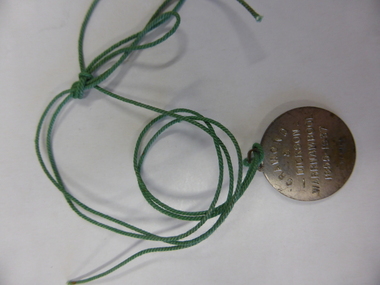
... One side has the heads of King George and Queen Elizabeth surrounded by wording and the other side has the name of the Warrnambool store issuing the medal. The medal is tarnished. A piece of green string...One side has the heads of King George and Queen Elizabeth surrounded by wording and the other side has the name of the Warrnambool store issuing the medal. The medal is tarnished. A piece of green string ...This medal has been issued to commemorate the Coronation of King George VI of England in 1937. It was issued by a department store in Warrnambool, that of Cramond and Dickson. This business was established by John Glass Cramond and James Dickson in Timor Street, Warrnambool in 1855. It moved to Liebig Street at the corner of Timor Street and sold mens and ladies wear. It had its own tailors and milliners and the building was a landmark one in Warrnambool for over 100 years. It closed in 1973. In 1937 the business of Cramond and Dickson was 82 years old. This medal is of great interest as it shows the level of fervor for British Royalty and all things British that was prevalent in Warrnambool in the 1930s. The Cramond and Dickson business was one of the most important ones in Warrnambool’s history as it operated for over 100 years. This is a silver-coloured medal commemorating the Coronation of King George VI of England. One side has the heads of King George and Queen Elizabeth surrounded by wording and the other side has the name of the Warrnambool store issuing the medal. The medal is tarnished. A piece of green string is attached to the hook at the top of the medal. ‘King George VI Queen Elizabeth Coronation 1937’ ‘Cramond & Dickson Warrnambool 1855-1937’ ‘P.J.King’ cramond and dickson, king george vi coronation, history of warrnambool -
 Warrnambool and District Historical Society Inc.
Needle case and needles, Late 19th century
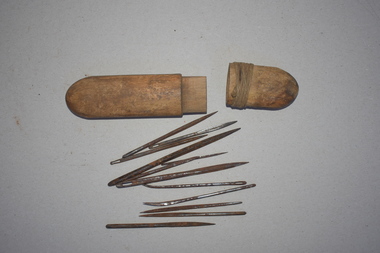
... The needles are bag needles, used with leather or string to sew up and enclose hessian bags etc. English-born Henry Phillips (1821-1896) came to Australia with his wife Elizabeth in 1849. ...The needles are bag needles, used with leather or string to sew up and enclose hessian bags etc. English-born Henry Phillips (1821-1896) came to Australia with his wife Elizabeth in 1849. ...This item is one of several in a collection of tools that are believed to have been owned by the Warrnambool carpenter and businessman, Henry Phillips. The needles are bag needles, used with leather or string to sew up and enclose hessian bags etc. English-born Henry Phillips (1821-1896) came to Australia with his wife Elizabeth in 1849. They lived for some time in Port Fairy. In 1865 Henry formed a partnership with Christopher Beattie to establish the Warrnambool undertaking business of Beattie and Phillips. This business continued on after the deaths of the founders and lasted until the year 2000. In Warrnambool Henry Phillips was involved in the management of the Mechanics Institute.This is a wooden case, elliptical in shape, with a detachable lid. The case is pointed at both ends. The lid is bound at one end with several strands of string. The case contains twelve metal needles of varying lengths and eye hole sizes. Two of the needles have curved ends and several have flattened middle sections. The needles are much rusted and the case is stained.Made in Englandvintage tools, henry phillips -
 Wodonga & District Historical Society Inc
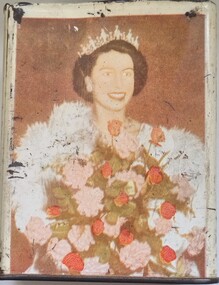
Memorabilia - Money Box - Coronation of Queen Elizabeth II, Besters Sweets, 1953
... Elizabeth with Prince Charles. They are framed by a window. She is wearing a light blue suit with a brooch on the lapel and a string of pearls around her neck. ...Elizabeth with Prince Charles. They are framed by a window. She is wearing a light blue suit with a brooch on the lapel and a string of pearls around her neck. ...The coronation of Elizabeth II as Queen of the United Kingdom and the other Commonwealth realms took place on 2 June 1953 at Westminster Abbey in London. Elizabeth acceded to the throne at the age of 25 upon the death of her father, George VI, on 6 February 1952. It was the first British coronation to be fully televised around the world. Celebrations took place around the world and a wide array of memorabilia was produced. Items ranged from mass-produced ceramics (mugs, plates, teasets) by firms like Doulton to official, limited-edition souvenirs. Commemorative items also included spoons, tins, flags and money boxes such as this item produced by Bester's Sweets Company in England and in Melbourne, Victoria.This item is significant because it records an important event in the British Royal Family, a vital part of the hereditary of many Wodonga residents. Queen Elizabeth became the official head of the Government of Australia at that time.Rectangular money box with light yellow background and a different illustration and inscription on each side. On one side is Queen Elizabeth with Prince Charles. They are framed by a window. She is wearing a light blue suit with a brooch on the lapel and a string of pearls around her neck. A more formal image of the Queen is on the opposite side. She is wearing a tiara and a white fur and is holding a large bunch of flowers. The background is brown. Both side panels are inscribed. Side 1 - "THE ROYAL LINE / SAXON / NORMAN / PLANTAGENET / TUDOR / STUART / HANOVER / SAXE-COBURG AND GOTHA / WINDSOR / ELIZABETH II" Side 2 - EIIR / BORN/ April 21st, 1926 / MARRIED / November 20th, 1947 / ACCESSION TO THRONE / February 6th, 1952 / CORONATION / June 2nd, 1953" One base - Bester's Sweetscoronation of queen elizabeth ii, british royal family, royal memorabilia -
 Kew Historical Society Inc
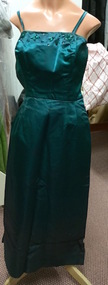
Clothing - Green Satin Cocktail Dress, 1954
... Elizabeth II in 1954 at Government House, Melbourne. [The personalised printed invitations are kept in the Subject File 'Gwen Steele'.] royal visit (victoria) 1954, gwen steele women's clothing australian fashion - 1950s cocktail dresses Emerald green, satin cocktail dress with shoe-string straps. ...The Fashion & Design collection of the Kew Historical Society includes examples of women’s, men’s, children’s and infants’ clothing from the 18th, 19th and 20th centuries. Items in the collection were largely produced for, or purchased by women in Melbourne, and includes examples of outerwear, protective wear, nightwear, underwear and costume accessories. This emerald green, satin evening dress, owned by Gwen Steele, was worn by her to a reception for Queen Elizabeth II in 1954 at Government House, Melbourne. [The personalised printed invitations are kept in the Subject File 'Gwen Steele'.]Emerald green, satin cocktail dress with shoe-string straps.royal visit (victoria) 1954,, gwen steele, women's clothing, australian fashion - 1950s, cocktail dresses -
 Kew Historical Society Inc
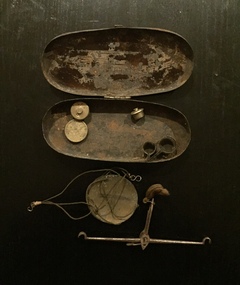
Equipment - Portable Gold Scales in Japanned Tin Case
... Orlando and his wife Elizabeth had four children of which Henry Beater (1886-1962) was the oldest. gold scales christian-washfold collection Gold scales encased in a rectangular hinged Japanned tin case. Old label on inside of case unreadable. String ...Part of a large donation of items once owned by members of the Christian-Washfold families of Kew. Henry Christian (c.1809-91) was one of the first settlers in Kew. He arrived in Victoria with his wife Agnes and son Orlando in 1855 on the Gypsy Queen. He established a rope-making business in Bulleen Road by 1858 but was declared insolvent two years later. In his final years, he was celebrated as one of the oldest living settlers of the district. His son, Orlando Henry Beater Christian (c.1853-1930) became a member of the Hawthorn Band and a foundation member of the Willsmere Swimming Club. Orlando and his wife Elizabeth had four children of which Henry Beater (1886-1962) was the oldest.Gold scales encased in a rectangular hinged Japanned tin case. Old label on inside of case unreadable. String requires repair and audit of components.gold scales, christian-washfold collection -
 Melbourne Tram Museum
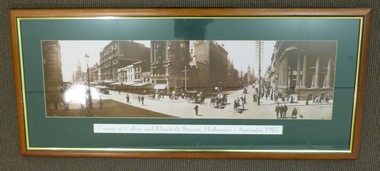
Print - Framed Print, Malvern Framing Gallery, "Corner of Collins and Elizabeth St, Melbourne, Australia 1903", 1997
... Elizabeth St, Melbourne, Australia 1903". Has been lined with brown paper on rear. Two screwed frame hanging supports on either side with four runs of string between them. ...Elizabeth St, Melbourne, Australia 1903". Has been lined with brown paper on rear. Two screwed frame hanging supports on either side with four runs of string between them. ...Framed and glazed photograph of the corner of Collins and Elizabeth Streets Melbourne, looking North East. Wooden frame, brown and gold lining, green card cut to present photograph, with title ""Corner of Collins and Elizabeth St, Melbourne, Australia 1903". Has been lined with brown paper on rear. Two screwed frame hanging supports on either side with four runs of string between them. Has Post Office, Town Hall and Scots Church Towers in the view. One cable car set and one motorised car along with many horse drawn vehicles. Has signed buildings for: Falk Carter & Verner City Hotel M.A Alexander R.H. Alston Blitz's DentistOn rear in black felt pen "$N/XX" and "1997"trams, tramways, melbourne, collins st, cable trams, elizabeth st
