Showing 9 items matching "student focus in libraries"
-
NMIT (Northern Melbourne Institute of TAFE)Report - NMIT, NMIT New Library: strategic statement 2006-2009, August 2006
... ...student focus in libraries...This document is NMIT's strategic plan to deliver services relevant to the needs of its clientele. libraries student focus in libraries library operational plan library staff nmit Some passages highlighted with pencilled stars. ...A collection of documents and reports related to the NMIT library strategic plan 2006-2009. This plan recognises changes to library service and sets down the plan for NMIT libraries in the first decade of the 21st century. Includes 2 copies of Library Operational Plan August 2007The role of libraries and librarians changed in response to changing client expectations, and new and emerging technologies. This document is NMIT's strategic plan to deliver services relevant to the needs of its clientele.A collection of documents and reports, text printed on white paper. Each document stapled in top left corner, collection held together with large clip.Some passages highlighted with pencilled stars.libraries, student focus in libraries, library operational plan, library staff, nmit, -
Warrnambool and District Historical Society Inc.Book - Australasian Literature Primers, Whitcombe & Tombs Pty Ltd, Robert Browning, 1940s
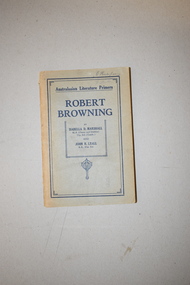
... students in Victorian schools in the early to mid 20th century. The editors are Isabella Marshall and John Lyall. Text books such as this one were mass produced and focus on the poems to be studied with a cheap and unattractive format. No information is available on the owner of the book, Ben Knapsey. This book is a good example of the texts used by senior students in Victorian schools in the early to mid 20th century and is retained to be included in our library ...This is a school literature text book for senior students in Victorian schools in the early to mid 20th century. The editors are Isabella Marshall and John Lyall. Text books such as this one were mass produced and focus on the poems to be studied with a cheap and unattractive format. No information is available on the owner of the book, Ben Knapsey.This book is a good example of the texts used by senior students in Victorian schools in the early to mid 20th century and is retained to be included in our library collection of vintage school text books.This is a soft cover book of 132 pages. It is a school text book for senior classes. It has a blue cover, now faded, with dark blue printing. The pages contain a preface, an introduction, selections of Robert Browning’s poetry, and notes and questions. There are some advertisements for other school text books.Ben Knapsey Form 1Vschool texts in the mid 20th century, history of warrnambool -
Federation University Historical CollectionBook - Book - Scrapbook, University of Ballarat: Scrapbook of Newspaper cutting; Book 4, November 1998 to May 1999
... Library (top floor) Mount Helen goldfields Newspaper cuttings relating to the University of Ballarat, SMB Campus. These are from various newspapers and include The Age, Ballarat Courier, The Australian, The Herald. The cuttings cover the period from 28 November 1998 to 15 May 1999. . employment advertisements application for enrolment outline of courses university of ballarat smb campus ub disability day iead in hygiene training obituary - john henry calaby smb adult vce graduation ballarat's tafe students better placed university's new music course internet scheme for farmers student services boosted boost for viticulture training farm safety focus uni scholarships to 8 koories 'sick' groundbreaking theatre mum - top student lunch lasts a long time pam davies new deputy chancellor work to begin on camp street 'cultural recycling' $12m for camp street $1m grant - remote education scholarships for koori students Book with yellow cover, front. ...Newspaper cuttings relating to the University of Ballarat, SMB Campus. These are from various newspapers and include The Age, Ballarat Courier, The Australian, The Herald. The cuttings cover the period from 28 November 1998 to 15 May 1999. . Book with yellow cover, front. Spiral bound.employment advertisements, application for enrolment, outline of courses, university of ballarat, smb campus, ub, disability day, iead in hygiene training, obituary - john henry calaby, smb adult vce graduation, ballarat's tafe students better placed, university's new music course, internet scheme for farmers, student services boosted, boost for viticulture training, farm safety focus, uni scholarships to 8 koories, 'sick' groundbreaking theatre, mum - top student, lunch lasts a long time, pam davies new deputy chancellor, work to begin on camp street, 'cultural recycling', $12m for camp street, $1m grant - remote education, scholarships for koori students -
Federation University Historical CollectionPhotograph - Photographs - colour, VIOSH: Postgraduate Student, Geoffrey Dell's PhD, 1996, c1996
... Barker Library (top floor) Mount Helen goldfields Victorian Institute of Occupational Safety and Health (VIOSH) Australia is the Asia-Pacific centre for teaching and research in occupational health and safety (OHS) and is known as one of Australia's leaders on the field. VIOSH has a global reputation for its innovative approach within the field of OHS management. VIOSH Australia enrolled its first PhD candidate in 1995 and during 1996 focused on attracting increasing numbers of students ...Victorian Institute of Occupational Safety and Health (VIOSH) Australia is the Asia-Pacific centre for teaching and research in occupational health and safety (OHS) and is known as one of Australia's leaders on the field. VIOSH has a global reputation for its innovative approach within the field of OHS management. VIOSH Australia enrolled its first PhD candidate in 1995 and during 1996 focused on attracting increasing numbers of students. In 1996, three candidates were enrolled through VIOSH Australia.They were John Culvenor, Geoffrey Dell and Thomas Mitchell. All had Prof Dennis Else as their supervisor. Previously, Geoffrey Dell was in Intake 7, 1985, Occupational Hazard Management. Geoffrey Dell's topic was "Airline Baggage Handler Back Injuries - Causes and Prevention." "The aim of this study is to investigate the work practises and operational systems used by baggage handlers in a range of airlines, worldwide. Where possible the investigation will include an epidemiological study of baggage handler back injury occurrence in those airlines. The information gathered will provide an understanding of back injury causation modes, and will focus attention on the specific tasks for which engineering solutions should be sought. Engineering solutions identified will be subject to controlled trial, to confirm their validity." This led to the construction of a full scale plywood baggage compartment model and a partnership with Ballarat University's School of Human Movement and Sports Science. Three different loading systems were tested. Qantas baggage handlers travelled to Ballarat University to fill the human frame of the investigation. The photographs show this aspect of the research. In 1997, Geoffrey Dell was awarded the Eric Wigglesworth Prize. The prize acknowledges publication of an article which constitutes a significant contribution to the body of occupational health and safety knowledge in an approved OH&S journal.32 co;our photographs showing procedure of baggage handlers.viosh, victorian institute of occupational safety and health, geoffrey dell, john culvenor, thomas mitchell, phd, airline baggage handler back injuries, work practises, operational systems, engineering solutions, causes of injury, qantas baggage handlers, prof dennis else, eric wiggles worth prize, oh&s journal, ballarate university, school of human movement and sports science, plywood compartment model, loading systems -
Federation University Historical CollectionDocument - Outreach Program, Federation University Australia, Regional Schools outreach Program (RSOP) Federation University, 2008 - 2017
... Barker Library (top floor) Mount Helen goldfields Regional Schools Outreach Program is a Federation University Program in conjunction with the Australian Government Regional Schools Outreach Program Federation University Student Guide Later Years Scholarships SEAS Special Entry Access Scheme University How to Make it Happen Course and Career Options Building your future Grade 5/6 Stepping Up Parent's Guide Reach for the stars Workshop Teachers Resource Dream makers The future is now Year 8 Teacher's Guide Focus on Your Future Focus on Their future Year 9 Student Workbook Year 10 Put yourself in the picture What do you know about Uni? ...Regional Schools Outreach Program is a Federation University Program in conjunction with the Australian Government.1 Student Action Plan A4 Sheet .2 Regional Schools Outreach Program informations sheet A4 .3 VTAC information sheet 2014 A4 .4 Special Entry Access Scheme (SEAS) information sheet A4 .5 Open Days 2014 A4 flyer .6 VCAL snapshot A4 flyer .7 4 page booklet titled University, put yourself in the picture. .8 From High School to University - Making the transistion A4 flyer .9 I don't know what I want to do! A4 Flyer .10 Bridging Courses and Pathway Programs A4 Flyer .11 FedUni Schools Outreach - Focus on your Future A4 Flyer .12 60 page A4 booklet Regional Schools outreach Program 2008 - 2013 Evaluation Report .13 9 Page A4 Booklet Excite explore Empower - Evaluation of Federation University Australia Regional Schools Outreach Program - Summary of 2008 - 2013 Evaluation Findings and Conclusions .14 Key Dates list 2016 - 2017 .15 Student Guide - Year 10 - Course and Career Options A4 Booklet - 13 Pages .16 Univeristy - Year 10 - Put yourself in the picture A4 Flyer .17 Year 9 Teacher's Guide - Focus on your future - A4 Booklet 13 page booklet .18a Focus on Your Future - Year 9 - Student Workbook 2015 - A4 Booklet 12 pages .18b Focus on your Future - Year 9 - Teacher's Guide 2015 - A4 Booklet 12 pages .19 Focus on their future - Parent's Guide 2015 - A4 Booklet 8 page booklet .20 Focus on your Future - A Parent's Guide 2013 - A4 Booklet 8 Pages .21 The Future is Now - Year 8 - Teacher's Guide 2014 - A4 Booklet 12 pages .22 a & b - The future is now - Year 8 - Student Workbook 2014 - A4 Booklets 12 pages .23 Dream Makers - Grade 5/6 a Parents guide - A5 8 page Booklet .24a & b Stepping Up reach for the stars - Grade 5/6 Parent's Guide - A5 8 page Booklet .25a & b Regional Schools Outreach Program Grade 5/6 Stepping up Workshop - Teacher's Resource - 3 page A4 document .26a & b Stepping up reach for th stars - Student Workbook - A4 12 page Booklet x 2 .27a & b Grade 5/6 Building your Future - A Parent's guide - 4 page A5 Booklet .28 Building your future - Grade 5/6 A Student's Guide - A4 8 page booklet .29 Joining the dots from secondary school to University - Course and career options - Beyond secondary school - a guide to future career options 2013 .30 Later years Students - University - How to Make it Happen 2014 - A4 Booklet 16 pages .31a & b Scholarships and SEAS Applications - Year 12 Guide - 4 page A4 document .32 Student Guide - Later Years - University how to make it happen - A4 Booklet 16 pages .33 Regional Schools Outreach Program - Putting Regional Students in the picture for University - A4 4 page pamphlet regional schools outreach program, federation university, student guide, later years, scholarships, seas, special entry access scheme, university how to make it happen, course and career options, building your future, grade 5/6, stepping up, parent's guide, reach for the stars, workshop, teachers resource, dream makers, the future is now, year 8, teacher's guide, focus on your future, focus on their future, year 9, student workbook, year 10, put yourself in the picture, what do you know about uni?, key dates, excite explore empower, evaluation findings and conclusions, evaluation report, fed uni schools outreach, bridging courses, pathway programs, i don't know what i want to do., support services, picture the possibilities, booklet, vcal, snapshot, vce, open days 2014, vtac, student action plan -
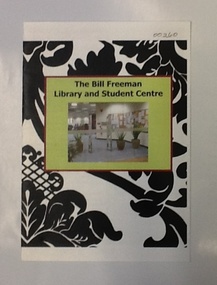
NMIT (Northern Melbourne Institute of TAFE)Brochure, The Bill Freeman Library and Student Centre, 2007
... Library and Student Centre. The new centre was designed to meet changes in thelibrary to a more student-focused service. ...Library and Student Centre. The new centre was designed to meet changes in thelibrary to a more student-focused service. ...The Collingwood Campus library of NMIT was redeveloped in 2007 and renamed the Bill Freeman Library and Student Centre. The new centre was designed to meet changes in thelibrary to a more student-focused service. It provides spaces for a variety of learning needs and styles. The library was named after Bill Freeman, a long-standing institute council member of Collingwood College of TAFE and later NMIT, serving as NMIT Council President 2002-2006. He retired from the Council in 2007.As the first 'student centre' the Bill Freeman Library and Student Centre was a design model for the development of Fairfield, Heidelberg and Epping campus libraries.2 copies of colour brochure, printed on A4 and folded to A5. Includes photographs of Collingwood campus library and background on Bill Freeman.student centres, libraries, collingwood college of tafe, bill freeman, ccot, nmit, -
Federation University Historical CollectionBook, Touching the Full Redemption of Mankind by the Death and Blood of Christ Jesus (human skin cover), 1599
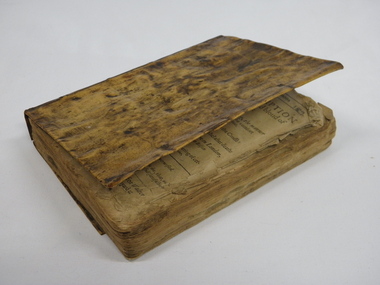
... student Talanna Buckley at Federation University finding an 100% match to human DNA on the outside cover of the book. This is one of only two confirmed anthropodermic books in Australia, the other is housed at the National Library of Australia. Other forms of testing the leather of books have been found to be more accurate than DNA testing. For example, before DNA testing or PMF (Peptide Mass Fingerprinting) are undertaken many books have been identified as made from human skin through the close examination of the skins patterning. Hair follicles are the focus...student Talanna Buckley at Federation University finding an 100% match to human DNA on the outside cover of the book. This is one of only two confirmed anthropodermic books in Australia, the other is housed at the National Library of Australia. Other forms of testing the leather of books have been found to be more accurate than DNA testing. For example, before DNA testing or PMF (Peptide Mass Fingerprinting) are undertaken many books have been identified as made from human skin through the close examination of the skins patterning. Hair follicles are the focus ...Anthropodermic Bibliopegy is the name given to the use of human leather to bind books. The name stems from the combination of the Greek root words, human (Anthropos), skin (derma), book (biblion), and fasten (pegia). The practice of creating anthropodermic books was popular throughout the 17th and 18th centuries. Most commonly, anthropodermic books are medical tomes, with the human leather taken from medical cadavers. Others were produced after criminal trials, with the criminal’s skin used to enclose the record of their own death sentences, creating a form of punishment that would surpass death. Other anthropodermic books contain poems or are religious texts. This book was written and printed in 1599 but most probably was rebound later when creation of anthropodermic books became more predominant. The book is a small tome of a religious nature containing the work of Bishop Thomas Bilson, who in a puritanical voice states that the primary argument articulated in this book is that “the metaphorical Calvinist interpretation of Hell as an exclusion from God was accurate then Christ's descent into hell after his crucifixion must refer to an actual existent hell as Christ was neither subject to sin nor able to be separated from the Divine.” The unusual cover of the book has led to many questions, the main being whether the book is covered with human skin. It was confirmed as such in 2014 with DNA testing undertaken by honours student Talanna Buckley at Federation University finding an 100% match to human DNA on the outside cover of the book. This is one of only two confirmed anthropodermic books in Australia, the other is housed at the National Library of Australia. Other forms of testing the leather of books have been found to be more accurate than DNA testing. For example, before DNA testing or PMF (Peptide Mass Fingerprinting) are undertaken many books have been identified as made from human skin through the close examination of the skins patterning. Hair follicles are the focus of the examination as certain patterns and sizes lend themselves to being human. However, many of these books have been proven to not be bound in human skin, the same can be said of books with inscriptions claiming them as anthropodermic. Peptide Mass Fingerprinting (PMF) testing has been found to be the most reliable way of confirming a leather bindings origin. This process involves the sampling of collagen-based materials, cutting the protein to gain specific amino acid combinations which form individual peptide sequences. Each mammal has an individual amino acid sequence in its collagen therefore its peptide mass combination is unique. This form of test can provide a more accurate outcome as collagen will be preserved for longer after the tanning process and will not be damaged in the same way DNA can be by the tanning process. DNA testing can also provide false positives as trace DNA from someone touching the book could be amplified and provide the reading instead of that of the leather itself. However, this book was tested with many controls as well as specific decontamination procedures in order to ensure that it was not trace DNA being tested. This book is historically and spiritually significant because it is a rare example of an early printed English Christian religious tract produced in Old English and Latin.. Its association with Thomas Bilson, who oversaw the final printing and publication of the King James Bible, is important. The covering of this book has been tested for human dna. Findings prove the book is covered with human skin, increasing the rarity of the object.420 page book with unusual leather cover. The book is written in Old English with passages in latin. There is a pressed petal between p.68 and 69. The covering of this book is made of human skin. The practice of binding books in human skin, also known as anthropodermic bibliopegy.Inside cover - James Hendy No 17 (Fu)gends Road Palmers Village Westminster. The gift of his mother Mrs Thomas Hendy. Some notes made through text eg p.112, and a passage written on the last page.religion, bible, edward lowe, edward lotos, thomas bilson, anthropodermic bibliopegy, james hendy, full redemption, religious, leather, wilson, winchester, jesus, puritanical, puritans, bungey, bilson, human skin, skin, human skin cover, human skin binding -
International House, The University of MelbournePhotograph (Item), Three students looking at books, 1961
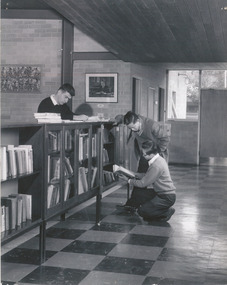
... Students' Club. The IH Library was formally created in 1962 as the Sir Angus Mitchell Library, with the Rotary Club of Melbourne a major source of financial support . Through 1961 and 1962, donated funds and books allowed for the development of a collection, initially focusing on necessary texts for undergraduate students, and texts on the histories and cultures of other countries....Students' Club. The IH Library was formally created in 1962 as the Sir Angus Mitchell Library, with the Rotary Club of Melbourne a major source of financial support . Through 1961 and 1962, donated funds and books allowed for the development of a collection, initially focusing on necessary texts for undergraduate students, and texts on the histories and cultures of other countries. ...This photo appeared in the International House magazine, Satadal, in 1961, with the caption 'A small but interesting collection of books is available for students' casual reading. A wide selection of magazines and newspapers is also provided, and administered, by the International House Students' Club. The IH Library was formally created in 1962 as the Sir Angus Mitchell Library, with the Rotary Club of Melbourne a major source of financial support . Through 1961 and 1962, donated funds and books allowed for the development of a collection, initially focusing on necessary texts for undergraduate students, and texts on the histories and cultures of other countries.'Satadal 1961' inscribed on reverselibrary, books -
Bendigo Historical Society Inc.Booklet - Michele Matthews Collection: PHD Research - The Bells of St Mary's, 1876-1983
... student population. The support of the Bendigo community through fundraising and donations played an important role in this development. As the college grew throughout the early twentieth century, it continued to modernise its facilities while maintaining its Catholic identity. The history records the addition of science laboratories, libraries, dormitories and other buildings, as well as significant anniversaries and celebrations. It concludes by noting the amalgamation of St Mary's College with Marist Brothers College to form a new Catholic secondary college, marking the end of an important chapter in the school's history. A major focus...student population. The support of the Bendigo community through fundraising and donations played an important role in this development. As the college grew throughout the early twentieth century, it continued to modernise its facilities while maintaining its Catholic identity. The history records the addition of science laboratories, libraries, dormitories and other buildings, as well as significant anniversaries and celebrations. It concludes by noting the amalgamation of St Mary's College with Marist Brothers College to form a new Catholic secondary college, marking the end of an important chapter in the school's history. A major focus ...Dr Michele Matthews has been a local and social historian for nearly three decades since she first used correspondence held by the then Bendigo City Council for her Honours thesis. She is an ardent advocate for the use of local history records to tell Victorian and Australian history from a grassroots perspective. Michele’s MA thesis, ‘A forgotten “Father” of Federation: Sir John Quick 1852‑1911’ (2003), and her PhD thesis, ‘Survivors, schemes, Samaritans and shareholders: the impact of the Great Depression on Bendigo and District 1925‑1935’ (2007), both drew heavily on Bendigo and district records. Michele used this Booklet as part of her research: "Belles of St. Mary's 1876–1983" is a commemorative history of St Mary's College, Bendigo, published in 1983 to celebrate more than a century of Catholic education. The book brings together historical information, photographs, school records and personal memories from former students and staff, preserving the story of the college and the community that shaped it. The history begins with the founding of St Mary's College in 1876 by the Sisters of Mercy. It describes the establishment of the school, the arrival of its first students and the steady growth of enrolments. As the school expanded, new classrooms, boarding facilities, chapels and specialist learning spaces were built to meet the needs of the growing student population. The support of the Bendigo community through fundraising and donations played an important role in this development. As the college grew throughout the early twentieth century, it continued to modernise its facilities while maintaining its Catholic identity. The history records the addition of science laboratories, libraries, dormitories and other buildings, as well as significant anniversaries and celebrations. It concludes by noting the amalgamation of St Mary's College with Marist Brothers College to form a new Catholic secondary college, marking the end of an important chapter in the school's history. A major focus of the publication is the personal memories of former students. These recollections describe school life during the 1920s, 1930s and 1940s, highlighting the close relationships between teachers and students, the strong religious atmosphere and the lasting friendships formed during their years at school. Former students recall small class sizes, daily prayers and Mass, music, concerts, sporting activities and the strong sense of community that characterised the college. Many memories come from former boarders, who describe daily routines in the dormitories, meal times, uniforms, study periods, recreation, choir practice and the discipline expected by the Sisters of Mercy. While the routines were often strict, the recollections also reflect warmth, humour and gratitude for the education and guidance they received. Throughout the publication, historical photographs and archival material complement the written accounts. Images of the original college buildings, early enrolment registers, principals, Sisters of Mercy, student groups and school events help illustrate the development of the college over more than one hundred years. A family history diagram also recognises generations of the Taylor family who were associated with the school. Overall, "Belles of St. Mary's 1876–1983" serves as both a historical record and a collection of personal memories. It celebrates the legacy of St Mary's College by documenting its growth, traditions and values while honouring the contributions of the Sisters of Mercy, staff, students and the wider Bendigo community. Michele Matthews Collection: PHD Research - The Bells of St Mary's, compiled by Evelyn M. Sandie and David Hughes. This item includes the following document: 8672.30a Photocopy of a booklet 19 A4 Pages "The Bells of St Mary's" St Mary's College Bendigo. St Mary's amalgamated with Marist Brothers in 1984bendigo, michele matthews collection, st mary's college, evelyn sandie, david hughs