
Showing 158 items matching "summer family"
-
 Mont De Lancey
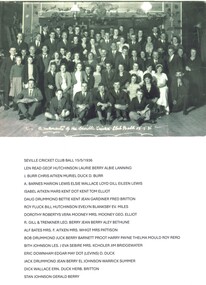
Photograph - Celebration Photograph, 15.05.1936
... ...Summer Family...Photograph of whole group at Seville Cricket Club Ball in 1936 Photographic prints History-Victoria-Seville Seville Cricket Club 1930s sport Cricket Sports Clubs Aitken Family Barnes Family Bates Family Berry Family Bethune Family Blanksby Family Bridgewater Family Britton Family Burr Family Downham Family Duck Family Elliot Family Fluck Family Gardner Family Gill Family Hutchinson Family Johnson Family Kcholer Family Kent Family Lanning Family Lewis Family May Family Miles Family Mooney Family Mould Family Patterson Family Payne Family Read Family Sebire family Summer Family Wallace Family Whigt Family 1 A5 photocopy of a photograph and an A5 typed inscription Photograph Celebration Photograph ...Photograph of whole group at Seville Cricket Club Ball in 19361 A5 photocopy of a photograph and an A5 typed inscription photographic prints, history-victoria-seville, seville cricket club, 1930s, sport, cricket, sports clubs, aitken family, barnes family, bates family, berry family, bethune family, blanksby family, bridgewater family, britton family, burr family, downham family, duck family, elliot family, fluck family, gardner family, gill family, hutchinson family, johnson family, kcholer family, kent family, lanning family, lewis family, may family, miles family, mooney family, mould family, patterson family, payne family, read family, sebire family, summer family, wallace family, whigt family -
 Bendigo Historical Society Inc.
Photograph - SANDHURST DRUMMERS COLLECTION: FOUR COLOURED PHOTOS OF THE SANDHURT DRUMMERS COLLECTION, 1992
... Melbourne Anzac Parade. c. Summer Family Bendigo Tramways Dec 1992. d. Summer Family Amie, Ashley and Jamie. ...Melbourne Anzac Parade. c. Summer Family Bendigo Tramways Dec 1992. d. Summer Family Amie, Ashley and Jamie. ...Photograph. Four coloured photos of the Sandhurst Drummers. a. Longlea 1996. b. Melbourne Anzac Parade. c. Summer Family Bendigo Tramways Dec 1992. d. Summer Family Amie, Ashley and Jamie. Bendigo Tramways 1992.photograph, person, sandhurst drummers -
 Bendigo Historical Society Inc.
Photograph - SANDHURST DRUMMERS COLLECTION: FOUR COLOURED PHOTOS OF THE SANDHURT DRUMMERS COLLECTION, 1992
... Four coloured photos of the Sandhurst Drummers. a. Summer Family Carols by Candlelight Dec 1992. b. ...Four coloured photos of the Sandhurst Drummers. a. Summer Family Carols by Candlelight Dec 1992. b. ...Photograph. Four coloured photos of the Sandhurst Drummers. a. Summer Family Carols by Candlelight Dec 1992. b. Summer Family Bendigo Tramways Dec 1992. c. Calista and Felicia Britton, Bendigo Tramways Dec 1992. d. Bridgit Fahey.photograph, person, sandhurst drummers -
 Greensborough Historical Society
Newspaper Clipping, Winter snake invasion, 12/06/2019
... After surviving 'snake invasion' during summer, Diamond Valley families are encountering another serpent problem - the venomous offspring....After surviving 'snake invasion' during summer, Diamond Valley families are encountering another serpent problem - the venomous offspring. diamond valley snake invasion mark pelley News article 1 page, black text. ...After surviving 'snake invasion' during summer, Diamond Valley families are encountering another serpent problem - the venomous offspring.News article 1 page, black text.diamond valley snake invasion, mark pelley -
 Kiewa Valley Historical Society
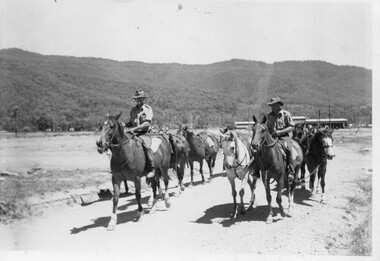
Photo - Pack horses leaving Mt Beauty
... Farmers from the Kiewa Valley drove their cattle up to the Bogong High Plains during summer. Each family had a lease and a hut to stay in. ...Farmers from the Kiewa Valley drove their cattle up to the Bogong High Plains during summer. Each family had a lease and a hut to stay in. ...Farmers from the Kiewa Valley drove their cattle up to the Bogong High Plains during summer. Each family had a lease and a hut to stay in. Pack horses were used to carry food and other necessary items for the men while they were away.The Ryder family farmed in the Kiewa Valley and had a grazing lease and hut on the Bogong High Plains where they droe their cattle during summer. Black and white photo with 2 men on horses each followed by two packhorses. Wally Ryder is on the horseman on the right. January 1947. This photo is published on page 114 of 'A History of the Kiewa Valley' by Esther Temple and David Lloyd.On back 'Pack horses leaving Mt Beauty / January 1947 / Suspect Wally Ryder on right.'wally ryder, cattlemen, packhorses -
 Federation University Historical Collection
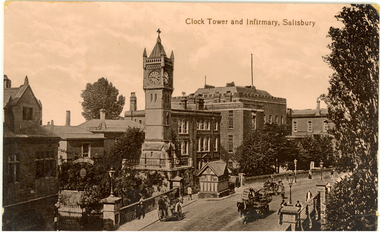
Postcard - photographic, Clock Tower and Infirmary, Salisbury
... Summer Time. At the same time the tower itself was restored, the main contractors for this work being R. Moulding and Co of South Newton. Smith of Derby continues to be responsible for maintaining the clock, and so this firm has now been providing a service to the City for over 100 years. salisbury clock tower chatham-holmes family collection carriage bridge Sepia photographic postcard depicting a bridge and road lined with buildings and a clock tower in Salisbury, Wiltshire, England. ...The Salisbury Clock Tower was built in memory of Arabella Roberts who died on 23 January 1892. The firm Smith of Derby installed the illuminated clock mechanism with four faces and was still responsible for maintenance when, in December 1970, it replaced the original gravity mechanism with a more modern movement. The original clock mechanism was sold to a customer in Providence, USA. In 1997, the new mechanism was completely refurbished and updated to include automatic adjustment for British Summer Time. At the same time the tower itself was restored, the main contractors for this work being R. Moulding and Co of South Newton. Smith of Derby continues to be responsible for maintaining the clock, and so this firm has now been providing a service to the City for over 100 years. Sepia photographic postcard depicting a bridge and road lined with buildings and a clock tower in Salisbury, Wiltshire, England.salisbury, clock tower, chatham-holmes family collection, carriage, bridge -
 Federation University Historical Collection
Postcard - Black and White, Westoutre, Belgium, c1916, c1916
... Family WW1 memorabilia. Westoutre British Cemetery is located 11.5 Kms south-west of Ieper town centre on a road leading from the N375 Dikkebusseweg. The village of Westoutre (now Westouter) remained in Allied hands from the early months of the First World War to the Armistice, but in the summer of 1918, after the Battles of the Lys, it was within 2.4 Kms of the front line. ...Family WW1 memorabilia. Westoutre British Cemetery is located 11.5 Kms south-west of Ieper town centre on a road leading from the N375 Dikkebusseweg. The village of Westoutre (now Westouter) remained in Allied hands from the early months of the First World War to the Armistice, but in the summer of 1918, after the Battles of the Lys, it was within 2.4 Kms of the front line. ...Holmes Family WW1 memorabilia. Westoutre British Cemetery is located 11.5 Kms south-west of Ieper town centre on a road leading from the N375 Dikkebusseweg. The village of Westoutre (now Westouter) remained in Allied hands from the early months of the First World War to the Armistice, but in the summer of 1918, after the Battles of the Lys, it was within 2.4 Kms of the front line. (http://www.cwgc.org/find-a-cemetery/cemetery/2023773/Westoutre%20British%20Cemetery, accessed 11/07/2014)Black and white postcard of showing the town of Westoutre on Belgium. chatham-holmes family collection, westoutre, world war one, belgium, postcard -
 Mission to Seafarers Victoria
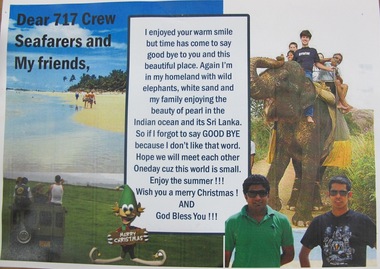
Card - Christmas message, Dear 717 Crew Seafarers and my Friends
... family enjoying the beusty of pearl in the Indian ocean and its [sic] Sri Lanka. So if I forgot to say GOOD BYE because I dont like that word. Hope we will meet each other Oneday [sic] cuz this world is small . Enjoy the summer...family enjoying the beusty of pearl in the Indian ocean and its [sic] Sri Lanka. So if I forgot to say GOOD BYE because I dont like that word. Hope we will meet each other Oneday [sic] cuz this world is small . Enjoy the summer ...Christmas Greeting sent by seafarers who previously visited the Mission to Seafarers circa 2000 - 2015A4 colour laser print of several collaged images with messageI enjoyed your warm smile but time has come to say goodbye to you and this beautiful place . Again I am in my homeland with wild elephants , white sand and my family enjoying the beusty of pearl in the Indian ocean and its [sic] Sri Lanka. So if I forgot to say GOOD BYE because I dont like that word. Hope we will meet each other Oneday [sic] cuz this world is small . Enjoy the summer!!! Wish you a merry Christmas ! AND God Bless You!!! / MERRY CHRISTMAScrew 717, flinders street, mission to seafarers, christmas, elephant, sri lanka, indian ocean -
 Frankston RSL Sub Branch
Photograph
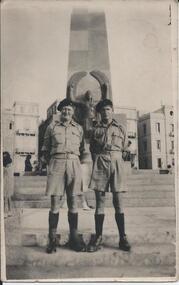
... summer uniform. The soldier to the left in the photograph is Noel Blundell, the other soldier is unknown. The photograph was sent home to family by Noel Blundell who served in the Middle East during World War 2....summer uniform. The soldier to the left in the photograph is Noel Blundell, the other soldier is unknown. The photograph was sent home to family by Noel Blundell who served in the Middle East during World War 2. ...Postcard with a black and white photograph of two Australian Army soldiers in summer uniform. The soldier to the left in the photograph is Noel Blundell, the other soldier is unknown. The photograph was sent home to family by Noel Blundell who served in the Middle East during World War 2.middle east, australia, army, aif, ww2, world war 2 -
 Frankston RSL Sub Branch
Card
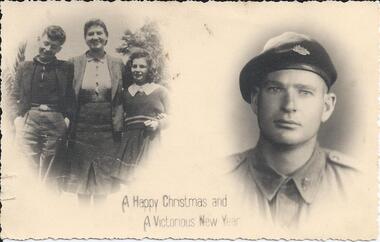
... summer uniform. To the left is a woman with two children in an outdoor setting. To the woman's right is a teenage boy and to the woman's left is a younger teenage girl. The photograph was sent home to family...summer uniform. To the left is a woman with two children in an outdoor setting. To the woman's right is a teenage boy and to the woman's left is a younger teenage girl. The photograph was sent home to family ...Christmas postcard with two black and white photographs on the front. To the right is a portrait image of Noel Blundell, an Australian Army soldier in summer uniform. To the left is a woman with two children in an outdoor setting. To the woman's right is a teenage boy and to the woman's left is a younger teenage girl. The photograph was sent home to family by Noel Blundell who served in the Middle East during World War 2. The card is inscribed "A Happy Christmas and A Victorious New Year"postcard, christmas, middle east, 2nd aif, australia, army, aif, ww2, world war 2 -
 Marysville & District Historical Society
Postcard (item) - Colour postcard, The Cumberland Marysville, Victoria, Unknown
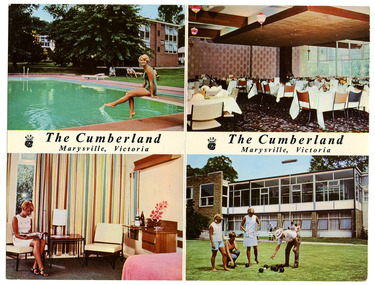
... summer, air-conditioning./ An excellent and varied menu is planned to meet the appetites sharpened by the invigorating mountain air. There are lounges to sit back in/ and enjoy the gentle art of doing nothing. Cards? A separate lounge is provided. Table Tennis? Of course. In the basement, billiards./ Outdoors there are tennis courts, bowls, croquet, and an inviting filtered pool./ At night, the soft comfort of deeply sprung beds in the privacy of your own suite; or family rooms if you wish./ Very little has been overlooked for your comfort at The Cumberland. ...summer, air-conditioning./ An excellent and varied menu is planned to meet the appetites sharpened by the invigorating mountain air. There are lounges to sit back in/ and enjoy the gentle art of doing nothing. Cards? A separate lounge is provided. Table Tennis? Of course. In the basement, billiards./ Outdoors there are tennis courts, bowls, croquet, and an inviting filtered pool./ At night, the soft comfort of deeply sprung beds in the privacy of your own suite; or family rooms if you wish./ Very little has been overlooked for your comfort at The Cumberland. ...A digital copy of a colour postcard from The Cumberland guest house in Marysville.A digital copy of a colour postcard from The Cumberland guest house in Marysville.The Cumberland Marysville, Victoria Fine foods, a selection of wines, spirits, liqueurs, ales. In winter, warmth; summer, air-conditioning./ An excellent and varied menu is planned to meet the appetites sharpened by the invigorating mountain air. There are lounges to sit back in/ and enjoy the gentle art of doing nothing. Cards? A separate lounge is provided. Table Tennis? Of course. In the basement, billiards./ Outdoors there are tennis courts, bowls, croquet, and an inviting filtered pool./ At night, the soft comfort of deeply sprung beds in the privacy of your own suite; or family rooms if you wish./ Very little has been overlooked for your comfort at The Cumberland. Phone Marysville 3, or book at all leading holiday bureaux. 1428-31marysville, victoria, australia, the cumberland guest house, accommodation, 2009 black saturday bushfires, villa day spa, postcard, souvenir -
 City of Moorabbin Historical Society (Operating the Box Cottage Museum)
Domestic object - Kitchen equipment, sad iron, c1880
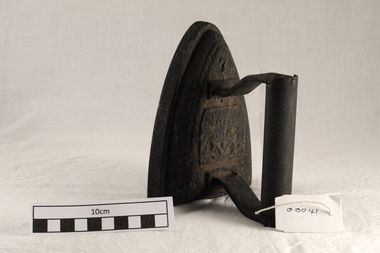
... summer. These sad irons remind us of the difficult circumstances experienced in their daily routines by the pioneers and early settlers of Moorabbin Shire. The family ...Sad-irons or "solid" irons were made by blacksmiths and used to smooth out material by pressing the hot iron over it. A piece of sheet -iron was placed over the kitchen fire and the irons placed on it could be heated whilst remaining clean of ash.. The women used 2 irons - one heating while the other was used. Thick cloth or gloves protected their hands from the hot irons. The handle was removed from the cool iron and re- attached to remove the hot iron from the fire. The cool iron was replaced on the fire or stove to heat again. These irons were cleaned with steel wool to prevent them marking the material. If the iron was too hot the material would scorch. Most homes set aside one day for ironing and some large households had an ironing room with a special stove designed to heat irons. However, most women had to work with a heavy, hot iron close to the fireplace even in summer.These sad irons remind us of the difficult circumstances experienced in their daily routines by the pioneers and early settlers of Moorabbin Shire. The family of Miss M Curtis were early settlers in Moorabbin Shire. Sad-iron, domestic, flat, cast iron, Silvester's Patent, No 6, Salter, England, c. 1890-1900s A sad iron made from cast iron was heated over a fire or on a stove and used for pressing clothing and table wareSILVESTER'S/ PATENT/ SALTERS / No 6 with the pretzel & a arrow going through the centresad iron, kitchen equipment, pioneers, early settlers, market gardeners, sewing, craftwork, clothing, moorabbin, brighton, bentleigh, fireplaces, stoves -
 City of Moorabbin Historical Society (Operating the Box Cottage Museum)
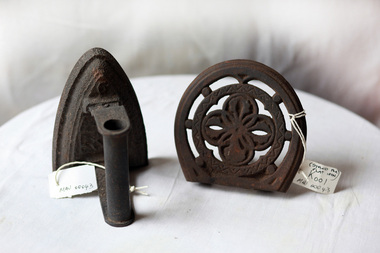
Domestic object - Kitchen Equipment, flat iron with trivet stand, c1880
... summer. These sad irons remind us of the difficult circumstances experienced in their daily routines by the pioneers and early settlers of Moorabbin Shire The family of Miss M Curtis were early settlers in Moorabbin Shire. sad iron kitchen equipment pioneers early settlers market gardeners sewing craftwork clothing moorabbin brighton bentleigh fireplaces stoves A) 5 on tip of iron A) A heavy cast iron, flat iron with B) horseshoe shaped trivet stand c1880 The trivet can be attached to a table by an adjustable clamp. ...Sad-irons or "solid" irons were made by blacksmiths and used to smooth out material by pressing the hot iron over it. A piece of sheet -iron was placed over the kitchen fire and the irons placed on it could be heated whilst remaining clean of ash.. The women used 2 irons - one heating while the other was used. Thick cloth or gloves protected their hands from the hot irons. The handle was removed from the cool iron and re- attached to remove the hot iron from the fire. The cool iron was replaced on the fire or stove to heat again. These irons were cleaned with steel wool to prevent them marking the material. If the iron was too hot the material would scorch. Most homes set aside one day for ironing and some large households had an ironing room with a special stove designed to heat irons. However, most women had to work with a heavy, hot iron close to the fireplace even in summer. These sad irons remind us of the difficult circumstances experienced in their daily routines by the pioneers and early settlers of Moorabbin Shire The family of Miss M Curtis were early settlers in Moorabbin Shire. A) A heavy cast iron, flat iron with B) horseshoe shaped trivet stand c1880 The trivet can be attached to a table by an adjustable clamp.A) 5 on tip of ironsad iron, kitchen equipment, pioneers, early settlers, market gardeners, sewing, craftwork, clothing, moorabbin, brighton, bentleigh, fireplaces, stoves -
 City of Moorabbin Historical Society (Operating the Box Cottage Museum)
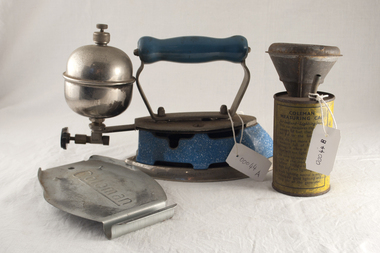
Domestic object - Kitchen equipment, spirit-fuelled sad iron, c1920
... summer. Late in the 19thC designers experimented with heat retaining fillings for these irons. William Coleman began selling Kerosene lanterns in 1900 in Kingfisher, Oklahoma, USA. He moved to Wichita, Kansas in 1902 and the company became world wide. The company also produced a range of cooking stoves and domestic irons. This spirit- fuelled flat iron was very popular in 1920s - 30s These sad irons remind us of the difficult circumstances experienced in their daily routines by the pioneers and early settlers of Moorabbin Shire The family ...Sad-irons or "solid" irons were made by blacksmiths and used to smooth out material by pressing the hot iron over it. A piece of sheet -iron was placed over the kitchen fire and the irons placed on it could be heated whilst remaining clean of ash.. The women used 2 irons - one heating while the other was used. Thick cloth or gloves protected their hands from the hot irons. The handle was removed from the cool iron and re- attached to remove the hot iron from the fire. The cool iron was replaced on the fire or stove to heat again. These irons were cleaned with steel wool to prevent them marking the material. If the iron was too hot the material would scorch. Most homes set aside one day for ironing and some large households had an ironing room with a special stove designed to heat irons. However, most women had to work with a heavy, hot iron close to the fireplace even in summer. Late in the 19thC designers experimented with heat retaining fillings for these irons. William Coleman began selling Kerosene lanterns in 1900 in Kingfisher, Oklahoma, USA. He moved to Wichita, Kansas in 1902 and the company became world wide. The company also produced a range of cooking stoves and domestic irons. This spirit- fuelled flat iron was very popular in 1920s - 30s These sad irons remind us of the difficult circumstances experienced in their daily routines by the pioneers and early settlers of Moorabbin Shire The family of Miss M Curtis were early settlers in Moorabbin ShireA) spirit- fuelled, sad iron with chrome plated sole c1920, and metal trivet The iron is blue enamel with a white speckled body, with a hemispherical tank for the Coleman 'Lighting Petrol' that provided the heat for smoothing the material B) Coleman Fuel measuring can and funnellMetal Trivet/stand " COLEMAN" ; Petrol can " COLEMAN" / MEASURING CAN / for INSTANT LIGHTING IRON/ with printed instructionssad iron, kitchen equipment, coleman william, kansas, oklahoma, pioneers, early settlers, market gardeners, sewing, craftwork, clothing, moorabbin, brighton, bentleigh, fireplaces, stoves, petrol fuelled irons, spirit flat irons, coleman lamp stove co. ltd. -
 City of Moorabbin Historical Society (Operating the Box Cottage Museum)
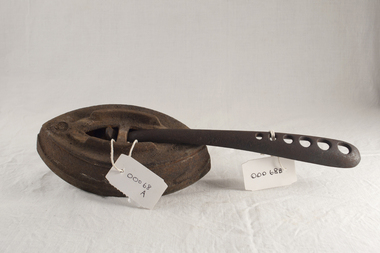
Domestic object - Kitchen Equipment, sad iron with lifter, c1900
... summer. These sad irons remind us of the difficult circumstances experienced in their daily routines by the pioneers and early settlers of Moorabbin Shire. The Curtis family ...Sad-irons or "solid" irons were made by blacksmiths and used to smooth out material by pressing the hot iron over it. A piece of sheet -iron was placed over the kitchen fire and the irons placed on it could be heated whilst remaining clean of ash.. The women used 2 irons - one heating while the other was used. Thick cloth or gloves protected their hands from the hot irons. The handle was removed from the cool iron and using the lifter the cool iron was replaced on the fire or stove to heat again. These irons were cleaned with steel wool to prevent them marking the material. If the iron was too hot the material would scorch. Most homes set aside one day for ironing and some large households had an ironing room with a special stove designed to heat irons. However, most women had to work with a heavy, hot iron close to the fireplace even in summer.These sad irons remind us of the difficult circumstances experienced in their daily routines by the pioneers and early settlers of Moorabbin Shire. The Curtis family were early settlers in Moorabbin ShireA) This heavy sad iron, made from cast iron, was heated over a fire or on a stove and used for pressing clothing and haberdashery. B) The separate tapered handle was used to lift the hot iron from the fire and when a "Potts" Handle was attached the ironing commenced. sad iron, kitchen equipment, fireplaces, stoves, pioneers, early settlers, market gardeners, sewing, craftwork, clothing, moorabbin, brighton, bentleigh -
 City of Moorabbin Historical Society (Operating the Box Cottage Museum)
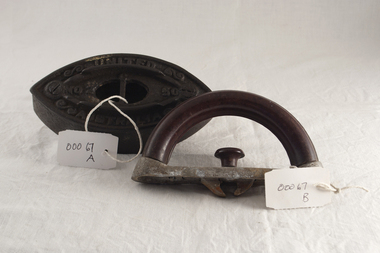
Domestic object - Kitchen Equipment, sad iron with Mrs Potts handle, c1900
... summer. Mrs Florence Potts invented this type of detachable walnut wood handle with a meta release latch for sad irons in 1871 and it sold widely throughout the world to grateful women including those in Moorabbin Shire. The family ...Sad-irons or "solid" irons were made by blacksmiths and used to smooth out material by pressing the hot iron over it. A piece of sheet -iron was placed over the kitchen fire and the irons placed on it could be heated whilst remaining clean of ash.. The women used 2 irons - one heating while the other was used. Thick cloth or gloves protected their hands from the hot irons. The handle was removed from the cool iron and re- attached to remove the hot iron from the fire. The cool iron was replaced on the fire or stove to heat again. Mrs Florence Potts invented in 1871 a detachable handle made from walnut wood with a metal latch to release the handle. These wooden handles prevented burned hands and were sold to grateful women all over the world. These irons were cleaned with steel wool to prevent them marking the material. If the iron was too hot the material would scorch. Most homes set aside one day for ironing and some large households had an ironing room with a special stove designed to heat irons. However, most women had to work with a heavy, hot iron close to the fireplace even in summer.Mrs Florence Potts invented this type of detachable walnut wood handle with a meta release latch for sad irons in 1871 and it sold widely throughout the world to grateful women including those in Moorabbin Shire. The family of Ms May Curtis were early settlers in Moorabbin ShireA) A sad iron, made of cast iron , has a special handle invented in 1871 by Mrs Florence Potts of Iowa, USA. B) The detachable handle made of walnut wood to prevent burned hands, was attached to the iron by a metal latch.A) UNITED/ N0 / 50 / AUSTRALIApotts florence, iowa usa, melbourne, moorabbin, sad irons, kitchen equipmentn fireplaces, walnut wood, sewing, laundry, table ware, linen, pioneers, early settlers, washing days, craftwork -
 Glenelg Shire Council Cultural Collection
Financial record - Account - J. Campbell Family Draper to Mrs Cummings, n.d
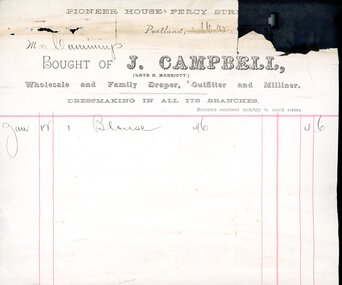
... Another advertisement on Trove from September 27 1907 shows the store showing their Spring and Summer Goods, including Choice Millinery, Latest Dress Fabrics, Laces and Silks, Blouses and Skirts. draper Portland trade accounts womens clothing City of Portland Betty Vivian Betty Vivian Collection PIONEER HOUSE PERCY STR / Portland, Mar / Mrs Cummings / BOUGHT OF J. CAMPBELL, / (LATE A. MARRIOTT.) / Wholesale and Family ...J.Campbell started a Draper , Outfitter and Milliner store in the Pioneer house on Percy Street in Portland Victoria in 1896. Advertisements found on Trove from November 20 1899 shows the store selling Spring goods, Millinery, Dress goods, prints, piques and muslins. Another advertisement on Trove from September 27 1907 shows the store showing their Spring and Summer Goods, including Choice Millinery, Latest Dress Fabrics, Laces and Silks, Blouses and Skirts.Paper account from J. Campbell, wholesaler and family draper to Mrs Cummings, in the sum of 4/6 for a blouse. Printed form, details handwritten in black ink top right hand corner is missing, and top left hand corner has two holes in the paper. Paper is cream and has darker brownish patches at the top. PIONEER HOUSE PERCY STR / Portland, Mar / Mrs Cummings / BOUGHT OF J. CAMPBELL, / (LATE A. MARRIOTT.) / Wholesale and Family Draper, Outfitter and Milliner. / DRESSMAKING IN ALL ITS BRANCHES. / Accounts rendered monthly to avoid errors / Jan ** 1 Blouse 4/6 4.6draper, portland trade, accounts, womens clothing, city of portland, betty vivian, betty vivian collection -
 City of Moorabbin Historical Society (Operating the Box Cottage Museum)
Clothing, Lady's black long crepe skirt with drawstring waist, c1910
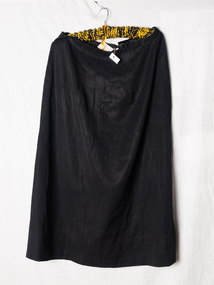
... summer. The early settler women were skilled dressmakers and made the clothing for their families...summer. The early settler women were skilled dressmakers and made the clothing for their families Typical day wear skirt worn by women in the early settler families of Moorabbin Shire c1910 The family of Nance Blackburn were early settlers. blackburn nance, early settlers, moorabbin, cheltenham, bentleigh clothing, dressmaking, moorabbin shire Lady's black long crepe skirt with drawstring waist and inserted side pockets Clothing, Lady's black long crepe skirt with drawstring waist Family of Nance Blackburn ...A typical long black crepe skirt worn by women in Moorabbin Shire c1910 whilst doing housework during spring and summer. The early settler women were skilled dressmakers and made the clothing for their familiesTypical day wear skirt worn by women in the early settler families of Moorabbin Shire c1910 The family of Nance Blackburn were early settlers. Lady's black long crepe skirt with drawstring waist and inserted side pockets blackburn nance, early settlers, moorabbin, cheltenham, bentleigh clothing, dressmaking, moorabbin shire -
 Greensborough Historical Society
Photograph - Digital image, June Roberts, Summer garden at Blackjack, 1999c
... The summer garden at "Blackjack", Hume Street Briar Hill. The Roberts family moved here in 1957. ...The summer garden at "Blackjack", Hume Street Briar Hill. The Roberts family moved here in 1957. ...The summer garden at "Blackjack", Hume Street Briar Hill. The Roberts family moved here in 1957. These colour photos are from late twentieth century.Digital copy of colour photographjune roberts, roberts family, blackjack, hume street briar hill -
 Greensborough Historical Society
Booklet, Atis Lejins, Remembering my grandparents: a hot Australian summer, by Atis Lejins, 2017_
... Story of Atis Lejins' family emigration to Australia, life in Greensborough and his return to Latvia. atis lejins greensborough immigration "To GHS with warm greetings from Latvia!. Atis Lejins, Riga. 20.03.2017" 22 p. text and black & white photographs Remembering my grandparents: a hot Australian summer, by Atis Lejins. ...Story of Atis Lejins' family emigration to Australia, life in Greensborough and his return to Latvia.22 p. text and black & white photographs"To GHS with warm greetings from Latvia!. Atis Lejins, Riga. 20.03.2017"atis lejins, greensborough, immigration -
 City of Moorabbin Historical Society (Operating the Box Cottage Museum)
Clothing,Lady's Black long crepe skirt, c1910
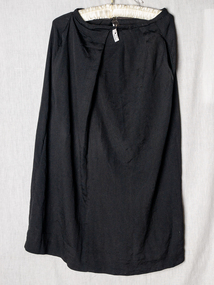
... A typical long black crepe skirt worn by women in Moorabbin Shire c1910 whilst doing housework during spring and summer Typical day wear skirt worn by women in the early settler families of Moorabbin Shire c1910 The family of Nance Blackburn were early settlers blackburn nance, early settlers, moorabbin, cheltenham, bentleigh clothing, dressmaking, moorabbin shire A woman's full length black crepe skirt with side fasteners, pleats and side inserted pockets Clothing,Lady's Black long crepe skirt Family of Nance Blackburn ...A typical long black crepe skirt worn by women in Moorabbin Shire c1910 whilst doing housework during spring and summerTypical day wear skirt worn by women in the early settler families of Moorabbin Shire c1910 The family of Nance Blackburn were early settlersA woman's full length black crepe skirt with side fasteners, pleats and side inserted pockets blackburn nance, early settlers, moorabbin, cheltenham, bentleigh clothing, dressmaking, moorabbin shire -
 Orbost & District Historical Society
black and white photograph, Sherwood, Herbert, 1900
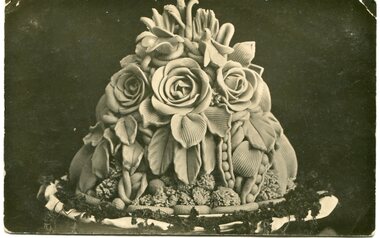
... The Harvest Festival display was always put together by the church ladies ( Orbost Presbyterian Church) and was a family friendly festival celebrating the end of summer. ...The Harvest Festival display was always put together by the church ladies ( Orbost Presbyterian Church) and was a family friendly festival celebrating the end of summer. The Harvest Festivals were regular community events in Orbost during the first half of the 20th century. ...This display of butter was created by Mrs Jessie Petterson for the Harvest Festival. Ten pounds of butter was used. The Harvest Festival display was always put together by the church ladies ( Orbost Presbyterian Church) and was a family friendly festival celebrating the end of summer. The Harvest Festivals were regular community events in Orbost during the first half of the 20th century. This photograph is associated with that time.A black / white photograph postcard of a butter sculpture, a flower arrangement carved out of butter.on back - "display of butter by Mrs Jessie Petterson, 1900"harvert-festival sculpture-butter petterson-jessie -
 Orbost & District Historical Society
Photograph - Bemm River hotel fire
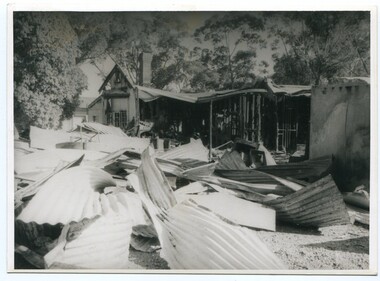
... Summer. This Hotel was located near a ford where traffic crossed the river. Annie Morgan was the next person to have a roadside licence to sell liquor at Bemm River, also known as Sydenham Inlet Hotel. In 1927, a hotel was built on the present site at Bemm River, again with the Morgan family...Summer. This Hotel was located near a ford where traffic crossed the river. Annie Morgan was the next person to have a roadside licence to sell liquor at Bemm River, also known as Sydenham Inlet Hotel. In 1927, a hotel was built on the present site at Bemm River, again with the Morgan family ...Bemm River is a small township in East Gippsland. There have been several Bemm River hotels since 1891 when the first Hotel was built by Henry Summer. This Hotel was located near a ford where traffic crossed the river. Annie Morgan was the next person to have a roadside licence to sell liquor at Bemm River, also known as Sydenham Inlet Hotel. In 1927, a hotel was built on the present site at Bemm River, again with the Morgan family. Like many hotels, the Bemm River hotel has burned down or suffered damage through fires and was rebuilt. These photos are likely of a fire at the Hotel in 1994 which resulted in the hotel burning down. It was re-built in 2000 on the same site.History of Bemm River and its hotel5 b/w photos showing a building with severe fire damage, and two people in front of the photos (probably owners).nonebemm river, fire, hotels -
 Orbost & District Historical Society
playsuit, Burton, Marjorie, 1950's
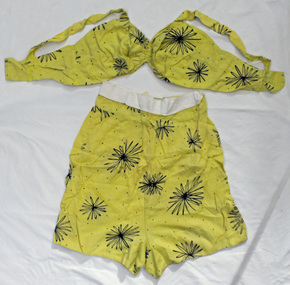
... summer holidays in Croyde,a village on the west-facing coastline of North Devon, England. Marjorie Burton ( nee Whiteman), born 12 June, in Birmingham, England came to Orbost in 1995. In England she did office work – typing, shorthand and secretarial work - in accountants’ offices and also trained as a comptometrist with Burroughs in London. She came from middle-class working church-going family...summer holidays in Croyde,a village on the west-facing coastline of North Devon, England. Marjorie Burton ( nee Whiteman), born 12 June, in Birmingham, England came to Orbost in 1995. In England she did office work – typing, shorthand and secretarial work - in accountants’ offices and also trained as a comptometrist with Burroughs in London. She came from middle-class working church-going family ...This item was worn by Marjorie Burton during summer holidays in Croyde,a village on the west-facing coastline of North Devon, England. Marjorie Burton ( nee Whiteman), born 12 June, in Birmingham, England came to Orbost in 1995. In England she did office work – typing, shorthand and secretarial work - in accountants’ offices and also trained as a comptometrist with Burroughs in London. She came from middle-class working church-going family. Her mother was a milliner who made mostl of Marjorie’s clothes, hats and outfits. Marjorie was married in 1938 to a salesman who later became a mechanic in the R.A.F. during WW11. Also called a vintage romper today, the playsuit was a cover-up worn outdoors – either at the beach, in the backyard to catch some sun or for sportswear, generally over swimsuits at the beach or pool, They were so comfortable women often wore them at home too, without swimsuits. Playsuits were usually made of cotton, although they could also be found in rayon. They were brightly colored, in reds, greens, yellows and blues. Floral and Hawaiian prints were popular towards the end of the decade. This item is an example of an item of women's clothing popular in the mid 20th century. A two piece lady's playsuit. It is yellow with black patterns - stylised flowers . The top is a bra top with a hook and eye closing. The shorts have a zip at the back and close with a hook and eye, There is a white band at the top.playsuit women's-clothing burton-marjorie -
 Orbost & District Historical Society
bikini, Burton, Marjorie, mid 1950's
... summer holidays in Croyde,a village on the west-facing coastline of North Devon, England. In England she did office work – typing, shorthand and secretarial work - in accountants’ offices and also trained as a comptometrist with Burroughs in London. She came from middle-class working church-going family...summer holidays in Croyde,a village on the west-facing coastline of North Devon, England. In England she did office work – typing, shorthand and secretarial work - in accountants’ offices and also trained as a comptometrist with Burroughs in London. She came from middle-class working church-going family ...This item was worn by Marjorie Burton during summer holidays in Croyde,a village on the west-facing coastline of North Devon, England. In England she did office work – typing, shorthand and secretarial work - in accountants’ offices and also trained as a comptometrist with Burroughs in London. She came from middle-class working church-going family. Her mother was a milliner who made many of Marjorie’s clothes, hats and outfits. Marjorie married in 1938 to a salesman who later became a mechanic in the R.A.F. during WW11. Marjorie Burton ( nee Whiteman), born 12 June, in Birmingham, England came to Orbost in 1995. This item is an example of a handcrafted item and reflects the handcraft skills of women during the mid 20th century.A pale hand-stitched torquoise coloured cotton bikini set. The bottoms are briefs and elasticated at the front. They have high rise leg openings . The top is a bra style with a strap pinned at the centre of the back with a gold safety pin and stitched at the shoulders to loop over. There are 2 hooks and eyes for closure.women's-clothing swimwear burton-marjorie -
 Orbost & District Historical Society
bloomers, Burton, Marjorie, mid 1950's
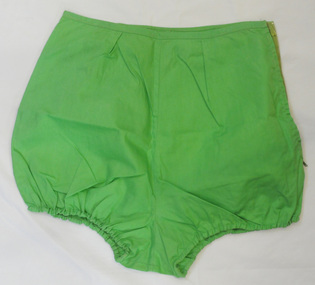
... summer holidays in Croyde,a village on the west-facing coastline of North Devon, England. Marjorie Burton ( nee Whiteman), born 12 June, in Birmingham, England came to Orbost in 1995. In England she did office work – typing, shorthand and secretarial work - in accountants’ offices and also trained as a comptometrist with Burroughs in London. She came from middle-class working church-going family...summer holidays in Croyde,a village on the west-facing coastline of North Devon, England. Marjorie Burton ( nee Whiteman), born 12 June, in Birmingham, England came to Orbost in 1995. In England she did office work – typing, shorthand and secretarial work - in accountants’ offices and also trained as a comptometrist with Burroughs in London. She came from middle-class working church-going family ...This item was made and worn by Marjorie Burton. This item was wornduring summer holidays in Croyde,a village on the west-facing coastline of North Devon, England. Marjorie Burton ( nee Whiteman), born 12 June, in Birmingham, England came to Orbost in 1995. In England she did office work – typing, shorthand and secretarial work - in accountants’ offices and also trained as a comptometrist with Burroughs in London. She came from middle-class working church-going family. Her mother was a milliner who mademanyof Marjorie’s clothes, hats and outfits. Marjorie married in 1938 to a salesman who later became a mechanic in the R.A.F. during WW11This item is an example of ahome-madepiece of clothing and reflects the needlework skills of women in the mid twentieth century.A pair of lime green cotton bloomers - home-made. They faste with a zip on the right-hand side. They are probably part of a set meant to wear with a bikini bra top.bloomers women's-clothing swimwear burton-marjorie -
 Orbost & District Historical Society
Booklet - Booklet, softcover, William Thomas Ah Chow, March 2019
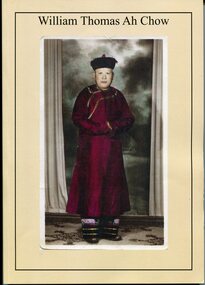
... He lived in the hut during the summer months and in winter, returned to his family in Ensay. Whenever there was fire danger, he rode his horse up to the fire tower on Mt Nugong and acted as look-out. ...He lived in the hut during the summer months and in winter, returned to his family in Ensay. Whenever there was fire danger, he rode his horse up to the fire tower on Mt Nugong and acted as look-out. ...This family history book was published as a family record of the Ah Chow family. A limited number of copies were printed. Thomas William (Bill) Ah Chow was a Chinese-Australian soldier, farmer, fire lookout and legendary bushman of East Gippsland in Victoria. Many Chinese came to the Victorian gold rush in the 1850s to seek their fortune at the Omeo and Cassilis diggings. Many of the immigrants later settled and integrated into their local communities working as farm labourers, tending market gardens, making furniture, running grocery stores and cafes or practising Chinese medicine. Thomas William "Bill" Ah Chow of Bruthen, Victoria attempted to enlist early in the War but was rejected for being "not substantially of European origin". Undeterred, he reapplied and was accepted in June 1917. During his service with the 5th Battalion, he was wounded at least three times. After the War, Bill returned to Bruthen where he drove sheep, worked cattle and eventually assisted in the building of roads through the area. He became a Forestry Commission fire-spotter and built a hut called 'Moscow Villa' in 1942. He lived in the hut during the summer months and in winter, returned to his family in Ensay. Whenever there was fire danger, he rode his horse up to the fire tower on Mt Nugong and acted as look-out. Bill worked for the Forestry Commission for more than twenty years and came out of retirement to continue his duties when no suitable replacement could be found. Bill died in 1967 and is buried in Omeo. Moscow Villa still stands and is a popular camping site This is a useful reference item. As a family history it is detailed and contains useful copies of personal documents. Bill Ah Chow, along with the Ah Chow family were well known in Orbost and East Gippsland. This booklet is a testament to his life. A soft covered 97pp book with a cream cover. On the front is a coloured photograph of a Chinese man in traditional robe and hat. On the back cover is Moscow Villa. It contains information, copies of 1949 photographs, documents, hand -written letters and a will. There is an envelope attached to the inside cover containing a CD, photos and family tree.ah-chow-william-thomas family-history-ah-chow -
 Orbost & District Historical Society
black and white photograph, C1900
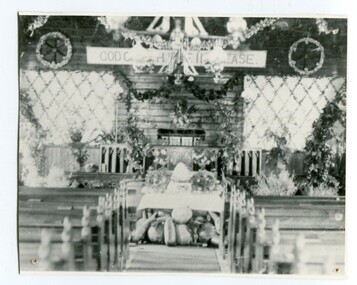
... The Festival was a family friendly festival celebrating the end of summer....The Festival was a family friendly festival celebrating the end of summer. This item is reminiscent of the late 19th - mid 20th centuries when church-going was more common. church-presbyterian-orbost harvest-festival on front - stamp -" Herbert Sherwood" on back - "M. ...The first Orbost Presbyterian Church was opened on January 9 1898. It was built by Mr R. P. Cameron for three pounds. The Harvest Festival display was always put together by the church ladies. The Festival was a family friendly festival celebrating the end of summer.This item is reminiscent of the late 19th - mid 20th centuries when church-going was more common.A black / white photograph of inside the Orbost Presbyterian Church decorated with rural produce and flowers for the "Harvest Festival". It is on a white buff card with a blue photographer's stamp in the bottom left hand corner.on front - stamp -" Herbert Sherwood" on back - "M. Gilbert, Orbost" - "Mrs J. Sterling, 6 Marine Parade , Elwood"church-presbyterian-orbost harvest-festival -
 Flagstaff Hill Maritime Museum and Village
Animal specimen - Whale Tooth, Probably 19th century
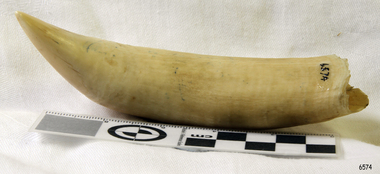
... Calves are typically born in the spring and summer, and females bear the responsibility for raising them, but more sociable species rely on the family group to care for calves. ...Calves are typically born in the spring and summer, and females bear the responsibility for raising them, but more sociable species rely on the family group to care for calves. ...The toothed whales (also called odontocetes, systematic name Odontoceti) are a parvorder of cetaceans that includes dolphins, porpoises, and all other whales possessing teeth, such as the beaked whales and sperm whales. Seventy-three species of toothed whales are described. They are one of two living groups of cetaceans, the other being the baleen whales (Mysticeti), which have baleen instead of teeth. The two groups are thought to have diverged around 34 million years ago (mya). Toothed whales range in size from the 4.5 ft (1.4 m) and 120 lb (54 kg) vaquita to the 20 m (66 ft) and 55 t (61-short-ton) sperm whale. Several species of odontocetes exhibit sexual dimorphism, in that there are size or other morphological differences between females and males. They have streamlined bodies and two limbs that are modified into flippers. Some can travel at up to 20 knots. Odontocetes have conical teeth designed for catching fish or squid. They have well-developed hearing, that is well adapted for both air and water, so much so that some can survive even if they are blind. Some species are well adapted for diving to great depths. Almost all have a layer of fat, or blubber, under the skin to keep warm in the cold water, with the exception of river dolphins. Toothed whales consist of some of the most widespread mammals, but some, as with the vaquita, are restricted to certain areas. Odontocetes feed largely on fish and squid, but a few, like the killer whale, feed on mammals, such as pinnipeds. Males typically mate with multiple females every year, but females only mate every two to three years, making them polygynous. Calves are typically born in the spring and summer, and females bear the responsibility for raising them, but more sociable species rely on the family group to care for calves. Many species, mainly dolphins, are highly sociable, with some pods reaching over a thousand individuals. Once hunted for their products, cetaceans are now protected by international law. Some species are attributed with high levels of intelligence. At the 2012 meeting of the American Association for the Advancement of Science, support was reiterated for a cetacean bill of rights, listing cetaceans as nonhuman persons. Besides whaling and drive hunting, they also face threats from bycatch and marine pollution. The baiji, for example, is considered functionally extinct by the IUCN, with the last sighting in 2004, due to heavy pollution to the Yangtze River. Whales occasionally feature in literature and film, as in the great white sperm whale of Herman Melville's Moby-Dick. Small odontocetes, mainly dolphins, are kept in captivity and trained to perform tricks. Whale watching has become a form of tourism around the world. Reference: https://en.wikipedia.org/wiki/Toothed_whaleWhale teeth were much prized for use in scrimshaw work.Whale tooth. Significant staining and yellowing. Broken at base, and missing the root.Noneflagstaff hill, warrnambool, shipwrecked-coast, flagstaff-hill, flagstaff-hill-maritime-museum, maritime-museum, shipwreck-coast, flagstaff-hill-maritime-village, whale tooth, whaling, whaling industry, whales -
 City of Moorabbin Historical Society (Operating the Box Cottage Museum)
Kitchen Equipment, curved sad iron, c1880
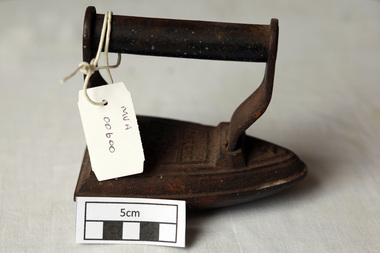
... However, most women had to work with a heavy, hot iron close to the fireplace even in summer. The Curtis family were early settlers in Moorabbin Shire c1880 and used sad irons sad iron kitchen equipment pioneers early settlers market gardeners sewing craftwork clothing moorabbin brighton bentleigh fireplaces stoves SILVESTER'S/ PATENT/ SALTERS / No 3 with the pretzel & a arrow going through the centre A small, curved, flat iron, with attached handle, used for cuffs, collars and frills Kitchen Equipment, curved sad iron Salter Pty Ltd ...Sad-irons or "solid" irons were made by blacksmiths and used to smooth out material by pressing the hot iron over it. A piece of sheet -iron was placed over the kitchen fire and the irons placed on it could be heated whilst remaining clean of ash.. The women used 2 irons - one heating while the other was used. Thick cloth or gloves protected their hands from the hot irons. The handle was removed from the cool iron and re- attached to remove the hot iron from the fire. The cool iron was replaced on the fire or stove to heat again. These irons were cleaned with steel wool to prevent them marking the material. If the iron was too hot the material would scorch. Most homes set aside one day for ironing and some large households had an ironing room with a special stove designed to heat irons. However, most women had to work with a heavy, hot iron close to the fireplace even in summer.The Curtis family were early settlers in Moorabbin Shire c1880 and used sad ironsA small, curved, flat iron, with attached handle, used for cuffs, collars and frillsSILVESTER'S/ PATENT/ SALTERS / No 3 with the pretzel & a arrow going through the centresad iron, kitchen equipment, pioneers, early settlers, market gardeners, sewing, craftwork, clothing, moorabbin, brighton, bentleigh, fireplaces, stoves
