
Showing 5 items matching "surf life saving association of australia"
-
 Torquay and District Historical Society
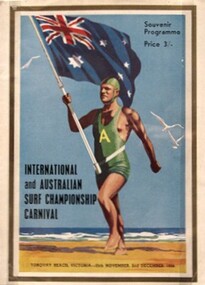
Programme - Souvenir Programme, International and Australian surf championship carnival, Torquay Beach, Victoria 25th November, 2nd December 1956, 1956
... ...Surf Life Saving Association of Australia...Surf Life Saving Association of Australia...In the Australian Championships NSW won the rescue and resuscitation event and a Victorian (J Fountain, Lorne) won the belt race. Surfing Surf Life Saving Association ...In 1956 an international surfing competition was staged on Torquay Beach in conjunction with the Melbourne Olympics. A number of countries were invited including the USA and its Territory of Hawaii, New Zealand, South Africa, Ceylon, Great Britain. An international surf carnival was held on 25th November and Australian championships were held on 2nd December. Australia was represented by each state with the majority of teams coming from NSW (64), then Queensland (18), Victoria (12), South Australia (7), Western Australia (7) and Tasmania (3). The Victorian teams were Anglesea, Apollo Bay, Lorne, Ocean Grove, Point Leo, Point Lonsdale, Port Fairy, Portland, RAAF College, Sorrento/Portsea, Torquay and Warrnambool. Preparation for the carnivals was immense. The mouth of Spring Creek was diverted closer to the bluff to allow more sand area for the competitors. Forestry Commission tractors were brought to do the task and they also smoothed other sections of the beach and covered rocky areas. Wire fences were erected to enclose the spectators' area. VIPs who accepted to attend were Prime Minister R G Menzies, State Premier H E Bolte, High Commissioners of South Africa, Ceylon and New Zealand and the Ambassador of USA. International visitors included Rusty Millar USA Chief Lifeguard and Duke Kahanamoku. Australian VIPs included Andrew "Boy" Charlton who set five world swimming records and won three silver and one bronze Olympic medal. Special trains ran from Flinders St Station from 8.45am connecting with buses to Torquay. Torquay locals were called upon to volunteer as ushers, gatekeepers and for other event duties. Torquay SLSC entered 52 competitors across all events both junior and senior. 70,000 people attended the International Carnival. The Americans came with narrow fibre-glass surfboards which were much faster than the Australian boards. The reel and line method of rescue was a new concept to the Americans who wore a belt and carried a reel of line into the water and let it out as they swam to the patient. New Zealand won the march past and Hawaii won the beach relay and the board race. In the Australian Championships NSW won the rescue and resuscitation event and a Victorian (J Fountain, Lorne) won the belt race.108 page souvenir programme, colour cover. Colour, and black and white pages inside. surfing, surf life saving association of australia, torquay -
 Flagstaff Hill Maritime Museum and Village
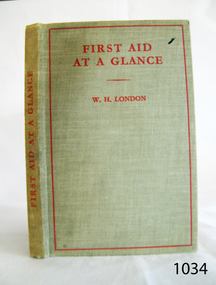
Book - Reference Medical/First Aid, William H. London, First Aid At A Glance, 1939
... Australian safety expert, first-aid instructor, and casualty specialist active during the mid-20th century. His qualifications at the time of publication included serving as a lecturer and examiner for the National Emergency Services of New South Wales, a lecturer and instructor for the Royal Life Saving Society, and an instructor for the Surf Life Saving Association of Western Australia. ...Australian safety expert, first-aid instructor, and casualty specialist active during the mid-20th century. His qualifications at the time of publication included serving as a lecturer and examiner for the National Emergency Services of New South Wales, a lecturer and instructor for the Royal Life Saving Society, and an instructor for the Surf Life Saving Association of Western Australia. ...Published on the eve of World War II in 1939, First Aid at a Glance is a compact, highly practical emergency manual. Designed as a concise summary for quick reference during crisis situations, it covers core civil defence and emergency medical topics such as the treatment of wounds, severe bleeding, and shock. Other subjects covered in this publication are fracture immobilisation and bandaging techniques, resuscitation and drowning intervention, and the management of casualties in public, industrial, or home settings.Hard cover book, First Aid at a Glance Author: William H. London Publisher: Angus & Robertson, Sydney, Australia Date: 1939 Further Information: Green cloth covered hardback volume with title in rednon-fictionPublished on the eve of World War II in 1939, First Aid at a Glance is a compact, highly practical emergency manual. Designed as a concise summary for quick reference during crisis situations, it covers core civil defence and emergency medical topics such as the treatment of wounds, severe bleeding, and shock. Other subjects covered in this publication are fracture immobilisation and bandaging techniques, resuscitation and drowning intervention, and the management of casualties in public, industrial, or home settings.flagstaff hill, warrnambool, shipwrecked-coast, flagstaff-hill, flagstaff-hill-maritime-museum, maritime-museum, shipwreck-coast, flagstaff-hill-maritime-village, first aid at a glance, book, william london, w.r. angus -
 Phillip Island and District Historical Society Inc.
Medallion, Surf Life Saving Association Australia 75th Anniversary Commemorative Medal
... Surf Life Saving Association Australia 75th Anniversary Commemorative Medal...LOGO Bronze Medal in hinged Blue Velvet Box Surf Life Saving Association Australia 75th Anniversary Commemorative Medal Medallion ...Bronze Medal in hinged Blue Velvet BoxCover inscription “Ted Clauscen In appreciation for years of service and assistance to Woolamai Beach S.L.S.C. From President, Committee & Members 1981 - 1982.” Inner lid S.L.S.A. LOGO -
 Geoffrey Kaye Museum of Anaesthetic History
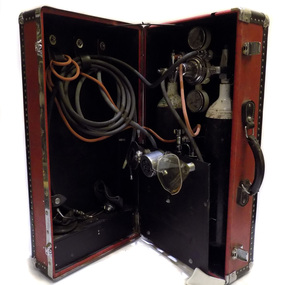
Equipment - Resuscitator Unit, c. 1960
... In 1981, the Australian Standards Association stated that the RM head failed to meet its revised standards and it was withdrawn from the market. Resuscitation Portable Surf Life Saving ...Mechanical resuscitation devices, such as the Pulmotor and Lungmotor, were popular in the early part of the twentieth century. Their use waned in the 1920s as significant bodies like the British Medical Research Council and American Red Cross refused to endorse them. The most popular of the resuscitators to emerge in the 1930s was the E&J (Ericson and Johnson) resuscitator. The device was soon widely available, vigorously promoted with support from many medical practitioners. They were soon to be found in hospitals, emergency services like the ambulance and fire brigade, and voluntary life-saving organisations. In Australia, Norman James, director of anaesthesia at the Royal Melbourne Hospital, developed an interest in equipment for ambulances and the resuscitation of drowning victims. Little in the way of practical, portable equipment was available to either the ambulances or the voluntary life-saving organisations, such as Surf Life Saving Australia (SLSA); American resuscitators, like the E&J, were expensive and bulky to import. James designed a simple portable resuscitation device for local use after being approached by Jack Conabere, secretary of the Elwood Life Saving Club (ELSC). The resulting Royal Melbourne Hospital resuscitator, or the R.M. resuscitator as it was marketed, was a simpler, manual version of those available overseas. It was gas driven with a plunger, marked “Press”, and a safety valve. The small working unit attached directly to the facemask. Once the patient was positioned facedown and the airway cleared of debris, the mask was placed firmly over the face. The plunger allowed gas to flow and lung inflation; releasing the plunger allowed expiration. This simple resuscitator was marketed by Commonwealth Industrial Gases (CIG) and became very popular in Australia with volunteer and professional rescue organisations. It represents one of the many innovations in resuscitation equipment that resulted from cooperation between volunteer life savers and medical practitioners. Norman James worked closely with Jack Conabere and the Government Pathologist to develop the equipment. ELSC was the first life saving club to use the resuscitator on the beach. While conducting an early training exercise on 23 December 1951, they used it to successfully resuscitate a man who had drowned after capsizing his home made yacht. The R.M. resuscitator was also used in more inventive ways. At Fairfield Hospital in Melbourne, a group of physiotherapists and doctors did some innovative work with polio patients, teaching them glossopharyngeal (or “frog”) breathing, as a means of becoming less dependent on ventilators. In 1981, the Australian Standards Association stated that the RM head failed to meet its revised standards and it was withdrawn from the market. Red leather suitcase with black leather trim with metal studs. There are clip locks for locking the suitcase in the closed position. The suitcase contains equipment for oxygen resuscitation. There is a space allocated for two oxygen cylinders, however there are no cylinders present.Embossed into metal plaque: The C.I.G. / Oxy-viva / PORTABLE UNIVERSAL OXYGEN RESUSCITATORresuscitation, portable, surf life saving australia, royal melbourne hospital, rm resuscitator -
 Warrnambool and District Historical Society Inc.
Badges, Warrnambool Surf Life Saving Club, C 1963
... surf carnival held in Warrnambool may have been produced for the 1963 Australian Championship Surf Carnival. It was estimated that 25,000 people were present at these championships held at the Warrnambool beach. The Warrnambool Surf Life Saving Club was formed in 1930. Some years previous to this a Warrnambool Surf Bathers and Beach Improvement Association...surf carnival held in Warrnambool may have been produced for the 1963 Australian Championship Surf Carnival. It was estimated that 25,000 people were present at these championships held at the Warrnambool beach. The Warrnambool Surf Life Saving Club was formed in 1930. Some years previous to this a Warrnambool Surf Bathers and Beach Improvement Association ...These badges issued for a surf carnival held in Warrnambool may have been produced for the 1963 Australian Championship Surf Carnival. It was estimated that 25,000 people were present at these championships held at the Warrnambool beach. The Warrnambool Surf Life Saving Club was formed in 1930. Some years previous to this a Warrnambool Surf Bathers and Beach Improvement Association had been established and this group amalgamated with the Warrnambool Surf Life Saving Club in 1933. Warrnambool claims to be the first surf life saving club in Victoria. These badges are small mementoes of the many surf carnivals held in Warrnambool and of the Warrnambool Surf Life Saving Club, an important volunteer organization which has operated in Warrnambool for 90 years. .1 A round metal badge with cream-coloured lettering and one star on a brown background .2 A round metal badge with brown lettering and one star on a cream-coloured background .1 and .2 Warrnambool Surf Life Saving Club Surf Carnivalwarrnambool surf life saving club, history of warrnambool, badge
