
Showing 64 items matching "surface men"
-
 Bendigo Historical Society Inc.
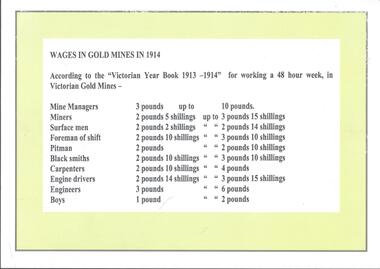
Document - Wages in MInes 1914
... ...surface men...Document was used for display at the commemoration in 2014, of the Great Extended Hustlers mine disaster, where 7 men were killed in 1914, gold mining wages mine managers miners surface men foreman pitman blacksmith carpenters engine drivers engineers 1914 List of mining occupations and wages paid in 1914. ...Document was used for display at the commemoration in 2014, of the Great Extended Hustlers mine disaster, where 7 men were killed in 1914,List of mining occupations and wages paid in 1914. List printed on green background in black text.gold mining, wages, mine managers, miners, surface men, foreman, pitman, blacksmith, carpenters, engine drivers, engineers, 1914 -
 Glenelg Shire Council Cultural Collection
Postcard - Postcard - Boxing, n.d
... Photo postcard, rope boxing ring, grass surface; two young men boxing; large crowd of men and boys outside ring watching bout; canvas screen around, number of people looking over top of screen....Front: 'BOXING CONTEST H.PARKER -V-KID LLOYD "DIGGERS SPORTS - CARNIVAL, TOYE PHOTO' - printed in white, bottom edge Photo postcard, rope boxing ring, grass surface; two young men boxing; large crowd of men and boys outside ring watching bout; canvas screen around, number of people looking over top of screen. ...Photo postcard, rope boxing ring, grass surface; two young men boxing; large crowd of men and boys outside ring watching bout; canvas screen around, number of people looking over top of screen.Front: 'BOXING CONTEST H.PARKER -V-KID LLOYD "DIGGERS SPORTS - CARNIVAL, TOYE PHOTO' - printed in white, bottom edge -
 Bendigo Historical Society Inc.
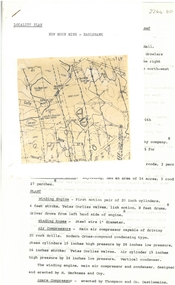
Document - ALBERT RICHARDSON COLLECTION: NEW MOON MINE, EAGLEHAWK
... At most mines, when the men were below the surface, the men could signal to the driver, but he could not communicate with them. ...At most mines, when the men were below the surface, the men could signal to the driver, but he could not communicate with them. ...The New Moon Company was registered by William Vinton in the Victorian Government Gazette (45) on Friday 8th July, 1870. (page 984), The place of operation was Napoleon Gully, Eaglehawk, Bendigo. Nominal capital was £24,000 pounds; shares being £1 . The names of the shareholders and number of shares held, was as follows: Nicholas Jeffrey 9000 shares, James Forde Graham 6000 shares, Joseph Harris, 1500 shares, John Wearne 1500 shares, John H. Hay, 1500 shares, Thomas Grieve 1500 shares, Henry Young 1500 shares, Alfred Wainright 1500 shares. With the exception of Wainwright, all shareholders lived in Eaglehawk. Alfred Wainright gave his address as 'Ireland'. On 23rd August, 1870, William Vinton, Mine Manager, reported that 'during the last fortnight we have crushed 294 loads of stone for 188 ounces 11 dwts of gold; 100 load still on surface, the roads being in such a bad state, we have been unable to cart it to the machine'. (Bendigo Advertiser, 23rd August, 1870, page 3 'Mining Intelligence') Heavy rain had fallen in Sandhurst the previous week: 'in the space of seven or so minutes, 3/4 of an inch of rain fell....in one of the severest storms to visit the district in many years' (Bendigo Advertiser, 18 August 1870, 'Dreadful storm and loss of life by lightning'). https://trove.nla.gov.au/newspaper/article/87913524?searchTerm=rainFour-page typed document with map, detailing the history and plant of the New Moon Gold Mine on the Garden Gully line of reef. The mine was located approximately one mile north of Eaglehawk Town Hall. The depth of the shaft was 2,400 ft. The mine was first formed in 1867. The signaling system in the mine was electric with a telephone service which connected the engine driver with the plat chamber. At most mines, when the men were below the surface, the men could signal to the driver, but he could not communicate with them. Total gold production from the mine was 230,601 ozs.bendigo, mining, new moon mine, william vinton, gold, rain, lightning -
 Federation University Historical Collection
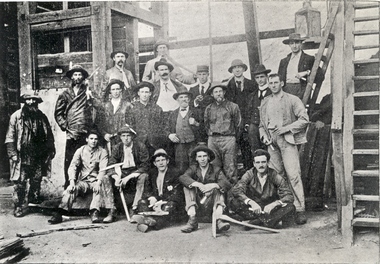
Photograph (black & white), Ballarat School of Mines Students visit the New Normanby Mine, 1899, 1899
... men, some Ballarat School of Mines students, pose outside Ballarat's New Normanby Mine. Some hold picks and candles. The man in the centre wearing a waistcoat is John Rowe, experienced miner and lecturer in Practical Mining at the Ballarat School of Mines. The June 1899 Ballarat School of Mines Magazine records: "The mining class visited the Britannia Gold Mine, and were kindly shown over the surface...men, some Ballarat School of Mines students, pose outside Ballarat's New Normanby Mine. Some hold picks and candles. The man in the centre wearing a waistcoat is John Rowe, experienced miner and lecturer in Practical Mining at the Ballarat School of Mines. The June 1899 Ballarat School of Mines Magazine records: "The mining class visited the Britannia Gold Mine, and were kindly shown over the surface ...In 1875 John Rowe enrolled at the Ballarat School of Mines (SMB) where he studied Metallurgy and Assaying. In 1880 the Britannia Mine closed and John Rowe moved to Launceston working as Manager of the Royal Tasman Gold Mining Company. He returned to Ballarat two years later to manage the Long Gully United Gold Mining Company. In 1885 John Rowe sought work in New Caledonia followed by South Africa. While in South Africa he received an offer from SMB to lecture in Practical Mining, an instructional innovation which involved weekly visits to some of the principle mines in the district. John Rowe took up this position in 1994, but it appears to have been a short lived innovation ending in 1996, possibly due to John Rowe's failing health. (http://guerin.ballarat.edu.au/curator/honour-roll/honourroll_Rowe,John.shtml)Nineteen men, some Ballarat School of Mines students, pose outside Ballarat's New Normanby Mine. Some hold picks and candles. The man in the centre wearing a waistcoat is John Rowe, experienced miner and lecturer in Practical Mining at the Ballarat School of Mines. The June 1899 Ballarat School of Mines Magazine records: "The mining class visited the Britannia Gold Mine, and were kindly shown over the surface and underground workings by Mr. Harvey."candle, ballarat school of mines, safety cage, john rowe, new normanby gold mine, mining alumni, pick -
 Flagstaff Hill Maritime Museum and Village
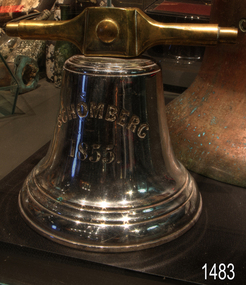
Functional object - Bell, Schomberg 1855, Before 1855
... men drowned in their attempt to reach the Schomberg, salvage efforts were abandoned. By 1870, parts of the ship had washed ashore on New Zealand’s South Island. Today, the wreck is about nine metres below the surface...men drowned in their attempt to reach the Schomberg, salvage efforts were abandoned. By 1870, parts of the ship had washed ashore on New Zealand’s South Island. Today, the wreck is about nine metres below the surface ...The Rescue and Journey of the Schomberg Bells: This bell was the smaller of two rescued by the crew of the Schomberg following the ship’s wreck in 1855. While the specific purpose of the smaller bell is unknown, it may have served to assemble the crew or signal mealtimes on board. After surviving the shipwreck, the crew carried both bells as they made their way along the coastline. Their journey eventually led them to the home of settler John Manning, located at Hopkins Point near Warrnambool. Manning took possession of the bells and subsequently presented them to two churches in Warrnambool. The smaller bell went to St Joseph’s Catholic Church, while the larger bell went to St John’s Presbyterian Church. After around a year, the small bell at St Joseph’s developed a crack and became unusable. Thomas Manifold imported a replacement bell for the church, and the damaged bell was stored at his farm. Years later, when the property was sold to John Logan, the discarded bell was donated to the old Warrnambool Museum upon its opening in 1886. The Curator, Joseph Archibald, placed the bell on display in the entry. In 1975, it was transferred from the Warrnambool Art Gallery to Flagstaff Hill. The ’Mystery’ of the small bell solved: Despite numerous attempts by the staff at Flagstaff Hill to restore the bell’s lustre, the bell remained dull and tarnished. In October 1986, Director Peter Ronald decided to send the bell for professional advice. The bell was entrusted to Briggs Marine Products, a renowned brass founder established in 1912. Upon examination, the specialists at Briggs discovered the reason behind the bell’s persistent lack of shine: it had originally been silver-plated, but most of the plating had worn away over time. The experts at Briggs then undertook the task of restoring the bell, successfully returning it to a gleaming silver surface. The Sailing Ship Schomberg: Launched in 1855, the Schomberg was regarded as the “Noblest” ship afloat at the time. Owned by the Black Ball Line, it was built for their passenger fleet by Alexander Hall of Aberdeen at a cost of £43,103. The construction featured three skins: one planked fore and aft and two diagonally planked, all fastened with screw-threaded trunnels (wooden rails). The ship’s First Class accommodation was luxurious, boasting velvet pile carpets, large mirrors, rosewood, birds-eye maple and mahogany timbers, satin damask soft furnishings, and an oak-lined library with a piano. Schomberg had a capacity for 1,000 passengers. The ship’s master, Captain James Nicol Forbes—also known as ‘Bully’ Forbes—was only 34 years old at the launch. He had a reputation for setting and breaking speed records on the Black Ball Line’s Marco Polo and Lightning. In 1852, Forbes completed the London to Melbourne journey on the Marco Polo in 68 days, a record at the time, though 53 passengers died during the voyage. In 1854, he sailed the Lightning to Melbourne in 76 days and returned in only 63 days—a record that stood among sailing ships. Forbes was known for driving his ship and crew to their limits, often prioritising speed over passenger comfort. Determined to set new records, he promised to reach Melbourne in sixty days, declaring he would do so “with or without the help of God.” The Maiden Voyage and the Wreck: Schomberg departed Liverpool on 6th October 1855, flying a banner that read “Sixty Days to Melbourne”. The vessel carried 430 passengers and 3,000 tons of cargo, including materials to build the Melbourne to Geelong Railway and a bridge over the Yarra River. Among the cargo were a cow for fresh milk, pens for fowls and pigs, and 90,000 gallons of water for drinking and washing. Additionally, it transported 17,000 letters and 31,800 newspapers. The ship and cargo were insured for $300,000, a considerable sum for the era. Poor winds while crossing the equator delayed Schomberg’s progress. Land was first sighted on Christmas Day at Cape Bridgewater near Portland. Captain Forbes followed the coastline towards Melbourne, but was reportedly playing cards when the third mate, Henry Keen, reported land only three miles away. The ship ran aground on a sand spit near Curdie’s Inlet (approximately 56 km west of Cape Otway) on 26th December 1855, after 78 days at sea. The sand spit and nearby currents were not marked on Forbes’s map. During the night, the crew launched a lifeboat to search for a safe landing spot for the passengers. The scouting party advised Forbes to wait until morning, as rough seas posed a danger to the lifeboats. At dawn, the ship’s Chief Officer spotted the SS Queen and signalled for help. The master of the Queen brought his vessel alongside, and all passengers and crew disembarked safely. The Black Ball Line’s Melbourne agent sent another steamer to collect the passengers’ baggage, and other steamers assisted with cargo salvage until worsening weather forced operations to cease. Notably, a plunderer later recovered a case of Wellington boots, but all were for the left foot. The wreck and its cargo were sold to local merchants Manifold & Bostock, who did not attempt further salvage. They later sold their interest to a Melbourne businessman and two seafarers. In 1864, after two men drowned in their attempt to reach the Schomberg, salvage efforts were abandoned. By 1870, parts of the ship had washed ashore on New Zealand’s South Island. Today, the wreck is about nine metres below the surface. Although most woodwork has disintegrated, the vessel’s shape remains discernible due to the railway irons, girders, and framework. Various goods and materials from the ship are scattered nearby. The bell is particularly significant in that along with other items from the wreck helped in part to having the legislation changed to protect shipwrecks, with far tighter controls being employed to oversee the salvaging of wreck sites. This bell forms part of the Schomberg collection at Flagstaff Hill maritime museum. The collection as a whole is of historical and archaeological significance at a State level. Flagstaff Hill’s collection of artefacts from the Schomberg is also significant for its association with the Victorian Heritage Registered Schomberg shipwreck (VHR S 612). The collection is of additional significance because of the relationship between the objects salvaged, as together they help us to interpret the story of the Schomberg. The collection as a whole is historically significant for representing aspects of Victoria's maritime history and its potential to interpret social and historical themes from society at the time of the wreck. A small ship’s bell. The silver-plated metal bell bears the ship’s name and year of construction on one side and the name and address of the ship’s builders on the other. These details are deeply engraved into the metal and formed in bold, upper-case lettering. The bell has two bell stands: the left and the right. Both stands have an Iron pipe bent into an inverted ‘Y’ shape, with a hole along its length and feet attached to a rectangular metal plate at the other two ends. Feet are bolted to a timber base that has a hole drilled through the centre for mounting. Bell's front; “SCHOMBERG” with “1855” below. Bell's back “HALL & SONS (crack splits letter “N”) / BUILDERS (in italics) / ABERDEEN” (crack splits letter “B”).flagstaff hill, flagstaff hill maritime museum and village, warrnambool, maritime museum, maritime village, great ocean road, shipwreck coast, schomberg, silver plated bell, mess bell, bell stands, captain ‘bully’ forbes, alexander hall and son, james baines and company, liverpool’s black ball line, bell, schomberg bell, ship's bell, small bell, st joseph's church, briggs marine, john manning, john logan, warrnambool museum, briggs foundry, silver bell -
 Flagstaff Hill Maritime Museum and Village
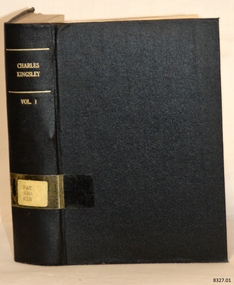
Book - Letters/Journals, Charles Kingsley, Charles Kingsley: His Letters and Memories of His Life Vol 1, 1879
... surface of a standard Victorian biography. This book is a vital cultural artefact that sits at the intersection of several massive 19th-century intellectual movements. Charles Kingsley was the leading architect of Muscular Christianity—a Victorian movement that rejected the idea that religious men should be pale, frail and solely focused on the afterlife. ...The focus of this book is not a standard biography written by an outside observer; it is a life story told through letters and personal journals. The volume is seamlessly woven together with editorial commentary by Kingsley’s widow, Frances "Fanny" Grenfell. Because this is Volume 1, it covers the first half of Charles Kingsley's life. It documents his childhood, his time at Cambridge University, and his intense courtship of Fanny. His early career as an Anglican clergyman in the rural parish of Eversley is covered, alongside his rise to national prominence in the late 1840s and 1850s as a social reformer. The text highlights his role in the Christian Socialist movement and his writing under the pen name "Parson Lot" to advocate for the working class. It also explores the writing and reception of his famous early novels, such as Alton Locke and Yeast, which tackled themes of poverty and systemic inequality.Charles Kingsley: His Letters and Memories of His Life Vol 1 Author: Charles Kingsley Edited by his wife ( Frances "Fanny" Grenfell) Publisher: C Kegan Paul & Co Date: 1879 Further Information: Sixth Abridged Editionnon-fictionThe focus of this book is not a standard biography written by an outside observer; it is a life story told through letters and personal journals. The volume is seamlessly woven together with editorial commentary by Kingsley’s widow, Frances "Fanny" Grenfell. Because this is Volume 1, it covers the first half of Charles Kingsley's life. It documents his childhood, his time at Cambridge University, and his intense courtship of Fanny. His early career as an Anglican clergyman in the rural parish of Eversley is covered, alongside his rise to national prominence in the late 1840s and 1850s as a social reformer. The text highlights his role in the Christian Socialist movement and his writing under the pen name "Parson Lot" to advocate for the working class. It also explores the writing and reception of his famous early novels, such as Alton Locke and Yeast, which tackled themes of poverty and systemic inequality.flagstaff hill, warrnambool, shipwrecked coast, flagstaff hill maritime museum, maritime museum, shipwreck coast, flagstaff hill maritime village, great ocean road, book, pattison collection, warrnambool library, warrnambool mechanics’ institute, ralph eric pattison, corangamite regional library service, warrnambool city librarian, mechanics’ institute library, victorian library board, warrnambool books and records, warrnambool children’s library, charles kingsley: his letters and memories of his life vol 1, frances "fanny" grenfell, mrs kingsley -
 Flagstaff Hill Maritime Museum and Village
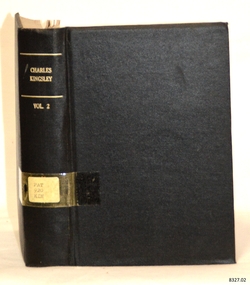
Book - Letters/Journals, Charles Kingsley, Charles Kingsley: His Letters and Memories of His Life Vol 2, 1879
... surface of a standard Victorian biography. This book is a vital cultural artefact that sits at the intersection of several massive 19th-century intellectual movements. Charles Kingsley was the leading architect of Muscular Christianity—a Victorian movement that rejected the idea that religious men should be pale, frail and solely focused on the afterlife. ...While Volume 1 introduces Charles Kingsley’s early development and his explosive rise as a radical social reformer, Volume 2 pivots to his mature years as an established public figure. It focuses on his high-profile intellectual battles and his global travels. The transition from Volume 1 to Volume 2 charts a shift from a young, controversial outsider to a celebrated, busy member of the Victorian elite. Volume 1 covers his early life from 1819 to 1856, while Volume 2 spans the years between 1857 and 1875. It documents his mature family life, his appointment as Royal Chaplain to Queen Victoria, his tenure as a professor of Modern History at Cambridge, and his time as Canon of Westminster. It was during these later years that his children's classic, The Water-Babies (1863), and his late historical fiction were published.Charles Kingsley: His Letters and Memories of His Life Vol 2 Author: Charles Kingsley Edited by his wife ( Frances "Fanny" Grenfell) Publisher: C Kegan Paul & Co Date: 1879 Further Information: Sixth Abridged Editionnon-fictionWhile Volume 1 introduces Charles Kingsley’s early development and his explosive rise as a radical social reformer, Volume 2 pivots to his mature years as an established public figure. It focuses on his high-profile intellectual battles and his global travels. The transition from Volume 1 to Volume 2 charts a shift from a young, controversial outsider to a celebrated, busy member of the Victorian elite. Volume 1 covers his early life from 1819 to 1856, while Volume 2 spans the years between 1857 and 1875. It documents his mature family life, his appointment as Royal Chaplain to Queen Victoria, his tenure as a professor of Modern History at Cambridge, and his time as Canon of Westminster. It was during these later years that his children's classic, The Water-Babies (1863), and his late historical fiction were published.flagstaff hill, warrnambool, shipwrecked coast, flagstaff hill maritime museum, maritime museum, shipwreck coast, flagstaff hill maritime village, great ocean road, book, pattison collection, warrnambool library, warrnambool mechanics’ institute, ralph eric pattison, corangamite regional library service, warrnambool city librarian, mechanics’ institute library, victorian library board, warrnambool books and records, warrnambool children’s library, charles kingsley: his letters and memories of his life vol 1, frances "fanny" grenfell, mrs kingsley -
 Mission to Seafarers Victoria
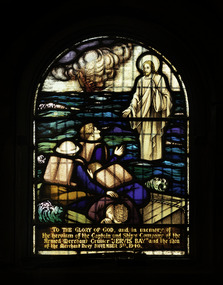
Artwork, other - Stained glass window, Brooks Robinson & Co, Jervis Bay, 1947
... (AR1947) Unfortunately it is lost. altar st peter chapel flinders street mission to seafarers seamen's mission mission to seamen st peter sailors seamen anchor stained glass windows WIN memorial chapel hope jervis bay crew lucas girls ballarat branch hlg Jesus To the Glory of God and in loving memory of the heroism of the Captain and Ship’s Company, of the Armed Merchant Cruiser ‘Jervis Bay’ and the Men of the Merchant Navy November 5th 1940. Arched stained glass windows depicting Jesus floating on the surface of the sea holding out his right hand to seamen who on a raft, their ship sinking in the background. ...This window, in memory of the crew of the ship Jervis Bay, was unveiled on the 14 December 1947 by Mrs Johnson, wife of the Bishop of Ballarat. As mentioned on the plaque below the window, it was a gift of the Ballarat branch of the HLG and the Lucas Girls from Ballarat. E Lucas & Co was a textile company in Ballarat. The "Lucas girls" are known Ballarat-wide for their commitment to philanthropic work during the period of the Great War. From Bronwyn Hughes report: The window was designed and made by Brooks, Robinson & Co. Melbourne, from an old cartoon that was ‘touched up’. The size (24 1⁄2 x 17 1⁄4 inches) precluded the inclusion of any ornamental borders or other decorative features. The order was not received until 1947. Below this window is the plaque from the donors: the Ballarat Branch of the Harbour Lights Guild and Lucas Girls. On the same occasion the mallet, used to launch the ship Manunda was donated to the Mission. (AR1947) Unfortunately it is lost. Arched stained glass windows depicting Jesus floating on the surface of the sea holding out his right hand to seamen who on a raft, their ship sinking in the background.To the Glory of God and in loving memory of the heroism of the Captain and Ship’s Company, of the Armed Merchant Cruiser ‘Jervis Bay’ and the Men of the Merchant Navy November 5th 1940.altar, st peter chapel, flinders street, mission to seafarers, seamen's mission, mission to seamen, st peter, sailors, seamen, anchor, stained glass windows, win, memorial chapel, hope, jervis bay, crew, lucas girls, ballarat branch, hlg, jesus -
 Bendigo Military Museum
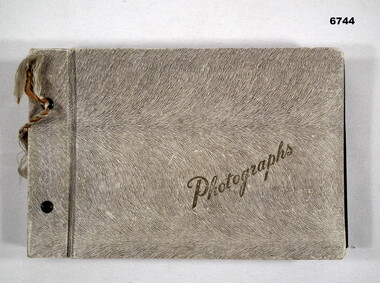
Album - ALBUM, PHOTOGRAPH, Photo Album of graves and important sites of 38 Bn men WW1
... men. Passchendaele Barracks Trust WW1 38th BN Photo album has a light gray surface resembling animal fur. ...38 Bn was raised 1 Mar 1916 in Bendigo during WW1. it was initially about 500 men.Photo album has a light gray surface resembling animal fur. The word photographs is embossed in gold on the front. It is bound with a cord (broken) thru 2 holes. Under each photo is a tag showing deceased soldier's name. The album has about 20 pages. The B & W photos are size 7.2 x 5.0 cms.passchendaele barracks trust, ww1, 38th bn -
 Eltham District Historical Society Inc
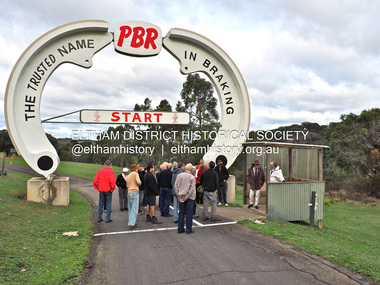
Photograph - Digital Photograph, Jim Connor, Rob Roy Hill Climb Circuit, Clintons Road, Christmas Hills, 12 May 2016
... men would ride their BSA or Harley Davidson motorcycles to the property which led to regular club-organised hillclimb meetings between 1930 and 1936. In 1935 Clinton offered the use of his property to the Light Car Club of Australia for their hillclimbs. The track was sealed that same year and the hillclimb at Clintons Road was one of only three specially designed bitumen surface...men would ride their BSA or Harley Davidson motorcycles to the property which led to regular club-organised hillclimb meetings between 1930 and 1936. In 1935 Clinton offered the use of his property to the Light Car Club of Australia for their hillclimbs. The track was sealed that same year and the hillclimb at Clintons Road was one of only three specially designed bitumen surface ...Rob Roy-EDHS visit 12 May 2016 On 12th May 2016 some members of the Eltham District Historical Society and others were fortunate to have the opportunity to visit and explore the Rob Roy Hillclimb in Clintons Road, Christmas Hills. This followed an invitation from Don Kinsey and Wayne Ruston, members of the MG Car Club, which operates Rob Roy. At the time, both men were actively involved in the running of the meetings there, Don, an EDHS member, as a course commentator, with a wide range of motorsport experiences, and Wayne as the main organiser of the meetings. Don Kinsey welcomed the group and spoke about the historical background of the property and the hillclimb, then led those interested around the site and up the hillclimb track, stopping at spots along the way to provide additional information. Everyone enjoyed their experiences, including inspecting Wayne Ruston’s MGBV8. The Rob Roy Hill Climb originated in 1935 on the property of former Heidelberg Mayor, William Clinton, where he reared the Rob Roy breed of miniature ponies. He established Pleasure Grounds on part of the property attracting groups of Sunday visitors from Melbourne's inner suburbs. Visitors enjoyed a picnic area, pony rides, a dance hall and a tap room. Young men would ride their BSA or Harley Davidson motorcycles to the property which led to regular club-organised hillclimb meetings between 1930 and 1936. In 1935 Clinton offered the use of his property to the Light Car Club of Australia for their hillclimbs. The track was sealed that same year and the hillclimb at Clintons Road was one of only three specially designed bitumen surface hillclimbs in the world, the others being Shelsey Walsh and Prescott Hillclimbs in the UK. The first Light Car Club of Australia hillclimb was held at Rob Roy in February 1937.jim connor collection, 2016-05-12, activities, christmas hills, clintons road, heritage excursion, rob roy hill climb, eltham district historical society -
 Eltham District Historical Society Inc
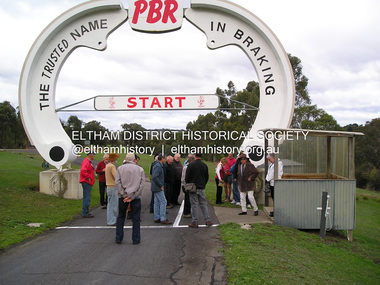
Photograph, Fay Bridge, Rob Roy Hill Climb Circuit, Clintons Road, Christmas Hills, 7 September 2013
... men would ride their BSA or Harley Davidson motorcycles to the property which led to regular club-organised hillclimb meetings between 1930 and 1936. In 1935 Clinton offered the use of his property to the Light Car Club of Australia for their hillclimbs. The track was sealed that same year and the hillclimb at Clintons Road was one of only three specially designed bitumen surface...men would ride their BSA or Harley Davidson motorcycles to the property which led to regular club-organised hillclimb meetings between 1930 and 1936. In 1935 Clinton offered the use of his property to the Light Car Club of Australia for their hillclimbs. The track was sealed that same year and the hillclimb at Clintons Road was one of only three specially designed bitumen surface ...Rob Roy-EDHS visit 12 May 2016 On 12th May 2016 some members of the Eltham District Historical Society and others were fortunate to have the opportunity to visit and explore the Rob Roy Hillclimb in Clintons Road, Christmas Hills. This followed an invitation from Don Kinsey and Wayne Ruston, members of the MG Car Club, which operates Rob Roy. At the time, both men were actively involved in the running of the meetings there, Don, an EDHS member, as a course commentator, with a wide range of motorsport experiences, and Wayne as the main organiser of the meetings. Don Kinsey welcomed the group and spoke about the historical background of the property and the hillclimb, then led those interested around the site and up the hillclimb track, stopping at spots along the way to provide additional information. Everyone enjoyed their experiences, including inspecting Wayne Ruston’s MGBV8. The Rob Roy Hill Climb originated in 1935 on the property of former Heidelberg Mayor, William Clinton, where he reared the Rob Roy breed of miniature ponies. He established Pleasure Grounds on part of the property attracting groups of Sunday visitors from Melbourne's inner suburbs. Visitors enjoyed a picnic area, pony rides, a dance hall and a tap room. Young men would ride their BSA or Harley Davidson motorcycles to the property which led to regular club-organised hillclimb meetings between 1930 and 1936. In 1935 Clinton offered the use of his property to the Light Car Club of Australia for their hillclimbs. The track was sealed that same year and the hillclimb at Clintons Road was one of only three specially designed bitumen surface hillclimbs in the world, the others being Shelsey Walsh and Prescott Hillclimbs in the UK. The first Light Car Club of Australia hillclimb was held at Rob Roy in February 1937.activities, eltham district historical society, heritage excursion, fay bridge collection, 2016-05-12, christmas hills, clintons road, rob roy hill climb -
 Eltham District Historical Society Inc
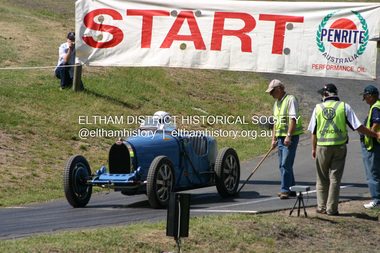
Photograph - Digital Photograph, Alan King, Rob Roy Hill Climb, 24 November 2007
... men would ride their BSA or Harley Davidson motorcycles to the property which led to regular club-organised hillclimb meetings between 1930 and 1936. In 1935 Clinton offered the use of his property to the Light Car Club of Australia for their hillclimbs. The track was sealed that same year and the hillclimb at Clintons Road was one of only three specially designed bitumen surface...men would ride their BSA or Harley Davidson motorcycles to the property which led to regular club-organised hillclimb meetings between 1930 and 1936. In 1935 Clinton offered the use of his property to the Light Car Club of Australia for their hillclimbs. The track was sealed that same year and the hillclimb at Clintons Road was one of only three specially designed bitumen surface ...The Rob Roy Hill Climb originated in 1935 on the property of former Heidelberg Mayor, William Clinton, where he reared the Rob Roy breed of miniature ponies. He established Pleasure Grounds on part of the property attracting groups of Sunday visitors from Melbourne's inner suburbs. Visitors enjoyed a picnic area, pony rides, a dance hall and a tap room. Young men would ride their BSA or Harley Davidson motorcycles to the property which led to regular club-organised hillclimb meetings between 1930 and 1936. In 1935 Clinton offered the use of his property to the Light Car Club of Australia for their hillclimbs. The track was sealed that same year and the hillclimb at Clintons Road was one of only three specially designed bitumen surface hillclimbs in the world, the others being Shelsey Walsh and Prescott Hillclimbs in the UK. The first Light Car Club of Australia hillclimb was held at Rob Roy in February 1937. Covered under Heritage Overlay, Nillumbik Planning Scheme. Published: Nillumbik Now and Then / Marguerite Marshall 2008; photographs Alan King with Marguerite Marshall.; p133 About six times a year the unlikely sound of car engines emerges from deep in the heart of Christmas Hills.* Usually a quiet retreat, the Hills are home to one of the world’s oldest purpose-built motor sport venues - the Rob Roy Hillclimb. When sealed in 1939, the hillclimb at Clintons Road was one of only three specially designed bitumen surface hillclimbs in the world, the others being Shelsley Walsh and Prescott Hillclimbs in the UK.1 The Rob Roy Hillclimb originated in 1935 on the property of former Heidelberg mayor, William Clinton, where he reared the Rob Roy breed of miniature ponies. Rob Roy was the Scottish folk hero and outlaw. On part of his property Clinton established Pleasure Grounds, attracting Sunday parties from Melbourne’s inner suburbs. Visitors enjoyed a picnic area, pony rides, a dance hall and a tap room.2 Young men riding on their BSA or Harley Davidson bikes led to club-organised regular hillclimb meetings, between 1930 and 1936. In 1935 Clinton offered his property to the Light Car Club of Australia for their hillclimbs. In February 1937, the first Light Car Club of Australia hillclimb meeting was held at Rob Roy. Jack Day achieved the fastest time that day for the 760 yard (695m) track at 36 seconds in a Ford V8 engined Bugatti Special. At first the climb was just a dusty gravel track, but in 1939 it was up-graded and bituminised. Today the 695 metre track begins on a slight incline, proceeds through a sharp right turn, which formerly passed a rusty iron shed, now remembered by the name Tin Shed Corner. The track continues down a slight incline to a level stretch along the top of an embankment holding back a half-acre (0.2ha) dam, then up to a one-in-three gradient. The track then winds uphill through several left turns to the finish line. In 1939 Frank Kleinig reduced the record to 29.72 seconds in an MG Hudson. Throughout World War Two the Rob Roy Hillclimbs were suspended, but were resumed in 1947. The hillclimbs consistently attracted crowds averaging 500 to 600 people, peaking at 2000, until the hillclimb was destroyed by the 1962 bushfires. The meetings included nine Australian Hillclimb Championships, with the first in 1938 won by Peter Whitehead in his ERA. Eight of the Outright and Class record holders were Australian Grand Prix winners including Jack Brabham, who became a triple F1 World Champion. The Light Car Club of Australia held 61 meetings at Rob Roy. Events usually included Touring, Gran Turismo, Production, Sports, Racing and Vintage cars and in the latter years Go-carts. These meets suddenly stopped after the 1962 bushfire destroyed the access bridge on the property leading to the track area, although fortunately Clinton saved his home. The club then established the Lakeland Hillclimb venue close to Lilydale.3 From 1979 to 1987 the MG Car Club ran hill climbs at the Templestowe Hillclimb until the land was to be sub-divided. In 1991 the MGCC approached the Shire of Nillumbik about using the derelict Rob Roy venue. In 1992, after much lobbying, the club signed a ten-year lease from Melbourne Water, which has been renewed. The original track was faithfully reconstructed. Access roads were improved and guard rails were installed on the causeway. Permanent structures were rebuilt and tonnes of rubbish removed. This was made possible by an immense amount of voluntary work by MGCC members and financial support from the newly formed Friends of Rob Roy. In February 1993 the first Return to Rob Roy Historic Meeting was run with a huge spectator attendance of around 1000 enthusiasts. In September 2007, the Nillumbik Shire Council gave the hillclimb heritage protection. This acknowledged the property’s significant contribution to early Australian motor sport with its social connection to William Clinton and the local community.4 *Christmas Hills was named after emancipated convict and shepherd David Christmas, lost in these hills.This collection of almost 130 photos about places and people within the Shire of Nillumbik, an urban and rural municipality in Melbourne's north, contributes to an understanding of the history of the Shire. Published in 2008 immediately prior to the Black Saturday bushfires of February 7, 2009, it documents sites that were impacted, and in some cases destroyed by the fires. It includes photographs taken especially for the publication, creating a unique time capsule representing the Shire in the early 21st century. It remains the most recent comprehenesive publication devoted to the Shire's history connecting local residents to the past. nillumbik now and then (marshall-king) collection, rob roy hill climb, clintons road, light car club of australia, william clinton -
 Kiewa Valley Historical Society
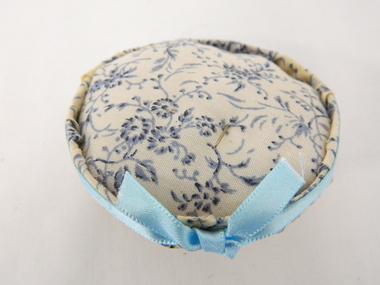
Cushion Pin, unknown, circa mid to late 1900's
... men folk. This item is very significant to the rural households in the Kiewa Valley because of the relative isolation of the region and the amount of wear and tear that clothes go through in a typical rural environment. sewing pin-cushion haberdashery This pin cushion is "home" made, circular and covered in a blue floral material, encircled with a light blue ribbon (glued on) for extra adhesion. The material encloses a padded surface ...This pin cushion was in use when home spun "fashion" clothing was manufactured or altered. When this item was used it was in a period when distances from haberdashery stores was too far and mail ordered clothing would take weeks to arrive.The ability to make and alter clothing for families within the Kiewa Valley and its regions was a domestic requirement up until the later period(1960's onwards)This pin cushion, although rarely used in the 21st Century, with the availability of "cheap" throw away clothes, was very important to a well run rural household. The emphasis for girls to be able to sew and repair clothing was generated by mothers and continued at high schools. Part of the role of women(in this time frame) within the family was to manufacture children's clothing and adjust the growing waistline of their men folk. This item is very significant to the rural households in the Kiewa Valley because of the relative isolation of the region and the amount of wear and tear that clothes go through in a typical rural environment.This pin cushion is "home" made, circular and covered in a blue floral material, encircled with a light blue ribbon (glued on) for extra adhesion. The material encloses a padded surface(allows pins to be safely inserted for storage(future use).sewing, pin-cushion, haberdashery -
 Bendigo Historical Society Inc.
Photograph - AUSTIN COLLECTION: Operating rock drill, Central Deborah Gold Mine, Possibly 1990's
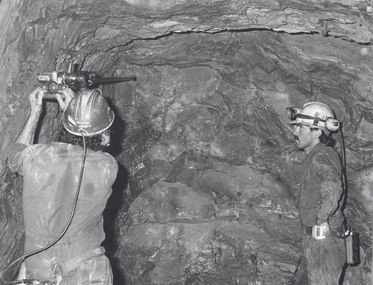
... Two men with hard hats and lights standing in front of underground rock surface at Central Deborah Gold Mine. ...Two men with hard hats and lights standing in front of underground rock surface at Central Deborah Gold Mine. ...Central Deborah Gold Mine history: At its peak, Central Deborah Gold Mine reached a depth of 412 metres. It has 17 separate levels and 15 kilometres of drives and cross cuts (tunnels). The Central Deborah was very much a hands-on mine and the conditions that the miners worked in would be considered shocking by today's standards – being lowered underground in a cage with only two sides, often working ankle to knee deep in water, filling up to 32 ore trucks a shift by hand which were then pushed a mile or more along rails in the drives, working by carbide lamp, breathing in the fumes and rock dust and communication by bells. Geez, they were ironmen. However, at the time working conditions were considered to be among the best on the goldfields at Central Deborah, after all it was one of the only mines that had hot showers. Following Central Deborah Gold Mine's closure, the Bendigo skyline began to noticeably change. Obvious remnants of mining such as poppet heads, engine rooms, service quarters, battery houses and chimneys were steadily disappearing. After intense lobbying by the local community, the Bendigo City Council purchased the still very much intact Central Deborah Gold Mine in 1970 for a mere $6,000 to ensure that a vital link to Bendigo's historic golden past was maintained. The Bendigo Trust was then formed to oversee the operations of the Central Deborah Gold Mine, which led to the surface of the mine being opened to the public in 1971. Initially the surface was open for just 12 hours a week and as the demand for viewing a part of Bendigo's history increased, so did the opening hours. In 1974 the mine was gazetted as a Public Historical Purposes Reserve and attracted such visitors as H.R.H Prince Charles. By far the greatest shortcoming at this stage was that no one could view the underground workings, as these had become flooded. After what could only be described as a monumental effort by everyone involved, Level 2 of the mine was officially opened to the public by the Premier of Victoria, the Honourable John Cain, on 20 June 1986, which brought to fruition a long standing dream.Black and white photograph. Two men with hard hats and lights standing in front of underground rock surface at Central Deborah Gold Mine. Paul Maker on left hand side of image is operating a small rock drill. John Jeffrey on right hand side is observing the procedure. gold mining, central deborah gold mine, rock drill, underground -
 Monbulk RSL Sub Branch
Book, Robert Moore, A time to die: The untold story of the Kursk tragedy, 2002
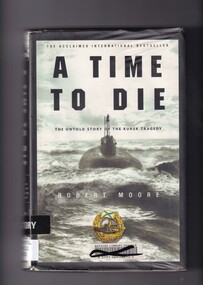
... russian submarine kursk explosion submarine disasters - russia At 11:28 a.m. on Saturday, August 12, 2000, high in the Arctic Circle under the roiling surface of the unforgiving Barents Sea, Captain Gennady Lyachin was taking the Kursk, the pride of Russia's elite Northern Fleet, through the last steps of firing a practice torpedo, part of an elaborate naval exercise. Suddenly, the torpedo exploded in a massive fireball, instantly incinerating all seven men ...At 11:28 a.m. on Saturday, August 12, 2000, high in the Arctic Circle under the roiling surface of the unforgiving Barents Sea, Captain Gennady Lyachin was taking the Kursk, the pride of Russia's elite Northern Fleet, through the last steps of firing a practice torpedo, part of an elaborate naval exercise. Suddenly, the torpedo exploded in a massive fireball, instantly incinerating all seven men in the submarine's forward compartment. The horror, however, was just beginning. The full, gripping story of the remarkable drama inside the Kursk and of the desperate rescue efforts has never been told - until now.Index, ill (b/w plates), p.362.non-fictionAt 11:28 a.m. on Saturday, August 12, 2000, high in the Arctic Circle under the roiling surface of the unforgiving Barents Sea, Captain Gennady Lyachin was taking the Kursk, the pride of Russia's elite Northern Fleet, through the last steps of firing a practice torpedo, part of an elaborate naval exercise. Suddenly, the torpedo exploded in a massive fireball, instantly incinerating all seven men in the submarine's forward compartment. The horror, however, was just beginning. The full, gripping story of the remarkable drama inside the Kursk and of the desperate rescue efforts has never been told - until now.russian submarine kursk explosion, submarine disasters - russia -
 Monbulk RSL Sub Branch
Book, Peter Barton, Beneath Flanders fields the tunnellers' war, 1914-1918, 2005
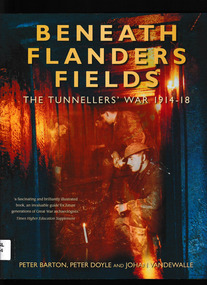
... Few on the surface knew the horrific details of the tunnellers work, yet this silent, claustrophobic conflict was a barbaric struggle that raged day and night for almost two and a half years. On 7 June 1917 the most dramatic mine offensive in history at Messines Ridge opened. After Messines, the tunnellers turned to the construction of deep dugouts, structures which housed tens of thousands of troops, men ...In the Ypres Salient, the secret struggle beneath no man's land became one of engineering, technology and science - and of carefully calculated assassination. This book reveals how this most intense of battles was fought and won. Few on the surface knew the horrific details of the tunnellers work, yet this silent, claustrophobic conflict was a barbaric struggle that raged day and night for almost two and a half years. On 7 June 1917 the most dramatic mine offensive in history at Messines Ridge opened. After Messines, the tunnellers turned to the construction of deep dugouts, structures which housed tens of thousands of troops, men for whom life on the surface had become almost untenable. Often electrically lit and ventilated, they incorporated headquarters, cookhouses, soup kitchens, hospitals, drying rooms and workshops. Hundreds were built, and thanks to the Flanders geology many still survive today, and are can be seen in photographs in this book.Index, ill, maps, p.305.non-fictionIn the Ypres Salient, the secret struggle beneath no man's land became one of engineering, technology and science - and of carefully calculated assassination. This book reveals how this most intense of battles was fought and won. Few on the surface knew the horrific details of the tunnellers work, yet this silent, claustrophobic conflict was a barbaric struggle that raged day and night for almost two and a half years. On 7 June 1917 the most dramatic mine offensive in history at Messines Ridge opened. After Messines, the tunnellers turned to the construction of deep dugouts, structures which housed tens of thousands of troops, men for whom life on the surface had become almost untenable. Often electrically lit and ventilated, they incorporated headquarters, cookhouses, soup kitchens, hospitals, drying rooms and workshops. Hundreds were built, and thanks to the Flanders geology many still survive today, and are can be seen in photographs in this book. world war 1914-1918 - campaigns - france, world war 1914-1918 - tunnellers -
 Bendigo Historical Society Inc.
Document - MARKS COLLECTION: CODE OF SIGNALS FOR MINES CHART
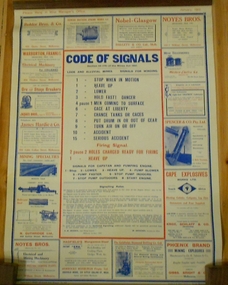
... 'Code of Signals, Section 45 (19) of the Mines Act 1961. lode and alluvial mines, signals for winding' Signals: 1 stop when in motion, 1 heave up, 2 lower, 3 hold fast danger, 4 pause men coming to surface, 6 cage at liberty, 7 change tanks or cages, 8 put drum in or out of gear, 9 turn air on or off, 10 accident, 15 serious accident. ...'Code of Signals, Section 45 (19) of the Mines Act 1961. lode and alluvial mines, signals for winding' Signals: 1 stop when in motion, 1 heave up, 2 lower, 3 hold fast danger, 4 pause men coming to surface, 6 cage at liberty, 7 change tanks or cages, 8 put drum in or out of gear, 9 turn air on or off, 10 accident, 15 serious accident. ...Poster, printed on coated fabric, wooden hanger on top. Yellow background, printed in red and blue. 'Code of Signals, Section 45 (19) of the Mines Act 1961. lode and alluvial mines, signals for winding' Signals: 1 stop when in motion, 1 heave up, 2 lower, 3 hold fast danger, 4 pause men coming to surface, 6 cage at liberty, 7 change tanks or cages, 8 put drum in or out of gear, 9 turn air on or off, 10 accident, 15 serious accident. Also lists firing signals. Advertisements for suppliers to mining companies around border of poster. E.g. Jaques Bros., Engineers, Coppin Street, Richmond, Melbourne. Ore and Stone Breakers manufactured in various sizes (has illustration of machine). James Hardie & Co., 581 Little Collins Street, Melbourne. Necessaries for success in mining enterprises are: Dick's original balata belting to drive your machinery with; Genuine Dodge wood split pulleys on the shafting, and fibro ciment(sic) sheets to protect you from fire. These sheets are also acid-proof.bendigo, mining, code of signals -
 Bendigo Historical Society Inc.
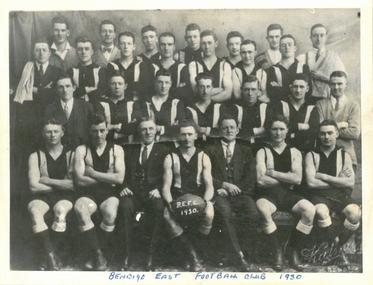
Photograph - PURDY COLLECTION: BENDIGO EAST FOOTBALL CLUB 1930
... Four rows of men dressed in football jumpers, trainers standing on sides. Middle front row player is holding a football with white writing ' B.E.F.C. 1930' printed on surface. ...Four rows of men dressed in football jumpers, trainers standing on sides. Middle front row player is holding a football with white writing ' B.E.F.C. 1930' printed on surface. ...The Bendigo District Football Association was superseded in 1913 by the Bendigo Football League. When competition resumed in 1919 after WW1 the League was composed of Eaglehawk, South Bendigo, Sandhurst and Bendigo East. In 1924 Echuca was included and Bendigo East was eliminated. Bendigo East moved to Golden City Football League and folded in the 1930s. Black and white photo stuck onto grey board, red back: Bendigo East Football Club 1930. Four rows of men dressed in football jumpers, trainers standing on sides. Middle front row player is holding a football with white writing ' B.E.F.C. 1930' printed on surface. Jim Purdy in right hand back corner.bendigo, sporting clubs, bendigo east football club -
 Bendigo Historical Society Inc.
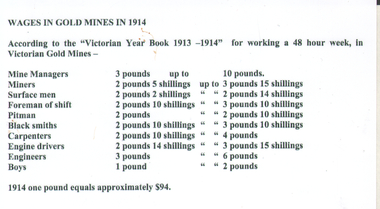
Document - Wages in gold mines 1914, 2014
... The new rates affecting Victorians were: miners, hard labor ordinary 12/- a shift; sinking 13/4; rising 14/6; underground stoping 14/-; miners, machine labor to receive 1/- per shift in addition to the above rates; timber men ordinary 13/2; shafts 16/2 a man; bracemen 12/-; truckers underground 11/6; open cut miners 13/-; laborers underground 11/-; on surface 10/-; boys between 16 and 19 9/-; over 19 full pay; shift bosses 15/-; tailings dame man 11/-; sluice man 11/-; grating man 11/-; box cleaners 11/-; pump-hole man 12/-; dressers and cleaners 13/-; man in charge erecting legs 12/6; woodcutters 12/6; woodcutter man, horse and dray 1/-/-; blacksmith 14/-; carpenter 15/-; bricklayer 15/-; tool sharpener 13/-; blacksmith's striker 11/-; rough carpenter 13/-; horse driver 11/-. ...The new rates affecting Victorians were: miners, hard labor ordinary 12/- a shift; sinking 13/4; rising 14/6; underground stoping 14/-; miners, machine labor to receive 1/- per shift in addition to the above rates; timber men ordinary 13/2; shafts 16/2 a man; bracemen 12/-; truckers underground 11/6; open cut miners 13/-; laborers underground 11/-; on surface 10/-; boys between 16 and 19 9/-; over 19 full pay; shift bosses 15/-; tailings dame man 11/-; sluice man 11/-; grating man 11/-; box cleaners 11/-; pump-hole man 12/-; dressers and cleaners 13/-; man in charge erecting legs 12/6; woodcutters 12/6; woodcutter man, horse and dray 1/-/-; blacksmith 14/-; carpenter 15/-; bricklayer 15/-; tool sharpener 13/-; blacksmith's striker 11/-; rough carpenter 13/-; horse driver 11/-. ...In April 1914, the Federated Mining Employes' Association, Victoria, put in a submission to establish improved wages for mining employees. A hearing in the Commonwealth Arbitration Court was to be held in four to six weeks from the lodgment of the plaint. The new log of claims would provide for a general increase in the previous log rates. The new rates affecting Victorians were: miners, hard labor ordinary 12/- a shift; sinking 13/4; rising 14/6; underground stoping 14/-; miners, machine labor to receive 1/- per shift in addition to the above rates; timber men ordinary 13/2; shafts 16/2 a man; bracemen 12/-; truckers underground 11/6; open cut miners 13/-; laborers underground 11/-; on surface 10/-; boys between 16 and 19 9/-; over 19 full pay; shift bosses 15/-; tailings dame man 11/-; sluice man 11/-; grating man 11/-; box cleaners 11/-; pump-hole man 12/-; dressers and cleaners 13/-; man in charge erecting legs 12/6; woodcutters 12/6; woodcutter man, horse and dray 1/-/-; blacksmith 14/-; carpenter 15/-; bricklayer 15/-; tool sharpener 13/-; blacksmith's striker 11/-; rough carpenter 13/-; horse driver 11/-. Extra rates and shorter hours for holidays and Sunday work were also demanded. (Bendigo Advertiser 27 April 1914)Printed list of mine employees' wages current in 1914. Card was used in an interpretive display to commemorate 100 years, on the 2nd of May 2014, since the devastating mine disaster at the Great Extended Hustlers Gold Mine. Seven men were killed on 2nd May 1914, in an underground explosion. The event was held on Hustler's Hill by the Bendigo Historical Society in 2014. On top of card: Wages in Gold Mines in 1914. gold mining 1914, gold mines, bendigo, employee wages, log of claims, commonwealth arbitration court, great extended hustlers gold mine -
 Bendigo Historical Society Inc.
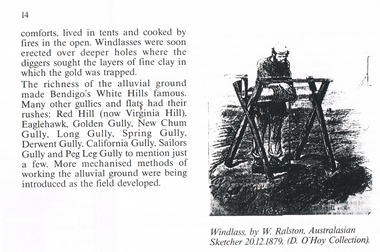
Document - LONG GULLY HISTORY GROUP COLLECTION: SOME HISTORICAL INFORMATION
... men in front of a fire at the front of the tent. Page 16 has a sketch of an old brick house with iron lace on the veranda and a picket fence at the front. Page 17 mentions the school and some Friendly Societies and Church. Page 22 mentions Quartz Mining. There is a Lithograph of a Quartz outcrop, New Chum Gully 1852 by George Rowe and a View of Surface...men in front of a fire at the front of the tent. Page 16 has a sketch of an old brick house with iron lace on the veranda and a picket fence at the front. Page 17 mentions the school and some Friendly Societies and Church. Page 22 mentions Quartz Mining. There is a Lithograph of a Quartz outcrop, New Chum Gully 1852 by George Rowe and a View of Surface ...BHS Collection12 photocopied pages. Page four has acknowledgements, Page five mentions Pen-Portraist by Raly Wallace and Kevin Vallence, Page 14 mentions some rich areas: White Hills, Red Hill (now Virginia Hill), Eaglehawk, Golden Gully, New Chum Gully, Long Gully, Spring Gully, Derwent Gully, California Gully, Sailors Gully and Peg Leg Gully. There are two sketches on the page: Windless, by W. Ralston, Australasian Sketcher 20/12/1879 (D O'Hoy Collection) and a sketch of some miners in a tent with some mining equipment in front of it. There are two men in front of a fire at the front of the tent. Page 16 has a sketch of an old brick house with iron lace on the veranda and a picket fence at the front. Page 17 mentions the school and some Friendly Societies and Church. Page 22 mentions Quartz Mining. There is a Lithograph of a Quartz outcrop, New Chum Gully 1852 by George Rowe and a View of Surface Workings 1861, a Batchelder Photo. Page 23 mentions Edward Nucella Emmett, a pioneer gold digger who became involved in many important public issues. Page 25 mentions Company Mining and Crushing. It has a sketch of a Primitive Quart Crusher. Page 37 Mentions Richard Pope, a Miner who tramped from job to job in Bendigo and eventually followed the rush to Broken Hill. Page 38 mentions the Eaglehawk Brass Band and Friendly Societies in Eaglehawk. Page 39 is headed Miner's Cottage. It mentions stone miners' cottages. Page 40 has a sketch of a Georgian Style Sandstone Cottage Harvey Town. Page 41 mentions men sweeping the road to get gold, Bull Family grocery shop and a blacksmith. Page 42 is headed St. Augustine's. Page 43 has a sketch of St. Augustine's Church. Page 59 is headed Bendigo Amalgamated Goldfields (B.A.G.) Edward Clarence Dyason was largely behind a new company set up in 1917 to work the Bendigo field in an entirely new way. (B.A.G.) wished to take over all existing mining companies, and place them under a single management structure.bendigo, history, long gully history group, the long gully history group - some historical information, mr l hooley, mr l bennetts, mr w watson, mr w heraud, mr d m davies, mr w perry, mr h harvey, mr a llewellyn, mr e oates, chook temple by mr alan llewellyn, mr f cusack, tracey ipsen, ray wallace, bendigo field naturalists' club, eaglehawk tree lovers' society, bendigo historical society, university of melbourne, kevin vallence, monash university, bendigo technical college, south australian writer's fellowship, windlass, w ralston, australasian sketcher 20.12.1879, d o'hoy, mechanics institute, california gully school, bell topper hill, i.o.r. (rechabites), cobden tent, refuge tent, sutton tent, m.u.i.o.o.f.'s loyal darling, bible christian church, california hill wesleyan methodist church, saint jude's anglican church, quartz mining, e n emmett, jonathan harris, haris' claim, j hustler, george rowe, batchelder, la trobe library, cave, amos, new chum line of reef, edward nucella emmett, bendigo city council, all saints, william westgarth, latham and watson, hustler's line of reef, bell and irons, ballerstedt and son, young and company, nicholas and bassit, ensor, thomas carpenter, quartz crusher, goldfields and mineral districts of victoria, richard pope, daniel webster mine, isaac dyason, old chum mine, north old chum mine, young chum mine, george lansell, lazarus, silicosis of the lungs, eaglehawk brass band, victoria hotel, mr williams, eaglehawk branch of the australian natives association, loyal catherine lodge, mr james, odd fellows in the loyal catherine lodge branch no 4935, richard harvey, thomas harvey, moonta copper mines, harvey town, national trust of australia, eaglehawk tree lovers society, saint mungo's methodist church, clark's beehive battery, world war 1, kee-young, lady barkly hotel, prankhurst, bull family, cousin jack, st augustine's, myers, nicholls, john o'brien, around the boree log, the rev dean hayes, st kilian's, bendigo amalgamated goldfields (b.a.g.), edward clarence dyason, r h s abbott, hercules and energetic, south new moon, new chum goldfields, central red white and blue consolidated, brown john, the life and times of long gully, bendigo press, val white, megan snoop -
 Bendigo Historical Society Inc.
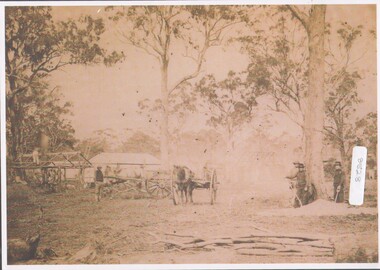
Photograph - On the goldfields
... BHS Collection Goldfields Surface mining activity Working on the Goldfields. Three men with shovels on the RHS, two horses and drays centrally positioned; and men building a building frame, which appears to have animal carcasses hang up. ...BHS CollectionWorking on the Goldfields. Three men with shovels on the RHS, two horses and drays centrally positioned; and men building a building frame, which appears to have animal carcasses hang up. goldfields, surface mining activity -
 Bendigo Historical Society Inc.
Newspaper - ALBERT RICHARDSON COLLECTION: INSPECTING THE NELL GWYNNE GOLDMINE POPPET HEAD
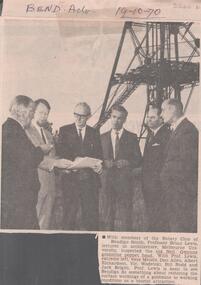
... Men in image are: Professor Lewis ( lecturer in architecture, Melbourne University) , Don Allen, Albert Richardson, Vic Wodetski, Bill Rodd and Jack Bright. 'Caption reads: Professor Lewis is keen to see Bendigo do something about restoring the surface workings of a goldmine to working condition as a tourist attraction.'...Men in image are: Professor Lewis ( lecturer in architecture, Melbourne University) , Don Allen, Albert Richardson, Vic Wodetski, Bill Rodd and Jack Bright. 'Caption reads: Professor Lewis is keen to see Bendigo do something about restoring the surface workings of a goldmine to working condition as a tourist attraction.' ...Newspaper clipping, Bendigo Advertiser 19.10.1970. . Image shows six men, members of the Rotary Club of Bendigo South standing at the foot of the Nell Gwynne Poppet head. Men in image are: Professor Lewis ( lecturer in architecture, Melbourne University) , Don Allen, Albert Richardson, Vic Wodetski, Bill Rodd and Jack Bright. 'Caption reads: Professor Lewis is keen to see Bendigo do something about restoring the surface workings of a goldmine to working condition as a tourist attraction.'bendigo, mining, minimg museum -
 Bendigo Historical Society Inc.
Document - DRAINAGE PROBLEMS - ELLENBOROUGH FLOODED
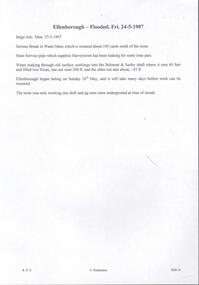
... Water soaking through old surface workings into the Belmont and Saxby shaft where it rose 60 feet and filled two x-cuts, one out west 208 ft, and the other out east about 45 ft. Ellenborough began baling on Sunday 26th May, and it will take many days before work can be resumed. The mine was only working one shift and no men...Water soaking through old surface workings into the Belmont and Saxby shaft where it rose 60 feet and filled two x-cuts, one out west 208 ft, and the other out east about 45 ft. Ellenborough began baling on Sunday 26th May, and it will take many days before work can be resumed. The mine was only working one shift and no men ...The Ellenborough mine was located on Snob's Hill in Eaglehawk, near Bendigo, Victoria, Australia. It was a notable mine operating on the New Chum line of reef in the Eaglehawk District. The Ellenborough Mine was the first mine in the world to use electricity to light above and underground. On 12th October 1882, the installation of the lighting system was completed by the Australian Electric Light Company. 'The whole of the levels and back have been lighted so that candles have been dispensed with ....the engine house, blacksmith''s shop and brace are also lighted at night' (Bendigo Advertiser, 13th October, 1882). 'The electricity is generated in an ordinary electric battery placed in the engine-house, and driven by a three horse power " Soho" engine. This engine is supplied with steam by a pipe leading from the steam pipe used to supply the air-compressor. It can be driven at full power with a pressure of 351bs of steam, with the engine wheel moving at the rate of 220 revolutions per minute; the battery wheel makes 850 revolutions. The plant occupies very little space. The battery is a to-light machine; that is, it can supply sufficient electricity for 35 lights. Whether there is only one light burning or 35, there is no necessity to alter the machine or the speed, and there is no danger of one light becoming too powerful because all the rest are put out. There is no danger, as many people suppose, in taking hold of the wires, even if uncovered, for the engineer last evening plainly demonstrated that where the shock was greatest it was very mild, and could hardly be felt'.Handwritten copy of a report in the Bendigo Advertiser 24/5/1907. ''Serious break in Water Main which is situated about 100 yards south of the mine. Main service pipe which supplies Harvey town has been leaking for some time past. Water soaking through old surface workings into the Belmont and Saxby shaft where it rose 60 feet and filled two x-cuts, one out west 208 ft, and the other out east about 45 ft. Ellenborough began baling on Sunday 26th May, and it will take many days before work can be resumed. The mine was only working one shift and no men were underground at time of in rush''. Document from Albert Richardson Collection of mining history.document, gold, drainage problems, ellenborough flooded, bendigo advertiser, 27/5/1907, harveytown, belmont & saxby, ellenborough, albert richardson, electricity -
 Bendigo Historical Society Inc.
Document - MINING ACCIDENTS - SENSATIONAL WINDING ACCIDENT AT THE HUSTLER'S RESERVE NO 2 CO
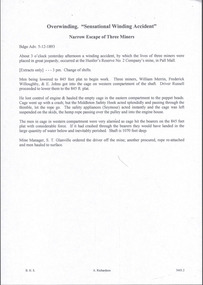
... Glanville ordered the driver off the mine; another rope re-attached and the men hauled to the surface....Glanville ordered the driver off the mine; another rope re-attached and the men hauled to the surface. Document MINING ACCIDENTS - SENSATIONAL WINDING ACCIDENT AT THE HUSTLER'S RESERVE NO 2 CO ...Handwritten extract from the Bendigo Advertiser 5/12/1893 where three miners had a narrow escape in a winding accident at the Huster's Reserve No 2 Company's Mine, in Pall Mall. At the change of shift, three miners, William Merrin, Frederick Willoughby and E. Johns got into the cage on the western compartment to be lowered to the 845 ft. plat. The Driver Russel lost control of the engine and hauled the empty cage in the eastern compartment to the poppet heads. Cage went up with a crash, but the safety hooks caught it and let the rope go. The men in the cage in western compartment were very alarmed has cage hit the bearers on the 845 feet plat with considerable force. If it had crashed through the bearers they would have landed in the water below. The shaft was 1070 feet deep. The Mine Manager, S. T. Glanville ordered the driver off the mine; another rope re-attached and the men hauled to the surface.document, gold, mining accidents, sensational winding accident at the hustler's reserve no 2 co, william merrin, frederick willoughby, e johns, driver russell, s t glanville -
 Bendigo Historical Society Inc.
Photograph - CEMETERY - BENDIGO - MINERS' CEMETERY
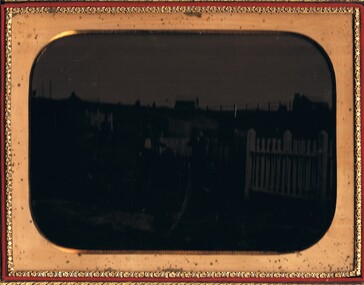
... surface. A photo of graveyard with picket fences around grave sites, three men standing in the background, one building in the distance. ...surface. A photo of graveyard with picket fences around grave sites, three men standing in the background, one building in the distance. ...Photograph - 'AMBROTYPE' which is imaging a negative on glass backed by a dark surface. A photo of graveyard with picket fences around grave sites, three men standing in the background, one building in the distance. Photo is in a leather bound box, two clips, open it up, has red velvet in case, glass over ambrotype photo.place, cemetery, cemetery, cemetery. bendigo area. ambrotype photo. -
 National Vietnam Veterans Museum (NVVM)
Model, Model Tank
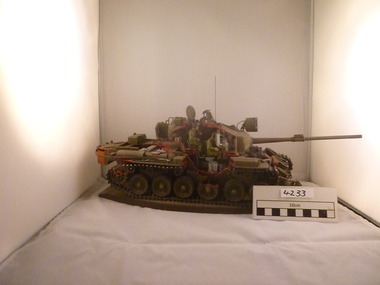
... Tank is painted army Green and has Red paint on edges of where surfaces are "cut away" This cut away model reveals the parts of the tank normally not seen from outside its exterior.Revealed are the men who operate the vechile and its functions, various parts included the engine /motor area....Tank is painted army Green and has Red paint on edges of where surfaces are "cut away" This cut away model reveals the parts of the tank normally not seen from outside its exterior.Revealed are the men who operate the vechile and its functions, various parts included the engine /motor area. ...Model Centurion Tank. Tank is painted army Green and has Red paint on edges of where surfaces are "cut away" This cut away model reveals the parts of the tank normally not seen from outside its exterior.Revealed are the men who operate the vechile and its functions, various parts included the engine /motor area.M 104model tank., centurion tank -
 Warrnambool and District Historical Society Inc.
Trophy, I C I S A Deck Quoits 1936-7, 1937
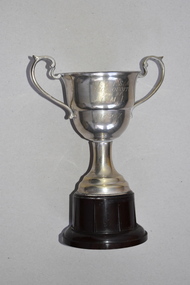
... surface. This game became very popular on ocean liner cruises from the 1920s on. The winner of this trophy, the Congregational Men’s Institute (C.M.I.) was a leading church activity group for men in the 1930s. ...surface. This game became very popular on ocean liner cruises from the 1920s on. The winner of this trophy, the Congregational Men’s Institute (C.M.I.) was a leading church activity group for men in the 1930s. ...This trophy is one of several from the 1930s that were awarded as part of inter-church competitions in Warrnambool. One of the chief sponsors of this inter-church competition was Fletcher Jones, the well-known clothing manufacturer. He had his head office and factory in Warrnambool. The competitions were for indoor sports and this one has been awarded for deck quoits. The game of quoits consists of competitors throwing four or five rings or hoops onto a raised spike some metres away. The hoops are generally made of plaited rope and the game is said to have been started or popularized by sailors on board ship. In deck quoits the raised spike is usually replaced by concentric circles drawn on the playing surface. This game became very popular on ocean liner cruises from the 1920s on. The winner of this trophy, the Congregational Men’s Institute (C.M.I.) was a leading church activity group for men in the 1930s. A Congregational Church in Warrnambool was opened in 1864 in Liebig Street and transferred to Henna Street in 1940. This church was sold in 1979 to the Salvation Army when the Congregational Church merged with the Methodist Church to become the Uniting Church. This trophy is of historical interest as it is one of the trophies dating from the 1930s and awarded by the now-defunct Inter-Church Indoor Sports Association in Warrnambool. This is a silver-coloured cup with an attached stem on a brown Bakelite stand. The cup has two ornamental handles. There is an inscription on one side of the cup. The silver is a little tarnished. ‘I.C.I.S.A. Deck Quoits won by C.M.I. 1936-7’inter church indoor sports association warrnambool, congregational church warrnambool -
 Warrnambool and District Historical Society Inc.
Trophy, ICISA Deck Quoits 1935, 1935
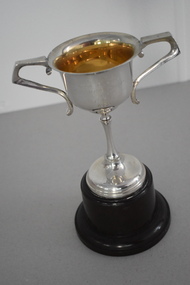
... Men’s Institute for deck quoits. The game of quoits consists of competitors throwing four or five rings or hoops on to a raised spike some metres away. The hoops are generally made of plaited rope and the game is said to have been started or popularized by sailors on board ship. In deck quoits the raised spike is usually replaced by concentric circles drawn on the playing surface...Men’s Institute for deck quoits. The game of quoits consists of competitors throwing four or five rings or hoops on to a raised spike some metres away. The hoops are generally made of plaited rope and the game is said to have been started or popularized by sailors on board ship. In deck quoits the raised spike is usually replaced by concentric circles drawn on the playing surface ...This trophy is one of several from the 1930s that were awarded as part of the inter-church indoor sports competitions held in Warrnambool. One of the sponsors of these competitions was Fletcher Jones, the well-known clothing manufacturer. The head office and major factory of the Fletcher Jones business were in Warrnambool. This trophy was awarded to the Congregational Men’s Institute for deck quoits. The game of quoits consists of competitors throwing four or five rings or hoops on to a raised spike some metres away. The hoops are generally made of plaited rope and the game is said to have been started or popularized by sailors on board ship. In deck quoits the raised spike is usually replaced by concentric circles drawn on the playing surface. This game became very popular on ocean liner cruises from the 1930s on. The Congregational Men’s Institute was a leading men’s activity group in Warrnambool in the 1930s. A Congregational Church was opened in Liebig Street in Warrnambool in 1864 and transferred to Henna Street in 1940. This Henna Street church was sold to the Salvation Army in 1979 when the Congregational Church merged with the Methodist Church to form the Uniting Church. This trophy is of interest as a memento of the now-defunct inter-church sporting competitions held in Warrnambool in the 1930s.This is an electro-plated nickel silver cup with two side handles, a thin stem and a silver base. The cup is mounted on a Bakelite stand. ‘I.C.I.S.A. Deck Quoits Championship Won by C.M.I. 1935’congregational church, warrnambool, inter-church sporting competitions, warrnambool, history of warrnambool -
 Bendigo Historical Society Inc.
Photograph - Nell Gwynne Main Shaft, 1934
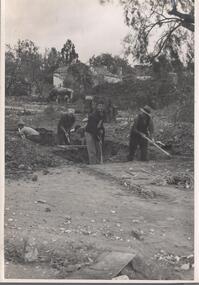
... Black and white photograph of five men standing on surface starting to dig a mine shaft. ...Nell Gwynne Gold Mine SHAFT Written in pencil on back of photograph in black pen: 'Nell Gwynne main shaft starting 26/9/34' Black and white photograph of five men standing on surface starting to dig a mine shaft. ...Significant to mining history of Bendigo.Black and white photograph of five men standing on surface starting to dig a mine shaft. One man is wearing a jumper with 'CFC" (Carlton Football Club ?) on front. String lines are set out to define the boundary of the shaft. In background, weatherboard house depicted in (11032.11 and 11032.12), and a cow standing alongside house. Written in pencil on back of photograph in black pen: 'Nell Gwynne main shaft starting 26/9/34'nell gwynne gold mine, shaft -
 Ballarat Tramway Museum
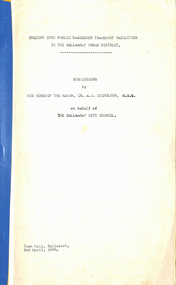
Document - Report, City of Ballaarat, "Submission to Enquiry into Public Transport Facilities in the Ballarat Urban District by A. W. Nicholson, Mayor of Ballaarat Council", Apr. 1968
... surface repairs, financial loss to the SEC, reduction in passengers due to car ownership. Council submitted that the tramway system should be retained and extended and that pensioner concessions should be continued. Notes that at the time 69 men...surface repairs, financial loss to the SEC, reduction in passengers due to car ownership. Council submitted that the tramway system should be retained and extended and that pensioner concessions should be continued. Notes that at the time 69 men ...Yields information about the view of the City of Ballaarat in 1968 about the possible replacement of tram service.Report or Submission - 6 Gestener printed foolscap sheets, stapled on left hand side and bound with a blue edging tape titled "Submission to Enquiry into Public Transport Facilities in the Ballarat Urban District by A. W. Nicholson, Mayor of Ballaarat Council". Dated 2 April 1968. Submission looks at the possible closure or the future of the tramway system, the SEC involvement, employment, road surface repairs, financial loss to the SEC, reduction in passengers due to car ownership. Council submitted that the tramway system should be retained and extended and that pensioner concessions should be continued. Notes that at the time 69 men on the trams, 18 at the depot and 8 on the track. If replaced by buses, supported a government owned bus provider rather than private. Document scanned - word searchable. pdftrams, tramways, closure, city of ballaarat, bus replacement, public transport, sec, finances
