
Showing 6 items matching "swimwear - men's"
-
 Kew Historical Society Inc
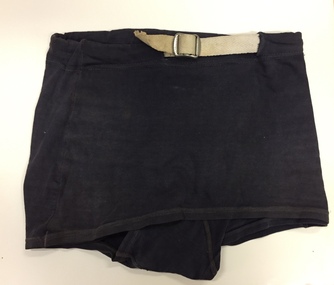
Clothing - Mens swimsuit, Alpha, 1937-39
... swimwear - men's...In Australia this was less so, and by 1940 it was common attire at the beach. swimwear - men's alpha swimwear alpha - menswear designer Label: "Alpha" Size: SM Pair of dark blue, woollen bathing trunks. ...The Fashion & Design collection of Kew Historical Society includes examples of women’s, men’s, children’s and infants' clothing from the 18th, 19th and 20th centuries. While the collection includes some examples of international fashion, most items were handmade or purchased in Melbourne. An early example of swimwear from when men were able to legally swim topless in the 1930s. The fashion originated in France in the early 1930s, and slowly caught on in other countries, although was often controversial. In Australia this was less so, and by 1940 it was common attire at the beach. Pair of dark blue, woollen bathing trunks. Front skirted flap. White woollen belt with silver-coloured metal buckle. White label with blue stitched text attached to rear. Label: "Alpha" Size: SMswimwear - men's, alpha swimwear, alpha - menswear designer -
 City of Moorabbin Historical Society (Operating the Box Cottage Museum)
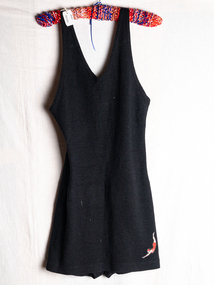
Clothing - Clothing, men's swim costume wool, 'Jantzen', 1930
... By 1930 the population had grown with new families who had other occupations - office workers in Melbourne, tradesmen, teachers, etc - and they raised their families in Bentleigh, McKinnon, Ormond, Moorabbin and Cheltenham. clothing brighton moorabbin pioneers market gardeners early settlers moorabbin shire bentleigh mckinnon dairy farms fruit orchards swimwear Clothing, men's swim costume wool, 'Jantzen' c1930 Clothing Clothing, men's swim costume wool, 'Jantzen' Jantzen Knitting Mills ...In 1910, Portland Knitting Company began in downtown Portland, Oregon, with a few hand-knitting machines above a tiny retail store. Little did founders Carl Jantzen, Roy and John Zehntbauer know that they would achieve both fame and controversy as swimwear pioneers. Producing a wool suit for a rowing team they began offering "bathing suits" in their catalog. Knit on sweater cuff machines, the suits became popular with swimmers. The demand increased for those "Jantzens" and the company name was changed in 1918 to Jantzen Knitting Mills. The suits were made of 100% pure virgin wool. Matching stockings and stocking cap completed the costume of the day. Early advertisements guaranteed the famous rib-stitch "gives that wonderful fit". c1930 Jantzen catalogs featured upcoming movie stars, including Loretta Young, Joan Blondell, Ginger Rogers, and Dick Powell. National magazines such as Esquire, the Saturday Evening Post, Life, and Colliers published advertisements illustrated by George Petty. 2010 Jantzen has achieved new levels of success this decade through social media, attracting thousands of fans around the world who share their own memories about their favorite Jantzen suits throughout the decades Early settlers and market gardeners established their families in Moorabbin Shire c1900 and after World War 1 soldiers were assisted to purchase land near the railway line. By 1930 the population had grown with new families who had other occupations - office workers in Melbourne, tradesmen, teachers, etc - and they raised their families in Bentleigh, McKinnon, Ormond, Moorabbin and Cheltenham.Early settlers and market gardeners established their families in Moorabbin Shire c1900 and after World War 1 soldiers were assisted to purchase land near the railway line. By 1930 the population had grown with new families who had other occupations - office workers in Melbourne, tradesmen, teachers, etc - and they raised their families in Bentleigh, McKinnon, Ormond, Moorabbin and Cheltenham. Clothing, men's swim costume wool, 'Jantzen' c1930 clothing, brighton, moorabbin, pioneers, market gardeners, early settlers, moorabbin shire, bentleigh, mckinnon, dairy farms, fruit orchards, swimwear -
 Glenelg Shire Council Cultural Collection
Clothing - Men's Bathing Costume, 1930-1940
... swimwear mens clothing bathing suit swimming recreation Men's one piece bathing costume, green woollen knit fabric modesty skirt with lighter green stripes over hips. ...Men's one piece bathing costume, green woollen knit fabric modesty skirt with lighter green stripes over hips. Meritas brand with logo ('the best under the sun') embroidered on left hip. Size tag 'OS' back neckswimwear, mens clothing, bathing suit, swimming, recreation -
 Bendigo Historical Society Inc.
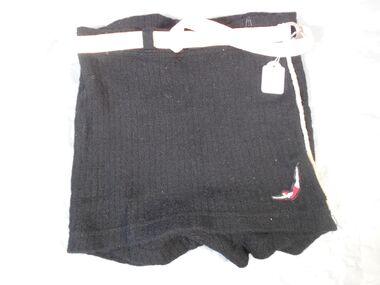
Textile - Swimming trunks
... swimwear that was established in 1916 and first appeared in the city of Portland, Oregon, United States. The brand name later replaced the name of the parent company that manufactured the branded products. The brand featured a logo image of a young woman, dressed in a red one-piece swimsuit and bathing hat, assuming a diving posture with outstretched arms and an arched back. Known as the Jantzen "Diving Girl", the image in various forms became famous throughout the world during the early twentieth century. (Wikipedia). . Swimming trunks Jantzen Diving Girl Black men's ...Jantzen is a brand of swimwear that was established in 1916 and first appeared in the city of Portland, Oregon, United States. The brand name later replaced the name of the parent company that manufactured the branded products. The brand featured a logo image of a young woman, dressed in a red one-piece swimsuit and bathing hat, assuming a diving posture with outstretched arms and an arched back. Known as the Jantzen "Diving Girl", the image in various forms became famous throughout the world during the early twentieth century. (Wikipedia). .Black men's woollen swimming trunks made by Jantzen. Inside label - "Jantzen" (red print), "Made in Australia" (faint green print). The trunks have a bone coloured cotton belt threaded through tabs at the waist. A silver coloured buckle has "Rustless" imprinted. Late 1940s. On the front at lower right is the Jantzen symbol of a costumed female swimmer in a diving position with arms outstretched.swimming trunks, jantzen, diving girl -
 Sunbury Family History and Heritage Society Inc.
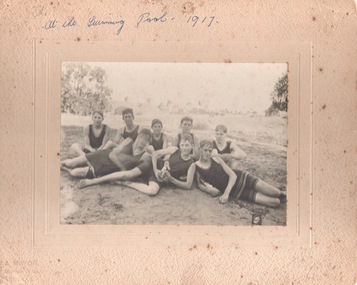
Photograph, Sunbury Swimming Club
... A non-digital sepia photograph mounted on cream board of eight young men sitting on a grassy area and dressed in swimwear c1917....Sunbury Swimming Club The Nook Swimming Sports A non-digital sepia photograph mounted on cream board of eight young men sitting on a grassy area and dressed in swimwear c1917. Sunbury Swimming Club Photograph ...The photograph was taken of swimmers at the water hole at The Nook in Sunbury in 1917. The pool at The Nook was the town's only swimming area from 1916 to 1966, when an Olympic size swimming pool was built in Ligar Street.A non-digital sepia photograph mounted on cream board of eight young men sitting on a grassy area and dressed in swimwear c1917.sunbury swimming club, the nook, swimming, sports -
 City of Melbourne Libraries
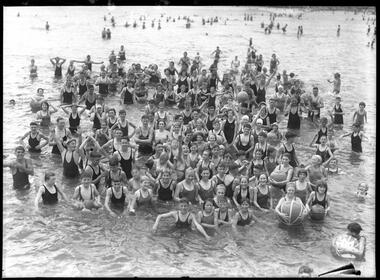
Photograph, Bull, Hugh Jones, 1897-1993, "On Christmas morning -- Bathing at St Kilda", 1933
... began to go without shirts for swimming and barechestedness in male swimwear became the norm by the end of the 1940s, including in competitive swimming events. Following a fire in 1925, the nearby St Kilda Baths were reopened in 1931 – with separate “enclosures” for men and women. ... began to go without shirts for swimming and barechestedness in male swimwear became the norm by the end of the 1940s, including in competitive swimming events. Following a fire in 1925, the nearby St Kilda Baths were reopened in 1931 – with separate “enclosures” for men and women. ...Published: 26 Dec 1933 The Age p9 Published title: "ON CHRISTMAS MORNING--BATHING AT ST. KILDA." Published caption: "Yesterday morning everyone who was near the bay seized the opportunity for a cooling dip. St. Kilda foreshore was particularly well patronised, as this picture shows." Trove article identifier: http://nla.gov.au/nla.news-article203364944 Description: Large group of swimmers at St Kilda Beach on Christmas morning. Research by project volunteer, Louise McKenzie: Approximately 150 men, women and children grouped in front of the photographer in the shallows of St Kilda Beach on Christmas morning 1933. All are wearing one piece bathing suits, some have bathing caps, some hold beach balls, and one boy has a model boat. They are happy and exuberant. Their swimming attire is traditional and conservative for the time. However at this time the bathing attire was undergoing a substantial change, as Wikipedia’s History of Swimwear attests. The English practice of men swimming in the nude was banned in the United Kingdom in 1860. In the first half of the 19th century the top became knee-length while an ankle-length drawer was added as a bottom. By the second half of the 19th century, in France, the sleeves started to vanish, the bottom became shorter to reach only the knees and the top became hip-length and both became more form fitting. In the West, in the 19th century women wore a bathing gown in the water. These were loose ankle-length full-sleeve chemise-type gown made of wool or flannel, so that modesty or decency was not threatened. They were long dresses of fabrics that would not become transparent when wet, with weights sewn into the hems so that they would not rise up in the water. The men's swim suit, a rather form-fitting wool garment with long sleeves and legs similar to long underwear, was developed and would change little for a century. By the second half of the 19th century, in France, the sleeves started to vanish, the bottom became shorter to reach only the knees and the top became hip-length and both became more form fitting. In the 1900s women wore wool dresses on the beach that were In the Victorian era, Western cultures deplored nudity of any degree, and people took great pains to cover themselves, even bare chested male swimmers at ocean beaches. In the 1910s despite opposition from some groups, the form-fitting style proved popular. It was not long before swimwear started to shrink further. At first arms were exposed and then legs up to mid-thigh. Necklines receded from around the neck down to around the top of the bosom. The development of new fabrics allowed for new varieties of more comfortable and practical swimwear. The name "swim suit" was coined in 1915 by Jantzen Knitting Mills, a sweater manufacturer who launched a swimwear brand named the "Red Diving Girl”. During the 1920s and 1930s, people began to shift from "taking in the water" to "taking in the sun", at bathhouses and spas, and swimsuit designs shifted from functional considerations to incorporate more decorative features. By the 1930s men began to go without shirts for swimming and barechestedness in male swimwear became the norm by the end of the 1940s, including in competitive swimming events. Following a fire in 1925, the nearby St Kilda Baths were reopened in 1931 – with separate “enclosures” for men and women. But here in the Bay just a few years later, everyone is happily enjoying the refreshing seaside event. References: History of Swimwear, Wikipedia, https://en.wikipedia.org/wiki/History_of_swimwear Jantzen Red Diving Girl, Oregon History Project, https://www.oregonhistoryproject.org/articles/historical-records/jantzen-red-diving-girl/ European History 1900-1950, St Kilda Historical Society, https://stkildahistory.org.au/about/timeline-1900-1950Photographer notations on slide: "Christmas morning St Kilda Age B9".
