
Showing 236 items matching "sydney head"
-
 Narre Warren and District Family History Group
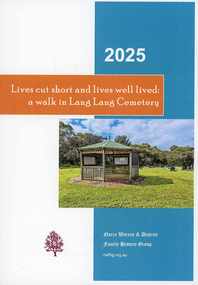
Book - Lives cut short and lives well lived: a walk in Lang Lang Cemetery, Narre Warren & District Family History Group Inc, October 2025
... ...Sydney Head...Lang Lang Cemetery Edward Bickerton Mary Ann Dainty James Denholm Clyde Lawrence Edey Elizabeth & Robert Gray Lucy May Greaves Sydney Head Maddron Henry Elizabeth Leggo Sarah & Thomas McAleese Raymond (Darby) & Yvonne Munro Andrew Trevor Nicholls Alexander Gladstone Orgill Geoffrey Frank Ridgway Samuel Alfred Thompson Henry Wildes Stories about the lives of fifteen families, including that of a policeman, a post mistress, a teacher, as well as farmers and farm labourers, and children who died in tragic circumstances, and a woman who was involved in many community activities. ...Stories about the lives of fifteen families, including that of a policeman, a post mistress, a teacher, as well as farmers and farm labourers, and children who died in tragic circumstances, and a woman who was involved in many community activities.non-fictionStories about the lives of fifteen families, including that of a policeman, a post mistress, a teacher, as well as farmers and farm labourers, and children who died in tragic circumstances, and a woman who was involved in many community activities.lang lang cemetery, edward bickerton, mary ann dainty, james denholm, clyde lawrence edey, elizabeth & robert gray, lucy may greaves, sydney head, maddron henry, elizabeth leggo, sarah & thomas mcaleese, raymond (darby) & yvonne munro, andrew trevor nicholls, alexander gladstone orgill, geoffrey frank ridgway, samuel alfred thompson, henry wildes -
 Flagstaff Hill Maritime Museum and Village
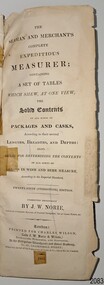
Book - Reference, navigation, J. W. Norie (author and editor), The Seaman and Merchants Complete Expeditious Measurer, 1853
... Sydney...Circular Head...In the 1940s, Rose Anna traded between Hobart, Melbourne, Adelaide, Sydney, Circular Head, Port Fairy, and Port Albert. ...In the 1940s, Rose Anna traded between Hobart, Melbourne, Adelaide, Sydney, Circular Head, Port Fairy, and Port Albert. ...The book was published at the same address as London’s Navigation Waterhouse and Naval Academy. It is likely to be one of the textbooks used in educating seafarers, both naval and merchant. It is the twenty-fifth edition, showing that it was in great demand in the early to mid-19th century. Sea merchants could have used this as a reference for working out freight costs for their cargo. Customs Officers could have referred to it as well to calculate fees and taxes. The book’s owner had inscribed in pen and ink "Rose Anna, Schooner, Melbourne, March 25th 1857". At that time, the registered owners were Thomas Lamb & E. Keays, who were freighting cargo between Melbourne and Geelong. Schooner, ROSE ANNA: - The schooner Rose Anna was built in 1844 at Fremantle, W.A., by H. Edwards for Capt. William Heard. The 2-masted wooden vessel was carvel-built. Captain Heard registered Rose Anna at Fremantle in 1845 and in the same year, registered it at Port Adelaide. in 1852, Rose Anna was crushed and sunk at Port Adelaide by the Selma and raised. In 1852, the schooner was lengthened by William Hardy. In 1853, William Burton and W. Roberts registered Rose Anna at Melbourne. In 1855, W. Roberts registered, followed by John Balston & Thomas Ross. In 1856, it was registered by Thomas Lamb & E. Keays, in 1857 by William Howes & Charles Holland, in 1865 by Charles Holland & John Balfour, and in 1866 registered in Melbourne by mariners John Balfour & David Griffiths. In the 1940s, Rose Anna traded between Hobart, Melbourne, Adelaide, Sydney, Circular Head, Port Fairy, and Port Albert. In the 1950s and 1960s, it traded between Geelong Heads and Hobsons Bay, Melbourne, in lime, wool, general cargo and ballast. In 1857, when Rose Anna’s registered owners were Thomas Lamb & E. Keays, an advertisement was placed in The Age on March 9th, announcing that the Rose Anna was taking freight from Melbourne to Geelong. Later in the year, in October, the registered owners were William Howes & Charles Holland. They were still trading with Geelong, as on October 7th, The Age announced that Rose Anna arrived in Geelong from Melbourne on October 5th. On October 6th, 1866, Rose Anna went ashore while loading wheat at Sandridge, Port Phillip Bay, in severe gales and heavy seas and became a total wreck. The book is significant for its association with reference information to instruct sea merchant traders and naval officers. The publication is in its twenty-fifth edition, indicating the importance of such an instructional book. The book of tables and calculations shows the evolution of such reference texts, going from handwritten notes, to printed tables like these, and forward to slide rules, calculators, and to modern time computers. it demonstrates the importance of accuracy in calculating weights and measures at sea and for the purposes of fess, charges and taxes. The book is important to the history of the schooner Rose Anna, which is listed as a significant vessel on the Victorian Heritage Register, S582, as it has an inscription with the ship's name, date, and destination. Book, tall and narrow, with index tabs on the side edges of the pages. FULL Title: The Seaman and Merchants Complete Expeditious Measurer: The Seaman and Merchants Complete Expeditious Measure; containing a set of tables which show, at one view, the solid contents of all kinds of packags and casks, according to their several lengths, breadths and depths: also, rules for determining the contents of all sorts of casks in wine and beer measure, according to the Imperial Standard. Twenty-Fifth (Stereotype) Edition. Author: Mr J W Norie (John William Norie) Date: 1853 Publisher: Charles Wilson (late J.W. Norrie & Wilson), Bookseller, Publisher and Stationer, At the Navigation Waterhouse and Naval Academy, No. 157, Leadenhall Street, where may be had all the publications of Steel & Co. Late at No. 70, Cornhill. Printer: Bateman and Dennis, 95 Leadenhall Street, London, England, 1853 The book has handwritten, pen and ink inscriptions. It refers to the Schooner, Rose Anna, Melbourne, March 25th 1857.Handwritten in script with pen and ink: "Rose Anna / Schooner / Melbourne, / March 25th 1857"flagstaff hill, warrnambool, shipwrecked-coast, flagstaff-hill, flagstaff-hill-maritime-museum, maritime-museum, shipwreck-coast, flagstaff-hill-maritime-village, the seaman and merchants complete expeditious measurer, book, sea merchants, cargo, calculations, measurements, sea trade, maritime book, sea transportation, cargo rate calculations, naval academy, navy education, navigation, navigation instruction, navigation waterhouse and naval academy, twenty-fifth edition, 19th century, 1853, 1857, customs, freight, ullage, rose anna, schooner, 2-masted, march 25th 1857, melbourne, 25 march 1857, thomas lamb & e. keays, geelong, 1844, h. edwards, fremantle, carvel-built, port adelaide, selma, william hardy, william burton and w. roberts, john balston & thomas ross., charles holland & john balfour, john balfour & david griffiths, hobart, sydney, circular head, port fairy, port albert, hobsons bay, sandridge, port phillip bay -
 Flagstaff Hill Maritime Museum and Village
Transfer
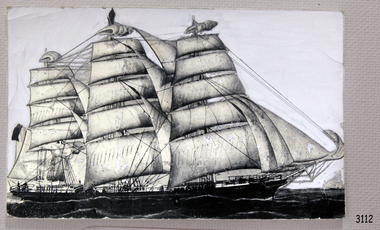
... Black and White transfer on pale blue back ground of Avie Hove, off Sydney Heads, 988mm x 62mm. SH 012 Ships A-B. ...flagstaff hill warrnambool shipwrecked-coast flagstaff-hill flagstaff-hill-maritime-museum maritime-museum shipwreck-coast flagstaff-hill-maritime-village Avie Hove Black and White transfer on pale blue back ground of Avie Hove, off Sydney Heads, 988mm x 62mm. SH 012 Ships A-B. Transfer ...Black and White transfer on pale blue back ground of Avie Hove, off Sydney Heads, 988mm x 62mm. SH 012 Ships A-B. flagstaff hill, warrnambool, shipwrecked-coast, flagstaff-hill, flagstaff-hill-maritime-museum, maritime-museum, shipwreck-coast, flagstaff-hill-maritime-village, avie hove -
 Flagstaff Hill Maritime Museum and Village
Wood Sample
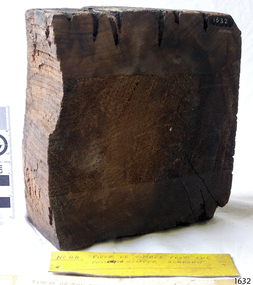
... Training ship sunk outside Sydney Heads 1936. Provided by the Shiplovers' Society....Training ship sunk outside Sydney Heads 1936. Provided by the Shiplovers' Society. ...Sample wooden square from wrecked ship Sobraon, later named Tingara. Training ship sunk outside Sydney Heads 1936. Provided by the Shiplovers' Society.flagstaff hill, warrnambool, shipwrecked-coast, flagstaff-hill, flagstaff-hill-maritime-museum, maritime-museum, shipwreck-coast, flagstaff-hill-maritime-village -
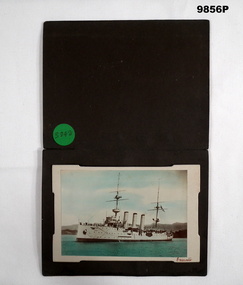 Bendigo Military Museum
Photograph - PHOTOGRAPH, MOUNTED
... Scuttled 1932 at Sydney Heads....Scuttled 1932 at Sydney Heads. Photograph RAN HMAS Encounter Written on front: "With Best Wishes". ...HMAS Encounter was a Second Class Protected Cruiser Challenger Class operated by the Royal Navy and then the Royal Aust. Navy. Built in 1905 and Decommissioned in 1929. Scuttled 1932 at Sydney Heads.Colour photo of HMAS Encounter at sea. Photo stuck on white backing then stuck onto a brown foldout. Folder cover is cream on outside with Best Wishes on front in gold.Written on front: "With Best Wishes".photograph, ran, hmas encounter -
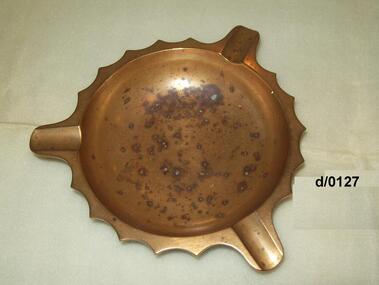 Waverley RSL Sub Branch
Ashtray H.M.A.S. Sydney
... HMAS Sydney was paid off in 1928 and broken up in 1929 and sunk off Sydney Heads. Numerous souvenirs – from fruit and nut bowls, ash trays, match holders, tobacco jars and paperweights to specially framed prints of the Sydney – were fashioned from teak and other wood fittings salvaged from the Sydney before she was scuttled....HMAS Sydney was paid off in 1928 and broken up in 1929 and sunk off Sydney Heads. Numerous souvenirs – from fruit and nut bowls, ash trays, match holders, tobacco jars and paperweights to specially framed prints of the Sydney – were fashioned from teak and other wood fittings salvaged from the Sydney before she was scuttled. ...HMAS Sydney was paid off in 1928 and broken up in 1929 and sunk off Sydney Heads. Numerous souvenirs – from fruit and nut bowls, ash trays, match holders, tobacco jars and paperweights to specially framed prints of the Sydney – were fashioned from teak and other wood fittings salvaged from the Sydney before she was scuttled.Brass ashtray made from brass sourced from used shell cases H.M.A.S. SydneyH.M.A.S. Sydney -
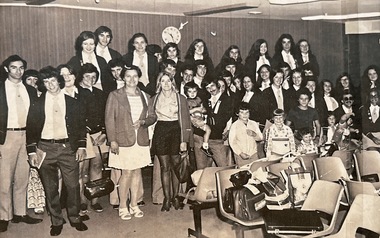 Maccabi Victoria
Photograph, 1977-1978
... Senior Carnival 45th, 1977/1978 in Sydney. Shadowed heads on tracing paper (43) are numbered & list attached to photo. ...Maccabi Senior Carnival 45 Senior Carnival 45th, 1977/1978 in Sydney. Shadowed heads on tracing paper (43) are numbered & list attached to photo. ...Senior Carnival 45th, 1977/1978 in Sydney. Shadowed heads on tracing paper (43) are numbered & list attached to photo. Names entered below. Heads numbered 3, 9, 17, 32 unknownmaccabi senior carnival 45 -
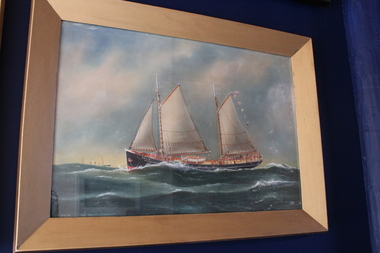 Queenscliffe Maritime Museum
Painting - Water colour painting of the ketch Falie, Falie, 1934
... During World War II, FALIE was requisitioned by the Royal Australian Navy for service, and was on patrol off Sydney Heads during the mini-submarine raid on Sydney Harbour in May 1942. ...During World War II, FALIE was requisitioned by the Royal Australian Navy for service, and was on patrol off Sydney Heads during the mini-submarine raid on Sydney Harbour in May 1942. ...Arthur V Gregory b.1867, d.1957 worked from studio at 326 Albert Road South Melbourne established by his father G F Gregory in 1852. FALIE operated for many years as a cargo ship, largely around South Australia where it formed a strong regional association. During World War II, FALIE was requisitioned by the Royal Australian Navy for service, and was on patrol off Sydney Heads during the mini-submarine raid on Sydney Harbour in May 1942. After the war it returned to commercial service and was retired in 1982. It was then the last working ship representing the South Australian ketch fleet, and along with NELCEBEE ( HV000419) one of the last two working sail powered cargo vessels in South Australia.Water colour painting in painted gilt frameFalie off Cape Schank A.V. Gregory 1934falie, a.v. gregory, water colour, painting -
 Mont De Lancey
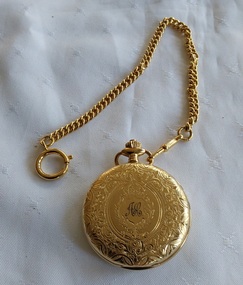
Accessory - Pocket Watch, Classique, Unknown
... Australian owned and operated, this business is family owned and continues to produce the finest quality timepieces, assembled in our Sydney head office, fitted with accurate Swiss movement. ...Australian owned and operated, this business is family owned and continues to produce the finest quality timepieces, assembled in our Sydney head office, fitted with accurate Swiss movement. ...The term 'fob' traces back to the 16th-century German word fuppe, meaning 'small pocket.' Fob watches evolved in the 17th century when King Charles II introduced waistcoats. Men placed their timepieces in these pockets, securing the watch to their clothing with a short ribbon, chain, or attached ornament (the 'fob'). Classique has been servicing the Australian watch industry for over 55 years. Australian owned and operated, this business is family owned and continues to produce the finest quality timepieces, assembled in our Sydney head office, fitted with accurate Swiss movement. Local history: The original owner of the watch being Bob Chapman given to his brother Bert (Albert) after the death of Albert. It was passed on to Les Chapman (Bert and Bob's brother).A gold 17 jewels Classique pocket watch with a white enamel dial and roman numerals. It also has a 'seconds' dial inset into the main dial. The ornate casing designs on this fob and pocket watch features delicate, openwork metal calligraphy shaped into intricate floral designs. A.C. ( Albert Chapman) is engraved inside a small circular decorative shape on the front of the casing. The back has 1994 engraved. At the top it has a gold ring attached to the winder with a curb chain to attach to clothing. It is in working order.'Always remembering the years we worked on the Farm Bob Chapman' is inscribed on the inside of the lid casing. A floral pattern engraving is on the back and lid of the casing with the initials AC inside a small decorative circular shape on the front. '17 jewels' 'Incabloc' 'Swiss Made' is printed above and below the 'seconds' hands circle at the bottom of the dial. On the back of the cover '1994' is engraved inside a crest.pocket watches, watches, fob watches, timepieces -
 Wangaratta RSL Sub Branch
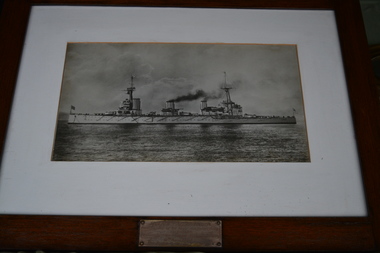
Print - Framed Print, HMAS Australia
... Quite obsolete, she became a training vessel in Westernport until scuttled off Sydney Heads on 12 April 1924....Quite obsolete, she became a training vessel in Westernport until scuttled off Sydney Heads on 12 April 1924. The Australian Navy's first flagship, the battle cruiser HMAS Australia (I) was the centrepiece of the 'Fleet Unit', whose acquisition signalled the RAN's arrival as a credible ocean going force. ...With the outbreak of the First World War, HMAS Australia became the flagship of the naval force that captured the German colonies in the southern Pacific. She led a force which captured Rabaul on 13 September 1914 before proceeding to Samoa. With no German forces left in the South Pacific, Australia was deployed to the United Kingdom. En route she sank the German ship Eleanore Woermann. On 8 February 1915 she became flagship of the 2nd Battle-cruiser Squadron of the Royal Navy's Grand Fleet. Australia's service with the Grand Fleet consisted of a series of frequent patrols and exercises. She was twice rammed, firstly on 22 April 1916 by HMS New Zealand. This led to her missing the Battle of Jutland which, considering the disastrous losses in the Battle-cruiser Force, may well have been fortunate. She was rammed again by HMS Repulse in December 1917. Australia carried out experimental aircraft operations in 1918 and led the port column of the Grand Fleet at the surrender of the German High Seas Fleet. Returning home in 1919, Australia suffered a mutiny upon reaching Fremantle, Western Australia. Quite obsolete, she became a training vessel in Westernport until scuttled off Sydney Heads on 12 April 1924.The Australian Navy's first flagship, the battle cruiser HMAS Australia (I) was the centrepiece of the 'Fleet Unit', whose acquisition signalled the RAN's arrival as a credible ocean going force. Ordered from John Brown and Company in March 1910, construction began three months later with the total cost of the ship and fittings expected to be some £2 million. The Commonwealth Government decided upon the name Australia, and it proved a popular choice, carefully avoiding any suggestion of favouritism towards any one Australian State. The ship's badge maintained the national theme by featuring the Federation Star overlaid by a naval crown, while the motto 'Endeavour' reflected the ideal of the Australian spirit and recalled Lieutenant James Cook's ship of 1768-71.Timber frame of black and white print of a ship at sea.Imperial War Museum Photograph HMAS AUSTRALIA - RAN FLAGSHIP First flagship of the Royal Austrlian Navy 1913-1920 Sunk under the terms of the Washington Treaty 12th April 1924 This frame is made of teak from her deckhmas australia, ww1 -
 National Vietnam Veterans Museum (NVVM)
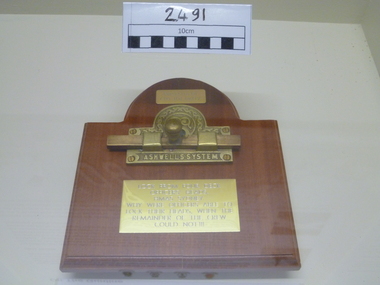
Award, Door Latch
... A door latch that has a small bar with handle hold by an omega plate with texts: "Ashwells System".Above the latch is plate with text "Presented by CPO Jim Britz" and below latch is plate with text "lock from four deck officers' heads HMAS Sydney. Why were offciers able to lock their heads when the remainder of the crew could not"....Lock from four deck officers' heads HMAS Sydney. Why were officers able to lock these heads when the remainder of the crew could not !!!...Door Latch HMAS Sydney Presented by CPO Jim Britz. Lock from four deck officers' heads HMAS Sydney. ...A door latch that has a small bar with handle hold by an omega plate with texts: "Ashwells System".Above the latch is plate with text "Presented by CPO Jim Britz" and below latch is plate with text "lock from four deck officers' heads HMAS Sydney. Why were offciers able to lock their heads when the remainder of the crew could not".Presented by CPO Jim Britz. Lock from four deck officers' heads HMAS Sydney. Why were officers able to lock these heads when the remainder of the crew could not !!!door latch, hmas sydney -
 Melbourne Legacy
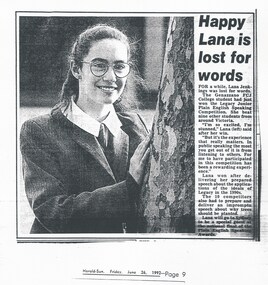
Newspaper - Article, Speaking Contest 1992, 1992
... Part of her speech was printed in the Melbourne Legacy newsletter and she was featured in an article in the Herald Sun on 26 June 1992, before she headed to Sydney for the National finals. The following was taken from a programme in 1996: "The Award aim is to promote enhanced oral communication skills for 12-14 year old students and to help young people appreciate the ideals of Legacy - voluntary service, caring and comradeship - and the need for remembrance. ...Part of her speech was printed in the Melbourne Legacy newsletter and she was featured in an article in the Herald Sun on 26 June 1992, before she headed to Sydney for the National finals. The following was taken from a programme in 1996: "The Award aim is to promote enhanced oral communication skills for 12-14 year old students and to help young people appreciate the ideals of Legacy - voluntary service, caring and comradeship - and the need for remembrance. ...For many years from 1988, Legacy held a public speaking contest called the Junior Plain English Speaking Award. Schools were eligible to send along representatives that competed. These two photos show President Geoffrey Swan with a Lana Jenkings (the winner) of Genazzano FCJ College in Kew. Part of her speech was printed in the Melbourne Legacy newsletter and she was featured in an article in the Herald Sun on 26 June 1992, before she headed to Sydney for the National finals. The following was taken from a programme in 1996: "The Award aim is to promote enhanced oral communication skills for 12-14 year old students and to help young people appreciate the ideals of Legacy - voluntary service, caring and comradeship - and the need for remembrance. It began in 1988 in the Melbourne area with the support of the Ministry of Education and The Plain English Foundation. Entries have grown from 24 in the 1988 competition to over 300 in schools across the Stat, plus greater numbers participating in the process of selecting four contestants from each school. In 1995, a successful Interstate Championship was held with contestants from Victoria, New South Wales and Queensland. On 11 November 1996 the first National final was held with contestants from six states."A record of a Junior Plain Speaking contest that has been run by Legacy since 1988.Colour photo x 2 of Junior Plain Speaking contest in 1992 and a newspaper article.legacy promotion, speaking contest -
 Coal Creek Community Park & Museum
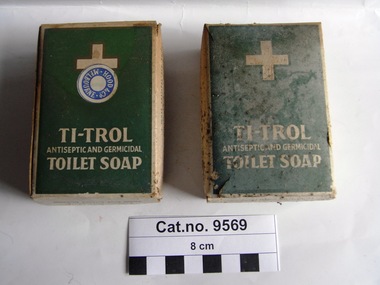
Soap, TI-TROL ANTISEPTIC AND GERMICIDAL TOILET SOAP, c. 1928-1968
... Sydney, NSW : 1869 - 1931), Thursday 11 October 1928, page 13. NEW COMPANIES The following new companies were registered this afternoon :- Australian Essential Oils Ltd : Nominal capital. £50,000, in 93.000 ordinary and 7,000 deferred shares at 10/-. to engage in business of distillers, manufacturers of, and dealers in oils from vegetables and other sub-stances, chemists etc. First directors: N. H.B.Keynor, R.K.Allport, E.M Humphries, and H. James. Head...Sydney, NSW : 1869 - 1931), Thursday 11 October 1928, page 13. NEW COMPANIES The following new companies were registered this afternoon :- Australian Essential Oils Ltd : Nominal capital. £50,000, in 93.000 ordinary and 7,000 deferred shares at 10/-. to engage in business of distillers, manufacturers of, and dealers in oils from vegetables and other sub-stances, chemists etc. First directors: N. H.B.Keynor, R.K.Allport, E.M Humphries, and H. James. Head ...TROVE : Evening News (Sydney, NSW : 1869 - 1931), Thursday 11 October 1928, page 13. NEW COMPANIES The following new companies were registered this afternoon :- Australian Essential Oils Ltd : Nominal capital. £50,000, in 93.000 ordinary and 7,000 deferred shares at 10/-. to engage in business of distillers, manufacturers of, and dealers in oils from vegetables and other sub-stances, chemists etc. First directors: N. H.B.Keynor, R.K.Allport, E.M Humphries, and H. James. Head office Sydney. TROVE : Government Gazette of the State of New South Wales (Sydney, NSW : 1901 - 2001), Friday 26 July 1968 (No.89), page 3028 IN the matter of the Companies Act, 1961-1966, and in the matter of AUSTRALIAN ESSENTIAL OILS LTD (Receiver and Manager Appointed).—Roy Leslie Pegler, Receiver and Manager of Australian Essential Oils Ltd (Receiver and Manager Appointed)„ appointed by debenture holders on the 11 th July, 1966, hereby gives notice that any debenture holders and others having any claim against or to Australian Essential Oils Ltd (Receiver and Manager Appointed) are required to send particulars of their debenture or claim to the Receiver, Roy Leslie Pegler, at c.o. Messrs Pegler, Ellis & Co., Chartered Accountants, 235-7 Elizabeth Street, Sydney, N.S.W., on or before the 27th September, 1968, at the expiration of which time the Receiver and Manager will distribute the assets of the said Company to the persons and/or companies entitled, having regard only to the claims of which he then has notice.—Dated 24th July, 1968. PEGLER, ELLIS & CO., Chartered Accountants, 235-7 Elizabeth Street, Sydney, N.S.W. 8744—$5 White cardboard box printed in dark green with a round blue and white sticker on one side, containing a cream paper leaflet printed in dark green, wrapped around a greaseproof paper wrapped rectangular cake of translucent brown soap with impressed text on one side.Impressed on one side of the cake of soap ' A PRODUCT OF AUSTRALIAN ESSENTIAL OILS LTD SYDNEY'. On reverse of soap impressed 'TI-TROL ANTISEPTIC TOU\ILET SOAP'. Printed on the box 'TI-TROL ANTISEPTIC AND GERMICIDAL TOILET SOAP. Printed Leaflet wrapped around cake of soap 'Germicide TI-TROL Antiseptic, Toilet Soap ELEVEN TIMES MORE POWERFUL THAN CARBOLIC. NON IRRITANT ………NON POISONOUS. “Ti –Trol” GERMICIDAL ANTISEPTIC SOAP is the most modern of all toilet soap …..Distilled and manufactured by Australian Essential Oils Ltd., the pioneers of Tea-Tree Oil Industry in Australia, and manufacturers of that famous antiseptic solution Melasol. It has taken years of patient research, of test, trial and experiment to reach the pinnacle of perfection which Ti-Trol Soap is now offering to the public. Ti-Trol is a hand-made glycerine base soap in which only the finest ingredients are used. One of its most attractive features is that it contains a full three per cent. of “Ti-trol”. In medical and clinical practice, both in Australia and abroad, Ti Trol has given remarkable results…particularly in its cleansing properties: its soothing HEALING action on dirty and inflamed septic wounds. By incorporating Ti-Trol in a glycerine base soap, experts are agreed that the result….. Ti-Trol soap is unequalled-anywhere- for its soft soothing healing and germicidal properties. Ti-Trol soap is non-irritant and non-poisonous and can be used on the tenderest skins…babies’ or the most delicate peach-bloom complexions, with most excellent results. . PRODUCT OF A SOAP MAKER OF INTERNATIONAL EXPERIENCE Australian Essential Oils Ltd., have been fortunate in procuring the services of a soap-maker of International experience and world-wide knowledge of Soap Production, whose genius has produced Ti-Trol, and whose uncanny sense of blending has made Ti-Trol the most famous of all Germicidal Toilet Soaps. Ti-Trol is non-irritant and non-poisonous and has been proved by medical and specialised authorities top\ possess great healing and cleansing properties. It is a powerful Germicide and antiseptic….ELEVEN TIMES QUICKER THAN PURE CARBOLIC. . DANDRUFF CAN’T LIVE WITH Ti-Trol. Dandruff ......that horrible “give away” which many men and women suffer from…..can easily be dispelled by using Ti-Trol Soap this way : Rub a little Olive Oil into the scalp before retiring at night, and the following morning wash your head thoroughly with Ti-Trol Soap, allowing the lather to remain on the scalp for about a minute and a half. Then rinse the hair thoroughly in warm water. .WASH BRUSHES AND COMBS WITH Ti-Trol SOAP When you’ve done this and dried your hair, wash all your brushes and combs in a strong, soapy solution made with Ti-Trol Soap, and then carefully sponge the inside of the hat bands with a flannel or cloth moistened with this soapy solution. Follow these directions and you’ll never need to fear dandruff. .Ti-Trol…WONDERFUL HEALER OF CUTS. SORES, WOUNDS, ETC. There never was a more patent healer of CUTS, SORES, WOUNDS, ABRASIONS AND SEPTIC SORES than Ti-Trol… Here’s how to use it : Wash the affected parts with a fairly strong Ti-Trol soapy solution made with warm water, and then apply with lint soaked with Melasol, which is the miscible form of Ti-Trol (Melasol is obtainable at all chemists and stores everywhere). . Ti-Trol SOAP……..A DEODORANT, A BEAUTIFIER……a safeguard for tender skins Ti-Trol Soap, because of its delicate, pungent, aroma and antiseptic properties, is unequalled as a deodorant, and is never failing when used for this purpose. Ti-Trol Soap can be used on the tenderest skins, and even baby’s skin, with greatest safety. It’s delightful fragrance will give added pleasure to your toilet. . DO NOT WASTE Ti-Trol Soap is too valuable to waste. Therefore, use it carefully. Do not leave it in the water. To obtain greatest economy it is preferable to use a face cloth when using Ti-Trol Soap. For health, for the most economical means of insuring against disease, use Ti-Trol Ointment…..for cuts, bruises etc. Ti-Trol….for boils, cuts, sores, abrasions and septic conditions. MELASOL…..for Tinea, Mouth Wash and as a Dentifice. . All are products containing Ti-Trol, distilled and provided by Australian Essential Oils Ltd. 18 Loftus Street, Sydney. N.S.W.'. tea tree oil, soap, glycerine, antisptic, germicide -
 Kyneton RSL Sub Branch
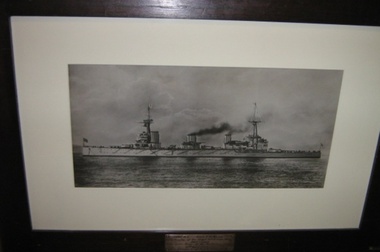
Framed photograph, HMAS Australia
... She was towed to sea by tugs and sunk along with her main armament in position 095 degrees, 24 miles from Inner South Head, Sydney, on 12 April 1924. Extracts from http://www.navy.gov.au/HMAS_Australia_(I)...She was towed to sea by tugs and sunk along with her main armament in position 095 degrees, 24 miles from Inner South Head, Sydney, on 12 April 1924. Extracts from http://www.navy.gov.au/HMAS_Australia_(I) navy world war one australia war wwi flagship hmas australia ran Metal Plaque on frame: HMAS Australia First flagship of the Royal Australian Navy 1913-1920 Sunk under terms of the Washington Treaty 12th April 1924 Teak frame photograph HMAS Australia Framed photograph ...The Australian Navy's first flagship, the battle cruiser HMAS Australia (I) was the centrepiece of the 'Fleet Unit', whose acquisition signalled the RAN's arrival as a credible ocean-going force. The Commonwealth Government decided upon the name Australia, and it proved a popular choice, carefully avoiding any suggestion of favouritism towards any one Australian State. Notwithstanding some construction delays, John Brown delivered Australia £295 000 under budget. Following successful gun, torpedo and machinery trials she commissioned as an Australian unit at Portsmouth, England, on 21 June 1913 under the command of Captain Stephen H. Radcliffe, RN. Two days later the ship hoisted the flag of Rear Admiral George Edwin Patey, MVO (later Vice Admiral Sir George Patey, KCMG, KCVO), who had been selected to command the Australian Fleet. In company with the new light cruiser HMAS Sydney (I), Australia sailed from Portsmouth on 21 July 1913, and their voyage home was seen as a further opportunity to stimulate public awareness and naval sentiment around the British Empire. Arrangements were made at the first opportunity for the flagship to visit many of the principal Australian ports. On the outbreak of World War I Australia (I) operated (with other ships of the Australian Fleet) as a counter to the German East Asiatic Cruiser Squadron under Admiral Graf von Spee. On 11 November 1918, the signing of the Armistice brought the fighting in Europe to an end. On 21 November, the Grand Fleet came out from the Firth-of-Forth in two divisions to meet the German High Seas Fleet steaming across the North Sea to be interned at Scapa Flow. Australia (I) had the honour of leading the port line at the head of her squadron. After returning home Australia (I) resumed the role of RAN flagship. A year later she played the leading part in the naval activities associated with the visit of the Prince of Wales in HMS Renown, but her time was rapidly running out. In November 1921 she returned to Sydney and the following month was paid off into reserve on 12 December 1921. Less than three years later she was prepared for scuttling to comply with the terms of the Washington Naval Treaty of 1922, which provided for a reduction in naval strengths. The RAN had already removed some of the ship's equipment for use in other warships, and now began the deliberate scrapping of Australia (I) by extracting piping and other small fittings. She was towed to sea by tugs and sunk along with her main armament in position 095 degrees, 24 miles from Inner South Head, Sydney, on 12 April 1924. Extracts from http://www.navy.gov.au/HMAS_Australia_(I)Teak frame photograph Metal Plaque on frame: HMAS Australia First flagship of the Royal Australian Navy 1913-1920 Sunk under terms of the Washington Treaty 12th April 1924 navy, world war one, australia, war, wwi, flagship, hmas australia, ran -
 Flagstaff Hill Maritime Museum and Village
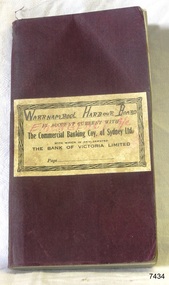
Financial record - Bank Transaction Book, Commercial Banking Company of Sydney Limited, before 1931
... Text on the fly page of the book is as follows – “The Commercial Banking Company of Sydney Limited with which is Amalgamated THE BANK OF VICTORIA LIMITED. Head Office – SYDNEY. ...Text on the fly page of the book is as follows – “The Commercial Banking Company of Sydney Limited with which is Amalgamated THE BANK OF VICTORIA LIMITED. Head Office – SYDNEY. ...The financial account book was used by the Warrnambool Harbour Board for its Emergency Account. It records transactions made with The Warrnambool branch of the Commercial Banking Company of Sydney Limited during the year 1931. The Secretary of the Warrnambool Harbour Board would have used this book in 1931. James Menzies, Pilot arid Harbour Master from 1929, was appointed as Acting Secretary for the Board in 1932 and held this office until the Board ceased in 1936. Warrnambool’s CBC Manager during this time was L E Whitney; he was Manager from 1924 to 1939. The Commercial Banking Company of Sydney Limited opened in 1893. On January 1, 1927 the CBC amalgamated with the Bank of Victoria. In 1981 the CBC merged with the National Bank of Australasia Limited and on January 1, 1983 the bank started using the abbreviated name of the National Australia Bank (NAB). Warrnambool Harbour Board- The Warrnambool Harbour Board was constituted by Order of Council on May 29, 1928, under the Harbour Board’s Act of 1927, taking over from the Ports and Harbours Branch of the Public Works Department of Victoria. The Board was then the only body with power to manage and control the whole Port, including shipping, facilities upkeep and improvements of the port. The work it carried out involved dredging, building of port facilities and drafting of port regulations, and collecting taxes, tolls, rates and charges. The Board was officially dissolved on June 30, 1936, at which time the Public Works Department again had control. The Warrnambool Harbour Board had rented out the Lighthouse Keeper’s Quarters from the 1920s until 1936, when the Board closed down. However, rentals continued with other currently unknown landlords until Flagstaff Hill Maritime Village opened in 1975 and began renovating the Cottage, in stages. Text on the fly page of the book is as follows – “The Commercial Banking Company of Sydney Limited with which is Amalgamated THE BANK OF VICTORIA LIMITED. Head Office – SYDNEY. Melbourne Office: 237 COLLINS STREET. BANKING Business of every description transacted. BRANCHES throughout VICTORIA, NEW SOUTH WALES and QUEENSLAND, and ADELAIDE BRANCH, SOUTH AUSTRALIA, and AGENCIES throughout AUSTRALASIA and NEW ZEALAND on which DRAFTS AND LETTERS OF CREDIT Are issued and also on LONDON BRANCH and AGENCIES in all the PRINCIPAL CITIES of the world. Telegraphic Remittances made, Bills Negotiated or Forwarded for Collection, Advances made, Deposits received, Current Accounts kept. FURTHER PARTICULARS ON APPLICATON. “ This bank transaction book is of local and state significance for its association with the Port of Warrnambool and the Warrnambool Harbour Board. The Warrnambool Harbour Board was the only board formed under the 1927 Harbour Boards Acts, even though other Victorian ports were eligible. The book is also significant as an example of bank records used by Australian and overseas branches of the Commercial Banking Company of Sydney Limited, and the Bank of Victoria Limited.Maroon coloured rectangular book with textured cover and cream coloured label attached. Label has a printed title on book plus hand written titles added in black and red. The corners of the book are rounded. The white pages have pre-printed text and lines. The book was used for transactions between the Warrnambool Harbour Board’s Emergency Account and the Commercial Banking Company of Sydney Limited during the year 1931.Handwritten in black “WARRNAMBOOL HARBOUR BOARD “, “EMERGENCY A/C” Printed in black “IN ACCOUNT CURRENT WITH”, “The Commercial Banking Coy. Of Sydney Ltd.”, “WITH WHICH IS AMALGAMATED”, “THE BANK OF VICTORIA LIMITED”, “Page …”warrnambool, shipwrecked-coast, flagstaff-hill, flagstaff-hill-maritime-museum, maritime-museum, shipwreck-coast, flagstaff-hill-maritime-village, warrnambool harbour board, financial account, emergency account, financial record, commercial banking company of sydney limited, 1931 bank book, bank of victoria limited, transaction book, financial management, stationery, deposit book, public works department, ports and harbours, commercial banking company of sydney ltd., james menzies, harbour master, l e whitney, cbc manager warrnambool, harbour board act, port of warrnambool, warrnambool harbour, lady bay, harbour pilot -
 Geelong Naval and Maritime Museum
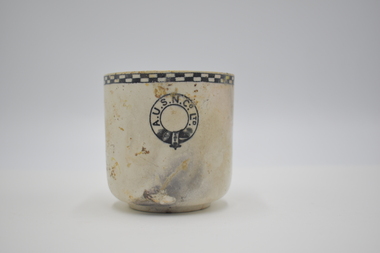
Teacup
... On its final voyage arriving at Port Phillip Heads from Sydney, Captain Gilling was attempting to enter the Heads ahead of a worsening south-westerly storm and, with a minefield known to have been laid in the area, had been warned by the Navy not to deviate from the swept channel. ...On its final voyage arriving at Port Phillip Heads from Sydney, Captain Gilling was attempting to enter the Heads ahead of a worsening south-westerly storm and, with a minefield known to have been laid in the area, had been warned by the Navy not to deviate from the swept channel. ...The Orungal was originally built in Glasgow in 1923 for the Khedival Mail Steamship & Graving Dock Company of Egypt and named the S.S. Fezara. Due to the effects on steamship companies of the Great Depression including the steep costs of building new ships and increases in running costs and port charges, no new passenger ships had been ordered in Australia since before World War One. To meet demand for passenger berths, the Fezara (5826 tons) along with its sister ship the Famaka (5856 tons, renamed Ormiston), were chartered by the Australasian United Steam Navigation Company Ltd (A.U.S.N.Co.) in 1927. Both the A.U.S.N.Co and the Khedival Mail Steamship Co. were part of the P&O Group. The Orungal operated in this role as an interstate passenger and mail steamer between 1927 and 1940, being used mainly on the Melbourne to Queensland and Western Australian runs, with 240 single class berths. Following the outbreak of World War Two six of the nine large passenger liners servicing mainland Australian passenger and mail trades were requisitioned by the Government to ferry equipment, troops and supplies. Some of them were converted to armed merchant cruisers and used for patrol work and escort duties in the Indian and Pacific Oceans. The Orungal had originally been requisitioned by the government along with the Zealandia on 25 June 1940, to transport troops to Darwin, but was returned to commercial service because "of her unsuitability", perhaps too slow for the demands of the work. Despite being rejected for patrol and convoy duties the Orungal still had a vital role as one of only three passenger liners left to service the mainland Australian trade. Following its requisitioning by the Government shortly after war broke out, it had been fitted out with defensive armament. On its final voyage arriving at Port Phillip Heads from Sydney, Captain Gilling was attempting to enter the Heads ahead of a worsening south-westerly storm and, with a minefield known to have been laid in the area, had been warned by the Navy not to deviate from the swept channel. The captain and crew held fears that in the stormy seas a mine may have been carried away. In the worsening weather a blur of lights at Barwon Heads was mistaken for Port Lonsdale, and the Orungal steamed ashore onto Formby Reef, just east of the entrance of the Barwon River - instead of passing safely through the middle of the Rip. At the Marine Board Inquiry Capt. Gilling - who had been master of the Orungal since 1926 - stated that after becoming uneasy about his position and changing course to starboard one point: " At 10.21 pm I ordered the engine room to stand by and gave instructions for the patent log to be hauled in and for the sounding-gear to be got ready. Approximately two minutes later, in a flash of lightning, I saw land off the port beam. I immediately recognised it as Barwon Heads, and ordered the helm to be put hard to starboard, but the vessel struck before she had time to answer the helm" Barwon Heads and Ocean Grove residents were startled to hear the shrill blast of the ship's whistle, followed by the bright flares and explosions of signal rockets. The Queenscliff lifeboat crew, who had responded to the tragic collision between the Goorangai and another passenger liner the Duntroon in Port Phillip Bay less than 24 hours earlier, were later praised for their efforts in safely taking off all the passengers and crew. Most of the passengers were asleep at the time of the wreck, and were woken up by the commotion, the ship shaking "from stem to stern" and stewards ordering them to lifeboat stations in driving rain. It was a dramatic time with the ship siren wailing and distress rockets being fired. It was reported that "When it was found the ship was safe, the passengers all went to the music room. There they sang and danced for several hours. The ship's orchestra played merrily, and amateur performers among the passengers clowned, danced and sang to keep the laughter going. In the early hours of the morning passengers went to their cabins, most of them to sleep soundly while the keel grated on the rocks". At dawn the Queenscliff lifeboat arrived at the scene having been launched at 2.30am, and cautiously approached the ship which was being "battered by mountainous seas". By 5am oil from a burst oil line was helping to calm seas around the Orungal sufficiently enough for the lifeboat to approach, and all the passengers and crew were taken off in several trips by the lifeboat. A Court of Inquiry later found that the wreck was caused by an abnormal set of current to the north-west and cleared the officers and crew of neglect of duty. The sight of a huge liner almost on the beach saw an unprecedented amount of traffic as people drove an estimated 10,000 cars, using some 60,000 gallons of fuel in a time of strict petrol rationing, to see the spectacle. Salvage operations began in an attempt to refloat the vessel, scheduled for the high tide on 15 December 1940. However, during these operations, at 2.30 am on 13 December 1940, a major fire broke out, believed to have been caused by spontaneous combustion in the boiler room. The ship was soon ablaze, with smoke pouring from its hatches and ventilators, and at mid-morning the magazine exploded fiercely. Of the 60 men working aboard the vessel two were severely burned and had to be taken to Geelong Hospital. The gathered spectators witnessed the eerie sight of the ship's hull glowing red when night fell. The well-known building demolition contractor Whelan the Wrecker bought the salvage rights, and methodically proceeded to dismantle the ship and its fittings. The drama was not yet over for the wreckers when - without warning - the burnt-out hulk was 'attacked' by RAAF for strafing practice. Salvage rights were transferred to another private owner in 1963. By 1945 the combined effects of the exposed location, fire and salvage had seen what was left of the wreck disappear beneath the waves. The site today is marked by two of the four Scotch type boilers sitting upright and exposed at low tide, just north-east of the small boats channel at the entrance to Barwon Heads. Large sections of steel hull plating and framing, and impressively large pieces of ships structure and machinery including masts, booms, deck winches, propeller shaft, flywheel, and a thrust block lie scattered about and make the site an interesting shallow dive. It is interesting to compare the site of the Orungal with the intact remains of similar large passenger ships scuttled in deep water in the Ships' Graveyard, such as the Milora and Malaita. The site is subject to waves and surge, and is best dived on flat calm days The teacup originated from the SS Orungal and was likely used heavily in the ship's life as a passenger, mail and cargo carrier around Australia. The teacup is significant for its connections to SS Orungal and of this ships connected story of being sunk in extraordinary circumstances in the local region. A.U.S.N. Co. Ltd. Teacup salvaged from SS Orungal ss orungal, fezara, world war two, barwon heads, ocean grove -
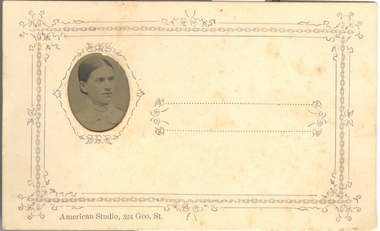 Federation University Historical Collection
Photograph - Little Gem tintype, American Studio, Portrait of a Woman, (exact)
... Sydney; - David Edelsten, 55 & 57 Bourke St, Melbourne; - Burman's Portrait Rooms, St. George's Hall, 209 Bourke St, Melbourne; - Bell's Gem Portrait Studio, 57 Bourke St East, Melbourne; - R. H. Kenny, Bridge St, Ballarat; - Marinus W. Bent, Sandhurst (Bendigo); - George Fisher, Victoria; - Anson Brothers, Hobart Town. (Abridged information from http://members.ozemail.com.au/~msafier/photos/tintypes.html) tintype american studio woman unidentified woman women photograph Printed lower left hand side of the card "American Studio, 324 Geo. St." A tintype portrait of a woman's head ...The tintype (or ferrotype or Melainotype) was produced on metallic sheet (not, actually, tin) instead of glass. The plate was coated with collodion and sensitized just before use. It was introduced by Adolphe Alexandre Martin in 1853. The most common size was about the same as the carte-de-visite, 5.5cm x 9.0cm, but both larger and smaller ferrotypes were made. The smallest were "Little Gem" tintypes, about the size of a postage-stamp, made simultaneously on a single plate in a camera with 12 or 16 lenses. They were often produced by travelling photographers, and were cheaper than Ambrotypes so made photography available to working classes, not just to the more well-to-do. The print would come out laterally reversed (as one sees oneself in a mirror). Being quite rugged, tintypes could be sent by post. Tintypes were eventually superseded by gelatin emulsion dry plates in the 1880s, though street photographers in various parts of the world continued with this process until the 1950s. (Above information abridged from http://www.rleggat.com/photohistory/history/tintype.htm) The firm of Gove and Allen opened in Sydney in 1880 and were responsible for the belated popularizing of the gem tintype in Australia. The firm traded as both The American Gem Studio and The American Studio. Others franchises were opened in Melbourne, Ballarat and Sandhurst (Bendigo). The Sandhurst branch closed in 1882 and Adelaide in 1884. All Gove and Allen studios had ceased trading by 1885. The studio addresses were: 23 King William St, Adelaide; 324 George St, Sydney; 95 Swanston St, Melbourne; Howard Place, Sandhurst; 7 Queen St, Brisbane; The card mounts used in Gove and Allen studios in Australia are identical to those used in America. They were initially made of plain white card with embossing around the oval image opening in the mount while some also had simple geometric and floral printed designs as well. Although Gove and Allen studios produced the majority of gem tintypes in Australia, other studios offered them including: - London, American & Sydney Photo Company, 328 George St, Sydney; - David Edelsten, 55 & 57 Bourke St, Melbourne; - Burman's Portrait Rooms, St. George's Hall, 209 Bourke St, Melbourne; - Bell's Gem Portrait Studio, 57 Bourke St East, Melbourne; - R. H. Kenny, Bridge St, Ballarat; - Marinus W. Bent, Sandhurst (Bendigo); - George Fisher, Victoria; - Anson Brothers, Hobart Town. (Abridged information from http://members.ozemail.com.au/~msafier/photos/tintypes.html) A tintype portrait of a woman's head, attached to a card.Printed lower left hand side of the card "American Studio, 324 Geo. St."tintype, american studio, woman, unidentified woman, women, photograph -
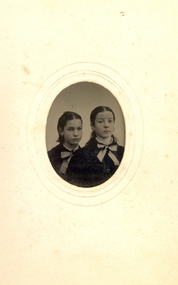 Federation University Historical Collection
Photograph - Tintype, Portrait of two young girls
... Sydney; - David Edelsten, 55 & 57 Bourke St, Melbourne; - Burman's Portrait Rooms, St. George's Hall, 209 Bourke St, Melbourne; - Bell's Gem Portrait Studio, 57 Bourke St East, Melbourne; - R. H. Kenny, Bridge St, Ballarat; - Marinus W. Bent, Sandhurst (Bendigo); - George Fisher, Victoria; - Anson Brothers, Hobart Town. (Abridged information from http://members.ozemail.com.au/~msafier/photos/tintypes.html) little gem women children photography tintype .2) A tintype portrait of two girls heads ...The tintype (or ferrotype or Melainotype) was produced on metallic sheet (not, actually, tin) instead of glass. The plate was coated with collodion and sensitized just before use. It was introduced by Adolphe Alexandre Martin in 1853. The most common size was about the same as the carte-de-visite, 5.5cm x 9.0cm, but both larger and smaller ferrotypes were made. The smallest were "Little Gem" tintypes, about the size of a postage-stamp, made simultaneously on a single plate in a camera with 12 or 16 lenses. They were often produced by travelling photographers, and were cheaper than Ambrotypes so made photography available to working classes, not just to the more well-to-do. The print would come out laterally reversed (as one sees oneself in a mirror). Being quite rugged, tintypes could be sent by post. Tintypes were eventually superseded by gelatin emulsion dry plates in the 1880s, though street photographers in various parts of the world continued with this process until the 1950s. (Above information abridged from http://www.rleggat.com/photohistory/history/tintype.htm) The firm of Gove and Allen opened in Sydney in 1880 and were responsible for the belated popularizing of the gem tintype in Australia. The firm traded as both The American Gem Studio and The American Studio. Others franchises were opened in Melbourne, 6 Sturt St Ballarat and Sandhurst (Bendigo). The Sandhurst branch closed in 1882 and Adelaide in 1884. All Gove and Allen studios had ceased trading by 1885. The studio addresses were: 23 King William St, Adelaide; 324 George St, Sydney; 95 Swanston St, Melbourne; Howard Place, Sandhurst; 7 Queen St, Brisbane; The card mounts used in Gove and Allen studios in Australia are identical to those used in America. They were initially made of plain white card with embossing around the oval image opening in the mount while some also had simple geometric and floral printed designs as well. Although Gove and Allen studios produced the majority of gem tintypes in Australia, other studios offered them including: - London, American & Sydney Photo Company, 328 George St, Sydney; - David Edelsten, 55 & 57 Bourke St, Melbourne; - Burman's Portrait Rooms, St. George's Hall, 209 Bourke St, Melbourne; - Bell's Gem Portrait Studio, 57 Bourke St East, Melbourne; - R. H. Kenny, Bridge St, Ballarat; - Marinus W. Bent, Sandhurst (Bendigo); - George Fisher, Victoria; - Anson Brothers, Hobart Town. (Abridged information from http://members.ozemail.com.au/~msafier/photos/tintypes.html) .2) A tintype portrait of two girls heads, attached to a card. The girls are wearing a cloak with a large bow at the frontlittle gem, women, children, photography, tintype -
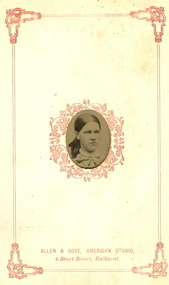 Federation University Historical Collection
Photograph - Photograph - Little Gem tintype, American Studio, Portrait of a Woman
... Sydney; - David Edelsten, 55 & 57 Bourke St, Melbourne; - Burman's Portrait Rooms, St. George's Hall, 209 Bourke St, Melbourne; - Bell's Gem Portrait Studio, 57 Bourke St East, Melbourne; - R. H. Kenny, Bridge St, Ballarat; - Marinus W. Bent, Sandhurst (Bendigo); - George Fisher, Victoria; - Anson Brothers, Hobart Town. (Abridged information from http://members.ozemail.com.au/~msafier/photos/tintypes.html) ballarat american studio little gem allen gove tintype woman unidentified woman photography Printed on the lower edge of the card "Allen & Gove, American Studion, 6 Sturt St, Ballarat" A tintype portrait of a woman's head, attached to a card. ...The tintype (or ferrotype or Melainotype) was produced on metallic sheet (not, actually, tin) instead of glass. The plate was coated with collodion and sensitized just before use. It was introduced by Adolphe Alexandre Martin in 1853. The most common size was about the same as the carte-de-visite, 5.5cm x 9.0cm, but both larger and smaller ferrotypes were made. The smallest were "Little Gem" tintypes, about the size of a postage-stamp, made simultaneously on a single plate in a camera with 12 or 16 lenses. They were often produced by travelling photographers, and were cheaper than Ambrotypes so made photography available to working classes, not just to the more well-to-do. The print would come out laterally reversed (as one sees oneself in a mirror). Being quite rugged, tintypes could be sent by post. Tintypes were eventually superseded by gelatin emulsion dry plates in the 1880s, though street photographers in various parts of the world continued with this process until the 1950s. (Above information abridged from http://www.rleggat.com/photohistory/history/tintype.htm) The firm of Gove and Allen opened in Sydney in 1880 and were responsible for the belated popularizing of the gem tintype in Australia. The firm traded as both The American Gem Studio and The American Studio. Others franchises were opened in Melbourne, 6 Sturt St Ballarat and Sandhurst (Bendigo). The Sandhurst branch closed in 1882 and Adelaide in 1884. All Gove and Allen studios had ceased trading by 1885. The studio addresses were: 23 King William St, Adelaide; 324 George St, Sydney; 95 Swanston St, Melbourne; Howard Place, Sandhurst; 7 Queen St, Brisbane; The card mounts used in Gove and Allen studios in Australia are identical to those used in America. They were initially made of plain white card with embossing around the oval image opening in the mount while some also had simple geometric and floral printed designs as well. Although Gove and Allen studios produced the majority of gem tintypes in Australia, other studios offered them including: - London, American & Sydney Photo Company, 328 George St, Sydney; - David Edelsten, 55 & 57 Bourke St, Melbourne; - Burman's Portrait Rooms, St. George's Hall, 209 Bourke St, Melbourne; - Bell's Gem Portrait Studio, 57 Bourke St East, Melbourne; - R. H. Kenny, Bridge St, Ballarat; - Marinus W. Bent, Sandhurst (Bendigo); - George Fisher, Victoria; - Anson Brothers, Hobart Town. (Abridged information from http://members.ozemail.com.au/~msafier/photos/tintypes.html) A tintype portrait of a woman's head, attached to a card. Printed on the lower edge of the card "Allen & Gove, American Studion, 6 Sturt St, Ballarat"ballarat, american studio, little gem, allen gove, tintype, woman, unidentified woman, photography -
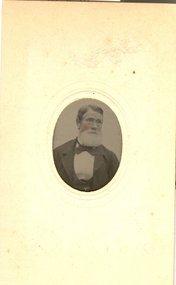 Federation University Historical Collection
Photograph - Little Gem tintype, Portrait of a Man
... Sydney; - David Edelsten, 55 & 57 Bourke St, Melbourne; - Burman's Portrait Rooms, St. George's Hall, 209 Bourke St, Melbourne; - Bell's Gem Portrait Studio, 57 Bourke St East, Melbourne; - R. H. Kenny, Bridge St, 6 Sturt St Ballarat; - Marinus W. Bent, Sandhurst (Bendigo); - George Fisher, Victoria; - Anson Brothers, Hobart Town. (Abridged information from http://members.ozemail.com.au/~msafier/photos/tintypes.html) little gem .8)A tintype portrait of a man's head ...The tintype (or ferrotype or Melainotype) was produced on metallic sheet (not, actually, tin) instead of glass. The plate was coated with collodion and sensitized just before use. It was introduced by Adolphe Alexandre Martin in 1853. The most common size was about the same as the carte-de-visite, 5.5cm x 9.0cm, but both larger and smaller ferrotypes were made. The smallest were "Little Gem" tintypes, about the size of a postage-stamp, made simultaneously on a single plate in a camera with 12 or 16 lenses. They were often produced by travelling photographers, and were cheaper than Ambrotypes so made photography available to working classes, not just to the more well-to-do. The print would come out laterally reversed (as one sees oneself in a mirror). Being quite rugged, tintypes could be sent by post. Tintypes were eventually superseded by gelatin emulsion dry plates in the 1880s, though street photographers in various parts of the world continued with this process until the 1950s. (Above information abridged from http://www.rleggat.com/photohistory/history/tintype.htm) The firm of Gove and Allen opened in Sydney in 1880 and were responsible for the belated popularizing of the gem tintype in Australia. The firm traded as both The American Gem Studio and The American Studio. Others franchises were opened in Melbourne, Ballarat and Sandhurst (Bendigo). The Sandhurst branch closed in 1882 and Adelaide in 1884. All Gove and Allen studios had ceased trading by 1885. The studio addresses were: 23 King William St, Adelaide; 324 George St, Sydney; 95 Swanston St, Melbourne; Howard Place, Sandhurst; 7 Queen St, Brisbane; The card mounts used in Gove and Allen studios in Australia are identical to those used in America. They were initially made of plain white card with embossing around the oval image opening in the mount while some also had simple geometric and floral printed designs as well. Although Gove and Allen studios produced the majority of gem tintypes in Australia, other studios offered them including: - London, American & Sydney Photo Company, 328 George St, Sydney; - David Edelsten, 55 & 57 Bourke St, Melbourne; - Burman's Portrait Rooms, St. George's Hall, 209 Bourke St, Melbourne; - Bell's Gem Portrait Studio, 57 Bourke St East, Melbourne; - R. H. Kenny, Bridge St, 6 Sturt St Ballarat; - Marinus W. Bent, Sandhurst (Bendigo); - George Fisher, Victoria; - Anson Brothers, Hobart Town. (Abridged information from http://members.ozemail.com.au/~msafier/photos/tintypes.html) .8)A tintype portrait of a man's head, attached to a card. The cheeks have been hand coloured.little gem -
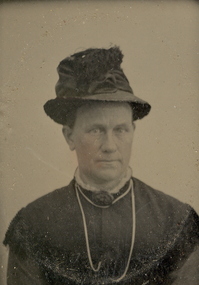 Federation University Historical Collection
Photograph - Little Gem tintype, Portrait of a Woman in a hat
... Sydney; - David Edelsten, 55 & 57 Bourke St, Melbourne; - Burman's Portrait Rooms, St. George's Hall, 209 Bourke St, Melbourne; - Bell's Gem Portrait Studio, 57 Bourke St East, Melbourne; - R. H. Kenny, Bridge St, 6 Sturt St Ballarat; - Marinus W. Bent, Sandhurst (Bendigo); - George Fisher, Victoria; - Anson Brothers, Hobart Town. (Abridged information from http://members.ozemail.com.au/~msafier/photos/tintypes.html) little gem woman unidentified woman women photography .9) A tintype portrait of a woman's head ...The tintype (or ferrotype or Melainotype) was produced on metallic sheet (not, actually, tin) instead of glass. The plate was coated with collodion and sensitized just before use. It was introduced by Adolphe Alexandre Martin in 1853. The most common size was about the same as the carte-de-visite, 5.5cm x 9.0cm, but both larger and smaller ferrotypes were made. The smallest were "Little Gem" tintypes, about the size of a postage-stamp, made simultaneously on a single plate in a camera with 12 or 16 lenses. They were often produced by travelling photographers, and were cheaper than Ambrotypes so made photography available to working classes, not just to the more well-to-do. The print would come out laterally reversed (as one sees oneself in a mirror). Being quite rugged, tintypes could be sent by post. Tintypes were eventually superseded by gelatin emulsion dry plates in the 1880s, though street photographers in various parts of the world continued with this process until the 1950s. (Above information abridged from http://www.rleggat.com/photohistory/history/tintype.htm) The firm of Gove and Allen opened in Sydney in 1880 and were responsible for the belated popularizing of the gem tintype in Australia. The firm traded as both The American Gem Studio and The American Studio. Others franchises were opened in Melbourne, Ballarat and Sandhurst (Bendigo). The Sandhurst branch closed in 1882 and Adelaide in 1884. All Gove and Allen studios had ceased trading by 1885. The studio addresses were: 23 King William St, Adelaide; 324 George St, Sydney; 95 Swanston St, Melbourne; Howard Place, Sandhurst; 7 Queen St, Brisbane; The card mounts used in Gove and Allen studios in Australia are identical to those used in America. They were initially made of plain white card with embossing around the oval image opening in the mount while some also had simple geometric and floral printed designs as well. Although Gove and Allen studios produced the majority of gem tintypes in Australia, other studios offered them including: - London, American & Sydney Photo Company, 328 George St, Sydney; - David Edelsten, 55 & 57 Bourke St, Melbourne; - Burman's Portrait Rooms, St. George's Hall, 209 Bourke St, Melbourne; - Bell's Gem Portrait Studio, 57 Bourke St East, Melbourne; - R. H. Kenny, Bridge St, 6 Sturt St Ballarat; - Marinus W. Bent, Sandhurst (Bendigo); - George Fisher, Victoria; - Anson Brothers, Hobart Town. (Abridged information from http://members.ozemail.com.au/~msafier/photos/tintypes.html) .9) A tintype portrait of a woman's head, attached to a card. The cheeks have been hand coloured.little gem, woman, unidentified woman, women, photography -
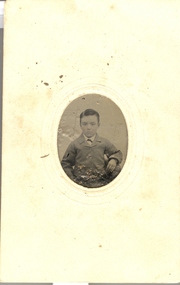 Federation University Historical Collection
Photograph - Little Gem tintype, Possibly American Studio, Portrait of a Boy
... Sydney; - David Edelsten, 55 & 57 Bourke St, Melbourne; - Burman's Portrait Rooms, St. George's Hall, 209 Bourke St, Melbourne; - Bell's Gem Portrait Studio, 57 Bourke St East, Melbourne; - R. H. Kenny, Bridge St, 6 Sturt St Ballarat; - Marinus W. Bent, Sandhurst (Bendigo); - George Fisher, Victoria; - Anson Brothers, Hobart Town. (Abridged information from http://members.ozemail.com.au/~msafier/photos/tintypes.html) little gem .9) A tintype portrait of a child's head ...The tintype (or ferrotype or Melainotype) was produced on metallic sheet (not, actually, tin) instead of glass. The plate was coated with collodion and sensitized just before use. It was introduced by Adolphe Alexandre Martin in 1853. The most common size was about the same as the carte-de-visite, 5.5cm x 9.0cm, but both larger and smaller ferrotypes were made. The smallest were "Little Gem" tintypes, about the size of a postage-stamp, made simultaneously on a single plate in a camera with 12 or 16 lenses. They were often produced by travelling photographers, and were cheaper than Ambrotypes so made photography available to working classes, not just to the more well-to-do. The print would come out laterally reversed (as one sees oneself in a mirror). Being quite rugged, tintypes could be sent by post. Tintypes were eventually superseded by gelatin emulsion dry plates in the 1880s, though street photographers in various parts of the world continued with this process until the 1950s. (Above information abridged from http://www.rleggat.com/photohistory/history/tintype.htm) The firm of Gove and Allen opened in Sydney in 1880 and were responsible for the belated popularizing of the gem tintype in Australia. The firm traded as both The American Gem Studio and The American Studio. Others franchises were opened in Melbourne, Ballarat and Sandhurst (Bendigo). The Sandhurst branch closed in 1882 and Adelaide in 1884. All Gove and Allen studios had ceased trading by 1885. The studio addresses were: 23 King William St, Adelaide; 324 George St, Sydney; 95 Swanston St, Melbourne; Howard Place, Sandhurst; 7 Queen St, Brisbane; The card mounts used in Gove and Allen studios in Australia are identical to those used in America. They were initially made of plain white card with embossing around the oval image opening in the mount while some also had simple geometric and floral printed designs as well. Although Gove and Allen studios produced the majority of gem tintypes in Australia, other studios offered them including: - London, American & Sydney Photo Company, 328 George St, Sydney; - David Edelsten, 55 & 57 Bourke St, Melbourne; - Burman's Portrait Rooms, St. George's Hall, 209 Bourke St, Melbourne; - Bell's Gem Portrait Studio, 57 Bourke St East, Melbourne; - R. H. Kenny, Bridge St, 6 Sturt St Ballarat; - Marinus W. Bent, Sandhurst (Bendigo); - George Fisher, Victoria; - Anson Brothers, Hobart Town. (Abridged information from http://members.ozemail.com.au/~msafier/photos/tintypes.html) .9) A tintype portrait of a child's head and torso, attached to a card. The boy is wearing a suit and the cheeks have been hand coloured.little gem -
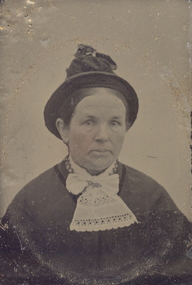 Federation University Historical Collection
Photograph - Little Gem tintype, Portrait of a Woman in a Hat
... Sydney; - David Edelsten, 55 & 57 Bourke St, Melbourne; - Burman's Portrait Rooms, St. George's Hall, 209 Bourke St, Melbourne; - Bell's Gem Portrait Studio, 57 Bourke St East, Melbourne; - R. H. Kenny, Bridge St, 6 Sturt St Ballarat; - Marinus W. Bent, Sandhurst (Bendigo); - George Fisher, Victoria; - Anson Brothers, Hobart Town. (Abridged information from http://members.ozemail.com.au/~msafier/photos/tintypes.html) little gem woman unidentified woman women photography A tintype portrait of a woman's head ...The tintype (or ferrotype or Melainotype) was produced on metallic sheet (not, actually, tin) instead of glass. The plate was coated with collodion and sensitized just before use. It was introduced by Adolphe Alexandre Martin in 1853. The most common size was about the same as the carte-de-visite, 5.5cm x 9.0cm, but both larger and smaller ferrotypes were made. The smallest were "Little Gem" tintypes, about the size of a postage-stamp, made simultaneously on a single plate in a camera with 12 or 16 lenses. They were often produced by travelling photographers, and were cheaper than Ambrotypes so made photography available to working classes, not just to the more well-to-do. The print would come out laterally reversed (as one sees oneself in a mirror). Being quite rugged, tintypes could be sent by post. Tintypes were eventually superseded by gelatin emulsion dry plates in the 1880s, though street photographers in various parts of the world continued with this process until the 1950s. (Above information abridged from http://www.rleggat.com/photohistory/history/tintype.htm) The firm of Gove and Allen opened in Sydney in 1880 and were responsible for the belated popularizing of the gem tintype in Australia. The firm traded as both The American Gem Studio and The American Studio. Others franchises were opened in Melbourne, Ballarat and Sandhurst (Bendigo). The Sandhurst branch closed in 1882 and Adelaide in 1884. All Gove and Allen studios had ceased trading by 1885. The studio addresses were: 23 King William St, Adelaide; 324 George St, Sydney; 95 Swanston St, Melbourne; Howard Place, Sandhurst; 7 Queen St, Brisbane; The card mounts used in Gove and Allen studios in Australia are identical to those used in America. They were initially made of plain white card with embossing around the oval image opening in the mount while some also had simple geometric and floral printed designs as well. Although Gove and Allen studios produced the majority of gem tintypes in Australia, other studios offered them including: - London, American & Sydney Photo Company, 328 George St, Sydney; - David Edelsten, 55 & 57 Bourke St, Melbourne; - Burman's Portrait Rooms, St. George's Hall, 209 Bourke St, Melbourne; - Bell's Gem Portrait Studio, 57 Bourke St East, Melbourne; - R. H. Kenny, Bridge St, 6 Sturt St Ballarat; - Marinus W. Bent, Sandhurst (Bendigo); - George Fisher, Victoria; - Anson Brothers, Hobart Town. (Abridged information from http://members.ozemail.com.au/~msafier/photos/tintypes.html) A tintype portrait of a woman's head and shoulders, attached to a card. The cheeks have been hand coloured.little gem, woman, unidentified woman, women, photography -
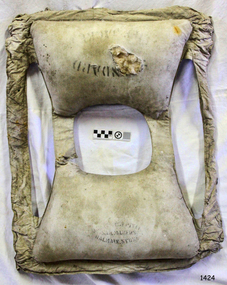 Flagstaff Hill Maritime Museum and Village
Equipment - Life Jacket, Harry West Pty Ltd, Sailmakers, 1930s-1950s
... head and tie at the waist. Inscriptions on pouches, some stencilled, some hand written, and inspection text on shoulder strap. Made by Harry West Pty Ltd., Sailmakers, Balmain, Sydney....Many lives were saved but tragically, eight lives were lost. flagstaff hill maritime museum and village flagstaff hill maritime museum maritime village warrnambool lady bay warrnambool harbour captain ward royal national lifeboat instution kapok life jacket orpheus newman salvus jacket life saving rescue rescue crew l.s.r.c. life saving equipment marine technology lifeboat shipwreck victim vintage Harry West Balmain Sydney Davies Standard life jacket survivor shipwreck sailmakers harry west pty ltd Stencilled on pockets: “- - - NDARD / LIFE JACKET” [STANDARD LIFE JACKET], “HARRY WEST PTY LTD / SAILMAKERS / BALMAIN, SYDNEY” Stamped on shoulder strap: "XM3271RC" Hand painted on pocket: “DAVIES” Life jacket, canvas covered, with two kapok padded compartments joined by shoulder straps and waist ties. Designed to slip over the head ...This standard design life jacket was made by sailmakers Harry West Pty Ltd at Balmain, Sydney, New South Wales from 1930s to 1950s. Harry West - Harry was a chandler, sailmaker and rigger. He made and sold all kinds of canvas and rope goods including sails, awnings and covers. In 1925 he was advertising life buoys but by 1933 he was advertising life jackets. He and his wife Margery had six children. His business was still operating in 1954, when an article on the craft of sailmaking appeared in the Sydney Morning Herald. His sailmaker's loft was located, traditionally, close to Sydney's harbour. Life Jackets - Life jackets were part of the equipment carried by the Life Saving Rescue Crew of South Western Victoria, including Warrnambool, from around 1858 until the 1950s. The purpose of a life jacket is to keep the wearer afloat until he or she is rescued from the water. Life jackets were first invented in 1854 by Captain Ward of the Royal National Lifeboat Institution in Britain. The early life jackets were filled with cork, which is very buoyant. However, many times he cork caused the jacket to rise up quickly with a force that caused unconsciousness, sometimes turning the person face down in the water , causing them to drown. After the tragic loss of the ship RMS Titanic in 1912 and the lost lives of those onboard, a woman named Orpheus Newman designed the Salvus life jacket (Salvus means safe), which was filled with kapok instead of cork. Kapok comes from seed pods of the Ceiba Pentandra tree and is waterproof as well as buoyant. These Salvus jackets were used by the Royal Navy until new synthetic materials became available around the time of World War II.This life jacket is significant for its connection with local history, maritime history and marine technology. Lifesaving has been an important part of the services performed from Warrnambool's very early days, supported by State and Local Government, and based on the methods and experience of Great Britain. Hundreds of shipwrecks along the coast are evidence of the rough weather and rugged coastline. Ordinary citizens, the Harbour employees, and the volunteer boat and rescue crew, saved lives in adverse circumstances. Some were recognised as heroes, others went unrecognised. In Lady Bay, Warrnambool, there were around 16 known shipwrecks between 1850 and 1905. Many lives were saved but tragically, eight lives were lost.Life jacket, canvas covered, with two kapok padded compartments joined by shoulder straps and waist ties. Designed to slip over the head and tie at the waist. Inscriptions on pouches, some stencilled, some hand written, and inspection text on shoulder strap. Made by Harry West Pty Ltd., Sailmakers, Balmain, Sydney.Stencilled on pockets: “- - - NDARD / LIFE JACKET” [STANDARD LIFE JACKET], “HARRY WEST PTY LTD / SAILMAKERS / BALMAIN, SYDNEY” Stamped on shoulder strap: "XM3271RC" Hand painted on pocket: “DAVIES”flagstaff hill maritime museum and village, flagstaff hill, maritime museum, maritime village, warrnambool, lady bay, warrnambool harbour, captain ward, royal national lifeboat instution, kapok, life jacket, orpheus newman, salvus jacket, life saving, rescue, rescue crew, l.s.r.c., life saving equipment, marine technology, lifeboat, shipwreck victim, vintage, harry west, balmain, sydney, davies, standard life jacket, survivor, shipwreck, sailmakers, harry west pty ltd -
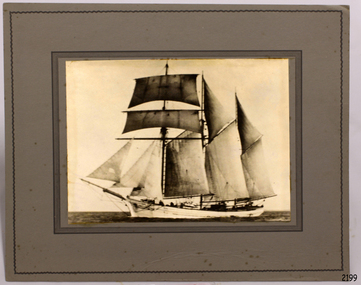 Flagstaff Hill Maritime Museum and Village
Photograph - Ship, Alma Doepel, 1931-1934
... Sydney in February, 1943. She was relaunched by the Army in 1944 minus two of her masts and her small 1936 engine, and was fitted with three large bus engines. In March 1945 she headed...Sydney in February, 1943. She was relaunched by the Army in 1944 minus two of her masts and her small 1936 engine, and was fitted with three large bus engines. In March 1945 she headed ...This photograph is of the square-rigged schooner "Alma Doepel". Details added to the back of the photograph incorrectly describe the vessel as "Amy Doepel / ketch / Amy Doepel". The rigging on the vessel dates the photograph to sometime between 1931-1933. The location is yet to be determined. Frederick Doepel was a shipping agent in Bellinger Valley, NSW. He employed an experienced shipwright to build Alma Doepel, which was made from local timber. He named the ship “Alma Doepel” after his baby daughter Alma. The ship was registered in Sydney and launched 19th October 1903, and her first sea voyage was in December. She traded in timber Port Macquarie/Bellinger River and New Zealand. “Alma Doepel” was purchased by Henry Jones & Co., Hobart jam makers, in partnership with Harry Heather, her new captain, in 1916. The ship was then registered in Hobart. She carried jam and timber to the mainland, particularly Melbourne, and brought back cargo for Tasmania. She even carried the piles for the building of Portland Harbour. When Harry Heather passed away in 1937 he was succeeded by Eric Droscoll. Before the square-rigged "Alma Doepel" left for Tasmania on March 8th 1937 she was fitted with a new set of sails, becoming a fore-and-aft rigged schooner. She had been the last 'top sail' schooner in Bass Strait trade! "Alma Doepel" continued her coastal trading until 1942, when she was requisitioned by the Army. In January 1943 she was left in Melbourne by her crew and the Army took her over, taking her to Sydney in February, 1943. She was relaunched by the Army in 1944 minus two of her masts and her small 1936 engine, and was fitted with three large bus engines. In March 1945 she headed for the war zone, delivering cargo up and down the coast of New Guinea, at one time carrying over 400 troops. In 1946 she returned to Hobart where the Army re-converted her back for Bass Strait trading and returned her. In January 1947 Eric Driscoll took “Alma Doepel” to the eastern Tasmanian coastal port of St. Helens, trading cargo of local mountain ash timber to Melbourne on the mainland until 1959. She was then stripped down to her hull with only a single mast and two engines, and fitted with wooden bins on rails in her hold. From 1961 to 1975 she carried limestone to a factory to make carbide. Michael Wood and David Boykett, two of the governors of "Sail and Adventure", then bought her for the price of her two Gardiner engines and in 1976 they brought her to Melbourne. An Alma Doepel Supporters Club was formed to support the ship’s major restoration to a topsail schooner. In 1987 she was overhauled in Adelaide, with the support of Elders IXL and she returned to Sydney to lead the Parade of Sail on Bicentenary Day, 25th January 1988. She returned to Melbourne in February and began sail training voyages in Port Phillip Bay, operating from an office on Station Pier. The Alma Doepel Voyagers Club was started. Trainees joined the crew in sailing the ship over nine or ten days of instruction in sailing and seamanship. These trips plus chartered trips and fund raisers continued until early 1999, when she was no longer in a condition to operate; she needed a lot of attention. She lay idle in Victoria Dock for quite some time. In April 2001 “Alma Doepel” was taken to Port Macquarie’s Lady Nelson Wharf where she became a museum ship maintained by volunteers. In 2008 she had time in dry-dock and after sea-trials headed off to Victoria Harbour, Docklands, in Melbourne, where she is currently being restored with the help of The Supporters.This phot graph is significant for its connection with the Bass Strait trade, being the last top-sail schooner to brade across the strait. The photograph is also significant in its representation of the the sailing ships that traded around Australia in the 1930s.Photograph of "Alma Doepel " a wooden, 3 masted, square rigged sailing schooner built in Sydney, launched in 10/10/1903. Photograph is sepia coloured, mounted on card, inscription on the back. Information also provided with photograph. Photograph (marked incorrectly on back) "Amy Doepel / ketch / Amy Doepel". Sticker with "91" in pencil. Information provided (dated incorrectly) "1943, Sydney, New South Wales"flagstaff hill, warrnambool, shipwreck coast, maritime museum, maritime village, photograph, alma doepel, frederick doepel, henry jones and co, harry heather, eric droscoll, alma doepel supporters club, elders ixl, parade of sail, bicentenary day, alma doepel voyagers club, last top sail schooner in bass strait trade, square-rigged, fore-and-aft rigged -
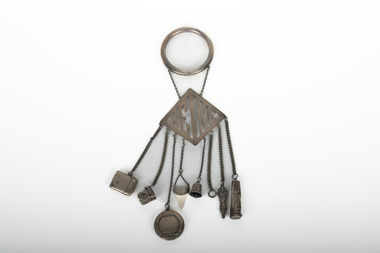 The Beechworth Burke Museum
Accessory - Chatelaine, C. 1890
... heads of the household as a display of position and power. The social history objects held in the Burke Museum's collection help to tell the stories of Beechworth's past by showing the social, cultural, and economic aspects of the town's history. Burke Museum silverware social history Heine HEINE/ [plate] CHERRY./ from/ LEO/ May 12th 1899/ [inscription on vesta case] L??S/ Anchor symbol/ x symbol/ lion symbol/ [Hallmark on scent bottle lid] R/ HM/ Anchor symbol/ Lion symbol/ m symbol/ [Hallmark on back of the compact] SYDNEY ...The exact creation date of this chatelaine is unknown, however the hallmarks and engravings on some of the attached objects indicate that this chatelaine was made in the late 1890s. The shark tooth and the liberty bell attached to the chatelaine suggest that the item once belonged to an Australian who had connections to America. The compact, scent bottle lid, and feminine design of the other objects suggest that this wasowned by a woman. The name on the plate indicates that this object may have belonged to someone with the surname Heine. The hallmarks on the scent bottle lid and the compact indicate that they were made in Birmingham, England in the late 1890s, and that the compact was made by H. Matthews. Chatelaines where used by both men and women, usually fastened to a belt or pocket, and small household objects were attached to the main body of the chatelaine by chains. They were only worn by the heads of the household as a display of position and power.The social history objects held in the Burke Museum's collection help to tell the stories of Beechworth's past by showing the social, cultural, and economic aspects of the town's history.A decorative silver belt hook with small household object attached by chains to a suspended name plate. There are 8 chains and 7 objects; a vesta case, scent bottle lid, compact, shark tooth, bell, button hook handle, container.HEINE/ [plate] CHERRY./ from/ LEO/ May 12th 1899/ [inscription on vesta case] L??S/ Anchor symbol/ x symbol/ lion symbol/ [Hallmark on scent bottle lid] R/ HM/ Anchor symbol/ Lion symbol/ m symbol/ [Hallmark on back of the compact] SYDNEY/ [inscription on shark tooth] Proclaim liberty throughout all the land unto all inhabitants thereof/ By order of the Assembly of the Province of Pensylvania for the State House in Philada/ [inscription on bell] A01176/ burke museum, silverware, social history, heine -
 Frankston RSL Sub Branch
Medal Set (set of 3)
... Thomas Richard Cook Service number: 1732 Rank: Private Roll title: 1 Infantry Battalion - 1 to 8 Reinforcements (December 1914 - August 1915) Conflict: First World War, 1914-1918 Date of embarkation: 10 April 1915 Place of embarkation: Sydney Ship embarked on: HMAT Argyllshire Ship number: A8 medals 1914 15 star british war medal victory medal ww1 medals 1) 1914-15 Star: Star with crown on top, with crossed swords, embossed with "1914-15" on obverse side, "1768/ Gnr T R Cook/ 1/Bn. A.I.F." 2)King George head ...Thomas Richard Cook Service number: 1732 Rank: Private Roll title: 1 Infantry Battalion - 1 to 8 Reinforcements (December 1914 - August 1915) Conflict: First World War, 1914-1918 Date of embarkation: 10 April 1915 Place of embarkation: Sydney Ship embarked on: HMAT Argyllshire Ship number: A8 Set of WW1 medals issued to T. R. Cook, note DCM + MM not included. 1) The 1914-1915 Star. Awarded for service on the establishment of a ship or unit in a theatre of war. A member awarded the 1914 Star could not be awarded the 1914-15 Star (this award). 2) British War Medal. Awarded for service as follows: • Navy - for 28 days mobilised service or to those who lost their lives in active operations before completing that period, between 5 August 1914 and 11 November 1918. • Army and Air Force - entry into a theatre of war on duty, or who left places of residence and rendered approved overseas service between 5 August 1914 and 11 November 1918. • Mercantile Marine - at least six months service between 5 August 1914 and 11 November 1918. 3) The Victory medal. Awarded for service as follows: • Navy - those who were mobilised and rendered approved service either at sea between 5 August 1914 and 11 November 1918 or on the establishment of a unit within a theatre of military operations. • Army - those who served on the establishment of a unit in a theatre of war. • Air Force - those who served on the establishment of a unit in a theatre of war outside the UK, served with an operational unit in the UK or overseas and had been actively engaged against the enemy, been employed in flying new aircraft to France or served on the complement of aircraft-carrying ships. A member Mentioned in Dispatches for service during World War 1 wears a bronze oak leaf on the ribbon. Only one emblem is worn no matter how many times a member may have been 'mentioned' 1) 1914-15 Star: Star with crown on top, with crossed swords, embossed with "1914-15" on obverse side, "1768/ Gnr T R Cook/ 1/Bn. A.I.F." 2)King George head and mounted warrioir on obverse. 3)Winged Brittania and obverse "The Great/war for/civilisation/1914-1919"medals, 1914 15 star, british war medal, victory medal, ww1 medals -
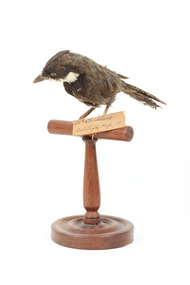 The Beechworth Burke Museum
Animal specimen - Eastern Whipbird, Trustees of the Australian Museum, 1860-1880
... head which is missing from this specimen. This specimen is part of a collection of almost 200 animal specimens that were originally acquired as skins from various institutions across Australia, including the Australian Museum in Sydney and the National Museum of Victoria (known as Museums Victoria since 1983), as well as individuals such as amateur anthropologist Reynell Eveleigh Johns between 1860-1880. ...head which is missing from this specimen. This specimen is part of a collection of almost 200 animal specimens that were originally acquired as skins from various institutions across Australia, including the Australian Museum in Sydney and the National Museum of Victoria (known as Museums Victoria since 1983), as well as individuals such as amateur anthropologist Reynell Eveleigh Johns between 1860-1880. ...The Eastern Whipbird isusually be found in pairs. They have a distinct white stripe on either side of the beak which helps to identify this bird. This species generally resides in wet habitats such as wetlands and rainforests, where there is dense vegetation. The Eastern Whipbird can be commonly found along the east coast of Australia. Since this is a taxidermy mount, there are a few inconsistencies. The main inconsistency is the colour of the specimen, the plumage should be an olive-green colour. This particular colouring has likely faded due to the taxidermy process and also the age of the specimen. There should also be black plume on top of the head which is missing from this specimen. This specimen is part of a collection of almost 200 animal specimens that were originally acquired as skins from various institutions across Australia, including the Australian Museum in Sydney and the National Museum of Victoria (known as Museums Victoria since 1983), as well as individuals such as amateur anthropologist Reynell Eveleigh Johns between 1860-1880. These skins were then mounted by members of the Burke Museum Committee and put-on display in the formal space of the Museum’s original exhibition hall where they continue to be on display. This display of taxidermy mounts initially served to instruct visitors to the Burke Museum of the natural world around them, today it serves as an insight into the collecting habits of the 19th century.This specimen is part of a significant and rare taxidermy mount collection in the Burke Museum. This collection is scientifically and culturally important for reminding us of how science continues to shape our understanding of the modern world. They demonstrate a capacity to hold evidence of how Australia’s fauna history existed in the past and are potentially important for future environmental research. This collection continues to be on display in the Museum and has become a key part to interpreting the collecting habits of the 19th century.This Eastern Whipbird is a small species of bird which has a dramatic stripe of white colouring on either side of the small bill and the crest is black. The belly and throat are black while the back, wings and tail are dark brown. This specimen stands upon a wooden perch and has an identification tag tied around its leg.25a / Thickhead / catalogue page 11taxidermy mount, taxidermy, animalia, burke museum, beechworth, australian museum, skin, reynell eveleigh johns, bird, eastern whipbird, australian birds -
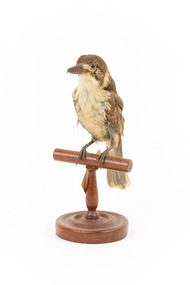 The Beechworth Burke Museum
Animal specimen - Grey Butcher Bird, Trustees of the Australian Museum, 1860-1880
... heads and white underparts. The brown colouring on this animal suggests that it is a young bird, with its grey adult feathers coming in. This bird appears thinner than most Grey Butcher Birds, but it is unclear if this is because of its age or because of inaccurate taxidermy. This specimen is part of a collection of almost 200 animal specimens that were originally acquired as skins from various institutions across Australia, including the Australian Museum in Sydney...heads and white underparts. The brown colouring on this animal suggests that it is a young bird, with its grey adult feathers coming in. This bird appears thinner than most Grey Butcher Birds, but it is unclear if this is because of its age or because of inaccurate taxidermy. This specimen is part of a collection of almost 200 animal specimens that were originally acquired as skins from various institutions across Australia, including the Australian Museum in Sydney ...Grey Butcherbirds live in wooded habitats, including suburban areas, from the north of Western Australia, across different parts of the top of the country, through to mid-eastern Queensland, and then south along the eastern side of the country all the way down to Tasmania. They have a 'lovely, lilting song', and are fiercely protective of their nests and chicks, swooping at presumed attackers with enough strength to sometimes draw blood. Adult Grey Butcher Birds are typically a light grey colour with dark heads and white underparts. The brown colouring on this animal suggests that it is a young bird, with its grey adult feathers coming in. This bird appears thinner than most Grey Butcher Birds, but it is unclear if this is because of its age or because of inaccurate taxidermy. This specimen is part of a collection of almost 200 animal specimens that were originally acquired as skins from various institutions across Australia, including the Australian Museum in Sydney and the National Museum of Victoria (known as Museums Victoria since 1983), as well as individuals such as amateur anthropologist Reynell Eveleigh Johns between 1860-1880. These skins were then mounted by members of the Burke Museum Committee and put-on display in the formal space of the Museum’s original exhibition hall where they continue to be on display. This display of taxidermy mounts initially served to instruct visitors to the Burke Museum of the natural world around them, today it serves as an insight into the collecting habits of the 19th century.This specimen is part of a significant and rare taxidermy mount collection in the Burke Museum. This collection is scientifically and culturally important for reminding us of how science continues to shape our understanding of the modern world. They demonstrate a capacity to hold evidence of how Australia’s fauna history existed in the past and are potentially important for future environmental research. This collection continues to be on display in the Museum and has become a key part to interpreting the collecting habits of the 19th century. This specimen is particularly special in the Burke Museum Collection as it is part of a male/female pair (see Relationships). Many birds in the collection were originally donated in male/female pairs, but at least one specimen has been lost, leaving these as one of the few surviving sets.This Grey Butcher Bird (likely female, based on size) has a light grey and brown bill with a sharp hook. The majority of the feathers on its back and tail are an olive-brown colour. The feathers of its underparts, the patches on either side of its bill, and two stripes coming up either side of its neck are a yellow-white colour. There are some light grey feathers coming through in small patches, particularly across the back, the top of the underparts, and along the upper half of the legs. The eyes are brown. The bird stands on a brown, wooden perch with a circular bar, curved stand, and circular base. It has an identification tag tied around its right leg.18a. / Collared Crow. Shrike / See Catalogue; Page 10. /taxidermy mount, taxidermy, animalia, burke museum, beechworth, australian museum, skin, australian birds, butcher bird, butcherbird, grey butcher bird, collared crow-shrike, australian butcherbird, tasmanian butcherbird, tasmania, bird pair -
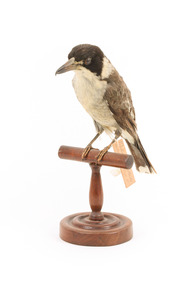 The Beechworth Burke Museum
Animal specimen - Grey Butcherbird, Trustees of the Australian Museum, 1860-1880
... heads and white underparts, while their young are typically olive-brown. The mix of these two types of colouring on this animal suggests that it is a younger bird. This bird appears thinner than most Grey Butcher Birds, but it is unclear if this is because of its age or because of inaccurate taxidermy. This specimen is part of a collection of almost 200 animal specimens that were originally acquired as skins from various institutions across Australia, including the Australian Museum in Sydney...heads and white underparts, while their young are typically olive-brown. The mix of these two types of colouring on this animal suggests that it is a younger bird. This bird appears thinner than most Grey Butcher Birds, but it is unclear if this is because of its age or because of inaccurate taxidermy. This specimen is part of a collection of almost 200 animal specimens that were originally acquired as skins from various institutions across Australia, including the Australian Museum in Sydney ...Grey Butcherbirds live in wooded habitats, including suburban areas, from the north of Western Australia, across different parts of the top of the country, through to mid-eastern Queensland, and then south along the eastern side of the country all the way down to Tasmania. They have a 'lovely, lilting song', and are fiercely protective of their nests and chicks, swooping at presumed attackers with enough strength to sometimes draw blood. Adult Grey Butcher Birds are typically a light grey colour with dark heads and white underparts, while their young are typically olive-brown. The mix of these two types of colouring on this animal suggests that it is a younger bird. This bird appears thinner than most Grey Butcher Birds, but it is unclear if this is because of its age or because of inaccurate taxidermy. This specimen is part of a collection of almost 200 animal specimens that were originally acquired as skins from various institutions across Australia, including the Australian Museum in Sydney and the National Museum of Victoria (known as Museums Victoria since 1983), as well as individuals such as amateur anthropologist Reynell Eveleigh Johns between 1860-1880. These skins were then mounted by members of the Burke Museum Committee and put-on display in the formal space of the Museum’s original exhibition hall where they continue to be on display. This display of taxidermy mounts initially served to instruct visitors to the Burke Museum of the natural world around them, today it serves as an insight into the collecting habits of the 19th century.This specimen is part of a significant and rare taxidermy mount collection in the Burke Museum. This collection is scientifically and culturally important for reminding us of how science continues to shape our understanding of the modern world. They demonstrate a capacity to hold evidence of how Australia’s fauna history existed in the past and are potentially important for future environmental research. This collection continues to be on display in the Museum and has become a key part to interpreting the collecting habits of the 19th century. This specimen is particularly special in the Burke Museum Collection as it is part of a male/female pair (see Relationships). Many birds in the collection were originally donated in male/female pairs, but at least one specimen has been lost, leaving these as one of the few surviving sets.This Grey Butcherbird (likely male, based on size) has a bill that is dark grey at the front with a sharp hook but becomes lighter towards the face. The majority of the feathers on its back are light brown with some grey feathers around the lower half. It's crown area is a dark black colour and its tail is a dark grey. The feathers of its underparts and a small patch on either side of the neck are a yellow-white colour. There are also grey feathers coming through on its underparts. The eyes are brown. The bird stands on a brown, wooden perch with a circular bar, curved stand, and circular base. It has an identification tag tied around its left leg.19a / Collared Crow. Shrike / See Catalogue, Page 10 /taxidermy mount, taxidermy, animalia, burke museum, beechworth, australian museum, skin, australian birds, butcher bird, butcherbird, grey butcherbird, collared crow-shrike, australian butcherbird, tasmanian butcherbird, tasmania, bird pair
