
Showing 56 items matching "table ware."
-
 Mont De Lancey
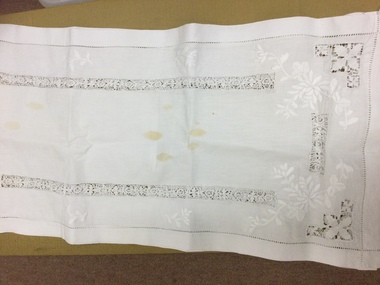
Domestic object - Table runner
... ...table ware...Table linen table ware Table runners Embroidery White, linen table runner with hand embroidery with floral patterns in various styles. ...White, linen table runner with hand embroidery with floral patterns in various styles.table linen, table ware, table runners, embroidery -
 Mont De Lancey
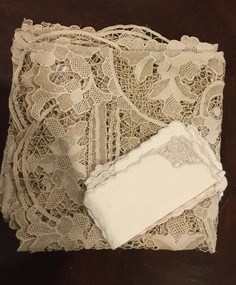
Supper cloth and serviettes
... table ware....table ware. table linen. Square, cream point lace supper cloth (floral pattern). ...Square, cream point lace supper cloth (floral pattern). Five cream linen serviettes with point lace flower in one corner and embroidered edging. Refer 1107 and 1108.table ware., table linen. -
 Mont De Lancey
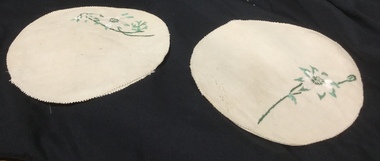
Doily
... table ware....table ware. table linen. doilies Four circular, cream-coloured table mat covers, each with a single hand-embroideered green and white flower on the right-hand side. ...Four circular, cream-coloured table mat covers, each with a single hand-embroideered green and white flower on the right-hand side. table ware., table linen., doilies -
 Williamstown Historical Society Inc
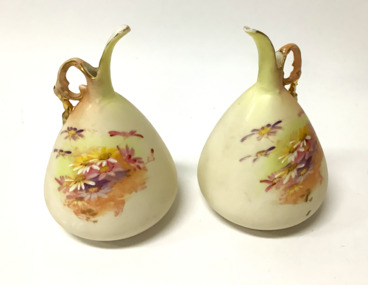
Accessory - Pair of Nelson Ware dressing table jugs
... Pair of Nelson Ware dressing table jugs...Probably used for hair oil, and as a dressing table accessory. Accessory Pair of Nelson Ware dressing table jugs ...Hair oil was historically used to smooth and nourish hair, by both men and women. These jugs probably date from the late 1800s. Pair of small urn shaped china jugs, with ornate gold rimmed handles. Hand painted with sprays of yellow and mauve flowers. Very small pouring holes and spout. Probably used for hair oil, and as a dressing table accessory.Etched on base: "1926 / 5F" On base of jug, in ink: "No 26" -
 Flagstaff Hill Maritime Museum and Village
Ceramic - Dish, Johnson Bros, Circa 1883 (very early Mark)
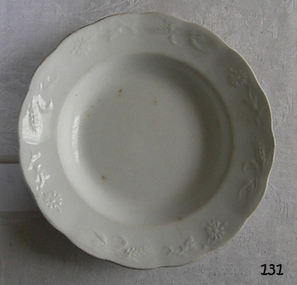
... ...table ware...This allowed potteries to produce fashionable pottery items that were affordable to all social classes of the time. flagstaff hill warrnambool shipwrecked coast flagstaff hill maritime museum flagstaff hill maritime village great ocean road bowl china bowl lion and unicorn crest table ware kitchen ware White Ware Johnson Brothers On base, "Royal Ironside China, Johnson Bros England" & crest of lion and unicorn Bowl white ceramic decorative with floral decoration around lip. ...Johnson Brothers were a British tableware manufacturer and exporter that was noted for its early introduction of "semi-porcelain" tableware. It was among the most successful of the Staffordshire potteries which produced tableware, much of it exported from the 1890s through the 1960s. They were also important manufacturers of large bathroom ceramics. The company was founded in 1883, but from 1968 to 2015 it operated as a part of the Wedgwood Group. However, after the Wedgwood Group was acquired by Fiskars in 2015, the production of Johnson Brothers was discontinued. The company's name derives from the names of the company's founders. The four original "Johnson Brothers" were Alfred, Frederick, Henry, and Robert. Their father married the daughter of a master potter, Alfred Meakin. In 1883, Alfred and Frederick Johnson began production at defunct pottery, known as the Charles Street Works, that they had purchased at a bankruptcy sale in Hanley, Stoke-on-Trent. At first, they specialised in the manufacture of durable earthenware, which they called "White Granite". The success of this venture led to rapid expansion. In 1888, the Rev. Henry Johnson joined them, followed ten years later by a fourth brother, Robert Johnson. Having established a solid reputation producing basic "whiteware", the company developed a product known as "semi-porcelain", a range of pottery that had the characteristics of fine china, but the durability of ironstone ware. This kind of tableware soon became very popular in the United States due to its durability and low cost. In 1889, the Hanley pottery was opened, later the Alexander pottery, and in 1891 the Imperial Works Pottery. In 1896, the Trent Sanitary Works was opened for the production of non-tableware products, and Alfred Johnson left the business to establish his pottery. By 1898, Robert Johnson had relocated to New York City to manage Johnson Brothers' rapid expansion into the North American market. An item that gives a snapshot into the emerging market for tableware that was reasonably priced and serviceable. The company produced "whiteware" but the innervation of the pottery line called semi-porcelain changed the industry. This allowed potteries to produce fashionable pottery items that were affordable to all social classes of the time. Bowl white ceramic decorative with floral decoration around lip. On base, "Royal Ironside China, Johnson Bros England" & crest of lion and unicorn flagstaff hill, warrnambool, shipwrecked coast, flagstaff hill maritime museum, flagstaff hill maritime village, great ocean road, bowl, china bowl, lion and unicorn crest, table ware, kitchen ware, white ware, johnson brothers -
 Flagstaff Hill Maritime Museum and Village
Ceramic - Jug, 1881
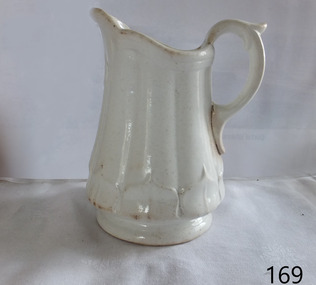
... ...table ware...A mid to late 19th century ironstone jug with no makers markings only a date letter therefore at this time cannot be associated with an historical event, person or place, provenance regards maker is unknown, item assessed as a collection asset given it was produced before 1950. flagstaff hill warrnambool shipwrecked coast flagstaff hill maritime museum flagstaff hill maritime village ceramic jug drink ware kitchen ware table ware ceramic pottery milk jug cream jug Ironstone Jug Letter "E" date mark for 1881 Jug, white Earthenware with leaf decoration around the base, handle and lip. ...Over 1500 pottery firms have operated in Stoke-on-Trent since the early 1700's - Some lasted only a few years and some for well over 200 years. Some potters built and owned their own works. Many others were tenants in works built by others and a succession of potters occupied the same works. It was also a common practice for a works to be split between two different pottery companies or for a larger manufacturer to let out a smaller section of his works to a potter who would make wares which were not of interest to the pot works owner. Some potters purchased 'blanks' from other manufacturers and put their own decoration on them some items have two back stamps some have no marks at all. This adds to the confusion and frustration of trying to trace details of a particular manufacturer such as the subject item.A mid to late 19th century ironstone jug with no makers markings only a date letter therefore at this time cannot be associated with an historical event, person or place, provenance regards maker is unknown, item assessed as a collection asset given it was produced before 1950.Jug, white Earthenware with leaf decoration around the base, handle and lip.Letter "E" date mark for 1881flagstaff hill, warrnambool, shipwrecked coast, flagstaff hill maritime museum, flagstaff hill maritime village, ceramic jug, drink ware, kitchen ware, table ware, ceramic, pottery, milk jug, cream jug, ironstone jug -
 City of Moorabbin Historical Society (Operating the Box Cottage Museum)
Domestic object - Kitchen Equipment, sad iron with Mrs Potts handle, c1900
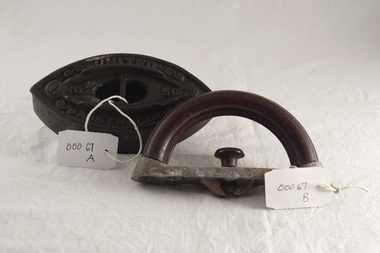
... ...table ware...The family of Ms May Curtis were early settlers in Moorabbin Shire potts florence iowa usa melbourne moorabbin sad irons kitchen equipmentn fireplaces walnut wood sewing laundry table ware linen pioneers early settlers washing days craftwork A) UNITED/ N0 / 50 / AUSTRALIA A) A sad iron, made of cast iron , has a special handle invented in 1871 by Mrs Florence Potts of Iowa, USA. ...Sad-irons or "solid" irons were made by blacksmiths and used to smooth out material by pressing the hot iron over it. A piece of sheet -iron was placed over the kitchen fire and the irons placed on it could be heated whilst remaining clean of ash.. The women used 2 irons - one heating while the other was used. Thick cloth or gloves protected their hands from the hot irons. The handle was removed from the cool iron and re- attached to remove the hot iron from the fire. The cool iron was replaced on the fire or stove to heat again. Mrs Florence Potts invented in 1871 a detachable handle made from walnut wood with a metal latch to release the handle. These wooden handles prevented burned hands and were sold to grateful women all over the world. These irons were cleaned with steel wool to prevent them marking the material. If the iron was too hot the material would scorch. Most homes set aside one day for ironing and some large households had an ironing room with a special stove designed to heat irons. However, most women had to work with a heavy, hot iron close to the fireplace even in summer.Mrs Florence Potts invented this type of detachable walnut wood handle with a meta release latch for sad irons in 1871 and it sold widely throughout the world to grateful women including those in Moorabbin Shire. The family of Ms May Curtis were early settlers in Moorabbin ShireA) A sad iron, made of cast iron , has a special handle invented in 1871 by Mrs Florence Potts of Iowa, USA. B) The detachable handle made of walnut wood to prevent burned hands, was attached to the iron by a metal latch.A) UNITED/ N0 / 50 / AUSTRALIApotts florence, iowa usa, melbourne, moorabbin, sad irons, kitchen equipmentn fireplaces, walnut wood, sewing, laundry, table ware, linen, pioneers, early settlers, washing days, craftwork -
 City of Moorabbin Historical Society (Operating the Box Cottage Museum)
Domestic object - Kitchen Equipment, 'Smoothwell' electric flat iron c1935, c1935
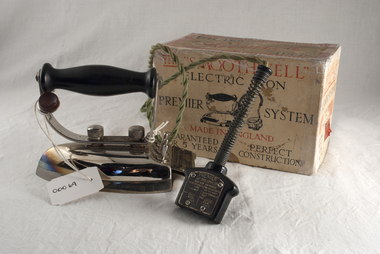
... ...table ware...This c1935 Premier System 'Smoothwell' flat iron was used by a resident of City of Moorabbin and is an example of the progress made from the sad irons used by the pioneers that are displayed beside it. seely henry w. sad irons electric flat irons dyer richard edison thomas hotpoint pty ltd. premier electric company birmingham england pioneers early settlers moorabbin bentleigh cheltenham laundry sewing craftwork table ware irons On plate of handle attached to Iron ' HARRODS Ltd. / LONDON On attached plate at rear of iron ' The "SMOOTHWELL" / "Premier System" /......... ...c1881 Henry W Seely, of New Jersey, USA, designed and patented an electric sad iron for pressing and smoothing material. He continued to modify and improve his designs, with his partner Richard Dyer, and other electrical appliance firms, e.g Hotpoint, began producing these flat irons that could provide continuous heat by connecting via an electrical flex to a light socket and hence without the need for hot fires, ash, or burning hot handles. Women with access to an electricity supply were delighted and their ironing chore became much less arduous No heat was felt at all from the iron as it is all concentrated on the bottom surface. By the early 20th century enthusiasm was building for the new electric smoothing irons: clean, powerful, adjustable, and labour-saving. This c1935 Premier System 'Smoothwell' flat iron was used by a resident of City of Moorabbin and is an example of the progress made from the sad irons used by the pioneers that are displayed beside it.A "Premier Smoothwell" electric flat iron with switched control lead and original box, c 1935 On plate of handle attached to Iron ' HARRODS Ltd. / LONDON On attached plate at rear of iron ' The "SMOOTHWELL" / "Premier System" /......... Plate on cord Plug " PREMIER/ FLAT IRON CONNECTOR/ THIS SIDE OUTWARDS/ (2 columns) 1) FOR 100-125 VOLTS/ USE THREE TERMINALS/ THUS ..... 2) FOR 200 - 240 VOLTS/ USE TWO RIGHT/ HAND TERMINALS/ ONLY/ THUS......seely henry w., sad irons, electric flat irons, dyer richard, edison thomas, hotpoint pty ltd., premier electric company birmingham england, pioneers, early settlers, moorabbin, bentleigh, cheltenham, laundry, sewing, craftwork, table ware, irons -
 Orbost & District Historical Society
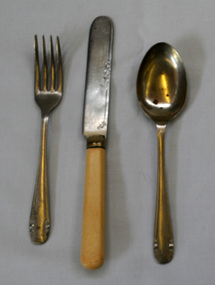
cutlery, 1920's
... cutlery nickel-silver table-ware...Items inscribed with WEARS WHITE meant that the metal stays white even as it wears. cutlery nickel-silver table-ware nickel silver WEARS WHITE Five items of silver plated cutlery. 2133.1 is a small knife, 2133.2 is a fork and 2133.3 is a spoon. ...Nickel silver first became popular as a base metal for silver-plated cutlery and other silverware, notably the electroplated wares called EPNS (electro-plated nickel silver). Nickel silver is named for its silvery appearance, but ironically it actually contains no elemental silver. Items inscribed with WEARS WHITE meant that the metal stays white even as it wears.Five items of silver plated cutlery. 2133.1 is a small knife, 2133.2 is a fork and 2133.3 is a spoon. These three pieces are children's cutlery. 2133.4 is salt spoon and 2133.5 is a butter knife. All but 2133.1 have metal handles. The knife handle could be celluloid plastic.nickel silver WEARS WHITEcutlery nickel-silver table-ware -
 Bendigo Historical Society Inc.
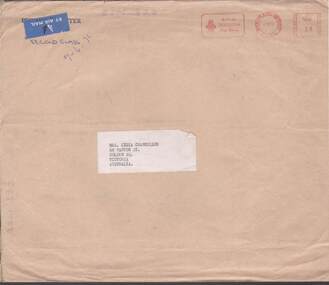
Magazine - LYDIA CHANCELLOR COLLECTION: 'TABLE TOPICS' AND 'TABLEWARE TIMES'
... ... table ware...HANDCRAFTS ceramics Lydia Chancellor Collection collection magazines Royal Doulton pottery ceramics recreations amusements table ware industries handcrafts ceramics 2 magazines - (i) 'Table Topics,' - The magazine of the Royal Doulton Tableware Division Autumn 1971. ...2 magazines - (i) 'Table Topics,' - The magazine of the Royal Doulton Tableware Division Autumn 1971. Printed in England by Warwick Savage Ltd. Burslem. (ii) 'Tableware Times,' - Royal Doulton No. 1 Summer 1971. Editor David Allen. Printed by Warwick Savage Ltd. Burslem. Both magazines are in a brown envelope addressed to Mrs. Lydia Chancellor 68 Panton St., Golden Sq., Victoria Australia. Dated 7-7-71.handcrafts, ceramics, lydia chancellor collection, collection, magazines, royal doulton, pottery, ceramics, recreations, amusements, table ware, industries, handcrafts, ceramics -
 Clunes Museum
Domestic object - COVER
... ...table ware...TABLE ACCESSORY USED BY TREMBATH FAMILY. local history manchester table ware trembath perry FINE COTTON CROCHET BAG TO COVER SAUCE BOTTLE Domestic object COVER ...TABLE ACCESSORY USED BY TREMBATH FAMILY.FINE COTTON CROCHET BAG TO COVER SAUCE BOTTLElocal history, manchester, table ware, trembath, perry -
 Whitehorse Historical Society Inc.
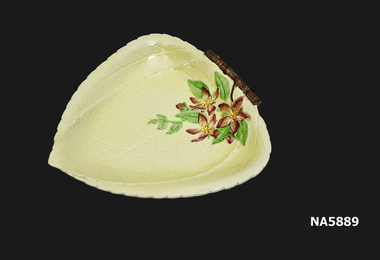
Domestic object - Leaf-shaped utility dish, Carlton ware, Circa 1950's
... Table ware...Utility dish used for fruit - table or sideboard Table ware Calton ware - Made England-Australia Design - registration applied for Circa 1950's Leaf-shaped utility dish - yellow glaze; floral design Majolica range Brown branch Domestic object Leaf-shaped utility dish Carlton ware ...Utility dish used for fruit - table or sideboardCirca 1950's Leaf-shaped utility dish - yellow glaze; floral design Majolica range Brown branchCalton ware - Made England-Australia Design - registration applied fortable ware -
 Whitehorse Historical Society Inc.
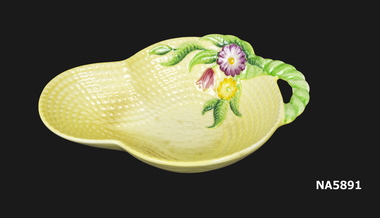
Domestic object - Pear-shaped utility dish, Carlton Ware, C 1950's
... Table ware...Utility dish used for fruit, meal additives Table or sideboard Table ware Carlton ware. Made in England - Trade Mark Registered - Australian Design - Registration applied for Circa 1950's Pear shaped- Majolica range Yellow glazed - coloured floral design Green plaited handle rippled inside Domestic object Pear-shaped utility dish Carlton Ware ...Utility dish used for fruit, meal additives Table or sideboardCirca 1950's Pear shaped- Majolica range Yellow glazed - coloured floral design Green plaited handle rippled insideCarlton ware. Made in England - Trade Mark Registered - Australian Design - Registration applied fortable ware -
The 5th/6th Battalion Royal Victoria Regiment Historical Collection
Memorabilia - Bucket Ice - small x 2
... ...Table Ware...Presented to the unit by two former Commanding Officers Regimental Property VSR Table Ware 5/6 RVR Silverware from Lt Col G. R. ...Presented to the unit by two former Commanding Officers 2 Stirling silver ice buckets, ornate handles, Rampart Lion on front inscribed from Lt Col G. R. Warfe DSO MC Commanding Officer 1948 - 1951and second one inscribed with from LT Col IH Lowen Commanding Officer 1951-1958. from Lt Col G. R. Warfe DSO MC Commanding Officer 1948 - 1951 from LT Col IH Lowen Commanding Officer 1951-1958.regimental property, vsr, table ware, 5/6 rvr, silverware -
 Mont De Lancey
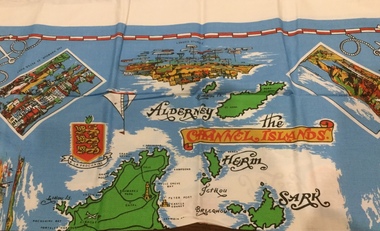
Functional object - Tablecloth
... table ware....table ware. household textiles. table linen. Names of places, beaches and bays on the Channel islands. ...A square, souvenir tablecloth from the Channel Islands. On an azure background, all the islands are printed and named on the tablecloth, as well as the names of the towns, villages and the bays of both Jersey and Guernsey. There are four rectangular pictures, surrounded by a white border, representing significant places and buildings, as well as others, without borders, depicting old and modern ships, a compass, a coat of arms and the distinctive Jersey and Guernsey cow.There is a red and white border, almost at the edge of the azure background and in each corner is printed a white anchor and rope. There is also a 3 cm. plain white outer border around the tablecloth.Names of places, beaches and bays on the Channel islands. Pictorial representations of significant places and buildings and a white anchor and rope in each of the four corners. "Exclusive to Creaseys of Guernsey" is printed at the bottom left hand corner of the tablecloth.table ware., household textiles., table linen. -
 Mont De Lancey
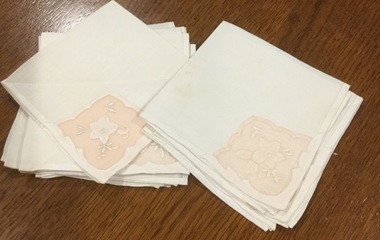
Serviettes, 1971
... ...table ware....table linen. table ware. household textiles Set of ten cream, linen serviettes, each with a pink applique'd and embroidered flower in one corner. ...Set of ten cream, linen serviettes, each with a pink applique'd and embroidered flower in one corner.table linen., table ware., household textiles -
 Mont De Lancey
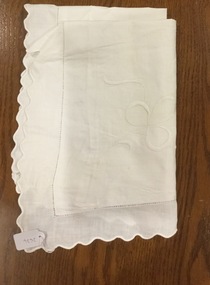
Tablecloth and pillow slip
... table ware....table ware. bed linen. household textiles. White, nylon tablecloth with lace star in the centre, surrounded by lace lines, with embroidered crystal shapes within lace in each corner. ...White, nylon tablecloth with lace star in the centre, surrounded by lace lines, with embroidered crystal shapes within lace in each corner. White, linen pillow slip with an embroidered flower and leaves in each corner. It has a pulled thread and embroidered, scalloped border, (Torn)table ware., bed linen., household textiles. -
 Mont De Lancey
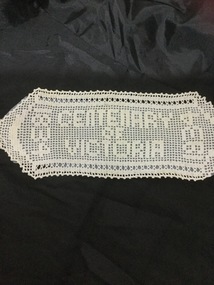
Doily, 1934
... table ware....Made to commemorate the centenary of Victoria 1834 - 1934. table ware. commemorative objects doilies "Centenary of Victoria 1834 - 1934" White cotton, hexagonal, commemorative doily with pulled thread and embroidery pattern and inscription. ...Made to commemorate the centenary of Victoria 1834 - 1934.White cotton, hexagonal, commemorative doily with pulled thread and embroidery pattern and inscription."Centenary of Victoria 1834 - 1934"table ware., commemorative objects, doilies -
 Mont De Lancey
Doily
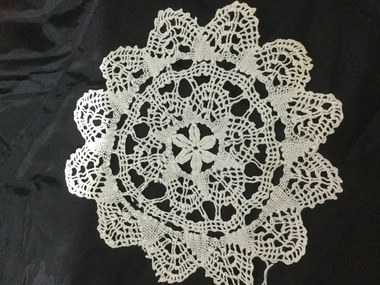
... table ware....table ware. doilies table linen. White, cotton lace doily with an embroidered flower in the centre and a scalloped edge. ...White, cotton lace doily with an embroidered flower in the centre and a scalloped edge.table ware., doilies, table linen. -
 Mont De Lancey
Supper cloth
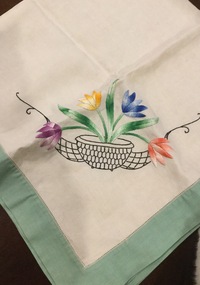
... ...table ware...table linen. table ware Square, white linen supper cloth with a basket of flowers, hand embroidered in satin stitch in each corner of the cloth and green ecru edging. ...Square, white linen supper cloth with a basket of flowers, hand embroidered in satin stitch in each corner of the cloth and green ecru edging.table linen., table ware -
 Mont De Lancey
Tablecloth
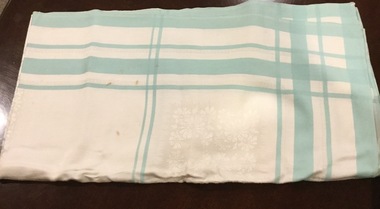
... ...table ware...table linen. table ware Square, white, rayon kitchen tablecloth with straight green line design and one inch border and a white floral embossed pattern. ...Square, white, rayon kitchen tablecloth with straight green line design and one inch border and a white floral embossed pattern.table linen., table ware -
 Mont De Lancey
Tray cloth and doily
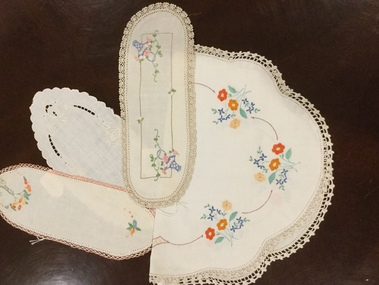
... ...table ware....table linen. table ware. Cream, hand-embroidered, linen tray cloth with orange, apricot, blue and green floral design and a scalloped, crocheted edging. ...Cream, hand-embroidered, linen tray cloth with orange, apricot, blue and green floral design and a scalloped, crocheted edging. Three cream, linen doilies, one with a scalloped edging and cream hand embroidery and one with two blue hand-embroidered baskets of pink flowers and with a crocheted edging. The third doily has a floral, hand-embroidered design, with a pink crocheted edging.table linen., table ware. -
 Mont De Lancey
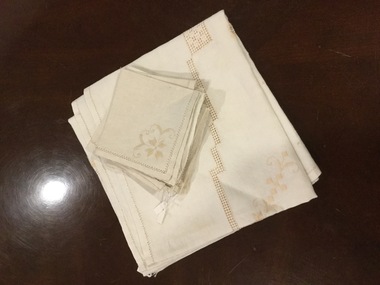
Tablecloth. Serviettes
... ...table ware....table linen. table ware. One cream linen tablecloth with drawn thread and hand-embroidered, floral design and 6 matching linen serviettes with a cream, hand-embroidered in satin stitch flower in one corner of each serviette. ...One cream linen tablecloth with drawn thread and hand-embroidered, floral design and 6 matching linen serviettes with a cream, hand-embroidered in satin stitch flower in one corner of each serviette.table linen., table ware. -
Emerald Museum & Nobelius Heritage Park
Domestic object - Carving set, 1900s-1930s
... ...table ware...The items are significant as they provide insights into the cooking equipment and techniques in use in the region in the early-to-mid twentieth century. kitchen equipment Domestic items--Food preparation table ware 1910s Carving set comprising carving fork with flip up thumb guard, knife sharpener and carving knife. ...The metal used to manufacture the items is unknown. They are not stamped to indicate the metal, and display more abrasion and staining than similar knives in the collection which are stamped to indicate their manufacture from Stainless Steel. This may indicate the age of the knife, as stainless steel (steel which did not rust) became more commonly used for tableware and kitchen equipment from the late 1920s.The items are significant as they provide insights into the cooking equipment and techniques in use in the region in the early-to-mid twentieth century.Carving set comprising carving fork with flip up thumb guard, knife sharpener and carving knife. Each item is cast metal with an ivory or bone handle. The set probably dates from the early 1900s.kitchen equipment, domestic items--food preparation, table ware, 1910s -
Emerald Museum & Nobelius Heritage Park
Domestic object - Flat Iron, Kerrick, early 1900s
... ...table ware...Mrs Florence Potts invented this type of detachable walnut wood handle with a meta release latch for sad irons in 1871 and it sold widely throughout the world to grateful women potts florence sad irons kitchen equipmentn fireplaces walnut wood sewing laundry table ware linen pioneers early settlers washing days craftwork Cast iron and steel flat iron. ...Sad-irons or "solid" irons were made by blacksmiths and used to smooth out material by pressing the hot iron over it. A piece of sheet -iron was placed over the kitchen fire and the irons placed on it could be heated whilst remaining clean of ash.. The women used 2 irons - one heating while the other was used. Thick cloth or gloves protected their hands from the hot irons. The handle was removed from the cool iron and re- attached to remove the hot iron from the fire. The cool iron was replaced on the fire or stove to heat again. Mrs Florence Potts invented in 1871 a detachable handle made from walnut wood with a metal latch to release the handle. These wooden handles prevented burned hands and were sold to grateful women all over the world. These irons were cleaned with steel wool to prevent them marking the material. If the iron was too hot the material would scorch. Most homes set aside one day for ironing and some large households had an ironing room with a special stove designed to heat irons. However, most women had to work with a heavy, hot iron close to the fireplace even in summer.Mrs Florence Potts invented this type of detachable walnut wood handle with a meta release latch for sad irons in 1871 and it sold widely throughout the world to grateful womenCast iron and steel flat iron. No 2. Embossed “Kerrick Mrs Potts Sad Iron – West ???mwich Englandpotts florence, sad irons, kitchen equipmentn fireplaces, walnut wood, sewing, laundry, table ware, linen, pioneers, early settlers, washing days, craftwork -
Emerald Museum & Nobelius Heritage Park
Domestic object - Flat Iron, early 1900s
... ...table ware...Mrs Florence Potts invented this type of detachable walnut wood handle with a meta release latch for sad irons in 1871 and it sold widely throughout the world to grateful women potts florence sad irons kitchen equipmentn fireplaces walnut wood sewing laundry table ware linen pioneers early settlers washing days craftwork Cast iron and steel flat iron. ...Sad-irons or "solid" irons were made by blacksmiths and used to smooth out material by pressing the hot iron over it. A piece of sheet -iron was placed over the kitchen fire and the irons placed on it could be heated whilst remaining clean of ash.. The women used 2 irons - one heating while the other was used. Thick cloth or gloves protected their hands from the hot irons. The handle was removed from the cool iron and re- attached to remove the hot iron from the fire. The cool iron was replaced on the fire or stove to heat again. Mrs Florence Potts invented in 1871 a detachable handle made from walnut wood with a metal latch to release the handle. These wooden handles prevented burned hands and were sold to grateful women all over the world. These irons were cleaned with steel wool to prevent them marking the material. If the iron was too hot the material would scorch. Most homes set aside one day for ironing and some large households had an ironing room with a special stove designed to heat irons. However, most women had to work with a heavy, hot iron close to the fireplace even in summer.Mrs Florence Potts invented this type of detachable walnut wood handle with a meta release latch for sad irons in 1871 and it sold widely throughout the world to grateful womenCast iron and steel flat iron. No 2potts florence, sad irons, kitchen equipmentn fireplaces, walnut wood, sewing, laundry, table ware, linen, pioneers, early settlers, washing days, craftwork -
Emerald Museum & Nobelius Heritage Park
Domestic object - Flat Iron, early 1900s
... ...table ware...Mrs Florence Potts invented this type of detachable walnut wood handle with a meta release latch for sad irons in 1871 and it sold widely throughout the world to grateful women potts florence sad irons kitchen equipmentn fireplaces walnut wood sewing laundry table ware linen pioneers early settlers washing days craftwork Cast iron and steel flat iron. ...Sad-irons or "solid" irons were made by blacksmiths and used to smooth out material by pressing the hot iron over it. A piece of sheet -iron was placed over the kitchen fire and the irons placed on it could be heated whilst remaining clean of ash.. The women used 2 irons - one heating while the other was used. Thick cloth or gloves protected their hands from the hot irons. The handle was removed from the cool iron and re- attached to remove the hot iron from the fire. The cool iron was replaced on the fire or stove to heat again. Mrs Florence Potts invented in 1871 a detachable handle made from walnut wood with a metal latch to release the handle. These wooden handles prevented burned hands and were sold to grateful women all over the world. These irons were cleaned with steel wool to prevent them marking the material. If the iron was too hot the material would scorch. Most homes set aside one day for ironing and some large households had an ironing room with a special stove designed to heat irons. However, most women had to work with a heavy, hot iron close to the fireplace even in summer.Mrs Florence Potts invented this type of detachable walnut wood handle with a meta release latch for sad irons in 1871 and it sold widely throughout the world to grateful womenCast iron and steel flat iron. No 1potts florence, sad irons, kitchen equipmentn fireplaces, walnut wood, sewing, laundry, table ware, linen, pioneers, early settlers, washing days, craftwork -
Emerald Museum & Nobelius Heritage Park
Domestic object - Clip on handle for flat irons, early 1900s
... ...table ware...Mrs Florence Potts invented this type of detachable walnut wood handle with a meta release latch for sad irons in 1871 and it sold widely throughout the world to grateful women potts florence sad irons kitchen equipmentn fireplaces walnut wood sewing laundry table ware linen pioneers early settlers washing days craftwork Clip on handle, steel and walnut Domestic object Clip on handle for flat irons. ...Sad-irons or "solid" irons were made by blacksmiths and used to smooth out material by pressing the hot iron over it. A piece of sheet -iron was placed over the kitchen fire and the irons placed on it could be heated whilst remaining clean of ash.. The women used 2 irons - one heating while the other was used. Thick cloth or gloves protected their hands from the hot irons. The handle was removed from the cool iron and re- attached to remove the hot iron from the fire. The cool iron was replaced on the fire or stove to heat again. Mrs Florence Potts invented in 1871 a detachable handle made from walnut wood with a metal latch to release the handle. These wooden handles prevented burned hands and were sold to grateful women all over the world. These irons were cleaned with steel wool to prevent them marking the material. If the iron was too hot the material would scorch. Most homes set aside one day for ironing and some large households had an ironing room with a special stove designed to heat irons. However, most women had to work with a heavy, hot iron close to the fireplace even in summer.Mrs Florence Potts invented this type of detachable walnut wood handle with a meta release latch for sad irons in 1871 and it sold widely throughout the world to grateful womenClip on handle, steel and walnutpotts florence, sad irons, kitchen equipmentn fireplaces, walnut wood, sewing, laundry, table ware, linen, pioneers, early settlers, washing days, craftwork -
 Whitehorse Historical Society Inc.
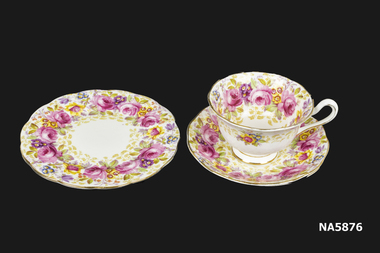
Domestic object - Cup, saucer & plate, Royal Albert, C 1950's
... Afternoon tea table serving ware...Afternoon tea serving ware Floral design (Serena) Afternoon tea table serving ware Royal Albert Bone China Serena, England Reg. ...Afternoon tea serving ware Floral design (Serena)Circa 1950 - Royal Albert Afternoon tea serving ware Rose pattern Gold leave edgingRoyal Albert Bone China Serena, England Reg. No 8393529afternoon tea table serving ware -
 City of Moorabbin Historical Society (Operating the Box Cottage Museum)
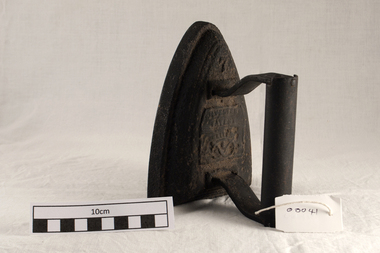
Domestic object - Kitchen equipment, sad iron, c1880
... Sad-iron, domestic, flat, cast iron, Silvester's Patent, No 6, Salter, England, c. 1890-1900s A sad iron made from cast iron was heated over a fire or on a stove and used for pressing clothing and table ware...The family of Miss M Curtis were early settlers in Moorabbin Shire. sad iron kitchen equipment pioneers early settlers market gardeners sewing craftwork clothing moorabbin brighton bentleigh fireplaces stoves SILVESTER'S/ PATENT/ SALTERS / No 6 with the pretzel & a arrow going through the centre Sad-iron, domestic, flat, cast iron, Silvester's Patent, No 6, Salter, England, c. 1890-1900s A sad iron made from cast iron was heated over a fire or on a stove and used for pressing clothing and table ware Domestic object Kitchen equipment, sad iron Silvester's Salter Pty Ltd ...Sad-irons or "solid" irons were made by blacksmiths and used to smooth out material by pressing the hot iron over it. A piece of sheet -iron was placed over the kitchen fire and the irons placed on it could be heated whilst remaining clean of ash.. The women used 2 irons - one heating while the other was used. Thick cloth or gloves protected their hands from the hot irons. The handle was removed from the cool iron and re- attached to remove the hot iron from the fire. The cool iron was replaced on the fire or stove to heat again. These irons were cleaned with steel wool to prevent them marking the material. If the iron was too hot the material would scorch. Most homes set aside one day for ironing and some large households had an ironing room with a special stove designed to heat irons. However, most women had to work with a heavy, hot iron close to the fireplace even in summer.These sad irons remind us of the difficult circumstances experienced in their daily routines by the pioneers and early settlers of Moorabbin Shire. The family of Miss M Curtis were early settlers in Moorabbin Shire. Sad-iron, domestic, flat, cast iron, Silvester's Patent, No 6, Salter, England, c. 1890-1900s A sad iron made from cast iron was heated over a fire or on a stove and used for pressing clothing and table wareSILVESTER'S/ PATENT/ SALTERS / No 6 with the pretzel & a arrow going through the centresad iron, kitchen equipment, pioneers, early settlers, market gardeners, sewing, craftwork, clothing, moorabbin, brighton, bentleigh, fireplaces, stoves
