
Showing 3 items matching "tangambalanga world war 1"
-
 Wodonga & District Historical Society Inc
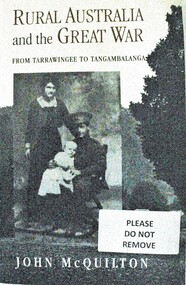
Book - Rural Australia and the Great War - From Tarrawingee to Tangambalanga, John McQuilton, 2001
... World War 1...Rural Conditions Australia 1914...World War 1 Social Conditions Australia...Tangambalanga...This publication is significant as it focuses on the impact of World War 1 in the rural communities of North Eastern Victoria. World War 1 Rural Conditions Australia 1914 World War 1 Social Conditions Australia Tangambalanga World War 1 This publication covers common issues of life in Australia during World War 1, such as recruitment, fundraising, conscription, homecomings and the construction of memorials. ...This publication covers common issues of life in Australia during World War 1, such as recruitment, fundraising, conscription, homecomings and the construction of memorials. However it is unique in that these aspects of war are examined through a focus on rural communities in North Eastern Victoria. The first chapter describes the region and its towns at the outbreak of war, then discusses the fracturing impact of war on different groups within these communities. It paints an interesting social history at a critical time in Australia's development. John Quilton is a native of North Eastern Victoria, having been born in Yackandandah and educated in Tangambalanga and Wodonga. He was a senior member of the Bicentennial History Project at the University of New South Wales, and head of the History and Politics Program at the University of Wollongong.This book consists of 275 pages including photos and a map, as well as an extensive bibliography. The cover depicts a soldier and his family and a country town streetscape on the back.This publication covers common issues of life in Australia during World War 1, such as recruitment, fundraising, conscription, homecomings and the construction of memorials. However it is unique in that these aspects of war are examined through a focus on rural communities in North Eastern Victoria. The first chapter describes the region and its towns at the outbreak of war, then discusses the fracturing impact of war on different groups within these communities. It paints an interesting social history at a critical time in Australia's development. John Quilton is a native of North Eastern Victoria, having been born in Yackandandah and educated in Tangambalanga and Wodonga. He was a senior member of the Bicentennial History Project at the University of New South Wales, and head of the History and Politics Program at the University of Wollongong.world war 1, rural conditions australia 1914, world war 1 social conditions australia, tangambalanga world war 1 -
 Kiewa Valley Historical Society
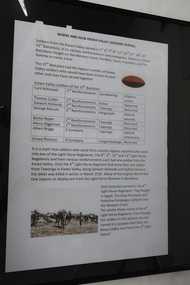
Posters - "Tawonga Remembers" x 8
... 1. Where and How Kiewa Valley Soldiers Served; 2. Tawonga and Dederang Servicemen; 3. Kergunyah and Gundowring Servicemen and Women; 4. Kiewa and Tangambalanga Servicemen.5. Sacrifice and Honour; 6. The End of the Great War; 7. World...1. Where and How Kiewa Valley Soldiers Served; 2. Tawonga and Dederang Servicemen; 3. Kergunyah and Gundowring Servicemen and Women; 4. Kiewa and Tangambalanga Servicemen.5. Sacrifice and Honour; 6. The End of the Great War; 7. World ...The town of Tawonga is in the Kiewa Valley surrounded by farmland. it is adjacent to Mt Beauty (built from 1946), an SECV town built for the workers on the Kiewa Hydro Electric Scheme which was being constructed from 1911 to 1961. Tawonga consisted of essential amenities including a store, school, butter factory, sporting facilities, post office, hall and hotel. Activities involved sport, social get togethers eg. dances, fundraising, CWA etc. The posters are a collection of historical photos, documentations and information regarding the history of the town of Tawonga, which is the centre of a farming community in the Kiewa Valley.Posters framed with thin black plastic strip, covered by glass. Each one has a title re "Tawonga Remembers" and includes print and photos in black and white. White background. 1. Where and How Kiewa Valley Soldiers Served; 2. Tawonga and Dederang Servicemen; 3. Kergunyah and Gundowring Servicemen and Women; 4. Kiewa and Tangambalanga Servicemen.5. Sacrifice and Honour; 6. The End of the Great War; 7. World War 1914-18; 8. Soldiers in Uniform (Black background and glass cracked) tawonga, photos of early tawonga, kiewa valley, tawonga remembers, ww1 -
 Wodonga & District Historical Society Inc
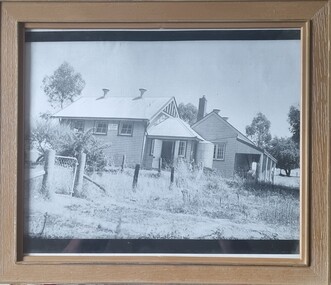
Photograph - Red Bluff Primary School No. 3526
... Tangambalanga school was rebuilt about 1910 the old one was annexed to Red Bluff as a second room. When the school opened about 35 pupils attended Grades 1 – VI under W. Boyd Jamieson and assistant Miss A.M Thomas. The first Committee consisted of T. Thomas, Chairman; W. H. Stuckey, Correspondent; J. Payne, C.W. Crosthwaite and T. H. Nevin. In 1914 a teacher’s residence was built. During the First World War...Tangambalanga school was rebuilt about 1910 the old one was annexed to Red Bluff as a second room. When the school opened about 35 pupils attended Grades 1 – VI under W. Boyd Jamieson and assistant Miss A.M Thomas. The first Committee consisted of T. Thomas, Chairman; W. H. Stuckey, Correspondent; J. Payne, C.W. Crosthwaite and T. H. Nevin. In 1914 a teacher’s residence was built. During the First World War ...Red Bluff was a grazing district with a few miners, a blacksmith and a storekeeper. Its 30 children used to attend school at Sandy Creek or Tangambalanga until a new school was built at Red Bluff. It opened in January 1906. The school had been proposed by T. Thomas William Stuckey and James Payne. The original one-room school was built on land owned by Mrs A.E. Stuckey near Five Ways about 4 miles from the Huon Railway station. When the Tangambalanga school was rebuilt about 1910 the old one was annexed to Red Bluff as a second room. When the school opened about 35 pupils attended Grades 1 – VI under W. Boyd Jamieson and assistant Miss A.M Thomas. The first Committee consisted of T. Thomas, Chairman; W. H. Stuckey, Correspondent; J. Payne, C.W. Crosthwaite and T. H. Nevin. In 1914 a teacher’s residence was built. During the First World War, Frank McNamara, a teacher at the school, was awarded the Victoria Cross; another teacher Frank Collins, was killed. Of the 12 ex-students who enlisted, 11 returned. The school itself raised considerable funds for patriotic purposes. Divine Service was held twice monthly in the school for many years. The school closed in 1952 with the pupils and buildings being relocated to the Kiewa Valley Consolidated School. The residence continued to be occupied by teachers until condemned in 1966.This item is significant because it documents a small school in the Wodonga District.A framed black and white photo of Red Bluff Primary School.On side of building Red Bluff School No 3526red bluff primary school, education wodonga & district
