
Showing 346 items matching "technicians"
-
 University of Melbourne, Burnley Campus Archives
Accreditation of Course, Collingwood College of T.A.F.E, Technicians Certificate in Sports Management, 1986
... Technicians Certificate in Sports Management......technicians...Submission to the TAFE Board for the accreditation of he Technicians Course in Sports Turf Management Volume 1 of 5 (including appendices). ...accreditation sports turf management technicians collingwood college of tafe curriculum Spiral bound with light cardboard covers. ...accreditation, sports turf management, technicians, collingwood college of tafe, curriculum -
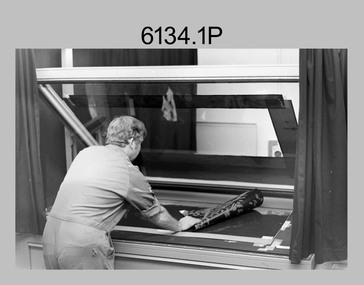 Bendigo Military Museum
Photograph - Lithographic Technicians Preparing Printing Plates at the Army Survey Regiment, Fortuna Villa Bendigo, 1988
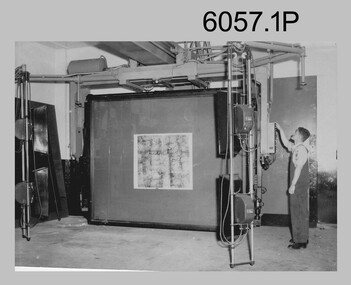
... Lithographic Technicians Preparing Printing Plates at the Army Survey Regiment, Fortuna Villa Bendigo. ...In these photos the technician preparing printing plates for offset printing. ...This is a set of six photographs of lithographic technicians preparing printing plates at the Army Survey Regiment, Bendigo in 1988. ...In these photos the technician preparing printing plates for offset printing. ...These six photographs were most likely taken in 1988 in Lithographic Squadron at the Army Survey Regiment, Fortuna, Bendigo. In these photos the technician preparing printing plates for offset printing. The Printing Technician in photos .1P to .4P is placing a map negative on top of the printing plate in a vacuum frame before light exposure. In photos .5P to .6P the technician is inserting the printing plate in the processor.This is a set of six photographs of lithographic technicians preparing printing plates at the Army Survey Regiment, Bendigo in 1988. The photographs were on 35mm negative film and were scanned at 96 dpi. They are part of the Army Survey Regiment’s Collection. The photos are not annotated.royal australian survey corps, rasvy, army survey regiment, army svy regt, fortuna, asr, litho, printing -
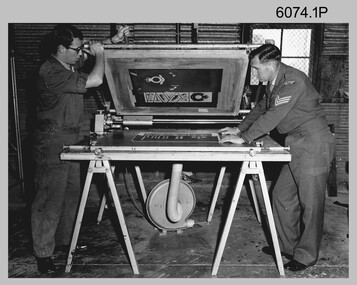 Bendigo Military Museum
Photograph - Lithographic Technicians Screen Printing at the Army Survey Regiment, c1970s
... Lithographic Technicians Screen Printing at the Army Survey Regiment...The photos are annotated with the name of the technicians written on the back. In these photos the technicians are performing screen printing tasks....This is a set of photographs of lithographic technicians using screen printing equipment at the Army Survey Regiment, Bendigo from c1960s to c1980s. ...The photos are annotated with the name of the technicians written on the back. In these photos the technicians are performing screen printing tasks. ...These two photographs were most likely taken in the 1970s at the Army Survey Regiment’s Drill Hall Golden Square, Bendigo. The photos are annotated with the name of the technicians written on the back. In these photos the technicians are performing screen printing tasks.This is a set of photographs of lithographic technicians using screen printing equipment at the Army Survey Regiment, Bendigo from c1960s to c1980s. The photographs were printed on photographic paper and are part of the Army Survey Regiment’s Collection. The photographs were scanned at 300 dpi. .1) - Photo, black & white, c1970s, L to R: Bruce Appleford, SGT Evan Giri, Lithographic Squadron .2) - Photo, black & white, c1970s, Ian ‘Lofty’ Turner, Lithographic Squadron.1 to .2 – personnel names (less rank) annotated on back. royal australian survey corps, rasvy, army survey regiment, army svy regt, fortuna, asr, litho, printing -
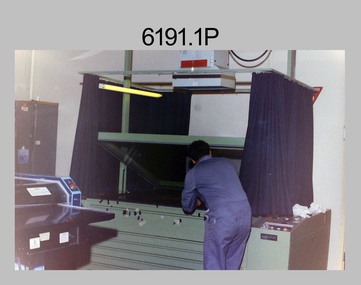 Bendigo Military Museum
Photograph - Lithographic Technicians operating printing plate processor at the Army Survey Regiment, Fortuna Villa Bendigo, c1990s
... Lithographic Technicians operating printing plate processor at the Army Survey Regiment, Fortuna Villa Bendigo...In photos .1P and .2P the Printing Technician is placing a map negative or positive on top of the printing plate in a vacuum frame before light exposure. ...This is a set of 12 photographs of lithographic technicians operating a new printing plate processor at the Army Survey Regiment, Bendigo c1990s. ...Lithographic Technicians operating printing plate processor at the Army Survey Regiment, Fortuna Villa Bendigo Photograph Lithographic Technicians operating printing plate processor at the Army Survey Regiment, Fortuna Villa Bendigo Army Survey Regiment ...These 12 photographs were most likely taken in the 1990s in Lithographic Squadron at the Army Survey Regiment, Fortuna, Bendigo. In photos .1P and .2P the Printing Technician is placing a map negative or positive on top of the printing plate in a vacuum frame before light exposure. Photos .3P to .9P and .12P feature the new Howson Algraphy Autoneg printing plate processor. It improved quality control and efficiency and allowed the conversion of printing plates for positive or negative use. Processed printing plates were checked as shown in photos .10P and .11P before their installation on the printing press.This is a set of 12 photographs of lithographic technicians operating a new printing plate processor at the Army Survey Regiment, Bendigo c1990s. Photos .1P to .11P are on 35mm negative film and scanned at 96 dpi. Photo .12P is printed on photographic paper and scanned at 300 dpi. They are part of the Army Survey Regiment’s Collection. .1) to .2) - Photo, colour, c1990s, unidentified technician preparing printing plate in a vacuum frame. .3) to .7) - Photo, colour, c1990s, unidentified technicians operating new printing plate processor. .8) - Photo, colour, c1990s, L to R: CPL Mark Doherty, unidentified technician, LCPL John Bateman operating new printing plate processor. .9) - Photo, colour, c1990s, LCPL John Bateman operating new printing plate processor. .10) to .11) - Photo, colour, c1990s, LCPL John Bateman checking printing plate after processing. .12) - Photo, colour, c1990s, SSGT Russ Mollenhauer operating new printing plate processor. .1P to .12P – there is no annotations.royal australian survey corps, rasvy, army survey regiment, army svy regt, fortuna, asr, litho -
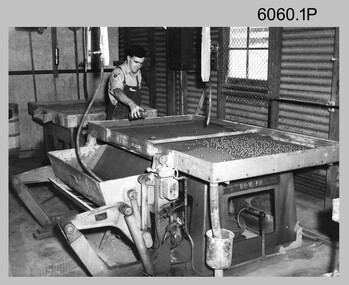 Bendigo Military Museum
Photograph - Lithographic Technicians Preparing Printing Plates at the Army Survey Regiment, c1960s to c1980s
... Lithographic Technicians Preparing Printing Plates at the Army Survey Regiment...The others have the name of the technicians written on the back. In these photos the technician preparing printing plates for offset printing. ...This is a set of photographs of lithographic technicians preparing printing plates at the Army Survey Regiment, Bendigo from c1960s to c1980s. ...The others have the name of the technicians written on the back. In these photos the technician preparing printing plates for offset printing. ...These eight photographs were most likely taken from the 1960s to the 1980s in Lithographic Squadron at the Army Survey Regiment, Fortuna, Bendigo. Photos .1P, .7P, and .8P are not annotated although .7P and .8P are positively identified. The others have the name of the technicians written on the back. In these photos the technician preparing printing plates for offset printing. The Printing Technician in photo .1P is resurfacing a zinc printing plate with ball bearings. In photos .2P to .6P the Printing Technicians are applying a light sensitive coating on the printing plate. In photos .7P and .8P the Printing Technicians are placing a map negative on top of the printing plate in a vacuum frame before light exposure. This is a set of photographs of lithographic technicians preparing printing plates at the Army Survey Regiment, Bendigo from c1960s to c1980s. The photographs were printed on photographic paper and are part of the Army Survey Regiment’s Collection. The photographs were scanned at 300 dpi. .1) - Photo, black & white, c1960s, SPR Bruce, Lithographic Squadron .2) - Photo, black & white, c1970s, Lance Percey, Lithographic Squadron .3) - Photo, black & white, c1970s, LCPL Col Hardisty, Lithographic Squadron .4) - Photo, black & white, c1970s, SPR Dave Edwards, Lithographic Squadron .5) - Photo, colour, c1970s, John Cain, Lithographic Squadron .6) - Photo, colour, c1970s, SGT Ken Slater, Lithographic Squadron .7) - Photo, black & white, c1980s, Roy Hicks, Lithographic Squadron .8) - Photo, black & white, c1980s, CPL Gary Drummond, Lithographic Squadron.1P - annotated 'SPR Bruce' on back of dupicate photo located in Volume 7 folder. .2 to .7 – personnel names (less rank) annotated on back. .8P – no annotationroyal australian survey corps, rasvy, army survey regiment, army svy regt, fortuna, asr, printing, litho -
 Federation University Historical Collection
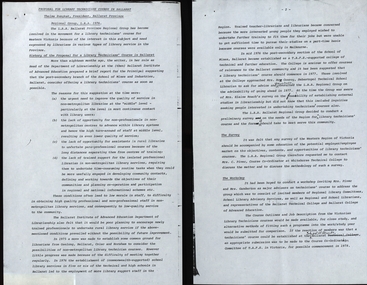
Document - Report, Proposal for Library Technicians Course in Ballarat
... Proposal for Library Technicians Course in Ballarat...Six page foolscap proposal for a Library Technicians Course at the Ballarat College of Advanced Education....library library technicians course thelma rungkat Six page foolscap proposal for a Library Technicians Course at the Ballarat College of Advanced Education. ...Six page foolscap proposal for a Library Technicians Course at the Ballarat College of Advanced Education.library, library technicians course, thelma rungkat -
 Eltham District Historical Society Inc
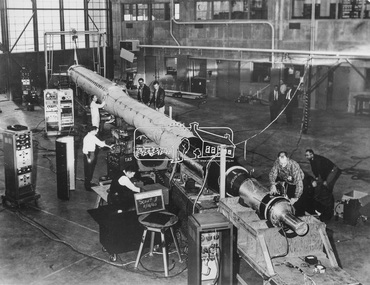
Photograph - Black and White Print, NASA, Technicians at Langley Research Centre performing final tests on 4 stage Scout solid fuel rocket, 16 November, 1960
... Technicians at Langley Research Centre performing final tests on 4 stage Scout solid fuel rocket, 16 November...On reverse: Technicians at Langley Research Centre performing final tests on four stage Scout solid fuel rocket...Alan Gardiner Collection Space Industry 1960 NASA Rocket Scout Solid Fuel Rocket On reverse: Technicians at Langley Research Centre performing final tests on four stage Scout solid fuel rocket Black and white print 20.5 x 25 cm Also large format negative (B&W) 11.8 x 16.3 cm Negative copy of photo NASA L-60-7880 Technicians at Langley Research Centre performing final tests on 4 stage Scout solid fuel rocket, 16 November Photograph Black and White Print NASA ...On reverse: Technicians at Langley Research Centre performing final tests on four stage Scout solid fuel rocketalan gardiner collection, space industry, 1960, nasa, rocket, scout solid fuel rocket -
 Bendigo Military Museum
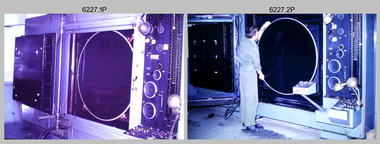
Photograph - Photographic Technicians operating the KLIMSCH Camera at the Army Survey Regiment, Fortuna, Bendigo, c1988
... Photographic Technicians operating the KLIMSCH Camera at the Army Survey Regiment, Fortuna, Bendigo....The equipment operated by the technicians is the KLIMCH camera. The main tasks undertaken by the technicians were most likely enlargements and reductions of map reproduction material. ...This is a set of four photographs of technicians operating the KLIMSCH Camera at the Army Headquarters Survey Regiment, Bendigo c1988. ...The equipment operated by the technicians is the KLIMCH camera. The main tasks undertaken by the technicians were most likely enlargements and reductions of map reproduction material. ...These nine photographs were most likely taken in c1988 in Lithographic Squadron at the Army Survey Regiment, Fortuna, Bendigo. The equipment operated by the technicians is the KLIMCH camera. The main tasks undertaken by the technicians were most likely enlargements and reductions of map reproduction material. The KLIMSCH Commodore camera was introduced in 1953 and was the largest in the Southern Hemisphere. It was replaced with a new model of the same size in 1979. The new model with its computer-based interface provided productivity gains with improved speed and its consistent results led to less wastage in time and materials. Its variomat lens system provided improved retention of map feature linear weights during the camera reduction process. The camera which was specially made for the Army in Germany was fully automatic and power operated. It was claimed to be one of the biggest automatic cameras of its type in the world. It was made to the specifications of the Royal Australian Army Survey Corps to assist in the production of the very high standard maps for the Army. There are several more photos catalogued in the Victorian Collections database of RA Svy personnel operating the KLIMSCH camera.This is a set of four photographs of technicians operating the KLIMSCH Camera at the Army Headquarters Survey Regiment, Bendigo c1988. The photographs are on 35mm colour slides scanned at 96 dpi. They are part of the Army Survey Regiment’s Collection. .1) - Photo, colour, c1988, KLIMSCH Camera. .2) - Photo, colour, c1988, KLIMSCH Camera, unidentified technician. .3) - Photo, colour, c1988, KLIMSCH Camera. .4) - Photo, colour, c1988, KLIMSCH Camera, L to R: SPR Shona Hastie, CPL Paul Baker. .5) - Photo, colour, c1988, KLIMSCH Camera. .6) & .7) - Photo, colour, c1988, KLIMSCH Camera, SPR Shona Hastie. .8) & .9) - Photo, colour, c1988, KLIMSCH Camera, SPR Russell Pajank.35mm colour slides are in good condition.rasvy, royal australian survey corps, army survey regiment, army svy regt, fortuna, asr, litho sqn -
 Bendigo Military Museum
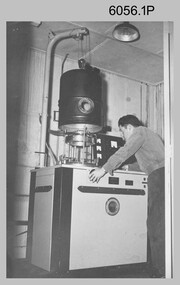
Photograph - Photographic Technicians performing tasks at the Army Survey Regiment, c1970s
... Photographic Technicians performing tasks at the Army Survey Regiment...Although Photo .1P is not annotated the remainder have the technician’s name written on the back. The equipment operated by the technicians is not identified. ...This is a set of photographs of technicians operating photographic reproduction equipment at the Army Survey Regiment, Bendigo c1970s. ...Although Photo .1P is not annotated the remainder have the technician’s name written on the back. The equipment operated by the technicians is not identified. ...These eleven photographs were most likely taken in the 1970s in Lithographic Squadron at the Army Survey Regiment, Fortuna, Bendigo. Although Photo .1P is not annotated the remainder have the technician’s name written on the back. The equipment operated by the technicians is not identified. The dates are unknown but most of these photos were probably taken the late 1970s. The main tasks undertaken by the technicians were most likely enlargements, reductions and duplication of map reproduction material, and aerial photography.This is a set of photographs of technicians operating photographic reproduction equipment at the Army Survey Regiment, Bendigo c1970s. The photographs were printed on photographic paper and are part of the Army Survey Regiment’s Collection. The photographs were scanned at 300 dpi. .1) - Photo, black & white, c1970s, unidentified, Lithographic Squadron .2) - Photo, black & white, c1970s, Gary Drummond, Lithographic Squadron .3) - Photo, black & white, c1970s, John Scott, Lithographic Squadron .4) - Photo, black & white, c1970s, WILD U4A Diapositive Camera, Bob Chamberlain, Lithographic Squadron. 5) - Photo, black & white, c1970s, WILD U4A Diapositive Camera, Zoe (Lisiewich) Ames, Lithographic Squadron .6) - Photo, black & white, c1970s, Garry Hudson, Lithographic Squadron .7) - Photo, black & white, c1970s, Garry Hudson, Lithographic Squadron .8) - Photo, black & white, c1970s, Garry Hudson, Lithographic Squadron .9) - Photo, black & white, c1970s, Mick Ellis, Lithographic Squadron .10) - Photo, black & white, c1970s, Col Darch, Lithographic Squadron .11) - Photo, black & white, c1970s, Phil Beatty, Lithographic Squadron.1P – no annotation .2 to .11 – personnel names (less rank) annotated on back. royal australian survey corps, rasvy, army survey regiment, army svy regt, fortuna, asr, litho -
 Bendigo Military Museum
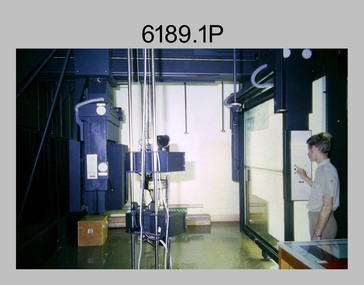
Photograph - Photographic Technicians operating the KLIMSCH Camera at the Army Survey Regiment, Fortuna, c1980s
... Photographic Technicians operating the KLIMSCH Camera at the Army Survey Regiment, Fortuna. ...The equipment operated by the technicians is the KLIMSCH camera. The main tasks undertaken by the technicians were most likely enlargements and reductions of map reproduction material. ...This is a set of four photographs of technicians operating the KLIMSCH Camera at the Army Headquarters Survey Regiment, Bendigo c1985. ...The equipment operated by the technicians is the KLIMSCH camera. The main tasks undertaken by the technicians were most likely enlargements and reductions of map reproduction material. ...These four photographs were most likely taken in the mid-1980s in Lithographic Squadron at the Army Survey Regiment, Fortuna, Bendigo. The equipment operated by the technicians is the KLIMSCH camera. The main tasks undertaken by the technicians were most likely enlargements and reductions of map reproduction material. The KLIMSCH Commodore camera was introduced in 1953 and was the largest in the Southern Hemisphere. It was replaced with a new model of the same size in 1979. The new model with its computer-based interface provided productivity gains with improved speed and its consistent results led to less wastage in time and materials. Its variomat lens system provided improved retention of map feature linear weights during the camera reduction process. The camera which was specially made for the Army in Germany was fully automatic and power operated. It was claimed to be one of the biggest automatic cameras of its type in the world. It was made to the specifications of the Royal Australian Army Survey Corps to assist in the production of the very high standard maps for the Army. This is a set of four photographs of technicians operating the KLIMSCH Camera at the Army Headquarters Survey Regiment, Bendigo c1985. The photographs were on 35mm negative film and scanned at 96 dpi. They are part of the Army Survey Regiment’s Collection. .1) Photo, black & white, c1985, Frank Lenane operating the KLIMSCH Camera. .2) - Photo, black & white, c1985, KLIMSCH Camera. .3) to .4) - Photo, black & white, c1985, John Whaling operating the KLIMSCH Camera..1P to .4P – no annotationroyal australian survey corps, rasvy, army survey regiment, army svy regt, fortuna, asr, litho -
 Bendigo Military Museum
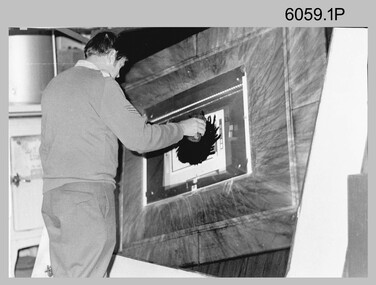
Photograph - Photographic Technicians performing tasks at the Army Survey Regiment, c1960s, c1970s
... Photographic Technicians performing tasks at the Army Survey Regiment...Photos .1P to .3P are annotated with the name of the technicians written on the back. Although Photo .4P is not annotated the technician is positively identified. ...This is a set of photographs of lithographic technicians preparing map proofs at the Army Survey Regiment, Bendigo c1960s c1970s. ...Photos .1P to .3P are annotated with the name of the technicians written on the back. Although Photo .4P is not annotated the technician is positively identified. ...These five photographs were most likely taken in the 1970s in Lithographic Squadron at the Army Survey Regiment, Fortuna, Bendigo. Photos .1P to .3P are annotated with the name of the technicians written on the back. Although Photo .4P is not annotated the technician is positively identified. In these five photos the technician is applying a UV-sensitive pigmented dye emulating one of the print colours to a white opaque polyester sheet mounted on a rotating table in a whirler. The coated sheet was dried before placement in a vacuum light frame beneath a stud registered map negative. They were then exposed to a carbon arc lamp. If there was more than one negative – typical for a type impression or 1st proof, the process was repeated for the other negatives of that print colour. There was a single exposure for composite negatives which was typical for the 2nd and final proof - the pre-press proof. The sheet was removed and washed with water and dried leaving the exposed colour impression. The technician repeated this process using process or spot dyes for remaining publication colours. Type impressions were a combination of the map grid and the topographic features in their correct print colours, forming a base for the cartographer to accurately position map names and symbols on a clear film overlay. The pre-press proof was a cost-effective way of producing a one-off visual copy of the map or chart product. It enabled cartographers to perform a quality inspection and correct any faults before publication. The pre-press proof was deemed authoritative before its release to Print Troop for bulk printing and distribution.This is a set of photographs of lithographic technicians preparing map proofs at the Army Survey Regiment, Bendigo c1960s c1970s. The photographs were printed on photographic paper and are part of the Army Survey Regiment’s Collection. The photographs were scanned at 300 dpi. .1) - Photo, black & white, c1970s, SGT Graham Jeffers, Lithographic Squadron .2) - Photo, black & white, c1970s, SGT Ken Slater Lithographic Squadron .3) - Photo, black & white, c1970s, Ian ‘Loft’ Turner, Lithographic Squadron .4) - Photo, black & white, c1970s, Gary Kerr, Lithographic Squadron .5) - Photo, black & white, c1960s, unidentified, Lithographic Squadron.1 to .3 – personnel names (less rank) annotated on back. .4 to .5P – no annotationroyal australian survey corps, rasvy, army survey regiment, army svy regt, fortuna, asr, litho -
 Bendigo Military Museum
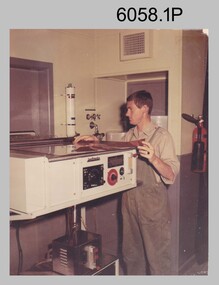
Photograph - Photographic Technicians performing tasks at the Army Survey Regiment, c1970s
... Photographic Technicians performing tasks at the Army Survey Regiment...The equipment operated by the technicians is the KLIMCH Commodore camera. The main tasks undertaken by the technicians were most likely enlargements and reductions of map reproduction material. ...This is a set of photographs of technicians operating photographic reproduction equipment at the Army Survey Regiment, Bendigo c1970s. ...The equipment operated by the technicians is the KLIMCH Commodore camera. The main tasks undertaken by the technicians were most likely enlargements and reductions of map reproduction material. ...These eight photographs were most likely taken in the 1970s in Lithographic Squadron at the Army Survey Regiment, Fortuna, Bendigo. Photos .1P to .7P have the name of the technician written on the back. Photo .8P is not annotated. The equipment operated by the technicians is the KLIMCH Commodore camera. The main tasks undertaken by the technicians were most likely enlargements and reductions of map reproduction material. The KLIMSCH Commodore camera was introduced in 1953 and was the largest in the Southern Hemisphere. It was replaced with a new model of the same size in 1979. The new model with its computer-based interface provided productivity gains with improved speed and its consistent results led to less wastage in time and materials. Its variomat lens system provided improved retention of map feature linear weights during the camera reduction process. This is a set of photographs of technicians operating photographic reproduction equipment at the Army Survey Regiment, Bendigo c1970s. The photographs were printed on photographic paper and are part of the Army Survey Regiment’s Collection. The photographs were scanned at 300 dpi. .1) - Photo, black & white, c1970s, Alan Virtue, Lithographic Squadron .2) - Photo, black & white, c1970s, Alan Virtue, Lithographic Squadron .3) - Photo, black & white, c1970s, Frank Lenane, Lithographic Squadron .4) - Photo, black & white, c1970s, Frank Lenane, Lithographic Squadron .5) - Photo, black & white, c1970s, SGT Garren Hill, Lithographic Squadron .6) - Photo, black & white, c1970s, Gavin Neilson, Lithographic Squadron .7) - Photo, black & white, c1970s, Bill Jones, Lithographic Squadron .8) - Photo, black & white, c1970s, unidentified personnel, Lithographic Squadron.1 and .2 – personnel names annotated on mounting card .3 to .7 – personnel names (less rank) annotated on back. .8 – no annotation royal australian survey corps, rasvy, army survey regiment, army svy regt, fortuna, asr, litho -
 Bendigo Military Museum
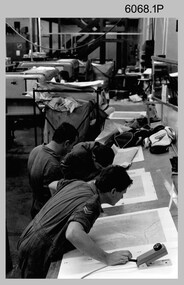
Photograph - Printer Technicians Performing Quality Checks at the Army Survey Regiment, c1980s
... Printer Technicians Performing Quality Checks at the Army Survey Regiment...When all passes were complete a final quality check off the press was performed before the Printer Technicians trimmed, wrapped and dispatched the product to customers....This is a set of photographs of Printer Technicians checking the quality of a printed product at the Army Survey Regiment, Bendigo c1980s. ...When all passes were complete a final quality check off the press was performed before the Printer Technicians trimmed, wrapped and dispatched the product to customers. ...These six photographs of Printer Technicians performing quality checks off the printing press were probably taken circa 1980s in Lithographic Squadron at the Army Survey Regiment, Fortuna, Bendigo. c1980s. Although the photos are not annotated, most personnel are positively identified. Quality control was applied progressively in the printing process, with registration checks and adjustments between colours on the first pass. In these photos a quality check was performed off the press before the printing press was prepared with the new set of printing plates and colours for the next pass. When all passes were complete a final quality check off the press was performed before the Printer Technicians trimmed, wrapped and dispatched the product to customers.This is a set of photographs of Printer Technicians checking the quality of a printed product at the Army Survey Regiment, Bendigo c1980s. The photographs were printed on photographic paper and are part of the Army Survey Regiment’s Collection. The photographs were scanned at 300 dpi. .1) - Photo, black & white, c1980s, L to R: unidentified, Paul Davis, Terry Winzar, CPL Kim Reynolds, Lithographic Squadron .2) - Photo, black & white, c1980s, L to R: CPL Kim Reynolds, Paul Davis, Terry Winzar, Lithographic Squadron .3) - Photo, black & white, c1980s, L to R: Per Andersen, Peter Dillon, Lithographic Squadron .4) - Photo, black & white, c1980s, L to R: Per Andersen, Peter Barrett, Peter Dillon, Lithographic Squadron .5) - Photo, black & white, c1980s, L to R: SSGT Peter Barrett, Greg Rowe, Lithographic Squadron .6) - Photo, black & white, c1980s, unidentified Lithographic Squadron.1P to .6P – no annotationroyal australian survey corps, rasvy, army survey regiment, army svy regt, fortuna, asr, litho, printing -
 Bendigo Military Museum
Photograph - Maps despatched by Printer Technicians at the Army Survey Regiment, c1970s to c1990s
... Maps despatched by Printer Technicians at the Army Survey Regiment...The Print Room’s Map Handling Station in photos .8P and .9P provided ergonomic benefits to the Printer Technician and improved despatch productivity....This is a set of photographs of Printer Technicians involved in the despatch of bulk printed map stock c1970s to c1990s. ...This is a set of photographs of Printer Technicians involved in the despatch of bulk printed map stock c1970s to c1990s. ...These nine photographs of Printer Technicians working on the despatch of bulk printed map stock to customers, were probably taken circa 1970s to 1990s in Lithographic Squadron at the Army Survey Regiment, Fortuna, Bendigo. Except for photo .3P, personnel are not annotated on the photos. Despatch was the final task performed by a team of Printer Technicians. It involved the wrapping of trimmed bulk maps into manageable parcels and sending them by freight to customers or to the Army Map Depot at Bandiana, VIC. The task’s Due date and sensitivity were essential considerations in the planning of production affecting the lead time and method of delivery. Freighting by commercial means was the normal method for routine tasks. The method of despatch for urgent time-critical tasks sometimes meant having to use military freight or safe-handed by Army Survey Regiment personnel. The mishap captured in photos .6P and .7P was rare, but costly if it was a time critical task. The Print Room’s Map Handling Station in photos .8P and .9P provided ergonomic benefits to the Printer Technician and improved despatch productivity.This is a set of photographs of Printer Technicians involved in the despatch of bulk printed map stock c1970s to c1990s. The photographs were printed on photographic paper and are part of the Army Survey Regiment’s Collection. The photographs were scanned at 300 dpi. .1) - Photo, black & white, c1970s, L to R: unidentified, unidentified, Lithographic Squadron .2) - Photo, black & white, c1980s, Steve Egan, Lithographic Squadron .3) - Photo, black & white, c1980s, L to R: unidentified, Kim Reynolds, Lithographic Squadron .4) - Photo, colour, c1980s, L to R: Jeff Willey, Gary Kerr, Lithographic Squadron .5) - Photo, black & white, c1980s, L to R: Jim Ash, Mark ‘Dogs’ Doherty, Stuart Ridge, Lithographic Squadron .6) - Photo, colour, c1980s, printed maps toppled, Lithographic Squadron .7) - Photo, colour, c1980s, printed maps toppled, Lithographic Squadron .8) - Photo, black & white, c1990s, L to R: unidentified, unidentified, Lithographic Squadron .9) - Photo, black & white, c1990s, unidentified, Lithographic Squadron .3P, personnel annotation on back. .1P, .2P, .4P, .5P, .8P and .9P – no personnel annotated .6P and .7P – ‘Good one Daryl’ annotated on back.royal australian survey corps, rasvy, army survey regiment, army svy regt, fortuna, asr, litho, printing -
 Bendigo Military Museum
Photograph - Tasks Demonstrated by Royal Australian Survey Corps Technicians, c1990s
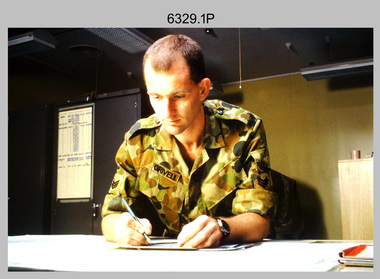
... Tasks Demonstrated by Royal Australian Survey Corps Technicians...This is a set of 17 photographs of technicians from the Royal Australian Survey Corps undertaking technical tasks circa 1990s. ...This is a set of 17 photographs of technicians from the Royal Australian Survey Corps undertaking technical tasks at the Army Survey Regiment, Fortuna, Bendigo, and the School of Military Survey, Bonegilla c1992. ...Tasks Demonstrated by Royal Australian Survey Corps Technicians Photograph Tasks Demonstrated by Royal Australian Survey Corps Technicians Army Survey Regiment ...This is a set of 17 photographs of technicians from the Royal Australian Survey Corps undertaking technical tasks circa 1990s. Photos .1P to .9P were taken at the Army Survey Regiment, Fortuna, Bendigo. Photos .10P to .15P and .17P of students operating survey equipment, were taken at the School of Military Survey, Bonegilla and survey stations surrounding Lake Hume. The base camp at photo .16P was probably taken at Sandy Creek, near Tallangatta Victoria, during the field phase of a basic or advanced RA Svy training course. CPL Steve Nokes appearing in photo .17P was attending the 1/90 Map Control Survey Course.This is a set of 17 photographs of technicians from the Royal Australian Survey Corps undertaking technical tasks at the Army Survey Regiment, Fortuna, Bendigo, and the School of Military Survey, Bonegilla c1992. Colour photos are on 35mm slide film and were scanned at 96 dpi. Photo .17P is in black & white, printed on photographic paper and scanned at 300 dpi. The photos are part of the Army Survey Regiment’s Collection. .1) – Photo, colour, c1992, Aerial photography Assessment, SGT Tony Grivell. .2) – Photo, colour, c1992, Aerial photography Assessment, L to R: WO2 Noel McNamara and LCPL Grant Lloyd. .3) – Photo, colour, c1992, Wild PUG4 point transfer device, LCPL Mark Fedden. .4) – Photo, colour, c1992, AUTOMAP 2 Graphic Edit Workstation, unidentified technician. .5) – Photo, colour, c1992, Heidelberg Speedmaster 102 computer-controlled five colour lithographic offset printing press, CPL Nick Vanderzwan. .6) – Photo, colour, c1992, Daylight film contact frame, SPR Ken Labourchardiere. .7) – Photo, colour, c1992, Heidelberg Speedmaster 102 Map Colour Evaluation Workstation, SGT Stuart Ridge. .8) – Photo, colour, c1992, Map proof evaluation, CPL John Bragg. .9) – Photo, colour, c1992, Wohlenberg MCS-2 guillotine, unidentified technician. .10) – Photo, colour, c1992, Wild T2 Theodolite, L to R: SPR Matt Arnold, SPR Kim Baker. .11) – Photo, colour, c1992, Wild T2 Theodolite, L to R: SSGT Bob Bright, SPR Kim Baker. .12) to .14) – Photo, colour, c1992, MRA-7 Tellurometer, CPL Mark Bourne. .15) – Photo, colour, c1992, Plane Tabling, CPL Mark Bourne. .16) – Photo, colour, c1992, School of Military Survey base camp, Sandy Creek, VIC. .17) – Photo, black & white, 1990, MRA-7 Tellurometer, CPL Steve Nokes. .1P to .16P - There are no annotations. .17P – annotated on back ‘CPL NOKES WITH MRA7 ON 1/90 MAP CONTROL COURSE’royal australian survey corps, rasvy, army survey regiment, army svy regt, school of military survey, fortuna, asr -
 Bendigo Military Museum
Photograph - Printer Technicians Operating Printing Presses at the Army Survey Regiment, c1970s, c1980s
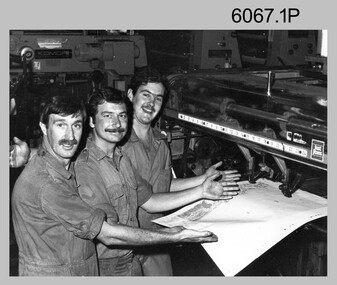
... Printer Technicians Operating Printing Presses at the Army Survey Regiment...These nine photographs of Printer Technicians operating printing presses were probably taken circa 1970s and 1980s in Lithographic Squadron at the Army Survey Regiment, Fortuna, Bendigo.They are most likely operating the Komori, Planeta or Ultra-MAN-III offset printing presses. ...This is a set of nine photographs of Printer Technicians operating printing presses at the Army Survey Regiment, Bendigo, c1970s, c1980s. ...These nine photographs of Printer Technicians operating printing presses were probably taken circa 1970s and 1980s in Lithographic Squadron at the Army Survey Regiment, Fortuna, Bendigo.They are most likely operating the Komori, Planeta or Ultra-MAN-III offset printing presses. ...These nine photographs of Printer Technicians operating printing presses were probably taken circa 1970s and 1980s in Lithographic Squadron at the Army Survey Regiment, Fortuna, Bendigo.They are most likely operating the Komori, Planeta or Ultra-MAN-III offset printing presses. Although these photos are not annotated most personnel are positively identified.This is a set of nine photographs of Printer Technicians operating printing presses at the Army Survey Regiment, Bendigo, c1970s, c1980s. The photographs were printed on photographic paper and are part of the Army Survey Regiment’s Collection. The photographs were scanned at 300 dpi. .1) - Photo, black & white, c1980s, L to R: Roy Hicks, Peter Dillon, Terry Winzar, Lithographic Squadron .2) - Photo, black & white, c1980s, Daryl South, Lithographic Squadron .3) - Photo, black & white, c1980s, Greg Rowe, Lithographic Squadron .4) - Photo, black & white, c1980s, L to R: Terry Winzar, unidentified, unidentified, Lithographic Squadron .5) - Photo, black & white, c1980s, unidentified, Lithographic Squadron .6) - Photo, black & white, c1980s, Stuart Ridge, Lithographic Squadron .7) - Photo, black & white, c1980s, Stuart Ridge, Lithographic Squadron .8) - Photo, black & white, c1980s, Jim Ash, Lithographic Squadron .9) - Photo, colour, c1970s, L to R: Paul Davis, Alan Fitts, John ‘Flash’ Anderson, Lithographic Squadron.1P to .8P – no annotationroyal australian survey corps, rasvy, army survey regiment, army svy regt, fortuna, asr, litho, printing -
 Bendigo Military Museum
Photograph - Photographic Technicians performing tasks at the Army Headquarters Survey Regiment, c1960s
... Photographic Technicians performing tasks at the Army Headquarters Survey Regiment...Although Photo .1P is not annotated the remainder have the name of the technicians written on the back. The equipment operated by the technicians is the KLIMCH Commodore camera. ...This is a set of photographs of technicians operating photographic reproduction equipment at the Army Headquarters Survey Regiment, Bendigo c1960s. ...Although Photo .1P is not annotated the remainder have the name of the technicians written on the back. The equipment operated by the technicians is the KLIMCH Commodore camera. ...These eight photographs were most likely taken in the 1960s in Lithographic Squadron at the Army Headquarters Survey Regiment, Fortuna, Bendigo. Although Photo .1P is not annotated the remainder have the name of the technicians written on the back. The equipment operated by the technicians is the KLIMCH Commodore camera. The main tasks undertaken by the technicians were most likely enlargements and reductions of map reproduction material. The KLIMSCH Commodore camera was introduced in 1953 and was the largest in the Southern Hemisphere. It was replaced with a new model of the same size in 1979. The new model with its computer-based interface provided productivity gains with improved speed and its consistent results led to less wastage in time and materials. Its variomat lens system provided improved retention of map feature linear weights during the camera reduction process. The typed description pasted on the back of photo .5P states “Cpl R. MacKenzie of Bentley, Perth (WA) of the AHQ Survey Regt, located at “Fortuna”, Bendigo, (Vic). Has been in the Army for 5 years. He removes the lens cap from the 70 inch F16 lens of the giant KLIMSCH camera used in map making for the Army. The camera which was specially made for the Army in Germany is fully automatic and power operated. It is claimed to be one of the biggest automatic cameras of its type in the world. It was made to the specifications of the Aust Army Survey Corps to assist in the production of the very high standard maps for the Army. The AHQ Survey Regt also assists Commonwealth and other Govt departments in the printing of maps required other than for Army needs. The KLIMSCH camera is used for cartographic mapping photography.” This is a set of photographs of technicians operating photographic reproduction equipment at the Army Headquarters Survey Regiment, Bendigo c1960s. The photographs were printed on photographic paper and are part of the Army Survey Regiment’s Collection. The photographs were scanned at 300 dpi. .1) - Photo, black & white, c1960s, Les ‘Snow’ Taylor, Lithographic Squadron .2) - Photo, black & white, c1960s, Les ‘Snow’ Taylor, Lithographic Squadron .3) - Photo, black & white, c1960s, John Rolfe, Lithographic Squadron .4) - Photo, black & white, c1960s, John Rolfe, Lithographic Squadron .5) - Photo, black & white, c1960s, CPL R. MacKenzie, Lithographic Squadron .6) - Photo, black & white, c1960s, unidentified, Lithographic Squadron .7) - Photo, black & white, c1960s, George Graham, Lithographic Squadron .8) - Photo, black & white, c1960s, L to R: Bill Snelson, George Graham, Lithographic Squadron.1P – no annotation .2 to .4 – personnel names (less rank) annotated on back. .5 – name and rank annotated on back, with detailed typed description .6 to .8 – personnel names (less rank) annotated on back. royal australian survey corps, rasvy, army survey regiment, army svy regt, fortuna, asr, litho -
 Bendigo Military Museum
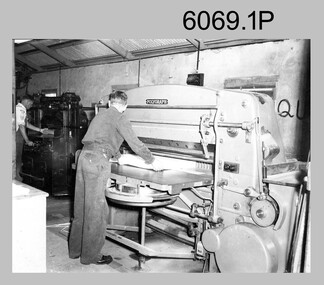
Photograph - Printer Technicians trimming printed map stock at the Army Survey Regiment, c1960s to c1980s
... Printer Technicians trimming printed map stock at the Army Survey Regiment...These six photographs of Printer Technicians using a heavy-duty guillotine to trim bulk printed map stock were probably taken circa 1960s to 1980s in Lithographic Squadron at the Army Survey Regiment, Fortuna, Bendigo. ...This is a set of photographs of Printer Technicians using a heavy-duty guillotine to trim bulk printed map stock c1960s to 1980s. ...These six photographs of Printer Technicians using a heavy-duty guillotine to trim bulk printed map stock were probably taken circa 1960s to 1980s in Lithographic Squadron at the Army Survey Regiment, Fortuna, Bendigo. ...These six photographs of Printer Technicians using a heavy-duty guillotine to trim bulk printed map stock were probably taken circa 1960s to 1980s in Lithographic Squadron at the Army Survey Regiment, Fortuna, Bendigo. Personnel are not identified on Photos .3P and .4P, however names are annotated on photos .1P, .2P, .4P and .5P. Cartographers normally provided trim marks to specified map dimensions as guidance to the printer. The trimming stage, like all the other printing processes required high levels of accuracy. These guillotines were extremely powerful to cut through bulk quantities of printed maps, as evident in photos .1P .3P, .4P and .6P.This is a set of photographs of Printer Technicians using a heavy-duty guillotine to trim bulk printed map stock c1960s to 1980s. The photographs were printed on photographic paper and are part of the Army Survey Regiment’s Collection. The photographs were scanned at 300 dpi. .1) - Photo, black & white, c1960s, L to R: ‘Wanger’ Payne, unidentified, Lithographic Squadron .2) - Photo, black & white, c1980s, CPL Ken Cavanagh, Lithographic Squadron .3) - Photo, black & white, c1970s, unidentified, Lithographic Squadron .4) - Photo, colour, c1970s, Peter Saunders, Lithographic Squadron .5) - Photo, black & white, c1980s, L to R: unidentified, WO1 Noel ‘Nesty’ Coulthard, Lithographic Squadron .6) - Photo, black & white, c1980s, unidentified, Lithographic Squadron.1P, .2P, .4P and .5P. personnel annotation on back. * unidentified on .1P due to poor writing. .3P and .6P – no annotationroyal australian survey corps, rasvy, army survey regiment, army svy regt, fortuna, asr, litho, printing -
Federation University Historical Collection
Correspondence, Correspondence from the Royal Institute of Architects regarding the Architectural Technicians' Course, 1949, 23/09/1949
... Correspondence from the Royal Institute of Architects regarding the Architectural Technicians' Course, 1949...Recommended Architectural Technicians course; 1st, 2nd & 3rd year subjects 11994.4 Letter from F.E. ...Recommended Architectural Technicians course; 1st, 2nd & 3rd year subjects 11994.4 Letter from F.E. ...11994.1 Page 01. Letter, dated 26/09/1949, from the Secretary of The Royal Victorian Institute Of Architects to F. E. Ferguson Esq., Registrar, The School of Mines and Industry. Letter requests a new architectural syllabus that caters to the separation of architectural professions into Qualified Architect and Architectural Technician 11994.2 Page 02. Recommending the Ballarat School of Mines establish an Architectural Technician course 11994.3 Page 03. Recommended Architectural Technicians course; 1st, 2nd & 3rd year subjects 11994.4 Letter from F.E. Ferguson to The Royal Victorian Institute of Architects confirming the establishment of the Architectural Technician course11994.1 Typed letter on quarto paper with letterhead 11994.2 Typed letter on quarto paper 11994.3 Typed letter on airplane paper, with an airoplane watermark 11994.4 Typed letter on quarto paperf.e. ferguson, royal victorian institute of architects, ballarat school of mines, registrar, architectural technician, 1949 -
 Bendigo Military Museum
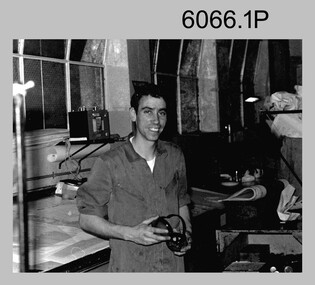
Photograph - Printer Technicians Operating Printing Presses at the Army Survey Regiment, c1980s
... Printer Technicians Operating Printing Presses at the Army Survey Regiment....These nine photographs of Printer Technicians operating printing presses were probably taken circa 1980s in Lithographic Squadron at the Army Survey Regiment, Fortuna, Bendigo. c1980s. ...Photograph Printer Technicians Operating Printing Presses at the Army Survey Regiment. ...These nine photographs of Printer Technicians operating printing presses were probably taken circa 1980s in Lithographic Squadron at the Army Survey Regiment, Fortuna, Bendigo. c1980s. They are most likely operating the Komori, Planeta or Ultra-MAN-III offset printing presses. Although most photos except for photos .1P to .4P are not annotated, most personnel are positively identified..1) - Photo, black & white, c1980s, SPR Mark ‘Dogs’ Doherty, Lithographic Squadron .2) - Photo, black & white, c1980s, Paul Davis, Lithographic Squadron .3) - Photo, black & white, c1980s, L to R: unidentified, CPL Peter Breukel, Lithographic Squadron .4) - Photo, black & white, c1980s, SPR Colin Campbell, Lithographic Squadron .5) - Photo, black & white, c1980s, CPL Paul Davis, Lithographic Squadron .6) - Photo, black & white, c1980s, CPL Paul Davis, Lithographic SPR Mark ‘Dogs’ Doherty Squadron .7) - Photo, black & white, c1980s, L to R: WO2 Jeff Lynch, CPL Paul Davis, Lithographic Squadron .8) - Photo, black & white, c1980s, unidentified, Lithographic Squadron .9) - Photo, black & white, c1980s, CPL Josh De Groot, Lithographic Squadron .1P to .4P – personnel annotated .5P to .6P, .8P to .9P – no annotation .7P – no personnel annotated, ‘Last PNG JOG’ annotatedroyal australian survey corps, rasvy, army survey regiment, army svy regt, fortuna, asr, litho, printing -
 Bendigo Military Museum
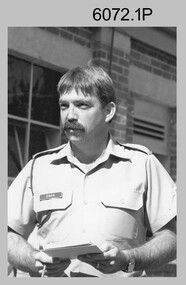
Photograph - Printer Technicians and other RASvy personnel at the Army Survey Regiment, c1980s
... Printer Technicians and other RASvy personnel at the Army Survey Regiment...This is a set of photographs of Printer Technicians and other RASvy personnel in Lithographic Squadron, Army Survey Regiment, Bendigo c1980s. ...Royal Australian Survey Corps RASvy Army Survey Regiment Army Svy Regt Fortuna ASR litho printing .1P to .4P – not annotated .5P - annotated on front with ‘I AM BROKE, I’M NOT and me neither’, annotated on back with ‘Curly Larry Moe’ .6P to .9P – not annotated .10P – annotated with date This is a set of photographs of Printer Technicians and other RASvy personnel in Lithographic Squadron, Army Survey Regiment, Bendigo c1980s. ...These ten photographs were probably taken circa 1980s in Lithographic Squadron at the Army Survey Regiment, Fortuna, Bendigo. Most of the photos were taken on the shop floor in the Print Room.This is a set of photographs of Printer Technicians and other RASvy personnel in Lithographic Squadron, Army Survey Regiment, Bendigo c1980s. The photographs were printed on photographic paper and are part of the Army Survey Regiment’s Collection. The photographs were scanned at 300 dpi. .1) - Photo, black & white, c1980s, WO2 Steve Egan, Lithographic Squadron .2) - Photo, black & white, c1980s, WO2 Jeff Lynch, Lithographic Squadron .3) - Photo, colour, c1980s, SPR Peter Dillon, Lithographic Squadron .4) - Photo, black & white, c1980s, L to R: Peter Dillon, unidentified, Lithographic Squadron .5) - Photo, black & white, c1980s, L to R: SPR Colin Yeats, SPR Graeme Spong, CPL Peter Dillon, Lithographic Squadron .6) - Photo, black & white, c1980s, L to R: SPR Colin Yeats, WO2 Ralph Chant, Lithographic Squadron .7) - Photo, black & white, c1980s, L to R: Dale Hudson, Mark ‘Dogs’ Doherty, Lithographic Squadron .8) - Photo, black & white, c1980s, L to R: SGT Greg Rowe, WO1 Trevor Osborne, Dale Hudson, Lithographic Squadron .9) - Photo, black & white, c1980s, L to R: unidentified, SGT Kim Reynolds, Shane ‘Soupy’ Campbell, Lithographic Squadron .10) - Photo, colour, 1987, L to R: Jim Ash, Daryl South, Jeff Willey, unidentified, Lithographic Squadron.1P to .4P – not annotated .5P - annotated on front with ‘I AM BROKE, I’M NOT and me neither’, annotated on back with ‘Curly Larry Moe’ .6P to .9P – not annotated .10P – annotated with dateroyal australian survey corps, rasvy, army survey regiment, army svy regt, fortuna, asr, litho, printing -
University of Melbourne, Burnley Campus Archives
Document, Authority to conduct a TAFE course of study Technicians Certificate in Sports Turf Management 1986
... Authority to conduct a TAFE course of study Technicians Certificate in Sports Turf Management 1986...Authority to conduct a TAFE course of study Technicians Certificate in Sports Turf Management 1986 Document Document ... -
University of Melbourne, Burnley Campus Archives
Document, Authority to conduct a TAFE course of study Technicians Certificate in Sports Turf Management 1986
... Authority to conduct a TAFE course of study Technicians Certificate in Sports Turf Management 1986...sports turf management Roneo sheets stapled together Authority to conduct a TAFE course of study Technicians Certificate in Sports Turf Management 1986 Document ...sports turf management -
University of Melbourne, Burnley Campus Archives
Document, VCAH Burnley Authority to conduct a TAFE course of study Technicians Certificate in Park Management 1986, 1986
... VCAH Burnley Authority to conduct a TAFE course of study Technicians Certificate in Park Management 1986...VCAH Burnley Authority to conduct a TAFE course of study Technicians Certificate in Park Management 1986 Document ...Submission, 24pp.vcah, tafe, cartificate, park management -
University of Melbourne, Burnley Campus Archives
Document, Proposal for Horticultural Technicians' course and/or Certificate of Horticultural Studies, c. 1973
... Proposal for Horticultural Technicians' course and/or Certificate of Horticultural Studies...horticultural technicians certificate of horticultural studies part-time courses Summary of part-time courses Proposal for Horticultural Technicians' course and/or Certificate of Horticultural Studies Document ...Summary of part-time courseshorticultural technicians, certificate of horticultural studies, part-time courses -
Whitehorse Historical Society Inc.
Newspaper, Job advertisements, 1974
... Includes advertisements for positions as Senior Assistants and Library Technicians with the Nunawading Library....Includes advertisements for positions as Senior Assistants and Library Technicians with the Nunawading Library....Includes advertisements for positions as Senior Assistants and Library Technicians with the Nunawading Library. Job advertisements Newspaper Newspaper ...Photocopy of a collection of advertisements for jobs with municipal councils.Photocopy of a collection of advertisements for jobs with municipal councils. Includes advertisements for positions as Senior Assistants and Library Technicians with the Nunawading Library.Photocopy of a collection of advertisements for jobs with municipal councils. city of nunawading, nunawading library -
 Port Melbourne Historical & Preservation Society
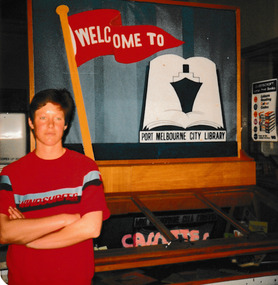
Photograph - Display Port Melbourne City Library, Liardet Street, c.1983
... Welcome to Port Melbourne Library display with Library Technician, Karen WALE in the foreground. The display was made by donor, Jay MILLER, a newly qualified, part-time librarian at Port Melbourne City Library from 1983 - 1984. ...Photograph of Welcome to Port Melbourne City Library with Library Technician, Karen Wale....Welcome to Port Melbourne Library display with Library Technician, Karen WALE in the foreground. The display was made by donor, Jay MILLER, a newly qualified, part-time librarian at Port Melbourne City Library from 1983 - 1984. ...Welcome to Port Melbourne Library display with Library Technician, Karen WALE in the foreground. The display was made by donor, Jay MILLER, a newly qualified, part-time librarian at Port Melbourne City Library from 1983 - 1984. The library was then situated next to the old Fire Station on the site where Coles is now located. Photograph of Welcome to Port Melbourne City Library with Library Technician, Karen Wale.Karen Wale on reversejay miller, port melbourne library, coles, fire station, karen wale -
 Bendigo Military Museum
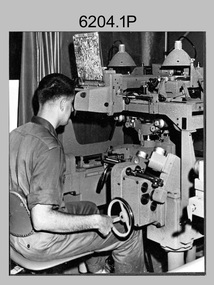
Photograph - Photogrammetric Equipment – Army Survey Regiment, Fortuna, Bendigo, c1960s to c1980s
... This is a set of eight photographs of technicians operating photogrammetric equipment in Air Survey Squadron, Army Survey Regiment, Fortuna, Bendigo. c1960s to c1980s. ...Unidentified technician in AUTOMAP 2 operating a Wild B8 stereo plotter....Unidentified technician in AUTOMAP 2 operating a Wild B8 stereo plotter. ...This is a set of eight photographs of technicians operating photogrammetric equipment in Air Survey Squadron, Army Survey Regiment, Fortuna, Bendigo. c1960s to c1980s. The Wild A9 Stereocomparator and Wild B9 stereo plotter were introduced in 1962. The Wild B8 stereo plotter was introduced in 1966. Technicians used the Wild A9 Stereocomparator to accurately measure between pass, tie, and survey control points on aerial photographs. The Wild B9 and B8s were used for plotting topographic detail and contours. These analogue machines were manually controlled by adjusting the control knobs for the orientation of the 3D image. The B9s used a four and a half square, and the B8s used a nine-inch square photo image on a film or glass diapositive which allowed highly accurate extraction of map features. At first, plotting with B8 and B9 stereo plotters was undertaken at the aerial photography scale of 1:80,000 in pencil onto a controlled plotting sheet. Sheets were then inked up and reduced photographically to the 1: 100,000 publication scale for scribe impression production. In the early days topographic detail and contours were plotted with a pencil or ink pen mounted at the far end of the pantograph arm. The plotting procedure was upgraded to direct plotting in ink with photographic reduction to publication scale. In 1975 four B8s were upgraded with tri-axis locaters as part of the Input Sub-system to enable digital extraction to AUTOMAP 1’s topographic database. When AUTOMAP 2 was introduced in 1982 these B8s were upgraded, and additional machines added to expand the Army Survey Regiment’s digital capture capability. This is a set of eight photographs of technicians operating photogrammetric equipment in Air Survey Squadron, Army Survey Regiment, Fortuna, Bendigo. c1960s to c1980s. Black and white and colour photos are on photographic paper and scanned at 300 dpi. .1) - Photo, black & white, c1965. Unidentified technician operating a Wild A9 Stereocomparator. .2) - Photo, black & white, c1965. Unidentified technician operating a Wild B9 stereo plotter. .3) - Photo, black & white, c1967. L to R: Unidentified technician, SPR Ken Jeffery operating a Wild B9 stereo plotter. .4) - Photo, colour, c1974. Unidentified technician, operating a Wild B8 stereo plotter. .5) - Photo, black & white, c1974. Unidentified technician operating a Wild B8 stereo plotter. .6) to .7) - Photo, black & white, c1979. Unidentified technicians operating a Wild B8 stereo plotter. .8) - Photo, black & white, c1985. Unidentified technician in AUTOMAP 2 operating a Wild B8 stereo plotter..1P, .2P, .4P, .5P, .7P – no annotations. .3P – annotated ‘Standing - , Seated SPR Ken Jefferies (sic). .6P – annotated with date ‘1979’ .8P – annotated ‘AUTOMAP 2’royal australian survey corps, rasvy, army survey regiment, army svy regt, fortuna, asr, air survey, photogrammetry -
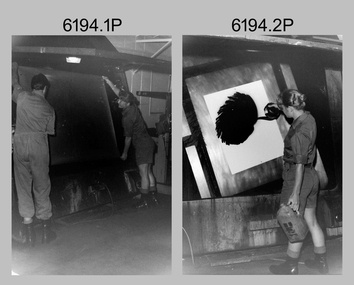 Bendigo Military Museum
Photograph - Lithographic Technicians and Equipment at the Army Survey Regiment, Fortuna Villa Bendigo, c1990s
... In photos .3P to .5P the technician is preparing a orthophotomap film positive. ...This is a set of 10 photographs of lithographic technicians undertaking tasks at the Army Survey Regiment, Bendigo c1990s. ...In photos .3P to .5P the technician is preparing a orthophotomap film positive. ...These 10 photographs were most likely taken in the 1990s in Lithographic Squadron at the Army Survey Regiment, Fortuna, Bendigo. In photos .1P to .2P the technicians are applying a UV-sensitive pigmented dye emulating one of the print colours to a white opaque polyester sheet mounted on a rotating table in a whirler. The coated sheet was dried before placement in a vacuum light frame beneath a stud registered map negative. They were then exposed to a carbon arc lamp. For more photos and details on the process, see item 6059.5P. In photos .3P to .5P the technician is preparing a orthophotomap film positive. Photo .6P is the rear view of the tri-linear film punch. In photos .7P and .8P the technician is operating a heavy-duty guillotine to trim bulk printed map stock. Cartographers normally provided trim marks to specified map dimensions as guidance to the printer. The trimming stage, like all the other printing processes required high levels of accuracy. These guillotines were extremely powerful to cut through bulk quantities of printed maps. For more photos and details on this process, see item 6069.6P. In photo .9P the technician is operating a daylight film contacting frame. In photo .10P LT Ian Stoddart is taking a well-earned break.This is a set of 10 photographs of lithographic technicians undertaking tasks at the Army Survey Regiment, Bendigo c1990s. Photos .1P to .7P and .9P to .11P are on 35mm negative film and scanned at 96 dpi. Photo .8P is printed on photographic paper and scanned at 300 dpi. They are part of the Army Survey Regiment’s Collection. .1) and .2) - Photo, black & white, c1990s, unidentified printer technician and SPR Janet Murray using the map proof whirler. .3) to .5) - Colour, c1990s, Mick ‘Buddha’ Ellis preparing an orthophotomap film positive. .6) - Photo, Colour, c1990s, rear view of tri-linear film punch. .7) & .8) - Photo, Colour, c1990s, unidentified technician operating a heavy-duty guillotine. .9) - Photo, Colour, c1990s, printer technician SPR Shona Hastie operating a daylight film contacting frame. .10) - Photo, Colour, c1990s, LT Ian Stoddart taking a well-earned break. .1P to .10P– no annotationroyal australian survey corps, rasvy, army survey regiment, army svy regt, fortuna, asr, litho -
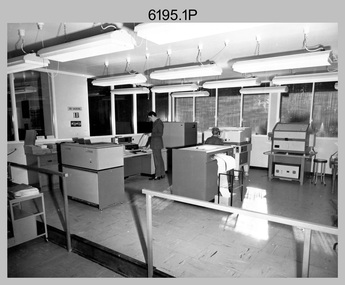 Bendigo Military Museum
Photograph - Aerotriangulation Production – Army Survey Regiment, Fortuna, Bendigo, c1979
... PUG4 devices were used by technicians to stereoscopically view the photography containing the survey control points and the mapping aerial photography. ...They are part of the Army Survey Regiment’s Collection. .1) - Photo, black & white, c1979, Aerotriangulation tasks, unidentified technicians. .2) to .3) - Photo, black & white, c1979, PDP-11 minicomputers tasks, unidentified technician. .4) - Photo, black & white, c1979, Aerotriangulation tasks, unidentified technician. .5) - Photo, colour, c1979, Zeiss (Jena) Stecometer, unidentified technician. .6) to.9) - Photo, black & white, c1979, Zeiss (Jena) Stecometer, unidentified technician. .10) - Photo, black & white, c1984, OMI/Nistri APC/3-1 analytical stereoplotter, SPR Kristin (Isaac) Skidmore. .11) - Photo, colour, c1979, OMI/Nistri APC/3-1 analytical stereoplotter, unidentified technician. .12) - Photo, colour, c1979, Zeiss D2 Planimat Stereoplotter, unidentified technician. .13) - Photo, black & white, c1979, Aerotriangulation tasks, unidentified technician. .14) - Photo, black & white, c1979, Aerotriangulation tasks, unidentified technician. .15) - Photo, black & white, c1979, Aerotriangulation tasks, CPL Ken Talbot-Smith .16) - Photo, black & white, c1979, Aerotriangulation tasks, SPR David Jobe. .17) - Photo, black & white, c1979, Wild PUG4 point transfer device, WO2 Brian Mead. .18) - Photo, black & white, c1979, Wild PUG4 point transfer device, CPL Andy Wilson. .19) - Photo, black & white, c1979, Wild PUG4 point transfer device, unidentified technician....They are part of the Army Survey Regiment’s Collection. .1) - Photo, black & white, c1979, Aerotriangulation tasks, unidentified technicians. .2) to .3) - Photo, black & white, c1979, PDP-11 minicomputers tasks, unidentified technician. .4) - Photo, black & white, c1979, Aerotriangulation tasks, unidentified technician. .5) - Photo, colour, c1979, Zeiss (Jena) Stecometer, unidentified technician. .6) to.9) - Photo, black & white, c1979, Zeiss (Jena) Stecometer, unidentified technician. .10) - Photo, black & white, c1984, OMI/Nistri APC/3-1 analytical stereoplotter, SPR Kristin (Isaac) Skidmore. .11) - Photo, colour, c1979, OMI/Nistri APC/3-1 analytical stereoplotter, unidentified technician. .12) - Photo, colour, c1979, Zeiss D2 Planimat Stereoplotter, unidentified technician. .13) - Photo, black & white, c1979, Aerotriangulation tasks, unidentified technician. .14) - Photo, black & white, c1979, Aerotriangulation tasks, unidentified technician. .15) - Photo, black & white, c1979, Aerotriangulation tasks, CPL Ken Talbot-Smith .16) - Photo, black & white, c1979, Aerotriangulation tasks, SPR David Jobe. .17) - Photo, black & white, c1979, Wild PUG4 point transfer device, WO2 Brian Mead. .18) - Photo, black & white, c1979, Wild PUG4 point transfer device, CPL Andy Wilson. .19) - Photo, black & white, c1979, Wild PUG4 point transfer device, unidentified technician. ...This collection of 19 photos was most likely taken in 1979 in Air Survey Squadron. The PDP 11/70 minicomputer shown in photos .2P to .3P was the operating system introduced in 1977 as the mainframe system for the control of the APC4, aerial triangulation block adjustments, SORA OP Analytical Orthophoto control, APR Analytical Terrain Profile Recorder computation, graphics, and general computing. The Zeiss (Jena) Stecometer analytic stereocomparator for air photography shown in photos .5P to .9P was introduced at Air Survey Squadron in 1963. Aerotriangulation production was expedited using computers for analytical photogrammetric processes. The technician accurately measured between pass, tie, and survey control points on aerial photographs. The OMI/Nistri AP/C-3 analytical plotter shown in photos .10P and .11P was introduced in 1972–1973. Photo .11P shows a coordinatorgraph attached to the AP/C-3. The Zeiss D2 Planimat Stereoplotter shown in photo .12P was used for analytical orthophoto control. Wild PUG4 point transfer devices shown in photos .17P to .19P were introduced in c1968 superseding the PUG2 devices. PUG4 devices were used by technicians to stereoscopically view the photography containing the survey control points and the mapping aerial photography. The Control points were transferred from the control photography to the mapping diapositives of aerial photography by drilling their locations into the photographic emulsion.See item 9045.17P for more photos of aerotriangulation equipment and their operation in map production.This is a set of 19 photographs of Air Survey Squadron personnel operating aerotriangulation equipment at the Army Survey Regiment at Fortuna, Bendigo, c1979. Black and white photos are on photographic paper and were scanned at 300 dpi. They are part of the Army Survey Regiment’s Collection. .1) - Photo, black & white, c1979, Aerotriangulation tasks, unidentified technicians. .2) to .3) - Photo, black & white, c1979, PDP-11 minicomputers tasks, unidentified technician. .4) - Photo, black & white, c1979, Aerotriangulation tasks, unidentified technician. .5) - Photo, colour, c1979, Zeiss (Jena) Stecometer, unidentified technician. .6) to.9) - Photo, black & white, c1979, Zeiss (Jena) Stecometer, unidentified technician. .10) - Photo, black & white, c1984, OMI/Nistri APC/3-1 analytical stereoplotter, SPR Kristin (Isaac) Skidmore. .11) - Photo, colour, c1979, OMI/Nistri APC/3-1 analytical stereoplotter, unidentified technician. .12) - Photo, colour, c1979, Zeiss D2 Planimat Stereoplotter, unidentified technician. .13) - Photo, black & white, c1979, Aerotriangulation tasks, unidentified technician. .14) - Photo, black & white, c1979, Aerotriangulation tasks, unidentified technician. .15) - Photo, black & white, c1979, Aerotriangulation tasks, CPL Ken Talbot-Smith .16) - Photo, black & white, c1979, Aerotriangulation tasks, SPR David Jobe. .17) - Photo, black & white, c1979, Wild PUG4 point transfer device, WO2 Brian Mead. .18) - Photo, black & white, c1979, Wild PUG4 point transfer device, CPL Andy Wilson. .19) - Photo, black & white, c1979, Wild PUG4 point transfer device, unidentified technician..5P is annotated ‘OMI-Nistri AP/C Analytical Plotter’ and ’Topo 36’. .12P is annotated ‘Zeiss Jena Stecometer Stereocomparator’ and ’Topo 35’. There are no annotations on the other photos.royal australian survey corps, rasvy, army survey regiment, army svy regt, fortuna, asr, aerotrig, air survey
