
Showing 11 items matching "ted cordner"
-
 Greensborough Historical Society
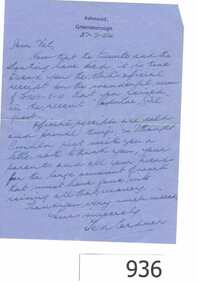
Letter, Letter from Ted Cordner to Val Rolfs, 27/07/1954
... Letter from Ted Cordner to Val Rolfs......ted cordner...In this letter, Ted Cordner thanks Val Rolfs (now Val Wilson) for her fundraising efforts in the Greensborough Football Club's Popular Girl Quest 1954....Ted Cordner...Written in blue ink. Letter from Ted Cordner to Val Rolfs Letter Ted Cordner ...In this letter, Ted Cordner thanks Val Rolfs (now Val Wilson) for her fundraising efforts in the Greensborough Football Club's Popular Girl Quest 1954.Handwritten note from (Doctor) Ted Cordner on Ashmead letterhead.Handwritten letter on blue "Ashmead" letterhead. Written in blue ink.Written in pencil on back:" Val Rolfs. 20 William Street Greensborough (at the time). Participant. Popular Girl.GFC."val rolfs, val wilson, ted cordner, ashmead, popular girl quest 1954, greensborough football club -
 Greensborough Historical Society
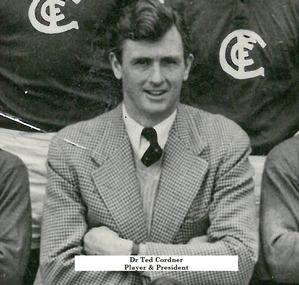
Photograph - Digital Image, Ted Cordner. Greensborough Football Club, 1955c
... Ted Cordner. Greensborough Football Club. ......ted cordner...Photograph of Ted Cordner, past President and player with the Greensborough Football Club. ...Photograph of Ted Cordner, past President and player with the Greensborough Football Club. greensborough football club gfc hall of fame ted cordner Digital copy of photographs Ted Cordner. ...Photograph of Ted Cordner, past President and player with the Greensborough Football Club. Digital copy of photographs greensborough football club, gfc hall of fame, ted cordner -
 Greensborough Historical Society
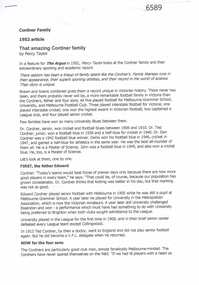
Article, Journal, Cordner Family, 26/09/1952
... ...ted cordner...This article describes their sporting records and notes their education and careers. cordner family ted cordner Link to Trove database 3p. text Cordner Family Article, Journal Percy Taylor The Argus Percy Taylor The Argus ...The Cordner family, resident in Greensborough, two of whom were doctors, included five Australian Rules football players for the Melbourne club. This article describes their sporting records and notes their education and careers.3p. textLink to Trove databasecordner family, ted cordner -
 Greensborough Historical Society
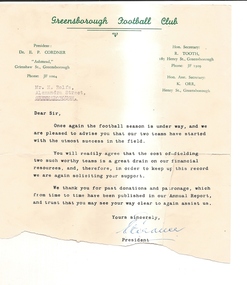
Document - Letter, Greensborough Football Club, 1950s
... ...ted cordner...The letterhead features the name of the President, Secretary and Assistant Secretary at the time of writing. greensborough football club tooth family orr family rolfs family ted cordner An undated partially torn letter from the Greensborough Football Club. ...This is a letter to Mr H Rolfe soliciting a donation to the Greensborough Football Club. Greensborough Football club has existed for over a century. The letterhead features the name of the President, Secretary and Assistant Secretary at the time of writing.An undated partially torn letter from the Greensborough Football Club. greensborough football club, tooth family, orr family, rolfs family, ted cordner -
 Greensborough Historical Society
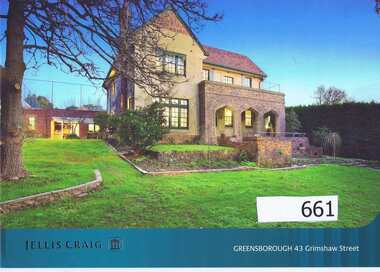
Flyer - Advertisement, Ashmead, 43 Grimshaw Street, 11/08/2012
... ...ted cordner...Five members of this family played for the Melbourne Football Club. cordner family ashmead ted cordner auctions grimshaw street greensborough A collection of advertising relating to the sale of "Ashmead" the former home of the Cordner family in Greensborough. ...The material relates to the auction of "Ashmead" on 11th August 2012. The house "Ashmead" was built in 1932 and was the home of the Cordner family. It is one of the grander houses in Greensborough and closely resembles an English country manor. Five members of this family played for the Melbourne Football Club.A collection of advertising relating to the sale of "Ashmead" the former home of the Cordner family in Greensborough.cordner family, ashmead, ted cordner, auctions, grimshaw street greensborough -
 Greensborough Historical Society
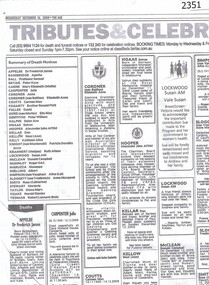
Newspaper clipping, Death notice for Mrs Cordner 2009, 16/12/2009
... Death notice of Elizabeth Anne Cordner nee Baillieu, wife of Ted Cordner....Death notice of Elizabeth Anne Cordner nee Baillieu, wife of Ted Cordner. elizabeth anne cordner cordner family 1 p. photocopy of Tributes & celebrations, The Age, 16 December 2009 Death notice for Mrs Cordner 2009. ...Death notice of Elizabeth Anne Cordner nee Baillieu, wife of Ted Cordner.1 p. photocopy of Tributes & celebrations, The Age, 16 December 2009elizabeth anne cordner, cordner family -
 Greensborough Historical Society
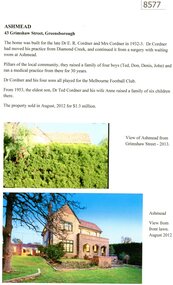
Article, Marilyn Smith, Ashmead: 43 Grimshaw Street Greensborough, 2023
... This house was built for Doctor Ted Cordner and family in the early 1930s. Doctor Cordner ran his medical practice from his home. ...This house was built for Doctor Ted Cordner and family in the early 1930s. Doctor Cordner ran his medical practice from his home. ...This house was built for Doctor Ted Cordner and family in the early 1930s. Doctor Cordner ran his medical practice from his home. The property was sold in 2012.2p., text and col. imagesgrimshaw street greensborough, ashmead, cordner family -
 Eltham District Historical Society Inc
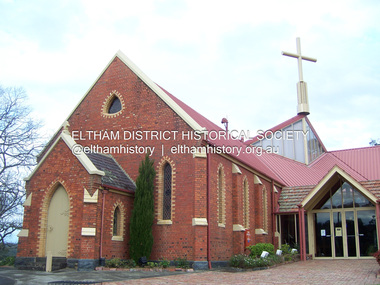
Photograph - Digital Photograph, Marguerite Marshall, St John's Anglican Church, Diamond Creek, 7 September 2008
... Another parishioner, Dr Ted Cordner, came to Diamond Creek in 1920. One of his sons Donald, who was a local doctor, won the Brownlow Medal, was President of the Melbourne Cricket Club and President of the Melbourne Grammar School Council. ...Another parishioner, Dr Ted Cordner, came to Diamond Creek in 1920. One of his sons Donald, who was a local doctor, won the Brownlow Medal, was President of the Melbourne Cricket Club and President of the Melbourne Grammar School Council. ...The building was designed by Charles Maplestone of Heidelberg, son-in-law to Anthony Beale of St Helena. Maplestone was a prominent architect who came out to Australia with his family in 1852. The foundation stone was laid by Mrs Isabella Maplestone on 11th November 1867. The bricklayers for the church were George Stebbing, H Limmer, H Spicer and a Mr Timm while Thomas Day was the stonemason. Another three years were to pass before sufficient money could be raised for its completion. It was opened by Bishop Perry on 1st November, 1870. The church bell which hung under a tree for 50 years until it was incorporated in the parish hall was brought out from England and presented by Charles Orme. In 1916, the estate of George Martin Pizzey left sufficient money to build the red brick hall, which still stands today (2023) though in January 1969 the hall and bell tower were badly damaged by bushfire. Coincidentally the former home of benefactor, George Pizzey was destroyed in the same fire. Of particular significance are the interior and exterior of the church, the Sunday school and hall with emphasis on pre-World War I fabric (excluding the 1990s additions) and the three coloured glass windows currently suspended in the 1990s entry foyer. In 2011 further alterations were made to the front of the Church. The church is historically significant because it was the oldest public building in the former Diamond Valley Shire, is amongst the oldest buildings in the Shire of Nillumbik and is associated with the early settlement of the Diamond Creek district. The church is historically, socially and spiritually significant because it has been a place of worship for over 150 years and continues to be, an important meeting place in the Shire. The church is aesthetically significant for the three stained glass windows executed by the noted stained glass manufacturers, Ferguson & Urie, as well as the supporting coloured glass windows in the church. The Sunday school & parish hall is architecturally significant because the hall is a well executed and preserved example of the work of noted church architects, North & Williams. It is historically significant because it is connected with local parishioner and Melbourne industrialist, George Pizzey, who bequeathed funds for its construction. Covered under Heritage Overlay, Nillumbik Planning Scheme. National Estate Ntionl Trust of Australia (Victoria) Local significance Published: Nillumbik Now and Then / Marguerite Marshall 2008; photographs Alan King with Marguerite Marshall.; p85 St John’s Anglican Church stands like a beacon on the hill on Main Street, Diamond Creek. Today the church has a large congregation, but its early years were marked by a small congregation struggling to find enough money to survive. It was gold in Diamond Creek that resulted in the building of this National Trust registered property.1 This church is far removed from William Wilson’s humble barn (later the Bowling Green) where the first Anglican church services were conducted – probably the first in the district.2 In the mid 19th century services were infrequent as the Rev Francis Hales, travelling on horseback, also conducted services elsewhere, including at Heidelberg, Coburg, Kinglake, Arthurs Creek, St Andrews and Kangaroo Ground. In 1860 Diamond Creek came under the jurisdiction of the Eltham Parish. Until the mid 1860s the Diamond Creek settlement included only about 20 families who were struggling farmers. But this changed when gold was found in 1862. Then the township grew to 200 families, including miners, civil administration workers and shopkeepers. The resulting growth of Church of England adherents prompted them to petition the Government in 1866 for land to build a church. The area chosen, on which the original building still stands, was at the centre of the proposed township. Today church leaders believe that this conspicuous location is one of the reasons for its exceptional growth. Prominent architect Charles Maplestone designed the building as he did the Presbyterian Church at Kangaroo Ground. St John’s, which is still intact, was built in the Gothic Revival style with the traditional rectangular plan of a central nave and sanctuary at the end. It is typical of small churches built in Victoria at that time, with polychromatic hand-made bricks, a porch, diagonal buttresses and a slate roof.3 The church was officially opened by Lord Bishop Perry on November 1, 1870. But during the next 40 years, due to the varying fortunes of gold mining, the church struggled to remain viable. In 1909 it separated from the Eltham Parish to form a parish with Greensborough. Life became more difficult with the privations of World War One. Then disaster struck in 1915 when fire destroyed the Diamond Creek Gold Mine, wiping out the major livelihood of most parishioners. However the church’s morale was lifted in 1916, when it received a bequest to build the red brick hall, from late parishioner and prominent leather manufacturer, George Pizzey. As prosperity grew, in 1924 the congregation separated from Greensborough, but they rejoined in the 1930s Depression. In the 1950s the wider population soared, impacting on St John’s, and it became a separate parish, becoming responsible for six churches at St Andrews, Hazel Glen, Hurstbridge, St Helena and Yarrambat. As parishioner numbers outgrew the building, extensions were added in 1989 and then in 1993, blending in well with the original building. Church members have made a huge contribution to the local community. John Ryan was a Heidelberg Shire Councillor for 25 years from 1931, Mayor in 1939 and headed several local sporting and other organisations. His son Jock became a clergyman and a local historian heading the Nillumbik Historical Society. Another parishioner, Dr Ted Cordner, came to Diamond Creek in 1920. One of his sons Donald, who was a local doctor, won the Brownlow Medal, was President of the Melbourne Cricket Club and President of the Melbourne Grammar School Council. Roy ‘Monty’ Vale was a state Liberal MP and was related to May Vale, a member of the Heidelberg School of Artists.4 In the early 21st century St John’s Anglican Church is one of the fastest growing congregations in Melbourne. References: St Johns Anglican Church complex, Sunday School and Parish Hall 61 Main Street DIAMOND CREEK, NILLUMBIK SHIRE. (2023, June 7). Retrieved from https://vhd.heritagecouncil.vic.gov.au/places/64023 Diamond Creek, VIC. – St John’s Anglican (2023, June 7). Retrieved from https://www.churchhistories.net.au/church-catalog/diamond-creek-vic-st-johns-anglican This collection of almost 130 photos about places and people within the Shire of Nillumbik, an urban and rural municipality in Melbourne's north, contributes to an understanding of the history of the Shire. Published in 2008 immediately prior to the Black Saturday bushfires of February 7, 2009, it documents sites that were impacted, and in some cases destroyed by the fires. It includes photographs taken especially for the publication, creating a unique time capsule representing the Shire in the early 21st century. It remains the most recent comprehenesive publication devoted to the Shire's history connecting local residents to the past. nillumbik now and then (marshall-king) collection, st john's anglican church, diamond creek -
 Greensborough Historical Society
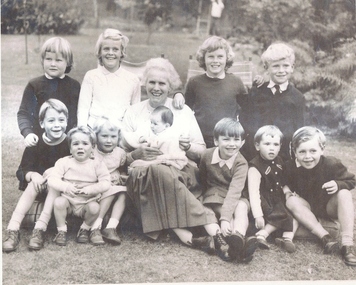
Photograph (copy), Mrs Cordner and grandchildren, 1955c
... The group shows Granny Cordner and her grandchildren. Mrs Cordner was the mother of Ted; Don; John and Denis....Mr Cordner senior and sons Ted and Don were local doctors. cordner family eldale avenue greensborough The description of the people is written in ink on the rear . ...The group shows Granny Cordner and her grandchildren. Mrs Cordner was the mother of Ted; Don; John and Denis.The Cordner family were a prominent local family for most of the 20th Century. Mr Cordner senior and sons Ted and Don were local doctors.A black and white copy of a photograph of an elderly woman and a group of children.The description of the people is written in ink on the rear .cordner family, eldale avenue greensborough -
 Greensborough Historical Society
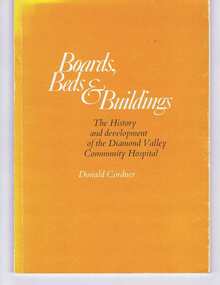
Book, Donald Cordner, Boards, beds and buildings: the history and development of the Diamond Valley Community Hospital, 1941-1971 / by Donald Cordner, 1971
... Written by Doctor Donald Cordner whose father Dr Ted Cordner was one of the founders of the hospital. diamond valley community hospital dvch donald cordner 71 p., black and white illus. ...A history of the founding and development of the Diamond Valley Community Hospital over its first 30 years. Includes names of those responsible for founding the hospital and many staff.Written by Doctor Donald Cordner whose father Dr Ted Cordner was one of the founders of the hospital. 71 p., black and white illus.diamond valley community hospital, dvch, donald cordner -
 Greensborough Historical Society
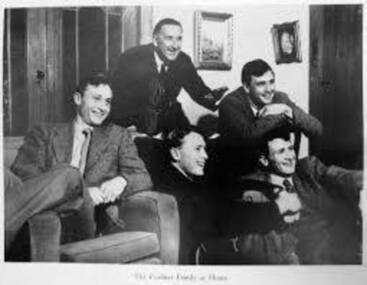
Photograph - Digital image, The Cordner family, 1955c
... The Cordner family were a prominent local family for most of the 20th Century. Mr Cordner senior and sons Ted and Don were local doctors. cordner family Digital copy of black and white photograph The Cordner family Photograph - Digital image ...The Cordner 'boys' at home.The Cordner family were a prominent local family for most of the 20th Century. Mr Cordner senior and sons Ted and Don were local doctors.Digital copy of black and white photograph cordner family
