
Showing 66 items matching "tenor solo"
-
 Flagstaff Hill Maritime Museum and Village
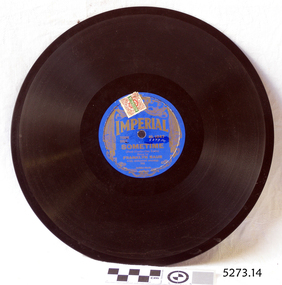
Audio - Gramophone Record, Imperial Records, Sometime, Early-to-mid 20th century
... ...tenor solo...Title: Sometime Artist: Franklyn Baur, tenor, solo Publisher: Imperial Records Number:1547 Size: 14 inch...Title: Sometime Artist: Franklyn Baur, tenor, solo Publisher: Imperial Records Number:1547 Size: 14 inch Sometime Audio Gramophone Record Imperial Records ...Thomas Edison (1847–1931), an American, invented the phonograph in 1877, making it possible to record sound waves vertically and reproduce them on a wax cylinder so they could be heard again. Later, the German American, Emile Berliner (1851-1929), improved on Edison’s principles, greatly increasing the quality of the reproduced sounds with his invention of the gramophone in 1887, which recorded the sound waves laterally onto a flat shellac disc, or ‘record’. Records could be mass-produced in a factory where audio recordings were converted to a physical copy of that recording on a plate-sized disc. A gramophone machine reproduced the sound by spinning the record on a turntable at a specified number of rotations per minute (RPM) and using a stylus or needle to transfer the vibration via a membrane to a speaker, which amplified the sound. Berliner helped set up affiliated businesses overseas. One of his representatives was William Barry Owen (1860–1914), who, on 23 February 1889, partnered with Edmund Trevor Lloyd Williams (1859–1946) in England to register The Gramophone Company. His Master’s Voice (HMV) soon became the company’s major recording label, popular worldwide. The business based the label's logo of a dog looking into a gramophone horn for ‘his master’s voice’ was based on a painting by English artist Francis Barraud, which featured a terrier called Nipper beside a gramophone. Early gramophone records were mostly made from a material referred to as shellac, a natural ingredient combined with slate powder, and a filler of manilla copal, wood resin, carnauba wax, and carbon black. Although Bakelite seemed a useful, synthetic product, it was unsuccessful as a product for records. Around the time of World War II, lightweight, flexible synthetic vinyl records began replacing shellac records. Common diameters of records: 7 inch, 10 inch, 12 inch and 16 inch Revolutions Per Minute include: 33 1/3, 45, 78 Minutes per side of record: 3, 5.5, 7, 8, 9, 12, 15 and 22 Labels, in minutes per side: Single Play 3-5 min, Extended Play (EP) 7-12 min, Long Play (LP) 12-22 min This gramophone represents a step in the evolution of recording sound. In the 19th century, the human voice was first recorded on wax cylinders and replayed. It was the beginning of a new era in sound. Then, in the 1880s, voice could be recorded onto flat discs like this record, reliably reproduced and replayed many times, even on portable devices. Later, in the mid-20th century the following generation of electronic audio recording began, and later that century, digital recording gave even better reproduction. The record represents a popular means of entertainment for personal and social activities, as well as in some businesses. Shellac gramophone record with a blue and gold label. Title: Sometime Artist: Franklyn Baur, tenor, solo Publisher: Imperial Records Number:1547 Size: 14 inchWhite paper stamp with gold, red and green printflagstaff hill, warrnambool, maritime village, maritime museum, flagstaff hill maritime museum and village, shipwreck coast, great ocean road, gramophone, phonograph, sound waves, record, reproduction, audio record, music, sound, thomas edison, emile berliner, 1887, shellac, rpm, william barry owen, edmund trevor lloyd williams, the gramophone company, his master’s voice, hmv, francis barraud, nipper, imperial record, 1547, sometime, tenor solo, franklyn baur, 14 inch -
 Coal Creek Community Park & Museum
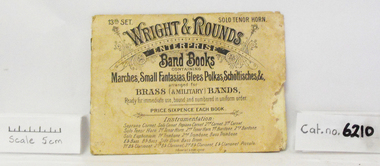
Music Book, Wright & Rounds Band Book, 13th Set, for Solo Tenor Horn
... Wright & Rounds Band Book, 13th Set, for Solo Tenor Horn...Music book, cream paper: Wright & Rounds Enterprise Band Book, 13th Set, Solo Tenor Horn, containing marches, small fantasias, glees polkas, schottisches, for brass & military bands....Wright & Rounds Band Book, 13th Set, for Solo Tenor Horn Music Book ...Music book, cream paper: Wright & Rounds Enterprise Band Book, 13th Set, Solo Tenor Horn, containing marches, small fantasias, glees polkas, schottisches, for brass & military bands. -
 Royal Australian Air Force Band
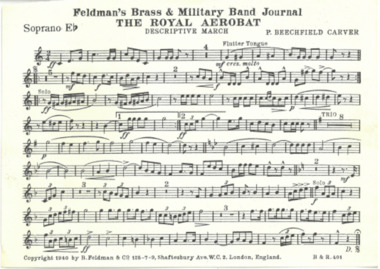
March Card, Carver, P. Beechfield (Composer), The Royal Aerobat, Composed: 1940
... Includes extended technique of flutter tonguing for an aeroplane effect Key Signature: Eb Major Feldman's Brass and Military Band Journal Instrumentation: Solo Cornet Bb (Conductor) Db Flute & Piccolo Concert Flute Oboe Eb Clarinet Repiano Bb 1st Bb Clarinet 2nd Bb Clarinet 3rd & 4th Bb Clarinets Bassoon Eb Soprano Eb Alto Saxophone 1st Baritone Bb (or Tenor Saxophone Bb) 2nd Baritone Bb 1st Eb Horn (or Solo Tenor) 2nd Eb Horn (or 1st Tenor) 3rd Eb Horn (or 2nd Tenor) Solo Bb Cornet (Conductor) 2nd Bb Cornet 3rd & 4th Cornets Bb 1st Trombone 2nd Trombone Bass Trombone Euphonium (Treble Clef) Euphonium (Bass Clef) Bombardon (Bass Clef) Eb Bass (Treble Clef) Bb Bass Drumes...Includes extended technique of flutter tonguing for an aeroplane effect Key Signature: Eb Major Feldman's Brass and Military Band Journal Instrumentation: Solo Cornet Bb (Conductor) Db Flute & Piccolo Concert Flute Oboe Eb Clarinet Repiano Bb 1st Bb Clarinet 2nd Bb Clarinet 3rd & 4th Bb Clarinets Bassoon Eb Soprano Eb Alto Saxophone 1st Baritone Bb (or Tenor Saxophone Bb) 2nd Baritone Bb 1st Eb Horn (or Solo Tenor) 2nd Eb Horn (or 1st Tenor) 3rd Eb Horn (or 2nd Tenor) Solo Bb Cornet (Conductor) 2nd Bb Cornet 3rd & 4th Cornets Bb 1st Trombone 2nd Trombone Bass Trombone Euphonium (Treble Clef) Euphonium (Bass Clef) Bombardon (Bass Clef) Eb Bass (Treble Clef) Bb Bass Drumes The Royal Aerobat March Card Carver, P. ...In 1932 the call was put out to the ABC to start a military band. The band’s task was to record music to play on air four times a week, and to perform live concerts for the public. By November 1933 a band was put together with 40 musicians from around Australia. The band was initially conducted by Captain H. E. Adkins, Director of the Royal Military School of Music, Kneller Hall, London. After the tour, Adkins returned to his position at Kneller Hall, and Stephen Yorke, a retired bandmaster of the Gloucestershire Regiment, was brought out to Australia to become the permanent director and conductor of the band, which he did until the band closed in 1951. During the band’s 17 year history they presented a sizable program of music. Their final concert received a standing ovation from its audience of 1500, with a teary-eyed Yorke. 28 parts concert band instrumentation Descriptive March - Introducing: The Auxiliary Air Force March, the Air Salute, the Flying Corps Drinking Song etc. Includes extended technique of flutter tonguing for an aeroplane effect Key Signature: Eb Major Feldman's Brass and Military Band Journal Instrumentation: Solo Cornet Bb (Conductor) Db Flute & Piccolo Concert Flute Oboe Eb Clarinet Repiano Bb 1st Bb Clarinet 2nd Bb Clarinet 3rd & 4th Bb Clarinets Bassoon Eb Soprano Eb Alto Saxophone 1st Baritone Bb (or Tenor Saxophone Bb) 2nd Baritone Bb 1st Eb Horn (or Solo Tenor) 2nd Eb Horn (or 1st Tenor) 3rd Eb Horn (or 2nd Tenor) Solo Bb Cornet (Conductor) 2nd Bb Cornet 3rd & 4th Cornets Bb 1st Trombone 2nd Trombone Bass Trombone Euphonium (Treble Clef) Euphonium (Bass Clef) Bombardon (Bass Clef) Eb Bass (Treble Clef) Bb Bass DrumesOn envelope: QM177, Royal Aerobat (Carver), Q263brass band, australian broadcasting commission, marching band, concert band -
 Royal Australian Air Force Band
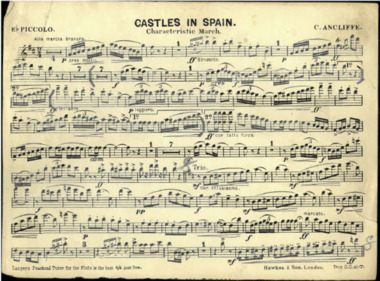
March Card, Charles Ancliffe (composer), Castles in Spain, Composed: 1917
... Concert Band & Brass Band Instrumentation Total 33 Parts Characteristic March Alla Marcia Bravura Key Signature:C minor Instrumentation: Eb Piccolo Oboes Eb Clarinet 1st Bb Clarinet 2nd Bb Clarinet 3rd & 4th Bb Clarinets 1st Bassoon 2nd Bassoon Solo Eb Saxhorn (Eb Alto) 1st Bb Baritone (Bb Tenor) Solo Bb Cornet 1st Bb Cornet 2nd Bb Cornet 3rd & 4th Bb Cornets Eb Trumpets 1st Eb Horn 2nd Eb Horn 3rd Eb Horn 4th Eb Horn 1st Trombone (Bass Clef) 1st Trombone (Tenor Clef) 2nd Trombone (Bass Clef) 2nd Trombone (Tenor Clef) Bass Trombone 2nd Bb Baritone (Bb Tenor) Euphonium (Baritone) Bombardon (Tuba) Eb Bombardon (Treble Clef) Bb Bass Side Drum Bass Drum Additional Hand Written 1st Bb Clarinet...Q26 (additional). 295 (crossed out) Stamped on the reverse of each card: Australian Broadcasting Co., The Property of Musical Director & Arranger Concert Band & Brass Band Instrumentation Total 33 Parts Characteristic March Alla Marcia Bravura Key Signature:C minor Instrumentation: Eb Piccolo Oboes Eb Clarinet 1st Bb Clarinet 2nd Bb Clarinet 3rd & 4th Bb Clarinets 1st Bassoon 2nd Bassoon Solo Eb Saxhorn (Eb Alto) 1st Bb Baritone (Bb Tenor) Solo Bb Cornet 1st Bb Cornet 2nd Bb Cornet 3rd & 4th Bb Cornets Eb Trumpets 1st Eb Horn 2nd Eb Horn 3rd Eb Horn 4th Eb Horn 1st Trombone (Bass Clef) 1st Trombone (Tenor Clef) 2nd Trombone (Bass Clef) 2nd Trombone (Tenor Clef) Bass Trombone 2nd Bb Baritone (Bb Tenor) Euphonium (Baritone) Bombardon (Tuba) Eb Bombardon (Treble Clef) Bb Bass Side Drum Bass Drum Additional Hand Written 1st Bb Clarinet Castles in Spain March Card Charles Ancliffe (composer) Hawkes & Son, U.S.A. ...In 1932 the call was put out to the ABC to start a military band. The band’s task was to record music to play on air four times a week, and to perform live concerts for the public. By November 1933 a band was put together with 40 musicians from around Australia. The band was initially conducted by Captain H. E. Adkins, Director of the Royal Military School of Music, Kneller Hall, London. After the tour, Adkins returned to his position at Kneller Hall, and Stephen Yorke, a retired bandmaster of the Gloucestershire Regiment, was brought out to Australia to become the permanent director and conductor of the band, which he did until the band closed in 1951. During the band’s 17 year history they presented a sizable program of music. Their final concert received a standing ovation from its audience of 1500, with a teary-eyed Yorke. Concert Band & Brass Band Instrumentation Total 33 Parts Characteristic March Alla Marcia Bravura Key Signature:C minor Instrumentation: Eb Piccolo Oboes Eb Clarinet 1st Bb Clarinet 2nd Bb Clarinet 3rd & 4th Bb Clarinets 1st Bassoon 2nd Bassoon Solo Eb Saxhorn (Eb Alto) 1st Bb Baritone (Bb Tenor) Solo Bb Cornet 1st Bb Cornet 2nd Bb Cornet 3rd & 4th Bb Cornets Eb Trumpets 1st Eb Horn 2nd Eb Horn 3rd Eb Horn 4th Eb Horn 1st Trombone (Bass Clef) 1st Trombone (Tenor Clef) 2nd Trombone (Bass Clef) 2nd Trombone (Tenor Clef) Bass Trombone 2nd Bb Baritone (Bb Tenor) Euphonium (Baritone) Bombardon (Tuba) Eb Bombardon (Treble Clef) Bb Bass Side Drum Bass Drum Additional Hand Written 1st Bb ClarinetOn envelope: QM30. Castles in Spain. Ancliffe. Stamps indicating 30 OCT 1940, 30 NOV 1940, 23 APR 1941, 17 JAN 1944. Q26 (additional). 295 (crossed out) Stamped on the reverse of each card: Australian Broadcasting Co., The Property of Musical Director & Arrangerbrass band, australian broadcasting commission, marching band, concert band -
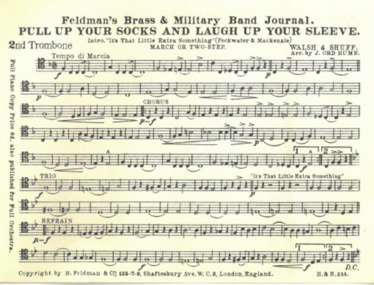 Royal Australian Air Force Band
March Card, Walsh & Shuff (Composer) et al, Pull Up Your Socks and Laugh Up Your Sleeve, Composed: ?
... 'It's That Little Extra Something" (Peckwater & Mackenzie) Full Piano Copy Rice 6d. also published for Full Orchestra Instrumentation: Conductor Flute & Piccolo Oboe Eb Clarinet Bb Repiano 1st Clarinet in Bb 2nd Clarinet in Bb 3rd Clarinet in Bb Bassoon Eb Alto Saxophone 1st Baritone Bb & Tenor Saxophone Bb 1st Eb Horn or Solo Tenor 2nd Eb Horn or 1st Tenor 3rd Eb Horn or 2nd Tenor 4th Eb Horn Solo Cornet in Bb 2nd Cornet in Bb 1st Trombone 2nd Trombone Bass Trombone Euphonium (bass clef) Basses Drums...'It's That Little Extra Something" (Peckwater & Mackenzie) Full Piano Copy Rice 6d. also published for Full Orchestra Instrumentation: Conductor Flute & Piccolo Oboe Eb Clarinet Bb Repiano 1st Clarinet in Bb 2nd Clarinet in Bb 3rd Clarinet in Bb Bassoon Eb Alto Saxophone 1st Baritone Bb & Tenor Saxophone Bb 1st Eb Horn or Solo Tenor 2nd Eb Horn or 1st Tenor 3rd Eb Horn or 2nd Tenor 4th Eb Horn Solo Cornet in Bb 2nd Cornet in Bb 1st Trombone 2nd Trombone Bass Trombone Euphonium (bass clef) Basses Drums Pull Up Your Socks and Laugh Up Your Sleeve March Card Walsh & Shuff (Composer) Hume, J. ...In 1932 the call was put out to the ABC to start a military band. The band’s task was to record music to play on air four times a week, and to perform live concerts for the public. By November 1933 a band was put together with 40 musicians from around Australia. The band was initially conducted by Captain H. E. Adkins, Director of the Royal Military School of Music, Kneller Hall, London. After the tour, Adkins returned to his position at Kneller Hall, and Stephen Yorke, a retired bandmaster of the Gloucestershire Regiment, was brought out to Australia to become the permanent director and conductor of the band, which he did until the band closed in 1951. During the band’s 17 year history they presented a sizable program of music. Their final concert received a standing ovation from its audience of 1500, with a teary-eyed Yorke. 23 parts Concert Band Instrumentation Quick March or Two Step Key Signature: F Major Intro. 'It's That Little Extra Something" (Peckwater & Mackenzie) Full Piano Copy Rice 6d. also published for Full Orchestra Instrumentation: Conductor Flute & Piccolo Oboe Eb Clarinet Bb Repiano 1st Clarinet in Bb 2nd Clarinet in Bb 3rd Clarinet in Bb Bassoon Eb Alto Saxophone 1st Baritone Bb & Tenor Saxophone Bb 1st Eb Horn or Solo Tenor 2nd Eb Horn or 1st Tenor 3rd Eb Horn or 2nd Tenor 4th Eb Horn Solo Cornet in Bb 2nd Cornet in Bb 1st Trombone 2nd Trombone Bass Trombone Euphonium (bass clef) Basses DrumsOn envelope: QM161, March at Two Step, Pull up your Socks, Walsh Q137, scrubbed out 407 Stamped on the reverse of each card: Australian Broadcasting Co.brass band, australian broadcasting commission, marching band, concert band -
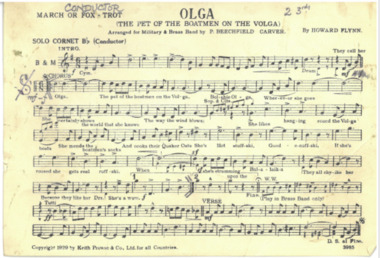 Royal Australian Air Force Band
March Card, Howard Flynn (Composer) et al, Olga (The Pet of the Boatmen on the Volga), Composed: 1929
... 20 Parts Concert Band Instrumentation March or Fox Trot Key Signature: F Major Instrumentation: Solo Cornet Bb (Conductor) Eb Flute & Piccolo Oboes Eb Clarinets Solo Bb Clarinet (1st written in pencil) 2nd & 3rd Bb Clarinets Bassoons Eb Alto Saxophone 1st & 2nd Horns Eb (or Solo & 1st Tenor) 3rd & 4th Horns Eb (or 2nd Tenor) Repiano Cornet Bb Solo Cornet Bb (Conductor) 2nd & 3rd Cornets Bb 1st Tenor Trombone 2nd Tenor Trombone Bass Trombone 1st Baritone Bb Euphonium (Bass clef) Basses (Bass clef) Bb Contra Bass (Treble clef) Drums...Brass Band Australian Broadcasting Commission Marching Band Concert Band On envelope: QM145, Olga Flynn, Q131, 346 (Scrubbed out) Stamped on the reverse of each card: Australian Broadcasting Commission *Sydney*, Charles Godfrey 20 Parts Concert Band Instrumentation March or Fox Trot Key Signature: F Major Instrumentation: Solo Cornet Bb (Conductor) Eb Flute & Piccolo Oboes Eb Clarinets Solo Bb Clarinet (1st written in pencil) 2nd & 3rd Bb Clarinets Bassoons Eb Alto Saxophone 1st & 2nd Horns Eb (or Solo & 1st Tenor) 3rd & 4th Horns Eb (or 2nd Tenor) Repiano Cornet Bb Solo Cornet Bb (Conductor) 2nd & 3rd Cornets Bb 1st Tenor Trombone 2nd Tenor Trombone Bass Trombone 1st Baritone Bb Euphonium (Bass clef) Basses (Bass clef) Bb Contra Bass (Treble clef) Drums Olga (The Pet of the Boatmen on the Volga) March Card Howard Flynn (Composer) Carver, P. ...In 1932 the call was put out to the ABC to start a military band. The band’s task was to record music to play on air four times a week, and to perform live concerts for the public. By November 1933 a band was put together with 40 musicians from around Australia. The band was initially conducted by Captain H. E. Adkins, Director of the Royal Military School of Music, Kneller Hall, London. After the tour, Adkins returned to his position at Kneller Hall, and Stephen Yorke, a retired bandmaster of the Gloucestershire Regiment, was brought out to Australia to become the permanent director and conductor of the band, which he did until the band closed in 1951. During the band’s 17 year history they presented a sizable program of music. Their final concert received a standing ovation from its audience of 1500, with a teary-eyed Yorke. 20 Parts Concert Band Instrumentation March or Fox Trot Key Signature: F Major Instrumentation: Solo Cornet Bb (Conductor) Eb Flute & Piccolo Oboes Eb Clarinets Solo Bb Clarinet (1st written in pencil) 2nd & 3rd Bb Clarinets Bassoons Eb Alto Saxophone 1st & 2nd Horns Eb (or Solo & 1st Tenor) 3rd & 4th Horns Eb (or 2nd Tenor) Repiano Cornet Bb Solo Cornet Bb (Conductor) 2nd & 3rd Cornets Bb 1st Tenor Trombone 2nd Tenor Trombone Bass Trombone 1st Baritone Bb Euphonium (Bass clef) Basses (Bass clef) Bb Contra Bass (Treble clef) DrumsOn envelope: QM145, Olga Flynn, Q131, 346 (Scrubbed out) Stamped on the reverse of each card: Australian Broadcasting Commission *Sydney*, Charles Godfreybrass band, australian broadcasting commission, marching band, concert band -
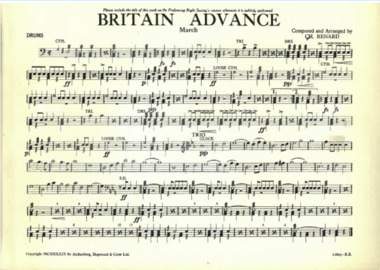 Royal Australian Air Force Band
March Card, CH. Renard (Composer, Arranger), Britain Advance, Composed: 1939
... 16 Parts Brass Band Instrumentation Quick March Ascherberg's Brass and Military Band Journal Key Signature: Ab Major Instrumentation: Repiano Cornet Bb Eb Soprano Cornet Solo Cornet Bb 2nd Cornet Bb 3rd Cornet Bb Solo Tenor Horn Eb 2nd Tenor Horn Eb 3rd Tenor Horn Eb 1st Baritone Bb 2nd Baritone Bb 1st Tenor Trombone 2nd Tenor Trombone Bass Trombone Bb Euphonium (Treble Clef) Eb Basses Bb Basses Drums...On Inner Envelope: QM22, Q271 16 Parts Brass Band Instrumentation Quick March Ascherberg's Brass and Military Band Journal Key Signature: Ab Major Instrumentation: Repiano Cornet Bb Eb Soprano Cornet Solo Cornet Bb 2nd Cornet Bb 3rd Cornet Bb Solo Tenor Horn Eb 2nd Tenor Horn Eb 3rd Tenor Horn Eb 1st Baritone Bb 2nd Baritone Bb 1st Tenor Trombone 2nd Tenor Trombone Bass Trombone Bb Euphonium (Treble Clef) Eb Basses Bb Basses Drums Britain Advance March Card CH. ...In 1932 the call was put out to the ABC to start a military band. The band’s task was to record music to play on air four times a week, and to perform live concerts for the public. By November 1933 a band was put together with 40 musicians from around Australia. The band was initially conducted by Captain H. E. Adkins, Director of the Royal Military School of Music, Kneller Hall, London. After the tour, Adkins returned to his position at Kneller Hall, and Stephen Yorke, a retired bandmaster of the Gloucestershire Regiment, was brought out to Australia to become the permanent director and conductor of the band, which he did until the band closed in 1951. During the band’s 17 year history they presented a sizable program of music. Their final concert received a standing ovation from its audience of 1500, with a teary-eyed Yorke. 16 Parts Brass Band Instrumentation Quick March Ascherberg's Brass and Military Band Journal Key Signature: Ab Major Instrumentation: Repiano Cornet Bb Eb Soprano Cornet Solo Cornet Bb 2nd Cornet Bb 3rd Cornet Bb Solo Tenor Horn Eb 2nd Tenor Horn Eb 3rd Tenor Horn Eb 1st Baritone Bb 2nd Baritone Bb 1st Tenor Trombone 2nd Tenor Trombone Bass Trombone Bb Euphonium (Treble Clef) Eb Basses Bb Basses DrumsOuter Envelope: Title, Composer, Instrumentation and Publisher information, QM22. On Inner Envelope: QM22, Q271brass band, australian broadcasting commission, marching band, concert band -
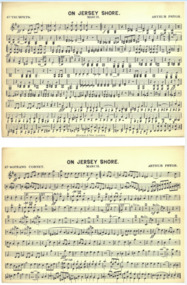 Royal Australian Air Force Band
March Card, Arthur Pryor (Composer), On Jersey Shore, Composed: 1907
... 34 parts concert band instrumentation Quick March Key Signature: Bb Major Instrumentation: Solo Bb Cornet (with Conductor pencilled) Eb Flute & Piccolo Oboes Eb Clarinets 1st Bb Clarinet 2nd Bb Clarinet 3rd & 4th Bb Clarinets 1st Bassoon 2nd Bassoon Eb Alto Saxophone Bb Tenor Saxophone Solo Eb Saxhorn 1st Eb Horn 2nd Eb Horn 3rd Eb Horn 4th Eb Horn Eb Trumpets Eb Soprano Cornet 1st Bb Cornet 2nd Bb Cornet 3rd & 4th Bb Cornets 1st Trombone (Tenor Clef) 2nd Trombone (Tenor Clef) 1st Trombone (Bass Clef) 2nd Trombone (Bass Clef) Bass Trombone 1st Bb Baritone 2nd Bb Baritone Bb Euphonium (Treble Clef) Euphonium Bombardon Bb Bass (Treble Clef) Side Drum Bass Drum...Brass Band Australian Broadcasting Commission Marching Band Concert Band On envelope: QM146, On Jersey Shore Pryor, Q124, 291 (Scrubbed out) Stamped on the reverse of each card: Australian Broadcasting Commission *Sydney*, The Property of Musical Director & Arranger Charles Godfrey 34 parts concert band instrumentation Quick March Key Signature: Bb Major Instrumentation: Solo Bb Cornet (with Conductor pencilled) Eb Flute & Piccolo Oboes Eb Clarinets 1st Bb Clarinet 2nd Bb Clarinet 3rd & 4th Bb Clarinets 1st Bassoon 2nd Bassoon Eb Alto Saxophone Bb Tenor Saxophone Solo Eb Saxhorn 1st Eb Horn 2nd Eb Horn 3rd Eb Horn 4th Eb Horn Eb Trumpets Eb Soprano Cornet 1st Bb Cornet 2nd Bb Cornet 3rd & 4th Bb Cornets 1st Trombone (Tenor Clef) 2nd Trombone (Tenor Clef) 1st Trombone (Bass Clef) 2nd Trombone (Bass Clef) Bass Trombone 1st Bb Baritone 2nd Bb Baritone Bb Euphonium (Treble Clef) Euphonium Bombardon Bb Bass (Treble Clef) Side Drum Bass Drum On Jersey Shore March Card Arthur Pryor (Composer) Hawkes & Son, London ...In 1932 the call was put out to the ABC to start a military band. The band’s task was to record music to play on air four times a week, and to perform live concerts for the public. By November 1933 a band was put together with 40 musicians from around Australia. The band was initially conducted by Captain H. E. Adkins, Director of the Royal Military School of Music, Kneller Hall, London. After the tour, Adkins returned to his position at Kneller Hall, and Stephen Yorke, a retired bandmaster of the Gloucestershire Regiment, was brought out to Australia to become the permanent director and conductor of the band, which he did until the band closed in 1951. During the band’s 17 year history they presented a sizable program of music. Their final concert received a standing ovation from its audience of 1500, with a teary-eyed Yorke. 34 parts concert band instrumentation Quick March Key Signature: Bb Major Instrumentation: Solo Bb Cornet (with Conductor pencilled) Eb Flute & Piccolo Oboes Eb Clarinets 1st Bb Clarinet 2nd Bb Clarinet 3rd & 4th Bb Clarinets 1st Bassoon 2nd Bassoon Eb Alto Saxophone Bb Tenor Saxophone Solo Eb Saxhorn 1st Eb Horn 2nd Eb Horn 3rd Eb Horn 4th Eb Horn Eb Trumpets Eb Soprano Cornet 1st Bb Cornet 2nd Bb Cornet 3rd & 4th Bb Cornets 1st Trombone (Tenor Clef) 2nd Trombone (Tenor Clef) 1st Trombone (Bass Clef) 2nd Trombone (Bass Clef) Bass Trombone 1st Bb Baritone 2nd Bb Baritone Bb Euphonium (Treble Clef) Euphonium Bombardon Bb Bass (Treble Clef) Side Drum Bass DrumOn envelope: QM146, On Jersey Shore Pryor, Q124, 291 (Scrubbed out) Stamped on the reverse of each card: Australian Broadcasting Commission *Sydney*, The Property of Musical Director & Arranger Charles Godfreybrass band, australian broadcasting commission, marching band, concert band -
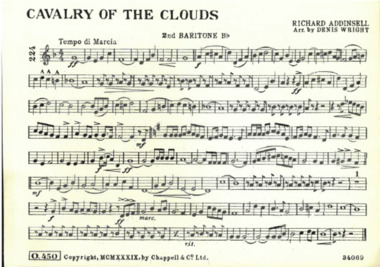 Royal Australian Air Force Band
March Card, Addinsell, Richard (Composer) et al, Cavalry Of The Clouds, Composed: 1939
... 16 Parts Brass Band Instrumentation Quick March Key Signature: Eb Major Instrumentation: Repiano Cornet Bb Soprano Cornet Eb Solo Cornet Bb (Conductor) 2nd Cornet Bb 3rd Cornet Bb 1st Horn Eb (or Solo Tenor) 2nd Horn Eb (or 1st Tenor 1st Baritone Bb (& Tenor Saxophone Bb) 2nd Baritone Bb 3rd Horn Eb (or 2nd Tenor) 1st Trombone 2nd Trombone Bass Trombone Euphonium Bb (Treble Clef) Eb Bass (Treble Clef) Contre Bass Bb (Treble Clef) Drums...Brass Band Australian Broadcasting Commission Marching Band Concert Band On envelope:QM31, The Chappell Band Club., A Stirring March Featured in The Great British Film "The Lion Has Wings", Brass Band 2/6, O. 450 16 Parts Brass Band Instrumentation Quick March Key Signature: Eb Major Instrumentation: Repiano Cornet Bb Soprano Cornet Eb Solo Cornet Bb (Conductor) 2nd Cornet Bb 3rd Cornet Bb 1st Horn Eb (or Solo Tenor) 2nd Horn Eb (or 1st Tenor 1st Baritone Bb (& Tenor Saxophone Bb) 2nd Baritone Bb 3rd Horn Eb (or 2nd Tenor) 1st Trombone 2nd Trombone Bass Trombone Euphonium Bb (Treble Clef) Eb Bass (Treble Clef) Contre Bass Bb (Treble Clef) Drums Cavalry Of The Clouds March Card Addinsell, Richard (Composer) Denis Wright (Arranger) Chappell & Co. ...In 1932 the call was put out to the ABC to start a military band. The band’s task was to record music to play on air four times a week, and to perform live concerts for the public. By November 1933 a band was put together with 40 musicians from around Australia. The band was initially conducted by Captain H. E. Adkins, Director of the Royal Military School of Music, Kneller Hall, London. After the tour, Adkins returned to his position at Kneller Hall, and Stephen Yorke, a retired bandmaster of the Gloucestershire Regiment, was brought out to Australia to become the permanent director and conductor of the band, which he did until the band closed in 1951. During the band’s 17 year history they presented a sizable program of music. Their final concert received a standing ovation from its audience of 1500, with a teary-eyed Yorke. 16 Parts Brass Band Instrumentation Quick March Key Signature: Eb Major Instrumentation: Repiano Cornet Bb Soprano Cornet Eb Solo Cornet Bb (Conductor) 2nd Cornet Bb 3rd Cornet Bb 1st Horn Eb (or Solo Tenor) 2nd Horn Eb (or 1st Tenor 1st Baritone Bb (& Tenor Saxophone Bb) 2nd Baritone Bb 3rd Horn Eb (or 2nd Tenor) 1st Trombone 2nd Trombone Bass Trombone Euphonium Bb (Treble Clef) Eb Bass (Treble Clef) Contre Bass Bb (Treble Clef) DrumsOn envelope:QM31, The Chappell Band Club., A Stirring March Featured in The Great British Film "The Lion Has Wings", Brass Band 2/6, O. 450brass band, australian broadcasting commission, marching band, concert band -
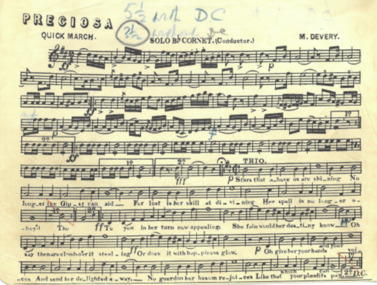 Royal Australian Air Force Band
March Card, Devery, M. (Composer), Preciosa, Composed: 1899 (?)
... 23 parts Concert Band instrumentation Quick March Key Signature: C Major Instrumentation: Solo Bb Cornet (Conductor) - with lyrics in the Trio Db Piccolo Oboes Eb Clarinets 1st Bb Clarinet 2nd Bb Clarinet 3rd & 4th Clarinet 1st Bassoon 2nd Bassoon Eb Solo Tenor (penciled Alto Sax) 1st Bb Baritone (penciled Tenor Sax) 1st Eb Tenor 2nd Ed Tenor 1st Eb Horn 2nd Eb Horn 2nd Bb Cornet 1st Trombone 2nd Trombone Bass Trombone Euponium Bombardon Side Drum Bass Drum Handwritten Timpani part...Brass Band Australian Broadcasting Commission Marching Band Concert Band On envelope: QM159, 15 APR 1910, 21 APR 1942, 23 FEB 1943, Q138 Scrubbed out: 419 23 parts Concert Band instrumentation Quick March Key Signature: C Major Instrumentation: Solo Bb Cornet (Conductor) - with lyrics in the Trio Db Piccolo Oboes Eb Clarinets 1st Bb Clarinet 2nd Bb Clarinet 3rd & 4th Clarinet 1st Bassoon 2nd Bassoon Eb Solo Tenor (penciled Alto Sax) 1st Bb Baritone (penciled Tenor Sax) 1st Eb Tenor 2nd Ed Tenor 1st Eb Horn 2nd Eb Horn 2nd Bb Cornet 1st Trombone 2nd Trombone Bass Trombone Euponium Bombardon Side Drum Bass Drum Handwritten Timpani part Preciosa March Card Devery, M. ...In 1932 the call was put out to the ABC to start a military band. The band’s task was to record music to play on air four times a week, and to perform live concerts for the public. By November 1933 a band was put together with 40 musicians from around Australia. The band was initially conducted by Captain H. E. Adkins, Director of the Royal Military School of Music, Kneller Hall, London. After the tour, Adkins returned to his position at Kneller Hall, and Stephen Yorke, a retired bandmaster of the Gloucestershire Regiment, was brought out to Australia to become the permanent director and conductor of the band, which he did until the band closed in 1951. During the band’s 17 year history they presented a sizable program of music. Their final concert received a standing ovation from its audience of 1500, with a teary-eyed Yorke. 23 parts Concert Band instrumentation Quick March Key Signature: C Major Instrumentation: Solo Bb Cornet (Conductor) - with lyrics in the Trio Db Piccolo Oboes Eb Clarinets 1st Bb Clarinet 2nd Bb Clarinet 3rd & 4th Clarinet 1st Bassoon 2nd Bassoon Eb Solo Tenor (penciled Alto Sax) 1st Bb Baritone (penciled Tenor Sax) 1st Eb Tenor 2nd Ed Tenor 1st Eb Horn 2nd Eb Horn 2nd Bb Cornet 1st Trombone 2nd Trombone Bass Trombone Euponium Bombardon Side Drum Bass Drum Handwritten Timpani partOn envelope: QM159, 15 APR 1910, 21 APR 1942, 23 FEB 1943, Q138 Scrubbed out: 419brass band, australian broadcasting commission, marching band, concert band -
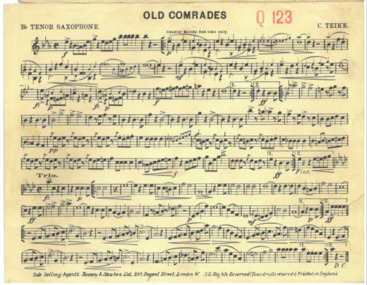 Royal Australian Air Force Band
March Card, Teike, Carl (Composer), Old Comrades (Alte Kameraden), Composed: 1889
... 30 parts Concert Band Instrumentation Quick March Key Signature: Db Major Instrumentation: Db Flute & Piccolo Oboes Eb Clarinets 1st Bb Clarinet 2nd Bb Clarinet 3rd & 4th Bb Clarinets 1st Bassoon 2nd Bassoon Eb Alto Saxophone Bb Tenor Saxophone Solo Eb Horn 1st Eb Horn 2nd Eb Horn 3rd Eb Horn 4th Eb Horn Eb Trumpets Eb Soprano Cornet Solo Bb Cornet 1st Bb Cornet 2nd Bb Cornet 3rd & 4th Bb Cornet 2nd Trombone (Tenor Clef) Bass Trombone 1st Bb Baritone 2nd Bb Baritone Bb Euphonium (Treble Clef) Bb Bass (Treble Clef) Bombardon (Treble Clef) Side Drum Bass Drum With Peak Hill Miner Band stamp: 3rd & 4th Altos Eb Cornet 3rd Trombone Baritone Saxophone 1st & 2nd Tenors Bb Bass 1st & 2nd Trombones Basses...Brass Band Australian Broadcasting Commission Marching Band Concert Band On envelope: QM141, Q123 30 parts Concert Band Instrumentation Quick March Key Signature: Db Major Instrumentation: Db Flute & Piccolo Oboes Eb Clarinets 1st Bb Clarinet 2nd Bb Clarinet 3rd & 4th Bb Clarinets 1st Bassoon 2nd Bassoon Eb Alto Saxophone Bb Tenor Saxophone Solo Eb Horn 1st Eb Horn 2nd Eb Horn 3rd Eb Horn 4th Eb Horn Eb Trumpets Eb Soprano Cornet Solo Bb Cornet 1st Bb Cornet 2nd Bb Cornet 3rd & 4th Bb Cornet 2nd Trombone (Tenor Clef) Bass Trombone 1st Bb Baritone 2nd Bb Baritone Bb Euphonium (Treble Clef) Bb Bass (Treble Clef) Bombardon (Treble Clef) Side Drum Bass Drum With Peak Hill Miner Band stamp: 3rd & 4th Altos Eb Cornet 3rd Trombone Baritone Saxophone 1st & 2nd Tenors Bb Bass 1st & 2nd Trombones Basses Old Comrades (Alte Kameraden) March Card Teike, Carl (Composer) Boosey & Hawkes, Ltd ...In 1932 the call was put out to the ABC to start a military band. The band’s task was to record music to play on air four times a week, and to perform live concerts for the public. By November 1933 a band was put together with 40 musicians from around Australia. The band was initially conducted by Captain H. E. Adkins, Director of the Royal Military School of Music, Kneller Hall, London. After the tour, Adkins returned to his position at Kneller Hall, and Stephen Yorke, a retired bandmaster of the Gloucestershire Regiment, was brought out to Australia to become the permanent director and conductor of the band, which he did until the band closed in 1951. During the band’s 17 year history they presented a sizable program of music. Their final concert received a standing ovation from its audience of 1500, with a teary-eyed Yorke. 30 parts Concert Band Instrumentation Quick March Key Signature: Db Major Instrumentation: Db Flute & Piccolo Oboes Eb Clarinets 1st Bb Clarinet 2nd Bb Clarinet 3rd & 4th Bb Clarinets 1st Bassoon 2nd Bassoon Eb Alto Saxophone Bb Tenor Saxophone Solo Eb Horn 1st Eb Horn 2nd Eb Horn 3rd Eb Horn 4th Eb Horn Eb Trumpets Eb Soprano Cornet Solo Bb Cornet 1st Bb Cornet 2nd Bb Cornet 3rd & 4th Bb Cornet 2nd Trombone (Tenor Clef) Bass Trombone 1st Bb Baritone 2nd Bb Baritone Bb Euphonium (Treble Clef) Bb Bass (Treble Clef) Bombardon (Treble Clef) Side Drum Bass Drum With Peak Hill Miner Band stamp: 3rd & 4th Altos Eb Cornet 3rd Trombone Baritone Saxophone 1st & 2nd Tenors Bb Bass 1st & 2nd Trombones BassesOn envelope: QM141, Q123brass band, australian broadcasting commission, marching band, concert band -
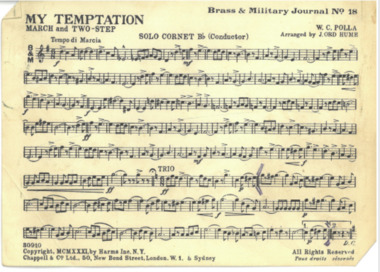 Royal Australian Air Force Band
March Card, Polla, W. C. (Composer) et al, My Temptation, Composed: 1931
... 24 parts Concert Band Instrumentation Quick March & Two Step Key Signature: F major Brass & Military Journal No. 18 Instrumentation: Solo Cornet Bb (Conductor) Piccolo Eb Oboe Eb Clarinet 1st Clarinet in Bb 2nd Clarinet in Bb 3rd Clarinet in Bb Bassoon Eb Alto Saxophone 1st Baritone Bb (and Tenor Saxophone Bb) 1st Horn Eb or Solo Tenor 2nd Horn Eb or 1st Tenor 3rd Horn Eb or 2nd Tenor 4th Horn Eb Repiano Cornet Bb 2nd Cornet Bb 1st Trombone 2nd Trombone Bass Trombone Euphonium (bass clef) Basses Contre Bass Bb Drums .... & The Property of Musical Director & Arranger Charles Godfrey 24 parts Concert Band Instrumentation Quick March & Two Step Key Signature: F major Brass & Military Journal No. 18 Instrumentation: Solo Cornet Bb (Conductor) Piccolo Eb Oboe Eb Clarinet 1st Clarinet in Bb 2nd Clarinet in Bb 3rd Clarinet in Bb Bassoon Eb Alto Saxophone 1st Baritone Bb (and Tenor Saxophone Bb) 1st Horn Eb or Solo Tenor 2nd Horn Eb or 1st Tenor 3rd Horn Eb or 2nd Tenor 4th Horn Eb Repiano Cornet Bb 2nd Cornet Bb 1st Trombone 2nd Trombone Bass Trombone Euphonium (bass clef) Basses Contre Bass Bb Drums My Temptation March Card Polla, W. ...In 1932 the call was put out to the ABC to start a military band. The band’s task was to record music to play on air four times a week, and to perform live concerts for the public. By November 1933 a band was put together with 40 musicians from around Australia. The band was initially conducted by Captain H. E. Adkins, Director of the Royal Military School of Music, Kneller Hall, London. After the tour, Adkins returned to his position at Kneller Hall, and Stephen Yorke, a retired bandmaster of the Gloucestershire Regiment, was brought out to Australia to become the permanent director and conductor of the band, which he did until the band closed in 1951. During the band’s 17 year history they presented a sizable program of music. Their final concert received a standing ovation from its audience of 1500, with a teary-eyed Yorke. 24 parts Concert Band Instrumentation Quick March & Two Step Key Signature: F major Brass & Military Journal No. 18 Instrumentation: Solo Cornet Bb (Conductor) Piccolo Eb Oboe Eb Clarinet 1st Clarinet in Bb 2nd Clarinet in Bb 3rd Clarinet in Bb Bassoon Eb Alto Saxophone 1st Baritone Bb (and Tenor Saxophone Bb) 1st Horn Eb or Solo Tenor 2nd Horn Eb or 1st Tenor 3rd Horn Eb or 2nd Tenor 4th Horn Eb Repiano Cornet Bb 2nd Cornet Bb 1st Trombone 2nd Trombone Bass Trombone Euphonium (bass clef) Basses Contre Bass Bb Drums On envelope: QM136, March Two Step My Temptation Polla, Q114, Scrubbed out 375 Stamped on the reverse of each card: Australian Broadcasting Co. & The Property of Musical Director & Arranger Charles Godfreybrass band, australian broadcasting commission, marching band, concert band -
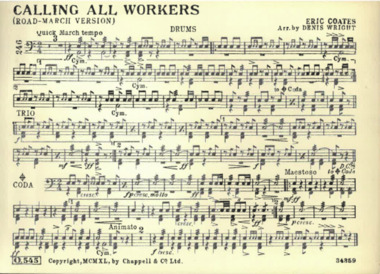 Royal Australian Air Force Band
March Card, Eric Coates (Composer) et al, Composed: 1940
... 19 Parts Concert Band Instrumentation (Missing parts: 2nd Horn, all saxes) Quick March (Road-March Version) Key Signature: Bb Major Instrumentation: Flute & Piccolo Db Eb Clarinet 1st Clarinet Bb 2nd Clarinet Bb 3rd Clarinet Bb Soprano Cornet Eb Repiano Cornet Bb Solo Cornet Bb (Conductor) 2nd Cornet Bb 3rd Cornet Bb 1st Horn Eb (or Solo Tenor) 3rd Horn Eb (or 2nd Tenor) 1st Trombone (Tenor Clef) 2nd Trombone (Tenor Clef) Bass Trombone Euphonium Bb (Treble Clef) Eb Bass (Treble Clef) Contre Bass Bb (Treble Clef) Drums...O.545, Brass Band 2/6 19 Parts Concert Band Instrumentation (Missing parts: 2nd Horn, all saxes) Quick March (Road-March Version) Key Signature: Bb Major Instrumentation: Flute & Piccolo Db Eb Clarinet 1st Clarinet Bb 2nd Clarinet Bb 3rd Clarinet Bb Soprano Cornet Eb Repiano Cornet Bb Solo Cornet Bb (Conductor) 2nd Cornet Bb 3rd Cornet Bb 1st Horn Eb (or Solo Tenor) 3rd Horn Eb (or 2nd Tenor) 1st Trombone (Tenor Clef) 2nd Trombone (Tenor Clef) Bass Trombone Euphonium Bb (Treble Clef) Eb Bass (Treble Clef) Contre Bass Bb (Treble Clef) Drums March Card Eric Coates (Composer) Denis Wright (Arranger) Chappell & Co. ...In 1932 the call was put out to the ABC to start a military band. The band’s task was to record music to play on air four times a week, and to perform live concerts for the public. By November 1933 a band was put together with 40 musicians from around Australia. The band was initially conducted by Captain H. E. Adkins, Director of the Royal Military School of Music, Kneller Hall, London. After the tour, Adkins returned to his position at Kneller Hall, and Stephen Yorke, a retired bandmaster of the Gloucestershire Regiment, was brought out to Australia to become the permanent director and conductor of the band, which he did until the band closed in 1951. During the band’s 17 year history they presented a sizable program of music. Their final concert received a standing ovation from its audience of 1500, with a teary-eyed Yorke. 19 Parts Concert Band Instrumentation (Missing parts: 2nd Horn, all saxes) Quick March (Road-March Version) Key Signature: Bb Major Instrumentation: Flute & Piccolo Db Eb Clarinet 1st Clarinet Bb 2nd Clarinet Bb 3rd Clarinet Bb Soprano Cornet Eb Repiano Cornet Bb Solo Cornet Bb (Conductor) 2nd Cornet Bb 3rd Cornet Bb 1st Horn Eb (or Solo Tenor) 3rd Horn Eb (or 2nd Tenor) 1st Trombone (Tenor Clef) 2nd Trombone (Tenor Clef) Bass Trombone Euphonium Bb (Treble Clef) Eb Bass (Treble Clef) Contre Bass Bb (Treble Clef) DrumsOn envelope:QM28, The Chappell Band Club, March By Eric Coates, Featured on all "Music While You Work" Programmes. O.545, Brass Band 2/6brass band, australian broadcasting commission, marching band, concert band -
 Thompson's Foundry Band Inc. (Castlemaine)
Document - Sheet Music for Brass Band, John Hartmann, Arbucklenian Polka, C.1912
... This polka is a fantastic piece full of excitement and has many runs of notes giving it much character. 14 Parts for Brass Band- Soprano Cornet Solo Cornet Repiano Cornet 2nd Cornet 3rd & 4th Cornets Solo Eb Tenor 1st and 2nd Eb Horns Bb Euphonium 1st Baritone 2nd Baritone 1st & 2nd Trombones Bass Trombone Eb Bass Bombardon Drums ...This polka is a fantastic piece full of excitement and has many runs of notes giving it much character. 14 Parts for Brass Band- Soprano Cornet Solo Cornet Repiano Cornet 2nd Cornet 3rd & 4th Cornets Solo Eb Tenor 1st and 2nd Eb Horns Bb Euphonium 1st Baritone 2nd Baritone 1st & 2nd Trombones Bass Trombone Eb Bass Bombardon Drums Arbucklenian Polka Document Sheet Music for Brass Band John Hartmann Boosey & Hawkes (Aust.) ...This Cornet Solo was written by John Hartmann (1830-1897) and especially composed for the great Scottish cornet virtuoso Matthew Arbuckle. This polka is a fantastic piece full of excitement and has many runs of notes giving it much character.This Cornet Solo was written by John Hartmann (1830-1897) and especially composed for the great Scottish cornet virtuoso Matthew Arbuckle. This polka is a fantastic piece full of excitement and has many runs of notes giving it much character. 14 Parts for Brass Band- Soprano Cornet Solo Cornet Repiano Cornet 2nd Cornet 3rd & 4th Cornets Solo Eb Tenor 1st and 2nd Eb Horns Bb Euphonium 1st Baritone 2nd Baritone 1st & 2nd Trombones Bass Trombone Eb Bass Bombardon Drums fictionThis Cornet Solo was written by John Hartmann (1830-1897) and especially composed for the great Scottish cornet virtuoso Matthew Arbuckle. This polka is a fantastic piece full of excitement and has many runs of notes giving it much character.matthew arbuckle, john hartmann, cornet solo, polka -
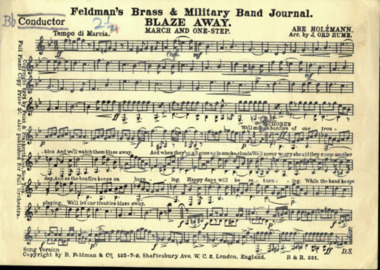 Royal Australian Air Force Band
March Card, Abe Holzmann (Composer) et al, Blaze Away, Composed: 1901
... 23 Parts Concert Band Instrumentation Feldman's Brass & Military Band Journal March and One-Step Tempo di Marcia Key Signature: Ab Major Instrumentation: Flute & Piccolo Eb Oboe Eb Clarinet 1st Clarinet Bb 2nd Clarinet Bb 3rd Clarinet Bb Bassoon Alto Saxophone Eb 1st Baritone Bb & Tenor Saxophone Bb (Treble Clef) Conductor (in Bb) Bb Repiano (Cornet) Solo Cornet Bb 2nd Cornet Bb 1st Horn Eb or Solo Tenor 2nd Horn Eb or 1st Tenor 3rd Horn Eb or 2nd Tenor 4th Horn Eb 1st Trombone 2nd Trombone Bass Trombone Euphonium (Bass Clef) Basses (Bass Clef) Drums...Stamped on the reverse of each card: Australian Broadcasting Commission *Sydney* 23 Parts Concert Band Instrumentation Feldman's Brass & Military Band Journal March and One-Step Tempo di Marcia Key Signature: Ab Major Instrumentation: Flute & Piccolo Eb Oboe Eb Clarinet 1st Clarinet Bb 2nd Clarinet Bb 3rd Clarinet Bb Bassoon Alto Saxophone Eb 1st Baritone Bb & Tenor Saxophone Bb (Treble Clef) Conductor (in Bb) Bb Repiano (Cornet) Solo Cornet Bb 2nd Cornet Bb 1st Horn Eb or Solo Tenor 2nd Horn Eb or 1st Tenor 3rd Horn Eb or 2nd Tenor 4th Horn Eb 1st Trombone 2nd Trombone Bass Trombone Euphonium (Bass Clef) Basses (Bass Clef) Drums Blaze Away March Card Abe Holzmann (Composer) Hume, J. ...In 1932 the call was put out to the ABC to start a military band. The band’s task was to record music to play on air four times a week, and to perform live concerts for the public. By November 1933 a band was put together with 40 musicians from around Australia. The band was initially conducted by Captain H. E. Adkins, Director of the Royal Military School of Music, Kneller Hall, London. After the tour, Adkins returned to his position at Kneller Hall, and Stephen Yorke, a retired bandmaster of the Gloucestershire Regiment, was brought out to Australia to become the permanent director and conductor of the band, which he did until the band closed in 1951. During the band’s 17 year history they presented a sizable program of music. Their final concert received a standing ovation from its audience of 1500, with a teary-eyed Yorke. 23 Parts Concert Band Instrumentation Feldman's Brass & Military Band Journal March and One-Step Tempo di Marcia Key Signature: Ab Major Instrumentation: Flute & Piccolo Eb Oboe Eb Clarinet 1st Clarinet Bb 2nd Clarinet Bb 3rd Clarinet Bb Bassoon Alto Saxophone Eb 1st Baritone Bb & Tenor Saxophone Bb (Treble Clef) Conductor (in Bb) Bb Repiano (Cornet) Solo Cornet Bb 2nd Cornet Bb 1st Horn Eb or Solo Tenor 2nd Horn Eb or 1st Tenor 3rd Horn Eb or 2nd Tenor 4th Horn Eb 1st Trombone 2nd Trombone Bass Trombone Euphonium (Bass Clef) Basses (Bass Clef) DrumsOn envelope: QM17, Stamps indicating 19 FEB 1940, 29 JUN 1940, 28 DEC 1940, 23 MAY 1941. Q23, 405 (crossed out). Stamped on the reverse of each card: Australian Broadcasting Commission *Sydney*brass band, australian broadcasting commission, marching band, concert band -
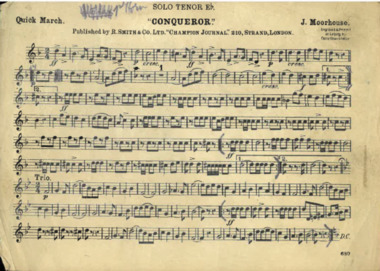 Royal Australian Air Force Band
March Card, Moorhouse, J. (Composer), Conqueror, Composed: Unknown (Between 1908-1960)
... LTD "Champion Journal". 210, Strand, London Engraved & Printed at Leipzig by Oscar Brandstetter "The British Bandsman" 2nd Weekly Instrumentation: Piccolo Oboes Clarinet Eb 1st Clarinet Bb 2nd Clarinet Bb 3rd Clarinet Bb Bassoons Solo Tenor Eb (1st Horn) 1st Tenor Eb (2nd Horn) 2nd & 3rd Tenors Eb (3rd & 4th Horns) Trumpets Eb Repiano Bb (Solo 1st Cornet) 2nd Cornet Bb 1st Trombone 2nd Trombone Bass Trombone 1st Baritone Bb Euphonium Contre Bass Contre Bass (Tuba) Drums ...LTD "Champion Journal". 210, Strand, London Engraved & Printed at Leipzig by Oscar Brandstetter "The British Bandsman" 2nd Weekly Instrumentation: Piccolo Oboes Clarinet Eb 1st Clarinet Bb 2nd Clarinet Bb 3rd Clarinet Bb Bassoons Solo Tenor Eb (1st Horn) 1st Tenor Eb (2nd Horn) 2nd & 3rd Tenors Eb (3rd & 4th Horns) Trumpets Eb Repiano Bb (Solo 1st Cornet) 2nd Cornet Bb 1st Trombone 2nd Trombone Bass Trombone 1st Baritone Bb Euphonium Contre Bass Contre Bass (Tuba) Drums Conqueror March Card Moorhouse, J. ...In 1932 the call was put out to the ABC to start a military band. The band’s task was to record music to play on air four times a week, and to perform live concerts for the public. By November 1933 a band was put together with 40 musicians from around Australia. The band was initially conducted by Captain H. E. Adkins, Director of the Royal Military School of Music, Kneller Hall, London. After the tour, Adkins returned to his position at Kneller Hall, and Stephen Yorke, a retired bandmaster of the Gloucestershire Regiment, was brought out to Australia to become the permanent director and conductor of the band, which he did until the band closed in 1951. During the band’s 17 year history they presented a sizable program of music. Their final concert received a standing ovation from its audience of 1500, with a teary-eyed Yorke. 21 Parts Concert Band Instrumentation Quick March Key Signature: F Minor Published by R. Smith & Co. LTD "Champion Journal". 210, Strand, London Engraved & Printed at Leipzig by Oscar Brandstetter "The British Bandsman" 2nd Weekly Instrumentation: Piccolo Oboes Clarinet Eb 1st Clarinet Bb 2nd Clarinet Bb 3rd Clarinet Bb Bassoons Solo Tenor Eb (1st Horn) 1st Tenor Eb (2nd Horn) 2nd & 3rd Tenors Eb (3rd & 4th Horns) Trumpets Eb Repiano Bb (Solo 1st Cornet) 2nd Cornet Bb 1st Trombone 2nd Trombone Bass Trombone 1st Baritone Bb Euphonium Contre Bass Contre Bass (Tuba) Drums On envelope: QM38, The Conqueror, Moorhouse. Q24 (pencilled), 207. Stamped on the reverse of each card: Australian Broadcasting Commission *Sydney*, Charles Godfreybrass band, australian broadcasting commission, marching band, concert band -
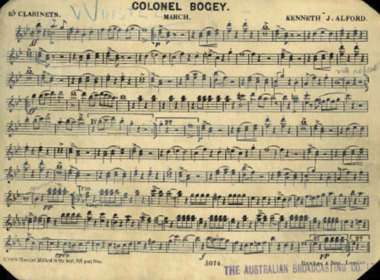 Royal Australian Air Force Band
March Card, Alford, Kenneth J. (Composer), Colonel Bogey, Composed: 1914
... 20 Parts Concert Band Instrumentation Quick March Key Signature: Db Major Printed on reverse of QM36 On The Quarter Deck Instrumentation: Eb Flute & Piccolo (actually written in Db) Oboes 1st Bb Clarinet 2nd Bb Clarinet 3rd Bb Clarinet 1st Bassoon 2nd Bassoon Bb Tenor Saxophone Eb Clarinets Solo Bb Cornet 2nd Bb Cornet 1st Eb Horn 2nd Eb Horn 1st Trombone 2nd Trombone (Tenor Clef) Bass Trombone Euphonium Bombardon Side Drum Bass Drum...Ltd. 20 Parts Concert Band Instrumentation Quick March Key Signature: Db Major Printed on reverse of QM36 On The Quarter Deck Instrumentation: Eb Flute & Piccolo (actually written in Db) Oboes 1st Bb Clarinet 2nd Bb Clarinet 3rd Bb Clarinet 1st Bassoon 2nd Bassoon Bb Tenor Saxophone Eb Clarinets Solo Bb Cornet 2nd Bb Cornet 1st Eb Horn 2nd Eb Horn 1st Trombone 2nd Trombone (Tenor Clef) Bass Trombone Euphonium Bombardon Side Drum Bass Drum Colonel Bogey March Card Alford, Kenneth J. ...In 1932 the call was put out to the ABC to start a military band. The band’s task was to record music to play on air four times a week, and to perform live concerts for the public. By November 1933 a band was put together with 40 musicians from around Australia. The band was initially conducted by Captain H. E. Adkins, Director of the Royal Military School of Music, Kneller Hall, London. After the tour, Adkins returned to his position at Kneller Hall, and Stephen Yorke, a retired bandmaster of the Gloucestershire Regiment, was brought out to Australia to become the permanent director and conductor of the band, which he did until the band closed in 1951. During the band’s 17 year history they presented a sizable program of music. Their final concert received a standing ovation from its audience of 1500, with a teary-eyed Yorke. 20 Parts Concert Band Instrumentation Quick March Key Signature: Db Major Printed on reverse of QM36 On The Quarter Deck Instrumentation: Eb Flute & Piccolo (actually written in Db) Oboes 1st Bb Clarinet 2nd Bb Clarinet 3rd Bb Clarinet 1st Bassoon 2nd Bassoon Bb Tenor Saxophone Eb Clarinets Solo Bb Cornet 2nd Bb Cornet 1st Eb Horn 2nd Eb Horn 1st Trombone 2nd Trombone (Tenor Clef) Bass Trombone Euphonium Bombardon Side Drum Bass DrumStamped on each card: Australian Broadcasting Co. Ltd.brass band, australian broadcasting commission, marching band, concert band -
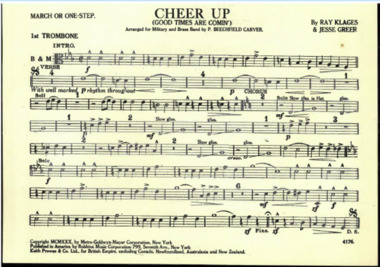 Royal Australian Air Force Band
March Card, Jesse Greer (Composer) et al, Cheer Up (Good Times Are Coming), Composed: 1930
... Beechfield Carver Instrumentation: Eb Flute & Piccolo Oboes Eb Clarinets 1st Clarinets Bb 2nd & 3rd Clarinets Bb Bassoons Eb Alto Saxophone 1st Baritone Bb (or Tenor Saxophone) Repiano Cornet Bb Solo Cornet Bb (Conductor) 2nd Cornet Bb 1st Horn Eb (or Solo Tenor) 2nd Horn Eb (or 1st Tenor) 3rd & 4th Horns Eb (or 2nd Tenor) 1st Trombone (Alto Clef) 2nd Trombone (Tenor Clef) Bass Trombone Euphonium (Bass Clef) Bb Bass (Treble Clef) Basses (Bass Clef) Drums & Effects (Tubular Bells in Eb, Sleigh Bells, Tambourine etc.)...Beechfield Carver Instrumentation: Eb Flute & Piccolo Oboes Eb Clarinets 1st Clarinets Bb 2nd & 3rd Clarinets Bb Bassoons Eb Alto Saxophone 1st Baritone Bb (or Tenor Saxophone) Repiano Cornet Bb Solo Cornet Bb (Conductor) 2nd Cornet Bb 1st Horn Eb (or Solo Tenor) 2nd Horn Eb (or 1st Tenor) 3rd & 4th Horns Eb (or 2nd Tenor) 1st Trombone (Alto Clef) 2nd Trombone (Tenor Clef) Bass Trombone Euphonium (Bass Clef) Bb Bass (Treble Clef) Basses (Bass Clef) Drums & Effects (Tubular Bells in Eb, Sleigh Bells, Tambourine etc.) ...In 1932 the call was put out to the ABC to start a military band. The band’s task was to record music to play on air four times a week, and to perform live concerts for the public. By November 1933 a band was put together with 40 musicians from around Australia. The band was initially conducted by Captain H. E. Adkins, Director of the Royal Military School of Music, Kneller Hall, London. After the tour, Adkins returned to his position at Kneller Hall, and Stephen Yorke, a retired bandmaster of the Gloucestershire Regiment, was brought out to Australia to become the permanent director and conductor of the band, which he did until the band closed in 1951. During the band’s 17 year history they presented a sizable program of music. Their final concert received a standing ovation from its audience of 1500, with a teary-eyed Yorke. 23 Parts Concert Band Instrumentation Quick March (March or One-Step) Key Signature: Eb Major Arranged for Military and Brass Band by P. Beechfield Carver Instrumentation: Eb Flute & Piccolo Oboes Eb Clarinets 1st Clarinets Bb 2nd & 3rd Clarinets Bb Bassoons Eb Alto Saxophone 1st Baritone Bb (or Tenor Saxophone) Repiano Cornet Bb Solo Cornet Bb (Conductor) 2nd Cornet Bb 1st Horn Eb (or Solo Tenor) 2nd Horn Eb (or 1st Tenor) 3rd & 4th Horns Eb (or 2nd Tenor) 1st Trombone (Alto Clef) 2nd Trombone (Tenor Clef) Bass Trombone Euphonium (Bass Clef) Bb Bass (Treble Clef) Basses (Bass Clef) Drums & Effects (Tubular Bells in Eb, Sleigh Bells, Tambourine etc.)On envelope: QM33. March or One Step, Cheer up Good Times are Coming, Greer. Q33, 402 (crossed out). Stamped on the reverse of each card: Australian Broadcasting Commission, Sydneybrass band, australian broadcasting commission, marching band, concert band -
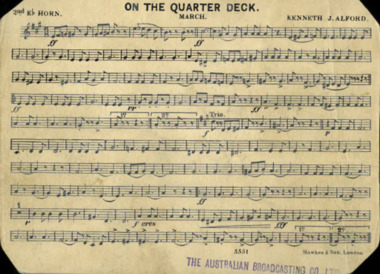 Royal Australian Air Force Band
March Card, Alford, Kenneth J. (Composer), On The Quarter Deck, Composed: 1917
... 20 Parts Concert Band Instrumentation Quick March Key Signature: C Major Printed on the reverse of QM36 Colonel Bogey Instrumentation: Eb Flute & Piccolo (actually written in Db) Oboe 1st Bb Clarinet 2nd Bb Clarinet 3rd Bb Clarinet 1st Bassoon 2nd Bassoon Bb Tenor Saxophone Eb Clarinet Solo Bb Cornet 2nd Bb Cornet 1st Eb Horn 2nd Eb Horn 1st Trombone 2nd Trombone (Tenor Clef) Bass Trombone Euphonium (Baritone.) ...Ltd. 20 Parts Concert Band Instrumentation Quick March Key Signature: C Major Printed on the reverse of QM36 Colonel Bogey Instrumentation: Eb Flute & Piccolo (actually written in Db) Oboe 1st Bb Clarinet 2nd Bb Clarinet 3rd Bb Clarinet 1st Bassoon 2nd Bassoon Bb Tenor Saxophone Eb Clarinet Solo Bb Cornet 2nd Bb Cornet 1st Eb Horn 2nd Eb Horn 1st Trombone 2nd Trombone (Tenor Clef) Bass Trombone Euphonium (Baritone.) ...In 1932 the call was put out to the ABC to start a military band. The band’s task was to record music to play on air four times a week, and to perform live concerts for the public. By November 1933 a band was put together with 40 musicians from around Australia. The band was initially conducted by Captain H. E. Adkins, Director of the Royal Military School of Music, Kneller Hall, London. After the tour, Adkins returned to his position at Kneller Hall, and Stephen Yorke, a retired bandmaster of the Gloucestershire Regiment, was brought out to Australia to become the permanent director and conductor of the band, which he did until the band closed in 1951. During the band’s 17 year history they presented a sizable program of music. Their final concert received a standing ovation from its audience of 1500, with a teary-eyed Yorke. 20 Parts Concert Band Instrumentation Quick March Key Signature: C Major Printed on the reverse of QM36 Colonel Bogey Instrumentation: Eb Flute & Piccolo (actually written in Db) Oboe 1st Bb Clarinet 2nd Bb Clarinet 3rd Bb Clarinet 1st Bassoon 2nd Bassoon Bb Tenor Saxophone Eb Clarinet Solo Bb Cornet 2nd Bb Cornet 1st Eb Horn 2nd Eb Horn 1st Trombone 2nd Trombone (Tenor Clef) Bass Trombone Euphonium (Baritone.) (Bass Clef) Bombardon (Tuba.) Side Drum Bass Drum On envelope: QM30, Q30 Stamped on each card: Australian Broadcasting Co. Ltd.brass band, australian broadcasting commission, marching band, concert band -
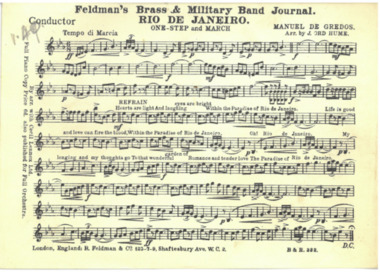 Royal Australian Air Force Band
March Card, de Gredos, Manuel (Composer) et al, Rio de Janeiro, Composed: 1930 ?
... Full Piano Copy Price 6d. also published for Full Orchestra Refrain lyrics included on Conductor's score Instrumentation: Conductor Flute & Piccolo Eb Oboe Eb Clarinet 1st Bb Clarinet 2nd Bb Clarinet 3rd Bb Clarinet Bassoon Eb Alto Saxophone 1st Bb Baritone & Tenor Saxophone Bb 1st Eb Horn or Solo Tenor 2nd Eb Horn or 1st Tenor 3rd Eb Horn or 2nd Tenor 4th Eb Horn Bb Repiano Solo Cornet Bb 2nd Cornet Bb 1st Trombone (Alto Clef) 2nd Trombone (Alto Clef) Bass Trombone (Bass Clef) Euphonium (Bass Clef) Basses Drums...Full Piano Copy Price 6d. also published for Full Orchestra Refrain lyrics included on Conductor's score Instrumentation: Conductor Flute & Piccolo Eb Oboe Eb Clarinet 1st Bb Clarinet 2nd Bb Clarinet 3rd Bb Clarinet Bassoon Eb Alto Saxophone 1st Bb Baritone & Tenor Saxophone Bb 1st Eb Horn or Solo Tenor 2nd Eb Horn or 1st Tenor 3rd Eb Horn or 2nd Tenor 4th Eb Horn Bb Repiano Solo Cornet Bb 2nd Cornet Bb 1st Trombone (Alto Clef) 2nd Trombone (Alto Clef) Bass Trombone (Bass Clef) Euphonium (Bass Clef) Basses Drums Rio de Janeiro March Card de Gredos, Manuel (Composer) Hume, J. ...In 1932 the call was put out to the ABC to start a military band. The band’s task was to record music to play on air four times a week, and to perform live concerts for the public. By November 1933 a band was put together with 40 musicians from around Australia. The band was initially conducted by Captain H. E. Adkins, Director of the Royal Military School of Music, Kneller Hall, London. After the tour, Adkins returned to his position at Kneller Hall, and Stephen Yorke, a retired bandmaster of the Gloucestershire Regiment, was brought out to Australia to become the permanent director and conductor of the band, which he did until the band closed in 1951. During the band’s 17 year history they presented a sizable program of music. Their final concert received a standing ovation from its audience of 1500, with a teary-eyed Yorke. 23 parts Concert Band instrumentation One-Step and March Key Signature: Db Major Feldman's Brass & Military Band Journal By arr. with Cecil Lennox Ltd. Full Piano Copy Price 6d. also published for Full Orchestra Refrain lyrics included on Conductor's score Instrumentation: Conductor Flute & Piccolo Eb Oboe Eb Clarinet 1st Bb Clarinet 2nd Bb Clarinet 3rd Bb Clarinet Bassoon Eb Alto Saxophone 1st Bb Baritone & Tenor Saxophone Bb 1st Eb Horn or Solo Tenor 2nd Eb Horn or 1st Tenor 3rd Eb Horn or 2nd Tenor 4th Eb Horn Bb Repiano Solo Cornet Bb 2nd Cornet Bb 1st Trombone (Alto Clef) 2nd Trombone (Alto Clef) Bass Trombone (Bass Clef) Euphonium (Bass Clef) Basses DrumsOn envelope: QM174, March + One Step, Rio de Janeiro, Q148, Scrubbed out 401 Stamped on the reverse of each card: Australian Broadcasting Commission Sydneybrass band, australian broadcasting commission, marching band, concert band -
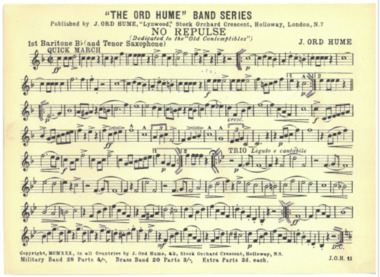 Royal Australian Air Force Band
March Card, Hume, J. Ord (Composer), No Repulse, Composed: 1930
... Instrumentation: Solo Cornet Bb (Conductor written along the top) Piccolo Eb Oboe Clarinet Eb 1st Clarinet Bb 2nd Clarinet Bb 3rd Clarinets Bb Bassoon 2nd Bb Baritone Eb Soprano Cornet Alto Saophone 1st Baritone Bb (and Tenor Saxophone) 1st Eb Horn (or Solo Tenor) 2nd Eb Horn (Or 1st Tenor) 3rd Eb Horn (or 2nd Tenor) 4th Eb Horn Repiano Bb (Cornet written) Solo Bb Cornet 2nd Bb Cornet 1st Trombone (Tenor Clef) 2nd Trombone (Tenor Clef) Bass Trombone Euphonium (Bass Clef) Basses (Bass Clef) Drums...Instrumentation: Solo Cornet Bb (Conductor written along the top) Piccolo Eb Oboe Clarinet Eb 1st Clarinet Bb 2nd Clarinet Bb 3rd Clarinets Bb Bassoon 2nd Bb Baritone Eb Soprano Cornet Alto Saophone 1st Baritone Bb (and Tenor Saxophone) 1st Eb Horn (or Solo Tenor) 2nd Eb Horn (Or 1st Tenor) 3rd Eb Horn (or 2nd Tenor) 4th Eb Horn Repiano Bb (Cornet written) Solo Bb Cornet 2nd Bb Cornet 1st Trombone (Tenor Clef) 2nd Trombone (Tenor Clef) Bass Trombone Euphonium (Bass Clef) Basses (Bass Clef) Drums No Repulse March Card Hume, J. ...In 1932 the call was put out to the ABC to start a military band. The band’s task was to record music to play on air four times a week, and to perform live concerts for the public. By November 1933 a band was put together with 40 musicians from around Australia. The band was initially conducted by Captain H. E. Adkins, Director of the Royal Military School of Music, Kneller Hall, London. After the tour, Adkins returned to his position at Kneller Hall, and Stephen Yorke, a retired bandmaster of the Gloucestershire Regiment, was brought out to Australia to become the permanent director and conductor of the band, which he did until the band closed in 1951. During the band’s 17 year history they presented a sizable program of music. Their final concert received a standing ovation from its audience of 1500, with a teary-eyed Yorke. 23 Parts Concert Band Instrumentation Quick March Key Signature: Eb Major "The Ord Hume" Band Series Dedicated to the "Old Contemptibles" Military Band 28 parts 4/-, Brass Band 20 Parts 3/-, Extra Parts 2d. each. Instrumentation: Solo Cornet Bb (Conductor written along the top) Piccolo Eb Oboe Clarinet Eb 1st Clarinet Bb 2nd Clarinet Bb 3rd Clarinets Bb Bassoon 2nd Bb Baritone Eb Soprano Cornet Alto Saophone 1st Baritone Bb (and Tenor Saxophone) 1st Eb Horn (or Solo Tenor) 2nd Eb Horn (Or 1st Tenor) 3rd Eb Horn (or 2nd Tenor) 4th Eb Horn Repiano Bb (Cornet written) Solo Bb Cornet 2nd Bb Cornet 1st Trombone (Tenor Clef) 2nd Trombone (Tenor Clef) Bass Trombone Euphonium (Bass Clef) Basses (Bass Clef) DrumsOn envelope: QM140, March No Re[pulse Ord Hume, Q120, scrubbed out 354 Stamped on the reverse of each card: Australian Broadcasting Commission *Sydney*, The Property of Musical Director & Arranger Charles Godfreybrass band, australian broadcasting commission, marching band, concert band -
 Royal Australian Air Force Band
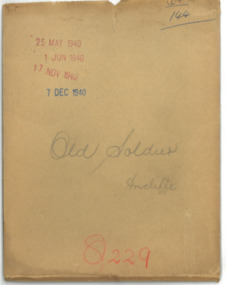
March Card, Boosey & Hawkes, Ltd et al, Old Soldier, Composed: 1938
... 30 parts Concert Band Instrumentation Quick March Key Signature: C Major Instrumentation: Solo Bb Cornet (Piston au Bugle) Db Flute & Piccolo Concert Flute & Piccolo Oboes Eb Clarinet 1st Bb Clarinet 2nd Bb Clarinet 3rd Bb Clarinets 1st Bassoon 2nd Bassoon Bb Soprano Saxophone Eb Alto Saxophone Bb Tenor Saxophone Eb Baritone Saxophone 1st Eb Horn 2nd Eb Horn Solo Eb Tenor Horn Eb Soprano Cornet Solo Bb Cornet 1st or Repiano Bb Cornet 2nd Bb Cornet 3rd & 4th Bb Cornets 1st Trombone (Treble) 2nd Trombone (Treble) Bass Trombone 1st Baritone 2nd Baritone Euphonium (Treble) Eb Basses (Treble) Side Drum Bass Drum Handwritten Rep. ...Brass Band Australian Broadcasting Commission Marching Band Concert Band On envelope: QM144, Old Solider Ancliffe, Q229, 25 May 1940, Jun 1940, 17 Nov 1940, 7 Dec 1940 30 parts Concert Band Instrumentation Quick March Key Signature: C Major Instrumentation: Solo Bb Cornet (Piston au Bugle) Db Flute & Piccolo Concert Flute & Piccolo Oboes Eb Clarinet 1st Bb Clarinet 2nd Bb Clarinet 3rd Bb Clarinets 1st Bassoon 2nd Bassoon Bb Soprano Saxophone Eb Alto Saxophone Bb Tenor Saxophone Eb Baritone Saxophone 1st Eb Horn 2nd Eb Horn Solo Eb Tenor Horn Eb Soprano Cornet Solo Bb Cornet 1st or Repiano Bb Cornet 2nd Bb Cornet 3rd & 4th Bb Cornets 1st Trombone (Treble) 2nd Trombone (Treble) Bass Trombone 1st Baritone 2nd Baritone Euphonium (Treble) Eb Basses (Treble) Side Drum Bass Drum Handwritten Rep. ...In 1932 the call was put out to the ABC to start a military band. The band’s task was to record music to play on air four times a week, and to perform live concerts for the public. By November 1933 a band was put together with 40 musicians from around Australia. The band was initially conducted by Captain H. E. Adkins, Director of the Royal Military School of Music, Kneller Hall, London. After the tour, Adkins returned to his position at Kneller Hall, and Stephen Yorke, a retired bandmaster of the Gloucestershire Regiment, was brought out to Australia to become the permanent director and conductor of the band, which he did until the band closed in 1951. During the band’s 17 year history they presented a sizable program of music. Their final concert received a standing ovation from its audience of 1500, with a teary-eyed Yorke. 30 parts Concert Band Instrumentation Quick March Key Signature: C Major Instrumentation: Solo Bb Cornet (Piston au Bugle) Db Flute & Piccolo Concert Flute & Piccolo Oboes Eb Clarinet 1st Bb Clarinet 2nd Bb Clarinet 3rd Bb Clarinets 1st Bassoon 2nd Bassoon Bb Soprano Saxophone Eb Alto Saxophone Bb Tenor Saxophone Eb Baritone Saxophone 1st Eb Horn 2nd Eb Horn Solo Eb Tenor Horn Eb Soprano Cornet Solo Bb Cornet 1st or Repiano Bb Cornet 2nd Bb Cornet 3rd & 4th Bb Cornets 1st Trombone (Treble) 2nd Trombone (Treble) Bass Trombone 1st Baritone 2nd Baritone Euphonium (Treble) Eb Basses (Treble) Side Drum Bass Drum Handwritten Rep. Clari BbOn envelope: QM144, Old Solider Ancliffe, Q229, 25 May 1940, Jun 1940, 17 Nov 1940, 7 Dec 1940brass band, australian broadcasting commission, marching band, concert band -
 Federation University Historical Collection
Document - Booklets, Books of sheet music, Mid 1900s
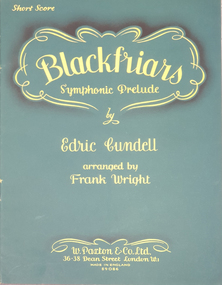
... 'Ida and Dot' Polka by F.H.Losey, for Soprano Cornet, 1st & 2nd Solo Cornet (Conductor), 3rd Cornet, Repiano B flat, 2nd Cornet, Solo Tenore E flat, 1st Tenor E flat, 2nd Tenor E flat, Euphonium B flat, Bass Trombone, 1st Baritone B flat, 2nd Baritone B flat, 1st Trombone, 2nd Trombone, Contre Bass E flat & Drums. ...'Ida and Dot' Polka by F.H.Losey, for Soprano Cornet, 1st & 2nd Solo Cornet (Conductor), 3rd Cornet, Repiano B flat, 2nd Cornet, Solo Tenore E flat, 1st Tenor E flat, 2nd Tenor E flat, Euphonium B flat, Bass Trombone, 1st Baritone B flat, 2nd Baritone B flat, 1st Trombone, 2nd Trombone, Contre Bass E flat & Drums. ...Frank Wright was a renown resident of Smeaton, where he was born on 2 August 1901. He lived at Laura Villa, and attended Smeaton State School. His father William was a gold miner and his mother's name was Sarah. Their family won many singing and instrumental awards. Frank was tutored by Percy Code and was awarded a gold medal for the highest marks in the ALCM examinations in the British Colonies at the age of seventeen years. He became the Australian Open Cornet Champion by the age of eighteen. A year later, Frank conducted the City of Ballarat Band, and later the Ballarat Soldiers’ Memorial Band. He formed the Frank Wright Frisco Band and Frank Wright and his Coliseum Orchestra. These bands won many South Street awards, and Frank as conductor won many awards in the Australian Band Championship contest. In 1933 Frank Wright sailed to England to conduct the famous St Hilda’s Band and was later appointed Musical Director of the London County Council, where he organized many amazing concerts in parks, in and around the London district. He was made Professor of Brass and Military Band Scoring and conducted at the Guildhall of Music and Drama. Frank was often invited to adjudicate Brass Band Championships around Europe, in Australia, including South Street and in New Zealand. The Frank Wright Medal at the Royal South Street competition is awarded to an individual recognized as making an outstanding contribution to brass music in Australia.11 books of sheet music written by various composers but all arranged by Frank Wright. 1). 'Le Carnaval Romain' (The Roman Carnival) Overture by Berlioz for Solo B flat Cornet (Conductor). 2). 'Ida and Dot' Polka by F.H.Losey, for Soprano Cornet, 1st & 2nd Solo Cornet (Conductor), 3rd Cornet, Repiano B flat, 2nd Cornet, Solo Tenore E flat, 1st Tenor E flat, 2nd Tenor E flat, Euphonium B flat, Bass Trombone, 1st Baritone B flat, 2nd Baritone B flat, 1st Trombone, 2nd Trombone, Contre Bass E flat & Drums. The Pianoforte accompaniment was arranged by Frank Wright. 3). 'Trumpet Concerto' by Haydn. The Full Score with parts for a band of 25. 4). 'Diadem of Gold' Overture by G.Bailey for Solo B flat Cornet (Conductor). 5). 'The Frogs (of Aristophanes)' Overture for Solo B flat Cornet (Conductor), Short Score & Full Score arranged for brass band. 6). Variations of 'The Shining River' by Edmund Rubbra for Solo B flat Cornet (Conductor). 7). 'Le Roi D'Ys' (The King of Ys) Overture by Edouard Lalo for Solo B flat Cornet (Conductor). 8). 'Sovereign Heritage' Symphonic Overture by J.Beaver for Solo B flat Cornet (Conductor). 9). 'La Forza del Destino' (The Force of Destiny) Overture by Verdi - the Short Score. 10). 'Blackfriars' Symphonic Prelude by Edric Cundell - Short Score. 11). 'Diadem of Gold' Overture by G.Bailey - Short Score1). Pencil markings on page 1,4,5 &6. 9). Written in pen on front cover - Mr Geoffrey Hosier. 10). Written in pen on title page - All good wishes F.W. 29.x.'55frank wright, sheet music, le carnaval romain, berlioz, ida and dot polka, f.h. losey, trumpet concerto, haydn, diadem of gold overture, g. bailey, the frogs overture, granville bantock, the shining river, edmund rubbra, le roi d'ys overture, edouard lalo, sovereign heritage, j. beaver, la forza del destino overture, verdi, cornet, blackfriars symphonic prelude, eric cundell -
 Victorian Interpretive Projects Inc.
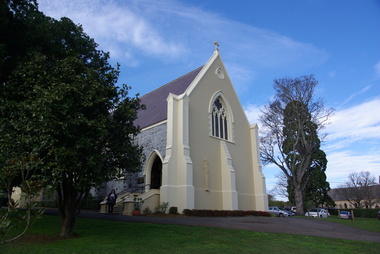
Photograph - colour, Clare Gervasoni, St Peter's Catholic Church, Daylesford, 2015, 14/06/2015
... solos, and it is scarcely necessary to add, rendered them with exquisite taste and feeling – her beautiful voice being heard with great effect throughout the entire building. The choir consisted of the following ladies and gentlemen who volunteered to aid in the ceremonies upon this most interesting occasion. Ladies: Mrs. Tresar, soprano; Mrs. J.J. McCormick, alto; Miss Julia Conry, soprano; Mrs. Vincent, soprano; Mrs. Aitken, soprano. Gentlemen: H. Guthiel, tenor...solos, and it is scarcely necessary to add, rendered them with exquisite taste and feeling – her beautiful voice being heard with great effect throughout the entire building. The choir consisted of the following ladies and gentlemen who volunteered to aid in the ceremonies upon this most interesting occasion. Ladies: Mrs. Tresar, soprano; Mrs. J.J. McCormick, alto; Miss Julia Conry, soprano; Mrs. Vincent, soprano; Mrs. Aitken, soprano. Gentlemen: H. Guthiel, tenor ..."The fine structure of St. Peter's, with its prettily-decorated interior, which holds crowded congregations at Holy Mass on Sundays, is alone an eloquent testimony of the piety and devotion which permeates the whole parish. Attached to the church is a circulating library, and Catholic papers and other literature are distributed at the church door. Branches of the H.A.C.B. Society and Catholic Federation are doing much good work. (Melbourne Advocate, 17 January 1914) "OPENING AND CONSECRATION OF THE NEW CATHOLIC CHURCH OF ST. PETER’S, DAYLESFORD Cross on St. Peter'sNotwithstanding the inclemency of the weather, the opening of the new Catholic Church of St. Peter’s, yesterday (Sunday), attracted a crowded congregation. Although the rain, which has poured almost incessantly for some days past, had left our roads and streets in the condition for which Daylesford is celebrated in winter weather, and although he storm and rain seemed to increase as the hour announced for the ceremonies approached, the church was filled by a large congregation, comprising all sects and denominations of Christians in and around the district. The beautiful edifice, erected mainly through the zeal, liberality and energy of the respected pastor, presented a most imposing appearance, and reflects infinite credit upon the Rev. Mr. Slattery, and the flock committed to his charge. The church was commenced in November 1863 and has been in the hands of the workmen up to the present time, work being uninterruptedly carried on. On commencing the foundations, it was necessary to excavate until solid clay was reached, which in consequence of the deep rich chocolate soil on the site of the building, had to be carried down to an average depth of 6 feet 6 inches. The foundations were laid with massive stones in courses of 12-inch, and four feet thick, reducing to 3 feet below the floor line. The style of the building is decorated Gothic, and consists of a nave, 80 feet by 30 feet in the clear, and a chancel 18 feet high; from floor line to apex of roof, 47 feet, which is elegantly constructed, consisting of six spans or frames with puncheons resting on carved corbels, low down between the windows. The north side consists of a handsome entrance, near the north-west angle, approached by nine steps of cut stone, and four bays of windows on nave, and a small door on side of chancel, intended as an entry from the sacristy. The south side presents a very handsome view to Victoria street, a beautiful porch entrance giving access to the building on the south-east end of nave; and on the south-west angle a handsome octagonal spire, terminating in an iron cross, with gilt floriations; the height of top of cross, from floor line, is 88 feet. A stone stairs gives access to the organ gallery and the belfry. The whole of the windows are of a handsome geometrical design, and carved in stone, with mullions and tracery, and glazed with amber-tinted glass, the chancel window being 15 feet high, and 8 feet wide. The chancel arch is unusually large, 27 feet St. Peter's interiorhigh and 18 feet wide, and handsomely moulded, and presents a fine appearance from the body of the church. The roof is stained a rich oak, with heavy cornice, and all the walls are smoothly plastered, and colored peach color, giving the amber-tinted glass a beautiful soft cathedral appearance to the interior. The altar is of a very chaste design, the panels being moulded with Gothic heads, and finished in white and gold; the altar rail was not completed, but is intended to be of polished cedar, with carved pillars. The interior fittings will be proceeded with immediately, and to complete the design, an organ gallery, with sittings for about 100 persons besides the choir, will be constructed on the west end. It is intended also to place pillar gaslights on each side of the main entrance, for lighting during vespers in winter. The style of architecture has been strictly carried out, and in the best and most substantial manner. The building has been erected under the superintendence of the architect Mr. John Townsend Brophy, a member of the congregation, and who has discharged his duty with great ability and care. The hour of half-past eleven has scarcely passed when from the sacristy entered His Lordship the Right Rev. Dr. Gould, Bishop of Melbourne, preceded by the Very Rev. Dean Hayes (Sandhurst), the Rev. P. J. Slattery, and a number of boys dressed in white surplices. The Right Reverend Prelate proceeded to the foot of the altar, the Very Rev. the Dean on his right, and the Rev. P. J. Slattery on the left. The prayers usual upon the occasion were read by the Bishop. A procession was then formed, and went around the church in the following order. Several youths bearing wax candles first, next the Very Rev. the Dean, then the Bishop and his train bearers, and following were the Rev. Mr. Slattery and acolytes. Having returned to the altar in the same order, the Deacon (Dean Hayes) and Sub-Deacon (Rev. P. J. Slattery) proceeded to robe his Lordship, who had taken his seat at the epistle side of the altar, for the solemn High Mass, at appropriate times wearing his mitre and bearing his crozier. The mass, which was chanted by the Bishop with touching simplicity and earnestness, was then commenced. The choir, under the direction of Mr. Meunsch, organist, was full and most effective. Mrs. Testar, of Melbourne, having generously offered her valuable services, took the leading soprano solos, and it is scarcely necessary to add, rendered them with exquisite taste and feeling – her beautiful voice being heard with great effect throughout the entire building. The choir consisted of the following ladies and gentlemen who volunteered to aid in the ceremonies upon this most interesting occasion. Ladies: Mrs. Tresar, soprano; Mrs. J.J. McCormick, alto; Miss Julia Conry, soprano; Mrs. Vincent, soprano; Mrs. Aitken, soprano. Gentlemen: H. Guthiel, tenor; Master John Murphy, tenor; James Knox, bass; J. M. Murphy, bass; Mr. Staunton, baritone; Mr. Sourby, alto; Mr. Short, bass. The chant, “Let us adore,” during the procession, was given by Mrs. Vincent with considerable power. The selection of the “Imperial Mass” (Haydn’s No. 3) was felicitous, and the highly artistic and finished manner in which the different parts were sustained, demonstrated that great and persevering care must have been bestowed on the preparation for “the opening day.” The “Kyrie” was given with the full strength and power of the choir. The swelling of the voices in complete harmony, and the pealing of the organ in the midst of incense and prayer, produced a most marked effect upon the congregation. In the “Gloria,” the solos of Mrs. Testar were really beautiful and Mrs. McCormick rendered the alto solos with considerable merit. Mr. Knox sang the part commencing with the words “Qui tolles” with much taste and power. The “Credo” than which we believe there is not a more magnificent piece of sacred music extant, was most successful in its rendering, nor do we ever remember to have heard anything more touching than the manner in which the line “Vetam Venturi in Seculi,” was given by Mrs. Testar. The offertory hymn “Come unto Me all ye that labor,” was given by Mrs. Testar with the most thrilling effect. The “Sanctus” having been sung, in which Mr. Sourby ably rendered an alto solo, the “Agnus Dei” was commenced with a solo by Mrs. McCormick and was given with great taste and feeling, Mrs. Testar, at the conclusion of the “Agnus,” taking up the soprano part. Mass being concluded, the Very Reverend Dean Hayes ascended the altar and proceeded to preach the opening sermon, taking as his text Second Paralipomenon [Chronicles II], 7th chapter and 16th verse – “For I have chosen and have sanctified this place that My hand may be there for ever, and My eyes and My heart may remain there perpetually.” St Peter's manseAt the close of the sermon a collection was made by the very reverend preacher, assisted by John Egan, Esq., Corinella, on behalf of the church, and about fifty pounds were contributed. When it is remembered that 500 tickets had been issues at 10s each, and the inclemency of the weather taken into consideration, the collection may be regarded as a large one. Benediction was sung by the Rev. P. J. Slattery, assisted by Dean Hayes, the choir singing the “O! Salutaris Hostia” and “Laudate.” Handel’s Hallelujah Chorus was sung at the termination of the ceremonies. The vestments issued at Benediction, as well as at the Mass, were of the most gorgeous and beautiful character. When the Benediction was over, the Rev. P. J. Slattery, standing at the front of the altar said– “I wish to say one or two words before the congregation leave. I feel most deeply indebted to all of you who have attended here today for the honor and glory of God, not withstanding the difficulties you had to encounter from this most inclement season. I am truly delighted at such a manifestation of feeling, and will not easily forget it.” The rev. gentleman having disrobed, thanked the members of the choir for their kindness in assisting at the ceremonies, and more especially Mrs. Testar, who had braved all the storm and rain to be present at, and give the advantage of her great musical abilities on, the “opening day.” (Daylesford Mercury, 15 May 1865.)A number of photographs of St Peter's Catholic Church, Daylesford, taken at the 150th anniversary celebration. st peter's catholic church daylesford, decoration, altar decoration, anniversary, daylesford, religion, painting, interior, slattery, gough, d'alton, mcmahon -
 Bendigo Historical Society Inc.
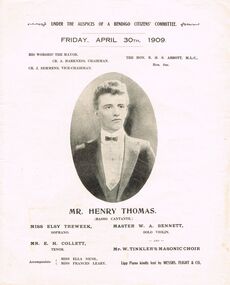
Document - LYDIA CHANCELLOR COLLECTION; MR. HENRY THOMAS PROGRAMME
... Bennett, solo violin, Mr. E.H. Collett, Tenor Mr. W. Tinkler's Masonic Choir. ...Bennett, solo violin, Mr. E.H. Collett, Tenor Mr. W. Tinkler's Masonic Choir. ...A black and white programme with the words, ' Under the auspices of a Bendigo Citizens, Committee. Friday, April 30th, 1909. His Worship the Major, Cr. A. Harkness, Chairman. Cr. L. Semmens, Vice-Chairman. The Hon. R.H S. Abbott, M.L.C., Hon. Sec. Mr. Henry Thomas (Basso Cantante.) Miss Elsy Treweek, soprano. Master W.A. Bennett, solo violin, Mr. E.H. Collett, Tenor Mr. W. Tinkler's Masonic Choir. Accompanists Miss Ella Nicol, Muss Frances Leary. Lipp Piano kindly lent by Messrs, Flight & Co. Inside is the programme itself and on the back cover are some quotes from newspapers relevant to Mr. Henry Thomas.program, music, singing, lydia chancellor, collection, music, event, performing arts, entertainment, programme, program -
Bendigo Historical Society Inc.
Document - ROYAL PRINCESS THEATRE COLLECTION: AUSTRALIASIAN TOUR, CALVE', 6 October, 1910
... Tenor M Pintel, Pianist. Madame Calve's Australian Tour, Direction J & N Tait. 6th October, 1910. Programme:Piano Solos by M Jaques Pintel; Ballade in A Flat, Rhapsodie No. 8, Polonaise. ...Tenor M Pintel Pianist. Madame Calve's Australian Tour Direction J & N Tait. 6th October 1910. Programme:Piano Solos by M Jaques Pintel; Ballade in A Flat Rhapsodie No. 8 Polonaise. ...Princess Theatre - Australiasian Tour, Calve'. Signor Gasparri, Tenor M Pintel, Pianist. Madame Calve's Australian Tour, Direction J & N Tait. 6th October, 1910. Programme:Piano Solos by M Jaques Pintel; Ballade in A Flat, Rhapsodie No. 8, Polonaise. Songs etc. by Signor Galileo Gasparri; Africana, Recitar mentre Preso, Vesti li giubba. Songs by Madame Calve; Stances, Air di Mysoli. Song Duo and Romance by Madame Calve' and Signor Gallieo Gasparri: Habanera, Canzonetta, Enfin c'est toi, La Fluer que to m'avais jetee, Non! Tu ne m'aimes pas! Markings none.program, music, princess theatre, princess theatre - australiasian tour, calve'. signor gasparri, tenor m pintel, pianist. madame calve's australian tour, direction j & n tait. 6th october, 1910. programme:piano solos by m jaques pintel; ballade in a flat, rhapsodie no. 8, polonaise. songs etc. by signor galileo gasparri; africana, recitar mentre preso, vesti li giubba. songs by madame calve; stances, air di mysoli. song duo and romance by madame calve' and signor gallieo gasparri: habanera, canzonetta, enfin c'est toi, la fluer que to m'avais jetee, non! tu ne m'aimes pas! -
Bendigo Historical Society Inc.
Document - GOLDEN SQUARE METHODIST CHURCH, c1957
... Solo Artists: Mr Cyril Warne, Mr Jack Mamouney, Mr E C Warne, Mr I Carne. Words by Rev J Sparrow-Simpson. Sopranos: Mrs R Munro, Miss M Medlin. Altos: Mrs F Warne, Miss P Chamney. Tenors...Solo Artists: Mr Cyril Warne Mr Jack Mamouney Mr E C Warne Mr I Carne. Words by Rev J Sparrow-Simpson. Sopranos: Mrs R Munro Miss M Medlin. Altos: Mrs F Warne Miss P Chamney. Tenors ...Golden Square Methodist Church. a/ Good Friday. Stainer's Crucifixion by Augmented Choir. Solo Artists: Mr Cyril Warne, Mr Jack Mamouney, Mr E C Warne, Mr I Carne. Words by Rev J Sparrow-Simpson. Sopranos: Mrs R Munro, Miss M Medlin. Altos: Mrs F Warne, Miss P Chamney. Tenors: Mr W Holland, Mr G Collett. Basses: Mr A Tilson, Mr A Evans. Choir: Mr Cecil Jones, remainder of choir unnamed. b/ Golden Square Methodist Church Choral Society Conducted by Cyril Warne Presents 'Elijah' (Mendelssohn. Soloists: Jenifer Eddy, Joyce Manley, Kevin Plant, Robert Payne. Pianist: Leila Watson. Organist: Hedley R Jones. Tuesday September 24, 1957. Ladies of the Choir: Mrs E Arnold, J Chamney, G Doenau, Miss G Douglas, R Douglas, Mrs R Duguid, Miss E Glen, A Graham, K Harry, Mrs J Jenkins, H Jones, G Leech, Miss B Mamouney, D Mauger, Mrs G Mayne, Mrs R Mellis, H Mustery, Miss G Perry, E Randall, Mrs J Samson, M Smith, A Spiller, H Trabinger, E Vapp, Miss E Vercoe, Mrs M Warne, Miss E Wilson, L Winzar, Mrs L Woodman. Gentlemen of the Choir: Mr R Every, J Gowty, E Hallett, W Harry, J Jenkins, L Jones, F Mamouney, F McCallum, R Mellis, A Nicholls, E Pearce, C Phillips, R Phillips, H Sims, M Warne, T Washington. Hon. Sec. J E Mamouney.program, theatre, golden square methodist church, golden square methodist church. good friday. stainer's crucifixion by augmented choir. solo artists: mr cyril warne, mr jack mamouney, mr e c warne, mr i carne. words by rev j sparrow-simpson. sopranos: mrs r munro, miss m medlin. altos: mrs f warne, miss p chamney. tenors: mr w holland, mr g collett. basses: mr a tilson, mr a evans. choir: mr cecil jones, . b/ golden square methodist church choral society conducted by cyril warne presents 'elijah' (mendelssohn. soloists: jenifer eddy, joyce manley, kevin plant, robert payne. pianist: leila watson. organist: hedley r jones. tuesday september 24, 1957. ladies choir: mrs e arnold, j chamney, g doenau, miss g douglas, r douglas, mrs r duguid, miss e glen, a graham, k harry, mrs j jenkins, h jones, g leech, miss b mamouney, d mauger, mrs g mayne, mrs r mellis, h mustery, miss g perry, e randall, mrs j samson, m smith, a spiller, h trabinger, e vapp, miss e vercoe, mrs m warne, miss e wilson, l winzar, mrs l woodman. gentlemen of the choir: mr r every, j gowty, e hallett, w harry, j jenkins, l jones, f mamouney, f mccallum, r mellis, a nicholls, e pearce, c phillips, r phillips, h sims, m warne, t washington. hon. sec. j e mamouney. -
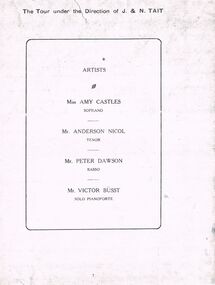 Bendigo Historical Society Inc.
Document - LYDIA CHANCELLOR COLLECTION; MUSIC PROGRAMME
... Anderson Nicol tenor, Mr. Peter Dawson Basso, Mr. Victor Busst solo pianoforte. On the inside and the back is the programme. ...Anderson Nicol tenor, Mr. Peter Dawson Basso, Mr. Victor Busst solo pianoforte. On the inside and the back is the programme. ...A photocopy of the programme of The Tour under the Direction J. & N. Tait. On the front page of the programme are the words, ' The Tour under the Direction of J. & N. Tait.. Artists Miss Amy Castles soprano, Mr. Anderson Nicol tenor, Mr. Peter Dawson Basso, Mr. Victor Busst solo pianoforte. On the inside and the back is the programme. Date unknown.program, music, singing, lydia chancellor, collection, ephemera, music, singing, event, concert, amy castles, anderson nicol, peter dawson, victor busst -
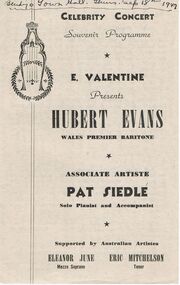 Bendigo Historical Society Inc.
Document - LYDIA CHANCELLOR COLLECTION; HUBERT EVANS CELEBRITY CONCERT PROGRAMME
... Valentine presents Hubert Evans Wales Premier Baritone Associate Artiste Pat Siedle Solo Pianist and Accompanist supported by Australian Artistes Eleanor June Mezzo Soprano Eric Mitchelson Tenor. ...Valentine presents Hubert Evans Wales Premier Baritone Associate Artiste Pat Siedle Solo Pianist and Accompanist supported by Australian Artistes Eleanor June Mezzo Soprano Eric Mitchelson Tenor. ...A green paper souvenir programme with black print. 'Celebrity Concert Souvenir Programme E. Valentine presents Hubert Evans Wales Premier Baritone Associate Artiste Pat Siedle Solo Pianist and Accompanist supported by Australian Artistes Eleanor June Mezzo Soprano Eric Mitchelson Tenor. On the inside is the programme and short histories of the artists. Also included are some newspaper cuttings related to the concert.Bendigo Town Hall. Thurs. Sep 18th 1947program, music, singing, lydia chancellor, collection, music, ephemera, concert, event, entertainment, individual, person, programme, program, hubert evens, pat siedle -
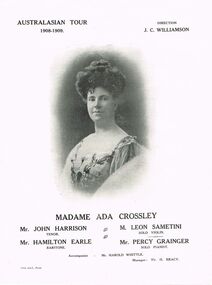 Bendigo Historical Society Inc.
Document - LYDIA CHANCELLOR COLLECTION; MADAME ADA CROSSLEY AUSTRALASIAN TOUR
... Tenor. Mr. Hamilton Earle Baritone. M. Leon Sametini Solo Violin. Mr. ...Tenor. Mr. Hamilton Earle Baritone. M. Leon Sametini Solo Violin. Mr. ...Yellow paper with black print. On the front cover are the words 'AUSTRALASIAN TOUR 1908-1909. Direction J.C. Williamson MADAME ADA CROSSLEY Mr. John Harrison Tenor. Mr. Hamilton Earle Baritone. M. Leon Sametini Solo Violin. Mr. Percy Grainger Solo Pianist. Accompanist Mr. Harold Whittle. Manager : Mr. H. Bracy. Syd. Day, Print.' There is also a photo of Madame Ada Crossley. On the inside is an outline of the programme. On the back cover is an advertisement for Dunlop Rubber.program, music, madam ada crossley, lydia chancellor, collection, ephemera, madam ada crossley, music, singing, event, person, individual, entertainment, female
