
Significance
In 1932 the call was put out to the ABC to start a military band. The band’s task was to record music to play on air four times a week, and to perform live concerts for the public. By November 1933 a band was put together with 40 musicians from around Australia. The band was initially conducted by Captain H. E. Adkins, Director of the Royal Military School of Music, Kneller Hall, London. After the tour, Adkins returned to his position at Kneller Hall, and Stephen Yorke, a retired bandmaster of the Gloucestershire Regiment, was brought out to Australia to become the permanent director and conductor of the band, which he did until the band closed in 1951. During the band’s 17 year history they presented a sizable program of music. Their final concert received a standing ovation from its audience of 1500, with a teary-eyed Yorke.
Physical description
28 parts concert band instrumentation
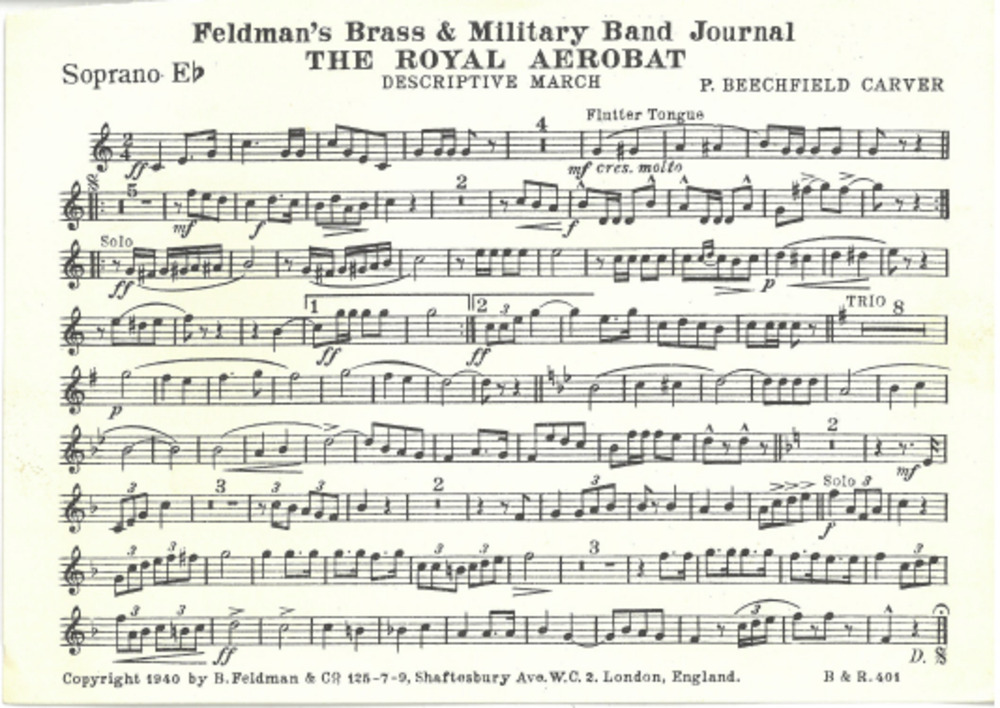
Descriptive March - Introducing: The Auxiliary Air Force March, the Air Salute, the Flying Corps Drinking Song etc.
Includes extended technique of flutter tonguing for an aeroplane effect
Key Signature: Eb Major
Feldman's Brass and Military Band Journal
Instrumentation:
Solo Cornet Bb (Conductor)
Db Flute & Piccolo
Concert Flute
Oboe
Eb Clarinet
Repiano Bb
1st Bb Clarinet
2nd Bb Clarinet
3rd & 4th Bb Clarinets
Bassoon
Eb Soprano
Eb Alto Saxophone
1st Baritone Bb (or Tenor Saxophone Bb)
2nd Baritone Bb
1st Eb Horn (or Solo Tenor)
2nd Eb Horn (or 1st Tenor)
3rd Eb Horn (or 2nd Tenor)
Solo Bb Cornet (Conductor)
2nd Bb Cornet
3rd & 4th Cornets Bb
1st Trombone
2nd Trombone
Bass Trombone
Euphonium (Treble Clef)
Euphonium (Bass Clef)
Bombardon (Bass Clef)
Eb Bass (Treble Clef)
Bb Bass
Drumes
Inscriptions & markings
On envelope: QM177, Royal Aerobat (Carver), Q263