
Showing 52 items matching "test cricket"
-
 Moorabbin Air Museum
Memorabilia (Item) - Ansett Marketing Sport Promotions AFL & Test Cricket booklets
... Ansett Marketing Sport Promotions AFL & Test Cricket booklets...Ansett Marketing Sport Promotions AFL & Test Cricket booklets...Ansett Marketing Sport Promotions AFL & Test Cricket booklets Memorabilia Ansett Marketing Sport Promotions AFL & Test Cricket booklets ... -
 Kew Historical Society Inc
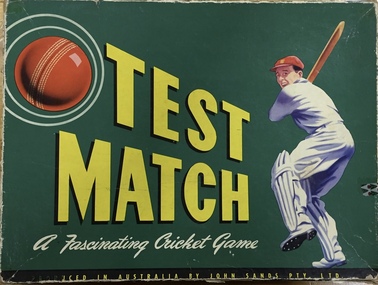
Leisure object - Board game, Test Match: A fascinating cricket game, 1955
... Test Match: A fascinating cricket game...'Test Cricket' was one of the most popular board games in the pre television era. ...'Test Cricket' was one of the most popular board games in the pre television era. ...'Test Cricket' was one of the most popular board games in the pre television era. John Sands Pty Ltd, the publisher, was an Australian bookseller and stationer founded in 1837 and produced board games from 1929-78.Board game consisting of a rectangular cardboard piece illustrated with a cricket ground, players and a scoreboard. Two semi-circles have been cut away from the background and are used to control the progress of the game. The right hand game control is moved to 'ball' position (1-8) and back to start which indicates the type of delivery shown in the window. The left hand control is moved to 'type of delivery bowled' and back to the start which reveals the number of runs scored or method of dismissal which is shown in the window. The scoreboard is operated by three circular wheels that show the result of runs and wickets. An oval handle is at the upper centre. The packaging includes a green cardboard box with lid, which has an image of a batsman and a red cricket ball.board games, john sands pty ltd, cricket -
 Stawell Historical Society Inc
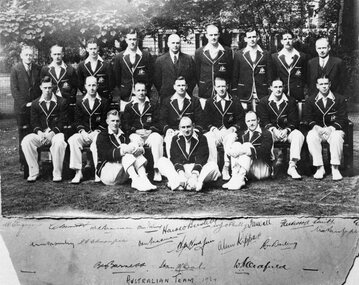
Photograph, Australian Cricket Test Team with names 1934
... Australian Cricket Test Team with names 1934...Australian Cricket Test Team 1934. The signed signatures below the photo are in line with the position of the cricket players in the photo. ...Australian Cricket Test Team 1934. The signed signatures below the photo are in line with the position of the cricket players in the photo. ...Australian Cricket Test Team 1934. The signed signatures below the photo are in line with the position of the cricket players in the photo. Some players names that are readable. Fleetwood Smith whose nick name was Chuck came from Stawell, (standing second from the right) Harold Bushby, (standing fifth from left) Seated Don Bradman (third from left). Alan Kipper, (third from right), Len Darling, (second from right), Bob Barnett, (sitting on the ground at right).Three black and white photographs of a cricket team. Two rows of players with three seated on the ground. All wearing blazers with crest on pockets. The original photograph has been autographed by the players.Australian Team 1934 Some players names that are readable. Fleetwood Smith (Chuck), (standing second from the right) Alan Kipper, Len Darling, Harold Bushby, Bob Barnett, Don Bradman stawell sport -
Port Melbourne Historical & Preservation Society
Newspaper - Digital copy of The Argus 15 March 1937, 18 Mar 1937
... Australian Women's Cricket Test Team...Peggy ANTONIO was a member of the Australian Women's Cricket Test Team....Peggy ANTONIO was a member of the Australian Women's Cricket Test Team. Sport - Women's Cricket Peggy ANTONIO The Argus Australian Women's Cricket Test Team Digital copy of The Argus newspaper with article about Peggy Antonio. ...Peggy ANTONIO was a member of the Australian Women's Cricket Test Team.Digital copy of The Argus newspaper with article about Peggy Antonio.sport - women's cricket, peggy antonio, the argus, australian women's cricket test team -
 Kew Historical Society Inc
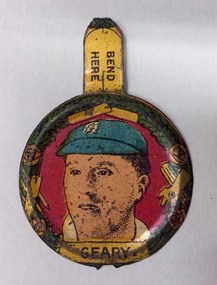
Badge - Souvenir Button, Geary, 1928-1929
... ...test cricket...Their widespread distribution means that they are frequently significant at a local, state, national and international level. george geary cricket test cricket "Geary" A tin buttonhole button from a series of 16 badges issued by Amalgamated Press. ...Frances Rigg was a local business identity in Kew, at one stage managing the local branch of the English, Scottish and Australian (ES&A) Bank at 175 High Street from c. 1920 until the 1940s. After Francis Rigg’s death, the collection of buttons and medallions was inherited by his son, Ken Rigg (1922-2014). The collection was subsequently donated to the Kew Historical Society in 2015 by Francis' grandson, Adrian Rigg, at the time of the Gallipoli & Beyond Commemoration in 2015. The collection covers a period of almost 40 years. The majority of the buttons are patriotic buttons, issued and sold during and immediately after the First World World War (1914-1918) to raise funds for national and overseas causes. The collection also includes a number of locally significant sporting event buttons and sporting club medallions, issued in the 1920s and 1930s.Patriotic and other pressed tin buttons and badges were produced in large numbers in the first decades of the twentieth century. By nature, insubstantial and ephemeral, they have not always survived. The collections of badges, buttons and medallions in the Kew Historical Society collection is homogenous and yet diverse, ranging from buttons sold to raise funds for the war efforts in 1914-18 and 1939-45, to those used at festivals and sporting events. Because of the manufacturing process, many surviving buttons and badges have been affected by inadequate storage, suffering from oxidisation and physical damage. These survivors are now historically and socially significant artefacts, revealing much about the attitudes and values of the period in which they were produced. Their widespread distribution means that they are frequently significant at a local, state, national and international level.A tin buttonhole button from a series of 16 badges issued by Amalgamated Press. George Geary (1893-1981) was an English Cricketer who played in a number of tests against Australia including the 1928-29 tour. The button includes a tab which states ‘Bend Me’ which was a simple method of attaching the badge to a lapel."Geary"george geary, cricket, test cricket -
Port Melbourne Historical & Preservation Society
Letter - Letters, photocopied re cricketer Peggy ANTONIO, 1937
... Material on cricketer Peggy ANTONIO: copies of two letters from AWCC advising her of her selection to Women's Test Cricket team for 1937,...Sport - Cricket Peggy HOWARD nee ANTONIO Material on cricketer Peggy ANTONIO: copies of two letters from AWCC advising her of her selection to Women's Test Cricket team for 1937, Letter Letters, photocopied re cricketer Peggy ANTONIO ...Material on cricketer Peggy ANTONIO: copies of two letters from AWCC advising her of her selection to Women's Test Cricket team for 1937,sport - cricket, peggy howard nee antonio -
 Bendigo Historical Society Inc.
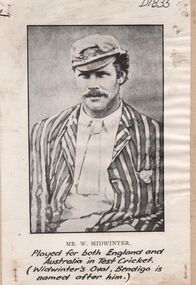
Photograph - BENDIGO UNITED CRICKET CLUB COLLECTION: MR. W. MIDWINTER
... Played for both England and Australia in test cricket. Midwinter's oval. Bendigo is named after him....Played for both England and Australia in test cricket. Midwinter's oval. Bendigo is named after him. ...Black and white photo mounted on cardboard of Mr. W. Midwinter. Played for both England and Australia in test cricket. Midwinter's oval. Bendigo is named after him.clubs, cricket, bendigo united cricket club -
Mission to Seafarers Victoria
Letter - Correspondence, 13/06/1950
... england v australia rugby test, sydnry cricket ground...He also comments on the extremely wet weather Sydney has been experiencing and encloses a newspaper clipping with a cartoon of the Rugby League first Test match between England and Australia and a photo of two very muddy players; Australian front-row forward Douglas Hall and England's captain Ernest Ward. The match was played at Sydney Cricket...Quinn Collection letters-from-abroad quinn douglas hall ernest ward england v australia rugby test, sydnry cricket ground sydney 1950 The letter commences "Dear Allan" and is singed "Your sincere friend Jim". ...The writer mentions some of Allan's family members. He also comments on the extremely wet weather Sydney has been experiencing and encloses a newspaper clipping with a cartoon of the Rugby League first Test match between England and Australia and a photo of two very muddy players; Australian front-row forward Douglas Hall and England's captain Ernest Ward. The match was played at Sydney Cricket Ground.Quinn CollectionA two-page letter written on two pages of buff-coloured, lined paper (0841a1-2) is headed 802 Macleay Regis, Macleay Street, Potts Point and dated 13/06/50. The matching envelope (0841.b) bears a one and sixpence Australian stamp, is postmarked Sydney and stamped with the slogan 'Road Carelessness Kills'. It is addressed to Mr Allan Quinn, M.S. Mongabarra, C/- Transatlantic Shipping Co., Gothenberg Sweden. Enclosed in the letter is an undated newspaper clipping (0841.c).The letter commences "Dear Allan" and is singed "Your sincere friend Jim".letters-from-abroad, quinn, douglas hall, ernest ward, england v australia rugby test, sydnry cricket ground, sydney 1950 -
 Greensborough Historical Society
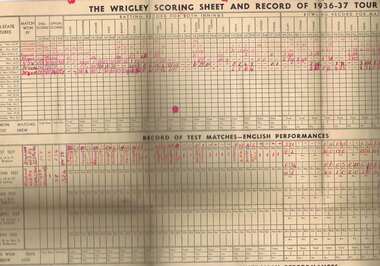
Memorabilia - Score sheet, Wrigley, The Wrigley Scoring Sheet and Record 1936-37 Tour, 1936
... Test cricket scoring sheet for 1936-37 tour...Test cricket scoring sheet for 1936-37 tour cricket sporting events australian history Beige chart with black text and red inscriptions The Wrigley Scoring Sheet and Record 1936-37 Tour Memorabilia Score sheet Wrigley ...Test cricket scoring sheet for 1936-37 tourBeige chart with black text and red inscriptionscricket, sporting events, australian history -
Port Melbourne Historical & Preservation Society
Programme, Programme of the Tour and Matches arranged for the First Visit of the Australian Women's Cricket Team 1937 to England, 1937
... Material on cricketer Peggy ANTONIO: Photocopies of Programme of the Tour and Matches arranged for the First Visit of the Australian Women's Cricket Team to England in 1937. plus photocopies of test results and map of Australian Women's test cricket tour 1937...Sport - Cricket Peggy HOWARD nee ANTONIO Material on cricketer Peggy ANTONIO: Photocopies of Programme of the Tour and Matches arranged for the First Visit of the Australian Women's Cricket Team to England in 1937. plus photocopies of test results and map of Australian Women's test cricket tour 1937 Programme of the Tour and Matches arranged for the First Visit of the Australian Women's Cricket Team 1937 to England Programme ...Material on cricketer Peggy ANTONIO: Photocopies of Programme of the Tour and Matches arranged for the First Visit of the Australian Women's Cricket Team to England in 1937. plus photocopies of test results and map of Australian Women's test cricket tour 1937sport - cricket, peggy howard nee antonio -
 Bendigo Historical Society Inc.
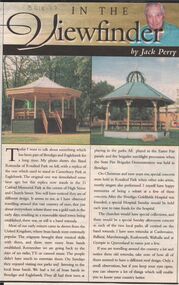
Newspaper - JACK PERRY COLLECTION: NEWSPAPER MIDWINTERS OVAL CALIFORNIA GULLY
... ... cricket... test...PERSON Individual jack perry William Midwinter cricket test match California Gully Newspaper article, Bendigo Weekly, regarding William Midwinter. ...Newspaper article, Bendigo Weekly, regarding William Midwinter. Midwinter played in the Australian test team against England at the MCG in 1878. He lived in California Gully, where the oval is situated, bounded by Butler, Bailey and Thorn Streets, California Gully.person, individual, jack perry, william midwinter, cricket, test match, california gully -
 Numurkah & District Historical Society
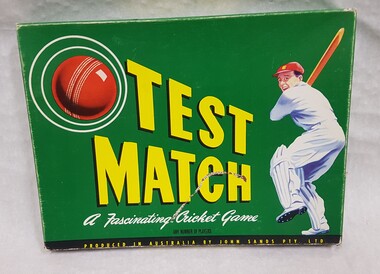
Test Match Game
... games, board games, family, cricket, test match, children...games, board games, family, cricket, test match, children See photo Cardboard box with test match board game inside (some "scoring pieces" torn away from board) Test Match Game ...Cardboard box with test match board game inside (some "scoring pieces" torn away from board)See photogames, board games, family, cricket, test match, children -
Port Melbourne Historical & Preservation Society
Newspaper - Digtal copy of The Herald 7 February 1939, 7 Feb1939
... Australian Women's Cricket Test Team...Sport - Women's Cricket Peggy ANTONIO Australian Women's Cricket Test Team The Herald Publishing - Newspapers Digital copy of The Herald newspaper with article about Peggy Antonio. ...Peggy ANTONIO was a member of the Australian Women's Cricket Team.Digital copy of The Herald newspaper with article about Peggy Antonio.sport - women's cricket, peggy antonio, australian women's cricket test team, the herald, publishing - newspapers -
Port Melbourne Historical & Preservation Society
Newspaper - The Herald 6 November 1939, 6 Nov 1939
... Australian Women's Cricket Test Team...Sport - Women's Cricket Peggy ANTONIO Australian Women's Cricket Test Team The Herald Publishing - Newspapers Digital copy of The Herald newspaper with article about Peggy Antonio. ...Peggy ANTONIO was a member of the Australian Women's Cricket Team.Digital copy of The Herald newspaper with article about Peggy Antonio.sport - women's cricket, peggy antonio, australian women's cricket test team, the herald, publishing - newspapers -
Melbourne Tram Museum
Film - DVD - Film - Reel 28, Lindsay Walker, "Tram Collection", 1960 to1980
... Set of two DVD's with digitized film: Each Reel has its own listing of sequences; Reel 28, Footscray, Williamstown Road, Russell St, cable tram at St Arnaud, Geelong tram 21, Ballarat prior to closure, Bendigo, Glen Iris, Collins St, High St Kew trackworks, old and new terminus Essendon Airport, Warrigul Road, Centenary Test cricket, Burwood, Bendigo Trust, ARE Special, Cavalcade of transport Wellington Parade Wattle Park, Burwood Batmana Ave and Cavalcade of Transport Spencer St...Set of two DVD's with digitized film: Each Reel has its own listing of sequences; Reel 28, Footscray, Williamstown Road, Russell St, cable tram at St Arnaud, Geelong tram 21, Ballarat prior to closure, Bendigo, Glen Iris, Collins St, High St Kew trackworks, old and new terminus Essendon Airport, Warrigul Road, Centenary Test cricket, Burwood, Bendigo Trust, ARE Special, Cavalcade of transport Wellington Parade Wattle Park, Burwood Batmana Ave and Cavalcade of Transport Spencer St Yields information about the operation of Melbourne trams in film and has a close association with the donor. ...Set of two DVD's with digitized film: Each Reel has its own listing of sequences; Reel 28, Footscray, Williamstown Road, Russell St, cable tram at St Arnaud, Geelong tram 21, Ballarat prior to closure, Bendigo, Glen Iris, Collins St, High St Kew trackworks, old and new terminus Essendon Airport, Warrigul Road, Centenary Test cricket, Burwood, Bendigo Trust, ARE Special, Cavalcade of transport Wellington Parade Wattle Park, Burwood Batmana Ave and Cavalcade of Transport Spencer StYields information about the operation of Melbourne trams in film and has a close association with the donor.Set of two DVD's in plastic cases, marked.In marker pen: 12/2 - "Lindsay Walker, Tram Collection, Movie Reels 28, 29, 39 and super 8melbourne, tramways, trackworks, films, transport cavalcade, footscray, geelong, ballarat, bendigo, cable tram, high st kew, essendon airport, batman ave -
 Sunshine and District Historical Society Incorporated
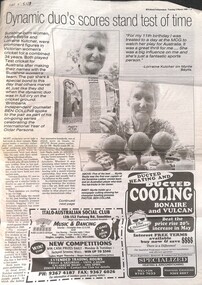
Article - Sunshine Women Test Players - Myrtle Baylis And Lorraine Kutcher, Brimbank Independent, 2nd March 1999
... A right‑arm medium‑fast bowler and lower‑order batter, she represented Australia in the 1960s during a period when women’s Test cricket was infrequent but highly competitive. ...A right‑arm medium‑fast bowler and lower‑order batter, she represented Australia in the 1960s during a period when women’s Test cricket was infrequent but highly competitive. ...Myrtle Baylis (née Craddock), a Braybrook and Sunshine resident was one of Australia’s early women’s Test cricketers and a rare dual‑international who represented Australia in both cricket and netball. She was born in Footscray in 1920 and raised in Sunshine, Melbourne, making her a significant figure in western‑suburbs sporting history. Myrtle Baylis played six Test matches for Australia between 1948 and 1951, taking 16 wickets at an excellent bowling average of 19.62. Lorraine Kutcher, born 29th January 1938, Sunshine, and a Sunshine resident, is one of the most accomplished women’s cricketers to come out of Melbourne’s western suburbs. A right‑arm medium‑fast bowler and lower‑order batter, she represented Australia in the 1960s during a period when women’s Test cricket was infrequent but highly competitive. Lorraine Kutcher played four Test matches for Australia between 1963 and 1969, taking 16 wickets at an outstanding bowling average of 18.62. Dynamic duo's scores stand test of time.myrtle baylis, lorraine kutcher, cricket -
Melbourne Tram Museum
Magazine - Cricket news, Melbourne Tramways Trust (MTT), "Among Ourselves", 1971 to 1987
... Set of 9 magazines containing Australian tramway cricket competition and other news. 1 - Among Ourselves - Municipal Tramways Trust - Adelaide - March 1971 - pages 20 - 24 - Victoria Wins Cricket Test 2 - ditto - March 1973 - pages 29 - 32 - SA Wins Jubilee Tramways Cricket Test 3 - ditto - April 1974 - pages 32 - 34 - Victoria Wins Cricket test 4 - ATMOEA Vic Tramway Record - March 1977 - pages - 24 and 25 - B shift cricket in New Zealand 5 - Among Ourselves - April 1977 - pages - 30 to 32 - Tramway Cricketers in New Zealand 6 - ditto - April 1978 - pages 31 to 33 - We win but! ...Set of 9 magazines containing Australian tramway cricket competition and other news. 1 - Among Ourselves - Municipal Tramways Trust - Adelaide - March 1971 - pages 20 - 24 - Victoria Wins Cricket Test 2 - ditto - March 1973 - pages 29 - 32 - SA Wins Jubilee Tramways Cricket Test 3 - ditto - April 1974 - pages 32 - 34 - Victoria Wins Cricket test 4 - ATMOEA Vic Tramway Record - March 1977 - pages - 24 and 25 - B shift cricket in New Zealand 5 - Among Ourselves - April 1977 - pages - 30 to 32 - Tramway Cricketers in New Zealand 6 - ditto - April 1978 - pages 31 to 33 - We win but! ...Set of 9 magazines containing Australian tramway cricket competition and other news. 1 - Among Ourselves - Municipal Tramways Trust - Adelaide - March 1971 - pages 20 - 24 - Victoria Wins Cricket Test 2 - ditto - March 1973 - pages 29 - 32 - SA Wins Jubilee Tramways Cricket Test 3 - ditto - April 1974 - pages 32 - 34 - Victoria Wins Cricket test 4 - ATMOEA Vic Tramway Record - March 1977 - pages - 24 and 25 - B shift cricket in New Zealand 5 - Among Ourselves - April 1977 - pages - 30 to 32 - Tramway Cricketers in New Zealand 6 - ditto - April 1978 - pages 31 to 33 - We win but! 7 - ditto - April 1979 - pages 27 to 30 - Night cricket and STA team retains shield 8 - ditto - April 1984 - pages 16 to 20 - SA wins the Cricket - includes team photos 9 - ditto - March 1987 - pages 16 to 19 - Cricket CarnivalYields information about the interstate tramway cricket matches.Set of 9 magazines - all centre stapledcricket, sports, tramways, mtt, social club -
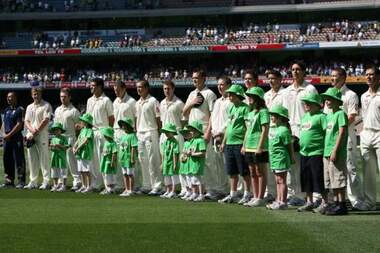 Blackburn Cricket Club
Milo Cricket - National Anthem Ceremony Boxing Day 2009
... In 2009 participants Blackburn Cricket Club Milo in2 Cricket were selected to stand with the Australian team during the national anthem on day 1 of the Boxing day test at the Melbourne Cricket Ground. ...In 2009 participants Blackburn Cricket Club Milo in2 Cricket were selected to stand with the Australian team during the national anthem on day 1 of the Boxing day test at the Melbourne Cricket Ground. ...In 2009 participants Blackburn Cricket Club Milo in2 Cricket were selected to stand with the Australian team during the national anthem on day 1 of the Boxing day test at the Melbourne Cricket Ground. -
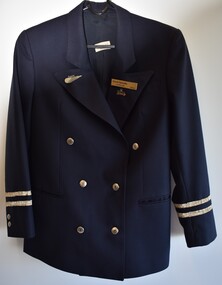 Moorabbin Air Museum
Uniform (item) - Ansett Airlines Purser Jacket
... The left jacket lapel features " Ansett Australia Caroline - Purser" name tag, below which is the Ansett Australia Test Series badge - Cricket 1997-1998. The right jacket lapel features the "Single Wing" lapel badge worn prominently by fight attendants /pursers....The left jacket lapel features " Ansett Australia Caroline - Purser" name tag, below which is the Ansett Australia Test Series badge - Cricket 1997-1998. The right jacket lapel features the "Single Wing" lapel badge worn prominently by fight attendants /pursers. ...Manufactured by Weiss Australia. -
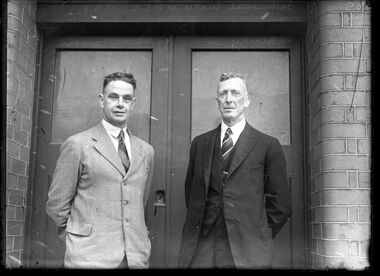 City of Melbourne Libraries
Photograph, Bull, Hugh Jones, 1897-1993, Bert Ironmonger and Don Blackie, Testimonial Cricket at MCC
... These men were famous for making their Test Cricket debuts when they were 46 years, 237 days old (Dainty) and 46 years, 252 days old (Rock). ...These men were famous for making their Test Cricket debuts when they were 46 years, 237 days old (Dainty) and 46 years, 252 days old (Rock). ...Ironmonger and Blackie BERT “DAINTY” IRONMONGER (1882-1971) and DON “ROCK” BLACKIE (1882-1955), the legendary off-spin bowlers, were “spin twins” in real life, born just two days apart. Dainty and Rock had an “average” age of 51 years and 273 days when photographed outside the Melbourne Cricket Club on the eve of their joint Testimonial Match on 16 November 1933. Blackie, a PMG linesman by trade, was nicknamed “Rock” because that’s what he’d call people when he inevitably forgot their names. Ironmonger, employed for over 30 years by St Kilda Council as a gardener, was nicknamed “Dainty” because he wasn’t! These men were famous for making their Test Cricket debuts when they were 46 years, 237 days old (Dainty) and 46 years, 252 days old (Rock). Whilst they only played one Test together, they were selected 24 times in the same Victorian team. It is no coincidence that the golden era of Victorian cricket coincided with their tenure. They played with St Kilda Cricket Club for nine seasons and the grandstand at Junction Oval bears the “Blackie-Ironmonger” name to this day. When on interstate tours, they shared a hotel room, where they plotted the downfall of their batting opponents. Their joint Testimonial Match was played over four days and featured all-star line-ups from three states. The opposing teams were captained by Bill “Wormkiller” Woodfull (memorial statue at Melbourne High School) and Vic “The Guardsman” Richardson (memorial gates at Adelaide Oval). The serious first class game attracted over 40,000 spectators and raised £908 for each man, around $45,000 in today’s money. In a game featuring la crème de la crème of contemporary batsmen – Bill “Ponny” Ponsford, Don “The Don” Bradman, Stan “Napper” McCabe et al – and all time doyens of the art of spin bowling – Clarrie “The Gnome” Grimmett, Bill “Tiger” O’Reilly and “Chuck” Fleetwood Smith – “Rock” topped his side of the bowling scorecard, picking up the best bowling figures of 3 for 69! Unhappily, Dainty’s old knee injury reoccurred and he had to sit out the last two days of play. Featured in "Newsworthy: Melbourne in photographs 1933-1936" exhibition at East Melbourne Library, October to December 2023. Exhibition caption by project volunteer, Ernie Ward. Photographer notations on slide: "Testimonial Cricket at MCC 1933 Blackie Ironmonger B9".cricket -
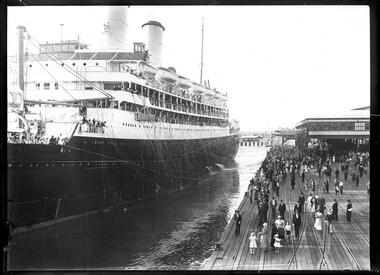 City of Melbourne Libraries
Photograph, Bull, Hugh Jones, 1897-1993, RMS Orford departing from Station Pier, Port Melbourne
... Amongst the 2000 passengers on board was the Davis Cup Tennis team, tennis champions Joan Hartigan and Nell Hopman, the Australian Test cricket team and British champion swimmer Joyce Cooper. ...Amongst the 2000 passengers on board was the Davis Cup Tennis team, tennis champions Joan Hartigan and Nell Hopman, the Australian Test cricket team and British champion swimmer Joyce Cooper. ...Published: 21 March 1934 The Age p11 Published title: CROWDED TOURIST SHIP WILL CARRY TEST AND DAVIS CUP TEAMS. Published caption: Carrying an exceptionally large number of tourists, business men and prominent sporting personalities, R.M.S. Orford sailed for London yesterday. Over two hundred passengers embarked at Melbourne, and on leaving the Australian coast there will be two thousand persons on board. The Australian Test team will join the vessel at Fremantle and the remaining two Davis Cup representatives will embark at Adelaide. A picture of the Orford taken just as she moved out from Station Pier, Port Melbourne, under her own steam. Trove article identifier: http://nla.gov.au/nla.news-article203826897 Description: Passenger ship about to depart Station Pier, Port Melbourne. Research by project volunteer, Fiona Collyer: The RMS Orford was built by Vickers-Armstrong Shipyard Barrow-in-Furness, Cumbria, England and launched in 1927 by Lady Ryrie, the wife of Sir Granville Ryrie, the Australian Ambassador to the UK. The Orford was owned by the Orient Steam Navigation Ltd and was designed for the mail and passenger service between England and Australia. She was 20,000 tons, 658 ft long, 75 ft across and 80 ft high from water-line to deck. She had eight decks, a swimming pool and cost more than £1,000,000. She could travel at 20 knots – 480 miles a day, a 5 week voyage between Australia and England. There were enough lifeboats to accommodate every person on board. Promoted as a ship of comfort, luxury, speed and grace with spacious, beautifully decorated lounges, smoking-rooms and writing rooms, the SMH 23/11/1928 review said “sitting-rooms where the furniture recreates the air of quiet, exquisite, safe luxury; suites where you may retire from other people, and on a sea voyage other people, even the most charming other people, often begin to resemble one’s worst enemies towards the end of several weeks sea voyaging together”. “Travel like a human being. This is what the great liners give you today. The Orford dining room is enormous (it seated 350 people) the walls sweep up to a white, cool roof supported on decorative pillars. Panels of grey scagliola and carved designs remove the bleak, comfortless air which used to cling to dining-rooms of ships. Everything about them was so wretchedly temporary that you could not enter them without wishing that you stayed at home. They gave you the creeps and indigestion. This room is gay, bright, sunlit, like a luxurious café overlooking the sea.” “You really feel in here that you are a human being and not a piece of cargo endowed with sensation.” The Orford had the punkah louvre system of ventilation which forced draughts through every part of the ship, ensuring “No Ship Smells!!” and avoiding - “… a mayonnaise of all the unpleasant odours generated under heaven. From the hot oil of the engines, from those overheated, bottomless pits below the water-line, from new paint and food, from people perspiring at work, from rope and tar and grease and fruit and wet clothes and tobacco, rises a deplorable incense that lingers unsettlingly in the nostril long after one has left the ship. Those dreadful odours will never rise to torture the senses of passengers who feel that all is over with them.” The modern electric kitchen had a roll making machine capable of producing 2000 rolls for the table an hour and a bread and butter machine which cut the bread into slices and spread the butter in one operation. (The Week – Brisbane 30/11/1928) On 13/10/1928, the Orford made its first voyage to Australia with 520 first class and 1100 3rd class passengers. The name of the passengers embarking and disembarking and their reason for visiting were published in newspapers and the number of migrants for the New Settlers Scheme and the Dreadnought Boys Co program to promote and assist the migration of British youths willing to become farm workers in Australia 1911-1939 were noted too. On the 19th March 1932, RMS Orford featured in the “Parade of Ships” celebrating the official opening of the Sydney Harbour Bridge. Only country people were allowed to book a ticket as a guest on board. The Post Office issued commemorative postage stamps showing the Orford sailing under the bridge. In March 1934, the Orford sailed from Australia to London, via Colombo, Aden, Port Said, Naples, Villefranche, Toulon, Parma, Gibraltar and Channel Port. Amongst the 2000 passengers on board was the Davis Cup Tennis team, tennis champions Joan Hartigan and Nell Hopman, the Australian Test cricket team and British champion swimmer Joyce Cooper. Every day tennis player Harry Hopman and an Australian Press Association reporter radioed through reports on their activities, which included – - Test cricket batsman Len Darling having spend 4 days in his cabin after straining his groin when he slipped over while playing ball tennis in his slippers. - Batsman Bill Brown dancing the fox-trot, displaying footwork similar to the grace he showed at the wicket. - Alluding to the seasickness of Don Bradman and Stan McCabe and how they were making up for meals lost on the Great (very choppy) Australian Bight. - Miss Joan Hartigan discarding her bright blue shorts for brighter blue bathers and being first into the pool. - Bowler Bill O’Reilly being tripped by a passenger on the deck and spending the voyage with bandaged wrists with daily updates of his progress in the press. - Wicketkeeper Ben Barnett’s conjuring tricks and constant whirring movie camera. - Results of the quoits, ball tennis and bridge tournaments. A fancy dress ball was held one night and the cricketers dressed as sheiks and sang “The Riff Song” from the pre-code 1929 operetta film “The Desert Song” starring John Bates as the Red Shadow and Myrna Lay as a native dancing girl. Alan Kippax’s beard blew overboard! Joan Hartigan dressed as Burlington Bertie from the music hall song and Nell Hopman a doll in a box wearing a crinkled paper dress. On arrival at Southampton, while they waited for the gangway to be lowered, Bradman entertained the team at the piano playing popular tunes while the cricketers sang. . In 1935, RMS Orford’s third class accommodation was converted to tourist class. Her passenger capacity was now 468 First Class, 515 tourist class and 440 crew. First saloon from Sydney fares cost for single £76, £82, £88 and Third Class fares were £21, £23, £25. Less than a penny a mile. . In 1936, the Orford embarked the exiled Emperor of Ethiopia, Haile Selassie at Gibraltar on his way to the UK. In 1939, she was requisitioned for Australian government service and on 7/1/1940 she conveyed the first Australian troops to Egypt and was then used to carry French troops from Tamatave, Madagascar to Marseilles. On 1/6/1940 RMS Orford was bombed and set on fire at Marseilles by German aircraft. 14 crew were killed, 25 wounded. In 1947, the wreck was re-floated and broken up at Savona. . . References: R.M.S. ORFORD. (1928, November 23). The Sydney Morning Herald (NSW : 1842 - 1954), p. 14. Retrieved September 15, 2023, from http://nla.gov.au/nla.news-article16511535 ARRIVAL OF THE ORFORD (1928, November 30). The Week (Brisbane, Qld. : 1876 - 1934), p. 21. Retrieved September 15, 2023, from http://nla.gov.au/nla.news-article181126802 CROWDED TOURIST SHIP WILL CARRY TEST AND DAVIS CUP TEAMS. (1934, March 21). The Age (Melbourne, Vic. : 1854 - 1954), p. 11. Retrieved October 5, 2023, from http://nla.gov.au/nla.news-article203826897 Photographer notations on slide: "B19".tennis, ships -
 City of Melbourne Libraries
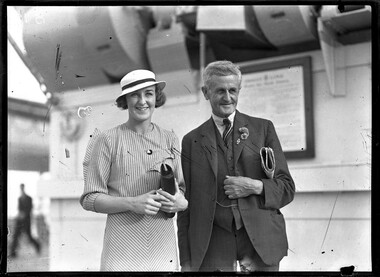
Photograph, Bull, Hugh Jones, 1897-1993, Miss Joan Hartigan and Mr Harley Malcolm embark on the RMS Orford for Wimbledon
... The Australian Test cricket and Davis Cup teams were also on the same voyage. ...The Australian Test cricket and Davis Cup teams were also on the same voyage. ...“MISS JOAN HARTIGAN, the well known New South Wales tennis player, who intends to play at Wimbledon this year. A photograph taken on board R.M.S. Orford before she sailed yesterday.” - The Age Photographer notations on slide: "B19" Published: Age (Melbourne, Vic. : 1854 - 1954), Wednesday 21 March 1934, page 13 Published title: MISS JOAN HARTIGAN Published caption: MISS JOAN HARTIGAN the well-known New South Wales tennis player, who intends to play at Wimbledon this year. A photograph taken on board R.M.S. Orford before she sailed yesterday. Trove article identifier: http://nla.gov.au/nla.news-article203827087 Description: On the deck of a ship, a smiling young woman wearing a white hat, printed fabric dress with brooch and holding a black clutch bag stands next to a middle aged man wearing a dark three piece suit and necktie with cornflower buttonhole and lapel pin and a newspaper under his arm. Research by project volunteer, Fiona Collyer: Twenty-one year old Australian Championships, (now known as the Australian Open) winner Miss Joan Hartigan and Mr Harley Malcolm, Lawn Tennis Association of Australia (LTAA) Honorary Secretary and referee, embark on the R.M.S. Orford at Station Pier, Port Melbourne on their way to Wimbledon. The Australian Test cricket and Davis Cup teams were also on the same voyage. Joan Marcia Hartigan (Bathurst) 1912-2000 from Sydney, won the Australian Championships three times in 1933, 1934, 1936 and was a Wimbledon semifinalist in 1934, 1935. A tall, stylish presence in visor and pleated dress, Joan was renowned for her power game and her “upside down backhand” i.e. striking the shot with the same face of the racquet that she hit her forehand. Joan’s world ranking was No.8 in 1934. Unfortunately, her career was interrupted by the outbreak of WW11 with international matches suspended for five years. Joan enlisted in the Australian Military Forces during WW11 and in 1947 she married Hugh Bathurst, private secretary to Senator James Fraser, Prime Minister Ben Chifley’s Health Minister. They had a daughter Mary and a son Thomas who became Chief Justice of NSW. Joan died in Sydney in 2000. In October 1933, Mr Harley Malcolm, declared “I consider shorts not regulation costume and would stop both men and women, particularly women, wearing them. I think women’s desire to strut in such a costume is unreasonable.” However, Harley was on the wrong side of history. In Europe and USA, many women tennis players were swapping their long skirts and stockings for bare legs, short skirts and shorts and men their long flannels for tailored shorts. In 1933, Henry “Bunny” Austin stunned the Wimbledon crowd when he wore shorts onto Centre Court - the first top male player to do so. He found it too hot to play in long trousers so he asked his tailor to run up some prototype shorts. At the 1933 Wimbledon Women’s Final, in front of the King and Queen, English champion Dorothy Round wore her trademark sleeveless dress with a divided skirt and her American competitor Helen Jacobs wore white, tailored shorts with a black stripe on each side, described as “mannish, though businesslike.” In November 1933, the Victorian Lawn Tennis Association officially allowed shorts as regulation dress at Kooyong for both sexes. In 1935, Dorothy wore her shorts while competing in Melbourne at the Australian Championships, Kooyong and there was hardly a murmur of dissent. Mr Harley Malcolm was involved with Australian tennis for 57 years, first as a player, then as a referee and administrator. He always wore a cornflower buttonhole on his lapel as he said the blue in that flower was his favourite colour. Cornflowers are sometimes referred to as “bachelor’s button” due to the old practice of men wearing cornflower buttonholes to indicate they are either in love or ready for courting. The Bleuet de France is the French flower of remembrance. References: WOMEN CITIZENS' MOVEMENT. (1934, March 21). The Age (Melbourne, Vic. : 1854 - 1954), p. 13. Retrieved March 20, 2024, from http://nla.gov.au/nla.news-article203827087 'Joan Hartigan', Wikipedia, https://en.wikipedia.org/wiki/Joan_Hartigan Leading Tennis Referee Condemns Wearing of Shorts (1933, October 5). The Herald (Melbourne, Vic. : 1861 - 1954), p. 11. Retrieved March 6, 2024, from http://nla.gov.au/nla.news-article243193607 REMEMBERING 57 YEARS OF TENNIS (1947, December 10). Daily Mercury (Mackay, Qld. : 1906 - 1954), p. 5. Retrieved April 1, 2024, from http://nla.gov.au/nla.news-article171166922Photographer notations on slide: "B19".tennis, 1930-1939, ships, sport, clothing and dress -
 Bendigo Historical Society Inc.
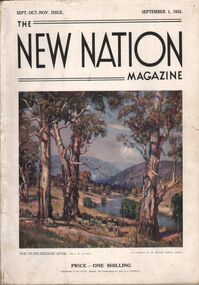
Magazine - AILEEN AND JOHN ELLISON COLLECTION: THE NEW NATION MAGAZINE
... Benetter)- The British commonwealth of Nations - Switzerland, land of lakes and mountains (by Hilary lofting) - Highways of the Syrian desert (by Francis Birtles) - Seven ages of the Australian aboriginal - The game of the empire, the approaching cricket test matches (by M. A. Noble) - Short story, the last run (by H. ...Benetter)- The British commonwealth of Nations - Switzerland, land of lakes and mountains (by Hilary lofting) - Highways of the Syrian desert (by Francis Birtles) - Seven ages of the Australian aboriginal - The game of the empire, the approaching cricket test matches (by M. A. Noble) - Short story, the last run (by H. ...The New Nation Magazine Sept. Oct. Nov. Issue. September 1, 1932. On the front cover a painting "The Murrumbidgee River by J. R. Jackson. Price 1 shilling the magazine has 112 pages, the last two pages are ripped and the back cover is missing. Contents: Frontispiece "morning of the dogger bank" (by T. Benetter)- The British commonwealth of Nations - Switzerland, land of lakes and mountains (by Hilary lofting) - Highways of the Syrian desert (by Francis Birtles) - Seven ages of the Australian aboriginal - The game of the empire, the approaching cricket test matches (by M. A. Noble) - Short story, the last run (by H. H. Cardinal) - "The hidden bird" (by E. M. England) - North Australia trails ( by C. Price Conigrave) - Tales of the turf Fred Archer (by S. A. Marden) - The wide world round - Cape Horn (by J. Newman Barker) - "The home in the clearing" (by Sydney long) - Whitsunday passage (by Henry G. Lamond) - Old bridges (by J. L. Ranken) - The city of the longest drink (by A. C. Cummins) - The life of the cuckoo (by M. S.) - Radio - The world of music (by A. L. Kelly) - The world of women (by E. G. Manby Suttor) - Shopping from an easy chair - The Australian wool trade - Our verse farm - My wool clip (by H. W. Wright) - Windjammer days (by Gerald M. Moody) - Quarterly review of the stock and meat industry (by J. B. Cramsie) - New Zealand letter - At ye booksellers today - A number of things - The modern home - Portland cement - The good housewife (by E. G. Manby Suttor) - Cousin Shirley.book, magazine, the new nation -
 City of Melbourne Libraries
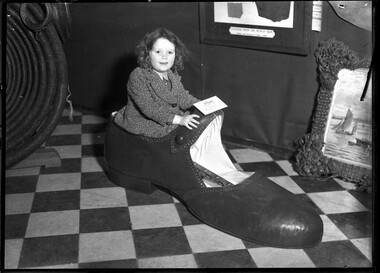
Photograph, Bull, Hugh Jones, 1897-1993, Leather Exhibition, Melbourne Town Hall
... Pataudi: Iftikhar A K Pataudi, “an Indian prince who in the 1930s played Test cricket for England, and in the 1940s played Test cricket for India (as Captain) – the only test cricketer to have played for both India and England...Pataudi: Iftikhar A K Pataudi, “an Indian prince who in the 1930s played Test cricket for England, and in the 1940s played Test cricket for India (as Captain) – the only test cricketer to have played for both India and England ...Photographer notations on slide: At the Leather Exhib. at T. Hall Melb 1933 Age Published: Age (Melbourne, Vic.: 1854- ), 1933 THE EXHIBITS. (1933, September 20). The Age (Melbourne, Vic. : 1854 - 1954), p. 16. Retrieved January 25, 2026, from http://nla.gov.au/nla.news-article205109730 Published title: THE EXHIBITS. A COMPREHENSIVE RANGE. Curios, Novelties, Working Displays Published Caption: ONE OF THE NOVELTIES – AN OUTSIZE IN SHOES Research by Project Volunteer, Louise McKenzie: Our photo is dated 20 September 1933, and shows a happy, chubby-faced young girl sitting in a very over-sized girl’s shoe. It is labelled – “Shoe, An Out Size, loaned by Messrs Blackman & Rose”. (1) It is an effective way to capture the attention of the readership and alert them to the Melbourne Leather Show 1933. This show was designed to be a drawcard of extraordinary proportion, and there is no doubt that this leather exhibition was a really big deal for Melbourne. It completely took over the Melbourne Town Hall, and was open from 10.30 am until 10.30 pm. It seemed to contain something for everyone – the military, the man about town, the home handyman, the housewife, the child, the sporting types, the domestic workers, the outdoor enthusiasts, the horseracing fans, car enthusiasts, those wishing to show off the latest fashion – both men and women - and those just intrigued by a lot of fascinating and wide ranging exhibits. One of the most comprehensive descriptions of the Exhibition accompanies the photograph, and is worth quoting in full: “PROMINENT among exhibits which first attract attention in the foyer of the Town Hall is a comprehensive display of leather articles used by the defence forces. A conspicuous legend states that leather plays an important part in national defence, being used for saddlery, tool containers, holdalls, range-finding, surveying and signalling equipment, explosives factories, harness accoutrement, bandsmen's equipment and clothing. Three models of horses and several figures of soldiers wearing leather equipment illustrate the lesson, and a great range of leather goods used in military training and work variegate the display. Nearby are Texas cowboy, buckjumping and breaking-in saddles; whips, a walking stick, made of leather and numerous other curios. The general exhibition occupies the whole floor space of the main Town Hall, and is subdivided by partitions running most of the length of the hall. A bewildering variety, of leather goods presses for close and leisured inspection. Here and there operatives in charge of working machinery give practical demonstrations of factory processes in the production of footwear. Polishing materials are well represented. One attractive exhibit includes two bush huts constructed of leather, with wattle bark for roofing. Opossums, rosellas and a kookaburra add touches of bush realism. Adjacent exhibits include bags, fishing boots, leggings, leather covers in all colours. Factory Processes. One exhibitor has installed an automatic cinema apparatus and screen, which projects various factory processes in making a shoe, the operator being shown at work. Elsewhere an interesting exhibit depicts the five stages in the manufacture of sole leather, and the tanning materials employed. "Very handsome effects are achieved in the interior appointments of motor cars, which are attended by figures of smart chauffeurs in leather coats. Motor-trimming leather is said to be more durable and hygienic than fabric materials, and cheaper. The neat finish of the material, its excellent appearance, certainly make a very favourable impression. It takes the hides of three beasts to cover the cushions, squabs and door panels of a full-sized sedan, while to finish the entire interior, including quarter-panels and head linings would take four or even five. Special Exhibits. Amongst the special sections the display arranged by the handicrafts and home industries- committee of the Country Women's Association of Victoria is a notable one. In all there are about 130 entries which are in four classifications, viz., hand-tooled or embossed leathers, suede, hand-made gloves and undecorated leather. The glove section attracted the most numerous entries, a number being the work of members and craft subscribers of the Country Women's Association. In the leathercraft competition, organised by the Country Women's Association, the judges yesterday awarded the first prize for bookbinding (the only prize given in this division) to Miss M. Alston, of South Yarra. There is also a creditable display of exhibits submitted by boys of the orthopaedic section of the Children's Hospital at Frankston. Amongst the novelties on view in other portions of the exhibition were the following: — Leather coats worn by Sir C. Kingsford Smith on his Atlantic flight. Model Wellington boot, Phar Lap's saddle. Melbourne Cup winner's saddle. Longest whip in world, 108 feet long. (33 metres) [See our photo, to left of Girl in Shoe] Diminutive shoes. Pair of shoes 65 years old. Pair of men's working boots 75 years old. Larwood's, Tate’s and Pataudi’s cricket boots. [Three internationally revered cricketers of the day] (2) Picture frame made of leather bought 63 years ago. [See our photo, to right of Girl in Shoe] Leather frame, powder bowl, &c. Saddle used by world's champion buckjumper in U.S.A. Mexican cowboy outfit. Miniature saddle and bridle. A fireman's helmet made of sole leather. (3) Sample of the leather hat worn by porters at the Billingsgate Fish Market, London. (4) From South Australia there have been obtained sets of harness for donkeys, goats and camels, the equipment being displayed to good advantage on stuffed representations of the animals mentioned. Close to the platform is a glass case containing snow shoes and coats which have been used in Antarctic exploration work. Trade Display. Amongst the trade exhibits may be seen in operation a slipper turn shoe sewing machine, with heeling and channelling facilities, and the various stages in the production of ladies' sandals are shown. There is a wide contrast between sole leather of varying degrees of thickness on view in one stall and the choice samples of ladies' footwear in another — footwear, by the way, which could almost be used as ornaments, so dainty in colour and production are they. Again, there are displays of upholstering leathers of such soft texture that they could he readily mistaken for some of the finest cloth. Those who may be particularly interested in the production of chamois leather may gain an insight into the materials and chemicals used in the "working up” of this variety of leather. Supplies of glace kid (5) are tastefully arranged, and there may also be seen bags of all shapes and sizes, including satchels, suit cases and "sporting" cases, and bags for tennis players and golfers. Further variety is given to the exhibition by the display of antique hides, brightly coloured, with punching balls, boxing gloves and batsman's pads. There are crocodile skins and snake skins so cleverly "Worked up" that one could be almost pardoned for betraying an affection for such unpopular creatures.” “ Another wonderful article on this Exhibition, published the same day in one of the opposition daily newspapers, The Argus, is in the weekly article “Women to Women”, entitled “A Great Victorian Industry: Many Uses for Leather”. This weekly column was penned by Vesta, and she writes, with much purpose: “Yesterday afternoon I paid a hurried visit to the Leather Exhibition now being held in the Melbourne Town Hall and I was disappointed to find that the early visitors to the main exhibition were almost all men. Women, I think, should make a point of seeing every exhibition of our great industries, for women are the buyers of household requisites and goods for their own use and their tastes, and opinion influence also, to a large extent, the purchases of men. So, the welfare of industries is more or less in their hands and it becomes a duty for them to inform themselves fully of the extent and the quality of the manufacturing that is done here. The value of the output of the Australian boot and shoe factories alone was in 1930-31, the latest year for which the figures are given, Stg 3,750,000. Fully two thirds of that amount must have been spent by women on boots and shoes for themselves and their children. In a host of other directions, in the purchase of handbags, travelling bags, belts and straps, cushions, furniture coverings, purses, notebooks, spectacle cases, their annual expenditure must be very high. Their interest, therefore, in this industry is practical, and their support of it should be governed by knowledge of comparable values and qualities of the goods they buy. From the point of view of women, however, the exhibition itself is rather disappointing. There is an amazing collection of good stuff on show, but most of it is not displayed in a fashion that attracts attention. I was surprised, for example, at the range and quality of the leathers displayed, the suppleness of the finer qualities, and the varied range of colours and designs. But they are shown in such a fashion that if one set out deliberately to look for them it would be quite easy to miss most of them.” …It was surprising, too, that no one seemed to have taken advantage of the present fashion of wearing coloured gloves, or the cult of glove making, which the Country Women’s Association has fostered so successfully. Outside the collection of chamois leathers I saw no skins which were suitable to glove making. (6) However, it is perhaps a little unfair to be highly critical of the exhibition, inasmuch as it is the first of its kind. The material is there, undoubtedly, for a splendid show of every phase of this enterprising industry, and I am confident that experience will prove to those concerned that it will be worth while next time to devote a great deal of attention of the method of display.” With further research, it transpires that “Vera” is in fact NZ born Stella May Allen (nee Henderson) (1871-1962), a journalist, the first woman in NZ to begin a law course, in 1890-91). She later worked at a law firm while she completed her degree. Study of the law had always been open to women in NZ, but its practice was still barred to them. Her case “…led to amending legislation in 1896 allowing women to practise as barristers or solicitors. However, on gaining her LL.B. in November 1897 she did not apply for admission to the Bar. Instead, she became the Wellington-based correspondent and leader-writer for the Lyttelton Times. Her appointment, the first for a woman, was not welcomed by the all-male Press Gallery, and special permission had to be obtained from a subcommittee of the House before her presence was accepted. In 1900 she married Edwin Allen, a senior leader-writer for the Wellington Evening Post, and they moved to Australia in 1903 when Edwin Allen took up the post of foreign affairs leader-writer and parliamentary man for the Melbourne Argus. As Patricia Keep notes in her excellent entry of Stella Allan in the Australian Dictionary of Biography: “In 1907 The Argus commissioned her to write a series of articles on the first Australian Women's Work Exhibition held in October. They aroused much interest and next year The Argus invited her to join its full-time staff and begin a weekly section on the particular interests of women. She adopted the nom de plume 'Vesta' and called the column 'Women to Women'. Her work was unique in an Australian daily paper at that time. Her pages extended to cover every aspect of women's affairs, children's interests and community welfare, and 'Vesta' became a household word for authoritative information and advice on such matters. An excellent needlewoman and first-rate cook herself, she thoroughly tutored her staff in the work and needs of women in both country and city, as well as providing the usual training for cadet journalists. She conducted interviews and also visited the country to see at first hand the results of bushfires, mouse plagues, droughts and floods. In 1910 she was one of three women foundation members of the Australian Journalists' Association. “…she found time to become deeply involved in community affairs. She was an original committee-member of the Victorian Association of Crèches and of the Free Kindergarten Union of Victoria, and had much to do with the early days of the Victorian Bush Nursing Association, the Baby Health Centres Association and the Queen Victoria Hospital. She was a member of the National Council of Women, first in New Zealand and then in Melbourne, and of the Country Women's Association from its inception. … in 1924 she was appointed substitute delegate for Australia to the fifth assembly of the League of Nations at Geneva and was a delegate to the second Pan Pacific Women's Conference in Hawaii in 1930. A meeting held in the Melbourne Town Hall in 1938 by representatives of all the main Victorian women's organizations paid special tribute to her work and influence. She retired next year to England where she continued to write for the Argus, contributing articles on the experiences of women and children in wartime.” It is little wonder that “Vesta” was unafraid to take to task both the women of Victoria, and those who created the exhibition! One item which appears to have gone unnoticed, or at least unreported, is a framed article in the background of the photo of the chubby girl in the shoe. The display frame is labelled “Leather from the Human Skin, Tanned and Dressed by French artists.” The exhibition was certainly a cabinet of curiosities! A charming article in The Argus is a nice note on which to end. It gives a quick history and overview of the Australian leather industry and its unprecedented, and possibly unexpected, development and success, and states with pride: “Though Victoria is the largest leather producer in the Commonwealth all tanners in the Commonwealth can look back with pride on the long march of progress.” Footnotes: (1) “Blackman and Rose”. Messrs Blackman and Rose were shoe manufacturers, from 1927 located at 200 Noone Street, Clifton Hill. The Melbourne Circle describes their building as a “fine-looking building in the Federation ‘blood and bandage’ style.” It was built around 1912 for Puttifoot and Bloom, boot manufacturers, and today the building is apartments. (2) These cricketers were household names in the day: Tate: Maurice Tate, “English cricketer of the 1920s and 1930s, and leader of England’s Test bowling attack for a long time during this period. The founder of modern seam bowling. “ Larwood: Harold Larwood, “English right-arm fast bowler and the main exponent of the bowling style known as “bodyline”. Used to considerable effect in the 1932-33 Test series in Australia. Pataudi: Iftikhar A K Pataudi, “an Indian prince who in the 1930s played Test cricket for England, and in the 1940s played Test cricket for India (as Captain) – the only test cricketer to have played for both India and England. (3) “sole” leather “… is the thickest and most resistant material existing in the tanning industry … made from vegetable tanned leathers, usually bovine butts, processed in a special way to make them the hardest type of leather in existence.” (4) The hats worn by porters at Billingsgate Fish Market were also known as a “Bobbin” and look quite squat and rather unsophisticated. They were made of wood and tarred leather, with a “flat, hardened top designed to support large rectangular boxes of fish. The upturned brim protected the porter’s head against fish juice draining from the boxes of fish which would be carried on top of the hat. Some hats featured a small drain hole at the rear to allow this collected juice to drain down the back of the carrier. The hats were made using the ‘cuir bouilli’ technique. The leather was immersed in water which was heated until the leather began to shrink. It was then removed and put on a wooden former. The leather was stitched together to make the hat while still wet, and then held in place until dry.” (See article and photo on the London Museum website) (5) Glace kid – described on the Boston Museum of Fine Arts’ Cameo database as “A smooth glossy leather originally prepared from goat or sheepskin. Early glace kid had a shiny surface that was originally prepared by tawing the skin in a mixture of alum, table salt, flour, and egg yolk. Today, glace kid is prepared from many types of vegetable or chrome tanned leathers. The smooth polished surface is obtained mechanically by shaving, glazing, ironing, and/or rolling the dry leather.” (6) In the 1930s, Melbourne’s glovemaking industry was characterised by local manufacturing, with key producers like Simpson’s Gloves Pty Ltd in Richmond and the Stagg Glove Company in Clifton Hill leading the market. These factories produced high-quality leather gloves, handbags, and specialty gear, often employing a clear gendered division of labour and training young, local women. Museum Victoria holds the Simpson’s Gloves Collection, comprising over 1200 items, and the University of Melbourne Archives holds the company’s business records. References: THE EXHIBITS. (1933, September 20). The Age (Melbourne, Vic. : 1854 - 1954), p. 16. Retrieved January 25, 2026, from http://nla.gov.au/nla.news-article205109730 EXPORT LEATHER. (1929, September 17). The Argus (Melbourne, Vic. : 1848 - 1957), p. 17. Retrieved January 19, 2026, from http://nla.gov.au/nla.news-article4037647 LEATHER EXHIBITION (1933, September 18). The Argus (Melbourne, Vic. : 1848 - 1957), p. 10. Retrieved January 19, 2026, from http://nla.gov.au/nla.news-article11693362 (1933, September 23). The Argus (Melbourne, Vic. : 1848 - 1957), p. 21. Retrieved January 19, 2026, from http://nla.gov.au/nla.news-page522766 WOMEN TO WOMEN (1933, September 20). The Argus (Melbourne, Vic. : 1848 - 1957), p. 13. Retrieved January 19, 2026, from http://nla.gov.au/nla.news-article11694034 Australian Dictionary of Biography, Stella May Allan (1871–1962) https://adb.anu.edu.au/biography/allan-stella-may-4998 WOMEN TO WOMEN (1930, January 22). The Argus (Melbourne, Vic. : 1848 - 1957), p. 13. Retrieved January 19, 2026, from http://nla.gov.au/nla.news-article4063888 Museums Victoria, Simpson’s Gloves, 486-496 Victoria Street, North Richmond, VIC, Australia https://collections.museumsvictoria.com.au/articles/2702 The Argus. (1927, October 31). The Argus (Melbourne, Vic. : 1848 - 1957), p. 20. Retrieved February 7, 2026, from http://nla.gov.au/nla.news-article3888451 Melbourne Circle: stories from the suburbs: “Boots and all in Clifton Hill” https://melbournecircle.net/2015/11/20/bootmakers-of-clifton-hill/ Wikipedia, Maurice Tate, https://en.wikipedia.org/wiki/Maurice_Tate Wikipedia, Harold Larwood, https://en.wikipedia.org/wiki/Harold_Larwood Wikipedia, Iftikhar Ali Khan Pataudi, https://en.wikipedia.org/wiki/Iftikhar_Ali_Khan_Pataudi Buy Leather Online Italy, Sole leather: https://buyleatheronline.com/en/blog/outsole-and-insole-leather-n7 London Museum, Porters hats, https://www.londonmuseum.org.uk/collections/v/object-731122/hat-porters-hat/ Cameo Database, Museum of Fine Arts, Boston, Glace Kid, https://cameo.mfa.org/wiki/Glac%C3%A9_kid VICTORIAN LEATHER HAS WON RENOWN (1937, September 22). The Argus (Melbourne, Vic. : 1848 - 1957), p. 31 (March of Progress Supplement). Retrieved February 7, 2026, from http://nla.gov.au/nla.news-article1108704 Photographer notations on slide: "At the Leather Exhib. at T. Hall Melb 1933 Age B5".displays, melbourne town hall, leather, children, shoes, 1930-1939, industry, hats, gloves -
Flagstaff Hill Maritime Museum and Village
Domestic object - Colander, Kande Kitchenware, Circa 1924
... Another director was Test cricketer Jack Gregory, an all-rounder who slipped easily into the role of businessman. Gregory enjoyed success in business as on the cricket field, helping the company grow from a tiny operation to a major manufacturer and exporter that employed 80 people in 1931. ...Another director was Test cricketer Jack Gregory, an all-rounder who slipped easily into the role of businessman. Gregory enjoyed success in business as on the cricket field, helping the company grow from a tiny operation to a major manufacturer and exporter that employed 80 people in 1931. ...Kande Kitchenware was established by Patrick Kavanagh and William English (the name Kande was formed from their initials, K and E) in 1922 and had its Sydney factory in Little Collins Street, Surrey Hills. Kavanagh and English, a subsidiary of Kande Kitchenware, became a limited company in 1924, with both founders as directors. Another director was Test cricketer Jack Gregory, an all-rounder who slipped easily into the role of businessman. Gregory enjoyed success in business as on the cricket field, helping the company grow from a tiny operation to a major manufacturer and exporter that employed 80 people in 1931. They managed to survive the Depression and kept manufacturing at least until the late 1960s.An appliance made by an early and successful Australian company that manufactured metal kitchen items during the first half of the 20th century. Colander enamel rusty holes in base of bowls, 2 handles, bowl shape.flagstaff hill, warrnambool, shipwrecked-coast, flagstaff-hill-maritime-museum, shipwreck-coast, flagstaff-hill-maritime-village, colander, kitchen item, domestic item, kitchen strainer -
 Federation University Historical Collection
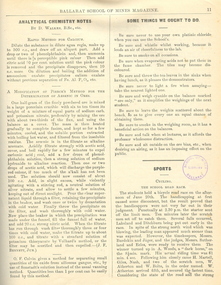
Magazine, Ballarat School of Mines Students' Magazine, 1898-1901, 1898-1901
... McPherson, Boer War * Students Association * Ballarat School of Mines Melbourne Excursion to the Government Electric Lighting Station, Austral-Otis Co, Working Mens College * Ballarat School of Mines Concert in Aid of Soldiers Statue Balance Sheet * Football * Cricket Vol 3., No 8b, November 1900 * Position of the Ballarat School of Mines with Regards to Mining Education * Age Limit * Entrance Examination * Presentation t0 Professor Alfred Mica Smith * Image of a Group of Old Ballarat School of Mines Students in Coolgardie and Kalgoorlie. * Students Association Vol 4., No 1, March 1901 * Espirit De Corps * A few Notes on the Testing of Explosives * Round About Inverell, NSW by F. and J. ...McPherson, Boer War * Students Association * Ballarat School of Mines Melbourne Excursion to the Government Electric Lighting Station, Austral-Otis Co, Working Mens College * Ballarat School of Mines Concert in Aid of Soldiers Statue Balance Sheet * Football * Cricket Vol 3., No 8b, November 1900 * Position of the Ballarat School of Mines with Regards to Mining Education * Age Limit * Entrance Examination * Presentation t0 Professor Alfred Mica Smith * Image of a Group of Old Ballarat School of Mines Students in Coolgardie and Kalgoorlie. * Students Association Vol 4., No 1, March 1901 * Espirit De Corps * A few Notes on the Testing of Explosives * Round About Inverell, NSW by F. and J. ...Bound copies of the Ballarat School of Mines Students' Magazine, 1898-1901 Vol 1, No. 1, September 1898 * News and Notes (Ballarat School of Mines Museum, J.F. Usher, New British Pharmacopoeia, excursion to Bendigo) * History of the Ballarat School of Mines * Current Topics (Federation, Gladstone, Anglo-American Alliance) * Of Custom * Discovery of Coolgardie * Mining Notes(Clunes, Pitfield, Birthday Mine, Western Australia, Transvaal, Mt Bischoff, Rand Drill Co.) * From the Journals * The Societies - (Student Association, Ballarat Field Club and Science Society, Ballarat Photographic Club) * Original Poetry * Sports * Students' Association Committee Meetings * On the Increase of Temperature of the Earth With Increased Depth Vol 1, No. 2, October 1898 * Notes about some of the Past Students (E.M. Weston, J.A. Porter, H.R. Sleeman, G.E. Sander, B.C.T. Solley, T. Rhys, C. Burbury, D. McDougal, J. Matsen) * Excursion to Daylesford, p.3 * History of the Ballarat School of Mines (continued) * The Soudan * Greater Melbourne * Image of J. Hopkinson, electrical engineer killed ascending the Alps * What is Science * Mining Notes (Pitfield Plains, Victoria United G.M.Co., Lithgow, Avoca, great Cobar, Mt Whycheproof) * Student's Association (women's franchise) * Sports Vol 2, No. 1, March 1899 * News and Notes * History of the Ballarat School of Mines (continued) * Notes of Victorian Geology, 1. Granites, by Thomas S. Hart * Sir William Crookes * Summaries and Notes from the Mining Journals * Students' Association * Sports * The Bush Assayer * Solubility of Gold-Silver Alloys in Potassium Cyanide * Correspondence Vol 2, No. 2, April 1899 * News and Notes (Smythesdale Excursion, New Buildings, A.S. Coyte, R.J. Allan) * History of the Ballarat School of Mines (Continued) * The New Students (J. Owen, A. Clayton Morrisby, A.S. Atkin, J. Alexander Reid, Alfred G. Johnston, L. Lowe, F.H. Dalton, W.M. Robertson, A. Hacke, H.L. Giles, W. Martin, E. Walshe, H.L. Krause, R. Sawyer) * Berringa by Oh'E Jay * Summaries and Notes from the Mining Journals * Mount Magnet to Victoria - A Long Bicycle Trip * 1898 Examination returns * Sports Vol 2, No. 3, May 1899 * Technical Education and the Proposed Affiliation of the Schools of Mines with the Melbourne University. * Laying of the Foundation Stone of the New Classrooms (now Administration Building). Alexander J. Peacock * News and Notes (Past Students - A.S. Lilburn, J.W. Sutherland, J. Richardson, E. Prendergast, J. Wallace, J. Kidd, J. Lake, Mathew Thompson), Coolgardie Exhibition. * Trip to Lal Lal * Students' Association * Summaries and Notes from the Mining Journals * Professor Henry Louis on Mining Education * Corrections Used in Chaining by C.W. Adams * The Black Horse Cyanide Plant * Sports * Completed List of 1898 Examinations Vol 2, No. 4, June 1899 * News and Notes * The Education Problem by D.N. McLean * A Few Hints on Histological Technique by Emil Gutheil * Summaries and Notes from the Mining Journals * Students' Association * A Visit to the Skipton Caves (Mount Widdern, Ormand Hill, volcano, Emu Creek, Mount Kinross, Mount Elephant, Mount Vite Vite, Mount Kinross, Mount Hamiston) * Mount Magnet To Victoria (cont) * The New Engines at the Ballarat Woollen Mills - includes image of the Compound 700 H.P. Engines constructed for the Ballarat Woollen Mills by Austral Otis Company and consulting engineers Monash and Anderson. * Sports * Original Poetry * Correspondence Vol 2, No. 5, July 1899 * News and Notes (E. Byron Moore, Visit to Britannia Gold Mine, J. Bryant, Visit to Last Chance Mine) * A Few Hints on Histological Technique (cont) by Emil Gutheil * Summaries and Notes from the Mining Journals * Professor Alfred Mica Smith (includes image) * Notes on Victorian Geology Part 2 The Trappean Rocks, by Thomas Hart * Origin of Diamonds * Hydraulic Mining by A.E.C. Kerr * Volcanoes by F.G. Bonney * Analytical Chemistry Notes by Daniel Walker * Some Things Out To Do * Sports * Correspondence Vol 2, No. 6, August 1899 *Summaries and notes from the Mining Journals * Some Regulations of the Academy of Mines at Freiberg * A visit to Mt Lyell Smelters * Professor Gilbert J. Dawbarn (includes image) * Air compressor and Transmission of Power by Compressed air by A.E.C. Kerr * Chemistry Notes by Daniel Walker * Mineralogical Notes, Ballarat by Thomas S. Hart * Kalgurli Gold Mines, W.A. * OUr New Lab Vol 2., No 7, September 1899 * Summaries and Notes from the Mining Journals * Some recent Steam Plants at Bendigo by Gilbert Dawbarn * Professor Thomas Stephen Hart (includes image) * Students Association * Notes on Victorian Geology by Thomas Hart * Centrifugal Pumps * A New Chum's Experience by E.M. Weston Vol 2., No 8, October 1899 * The institute of Chemistry Examinations * A New Method of Qualitative Chemical Analysis by Emil Gutheil * Steam Engine Valves and Valve-Gears by Gilbert Dawbarn * Daniel Walker (includes image) * Notes on Victorian Geology by Thomas Hart * Cyaniding Cripple Creek Tellurides (Metallic Extraction Company) * Notes on Two Ballarat Gravel Pumping Plants, G.A. Wilberforce (Eureka Jennings Co and Yarrowee Sluicing Co) * History of the School of Mines (concluded) Vol 3., No 1, March 1900 * A Journey from Natal to Mashomaland with the British Police * A Plea for Research * New Caledonia by C.A.M. Deane * Notes of Victorian Geology - Lower Palaeoroic Rocks by Thomas Hart * Mt Bischoff Mine and Mill * Summaries and Notes from the Mining Journals * Things we Eat and Drink * Farewell to A.S. Coyte Vol 3., No 1, March 1900 * Mining Education * Model Locomotive made by the apprentices of the Phoenix Foundry, p2 * Glimpses of Rhodesian Police Camp Life * New Caledonia (continued) * Summaries from the Mining and Engineering Journals * Boot and Saddle Vol 3., No 3, May 1900 * A Students' Common Room * Geological Excursion to Hardie's Hill * Notes on Victorian Geology by Thomas Hart * The Planet Venus by John Brittain * Summaries and Notes from the Australian Mining Standard * The Assay Ton * Zeehan Smelters * Electrical Notes by Ohe Jay * Trop of the Cricket Club to Stawell * Students' Association * Solid Hydrogen Vol 3., No 4, June 1900 * The Minister of Mines on Mining Education (Minister A.R. Outtrim) * Lal Lal Geology Trip (Thomas Hart) * Rifle Club now defunct, pg 3 * A Contribution to the Mining Geology of Kalgoorlie, W.A. by Ferdinand Krause (includes cross sections) (Wood's Point, Rand, Johannesburg, South Africa, Gaffney's Creek, Walhalla, Shady Creek, Sago Hill at Cardigan, Bunbury) * Summaries and Notes from the Australian Mining Standard (Buninyong Estate Mine) * Monthly Progress Reports of the Geological Survey * Electrical Notes by John M Sutherland (Telagraphone, phonograph, telephone receiver) * Students' Theatre Party (Gordon Todd, Ohe Jaeger, C.S. Wakley) * Opening of the New Buildings - Ministerial Speeches (Outtrim, W.H. Irvine, New Mining Laboratory, Old Chemistry Building, Battery, Model Mine) * Students' Association * Relief of Mafeking * A Critic Criticised * Things We Eat and Drink by Ohe Jay - Oatmeal, Coffee and Cocoa. Vol 3., No 5, July 1900 * Research * Adelaide Varsity Students at Ballarat * The Manchester-Liverpool Mono Railway * Students Association * *A Contribution to the Mining Geology of Kalgoorlie, W.A. by Ferdinand Krause (continued) (includes cross-sections) * Motive Power, address by Charles A. Parsons * Summaries and Notes from the Australian Mining Standard * Sugar Manufacturing by Sugna * Great Creswick Hydraulic Sluicing Plant (THomas Hart, Ballarat School of Mines Mining Class visit) * Reminiscences of a Students Life in Germany * Football - Ballarat School of Mines v Geelong Grammar School (Australian Rules Football) Vol 3., No 6, August 1900 * Cheap Mine Management * Library * Bendigo School of Mines, pg 3 * Notes on Ore Dressing by T, Vincent, Manager The Zeehan (Tas) Silver-Lead Mines Ltd) * Motive Power * Notes on Broken Hill - Its Mines and Minerals by J. Williams * The Concert * Summaries and Notes from the Australian Mining Standard * The Dandy Duke's Dreadful Demise * The Road Race Vol 3., No 7, September 1900 * Michaelmas Excursion (Melbourne University, Prof Kernot, Applied Mechanics) * Injury to School Property * Return of E. Ditchburn (Boer War) * Mt William Gold-Field visit, pg 3 * The Stoping of Wide Lodes by J.V. Lake (includes cross sections) * Summaries of Notes from the Australian Mining Standard * Notes on Broken Hill Part 2- Its Mines and Minerals by W.J. Williams * Motive Power from the Waves * Electrical Notes * Some Account of Italian Mining (Sarinia, Sicily, Peidmont, Lombardia) by Candido Maglione * Students Association * Should Women Have the Vote by Frank Bessemeres * The School Theatre Parly * Past Students * Poetry * Football * Surveying Rules Vol 3., No 8, October 1900 * Ballarat School of Mines Associateship * An Engineering Laboratory * Students' Practical Work * Notes on Broken Hill Part 3 by W.J. Williams * The Lake View Consols by F.S. Earp - Battery Treatment of Sulpo-Telluride Ore * Neglected Mineral Fields - Eurowie and Warrata * A Glimpse Ahead * News and Notes * A.W. G. McPherson, Boer War * Students Association * Ballarat School of Mines Melbourne Excursion to the Government Electric Lighting Station, Austral-Otis Co, Working Mens College * Ballarat School of Mines Concert in Aid of Soldiers Statue Balance Sheet * Football * Cricket Vol 3., No 8b, November 1900 * Position of the Ballarat School of Mines with Regards to Mining Education * Age Limit * Entrance Examination * Presentation t0 Professor Alfred Mica Smith * Image of a Group of Old Ballarat School of Mines Students in Coolgardie and Kalgoorlie. * Students Association Vol 4., No 1, March 1901 * Espirit De Corps * A few Notes on the Testing of Explosives * Round About Inverell, NSW by F. and J. Mawl * On the Choice of Drawing Instruments * Summaries and Notes From the Technical Journals * Annual Examinations 1900 * New Students * Sporting Notes * The Vale of Coolgardie Mine, Bonnievale, W.A. by G. Stephen Hart * News and Notes (Kerr Grant, C.L. Nash, R. Gordon Todd, Vial) * Editorial Notices Vol 4., No 2, Second Term 1901 * The Metallurgical Treatment of Sulpho-Telluride Ores by L.W. Grayson * Some Metallurgical Difficulties of Aluminium * Diehl's Sulphide Process by A.E. C. Kerr * A Californian Gold Mine by A.E. C. Kerr * New Express Locomotives for the Victorian Government (Phoenix Foundry) * An Excursion to Geelong (Electric Light and Traction Company of Australia) * The Linkenback Table for our New Mining Laboratory (Humboldt Company of Colgne) * Death of Thomas Bath * The Late Alfred G. Johnson (Boer War) * An Introduction to Natural Science by Emil Gutheil * The First Annual School Sports Meeting * Concert in Aid of Magazine Funds * The Men That Made the Concert (C.E. Denniston, W.H. Chandler, Mr White, William Litte Jnr, Marriott, Giles McCracken) * Sports * News and Notes Vol 4., No 2, Third Term 1901 * Bagging-Up - A Sketch * Concentration of Difficult Silver-Lead Ores * Estimation of Chlorine, Bromine and Iodine by D. Runting * Summaries of Notes from teh technical Journals * Notes on the Use and Care of Platinum Ware Common Sense * The Machinery at the Tasmania Gold Mine, Beaconsfield, Tasmania * Mining at Walhalla - The Long Tunnel Mine * Past Students * Mapping our of Agricultural Areas, etc, In Dense Vine Lands, North Queensland by R.A. Suter * News and Notes * Concert Balance Sheet e.m. weston, robert brough smyth, mcdougall, bruce, charles burbury, harrie wood, graham j. hopwood, emil gutheil, daniel walker, thomas hart, thomas stephen hart, m. hacker, schnitzler, f.a., ditchfield, l.h, alfred e.c. kerr, charles harvey, campbell, joseph bryant, campbell & ferguson, gilbert j. dawburn, irving, g.b., kerr, a.e.c., john walter sutherland, william robertson, herbert l. krause, alfred mica smith, binh pham, crosbie, d. jack, ditchburn, j., james hiscock, alfred johnston, reid, j.a., kidd, john, james bonwick, james, j.p, overall, d, e.h salmon, gaynor marquand, williams, w.w., williams, william, deane, c.m., vincent, tom, phillips, g.e., hart, d.w., jarnail suingh, rowlands, e., ferdinand m. krause,, easterby, f.l, parsons, r.g., partington, j.r., vial, s.b., meadows, h, atkins, arthur, john braisted burdekin, w.h. corbould, ditchburn, john, hill, john, otto e. jager, mcpherson, g.t, nicholls, c, thom, j.m., crafter, stewart, john brittain, peter lalor, hardy - commissioner, thomas bath, alf johnston, charles campbell, nash, llewellyn, watson, m.a, gardener, eddie, adamson, s.g, alford, l.c, allen, r.j, arthur, d.w.b., burge, a., willia, cairncross, cooper, i, maurice osric copland, maurice copland, dickinson, s., doepel, dunstan, john, loveday dunstan, eeles, terri, flegeltaub, israel, fletcher, a, fyrar, peter, kerr grant, w.kerr, green, gary, betty harris, harris, c.m., hay, a.l., hearn, hill, martin, james, david, johnston, alfred g, kilner, marion, kingston, thomas, lewin, f.c.k., lilburne, arthur m, linahan, colin, macready, w.h, major birlefco, markwald, henry, mccaffrey, mcfarlane, kaye, mciver, s.k, mellins, b, morton, felicity, w. kenneth moss, ken moss, nash, c.w., nash, neville, nickolls, berkeley, osborne, percy, philp, e., playford, william, reid, e, roberts, gordon, ross, f.c., royce, phillip, sawyer, basil, stewart, r.c., todhunter, i, vaisey, a., vincent, john, vinden, sue, wakley, cecil, watt, james, westcott, lewis, charles w. whyte,, vial, s browning, ballarat school of mines students in coolgardie and kalgoorlie, coolgardie, kalgoorlie, claude maitland, a.l. hay, a.s. lilburne, latham watson, arthur kildahl, thomas copeland, f.a. moss, w.a. hearman, cardoc james, alexander fraser, e.o. watt, g.m. roberts, j.j. dunstan, h.v. moss, j.a. hill,, john dunstan, c.m. harris, william h. corbould, j.w. sutherland, ballarat photographic club, ballarat field naturalists club, ballarat field club and science society, photography, geology, excursions, last chance mine, tasmania gold mine, beaconsfield, tasmania, rand, south africa, mount lyell, ballarat school of mines student excursion to mount lyell, h.l. krause, ferdinand krause, krause, hardie's hill, hardie's hill excursion, lal lal, lal lal excursion, lal lal geology excursion, smythesdale, smythesdale excursion, soudan, south african miners, south star mines, wynne and tregurtha battery, ananconda copper mining, arizona copper mining, boiler plates, british guinea, butte copper smelter, daylesford geology camp, daylesford excursion, diehl process, electric power house ballarat, electric pumps, geelong rope factory, gympie, golden horseshoe estate, c johnstone, jack nichol, c. macgennis, alec saunders, alfred g. johnstone, graeme jolly, william purdie, john mann, maxwell l gaunt, sale school of mines, freiberg school of mines, schools of mines, railway locomotive -
 Blackburn Cricket Club
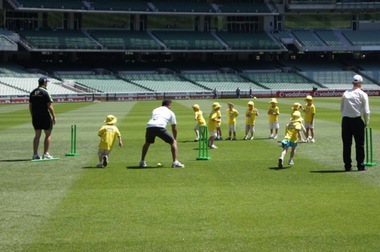
Milo Cricket Session at MCG Chirstmas Eve 2010
... Blackburn Cricket Club Milo in2 Cricket conducted a session on the MCG alongside the Australian test side prior to the boxing day test. 50 of Blackburn's youngest walked onto the hallowed turf of the world famous ground with a number of the Milo Coaches including Reggie Kunst and Dwayne Rabel. ...Phillip Hughes was making a comeback and trying to save his test career and Victorian Michael Beer would later that series make his test debut. Milo Cricket Session at MCG Chirstmas Eve 2010 ...Blackburn Cricket Club Milo in2 Cricket conducted a session on the MCG alongside the Australian test side prior to the boxing day test. 50 of Blackburn's youngest walked onto the hallowed turf of the world famous ground with a number of the Milo Coaches including Reggie Kunst and Dwayne Rabel. The kids then had an opportunity the meet two Australian Players. Phillip Hughes was making a comeback and trying to save his test career and Victorian Michael Beer would later that series make his test debut. -
 Blackburn Cricket Club
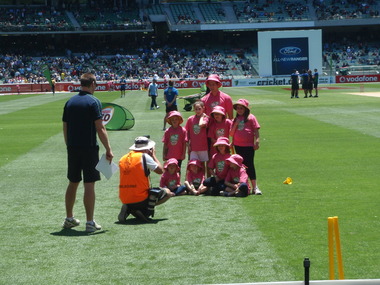
Young Women of Blackburn Cricket Club support female cricket at the MCG, Milo girls from Blackburn CC
... On 27 December 2011 the girls from Blackburn Milo in2 Cricket were selected to take the field in a girls only lunch time Milo cricket session on the second day of the Boxing Day Test at the MCG. ...On 27 December 2011 the girls from Blackburn Milo in2 Cricket were selected to take the field in a girls only lunch time Milo cricket session on the second day of the Boxing Day Test at the MCG. ...On 27 December 2011 the girls from Blackburn Milo in2 Cricket were selected to take the field in a girls only lunch time Milo cricket session on the second day of the Boxing Day Test at the MCG. The Girls were presented with pink tops in keeping with the Jane McGrath breast cancer awareness campaign. -
 Blackburn Cricket Club
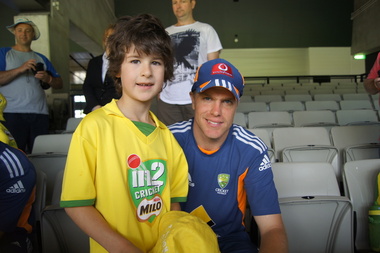
Sam Montgomery meets Michael Beer at MCG
... On 24 December 2010 Sam Montgomery was one of the Blackburn Milo in2 Cricket kids fortunate enough to meet Michael Beer. Michael is a Victorian spin bowler who went on to play his first test match for Australia in Perth during the 2010-11 series....On 24 December 2010 Sam Montgomery was one of the Blackburn Milo in2 Cricket kids fortunate enough to meet Michael Beer. Michael is a Victorian spin bowler who went on to play his first test match for Australia in Perth during the 2010-11 series. ...On 24 December 2010 Sam Montgomery was one of the Blackburn Milo in2 Cricket kids fortunate enough to meet Michael Beer. Michael is a Victorian spin bowler who went on to play his first test match for Australia in Perth during the 2010-11 series. -
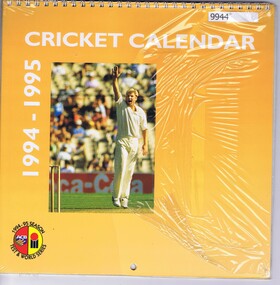 Greensborough Historical Society
Booklet - Calendar, 1994 - 1995 Cricket Calendar, 1994
... 1994 - 1995 Cricket Calendar with photos of cricketers: also has test and World Series fixture...1994 - 1995 Cricket Calendar with photos of cricketers: also has test and World Series fixture cricket calendars 12 month Calendar with Coloured photos, black, blue, red, pink and purple text with yellow border 1994 - 1995 Cricket Calendar Booklet Calendar ...1994 - 1995 Cricket Calendar with photos of cricketers: also has test and World Series fixture12 month Calendar with Coloured photos, black, blue, red, pink and purple text with yellow bordercricket, calendars
