
Showing 292 items matching "textile processing"
-
 National Wool Museum
Book, Geelong Textiles
... Geelong Manufacturing Council: Geelong Textile Network...Wool Processing...Lists Geelong based textile processing and manufacturing industries....Lists Geelong based textile processing and manufacturing industries. Wool Processing Textile Industry Geelong Manufacturing Council: Geelong Textile Network Wool Processing Textile Industry Geelong Textiles Book ..."Geelong Textiles: directory of capability, products and services" Geelong Textile Network, 2001. Lists Geelong based textile processing and manufacturing industries.wool processing textile industry, geelong manufacturing council: geelong textile network, wool processing, textile industry -
 National Wool Museum
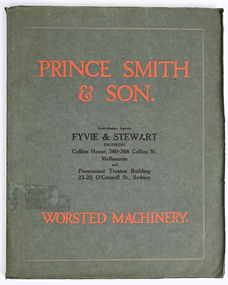
Archive - Prince Smith & Son, Worsted Machinery Catalogue, Prince Smith & Sons, Burlington Shed, Keighley, 1910-1922
... ...Textile Processing...He produced spinning frames known as throstles and in the early 19th century was producing high-quality machinery for processing textiles. His son, Prince Smith, took over the business and in 1869 he bought the Burlington Shed works from Samuel Cunliffe Lister and renamed the company Prince Smith & Son. ...He produced spinning frames known as throstles and in the early 19th century was producing high-quality machinery for processing textiles. His son, Prince Smith, took over the business and in 1869 he bought the Burlington Shed works from Samuel Cunliffe Lister and renamed the company Prince Smith & Son. ...Catalogue of machinery made by Prince Smith & Son of Burlington Shed, Keighley, England. The company was founded by William Smith in 1795. He produced spinning frames known as throstles and in the early 19th century was producing high-quality machinery for processing textiles. His son, Prince Smith, took over the business and in 1869 he bought the Burlington Shed works from Samuel Cunliffe Lister and renamed the company Prince Smith & Son. The organisation had reputation for machines of the highest quality. A letter in the front of this catalogue shows that it was sent to the Collins Bros. Mill in Geelong in 1922 for their consideration.Sixty two page book featuring black and white illustrations of worsted machinery, with text. Front cover is green with black and red embossed text. A letter with typed printed text addressed to Marcus Collins Esq. is sitting inside the front cover.PRINCE SMITH / & SON. / Australian Agents: / FYVIE & STEWART / ENGINEERS / Collins House, 360-366 Colling St. / Melbourne / and / Permanent Trustee Building / 23-25 O’Connell St., Sydney / WORSTED MACHINERY.prince smith & son, burlington shed, keighley, england, textile machinery, textile processing, collins bros mill pty ltd, catalogue, sales -
 National Wool Museum
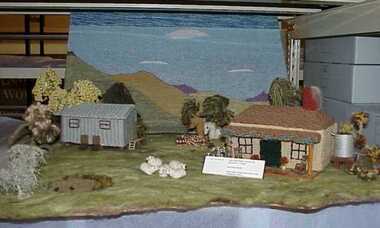
Model
... Model farm made using various textile processes by the Geelong Handweavers and Spinners Guild, 1993....Handicrafts Knitting Model farm made using various textile processes by the Geelong Handweavers and Spinners Guild, 1993. ...Model farm made by the Geelong Handweavers and Spinners Guild Inc. Entered in the 1993 Weekly Times Melbourne Sheep and Woolcraft Show, where it won 2nd prize in the team competition - five different articles made by a team.Model farm made using various textile processes by the Geelong Handweavers and Spinners Guild, 1993.handicrafts knitting, geelong handweavers and spinners guild inc., handicrafts, knitting -
National Wool Museum
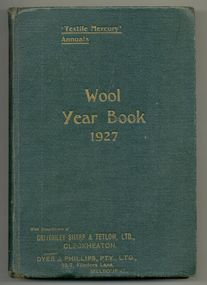
Book, Wool Year Book 1927
... Textile History Textile Finishing Wool Processing Textile Machinery Weaving...Textile History Textile Finishing Wool Processing Textile Machinery Weaving Textile Mercury Ltd Carding Spinning Machinery Weaving Machinery Textile History Textile Finishing Wool Processing Textile Machinery Weaving Wool Year Book 1927 Book ..."Wool Year Book 1927" compiled by the editor of the 'Textile Mercury'.textile history textile finishing wool processing textile machinery weaving, textile mercury ltd, carding, spinning machinery, weaving machinery, textile history, textile finishing, wool processing, textile machinery, weaving -
National Wool Museum
Book, Wool Year Book 1949
... Textile History Textile Finishing Wool Processing Textile Machinery Weaving...Textile History Textile Finishing Wool Processing Textile Machinery Weaving Textile Mercury Ltd Carding Spinning Machinery Weaving Machinery Textile History Textile Finishing Wool Processing Textile Machinery Weaving H D Radford Wool Year Book 1949 Book ..."Wool Year Book 1949" - The Textile Mercury Ltd.H D Radfordtextile history textile finishing wool processing textile machinery weaving, textile mercury ltd, carding, spinning machinery, weaving machinery, textile history, textile finishing, wool processing, textile machinery, weaving -
 National Wool Museum
Book, Wool Year Book 1927
... Textile History Textile Finishing Wool Processing Textile Machinery Weaving...Textile History Textile Finishing Wool Processing Textile Machinery Weaving Alexander Lau Pty Ltd Carding Spinning Machinery Weaving Machinery Lau Mr Alexander - Alexander Lau Pty Ltd Textile History Textile Finishing Wool Processing Textile Machinery Weaving Mr A G .[?] ..."Wool Year Book 1927" compiled by the editor of the 'Textile Mercury'.Mr A G .[?]textile history textile finishing wool processing textile machinery weaving, alexander lau pty ltd, carding, spinning machinery, weaving machinery, lau, mr alexander - alexander lau pty ltd, textile history, textile finishing, wool processing, textile machinery, weaving -
 National Wool Museum
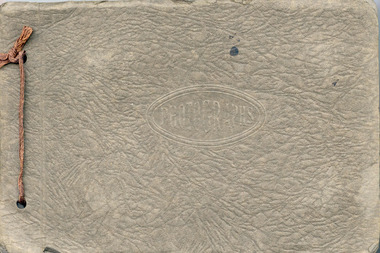
Photograph Album, The Valley Worsted Mills, Geelong
... Photograph album containing 15 photographs of the textile processes which took place at the Valley Worsted Mill which was established in 1923....Photograph album contains 15 photographic postcards of textile processes from the Valley Mill, c.1920s. ...Photograph album containing 15 photographs of the textile processes which took place at the Valley Worsted Mill which was established in 1923. ...Photograph album containing 15 photographs of the textile processes which took place at the Valley Worsted Mill which was established in 1923.Photograph album contains 15 photographic postcards of textile processes from the Valley Mill, c.1920s. Valley Mill, Geelong, c.1920s. Wool sorting at the Valley Mill, Geelong, c.1920s. Wool scouring at the Valley Mill, Geelong, c.1920s. Woollen carding at the Valley Mill, Geelong, c.1920s. Worsted carding at the Valley Mill, Geelong, c.1920s. Combing and drawing at the Valley Mill, Geelong, c.1920s. Woollen spinning at the Valley Mill, Geelong, c.1920s. Worsted spinning at the Valley Mill, Geelong, c.1920s. Winding at the Valley Mill, Geelong, c.1920s. Warping at the Valley Mill, Geelong, c.1920s. Weaving at the Valley Mill, Geelong, c.1920s. Mending at the Valley Mill, Geelong, c.1920s. Wet finishing at the Valley Mill, Geelong, c.1920s. Dry finishing at the Valley Mill, Geelong, c.1920s. Warehouse at the Valley Mill, Geelong, c.1920s.PHOTOGRAPHS THE / VALLEY WORSTED MILLS / GEELONG WOOL SORTING / WOOL SCOURING / WOOLLEN CARDING / WORSTED CARDING / COMBING & DRAWING / WOOLLEN SPINNING / WORSTED SPINNING / WINDING / WARPING / WEAVING / MENDING / WET FINISHING / DRY FINISHING / WAREHOUSE C.J. Frazer Photographer / Melbournetextile mills warehouses, weaving, textile production, textile mills, valley worsted mill, scouring, carding, combing, drawing, spinning, winding, warping, wet finishing, mending, milling, dry finishing, textile mills - warehouses -
 National Wool Museum
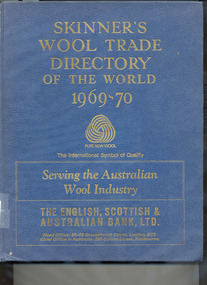
Book, Skinner's Wool Trade Directory of the World 1969-70
... Wool Processing Textile Industry Textile Production...(Publishers) Ltd, England. Wool Processing Textile Industry Textile Production Wool Processing Textile Industry Textile Production Skinner's Wool Trade Directory of the World 1969-70 Book ..."Skinner's Wool Trade Directory of the World 1969-70" - Thomas Skinner & Co. (Publishers) Ltd, England.wool processing textile industry textile production, wool processing, textile industry, textile production -
National Wool Museum
Book, Wool and the nation 3rd ed
... ...Wool Processing...Textile...Shearing Sheep breeding - history Merino sheep - history Wool - history Wool Sales Wool Processing Textile Industry - history Goldsbrough Mort and Company Limited Shearing Sheep breeding - history Merino sheep - history Wool - history Wool Sales Wool Processing Textile Industry - history Wool and the nation 3rd ed Book ..."Wool and the nation 3rd ed, 1960" , gives an overview of all facets of the "Wool" industry.shearing sheep breeding - history merino sheep - history wool - history wool sales wool processing textile industry - history, goldsbrough, mort and company limited, shearing, sheep breeding - history, merino sheep - history, wool - history, wool sales, wool processing, textile industry - history -
National Wool Museum
Book, Wool Technologies - present and future
... Textile Production Wool Processing...Paper presented at the 7th Quinquennial Wool Textile Research Conference, Tokyo. Looks at all stages of current (1985) wool processing activities and anticipates possible future directions....Textile Production Wool Processing CSIRO Division of Textile Technology Textile Production Wool Processing Wool Technologies - present and future Book ..."Wool Technologies - present and future" - D.S. Taylor, CSIRO Division of Textile Technology, 1985. Paper presented at the 7th Quinquennial Wool Textile Research Conference, Tokyo. Looks at all stages of current (1985) wool processing activities and anticipates possible future directions.textile production wool processing, csiro division of textile technology, textile production, wool processing -
National Wool Museum
Book, Recent Developments in Wool and Wool Blend Processing
... Textile Finishing Wool Processing..."Recent Developments in Wool and Wool Blend Processing" CSIRO Division of Textile Industry, 1983...."Recent Developments in Wool and Wool Blend Processing" CSIRO Division of Textile Industry, 1983. Textile Finishing Wool Processing CSIRO Division of Textile Industry Dyeing Spinning Textile Finishing Wool Processing Recent Developments in Wool and Wool Blend Processing Book ..."Recent Developments in Wool and Wool Blend Processing" CSIRO Division of Textile Industry, 1983.textile finishing wool processing, csiro division of textile industry, dyeing, spinning, textile finishing, wool processing -
National Wool Museum
Book, Proceedings: 5th International Wool Textile Research Conference vol. I, 1975
... ...Wool Processing...Textile..."Proceedings: 5th International Wool Textile Research Conference, vol. I" Sept. 1975. Wool - chemistry Knitting Wool Processing Textile Finishing Deutsches Wollforschungsinstitut an der Technischen Hochschule Aachen e.V. ..."Proceedings: 5th International Wool Textile Research Conference, vol. I" Sept. 1975.wool - chemistry knitting wool processing textile finishing, deutsches wollforschungsinstitut an der technischen hochschule aachen e.v., dyeing, wool - chemistry, knitting, wool processing, textile finishing -
 National Wool Museum
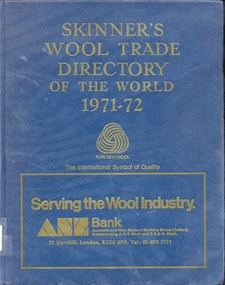
Book, Skinner's Wool Trade Directory of the World 1971-1972
... ...Textile Production...Wool Processing..."Skinner's wool trade directory of the world 1971-1972" Wool Brokering Textile Industry Textile Production Wool Processing Wool Brokering Textile Industry Textile Production Wool Processing Skinner's Wool Trade Directory of the World 1971-1972 Book ..."Skinner's wool trade directory of the world 1971-1972"wool brokering textile industry textile production wool processing, wool brokering, textile industry, textile production, wool processing -
National Wool Museum
Book, CSIRO Wool Technology
... Wool Processing Textile Finishing...Glossy brochure promoting the work done by the Division of Wool Technology at CSIRO in Geelong. Wool Processing Textile Finishing CSIRO Division of Wool Technology Wool Processing Textile Finishing CSIRO Wool Technology Book ..."CSIRO Wool Technology" c.1990. Glossy brochure promoting the work done by the Division of Wool Technology at CSIRO in Geelong.wool processing textile finishing, csiro division of wool technology, wool processing, textile finishing -
National Wool Museum
Book, CSIRO Wool Technology: research for a great Australian industry
... Wool Processing Textile Finishing...It provides an overview of its history and explains some of the breakthroughs made by the division. Wool Processing Textile Finishing CSIRO Division of Wool Technology Wool Processing Textile Finishing CSIRO Wool Technology: research for a great Australian industry Book ..."CSIRO Wool Technology: research for a great Australian industry", 1992. Brochure promoting the work done by the Division of Wool Technology at CSIRO in Geelong. It provides an overview of its history and explains some of the breakthroughs made by the division.wool processing textile finishing, csiro division of wool technology, wool processing, textile finishing -
 National Wool Museum
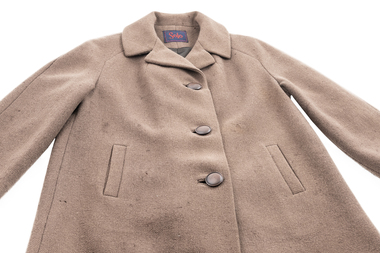
Coat, Lindsay and McKenzie, The Fleece That Would Not Die, 1968
... ...wool processing...textile...A video giving the history of the coat and a text panel used by Elders were also donated at the same time. fashion wool - characteristics wool processing textile mills textile mills lindsay and mckenzie elders limited gordon technical college royal adelaide show - exhibition (31/08/2001 - 08/09/2001) groves mr mal groves mrs dutchman station south australia fashion wool - characteristics wool processing textile mills Wording: Solo;Method: Embroidered;Location: Label at base of collar, inside coat Wording: PURE WOOL;Method: Printed;Location: Label on side seam, inside coat Coat, brown wool. ...This coat was produced from wool first shorn in c.1928. In 1928 Mr Mal Groves took over the Dutchman Station near Port Augusta in South Australia. Whilst out riding in some rough country he came across a sheep that had been left by the previous owner of the station. As he carried shears with him, he sheared the sheep and left the fleece rolled up and partially covered by rocks and wood, as he had no bag to carry it back with him. He intended to come back for the fleece, but forgot about it until he came across it some forty years later. It was still in good condition (despite having experienced extreme temperatures and rainfall whilst in the open), so he showed it to Elders who arranged to display it at agricultural shows in Adelaide, Melbourne and Geelong. The Gordon Institute of Technology, Geelong, offered to spin the fleece into a fabric and make a coat for Mrs Groves. The fabric was tailored into a coat by Lindsay and McKenzie of Geelong and presented to Mrs Groves in July 1968 by the South Australian manager of Elder Smith Goldsbrough Mort Ltd. It is not know how the coat came to Elders from the Groves family, but Elders displayed the coat under the heading "The Fleece That Would Not Die" before donating it to the National Wool Museum in 1997. A video giving the history of the coat and a text panel used by Elders were also donated at the same time.Coat, brown wool. Long sleeves, knee length with three circular brown buttons and two external pockets. Lined in brown satin, with a blue and red label at the base of the collar.Wording: Solo;Method: Embroidered;Location: Label at base of collar, inside coat Wording: PURE WOOL;Method: Printed;Location: Label on side seam, inside coatfashion wool - characteristics wool processing textile mills textile mills, lindsay and mckenzie elders limited gordon technical college, royal adelaide show - exhibition (31/08/2001 - 08/09/2001), groves, mr mal groves, mrs, dutchman station, south australia, fashion, wool - characteristics, wool processing, textile mills -
 National Wool Museum
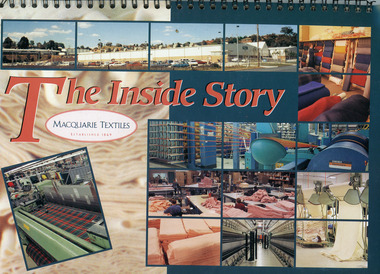
Booklet - Binder, The Inside Story, 1995
... textile...wool processing...The information is dated to 1995 and makes for interesting reading into the past, especially the information in regards to computers and how they were begin to be introduced into the work place. macquarie textile wool processing A4 sized binder with 8 individual pages containing information on both front and back. ...Binder begins by discussing the history of Macquarie Textiles before expanding into explaining the operations of the company and how they produce their different finished worsted and woollen textiles. The information is dated to 1995 and makes for interesting reading into the past, especially the information in regards to computers and how they were begin to be introduced into the work place.A4 sized binder with 8 individual pages containing information on both front and back. Coloured ink with attached samples make up the contents of these pages. All pages have the same image of wool in the backgroundmacquarie textile, wool processing -
National Wool Museum
Journal, Wool Record
... Wool Processing Wool Marketing Textile Fibres Textile Industry Textile Production...Wool Processing...Wool Processing Wool Marketing Textile Fibres Textile Industry Textile Production Wool Processing Wool Marketing Textile Fibres Textile Industry Textile Production Wool Record Journal ..."Wool Record" Vol. 100, No. 2745, Bradford, Fri. Dec. 22, 1961.wool processing wool marketing textile fibres textile industry textile production, wool processing, wool marketing, textile fibres, textile industry, textile production -
 National Wool Museum
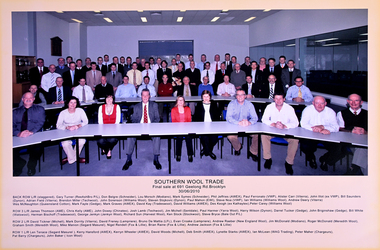
Photograph - Southern Wool Trade, Final Sale, 30 June 2010
... ...Early Wool Processing...Textile...Victorian Wool Processors Melbourne Wool Selling Centre Early Wool Processing Textile Industry Jim Kim Wool Trading Trade Sale front: [printed] SOUTHERN WOOL TRADE / Final sale at 691 Geelong Rd. ...Part of a collection of photographs previously housed at Victorian Wool Processors (VWP), who were the last early stage wool processing company in Melbourne, and the second last in Victoria. The photographs were collected from other companies as they closed, and were donated to the museum by David Ritchie who was the General Manager at VWP. Victoria Wool Processors (Aust) Pty Ltd was founded by Jim Kim in 1983 as a dedicated international wool trading firm. Seeking greater quality control, the company opened its first physical processing plant in Melbourne in 1990 before scaling up to a state-of-the-art, 24-hour carbonising and scouring facility at Laverton North in 2002. For decades, it stood as one of the largest early-stage wool processing operations in the Southern Hemisphere, known for incorporating modern water-recycling and waste-management infrastructure. However, a severe domestic energy crisis and soaring natural gas prices forced the permanent closure of its manufacturing plant in December 2024, culminating in the company's official corporate liquidation in April 2026. This photo shows the final sale to take place at the Melbourne Wool Selling Centre located off Geelong Road in Brooklyn, Victoria on 30th June 2010.Colour photograph featuring a group portrait of people seated and standing inside a room.front: [printed] SOUTHERN WOOL TRADE / Final sale at 691 Geelong Rd. Brooklyn / 30/06/2010victorian wool processors, melbourne wool selling centre, early wool processing, textile industry, jim kim, wool trading, trade, sale -
 National Wool Museum
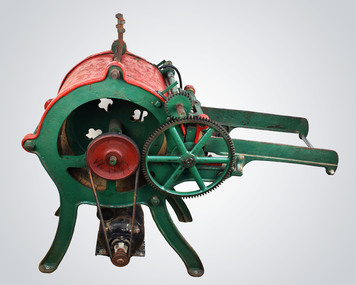
Picker
... ...Textile manufacturing...wool processing...Wool Picking Textile manufacturing wool processing Black texter. On top of drum. ...Wool picking machine designed to separate locks of wool before it is carded and spun. The picker opens the wool’s locks which makes it easier to send the fleece through a carding machine. It does this by teasing the fibres (which can also be done by hand just by pulling the lock structure apart), but a picker does this in bulk and much quicker than what can be done by hand. It is possible to spin fibres directly after the picking stage; however, it is usually more desirable to card and blend them with other fibres. Typically, at a textile mill, a picking machine can separate enough lengths of fibre for a full day’s work after just a single hour. It will also help to remove any vegetation matter or other any unwanted elements that may be present in the wool. The quality of the casting on this machine suggest that it was made locally, either in Australia or New Zealand. Mike Leggett, the donor of the machine, acquired it from New Zealand where the seller said it had been used by his father to pick wool to make hand stuffed horse saddles. Mike attempted to used it a couple of times to pick alpaca hair, but the speed of the attached motor caused damage to the fibres. The motor is thought to be an added attachment, sometime around the 1960s judging by its age, while the machine itself is thought to be dated around the 1920s. The machine works by inserting wool through the rollers. Initially there was a conveyor belt feeder system which was powered by the handle on the side. This conveyor belt has been removed however, most likely due to age and deterioration. Wool is now fed through the initial teeth and is met by a spiked rotating drum which works to separate the fibres. The separated fibres would then complete a loop of the drum before being dispatched somewhere below, around where the motor presently sits, at a rapid rate of speed. Typically this wool will be collected in a closet or large catchment area, as can be seen from the 8:47 minute marker in the linked video (link - https://www.youtube.com/watch?v=kMjx-t3tH3A). It is not apparent how the wool is collected with this machine. Red and green machine with four green legs currently attached to a wooden pallet with wheels for easy movement. The green legs lead up to a red central circular barrel from which many attachments are present. Also present on the wooden pallet is a small black motor which is attached by a rubber belt to the central drum inside the red barrel. The belt spins the wooden drum via a dark red circular plate attached to the side of the drum. On the other side of the red barrel, a green handle extends for turning the picker’s conveyor belt feeder system. Two green walls extend forward from the central red barrel, guarding either side of where the conveyor belt would have been. At the start of these walls is a wooden cylinder, which the conveyor belt would have wrapped around, followed by two interlocking gears which rotate and accept the fed wool. The red roof extends over the central cylinder from here, securing the wool inside and protecting hands from the heavily spiked internal wooden cylinder which rotates and separates (picks) the wool. Extending over the top of this red roof is a green handle which reaches to the back of the machine (not pictured). Here it accepts a weight to ensure pressure is always present for the initial feeder interlocked gear teeth. There are two large gear cogs on the rubber belt side of the machine and 3 small gear cogs on the handle side of the machine, all coloured green. A green handle is also present at the rear of the machine, below the location from which the weight is hanging. A power cable extends from the motor and there are two adjustable metal rods on the top of the machine, the purpose of these rods is presently unknown. Black texter. On top of drum. Wording: HG3707 Wording. Imprint: BRACEWIND BLYN On motor. Wording AEIwool picking, textile manufacturing, wool processing -
 National Wool Museum
Throw, 2017
... ...wool processing textile finishing...This attention to detail results in the buttery softness distinctive of the exclusive woollen range. wool merino sheep south australia wool processing wool processing textile finishing Wording: ANLABY Pure Anlaby Merino Wool Oldest merino stud on mainland Australia Made in Australia Card. ...Anlaby’s sheep are born, bred and shorn at their farm located in South Australia. The wool is then scoured at Michels in Adelaide, combed and turned into Tops at Cashmere Connections in Bacchus Marsh, and then Spun and Woven at a historic mill in Scotland named Johnstons of Elgin. Sewing is completed by artisan seamstresses and packaging is from a local Adelaide family business. Established in 1839 just North of the Barossa Valley in South Australia, Anlaby is the oldest continuing merino sheep stud on mainland Australia. Fredrick Dutton employed Alexander Buchannan to bring sheep to the buoyant market in Adelaide from Goulburn NSW. Several others speculated on possible successes, including Buchannan and a flock of 18,000 sheep were walked overland. The trek took nine months. During this time the Adelaide market prices had collapsed. Having found land with a spring of sweet water, Dutton decided to keep his flock of 5,000 stud sheep and purchased a small parcel of land that is now called Anlaby. The property prospered and Buchannan was employed as manager for the next 25 years. At its height Anlaby covered 250sq miles – 160,000 acres and employed 70 men. The first bale of wool from South Australia to be auctioned in London came from Anlaby. The Anlaby stud also provided the foundation ewes for the well-known Bungaree merino stud in 1841. With prosperity came a large house and gardens for Buchannan in 1861. Anlaby was inherited by Henry Dutton from his uncle in 1895. Squire Dutton, as he was known, continued to grow the family’s fortunes and spent his money expanding the grand home and creating a magnificent 10-acre garden. Today the Anlaby merino stud continues and both the house and garden are undergoing significant restorations. Wool continues to be one of the most important elements at Anlaby. It was the source of great wealth in the past and is now directly tied into Anlaby’s future. Anlaby makes beautiful woollen scarves, lady’s wraps, exquisite throws and small range of baby blankets. From the moment a lamb is conceived and through its entire lifecycle Anlaby look after nutrition and quality of life. Twice a year the sheep are shorn and the wool using minimal treatment is washed, combed, spun and woven into the Anlaby product range. This attention to detail results in the buttery softness distinctive of the exclusive woollen range.Throw came with packaging and information card which reads ANLABY in large capital lettering at the top and bottom of either side of card. Throw is white with green edging of 15cm on two edges. Within this edging is the sewing of a tree in white.Wording: ANLABY Pure Anlaby Merino Wool Oldest merino stud on mainland Australia Made in Australia Card. Wording: ANLABY Certificate of Authentication THIS CERTIFICATE AUTHENTICATES THE PRODUCT TO BE 100% AUSTRALIAN AND MADE FROM PURE MERINO WOOL PRODUCED EXCLUSIVELY AT THE ANLABY MERINO STUD IN SOUTH AUSTRALIA THE ANLABY FLOCK (REGISTERED NUMBER 102) IS THE OLDEST CONTINUOSLY OPERATING MERINO STUD IN MAINLAND AUSTRALIA. THE MERINO FLOCK AT ANLABY MAINTAINS A GENETIC LINE STARTED IN 1839 THIS PRODUCT IS PART OF THE LIMMITED EDITION RANGE PRODUCED AT ANLABY. IN 2014 WE CELEBRATED ANLABY’S 175TH ANNIVERSAY ANLABY Reverse. Wording: ANLABY PURE NATURAL WOOL THE SHEEP GRAZE AMONGST THE GUM TREES ON THE ROLLING HILLS OF ANLABY. ANLABY SHEEP ARE CHARACTERISTICALLY BIG BODDIED AND BRED TO FLOURISH IN THE WARM AUSTRALIAN CLIMATE. OUR WOOL IS MINIMALLY TREATED AND THE PRODUCTS ARE MADE IN SMALL RUNS UNDER THE PERSONAL SUPERVISION OF THE OWNERS. WE BELIEVE IN SUSTAINABLE AND RESPONSIBLE FARMING AND MILLING PRACTICES. THE ATTENTION TO DETAIL RESULTS IN THE BUTTERY SOFTNESS DISTINCTIVE OF THIS EXCLUSIVE WOOLLEN PRODUCT. WITH CARE THIS IS A TREASURED ITEM FOR THE NEXT GENERATION. ANLABY www.anlaby.com.auwool, merino sheep, south australia, wool processing, wool processing textile finishing -
National Wool Museum
Book, The Things We Need and Where They Come From: Wool
... Wool Processing Wool Growing Textile Production...Wool Processing...Colin Clair, c.1950 Wool Processing Wool Growing Textile Production Wool Processing Wool Growing Textile Production The Things We Need and Where They Come From: Wool Book ..."The Things We Need and Where They Come From: Wool" ed. Colin Clair, c.1950wool processing wool growing textile production, wool processing, wool growing, textile production -
 National Wool Museum
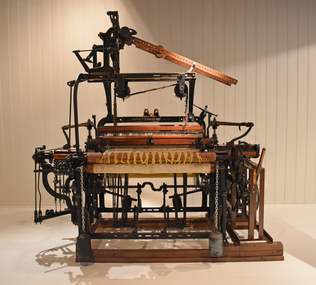
Machine - Loom, George Hattersley and Sons Ltd, 1920 - 1935
... ...Wool processing...Textile...Finally, the weft is pushed tight against the previous yarns, gradually building up the fabric. weaving george hattersley and sons ltd weaving machinery Loom Wool processing Textile Industry Hattersley dobby loom. ...Weaving is the interlacing of two yarns, one at right angles to the other. Yarns that run the length of the fabric are called the warp. Yarns that run across the fabric are called the weft. Most woven fabrics are produced on a loom. The warp yarns are raised to form an opening - the shed. The weft carrier, usually the shuttle, shoots through the shed. Then the warp yarns change position up and down. Finally, the weft is pushed tight against the previous yarns, gradually building up the fabric. Hattersley dobby loom. In working order, black painted cast iron.weaving, george hattersley and sons ltd, weaving machinery, loom, wool processing, textile industry -
 National Wool Museum
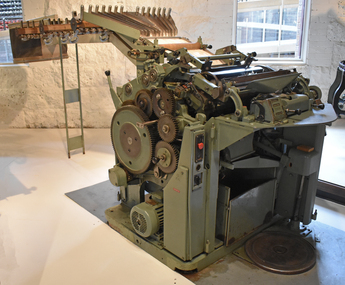
Machine - French Comb, Schlumberger & Cie, 1964
... ...Wool processing...Textile...French Comb Wool processing Textile Industry Factory Machine comb restoration fibres French comb machine. 1962 Shlumberger and Co, France Model PB 251 NO. 3953. ...Combing removes the short or broken fibres and draws out the long fibres into even strands suitable for spinning. The process is necessary to produce long and soft strands needed for worsted yarn. These machines remove the short fibres and blend the remaining long fibres together to form the top. The short fibres that are removed, known as the noil, are used in the woollen system. The long fibres are drawn together, ready for spinning. To retain as many of the valuable long fibres as possible, a skilled operator always needed to be on duty in the factory to precisely set the machine. Machine has been completely rebuilt and set up by Nick Sokolov of Comb Research and Development with the help of Bruce Hill and others. NSC Schlumberger Comb PB25L machine No 3953, year of manufacture 1964. A rectilinear version of the Noble Comb, this machine separated long and short fibres. Donated to the National Wool Museum by Port Phillip Wool Processing Pty Ltd in 1993.French comb machine. 1962 Shlumberger and Co, France Model PB 251 NO. 3953.french comb, wool processing, textile industry, factory, machine, comb, restoration, fibres -
 National Wool Museum
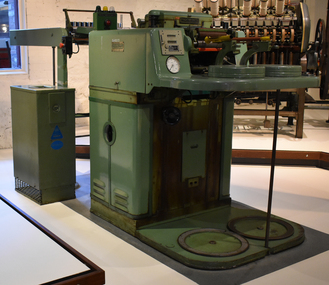
Machine - Gill Box, Deutscher Spinnereimaschinenbau Ingolstadt, 1963
... ...Textile Industry...Wool Processing...Mitchell & Son, Adelaide have celebrated 125 Years of involvement with the Australian Wool Processing Industry by contributing the funds necessary to restore The Carding Machine, Noble Comb & The Gill Box. deutscher spinnereimaschinenbau ingolstadt gilling Gill Box Textile Industry Wool Processing Factory Machine Mills Spinning Fibre Comb Deutscher / Spinnereimaschinenbau / Ingolstadt / 1963 Gill box. ...This machine uses a series of combs attached to bars that move with increasing speed away from a starting point. This draws-out and aligns the wool fibres to produce a gilled top. The gilling process is also used in other positions along the worsted production line. A gill box draws and combs the fibres prior to spinning. Gold plaque on display with machine until 2018 read: G.H. Mitchell & Son, Adelaide have celebrated 125 Years of involvement with the Australian Wool Processing Industry by contributing the funds necessary to restore The Carding Machine, Noble Comb & The Gill Box.Gill box. Green painted steel.Deutscher / Spinnereimaschinenbau / Ingolstadt / 1963deutscher spinnereimaschinenbau ingolstadt, gilling, gill box, textile industry, wool processing, factory, machine, mills, spinning, fibre, comb -
 National Wool Museum
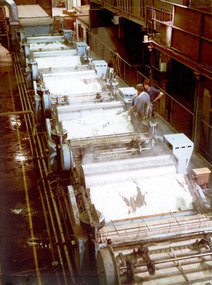
Photograph - Wool Scouring, Port Phillip Mills, Williamstown, 1984
... ...Early Wool Processing...Textile...Victorian Wool Processors Early Wool Processing Textile Industry Jim Kim Topmaking Port Phillip Topmaking Pty Ltd williamstown pressing Carding combing wool scouring Colour photograph showing industrial wool processing machinery from a high angle during the wool scouring process. ...Part of a collection of photographs previously housed at Victorian Wool Processors (VWP), who were the last early stage wool processing company in Melbourne, and the second last in Victoria. The photographs were collected from other companies as they closed, and were donated to the museum by David Ritchie who was the General Manager at VWP. Victoria Wool Processors (Aust) Pty Ltd was founded by Jim Kim in 1983 as a dedicated international wool trading firm. Seeking greater quality control, the company opened its first physical processing plant in Melbourne in 1990 before scaling up to a state-of-the-art, 24-hour carbonising and scouring facility at Laverton North in 2002. For decades, it stood as one of the largest early-stage wool processing operations in the Southern Hemisphere, known for incorporating modern water-recycling and waste-management infrastructure. However, a severe domestic energy crisis and soaring natural gas prices forced the permanent closure of its manufacturing plant in December 2024, culminating in the company's official corporate liquidation in April 2026. This photo was previously in a frame with three others taken in 1984 at the Port Phillip Mills in Williamstown. This image shows the wool scouring process.Colour photograph showing industrial wool processing machinery from a high angle during the wool scouring process. Two men are shown stading beside the machinery.victorian wool processors, early wool processing, textile industry, jim kim, topmaking, port phillip topmaking pty ltd, williamstown, pressing, carding, combing, wool scouring -
 National Wool Museum
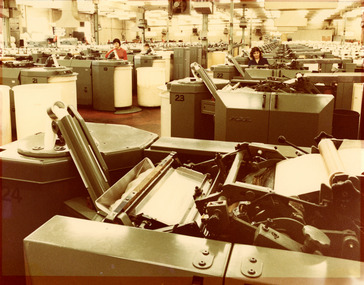
Photograph - Combing, Port Phillip Mills, Williamstown, 1984
... ...Early Wool Processing...Textile...Victorian Wool Processors Early Wool Processing Textile Industry Jim Kim Topmaking Port Phillip Topmaking Pty Ltd williamstown pressing Carding combing Colour photograph showing industrial wool processing machinery during the combing process. ...Part of a collection of photographs previously housed at Victorian Wool Processors (VWP), who were the last early stage wool processing company in Melbourne, and the second last in Victoria. The photographs were collected from other companies as they closed, and were donated to the museum by David Ritchie who was the General Manager at VWP. Victoria Wool Processors (Aust) Pty Ltd was founded by Jim Kim in 1983 as a dedicated international wool trading firm. Seeking greater quality control, the company opened its first physical processing plant in Melbourne in 1990 before scaling up to a state-of-the-art, 24-hour carbonising and scouring facility at Laverton North in 2002. For decades, it stood as one of the largest early-stage wool processing operations in the Southern Hemisphere, known for incorporating modern water-recycling and waste-management infrastructure. However, a severe domestic energy crisis and soaring natural gas prices forced the permanent closure of its manufacturing plant in December 2024, culminating in the company's official corporate liquidation in April 2026. This photo was previously in a frame with three others taken in 1984 at the Port Phillip Mills in Williamstown. This image shows the combing process.Colour photograph showing industrial wool processing machinery during the combing process. Two women are shown in the background operating machinery.victorian wool processors, early wool processing, textile industry, jim kim, topmaking, port phillip topmaking pty ltd, williamstown, pressing, carding, combing -
 National Wool Museum
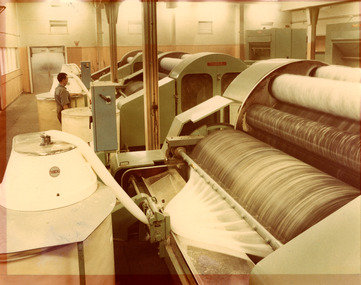
Photograph - Carding, Port Phillip Mills, Williamstown, 1984
... ...Early Wool Processing...Textile...Victorian Wool Processors Early Wool Processing Textile Industry Jim Kim Topmaking Port Phillip Topmaking Pty Ltd williamstown pressing Carding combing Colour photograph showing industrial wool processing machinery during the carding process. ...Part of a collection of photographs previously housed at Victorian Wool Processors (VWP), who were the last early stage wool processing company in Melbourne, and the second last in Victoria. The photographs were collected from other companies as they closed, and were donated to the museum by David Ritchie who was the General Manager at VWP. Victoria Wool Processors (Aust) Pty Ltd was founded by Jim Kim in 1983 as a dedicated international wool trading firm. Seeking greater quality control, the company opened its first physical processing plant in Melbourne in 1990 before scaling up to a state-of-the-art, 24-hour carbonising and scouring facility at Laverton North in 2002. For decades, it stood as one of the largest early-stage wool processing operations in the Southern Hemisphere, known for incorporating modern water-recycling and waste-management infrastructure. However, a severe domestic energy crisis and soaring natural gas prices forced the permanent closure of its manufacturing plant in December 2024, culminating in the company's official corporate liquidation in April 2026. This photo was previously in a frame with three others taken in 1984 at the Port Phillip Mills in Williamstown. This image shows the carding process.Colour photograph showing industrial wool processing machinery during the carding process. A man is shown in the background standing near machinery.victorian wool processors, early wool processing, textile industry, jim kim, topmaking, port phillip topmaking pty ltd, williamstown, pressing, carding, combing -
 National Wool Museum
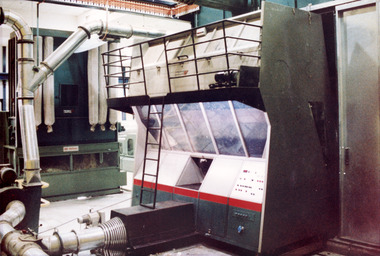
Photograph - Automatic Card Feeding, Port Phillip Topmaking, 1990
... ...Early Wool Processing...Textile...Victorian Wool Processors Early Wool Processing Textile Industry Jim Kim Topmaking Port Phillip Topmaking Pty Ltd williamstown pressing Colour photograph showing industrial wool processing machinery during the automatic card feeding process. ...Part of a collection of photographs previously housed at Victorian Wool Processors (VWP), who were the last early stage wool processing company in Melbourne, and the second last in Victoria. The photographs were collected from other companies as they closed, and were donated to the museum by David Ritchie who was the General Manager at VWP. Victoria Wool Processors (Aust) Pty Ltd was founded by Jim Kim in 1983 as a dedicated international wool trading firm. Seeking greater quality control, the company opened its first physical processing plant in Melbourne in 1990 before scaling up to a state-of-the-art, 24-hour carbonising and scouring facility at Laverton North in 2002. For decades, it stood as one of the largest early-stage wool processing operations in the Southern Hemisphere, known for incorporating modern water-recycling and waste-management infrastructure. However, a severe domestic energy crisis and soaring natural gas prices forced the permanent closure of its manufacturing plant in December 2024, culminating in the company's official corporate liquidation in April 2026. This photo was previously in a frame with three others taken in 1990 at the modernised facility in Williamstown operated by Port Phillip Topmaking Pty Ltd. This image shows the automatic card feeding process.Colour photograph showing industrial wool processing machinery during the automatic card feeding process.victorian wool processors, early wool processing, textile industry, jim kim, topmaking, port phillip topmaking pty ltd, williamstown, pressing -
 National Wool Museum
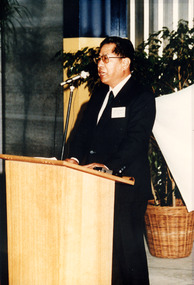
Photograph - Opening Ceremony, Port Phillip Topmaking, 18 June 1990
... ...Early Wool Processing...Textile...Victorian Wool Processors Early Wool Processing Textile Industry Jim Kim Topmaking Port Phillip Topmaking Pty Ltd williamstown Colour photograph featuring a man standing at a lectern. ...Part of a collection of photographs previously housed at Victorian Wool Processors (VWP), who were the last early stage wool processing company in Melbourne, and the second last in Victoria. The photographs were collected from other companies as they closed, and were donated to the museum by David Ritchie who was the General Manager at VWP. Victoria Wool Processors (Aust) Pty Ltd was founded by Jim Kim in 1983 as a dedicated international wool trading firm. Seeking greater quality control, the company opened its first physical processing plant in Melbourne in 1990 before scaling up to a state-of-the-art, 24-hour carbonising and scouring facility at Laverton North in 2002. For decades, it stood as one of the largest early-stage wool processing operations in the Southern Hemisphere, known for incorporating modern water-recycling and waste-management infrastructure. However, a severe domestic energy crisis and soaring natural gas prices forced the permanent closure of its manufacturing plant in December 2024, culminating in the company's official corporate liquidation in April 2026. This photo was previously in a frame with four others taken at the opening day of the modernised facility in Williamstown operated by Port Phillip Topmaking Pty Ltd on 18th June, 1990. The man depicted is M. Shiraha, Executive Managing Director, Nippon Keori Kaisha Ltd.Colour photograph featuring a man standing at a lectern.victorian wool processors, early wool processing, textile industry, jim kim, topmaking, port phillip topmaking pty ltd, williamstown
