
Showing 510 items matching "textiles - lace"
-
 Bendigo Historical Society Inc.
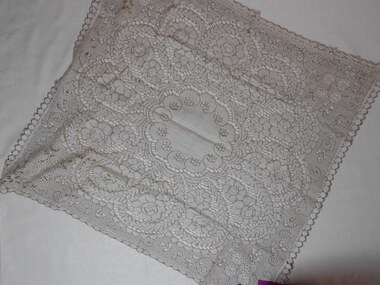
Textile - LACE TABLECLOTH
... TEXTILES...Domestic...lace...Textiles, brown cream lace tablecloth. Machine made. Large flower in centre 67 cm diameter, Floral patterns in corners and along sides. ...TEXTILES Domestic lace tablecloth Textiles, brown cream lace tablecloth. ...Textiles, brown cream lace tablecloth. Machine made. Large flower in centre 67 cm diameter, Floral patterns in corners and along sides. Two opposite sides have scalloped edges. Other two sides have straight sides.textiles, domestic, lace tablecloth -
 Kew Historical Society Inc
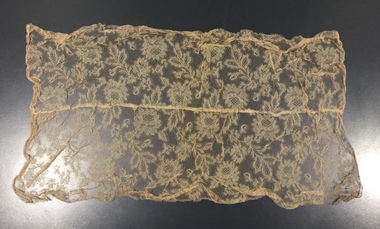
Textile, Lace
... ...textiles - lace...Lace Textile Textile ...Piece of very finely constructed coffee-coloured lace probably removed from the bodice of a dress.fashion and textiles collection - kew historical society, textiles - lace -
 Kew Historical Society Inc
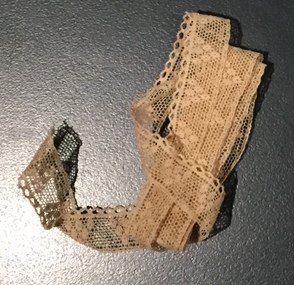
Textile, Ribbon Lace, 1900-1914
... ...textiles - lace...fashion and textiles collection - kew historical society textiles - lace Coffee coloured lace edging. Ribbon Lace Textile Textile ...Coffee coloured lace edging.fashion and textiles collection - kew historical society, textiles - lace -
 Kew Historical Society Inc
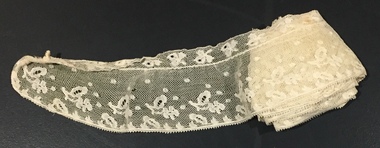
Textile, Lace
... ...textiles - lace...fashion and textiles collection - kew historical society textiles - lace Cream coloured lace edging. Lace Textile Textile ...Cream coloured lace edging.fashion and textiles collection - kew historical society, textiles - lace -
 Bendigo Historical Society Inc.
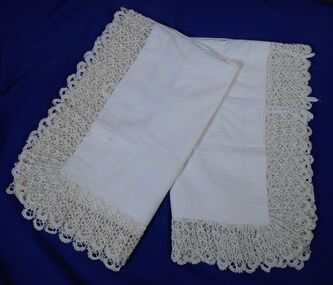
Textile - FAVALORO COLLECTION: TWO PILLOW CASES, LACE TRIMMED, Late 1800-1900's
... TEXTILES...Domestic...Two lace...Textiles. With the same lace edging as the pillowcases 11408.102, but no embroidered initial. ...TEXTILES Domestic Two lace trimmed pillow cases Textiles. ...Textiles. With the same lace edging as the pillowcases 11408.102, but no embroidered initial. These pillowcases, along with the bedspread (11408.101) complete a delightful set. Measuring 119 cm x 96 cm, the pillow slips have an envelope 48 cm x 80 cm stitched to the back, to hold the pillow. This is tied with three sets of two cotton tapes. The same corded and floral lace, 10 cm deep edges the pillowslip.textiles, domestic, two lace trimmed pillow cases -
 Bendigo Historical Society Inc.
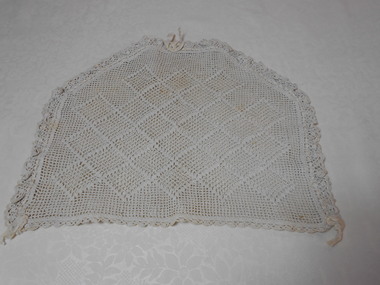
Textile - LACE TEA COSY
... TEXTILES...Domestic...lace...Textiles, cream coloured six sided lace tea cosy. Diagonal diamond pattern on front and back. ...TEXTILES Domestic lace tea cosy Textiles, cream coloured six sided lace tea cosy. ...Textiles, cream coloured six sided lace tea cosy. Diagonal diamond pattern on front and back. Edged with scalloped lace with eyelets. Ribbon threaded from each side of lower edge and tied in a bow at centre top on one side.textiles, domestic, lace tea cosy -
 Bendigo Historical Society Inc.
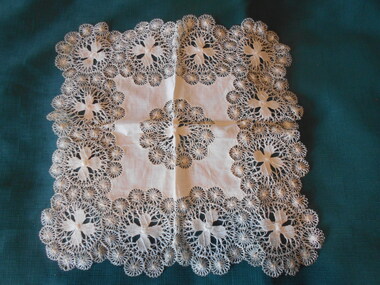
Textile - MAGGIE BARBER COLLECTION: CREAM LINEN AND LACE SQUARE DOYLEY, Early 1900's
... TEXTILES...Domestic...Lace...TEXTILES Domestic Lace Doyley Cream linen and lace square doyley Textile MAGGIE BARBER COLLECTION: CREAM LINEN AND LACE SQUARE DOYLEY ...Cream linen and lace square doyleytextiles, domestic, lace doyley -
 National Wool Museum
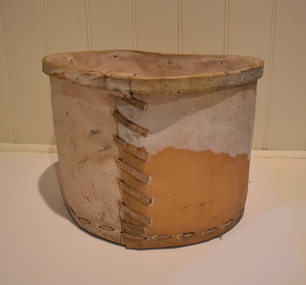
Functional object - Container
... Kidney-shaped plastic textile container with lacing on joins....Foster Valley Mills Textile Industry Loom Weaving Container Wool Kidney-shaped plastic textile container with lacing on joins. Functional object Container ...Used at Foster Valley Mills.Kidney-shaped plastic textile container with lacing on joins.foster valley mills, textile industry, loom, weaving, container, wool -
 Bendigo Historical Society Inc.
Textile - FAVALORO COLLECTION: EMBROIDERED LACE EDGED PAIR OF PILLOWCASES, Early 1900's
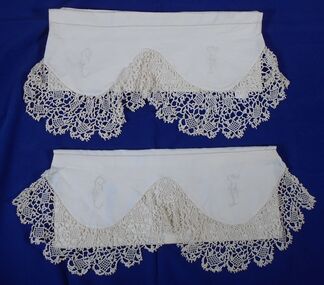
... TEXTILES...Domestic...Embroidered lace...Textiles. Very fine linen fabric, white in colour, now a soft cream colour. A spoke-stitched hem joins a curved embroidered and lace trim decorative feature to the set. ...TEXTILES Domestic Embroidered lace edged pr of pillowcases Textiles. ...Textiles. Very fine linen fabric, white in colour, now a soft cream colour. A spoke-stitched hem joins a curved embroidered and lace trim decorative feature to the set. This panel forms two deep curves, where the initials CF are embroidered, and decorated with small daisy-like flowers and leaves. A 10 cm deep crochet frill is gathered and machine stitched along the curved edge. The initials CF may be the initials of Caterina Lamaro, who married Giovanni Favaloro or those of Caterina Lopes, who married Salvatore Favaloro.textiles, domestic, embroidered lace edged pr of pillowcases -
 Bendigo Historical Society Inc.
Textile - MILK JUG COVER
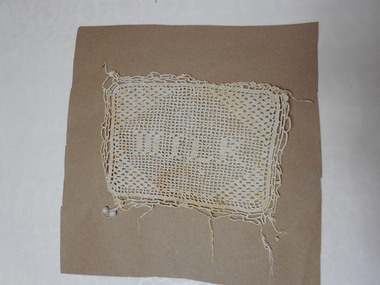
... Textiles, cotton lace milk jug cover. Word 'MILK' woven into pattern. ...TEXTILES Domestic milk jug cover Textiles, cotton lace milk jug cover. Word 'MILK' woven into pattern. ...Textiles, cotton lace milk jug cover. Word 'MILK' woven into pattern. Two 5 mm round white beads tied into one corner. Open loops of cotton around edges.textiles, domestic, milk jug cover -
 National Wool Museum
Book - Textile Department Workbook, A. Eastwood, 1937
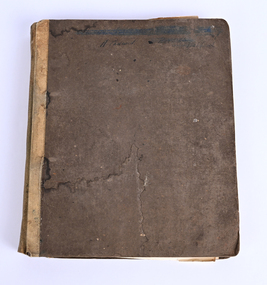
... Ruled paper notebook with brown board cover and textile binding with laces. Handwritten notes, textile samples and illustrations....Ruled paper notebook with brown board cover and textile binding with laces. Handwritten notes, textile samples and illustrations. ...Part of a set of three notebooks belonging to A. Eastwood, all relating to textile courses.Ruled paper notebook with brown board cover and textile binding with laces. Handwritten notes, textile samples and illustrations.Front: [handwritten] A. Eastwood Inside front cover: [handwritten] Eastwood. / Textile Dept.textiles, education, textile industry, workbook, notebook, a. eastwood -
 Bendigo Historical Society Inc.
Textile - LACE NET CURTAIN
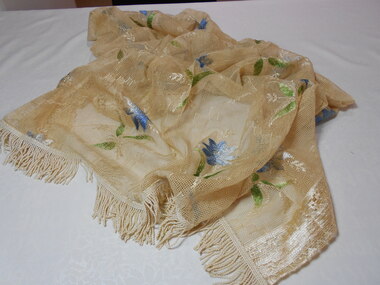
... Textiles, beige lace net curtain,Rows of embroidered blue flowers and green leaves worked in net. ...Bottom of curtain is finished with 5 cm fringing of 2 cm twisted card. Textile LACE NET CURTAIN ...Textiles, beige lace net curtain,Rows of embroidered blue flowers and green leaves worked in net. Machine made lace net has geometric pattern of squares of diminishing sizes.6 cm border on each side of open square pattern with scalloped edges. Rod pocket casing along top. Bottom of curtain is finished with 5 cm fringing of 2 cm twisted card.textiles, domestic, curtaining -
 Bendigo Historical Society Inc.
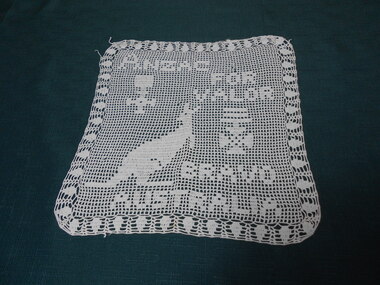
Textile - SQUARE DOYLEY
... Textiles, cream coloured crocheted lace doyley. Words formed in lace "ANZAC FOR VALOR'' ''BRAVO AUSTRALIA''. ...TEXTILES Domestic square doyley Textiles, cream coloured crocheted lace doyley. Words formed in lace "ANZAC FOR VALOR'' ''BRAVO AUSTRALIA''. ...Textiles, cream coloured crocheted lace doyley. Words formed in lace "ANZAC FOR VALOR'' ''BRAVO AUSTRALIA''. Also pictures of a kangaroo and two service medals. Straight edges. Old box 75.textiles, domestic, square doyley -
 Bendigo Historical Society Inc.
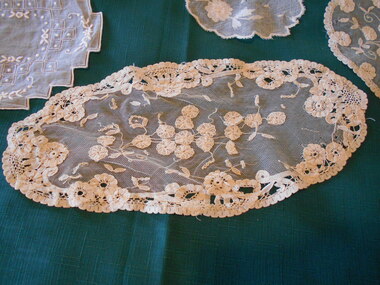
Textile - MAGGIE BARBER COLLECTION: NET AND LACE OVAL DOYLEY, Early1900-;late 1800's
... TEXTILES...Domestic...net and lace...Textiles. Possibly Brussells linen lace. Oval in shape, very fine net is overlaid with a floral design of linen lace. ...TEXTILES Domestic net and lace oval doyley Textiles. Possibly Brussells linen lace. ...Textiles. Possibly Brussells linen lace. Oval in shape, very fine net is overlaid with a floral design of linen lace. A spray of 16 x 1.5 cm diameter flowers, and 1.0 cm leaves are attached. Clusters of the flowers edge the net, with fillers of filligree type lace. Outer edge has a scalloped effect of linen woven lace.textiles, domestic, net and lace oval doyley -
 Flagstaff Hill Maritime Museum and Village
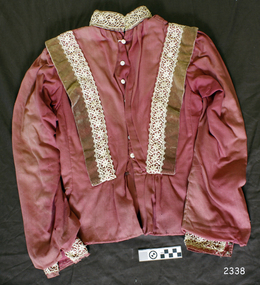
Clothing - Bodice
... As a hand sewn item it is significant to demonstrate the craftsmanship and textiles used in that time period. flagstaff hill warrnambool shipwrecked-coast flagstaff-hill flagstaff-hill-maritime-museum maritime-museum shipwreck-coast flagstaff-hill-maritime-village bodice ladies bodice hand sewn Edwardian Deep pink bodice with velvet and lace at collar. ...Historically the bodice is representative of a style from the early 1900s.As a hand sewn item it is significant to demonstrate the craftsmanship and textiles used in that time period.Deep pink bodice with velvet and lace at collar. Velvet ribbon and lace border on bodice edge next to sleeves, the edging goes from the front of the bodice and over to the back. Seven white mother-of-pearl buttons down the front and pintucks across the top back of the bodice. The sleeve cuffs have a lace border and are closed using hooks and eyes. The bodice is lined, with the lining visibly stitched to the back of the bodice at waist level. The bottom of the bodice is designed as a peplum.flagstaff hill, warrnambool, shipwrecked-coast, flagstaff-hill, flagstaff-hill-maritime-museum, maritime-museum, shipwreck-coast, flagstaff-hill-maritime-village, bodice, ladies bodice, hand sewn, edwardian -
 Blacksmith's Cottage and Forge
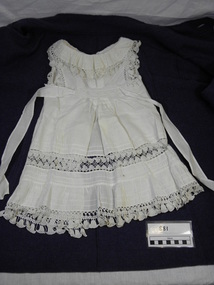
Pinafore, 1900 (estimated)
... lace...celebrations...handmade...white...brown...ceremony...textile...The christening gown represents the rites of passage: great importance is placed on the clothing, as well as the ceremony. lace celebrations handmade white brown ceremony textile cotton bacchus marsh brown family 1905 mrs beeching fagg family pinafore infants clothes rituals fagg costumes family heirloom christening ellen brown This is a white cotton infant's christening pinafore, round neck with a flounce, sleeveless with a sash attached at the front and tied at the back. ...This handmade pinafore was worn by the donor, Ellen Brown, at her christening in 1905. It was made by Ellen's grandmother, Mrs Beeching, for the first daughter born in the Fagg family. The pinafore was a treasured family heirloom, and was not worn again. It is a rare example of a modest, homemade christening costume. Most costumes were gowns, but this humble pinafore still shows loving attention to detail.The connection between milestone moments and the wearing of a particular garment carries great significance. The christening gown represents the rites of passage: great importance is placed on the clothing, as well as the ceremony.This is a white cotton infant's christening pinafore, round neck with a flounce, sleeveless with a sash attached at the front and tied at the back. There are lace inserts and lace at the hemline. Tucks are machined as embellishments and a tie at the back of the neck.lace, celebrations, handmade, white, brown, ceremony, textile, cotton, bacchus marsh, brown family, 1905, mrs beeching, fagg family, pinafore, infants clothes, rituals, fagg, costumes, family heirloom, christening, ellen brown -
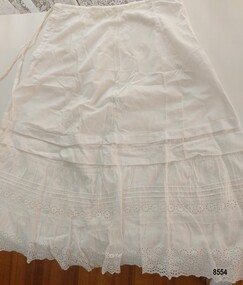 Flagstaff Hill Maritime Museum and Village
Clothing - Petticoat, late 19th century to early 20th century
... Although broderie anglaise was a lace that could be made by hand, it was very time consuming to make. St Gallen was a city in Switzerland that had become known for producing quality textiles. ...Although broderie anglaise was a lace that could be made by hand, it was very time consuming to make. St Gallen was a city in Switzerland that had become known for producing quality textiles. ...This petticoat was one of several items donated from the estate of Susan Henry OAM nee Vedmore (1944 - 2021). It is in very good condition and appears to be from the Edwardian era - early 20th century. A petticoat is a lady's undergarment - worn under a skirt or dress. They provided warmth, modesty and shape to the dress. In the middle of the 19th century, petticoats were worn over hoops, bustles or in layers. Petticoats varied according to the style of the outside skirt or dress. Plain petticoats tended to be worn with everyday wear whilst better dresses (party dresses or silk gowns) were worn with petticoats that often had more trim and embellishments. Edwardian petticoats had less volume than Victorian era petticoats and they had a "dust ruffle" or lining under a lace flounce. The "dust ruffle" protected the lace flounce and gave the petticoat more flare at the bottom, greater freedom when walking as well as saving the flounce (which was often made of finer material) from everyday wear and tear. Tucks are another feature of Edwardian petticoats - when the lace at the bottom became worn, it could be cut off and the tucks released. This extended the life of the petticoat. This petticoat features an intricate trim of broderie anglaise. Although broderie anglaise was a lace that could be made by hand, it was very time consuming to make. St Gallen was a city in Switzerland that had become known for producing quality textiles. At the beginning of the 19th century, the first embroidery machines were developed in St Gallen. Factories used embroidery machines but people also had them in their homes. They were able to produce broderie anglaise for export. By the early 20th century, machine made lace, fabric, ribbons etc. were being sold in drapers shops all over England and Wales to women who were making clothes and furnishings for their families. It is highly likely that the lady who made this petticoat brought the lengths of broderie anglaise already made to embellish and personalise her petticoat. Susan's family (Harold and Gladys Vedmore) immigrated to Australia from Wales in 1955 and settled in Warrnambool. Susan was well known in the Warrnambool community for her work supporting children and families across the district - particular those with disabilities, or those who were homeless, unemployed or isolated. Susan was the founding trustee of the "Vedmore Foundation" - a Warrnambool philanthropic trust set up in 2010 to support a range of charitable and not-for-profit causes by providing grant assistance. In 2021, she was awarded a Medal of the Order of Australia for services to the community.This item is an example of the needlework skills of women in the late 19th century - creating pintucks and adding lace to personalise and embellish a practical item of clothing. It is also significant as an example of a practical solution to the difficulties that women of this era faced with regard to the washing of clothes and household linens.A white lawn petticoat with a 22.5 cm opening that fastens with 2 small buttons and a drawstring tie. It is decorated with two wide pintucks followed by two gathered frills (or flounces) - one decorated with three rows of narrow pintucks and a single row of broderie anglaise and the bottom frilled hem finished with 3 rows of broderie anglaise in a flower design. The two bottom frills are lined with plain white cotton fabric.flagstaff hill maritime museum and village, great ocean road, petticoat, lady's petticoat, undergarment, lady's undergarment, lingerie, edwardian petticoat, broderie anglaise, lace, machine made lace, hand sewn, machine sewn, draper's shop, susan henry oam, vedmore foundation -
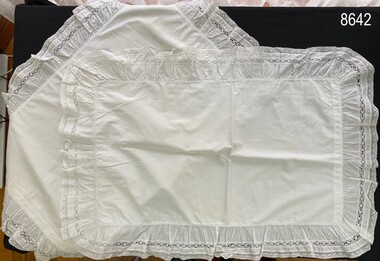 Flagstaff Hill Maritime Museum and Village
Textile - Pillowcase Pair
... lace...Warrnambool...textile...Flagstaff Hill Maritime Museum and Village Great Ocean Road Shipwreck Coast pillowcase decorative lace edging domestic object pair of pillowcases cotton crochet lace Warrnambool textile Pair of pillowcases made from soft white cotton and machine stitched. ...An example of a pair of pillowcases from the early 1900s. The item is of significance socially as an example of decorative domestic objects in the early 1900s.Pair of pillowcases made from soft white cotton and machine stitched. Cotton ties are sewn into the back of each pillowcase. A combination of material and hand crocheted lace forms the edging of each pillowcase.flagstaff hill maritime museum and village, great ocean road, shipwreck coast, pillowcase, decorative lace edging, domestic object, pair of pillowcases, cotton, crochet lace, warrnambool, textile -
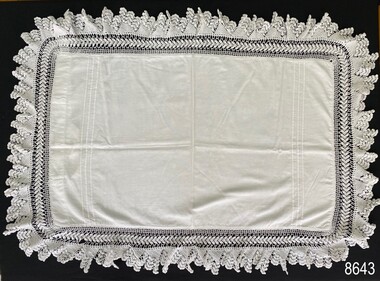 Flagstaff Hill Maritime Museum and Village
Textile - Lace Edged Pillowcase
... lace...domestic object...textile...The lace edging has been handstitched on. Textile Lace Edged Pillowcase ...An example of a decorative domestic object from the early 1900s.The item is of significance socially as an example of decorative domestic objects in the early 1900s.Single pillowcase made from soft white cotton with a crochet lace edge. The pillowcase is machine stitched and on the front has three fine pintucks at each end. The lace edging has been handstitched on.flagstaff hill maritime museum and village, great ocean road, shipwreck coast, warrnambool, pillowcase, cotton, crochet lace, domestic object, textile, decorative lace edging -
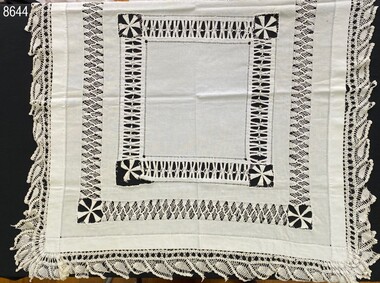 Flagstaff Hill Maritime Museum and Village
Textile - Drawn thread tablecloth
... lace...drawn thread work...textile...Flagstaff Hill Maritime Museum and Village Great Ocean Road Shipwreck Coast Great Ocean Road Tablecloth linen crochet lace drawn thread work textile domestic object decorative lace edging Handmade decorative tablecloth created from soft white linen. ...Drawn thread was an embroidery technique that appeared in the 17th century. In the late 19th and early 20th century it was used on linen and cotton to create decorative functional items such as this tablecloth. The item is of significance socially as an example of a decorative domestic object from the early 1900s. It is a fine example of drawn thread embroidery.Handmade decorative tablecloth created from soft white linen. A crochet lace edge decorates the outer edge of the tablecloth and drawn thread work has been used to create two large inner borders as well as fine edging borders.flagstaff hill maritime museum and village, great ocean road, shipwreck coast, great ocean road, tablecloth, linen, crochet lace, drawn thread work, textile, domestic object, decorative lace edging -
 Flagstaff Hill Maritime Museum and Village
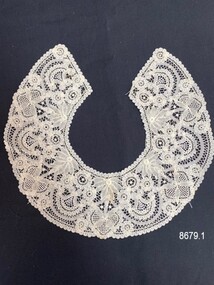
Textile - Brussels Duchesse lace set, Early 20th century
... In each piece the lace motifs are flower based (petals, stems, leaves) and are joined by thin bars. Textile Brussels Duchesse lace set ...Lace collars and cuffs were used by women in the late 19th and early 20th century to embellish their clothing. They were able to be detached which made them suitable as a decorative object on clothing that could be easily changed when required. Duchesse lace, was produced in Belgium from about the mid-nineteenth century onwards. In general, it was regarded as a cheaper version of 'true' Brussels lace and is a form of bobbin lace. The lace set was part of a collection belonging to Alice Matilda Barrie. Alice was born on October 17th, 1885 at Willowie, SA, she died on May 10th, 1981 in Adelaide. Alice was the daughter of Thomas and Luisse Mathilde Wood. Thomas was the publican of the Willowie hotel and Alice's brother Frank owned the Willowie store where the lace set may have been purchased. A family photo shows Alice wearing a lace collar in the early 1940’s which confirms her use of similar articles.The lace set has significance historically and socially as an example of textile accessories women used to embellish their clothing in the late 19th and early 20th century.A Duchesse lace set comprising three collars, a pair of cuffs and a hanky. Two of the collars are rounded and the third has a rectangular back and falls to points at the front. The lace on the hanky has been handstitched to the fine linen centre shape. In each piece the lace motifs are flower based (petals, stems, leaves) and are joined by thin bars.flagstaff hill maritime museum and village, great ocean road, shipwreck coast, lace, brussels duchesse lace, duchesse lace, cotton, linen, flower motifs, bobbin lace, lace collar, lace cuff, lace hanky, lace handkerchief, lace set, lace accessories -
 Flagstaff Hill Maritime Museum and Village
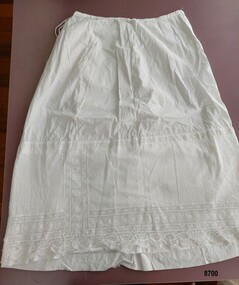
Textile - Petticoat, circa 1900
... Although broderie anglaise was a lace that could be made by hand, it was very time consuming to make. St Gallen was a city in Switzerland that had become known for producing quality textiles. ...Although broderie anglaise was a lace that could be made by hand, it was very time consuming to make. St Gallen was a city in Switzerland that had become known for producing quality textiles. ...This item is one of a collection of clothing items that belonged to the Stephenson family who lived at 22 McCracken Street, Kensington, Melbourne. Matthew Stephenson (1861 – 1943) who had grown up on the Bendigo goldfields and shifted to Melbourne in the early 1900’s was a train driver and later, a fireman with the railways. His wife Elizabeth Jane (Betsy) Wigley (1865 – 1953) also grew up on the goldfields around Majorca and Bendigo. They married in 1885 in Bendigo. They had two daughters – Ethel Evelyn Stephenson (1886 – 1956) and Lillian or Lila (1891 – 1977) who were milliners and dressmakers and who continued to live in the family home after the death of their parents. The family are recorded as living at 22 McCracken Street, Kensington, as early as 1914. It is not known who made or owned the clothing that makes up this collection but as it appears to be from the late Victorian and early Edwardian era, the different pieces were probably made and worn by any of the three ladies of the house – Betsy, Ethel and/or Lila. During W.W.2, a local Warrnambool couple (Meryl and Tony Everard) boarded with them – Tony was in the airforce training paratroopers to jump into (and survive) enemy territory and his wife Meryl worked in the Methodist baby Home. The Everards developed a close friendship with the Stephensons and were responsible for clearing out the house (and finding this clothing collection) after Lila died in 1977. A petticoat is a lady's undergarment - worn under a skirt or dress. They provided warmth, modesty and shape to the dress. In the middle of the 19th century, petticoats were worn over hoops, bustles or in layers. Petticoats varied according to the style of the outside skirt or dress. Plain petticoats tended to be worn with everyday wear whilst better dresses (party dresses or silk gowns) were worn with petticoats that often had more trim and embellishments. Edwardian petticoats had less volume than Victorian era petticoats and they had a "dust ruffle" or lining under a lace flounce. The "dust ruffle" protected the lace flounce and gave the petticoat more flare at the bottom, greater freedom when walking as well as saving the flounce (which was often made of finer material) from everyday wear and tear. Tucks are another feature of Edwardian petticoats - when the lace at the bottom became worn, it could be cut off and the tucks released. This extended the life of the petticoat. This petticoat features an intricate trim of broderie anglaise. Although broderie anglaise was a lace that could be made by hand, it was very time consuming to make. St Gallen was a city in Switzerland that had become known for producing quality textiles. At the beginning of the 19th century, the first embroidery machines were developed in St Gallen. Factories used embroidery machines but people also had them in their homes. They were able to produce broderie anglaise for export. By the early 20th century, machine made lace, fabric, ribbons etc. were being sold in drapers shops all over England and Wales to women who were making clothes and furnishings for their families. It is highly likely that the lady who made this petticoat brought the lengths of broderie anglaise already made to embellish and personalise her petticoat.This item is an example of the needlework skills of women in the late 19th century - creating pintucks and adding lace to personalise and embellish a practical item of clothing. A lady's fine cotton and lace ankle length petticoat featuring a deep decorative hem made from sheer pinspot fabric and bands of eyelet lace. The top section of the petticoat is made from five sections of fine cotton sewn together with french seams and gathered with pleats and darts into the waistband. The waistband opening has two button holes and one button (the top button is missing) and a front section with a drawstring. The lace hem is lined with the same fine cotton as the top of the petticoat. There are three different lace bands - a narrow one featuring small flowers, a similar wider band with larger flowers and it is finished at the bottom with a broad band of lace with an intricate leaf design.flagstaff hill maritime museum and village, great ocean road, warrnambool, shipwreck coast, petticoat, lady's petticoat, broderie anglaise, decorative petticoat, draw string waist, machine sewn, dressmaker, stephenson family, pintucks, needlework -
 Flagstaff Hill Maritime Museum and Village
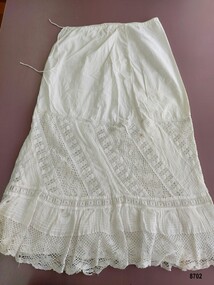
Textile - Petticoat, circa 1910
... Although broderie anglaise was a lace that could be made by hand, it was very time consuming to make. St Gallen was a city in Switzerland that had become known for producing quality textiles. ...Although broderie anglaise was a lace that could be made by hand, it was very time consuming to make. St Gallen was a city in Switzerland that had become known for producing quality textiles. ...This item is one of a collection of clothing items that belonged to the Stephenson family who lived at 22 McCracken Street, Kensington, Melbourne. Matthew Stephenson (1861 – 1943) who had grown up on the Bendigo goldfields and shifted to Melbourne in the early 1900’s was a train driver and later, a fireman with the railways. His wife Elizabeth Jane (Betsy) Wigley (1865 – 1953) also grew up on the goldfields around Majorca and Bendigo. They married in 1885 in Bendigo. They had two daughters – Ethel Evelyn Stephenson (1886 – 1956) and Lillian or Lila (1891 – 1977) who were milliners and dressmakers and who continued to live in the family home after the death of their parents. The family are recorded as living at 22 McCracken Street, Kensington, as early as 1914. It is not known who made or owned the clothing that makes up this collection but as it appears to be from the late Victorian and early Edwardian era, the different pieces were probably made and worn by any of the three ladies of the house – Betsy, Ethel and/or Lila. During W.W.2, a local Warrnambool couple (Meryl and Tony Everard) boarded with them – Tony was in the airforce training paratroopers to jump into (and survive) enemy territory and his wife Meryl worked in the Methodist baby Home. The Everards developed a close friendship with the Stephensons and were responsible for clearing out the house (and finding this clothing collection) after Lila died in 1977. A petticoat is a lady's undergarment - worn under a skirt or dress. They provided warmth, modesty and shape to the dress. In the middle of the 19th century, petticoats were worn over hoops, bustles or in layers. Petticoats varied according to the style of the outside skirt or dress. Plain petticoats tended to be worn with everyday wear whilst better dresses (party dresses or silk gowns) were worn with petticoats that often had more trim and embellishments. Edwardian petticoats had less volume than Victorian era petticoats and they had a "dust ruffle" or lining under a lace flounce. The "dust ruffle" protected the lace flounce and gave the petticoat more flare at the bottom, greater freedom when walking as well as saving the flounce (which was often made of finer material) from everyday wear and tear. Tucks are another feature of Edwardian petticoats - when the lace at the bottom became worn, it could be cut off and the tucks released. This extended the life of the petticoat. This petticoat features an intricate trim of broderie anglaise. Although broderie anglaise was a lace that could be made by hand, it was very time consuming to make. St Gallen was a city in Switzerland that had become known for producing quality textiles. At the beginning of the 19th century, the first embroidery machines were developed in St Gallen. Factories used embroidery machines but people also had them in their homes. They were able to produce broderie anglaise for export. By the early 20th century, machine made lace, fabric, ribbons etc. were being sold in drapers shops all over England and Wales to women who were making clothes and furnishings for their families. It is highly likely that the lady who made this petticoat brought the lengths of broderie anglaise already made to embellish and personalise her petticoat.This item is an example of the needlework skills of women in the late 19th century - creating pintucks and adding lace to personalise and embellish a practical item of clothing.A lady's ankle length petticoat made in three sections. The top section is made from three rectangles of fine cotton (batiste) joined into a round with narrow french seams and inserted into a simple drawstring waistband with a small opening. The second section is made with rows of alternating strips of fine pin tucked lawn, white cotton cut work embroidery and a wider cotton lace design all joined in a diagonal pattern and lined with fine lawn. The bottom section of the petticoat has a horizontal strip of eyelet lace followed by a wider strip of fine pin tucked lawn and is finished with a deep hem of white cotton crocheted lace fabric and has the same lawn lining as the section above.flagstaff hill maritime museum and village, great ocean road, shipwreck coast, warrnambool, petticoat, lady's petticoat, needlework, sewing, broderie anglaise, stephenson family, drawstring waistband -
 Flagstaff Hill Maritime Museum and Village
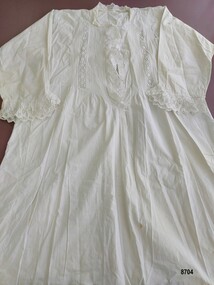
Textile - Nightgown, Circa 1900
... There is also a frill of broderie anglaise lace around the neck. The back of the nightgown is gathered onto a yoke. Textile Nightgown ...This item is one of a collection of clothing items that belonged to the Stephenson family who lived at 22 McCracken Street, Kensington, Melbourne. Matthew Stephenson (1861 – 1943) who had grown up on the Bendigo goldfields and shifted to Melbourne in the early 1900’s was a train driver and later, a fireman with the railways. His wife Elizabeth Jane (Betsy) Wigley (1865 – 1953) also grew up on the goldfields around Majorca and Bendigo. They married in 1885 in Bendigo. They had two daughters – Ethel Evelyn Stephenson (1886 – 1956) and Lillian or Lila (1891 – 1977) who were milliners and dressmakers and who continued to live in the family home after the death of their parents. The family are recorded as living at 22 McCracken Street, Kensington, as early as 1914. It is not known who made or owned the clothing that makes up this collection but as it appears to be from the late Victorian and early Edwardian era, the different pieces were probably made and worn by any of the three ladies of the house – Betsy, Ethel and/or Lila. During W.W.2, a local Warrnambool couple (Meryl and Tony Everard) boarded with them – Tony was in the airforce training paratroopers to jump into (and survive) enemy territory and his wife Meryl worked in the Methodist baby Home. The Everards developed a close friendship with the Stephensons and were responsible for clearing out the house (and finding this clothing collection) after Lila died in 1977. This nightgown is machine sewn and has an added detailed design of pintucks and broderie anglaise lace to the front yoke and cuffs as a decorative element. The 1800's bought a shift in attitude towards modesty as the Victorian era progressed and by the mid to late 1800's it had become more acceptable ladies to wear simple, modest nightgowns. They tended to have a very loose fit and were usually made of linen, cotton or flannel, which had the advantage of providing warmth and also being easy to wash - a necessity for a garment worn next to the skin. Although the basic design of the nightgown was fairly simple, the wearer was free to add various types of trim e.g. lace, crochet, pintucks, embroidery etc.This item is an example of the needlework skills of women in the late 19th and early 20th century - combining machine stitching with hand embroidery to personalise and embellish a practical item of clothing. A full length lady's cotton nightgown with long sleeves finished with a diagonal pointed cuff of broderie anglaise. The bodice features a front opening placket with 3 buttons and buttonholes and a broderie anglaise cover. On either side of the placket, the bodice has been decorated with rows of vertical pintucks and a broderie anglaise panel insert. There is also a frill of broderie anglaise lace around the neck. The back of the nightgown is gathered onto a yoke.flagstaff hill maritime museum and village, great ocean road, shipwreck coast, warrnambool, nightgown, lady's nightgown, needlework, sewing, broderie anglaise, pintucks, stephenson family -
 Flagstaff Hill Maritime Museum and Village
Textile - Skirt, circa 1910
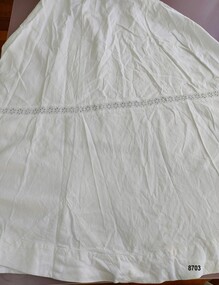
... Although broderie anglaise was a lace that could be made by hand, it was very time consuming to make. St Gallen was a city in Switzerland that had become known for producing quality textiles. ...Although broderie anglaise was a lace that could be made by hand, it was very time consuming to make. St Gallen was a city in Switzerland that had become known for producing quality textiles. ...This item is one of a collection of clothing items that belonged to the Stephenson family who lived at 22 McCracken Street, Kensington, Melbourne. Matthew Stephenson (1861 – 1943) who had grown up on the Bendigo goldfields and shifted to Melbourne in the early 1900’s was a train driver and later, a fireman with the railways. His wife Elizabeth Jane (Betsy) Wigley (1865 – 1953) also grew up on the goldfields around Majorca and Bendigo. They married in 1885 in Bendigo. They had two daughters – Ethel Evelyn Stephenson (1886 – 1956) and Lillian or Lila (1891 – 1977) who were milliners and dressmakers and who continued to live in the family home after the death of their parents. The family are recorded as living at 22 McCracken Street, Kensington, as early as 1914. It is not known who made or owned the clothing that makes up this collection but as it appears to be from the late Victorian and early Edwardian era, the different pieces were probably made and worn by any of the three ladies of the house – Betsy, Ethel and/or Lila. During W.W.2, a local Warrnambool couple (Meryl and Tony Everard) boarded with them – Tony was in the airforce training paratroopers to jump into (and survive) enemy territory and his wife Meryl worked in the Methodist baby Home. The Everards developed a close friendship with the Stephensons and were responsible for clearing out the house (and finding this clothing collection) after Lila died in 1977. This skirt features broderie anglaise trim. Although broderie anglaise was a lace that could be made by hand, it was very time consuming to make. St Gallen was a city in Switzerland that had become known for producing quality textiles. At the beginning of the 19th century, the first embroidery machines were developed in St Gallen. Factories used embroidery machines but people also had them in their homes. They were able to produce broderie anglaise for export. By the early 20th century, machine made lace, fabric, ribbons etc. were being sold in drapers shops all over England and Wales to women who were making clothes and furnishings for their families. It is highly likely that the lady who made this skirt brought the lengths of broderie anglaise already made to embellish and personalise her skirt.This item is an example of the needlework skills of women in the late 19th century - creating pintucks and adding lace to personalise and embellish a practical item of clothing. A full length lady's skirt of heavy textured ribbed twill cotton. The top of the skirt is made from five pieces of fabric, sewn together and inserted into a simple waistband. It has an opening with room for 6 hook and eyes (but only the middle three remain). The top section of the skirt is separated from the bottom section by a strip of eyelet embroidery that has been inserted in a horizontal line at the back but becomes slightly diagonal at the front causing the two ends to cross in a decorative X fashion. The bottom of the skirt is the same heavy cotton as the top and one seam features a V shaped insert or patch.flagstaff hill maritime museum and village, great ocean road, shipwreck coast, warrnambool, broderie anglaise, needlework, sewing, stephenson family, skirt, lady's skirt -
 Flagstaff Hill Maritime Museum and Village
Textile - Jug Cover, Mary Jane Giles (Mrs Harry Giles), Late 19th to Early 20th Century
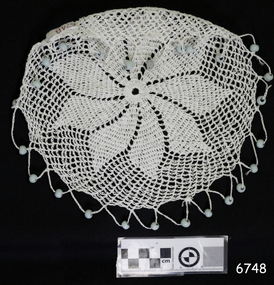
... ...textile...Lace...But the Giles collection also gives us today a snapshot into what domestic life was like in early colonial times prior to Federation. warrnambool shipwrecked-coast flagstaff-hill flagstaff-hill-maritime-museum shipwreck-coast flagstaff-hill-maritime-village giles collection henry giles tower hill cooramook mailor’s flat wangoom 19th century household goods textile Lace work Jug Cover None Jug cover, white with knitted lace on the front and part of the two sides beads to edge Textile Jug Cover Mary Jane Giles (Mrs Harry Giles) ...This jug cover is one of many 19th century items of furniture, linen and crockery donated to Flagstaff Hill Maritime Village by, Vera and Aurelin Giles. The items are associated with Warrnambool and the Giles Family history. Items donated by the family have come to be known as the “Giles Collection”. Many items in the Lighthouse Keeper’s Cottage were donated by Vera and Aurelin Giles and mostly came from the home of Vera’s parents-in-law, Henry Giles and his wife Mary Jane (nee Freckleton) who married in 1880 and whose photos are on display in the parlour. Henry was born at Tower Hill in 1858, and was a labourer on the construction of the Warrnambool Breakwater before leaving in 1895 for around seven years to build bridges in NSW. Mary Jane was born in 1860 at Cooramook and she attended Mailor’s Flat State School and where she eventually was to become a student teacher. After which she became a governess at “Injemiara” where her grandfather, Francis Freckleton, had once owned land. Henry and Mary’s family consisted of six, some of the children were born at Mailor’s Flat and later some children at Wangoom. They lived with their parents at Wangoom and Purnim west, and this is where Henry died in 1933 and Mary Jane in 1940.The Giles family collection is of social significance at a local level, because it not only illustrates the level of material support the Warrnambool community gave to Flagstaff Hill during it’s establishment. But the Giles collection also gives us today a snapshot into what domestic life was like in early colonial times prior to Federation.Jug cover, white with knitted lace on the front and part of the two sides beads to edgeNonewarrnambool, shipwrecked-coast, flagstaff-hill, flagstaff-hill-maritime-museum, shipwreck-coast, flagstaff-hill-maritime-village, giles collection, henry giles, tower hill, cooramook, mailor’s flat, wangoom, 19th century household goods, textile, lace work, jug cover -
 Flagstaff Hill Maritime Museum and Village
Textile - Bolster Sham, Eliza Towns, Late 19th century to early 20th century
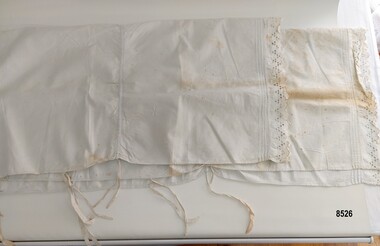
... It has two pull string ties near each end to enclose a bolster and is finished with a decorative edge of pintucks and handmade eyelet lace and embroidery. Textile Bolster Sham Eliza Towns ...This bolster sham is one of several linen and clothing items that were made and belonged to Mrs. Eliza Towns and donated to Flagstaff Hill Maritime Museum and Village. Eliza was born Eliza Gould in 1857 in South Melbourne (Emerald Hill) and in 1879 married Charles Towns. In the early 1880's they moved to Nhill in western Victoria and remained there for the rest of their married life. Charles was a jeweller and later became an accountant and for many years was involved with the Shire Council, the local show committee (A & P Society), the Hospital Committee and the Board of the local newspaper (the Nhill Free Press). They had three children and lived a life that would be regarded as comfortably "middle class". Eliza probably had a treadle sewing machine and would have made many of her own clothes and household linens - adding her own handmade embroidered or crocheted decorative trim. Most beds during the late 19th and early 20th century had a feather, hair or spring mattress covered by a blanket and topped with an under sheet, an upper sheet, several blankets and a bedspread. A flat bolster could be placed either under the pillows or on top of the pillows with a decorative sham. Washing pillows and quilts by hand would have been a very onerous task (involving heating water and handwashing in a tub or using a copper) and so it became the practise of many housewives to cover the pillows and bolsters with an outer slip (or sham) of washable material which could be easily removed and washed when needed. If the bolster was kept under the pillows it wouldn't need to be very decorative but many shams or slips that were "on show" were often highly decorated with embroidery, pintucks, ribbons or lace. This bolster sham is machine made and quite plain with the exception of some pintucking and eyelet lace on each end which suggests that it would mostly be hidden under the top pillows with just the decorative edges on display.This item is an example of the needlework skills of women in the early 20th century - combining machine stitching with hand embroidery to personalise and embellish a practical domestic object. It is also significant as an example of an early 20th century innovation that helped make the working lives of housewives a little bit easier.A long white cotton rectangular bolster sham, machine sewn, with seven ties and two buttons (plus one missing button) to enable it to be folded over lengthwise and closed. It has two pull string ties near each end to enclose a bolster and is finished with a decorative edge of pintucks and handmade eyelet lace and embroidery.flagstaff hill maritime museum and village, eliza towns, sham, bedding, great ocean road, shipwreck coast, warrnambool, household textiles, sewing, bolster sham, housework, pillow sham, charles towns, nhill, haberdashery, needlework, manchester, handmade, household linen -
 Flagstaff Hill Maritime Museum and Village
Clothing - Nightgown, Eliza Towns, circa 1890's
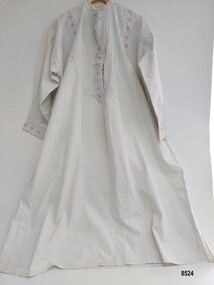
... lace, crochet, pintucks, embroidery etc. This item is an example of the needlework skills of women in the late 19th century - combining machine stitching with hand embroidery to personalise and embellish a practical item of clothing. It is also significant as an example of a practical solution to the difficulties that women of this era faced with regard to the washing of clothes and household linens. Flagstaff Hill Flagstaff Hill Maritime Museum and Village Warrnambool Great Ocean Road Shipwreck Coast Victorian era clothing Victorian era nightgown nightgown nightdress Eliza Towns Nhill Wimmera textiles ...This nightgown is one of several linen and clothing items that were made and belonged to Mrs. Eliza Towns and donated to Flagstaff Hill Maritime Museum and Village. Eliza was born Eliza Gould in 1857 in South Melbourne (Emerald Hill) and in 1879 married Charles Towns. In the early 1880's they moved to Nhill in western Victoria and remained there for the rest of their married life. Charles was a jeweller and later became an accountant and for many years was involved with the Shire Council, the local show committee (A & P Society), the Hospital Committee and the Board of the local newspaper (the Nhill Free Press). They had three children and lived a life that would be regarded as comfortably "middle class". Eliza probably had a treadle sewing machine and would have made many of her own clothes as well as clothes for her children - adding her own handmade embroidered or crocheted decorative trim. This nightgown is machine sewn by Eliza Towns and she has added a detailed design of pintucks and broderie anglaise lace to the front yoke and cuffs as a decorative element. The 1800's bought a shift in attitude towards modesty as the Victorian era progressed and by the mid to late 1800's it had become more acceptable ladies to wear simple, modest nightgowns. They tended to have a very loose fit and were usually made of linen, cotton or flannel, which had the advantage of providing warmth and also being easy to wash - a necessity for a garment worn next to the skin. Although the basic design of the nightgown was fairly simple, the wearer was free to add various types of trim e.g. lace, crochet, pintucks, embroidery etc.This item is an example of the needlework skills of women in the late 19th century - combining machine stitching with hand embroidery to personalise and embellish a practical item of clothing. It is also significant as an example of a practical solution to the difficulties that women of this era faced with regard to the washing of clothes and household linens.Lady's long, white, cotton nightgown with a V shaped bodice decorated with bands of nine pintucks alternating with strips of broderie anglaise lined with pink ribbon. The opening front placket and neckline are bordered with a simpler broderie anglaise lace. The long sleeves are gathered into cuffs with a matching V shape, pintuck and broderie anglaise design. The front placket fastens with three cream buttons although one is missing. The back of the nightgown has gathered fabric on a plain, narrow V shape yoke. A narrow gusset has been added to the both sides at the bottom of the nightgown.Noneflagstaff hill, flagstaff hill maritime museum and village, warrnambool, great ocean road, shipwreck coast, victorian era clothing, victorian era nightgown, nightgown, nightdress, eliza towns, nhill, wimmera, textiles, clothing, machine sewing, hand sewing, pintucks, broderie anglaise, sewing -
 Flagstaff Hill Maritime Museum and Village
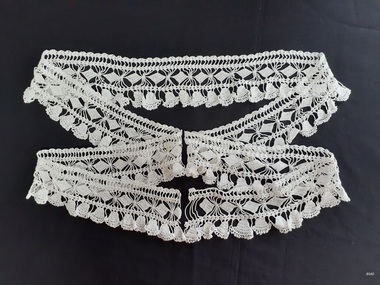
Textile - Lace Sample, Late 1800s to 1930s
... Mercerised white crochet thread has been used to crochet a repeat pattern consisting of three rows: a decorative top row, a middle section of diamond shapes and a bottom row of Christmas bells. Textile Lace Sample ...The sample of crochet lace is an example of a handmade item that would have been used to decorative purpose around the home. It may have been used to edge curtains, a table runner or a mantlepiece. The Christmas Bells pattern suggests usage as a Christmas decoration.The item is significant socially to show the use of textile crafts, such as handmade crocheted lace, to decorate regular domestic objects around the home such as curtains and mantlepieces.Length of handmade crochet lace. Mercerised white crochet thread has been used to crochet a repeat pattern consisting of three rows: a decorative top row, a middle section of diamond shapes and a bottom row of Christmas bells.flagstaff hill, warrnambool, maritime village, maritime museum, flagstaff hill maritime museum & village, shipwreck coast, great ocean road, lace, handmade lace, crocheted lace, decorative edging, decorative lace edging, domestic object, crocheted trim -
 Flagstaff Hill Maritime Museum and Village
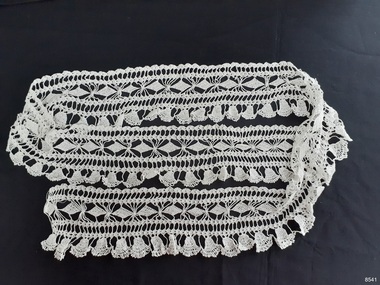
Textile - Lace Sample, Late 1800s to 1930s
... Mercerised white crochet thread has been used to crochet a repeat pattern consisting of four rows: a decorative top row, a second row composed of diamond shapes, a repeat of the decorative top row and finally a row of Christmas bells to complete the pattern. Textile Lace Sample ...The sample of crochet lace is an example of a handmade item that would have been used to decorative purpose around the home. It may have been used to edge curtains, a table runner or a mantlepiece. The Christmas Bells pattern suggests usage as a Christmas decoration.The item is significant socially to show the use of textile crafts, such as handmade crocheted lace, to decorate regular domestic objects around the home such as curtains and mantlepieces.Length of handmade crochet lace. Mercerised white crochet thread has been used to crochet a repeat pattern consisting of four rows: a decorative top row, a second row composed of diamond shapes, a repeat of the decorative top row and finally a row of Christmas bells to complete the pattern.flagstaff hill, warrnambool, maritime village, maritime museum, flagstaff hill maritime museum & village, shipwreck coast, great ocean road, lace, handmade lace, crocheted lace, decorative edging, decorative lace edging, domestic object, crocheted trim
