
Showing 18 items matching "the art of bombing"
-
 Moorabbin Air Museum
Book - Aviation history, Young America's Aviation Manual
... ...The art of bombing...Aviation history The conquest of the air The US Air Force US Naval aviation Research for flight Russian air force Military air transport Strategic Air Command The B-36 Bomber The art of bombing History of American aviation for young readers Young America's Aviation Manual Book Aviation history ...History of American aviation for young readersnon-fictionHistory of American aviation for young readersthe conquest of the air, the us air force, us naval aviation, research for flight, russian air force, military air transport, strategic air command, the b-36 bomber, the art of bombing -
 Bendigo Military Museum
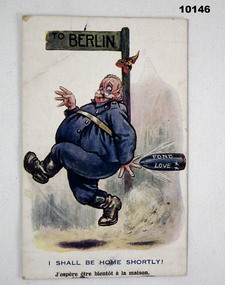
Postcard - CARTOON POSTCARD, Inter Art- Co, c.1915
... bomb shell in the direction of a sign pointing to Berlin. Detailed message on back that looks like it is only part of the message. Postcard CARTOON POSTCARD Inter Art ...Example of comic postcards produced during WW1. Part of the collection of William (Bill) Thomason. Refer Cat No. 4136P.On the front is a drawing of a comic German soldier being chased by a bomb shell in the direction of a sign pointing to Berlin. Detailed message on back that looks like it is only part of the message.At bottom are the words "I shall be home shortly" and similar message in French. “Dated 5/1/18”collection of william (bill) thomason, comic postcard, ww1 -
 Bendigo Military Museum
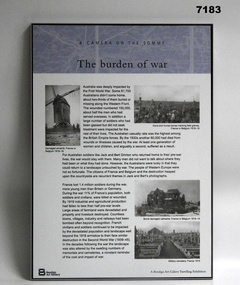
Literary work - STORY BOARD - FRAMED - WW1, Bendigo & District RSL Sub Branch et al, C.2008/09
... Bomb damaged cathedral, France or Belgium 1916-19" Bottom right "Military Cemetery, France 1919" Story board - framed. Story Board - black print on white and pale blue background on synthetic paper adhered to backing board. Frame - metal with wood backing board. Literary work STORY BOARD - FRAMED - WW1 Bendigo & District RSL Sub Branch Bendigo Art ...Jack Grinton. Refer Cat No.1280 for his service history.Story board - framed. Story Board - black print on white and pale blue background on synthetic paper adhered to backing board. Frame - metal with wood backing board." A CAMERA ON THE SOMME' "The Burden of War". Photographs top left - "Damaged windmill, France or Belgium 1916-1919" Top right "Guns and human bones marking field graves, France or Belgium 1916-1919" Middle right "Bomb damaged cathedral, France or Belgium 1916-19" Bottom right "Military Cemetery, France 1919" framed accessories, camera on the somme, ww1, 38th bn, grinton -
 Bendigo Military Museum
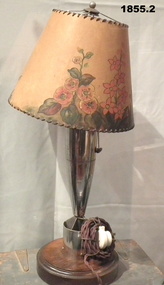
Memorabilia - TRENCH ART, LAMP, Post WW2
... This object is an example of trench art. .1 The lamp base consists of a chrome plated deactivated mortar bomb attached to a turned brown wooden base. ...Ornaments Lighting - electrical Trench art Souvenir On the base of the mortar bomb: ' ?LB, IM, MF, 1940' This object is an example of trench art. .1 The lamp base consists of a chrome plated deactivated mortar bomb attached to a turned brown wooden base. ...Possibly made by the donor.This object is an example of trench art. .1 The lamp base consists of a chrome plated deactivated mortar bomb attached to a turned brown wooden base. A globe and switch socket are attached to the tip of the bomb. An electrical cord with power plug is threaded through the base of the bomb. .2 The lampshade is made of stiffened brown paper laced to a wire frame with dark brown cord. Handpainted coloured flowers decorate the outer surface of the shade. The shade is attached to the globe via a wire clamp.On the base of the mortar bomb: ' ?LB, IM, MF, 1940'ornaments, lighting - electrical, trench art, souvenir -
 Robin Boyd Foundation
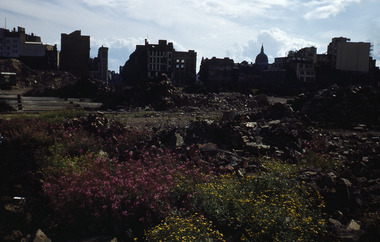
Slide, Robin Boyd, 1950
... art gallery. The scholarship helped fund their first overseas trip. Robin and Patricia were passengers on the Greek ship “Cyrenia” departing in May 1950, passing through the Suez Canal and landing in Genoa five weeks later. For six months, they travelled extensively throughout Europe (predominantly driving themselves) - France, Italy, United Kingdom, Sweden, Denmark, Germany, Austria, Switzerland and Spain. Haddon Travelling Scholarship Haddon robin boyd slide London / Eastend / Bomb ...Penleigh Boyd, Robin and Patricia Boyd's son, writes “Prior to 1950 Robin, like most other amateur or hobby photographers, took black and white printed photographs. The oldest slides date from 1950 when Robin and Patricia travelled to Europe on Robin’s Robert Haddon Travelling Scholarship.” In 1948 Robin Boyd was awarded ‘joint first place’ in the Robert Haddon competition for his design of Mildura art gallery. The scholarship helped fund their first overseas trip. Robin and Patricia were passengers on the Greek ship “Cyrenia” departing in May 1950, passing through the Suez Canal and landing in Genoa five weeks later. For six months, they travelled extensively throughout Europe (predominantly driving themselves) - France, Italy, United Kingdom, Sweden, Denmark, Germany, Austria, Switzerland and Spain.Colour slide in a mount. East End, London, England (St Paul's Cathedral in background)London / Eastend / Bomb Site - To St. Paul's (All Handwritten)haddon travelling scholarship, haddon, robin boyd, slide -
 Wangaratta RSL Sub Branch
Work on paper - Envelope Art
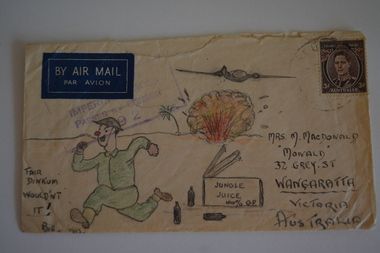
... Even though the Battation was disbanded in 1946 members and their families return each year, in November, for a commemorative service at the 2/24th Battalion Memorial Wall at the Wangaratta Cemetery. ww2 envelope art Top left - AIR MAIL Top right - postage stamp Left side - AIF Censor stamp Right side Mrs M MacDonald "Monald" 32 Grey Street Wangaratta Victoria Australia Bottom left- "Fair Dinkum Wouldn't it!" Box - "Jungle Juice 100% OP' Cream paper envelope with coloured sketch of soldier running away from aircraft dropping bombs. ...One of several illustrated envelopes, without letter, sketched by soldier/s during the second world war and sent to Mrs MacDonald of WangarattaVictoria's 2/24th Infantry Battalion was raised in Wangaratta in July 1940. They were welcomed with open arms by the local community as they rapidly built up their numbers. The people of Wangaratta adopted the Battalion and they became known as "Wangaratta's Own" because of the time the battalion spent in the town during its formative period prior to deployment overseas. Many of the soldiers maintained life long friendships with the people of Wangaratta. Even though the Battation was disbanded in 1946 members and their families return each year, in November, for a commemorative service at the 2/24th Battalion Memorial Wall at the Wangaratta Cemetery.Cream paper envelope with coloured sketch of soldier running away from aircraft dropping bombs. Box and bottles in foreground.Top left - AIR MAIL Top right - postage stamp Left side - AIF Censor stamp Right side Mrs M MacDonald "Monald" 32 Grey Street Wangaratta Victoria Australia Bottom left- "Fair Dinkum Wouldn't it!" Box - "Jungle Juice 100% OP' ww2, envelope art -
 Wangaratta RSL Sub Branch
Work on paper - Envelope Art
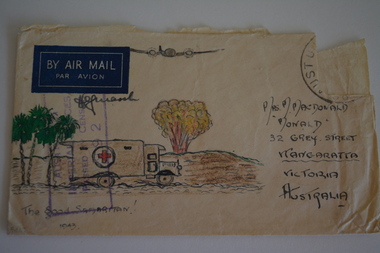
... Even though the Battation was disbanded in 1946 members and their families return each year, in November, for a commemorative service at the 2/24th Battalion Memorial Wall at the Wangaratta Cemetery. ww2 envelope art Top left - BY AIR MAIL Top right - postage stamp Left side - AIF Censor stamp Right side - Mrs M MacDonald "Monald" 32 Grey Street Wangaratta Victoria Australia Bottom - "The good samaritan" 1943 Cream paper envelope with coloured sketch of three palm trees an ambulance and plane overhead with bomb exploding in distance. ...One of several illustrated envelopes, without letter, sketched by soldier/s during the second world war and sent to Mrs MacDonald of WangarattaVictoria's 2/24th Infantry Battalion was raised in Wangaratta in July 1940. They were welcomed with open arms by the local community as they rapidly built up their numbers. The people of Wangaratta adopted the Battalion and they became known as "Wangaratta's Own" because of the time the battalion spent in the town during its formative period prior to deployment overseas. Many of the soldiers maintained life long friendships with the people of Wangaratta. Even though the Battation was disbanded in 1946 members and their families return each year, in November, for a commemorative service at the 2/24th Battalion Memorial Wall at the Wangaratta Cemetery.Cream paper envelope with coloured sketch of three palm trees an ambulance and plane overhead with bomb exploding in distance.Top left - BY AIR MAIL Top right - postage stamp Left side - AIF Censor stamp Right side - Mrs M MacDonald "Monald" 32 Grey Street Wangaratta Victoria Australia Bottom - "The good samaritan" 1943 ww2, envelope art -
 Wangaratta RSL Sub Branch
Work on paper - Envelope Art
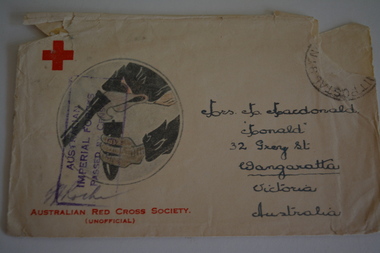
... Even though the Battation was disbanded in 1946 members and their families return each year, in November, for a commemorative service at the 2/24th Battalion Memorial Wall at the Wangaratta Cemetery. ww2 envelope art Top left - Red Cross Top right - postage stamp Centre - AIF Censor stamp and signature Right side - Mrs M MacDonald "Monald" 32 Grey Street Wangaratta Victoria Australia Bottom Left - Australian Red Cross Society Cream paper envelope with a circular sketch of an eagle holding shell/bomb Work on paper Envelope Art ...One of several illustrated envelopes without letter sketched by soldier/s during the second world war and sent to Mrs MacDonald of WangarattaVictoria's 2/24th Infantry Battalion was raised in Wangaratta in July 1940. They were welcomed with open arms by the local community as they rapidly built up their numbers. The people of Wangaratta adopted the Battalion and they became known as "Wangaratta's Own" because of the time the battalion spent in the town during its formative period prior to deployment overseas. Many of the soldiers maintained life long friendships with the people of Wangaratta. Even though the Battation was disbanded in 1946 members and their families return each year, in November, for a commemorative service at the 2/24th Battalion Memorial Wall at the Wangaratta Cemetery.Cream paper envelope with a circular sketch of an eagle holding shell/bomb Top left - Red Cross Top right - postage stamp Centre - AIF Censor stamp and signature Right side - Mrs M MacDonald "Monald" 32 Grey Street Wangaratta Victoria Australia Bottom Left - Australian Red Cross Society ww2, envelope art -
 Wangaratta RSL Sub Branch
Work on paper - Envelope Art
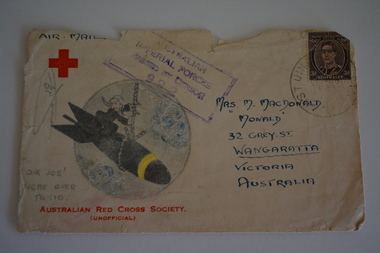
... Even though the Battation was disbanded in 1946 members and their families return each year, in November, for a commemorative service at the 2/24th Battalion Memorial Wall at the Wangaratta Cemetery. ww2 envelope art Top left - AIR MAIL Top right - postage stamp Top centre - AIF Censor stamp Right side Mrs M MacDonald "Monald" 32 Grey Street Wangaratta Victoria Australia Bottom left side - "OK Joe Were over Toyko" Rear - 129537 ACI Gilbert A V Group 436 Flinders Island Tasmania Cream paper envelope with hand drawing of rope around bomb with yellow strip and pilot on top. ...Sent to Mrs MacDonald "Monald" 32 Grey Street Wangaratta during Second World War possibly by Arthur Vincent Gilbert born 7/2/1923 in NSW Enlisted in the Army and served mainly in the Bonegilla/Bandiana area between 1943-6. No active service outside Australia recorded. service no NX176929Victoria's 2/24th Infantry Battalion was raised in Wangaratta in July 1940. They were welcomed with open arms by the local community as they rapidly built up their numbers. The people of Wangaratta adopted the Battalion and they became known as "Wangaratta's Own" because of the time the battalion spent in the town during its formative period prior to deployment overseas. Many of the soldiers maintained life long friendships with the people of Wangaratta. Even though the Battation was disbanded in 1946 members and their families return each year, in November, for a commemorative service at the 2/24th Battalion Memorial Wall at the Wangaratta Cemetery.Cream paper envelope with hand drawing of rope around bomb with yellow strip and pilot on top. Red cross top left cornerTop left - AIR MAIL Top right - postage stamp Top centre - AIF Censor stamp Right side Mrs M MacDonald "Monald" 32 Grey Street Wangaratta Victoria Australia Bottom left side - "OK Joe Were over Toyko" Rear - 129537 ACI Gilbert A V Group 436 Flinders Island Tasmania ww2, envelope art -
 Wangaratta RSL Sub Branch
Work on paper - Envelope Art
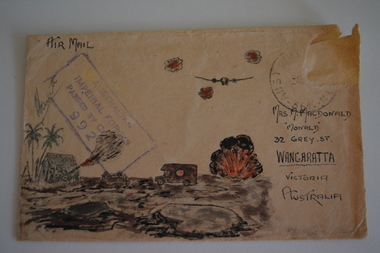
... Even though the Battation was disbanded in 1946 members and their families return each year, in November, for a commemorative service at the 2/24th Battalion Memorial Wall at the Wangaratta Cemetery. ww2 envelope art Top left - AIR MAIL Top right - postage stamp Left side - AIF Censor stamp Right side Mrs M MacDonald "Monald" 32 Grey Street Wangaratta Victoria Australia Cream paper envelope with drawing of war scene - cannon in front of hut and palm trees, ambulance in centre and bomb exploding below aircraft in sky. ...One of a series of illustrated envelopes which once contained letters drawn by a soldier/s and sent to Mrs MacDonald of 32 Grey Street Wangaratta.Victoria's 2/24th Infantry Battalion was raised in Wangaratta in July 1940. They were welcomed with open arms by the local community as they rapidly built up their numbers. The people of Wangaratta adopted the Battalion and they became known as "Wangaratta's Own" because of the time the battalion spent in the town during its formative period prior to deployment overseas. Many of the soldiers maintained life long friendships with the people of Wangaratta. Even though the Battation was disbanded in 1946 members and their families return each year, in November, for a commemorative service at the 2/24th Battalion Memorial Wall at the Wangaratta Cemetery.Cream paper envelope with drawing of war scene - cannon in front of hut and palm trees, ambulance in centre and bomb exploding below aircraft in sky.Top left - AIR MAIL Top right - postage stamp Left side - AIF Censor stamp Right side Mrs M MacDonald "Monald" 32 Grey Street Wangaratta Victoria Australia ww2, envelope art -
 Melbourne Legacy
Photograph - Photo, 1990
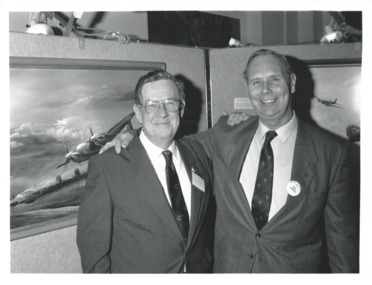
... Art at Legacy House. Paintings were by Frank Harding of Renmark, South Australia. The photo was used for a newspaper article published on 23 August 1990, mentions that Frank Harding had painted over 50 paintings of aircraft flown by Australians and published a book of the images. It was called 'They flew for the King'. Each painting had been extensively researched to capture a specific moment in the World War 2 combat career of various pilots, flight officers or bomb...Art at Legacy House. Paintings were by Frank Harding of Renmark, South Australia. The photo was used for a newspaper article published on 23 August 1990, mentions that Frank Harding had painted over 50 paintings of aircraft flown by Australians and published a book of the images. It was called 'They flew for the King'. Each painting had been extensively researched to capture a specific moment in the World War 2 combat career of various pilots, flight officers or bomb ...Photograph of Legatee Bob Cowper and another man by displays of paintings of aircraft. It was the launch of Legacy Week in 1990 which included an exhibition of Aviation Art at Legacy House. Paintings were by Frank Harding of Renmark, South Australia. The photo was used for a newspaper article published on 23 August 1990, mentions that Frank Harding had painted over 50 paintings of aircraft flown by Australians and published a book of the images. It was called 'They flew for the King'. Each painting had been extensively researched to capture a specific moment in the World War 2 combat career of various pilots, flight officers or bomb-aimers. His aim was to honour the fine efforts of these great individuals. Unfortunately the artist died a few weeks after the exhibition and launch of his book. Photos are at 01523, the article at 01522, also see media release at 01521. Date is assumed to be 22 August 1990 from the reference number on the back 900822.An example of an art exhibition being held at Legacy House to promote Legacy during Legacy week in 1990.Black and white photo of Legatee Bob Cowper at the aviation exhibition. Stamped on back Copyright Herald and Weekly Times in green ink. Handwritten "900822 / 261" in blue ink, "Pic 7" in black ink.legacy promotion, legacy week, painting -
 Surrey Hills Historical Society Collection
Photograph, Norma Bull portrait
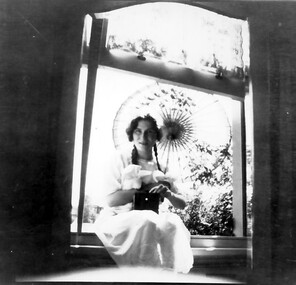
... Art. This enabled her to travel to England to study at the Royal Academy in London. She arrived in April 1939 and after the outbreak of war, she worked as a volunteer at a First Aid Clearing Station and applied to become a war artist. In 1941, she was given a sketching permit by the War Artists Advisory Committee to record bomb...Art. This enabled her to travel to England to study at the Royal Academy in London. She arrived in April 1939 and after the outbreak of war, she worked as a volunteer at a First Aid Clearing Station and applied to become a war artist. In 1941, she was given a sketching permit by the War Artists Advisory Committee to record bomb ...Norma Bull in a window of 'Medlow', 1920s Her brother (Ronald) Richard was a keen photographer and is believed to have taken the photographs of the family and in the grounds of 'Medlow'. Norma Catherine Bull (7 September 1906 – September 1980) was an Australian painter, printmaker and etcher best known for the paintings and sketches she made in Britain during World War II. Norma was the daughter of Richard Joseph Bull (1874-1927) and Catherine Grace Perrier (1884-1972). Her father was the Director of Bacteriology at Melbourne University. Richard and Catherine had 2 children. Norma was born in Hawthorn in 1906 and her brother Ronald Richard was born in Surrey Hills in 1912, where in 1911 Richard bought a property at 42 Warrigal Road, Surrey Hills developed by Colonel William Cairncross, known as ‘Willcyrus’ and renamed ‘Medlow’ by the Bulls. As a child, Norma was a high achiever both intellectually and artistically. She was educated at Fintona, where she matriculated as Dux of the School and winner of an exhibition in French. She won a scholarship to attend the University of Melbourne where she studied French, Zoology, Philosophy, English and History, leading to a Bachelor of Arts in 1929. Following this she studied painting and drawing at the National Gallery Art School for seven years. Whilst most of the students of the 1930s were inspired by Modernism, Norma followed more traditional styles and became known for her etchings and realistic depiction of urban scenes. Her work was strongly influenced by the conservative nature of the National Gallery Art School under Bernard Hall, and she remained a traditionalist all her life. In 1938, she was awarded the Sir John Longstaff Scholarship in Fine Art. This enabled her to travel to England to study at the Royal Academy in London. She arrived in April 1939 and after the outbreak of war, she worked as a volunteer at a First Aid Clearing Station and applied to become a war artist. In 1941, she was given a sketching permit by the War Artists Advisory Committee to record bomb damage in the Bristol area. In 1947, an exhibition of her 205 wartime works entitled “Two Hemispheres”, opened at Australia House in London. Many were acquired for major collections in England including the Victoria and Albert Museum, the Imperial War Museum and the Royal Collection. The “Two Hemispheres” exhibition toured Australia in 1948 and for over twelve months she followed Wirth’s Circus around the country, painting aspects of circus life. From then on she lived at Medlow’, From 1960 she was secretary of the Fellowship of Australian Artists. She was a finalist in the Archibald Prize on 2 occasions and is remembered through a biennial Art Prize, ‘The Norma Bull Portraiture Scholarship’ which is administered by The Victorian Artist’s Society. She continued to paint landscapes and seascapes in her traditionalist style. She had holiday homes at Anglesea and Bright. After she died in September 1980, 31 of her works were bequeathed to Bright Art Gallery. A black and white photograph of a lady holding a sun umbrella and sitting in a window frame.miss norma bull, medlow, house names, warrigal road, surrey hills, mr ronald richard bull -
 Dandenong/Cranbourne RSL Sub Branch
Painting - Large wooden framed painting
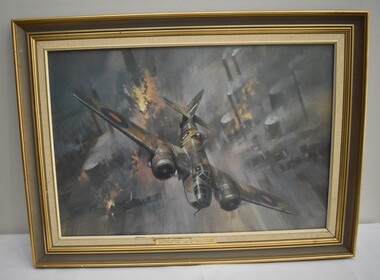
... Art College followed by National Service with the Royal Electrical and Mechanical Engineers for 2 years. On leaving National Service he worked with a London advertising studio before turning freelance in1957. The Bristol Blenheim depicted in the painting was a British light bomber used extensively for 2 years of the Second World War. It was powered by a pair of Bristol Mercury V111 air cooled radial engines capable of developing 860 bhp. armament was a combination of Vickers, Browning and Lewis machine guns in .303 ( 7.7mm ). A 1000lb (450kg ) could be carried in the internal bomb...Art College followed by National Service with the Royal Electrical and Mechanical Engineers for 2 years. On leaving National Service he worked with a London advertising studio before turning freelance in1957. The Bristol Blenheim depicted in the painting was a British light bomber used extensively for 2 years of the Second World War. It was powered by a pair of Bristol Mercury V111 air cooled radial engines capable of developing 860 bhp. armament was a combination of Vickers, Browning and Lewis machine guns in .303 ( 7.7mm ). A 1000lb (450kg ) could be carried in the internal bomb ...Michael Turner born in 1934 is a British painter and illustrator specialising in motoring and aviation paintings. After leaving school he attended Art College followed by National Service with the Royal Electrical and Mechanical Engineers for 2 years. On leaving National Service he worked with a London advertising studio before turning freelance in1957. The Bristol Blenheim depicted in the painting was a British light bomber used extensively for 2 years of the Second World War. It was powered by a pair of Bristol Mercury V111 air cooled radial engines capable of developing 860 bhp. armament was a combination of Vickers, Browning and Lewis machine guns in .303 ( 7.7mm ). A 1000lb (450kg ) could be carried in the internal bomb bay in the centre section of the fuselage. The 114 Squadron was a Squadron of the British Royal Air Force formed in India during the First World War. The Squadron was disbanded in 1971.Large wooden framed painting of an RAF WW2 bomber in flight.Below the painting is the wording " A 114 Squadron Blenheim 1V on a low level bombing run over the power station at Knapsack Cologne, in August 1941 - donated by Laurie Pillar". -
Woodend RSL
Memorabilia - Trench Art - French Shell Casing Model 1885 37 mm, January 1918
... On the base: PDPs 267 1.18 37-85 (there is a symbol of a flaming bomb between 18 and 37) On the side: "1916 ROBECQ VIMY HAMEL BUSIGNY" On opposite side (in an engraved ribbon starting from the base): A-F-A- - - - 46th Bty - - K.F. KEATING Shell casing - Brass Memorabilia Trench Art ...The Canon d'Infanterie de 37 modèle 1916 TRP (37mm mle.1916) was a French infantry support gun, first used during World War I. TRP stands for tir rapide, Puteaux (fast-firing, designed by the Atelier de Puteaux). The tactical purpose of this gun was the destruction of machine gun nests. It was also used on aircraft such as the Beardmore W.B.V and the Salmson-Moineau. Fighter ace René Fonck used a 37mm mle.1916 on a SPAD S.XII.Shell casing - BrassOn the base: PDPs 267 1.18 37-85 (there is a symbol of a flaming bomb between 18 and 37) On the side: "1916 ROBECQ VIMY HAMEL BUSIGNY" On opposite side (in an engraved ribbon starting from the base): A-F-A- - - - 46th Bty - - K.F. KEATING -
Woodend RSL
Memorabilia - Trench Art - French Shell Casing Model 1885 37 mm, January 1918
... On the base: PDPs 267 1.18 37-85 (there is a symbol of a flaming bomb between 18 and 37) On the side: "1917 BULLECOURT MESSINES NIEUPORT YPRES" On opposite side (in an engraved ribbon towards top of casing): K.F. KEATING Shell casing - Brass Memorabilia Trench Art ...The Canon d'Infanterie de 37 modèle 1916 TRP (37mm mle.1916) was a French infantry support gun, first used during World War I. TRP stands for tir rapide, Puteaux (fast-firing, designed by the Atelier de Puteaux). The tactical purpose of this gun was the destruction of machine gun nests. It was also used on aircraft such as the Beardmore W.B.V and the Salmson-Moineau. Fighter ace René Fonck used a 37mm mle.1916 on a SPAD S.XII.Shell casing - BrassOn the base: PDPs 267 1.18 37-85 (there is a symbol of a flaming bomb between 18 and 37) On the side: "1917 BULLECOURT MESSINES NIEUPORT YPRES" On opposite side (in an engraved ribbon towards top of casing): K.F. KEATING -
 Melbourne Legacy
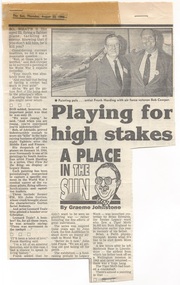
Document, Playing for high stakes - Aviation art exhibition, 1990
... Art at Legacy House. Paintings were by Frank Harding of Renmark, South Australia. The article published on 23 August 1990, mentions that Frank Harding had painted over 50 paintings of aircraft flown by Australians and published a book of the images. It was called 'They flew for the King'. Each painting had been extensively researched to capture a specific moment in the World War 2 combat career of various pilots, flight officers or bomb...Art at Legacy House. Paintings were by Frank Harding of Renmark, South Australia. The article published on 23 August 1990, mentions that Frank Harding had painted over 50 paintings of aircraft flown by Australians and published a book of the images. It was called 'They flew for the King'. Each painting had been extensively researched to capture a specific moment in the World War 2 combat career of various pilots, flight officers or bomb ...Launch of Legacy Week in 1990 included an exhibition of Aviation Art at Legacy House. Paintings were by Frank Harding of Renmark, South Australia. The article published on 23 August 1990, mentions that Frank Harding had painted over 50 paintings of aircraft flown by Australians and published a book of the images. It was called 'They flew for the King'. Each painting had been extensively researched to capture a specific moment in the World War 2 combat career of various pilots, flight officers or bomb-aimers. His aim was to honour the fine efforts of these great individuals. Unfortunately the artist died a few weeks after the exhibition and launch of his book. Photos are at 01523 also see media release at 01521. In 1990 the slogan was "Lest YOU forget" with an image of the statue of Simpson and his donkey rather than a personality, see items at 01250, 01520. The main time of year for fundraising is September when Legacy holds 'Badge Week'. An example of promotional material from the 1990s, including the speech and media release. Marketing material and photos were compiled and released to newspapers, also printed as brochures and sometimes as stickers and collection tin wrappers. Newspaper article for an aviation art exhibition for Legacy Week in 1990 and an article about the death of the artist.legacy week, paintings, promotion, frank harding, planes, warplanes -
 Melbourne Legacy
Photograph - Photo, Launch of Legacy Week - 3rd September 1990 - Aviation art exhibition, 1990
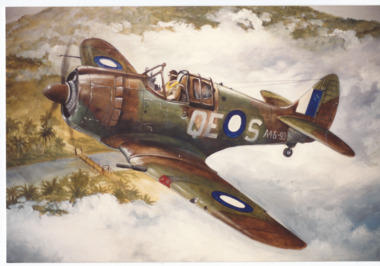
... Art at Legacy House. Paintings were by Frank Harding of Renmark, South Australia. A newspaper article published on 23 August 1990, mentions that Frank Harding had painted over 50 paintings of aircraft flown by Australians and published a book of the images. It was called 'They flew for the King'. Each painting had been extensively researched to capture a specific moment in the World War 2 combat career of various pilots, flight officers or bomb...Art at Legacy House. Paintings were by Frank Harding of Renmark, South Australia. A newspaper article published on 23 August 1990, mentions that Frank Harding had painted over 50 paintings of aircraft flown by Australians and published a book of the images. It was called 'They flew for the King'. Each painting had been extensively researched to capture a specific moment in the World War 2 combat career of various pilots, flight officers or bomb ...Launch of Legacy Week in 1990 included an exhibition of Aviation Art at Legacy House. Paintings were by Frank Harding of Renmark, South Australia. A newspaper article published on 23 August 1990, mentions that Frank Harding had painted over 50 paintings of aircraft flown by Australians and published a book of the images. It was called 'They flew for the King'. Each painting had been extensively researched to capture a specific moment in the World War 2 combat career of various pilots, flight officers or bomb-aimers. His aim was to honour the fine efforts of these great individuals. Unfortunately the artist died a few weeks after the exhibition and launch of his book. Guests included Bud Tingwell, who flew for the RAAF in World War 2 and other RAAF personnel. It appears to have included a heritage display from the Royal Australian Air Force Museum at the same time. The article is at 01522 also see media release at 01521, more photos of the paintings and guests are in 01524. In 1990 the slogan was "Lest YOU forget" with an image of the statue of Simpson and his donkey rather than a personality. The main time of year for fundraising is September when Legacy holds 'Badge Week'. Often there is a celebrity who gives his or her time as 'Personality of the Year'. Was in a scrapbook of photos spanning 1987 to 1991.An example of an art exhibition being held at Legacy House to promote Legacy during Legacy week in 1990.Colour photo x 6 of an art exhibition for Legacy Week in 1990.legacy week, paintings, planes, warplanes, promotion -
 Melbourne Legacy
Photograph - Photo, Launch of Legacy Week - 3rd September 1990 - Aviation art exhibition, 1990
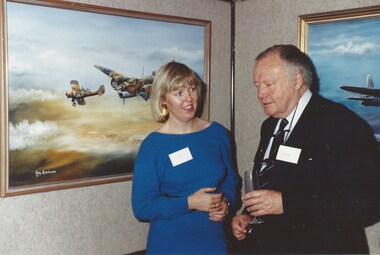
... Art at Legacy House. Paintings were by Frank Harding of Renmark, South Australia. A newspaper article published on 23 August 1990, mentions that Frank Harding had painted over 50 paintings of aircraft flown by Australians and published a book of the images. It was called 'They flew for the King'. Each painting had been extensively researched to capture a specific moment in the World War 2 combat career of various pilots, flight officers or bomb...Art at Legacy House. Paintings were by Frank Harding of Renmark, South Australia. A newspaper article published on 23 August 1990, mentions that Frank Harding had painted over 50 paintings of aircraft flown by Australians and published a book of the images. It was called 'They flew for the King'. Each painting had been extensively researched to capture a specific moment in the World War 2 combat career of various pilots, flight officers or bomb ...Launch of Legacy Week in 1990 included an exhibition of Aviation Art at Legacy House. Paintings were by Frank Harding of Renmark, South Australia. A newspaper article published on 23 August 1990, mentions that Frank Harding had painted over 50 paintings of aircraft flown by Australians and published a book of the images. It was called 'They flew for the King'. Each painting had been extensively researched to capture a specific moment in the World War 2 combat career of various pilots, flight officers or bomb-aimers. His aim was to honour the fine efforts of these great individuals. Guests included Bud Tingwell, who flew for the RAAF in World War 2 and other RAAF personnel. It appears to have included a heritage display from the Royal Australian Air Force Museum at the same time. Unfortunately the artist died a few weeks after the exhibition and launch of his book. The article is at 01522 also see media release at 01521, more photos of the paintings and guests are in 01523. In 1990 the slogan was "Lest YOU forget" with an image of the statue of Simpson and his donkey rather than a personality. The main time of year for fundraising is September when Legacy holds 'Badge Week'. Often there is a celebrity who gives his or her time as 'Personality of the Year'. Was in a scrapbook of photos spanning 1987 to 1991.An example of an art exhibition being held at Legacy House to promote Legacy during Legacy week in 1990.Colour photo x 9 of an art exhibition for Legacy Week in 1990.legacy week, painting, promotion, planes, warplanes
