
Showing 31 items matching "the australian imperial force in france 1917"
-
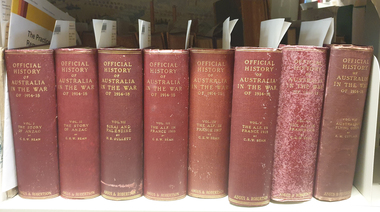 Federation University Historical Collection
Book, Charles E.W. Bean, Official History of Australia in the War, Vol 3, The Australian Imperial Force in France, 1917, 1937
... Official History of Australia in the War, Vol 3, The Australian Imperial Force in France, 1917...Official History of Australia in the War, Vol 3, The Australian Imperial Force in France, 1917 Book Book Charles E.W. ...Red hard covered book of 1030 pages, with 423 illustrations and maps.world war, world war one, charles bean, aif, anzac, lagnicourt, messines, ypres, menin road, polygon wood, broodseinde ridge, passchendale, hill 60, hill 70, benafay wood, hindenburg line, hooge dump, butte, bapaume, bullecourt -
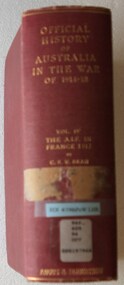 4th/19th Prince of Wales's Light Horse Regiment Unit History Room
Book, C E W Bean, Official History of Australia in the War of 1914-18 Vol IV The Australian Imperial Force in France 1917, 1933
... Official History of Australia in the War of 1914-18 Vol IV The Australian Imperial Force in France 1917...book aif france book aif france Stamps of various librararies before coming to us Hard covered red book of 1030 pages Official History of Australia in the War of 1914-18 Vol IV The Australian Imperial Force in France 1917 Book Book C E W Bean ...Hard covered red book of 1030 pagesStamps of various librararies before coming to usbook, aif, france, book, aif, france -
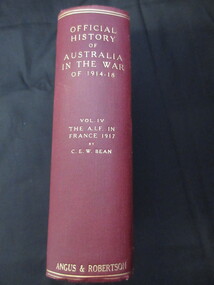 Lilydale RSL Sub Branch
Book, C.E.W. Bean, Official History of Australia in the War/ The Australian Imperial Force in France 1917
... Official History of Australia in the War/ The Australian Imperial Force in France 1917...Book Official History of Australia in the War/ The Australian Imperial Force in France 1917 Book Book C.E.W. Bean Angus and Robertson Ltd Halstead Press. ...Book -
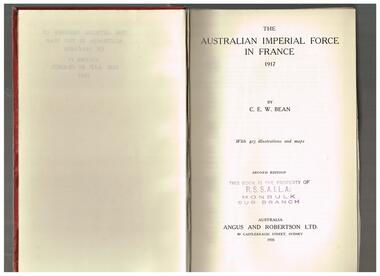 Mrs Aeneas Gunn Memorial Library
Book, C. E. W. Bean, The Official history of Australia in the War of 1914-1918: The Australian Imperial Force in France 1917, 1921-1942
... The Official history of Australia in the War of 1914-1918: The Australian Imperial Force in France 1917...The Official history of Australia in the War of 1914-1918: The Australian Imperial Force in France 1917 Book C. E. W. Bean Angus & Robertson Ltd ...Volume one of the official history of Australia in the war of 1914-1918Index, Ill, maps, p.967.non-fictionVolume one of the official history of Australia in the war of 1914-1918world war 1914-1918 - australia - history, australia - history - 20th century -
 Flagstaff Hill Maritime Museum and Village
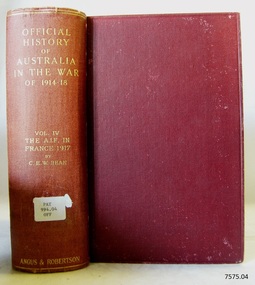
Book, Official History of Australia In The War of 1914-18 Vol 4
... australia in the war of 1914-18...the australian imperial force in france 1917...Official History of Australia In The War of 1914-18 Vol 4 The Australian Imperial Force in France 1917 Author: C E W Bean Publisher: Angus & Robertson Date: 1936 ...France and Belgium. The High Commissioner ( Mr. S. M. Bruce) states in his annual report that, althoughthe 47 bodies were readily identifiable by their uniforms,caps,and badges and shoulder titles as those of Australian soldeirs, it must be regretfully recorded that in most cases their names will never be known." Official History of Australia In The War of 1914-18 Vol 4 The Australian Imperial Force in France 1917 ...This item is from the ‘Pattison Collection’, a collection of books and records that was originally owned by the Warrnambool Mechanics’ Institute, which was founded in Warrnambool in 1853. By 1886 the Warrnambool Mechanics’ Institute (WMI) had grown to have a Library, Museum and Fine Arts Gallery, with a collection of “… choice productions of art, and valuable specimens in almost every branch and many wonderful national curiosities are now to be seen there, including historic relics of the town and district.” It later included a School of Design. Although it was very well patronised, the lack of financial support led the WMI in 1911 to ask the City Council to take it over. In 1935 Ralph Pattison was appointed as City Librarian to establish and organise the Warrnambool Library as it was then called. When the WMI building was pulled down in 1963 a new civic building was erected on the site and the new Warrnambool Library, on behalf of the City Council, took over all the holdings of the WMI. At this time some of the items were separated and identified as the ‘Pattison Collection’, named after Ralph Pattison. Eventually the components of the WMI were distributed from the Warrnambool Library to various places, including the Art Gallery, Historical Society and Flagstaff Hill. Later some were even distributed to other regional branches of Corangamite Regional Library and passed to and fro. It is difficult now to trace just where all of the items have ended up. The books at Flagstaff Hill Maritime Village generally display stamps and markings from Pattison as well as a variety of other institutions including the Mechanics’ Institute itself. RALPH ERIC PATTISON Ralph Eric Pattison was born in Rockhampton, Queensland, in 1891. He married Maude Swan from Warrnambool in 1920 and they set up home in Warrnambool. In 1935 Pattison accepted a position as City Librarian for the Warrnambool City Council. His huge challenge was to make a functional library within two rooms of the Mechanics’ Institute. He tirelessly cleaned, cleared and sorted a disarrayed collection of old books, jars of preserved specimens and other items reserved for exhibition in the city’s museum. He developed and updated the library with a wide variety of books for all tastes, including reference books for students; a difficult task to fulfil during the years following the Depression. He converted all of the lower area of the building into a library, reference room and reading room for members and the public. The books were sorted and stored using a cataloguing and card index system that he had developed himself. He also prepared the upper floor of the building and established the Art Gallery and later the Museum, a place to exhibit the many old relics that had been stored for years for this purpose. One of the treasures he found was a beautiful ancient clock, which he repaired, restored and enjoyed using in his office during the years of his service there. Ralph Pattison was described as “a meticulous gentleman whose punctuality, floorless courtesy and distinctive neat dress were hallmarks of his character, and ‘his’ clock controlled his daily routine, and his opening and closing of the library’s large heavy doors to the minute.” Pattison took leave during 1942 to 1942 to serve in the Royal Australian Navy, Volunteer Reserve as Lieutenant. A few years later he converted one of the Museum’s rooms into a Children’s Library, stocking it with suitable books for the younger generation. This was an instant success. In the 1950’s he had the honour of being appointed to the Victorian Library Board and received more inspiration from the monthly conferences in Melbourne. He was sadly retired in 1959 after over 23 years of service, due to the fact that he had gone over the working age of council officers. However he continued to take a very keen interest in the continual development of the Library until his death in 1969. WARRNAMBOOL PUBLIC LIBRARY The Warrnambool Mechanics’ Institute (WMI) was formed by a voluntary community group in 1863, within six years of Warrnambool’s beginnings, and its Reading Room opened in 1854. The WMI operated until 1963, at which time it was one of the oldest Mechanics’ Institutes in Victoria. Mechanics’ Institutes offered important services to the public including libraries, reading rooms and places to display and store collections of all sorts such as curiosities and local historical relics. In 1886 a Museum and Fine Arts Gallery were added to the WMI and by the beginning of the 20th century there was also a billiards room and a School of Art. By this time all Mechanics’ Institutes in country Victoria had museums attached. Over the years the Warrnambool Mechanics’ Institute Library was also known as the Warrnambool Public Library the Warrnambool Library and the Free Library. Early funding from the government was for the “Free Library”. The inscription in a book “Science of Man” was for the “Warrnambool Public Library”, donated by Joseph Archibald in 1899. Another inscription in the book “Catalogue of Plants Under Cultivation in the Melbourne Botanic Gardens 1 & 2, 1883” was presented to the “Warrnambool Library” and signed by the author W.R. Guilfoyle. In 1903 the Warrnambool Public Library decided to add a Juvenile Department to library and stock it with hundreds of books suitable for youth. In 1905 the Public Library committee decided to update the collection of books and added 100 new novels plus arrangements for the latest novels to be included as soon as they were available in Victoria. In July 1911 the Warrnambool Council took over the management of the Public Library, Art Gallery, Museum and Mechanics’ Institute and planned to double the size of the then-current building. In 1953, when Mr. R. Pattison was Public Librarian, the Warrnambool Public Library’s senior section 10,000 of the 13,000 books were fiction. The children’s section offered an additional 3,400 books. The library had the equivalent of one book per head of population and served around 33 percent of the reading population. The collection of books was made up of around 60 percent reference and 40 percent fiction. The library was lending 400 books per day. In 1963 the Warrnambool City Council allocated the site of the Mechanics’ Institute building, which included the Public Library, Museum and Art Gallery, for the new Municipal Offices and the Collections were dispersed until 1971. The Warrnambool Library took over the Mechanics’ Institute Library’s holdings on behalf of the Warrnambool City Council. Since the closure of the Warrnambool Mechanics’ Institute the exact location and composition of the original WMI books and items has become unclear. Other materials have been added to the collection, including items from Terang MI, Warrnambool Court House and Customs House. Many of the books have been identified as the Pattison Collection, named after the Librarian who catalogued and numbered the books during his time as Warrnambool Public Librarian in the time before the Mechanics’ Institute closed. It seems that when Warrnambool became part of the Corangamite Regional Library some of the books and materials went to its head office in Colac and then back to Warrnambool where they were stored at the Art Gallery for quite some time. Some then went to the Warrnambool Historical Society, some stayed at the Art Gallery and some were moved to Flagstaff Hill Maritime Village. The various stamps and labels on the books held at Flagstaff Hill show the variety of the collection’s distribution and origin. The books in the collection at Flagstaff Hill Maritime Village date from the 1850’s to the late 1950’s and include rare and valuable volumes. Many of the books are part of the “Pattison Collection” after the Warrnambool’s Public Librarian, Mr. R. Pattison The Pattison Collection, along with other items at Flagstaff Hill Maritime Village, was originally part of the Warrnambool Mechanics' Institute’s collection. The Warrnambool Mechanics’ Institute Collection is primarily significant in its totality, rather than for the individual objects it contains. Its contents are highly representative of the development of Mechanics' Institute libraries across Australia, particularly Victoria. A diversity of publications and themes has been amassed, and these provide clues to our understanding of the nature of and changes in the reading habits of Victorians from the 1850s to the middle of the 20th century. The collection also highlights the Warrnambool community’s commitment to the Mechanics’ Institute, reading, literacy and learning in the regions, and proves that access to knowledge was not impeded by distance. These items help to provide a more complete picture of our community’s ideals and aspirations. The Warrnambool Mechanics Institute book collection has historical and social significance for its strong association with the Mechanics Institute movement and the important role it played in the intellectual, cultural and social development of people throughout the latter part of the nineteenth century and the early twentieth century. The collection of books is a rare example of an early lending library and its significance is enhanced by the survival of an original collection of many volumes. The Warrnambool Mechanics' Institute’s publication collection is of both local and state significance. The Warrnambool Mechanics' Institute Collection is primarily significant in its totality, rather than for the individual objects it contains. Its contents are highly representative of the development of Mechanics' Institute libraries across Australia, particularly Victoria. A diversity of publications and themes has been amassed, and these provide clues to our understanding of the nature of and changes in the reading habits of Victorians from the 1850s to the middle of the 20th century. The collection also highlights the Warrnambool community’s commitment to the Mechanics’ Institute, and to reading, literacy and learning in the regions, and proves that access to knowledge was not impeded by distance. These items help to provide a more complete picture of our community’s ideals and aspirations. As with many Mechanics' Institutes in Australia, the one which operated in Warrnambool was established and overseen for many years by key individuals associated with the development of the city itself. The WMI publication collection is historically significant because of its association with local people, places and the key historical themes in the development of Warrnambool of rural development, industry, farming, education, and community. The collection documents and illustrates the changing interests, focus and tastes of Victorians, especially those in regional cities. Generally the individual items in the collection are not particularly rare, as examples of all probably exist in other public collections in Victoria. It is primarily because there are so very few surviving Mechanics' Institute collections in Victoria, which lends this overall collection its significance. Many items in the WMI Collection have the potential to support further research, both as individual objects and through the collection in its entirety. This material is significant for its ability to assist in the interpretation of the history of the area and adds to the general understanding of the development of the township. Many components of the WMI publication collection complement and reinforce the Flagstaff Hill Maritime Museum Collection, the Warrnambool Art Gallery Collection, and that in the Warrnambool Historical Society, and also contribute to a clearer understanding of the original Warrnambool Mechanics' Institute collections. This will greatly enhance the appreciation of the few surviving Mechanics' Institute collections across Victoria, and also in New South Wales. The similarities and differences between the small number of collections that have survived can provide further insights into how the people of Victoria in general, and Warrnambool in particular, constructed a civic culture of adult learning to foster an informed citizenry. The Warrnambool Mechanics' Institute publication collection is of both local and state significance. (This Statement of Significance is quoted from the Significance Assessment : Warrnambool Mechanics’ Institute Book Collection at Flagstaff Hill Maritime Museum, February 2009, by Annette Welkamp, Cultural Connections, for Delise Oldfied, FHMV) References Juvenile Department in Warrnambool Public Library In August 1903 The Age newspaper reported in its Warrnambool news section that “With the object of discouraging boys from reading literature of the “penny dreadful” class, the committee of the local public library has decided to open a juvenile department and to stock it with hundreds of suitable books attractive to the youthful mind.” 100 new novels added to Warrnambool Public Library Shelves In November 1905 The Argue newspaper’s Warrnambool news section announced “The committee of the Public Library is bringing the collection of books more up to date. It has recently added 100 new novels to the shelves, and arrangements have been made for a supply of the latest novels immediately they arrive in the state.” Warrnambool Town Council takes over Mechanics’ Institute, Art Gallery, Public Library, Museum – and will double the building’s size In 1912 The Age reported in its Warrnambool news section “Considerable improvements are being effected by the town council in the most picturesque part of Liebig Street. Between the fire brigade station and the mechanics’ institute and art gallery a vacant block of land is being transformed a garden for carpet bedding and flowering plants. The council, which recently took over the control of the art gallery, public library, museum and mechanics’ institute, is doubling the size of the substantial stone building containing these institutions. The new building will contain a supper room for use in conjunction with functions in the town hall, adjoining, and a new reading room.” Mr Pattison, Public Librarian, says Library has a book per head of population In 1953 The Age reported an interview with the Public Librarian, Mr. R. Pattison, who said “Warrnambool has an insatiable thirst for reading. And its reading recipe contains a strong dash of fiction – 73 percent of it. Fiction makes up 10,000 of the 13,000 books in the senior section of the public library. That works out at a book per head of population. Warrnambool today is really book minded. This city has an almost insatiable thirst for knowledge as well as fiction. We’re lending 400 books a day. We supply 33 percent of the reading population of Warrnambool.” The reporter goes on to say “Warrnambool Public Library also has an ultra-modern children’s section of 3,400 books, open to every boy and girl attending school in Warrnambool. Mr Pattison hopes to show travel-talk films and install a radiogram in the children’s section “later on”. But it won’t disturb adult reading next door because the junior section is sound proof. “ Mechanics’ Institutes and Museums Mechanics’ Institutes were important sites for collecting in country Victoria … Warrnambool … all had museums attached to Mechanics’ Institutes before the end of the twentieth century” Warrnambool Mechanics’ Institute Ms Tierney said FHMV holds the collection of the Warrnambool Mechanics’ Institute in three different locations on its site. “The Mechanics’ Institute opened in 1871, was demolished in the 1960s and was one of the oldest in Victoria. “FHMV intends to create a new storage area and bring the collection together in one place which will greatly facilitate access and research. “The collection consists of books and archives dating from the 1850s to 1959s. “Some of the books are rare and valuable but it is unclear as to their relevance to the history of Warrnambool or Victoria,” Ms Tierney said. Warrnambool TAFE History South West TAFE has a long and proud history of providing technical and specialist education, with links back to the formation of the Mechanic’s Institute in 1853. Warrnambool Art Gallery’s History The Warrnambool Art Gallery began in 1886 when retired police officer Joseph Archibald opened its doors in a building behind the mechanics institute in Liebig Street. The Gallery began with an eclectic mix of artworks and museum curios. Before long Archibald mobilised public support and paid for a new gallery annex. Loans and grants allowed the Gallery collection to grow with significant early acquisitions by French, German, and Belgian artists, which were less expensive than British works. Despite its enthusiastic start the economic downturn of the 1890s brought the Collection to a halt. In 1910 the Council took control of the Mechanics Institute and ran the Gallery there until 1963 when the building was allocated for municipal offices. The Collection was dispersed on loan to galleries in Shepparton and Hamilton and not reunited until 1971. In 1986 the Gallery’s Centenary year, a permanent home was built next to the ‘Civic Green’ and named in memory of one its champions Sir Fletcher Jones O.B.E. 2016 Warrnibald Entries Joseph Archibald established the Warrnambool Museum and Art Gallery in 1886 while his son Jules Francois Archibald founded the Archibald Prize through his bequest of 1919. His aim was to foster portraiture, as well as support artists, and perpetuate the memory of great Australians. Official History of Australia In The War of 1914-18 Vol 4 The Australian Imperial Force in France 1917 Author: C E W Bean Publisher: Angus & Robertson Date: 1936 Label on spine cover with typed text PATT 994.04 OFF Front loose endpaper has a sticker from Warrnambool Public Library covered by a sticker from Corangamite Regional Library Service Front end pastedown paper has a type written paper that reads "Unknown Soldiers. Last year 795 bodies of British Soldiers of which 47 were Australiands, were recovered from the battlefields of France and Belgium. The High Commissioner ( Mr. S. M. Bruce) states in his annual report that, althoughthe 47 bodies were readily identifiable by their uniforms,caps,and badges and shoulder titles as those of Australian soldeirs, it must be regretfully recorded that in most cases their names will never be known." warrnambool, shipwrecked-coast, flagstaff-hill, flagstaff-hill-maritime-museum, maritime-museum, shipwreck-coast, flagstaff-hill-maritime-village, shipwrecked-artefact, book, warrnambool mechanics’ institute, pattison collection, warrnambool library, ralph eric pattison, warrnambool city librarian, mechanics’ institute library, victorian library board, warrnambool books and records, warrnambool children’s library, official history of australia in the war of 1914-18 vol 4, official history of australia in the war of 1914-18, the australian imperial force in france 1917, a.i.f., c e w bean, s. m. bruce -
 Flagstaff Hill Maritime Museum and Village
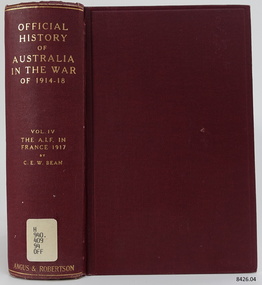
Book, Official History of Australia in the War of 1914-1918 Vol 4
... Bean Publisher: Angus & Robertson Ltd Date: 1941 Further Information: The Australian Imperial Force in France 1917...Bean Publisher: Angus & Robertson Ltd Date: 1941 Further Information: The Australian Imperial Force in France 1917 Official History of Australia in the War of 1914-1918 Vol 4 Book ...This book was part of a large group of books referred to as the Pattison Collection, which belonged to the Warrnambool Public Library, part of the Warrnambool Mechanics’ Institute. About RALPH ERIC PATTISON and the ‘PATTISON COLLECTION’ The ‘Pattison Collection’ is a collection of books and records that was originally owned by the Warrnambool Mechanics’ Institute, founded in Warrnambool in 1853. By 1886 the Warrnambool Mechanics’ Institute (WMI) had grown to have a Library, Museum and Fine Arts Gallery, with a collection of “… choice productions of art and valuable specimens in almost every branch and many wonderful national curiosities, are now to be seen there, including historic relics of the town and district.” It later included a School of Design. Although it was very well patronised, the WMI was led to ask the City Council to take it over in 1911 due to a lack of financial support. In 1935 Ralph Pattison was appointed as City Librarian to establish and organise the Warrnambool Public Library as it was then called. Ralph Eric Pattison was born in Rockhampton, Queensland, in 1891. He married Maude Swan from Warrnambool in 1920 and they set up a home in Warrnambool. In 1935 when Pattison accepted the position as City Librarian for the Warrnambool City Council his huge challenge was to make a functional library within two rooms of the Mechanics’ Institute. He tirelessly cleaned, cleared and sorted a disarrayed collection of old books, jars of preserved specimens and other items reserved for exhibition in the city’s museum. He developed and updated the library with a wide variety of books for all tastes, including reference books for students; a difficult task to fulfil during the years following the Depression. He converted all of the lower areas of the building into a library, reference room and reading room for members and the public. The books were sorted and stored using a cataloguing and card index system that he had developed himself. He also prepared the upper floor of the building and established the Art Gallery and later the Museum, a place to exhibit the many old relics that had been stored for years for this purpose. One of the treasures he found was a beautiful ancient clock, which he repaired, restored and enjoyed using in his office during the years of his service there. Ralph Pattison was described as “a meticulous gentleman whose punctuality, floorless courtesy and distinctive neat dress were hallmarks of his character, and ‘his’ clock controlled his daily routine and his opening and closing of the library’s large heavy doors to the minute.” Pattison took leave from 1942 to 1945 to serve in the Royal Australian Navy, Volunteer Reserve as Lieutenant. A few years later he converted one of the Museum’s rooms into a Children’s Library, stocking it with suitable books for the younger generation. This was an instant success. In the 1950’s he had the honour of being appointed to the Victorian Library Board and received more inspiration from the monthly conferences in Melbourne. He was sadly retired in 1959 after over 23 years of service, due to the fact that he had gone over the working age of council officers. However, he continued to take a very keen interest in the continual development of the Library until his death in 1969. THE NEW WARRNAMBOOL LIBRARY When the WMI building was pulled down in 1963 a new civic building was erected on the site and the new Warrnambool Library, on behalf of the City Council, took over all the holdings of the WMI. At this time some of the items were separated and identified as the ‘Pattison Collection’, named after Pattison. Eventually, the components of the WMI were distributed from the Warrnambool Library to various places, including the Art Gallery, Historical Society and Flagstaff Hill. Later some were even distributed to other regional branches of Corangamite Regional Library and passed to and fro. It is difficult now to trace just where all of the items have ended up. The books at Flagstaff Hill Maritime Village generally display stamps and markings from Pattison as well as a variety of other institutions including the Mechanics’ Institute itself. The Pattison Collection, along with other items at Flagstaff Hill Maritime Village, was originally part of the Warrnambool Mechanics' Institute’s collection. The Warrnambool Mechanics’ Institute Collection is primarily significant in its totality, rather than for the individual objects it contains. Its contents are highly representative of the development of Mechanics' Institute libraries across Australia, particularly Victoria. A diversity of publications and themes has been amassed, and these provide clues to our understanding of the nature of and changes in the reading habits of Victorians from the 1850s to the middle of the 20th century. The collection also highlights the Warrnambool community’s commitment to the Mechanics’ Institute, reading, literacy and learning in the regions, and proves that access to knowledge was not impeded by distance. These items help to provide a more complete picture of our community’s ideals and aspirations. The Warrnambool Mechanics Institute book collection has historical and social significance for its strong association with the Mechanics Institute movement and the important role it played in the intellectual, cultural and social development of people throughout the latter part of the nineteenth century and the early twentieth century. The collection of books is a rare example of an early lending library and its significance is enhanced by the survival of an original collection of many volumes. The Warrnambool Mechanics' Institute’s publication collection is of both local and state significance. Official History of Australia in the War of 1914-1918 Vol 4 Author: C.E.W. Bean Publisher: Angus & Robertson Ltd Date: 1941 Further Information: The Australian Imperial Force in France 1917The label on the spine cover with typed text H 940.40994 OFF Paste down front end paper has a sticker from Corangamite Regional Library Service.flagstaff hil, warrnambool, flagstaff hill maritime museum, maritime museum, shipwreck coast, flagstaff hill maritime village, great ocean road, book, pattison collection, warrnambool library, warrnambool mechanics’ institute, ralph eric pattison, corangamite regional library service, warrnambool city librarian, mechanics’ institute library, victorian library board, warrnambool books and records, warrnambool children’s library, official history of australia in the war of 1914-1918 vol 4, c.e.w. bean -
 Flagstaff Hill Maritime Museum and Village
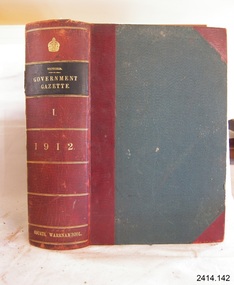
Book - Reference/State Government Notification Gazette, Albert John Mullett, The Victorian Government Gazette 1912 Vol 1 /146, 1912
... Australian meeting, and the detailed Education Department's Record of War Service (1914–1919) published in 1921. Unfortunately Mullet's tenure intersected with the heavy personal tolls of World War I; his own son, Leslie Holmes Mullett, was killed in action on April 11, 1917, at Bullecourt, France, while serving with the Australian Imperial Force. ...Australian meeting, and the detailed Education Department's Record of War Service (1914–1919) published in 1921. Unfortunately Mullet's tenure intersected with the heavy personal tolls of World War I; his own son, Leslie Holmes Mullett, was killed in action on April 11, 1917, at Bullecourt, France, while serving with the Australian Imperial Force. ...The Victoria Government Gazette and other government documents from 1887 were printed and published by Robert S. Brain, Government Printer, Melbourne. Brain held the position of Victorian Government Printer through the 1890s and into the early 1900s. The same imprint appears on other official Victorian publications from that era, such as the annual reports of the Board for the Protection of the Aborigines and the colony's Statistical Register. There wasn't really an editor in the modern sense the Gazette was compiled and issued under the authority of the colonial government, via the Chief Secretary's Department, with Brain's printing office producing and publishing it. In May 1906, James Kemp succeeded him, serving as Government Printer from May 1906 to August 1912, with the title of Acting Government Printer right at the very start of his tenure he was stepping into the role Brain had just vacated, and by later in December 1906 he was signing gazettes in that capacity, apparently before his appointment was made permanent. Then in 1912 Albert John Mullett took over the role starting from January 1912 the same way Kemp had as Acting Government Printer with his appointment made permanent in 1913 where he served all through the 1920s.Hard cover book. The Victorian Government Gazette 1912 Vol 1 /146 Printer: Albert John Mullett Publisher: Albert John Mullett Publisher: Authority of The Colonial Government Date: 1912 Further Information: Textured hard cover bound book leather burgundy colour spine with gilt lettering, covers embossed blue cloth & reinforced corners to front and back cover. non-fictionThe Victoria Government Gazette and other government documents from 1887 were printed and published by Robert S. Brain, Government Printer, Melbourne. Brain held the position of Victorian Government Printer through the 1890s and into the early 1900s. The same imprint appears on other official Victorian publications from that era, such as the annual reports of the Board for the Protection of the Aborigines and the colony's Statistical Register. There wasn't really an editor in the modern sense the Gazette was compiled and issued under the authority of the colonial government, via the Chief Secretary's Department, with Brain's printing office producing and publishing it. In May 1906, James Kemp succeeded him, serving as Government Printer from May 1906 to August 1912, with the title of Acting Government Printer right at the very start of his tenure he was stepping into the role Brain had just vacated, and by later in December 1906 he was signing gazettes in that capacity, apparently before his appointment was made permanent. Then in 1912 Albert John Mullett took over the role starting from January 1912 the same way Kemp had as Acting Government Printer with his appointment made permanent in 1913 where he served all through the 1920s. flagstaff hill, warrnambool, shipwrecked-coast, flagstaff-hill, flagstaff-hill-maritime-museum, maritime-museum, shipwreck-coast, flagstaff-hill-maritime-village, book, the victoria government gazette 1912 1 vol 146, the victoria government gazette 1912, the victoria government gazette -
 Flagstaff Hill Maritime Museum and Village
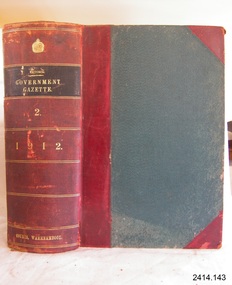
Book - Reference/State Government Notification Gazette, Albert John Mullett, The Victorian Government Gazette 1912 Vol 2 /147, 1912
... Australian meeting, and the detailed Education Department's Record of War Service (1914–1919) published in 1921. Unfortunately Mullet's tenure intersected with the heavy personal tolls of World War I; his own son, Leslie Holmes Mullett, was killed in action on April 11, 1917, at Bullecourt, France, while serving with the Australian Imperial Force. ...Australian meeting, and the detailed Education Department's Record of War Service (1914–1919) published in 1921. Unfortunately Mullet's tenure intersected with the heavy personal tolls of World War I; his own son, Leslie Holmes Mullett, was killed in action on April 11, 1917, at Bullecourt, France, while serving with the Australian Imperial Force. ...The Victoria Government Gazette and other government documents from 1887 were printed and published by Robert S. Brain, Government Printer, Melbourne. Brain held the position of Victorian Government Printer through the 1890s and into the early 1900s. The same imprint appears on other official Victorian publications from that era, such as the annual reports of the Board for the Protection of the Aborigines and the colony's Statistical Register. There wasn't really an editor in the modern sense the Gazette was compiled and issued under the authority of the colonial government, via the Chief Secretary's Department, with Brain's printing office producing and publishing it. In May 1906, James Kemp succeeded him, serving as Government Printer from May 1906 to August 1912, with the title of Acting Government Printer right at the very start of his tenure he was stepping into the role Brain had just vacated, and by later in December 1906 he was signing gazettes in that capacity, apparently before his appointment was made permanent. Then in 1912 Albert John Mullett took over the role starting from January 1912 the same way Kemp had as Acting Government Printer with his appointment made permanent in 1913 where he served all through the 1920s.Hard cover book. The Victorian Government Gazette 1912 Vol 2 /147 Printer: Albert John Mullett Publisher: Albert John Mullett Publisher: Authority of The Colonial Government Date: 1912 Further Information: Textured hard cover bound book leather burgundy colour spine with gilt lettering, covers embossed blue cloth & reinforced corners to front and back cover. non-fictionThe Victoria Government Gazette and other government documents from 1887 were printed and published by Robert S. Brain, Government Printer, Melbourne. Brain held the position of Victorian Government Printer through the 1890s and into the early 1900s. The same imprint appears on other official Victorian publications from that era, such as the annual reports of the Board for the Protection of the Aborigines and the colony's Statistical Register. There wasn't really an editor in the modern sense the Gazette was compiled and issued under the authority of the colonial government, via the Chief Secretary's Department, with Brain's printing office producing and publishing it. In May 1906, James Kemp succeeded him, serving as Government Printer from May 1906 to August 1912, with the title of Acting Government Printer right at the very start of his tenure he was stepping into the role Brain had just vacated, and by later in December 1906 he was signing gazettes in that capacity, apparently before his appointment was made permanent. Then in 1912 Albert John Mullett took over the role starting from January 1912 the same way Kemp had as Acting Government Printer with his appointment made permanent in 1913 where he served all through the 1920s. flagstaff hill, warrnambool, shipwrecked-coast, flagstaff-hill, flagstaff-hill-maritime-museum, maritime-museum, shipwreck-coast, flagstaff-hill-maritime-village, book, the victoria government gazette 1912 1 vol 146, the victoria government gazette 1912, the victoria government gazette -
 Flagstaff Hill Maritime Museum and Village
Book - Reference/State Government Notification Gazette, Albert John Mullett, The Victorian Government Gazette 1912 Vol 3 /148, 1912
... Australian meeting, and the detailed Education Department's Record of War Service (1914–1919) published in 1921. Unfortunately Mullet's tenure intersected with the heavy personal tolls of World War I; his own son, Leslie Holmes Mullett, was killed in action on April 11, 1917, at Bullecourt, France, while serving with the Australian Imperial Force. ...Australian meeting, and the detailed Education Department's Record of War Service (1914–1919) published in 1921. Unfortunately Mullet's tenure intersected with the heavy personal tolls of World War I; his own son, Leslie Holmes Mullett, was killed in action on April 11, 1917, at Bullecourt, France, while serving with the Australian Imperial Force. ...The Victoria Government Gazette and other government documents from 1887 were printed and published by Robert S. Brain, Government Printer, Melbourne. Brain held the position of Victorian Government Printer through the 1890s and into the early 1900s. The same imprint appears on other official Victorian publications from that era, such as the annual reports of the Board for the Protection of the Aborigines and the colony's Statistical Register. There wasn't really an editor in the modern sense the Gazette was compiled and issued under the authority of the colonial government, via the Chief Secretary's Department, with Brain's printing office producing and publishing it. In May 1906, James Kemp succeeded him, serving as Government Printer from May 1906 to August 1912, with the title of Acting Government Printer right at the very start of his tenure he was stepping into the role Brain had just vacated, and by later in December 1906 he was signing gazettes in that capacity, apparently before his appointment was made permanent. Then in 1912 Albert John Mullett took over the role starting from January 1912 the same way Kemp had as Acting Government Printer with his appointment made permanent in 1913 where he served all through the 1920s.Hard cover book. The Victorian Government Gazette 1912 Vol 3 /148 Printer: Albert John Mullett Publisher: Albert John Mullett Publisher: Authority of The Colonial Government Date: 1912 Further Information: Textured hard cover bound book leather burgundy colour spine with gilt lettering, covers embossed blue cloth & reinforced corners to front and back cover. non-fictionThe Victoria Government Gazette and other government documents from 1887 were printed and published by Robert S. Brain, Government Printer, Melbourne. Brain held the position of Victorian Government Printer through the 1890s and into the early 1900s. The same imprint appears on other official Victorian publications from that era, such as the annual reports of the Board for the Protection of the Aborigines and the colony's Statistical Register. There wasn't really an editor in the modern sense the Gazette was compiled and issued under the authority of the colonial government, via the Chief Secretary's Department, with Brain's printing office producing and publishing it. In May 1906, James Kemp succeeded him, serving as Government Printer from May 1906 to August 1912, with the title of Acting Government Printer right at the very start of his tenure he was stepping into the role Brain had just vacated, and by later in December 1906 he was signing gazettes in that capacity, apparently before his appointment was made permanent. Then in 1912 Albert John Mullett took over the role starting from January 1912 the same way Kemp had as Acting Government Printer with his appointment made permanent in 1913 where he served all through the 1920s. flagstaff hill, warrnambool, shipwrecked-coast, flagstaff-hill, flagstaff-hill-maritime-museum, maritime-museum, shipwreck-coast, flagstaff-hill-maritime-village, book, the victoria government gazette 1912 1 vol 146, the victoria government gazette 1912, the victoria government gazette -
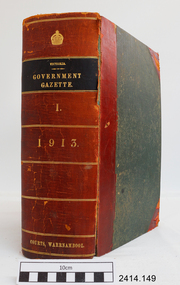 Flagstaff Hill Maritime Museum and Village
Book - Reference/State Government Notification Gazette, Albert John Mullett, The Victorian Government Gazette 1913 Vol 1 /149 ( Vol Number Mis Print on Volume Title CXLVIX See Note Section), 1913
... Australian meeting, and the detailed Education Department's Record of War Service (1914–1919) published in 1921. Unfortunately Mullet's tenure intersected with the heavy personal tolls of World War I; his own son, Leslie Holmes Mullett, was killed in action on April 11, 1917, at Bullecourt, France, while serving with the Australian Imperial Force. ...Australian meeting, and the detailed Education Department's Record of War Service (1914–1919) published in 1921. Unfortunately Mullet's tenure intersected with the heavy personal tolls of World War I; his own son, Leslie Holmes Mullett, was killed in action on April 11, 1917, at Bullecourt, France, while serving with the Australian Imperial Force. ...The Victoria Government Gazette and other government documents from 1887 were printed and published by Robert S. Brain, Government Printer, Melbourne. Brain held the position of Victorian Government Printer through the 1890s and into the early 1900s. The same imprint appears on other official Victorian publications from that era, such as the annual reports of the Board for the Protection of the Aborigines and the colony's Statistical Register. There wasn't really an editor in the modern sense the Gazette was compiled and issued under the authority of the colonial government, via the Chief Secretary's Department, with Brain's printing office producing and publishing it. In May 1906, James Kemp succeeded him, serving as Government Printer from May 1906 to August 1912, with the title of Acting Government Printer right at the very start of his tenure he was stepping into the role Brain had just vacated, and by later in December 1906 he was signing gazettes in that capacity, apparently before his appointment was made permanent. Then in 1912 Albert John Mullett took over the role starting from January 1912 the same way Kemp had as Acting Government Printer with his appointment made permanent in 1913 where he served all through the 1920s.Hard cover book. The Victorian Government Gazette 1913 Vol 1 /149 Printer: Albert John Mullett Publisher: Albert John Mullett Publisher: Authority of The Colonial Government Date: 1913 Further Information: Textured hard cover bound book leather burgundy colour spine with gilt lettering, covers embossed blue cloth & reinforced corners to front and back cover. non-fictionThe Victoria Government Gazette and other government documents from 1887 were printed and published by Robert S. Brain, Government Printer, Melbourne. Brain held the position of Victorian Government Printer through the 1890s and into the early 1900s. The same imprint appears on other official Victorian publications from that era, such as the annual reports of the Board for the Protection of the Aborigines and the colony's Statistical Register. There wasn't really an editor in the modern sense the Gazette was compiled and issued under the authority of the colonial government, via the Chief Secretary's Department, with Brain's printing office producing and publishing it. In May 1906, James Kemp succeeded him, serving as Government Printer from May 1906 to August 1912, with the title of Acting Government Printer right at the very start of his tenure he was stepping into the role Brain had just vacated, and by later in December 1906 he was signing gazettes in that capacity, apparently before his appointment was made permanent. Then in 1912 Albert John Mullett took over the role starting from January 1912 the same way Kemp had as Acting Government Printer with his appointment made permanent in 1913 where he served all through the 1920s. flagstaff hill, warrnambool, shipwrecked-coast, flagstaff-hill, flagstaff-hill-maritime-museum, maritime-museum, shipwreck-coast, flagstaff-hill-maritime-village, book, the victoria government gazette 1912 1 vol 146, the victoria government gazette 1912, the victoria government gazette -
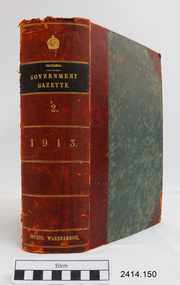 Flagstaff Hill Maritime Museum and Village
Book - Reference/State Government Notification Gazette, Albert John Mullett, The Victorian Government Gazette 1913 Vol 2 /150, 1913
... Australian meeting, and the detailed Education Department's Record of War Service (1914–1919) published in 1921. Unfortunately Mullet's tenure intersected with the heavy personal tolls of World War I; his own son, Leslie Holmes Mullett, was killed in action on April 11, 1917, at Bullecourt, France, while serving with the Australian Imperial Force. ...Australian meeting, and the detailed Education Department's Record of War Service (1914–1919) published in 1921. Unfortunately Mullet's tenure intersected with the heavy personal tolls of World War I; his own son, Leslie Holmes Mullett, was killed in action on April 11, 1917, at Bullecourt, France, while serving with the Australian Imperial Force. ...The Victoria Government Gazette and other government documents from 1887 were printed and published by Robert S. Brain, Government Printer, Melbourne. Brain held the position of Victorian Government Printer through the 1890s and into the early 1900s. The same imprint appears on other official Victorian publications from that era, such as the annual reports of the Board for the Protection of the Aborigines and the colony's Statistical Register. There wasn't really an editor in the modern sense the Gazette was compiled and issued under the authority of the colonial government, via the Chief Secretary's Department, with Brain's printing office producing and publishing it. In May 1906, James Kemp succeeded him, serving as Government Printer from May 1906 to August 1912, with the title of Acting Government Printer right at the very start of his tenure he was stepping into the role Brain had just vacated, and by later in December 1906 he was signing gazettes in that capacity, apparently before his appointment was made permanent. Then in 1912 Albert John Mullett took over the role starting from January 1912 the same way Kemp had as Acting Government Printer with his appointment made permanent in 1913 where he served all through the 1920s.Hard cover book. The Victorian Government Gazette 1913 Vol 2 /150 Printer: Albert John Mullett Publisher: Albert John Mullett Publisher: Authority of The Colonial Government Date: 1913 Further Information: Textured hard cover bound book leather burgundy colour spine with gilt lettering, covers embossed blue cloth & reinforced corners to front and back cover. non-fictionThe Victoria Government Gazette and other government documents from 1887 were printed and published by Robert S. Brain, Government Printer, Melbourne. Brain held the position of Victorian Government Printer through the 1890s and into the early 1900s. The same imprint appears on other official Victorian publications from that era, such as the annual reports of the Board for the Protection of the Aborigines and the colony's Statistical Register. There wasn't really an editor in the modern sense the Gazette was compiled and issued under the authority of the colonial government, via the Chief Secretary's Department, with Brain's printing office producing and publishing it. In May 1906, James Kemp succeeded him, serving as Government Printer from May 1906 to August 1912, with the title of Acting Government Printer right at the very start of his tenure he was stepping into the role Brain had just vacated, and by later in December 1906 he was signing gazettes in that capacity, apparently before his appointment was made permanent. Then in 1912 Albert John Mullett took over the role starting from January 1912 the same way Kemp had as Acting Government Printer with his appointment made permanent in 1913 where he served all through the 1920s. flagstaff hill, warrnambool, shipwrecked-coast, flagstaff-hill, flagstaff-hill-maritime-museum, maritime-museum, shipwreck-coast, flagstaff-hill-maritime-village, book, the victoria government gazette 1912 1 vol 146, the victoria government gazette 1912, the victoria government gazette -
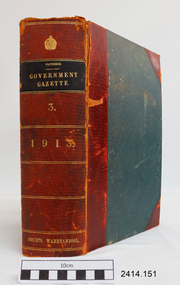 Flagstaff Hill Maritime Museum and Village
Book - Reference/State Government Notification Gazette, Albert John Mullett, The Victorian Government Gazette 1913 Vol 3 /151, 1913
... Australian meeting, and the detailed Education Department's Record of War Service (1914–1919) published in 1921. Unfortunately Mullet's tenure intersected with the heavy personal tolls of World War I; his own son, Leslie Holmes Mullett, was killed in action on April 11, 1917, at Bullecourt, France, while serving with the Australian Imperial Force. ...Australian meeting, and the detailed Education Department's Record of War Service (1914–1919) published in 1921. Unfortunately Mullet's tenure intersected with the heavy personal tolls of World War I; his own son, Leslie Holmes Mullett, was killed in action on April 11, 1917, at Bullecourt, France, while serving with the Australian Imperial Force. ...The Victoria Government Gazette and other government documents from 1887 were printed and published by Robert S. Brain, Government Printer, Melbourne. Brain held the position of Victorian Government Printer through the 1890s and into the early 1900s. The same imprint appears on other official Victorian publications from that era, such as the annual reports of the Board for the Protection of the Aborigines and the colony's Statistical Register. There wasn't really an editor in the modern sense the Gazette was compiled and issued under the authority of the colonial government, via the Chief Secretary's Department, with Brain's printing office producing and publishing it. In May 1906, James Kemp succeeded him, serving as Government Printer from May 1906 to August 1912, with the title of Acting Government Printer right at the very start of his tenure he was stepping into the role Brain had just vacated, and by later in December 1906 he was signing gazettes in that capacity, apparently before his appointment was made permanent. Then in 1912 Albert John Mullett took over the role starting from January 1912 the same way Kemp had as Acting Government Printer with his appointment made permanent in 1913 where he served all through the 1920s.Hard cover book. The Victorian Government Gazette 1913 Vol 3 /151 Printer: Albert John Mullett Publisher: Albert John Mullett Publisher: Authority of The Colonial Government Date: 1913 Further Information: Textured hard cover bound book leather burgundy colour spine with gilt lettering, covers embossed blue cloth & reinforced corners to front and back cover. non-fictionThe Victoria Government Gazette and other government documents from 1887 were printed and published by Robert S. Brain, Government Printer, Melbourne. Brain held the position of Victorian Government Printer through the 1890s and into the early 1900s. The same imprint appears on other official Victorian publications from that era, such as the annual reports of the Board for the Protection of the Aborigines and the colony's Statistical Register. There wasn't really an editor in the modern sense the Gazette was compiled and issued under the authority of the colonial government, via the Chief Secretary's Department, with Brain's printing office producing and publishing it. In May 1906, James Kemp succeeded him, serving as Government Printer from May 1906 to August 1912, with the title of Acting Government Printer right at the very start of his tenure he was stepping into the role Brain had just vacated, and by later in December 1906 he was signing gazettes in that capacity, apparently before his appointment was made permanent. Then in 1912 Albert John Mullett took over the role starting from January 1912 the same way Kemp had as Acting Government Printer with his appointment made permanent in 1913 where he served all through the 1920s. flagstaff hill, warrnambool, shipwrecked-coast, flagstaff-hill, flagstaff-hill-maritime-museum, maritime-museum, shipwreck-coast, flagstaff-hill-maritime-village, book, the victoria government gazette 1912 1 vol 146, the victoria government gazette 1912, the victoria government gazette -
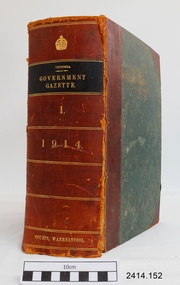 Flagstaff Hill Maritime Museum and Village
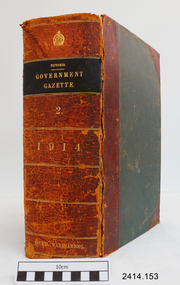
Book - Reference/State Government Notification Gazette, Albert John Mullett, The Victorian Government Gazette 1914 Vol 1 /152, 1914
... Australian meeting, and the detailed Education Department's Record of War Service (1914–1919) published in 1921. Unfortunately Mullet's tenure intersected with the heavy personal tolls of World War I; his own son, Leslie Holmes Mullett, was killed in action on April 11, 1917, at Bullecourt, France, while serving with the Australian Imperial Force. ...Australian meeting, and the detailed Education Department's Record of War Service (1914–1919) published in 1921. Unfortunately Mullet's tenure intersected with the heavy personal tolls of World War I; his own son, Leslie Holmes Mullett, was killed in action on April 11, 1917, at Bullecourt, France, while serving with the Australian Imperial Force. ...The Victoria Government Gazette and other government documents from 1887 were printed and published by Robert S. Brain, Government Printer, Melbourne. Brain held the position of Victorian Government Printer through the 1890s and into the early 1900s. The same imprint appears on other official Victorian publications from that era, such as the annual reports of the Board for the Protection of the Aborigines and the colony's Statistical Register. There wasn't really an editor in the modern sense the Gazette was compiled and issued under the authority of the colonial government, via the Chief Secretary's Department, with Brain's printing office producing and publishing it. In May 1906, James Kemp succeeded him, serving as Government Printer from May 1906 to August 1912, with the title of Acting Government Printer right at the very start of his tenure he was stepping into the role Brain had just vacated, and by later in December 1906 he was signing gazettes in that capacity, apparently before his appointment was made permanent. Then in 1912 Albert John Mullett took over the role starting from January 1912 the same way Kemp had as Acting Government Printer with his appointment made permanent in 1913 where he served all through the 1920s.Hard cover book. The Victorian Government Gazette 1914 Vol 1 /152 Printer: Albert John Mullett Publisher: Albert John Mullett Publisher: Authority of The Colonial Government Date: 1914 Further Information: Textured hard cover bound book leather burgundy colour spine with gilt lettering, covers embossed blue cloth & reinforced corners to front and back cover. non-fictionThe Victoria Government Gazette and other government documents from 1887 were printed and published by Robert S. Brain, Government Printer, Melbourne. Brain held the position of Victorian Government Printer through the 1890s and into the early 1900s. The same imprint appears on other official Victorian publications from that era, such as the annual reports of the Board for the Protection of the Aborigines and the colony's Statistical Register. There wasn't really an editor in the modern sense the Gazette was compiled and issued under the authority of the colonial government, via the Chief Secretary's Department, with Brain's printing office producing and publishing it. In May 1906, James Kemp succeeded him, serving as Government Printer from May 1906 to August 1912, with the title of Acting Government Printer right at the very start of his tenure he was stepping into the role Brain had just vacated, and by later in December 1906 he was signing gazettes in that capacity, apparently before his appointment was made permanent. Then in 1912 Albert John Mullett took over the role starting from January 1912 the same way Kemp had as Acting Government Printer with his appointment made permanent in 1913 where he served all through the 1920s. flagstaff hill, warrnambool, shipwrecked-coast, flagstaff-hill, flagstaff-hill-maritime-museum, maritime-museum, shipwreck-coast, flagstaff-hill-maritime-village, book, the victoria government gazette 1912 1 vol 146, the victoria government gazette 1912, the victoria government gazette -
 Flagstaff Hill Maritime Museum and Village
Book - Reference/State Government Notification Gazette, Albert John Mullett, The Victorian Government Gazette 1914 Vol 2 /153, 1914
... Australian meeting, and the detailed Education Department's Record of War Service (1914–1919) published in 1921. Unfortunately Mullet's tenure intersected with the heavy personal tolls of World War I; his own son, Leslie Holmes Mullett, was killed in action on April 11, 1917, at Bullecourt, France, while serving with the Australian Imperial Force. ...Australian meeting, and the detailed Education Department's Record of War Service (1914–1919) published in 1921. Unfortunately Mullet's tenure intersected with the heavy personal tolls of World War I; his own son, Leslie Holmes Mullett, was killed in action on April 11, 1917, at Bullecourt, France, while serving with the Australian Imperial Force. ...The Victoria Government Gazette and other government documents from 1887 were printed and published by Robert S. Brain, Government Printer, Melbourne. Brain held the position of Victorian Government Printer through the 1890s and into the early 1900s. The same imprint appears on other official Victorian publications from that era, such as the annual reports of the Board for the Protection of the Aborigines and the colony's Statistical Register. There wasn't really an editor in the modern sense the Gazette was compiled and issued under the authority of the colonial government, via the Chief Secretary's Department, with Brain's printing office producing and publishing it. In May 1906, James Kemp succeeded him, serving as Government Printer from May 1906 to August 1912, with the title of Acting Government Printer right at the very start of his tenure he was stepping into the role Brain had just vacated, and by later in December 1906 he was signing gazettes in that capacity, apparently before his appointment was made permanent. Then in 1912 Albert John Mullett took over the role starting from January 1912 the same way Kemp had as Acting Government Printer with his appointment made permanent in 1913 where he served all through the 1920s.Hard cover book. The Victorian Government Gazette 1914 Vol 2 /153 Printer: Albert John Mullett Publisher: Albert John Mullett Publisher: Authority of The Colonial Government Date: 1914 Further Information: Textured hard cover bound book leather burgundy colour spine with gilt lettering, covers embossed blue cloth & reinforced corners to front and back cover. non-fictionThe Victoria Government Gazette and other government documents from 1887 were printed and published by Robert S. Brain, Government Printer, Melbourne. Brain held the position of Victorian Government Printer through the 1890s and into the early 1900s. The same imprint appears on other official Victorian publications from that era, such as the annual reports of the Board for the Protection of the Aborigines and the colony's Statistical Register. There wasn't really an editor in the modern sense the Gazette was compiled and issued under the authority of the colonial government, via the Chief Secretary's Department, with Brain's printing office producing and publishing it. In May 1906, James Kemp succeeded him, serving as Government Printer from May 1906 to August 1912, with the title of Acting Government Printer right at the very start of his tenure he was stepping into the role Brain had just vacated, and by later in December 1906 he was signing gazettes in that capacity, apparently before his appointment was made permanent. Then in 1912 Albert John Mullett took over the role starting from January 1912 the same way Kemp had as Acting Government Printer with his appointment made permanent in 1913 where he served all through the 1920s. flagstaff hill, warrnambool, shipwrecked-coast, flagstaff-hill, flagstaff-hill-maritime-museum, maritime-museum, shipwreck-coast, flagstaff-hill-maritime-village, book, the victoria government gazette 1912 1 vol 146, the victoria government gazette 1912, the victoria government gazette -
 Bendigo Military Museum
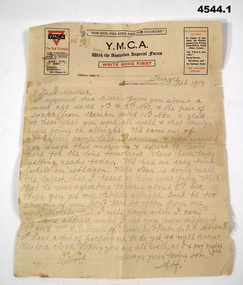
Letter - LETTERS WW1, C.1917
... Letters YMCA France .1) Main points, “France Sun 11th Feb 1917”, “Dear Mother”, “Always your loving son Alf” .2) Main points, “I remain your loving brother & son xxxx Alf (Love to all)” .3 Main points, “France Sun 18th Feb 1917”, “Dear Mother & all” .1) Letter, “YMCA, With the Australian Imperial Force” letterhead, yellowed, all printing in red & black, ruled lines, hand written in black pencil, dated. .2) letter, rectangular shape, off white colour, hand written in black pencil & ink. .3) Letter, rectangular shape, off white colour, unlined, hand written in black pencil, dated. ...Letters from Alfred G Ferris No 2156 AIF to his family at Terrick Terrick. Refer cat No 4183.3P for Alf’s service details..1) Letter, “YMCA, With the Australian Imperial Force” letterhead, yellowed, all printing in red & black, ruled lines, hand written in black pencil, dated. .2) letter, rectangular shape, off white colour, hand written in black pencil & ink. .3) Letter, rectangular shape, off white colour, unlined, hand written in black pencil, dated..1) Main points, “France Sun 11th Feb 1917”, “Dear Mother”, “Always your loving son Alf” .2) Main points, “I remain your loving brother & son xxxx Alf (Love to all)” .3 Main points, “France Sun 18th Feb 1917”, “Dear Mother & all”letters, ymca, france -
 Bendigo Historical Society Inc.
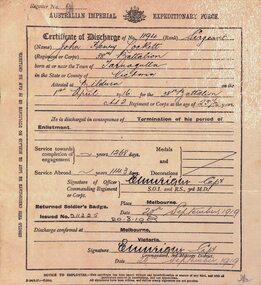
Document - Jack Lockett Collection: Army Certificate of Discharge
... Australian Imperial Force. He served in France with the 38th Battalion, earning promotion to sergeant and was discharged on 20 September 1919. https://en.wikipedia.org/wiki/Jack_Lockett The 38th Battalion was formed on 1 March 1916 at a camp established on the Epsom Racecourse at Bendigo in Victoria. After training in both Australia and Britain, the 38th Battalion crossed to France in late November 1916 and moved into the trenches of the Western Front for the first time on 1 December.The 38th fought in its first major battle at Messines, in Belgium, between 7-9 June 1917. ...Australian Imperial Force. He served in France with the 38th Battalion, earning promotion to sergeant and was discharged on 20 September 1919. https://en.wikipedia.org/wiki/Jack_Lockett The 38th Battalion was formed on 1 March 1916 at a camp established on the Epsom Racecourse at Bendigo in Victoria. After training in both Australia and Britain, the 38th Battalion crossed to France in late November 1916 and moved into the trenches of the Western Front for the first time on 1 December.The 38th fought in its first major battle at Messines, in Belgium, between 7-9 June 1917. ...John Henry Lockett OAM (22 January 1891 – 25 May 2002) was the oldest man ever in Australia when he died aged 111 years, 123 days. As one of the last surviving veterans of World War I, he was acclaimed as a national hero during the last decade of his life. Lockett was born in the small Victorian town of Waanyarra, near Bendigo. He left school aged nine to work on a local farm. Later, he worked for his uncles in the Mallee. On 24 March 1916, he travelled to Mildura to enlist in the Australian Imperial Force. He served in France with the 38th Battalion, earning promotion to sergeant and was discharged on 20 September 1919. https://en.wikipedia.org/wiki/Jack_Lockett The 38th Battalion was formed on 1 March 1916 at a camp established on the Epsom Racecourse at Bendigo in Victoria. After training in both Australia and Britain, the 38th Battalion crossed to France in late November 1916 and moved into the trenches of the Western Front for the first time on 1 December.The 38th fought in its first major battle at Messines, in Belgium, between 7-9 June 1917. It fought in another two major attacks in this sector - the battle of Broodseinde on 4 October, and the battle of Passchendaele on 12 October. Belgium remained the focus of the 38th Battalion's activities for the next five months, until it was rushed south to France in late March 1918 to meet the German Army's Spring Offensive. The 38th participated in its last major action of the war between 29 September and 2 October 1918 as part of the Australian-American operation that breached the formidable defences of the Hindenburg Line along the St Quentin Canal. It was disbanded in April 1919. Source, Australian War Memorial https://www.awm.gov.au/collection/U51478 After the war, Jack returned to The Mallee and selected a 640 acres (260 ha) block of land in Linga, Victoria, deciding to make his living as a farmer. In 1923, he married Maybell Ingwerson and they had four children together. In 1963, the couple retired to Bendigo, leaving the farmland (which now covered more than 130,000 acres (53,000 ha), in the care of their children and grandchildren. An off-white coulored document with black print and black handwriting headed AUSTRALIAN IMPERIAL EXPEDITIONARY FORCE Certificate of Discharge No 1194 Sergeant John Henry Lockett 38th Battalion, born Tarnagulla Victoria Attested at Mildura 1st April 1916for the 38th Battalion at the age of 25 1/2 years Total service 1268 days Service abroad 1143 days Discharge confirmed at Melbourne Victoria 20th September 1919 On the reverse V/B 60883 No 177770 Description of the above named Soldier on discharge Age 28 1/2 years Height 5' 10", complexion Medium, Eyes Blue, Hair Brown, Trade Farmer, Intended place of Residence Ouyen P.O. Victoria Singed J H Lockett jack lockett, mabel ingwersen, 38th australian infantry battalion, w.w.1, mallee farming -
 Bendigo Historical Society Inc.
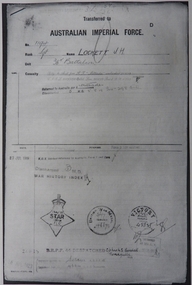
Document - Jack Lockett Collection: Copies of Army Service documents
... Australian Imperial Force. He served in France with the 38th Battalion, earning promotion to sergeant and was discharged on 20 September 1919. https://en.wikipedia.org/wiki/Jack_Lockett The 38th Battalion was formed on 1 March 1916 at a camp established on the Epsom Racecourse at Bendigo in Victoria. After training in both Australia and Britain, the 38th Battalion crossed to France in late November 1916 and moved into the trenches of the Western Front for the first time on 1 December.The 38th fought in its first major battle at Messines, in Belgium, between 7-9 June 1917. ...Australian Imperial Force. He served in France with the 38th Battalion, earning promotion to sergeant and was discharged on 20 September 1919. https://en.wikipedia.org/wiki/Jack_Lockett The 38th Battalion was formed on 1 March 1916 at a camp established on the Epsom Racecourse at Bendigo in Victoria. After training in both Australia and Britain, the 38th Battalion crossed to France in late November 1916 and moved into the trenches of the Western Front for the first time on 1 December.The 38th fought in its first major battle at Messines, in Belgium, between 7-9 June 1917. ...John Henry Lockett OAM (22 January 1891 – 25 May 2002) was the oldest man ever in Australia when he died aged 111 years, 123 days. As one of the last surviving veterans of World War I, he was acclaimed as a national hero during the last decade of his life. Lockett was born in the small Victorian town of Waanyarra, near Bendigo. He left school aged nine to work on a local farm. Later, he worked for his uncles in the Mallee. On 24 March 1916, he travelled to Mildura to enlist in the Australian Imperial Force. He served in France with the 38th Battalion, earning promotion to sergeant and was discharged on 20 September 1919. https://en.wikipedia.org/wiki/Jack_Lockett The 38th Battalion was formed on 1 March 1916 at a camp established on the Epsom Racecourse at Bendigo in Victoria. After training in both Australia and Britain, the 38th Battalion crossed to France in late November 1916 and moved into the trenches of the Western Front for the first time on 1 December.The 38th fought in its first major battle at Messines, in Belgium, between 7-9 June 1917. It fought in another two major attacks in this sector - the battle of Broodseinde on 4 October, and the battle of Passchendaele on 12 October. Belgium remained the focus of the 38th Battalion's activities for the next five months, until it was rushed south to France in late March 1918 to meet the German Army's Spring Offensive. The 38th participated in its last major action of the war between 29 September and 2 October 1918 as part of the Australian-American operation that breached the formidable defences of the Hindenburg Line along the St Quentin Canal. It was disbanded in April 1919. Source, Australian War Memorial https://www.awm.gov.au/collection/U51478 After the war, Jack returned to The Mallee and selected a 640 acres (260 ha) block of land in Linga, Victoria, deciding to make his living as a farmer. In 1923, he married Maybell Ingwerson and they had four children together. In 1963, the couple retired to Bendigo, leaving the farmland (which now covered more than 130,000 acres (53,000 ha), in the care of their children and grandchildren. Thirteen photocopies relating to Jack Lockett's service in the Australian Imperial Force jack lockett, mabel ingwersen, 38th australian infantry battalion, w.w.1, mallee farming -
 Bendigo Historical Society Inc.
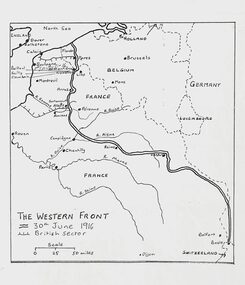
Map - Jack Lockett Collection: Copies of two maps of WW1 Battles
... Australian Imperial Force. He served in France with the 38th Battalion, earning promotion to sergeant and was discharged on 20 September 1919. https://en.wikipedia.org/wiki/Jack_Lockett The 38th Battalion was formed on 1 March 1916 at a camp established on the Epsom Racecourse at Bendigo in Victoria. After training in both Australia and Britain, the 38th Battalion crossed to France in late November 1916 and moved into the trenches of the Western Front for the first time on 1 December.The 38th fought in its first major battle at Messines, in Belgium, between 7-9 June 1917. ...Australian Imperial Force. He served in France with the 38th Battalion, earning promotion to sergeant and was discharged on 20 September 1919. https://en.wikipedia.org/wiki/Jack_Lockett The 38th Battalion was formed on 1 March 1916 at a camp established on the Epsom Racecourse at Bendigo in Victoria. After training in both Australia and Britain, the 38th Battalion crossed to France in late November 1916 and moved into the trenches of the Western Front for the first time on 1 December.The 38th fought in its first major battle at Messines, in Belgium, between 7-9 June 1917. ...John Henry Lockett OAM (22 January 1891 – 25 May 2002) was the oldest man ever in Australia when he died aged 111 years, 123 days. As one of the last surviving veterans of World War I, he was acclaimed as a national hero during the last decade of his life. Lockett was born in the small Victorian town of Waanyarra, near Bendigo. He left school aged nine to work on a local farm. Later, he worked for his uncles in the Mallee. On 24 March 1916, he travelled to Mildura to enlist in the Australian Imperial Force. He served in France with the 38th Battalion, earning promotion to sergeant and was discharged on 20 September 1919. https://en.wikipedia.org/wiki/Jack_Lockett The 38th Battalion was formed on 1 March 1916 at a camp established on the Epsom Racecourse at Bendigo in Victoria. After training in both Australia and Britain, the 38th Battalion crossed to France in late November 1916 and moved into the trenches of the Western Front for the first time on 1 December.The 38th fought in its first major battle at Messines, in Belgium, between 7-9 June 1917. It fought in another two major attacks in this sector - the battle of Broodseinde on 4 October, and the battle of Passchendaele on 12 October. Belgium remained the focus of the 38th Battalion's activities for the next five months, until it was rushed south to France in late March 1918 to meet the German Army's Spring Offensive. The 38th participated in its last major action of the war between 29 September and 2 October 1918 as part of the Australian-American operation that breached the formidable defences of the Hindenburg Line along the St Quentin Canal. It was disbanded in April 1919. Source, Australian War Memorial https://www.awm.gov.au/collection/U51478 After the war, Jack returned to The Mallee and selected a 640 acres (260 ha) block of land in Linga, Victoria, deciding to make his living as a farmer. In 1923, he married Maybell Ingwerson and they had four children together. In 1963, the couple retired to Bendigo, leaving the farmland (which now covered more than 130,000 acres (53,000 ha), in the care of their children and grandchildren. Two photocopies of hand drawn maps on one A4 sheet of paper. One side labeled THE WESTERN FRONT 30th June 1916 British Sector Scale 1 inch to 50 miles. The Western Front spans from the North Sea to Switzerland. The other side is labeled POZIERES scale 1 inch to 500 yards. July to September 1916. There are numerous roads and trench lines. jack lockett, mabel ingwersen, 38th australian infantry battalion, w.w.1, mallee farming, pozieres 1916, the western front 1916 -
 Bendigo Historical Society Inc.
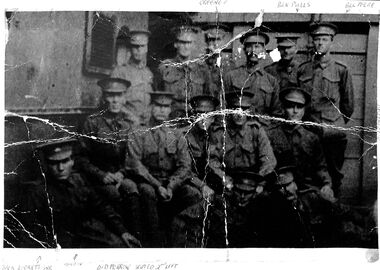
Postcard - Jack Lockett Collection:
... Australian Imperial Force. He served in France with the 38th Battalion, earning promotion to sergeant and was discharged on 20 September 1919. https://en.wikipedia.org/wiki/Jack_Lockett The 38th Battalion was formed on 1 March 1916 at a camp established on the Epsom Racecourse at Bendigo in Victoria. After training in both Australia and Britain, the 38th Battalion crossed to France in late November 1916 and moved into the trenches of the Western Front for the first time on 1 December.The 38th fought in its first major battle at Messines, in Belgium, between 7-9 June 1917. ...Australian Imperial Force. He served in France with the 38th Battalion, earning promotion to sergeant and was discharged on 20 September 1919. https://en.wikipedia.org/wiki/Jack_Lockett The 38th Battalion was formed on 1 March 1916 at a camp established on the Epsom Racecourse at Bendigo in Victoria. After training in both Australia and Britain, the 38th Battalion crossed to France in late November 1916 and moved into the trenches of the Western Front for the first time on 1 December.The 38th fought in its first major battle at Messines, in Belgium, between 7-9 June 1917. ...John Henry Lockett OAM (22 January 1891 – 25 May 2002) was the oldest man ever in Australia when he died aged 111 years, 123 days. As one of the last surviving veterans of World War I, he was acclaimed as a national hero during the last decade of his life. Lockett was born in the small Victorian town of Waanyarra, near Bendigo. He left school aged nine to work on a local farm. Later, he worked for his uncles in the Mallee. On 24 March 1916, he travelled to Mildura to enlist in the Australian Imperial Force. He served in France with the 38th Battalion, earning promotion to sergeant and was discharged on 20 September 1919. https://en.wikipedia.org/wiki/Jack_Lockett The 38th Battalion was formed on 1 March 1916 at a camp established on the Epsom Racecourse at Bendigo in Victoria. After training in both Australia and Britain, the 38th Battalion crossed to France in late November 1916 and moved into the trenches of the Western Front for the first time on 1 December.The 38th fought in its first major battle at Messines, in Belgium, between 7-9 June 1917. It fought in another two major attacks in this sector - the battle of Broodseinde on 4 October, and the battle of Passchendaele on 12 October. Belgium remained the focus of the 38th Battalion's activities for the next five months, until it was rushed south to France in late March 1918 to meet the German Army's Spring Offensive. The 38th participated in its last major action of the war between 29 September and 2 October 1918 as part of the Australian-American operation that breached the formidable defences of the Hindenburg Line along the St Quentin Canal. It was disbanded in April 1919. Source, Australian War Memorial https://www.awm.gov.au/collection/U51478 After the war, Jack returned to The Mallee and selected a 640 acres (260 ha) block of land in Linga, Victoria, deciding to make his living as a farmer. In 1923, he married Maybell Ingwerson and they had four children together. In 1963, the couple retired to Bendigo, leaving the farmland (which now covered more than 130,000 acres (53,000 ha), in the care of their children and grandchildren. An A4 size copy of a postcard with a black and white photograph of 14 men in army uniforms with some men identified - Greeno, Ben Pulls, Bill McCae, Jack Lockett Snr, Maldon, Dad Morrow. On the back there is a copy of the back of the postcard with handwriting - Dear Boys this a group of my cobbers No 1 section ............Dont loose it, Jack jack lockett, mabel ingwersen, 38th australian infantry battalion, w.w.1, mallee farming -
 Bendigo Historical Society Inc.
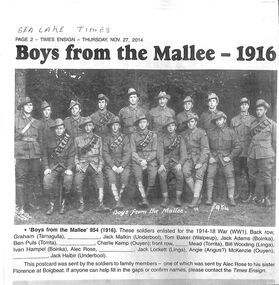
Memorabilia - Jack Lockett Collection: Boys from the Mallee 1916
... Australian Imperial Force. He served in France with the 38th Battalion, earning promotion to sergeant and was discharged on 20 September 1919. https://en.wikipedia.org/wiki/Jack_Lockett The 38th Battalion was formed on 1 March 1916 at a camp established on the Epsom Racecourse at Bendigo in Victoria. After training in both Australia and Britain, the 38th Battalion crossed to France in late November 1916 and moved into the trenches of the Western Front for the first time on 1 December.The 38th fought in its first major battle at Messines, in Belgium, between 7-9 June 1917. ...Australian Imperial Force. He served in France with the 38th Battalion, earning promotion to sergeant and was discharged on 20 September 1919. https://en.wikipedia.org/wiki/Jack_Lockett The 38th Battalion was formed on 1 March 1916 at a camp established on the Epsom Racecourse at Bendigo in Victoria. After training in both Australia and Britain, the 38th Battalion crossed to France in late November 1916 and moved into the trenches of the Western Front for the first time on 1 December.The 38th fought in its first major battle at Messines, in Belgium, between 7-9 June 1917. ...John Henry Lockett OAM (22 January 1891 – 25 May 2002) was the oldest man ever in Australia when he died aged 111 years, 123 days. As one of the last surviving veterans of World War I, he was acclaimed as a national hero during the last decade of his life. Lockett was born in the small Victorian town of Waanyarra, near Bendigo. He left school aged nine to work on a local farm. Later, he worked for his uncles in the Mallee. On 24 March 1916, he travelled to Mildura to enlist in the Australian Imperial Force. He served in France with the 38th Battalion, earning promotion to sergeant and was discharged on 20 September 1919. https://en.wikipedia.org/wiki/Jack_Lockett The 38th Battalion was formed on 1 March 1916 at a camp established on the Epsom Racecourse at Bendigo in Victoria. After training in both Australia and Britain, the 38th Battalion crossed to France in late November 1916 and moved into the trenches of the Western Front for the first time on 1 December.The 38th fought in its first major battle at Messines, in Belgium, between 7-9 June 1917. It fought in another two major attacks in this sector - the battle of Broodseinde on 4 October, and the battle of Passchendaele on 12 October. Belgium remained the focus of the 38th Battalion's activities for the next five months, until it was rushed south to France in late March 1918 to meet the German Army's Spring Offensive. The 38th participated in its last major action of the war between 29 September and 2 October 1918 as part of the Australian-American operation that breached the formidable defences of the Hindenburg Line along the St Quentin Canal. It was disbanded in April 1919. Source, Australian War Memorial https://www.awm.gov.au/collection/U51478 After the war, Jack returned to The Mallee and selected a 640 acres (260 ha) block of land in Linga, Victoria, deciding to make his living as a farmer. In 1923, he married Maybell Ingwerson and they had four children together. In 1963, the couple retired to Bendigo, leaving the farmland (which now covered more than 130,000 acres (53,000 ha), in the care of their children and grandchildren. A photocopy of an article and photograph headed - PAGE 2 TIMES ENSIGN - THURSDAY, NOV. 2014 (Sea Lake Times?) Boys from the Mallee- 1916. A photograph of a postcard of17 men in Australian Army Uniforms, 10 standing and seven sitting. Names listed Graham (Tarnagulla), Jack Malkin (Underbol), Tom Baker (Walpeup), Jack Adams (Binka), Ben Puls Torria), Charlie Kemp (Ouyen), Mead (Torrita), Bill Wooding (Linga), Ivan Hampel (Boinka), Alec Rose, Jack Locket (Linga) Angus McKenzie (Ouyen), Jack Halbir (Underbool) This postcard was sent by Alec Rose to his sister Florence. dge and Rheola. jack lockett, mabel ingwersen, 38th australian infantry battalion, w.w.1, mallee farming -
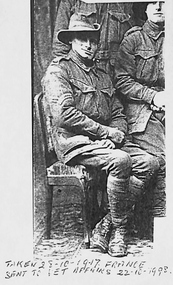 Bendigo Historical Society Inc.
Photograph - Jack Lockett Collection: Five W.W.1 photographs
... Australian Imperial Force. He served in France with the 38th Battalion, earning promotion to sergeant and was discharged on 20 September 1919. https://en.wikipedia.org/wiki/Jack_Lockett The 38th Battalion was formed on 1 March 1916 at a camp established on the Epsom Racecourse at Bendigo in Victoria. After training in both Australia and Britain, the 38th Battalion crossed to France in late November 1916 and moved into the trenches of the Western Front for the first time on 1 December.The 38th fought in its first major battle at Messines, in Belgium, between 7-9 June 1917. ...Australian Imperial Force. He served in France with the 38th Battalion, earning promotion to sergeant and was discharged on 20 September 1919. https://en.wikipedia.org/wiki/Jack_Lockett The 38th Battalion was formed on 1 March 1916 at a camp established on the Epsom Racecourse at Bendigo in Victoria. After training in both Australia and Britain, the 38th Battalion crossed to France in late November 1916 and moved into the trenches of the Western Front for the first time on 1 December.The 38th fought in its first major battle at Messines, in Belgium, between 7-9 June 1917. ...John Henry Lockett OAM (22 January 1891 – 25 May 2002) was the oldest man ever in Australia when he died aged 111 years, 123 days. As one of the last surviving veterans of World War I, he was acclaimed as a national hero during the last decade of his life. Lockett was born in the small Victorian town of Waanyarra, near Bendigo. He left school aged nine to work on a local farm. Later, he worked for his uncles in the Mallee. On 24 March 1916, he travelled to Mildura to enlist in the Australian Imperial Force. He served in France with the 38th Battalion, earning promotion to sergeant and was discharged on 20 September 1919. https://en.wikipedia.org/wiki/Jack_Lockett The 38th Battalion was formed on 1 March 1916 at a camp established on the Epsom Racecourse at Bendigo in Victoria. After training in both Australia and Britain, the 38th Battalion crossed to France in late November 1916 and moved into the trenches of the Western Front for the first time on 1 December.The 38th fought in its first major battle at Messines, in Belgium, between 7-9 June 1917. It fought in another two major attacks in this sector - the battle of Broodseinde on 4 October, and the battle of Passchendaele on 12 October. Belgium remained the focus of the 38th Battalion's activities for the next five months, until it was rushed south to France in late March 1918 to meet the German Army's Spring Offensive. The 38th participated in its last major action of the war between 29 September and 2 October 1918 as part of the Australian-American operation that breached the formidable defences of the Hindenburg Line along the St Quentin Canal. It was disbanded in April 1919. Source, Australian War Memorial https://www.awm.gov.au/collection/U51478 After the war, Jack returned to The Mallee and selected a 640 acres (260 ha) block of land in Linga, Victoria, deciding to make his living as a farmer. In 1923, he married Maybell Ingwerson and they had four children together. In 1963, the couple retired to Bendigo, leaving the farmland (which now covered more than 130,000 acres (53,000 ha), in the care of their children and grandchildren. Five photographs including Jack Lockett a. A photocopy of part of a group photograph, Jack sitting on a chair wearing an Australian Army Uniform. Written underneath - Teken 25-10-1917 France sent to Vet affairs 22-10-1998 b. A black and white photograph of a ship crowed with people on deck with printing - H.M.A.T. "RUNIC" (copyright) 20/6/16 written on the back in blue ink - Private Jack Locket No 1194 D Company 38th Battalion A.I.F. left Port Melbourne pier on Tues 20 June 1916 aboard H.M.A.T. RUNIC bound for England via South Africa. He was below deck peering out of a porthole when the boat pulled away from the pier, as he had the job of guarding some supplies. the arrived in England on (sic) Returning to Australia on Miltides on Mon 17th Feb 1919 as a Sargent Discharged 20 SEPT 1919 c. A very faded sepia tone photograph of four men in Army Uniforms without hats. three sitting and Jack Lockett lying on the man in the middle. Written on the back - JACK LOCKETT LYING ON ONE of His 3 MATES NAMES UNKNOWN FIRST AIF 1914 -1918 GREAT WAR d. A black and white postcard of Jack Lockett in an Australian Army Uniform sitting cross legged in a chair with an image of a forest behind him. Written on the back J H LOCKETT D COY 38 BATT 3DIV NO1194 1stAIF FRANCE e. c. A very faded sepia tone photograph of nine men in Army Uniforms wearing gas masks, six men standing, four men Kneeling in front. Behind them there is a corrugated-iron building. Written on the back - FIRST GAS MASKS W.W. 1 JACK LOCKET 2nd RIGHT STANDING jack lockett, mabel ingwersen, 38th australian infantry battalion, w.w.1, mallee farming, h.m.a.t. runic, gas masks -
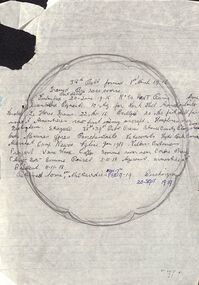 Bendigo Historical Society Inc.
Journal - Jack Lockett Collection: Brief handwritten 38th Battalion Histroy
... Australian Imperial Force. He served in France with the 38th Battalion, earning promotion to sergeant and was discharged on 20 September 1919. https://en.wikipedia.org/wiki/Jack_Lockett The 38th Battalion was formed on 1 March 1916 at a camp established on the Epsom Racecourse at Bendigo in Victoria. After training in both Australia and Britain, the 38th Battalion crossed to France in late November 1916 and moved into the trenches of the Western Front for the first time on 1 December.The 38th fought in its first major battle at Messines, in Belgium, between 7-9 June 1917. ...Australian Imperial Force. He served in France with the 38th Battalion, earning promotion to sergeant and was discharged on 20 September 1919. https://en.wikipedia.org/wiki/Jack_Lockett The 38th Battalion was formed on 1 March 1916 at a camp established on the Epsom Racecourse at Bendigo in Victoria. After training in both Australia and Britain, the 38th Battalion crossed to France in late November 1916 and moved into the trenches of the Western Front for the first time on 1 December.The 38th fought in its first major battle at Messines, in Belgium, between 7-9 June 1917. ...John Henry Lockett OAM (22 January 1891 – 25 May 2002) was the oldest man ever in Australia when he died aged 111 years, 123 days. As one of the last surviving veterans of World War I, he was acclaimed as a national hero during the last decade of his life. Lockett was born in the small Victorian town of Waanyarra, near Bendigo. He left school aged nine to work on a local farm. Later, he worked for his uncles in the Mallee. On 24 March 1916, he travelled to Mildura to enlist in the Australian Imperial Force. He served in France with the 38th Battalion, earning promotion to sergeant and was discharged on 20 September 1919. https://en.wikipedia.org/wiki/Jack_Lockett The 38th Battalion was formed on 1 March 1916 at a camp established on the Epsom Racecourse at Bendigo in Victoria. After training in both Australia and Britain, the 38th Battalion crossed to France in late November 1916 and moved into the trenches of the Western Front for the first time on 1 December.The 38th fought in its first major battle at Messines, in Belgium, between 7-9 June 1917. It fought in another two major attacks in this sector - the battle of Broodseinde on 4 October, and the battle of Passchendaele on 12 October. Belgium remained the focus of the 38th Battalion's activities for the next five months, until it was rushed south to France in late March 1918 to meet the German Army's Spring Offensive. The 38th participated in its last major action of the war between 29 September and 2 October 1918 as part of the Australian-American operation that breached the formidable defences of the Hindenburg Line along the St Quentin Canal. It was disbanded in April 1919. Source, Australian War Memorial https://www.awm.gov.au/collection/U51478 After the war, Jack returned to The Mallee and selected a 640 acres (260 ha) block of land in Linga, Victoria, deciding to make his living as a farmer. In 1923, he married Maybell Ingwerson and they had four children together. In 1963, the couple retired to Bendigo, leaving the farmland (which now covered more than 130,000 acres (53,000 ha), in the care of their children and grandchildren. An A blue-lined A4 page with black ink handwriting. A brief history of the 38th Battalion A.I.F. from when it was formed 1st March 1916 until returning home on 17th February 1919. A decorated circle is drawn with pencil over the handwriting jack lockett, mabel ingwersen, 38th australian infantry battalion, w.w.1, mallee farming, h.m.a.t. runic, gas masks -
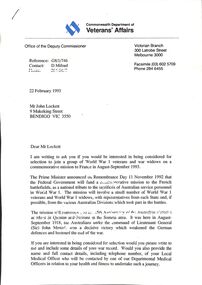 Bendigo Historical Society Inc.
Letter - Jack Lockett Collection: Letter Re Mission to France 1993
... Australian Imperial Force. He served in France with the 38th Battalion, earning promotion to sergeant and was discharged on 20 September 1919. https://en.wikipedia.org/wiki/Jack_Lockett The 38th Battalion was formed on 1 March 1916 at a camp established on the Epsom Racecourse at Bendigo in Victoria. After training in both Australia and Britain, the 38th Battalion crossed to France in late November 1916 and moved into the trenches of the Western Front for the first time on 1 December.The 38th fought in its first major battle at Messines, in Belgium, between 7-9 June 1917. ...Australian Imperial Force. He served in France with the 38th Battalion, earning promotion to sergeant and was discharged on 20 September 1919. https://en.wikipedia.org/wiki/Jack_Lockett The 38th Battalion was formed on 1 March 1916 at a camp established on the Epsom Racecourse at Bendigo in Victoria. After training in both Australia and Britain, the 38th Battalion crossed to France in late November 1916 and moved into the trenches of the Western Front for the first time on 1 December.The 38th fought in its first major battle at Messines, in Belgium, between 7-9 June 1917. ...John Henry Lockett OAM (22 January 1891 – 25 May 2002) was the oldest man ever in Australia when he died aged 111 years, 123 days. As one of the last surviving veterans of World War I, he was acclaimed as a national hero during the last decade of his life. Lockett was born in the small Victorian town of Waanyarra, near Bendigo. He left school aged nine to work on a local farm. Later, he worked for his uncles in the Mallee. On 24 March 1916, he travelled to Mildura to enlist in the Australian Imperial Force. He served in France with the 38th Battalion, earning promotion to sergeant and was discharged on 20 September 1919. https://en.wikipedia.org/wiki/Jack_Lockett The 38th Battalion was formed on 1 March 1916 at a camp established on the Epsom Racecourse at Bendigo in Victoria. After training in both Australia and Britain, the 38th Battalion crossed to France in late November 1916 and moved into the trenches of the Western Front for the first time on 1 December.The 38th fought in its first major battle at Messines, in Belgium, between 7-9 June 1917. It fought in another two major attacks in this sector - the battle of Broodseinde on 4 October, and the battle of Passchendaele on 12 October. Belgium remained the focus of the 38th Battalion's activities for the next five months, until it was rushed south to France in late March 1918 to meet the German Army's Spring Offensive. The 38th participated in its last major action of the war between 29 September and 2 October 1918 as part of the Australian-American operation that breached the formidable defences of the Hindenburg Line along the St Quentin Canal. It was disbanded in April 1919. Source, Australian War Memorial https://www.awm.gov.au/collection/U51478 After the war, Jack returned to The Mallee and selected a 640 acres (260 ha) block of land in Linga, Victoria, deciding to make his living as a farmer. In 1923, he married Maybell Ingwerson and they had four children together. In 1963, the couple retired to Bendigo, leaving the farmland (which now covered more than 130,000 acres (53,000 ha), in the care of their children and grandchildren. A typed letter on two A4 pages to Jack Lockett Sent from the Commonwealth Department of Veterans Affairs, Office of the Deputy Commissioner, 22 February asking Jack if he wished to be considered for selection to join a commemorative mission to France in August - September 1993. Signed Brian Flynn DEPUTY COMMISSIONER jack lockett, mabel ingwersen, 38th australian infantry battalion, w.w.1, mallee farming, commemorative mission to france 1993, brian flynn -
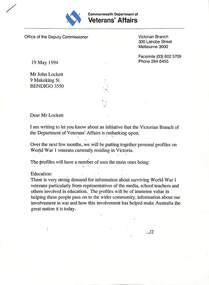 Bendigo Historical Society Inc.
Letter - Jack Lockett Collection: Letter Re Person profiles of W.W.1 veterans
... Australian Imperial Force. He served in France with the 38th Battalion, earning promotion to sergeant and was discharged on 20 September 1919. https://en.wikipedia.org/wiki/Jack_Lockett The 38th Battalion was formed on 1 March 1916 at a camp established on the Epsom Racecourse at Bendigo in Victoria. After training in both Australia and Britain, the 38th Battalion crossed to France in late November 1916 and moved into the trenches of the Western Front for the first time on 1 December.The 38th fought in its first major battle at Messines, in Belgium, between 7-9 June 1917. ...Australian Imperial Force. He served in France with the 38th Battalion, earning promotion to sergeant and was discharged on 20 September 1919. https://en.wikipedia.org/wiki/Jack_Lockett The 38th Battalion was formed on 1 March 1916 at a camp established on the Epsom Racecourse at Bendigo in Victoria. After training in both Australia and Britain, the 38th Battalion crossed to France in late November 1916 and moved into the trenches of the Western Front for the first time on 1 December.The 38th fought in its first major battle at Messines, in Belgium, between 7-9 June 1917. ...John Henry Lockett OAM (22 January 1891 – 25 May 2002) was the oldest man ever in Australia when he died aged 111 years, 123 days. As one of the last surviving veterans of World War I, he was acclaimed as a national hero during the last decade of his life. Lockett was born in the small Victorian town of Waanyarra, near Bendigo. He left school aged nine to work on a local farm. Later, he worked for his uncles in the Mallee. On 24 March 1916, he travelled to Mildura to enlist in the Australian Imperial Force. He served in France with the 38th Battalion, earning promotion to sergeant and was discharged on 20 September 1919. https://en.wikipedia.org/wiki/Jack_Lockett The 38th Battalion was formed on 1 March 1916 at a camp established on the Epsom Racecourse at Bendigo in Victoria. After training in both Australia and Britain, the 38th Battalion crossed to France in late November 1916 and moved into the trenches of the Western Front for the first time on 1 December.The 38th fought in its first major battle at Messines, in Belgium, between 7-9 June 1917. It fought in another two major attacks in this sector - the battle of Broodseinde on 4 October, and the battle of Passchendaele on 12 October. Belgium remained the focus of the 38th Battalion's activities for the next five months, until it was rushed south to France in late March 1918 to meet the German Army's Spring Offensive. The 38th participated in its last major action of the war between 29 September and 2 October 1918 as part of the Australian-American operation that breached the formidable defences of the Hindenburg Line along the St Quentin Canal. It was disbanded in April 1919. Source, Australian War Memorial https://www.awm.gov.au/collection/U51478 After the war, Jack returned to The Mallee and selected a 640 acres (260 ha) block of land in Linga, Victoria, deciding to make his living as a farmer. In 1923, he married Maybell Ingwerson and they had four children together. In 1963, the couple retired to Bendigo, leaving the farmland (which now covered more than 130,000 acres (53,000 ha), in the care of their children and grandchildren. A typed letter on two A4 pages to Jack Lockett sent from the Commonwealth Department of Veterans Affairs, Office of the Deputy Commissioner, 19 May 1994. It's asking if he would be part of program putting together personal profiles on World War 1 veterans currently residing in Victoria. Signed Brian Flynn, DEPUTY COMMISSIONER jack lockett, mabel ingwersen, 38th australian infantry battalion, w.w.1, mallee farming, profile of w.w.1 veterans, brian flynn -
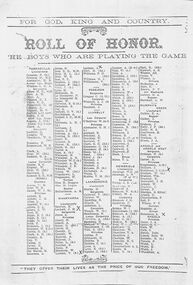 Bendigo Historical Society Inc.
Memorabilia - Jack Lockett Collection: Copy of Roll of Honor
... Australian Imperial Force. He served in France with the 38th Battalion, earning promotion to sergeant and was discharged on 20 September 1919. https://en.wikipedia.org/wiki/Jack_Lockett The 38th Battalion was formed on 1 March 1916 at a camp established on the Epsom Racecourse at Bendigo in Victoria. After training in both Australia and Britain, the 38th Battalion crossed to France in late November 1916 and moved into the trenches of the Western Front for the first time on 1 December.The 38th fought in its first major battle at Messines, in Belgium, between 7-9 June 1917. ...Australian Imperial Force. He served in France with the 38th Battalion, earning promotion to sergeant and was discharged on 20 September 1919. https://en.wikipedia.org/wiki/Jack_Lockett The 38th Battalion was formed on 1 March 1916 at a camp established on the Epsom Racecourse at Bendigo in Victoria. After training in both Australia and Britain, the 38th Battalion crossed to France in late November 1916 and moved into the trenches of the Western Front for the first time on 1 December.The 38th fought in its first major battle at Messines, in Belgium, between 7-9 June 1917. ...John Henry Lockett OAM (22 January 1891 – 25 May 2002) was the oldest man ever in Australia when he died aged 111 years, 123 days. As one of the last surviving veterans of World War I, he was acclaimed as a national hero during the last decade of his life. Lockett was born in the small Victorian town of Waanyarra, near Bendigo. He left school aged nine to work on a local farm. Later, he worked for his uncles in the Mallee. On 24 March 1916, he travelled to Mildura to enlist in the Australian Imperial Force. He served in France with the 38th Battalion, earning promotion to sergeant and was discharged on 20 September 1919. https://en.wikipedia.org/wiki/Jack_Lockett The 38th Battalion was formed on 1 March 1916 at a camp established on the Epsom Racecourse at Bendigo in Victoria. After training in both Australia and Britain, the 38th Battalion crossed to France in late November 1916 and moved into the trenches of the Western Front for the first time on 1 December.The 38th fought in its first major battle at Messines, in Belgium, between 7-9 June 1917. It fought in another two major attacks in this sector - the battle of Broodseinde on 4 October, and the battle of Passchendaele on 12 October. Belgium remained the focus of the 38th Battalion's activities for the next five months, until it was rushed south to France in late March 1918 to meet the German Army's Spring Offensive. The 38th participated in its last major action of the war between 29 September and 2 October 1918 as part of the Australian-American operation that breached the formidable defences of the Hindenburg Line along the St Quentin Canal. It was disbanded in April 1919. Source, Australian War Memorial https://www.awm.gov.au/collection/U51478 After the war, Jack returned to The Mallee and selected a 640 acres (260 ha) block of land in Linga, Victoria, deciding to make his living as a farmer. In 1923, he married Maybell Ingwerson and they had four children together. In 1963, the couple retired to Bendigo, leaving the farmland (which now covered more than 130,000 acres (53,000 ha), in the care of their children and grandchildren. An A4 photocopy of a ROLL OF HONOR for people who served in World War 1, with names from the towns of TARNAGULLA, WAANYARRA including (marked with a X) Lockett J.H., Lockett T., Lockett J., LLANELLY, LAAANECOORIE, NEWBRIDGE, MURPHY'S CREEK, ARNOLD and ARNOLD WEST including (marked with a X) Metelman J.C., Metelman A and RHEOLA jack lockett, mabel ingwersen, 38th australian infantry battalion, w.w.1, mallee farming -
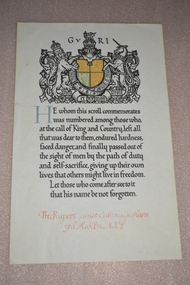 Wangaratta RSL Sub Branch
Document - Commemorative Scroll, R.J.C. Moore
... France. MOORE was born in Wangaratta, Victoria and a Printer when enlisted on 6/2/1917. In 1922 a Memorial Scroll was presented to the next of kin of those soldiers, sailors, and nurses who died while serving in the Australian Imperial Force or Royal Australian Navy during the First World War. ...Commemorative scroll sent to the next of kin of Private Rupert James Cavanagh MOORE 6852 attached to the 3rd Machine Gun Battalion and who made the ultimate sacrifice.- killed in action on 13/7/1918 in France. MOORE was born in Wangaratta, Victoria and a Printer when enlisted on 6/2/1917.In 1922 a Memorial Scroll was presented to the next of kin of those soldiers, sailors, and nurses who died while serving in the Australian Imperial Force or Royal Australian Navy during the First World War. Later they were presented with a Next of Kin Memorial Plaque. The Memorial Scroll bears the Royal Coat of Arms and a message paying tribute to the soldiers who gave up "their own lives that others might live in freedom". Cream paper scroll with Coat of Arms above ten lines of black writing and two lines in red ink.Pte. Rupert James Cavanagh Moore 3rd M.G.Bn., A.I.F.pte rupert james cavanagh moore, kia, wangaratta, ww1 -
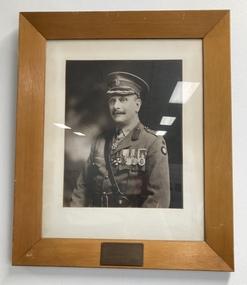 Melbourne Legacy
Photograph - Portrait, Legatee Harold Cohen
... In 1915 he was appointed commanding officer of the 6th Army Brigade, Australian Field Artillery Regiment, Australian Imperial Force, with the rank of lieutenant-colonel, serving in the Middle East, England and France until June 1919. Twice wounded and twice mentioned in dispatches, he was awarded the Distinguished Service Order in 1917 and created C.M.G. in 1918. ...In 1915 he was appointed commanding officer of the 6th Army Brigade, Australian Field Artillery Regiment, Australian Imperial Force, with the rank of lieutenant-colonel, serving in the Middle East, England and France until June 1919. Twice wounded and twice mentioned in dispatches, he was awarded the Distinguished Service Order in 1917 and created C.M.G. in 1918. ...A framed photo of the first president of Melbourne Legacy, Legatee Harold Cohen. Harold Edward Cohen (1881-1946), soldier, lawyer, politician and businessman, was born on 25 November 1881. In 1901 Cohen was commissioned in the Field Artillery Brigade, Australian Military Forces, and was promoted captain in 1905 and major in 1909. In 1915 he was appointed commanding officer of the 6th Army Brigade, Australian Field Artillery Regiment, Australian Imperial Force, with the rank of lieutenant-colonel, serving in the Middle East, England and France until June 1919. Twice wounded and twice mentioned in dispatches, he was awarded the Distinguished Service Order in 1917 and created C.M.G. in 1918. He was awarded the Volunteer Decoration in 1921 and the CBE in 1934. In 1929 Brigadier Cohen entered Parliament as the member for Melbourne South in the Legislative Council, and in 1935 transferred to the Assembly as member for Caulfield, which seat he held until 1943. During the Second World War Brigadier Cohen served in the Middle East as honorary Red Cross Commissioner overseas. Returning to Australia in 1942 he was appointed director of amenities, and subsequently Deputy Adjutant-General to the AMF, which post he held until his retirement in 1944.A record of the past presidents being honoured in a prominent position at Legacy House.Black and white photograph in a wooden frame of Legatee Harold Cohen.Plaque on the frame is engraved 'Legatee Harold Cohen First President, Melbourne Legacy 1923-24'.past presidents, harold cohen -
 Vision Australia
Photograph - Image, Jim Kibble, 1992
... The plaque reads: Bullecourt 1917-1992 Sacred to the memory of the 10,000 members of the Australian Imperial Force who were killed and wounded in the two battles of Bullecourt, April - May 1917. And to the Australian dead and their comrades in arms who lie here forever in the soil of France. ...The plaque reads: Bullecourt 1917-1992 Sacred to the memory of the 10,000 members of the Australian Imperial Force who were killed and wounded in the two battles of Bullecourt, April - May 1917. And to the Australian dead and their comrades in arms who lie here forever in the soil of France. ...On June 2, 1992 Tony Carr presented Elanora resident Jim Kibble with a plaque commemorating the anniversary of the battle. Also in attendance was Tony Thompson, a fellow Bullecourt veteran. A typed page providing an overview of both the battle and presentation is included. The plaque reads: Bullecourt 1917-1992 Sacred to the memory of the 10,000 members of the Australian Imperial Force who were killed and wounded in the two battles of Bullecourt, April - May 1917. And to the Australian dead and their comrades in arms who lie here forever in the soil of France. "Lest We Forget" (drawing of two flags and cairn memorial) "N'oublions Jamais Leur Sacrifice" This Monument was dedicated on Anzac Day, 25 April 1992 to commemorate the 75th anniversary of the Two Battles of Bullecourt April-May 19173 coloured photographs of Jim Kibble, Tony Thompson, Tony Carr and a plaque and 1 typed pageassociation for the blind, elanora home (brighton), jim kibble, tony thompson, tony carr -
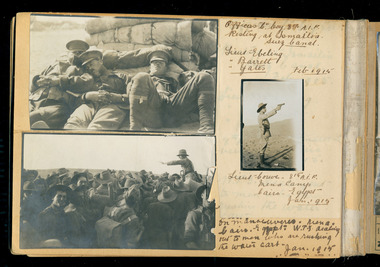 Magnet Galleries Melbourne Inc
soldiers resting / in camp, red cliffs00143.tif
... Australian Imperial Force. Officers resting, while on manoeuvres, among them William T. Yates of Camperdown. Yates survived Gallipoli, went to France where he won a Distinguished Conduct Medal at Bullecourt and survived a bullet wound to the head in 1917. ...Australian Imperial Force. Officers resting, while on manoeuvres, among them William T. Yates of Camperdown. Yates survived Gallipoli, went to France where he won a Distinguished Conduct Medal at Bullecourt and survived a bullet wound to the head in 1917. ...Officers of the 8th Australian Imperial Force. Officers resting, while on manoeuvres, among them William T. Yates of Camperdown. Yates survived Gallipoli, went to France where he won a Distinguished Conduct Medal at Bullecourt and survived a bullet wound to the head in 1917. In 1919 he went to America to study agriculture prior to becoming a soldier settler in the Sunraysia region. The rush for water the heat of the desert among parched troops on manoeuvres. "Officers 'C' Coy (company) 8th A.I.F resting at Ismailia, Suez Canal" Lieut (Lieutenant) Ebeling, Barrett, Yates, Feb 1915 Lieut Couve 8th A.I.F, Mena Camp, Cairo Egypt Jan 1915 On manoeuvres, Mena, Cairo, Egypt. W.T.S dealing out to men who are rushing the water cart, Jan 1915 8th australian imperial force, officers, william t. yates, camperdown, desert, suez canal, ismailia, 8th a.i.f, australian infantry force, lieutenant, cairo, egypt, ww1, world war 1, soldiers, war -
Emerald Museum & Nobelius Heritage Park
Award - British War Medal 1914-20, Royal Mint, 1919-1920
... James Beashel enlisted for the Australian Imperial Force (AIF) on 1 June 1917. He served with the 33rd Battalion and was marched out to the front in France in February 1918. ...James Beashel enlisted for the Australian Imperial Force (AIF) on 1 June 1917. He served with the 33rd Battalion and was marched out to the front in France in February 1918. ...James Beashel enlisted for the Australian Imperial Force (AIF) on 1 June 1917. He served with the 33rd Battalion and was marched out to the front in France in February 1918. In that year the 33rd Battalion engaged in a number of significant battles as the Germans launched their ‘Spring Offensive’ – a final push for victory following the revolution and collapse of the Russian army in late 1917. Some of the notable engagements include the Battle of Mont St Quentin, the Battle of Amiens and the Battle of Villers Bretonneux. The British War Medal 1914-20 was instituted by King George V in 1919 to mark the end of the First World War. It was awarded to members of British and Imperial forces who had served for a prescribed period during the course of the war, or who had died in active service. Beashel was not the most disciplined of soldiers throughout his time with the AIF. He was regularly disciplined for offences such as neglecting to obey orders, drunkenness, going AWOL and missing marching parades. He was discharged from the AIF at the conclusion of the First World War and returned home to New South Wales. Later in life he relocated to Victoria and died in 1965. For his service he received the Victory Medal, the British War Medal 1914-20, and the 1914-15 Star.This item is historically significant as it represents the service of an Australian in one of the most significant events of the twentieth century, and indeed in human history. 416,809 Australians enlisted for service, of which more than 60,000 were killed and more than 150,000 were wounded, gassed, or taken prisoner. The First World War remains a significant event in Australia's history. The landings at Gallipoli on April 25, 1915 is remembered as ANZAC Day, and is still commemorated to this day, over 100 years later.Silver, circular medallion. The profile of King George V is impressed on the obverse, along with the words 'GEORGIVS V BRITT: OMN: REX ET IND: IMP:' The reverse has an impression of St George on horseback, along with '1914' and '1918'. The ribbon is a thick orange band, flanked on both sides by thinner blue, black and white bands.Obverse: GEORGIVS V BRITT: OMN: REX ET IND: IMP: / Reverse: 1914 1918 //medal, commemorative medals, military, first world war, world war one, world war i, world war 1, wwi, ww1
