
Showing 24 items matching "the invasion threat"
-
 Moorabbin Air Museum
Book - Aerial reconnaisance, Evidence in Camera
... ...The invasion threat...Aerial reconnaisance Higher & faster Trial & error The invasion threat Start of the bombing The sea war The Mediterranean Combined operations Allied bombing offensive Battle against V weapons Last stages in Europe The story of photographic intelligence in World War II, circa 1957 Evidence in Camera Book Aerial reconnaisance ...The story of photographic intelligence in World War II, circa 1957non-fictionThe story of photographic intelligence in World War II, circa 1957higher & faster, trial & error, the invasion threat, start of the bombing, the sea war, the mediterranean, combined operations, allied bombing offensive, battle against v weapons, last stages in europe -
 Monbulk RSL Sub Branch
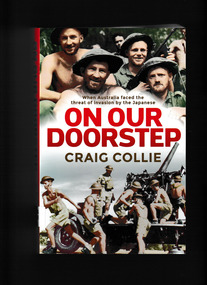
Book, Allen & Unwin, On our doorstep : when Australia faced the threat of invasion by the Japanese, 2020
... On our doorstep : when Australia faced the threat of invasion by the Japanese...On our doorstep : when Australia faced the threat of invasion by the Japanese Book Allen & Unwin Craig Collie ...By March 1942, the Japanese had steamrolled through Malaya, laid siege to Singapore, and bombed Darwin with the same ferocity they had dealt Pearl Harbor. Nothing could stop them. Their next step was inevitable, surely: the invasion and occupation of Australia. Meanwhile, as Australian prime minister John Curtin was battling with Winston Churchill to get troops back from overseas to defend their homeland, he was also positioning to ensure the United States would be there with us to fend off the approaching enemy. And at home, people pitched in as best they could and in any way to frustrate the invader. They all played their part, torn between 'she'll be right' and near panic. On Our Doorstep is the story of how Australia and Australians - the government, the military and the people - prepared to face this calamity, and the events that persuaded them of its probability. In the end, Japan found it had stretched itself beyond the reliability of its supply line, but had it ever intended to invade Australia?Index, bibliography, notes, ill, map, p.404.non-fictionBy March 1942, the Japanese had steamrolled through Malaya, laid siege to Singapore, and bombed Darwin with the same ferocity they had dealt Pearl Harbor. Nothing could stop them. Their next step was inevitable, surely: the invasion and occupation of Australia. Meanwhile, as Australian prime minister John Curtin was battling with Winston Churchill to get troops back from overseas to defend their homeland, he was also positioning to ensure the United States would be there with us to fend off the approaching enemy. And at home, people pitched in as best they could and in any way to frustrate the invader. They all played their part, torn between 'she'll be right' and near panic. On Our Doorstep is the story of how Australia and Australians - the government, the military and the people - prepared to face this calamity, and the events that persuaded them of its probability. In the end, Japan found it had stretched itself beyond the reliability of its supply line, but had it ever intended to invade Australia?world war 1939 – 1945 – campaigns – south west pacific, australia - politics and government - 1939-1945 -
Tarnagulla History Archive
Magazine article: The Russians Were Coming!, The Russians Were Coming!, March 26, 1988
... A magazine article from the Australasian Post of March 26, 1988 with title 'The Russians Were Coming!'. Discusses threats of invasion in Australia's past and the artillery which was installed on coastal positions to repel them. ...Donald Clark Collection tarnagulla cannon canon HMVS Nelson A magazine article from the Australasian Post of March 26, 1988 with title 'The Russians Were Coming!'. Discusses threats of invasion in Australia's past and the artillery which was installed on coastal positions to repel them. ...Donald Clark Collection A magazine article from the Australasian Post of March 26, 1988 with title 'The Russians Were Coming!'. Discusses threats of invasion in Australia's past and the artillery which was installed on coastal positions to repel them. Mentions the HMVS Nelson from which Tarnagulla's cannon (now in Soldiers Memorial Park) was taken. tarnagulla, cannon, canon, hmvs nelson -
 Wangaratta RSL Sub Branch
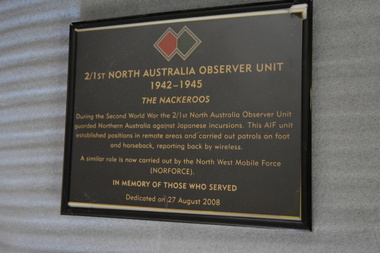
Memorabilia - Framed Dedication, The Nackeroos
... The men made use of the knowledge of local Aboriginals and maintained coast watching outposts. As the threat of invasion passed, the unit was reduced in strength and disbanded in March 1945. ...The men made use of the knowledge of local Aboriginals and maintained coast watching outposts. As the threat of invasion passed, the unit was reduced in strength and disbanded in March 1945. ...2/1st North Australia Observer Unit 1942-1945 The Nackeroos - During the second World War the 2/1st North Australia Observer Unit guarded Northern Australia against Japanese incursions. The unit established positions in remote areas and carried out patrols on foot and horseback, reporting back by wireless.The unit was barely 550 strong, and with their headquarters in Katherine, in the Northern Territory, they were given the task of patrolling northern Australia to look for signs of enemy activity. The men made use of the knowledge of local Aboriginals and maintained coast watching outposts. As the threat of invasion passed, the unit was reduced in strength and disbanded in March 1945. A similar role is now carried out by the North West Mobile Force (NORFORCE) Black plastic frame containing a dedication on black background with red and green joined square symbol 2/1st North Australia Observer Unit 1942-1945 The Nackeroos In memory of those who served Dedicated on 27 August 20082/1st north australia observer unit, the nackeroos -
 Warrnambool and District Historical Society Inc.
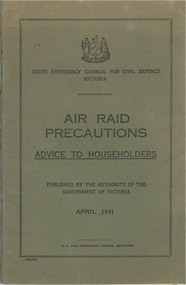
Booklet, Air Raid Precautions, 1941
... Attacks continued into 1943 and it wasn’t until later in that year that the Prime Minister, John Curtin announced that the threat of invasion had passed....Attacks continued into 1943 and it wasn’t until later in that year that the Prime Minister, John Curtin announced that the threat of invasion had passed. While the link to Warrnambool’s history is tenuous, it was a government publication to all persons in the state of Victoria in 1941.This item relates to a significant period in Australia’s history. ...This booklet was published on the recommendation of the Commonwealth government as part of a plan to offer protection to the people in the event of air strikes. Local councils and individuals were called to help to protect themselves in taking precautions,. The booklet itself sets out action to be taken in the event of an air raid happening, lighting restrictions fire prevention, refuge rooms and garden shelters and risks from air raids. It contains the relevant siren signals which denote different types of events and explains in detail various aspects of preparing for possible attack. There was discussion about issues such as evacuation of children should such an event occur with the focus primarily on the larger centres such as Geelong and Melbourne. From 1942 the number of air attacks increased mainly from Japan on the northern and western parts of Australia including over 60 on Darwin. Attacks continued into 1943 and it wasn’t until later in that year that the Prime Minister, John Curtin announced that the threat of invasion had passed.While the link to Warrnambool’s history is tenuous, it was a government publication to all persons in the state of Victoria in 1941.This item relates to a significant period in Australia’s history. All Australians were affected by the war. It has historical and scientific or research interest as it gives a number of diagrams and possible plans and the effectiveness of same. Olive green soft card cover with black text. 36 pages, with 2 extra pages depicting plans for shelters pasted inside back cover. Victorian coat of arms at top of cover.April 1941. H. E. Daw, Government printer. Forward by Sir John Harris KBE MLC Minister of Public Instruction and Public Healthhistory of warrnambool, air raid precautions 1941 -
 Brighton Historical Society
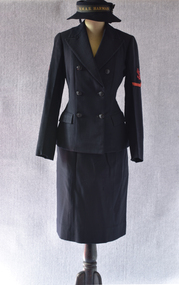
Uniform, WRANS uniform, 1942-1944
... However, as the threat of invasion by Japan loomed closer following the bombing of Pearl Harbour and the fall of Singapore, in 1943 she volunteered to join Australia's war effort as part of the Women's Royal Australian Naval Service (WRANS). ...However, as the threat of invasion by Japan loomed closer following the bombing of Pearl Harbour and the fall of Singapore, in 1943 she volunteered to join Australia's war effort as part of the Women's Royal Australian Naval Service (WRANS). ...This uniform belonged to Marion Elaine Caffrey, nee Bullock (1920-1993). Marion was born and lived in Begonia Road, Gardenvale and attended Star of the Sea College with her younger twin sisters, Hilary and Margaret Bullock. Their family had been living in the district since 1892 when their grandfather, James Stewart, settled first at Brighton Beach before building a new home in Gardenia Road, Gardenvale in 1910. On leaving school, Marion took a job with the T&G Insurance Company in Collins Street. However, as the threat of invasion by Japan loomed closer following the bombing of Pearl Harbour and the fall of Singapore, in 1943 she volunteered to join Australia's war effort as part of the Women's Royal Australian Naval Service (WRANS). She initially trained as a coder at HMAS Cerberus, followed by a posting to HMAS Magnetic in Townsville. By the time Marion arrived in Townsville in 1944 it was very much a garrison town, inhabited largely by Australian and American servicemen. Whereas in Melbourne the war in the Pacific may have felt somewhat distant, in Townsville it was very immediate. Though the town was never subjected to the heavy bombardments of Darwin, a series of small air strikes in July 1942 had made the fear of air raids quite real. The naval base HMAS Magnetic was responsible for communications, Port Examination Services and servicing of Allied warships. Marion worked as a coder, encoding outgoing transmissions and decoding incoming ones either manually or using a Typex cipher machine. In 1945, she completed additional training to attain the rank of Leading Coder. Her keenness for the work is evident in a note on her service record: although no WRANS women were ever sent to active warzones, Marion volunteered for overseas service. Marion later recalled her time with the WRANS as one of the happiest and most personally fulfilling times of her life. Like many Australian women, she embraced the opportunity to serve her country and take on roles traditionally reserved for men. She completed her three years' service at HMAS Harman in Canberra where she was de-mobbed in 1946. Afterwards, she secured a job with Metro Goldwyn Mayer, where she worked until her marriage to Hugh Caffrey in 1947.Second World War WRANS uniform consisting of a dark navy blue serge blazer (.1), skirt (.2) and hat (.3). The blazer features six buttons. The left arm features a black patch embroidered with a red anchor wrapped in a length of rope (a fouled anchor) with a single red chevron beneath, denoting the rank of Leading Wran (equivalent to Leading Seaman). The right arm features a black patch embroidered with red crossed flags over the letter 'C'. The pencil skirt is lined and fastens at the side with a button and snap fastenings. The navy felt hat features a round brim and a black ribbon band machine embroidered in gold with the words "H.M.A.S. HARMAN".Maker's label in collar of blazer reads "N491 / 1942 / SIZE [indistinct] / MADE IN AUSTRALIA" The label features a pen inscription, "BULLOCK". Size label in back of skirt: "2". Label inside the hat: "N18 / 1944 Size 20½ / MADE IN AUSTRALIA"1940s, marion elaine bullock, marion elaine caffrey, second world war, military uniform, wrans, women's royal australian naval service -
 Federation University Historical Collection
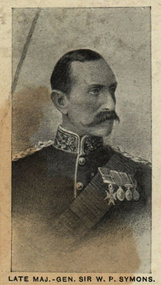
Photograph (black & White), Major General, Sir William Penn Symons - South Africa
... He was asked by the War Office to advise on the number of troops required to safely garrison the Natal from the threat of invasion from the Boer Republics of the Transvaal and Orange Free states. ...He was asked by the War Office to advise on the number of troops required to safely garrison the Natal from the threat of invasion from the Boer Republics of the Transvaal and Orange Free states. ...William Penn Symons' first combat experience was in South Africa during the Ninth Xhosa War, 1877-78. In 1879 he took part in the Zulu war. He then served during the Burma Expedition (1885-89). In 1889 he received the Companion of the Order of the Bath. In 1898, following other campaigns, he was awarded the Knight Commander of the Order of the Bath. In 1899, Symons was given the staff rank of brigadier general and was to be General Officer Commanding of Natal. He was asked by the War Office to advise on the number of troops required to safely garrison the Natal from the threat of invasion from the Boer Republics of the Transvaal and Orange Free states. Cabinet decided to send ten thousand extra troop abut they also appointed Lieutenant General Sir George White to supersede Symons as Generat Officer Commanding in Natal. Penn Symons, on his own authority deployed one of his brigades to Dundee, a town north of Ladysmith. The position of Ladysmith anad Dundee was precarious as they stand in a triangle of Natal, Orange Free State and Transvaal. White wanted to recall the Dundee garrison to Ladysmith but because of political pressure from Sit Walter Hely-Harrison, the Governor of Natal, he agreed to leave them there. The Boers declared war on 11 October and began crossing the Natal borders the following day. On 20 October 1899 Boer troops on the nearby Talana Hill proceeded to open fire on the town. The British guns moved to return fire as the general surveyed the Boer positions and gave orders to his commanding officers. Symons believed in old fashioned military tactics of close order but these formations were not designed to be used against lonf range bolt action rifles and Symons' brigades would be the first of manyin this war to pay the heavy cost ofthe mistake, as many generals would repeat it. The infantry battalions set off from the east of the town. The first part of the advance went well and they reached a small wood at the foot of the hill where they found shelter. Beyond the wood was a wall and then open ground. Symons rode up to the wood to find out why the attack had halted. He ordered the men to proceed, rode through the wood then walked through the gap in the wall. After a few moments he returned and was helped to remount his horse. He rode back from the front lines until he was out of sight of his troops before he asked for assistance from the Indian stretcher bearers. He had been shot in the stomach. Symons was taken to the field hospital at Dundee. After a few wasted days Symons' replacement, Brigadier General Yule, decided to abandon the town and the worst-wounded to the Boers and steal away at night to Ladysmith. Symons became a prisoner of war along with many others. He felt betrayed by Yule and just before he died he implored the medical officer, Major Donegal, to "tell everyone I died facing the enemy". Individual image from photographed poster of tobacco and cigarette cards.william penn symons, south africa, ninth xhosa war, companion of the order of the bath, knigt commander of the order of the bath, general officer commanding in natal, dundee, ladysmith, orange free state, transvaal, sir walter hely-harrison, governor of natal, boers, brigadier general yule -
 Uniting Church Archives - Synod of Victoria
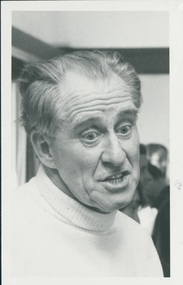
Bw photo, Undated
... To his children, he explained his justification as being the real threat of invasion but it was a war that altered the direction of his life. ...To his children, he explained his justification as being the real threat of invasion but it was a war that altered the direction of his life. ...Harvey Perkins was a Methodist minister and a peacemaker throughout his life of service and social activism. He knew the certainty that without justice there can be no peace, within, or between, communities and nations. He was greatly influenced by ''liberation theology'' and framed his life of thought, analysis and action on the teachings of the Bible. He was also a visionary in working closely with Asian churches on ecumenical and social justice issues in a way that anticipated by decades the closer relationships Australia now enjoys with Asia. He understood that any form of intervention altered the power relationship within a community and often challenged the dominant social interests in the post-colonial Asian countries. He knew any form of aid had to empower its recipients and be based on a partnership of equality. In the early 1960s, Perkins was an opponent of the war in Indochina and conscription in Australia and played an important role in activating congregations to protest against the war. His keen intelligence, knowledge of history and analytical skills demolished the false foundation on which the US and its allies entered the war and he organised medical and social work teams in South Vietnam and Laos to help refugees and displaced persons. In the 1970s Perkins played an important role in ''decolonising'' and devolving power in the Methodist Church missions in Aboriginal Australia and the Pacific Islands by analysing power structures and relationships through what he had learnt in Asia. Harvey Perkins and his twin sister, Jean, were born in Tasmania on January 29, 1919, children of Leslie Perkins and his wife, Doris (nee Cook). Leslie was a Methodist minister and Harvey and Jean's childhood was spent in parishes in urban and rural areas of Tasmania and Victoria. The family saw the grinding poverty and desperate human need wrought by the Depression as a ceaseless tide of people came knocking at the door of the local parsonage for help. In 1941, Perkins enlisted as an officer in the Australian Navy and served in the Pacific theatre until 1946. To his children, he explained his justification as being the real threat of invasion but it was a war that altered the direction of his life. On discharge he abandoned his completed studies at Melbourne University in law and commerce and studied for a degree in divinity. He was active in the World Student Christian Federation and in 1949, was ordained into the Methodist Church. A few years later, Perkins travelled to a World Student Christian Federation conference in Canada, on his way to study in Cambridge, and met an expatriate, Jill McCrory. They married in 1953. After Cambridge, Perkins returned to Australia and served as a minister in the Mitcham area of the growing Melbourne outer suburbs until 1956, when he was appointed General Secretary of the Australian Council of Churches and director of the Inter-Church Aid and Refugee World Service. From 1968 to 1971, Perkins worked with the East Asian Christian Conference and then took a position with the World Council of Churches in Geneva with its Commission on Churches Participation in Development. He returned to Australia in 1973 to a position with the Methodist Board of Missions and then returned to the Christian Conference of Asia in 1976 and relocated to Singapore for several years. Before retiring in 1984 he worked with the Uniting Church Board of Social Responsibility. In retirement Perkins continued to work in the Dee Why parish, enjoying preaching, leading study groups and working as a pastor in a local community. Along with his work, Perkins had a lifelong passion for AFL and his beloved team North Melbourne. Wherever he was in the world he could be found fiddling with a short-wave radio to listen to a game. In later years, Perkins developed Alzheimer's and his home became his haven until two weeks before his death. Harvey Perkins is survived by Jill, children Mary, Ro, David, Marguerite, Anna, Harvey and Kate and their partners, 13 grandchildren and two great-grandchildren. Jean died in 1981. (Obituary in the SMH by David Perkins) Head and shoulders portrait of Rev. Harvey PerkinsRev. Harvey Perkinsrev. harvey perkins; methodist minister; christian conference of asia; australian council of churches -
 Uniting Church Archives - Synod of Victoria
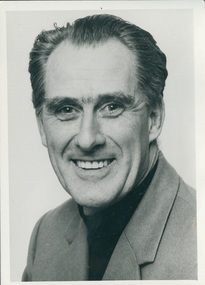
BW photo, Undated
... To his children, he explained his justification as being the real threat of invasion but it was a war that altered the direction of his life. ...To his children, he explained his justification as being the real threat of invasion but it was a war that altered the direction of his life. ...Harvey Perkins was a Methodist minister and a peacemaker throughout his life of service and social activism. He knew the certainty that without justice there can be no peace, within, or between, communities and nations. He was greatly influenced by ''liberation theology'' and framed his life of thought, analysis and action on the teachings of the Bible. He was also a visionary in working closely with Asian churches on ecumenical and social justice issues in a way that anticipated by decades the closer relationships Australia now enjoys with Asia. He understood that any form of intervention altered the power relationship within a community and often challenged the dominant social interests in the post-colonial Asian countries. He knew any form of aid had to empower its recipients and be based on a partnership of equality. In the early 1960s, Perkins was an opponent of the war in Indochina and conscription in Australia and played an important role in activating congregations to protest against the war. His keen intelligence, knowledge of history and analytical skills demolished the false foundation on which the US and its allies entered the war and he organised medical and social work teams in South Vietnam and Laos to help refugees and displaced persons. In the 1970s Perkins played an important role in ''decolonising'' and devolving power in the Methodist Church missions in Aboriginal Australia and the Pacific Islands by analysing power structures and relationships through what he had learnt in Asia. Harvey Perkins and his twin sister, Jean, were born in Tasmania on January 29, 1919, children of Leslie Perkins and his wife, Doris (nee Cook). Leslie was a Methodist minister and Harvey and Jean's childhood was spent in parishes in urban and rural areas of Tasmania and Victoria. The family saw the grinding poverty and desperate human need wrought by the Depression as a ceaseless tide of people came knocking at the door of the local parsonage for help. In 1941, Perkins enlisted as an officer in the Australian Navy and served in the Pacific theatre until 1946. To his children, he explained his justification as being the real threat of invasion but it was a war that altered the direction of his life. On discharge he abandoned his completed studies at Melbourne University in law and commerce and studied for a degree in divinity. He was active in the World Student Christian Federation and in 1949, was ordained into the Methodist Church. A few years later, Perkins travelled to a World Student Christian Federation conference in Canada, on his way to study in Cambridge, and met an expatriate, Jill McCrory. They married in 1953. After Cambridge, Perkins returned to Australia and served as a minister in the Mitcham area of the growing Melbourne outer suburbs until 1956, when he was appointed General Secretary of the Australian Council of Churches and director of the Inter-Church Aid and Refugee World Service. From 1968 to 1971, Perkins worked with the East Asian Christian Conference and then took a position with the World Council of Churches in Geneva with its Commission on Churches Participation in Development. He returned to Australia in 1973 to a position with the Methodist Board of Missions and then returned to the Christian Conference of Asia in 1976 and relocated to Singapore for several years. Before retiring in 1984 he worked with the Uniting Church Board of Social Responsibility. In retirement Perkins continued to work in the Dee Why parish, enjoying preaching, leading study groups and working as a pastor in a local community. Along with his work, Perkins had a lifelong passion for AFL and his beloved team North Melbourne. Wherever he was in the world he could be found fiddling with a short-wave radio to listen to a game. In later years, Perkins developed Alzheimer's and his home became his haven until two weeks before his death. Harvey Perkins is survived by Jill, children Mary, Ro, David, Marguerite, Anna, Harvey and Kate and their partners, 13 grandchildren and two great-grandchildren. Jean died in 1981. (Obituary in the SMH by David Perkins) Head and shoulders portrait of the Rev. Harvey Perkins. Photo taken some years before the photo of him in F524 -9Rev. Harvey Perkinsrev. harvey perkins; methodist minister; christian conference of asia; australian council of churches -
 Melton City Libraries
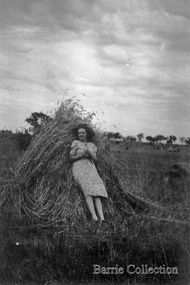
Photograph, Edna Barrie, 1920, 1924, 1933 and 1940
... Edna and Bon carried on with this from their home in Ferris Rd when the threat of invasion had ceased Community life Community life in Melton revolved around fund raising events for the Melton Mechanics Institute for the War effort and keeping up with maintenance for the Hall. ...Edna and Bon carried on with this from their home in Ferris Rd when the threat of invasion had ceased Community life Community life in Melton revolved around fund raising events for the Melton Mechanics Institute for the War effort and keeping up with maintenance for the Hall. ...SUMMARY - Edna (Myers) Barrie, 1918 – 2018, Profile Early Life Edna was born at Melton and delivered by Hannah Watts. Her mother Martha walked in the dark at night with her basket under her arm to the bridge over the Toolern Creek Bridge and into Sherwin Street to the corner of Yuille Street to Hannah’s house Lynch Cottage. Martha’s husband was away shearing and eventually heard the news of the birth of their blue eyed third child and second daughter. She was born into a family that was surrounded by music; her father played the “squeeze box” and mother the mouth organ. From an early age the family were aware of the great composers, a framed picture of Beethoven, Chopin, Schubert and Wagner hung above the door to the lounge room of their 4 roomed cottage, the room where the piano stood. Her life on stage started as a singer aged 6 years at the Melton Mechanics Institute Hall. Edna was born with a natural ear for music learning piano and singing from her older sister Marjorie who became an accomplished pianist and soloist and renowned music teacher in Melton and district. In the 1920s and 1930s concerts at the Melton Mechanics Institute were regular events were the local talent was fostered. The Myers children, like other children of Melton and Rockbank, studied singing, piano and elocution, sat examinations, entered in competitions in South Street Ballarat, Footscray and Melbourne. In 1929 a Sacred Concert was broadcast by 3AR from the Hall as part of the Back to Melton Celebrations. Marjorie Myers performed two of the items on the piano. Edna attended Melton State School 430 from 1924 – 1933. Her father Fred had also attended the same school. In 1924 the School staged Cinderella at the Melton Mechanics Institute Hall with a cast of 33 students. After completing her education a Melton she boarded in South Melbourne and attending Melbourne Girls High School (MacRobertson Girls High School), a school which recognized her musical attributes. She travelled home on the train on the weekends, sometimes getting off at Rockbank to save a few pennies in fares. Working life The early 1930s the Depression was a difficult time for a young woman to find work. Jobs were often menial and given to the youngest and therefore cheapest applicant. She worked as sales assistant at Polonskis and Myer in the city, and Irvines Modes in Footscray. Working to 1pm on Saturday, and when held up by a customer meant missing the train home. While at Myer Department store she lived at home and rode her bike to the Melton railway station. On one occasion she had a nasty fall when a part of her bicycle came loose causing the bike to crash rendering her concussed and injuring her nose. During the 1930s she was given a camera “a little snap” by Mrs Kelly her landlady. This began her interest in photography documenting family life at their “Burnbank” home. Musically, while at Myers she participated in annual performances held at The Kings Hall and the Myer Mural Hall. Working in the basement at Myers she was often embarrassed when her name was called, customers assuming she belonged to the Myer Family. Ken Myer worked in the basement at the same time handling the ‘Wheeler’, a wicker basket used for moving goods around the store. The family philosophy was for the children to start at the bottom and work their way up. Social life Social life in her teenage years was connected also with Scots Presbyterian Church. She attended Sunday School classes and received book prizes for attendance. She loved to read and welcomed the times when she received new book. She took part in the Sunday School Anniversaries and was presented with a Bible from the Superintendent, Henry Robinson for her assistance with the music. Marriage and War years In 1941 Edna married Ernest “Bonnie” Barrie. War in the Pacific was soon to break out. While in Sydney on their honeymoon they met up with Jim Barrie who was on his way to Canada via Hawaii just missing Pearl Harbour by two days. Jim became a Spitfire Pilot and joined the RAF and was based in England. He returned to Australia later in RAAF to fight the Japanese off the coast of New Guinea. The three eldest Barrie brothers were farmers and food producers and were thus except from military service. Edna and Bon were members of the VAOC- Volunteer Air Observers Corp entailing being rostered on duty as plane spotters. The women took shifts during the day and the men at night which involved staying overnight in the Shire Offices. Later the spotting tower was built in the plantation opposite the Post Office. Edna and Bon carried on with this from their home in Ferris Rd when the threat of invasion had ceased Community life Community life in Melton revolved around fund raising events for the Melton Mechanics Institute for the War effort and keeping up with maintenance for the Hall. In 1944 the Minister for Health gave approval for the Shire of Melton to open and Infant Welfare Centre inviting Edna to form part of the Committee with seven other women. In 1948 she was President of Melton Branch of the Victorian Health Centres Association. She volunteered this use of her car driving the person in charge, Sister Smith to visit mothers and their babies. In 1963, along with Betty Jones and Isabel Snell, Edna was instrumental in forming the 1st Melton Cub Pack and later supported the formation of the 1st Melton Scouts. During 1963 – 1968 she completed the Australian Boy Scout Association Cub Pack Preliminary Training and achieved her Wood Badge. Country Women’s Association In 1944-1996 she was a member of the Melton Branch Country Women’s Association (CWA), Melton Branch, Secretary of the Branch in 1945 – 1946 and Branch International Secretary 1970-1971. She worked with choir, music and drama interest groups within the branch attaining both first and second place in 1959, second place in 1952 Exhibition and second in Music in 1960 in the state. She was involved in their handicraft craft events, fund raising and musical events and singing competitions. During the 1950s she trained Trios and Quartets in part singing for the CWA competitions in Ballarat and Melbourne. It was at this time that she developed her skill as a conductor and trainer of choirs. She later auditioned for the Victorian Choir for alto parts believing she would stand a better chance of being chosen, because of her ability to sing in natural harmony. In 1962 she participated in the Tenth Australian Country Women of the World (ACWW) Triennial Conference “Australia Presents: CWA Massed Choir” in the Melbourne Town Hall. This event was recorded by Super Sound Spotlight on 45 extended play vinyl record. The songs were Australian music and words, for example The Silver Stars are in the Sky, The Graceful Swaying Wattle and Kookaburra. Edna continued with her interest in the Victorian Choir regularly meeting at the CWA Headquarters in Toorak for rehearsals. In 1974 she took part in the Australian Choir at the fourteenth Triennial conference of the ACWW Interfaith Service held at the Perth Concert Hall on the 13th of October. Arts and Culture Edna was also in the Choir of 3KZ Carols by Candlelight at the Myer Music Bowl in 1963 and 1964. Melton Choral Society. Edna was Director and Conductor in the 1970s performing at many community events such as Carols by Candle Light, Church Services, Easter and Palm Sunday services, Mothers Union and the 1976 Community Services Week Combined Church Service. The October – November 1978 Program covered the following: songs from the Musicals, Choral and Solo with Narratives, Guest Instrumental Item, Recitation Negro Spirituals and Australian Songs. Her involvement with church choirs included the Scots Presbyterian Church Choir Easter and Christmas performances and the 1967 Centenary Service. In 1980s the Melton Uniting Church Sacred Music Performances included The Crucifixion by Stainer, The Olivet to Calvary and other church Hymns. Edna was Musical Director of the Melton Amateur Theatrical Society and worked on performances in collaboration with Mabel Rogers on script and musical interpretation. Melton and District Historical Society Annual Art and Craft Show. First held in Melton Mechanics Institute Hall in 1973, it later took place in the in the Melton Community Hall. The Art Show was also run in conjunction with other community organizations such as Rotary and Girl Guides. Community history and research Melton streetscape and society Over 20 years commencing in the 1970s, Edna undertook extensive photographing of the changing streetscape of Melton’s High Street. She anticipated the impact of change on the community during the time of Melton’s rapid transition from a small farming district to a large urban community and this led to her extensively document and photograph many of the structures and landscape features of the township that have since been lost. She also meticulously recorded much of the contemporary life of the town and has left a significant legacy of archival material. Melton State School 100 Years Celebration, October 1970 Co-author with Mabel Rogers “The First 100 Years, 1870 – 1970” Assembled a collection of School Class Photograph and identified and compiled lists of names for future school history. She also assembled a photographic display for the 125th anniversary in 1995. Melton and District Historical Society (M&DHS) Foundation Member, 1968 Held President and Secretary positions from its inception Research associated with the classification of Heritage buildings Christ Church Classification C Scots’ Presbyterian Church Classification D Set up the storage and Catalogue system in the Office at the Willows Organised society visits to Heritage sites in and beyond the Shire of Melton, including Stathtulloh, Eynesbury, Deanside, ToolernVale sites including Merrywood (now demolished) Staughton Vale, Chirnside, Point Cook, Shwerkolts Cottage. 1970 – 1983 Melton and District Historical Society Letterhead. Staughton Memorial Light from early newspaper cutting in its location before restoration to present location. Sketch by Wendy Barrie. Designing and printing pamphlets, stationery, and other sale items with Willows title. M&DHS street naming research for new housing developments (1970 – 2000). Collaborated with Mary Tolhurst to research the names of early landowners and pioneer families connected to the first settlers. Researched Aboriginal names for inclusion on lists submitted to developers. An early example is the naming of Kuranjang and the street names associated with the McPherson family. Plains of Promise (Shire of Melton history) by Joan Starr (1985). Edna assisted with Historical Society materials and contributed her own research and photographs. Contacted and organised for Hubert Opperman to launch the book. (She was also present at his last bike ride at Rochester in 1995.) Western Metropolitan Groups of Historical Societies. Member attending meetings and representing Melton, also hosted the Group at Melton The Willows Member of the Committee of Management for the restoration of the “Willows” house the establishment of The Willows Park 1982 March - Official Opening of the Willows Park- Preparation and planning for the event. Involved in the collecting of items in the furnishing of the display rooms in the Willows house. Donated items and furniture from the Myers and Daley family houses. (19th century) Machinery Shed Establishment. Involved with Jeff Robinson in the construction and collection of machinery display Other significant sites Championed and participated in the restoration and preservation significant sites in Melton, including: restoration of the Staughton Memorial Light and its return to its present site restoration of the Pykes Grave (using EW Barrie earthmoving equipment) restoration and reconstruction of Dunvegan restoration and reconstruction of Macs Cottage, the management and Caretakers residence Melton State School War Memorial Gates removed from Unitt Street entrance and relocated to the Willows Park Donated the Barrie family single furrow plough which was standing at the Court House Plaza. It removed and to Council Depot and later missing. The plaque was taken to the Willows. Jimmy Melrose (aviator) cairn restoration at crash site in Melton South Donald Mackintosh (Olympic gold medallist marksman) grave site at the Melton Cemetery (Historical items held by the Myers family collection.) Houdini first flight at Diggers Rest. Edna’s father was shearing at Diggers Rest at the time and witnessed the flight. She attended the 90 year anniversary of the event at the site in 2000. Radio and electronics Edna’s husband Bon interest in wireless communication dates in the 1920s with the building of a crystal set in the early days of public broadcasting. At the Back to Melton Celebrations in 1929, 3AR broadcast a concert from the Melton Mechanics Institute on the 20th February at 8pm featuring Footscray City Band, James Hill baritone, Vera Carew Soprano, James Foran Tenor, Marjorie Myers Piano, and James Williamson Entertainer. Accompanists: Miss Agnes Ross and Mrs James Hill. The Myers children had recordings of their piano playing made onto the aluminium records, Martha Myers’ voice can be heard introducing an item. These were made in a studio in Melbourne. Marjorie was given a upright Gramophone by Donald Mackintosh in recognition of her talent and her contribution to the cultural life of Melton. The family were then able to listen to 78rpm recordings of the famous classical recordings. The turntable was hand wound metal stylus needles had to be regularly replaced. The aluminium disk needed a bamboo needle to prevent damage to the surface. Before electricity was introduced to Melton in 1939 the Mechanics Hall relied on generators to produce electricity. Bon Barrie, being mechanically minded, built a public address system for be used a community functions at the Hall and Recreational Park. By 1939 this was up and running and used for over three decades. A large Collection of 78rpm records provided music for dances, marching, parades and any public event needing music and microphones. The early system was portable and worked on batteries. CFA Radio Communication In the 1950s with the introduction two-way HF and later VHF very high frequency radio sets. Melton Rural Fire Brigade was part of the Bacchus Marsh Group. Radio sets where located in the Melton Fire Truck, and in the house of the Barrie family at Ferris Road. This was an ideal location to observe a 360 degree view in all directions when smoke appeared on the horizon. An antenna was erected beside the house. The set OX 7 was located in the kitchen and monitored 24 hours by the family. When an electrical fire occurred at the junction of the electricity to the house there was time to radio the fire station and summons the men working in the paddocks, thus saving the house from possible destruction. With the introduction of UHF – ultra high frequency Vinten Radios the signal was clearer and static and interference lessened and radio traffic became easier to read, and reduced noise levels in the household. VL3 LY Radio Base became the Group Headquarters was established in 1967. By 1970 the Brigades were: Melton, Rockbank, Sydenham, Toolern Vale, Diggers Rest, Truganina, and Werribee. In 1974 when the family moved to First Avenue, another antenna and a small building were erected adjacent to the residence and used to house the equipment, maps. Radio traffic consisted of regular schedule times and communication with adjoining groups of brigades such as Bacchus Marsh, Mt Macedon and Little River Groups. Many of the brigade and group base radios were situated in private residences and operated primarily by fire fighters wives who held the position of Communications Officer, either registered as a brigade member or informally. Edna was never registered as an operational brigade member but operated informally as an assistant to her husband Bon. She was however a member of the Melton Fire Brigade Ladies Auxiliary from its inception in 1968, a non-operational position. Edna kept up to date with radio procedure following the 1967 handbook; preparing maps, plotting compass points and taking notes on weather forecasts from the SA Border and Western District. Daily notes were taken in anticipation of fire warnings. These log books and daily radio traffic were incidental to the regular radio schedules. Emergency turnouts noted, burning off times and predicted location of smoke. In the summer fire season all TBF (total fire ban days were recorded.) In times of emergency the Barrie family assisted Bon the base radio operator to plot the position and location of fire trucks and to help clarify garbled radio traffic, keep notes and make telephone calls. These log books are held in the EE and EW Family Archive. Melton Uniting Church Edna founded the Church Opportunity with Maisie Robinson in 1975 in the Melton South Methodist Church building. Methodist and Presbyterian Churches of Melton had combined severing their long held connection with Bacchus Marsh. A Manse had been recently built for the Melton Minister. At a Parish Committee meeting at the Melton South Church it was suggested to use the building as an Opportunity Shop. It opened in July 1975, and it raised $1,600 contribution to the church budget in 1976. In 1977 The Uniting Church in Australia was formed and the Melton South Uniting Church Opportunity shop continued to go from strength to strength expanding the buildings providing the welfare needs of the community. Archive Set up by Edna Catalogued items dating from 1857 Minute Book and set ongoing system and storage of items of heritage. Melton Un Awards and recognition of service to the Melton community Rotary Award for Community Service, 1980 Victoria 150th Anniversary Celebrations contributions, 1985 Life Membership of the Melton and District Historical Society (M&DHS), 1989 Extra-Ordinary Contribution for years of service to M&DHS, 1992 Long Service for Exceptional Service MD&HS, 1993 Royal Historical Society of Victoria Award of Merit, 1997 Shire of Melton Certificate of Appreciation for continued support and dedication as a member of MD&HS to the preservation of Melton’s History, 1998 Centenary of Federation Peoplescape (Canberra) Melton Shire nomination, 2001 Uniting Church Melton Life Membership of the Opportunity Shop Uniting Church in Australia Commission for Mission for 30 years of hard work and dedications to the Uniting Church, 2007 Uniting Church Adult Fellowship Certificate appreciation in recognition of valuable support through the “Sammy” Stamp Fund Neighbourhood Watch 5 year award Photographs of Edna at different ageslocal identities -
 Flagstaff Hill Maritime Museum and Village
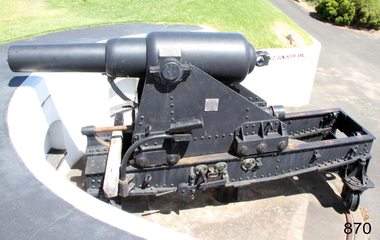
Weapon - Cannon, 1866
... (Conservation Management Plan for Victorian Guns and Cannon, South Western Victoria, May 2008, ref W/F/05) The Warrnambool Garrison has been added to the Victorian Heritage Register H1250 “for its intact battery and guns, a strong reminder of Victoria’s wealth and determination to protect itself from the perceived threat of invasion in the 1880’s.” The City of Warrnambool is one of several custodians of a collection of artillery pieces of heritage significance at a state, national and international level. ...In the years following the Crimean War (1854-1857J) there was a great concern in the Colony that Imperial Russia would attempt an invasion. Coastal defences in the colony of Victoria were greatly strengthened by the Government as a result. Warrnambool was originally protected by cannons at Cannon Hill, approximately 1 kilometer west of the Flagstaff Hill Fortifications. These cannons included two 1866 guns, both 80 Pound Rifled Muzzle Loaders (RML) purchased by Victoria’s Colonial Government. They were part of a shipment of 26 such guns sent from England in December 1866. They are registered as No. 23 (80cwt-2qr-0lbs) - Gun 1, and No.13 (81cwt-1qr-12lbs) - Gun 2. They were cast at the Royal Gun Factory, Woolwich Arsenal, in 1866 and have a 6.3 inch bore. Both barrels carry the Royal Cypher of Queen Victoria, Insignia of the Royal Engineers, within the Garter and Motto surmounted by the Crown, with the Royal Cypher of Queen Victoria within the Garter (letters in centre “VR”, motto “HONI SOIT QUI MAL Y PENSE”, "Shame be to him who thinks evil of it."). The guns were originally supplied with wooden carriages. (The Royal Arsenal at Woolwich, England, was established eleven years after the Restoration of King Charles II. It was the principal supplier of armaments to the British and Empire Governments. At the height of its operations during World War One the factory covered 1300 acres and employed very nearly 80,000 workers. Woolwich was the Headquarters of the Royal Artillery since the raising of that Regiment in 1716. The Arsenal was closed in the late 1960’s.) These two cannons were transferred to the Warrnambool Garrison Artillery Battery Fortifications erected at Flagstaff Hill in 1887 as part of Victoria’s Coastal Defences. The original wooden carriages were subsequently replaced with the present iron garrison carriages in 1888. They are a “C” pivot. The ‘racers’ or curved track set into the floor of the gun emplacement (which enabled the guns to be traversed more quickly) are as specified for guns up to 10 inch, being of wrought iron 2.78 inches wide. A temporary third gun, now no longer on Flagstaff Hill’s site, was a 5 inch Rifled Breech Loading (BL) Armstrong gun mounted on an Elswick hydro pneumatic disappearing carriage It was faster to load and fire than the 80 pound RMLs and its arrival spelt the end of the older 80 pound guns’ useful life, apart from being used for practice sessions. The 5 inch BL gun was the main defensive weapon of the Warrnambool Battery until the Battery was downgraded in importance and the gun was recalled to Melbourne in 1910. The State of Victoria took over the ownership of the guns at the time of Australian Federation in 1901. In about 1901/1902 the Garrison Battery was converted to the Warrnambool Battery of the Australian Field Artillery (No 4 Field Battery). It was equipped with 4.7 inch naval guns mounted on field carriages. They were now a mobile unit but continued to use the Warrnambool Garrison area at Flagstaff Hill for practice. When the Fortifications were declared obsolete, the two 80 Pounder RML were relocated to Cannon Hill in 1910. On the outbreak of World War One the 4.7 inch guns were recalled to Melbourne, and the Battery was disbanded. Most of the personnel probably re-enlisted in the local 4th Australian Light Horse Regiment. The two 80 Pounder RML were moved back to the Fortifications in 1973. They were both fully restored by Army First Year Apprentices at the Ordinance Factory in Bendigo in time for the centenary year of the fortifications in 1987. The guns are capable of firing 80 pound (32.3kg) armour piercing exploding shells 3.65kms out to sea. They were original manned by volunteers before a paid Garrison was established. Now the Guns are again fired by volunteers on Special Event days. Since restoration the Gun Number 1 had been fired on a regular basis but Gun Number 2 hadn’t been fired since the mid 1990’s. In April 2015 Gun Number 2 was serviced in preparation for the firing of both cannons on the ANZAC Centenary commemorations on April 25th 2015. Other guns from the original Cannon Hill location were obsolete by the time the 1887 Warrnambool Garrison Artillery Battery was built. These guns are (1) a 32 Pounder Muzzle Loading Smooth Bore (SB) cast in 1813 at the famous Carron Foundry, number 80837 and now located in the Warrnambool Botanic Gardens (2) a 68 Pounder Muzzle Loading Smooth Bore cast in 1861 at the equally august Low Moor Foundry, number 10310 and now located on the lawn area at the entrance to Flagstaff Hill Maritime Village. Both of these guns are mounted on their original wooden garrison carriages. There are only seven 32 Pounder SB made by Carron and fifteen 68 Pounder SB made at Low Moor known to exist in the State of Victoria. Funding was received to repair Cannon No.2 and its iron carriage. After completion, both Cannon No 1 and No. 2 were 'fired' in a public re-enactment on April 4th, 2026. (Conservation Management Plan for Victorian Guns and Cannon, South Western Victoria, May 2008, ref W/F/05)The Warrnambool Garrison has been added to the Victorian Heritage Register H1250 “for its intact battery and guns, a strong reminder of Victoria’s wealth and determination to protect itself from the perceived threat of invasion in the 1880’s.” The City of Warrnambool is one of several custodians of a collection of artillery pieces of heritage significance at a state, national and international level. These pieces are directly related to the defence of south-west Victoria in the 19th century. The care and preservation come under the Heritage Act 1995. Cannon. 80 Pound Rifled Muzzle Loading (RML) Gun on iron carriage and slide, installed in the Battery at Flagstaff Hill’s Fortifications. Made in 1866 at the Royal Gun Factory (R-G-F), Woolich, England. Gun Reg No 13. Flagstaff Hill Garrison Gun 2 (Gun No. 2). Insignia of the Royal Engineers, and the weight of the gun, stamped on top of the gun’s barrel. There is a brass plate on the side of the gun with the details of 1987 restoration.Stamped into the metal on top of the barrel, Insignia of the Royal Engineers; Garter and Motto “HONI SOIT QUI MAL Y PENSE”, surmounted by the Crown, with the Royal Cypher of Queen Victoria “VR” within the Garter. Also stamped on top of the gun are 2 inward pointing arrows above the weight ”81-1-12”. Brass plate “RESTORATION / BY / FIRST YEAR / APPRENTICES / ORDANANCE FACTORY / BENDIGO 1987”flagstaff hill, warrnambool, shipwrecked coast, flagstaff hill maritime museum, maritime museum, shipwreck coast, flagstaff hill maritime village, great ocean road, colonial defences, victoria’s coastal defences, warrnambool fortification, warrnambool garrison battery, warrnambool volunteer corps, ordinance, armaments, cannon hill fortifications, 4th australian light horse regiment, no 4 field battery, 80 pound cannon rifled muzzle loaders (rml), victorian colonial government, royal gun factory england, woolwich arsenal, royal cypher of queen victoria, garrison gun -
 Flagstaff Hill Maritime Museum and Village
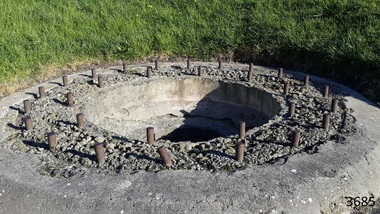
Gun Emplacement, 1890's
... The Warrnambool Garrison has been added to the Victorian Heritage Register H1250 “for its intact battery and guns, a strong reminder of Victoria’s wealth and determination to protect itself from the perceived threat of invasion in the 1880’s.” The City of Warrnambool is one of several custodians of a collection of artillery pieces of heritage significance at a state, national and international level. ...The Warrnambool Battery on Flagstaff Hill has embankments for 3 guns. Those on the left and right still have cannon in place but in the centre is an empty embankment, apart from this concrete ring with metal threaded studs. In 1898 a 5 inch breech loading gun (BL) was installed here. The gun had a hydro-pneumatic disappearing carriage (hence the sign on the concrete wall "5" BL HP").. This type of gun was faster to load and fire that the 80 pound RML’s installed on either side of it. Its arrival spelt the end of the 80 pound RML guns’ useful life, although they continued to be used for practice sessions. The 5 inch BL was the main defensive weapon of the Warrnambool Battery until the Battery was downgraded in importance. It was removed in 1904 and recalled to Melbourne in 1910. The gun emplacement ring is all that remains of the mounting for a 5 inch Armstrong rifled breech loading gun. HISTOR of the WARRNAMBOOL GUNS & CANNON In the years following the Crimean War (1854-1857J) there was a great concern in the Colony that Imperial Russia would attempt an invasion. Coastal defences in the colony of Victoria were greatly strengthened by the Government as a result. Warrnambool was originally protected by cannons at Cannon Hill, approximately 1 kilometer west of the Flagstaff Hill Fortifications. The cannons included two 1866 guns, both 80 Pound Rifled Muzzle Loaders (RML) purchased by Victoria’s Colonial Government. They were part of a shipment of 26 such guns sent from England in December 1866. They are registered as No. 23 (80cwt-2qr-0lbs) - Gun 1, and No.13 (81cwt-1qr-12lbs) - Gun 2. They were cast at the Royal Gun Factory, Woolwich Arsenal, in 1866 and have a 6.3 inch bore. Both barrels carry the Royal Cypher of Queen Victoria, Insignia of the Royal Engineers, within the Garter and Motto surmounted by the Crown, with the Royal Cypher of Queen Victoria within the Garter (letters in centre “VR”, motto “HONI SOIT QUI MAL Y PENSE”, "Shame be to him who thinks evil of it."). The guns were originally supplied with wooden carriages. (The Royal Arsenal at Woolwich, England, was established eleven years after the Restoration of King Charles II. It was the principal supplier of armaments to the British and Empire Governments. At the height of its operations during World War One the factory covered 1300 acres and employed very nearly 80,000 workers. Woolwich was the Headquarters of the Royal Artillery since the raising of that Regiment in 1716. The Arsenal was closed in the late 1960’s.) These two 80pdr cannons were transferred to the Warrnambool Garrison Artillery Battery Fortifications erected at Flagstaff Hill in 1887 as part of Victoria’s Coastal Defences. The original wooden carriages were subsequently replaced with the present iron garrison carriages in 1888. They are a “C” pivot. The ‘racers’ or curved track set into the floor of the gun emplacement (which enabled the guns to be traversed more quickly) are as specified for guns up to 10 inch, being of wrought iron 2.78 inches wide. A temporary third gun, now no longer on Flagstaff Hill’s site, was the 5 inch Rifled Breech Loading (BL) Armstrong gun mounted on an Elswick hydro pneumatic disappearing carriage and installed in this very concrete base or pad. The State of Victoria took over the ownership of the guns at the time of Australian Federation in 1901. In about 1901/1902 the Garrison Battery was converted to the Warrnambool Battery of the Australian Field Artillery (No 4 Field Battery). It was equipped with 4.7 inch naval guns mounted on field carriages. They were now a mobile unit but continued to use the Warrnambool Garrison area at Flagstaff Hill for practice. When the Fortifications were declared obsolete the two 80 Pounder RML were relocated to Cannon Hill in 1910. On the outbreak of World War One the 4.7 inch guns were recalled to Melbourne, and the Battery was disbanded. Most of the personnel probably re-enlisted in the local 4th Australian Light Horse Regiment. The two 80 Pounder RML were moved back to the Fortifications in 1973. They were both fully restored by Army First Year Apprentices at the Ordinance Factory in Bendigo in time for the centenary year of the fortifications in 1987. The guns are capable of firing 80 pound (32.3kg) armour piercing exploding shells 3.65kms out to sea. They were originally manned by volunteers before a paid Garrison was established. Now the Guns are again fired by volunteers on Special Event days. Since restoration the Gun Number 1 had been fired on a regular basis but Gun Number 2 hadn’t been fired since the mid 1990’s. In April 2015 Gun Number 2 was serviced in preparation for the firing of both cannons on the ANZAC Centenary commemorations on April 25th 2015. Other guns from the original Cannon Hill location were obsolete by the time the 1887 Warrnambool Garrison Artillery Battery was built. These guns are (1) a 32 Pounder Muzzle Loading Smooth Bore (SB) cast in 1813 at the famous Carron Foundry, number 80837 and now located in the Warrnambool Botanic Gardens. It is now mounted on a replica carriage due to the original carriage being in a fragile condition (the original carriage stored under cover at Flagstaff Hill). (2) a 68 Pounder Muzzle Loading Smooth Bore cast in 1861 at the equally august Low Moor Foundry, number 10310 and now located on the lawn area at the entrance to Flagstaff Hill Maritime Village. It is still mounted on its original wooden garrison carriage. Its wooden slide compressor mechanism is fragile and now kept in Flagstaff Hill’s storage. There are only seven 32 Pounder SB made by Carron and fifteen 68 Pounder SB made at Low Moor known to exist in the State of Victoria [references; Flagstaff Hill Maritime Village interpretation boards, information sheets and other documents; South Western Victoria Guns and Cannon report, May 2008, ref W/F/08] The Gun embankment is contained within the heritage listed Lady Bay Lighthouse Comples, on the Victorian Heritage Register VHR H1520. The gun emplacement base is evidence of the last defences installed on this stretch of coastline. The Warrnambool Garrison has been added to the Victorian Heritage Register H1250 “for its intact battery and guns, a strong reminder of Victoria’s wealth and determination to protect itself from the perceived threat of invasion in the 1880’s.” The City of Warrnambool is one of several custodians of a collection of artillery pieces of heritage significance at a state, national and international level. These pieces are directly related to the defence of south-west Victoria in the 19th century. The care and preservation come under the Heritage Act 1995. Gun emplacement; the remains of the mounting platform of a temporary third gun installed in 1898 in the centre of the battery. This consists of a circular concrete well or sump surrounded by two rings of mounting bolts, the inner of 10 and the outer of 20. The base once held a 5 inch Armstrong rifled breech loading gun with hydro-pneumatic disappearing. In the centre of the ring on the ground is a keyhole shaped space. The gun was removed in 1904. flagstaff hill, warrnambool, shipwrecked coast, flagstaff hill maritime museum, maritime museum, shipwreck coast, flagstaff hill maritime village, great ocean road, colonial defences, victoria’s coastal defences, warrnambool fortification, warrnambool garrison battery, warrnambool volunteer corps, ordinance, armaments, cannon hill fortifications, flagstaff hill fortifications, 4th australian light horse regiment, garrison gun, 5 inch breech loading gun, emplacement for hydro-pneumatic disappearing carriage, gun emplacement -
 Orbost & District Historical Society
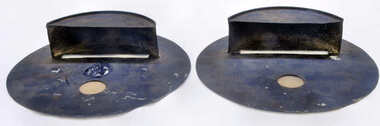
shields - blackout, Swan, Wally, WW11
... By 1941, the threat of Japanese invasion caused restrictions to daily life. ...By 1941, the threat of Japanese invasion caused restrictions to daily life. ...By 1941, the threat of Japanese invasion caused restrictions to daily life. Blackouts became the norm. To prevent identification from enemy planes all lights had to be turned down, including car headlights that had to be covered to minimize light exposure. In Australia more relaxed regulations led to the Australian air raid precautions being dubbed the “brownout”. These shields limited the amount of light emitted by a vehicle. To drive at night without them was an offence; however, the increase in road accidents led to the removal of headlight masks everywhere in Australia south of Rockhampton from 15 February 1943.These shields, though not rare, evoke a period of restrictions, fear, rationing and confinement.Pair of handmade car light blackout shields. Black round metal with scoop at front as well as small glass partition.shields-blackout ww11 transport-motor-vehicles -
 Orbost & District Historical Society
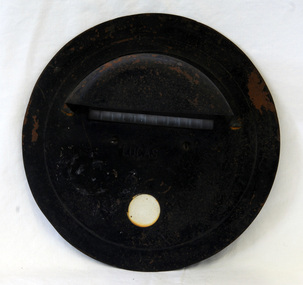
blackout shield, Lucas Industries, WW 11
... By 1941, the threat of Japanese invasion caused restrictions to daily life. ...By 1941, the threat of Japanese invasion caused restrictions to daily life. ...By 1941, the threat of Japanese invasion caused restrictions to daily life. Blackouts became the norm. To prevent identification from enemy planes all lights had to be turned down, including car headlights that had to be covered to minimize light exposure. In Australia more relaxed regulations led to the Australian air raid precautions being dubbed the “brownout”. These shields limited the amount of light emitted by a vehicle. To drive at night without them was an offence; however, the increase in road accidents led to the removal of headlight masks everywhere in Australia south of Rockhampton from 15 February 1943. These shields, though not rare, evoke a period of restrictions, fear, rationing and confinement.A circular metal disc painted black - car light blackout shield. It has a small glass slot in front and a scooped out front to cover the light.ww11 blackout-shield -
 Flagstaff Hill Maritime Museum and Village
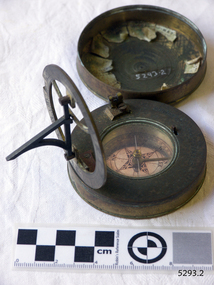
Compass and Sundial, Mid 19th Century
... The Association established in 1859 with the aim to improve the shooting skills of the newly formed corps of volunteers to meet the perceived threat of an invasion by the French. J.H. Steward advert first appeared in the NRA competition program of 1865. ...The Association established in 1859 with the aim to improve the shooting skills of the newly formed corps of volunteers to meet the perceived threat of an invasion by the French. J.H. Steward advert first appeared in the NRA competition program of 1865. ...James Henry Steward (1817–1896) established J.H. Steward in London in 1852. As “Head Optician” he would have been a qualified oculist but little is known about the founder’s early life and scholastic achievements. However, given the variety of disciplines for which he undertook he was also an accredited instrument maker,he clearly was a gifted scholar and quickly gained professional recognition in a full range of fields for an instrument maker of his day. J.H Steward became incorporated as J.H. Steward Limited on 1st February,1913. The business grew from modest beginnings. Steward would sell pocket watches and assorted items at the annual competition days of "The National Rifle Association of the United Kingdom(NRA)" from a stall. As the governing body for full bore rifle and pistol shooting sports in the UK. The Association established in 1859 with the aim to improve the shooting skills of the newly formed corps of volunteers to meet the perceived threat of an invasion by the French. J.H. Steward advert first appeared in the NRA competition program of 1865. The NRA meetings were held at first on Wimbledon Common, Surrey until 1889. Then because of pressure by the local community, the NRA along with its buildings and its flourishing meetings moved further south to Brookwood, Surrey. By now the Steward operation had grown from a modest stall into a large marquee selling various optical and scientific instruments at these meetings. Throughout its long trading history the J.H. Steward company and many members of the family maintained strong ties to the NRA and competition shooting events. The NRA records show that at the end of the 19th century the NRA bestowed a Life Membership on 7 Steward family members. First presented by J. H. Steward Ltd. in 1902 was the “Steward Trophy” that is still an annual competition for teams of four from any rifle club affiliated to the NRA. There is also evidence that many family members were fine shots.The item was made by a significant instrument manufacturing company that concentrated during the middle 19th century on supplying the British military. This items pattern & design is still available as a reproduction, available on the internet. However this original seems unique as the writer cannot find another for sale or in a collection to date. The assumption is that this type of compass was made for the British artillery units given the sun dial. Further research is ongoing as the writer regards this item as rare and social significant.Brass Compass and Sundial manufactured by J H Steward 407 & 406 West Strand, London. Can be used in both hemispheres. flagstaff hill, warrnambool, shipwrecked-coast, flagstaff-hill, flagstaff-hill-maritime-museum, maritime-museum, shipwreck-coast, flagstaff-hill-maritime-village, compass, sundial, combination compass and sundial, steward strand london, j h steward -
 Flagstaff Hill Maritime Museum and Village
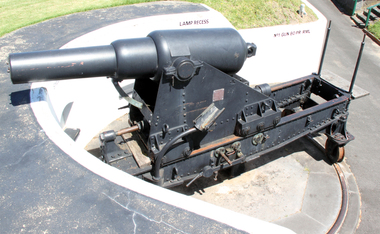
Weapon - Cannon, 1866
... (Conservation Management Plan for Victorian Guns and Cannon, South Western Victoria, May 2008, ref W/F/04) The Warrnambool Garrison has been added to the Victorian Heritage Register H1250 “for its intact battery and guns, a strong reminder of Victoria’s wealth and determination to protect itself from the perceived threat of invasion in the 1880’s.” The City of Warrnambool is one of several custodians of a collection of artillery pieces of heritage significance at a state, national and international level. ...In the years following the Crimean War (1854-1857J) there was a great concern in the Colony that Imperial Russia would attempt an invasion. Coastal defences in the colony of Victoria were greatly strengthened by the Government as a result. Warrnambool was originally protected by cannons at Cannon Hill, approximately 1 kilometer west of the Flagstaff Hill Fortifications. These cannons included two 1866 guns, both 80 Pound Rifled Muzzle Loaders (RML) purchased by Victoria’s Colonial Government. They were part of a shipment of 26 such guns sent from England in December 1866. They are registered as No. 23 (80cwt-2qr-0lbs) - Gun 1, and No.13 (81cwt-1qr-12lbs) - Gun 2. They were cast at the Royal Gun Factory, Woolwich Arsenal, in 1866 and have a 6.3 inch bore. Both barrels carry the Royal Cypher of Queen Victoria, Insignia of the Royal Engineers, within the Garter and Motto surmounted by the Crown, with the Royal Cypher of Queen Victoria within the Garter (letters in centre “VR”, motto “HONI SOIT QUI MAL Y PENSE”, "Shame be to him who thinks evil of it."). The guns were originally supplied with wooden carriages. (The Royal Arsenal at Woolwich, England, was established eleven years after the Restoration of King Charles II. It was the principal supplier of armaments to the British and Empire Governments. At the height of its operations during World War One the factory covered 1300 acres and employed very nearly 80,000 workers. Woolwich was the Headquarters of the Royal Artillery since the raising of that Regiment in 1716. The Arsenal was closed in the late 1960’s.) These two cannons were transferred to the Warrnambool Garrison Artillery Battery Fortifications erected at Flagstaff Hill in 1887 as part of Victoria’s Coastal Defences. The original wooden carriages were subsequently replaced with the present iron garrison carriages in 1888. They are a “C” pivot. The ‘racers’ or curved track set into the floor of the gun emplacement (which enabled the guns to be traversed more quickly) are as specified for guns up to 10 inch, being of wrought iron 2.78 inches wide. A temporary third gun, now no longer on Flagstaff Hill’s site, was a 5 inch Rifled Breech Loading (BL) Armstrong gun mounted on an Elswick hydro pneumatic disappearing carriage It was faster to load and fire than the 80 pound RMLs and its arrival spelt the end of the older 80 pound guns’ useful life, apart from being used for practice sessions. The 5 inch BL gun was the main defensive weapon of the Warrnambool Battery until the Battery was downgraded in importance and the gun was recalled to Melbourne in 1910. The State of Victoria took over the ownership of the guns at the time of Australian Federation in 1901. In about 1901/1902 the Garrison Battery was converted to the Warrnambool Battery of the Australian Field Artillery (No 4 Field Battery). It was equipped with 4.7 inch naval guns mounted on field carriages. They were now a mobile unit but continued to use the Warrnambool Garrison area at Flagstaff Hill for practice. When the Fortifications were declared obsolete the two 80 Pounder RML were relocated to Cannon Hill in 1910. On the outbreak of World War One the 4.7 inch guns were recalled to Melbourne, and the Battery was disbanded. Most of the personnel probably re-enlisted in the local 4th Australian Light Horse Regiment. The two 80 Pounder RML were moved back to the Fortifications in 1973. They were both fully restored by Army First Year Apprentices at the Ordinance Factory in Bendigo in time for the centenary year of the fortifications in 1987. The guns are capable of firing 80 pound (32.3kg) armour piercing exploding shells 3.65kms out to sea. They were original manned by volunteers before a paid Garrison was established. Now the Guns are again fired by volunteers on Special Event days. Since restoration the Gun Number 1 had been fired on a regular basis but Gun Number 2 hadn’t been fired since the mid 1990’s. In April 2015 Gun Number 2 was serviced in preparation for the firing of both cannons on the ANZAC Centenary commemorations on April 25th 2015. Other guns from the original Cannon Hill location were obsolete by the time the 1887 Warrnambool Garrison Artillery Battery was built. These guns are (1) a 32 Pounder Muzzle Loading Smooth Bore (SB) cast in 1813 at the famous Carron Foundry, number 80837 and now located in the Warrnambool Botanic Gardens (2) a 68 Pounder Muzzle Loading Smooth Bore cast in 1861 at the equally august Low Moor Foundry, number 10310 and now located on the lawn area at the entrance to Flagstaff Hill Maritime Village. Both of these guns are mounted on their original wooden garrison carriages. There are only seven 32 Pounder SB made by Carron and fifteen 68 Pounder SB made at Low Moor known to exist in the State of Victoria On April 4th, 2026, both Cannon No 1 and the recently restored Cannon No. 2 were 'fired' in a public re-enactment. (Conservation Management Plan for Victorian Guns and Cannon, South Western Victoria, May 2008, ref W/F/04)The Warrnambool Garrison has been added to the Victorian Heritage Register H1250 “for its intact battery and guns, a strong reminder of Victoria’s wealth and determination to protect itself from the perceived threat of invasion in the 1880’s.” The City of Warrnambool is one of several custodians of a collection of artillery pieces of heritage significance at a state, national and international level. These pieces are directly related to the defence of south-west Victoria in the 19th century. The care and preservation come under the Heritage Act 1995. Cannon. 80 Pounder Rifled Muzzle Loading (RML) Gun on iron carriage and slide, installed in the Battery at Flagstaff Hill’s Fortifications.. Made in 1866 at the Royal Gun Factory (R-G-F), Woolich, England. Gun Reg No - 23. Flagstaff Hill Garrison Gun 1 (Gun No. 1) Insignia of the Royal Engineers, and the weight of the gun, stamped on top of the gun’s barrel. There is a brass plate on the side of the gun with the details of 1987 restoration.Stamped on axle cover on side of barrel “R-G-F / No 23 / 1866”. Stamped into the metal on top of the barrel, Insignia of the Royal Engineers; Garter and Motto “HONI SOIT QUI MAL Y PENSE”, surmounted by the Crown, with the Royal Cypher of Queen Victoria “VR” within the Garter. Also stamped on top of the gun are 2 inward pointing arrows above the weight ”81-2-0”. Brass plate “RESTORATION / BY / FIRST YEAR / APPRENTICES / ORDANANCE FACTORY / BENDIGO 1987”flagstaff hill, warrnambool, shipwrecked coast, flagstaff hill maritime museum, maritime museum, shipwreck coast, flagstaff hill maritime village, great ocean road, cannon, 80 pounder, rifled muzzle, loading, royal gun factory, woolich -
 Ringwood and District Historical Society
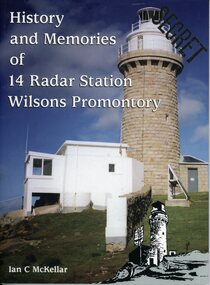
Book, History and Memories of 14 Radar Station Wilsons Promontory - Ian C McKellar, 2007
... Overview extract: "In 1939, the Australian Government considered "that Australia was not open to the threat of invasion and that we only need prepare for sporadic raids". ...Overview extract: "In 1939, the Australian Government considered "that Australia was not open to the threat of invasion and that we only need prepare for sporadic raids". ...Soft covered 103-page book with sketches, photographs and genealogical charts.Overview extract: "In 1939, the Australian Government considered "that Australia was not open to the threat of invasion and that we only need prepare for sporadic raids". Accordingly a radar research and construction program was put in hand using British equipment as a basis. The secrecy of the work was extreme. The veil of secrecy has now been lifted and, in the following pages are the personal accounts of some of the men who served at the Wilsons Promontory radar station." -
 Bendigo Historical Society Inc.
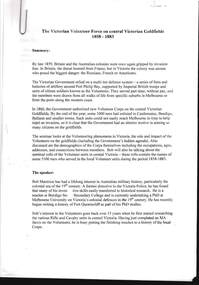
Document - THE VICTORIAN VOLUNTEER FORCE ON CENTRAL GOLDFIELDS 1858-1883
... By late 1859, Britain and the Australian colonies were once again gripped by invasion fear. In Britain the threat loomed from France, but in Victoria the colony was unsure who posed the biggest danger.Speaker: Bob Marmion. ...By late 1859, Britain and the Australian colonies were once again gripped by invasion fear. In Britain the threat loomed from France, but in Victoria the colony was unsure who posed the biggest danger.Speaker: Bob Marmion. ...Glider clipped 15 page Document, The Victorian Volunteer Force on Central Victorian Goldfields 1858-1883.. By late 1859, Britain and the Australian colonies were once again gripped by invasion fear. In Britain the threat loomed from France, but in Victoria the colony was unsure who posed the biggest danger.Speaker: Bob Marmion. Included are several letters dated in the 1850's from the Gold fieldsdocument, names of bendigo pioneers, bendigo goldfields -
 Bendigo Historical Society Inc.
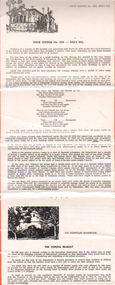
Document - LONG GULLY HISTORY GROUP COLLECTION: STATE SCHOOL NO 323 - RAE'S HILL
... The old Rae's Hill School remained empty until it was used as a storage depot for goods of an essential nature when there was a threat of possible Japanese invasion during 1939 - 1945. By 1911 the Department paid £1 per week rent to the trustees of the Hopetoun Bandroom on Mr Korong Rd so renovations could be carried out. ...The old Rae's Hill School remained empty until it was used as a storage depot for goods of an essential nature when there was a threat of possible Japanese invasion during 1939 - 1945. By 1911 the Department paid £1 per week rent to the trustees of the Hopetoun Bandroom on Mr Korong Rd so renovations could be carried out. ...BHS CollectionArticle titled State School No. 323 - Rae's Hill printed on paper and mounted on orange paper with a card backing and laminated. The school first started as a small building on Mt. Korong Rd and was later transferred to a new site on Ironbark Hill. It was known as Rae's School. When the State System was introduced under the Act of 1872 the school was purchased by the Education Department and Mr. Rae was retained as Head. Later it became part of Violet St. It ceased as a separate school in 1928. The old Rae's Hill School remained empty until it was used as a storage depot for goods of an essential nature when there was a threat of possible Japanese invasion during 1939 - 1945. By 1911 the Department paid £1 per week rent to the trustees of the Hopetoun Bandroom on Mr Korong Rd so renovations could be carried out. Classes were taught under the control of Mr. J C Kilfeder. For the younger pupils an arrangement was made with the Trustees of the Rechabite Hall at the rear of the Temperance Hall in View St. The rental here was £1.10.0 per week. At the top of the article is a sketch of Rae's School and near the bottom is a photo of The Hopetoun Bandroom.bendigo, history, long gully history group, the long gully history group - state school no 323 - rae's hill & the hopetoun bandroom, bunny rae, education epartment, the ironbark school, bendigo high school, the junior technical school, the girls' school, gravel hill school, mr j c kilfeder, rechabite hall -
 Ruyton Girls' School
Literary work - Ruyton Prize Book, Geoffrey Cumberlege Oxford University Press, The Complete Works of William Shakespeare, No date
... Only in 1919, with the threat of Spanish Flu, did the Night get cancelled. Later, fear of Japanese invasion in the Second World War years, and the consequent black-out restrictions, turned the ‘Night’ into an afternoon event. ...This book contains a collection of literary works written by William Shakespeare. Shakespeare was an English playwright, poet, and actor, widely esteemed as the foremost writer in the English language and the world's premier dramatist. Often hailed as England's national poet, his surviving works comprise around 39 plays, 154 sonnets, three lengthy narrative poems, and a handful of other verses, some of which are of uncertain authorship. His plays have been translated into every major living language and are staged more frequently than those of any other playwright. Shakespeare remains arguably the most influential figure in English literature, with his works persistently reinterpreted and reimagined. Ruyton Girls' School has a long tradition of awarding prizes to students at annual "Speech Night" events. Speech Night at Ruyton is an extraordinary occasion. It is a time when we gather to celebrate both the year just lived and the contribution of our Year 12 girls to the life of our School. It is a night of stirring student speeches, acknowledgement of student endeavour and excellence and awe-inspiring performances by School choirs and ensembles. The record has strong historic significance as it was awarded to a former notable student, Helen Gordon (maiden name Cole). Helen started at Little Ruyton in Prep 1940 and finished Year 12 in 1952 as School Captain, Bromby Captain, Form Captain for Matric, Tennis Captain, Hockey Captain, Swimming Vice Captain, and an award for Best All-Round Girl. She also played baseball for Victoria. After finishing school, Helen went on to graduate from the University of Melbourne as a physiotherapist in 1956. Her first position at age 19 involved setting up clinics with the Victorian Health Department Poliomyelitis Rural division. Helen’s strong ties to Ruyton continued when she held the position of President of the Old Ruytonians’ Association from the start of 1966 to the end of 1967. In 2019, Helen received an Order of Australia Medal for service to community health as a physiotherapist. She was also the recipient of the 2022 Victorian Senior Achiever Award at Parliament House. This historic significance is further enhanced by Ruyton's bygone "Shakespeare Night" tradition. A celebration of ‘culture’, and a chance to enjoy some ‘fun and games, cakes and ale’, were the motivation behind Ruyton’s annual Shakespeare Night party, led by longstanding Principal Miss Hilda Daniell. In her book, "The History of Ruyton 1878-1956", she describes how the yearly tradition began in 1915, just two years after she took over the role of Principal. That first Shakespeare Night, the senior girls and other guests gathered in the School’s chrysanthemum-filled dining room for music, games and supper. Such fun was had that the festivities became an annual event and was one of the coveted privileges of being one of Ruyton’s older girls. The Night was always held as close and possible to April 23rd, which is the date of William Shakespeare’s death, and the approximate date of his birth. Senior girls and some staff and parents would be invited to a party in the School. There, Shakespearean songs were sung, his poetry recited, and scenes from his plays were acted. Sometimes a competition was held to see who could recognise the largest number of quotations. In other years all the attendees would dress as Shakespearean characters. In a nod to a minor character from ‘A Midsummer Night’s Dream’, Senior teacher Miss Dorothy Derham famously came disguised as a lion one time, and no one knew who it was until she dramatically removed her mask at the end of the evening. Whatever the programme, the Night always drew to a close with a delicious supper that included a spectacular birthday cake especially in honour of the Bard. (Accompanying it may have been the ‘ale’ of Miss Daniell’s description, though of course it was presumably of the ginger rather than the alcoholic variety.) The evening was complete when ‘God Save the King’ and ‘Auld Lang Syne’ were sung. Shakespeare Night was held almost without interruption from 1915 to at least the mid 1950s. Only in 1919, with the threat of Spanish Flu, did the Night get cancelled. Later, fear of Japanese invasion in the Second World War years, and the consequent black-out restrictions, turned the ‘Night’ into an afternoon event. Thankfully, Miss Daniell notes, "from 1944 the programmes could be given as usual", though as we now know, it was a School tradition that eventually faded away. The record's significance is also supported by its strong provenance, having been produced by Ruyton Girls' School and donated to the Archives by a familial connection.Navy leather hardcover bound book with gold detailing on front cover and spine. 1,164 pages.Front Cover: R / RECTE ET FIDE LITER / RUYTON / Spine: SHAKESPEARE'S / COMPLETE / WORKS / OXFORD / Inside Cover: R / RECTE ET FIDE LITER / RUYTON / PRIZE / AWARDED TO / Helen Cole / FOR / Latin / VB / H. Daniell. / 9th Dec. 1949 / Katie Alsop Memorial Prize /ruyton girls' school, school, students, prize, speech night, poetry, lord tennyson, queen victoria, senior school, high school, ruyton, old ruytonians' association -
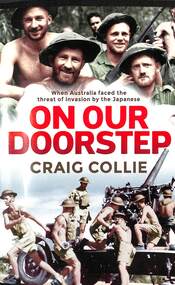 Sunshine and District Historical Society Incorporated
Book - On Our Doorstep, Craig Collie, 2020
... On Our Doorstep When Australia faced the threat of invasion by the Japanese...The book was given to John Alchin, by Alan Dash curator of the Sunshine & District Historical Society for Christmas 2021 World World 1939 - 1945 history The history of when Australia faced the direct threat of a Japanese invasion during World War II On Our Doorstep When Australia faced the threat of invasion by the Japanese Soft covered book with photographs of Australian soldiers on the front. ...The history of when Australia faced the direct threat of a Japanese invasion during World War IISoft covered book with photographs of Australian soldiers on the front.non-fictionThe history of when Australia faced the direct threat of a Japanese invasion during World War IIworld world 1939 - 1945, history -
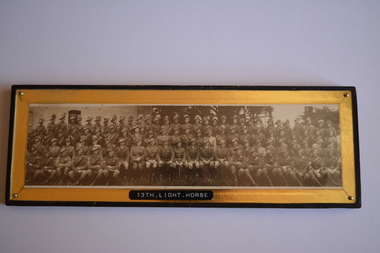 Wangaratta RSL Sub Branch
Memorabilia - Photograph, 13th Light Horse, c1935
... invasion of mainland Australia. After moving to Puckapunyal in July, the regiment was equipped with M3 Grant tanks. Further training was undertaken in Murgon, Queensland, throughout 1943. By that time, manpower within the Army was scarce and as the threat...invasion of mainland Australia. After moving to Puckapunyal in July, the regiment was equipped with M3 Grant tanks. Further training was undertaken in Murgon, Queensland, throughout 1943. By that time, manpower within the Army was scarce and as the threat ...This black and white mage depicts large group of men dressed in military uniform of the Light Horse - with most wearing bandoliers and slouch hat, some with emu plumes. The 13th Light Horse Regiment was formed at Broadmeadows in Victoria in March 1915; it was the third light horse regiment to have been raised in that state. Its regimental number quickly led to it becoming known as the "Devil's Own" regiment. It left Australia on 28 May and disembarked in Egypt on 29 June 1915. In 1921, Australia's part-time military forces were re-organised to perpetuate the numerical designations of the AIF following its demobilisation. Through this process, the 13th Light Horse was re-raised as a Citizens Forces unit in Victoria, adopting the territorial designation of the "Gippsland Light Horse". In 1939, the regiment was amalgamated with the 19th Light Horse to become the 13th/19th Light Horse.In August 1940, during the opening stages of the Second World War, the 13th was re-formed in its own right. It was later mechanised and re-designated the "13th Motor Regiment". In May 1942, it was converted into an armoured regiment – designated as the "13th Armoured Regiment" – as part of the 2nd Armoured Division's 6th Armoured Brigade, which had been formed for defensive duties to guard against a possible invasion of mainland Australia. After moving to Puckapunyal in July, the regiment was equipped with M3 Grant tanks. Further training was undertaken in Murgon, Queensland, throughout 1943. By that time, manpower within the Army was scarce and as the threat of an invasion by the Japanese diminished during the year, so too did the need for large-scale armoured forces. A number of armoured units were subsequently disbanded as men and equipment were reallocated as the Army reorganised for jungle warfare. As a result, the 13th was disbanded in October 1943. In the post war period, the unit was perpetuated by the 8th/13th Victorian Mounted Rifles, which existed between 1948 and 1991–92. During WWI three light horse regiments were raised in Victoria for the AIF, the 4th ALH, the 8th ALH and the 13th ALH. These regiments served with distinction at Gallipoli, in the Middle East and on the Western Front.Wide and narrow rectangle shaped black painted frame with gold colour mount. The frame contains a black and white photograph depicting a large group of men dressed in military uniform with bandoliers and slouch hat, some with emu plumes. A small black strip of plastic is attached in the centre of lower edge.Front - 13th Light Horse Rear - 2nd Division Cavalry School Broadmeadows 20-09-1935victoria, 13th light horse -
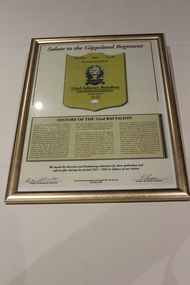 Dandenong/Cranbourne RSL Sub Branch
Certificate - Certificate -Salute to the Gippsland Regiment
... However as the threat of invasion lifted, a restructure of army units saw the disbandment of the 10th Brigade and hence the 52nd in September 1942 and the revival of the 37th/52nd Battalion. ...However as the threat of invasion lifted, a restructure of army units saw the disbandment of the 10th Brigade and hence the 52nd in September 1942 and the revival of the 37th/52nd Battalion. ...Refer also https://en.wikipedia.org/wiki/52nd_Battalion_(Australia)Rectangular framed Certificate. Salute to the Gippsland Regiment. ---------------------------------------------------------------------------------------------------------------------------------------- In Shield in top half of certificate-: Defending Australia with rising sun badge then In commemoration of: No 52 surrounded by wreath with inscription on bottom Always Ready Gippsland Regiment 52nd Infantry Battalion (The Gippsland Regiment) "Always Ready" 1921-1930 1936-1942 Circle with white top half and light blue bottom half. -------------------------------------------------------------------------------------------------------------------------------- Under the Shield-: History of the 52nd Battalion. Tracing the ancestry going back to the "Gippsland Battalion of the Victorian Rangers, the Militia (CMF) 52nd Battalion was raised from the 2nd Bn/5th Australian Infantry Regiment (HQ Dandenong) as part of an overhaul of Australia's defences in 1920-21 that saw the reintroduction of compulsory military service. To afford it a proud identity ,the new battalion was assigned the same number as the 52nd/1st AIF which had performed with distinction in France ( Somme, Pozieres, Bullicort, Messine and Ypes to name just some). In addition the new battalion also inherited the Kings and Regimental Colours which, as part of the 52nd Bn/1st AIF's lineage including battle honours earned by 2nd Bn, Tasmanian Infantry Regiment in the Boer War, 1899-1902, and the same circular colour patch, horizontally bisected with white over blue halves. Later the 52nd officially received its regional title, "The Gippsland Regiment" and its motto "Always Ready". Digger prevailing during WW2 it was nicknamed "The Gippsland Bushrangers". The 52nd formed part of the 10th Infantry Brigade, 3rd Militia (CMF) Division. With the reversion to voluntary citizen forces in1930,declining numbers forced an amalgamation with the 37th Bn to become 37th/52nd Bn. Then in mid 1936, an expansion and modernisation of the CMF, including the conversation of the Light Horse to motorised, allowed both battalions to separate and for the 52nd to expand into East Gippsland. In 1938, 52nd Bn was granted linkage with the "Queens Own Cameron Highlanders" and permission to use its Regimental March- "March of the Cameron Men'. When Japan entered the war in December 1941,the Australian Military Forces were fully mobilized, (part time to full time) for the defence of homeland Australia. While training at various locations in central Victoria, the militia became for many, a stepping stone into the AIF and other services, as well as a training unit for new conscripts. As part of our national defence preparations, in mid 1942 the 52 Bn relocated to Queensland as part of the 3rd Division, replacing the AIF 7th Div on the so called "Brisbane Line". However as the threat of invasion lifted, a restructure of army units saw the disbandment of the 10th Brigade and hence the 52nd in September 1942 and the revival of the 37th/52nd Battalion. The 52nds colours were returned to Melbourne, eventually being placed in the Shrine of Remembrance for safe keeping. ----------------------------------------------------------------------------------------------------------------------------------------------------------------------------------------------------------------------------------- At bottom of the certificate- We thank the Berwick and Dandenong volunteers for their dedication and self sacrifice during the period 1921- 1942 in defence of our nation. (Signed) D W Shields President Dandenong RSL Sub Branch L Lucas President Berwick RSL Sub Branch Presented by the Dandenong and Berwick RSL Sub Branches November 2009. -
 Falls Creek Historical Society
Book - Alps Invaders - Weeds of the Australian High Country, John Hosking, Geoff Sainty, Surrey Jacobs, 2006
... By identifying weeds that pose the greatest threat to native vegetation, all users and visitors to these parks can assist park staff to locate weeds that require control. This identification guide has been produced for those concerned about weed invasions in these areas. ...The Australian Alps National Parks are relatively weed free compared with other environments that have been exploited by humans. By identifying weeds that pose the greatest threat to native vegetation, all users and visitors to these parks can assist park staff to locate weeds that require control. This identification guide has been produced for those concerned about weed invasions in these areas.A spiral volume of 62 pages including illustrations, a table of contents, map and index. The back cover includes logos of sponsors of the publication.The Australian Alps National Parks are relatively weed free compared with other environments that have been exploited by humans. By identifying weeds that pose the greatest threat to native vegetation, all users and visitors to these parks can assist park staff to locate weeds that require control. This identification guide has been produced for those concerned about weed invasions in these areas.alpine threats, australian environmental threats
