
Showing 12 items matching "the junior argus"
-
 NMIT (Northern Melbourne Institute of TAFE)
Folder: Bound newspaper pages The Junior Argus 1934
... Folder: Bound newspaper pages The Junior Argus 1934...Folder: Bound newspaper pages The Junior Argus 1934...The Junior Argus...Manilla folder with pages from The Junior Argus: supplement to The Argus newspaper 15 January 1934 to 16 July 1934....Folder: Bound newspaper pages The Junior Argus 1934 Folder: Bound newspaper pages The Junior Argus 1934 ...Manilla folder with pages from The Junior Argus: supplement to The Argus newspaper 15 January 1934 to 16 July 1934.the junior argus, newspaper cuttings, -
Warrnambool and District Historical Society Inc.
Newspaper - Bound Volumes of The Junior Argus Newspaper, Richard Arthur Maddern Wellington, 1934 to 1937
... Bound Volumes of The Junior Argus Newspaper ...These four bound volumes contain copies of the Junior Argus from 1934 to 1937. The Junior Argus was a supplement inserted in the Argus newspaper in the 1930s and 1940s. ...Warrnambool and District Historical Society Inc. 2 Gilles Street (south of Merri St) Warrnambool great-ocean-road These four bound volumes contain copies of the Junior Argus from 1934 to 1937. The Junior Argus was a supplement inserted in the Argus newspaper in the 1930s and 1940s. ...Bound volumes of newspapers containing fiction and non fiction material..1 Copies of a newspaper bound with a grey and black mottled cover with black binding on the spine which has some damage. .2 As above but with a cream and black mottled cover. and the tape missing on the spine. .3 As above but with spine binding intact .4 as above All have a library stamp inside the front cover.fictionBound volumes of newspapers containing fiction and non fiction material.argus newspaper, orana, junior argus -
Kew Historical Society Inc
Archive (Sub-series) - Subject File, Kew Historical Society, Genazzano FCJ, 1934
... The most interesting item in the file is a damaged copy of ‘The Junior Argus’ (Thursday 10 May 1934), which includes a full-page article on Scouts and Guides: A survey of the Jamboree (by Lone Woolf), and a small article on the Genazzano Badge....The most interesting item in the file is a damaged copy of ‘The Junior Argus’ (Thursday 10 May 1934), which includes a full-page article on Scouts and Guides: A survey of the Jamboree (by Lone Woolf), and a small article on the Genazzano Badge. ...Various partiesReference, Research, InformationSecondary Values (KHS Imposed Order)Subject file containing information on Genazzano FCJ, Cotham Road. The file includes old and new newspaper articles/clippings, and a history of the Stanislaus Room. The most interesting item in the file is a damaged copy of ‘The Junior Argus’ (Thursday 10 May 1934), which includes a full-page article on Scouts and Guides: A survey of the Jamboree (by Lone Woolf), and a small article on the Genazzano Badge.genezzano fcj - kew (vic), boy scout girl guide jamboree 1934, private schools - kew (vic.), girls' schools - kew (vic.)genezzano fcj - kew (vic), boy scout girl guide jamboree 1934, private schools - kew (vic.), girls' schools - kew (vic.) -
![Photograph, Bull, Hugh Jones, 1897-1993, View looking along St Kilda Road [completed Centenary pylons on Princes Bridge]](/media/collectors/68524623ad73480cc6fce59f/items/68f089892b74709eaf6d30e8/item-media/68f089af2b74709eaf6d372a/item-fit-380x285.jpg?cb=6) City of Melbourne Libraries
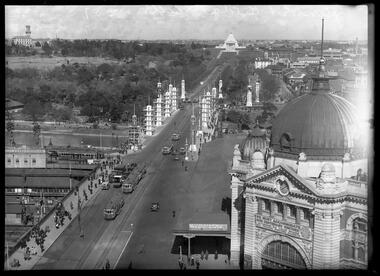
City of Melbourne LibrariesPhotograph, Bull, Hugh Jones, 1897-1993, View looking along St Kilda Road [completed Centenary pylons on Princes Bridge]
... . : 1848 - 1957), p. 1 (The Junior Argus). Retrieved September 21, 2023, from http://nla.gov.au/nla.news-article10977836.... : 1848 - 1957), p. 1 (The Junior Argus). Retrieved September 21, 2023, from http://nla.gov.au/nla.news-article10977836 centenaries 1930-1939 bridges Photographer notations on slide: "View looking along St Kilda Road C57". ...Princes Bridge Centenary pylons complete Even though this is a street scene, it feels very intimate; we are instantly immersed in the activity of a Melbourne afternoon, looking down St Kilda Road from a viewpoint near today’s Federation Square. The focus is on the Centenary Pylons, erected on Princes Bridge to mark Melbourne’s Centenary in 1934. The sixteen plastered pylons were designed by Roy Prentice, the second person to qualify as an architect at the University of Melbourne in 1933, and aged just 27. The State Electricity Commission sponsored the work and The Argus reported that the pylons were “illuminated from within to give the effect of soft radiance”. Australia Home Beautiful reported that the taller pylons were 48 feet high. Timber-framed and faced with fibrous plaster and galvanised sheet iron, each structure was bolted to a concrete foundation three feet in depth. Panels of glass were indirectly lit by forty 100 watt lamps, and the upper bank of lamps were dyed so as to flood them with a deep red light. The shields and flagpoles were illuminated by three 200 watt concealed projectors, part of an electric night light decoration scheme involving 28 miles of wire to supply more than 20,000 lights. Melbourne was converted into “a coloured fairyland by night”. Featured in "Newsworthy: Melbourne in photographs 1933-1936" exhibition at East Melbourne Library, October to December 2023. Exhibition caption by project volunteer, Louise McKenzie Photographer notations on slide: "View looking along St Kilda Road C57" Published: (1934, September 5). The Age (Melbourne, Vic. : 1854 - 1954), p. 11. Published title: DECORATIONS -- THEN AND NOW. Published caption: "The second picture shows one of the Princes-bridge pylons completed..." Trove article identifier: http://nla.gov.au/nla.news-article205880269 Research by project volunteer, Louise McKenzie: Even though this is a street scene, it feels very intimate; we are instantly immersed in the activity of a Melbourne afternoon, looking down St Kilda Road from a viewpoint near today’s Federation Square. The focus is on the Centenary Pylons, erected on Princes Bridge to mark Melbourne’s Centenary in 1934. The sixteen plastered pylons were designed by Roy Prentice, the second person to qualify as an architect at the University of Melbourne in 1933, and aged just 27. The State Electricity Commission sponsored the work and The Argus reported that the pylons were “illuminated from within to give the effect of soft radiance”. Australia Home Beautiful reported that the taller pylons were 48 feet high. Timber-framed and faced with fibrous plaster and galvanised sheet iron, each structure was bolted to a concrete foundation three feet in depth. Panels of glass were indirectly lit by forty 100 watt lamps, and the upper bank of lamps were dyed so as to flood them with a deep red light. The shields and flagpoles were illuminated by three 200 watt concealed projectors, part of an electric night light decoration scheme involving 28 miles of wire to supply more than 20,000 lights. Melbourne was converted into “a coloured fairyland by night”. References: DECORATIONS -- THEN AND NOW. (1934, September 5). The Age (Melbourne, Vic. : 1854 - 1954), p. 11. Retrieved September 21, 2023, from http://nla.gov.au/nla.news-article205880269 'Dressing Melbourne for the Duke', The Australian home beautiful: a journal for the home builder. Vol 12 No. 10 (1 October 1934), page 21, 58. Retrieved September 14, 2023, from http://nla.gov.au/nla.obj-2950922209 28 Miles of Wire (1934, October 18). The Argus (Melbourne, Vic. : 1848 - 1957), p. 1 (The Junior Argus). Retrieved September 21, 2023, from http://nla.gov.au/nla.news-article10977836Photographer notations on slide: "View looking along St Kilda Road C57".centenaries, 1930-1939, bridges -
 City of Melbourne Libraries
Photograph, Bull, Hugh Jones, 1897-1993, Princes Bridge Centenary pylons under construction
... . : 1848 - 1957), p. 1 (The Junior Argus). Retrieved September 21, 2023, from http://nla.gov.au/nla.news-article10977836 'Historical references for Boathouse Row, Melbourne', http://boathouserowmelbourne.com.au/history/ 'ITALIAN DELEGATION TO HONOUR CARLO CATANI, DESIGNER OF THE ST KILDA FORESHORE, St Kilda Historical Society, 2001, https://web.archive.org/web/20070928061938/http://www.skhs.org.au/~SKHSarticles/articles/Carlo_Catani.html# HISTORY IN LIGHTS (1934, July 12). .... : 1848 - 1957), p. 1 (The Junior Argus). Retrieved September 21, 2023, from http://nla.gov.au/nla.news-article10977836 'Historical references for Boathouse Row, Melbourne', http://boathouserowmelbourne.com.au/history/ 'ITALIAN DELEGATION TO HONOUR CARLO CATANI, DESIGNER OF THE ST KILDA FORESHORE, St Kilda Historical Society, 2001, https://web.archive.org/web/20070928061938/http://www.skhs.org.au/~SKHSarticles/articles/Carlo_Catani.html# HISTORY IN LIGHTS (1934, July 12). ...Princes Bridge Centenary pylons under construction Possibly taken from Young and Jacksons Hotel (formerly Princes Bridge Hotel) on the corner of Flinders and Swanston streets, Flinders Street Station’s clocks and main entrance dominate, along with its distinctive copper dome and decorative façade. The time on the main clock is 1.40pm, and the sign underneath, reflecting Melbourne’s upcoming Centenary reads, “We must accommodate our Centenary visitors! Citizens! Do your share by taking paying guests.” At left is the original Princes Bridge Station, today the site of Federation Square. The riverside tram terminus advertises a Café/Tobacconist/Refreshment Room selling cigars & cigarettes, fountain drinks & confectionery, and in smaller text: “Leave your boot repairs here”. Nearly everyone is dressed in dark suits, coats and hats. The footpaths are wide and there are no traffic lights. The roadway stretches towards the Shrine of Remembrance, not yet dedicated but very dominant on the skyline. Government House is clearly visible across the wide parkland that would come to be known as Kings Domain and that is an area of deep importance to the people of the Eastern Kulin. Originally, Birrarung was part of a network of swamps and lagoons linked to the course of the river. From 1896, Public Works Department engineer Carlo Catani, oversaw a new channel to straighten the river and the swamps and lagoons were filled with spoil from the channel works. From the same vantage point today, only the top of the tower of Government House would be visible. The photo captures the pylons along Princes Bridge, mid-construction and being installed to mark Melbourne’s Centenary. The pylons were not without controversy. Both The Argus and The Age bemoaned them for being “made almost entirely of imported softwood timber”, denying work to native hardwood timber workers and sawmillers, and leading visitors to think Australia did not have its own exceptional native hardwoods. The pylons were also variously described in their incomplete state, as unimaginative and resembling an oilfield. Published: The Age 5 September 1934 Featured in "Newsworthy: Melbourne in photographs 1933-1936" exhibition at East Melbourne Library, October to December 2023. Exhibition caption by project volunteer, Louise McKenzie Photographer notations on slide: "Pylons + St Kilda Rd C57" Published: Age (Melbourne, Vic. : 1854 - 1954), Wednesday 5 September 1934, page 11 Published title: DECORATIONS -- THEN AND NOW. Published caption: "Although not completed yet, some impression of the effect of the decorations on Princes-bridge may be obtained from the first picture which shows the majestic sweep of St Kilda road with the Shrine of Remembrance and Government House dominating the horizon. The area to the left of St. Kilda-road and in front of Government House is portion of the area which it is proposed to call the King's Domain, which extends to Domain-road and Anderson-street..." Description: East-facing, elevated view of Flinders Street Station and Princes Bridge, featuring partially completed pylons erected for Melbourne's Centenary celebrations. The Shrine of Remembrance and Government House can be seen in the distance. In the foreground are trams, cars and trucks, pedestrians, Batman Avenue tram terminus and refreshment rooms. Signage on Flinders Street Station encourages citizens to accommodate Centenary visitors. The Melbourne Centenary was held 1934-35 in celebration John Batman's proclamation that Melbourne "the place for a village". Centenary events included a visit by Prince Henry, Duke of Gloucester. A Centenary Cake measuring 50 feet in height and ten tons in weight was cut into 250,000 pieces and sold at 1 shilling per piece for charity. Spectacular floodlighting of city landmarks, the creation of the Pioneer Women's Memorial Garden, and the MacRobertson Air Race from London, were other notable activities. Research by project volunteer, Louise McKenzie: The photo in The Age collage of 5 September 1934 has a slightly cropped foreground. The original photo has been taken from an elevated vantage point, most probably the roof of the Nicholas Building on the corner of Flinders and Swanston streets. The right foreground is dominated by the main “clocks” entrance to Flinders Street Station, showing its distinctive copper dome and decorative façade. The time on the main clock is 1.40 pm. The main sign on the front of the Station reads, "We Must Accommodate our Centenary Visitors! Citizens! Do your share by taking paying guests. Write to The Official Centenary Accommodation Bureau, 436 Collins St. City. Tel M 4671”. Another sign at eye level at the main entrance says: “Cheap Trips on Sundays”. The sign on the end of the roof along the eastern side of the station reads, “The Babies Need Your Help! Support Broadmeadows Foundling Hospital Appeal. July and August”. Run by the Sisters of St Joseph of the Sacred Heart, St Joseph’s Foundling Hospital was a purpose built infants’ home for up to 300 babies, plus accommodation for expectant mothers, mainly single women. In the early 1930s, the department (Victorian Children’s Welfare Department) contracted St Joseph’s Foundling Hospital to care for an additional 60 infant state wards, and up to 175 non wards at any given time. In 1931 it also operated a mothercraft training school. The centre foreground shows the commencement of Princes Bridge. Beneath the left side of the bridge was the site of the original Princes Bridge Station, by this time incorporated into Flinders Street Station, and today the area is the site of Federation Square. It was linked to Flinders Street station by the railway tracks that ran underneath the northern approach to the bridge. This photo shows a tram terminus which has a Café/Tobacconist/Refreshment Room, selling cigars & cigarettes, fountain drinks & confectionary, and a sign: Leave your boot repairs here. In the foreground is a wide roadway running south/north, comprising two vehicle lanes each heading north/south, and a central section containing two sets of tram tracks. There are cars, buses and delivery vans on the roadway. The trams visible are Glen Iris (Route No. 6; tram no. 448), Toorak (Route No. 8, tram no. 333), ? (No. 7), ? (No. 1), and ? (No. 2A). The footpaths are extremely wide. There is a square newspaper/magazine stand on the eastern side footpath. And also a “Ferry” sign. There are no traffic lights, but a policeman is visible on the roadway. There are pedestrians – men, women, children, a porter with trolley, women with prams. Clothing comprises dark suits, coats and hats for nearly everyone. There are double headed “Collins Street” lights along the side of the roadway, and along the northern riverbank. The roadway in the foreground is an extension of Swanston Street, which becomes Princes Bridge, then St Kilda Road, stretching towards the Shrine of Remembrance, and diverting past it. The Shrine had not yet been officially dedicated, and looks very white and dominant on the skyline. On the LHS of St Kilda Road, Government House is clearly visible across the wide parkland to be known as Kings Domain. The Kings Domain area is important to the people of the Eastern Kulin nation, and also has historical importance for its association with the early settlement of Melbourne and the foundation of British colonial administration in Victoria. On the southern side of the Yarra River (Birrarung) an historic rowing boathouse is visible, located adjacent to the Alexandra Gardens. Originally Birrarung was part of a network of swamps and lagoons linked to the course of the river. From 1896, under the guidance of engineer Carlo Catani* a new channel to straighten the river was created and the swamps and lagoons were filled with spoil from the channel works. The gardens were then created and completed in time for a Royal visit by the Duke of York in May 1901. The gardens are named after Alexandra of Denmark, the wife of King Edward VII. Both these areas, plus the Royal Botanic Gardens Victoria, Shrine of Remembrance Reserve, Sidney Myer Music Bowl, Government House, and the Queen Victoria Gardens together form the Domain Parklands. The extent of the subsequent plantings is evident today, where from the same vantage point only the top of the tower of Government House would be visible. *Catani was born in Florence in 1852, but after arriving in Melbourne worked as a civil engineer for the Victorian Government. His last major project was the reclamation of the foreshore of St Kilda, envisaged in the style of a European resort, complete with a split level esplanade, bathing pavilions, dance halls, amusements and a French-Italian style of landscape complete with palms. The gardens at the end of Fitzroy Street, St Kilda, now bear his name. The historic boathouse visible across the Yarra is another glimpse into Melbourne’s past. “Boathouse Row” comprises 7 amateur rowing clubs, the first established in 1859 (Melbourne University Boat Club). Other Clubs were Richmond, Melbourne, Banks, Melbourne Grammar School, Yarra Yarra and Mercantile. South of the river and west of the bridge is an area today developed into the Melbourne arts precinct of Hamer Hall and the Arts Centre. But at this time it was the home of Wirths Olympia Circus, which comprised Wirths Pleasure Park (an amusement park), a 5,000 seat auditorium – Hippodrome, a roller skating rink, a glaciarium, a cinema, and the Green Mill Dance Hall. Dog shows were also held at Olympia. The Green Mill Dance Hall closed in 1950, and the remainder of the Wirth buildings on site were destroyed by fire in December 1953. The feature of the photo is the pylons erected along Princes Bridge to mark Melbourne’s Centenary in 1934. The sixteen plastered pylons were designed by Roy Prentice, the second person to qualify as an architect at The University of Melbourne’s Bachelor of Architecture degree, in 1933, aged 27. Simon Reeves in his article marking the 100th birthday of Roy Prentice on 20 June 2006 reports that the State Electricity Commission sponsored this work, and the Argus reported that “… the pylons were “illuminated from within to give the effect of soft radiance”. Australia Home Beautiful 1 Oct 1934 reports in a very detailed and comprehensive article: The 10 taller pylons, including flagpole, were 48 ft, with a base of 8 ft. Timber-framed and faced with fibrous plaster and galvanised sheet iron, each structure was securely bolted to a concrete foundation three feet in depth. Panels of glass let into the shaft of each pylon were indirectly lit by 40, 100 watt lamps, and the upper bank of internal lamps were dyed so as to flood the panels with a deep red light. The decorative painted shields and flagpoles/pennants were illuminated by three 200 watt projectors concealed in the roof of each pylon, and were part of an electric night light decoration scheme involving 28 miles of wire to supply more than 20,000 lights. An article in the Argus on 18 October 1934 provided minute detail of the lighting erected in Melbourne for the Centenary, converting it “… into a coloured fairyland by night.” The estimated cost of 10 pounds per hour the lights were on. The display included 800 standard light poles 30 feet high which were tiered with electric bulbs concealed in inverted cones, 138 specially designed “Venetian poles” draped in flags trophies and streamers. The streets included in the electric night light decoration scheme were Bourke Street from Spring to William, the entire length of Collins Street, Flinders Street from Elizabeth to Spring, Lonsdale Street from Elizabeth to Swanston, Swanston and Elizabeth Streets from Flinders to Lonsdale, and parts of Springs and Spencer Streets. Together with the Princes Bridge pylons, approximately 28 miles of wire was required to supply power to the more than 20,000 lights. And that is just in the city of Melbourne. It was estimated the same amount of lighting was duplicated among other local councils. The pylons were not without controversy. The Argus on 28 August 1934 in an article headed “Imported Timber in Pylons” reported that the Princes Bridge pylons are “made almost entirely of imported softwood timber”, and have therefore denied work to native hardwood timber workers and sawmillers. The same day the Melbourne Age ran a similar story, bemoaning the fact that foreign oregon had been used which may lead tourists to think Australia did not have its own exceptional native hardwoods. A Camberwell City Councillor described the pylons as unimaginative, and the Herald reported that skeletons of pylons for the Centenary decorations in their present form led the area to resemble an oilfield! The Yarra River and Princes Bridge have long been a focal point of Melbourne life. In the early days of European settlement in Melbourne a rope-hauled punt carried people across the Yarra River. A surge in population and increased shipping traffic created a need for a bridge. There was difficulty in agreeing on a suitable site for the bridge (options were crossing at Elizabeth, Swanston, Queen or Market Streets), but the NSW Government favoured Swanston Street and the Melbourne Town Council decided on a temporary bridge across the Yarra spanning from the foot of Swanston Street. This first bridge was a single span timber toll bridge designed by Scottish born bridge designer David Lennox, and completed in 1845. It was 120 feet long, had a roadway of 17 feet wide, and a footpath on one side of 4 feet. It was leased to the Melbourne Bridge Company in the name of Robert A Balbirnie. The tollhouse was on the north side of the river and the toll keeper, Patrick Doherty, was credited with saving nine lives during the four years he was in charge of the toll station. The second bridge was stone (completed 1850), and named Prince’s Bridge after the HRH Prince of Wales, later Edward VII. It was designed with an elliptical single arc and an exceedingly small rise in proportion to the span. However, this design created an obstacle for flood waters, and together with Melbourne’s increasing population it was quickly apparent that a new bridge was required. At its opening on 15 November 1850 coincided with the imminent declaration of Victoria as a separate colony, it provided a moment of great celebration for Melbournians and “The opening ceremony was described as the grandest processional display witnessed in the colony.” (ToMelbourne.com.au) Princes Bridge in its present form, as depicted in this photograph, was designed by Jenkins, D’Ebro and Grainger, and constructed in 1886-88 by David Munro. John Grainger (father of Australian composer Percy Grainger) did the majority of the design work for the bridge. The structure was to have three arches each 96 feet wide measured across the river, and the banks on both sides were raised to allow more space for floodwater to flow. St Kilda Road was originally many feet below the current level. The bridge is of architectural significance for its substantial size, giant half columns, extensive use of wrought and cast iron, decorative elements (cast-iron lamps) and the skilled stonemasonry in the construction of the abutments and piers. Its main design features are similar to those of Blackfriars Bridge in London (1870). The bluestones were quarried from Footscray, the Malmsbury stones were from quarries at Kyneton, and the granite from Harcourt. The cost was met by the State of Victoria, City of Melbourne, and six out of seven of its municipalities, and their coats of arms feature on the bridge. The building of the bridge reflected the boom period of Melbourne, including the Victorian gold rush 1851- late 1860s, and its contractor, David Munro, was also responsible for the construction of Queens Bridge and Sandridge Railway Bridge. The Centenary pylons are no longer in place, but today this intersection still plays a major part in Melbourne’s daily life: people still meet “under the clocks” at Flinders Street station, and the route in and out of the city along St Kilda Road is often a feature of parades such as Moomba, the Grand Final Parade, and of course the Anzac Day Parade which commences at the Princes Bridge intersection and finishes at the Shrine of Remembrance. There are many tram routes, which cross the Bridge, and it directs pedestrians towards the Arts Precinct, the various components of Domain Park, plus the Southbank restaurant and rowing precincts. Even though this is a street scene, it feels very intimate; the viewer is instantly immersed in the activity of a Melbourne afternoon, looking down St Kilda Road from a viewpoint near today’s Federation Square. References: DECORATIONS -- THEN AND NOW. (1934, September 5). The Age (Melbourne, Vic. : 1854 - 1954), p. 11. Retrieved September 21, 2023, from http://nla.gov.au/nla.news-article205880269 'Flinders Street railway station', Wikipedia, https://en.wikipedia.org/wiki/Flinders_Street_railway_station 'St Joseph’s Foundling Hospital (1901-75)', Finding Records, Department of Health and Human Services, State of Victoria, https://www.findingrecords.dhhs.vic.gov.au/collectionresultspage/St-JosephsFoundling-Hospital-Babies-Home#departmental-administration 'Alexandra Gardens', City of Melbourne, https://www.melbourne.vic.gov.au/community/parks-open-spaces/major-parks-gardens/Pages/alexandra-gardens.aspx 'Wirths Circus', Wikipedia, https://en.wikipedia.org/wiki/Wirth's_Circus 'Roy Prentice: Centenary Architect', Built Heritage Pty Ltd, Simon Reeves, https://www.builtheritage.com.au/downloads/prentice.pdf 'Princes Bridge', Heritage Council Victoria, https://vhd.heritagecouncil.vic.gov.au/places/817 PORT PHILLIP. (1846, April 1). The Sydney Morning Herald (NSW : 1842 - 1954), p. 3. Retrieved September 21, 2023, from http://nla.gov.au/nla.news-article12886251 'Edward VII', Wikipedia, https://en.wikipedia.org/wiki/Edward_VII 'Princes Bridge', ToMelbourne.com, https://tomelbourne.com.au/princes-bridge/ 'Princes Bridge', eMelbourne, https://www.emelbourne.net.au/biogs/EM01189b.htm 'Princes Bridge', Australia for everyone, http://australiaforeveryone.com.au/files/melbourne/princes-bridge.html 'Victorian gold rush', Wikipedia, https://en.wikipedia.org/wiki/Victorian_gold_rush IMPORTED TIMBER IN PYLONS (1934, August 28). The Argus (Melbourne, Vic. : 1848 - 1957), p. 9. Retrieved September 21, 2023, from http://nla.gov.au/nla.news-article10952507 Princes-Bridge Pylons. (1934, August 28). The Age (Melbourne, Vic. : 1854 - 1954), p. 7. Retrieved September 21, 2023, from http://nla.gov.au/nla.news-article205532235 Pylons Appear Near Princes Bridge (1934, August 18). The Herald (Melbourne, Vic. : 1861 - 1954), p. 1. Retrieved September 21, 2023, from http://nla.gov.au/nla.news-article243104375 PRINCES-BRIDGE PYLONS. (1934, September 20). The Age (Melbourne, Vic. : 1854 - 1954), p. 10. Retrieved September 21, 2023, from http://nla.gov.au/nla.news-article205873535 28 Miles of Wire (1934, October 18). The Argus (Melbourne, Vic. : 1848 - 1957), p. 1 (The Junior Argus). Retrieved September 21, 2023, from http://nla.gov.au/nla.news-article10977836 'Historical references for Boathouse Row, Melbourne', http://boathouserowmelbourne.com.au/history/ 'ITALIAN DELEGATION TO HONOUR CARLO CATANI, DESIGNER OF THE ST KILDA FORESHORE, St Kilda Historical Society, 2001, https://web.archive.org/web/20070928061938/http://www.skhs.org.au/~SKHSarticles/articles/Carlo_Catani.html# HISTORY IN LIGHTS (1934, July 12). The Herald (Melbourne, Vic. : 1861 - 1954), p. 16. Retrieved September 21, 2023, from http://nla.gov.au/nla.news-article243172436 'Dressing Melbourne for the Duke', The Australian home beautiful: a journal for the home builder. Vol 12 No. 10 (1 October 1934), page 21, 58. Retrieved September 14, 2023, from http://nla.gov.au/nla.obj-2950922209Photographer notations on slide: "Pylons + St Kilda Rd C57".centenaries, bridges, lighting, flinders street railway station -
 City of Melbourne Libraries
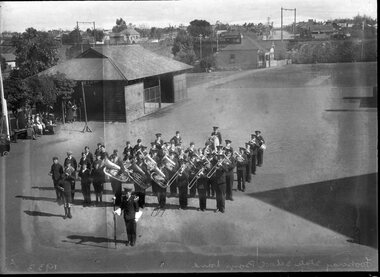
Photograph, Bull, Hugh Jones, 1897-1993, Footscray State School Boys Band
... Retrieved April 8, 2025, from http://nla.gov.au/nla.news-article276259073 AROUND THE SCHOOLS: THE ARGUS JUNIOR (1947, September 23). The Argus (Melbourne, Vic. : 1848 - 1957), p. 6 (The Argus Super Comic). ...Retrieved April 8, 2025, from http://nla.gov.au/nla.news-article276259073 AROUND THE SCHOOLS: THE ARGUS JUNIOR (1947, September 23). The Argus (Melbourne, Vic. : 1848 - 1957), p. 6 (The Argus Super Comic). ...Photographer notations on slide: Footscray State School Boys Band 1933 B5 Published: JUNIOR BAND CHAMPIONS--BEFORE THE HOLIDAYS--BELGIAN CARNIVAL--A ROYAL YACHTSMAN. (1933, September 1). The Age (Melbourne, Vic. : 1854 - 1954), p. 3. Published caption: “Proud Champions.- The drum-major of the band of the Hyde-street State School, Footscray, leads his players in a march past for visitors during Music Week. Under Mr. Frank Johnston’s conductorship this band has held the championship for two years.” Trove article identifier: http://nla.gov.au/nla.news-article205116143 Scope and Content: Footscray’s Hyde Street State School Band, led by their drum major, prepare to march past a group of mothers while playing their instruments. The band held the record for winning the most Victorian State Schools Association Championships between 1931 and 1966. Research by project volunteer, Fiona Collyer: Description: A large group of boys, most of whom are dressed in long trousers and peaked band hats, led by their drum major, prepare to march past a group of women dressed in overcoats and hats and an infant in a pram. In the background is a school shelter shed, a railway line, houses and a netball ring on a wooden stand. The Hyde Street State School Band was formed in 1928 as the school band for Hyde Street State School No. 1912 at 10 Hyde Street Footscray (now Footscray City Primary School). Their bandmaster, Francis Charles Johnston,(1880-1953) nicknamed “Massa” as a boy for his love and admiration of southern American jazz music, also conducted the Victorian Police Band, Collingwood Citizens Band, and the Melbourne Metropolitan Fire Brigade Band, amongst others, leading to scores of wins in brass band competitions. Even into his sixties, “Massa” ran three laps around the South Melbourne Oval every morning in order to maintain fitness for his busy conducting schedule. He was a cornetist and horn player, and performed in and lead brass bands for more than fifty years including bands that farewelled Australian troops from the Boer War to the Second World War. The Argus 13 December 1947, described “Massa” - “Bandsmen say he is a genius in brass band music, and the best conductor in the Southern Hemisphere. He still retains the romance and Bohemianism of the old German bandsmen he played with in the streets of Melbourne 50 years ago.” In 1925, a bequest of £10,000 from the estate of the late writer, William Gillies was made to the Education Department of Victoria. It was devoted to three purposes - “1) The encouragement of instrumental music (school bands or orchestras) in the State schools of Victoria, leading, it is hoped, to an increase in the number of village bands and orchestras, and, most important of all, family orchestras; (2) The encouragement of the art of reading aloud, leading, it is hoped, to an increase of the admirable pastime of reading aloud in the family circle; and (3) The encouragement of any branch of nature study, the aim of all three being to make home life, especially in the country, more attractive.” The Director of Education, Mr. M.P. Hansen wrote in his book “Thoughts That Breathe” published in 1932, that, as a result of the Gillies Bequest- “£3,030 has already been made available for the purchase of band instruments, and thanks largely to the encouragement given by this fine bequest, there are now in State schools in Victoria, each under expert tuition, 31 brass bands, 9 orchestras, 13 fife bands and 23 violin classes. That the effect of such work has a significant bearing on the right use of leisure, is undeniable.” By 1937, at least 50 State school bands had been set up in Victoria and the Victorian State Schools Association Championships were hotly contested. Frank quickly and skilfully brought the inexperienced boys of the Hyde Street Brass Band to A grade level, winning their first Victorian State Schools Association Championships in 1931. The band went on to win multiple times, holding the record for winning the most Victorian State Schools Association Championships between 1931 and 1966. The band soon became an integral part of community events. Whenever the Footscray Football Team played a home game at the perpetually blustery Western Oval, (Whitten Oval since 1995) the band performed at half time, marching around the boundary line, belting out the Footscray Football Team theme song- “Sons of the ’Scray” played to the tune of “Sons of the Sea” by British music hall songwriter Felix McGlennon. Volunteers walked behind the band carrying a large tarpaulin to catch the shower of coins thrown by fans from both teams, which helped pay for new instruments, repairs and uniforms. The old footy joke goes- Q. Who played on the wing at the Western Oval for 20 years, but never kicked a goal? A. The Hyde Street Band. Now called the Hyde Street Youth Band Inc, it is a not-for-profit organisation, supported by the City of Maribyrnong. Their aim is to make brass music accessible to young people aged from 5-25 years, by supplying the instruments and lessons for a modest annual membership fee. The traditional British brass band comprises of three musical ensembles according to ability. The Hyde Street Youth Band Inc. play at community events including the AFL Grand Final Parade, ANZAC Day March at the Shrine of Remembrance, Moomba Parade and Yarraville Carols by Candlelight. Their repertoire includes classical, marches, hymns, contemporary music and movie themes. https://bandblastsfromthepast.blog/2018/04/08/victorian-state-school-brass-bands-their-legacy-lives-on/ Massa" and His Musical Firemen (1947, December 13). The Argus (Melbourne, Vic. : 1848 - 1957), p. 2 (The Argus Week-end Magazine). Retrieved May 5, 2025, from http://nla.gov.au/nla.news-article22532344 http://www.hydestreethistory.8m.net/photo2.html MUSIC AND MUSICIANS (1932, March 9). The Mercury (Hobart, Tas. : 1860 - 1954), p. 2. Retrieved May 8, 2025, from http://nla.gov.au/nla.news-article29946674 https://hsyb.org.au/about/history-2/ https://hsyb.org.au/about/ MUSIC AND READING ALOUD. (1925, June 1). The Argus (Melbourne, Vic. : 1848 - 1957), p. 10. Retrieved May 5, 2025, from http://nla.gov.au/nla.news-article2122525 Shake! Narrow Escape From Shark The Birdcage Walk Champion Schoolboy's Band (1931, December 24). The Sun News-Pictorial (Melbourne, Vic. : 1922 - 1954; 1956), p. 14-15. Retrieved April 8, 2025, from http://nla.gov.au/nla.news-article276259073 AROUND THE SCHOOLS: THE ARGUS JUNIOR (1947, September 23). The Argus (Melbourne, Vic. : 1848 - 1957), p. 6 (The Argus Super Comic). Retrieved April 20, 2025, from http://nla.gov.au/nla.news-article22509356 https://bandblastsfromthepast.blog/tag/hyde-street-youth-band/ THE GILLIES BEQUEST (1933, September 2). The Argus (Melbourne, Vic. : 1848 - 1957), p. 22. Retrieved May 5, 2025, from http://nla.gov.au/nla.news-article11688410 https://adb.anu.edu.au/biography/johnston-francis-charles-massa-13009 Hyde Street, Footscray, State School Children (1930, March 8). Weekly Times (Melbourne, Vic. : 1869 - 1954), p. 40. Retrieved May 8, 2025, from http://nla.gov.au/nla.news-article223899955Photographer notations on slide: Footscray State School Boys Band 1933 B5bands, 1930-1939, musical instruments, schools, state schools, uniforms, footscray -
 Mortlake and District Historical Society
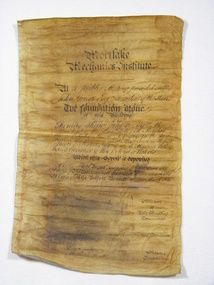
Poster - Mortlake Mechanics Institute, re foundation stone, Mortlake Mechanics' Institute Scroll
... Junior Esquire the President of the Institute on Monday/the 29th day of March A. D. 1869 in the 32nd year of the Reign of Her/Most Gracious Majesty Queen Victoria Sir I. A. T. Manners Sutton/being Governor of this Colony of Victoria/With this Scroll is Deposited/A copy of The Argus Newspaper of 28th March 1869/A copy of The Warrnambool Examiner of ? ...Junior Esquire the President of the Institute on Monday/the 29th day of March A. D. 1869 in the 32nd year of the Reign of Her/Most Gracious Majesty Queen Victoria Sir I. A. T. Manners Sutton/being Governor of this Colony of Victoria/With this Scroll is Deposited/A copy of The Argus Newspaper of 28th March 1869/A copy of The Warrnambool Examiner of ? ...In April 1869 when the foundation stone of the Mortlake Mechanics' Institute was laid by Thomas Shaw of Wooriwyrite, this parchment scroll was sealed with other documents in the foundation stone. In 1891 when further alterations were made the hall these documents were retrieved from the stone. This building was erected to house the local library whichup until that time had been housed in the Morllake Common School.Discoloured foolscap parchment with copperplate lettering, some water damage which has caused the obliteration of the names of the Members of the Building Committee, Hon.Secretary and Architect. At a Public Meeting presided over by John Grieve Esq. President of the Shire/The foundation stone/of this building/was laid by - /Thomas Shaw Junior Esquire the President of the Institute on Monday/the 29th day of March A. D. 1869 in the 32nd year of the Reign of Her/Most Gracious Majesty Queen Victoria Sir I. A. T. Manners Sutton/being Governor of this Colony of Victoria/With this Scroll is Deposited/A copy of The Argus Newspaper of 28th March 1869/A copy of The Warrnambool Examiner of ? March 1869/A copy of The Belfast Examiner of 17th March 1869/Members of/The Building/ Committee/Hon.Secretary and Treasurer/Architect/Contractors/Messrs Jenkins and Harvey,Mason/Mr Joseph Wyatt,Carpenter.institute, free, libraries, public buildings, mortlake, mechanics -
 Uniting Church Archives - Synod of Victoria
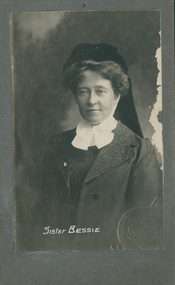
Photograph, Sister Bessie (Emma Elizabeth Dau), 1927
... Husband, Alfred Coates was Home Missionary in Diamond Creek from 1910 to 1913 and in Bacchus Marsh on 18/3/191, according to the Argus, p. 19, 18/3/1916. dau, emma elizabeth sister bessie methodist central mission, home missionary, alfred coates Verso: "Presented to the Junior Department of the Carlton Methodist Mission by: Ruby Farrell, Marjorie P. ...Possible dates: b. 12/10/1868, d. 14/10/1947. Husband, Alfred Coates was Home Missionary in Diamond Creek from 1910 to 1913 and in Bacchus Marsh on 18/3/191, according to the Argus, p. 19, 18/3/1916.B & W waist length studio portrait of Sister Bessie (Emma Elizabeth Coates nee Dau) dressed in her Home Missionary uniform.Verso: "Presented to the Junior Department of the Carlton Methodist Mission by: Ruby Farrell, Marjorie P. Saynor, Ruth I. Lane, Daphne Blanthorne, Thelma Jessop, Margaret McCutcheon, Elva Taylor, Phylis McCrohan, Dulcie Bolton, Eileen Colk, Teacher Junior (Supt.) Eva Reed, Sister Louie, 2 Thessalonians 1. 11,12 1927dau, emma elizabeth, sister bessie, methodist central mission, home missionary, alfred coates -
 Melbourne Legacy
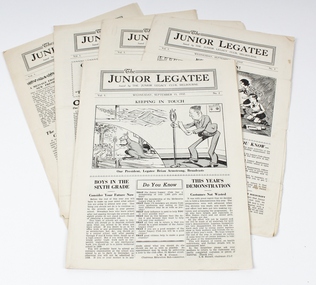
Journal - Document, set of newsletters, The Junior Legatee, Seven Issues from Wednesday, September 1, 1937 to Wednesday November 24, 1937
... Became Legacy Newsletter in August 1942 The Junior Legatee Journal Document, set of newsletters The Argus and Australasian Ltd. ...A newsletter produced on a regular basis by Melbourne Legacy for Junior Legatees, containing news, stories and messages including articles by current and retired members of the committee and executive as well as contributions from Legatee’s themselves. Articles include ‘Home Exercises for Girls’ Letters to the Editor and advice from the Legatee Doctor about sunburn and other health issues. It includes details of education classes, events, functions, holidays and news from the residences.Records the work done by Melbourne Legacy to care for children of servicemen who were either dead or no longer able to care for families. Also records social conditions of the times. Newspaper style newsletter of the Junior Legatee of between four and six pages. 00009.1, Vol 1, No 1, September 1, 1937 00009.2, Vol 1, No 2, September 15, 1937 00009.3, Vol 1, No 3, September 29, 1937 00009.4, Vol 1, No 4, October 13, 1937 00009.5, Vol 1, No 5, October 27, 1937 00009.6, Vol 1, No 6, November 24, 1937 00009.7, Vol 1, No 7, December 22, 1937. Became Legacy Newsletter in August 1942newsletter, activities -
 Melbourne Legacy
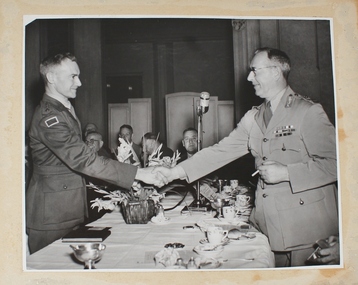
Photograph, Induction of first Junior Legatee into Melbourne Legacy, 1943
... Junior Legatee after his father died in the first World War at Ypres. He then served in World War 2 and on his return qualified to become a member of Melbourne Legacy. His service number was VX15205, full name Leonard Thomas Frazer. From Trove a newspaper article describes his background. "Argus...Junior Legatee after his father died in the first World War at Ypres. He then served in World War 2 and on his return qualified to become a member of Melbourne Legacy. His service number was VX15205, full name Leonard Thomas Frazer. From Trove a newspaper article describes his background. "Argus ...The photo shows a Junior Legatee, now Captain Len Frazer being inducted into Melbourne Legacy as a senior legatee by L/- Stan Savige on 26 January 1943. Notes with another photo taken at the event (see 01368) identifies the man as Captain Len Fraser, who had been a Junior Legatee after his father died in the first World War at Ypres. He then served in World War 2 and on his return qualified to become a member of Melbourne Legacy. His service number was VX15205, full name Leonard Thomas Frazer. From Trove a newspaper article describes his background. "Argus (Melbourne, Vic. : 1848 - 1957), Wednesday 27 January 1943, page 5 FIRST JUNIOR LEGATEE IN SENIOR CLUB Capt L. T. Frazer was initiated to membership of Legacy Club by Maj-Gen S. G. Savige, founder of the club, at a simple ceremony yesterday. He was the first returned soldier of this war, and first junior Legatee, to be admitted to membership. Joining junior Legacy in 1928, Capt Frazer, whose father was killed in the last war, was a foundation member of the Intermediate Club, of which he became president, and he gained the right to admittance to the senior club by having seen active service with the AIF. Enlisting in April, 1940, he served in the Middle East, Greece, and Crete. His father was killed in action with the first AIF at Ypres. Capt Frazer, who joined the Melbourne City Council as an engineering junior in 1928, graduated to senior MCC engineering assistant before he enlisted. At present he is attached to Army Engineers, LHQ. His wife and 3 children live at Canterbury."Sir Stanley Savige was the founder of Melbourne Legacy. A record of the first Junior Legatee becoming a Senior Legatee after his war service.Black and white photo of the induction of a new Legatee by L/- Stan Savige in 1943.savige, legatee event, len frazer, membership -
 Melbourne Legacy
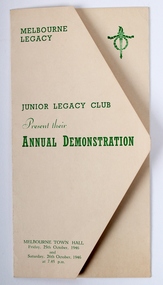
Programme, Junior Legacy Club Annual Demonstration 1946, October 1946
... It went ahead on Friday 1 November, as reported in The Argus on 2 Nov 1946: "Preceded by the impressive ceremony of remembrance, nearly 500 members of the Junior Legacy Club gave their annual display of physical culture and folk dancing at the Town Hall last night. ...It went ahead on Friday 1 November, as reported in The Argus on 2 Nov 1946: "Preceded by the impressive ceremony of remembrance, nearly 500 members of the Junior Legacy Club gave their annual display of physical culture and folk dancing at the Town Hall last night. ...Throughout the year Melbourne Legacy provided classes for Junior Legatees such as dancing, gymnastics and eurythmics, the Demonstration was an annual event to showcase their skills. Melbourne Legacy conducted Annual Demonstrations / Parades from 1928 through to 1979, usually held at Melbourne Town Hall or Olympic Pool Stadium. The event had to be deferred due to a transport strike. An article in The Age said: "In view of the transport strike still being in operation on either Friday or Saturday nights, the annual demonstration of the Melbourne, Legacy Club in Melbourne Town Hall will not be held. Efforts are being made to arrange for alternative dates after the strike is settled, and announcement of these will be made." It went ahead on Friday 1 November, as reported in The Argus on 2 Nov 1946: "Preceded by the impressive ceremony of remembrance, nearly 500 members of the Junior Legacy Club gave their annual display of physical culture and folk dancing at the Town Hall last night. Of particular interest were the appearances of the Don Esses Boys and Girls, who are children of disabled ex-servicemen. Their training classes are controlled and financed by members of the Intermediate Legacy Club, sons of deceased ex-servicemen. The Town Hall was packed for the performance, which will be repeated tonight."A record of a Junior Legacy Demonstration.Cardboard program. Contains running order, acts and names of instructors. Presented at the Town Hall Friday 25th October and Saturday 26th October 1946.Pen 'X' in the bottom left corner of coverjunior legatee, annual demonstration -
 Melbourne Legacy
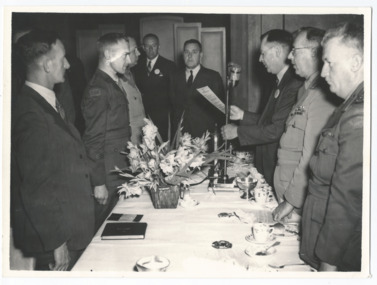
Photograph, Induction of first Junior Legatee into Melbourne Legacy, 1943
... Junior Legatee after his father died in the first World War at Ypres. He then served in World War 2 and on his return qualified to become a member of Melbourne Legacy. His service number was VX15205, full name Leonard Thomas Frazer. From Trove a newspaper article describes his background. "Argus...Junior Legatee after his father died in the first World War at Ypres. He then served in World War 2 and on his return qualified to become a member of Melbourne Legacy. His service number was VX15205, full name Leonard Thomas Frazer. From Trove a newspaper article describes his background. "Argus ...The photo shows a Junior Legatee, now Captain Len Frazer being inducted into Melbourne Legacy as a senior legatee on 26 January 1943. See also item 00040 for another photo of the event. The notes on the photo identify Legatees Stan Savige, Frank Doolan and W Cremor (ex-Pres. 1936), the man speaking is President Os Gawler, three others in the photo are unknown. Captain Len Frazer had been a Junior Legatee after his father died in the first World War at Ypres. He then served in World War 2 and on his return qualified to become a member of Melbourne Legacy. His service number was VX15205, full name Leonard Thomas Frazer. From Trove a newspaper article describes his background. "Argus (Melbourne, Vic. : 1848 - 1957), Wednesday 27 January 1943, page 5 FIRST JUNIOR LEGATEE IN SENIOR CLUB Capt L. T. Frazer was initiated to membership of Legacy Club by Maj-Gen S. G. Savige, founder of the club, at a simple ceremony yesterday. He was the first returned soldier of this war, and first junior Legatee, to be admitted to membership. Joining junior Legacy in 1928, Capt Frazer, whose father was killed in the last war, was a foundation member of the Intermediate Club, of which he became president, and he gained the right to admittance to the senior club by having seen active service with the AIF. Enlisting in April, 1940, he served in the Middle East, Greece, and Crete. His father was killed in action with the first AIF at Ypres. Capt Frazer, who joined the Melbourne City Council as an engineering junior in 1928, graduated to senior MCC engineering assistant before he enlisted. At present he is attached to Army Engineers, LHQ. His wife and 3 children live at Canterbury."A record of the first Junior Legatee becoming a Senior Legatee after his war service.Black and white photo of the induction of a new Legatee by L/- Stan Savige in 1943.Hand-written on reverse: 'Induction into Melbourne Legacy of First Junior Legatee, Len Fraser. Legatees S. Savige and W. Cremor on right / Legatee F Doolan on left.' in blue ink. Stamped with a copyright stamp (indistinct) in purple ink, and negative number '3245' in pencil.legatee event, membership, stan savige, len frazer
