
Showing 1080 items matching "the melbourne story"
-
 Kew Historical Society Inc
The Button Collection of Sally Hearn
... ...The Melbourne Story...Her button collection was featured as a primary display in the 'The Melbourne Story' exhibition at the Melbourne Museum, which opened in mid-2008. ...Collection of catalogued buttons in six trays, annotated by Sally Hearn and forming part of 'The Melbourne Story' which opened in 2008. Individual items are linked to this 'parent record'....Her button collection was featured as a primary display in the 'The Melbourne Story' exhibition at the Melbourne Museum, which opened in mid-2008. ...Sally Hearn (1932–2018) was a dedicated button collector and a prominent member of the Victoria Button Collectors Club. Her button collection was featured as a primary display in the 'The Melbourne Story' exhibition at the Melbourne Museum, which opened in mid-2008. Her display of over 10,000 buttons, ranging from 19th century military brass to mid-century glass and plastic served as a miniature history of Australian life and fashion. Portions of the button collection remained on public view at the Museum for over a decade.The button collection is historically and aesthetically significant in that it illustrates the textile and manufacturing history of Melbourne: * Textile History – how fashion and manufacturing changed over the 19th and 20th centuries; * Material Innovation – how early buttons were made from shell, horn, and bone, later moving into elaborate plastics and metals; and * Identity – how buttons can be 'institutional', representing uniform details from transport, military, or civil organisations.Collection of catalogued buttons in six trays, annotated by Sally Hearn and forming part of 'The Melbourne Story' which opened in 2008. Individual items are linked to this 'parent record'.buttons, sally hearn, the melbourne story, textile history, material innovation, identity, sally buttons -
Port Melbourne Historical & Preservation Society
Book - The O'Collins Story - A Melbourne Family, William J McCARTHY, 2002
... The O'Collins Story - A Melbourne Family...The O'Collins Story - A Melbourne Family...The O"Collins Story traces the lives of Patrick James O'COLLINS and his wife Ellen FITZGERALD, who migrated to Port Melbourne in 1895 and settled firstly at 5 Bridge Street, then in Ross Street before moving to Swallow Street . ...The O'Collins Story - A Melbourne Family Book The O'Collins Story - A Melbourne Family William J McCARTHY ...The O"Collins Story traces the lives of Patrick James O'COLLINS and his wife Ellen FITZGERALD, who migrated to Port Melbourne in 1895 and settled firstly at 5 Bridge Street, then in Ross Street before moving to Swallow Street . In 1914 the family moved to 40 Beaconsfield Parade. The book goes on to tell of the lives of their 9 children -Thomas William, James Patrick, Patrick Francis, Mary Margaret (Mollie), Margaret Ellen (Madge), Michael Fitzgerald, Alice Dorothy and Joseph Bernard.Book of 184 pages with a yellow cover inset with a black & white photograph O'COLLINS family in 1897.families, domestic life, patrick james ocollins, ellen ocollins (fitzgerald), thomas william ocollins, alice dorothy and joseph bernard., james patrick ocollins, patrick francis ocollins, mary margaret (mollie) ocollins, margaret ellen ( madge) mccarthy (ocollins), michael fitzgerald ocollins, alice dorothy ocollins, joseph bernard ocollins -
Marysville & District Historical Society
Document (Item) - Book extract, John (Jack) Cato, John William Lindt F.R.G.S. of Melbourne-The Story of the Camera in Australia, 1955
... John William Lindt F.R.G.S. of Melbourne-The Story of the Camera in Australia...John (Jack) Cato was a keen photographer from an early age and was the author of The Story of the Camera in Australia which when it was first published in 1955, was the first history of Australian photography and photographs. john william lindt fernshaw watts river black spur the hermitage nicholas nicholas john caire the argus john (jack) cato the story of the camera in australia An account of the life of John Willliam Lindt extracted from the book The Story of the Camera in Australia. John William Lindt F.R.G.S. of Melbourne-The Story of the Camera in Australia Document Book extract John (Jack) Cato ...An account of the life of John Willliam Lindt extracted from the book The Story of the Camera in Australia.An account of the life of John Willliam Lindt extracted from the book The Story of the Camera in Australia. John William Lindt (1845–1926), was a German-born Australian landscape and ethnographic photographer, early photojournalist, and portraitist. John Lindt was responsible for a folio of photographs of the Fernshaw and Watts River area and he sold over 25,000 images of the Black Spur from his original negatives. In 1895 he was able to purchase land on the North East side of the Black Spur and subsequently built his home and guesthouse "The Hermitage" from where he continued his photographic career. In 1913 he collaborated with Nicholas Caire to produce a tourist booklet on the area. In 1925 the Argus reported that Lindt "continues to produce remarkable and most artistic pictures of the beauties of mountain landscape. He is not a believer in the blurred effects favoured by many ... instead he is a master of detail." Aged 81 Lindt died of heart failure during disastrous bushfires on 19 February 1926 at the Hermitage. He was survived by his wife Catherine who continued to run ‘The Hermitage’ guest house before she retired to the city. John (Jack) Cato was a keen photographer from an early age and was the author of The Story of the Camera in Australia which when it was first published in 1955, was the first history of Australian photography and photographs.john william lindt, fernshaw, watts river, black spur, the hermitage, nicholas, nicholas john caire, the argus, john (jack) cato, the story of the camera in australia -
Marysville & District Historical Society
Document (Item) - Book extract, John (Jack) Cato, Nicholas John Caire of Melbourne-The Story of the Camera in Australia, 1955
... Nicholas John Caire of Melbourne-The Story of the Camera in Australia...After 1885 Nicholas John Caire gave up his city work and made his home in South Yarra and devoted the rest of his life to outdoor photography, specializing in the bush, the gullies, and the mountains of south-eastern Victoria. nicholas john caire john (jack) cato the story of the camera in australia An account of the life of Nicholas John Caire extracted from the book The Story of the Camera in Australia. Nicholas John Caire of Melbourne-The Story of the Camera in Australia Document Book extract John (Jack) Cato ...An account of the life of Nicholas John Caire extracted from the book The Story of the Camera in Australia.An account of the life of Nicholas John Caire extracted from the book The Story of the Camera in Australia. Nicholas John Caire was born in 1837 in Guernsey. He arrived in Adelaide about 1860 along with his parents who encouraged his early interest in photography. He opened a studio in Adelaide in 1867 after traveling extensively throughout the Gippsland taking photographs. After marrying in 1870 he moved to Talbot in Victoria until 1876 when he opened a studio in the Royal Arcade in Melbourne. After 1885 Nicholas John Caire gave up his city work and made his home in South Yarra and devoted the rest of his life to outdoor photography, specializing in the bush, the gullies, and the mountains of south-eastern Victoria. nicholas john caire, john (jack) cato, the story of the camera in australia -
 Eltham District Historical Society Inc
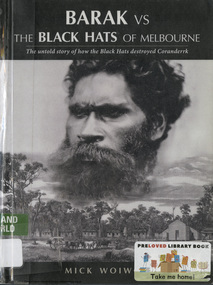
Book, Mick Woiwod, Barak vs the Black Hats of Melbourne: The Untold Story of How the Black Hats Destroyed Coranderrk, July 2017
... Barak vs the Black Hats of Melbourne: The Untold Story of How the Black Hats Destroyed Coranderrk...Coranderrk Wurundjeri William Barak Black Hats of Melbourne Board for the Protection of Aborigines (BPA) Aboriginal Australians Barak vs the Black Hats of Melbourne: The Untold Story of How the Black Hats Destroyed Coranderrk Book Book Mick Woiwod ...European settlement had removed the Wurundjeri from their hunting grounds in the Yarra Valley. In 1863, after twenty-eight years of dispossession and the death of most of the Colony's 'first people', a repentant government had returned 4,860 acres of land to its Wurundjeri people - they named it Coranderrk. Upon it, the survivors had enthusiastically built a village of twenty-three slab cottages with around it some 500 acres of cleared land grazed by a dairy herd, plus further paddocks devoted to wheat, oats and hops. Enter the 'Black Hats of Melbourne' a wealthy lobby-group committed to the introduction and release into the Victorian bush of such alien creatures as deer, hare, salmon and grouse. In 1874, intent upon additional introductions onto their land, these Black Hats had organised the dismissal of Coranderrk's high-achieving manager. Then, when later informed that senior Elder William Barak, had shot five of their released deer they had taken control of the Board for the Protection of Aborigines (BPA) and set about the expulsion of its residents to a remote location on the Murray. Standing four-square in their way had been William Barak who, by leading a series of deputations into Melbourne, had blocked every move by the Black Hats to close Coranderrk. Undeterred, these determined intruders had starved Coranderrk of funding and appointed a succession of scurrilous managers with instructions to run the station into the ground. The result was its closure in 1924.coranderrk, wurundjeri, william barak, black hats of melbourne, board for the protection of aborigines (bpa), aboriginal australians -
 Ringwood and District Historical Society
Book, Dr Maxwell Lay, Melbourne Miles - The Story of Melbourne's Roads, 2012
... Melbourne Miles - The Story of Melbourne's Roads...Soft cover book, 300 pages. Melbourne Miles - The Story of Melbourne's Roads Book Dr Maxwell Lay Australian Scholarly Publishing Pty Ltd Mercury Printeam Robin Underwood ...Soft cover book, 300 pages.A comprehensive history of the roads and streets of metropolitan Melbourne, with maps. Dr Max Lay, a Melburnian, is an international authority on roads. His very many publications include the Source Book for Australian Roads, Handbook of Road Technology, History of Australian Roads, Ways of the World, and Encyclopedia Britannica entry on roads. Dr Lay is also the past-president of both the Royal Automobile Club of Victoria and the Australian Automobile Association. -
 Stawell Historical Society Inc
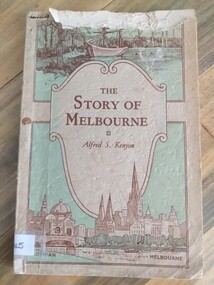
Book, Alfred S Kenyon, The Story of Melbourne by Alfred S Kenyon, 1934
... The Story of Melbourne by Alfred S Kenyon...Back Cover contains a drawing of a series of books, in the shape of question mark with a Kookaburra sitting at the top. The Story of Melbourne by Alfred S Kenyon Book Alfred S Kenyon ...This Book is most interesting - Melbourne's Beginnings. The Inscription in front of this book M.G. Phillips (nee Taylor), taught school at Concongella during World War II.Soft Card cover of a green and cream colour Three Separate Panels on front cover. Top panel contains a drawing of a ship moored at shore with trees in background. Send Panel Is a Shield with curled side inside is The Title and Authors Name in Brown print. The Lower Panel is the largest contains a drawing of a river with a bridge crossing it, also a church and domed building with a clock tower in the distance. Back Cover contains a drawing of a series of books, in the shape of question mark with a Kookaburra sitting at the top.Inside front cover hand written M.G. Phillipsstawell education -
 Tatura Irrigation & Wartime Camps Museum
Book, The Story of Melbourne, 1934
... The Story of Melbourne...the story of melbourne...Paul's Cathedral The Story of Melbourne Book Book ...Cream, pale green cover. Brown lettering. Sketches of early discovery scene and Yarra river, Flinders Street, Station and St. Paul's Cathedralthe story of melbourne, kenyon af, stewart f, tatura, victorian history, sir gengoult-smith -
Canterbury History Group
Book, Weston Bate, Richard Broome, The Story of Melbourne Lanes, 2024
... The Story of Melbourne Lanes...Melbourne Lanes Town Planning Bridges The story of Melbourne's Lanes. ...The story of Melbourne's Lanes. Some lanes feature with photos from past with photos of the lane in the present. Includes material from the 1994 edition.268 pages, includes black and white and colour photos and index non-fictionThe story of Melbourne's Lanes. Some lanes feature with photos from past with photos of the lane in the present. Includes material from the 1994 edition.melbourne lanes, town planning, bridges -
 Kew Historical Society Inc
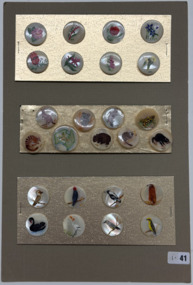
25 buttons on gold card on green card, 1996-1999
... Her button collection was featured as a primary display in the 'The Melbourne Story' exhibition at the Melbourne Museum, which opened in mid-2008....Her button collection was featured as a primary display in the 'The Melbourne Story' exhibition at the Melbourne Museum, which opened in mid-2008. ...Sally Hearn (1932–2018) was a dedicated button collector and a prominent member of the Victoria Button Collectors Club. Her button collection was featured as a primary display in the 'The Melbourne Story' exhibition at the Melbourne Museum, which opened in mid-2008.The Hearn Collection of locally made and international buttons is historically and aesthetically significant as it illustrates the textile and manufacturing history of button making.25 buttons on gold card on green card. Clothing buttons, or to be admired. Made by an individual named 'Heather' in Mt. Compass (South Australia), through 1996-1999.Original Catalogue Entry: "En route to Victor Harbour we passed through Naracoorte S.A. where a lady in the Op Shop was sporting a lovely hand painted brooch. I asked her where she got it. She said her daughter had made it for her. I asked for her daughter’s details only to discover she lived where we were heading. Having made contact and eventually providing Heather with the sets of Mother of pearl buttons, she sent me a set each year in turn, of the flower, bird and animal emblems of each Australian State and Territory."sally hearn, button collections -
 Kew Historical Society Inc
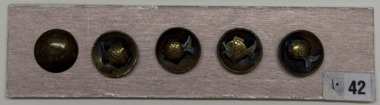
5 buttons on pink metallic card, 1950-1960
... Her button collection was featured as a primary display in the 'The Melbourne Story' exhibition at the Melbourne Museum, which opened in mid-2008....Her button collection was featured as a primary display in the 'The Melbourne Story' exhibition at the Melbourne Museum, which opened in mid-2008. ...Sally Hearn (1932–2018) was a dedicated button collector and a prominent member of the Victoria Button Collectors Club. Her button collection was featured as a primary display in the 'The Melbourne Story' exhibition at the Melbourne Museum, which opened in mid-2008.The Hearn Collection of locally made and international buttons is historically and aesthetically significant as it illustrates the textile and manufacturing history of button making.5 buttons on pink metallic card. Made from brass, depicting mostly fish. Used for lady's blouse or dress. Made in Friesland (Netherlands) between 1950-1960.Original Catalogue Entry: "On a visit home Martha bought a set of buttons. Wearing them in Australia she lost one. Returning to Europe she returned to the jeweller for a replacement, only to discover the fish had changed direction! The next year she lost another and returning, on her annual visit, to replace it she discovered no more fish just plain hammered buttons! No matter she still bought one!"sally hearn, button collections -
 Kew Historical Society Inc
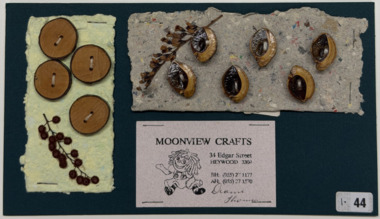
10 buttons on handmade paper on green card with dried flowers, 1995
... Her button collection was featured as a primary display in the 'The Melbourne Story' exhibition at the Melbourne Museum, which opened in mid-2008....Her button collection was featured as a primary display in the 'The Melbourne Story' exhibition at the Melbourne Museum, which opened in mid-2008. ...Sally Hearn (1932–2018) was a dedicated button collector and a prominent member of the Victoria Button Collectors Club. Her button collection was featured as a primary display in the 'The Melbourne Story' exhibition at the Melbourne Museum, which opened in mid-2008.The Hearn Collection of locally made and international buttons is historically and aesthetically significant as it illustrates the textile and manufacturing history of button making.10 buttons on handmade paper on green card with dried flowers. Each button is a wooden representation of either logs or seed pods. Made by Dianne Thomas in South Australia, 1995.Original Catalogue Entry: "En route to Adelaide I found a post card and a few buttons in the Op shop in Heywood, A rubber stamp of a phone number was just decipherable. I rang to order a set, Dianne said she no longer made them but had a few left somewhere. At a later date they arrived in the mail - Thank you Dianne!"sally hearn, button collections -
 Kew Historical Society Inc
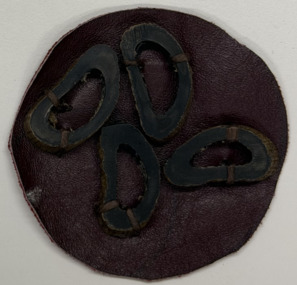
7 loops on 2 circles of leather, 1999
... Her button collection was featured as a primary display in the 'The Melbourne Story' exhibition at the Melbourne Museum, which opened in mid-2008....Her button collection was featured as a primary display in the 'The Melbourne Story' exhibition at the Melbourne Museum, which opened in mid-2008. ...Sally Hearn (1932–2018) was a dedicated button collector and a prominent member of the Victoria Button Collectors Club. Her button collection was featured as a primary display in the 'The Melbourne Story' exhibition at the Melbourne Museum, which opened in mid-2008.The Hearn Collection of locally made and international buttons is historically and aesthetically significant as it illustrates the textile and manufacturing history of button making.Contrary to title, there is only 4 loops on 1 circle of leather. Made of goat horn, usefulness as buttons questionable. Created by an individual only known as 'Percy' in South Australia, 1999.Original Catalogue Entry: "The 2 ladies in the shop said they had no buttons then one remembered the ones that “Percy” had made so I bought them both but I’m not sure if it’s 2 circular leather buttons decorated with goats horn, or if it’s 7 goats horn buttons and if so how were they used?"sally hearn, button collections -
 Kew Historical Society Inc
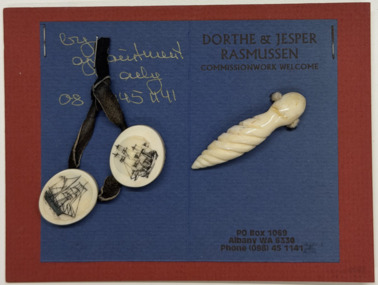
3 toggles on blue paper on red card, 30th July, 2001
... Her button collection was featured as a primary display in the 'The Melbourne Story' exhibition at the Melbourne Museum, which opened in mid-2008....Her button collection was featured as a primary display in the 'The Melbourne Story' exhibition at the Melbourne Museum, which opened in mid-2008. ...Sally Hearn (1932–2018) was a dedicated button collector and a prominent member of the Victoria Button Collectors Club. Her button collection was featured as a primary display in the 'The Melbourne Story' exhibition at the Melbourne Museum, which opened in mid-2008.The Hearn Collection of locally made and international buttons is historically and aesthetically significant as it illustrates the textile and manufacturing history of button making.3 toggles on blue paper on red card. Representing two ships and a tusk, made from whale's teeth. Made by a Jesper Rasmussen of Albany (Western Australia) in 2001.Original Catalogue Entry: "Seeing the lovely scrimshaw pieces for sale at the Information Centre in Albany, I enquired about the artist and was given a phone no. which I rang. Dorthe answered they weren’t far away “but don’t come for at least 20 mins” so she could square up! On arrival Jesper was gardening, not very interested in callers. “No” said Dorthe “no more buttons only these toggles” – his supply of whale’s teeth was gone and he was sick. Lovely other items there for sale. The next year I sent friends there to visit them, and was very sad to later learn Jesper had died not long after our visit, from a lung complaint, no doubt brought on by the dust from his scrimshandering."sally hearn, button collections -
 Kew Historical Society Inc
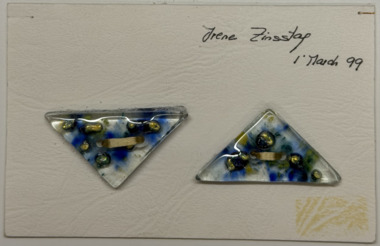
2 buttons on white card, 1999
... Her button collection was featured as a primary display in the 'The Melbourne Story' exhibition at the Melbourne Museum, which opened in mid-2008....Her button collection was featured as a primary display in the 'The Melbourne Story' exhibition at the Melbourne Museum, which opened in mid-2008. ...Sally Hearn (1932–2018) was a dedicated button collector and a prominent member of the Victoria Button Collectors Club. Her button collection was featured as a primary display in the 'The Melbourne Story' exhibition at the Melbourne Museum, which opened in mid-2008.The Hearn Collection of locally made and international buttons is historically and aesthetically significant as it illustrates the textile and manufacturing history of button making.2 buttons on white card. Made of glass, coloured in blue and yellow with a triangular shape. For use on cardigans and jackets. Made by Irene Zinsstag in Victoria, sometime in 1999.Original Catalogue Entry: "I gave a talk at Hampton Community Centre, it was advertised in the local paper and Irene attended. She introduced herself afterwards and gave me the buttons."sally hearn, button collections -
 Kew Historical Society Inc
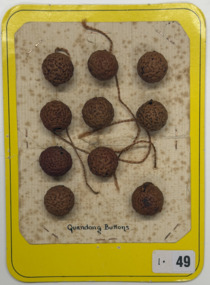
10 buttons on old paper on yellow card, c. 1930s
... Her button collection was featured as a primary display in the 'The Melbourne Story' exhibition at the Melbourne Museum, which opened in mid-2008....Her button collection was featured as a primary display in the 'The Melbourne Story' exhibition at the Melbourne Museum, which opened in mid-2008. ...Sally Hearn (1932–2018) was a dedicated button collector and a prominent member of the Victoria Button Collectors Club. Her button collection was featured as a primary display in the 'The Melbourne Story' exhibition at the Melbourne Museum, which opened in mid-2008.The Hearn Collection of locally made and international buttons is historically and aesthetically significant as it illustrates the textile and manufacturing history of button making.10 buttons on old paper on yellow card. Made from dried quandongs, presumably somewhere around the Mildura area. Unknown creator, circa 1930s.Original Catalogue Entry: "I like to think they were made and mounted by a housewife to supplement the family income during the Depression. No doubt an educated lady – the calligraphy is delightful. The rayon or artificial silk thread – “poor man’s embroidery thread” has not lasted the distance and some have fallen off and been lost. Of course the delicious fruit surrounding the stones would have been made into jelly or jam – and maybe sold too for more income."sally hearn, button collections -
 Kew Historical Society Inc
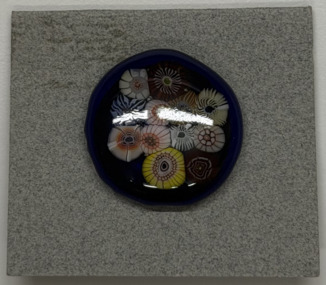
1 button on grey card, c. 2000
... Her button collection was featured as a primary display in the 'The Melbourne Story' exhibition at the Melbourne Museum, which opened in mid-2008....Her button collection was featured as a primary display in the 'The Melbourne Story' exhibition at the Melbourne Museum, which opened in mid-2008. ...Sally Hearn (1932–2018) was a dedicated button collector and a prominent member of the Victoria Button Collectors Club. Her button collection was featured as a primary display in the 'The Melbourne Story' exhibition at the Melbourne Museum, which opened in mid-2008.The Hearn Collection of locally made and international buttons is historically and aesthetically significant as it illustrates the textile and manufacturing history of button making.One button on grey card. Made of glass and brass, depicting a collection of colourful flowers. Made by a B. Stoner in 2000, location unknown.Original caption: "Bought from Dot’s stall at the Needlework Tool Collectors Association Conference, Melbourne."sally hearn, button collections -
 Kew Historical Society Inc
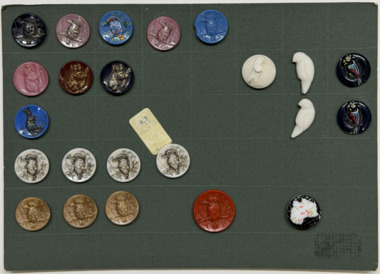
21 buttons on dark green card, c. 1950s
... Her button collection was featured as a primary display in the 'The Melbourne Story' exhibition at the Melbourne Museum, which opened in mid-2008....Her button collection was featured as a primary display in the 'The Melbourne Story' exhibition at the Melbourne Museum, which opened in mid-2008. ...Sally Hearn (1932–2018) was a dedicated button collector and a prominent member of the Victoria Button Collectors Club. Her button collection was featured as a primary display in the 'The Melbourne Story' exhibition at the Melbourne Museum, which opened in mid-2008.The Hearn Collection of locally made and international buttons is historically and aesthetically significant as it illustrates the textile and manufacturing history of button making.21 buttons on dark green card. Depict different Australian animals with an impression made on the button, then painted. Two in the shapes of lorikeet, and another a map of Australia.Official Catalogue Entry: "This collection of glass buttons depicts Australian fauna and a small map."sally hearn, button collections -
 Kew Historical Society Inc
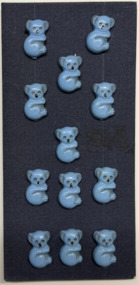
12 buttons on dark blue card, c. 1950s
... Her button collection was featured as a primary display in the 'The Melbourne Story' exhibition at the Melbourne Museum, which opened in mid-2008....Her button collection was featured as a primary display in the 'The Melbourne Story' exhibition at the Melbourne Museum, which opened in mid-2008. ...Sally Hearn (1932–2018) was a dedicated button collector and a prominent member of the Victoria Button Collectors Club. Her button collection was featured as a primary display in the 'The Melbourne Story' exhibition at the Melbourne Museum, which opened in mid-2008.The Hearn Collection of locally made and international buttons is historically and aesthetically significant as it illustrates the textile and manufacturing history of button making.12 buttons on dark blue card. Made to look like blue koalas.Official Catalogue Entry: "Nancye gave me these saying she had used them on her daughter Louise Anne’s dress in 1956"sally hearn, button collections -
 Kew Historical Society Inc
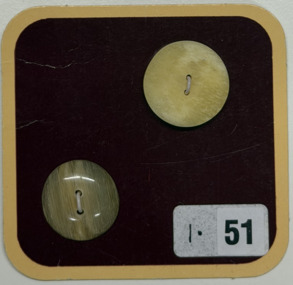
2 buttons on brown card, c. 2004
... Her button collection was featured as a primary display in the 'The Melbourne Story' exhibition at the Melbourne Museum, which opened in mid-2008....Her button collection was featured as a primary display in the 'The Melbourne Story' exhibition at the Melbourne Museum, which opened in mid-2008. ...Sally Hearn (1932–2018) was a dedicated button collector and a prominent member of the Victoria Button Collectors Club. Her button collection was featured as a primary display in the 'The Melbourne Story' exhibition at the Melbourne Museum, which opened in mid-2008.The Hearn Collection of locally made and international buttons is historically and aesthetically significant as it illustrates the textile and manufacturing history of button making.Two buttons on brown card. Made from either the bone or horn of a merino ram, ivory coloured round buttons perhaps as an academic exercise. Created by Eldred Johnstone in Kyabram (Victoria), 2004.Original Catalogue Entry: "Eldred collects shearer’s combs. I gave him 2 several years ago and told him he owed me 2 good buttons! Then he appeared on the doorstep several years later, out of the blue, with these 2 which he had so carefully made."sally hearn, button collections -
 Kew Historical Society Inc
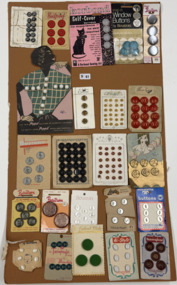
Buttons on large brown card, 1930
... Her button collection was featured as a primary display in the 'The Melbourne Story' exhibition at the Melbourne Museum, which opened in mid-2008....Her button collection was featured as a primary display in the 'The Melbourne Story' exhibition at the Melbourne Museum, which opened in mid-2008. ...Sally Hearn (1932–2018) was a dedicated button collector and a prominent member of the Victoria Button Collectors Club. Her button collection was featured as a primary display in the 'The Melbourne Story' exhibition at the Melbourne Museum, which opened in mid-2008.The Hearn Collection of locally made and international buttons is historically and aesthetically significant as it illustrates the textile and manufacturing history of button making.Buttons on large brown card. Various different colours, materials, and designs. Each set of buttons is attached to it's own card.Original Catalogue Entry: "The cards offer a variety of designs, and the countries of manufacture and the washing instructions are quite historical to us today."sally hearn, button collections -
 Kew Historical Society Inc
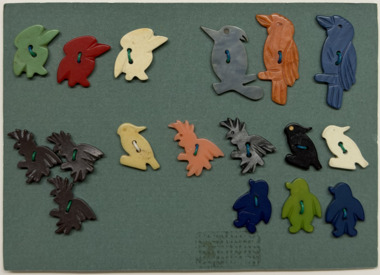
Animal buttons on green card, 1930
... Her button collection was featured as a primary display in the 'The Melbourne Story' exhibition at the Melbourne Museum, which opened in mid-2008....Her button collection was featured as a primary display in the 'The Melbourne Story' exhibition at the Melbourne Museum, which opened in mid-2008. ...Sally Hearn (1932–2018) was a dedicated button collector and a prominent member of the Victoria Button Collectors Club. Her button collection was featured as a primary display in the 'The Melbourne Story' exhibition at the Melbourne Museum, which opened in mid-2008.The Hearn Collection of locally made and international buttons is historically and aesthetically significant as it illustrates the textile and manufacturing history of button making.Animal buttons on white card. Includes kookaburras, cockatoos, and penguins in various colours.Official Catalogue Entry: "What fun they all are and what “attitude” some of the dogs and cats have!"sally hearn, button collections -
 Kew Historical Society Inc
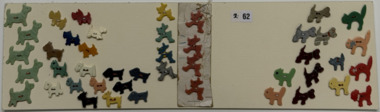
Animal buttons on cream card
... Her button collection was featured as a primary display in the 'The Melbourne Story' exhibition at the Melbourne Museum, which opened in mid-2008....Her button collection was featured as a primary display in the 'The Melbourne Story' exhibition at the Melbourne Museum, which opened in mid-2008. ...Sally Hearn (1932–2018) was a dedicated button collector and a prominent member of the Victoria Button Collectors Club. Her button collection was featured as a primary display in the 'The Melbourne Story' exhibition at the Melbourne Museum, which opened in mid-2008.The Hearn Collection of locally made and international buttons is historically and aesthetically significant as it illustrates the textile and manufacturing history of button making.Animal buttons on cream card. Consist of cats and dogs in various colours, materials, shapes, and sizes.No catalogue entry included.sally hearn, button collections -
 Kew Historical Society Inc
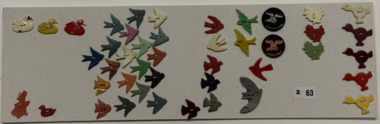
Animal buttons on white card
... Her button collection was featured as a primary display in the 'The Melbourne Story' exhibition at the Melbourne Museum, which opened in mid-2008....Her button collection was featured as a primary display in the 'The Melbourne Story' exhibition at the Melbourne Museum, which opened in mid-2008. ...Sally Hearn (1932–2018) was a dedicated button collector and a prominent member of the Victoria Button Collectors Club. Her button collection was featured as a primary display in the 'The Melbourne Story' exhibition at the Melbourne Museum, which opened in mid-2008.The Hearn Collection of locally made and international buttons is historically and aesthetically significant as it illustrates the textile and manufacturing history of button making.Animal buttons on white card. Includes birds, swans, chickens.No catalogue entry included.sally hearn, button collections -
 Kew Historical Society Inc
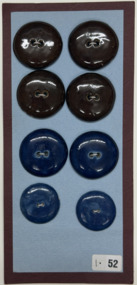
8 buttons on blue paper on red card, c. 1930
... Her button collection was featured as a primary display in the 'The Melbourne Story' exhibition at the Melbourne Museum, which opened in mid-2008....Her button collection was featured as a primary display in the 'The Melbourne Story' exhibition at the Melbourne Museum, which opened in mid-2008. ...Sally Hearn (1932–2018) was a dedicated button collector and a prominent member of the Victoria Button Collectors Club. Her button collection was featured as a primary display in the 'The Melbourne Story' exhibition at the Melbourne Museum, which opened in mid-2008.The Hearn Collection of locally made and international buttons is historically and aesthetically significant as it illustrates the textile and manufacturing history of button making.8 buttons on blue paper on red card. Dark blue and brown in colour, made of glazed clay. Made by a 'Wally' c. 1930, somewhere around Maribyrnong (Victoria). Original Catalogue Entry: "Margaret’s mother Ella Stone had a boarder named Wally. Wally was an alcoholic and a bit of a ‘no hoper’ but he worked at the Maribyrnong Pipe Works. One day after school Margaret told him to take off his trousers, he couldn’t continue to go around without any buttons and she would sew some on for him. A while later Wally came home with a paper bag for her. In it were these buttons he had made at work for her! – made from the clay and glazes of Melbourne’s sewerage pipes in exchange for some trouser fly buttons!!!"sally hearn, button collections -
 Kew Historical Society Inc
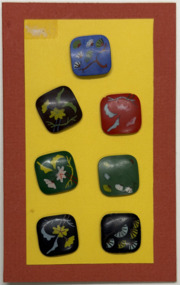
7 buttons on yellow card on tangerine card, 1930s
... Her button collection was featured as a primary display in the 'The Melbourne Story' exhibition at the Melbourne Museum, which opened in mid-2008....Her button collection was featured as a primary display in the 'The Melbourne Story' exhibition at the Melbourne Museum, which opened in mid-2008. ...Sally Hearn (1932–2018) was a dedicated button collector and a prominent member of the Victoria Button Collectors Club. Her button collection was featured as a primary display in the 'The Melbourne Story' exhibition at the Melbourne Museum, which opened in mid-2008.The Hearn Collection of locally made and international buttons is historically and aesthetically significant as it illustrates the textile and manufacturing history of button making.The item comprises seven square plastic buttons with rounded corners on yellow card on a larger tangerine coloured card. Official Catalogue Entry: "Mary worked at Tharrat’s Drapery Northcote1941 – 1971. She bought these buttons for her daughter Norma at Preston Market early 1930’s."sally hearn, button collections -
 Kew Historical Society Inc
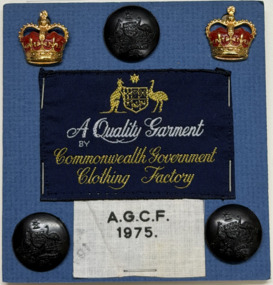
3 buttons. 2 crowns - 2 fabric patches on blue card, 1975
... Her button collection was featured as a primary display in the 'The Melbourne Story' exhibition at the Melbourne Museum, which opened in mid-2008....Her button collection was featured as a primary display in the 'The Melbourne Story' exhibition at the Melbourne Museum, which opened in mid-2008. ...Sally Hearn (1932–2018) was a dedicated button collector and a prominent member of the Victoria Button Collectors Club. Her button collection was featured as a primary display in the 'The Melbourne Story' exhibition at the Melbourne Museum, which opened in mid-2008.The Hearn Collection of locally made and international buttons is historically and aesthetically significant as it illustrates the textile and manufacturing history of button making.The item comprises three black moulded buttons, two embroidered crown badges and two fabric patches on a rectangle blue card. The buttons are round and have a raised Australian Commonwealth Coat of Arms design. The two crown shaped badges are machine embroidered in red and gold coloured thread. A rectangular navy fabric patch is embroidered in gold white with the Australian Coat of Arms and the words "A Quality Garment by Commonwealth Government Clothing Factory." A smaller rectangular cream fabric patch below is marked "A.G.C.F. 1975." Official Catalogue Entry: "Purchased in Victor Harbour and brought to Melbourne and given to me by Colin and Lureen Creek when they came over from S.A. to stay. I gave the jacket (as new) to the local Doncare Op shop."sally hearn, button collections -
 Kew Historical Society Inc
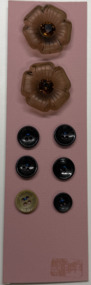
8 buttons on pink card, 1940s
... Her button collection was featured as a primary display in the 'The Melbourne Story' exhibition at the Melbourne Museum, which opened in mid-2008....Her button collection was featured as a primary display in the 'The Melbourne Story' exhibition at the Melbourne Museum, which opened in mid-2008. ...Sally Hearn (1932–2018) was a dedicated button collector and a prominent member of the Victoria Button Collectors Club. Her button collection was featured as a primary display in the 'The Melbourne Story' exhibition at the Melbourne Museum, which opened in mid-2008.The Hearn Collection of locally made and international buttons is historically and aesthetically significant as it illustrates the textile and manufacturing history of button making.The item comprises eight buttons, two of which are made from glass and are in the shape of flowers and six of which are made from vegetable ivory and were used for men's trousers. Manufacturers are unknown. Official Catalogue Entry: "Margaret Glover wore the glass buttons on a pink woollen dress. Alan’s father, Arch Glover, was a Collin’s St. tailor making “Weary” Dunlop’s suits, etc., in partnership with Mr. Guest. When Mr. Guest died in 1951, Arch worked at home, having built up a healthy list of clients."sally hearn, button collections -
 Kew Historical Society Inc
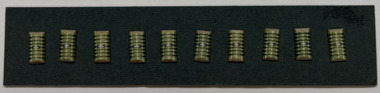
10 buttons on green card, 1930s
... Her button collection was featured as a primary display in the 'The Melbourne Story' exhibition at the Melbourne Museum, which opened in mid-2008....Her button collection was featured as a primary display in the 'The Melbourne Story' exhibition at the Melbourne Museum, which opened in mid-2008. ...Sally Hearn (1932–2018) was a dedicated button collector and a prominent member of the Victoria Button Collectors Club. Her button collection was featured as a primary display in the 'The Melbourne Story' exhibition at the Melbourne Museum, which opened in mid-2008.The Hearn Collection of locally made and international buttons is historically and aesthetically significant as it illustrates the textile and manufacturing history of button making.The item comprises ten rectangular casein buttons mounted in a single row on a dark green card. Official Catalogue Entry: Beryl was a tailoress and dressmaker 1927 – 1930 - C.H.V. Thomas, Collins S., Melbourne 1930 – 1932 - ? Bros, Flinders Lane In the Depression years she worked at Jim Wise, Thornbury, making school and college blazers."sally hearn, button collections -
 Kew Historical Society Inc
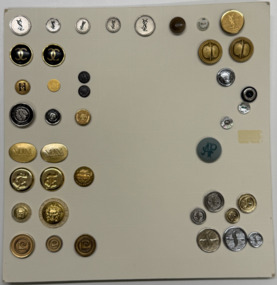
40 buttons on cream card, 1960s
... Her button collection was featured as a primary display in the 'The Melbourne Story' exhibition at the Melbourne Museum, which opened in mid-2008....Her button collection was featured as a primary display in the 'The Melbourne Story' exhibition at the Melbourne Museum, which opened in mid-2008. ...Sally Hearn (1932–2018) was a dedicated button collector and a prominent member of the Victoria Button Collectors Club. Her button collection was featured as a primary display in the 'The Melbourne Story' exhibition at the Melbourne Museum, which opened in mid-2008.The Hearn Collection of locally made and international buttons is historically and aesthetically significant as it illustrates the textile and manufacturing history of button making.The item comprises 40 assorted couture buttons mounted on a rectangular cream card.Official Catalogue Entry: "Acquired over 20 years from numerous sources The Versace ones were given to me by Robert Smith after the closing down of Georges of Collins St."sally hearn, button collections
