
Showing 5 items matching "the obstacle race"
-
 Federation University Historical Collection
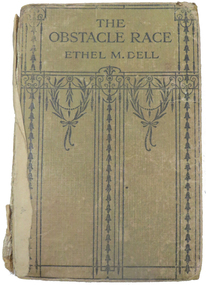
Book, The Obstacle Race, 1921
... The Obstacle Race......the obstacle race...A hard covered, fawn coloured book with art deco decorations printed on the front cover along with the title and author, The Obstacle Race by Ethel M. Dell. The spine has been removed and a paper binding has been pasted in place.The book is 303 pages long and was owned by Harry Smerdon Holmes...The book belonged to Harry Holmes. harry holmes chatham-holmes family collection the obstacle race ethel m. dell A hard covered, fawn coloured book with art deco decorations printed on the front cover along with the title and author, The Obstacle Race by Ethel M. ...This book is part of a collection of books, photos and memorabilia donated from the Chatham-Holmes family collection. The book belonged to Harry Holmes.A hard covered, fawn coloured book with art deco decorations printed on the front cover along with the title and author, The Obstacle Race by Ethel M. Dell. The spine has been removed and a paper binding has been pasted in place.The book is 303 pages long and was owned by Harry Smerdon Holmesharry holmes, chatham-holmes family collection, the obstacle race, ethel m. dell -
 Women's Art Register
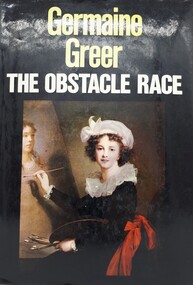
Book, Germaine Greer, The Obstacle Race. The fortunes of women painters and their work, 1979
... The Obstacle Race. The fortunes of women painters and their work..."La Motte '80" on front page; " GENTILESGHI Artemisia b. 8th July 1593 in Rome d.1653" inside back cover Book The Obstacle Race. The fortunes of women painters and their work Book Book Germaine Greer Secker & Warburg, London ...Traces the social, educational, and psychological barriers for women artists from the Middle Ages to the early 19th century to gain recognition, most relying on relationships with artists in their families to gain success. or conversely denied success through partnerships with male painters.Book non-fictionTraces the social, educational, and psychological barriers for women artists from the Middle Ages to the early 19th century to gain recognition, most relying on relationships with artists in their families to gain success. or conversely denied success through partnerships with male painters. portraiture, flowerpainting, miniaturists, still life -
 Federation University Historical Collection
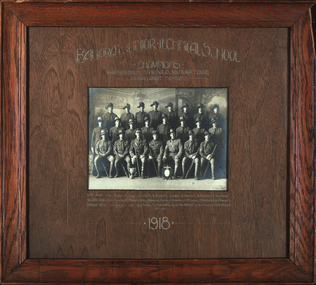
Photograph, Richards & co, Ballarat Junior Technical School Senior Cadet Team, 1918
... .— Ballarat Technical School. 1; Maryborough; 2. Obstacle Race.. — Sergeant C. F. W. Krahnert (Ballarat), 1; T. ....— Ballarat Technical School. 1; Maryborough; 2. Obstacle Race.. — Sergeant C. F. W. Krahnert (Ballarat), 1; T. ...In 1918 the Ballarat Junior Technical School Cadets were the champions of the Maryborough, St Arnaud, Mildura, Colac and Ballarat Districts. According to Neil Leckie, Manager of the Ballarat Ranger Military Museum: * Originally 12 – 14 year olds went to Junior Cadets attached to their school. * From age 14 – 17 they were Senior Cadets attached to the local militia unit. * After 1 July of the year a Cadet turned 18, the Cadet left the Senior Cadets and became a member of the Citizen Military Force. * In October 1918 the AIF, Militia and Cadets were renamed to give some connection to the AIF battalion raised in the area. Ballarat saw: 8th Australian Infantry Regiment comprising: * 8th Battalion AIF renamed 1st Battalion 8th Australian Infantry Regiment * 70th Infantry Militia renamed 2nd Battalion 8th Australian Infantry Regiment * 70th Infantry Cadets renamed 3rd B, 8th Australian Infantry. 39th Australian Infantry Regiment comprising: * 39th Battalion AIF renamed 1st Battalion 39th Australian Regiment * 71st Infantry Militia renamed 2nd Bn, 39th Australian Infantry Regiment * 71st Infantry Cadets renamed 3rd Bn, 39th Australian Infantry Regiment Prior to the reorganisation in 1918 the 18th Brigade was the 70th, 71st and 73rd Infantry. It is thought that the 18th Brigade Cadet units in 1920 were those that came from the old: * 69th Infantry (Geelong/Queenscliff) * 70th Infantry (Ballarat/Colac) * 71st Infantry (Ballarat West) * 72nd Infantry Warrnambool) * 73rd Infantry (NW Vic) The next name change came in 1921! The Ballarat Star, Saturday 22 June 1918, Page 4 Junior Technical School Cadet Team. The Ballarat Junior Technical School Cadet Team, which was very successful in the competitions recently held at Colac, hopes to be able to compete in similar events at Maryborough. Mildura, and St. Arnaud, but unfortunately they have no funds available for the purpose. An appeal is to be made to the citizens of Ballarat to assist them in defraying the cost of their participation in the competitions at the places mentioned. The Ballarat Star, Saturday 6 July 1918, Page 3 MARYBOROUGH MILITARY SPORTS SUCCESS OF BALLARAT CADETS Maryborough, Friday, The following were the principal results of the events held here on the occasion of the handing over of' the 1900 quota of cadets to the Citizens' Forces, the ceremony in connection with which' was supplemented by arranging a programme of military events. Rifle Exercises, - Ballarat Technical School (85 pts:). l; St: Arnaud (75 pts.). 2; Maryborough High School (68 pts.). 3. Maryborough (66 pts), also competed. Despatch Race. 400 yards— Maryborough (No. 1); 1; Ballarat Technical School, 2. Squad Drill with Arms — Ballarat Technical. School (85. pts): 1; St. Arnaud (72 pts.) 2; Maryborough High School (70- pts), 3. Maryborough No. 1 (68 pts.) 3. Night Alarm: — Ballarat Technical School (3 min. 35. sees), 1; Maryborough High School (4 min. 4 secs), 2; Maryborough No. I (3- min 50 secs), 3. St. Arnaud (4 min. 10 secs). Placing Indian Club. — Maryborough No. 1,1; Ballarat Technical School, 2 Physical Training. Ballarat Technical School (85 pts), 1 ; Maryborough High School, (76 pts). 2; St. Arnaud (70. pts), .3. Tunnel Ball: Maryborough No. 2, 1'; Ballarat Technical School, 2; St. Arnaud; 3. Chase Ball in Two Lines.— Ballarat Technical School. 1; Maryborough; 2. Obstacle Race.. — Sergeant C. F. W. Krahnert (Ballarat), 1; T. Brown (High School) 2; Aggregate Points — Following are the aggregate points scored by the four leading teams :— Ballarat Technical School; 21; Maryborough. 9; Maryborough High School, 6; St. Arnaud 6. The Ballarat Star, Monday 28 October 1918, Page 4. Junior Technical School Cadet Team. —The Junior Technical School's cadet team, which won the championship at the South street competitions this year, was tendered a dinner by the staff in appreciation of the honor they had brought to the school. The function was held at Miss Brazenor's tea rooms, and a most dainty repast was served, the tables being arranged in the artistic fashion which is characteristic of these ladies. Mr W. H. Middleton (president of the School of Mines), Mr H. Smith (principal of the Art School), Lieut. P. Miller (instructor of the High School team), and Sgt. S. Fry were also present. Mr A. W. Steane (head master of The Junior Technical School) presided. After the toast of the King, Mr Middleton proposed, and Mr H. Smith supported, the health of the team and their instructor, Lieut. H. Wakeling, who suitably responded. The toast of the High School team was proposed by Mr. R. Cutler.; and Lieut D. Miller responded. The cup won at the recent competitions was then handed over to Mr - Steane; in accepting the trophy, said he was pleased to see swell a clean, sportsmanlike spirit between the rival teams. He hoped it would continue. He was proud to accept the cup from the team for the school. The Ballarat Star, Monday 12 April 1920 SENIOR CADET COMPETITION. 18th BRIGADE CHAMPIONSHIP. WON BY HIGH SCHOOL. On Saturday afternoon the championship of the 18th Brigade was decided as a preliminary to the State Championship, which will be held on the M.C.C. ground, Melbourne, on Anzac Day. Results, after a keen contest : Ballarat High School .... 1, Junior Technical School .. 2 As a result of this competition, High School will represent the 18th Brigade which embraces Ballarat, Geelong, Colac and the Western District, in the State event. Black and white photograph of 23 men in military uniform. Most wear a slouch hat, with the number 71 on the hat band. Two trophies are positioned in the front. Four men in the front row hold rifles. Back: R. Hirt; Percy Trompf; J. Nicholls; Robert Serjeant; J. Jones; A. Hannah; A. Duncan; L. Lindsay. Centre: H. Ashley; H. Beanland; J. Finlayson; F. Larkin; G. Chambers; A. McCallum; T. Shattock; E. Rowsell. Front: Sergeant A. Roe; John Dulfer, Major Tucker; Lieutenant Harold Wakeling; Sergeant-Major Reeves; Sergeant K. Krahnert; W. Middleton. .1) Mount and frame are wood grain. Top right hand corner of frame is chipped. .5) Framed black and white print of 1918 Ballarat Junior Technical School senior cadet team. 23 men in uniform. The St Arnaud event was for boys born in 1900 (the Quota). They would turn 18 in 1918..2) Reverse of photograph - "Ballarat Tech School Cadet Corp, 1918 / H Wakeling in charge / Photo property of H. Beanland / A Williams not in photo / H Wakeling & A Williams completed teacher training courses as I did but were 3 or 4 years my senior." .5) Top of mount - "Ballarat Junior Technical School Senior Cadet Team / champions 1918" Bottom of mount - "Winners of Following Competitions:- Stawell Colac Maryborough St Arnaud Mildura South Street "A" Grade" r hirt, percy trompf, j nicholls, robert serjeant, j jones, a hannah, a duncan, l lindsay, h ashley, h beanland, j finlayson, f larkin, g chambers, a mccallum, t shattock, e rowsell, a roe, john dulfer, tucker, harold gordon wakeling, reeves, krahnert, w middleton, world war 1, world war i, world war one, ballarat junior technical school, ballarat school of mines, wakeling, harold wakeling, royal south street competitions, 71st regiment, howard beanland -
 Eltham District Historical Society Inc
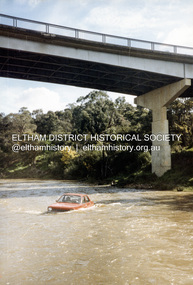
Photograph, A Holden Gemini car in the Yarra River near Westerfolds Park, Templestowe, 1985
... race (EDHS_02250) taken by the same photographer, Eric Stephenson. Perhaps the owner of the Gemini decided to get a little too close to the action or maybe it was just another obstacle placed there in the course. ...race (EDHS_02250) taken by the same photographer, Eric Stephenson. Perhaps the owner of the Gemini decided to get a little too close to the action or maybe it was just another obstacle placed there in the course. ...Under Fitzsimons Lane Bridge in 1985 but how did that Holden Gemini get there? [Photo: Attributed to Eric Stephensen of Jingalong, Ryans Road, Eltham] The Great Yarra Raft Race was held 23 February 1985. We have a series of 9 photos of that race (EDHS_02250) taken by the same photographer, Eric Stephenson. Perhaps the owner of the Gemini decided to get a little too close to the action or maybe it was just another obstacle placed there in the course. Originally contained in a 'magnetic' photo album believed to have been donated by Mr Eric Stephenson, Jingalong, 110 Ryans Road, Eltham, Vic. 3095; relocated to archival safe storage.Two colour photographstemplestowe, westerfolds park, yarra river -
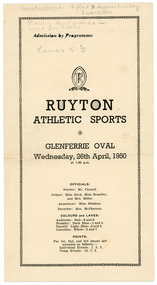 Ruyton Girls' School
Programme, Ruyton Girls' School, Ruyton Athletic Sports, 26 April 1950
... The program outlines a series of activities to be undertaken by junior and senior school students (including day girls and boarders), including crossball, potato sack race, hockey dribbling, egg and spoon race, relays, baseball throwing, and obstacle courses. Each sport is divided into age brackets including under 14, under 16, and 16 and over. ...The program outlines a series of activities to be undertaken by junior and senior school students (including day girls and boarders), including crossball, potato sack race, hockey dribbling, egg and spoon race, relays, baseball throwing, and obstacle courses. Each sport is divided into age brackets including under 14, under 16, and 16 and over. ...The pamphlet documents the agenda for the Ruyton Girls' School athletics sports carnival hosted at Glenferrie Oval on Wednesday, 26 April 1950. The program outlines a series of activities to be undertaken by junior and senior school students (including day girls and boarders), including crossball, potato sack race, hockey dribbling, egg and spoon race, relays, baseball throwing, and obstacle courses. Each sport is divided into age brackets including under 14, under 16, and 16 and over. The pamphlet also acts as a scorecard, featuring columns for recording results, points scored, progress points and times. Ruyton Girls' School has an exceptional reputation in school sport. The School is a member school of Girls' Sport Victoria (GSV), a large sporting association involving 24 independent girls’ schools in Melbourne. Girls in the Senior School have the opportunity to compete in a range of sports over the four terms and at three major carnivals; Swimming and Diving, Cross Country and Track and Field. Ruyton also has a very successful Rowing program and participates in the Victorian Interschools Snowsports Championships.The record has strong historic significance as it gives insight into the House system at Ruyton Girls' School; in particular, how the House system is used in a sports context. In the early 1920s, Ruyton was settling into its new home at Selbourne Road, Kew. At the time, students were arranged by their form (or year level) for lessons and other school activities. A collection of eight emblems and mottoes for each form group was published in the Ruytonian December 1922, although the genesis of each were left unexplained. With enrolments continually growing, Principal Miss Hilda Daniell felt a new basis of organisation would benefit students, giving them a broader outlook and something bigger to work for. She took inspiration from tradition and implemented a House system. The House system was adopted at Ruyton in September 1924 to "provide a new kind of co-operation and competition among the girls, especially in Sport." There were four houses, three of which were named after early Principals: Anderson, Bromby and Lascelles. There was also the School House, initially for boarders only. Some time after the publication of the Ruytonian in April 1928, the School House was renamed Daniell House, and had opened up to day girls. The account published by the newly formed Daniell House in the Ruytonian December 1928 reads, "we are rather bashful in presenting this account of our doings, for we are conscious of our newness. Our house has now the honour of being known as Daniell House." Four of the original eight form emblems were adopted by the new Houses, while the others were discarded. According to former teacher and author of the centenary history of Ruyton, Ms Majorie Theobald, the House system "gave a new focus for all competitive sport, which had previously been organised on a rather inequitable basis." The colours chosen for the Houses were cherry red for Anderson, royal blue for Bromby, gold for Lascelles, and pale blue for School (later Daniell). New students starting at Ruyton from Prep onwards are allocated to one of the following Houses with consideration to family connections and balance of numbers. The record's significance is further enhanced by its strong provenance, having been produced by Ruyton Girls' School and donated to the Archives by a familial connection of a former notable student.Pamphlet printed on cream coloured paper with navy blue ink. Two pages, folded in half.Obverse: tenns allowed 2 flat 3 teas 1 relay / 1 noveltie / 3 every thing entered in. / move for heats / Lanes 5 - 2 / First Page: under 15 50 yds. / 2. / 3 under 15 75 yds. / 4 / 5 / 6. Junior Crossball. / 7 / 8 / Second Page: 9 / 10 under 15. / 11 / 12 / 13 / 14 under 15 / 15 / 16. / Reverse: 21 Diamond Throwing open / 22 / 23 under 15 / 24 / 25 / 26 / 27 / Diamond / 28 / 29 / 30 / 31 / 32 / Junior under 15 1st July 1 Junior relay (?) / under 15 / Two sprints and potato go for championships /ruyton girls' school, students, school, ruyton, victoria, high school, senior school, day school, letter, old ruytonians association, kew, sport, school sport, girls' sport victoria, house, anderson, lascelles, bromby, daniell, athletics, glenferrie
