
Showing 43 items matching "the pilot in command"
-
 Moorabbin Air Museum
Book - Pilot training - general aviation, Emergency Maneuver Training. Controlling Your Airplane During a Crises
... ...The pilot in command...Pilot training - general aviation Basic aerodynamics Roll / yaw & pitch Pitch & power Curved flight Stalls Spins Overbanked Control failures Glides Powerplant failures Off airport landings The pilot in command Overview of emergency strategies for general aviation pilots, circa 1996 Emergency Maneuver Training. ...Overview of emergency strategies for general aviation pilots, circa 1996non-fictionOverview of emergency strategies for general aviation pilots, circa 1996basic aerodynamics, roll / yaw & pitch, pitch & power, curved flight, stalls, spins, overbanked, control failures, glides, powerplant failures, off airport landings, the pilot in command -
 Flagstaff Hill Maritime Museum and Village
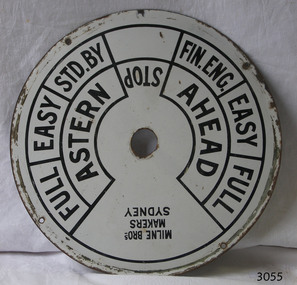
Equipment - Ships' Telegraph section, Milne Brothers, Copper and Brass Works, Early-to mid-20th century
... The standard commands printed or stamped onto the dial are the directions of AHEAD and ASTERN, and the speeds of STOP, FULL, EASY, STD. BY. and FIN. ENG. The ship’s pilot...The standard commands printed or stamped onto the dial are the directions of AHEAD and ASTERN, and the speeds of STOP, FULL, EASY, STD. BY. and FIN. ENG. The ship’s pilot ...This Engine Room section of a ship's telegraph system was part of the equipment of the Ports and Harbour ship the SS Rip. The vessel serviced and maintained the lights and buoys at Port Phillip Bay and Queenscliffe. The SS Rip was possibly the former gunboat "Albert". The ship’s communication system that was used from the late 19th century to early-to-mid-20th-century is called an Engine Order Telegraph (E.O.T.) or ship’s telegraph. The system has two parts, the Bridge Section and the Engine Room Section. The Bridge Section is usually mounted on top of a pedestal, and the Engine Room Section is often attached to a vertical surface. The standard commands printed or stamped onto the dial are the directions of AHEAD and ASTERN, and the speeds of STOP, FULL, EASY, STD. BY. and FIN. ENG. The ship’s pilot on the Bridge of a vessel sends his Orders for speed and direction to the to the Engine Room with the E.O.T. He moves the lever or levers, depending on the number of engines the ship has, to change the indicator on the Bridge Section’s dial to point in the new direction and speed of travel. This change causes the Orders to be duplicated on the Engine Room Section’s dial and a bell to signal the change simultaneously. The engineer then adjusts the ship’s engines and steering equipment to follow the pilot’s Order. The manufacturer, Mulne Bros., was a copper and brass works at 166 Sussex Street Sydney, in December 1892, and previously from 1870 at 128 to 130 Sussex Street. The company made and sold a wide range of equipment including machinery and gauges for the Railways.The Engine Room section is significant for being part of the communications system on the ship SS Rip, owned by Melbourne's Ports & Harbours department and used to service and maintain the navigation signals of Port Phillip Bay and at Queenscliffe in the mid-20th century. The dial is an example of marine equipment made in Australia and used for the safety of Victorian vessels. It is also significant for being made by an early Australian manufacturer, Milne Brothers of Sydney.Engine Room Section of a ship’s telegraph or Engine Order Telegraph (E.O.T.). The round metal dial has inscriptions stamped around the edges. The inscriptions are nautical terms for direction and speed and include the maker’s details. The dial was made by Milne Bros. of Sydney. It was part of the equipment on the "SS Rip" in Victoria.Black paint around dial: "MILNE BROS. / MAKERS / SYDNEY" "FULL EASY STD. BY " "FIN ENG. EASY FULL" ""ASTERN" "STOP" "AHEAD"flagstaff hill, warrnambool, maritime museum, maritime village, great ocean road, shipwreck coast, marine technology, marine communications, engine order telegraph, e.o.t., ship’s telegraph, bridge section, engine room section, ship’s engine telegraph section, marine telegraph, milne bros., milne brothers, sydney, copper and brass works, ports & harbours ship, ss rip, gunboat albert, service ship, maintenance ship -
 Flagstaff Hill Maritime Museum and Village
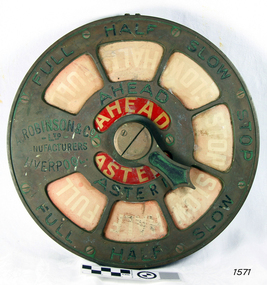
Equipment - Ship's Telegraph section, A. Robinson & Co. Ltd, Late-19th to mid-20th centuries
... The standard commands printed or stamped onto the dial are the directions of AHEAD and ASTERN, and the speeds of STOP, SLOW, HALF, and FULL. The ship’s pilot...The standard commands printed or stamped onto the dial are the directions of AHEAD and ASTERN, and the speeds of STOP, SLOW, HALF, and FULL. The ship’s pilot ...The ship’s communication system that was used from the late 19th century to early-to-mid-20th-century is called an Engine Order Telegraph (E.O.T.) or ship’s telegraph. The system has two parts, the Bridge Section and the Engine Room Section. The Bridge Section is usually mounted on top of a pedestal, and the Engine Room Section is often attached to a vertical surface. The standard commands printed or stamped onto the dial are the directions of AHEAD and ASTERN, and the speeds of STOP, SLOW, HALF, and FULL. The ship’s pilot on the Bridge of a vessel sends his Orders for speed and direction to the to the Engine Room with the E.O.T. He moves the lever or levers, depending on the number of engines the ship has, to change the indicator on the Bridge Section’s dial to point in the new direction and speed of travel. This change causes the Orders to be duplicated on the Engine Room Section’s dial and a bell to signal the change at the same time. The engineer then adjusts the ship’s engines and steering equipment to follow the pilot’s Order. The manufacturer, A. Robinson & Co. Ltd of Liverpool, established his business in 1780 and continued until 1968 when the business was purchased by marine products maker Chadburns, established in London in 1870.This Engine Room section is part of a ship's telegraph communication system and represents marine technology used in the late-19th to mid-20th-century. Engine Room Section of a ship’s telegraph or Engine Order Telegraph (E.O.T.). The round brass dial has inscriptions stamped around its edge and centre. Red inlaid glass plates have inscriptions in white paint on them. The inscriptions are nautical terms for direction and speed and include the maker’s details. A rotating pointer is joined to the centre of the dial. The maker is A. Robinson & Co. Ltd of Liverpool. Stamped: “FULL / HALF / SLOW / STOP / FULL / HALF / SLOW / STOP”, “AHEAD / ASTERN” Printed: “FULL / HALF / SLOW / STOP / FULL / HALF / SLOW / STOP” Stamped on the dial: “A. ROBINSON & CO. LTD / MANUFACTURERS / LIVERPOOL”flagstaff hill, warrnambool, maritime museum, maritime village, great ocean road, shipwreck coast, marine technology, marine communications, engine order telegraph, e.o.t., ship’s telegraph, bridge section, engine room section, ship’s engine telegraph section, marine telegraph, a. robinson & co. ltd, liverpool -
 Mission to Seafarers Victoria
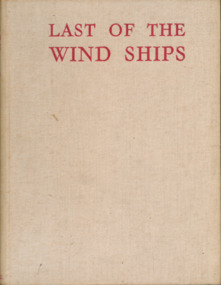
Book, Routledge, The Last of the Wind Ships, 1934
... There followed many projects requiring his formidable skills of seamanship, command and organisation: sailing with the Parma in the 1932 and 1933 grain races; as proprietor of the sail-training vessel, Joseph Conrad, in 1934-36; training as a pilot, 1937-38; sailing with Arab dhows in the Persian Gulf, 1938-39; and captaining a replica of the Mayflower in its Atlantic crossing in 1957. ...No dust jacketnon-fictionsea voyage, allan villiers (1903-1982), keith oliver, donation, windjammers -
Nhill Aviation Heritage Centre
Book, A Quiet and Efficient Captain of Aircraft, The story of Bill Gray - an RAAF Lancaster Bomber Command Pilot during WWII (as told by Christofer B. Yardley)
... A Quiet and Efficient Captain of Aircraft, The story of Bill Gray - an RAAF Lancaster Bomber Command Pilot during WWII (as told by Christofer B. ...Published by the Australian Capitol Teritory Branch of the Military Historical Society of Australia Paper back, purple A Quiet and Efficient Captain of Aircraft, The story of Bill Gray - an RAAF Lancaster Bomber Command Pilot during WWII (as told by Christofer B. ...Paper back, purple -
 Ballarat Clarendon College
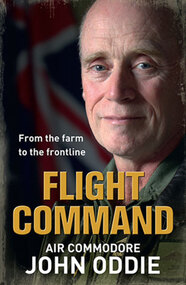
Book, Flight command: from the farm to the front line, 2014
... As well as covering the war in Afghanistan, Flight Command provides an insider's account of being a combat pilot in the first Gulf War, a commander supporting peace in Bougainville and security in Cambodia and the often harrowing experience of being a first-response commander dealing with the aftermath of the Boxing Day tsunami in Indonesia. ...As well as covering the war in Afghanistan, Flight Command provides an insider's account of being a combat pilot in the first Gulf War, a commander supporting peace in Bougainville and security in Cambodia and the often harrowing experience of being a first-response commander dealing with the aftermath of the Boxing Day tsunami in Indonesia. ...John Oddie's (1974) appointment as deputy commander of Aussie forces in the Middle East capped a remarkable career of service to Australia. Sadly, this honour also involved the heartbreaking duty of informing families of the deaths of their husbands and sons in Afghanistan and overseeing departure ceremonies for the fallen soldiers. As well as covering the war in Afghanistan, Flight Command provides an insider's account of being a combat pilot in the first Gulf War, a commander supporting peace in Bougainville and security in Cambodia and the often harrowing experience of being a first-response commander dealing with the aftermath of the Boxing Day tsunami in Indonesia. By turns heart-warming and poignant, Flight Command is the story of a farm boy who managed to carve an international career in the military that included service in two wars.Medium size, soft cover bookjohn oddie, ballarat college -
 Flagstaff Hill Maritime Museum and Village
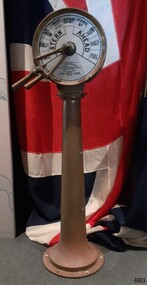
Equipment - Ship's Telegraph section, Chadburn & Sons, 1875-1898
... The gong sounded two signals whenever the navigational commands to change the speed or direction were given by the ship’s pilot. Communication between the ship’s pilot and the engine room in the late 19th to the mid-20th centuries was made with a system called an Engine Order Telegraph (E.O.T.) or ship’s telegraph. ...The gong sounded two signals whenever the navigational commands to change the speed or direction were given by the ship’s pilot. Communication between the ship’s pilot and the engine room in the late 19th to the mid-20th centuries was made with a system called an Engine Order Telegraph (E.O.T.) or ship’s telegraph. ...The ship’s telegraph section was once part of the navigational equipment of the famous paddle steamer, PS Hygeia, and was later installed on Flagstaff Hill’s exhibit, the steamer Rowitta. This is the Bridge Section of a ship’s telegraph, a Duplex Gong model, made by Chadburn & Son of Liverpool. The gong sounded two signals whenever the navigational commands to change the speed or direction were given by the ship’s pilot. Communication between the ship’s pilot and the engine room in the late 19th to the mid-20th centuries was made with a system called an Engine Order Telegraph (E.O.T.) or ship’s telegraph. The equipment has two parts, the Bridge Section and the Engine Room Section. The Bridge Section was usually mounted onto a pedestal, and the Engine Room Section was attached to a vertical surface. The standard marine commands were printed or stamped around the face of the dial and indicated by a pointer or arrow that was usually moved by a rotating brass section or handle. The ship’s pilot stationed on the Bridge of a vessel sends his Orders for speed and direction to the Engine Room with the E.O.T. He moves the lever or levers, depending on the number of engines the ship has, to change the indicator on the Bridge Section’s dial to point in the new direction and speed of travel. This change causes the Orders to be duplicated on the Engine Room Section’s dial and a bell or bells to signal the change at the same time. The engineer then adjusts the ship’s engines and steering equipment to follow the pilot’s Order. CHADBURN & SON, Liverpool- Chadburn Brothers, William and C.H., were joint inventors and well-established makers of optical and scientific instruments and marine gauges. The firm was granted the Prince Albert Royal Warrant in the late 19th century. In 1870, William Chadburn applied for a patent for his navigational communication device for use on ships. By 1875, Chadburn & Son was producing the brass Engine Order Telegraph in its plant at 71 Lord Street, Liverpool. In 1911, the ship, RMS Titanic, was launched, fitted with Chadburn & Sons E.O.T. The Chadburn Ship Telegraph Company Limited was registered in 1898 to take over Chadburn & Sons. In 1903, a large factory at Bootle, near Liverpool, and its products were being sold overseas. In 1920, electric-powered telegraphs were developed. In 1944, the name changed to Chadburn’s (Liverpool) Limited. In 1968, the company became Chadburn Bloctube Ltd. In 2000, the company, now Bloctube Marine Limited, was still manufacturing ship telegraphs. The P.S. HYGEIA 1890-1932: - This ship’s telegraph was installed on the new paddle steamer, PS Hygeia, one of three iconic pleasure steamers famous for providing regular services in Port Phillip Bay, Victoria, to thousands of passengers between the ports of Queenscliff, Sorrento, Portsea, Dromana, Rosebud, Rye, and Mornington. It joined the Ozone and the Weeroona, all three described as being glamorous, powerful and fast. Its ticket office was on the pier itself. The P.S. Hygeia was built in Yorker, Scotland, in 1890, by Napier, Sharks & Bell. It was registered in Melbourne, Australia, by Hubbart, Parker & Co. in 1891. The steel ship was 92 metres long, able to travel at 22 knots, and licensed to carry over 1600 passengers in luxury, with even a barber shop on board. The regular service between the ports in Port Phillip Bay, Victoria, continued for over 40 years. With the decline in passenger demand, the service wound down. The Hygeia was sold to H.M. Morris in 1931 for demolition and breaking up. Equipment, fittings, and even lifebuoys were sold, with many items purchased by people who had some connection to the Hygeia. On August 25th, 1931, what was left of the vessel departed Port Melbourne and eventually, in June 1932, it was laid to rest at the ships’ graveyard outside Port Phillip Heads. The SS ROWITTA 1909-2015: - The ship’s telegraph was originally installed on the PS Hygeia. It was purchased when the Hygeia was broken up in 1931 and later installed, in 1975, on Flagstaff Hill’s SS Rowitta, an exhibit greatly enjoyed by the public until it was demolished in 2015. The ferry “SS Rowitta” was built in 1909 in Hobart, Tasmania. The timber steam ferry was built using planks of Huon and Karri wood. It was a favourite with sightseeing passengers steaming along Tasmania’s Tamar and Derwent rivers for 30 years. Rowitta was also known as Tarkarri and Sorrento and had worked as a coastal trading vessel between Devonport and Melbourne, and Melbourne, Queenscliff and Sorrento. The vessel had given over 100 years of service and pleasure. This Bridge section of a ship’s Engine Order Telegraph, used with an Engine Room section, represents late-19th-century change and progress in communication and navigation at sea. This type of equipment was still in use in the mid-20th century. It is significant for its association with its maker, Chadburn & Son, of Liverpool, a well-known marine instrument maker whose work was recognised by English Royalty, and whose products were selected to supply similar equipment for use on the RMS Titanic. The ship’s telegraph is also significant for its association with the paddle steamer PS Hygeia, one of three iconic steamers that transported thousands of passengers from port to port within Port Phillip Bay, Victoria, for over 40 years from the 1890s to the 1930s. Queenscliff Borough remembers the Hygeia by naming a road near the pier Hygeia Drive. The Hygeia is registered on the Victorian Heritage Database as a vessel of significance, VHR S329. In 1901, Hygeia had the privilege of carrying their Royal Highnesses, the Duke and Duchess of York, from Mornington to St Kilda Pier, Melbourne, during their Royal visit celebrating the Federation of Australia. The ship’s telegraph is also important for its connection with the Rowitta, a large exhibit on display at Flagstaff Hill Maritime Village, aiding maritime education for over 40 years. It represented the importance of coastal traders to transport, trade and communication along the coast of Victoria, and before the availability of rail and motor vehicles, serving many roles. Bridge section of a Ship’s Telegraph or Engine Order Telegraph (E.O.T.). The round, double-sided, painted glass dial is inside a brass case behind glass. It is fitted onto an outward tapering brass pedestal with a round base. The brass indicator arrows between the handles point simultaneously to both sides of the dial when moved. An oval brass maker’s plate is attached to the top of the case. The dial’s faces have inscriptions that indicate speed and direction, and the front face and plate include the maker’s details. A serial number is stamped on the collar where the dial is fitted to the pedestal. The ship’s telegraph is a Duplex Gong model, made by Chadburn & Son of Liverpool. It was originally part of the navigational fittings on the paddle steamer, PS Hygeia.Dial, maker’s details: “PATENT “DUPLEX GONG” TELEGRAPH / CHADBURN & SON / TELEGRAPH WORKS / PATENTEES & MANUFACTURERS / 11 WATERLOO ROAD / LIVERPOOL” LONDON / 105 FENCHURCH STREET” “NEWCASTLE / 85 QUAY + SIDE” “GLASGOW / 69 ANDERSON QUAY” “PATENT” Dial instructions: “FULL / HALF/ SLOW / FINISHED WITH ENGINES / STOP STAND BY / SLOW / HALF / FULL / ASTERN / AHEAD” Maker’s plate: “CHADBURN / & SON / PATENT / LIVERPOOL” Serial number: “22073”flagstaff hill, warrnambool, maritime village, maritime museum, shipwreck coast, great ocean road, engine order telegraph, e.o.t., navigational instrument, communication device, ship’s telegraph, engine room section, bridge section, rms titanic, chadburn & son, chadburn brothers, william chadburn, chadburn ship telegraph company, chadburns, duplex gong, liverpool, ss rowitta, navigation, marine technology, pilot’s orders, steam power, hobart, tasmania, devonport, tasmanian-built, ferry, steam ferry, steamer, 1909, early 20th century vessel, passenger vessel, tamar trading company, launceston, george town, sorrento, tarkarri, speculant, peter mcgennan, p j mcgennan & co. port phillip ferries pty ltd, melbourne, coastal trader, timber steamer, huon, karri, freighter, supply ship, charter ferry, floating restaurant, prawn boat, lakes entrance, ps hygeia, paddle steamer, pleasure steamer, port phillip bay, queenscliff, portsea, dromana, rosebud, rye, mornington, hubbart parker & co, 1890, 1903, h.m. morris, hygeia -
 Bendigo Military Museum
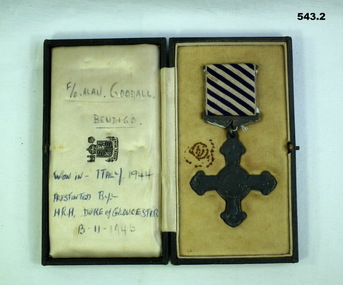
Award - MEDAL DFC, C.1944 - 46
... Command) with 150 Sqd RAF flying Wellingtons from North Africa. On 21.12.1943 on a non operational flight from Africa to Italy his flight crashed into Mt Etna, they were coming out of a cloud when the Pilot saw Etna. ...Command) with 150 Sqd RAF flying Wellingtons from North Africa. On 21.12.1943 on a non operational flight from Africa to Italy his flight crashed into Mt Etna, they were coming out of a cloud when the Pilot saw Etna. ...Allan Frederick GOODALL DFC. (Born Ringwood, enlisted Melbourne) in the RAAF on 10.10.1941 No 409828 age 18 years. He was mustered as Aircrew on elisted and was designated as WO/AG ( Wireless operator Air Gunner) on 23.7.1942. he rose through the ranks from AC2, LAC, Sgt, F/Sgt, W/O, F/O to Flt/Lt on 1.3.1945. Embarked for England on 24.8.1942 and posted to RAF Station Bournemouth on 18 .11.1942, posted to MEC (Middle East Command) with 150 Sqd RAF flying Wellingtons from North Africa. On 21.12.1943 on a non operational flight from Africa to Italy his flight crashed into Mt Etna, they were coming out of a cloud when the Pilot saw Etna. Allan as least injured made sure his mates were okay and sheltered he walked down to a nearby village (Maletto) to get help. Allan spent from 21.12.1943 to 5.1.1944 in hospital with Abrasions. He was awarded the DFC (Distinguished Flying Cross) in 1944 for operations over Italy, at the time he was classed as Sqd Signals Leader. According to his records he flew 37 Operational sorties. He was discharged from the RAAF on 3.1.1946. The crew of the Plane were; Bruce Hayman (NZ) Pilot, Fractured leg. Allan Goodall Aust (WOP/AG) abrasions and injured wrist. Alan Warner (Aust) Navigator, Fractured Ankle. Y.F.Redknap (UK) injured shoulder. C.A. Carr (UK) Fractured Dorsal Spine. J.E. Ward (UK) Dislocated shoulder. Alfred Dugdale (UK) Deceased. Tony Moore (UK) Deceased. Both are buried at the Catania War Cemetery Sicily. Refer Cat No 1025P for his photo.543.1 Medal-Distinguished FLying Cross won by FO Alan F Goodall. Rear of medal is engraved "Italy FO Alan Goodall 1944" 543.2 Case-to suit DFC above. Case rear has a note "Alan's sister Jean, Mrs R.T Mitchell, 22 O'Dea Cres Kangaroo Flat 3555 471428." Written inside case in pen "F/O Alan Goodall Bendigo Won in Italy 1944 Presented by HRH Duke of Gloucester 13-11-1946"awards, dfc ww2, raaf -
 Bendigo Military Museum
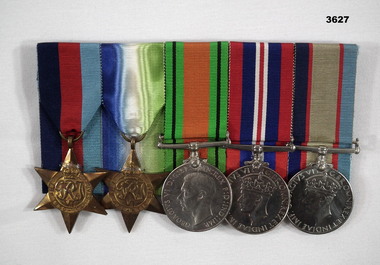
Award - MEDALS RAAF, Post 1945
... Pilot Officer, Flying Officer and last Flight Lieutenant on 10.3.1945. He is discharged from the RAAF on 7.12.1945 at RAF Station Beecles Suffolk England. 461 Sqd was a Coastal Command unit mostly involved in submarine detection and hunting in the Atlantic and Bay of Biscay. ...Pilot Officer, Flying Officer and last Flight Lieutenant on 10.3.1945. He is discharged from the RAAF on 7.12.1945 at RAF Station Beecles Suffolk England. 461 Sqd was a Coastal Command unit mostly involved in submarine detection and hunting in the Atlantic and Bay of Biscay. ...Reginald Charles ALLARDICE enlisted first in the CMF on 10.8.1940 age 21 years Regt No V40236. During this time he applied to join the RAAF so was discharged from the Army on 21.5.1942 as a Pte in the 24/39th Bn. Two days later he is in the RAAF as a Trainee Aircrew WEF No 418577. On 31.12.1942 he is listed as a LAC (Leading Aircraftsman. Ongoing training sees him at Benalla, Mallala in SA, Mt Gambier, Pt Cook, Camp Miles Standish USA. Finally he is stationed in England at Pembroke with 461 Sqd RAAF with the rank of Sgt on 10.10.1943. This was a Sunderland Sqd which was a large long range patrol Flying Boat. The unit was mainly Australians from many nations. He rises through the ranks to T/F/Sgt, Officer, Pilot Officer, Flying Officer and last Flight Lieutenant on 10.3.1945. He is discharged from the RAAF on 7.12.1945 at RAF Station Beecles Suffolk England. 461 Sqd was a Coastal Command unit mostly involved in submarine detection and hunting in the Atlantic and Bay of Biscay. They were involved in the D Day landings. The Sqd lost 20 aircraft to enemy action and accidents. A total of 86 Sqd members were lost of which 64 were Australian.Medals, individual with ribbons re R.C.Allardice. (1) 1939 - 45 Star, original not engraved. (2) Atlantic Star, original not engraved. (3) Defence Medal. (4) British War Medal 1939 - 45. (5) Australian Service Medal 1939 - 45. (.3, .4, .5) “418577 R.C.ALLARDICE”medals, campaign, service, world war2 -
B-24 Liberator Memorial Restoration Australia Inc
Oral History, My RAAF Experience by Keith R.E. Johnston, 1980's
... Johnston was in the RAAF from September 1941 until December 1945 and was a B-24 Liberator pilot between 1942 and December 1945. He was attached to Fifth Bomber Command USAF the 12 Squadron RAAF....Johnston was in the RAAF from September 1941 until December 1945 and was a B-24 Liberator pilot between 1942 and December 1945. He was attached to Fifth Bomber Command USAF the 12 Squadron RAAF. ...K. Johnston was in the RAAF from September 1941 until December 1945 and was a B-24 Liberator pilot between 1942 and December 1945. He was attached to Fifth Bomber Command USAF the 12 Squadron RAAF.This oral history of Keith Johnston is of historical significance because it provides a first hand account of this individual's experiences during World War II as a member of the RAAF who trained at Bradfield Park Sydney and Bundaberg and saw active service during the Pacific conflict flying B-24 Liberator aircraft in New Guinea and Darwin.A4 paper printed transcript, stapled in cornerMy RAAF Experience by R.E.Johnston, photo of 12 Squadron RAAF badge, Flight Lieutenant 12 Squadron RAAForal history raaf world war ii -
 Monbulk RSL Sub Branch
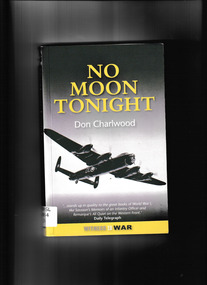
Book, Crecy Publishing, No moon tonight, 2000
... There he crewed up with a pilot from Western Australia and a British crew to fly a Lancaster bomber. In No Moon Tonight he gives a profound insight into the inner lives of the men of Bomber Command and their hopes and fears in the face of mounting losses. ...Don Charlwood was born in Melbourne in 1915. Accepted as a RAF navigator in 1940, he was posted to 103 Squadron at Elsham Wolds in the winter of 1942. There he crewed up with a pilot from Western Australia and a British crew to fly a Lancaster bomber. In No Moon Tonight he gives a profound insight into the inner lives of the men of Bomber Command and their hopes and fears in the face of mounting losses. He depicts the appalling human cost of the air war in an account which has been favorably compared to other enduring memoirs of the 1st World War, namely Sassoon's Memoirs of an Infantry Officer and Remarque's All Quiet on the Western Front. A memorable first hand account of the air war over Germany.Ill, p.244.non-fictionDon Charlwood was born in Melbourne in 1915. Accepted as a RAF navigator in 1940, he was posted to 103 Squadron at Elsham Wolds in the winter of 1942. There he crewed up with a pilot from Western Australia and a British crew to fly a Lancaster bomber. In No Moon Tonight he gives a profound insight into the inner lives of the men of Bomber Command and their hopes and fears in the face of mounting losses. He depicts the appalling human cost of the air war in an account which has been favorably compared to other enduring memoirs of the 1st World War, namely Sassoon's Memoirs of an Infantry Officer and Remarque's All Quiet on the Western Front. A memorable first hand account of the air war over Germany.world war 1939-1945 - aerial operations - britain, world war 1939-1945 - personal narratives - australia -
 Monbulk RSL Sub Branch
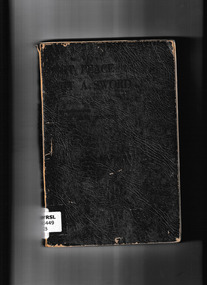
Book, Cassell, Not peace but a sword, 1943
... World War 1939-1945 - Aerial operations - Britain World war 1939 – 1945 – Personal narratives – Japan Personal experiences of a Coastal Command pilot in World war Two p.270. Not peace but a sword Book Cassell RPM Gibbs ...Personal experiences of a Coastal Command pilot in World war Twop.270.non-fictionPersonal experiences of a Coastal Command pilot in World war Twoworld war 1939-1945 - aerial operations - britain, world war 1939 – 1945 – personal narratives – japan -
 Monbulk RSL Sub Branch
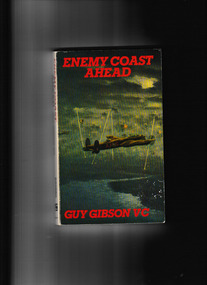
Book, Goodall publications, Enemy coast ahead, 1966
... World War 1939-1945 - Aerial operations - Britain Bomber Command Describes the night-to-night life of a bomber pilot, and traces the development of Bomber Command during the War. p.286, Enemy coast ahead Book Goodall publications Guy Gibson ...Describes the night-to-night life of a bomber pilot, and traces the development of Bomber Command during the War.p.286,Describes the night-to-night life of a bomber pilot, and traces the development of Bomber Command during the War.world war 1939-1945 - aerial operations - britain, bomber command -
 Eltham District Historical Society Inc
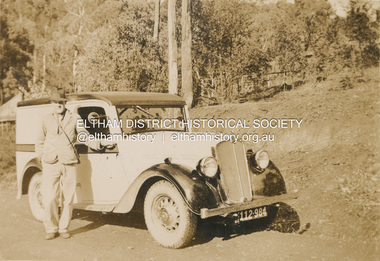
Photograph, Lester Neil Ingram with his Morris Ten Series II delivery van, c.1942
... Command, R.A.F. Lester’s service file reveals that on the evening of 22 April 1943, Lester was a member of the aircrew of Whitley V bomber, N.1374. The airframe had run 1,127 hours. A full moon was just rising. The flight was non-operational, its purpose a dual conversion on type mission flown by a student pilot...Command, R.A.F. Lester’s service file reveals that on the evening of 22 April 1943, Lester was a member of the aircrew of Whitley V bomber, N.1374. The airframe had run 1,127 hours. A full moon was just rising. The flight was non-operational, its purpose a dual conversion on type mission flown by a student pilot ...The van is a Morris Ten Series II which was manufactured 1935-1937. The numeral only Victorian Registration plate 112-984 was part of the sequence of numeral only plates issued 1910-1939. Lester Neil Ingram was born at Kew, 8 November 1911, the son of John and Ada (Key) Ingram of Research. According to Electoral Roll records, in 1903, John Ingram was a farmer at Lancefield, his wife Ada, a milliner. By 1906, John Ingram was a baker at Research and from about 1912, an orchardist. The family moved to Anglesea River sometime between 1937 and 1942. A sheet metal worker by trade, Lester had run the bakery business for 14 years, his father retired, and was working as a baker at Anglesea when he enlisted in the R.A.A.F. on 5 December 1941 at Melbourne. Previously he had worked as a baker at Research (1937). He undertook training as Aircrew at No. 4 Initial Training School at Victor Harbour, South Australia, followed by No. 1 Wireless Air Gunners School at Ballarat, Victoria, and No. 3 Bombing and Gunnery School, West Sale, Victoria. On October 15, 1942 Lester qualified as an Air Gunner, promoted to Sergeant, and was posted to 1 Embarkation Depot at Ascot Vale, Victoria, and attached to R.A.F. UK. Lester embarked from Australia December 2, 1942 and arrived at 11 Personnel Despatch and Reception Depot on January 13, 1943. On March 9 he was transferred to 10 Operational Training Unit, Group No. 91, Bomber Command, R.A.F. Lester’s service file reveals that on the evening of 22 April 1943, Lester was a member of the aircrew of Whitley V bomber, N.1374. The airframe had run 1,127 hours. A full moon was just rising. The flight was non-operational, its purpose a dual conversion on type mission flown by a student pilot with almost two hours completed at night on similar flights. They had just changed aircraft as their previous aircraft had become unserviceable. The pilot had accepted the aircraft, which was technically unserviceable as the NCO in charge of flight had not completed the inspection paperwork correctly. The aircraft had undergone a major engine repair the day before. The aircraft took off at 2348 hours from R.A.F. Abington. It was reported that the aircraft take-off was quite normal and after climbing to 800 feet it passed out of view of the ground observers. A few seconds later the aircraft crashed, and it was reported that the sound of the engines seemed to become desynchronised. The crash occurred one and a half miles northwest of Longworth, Berkshire and the aircraft destroyed by fire. It carried a crew of five. Lester is commemorated on the Eltham Roll of Honour Board, which was commissioned by the Eltham War Memorial Trust to be hung in the Eltham Infant Welfare Centre, part of complex of buildings that form the Eltham War Memorial. The Honour Roll is presently (2023) hanging in the Eltham Library Community Gallery space. Lester was remembered with the following notices published in The Argus newspaper, Saturday 22 April 1944, p2: INGRAM. —In treasured memories you are with me still. Sgt. Lester Neil Ingram, killed, aircraft accident, England, April 22, 1943. (Mother and father.) INGRAM. —In proud and ever loving memory of Lester, 410236, Sgt. L. N. Ingram, R.A.A.F., air crash England, April 22, 1943. —Per ardua ad astra. (Ellen Peake and family.) [“Per ardua ad astra” is a Latin phrase meaning “through adversity to the stars” or “through struggle to the stars” which was the motto of the Royal Air Force and other Commonwealth air forces such as the Royal Australian Air Force.] And from his fiancé Ellen, in The Argus, Wednesday, 5 May 1943, p2: INGRAM. —On April 22 (result of aircraft accident near Lodgeworth Village, Berks, England), Sgt. Lester Neil Ingram, R.A.A.F., fiance of Ellen. -Treasured memories till we meet again. Lester is buried at Brookwood Military Cemetery, Surrey, United Kingdom, Grave 4. 1. 11. INGRAM, Flt. Sgt. LESTER NEIL, 410236. R.A.A.F. 22nd April 1943. Age 31. Son of John and Ada Ingram, of Anglesea, Victoria, Australia. He gave his life For freedom’s cause ◊ ◊ ◊ LEST WE FORGET “They shall grow not old, as we that are left grow old; Age shall not weary them, nor the years condemn. At the going down of the sun and in the morning We will remember them.”On reverse "Lester Ingram"112-984 (victorian registration), lester neil ingram, morris ten series ii, bakery, delivery van, pam thoonen (nee ingram) collection -
 Eltham District Historical Society Inc
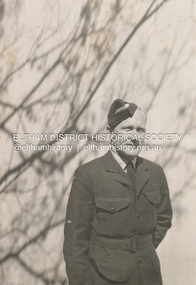
Photograph, Leading Aircraftsman, Lester Neil Ingram, RAAF, c.1943
... Command, R.A.F. Lester’s service file reveals that on the evening of 22 April 1943, Lester was a member of the aircrew of Whitley V bomber, N.1374. The airframe had run 1,127 hours. A full moon was just rising. The flight was non-operational, its purpose a dual conversion on type mission flown by a student pilot...Command, R.A.F. Lester’s service file reveals that on the evening of 22 April 1943, Lester was a member of the aircrew of Whitley V bomber, N.1374. The airframe had run 1,127 hours. A full moon was just rising. The flight was non-operational, its purpose a dual conversion on type mission flown by a student pilot ...Lester Neil Ingram was born at Kew, 8 November 1911, the son of John and Ada (Key) Ingram of Research. According to Electoral Roll records, in 1903, John Ingram was a farmer at Lancefield, his wife Ada, a milliner. By 1906, John Ingram was a baker at Research and from about 1912, an orchardist. The family moved to Anglesea River sometime between 1943 and 1949. A sheet metal worker by trade, Lester had run the bakery business for 14 years, his father retired, and was working as a baker at Anglesea when he enlisted in the R.A.A.F. on 5 December 1941 at Melbourne. Previously he had worked as a baker at Research (1937). He undertook training as Aircrew at No. 4 Initial Training School at Victor Harbour, South Australia, followed by No. 1 Wireless Air Gunners School at Ballarat, Victoria, and No. 3 Bombing and Gunnery School, West Sale, Victoria. On October 15, 1942 Lester qualified as an Air Gunner, promoted to Sergeant, and was posted to 1 Embarkation Depot at Ascot Vale, Victoria, and attached to R.A.F. UK. Lester embarked from Australia December 2, 1942 and arrived at 11 Personnel Despatch and Reception Depot on January 13, 1943. On March 9 he was transferred to 10 Operational Training Unit, Group No. 91, Bomber Command, R.A.F. Lester’s service file reveals that on the evening of 22 April 1943, Lester was a member of the aircrew of Whitley V bomber, N.1374. The airframe had run 1,127 hours. A full moon was just rising. The flight was non-operational, its purpose a dual conversion on type mission flown by a student pilot with almost two hours completed at night on similar flights. They had just changed aircraft as their previous aircraft had become unserviceable. The pilot had accepted the aircraft, which was technically unserviceable as the NCO in charge of flight had not completed the inspection paperwork correctly. The aircraft had undergone a major engine repair the day before. The aircraft took off at 2348 hours from R.A.F. Abington. It was reported that the aircraft take-off was quite normal and after climbing to 800 feet it passed out of view of the ground observers. A few seconds later the aircraft crashed, and it was reported that the sound of the engines seemed to become desynchronised. The crash occurred one and a half miles northwest of Longworth, Berkshire and the aircraft destroyed by fire. It carried a crew of five. Lester is commemorated on the Eltham Roll of Honour Board, which was commissioned by the Eltham War Memorial Trust to be hung in the Eltham Infant Welfare Centre, part of complex of buildings that form the Eltham War Memorial. The Honour Roll is presently (2023) hanging in the Eltham Library Community Gallery space. Lester was remembered with the following notices published in The Argus newspaper, Saturday 22 April 1944, p2: INGRAM. —In treasured memories you are with me still. Sgt. Lester Neil Ingram, killed, aircraft accident, England, April 22, 1943. (Mother and father.) INGRAM. —In proud and ever loving memory of Lester, 410236, Sgt. L. N. Ingram, R.A.A.F., air crash England, April 22, 1943. —Per ardua ad astra. (Ellen Peake and family.) [“Per ardua ad astra” is a Latin phrase meaning “through adversity to the stars” or “through struggle to the stars” which was the motto of the Royal Air Force and other Commonwealth air forces such as the Royal Australian Air Force.] And from his fiancé Ellen, in The Argus, Wednesday, 5 May 1943, p2: INGRAM. —On April 22 (result of aircraft accident near Lodgeworth Village, Berks, England), Sgt. Lester Neil Ingram, R.A.A.F., fiance of Ellen. -Treasured memories till we meet again. Lester is buried at Brookwood Military Cemetery, Surrey, United Kingdom, Grave 4. 1. 11. INGRAM, Flt. Sgt. LESTER NEIL, 410236. R.A.A.F. 22nd April 1943. Age 31. Son of John and Ada Ingram, of Anglesea, Victoria, Australia. He gave his life For freedom’s cause ◊ ◊ ◊ LEST WE FORGET “They shall grow not old, as we that are left grow old; Age shall not weary them, nor the years condemn. At the going down of the sun and in the morning We will remember them.”On reverse "Lester Ingram"lester neil ingram, baker, eltham, honour board, raaf, research (vic.), roll of honour, pam thoonen (nee ingram) collection -
 Eltham District Historical Society Inc
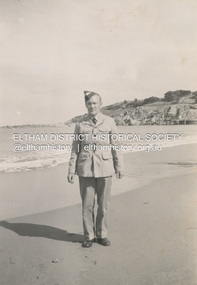
Photograph, Leading Aircraftsman, Lester Neil Ingram, RAAF, c.1943
... Command, R.A.F. Lester’s service file reveals that on the evening of 22 April 1943, Lester was a member of the aircrew of Whitley V bomber, N.1374. The airframe had run 1,127 hours. A full moon was just rising. The flight was non-operational, its purpose a dual conversion on type mission flown by a student pilot...Command, R.A.F. Lester’s service file reveals that on the evening of 22 April 1943, Lester was a member of the aircrew of Whitley V bomber, N.1374. The airframe had run 1,127 hours. A full moon was just rising. The flight was non-operational, its purpose a dual conversion on type mission flown by a student pilot ...Lester Neil Ingram was born at Kew, 8 November 1911, the son of John and Ada (Key) Ingram of Research. According to Electoral Roll records, in 1903, John Ingram was a farmer at Lancefield, his wife Ada, a milliner. By 1906, John Ingram was a baker at Research and from about 1912, an orchardist. The family moved to Anglesea River sometime between 1943 and 1949. A sheet metal worker by trade, Lester had run the bakery business for 14 years, his father retired, and was working as a baker at Anglesea when he enlisted in the R.A.A.F. on 5 December 1941 at Melbourne. Previously he had worked as a baker at Research (1937). He undertook training as Aircrew at No. 4 Initial Training School at Victor Harbour, South Australia, followed by No. 1 Wireless Air Gunners School at Ballarat, Victoria, and No. 3 Bombing and Gunnery School, West Sale, Victoria. On October 15, 1942 Lester qualified as an Air Gunner, promoted to Sergeant, and was posted to 1 Embarkation Depot at Ascot Vale, Victoria, and attached to R.A.F. UK. Lester embarked from Australia December 2, 1942 and arrived at 11 Personnel Despatch and Reception Depot on January 13, 1943. On March 9 he was transferred to 10 Operational Training Unit, Group No. 91, Bomber Command, R.A.F. Lester’s service file reveals that on the evening of 22 April 1943, Lester was a member of the aircrew of Whitley V bomber, N.1374. The airframe had run 1,127 hours. A full moon was just rising. The flight was non-operational, its purpose a dual conversion on type mission flown by a student pilot with almost two hours completed at night on similar flights. They had just changed aircraft as their previous aircraft had become unserviceable. The pilot had accepted the aircraft, which was technically unserviceable as the NCO in charge of flight had not completed the inspection paperwork correctly. The aircraft had undergone a major engine repair the day before. The aircraft took off at 2348 hours from R.A.F. Abington. It was reported that the aircraft take-off was quite normal and after climbing to 800 feet it passed out of view of the ground observers. A few seconds later the aircraft crashed, and it was reported that the sound of the engines seemed to become desynchronised. The crash occurred one and a half miles northwest of Longworth, Berkshire and the aircraft destroyed by fire. It carried a crew of five. Lester is commemorated on the Eltham Roll of Honour Board, which was commissioned by the Eltham War Memorial Trust to be hung in the Eltham Infant Welfare Centre, part of complex of buildings that form the Eltham War Memorial. The Honour Roll is presently (2023) hanging in the Eltham Library Community Gallery space. Lester was remembered with the following notices published in The Argus newspaper, Saturday 22 April 1944, p2: INGRAM. —In treasured memories you are with me still. Sgt. Lester Neil Ingram, killed, aircraft accident, England, April 22, 1943. (Mother and father.) INGRAM. —In proud and ever loving memory of Lester, 410236, Sgt. L. N. Ingram, R.A.A.F., air crash England, April 22, 1943. —Per ardua ad astra. (Ellen Peake and family.) [“Per ardua ad astra” is a Latin phrase meaning “through adversity to the stars” or “through struggle to the stars” which was the motto of the Royal Air Force and other Commonwealth air forces such as the Royal Australian Air Force.] And from his fiancé Ellen, in The Argus, Wednesday, 5 May 1943, p2: INGRAM. —On April 22 (result of aircraft accident near Lodgeworth Village, Berks, England), Sgt. Lester Neil Ingram, R.A.A.F., fiance of Ellen. -Treasured memories till we meet again. Lester is buried at Brookwood Military Cemetery, Surrey, United Kingdom, Grave 4. 1. 11. INGRAM, Flt. Sgt. LESTER NEIL, 410236. R.A.A.F. 22nd April 1943. Age 31. Son of John and Ada Ingram, of Anglesea, Victoria, Australia. He gave his life For freedom’s cause ◊ ◊ ◊ LEST WE FORGET “They shall grow not old, as we that are left grow old; Age shall not weary them, nor the years condemn. At the going down of the sun and in the morning We will remember them.”On reverse "Lester Ingram"lester neil ingram, baker, eltham, honour board, raaf, research (vic.), roll of honour, pam thoonen (nee ingram) collection -
 Eltham District Historical Society Inc
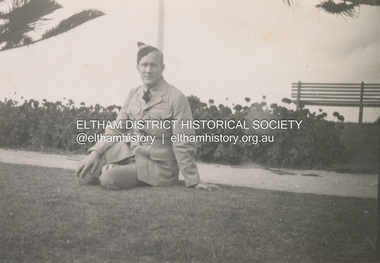
Photograph, Leading Aircraftsman, Lester Neil Ingram, RAAF, c.1943
... Command, R.A.F. Lester’s service file reveals that on the evening of 22 April 1943, Lester was a member of the aircrew of Whitley V bomber, N.1374. The airframe had run 1,127 hours. A full moon was just rising. The flight was non-operational, its purpose a dual conversion on type mission flown by a student pilot...Command, R.A.F. Lester’s service file reveals that on the evening of 22 April 1943, Lester was a member of the aircrew of Whitley V bomber, N.1374. The airframe had run 1,127 hours. A full moon was just rising. The flight was non-operational, its purpose a dual conversion on type mission flown by a student pilot ...Lester Neil Ingram was born at Kew, 8 November 1911, the son of John and Ada (Key) Ingram of Research. According to Electoral Roll records, in 1903, John Ingram was a farmer at Lancefield, his wife Ada, a milliner. By 1906, John Ingram was a baker at Research and from about 1912, an orchardist. The family moved to Anglesea River sometime between 1943 and 1949. A sheet metal worker by trade, Lester had run the bakery business for 14 years, his father retired, and was working as a baker at Anglesea when he enlisted in the R.A.A.F. on 5 December 1941 at Melbourne. Previously he had worked as a baker at Research (1937). He undertook training as Aircrew at No. 4 Initial Training School at Victor Harbour, South Australia, followed by No. 1 Wireless Air Gunners School at Ballarat, Victoria, and No. 3 Bombing and Gunnery School, West Sale, Victoria. On October 15, 1942 Lester qualified as an Air Gunner, promoted to Sergeant, and was posted to 1 Embarkation Depot at Ascot Vale, Victoria, and attached to R.A.F. UK. Lester embarked from Australia December 2, 1942 and arrived at 11 Personnel Despatch and Reception Depot on January 13, 1943. On March 9 he was transferred to 10 Operational Training Unit, Group No. 91, Bomber Command, R.A.F. Lester’s service file reveals that on the evening of 22 April 1943, Lester was a member of the aircrew of Whitley V bomber, N.1374. The airframe had run 1,127 hours. A full moon was just rising. The flight was non-operational, its purpose a dual conversion on type mission flown by a student pilot with almost two hours completed at night on similar flights. They had just changed aircraft as their previous aircraft had become unserviceable. The pilot had accepted the aircraft, which was technically unserviceable as the NCO in charge of flight had not completed the inspection paperwork correctly. The aircraft had undergone a major engine repair the day before. The aircraft took off at 2348 hours from R.A.F. Abington. It was reported that the aircraft take-off was quite normal and after climbing to 800 feet it passed out of view of the ground observers. A few seconds later the aircraft crashed, and it was reported that the sound of the engines seemed to become desynchronised. The crash occurred one and a half miles northwest of Longworth, Berkshire and the aircraft destroyed by fire. It carried a crew of five. Lester is commemorated on the Eltham Roll of Honour Board, which was commissioned by the Eltham War Memorial Trust to be hung in the Eltham Infant Welfare Centre, part of complex of buildings that form the Eltham War Memorial. The Honour Roll is presently (2023) hanging in the Eltham Library Community Gallery space. Lester was remembered with the following notices published in The Argus newspaper, Saturday 22 April 1944, p2: INGRAM. —In treasured memories you are with me still. Sgt. Lester Neil Ingram, killed, aircraft accident, England, April 22, 1943. (Mother and father.) INGRAM. —In proud and ever loving memory of Lester, 410236, Sgt. L. N. Ingram, R.A.A.F., air crash England, April 22, 1943. —Per ardua ad astra. (Ellen Peake and family.) [“Per ardua ad astra” is a Latin phrase meaning “through adversity to the stars” or “through struggle to the stars” which was the motto of the Royal Air Force and other Commonwealth air forces such as the Royal Australian Air Force.] And from his fiancé Ellen, in The Argus, Wednesday, 5 May 1943, p2: INGRAM. —On April 22 (result of aircraft accident near Lodgeworth Village, Berks, England), Sgt. Lester Neil Ingram, R.A.A.F., fiance of Ellen. -Treasured memories till we meet again. Lester is buried at Brookwood Military Cemetery, Surrey, United Kingdom, Grave 4. 1. 11. INGRAM, Flt. Sgt. LESTER NEIL, 410236. R.A.A.F. 22nd April 1943. Age 31. Son of John and Ada Ingram, of Anglesea, Victoria, Australia. He gave his life For freedom’s cause ◊ ◊ ◊ LEST WE FORGET “They shall grow not old, as we that are left grow old; Age shall not weary them, nor the years condemn. At the going down of the sun and in the morning We will remember them.”On reverse "Lester Ingram"lester neil ingram, baker, eltham, honour board, raaf, research (vic.), roll of honour, pam thoonen (nee ingram) collection -
 National Vietnam Veterans Museum (NVVM)
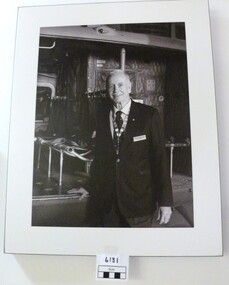
Photograph, C.2015
... Command. For his service with the USAF, Alan Reed was awarded the United States Distinguished Flying Cross with oak leaf cluster. His final rank with the Air Force was Air Vice Marshal and his last posting was with Headquarters, Australian Force Vietnam (RAAF Element) Pilot Alan Reed Tan Son Nhut Saigon Phantom RF4C United States Air Force USAF "Carolina Kangaroo". ...AVM Alan Reed AO, Tan Son Nhut, Saigon, June - November 1968. I was an Australian exchange officer flying RF4C Phantoms and training United States Air Force (USAF) pilots and navigators to go to Vietnam. I felt I needed some Vietnam experience if I were to do my job as an instructor. I managed to persuade both the US and Australian Governments to let me go the the war. I claim to be one of the few people 'invited' to the war because, for protocol reasons. the USAF could not order me to go. I was on exchange with the USAF from 1967 to 1970. My job was to fly reconnaissance missions in South and North Vietnam. My navigator was from North Carolina so we named our aircraft the 'Carolina Kangaroo'. All up, I flew 100 missions in Vietnam. Squadron Leader Alan Reed from the Royal Australian Air Force 052363 served in Vietnam from 26 May 1968 until 20 November 1968. He spent most of his tour detached to the 12th Tactical Reconnaissance Squadron, US Air Force. He was made an Officer of the Order of Australia (AO) in June 1989 for his service to the RAAF as Air Officer Commanding, Support Command. For his service with the USAF, Alan Reed was awarded the United States Distinguished Flying Cross with oak leaf cluster. His final rank with the Air Force was Air Vice Marshal and his last posting was with Headquarters, Australian Force Vietnam (RAAF Element) Black and white photo of Alan Reed Sqdr Ldr Pilot at the N.V.V.M. 2015 with supporting info.pilot, alan reed, tan son nhut, saigon, phantom rf4c, united states air force, usaf, "carolina kangaroo"., squadron leader alan reed, royal australian air force, 052363, 12th tactical reconnaissance squadron, officer of the order of australia, raaf, distinguished flying cross, air vice marshall allan reed, headquarters, australian force vietnam -
 National Vietnam Veterans Museum (NVVM)
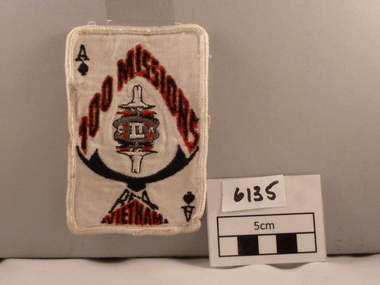
Award - Cloth badge, C. 1968
... Command. For his service with the USAF, Alan Reed was awarded the United States Distinguished Flying Cross with oak leaf cluster. His final rank with the Air Force was Air Vice Marshal and his last posting was with Headquarters, Australian Force Vietnam (RAAF Element) Cloth badge Alan Reed Royal Australian Air Force 052363 12th Tactical Reconnaissance Squadron US Air Force United States Distinguished Flying Cross Air Vice Marshall Allan Reed Squadron Leader Alan Reed Pilot Australian Force Headquarters RAAF Officer of the Order of Australia Ace of Spades insignia. ...Squadron Leader Alan Reed from the Royal Australian Air Force 052363 served in Vietnam from 26 May 1968 until 20 November 1968. He spent most of his tour detached to the 12th Tactical Reconnaissance Squadron, US Air Force. He was made an Officer of the Order of Australia (AO) in June 1989 for his service to the RAAF as Air Officer Commanding, Support Command. For his service with the USAF, Alan Reed was awarded the United States Distinguished Flying Cross with oak leaf cluster. His final rank with the Air Force was Air Vice Marshal and his last posting was with Headquarters, Australian Force Vietnam (RAAF Element) Rectangular woven cloth badge signifying '100 Missions in Vietnam' white, red and black.Ace of Spades insignia.cloth badge, alan reed, royal australian air force, 052363, 12th tactical reconnaissance squadron, us air force, united states distinguished flying cross, air vice marshall allan reed, squadron leader alan reed, pilot, australian force headquarters, raaf, officer of the order of australia -
 National Vietnam Veterans Museum (NVVM)
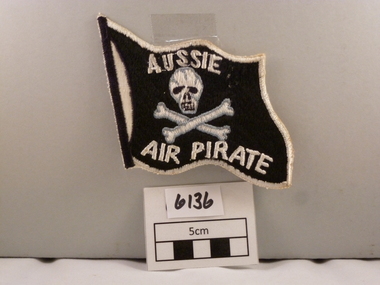
Award - Cloth badge, C.1968
... Command. For his service with the USAF, Alan Reed was awarded the United States Distinguished Flying Cross with oak leaf cluster. His final rank with the Air Force was Air Vice Marshal and his last posting was with Headquarters, Australian Force Vietnam (RAAF Element) Cloth badge Alan Reed Alan Raymond Reed Royal Australian Air Force 052363 Squadron Leader Alan Reed Pilot Headquarters Australian Force Vietnam RAAF Element 12th Tactical Reconnaissance Squadron Officer of the Order of Australia AO United States Distinguished Flying Cross Aussie Air Pirate.Skull and Cross Bones . ...Squadron Leader Alan Reed from the Royal Australian Air Force 052363 served in Vietnam from 26 May 1968 until 20 November 1968. He spent most of his tour detached to the 12th Tactical Reconnaissance Squadron, US Air Force. He was made an Officer of the Order of Australia (AO) in June 1989 for his service to the RAAF as Air Officer Commanding, Support Command. For his service with the USAF, Alan Reed was awarded the United States Distinguished Flying Cross with oak leaf cluster. His final rank with the Air Force was Air Vice Marshal and his last posting was with Headquarters, Australian Force Vietnam (RAAF Element) Woven cloth badge black, white & grey, flag shaped.Aussie Air Pirate.Skull and Cross Bones .cloth badge, alan reed, alan raymond reed, royal australian air force, 052363, squadron leader alan reed, pilot, headquarters, australian force vietnam, raaf element, 12th tactical reconnaissance squadron, officer of the order of australia, ao, united states distinguished flying cross -
 National Vietnam Veterans Museum (NVVM)
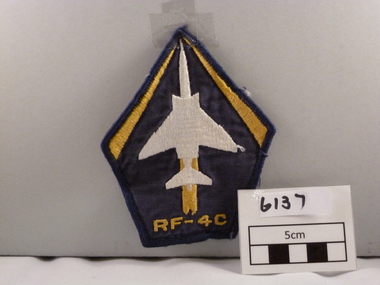
Award, Badge, C.1968
... Command. For his service with the USAF, Alan Reed was awarded the United States Distinguished Flying Cross with oak leaf cluster. His final rank with the Air Force was Air Vice Marshal and his last posting was with Headquarters, Australian Force Vietnam (RAAF Element) Cloth Badge Alan Raymond Reed Squadron Leader Alan Reed Pilot Royal Australian Air Force 052363 Headquarters Australian Force Vietnam RAAF Element 12th Tactical Reconnaissance Squadron United States Air Force USAF Air Vice Marshall Allan Reed Officer of the Order of Australia AO United States Distinguished Flying Cross RF- 4C.Aircraft design. ...This is part of the collection that was donated by Squadron Leader Alan Reed. Squadron Leader Alan Reed from the Royal Australian Air Force 052363 served in Vietnam from 26 May 1968 until 20 November 1968. He spent most of his tour detached to the 12th Tactical Reconnaissance Squadron, US Air Force. He was made an Officer of the Order of Australia (AO) in June 1989 for his service to the RAAF as Air Officer Commanding, Support Command. For his service with the USAF, Alan Reed was awarded the United States Distinguished Flying Cross with oak leaf cluster. His final rank with the Air Force was Air Vice Marshal and his last posting was with Headquarters, Australian Force Vietnam (RAAF Element) Woven cloth badge coloured, blue, white, yellow diamond shaped.RF- 4C.Aircraft design.cloth badge, alan raymond reed, squadron leader alan reed, pilot, royal australian air force, 052363, headquarters, australian force vietnam, raaf element, 12th tactical reconnaissance squadron, united states air force, usaf, air vice marshall allan reed, officer of the order of australia, ao, united states distinguished flying cross -
 National Vietnam Veterans Museum (NVVM)
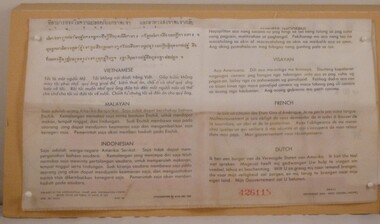
Functional Object - Letter, April 1961
... Command. For his service with the USAF, Alan Reed was awarded the United States Distinguished Flying Cross with oak leaf cluster. His final rank with the Air Force was Air Vice Marshal and his last posting was with Headquarters, Australian Force Vietnam (RAAF Element) Silk pilots letter. ...Squadron Leader Alan Reed from the Royal Australian Air Force 052363 served in Vietnam from 26 May 1968 until 20 November 1968. He spent most of his tour detached to the 12th Tactical Reconnaissance Squadron, US Air Force. He was made an Officer of the Order of Australia (AO) in June 1989 for his service to the RAAF as Air Officer Commanding, Support Command. For his service with the USAF, Alan Reed was awarded the United States Distinguished Flying Cross with oak leaf cluster. His final rank with the Air Force was Air Vice Marshal and his last posting was with Headquarters, Australian Force Vietnam (RAAF Element) Silk Pilots Letter , Squadron Leader A.R. Reed, Service number: 426115. LD Allan Reed. All Pilots of the RF-4C Phantom aircraft carried a silk letter with the same message in many languages. It asks people to assist the holder and advises that they will be rewarded for doing so.SQD LD Alan Reed.Service No. 42611S.silk pilots letter., alan reed, squadron leader alan reed, 052363, royal australian air force, 12th tactical reconnaissance squadron, officer of the order of australia, distinguished flying cross, usaf, united states air force, air vice marshall allan reed, headquarters, australian force vietnam, raaf element, pilot -
 National Vietnam Veterans Museum (NVVM)
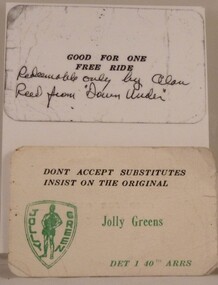
Document - Jolly Green Ticket, C.1968
... Command. For his service with the USAF, Alan Reed was awarded the United States Distinguished Flying Cross with oak leaf cluster. His final rank with the Air Force was Air Vice Marshal and his last posting was with Headquarters, Australian Force Vietnam (RAAF Element) Jolly Green Ticket Alan Reed Squadron Leader Alan Reed Royal Australian Air Force 052363 12th Tactical Reconnaissance Squadron United States Air Force USAF United States Distinguished Flying Cross Australian Force Headquarters Pilot RAAF Element Air Vice Marshall Allan Reed Officer of the Order of Australia GOOD FOR ONE FREE RIDE. ...Squadron Leader Alan Reed from the Royal Australian Air Force 052363 served in Vietnam from 26 May 1968 until 20 November 1968. He spent most of his tour detached to the 12th Tactical Reconnaissance Squadron, US Air Force. He was made an Officer of the Order of Australia (AO) in June 1989 for his service to the RAAF as Air Officer Commanding, Support Command. For his service with the USAF, Alan Reed was awarded the United States Distinguished Flying Cross with oak leaf cluster. His final rank with the Air Force was Air Vice Marshal and his last posting was with Headquarters, Australian Force Vietnam (RAAF Element) ' Jolly Greens ' card / tickets to ride used in rescue operations for downed American airmen through out the Vietnam War. Ticket to Ride: Jolly Greens was the nickname given to the US helicopters that rescued downed aircrew. The reverse side of this card reads: redeemable only by Alan Reed from "Down Under".GOOD FOR ONE FREE RIDE. Redeemable only by Alan Reed from 'Down Under' DON"T ACCEPT SUBSTITUTES INSIST ON THE ORIGINAL. Jolly Greens. DET 1 40th ARRS.jolly green ticket, alan reed, squadron leader alan reed, royal australian air force, 052363, 12th tactical reconnaissance squadron, united states air force, usaf, united states distinguished flying cross, australian force headquarters, pilot, raaf element, air vice marshall allan reed, officer of the order of australia -
 National Vietnam Veterans Museum (NVVM)
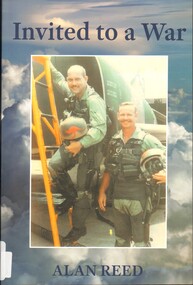
Book, Reed, Alan AO, Invited to a War, 2020
... Pilot. Graduating as a Sergeant in 1954 he progressed through the ranks completing his career as an Air Vice Marshall leading RAAF Support Command, an organisation of more that twelve thousand people: one of Australia's largest institutions at the time. ...Family circumstances dictated that Alan Reed leave school before his sixteenth birthday. He was employed in a Chartered Accountants office until 'called up' for National Service Training in the RAAF. Becoming airborne for the first time in a Dakota DC3 changed his life forever and he applied for and was accepted by the RAAF as a Trainee Pilot. Graduating as a Sergeant in 1954 he progressed through the ranks completing his career as an Air Vice Marshall leading RAAF Support Command, an organisation of more that twelve thousand people: one of Australia's largest institutions at the time.Family circumstances dictated that Alan Reed leave school before his sixteenth birthday. He was employed in a Chartered Accountants office until 'called up' for National Service Training in the RAAF. Becoming airborne for the first time in a Dakota DC3 changed his life forever and he applied for and was accepted by the RAAF as a Trainee Pilot. Graduating as a Sergeant in 1954 he progressed through the ranks completing his career as an Air Vice Marshall leading RAAF Support Command, an organisation of more that twelve thousand people: one of Australia's largest institutions at the time.alan reed, australia. royal australian air force – veterans, australia. royal australian air force - history -
 National Vietnam Veterans Museum (NVVM)
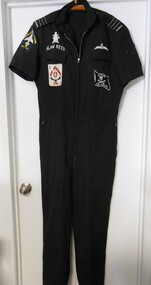
Uniform - Uniform, RAAF, Party Suit
... Command. For his service with the USAF, Alan Reed was awarded the United States Distinguished Flying Cross with oak leaf cluster. His final rank with the Air Force was Air Vice Marshal and his last posting was with Headquarters, Australian Force Vietnam (RAAF Element) Alan Reed United States Air Force Air pilots Royal Australian Air Force Squadron Leader Air Vice Marshall Allan Reed Squadron Leader Alan Reed Pilot Headquarters Australian Force Vietnam RAAF Element 12th Tactical Reconnaissance Squadron Officer of the Order of Australia AO United States Distinguished Flying Cross 052363 White embroidered RAAF Brevet on left breast." ...Squadron Leader Alan Reed from the Royal Australian Air Force 052363 served in Vietnam from 26 May 1968 until 20 November 1968. He spent most of his tour detached to the 12th Tactical Reconnaissance Squadron, US Air Force. He was made an Officer of the Order of Australia (AO) in June 1989 for his service to the RAAF as Air Officer Commanding, Support Command. For his service with the USAF, Alan Reed was awarded the United States Distinguished Flying Cross with oak leaf cluster. His final rank with the Air Force was Air Vice Marshal and his last posting was with Headquarters, Australian Force Vietnam (RAAF Element) A black one piece Dining Suit (party suit) similar in style to a short sleeve Flying Suit, with zippered front and pockets, bearing Squadron Leader epaulettes worn by the then Squadron Leader Alan Reed whilst serving in Vietnam in 1968. It has a white embroidered RAAF brevet on the left chest, with a "Phamous Phantom Spook" (82 Wing RAAF F4E) caricature above the embroidered name ALAN REED on the right chest. Three additional embroidered patches are attached to the suit (RF-4C, 100 Missions Vietnam and Aussie Air Pirate) two on the chest and one on the left sleeve.White embroidered RAAF Brevet on left breast."Phan"alan reed, united states air force, air pilots, royal australian air force, squadron leader, air vice marshall allan reed, squadron leader alan reed, pilot, headquarters, australian force vietnam, raaf element, 12th tactical reconnaissance squadron, officer of the order of australia, ao, united states distinguished flying cross, 052363 -
 Chiltern Athenaeum Trust
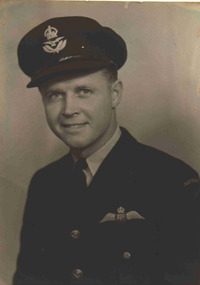
Photograph
... pilot aces. He was born on the 17/5/1916 and died over Exmouth, Western Australia on 28/3/1943 in an Aircraft accident whilst on duty. He initially trained under the Commonwealth Empire Training Scheme In Canada at the beginning of WW2, and later on was posted to Number 452 Squadron England where he flew Spitfires over Europe. He was awarded the distinguished Flying Cross in 1941 for his Air action and bravery. In 1942 he was further awarded the DFC Bar for further outstanding Air action and bravery. He returned to Australia and commanded...pilot aces. He was born on the 17/5/1916 and died over Exmouth, Western Australia on 28/3/1943 in an Aircraft accident whilst on duty. He initially trained under the Commonwealth Empire Training Scheme In Canada at the beginning of WW2, and later on was posted to Number 452 Squadron England where he flew Spitfires over Europe. He was awarded the distinguished Flying Cross in 1941 for his Air action and bravery. In 1942 he was further awarded the DFC Bar for further outstanding Air action and bravery. He returned to Australia and commanded ...Photo of Bluey Truscott. Squadron Leader Keith William (Bluey) Truscott was regarded as one of Australia’s most well known WW2 fighter pilot aces. He was born on the 17/5/1916 and died over Exmouth, Western Australia on 28/3/1943 in an Aircraft accident whilst on duty. He initially trained under the Commonwealth Empire Training Scheme In Canada at the beginning of WW2, and later on was posted to Number 452 Squadron England where he flew Spitfires over Europe. He was awarded the distinguished Flying Cross in 1941 for his Air action and bravery. In 1942 he was further awarded the DFC Bar for further outstanding Air action and bravery. He returned to Australia and commanded number 76 Squadron who undertook duties in Papua New Guinea, specifically Milne Bay. When with 76 Squadron they largely flew Kittyhawks. There is a club named after SQN LDR Truscott, called the Truscott Club, at Airforce Base Darwin. There is also a decommissioned WW2 Airfield in the Kimberley’s called after him ( Truscott Air Base). Truscott has more recently been called Mungalu-Truscott Air Base as it is now owned by the traditional people of the Wunambal Gaambera. The Airfield is now used for commercial and private flying and is heritage listed under the National Trust of Australia (W.A.) due to its historical significance relating to WW2 and the remaining artefacts that are still in place presently. Bluey Truscott was also a well known Australian Rules Football player prior to WW2 having played for Melbourne. Photograph of Keith William (Bluey) Truscott in uniform.ww2, bluey truscott, flying cross -
 Moorabbin Air Museum
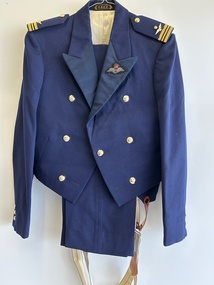
Uniform (item) - RAAF Mess Dress Uniform, RAAF Mess Dress Uniform Belonging To W.A.Eacott
... Joined RAF December 1940 to be trained as a pilot, he got his wings December 1941, became a night fighter pilot after OTU and posted to 219 Squadron. Was posted to 603 Squadron December 1942 flying Beaufighters on coastal command convoy escorts, desert patrols, supporting Sicilian and Italian invasions (all from the N.African desert, then on Greek Island " Armed Rovers" until 10 November 1943, just at the end of ops, when he was shot down in the Aegean Sea and became a POW the next day 11 November 1943. ...Joined RAF December 1940 to be trained as a pilot, he got his wings December 1941, became a night fighter pilot after OTU and posted to 219 Squadron. Was posted to 603 Squadron December 1942 flying Beaufighters on coastal command convoy escorts, desert patrols, supporting Sicilian and Italian invasions (all from the N.African desert, then on Greek Island " Armed Rovers" until 10 November 1943, just at the end of ops, when he was shot down in the Aegean Sea and became a POW the next day 11 November 1943. ...This RAAF dress uniform and other associated article of clothing was owned by Walter Alexander Scott. Joined RAF December 1940 to be trained as a pilot, he got his wings December 1941, became a night fighter pilot after OTU and posted to 219 Squadron. Was posted to 603 Squadron December 1942 flying Beaufighters on coastal command convoy escorts, desert patrols, supporting Sicilian and Italian invasions (all from the N.African desert, then on Greek Island " Armed Rovers" until 10 November 1943, just at the end of ops, when he was shot down in the Aegean Sea and became a POW the next day 11 November 1943. Transferred to Germany he was in Stalag IVB for 3 months, before exchanging ID with an Irish soldier ,in order to get out of the main camp into a working sub-camp in order to escape. Post war Walter returned to Australia, he became "Citizen of the Year" in Werribee 1992 for his service to the community. In 1993 he was awarded the Order of Australia Medal for services to youth and to the retired.CGCF ( Commonwealth Government Clothing Factory) -
 Moorabbin Air Museum
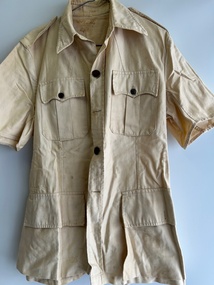
Uniform (item) - RAAF Tropical Uniform Jacket, RAAF Tropical Uniform Jacket Belonging To W.A.Eacott
... Joined RAF December 1940 to be trained as a pilot, he got his wings December 1941, became a night fighter pilot after OTU and posted to 219 Squadron. Was posted to 603 Squadron December 1942 flying Beaufighters on coastal command convoy escorts, desert patrols, supporting Sicilian and Italian invasions (all from the N.African desert, then on Greek Island " Armed Rovers" until 10 November 1943, just at the end of ops, when he was shot down in the Aegean Sea and became a POW the next day 11 November 1943. ...Joined RAF December 1940 to be trained as a pilot, he got his wings December 1941, became a night fighter pilot after OTU and posted to 219 Squadron. Was posted to 603 Squadron December 1942 flying Beaufighters on coastal command convoy escorts, desert patrols, supporting Sicilian and Italian invasions (all from the N.African desert, then on Greek Island " Armed Rovers" until 10 November 1943, just at the end of ops, when he was shot down in the Aegean Sea and became a POW the next day 11 November 1943. ...This RAAF dress uniform and other associated article of clothing was owned by Walter Alexander Scott. Joined RAF December 1940 to be trained as a pilot, he got his wings December 1941, became a night fighter pilot after OTU and posted to 219 Squadron. Was posted to 603 Squadron December 1942 flying Beaufighters on coastal command convoy escorts, desert patrols, supporting Sicilian and Italian invasions (all from the N.African desert, then on Greek Island " Armed Rovers" until 10 November 1943, just at the end of ops, when he was shot down in the Aegean Sea and became a POW the next day 11 November 1943. Transferred to Germany he was in Stalag IVB for 3 months, before exchanging ID with an Irish soldier ,in order to get out of the main camp into a working sub-camp in order to escape. Post war Walter returned to Australia, he became "Citizen of the Year" in Werribee 1992 for his service to the community. In 1993 he was awarded the Order of Australia Medal for services to youth and to the retired. -
 Moorabbin Air Museum
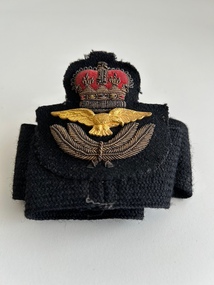
Uniform (item) - RAAF Officers Cloth Bullion Cap Badge - Queens Crown ,Belonging To W.A.Eacott
... Joined RAF December 1940 to be trained as a pilot, he got his wings December 1941, became a night fighter pilot after OTU and posted to 219 Squadron. Was posted to 603 Squadron December 1942 flying Beaufighters on coastal command convoy escorts, desert patrols, supporting Sicilian and Italian invasions (all from the N.African desert, then on Greek Island " Armed Rovers" until 10 November 1943, just at the end of ops, when he was shot down in the Aegean Sea and became a POW the next day 11 November 1943. ...Joined RAF December 1940 to be trained as a pilot, he got his wings December 1941, became a night fighter pilot after OTU and posted to 219 Squadron. Was posted to 603 Squadron December 1942 flying Beaufighters on coastal command convoy escorts, desert patrols, supporting Sicilian and Italian invasions (all from the N.African desert, then on Greek Island " Armed Rovers" until 10 November 1943, just at the end of ops, when he was shot down in the Aegean Sea and became a POW the next day 11 November 1943. ...This RAAF dress uniform and other associated article of clothing was owned by Walter Alexander Scott. Joined RAF December 1940 to be trained as a pilot, he got his wings December 1941, became a night fighter pilot after OTU and posted to 219 Squadron. Was posted to 603 Squadron December 1942 flying Beaufighters on coastal command convoy escorts, desert patrols, supporting Sicilian and Italian invasions (all from the N.African desert, then on Greek Island " Armed Rovers" until 10 November 1943, just at the end of ops, when he was shot down in the Aegean Sea and became a POW the next day 11 November 1943. Transferred to Germany he was in Stalag IVB for 3 months, before exchanging ID with an Irish soldier ,in order to get out of the main camp into a working sub-camp in order to escape. Post war Walter returned to Australia, he became "Citizen of the Year" in Werribee 1992 for his service to the community. In 1993 he was awarded the Order of Australia Medal for services to youth and to the retired. -
 Moorabbin Air Museum
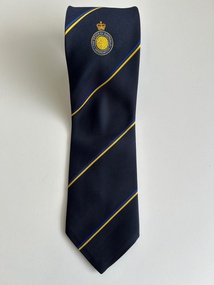
Clothing (item) - Tie - The Order Of Australia Association ,Belonging To W.A Eacott
... Joined RAF December 1940 to be trained as a pilot, he got his wings December 1941, became a night fighter pilot after OTU and posted to 219 Squadron. Was posted to 603 Squadron December 1942 flying Beaufighters on coastal command convoy escorts, desert patrols, supporting Sicilian and Italian invasions (all from the N.African desert, then on Greek Island " Armed Rovers" until 10 November 1943, just at the end of ops, when he was shot down in the Aegean Sea and became a POW the next day 11 November 1943. ...Joined RAF December 1940 to be trained as a pilot, he got his wings December 1941, became a night fighter pilot after OTU and posted to 219 Squadron. Was posted to 603 Squadron December 1942 flying Beaufighters on coastal command convoy escorts, desert patrols, supporting Sicilian and Italian invasions (all from the N.African desert, then on Greek Island " Armed Rovers" until 10 November 1943, just at the end of ops, when he was shot down in the Aegean Sea and became a POW the next day 11 November 1943. ...This RAAF dress uniform and other associated article of clothing was owned by Walter Alexander Scott. Joined RAF December 1940 to be trained as a pilot, he got his wings December 1941, became a night fighter pilot after OTU and posted to 219 Squadron. Was posted to 603 Squadron December 1942 flying Beaufighters on coastal command convoy escorts, desert patrols, supporting Sicilian and Italian invasions (all from the N.African desert, then on Greek Island " Armed Rovers" until 10 November 1943, just at the end of ops, when he was shot down in the Aegean Sea and became a POW the next day 11 November 1943. Transferred to Germany he was in Stalag IVB for 3 months, before exchanging ID with an Irish soldier ,in order to get out of the main camp into a working sub-camp in order to escape. Post war Walter returned to Australia, he became "Citizen of the Year" in Werribee 1992 for his service to the community. In 1993 he was awarded the Order of Australia Medal for services to youth and to the retired.
