
Showing 21 items matching "the pioneer players"
-
 Emerald Museum & Nobelius Heritage Park
Book - Biography, Fitzpatrick, Peter, 1944, Pioneer players: The Lives of Louis and Hilda Esson, 1995
... Pioneer players: The Lives of Louis and Hilda Esson......The Pioneer Players...With Vance Palmer, also living in Emerald at the time, Louis Esson formed the Pioneer Players as an outlet for performance of plays by local writers. ...With Vance Palmer, also living in Emerald at the time, Louis Esson formed the Pioneer Players as an outlet for performance of plays by local writers. ...A biography of playwright Louis Esson (1878-1943) and his wife Dr Hilda Esson, nee Bull (1866-1953), who lived in Emerald from 1910 to 1916. With Vance Palmer, also living in Emerald at the time, Louis Esson formed the Pioneer Players as an outlet for performance of plays by local writers. The author is in the Department of English, Monash University. Includes photographs taken in Emerald.Soft cover, xi, 395 p. : ill.., ports. IBSN 0-521-45644-4emerald, victoria, australia, biographies, authors, writing, louis esson, hilda esson, hilda bull, peter fitzpatrick, the pioneer players, vance palmer, nettie palmer, katharine susannah prichard -
 Wodonga & District Historical Society Inc
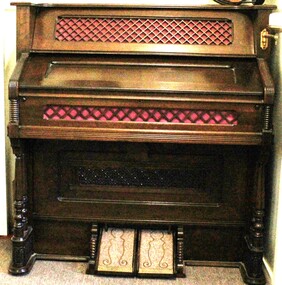
Instrument - Farrand & Votey Pump Organ, Farrand & Votey Organ Company, c1885
... Votey did pioneering work on piano players, developing the famous Pianola. ...Votey did pioneering work on piano players, developing the famous Pianola. ...This Farrand & Votey pump organ was manufactured in Detroit USA c1885. It was lovingly restored by the late Peter Frost of Tallangatta. The organ was gifted to Peter in 2000 in a state of disrepair and was not working. Peter was born in Devon, England in 1930 and completed an apprenticeship in joinery and cabinetry, specialising in ornate church and cathedral furniture. He migrated to Australia in 1957 and became a highly regarded woodwork and building science teacher as well as a Building Inspector. He was also a passionate musician. On completion of the refurbishment Peter gave the organ to his daughter at Georges Creek. Farrand & Votey started out as the Detroit Organ Co. in 1881. They started building pipe organs in 1888. Votey did pioneering work on piano players, developing the famous Pianola. However, in 1897 the company split up, Farrand remaining with the reed organs as the Farrand Organ Co., and Votey taking the pipe organ and player piano business. The Farrand Organ Co. later brought out its own piano player, the Cecilian, but went bankrupt in 1915.This organ is an example of a craftsmanship from the late 19th century and has been fully refurbished by a skilled craftsmen from the Tallangatta district near Wodonga.An upright Farrand & Votey Pump Organ which was originally manufactured in Detroit, USA. It has been fully refurbished and is in working condition. Ron Fudge, a pump organ restorer in USA has dated it at c.1885 based on its serial number 14404 83.Above keyboard: "Farrand & Votey"farrand & votey, pump organ, organ restoration -
 Flagstaff Hill Maritime Museum and Village
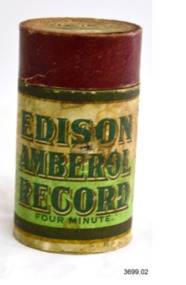
Audio - Gramophone Cylinder, National Phonograph Co, Poor old England, 1908
... Edison Records was one of the early record labels that pioneered sound recording and reproduction, and was an important player in the early recording industry. ...Edison Records was one of the early record labels that pioneered sound recording and reproduction, and was an important player in the early recording industry. ...Edison Records was one of the early record labels that pioneered sound recording and reproduction, and was an important player in the early recording industry. The first phonograph cylinders were manufactured in 1888, followed by Edison's foundation of the Edison Phonograph Company in the same year. The recorded wax cylinders, later replaced by Blue Amberol cylinders, and vertical-cut Diamond Discs, were manufactured by Edison's National Phonograph Company from 1896 on, reorganized as Thomas A. Edison, Inc. in 1911. Until 1910 the recordings did not carry the names of the artists. The company began to lag behind its rivals in the 1920s, both technically and in the popularity of its artists, and halted production of recordings in 1929. Thomas A. Edison invented the phonograph, the first device for recording and playing back sound, in 1877. After patenting the invention and benefiting from the publicity and acclaim it received, Edison and his laboratory turned their attention to the commercial development of electric lighting, playing no further role in the development of the phonograph for nearly a decade. Start of the Recording Industry: In 1887, Edison turned his attention back to improving the phonograph and the phonograph cylinder. The following year, the Edison company introduced the ”Perfected Phonograph”. Edison introduced wax cylinders approximately 4+1⁄4 inches (11 cm) long and 2+1⁄4 inches (5.7 cm) in external diameter, which became the industry standard. They had a maximum playing time of about 3 minutes at 120 RPM, but around the turn of the century the standard speed was increased to (first 144) and then 160 RPM to improve clarity and volume, reducing the maximum to about 2 minutes and 15 seconds. Several experimental wax cylinder recordings of music and speech made in 1888 still exist. The wax entertainment cylinder made its commercial debut in 1889 at first, the only customers were entrepreneurs who installed nickel-in-the-slot phonographs in amusement arcades, saloons and other public places. At that time, a phonograph cost the equivalent of several months' wages for the average worker and was driven by an electric motor powered by hazardous, high-maintenance wet cell batteries. After more affordable spring-motor-driven phonographs designed for home use were introduced in 1895, the industry of producing recorded entertainment cylinders for sale to the general public began in earnest. Blank records were an important part of the business early on. Most phonographs had or could be fitted with attachments for the users to make their own recordings. One important early use, in line with the original term for a phonograph as a "talking machine", was in business for recording dictation. Attachments were added to facilitate starting, stopping, and skipping back the recording for dictation and playback by stenographers. The business phonograph eventually evolved into a separate device from the home entertainment phonograph. Edison's brand of business phonograph was called the Ediphone. The collection of three phonograph cylinders are an example of early recorded music use for domestic entertainment. They are significant as they represent the beginnings of the modern recording industry.Cardboard tube-shaped gramophone cylinder box with lid. The printed label on the outside of the box advertises the maker and patent details. The Catalogue Number and Title are either printed or hand written on the cylinder’s lid. This cylinder contained Record no. 13619, the recording “Poor old England” published by Castling and Godfrey, sung by Billy Williams. Made by National Phonograph Company USA. C.1907On lid “Edison Record” and “This record should turn at 160 revolutions per minute, no faster” Written on lid in blue pen “Trumpet”, “EDISON AMBEROL RECORD / FOUR MINUTE”warrnambool, flagstaff hill maritime museum, maritime museum, shipwreck coast, flagstaff hill maritime village, gramophone record, gramophone cylinder, edison cylinder, edison record, home entertainment, music recording, edison laboratory orange nj, usa, national phonograph company of australia ltd sydney, thomas a. edison -
 Flagstaff Hill Maritime Museum and Village
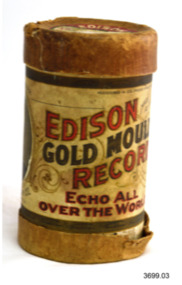
Audio - Gramophone Cylinder, B & H Jack, 1907
... Edison Records was one of the early record labels that pioneered sound recording and reproduction, and was an important player in the early recording industry. ...Edison Records was one of the early record labels that pioneered sound recording and reproduction, and was an important player in the early recording industry. ...Edison Records was one of the early record labels that pioneered sound recording and reproduction, and was an important player in the early recording industry. The first phonograph cylinders were manufactured in 1888, followed by Edison's foundation of the Edison Phonograph Company in the same year. The recorded wax cylinders, later replaced by Blue Amberol cylinders, and vertical-cut Diamond Discs, were manufactured by Edison's National Phonograph Company from 1896 on, reorganized as Thomas A. Edison, Inc. in 1911. Until 1910 the recordings did not carry the names of the artists. The company began to lag behind its rivals in the 1920s, both technically and in the popularity of its artists, and halted production of recordings in 1929. Thomas A. Edison invented the phonograph, the first device for recording and playing back sound, in 1877. After patenting the invention and benefiting from the publicity and acclaim it received, Edison and his laboratory turned their attention to the commercial development of electric lighting, playing no further role in the development of the phonograph for nearly a decade. Start of the Recording Industry: In 1887, Edison turned his attention back to improving the phonograph and the phonograph cylinder. The following year, the Edison company introduced the ”Perfected Phonograph”. Edison introduced wax cylinders approximately 4+1⁄4 inches (11 cm) long and 2+1⁄4 inches (5.7 cm) in external diameter, which became the industry standard. They had a maximum playing time of about 3 minutes at 120 RPM, but around the turn of the century the standard speed was increased to (first 144) and then 160 RPM to improve clarity and volume, reducing the maximum to about 2 minutes and 15 seconds. Several experimental wax cylinder recordings of music and speech made in 1888 still exist. The wax entertainment cylinder made its commercial debut in 1889 at first, the only customers were entrepreneurs who installed nickel-in-the-slot phonographs in amusement arcades, saloons and other public places. At that time, a phonograph cost the equivalent of several months' wages for the average worker and was driven by an electric motor powered by hazardous, high-maintenance wet cell batteries. After more affordable spring-motor-driven phonographs designed for home use were introduced in 1895, the industry of producing recorded entertainment cylinders for sale to the general public began in earnest. Blank records were an important part of the business early on. Most phonographs had or could be fitted with attachments for the users to make their own recordings. One important early use, in line with the original term for a phonograph as a "talking machine", was in business for recording dictation. Attachments were added to facilitate starting, stopping, and skipping back the recording for dictation and playback by stenographers. The business phonograph eventually evolved into a separate device from the home entertainment phonograph. Edison's brand of business phonograph was called the Ediphone. The collection of three phonograph cylinders are an example of early recorded music use for domestic entertainment. They are significant as they represent the beginnings of the modern recording industry.Cardboard tube-shaped gramophone cylinder box with lid. The printed label on the outside of the box advertises the maker and patent details. The Catalogue Number and Title are either printed or hand written on the cylinder’s lid. This cylinder contained Record no. 49, “B & H Jack” and was made at the Edison Laboratory USA. C. 1905On lid “Edison Record No. 49”, written in pencil “B & H Jack” (it looks like this) On cylinder “EDISON GOLD MOULDED RECORDS ECHO ALL OVER THE WORLD” Patents listed for 1904 & 1905warrnambool, flagstaff hill maritime museum, maritime museum, shipwreck coast, flagstaff hill maritime village, gramophone record, gramophone cylinder, edison cylinder, edison record, home entertainment, music recording, edison laboratory orange nj, usa, national phonograph company of australia ltd sydney, thomas a. edison -
 Greensborough Historical Society
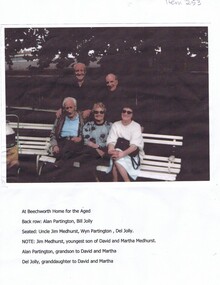
Newspaper - Newspaper clipping, Jim had his own jubilee, 1971_
... In particular it centres on Jim Medhurst the only former player present from the Greensborough team that won the inaugural 1921 premiership. Jim Medhurst's ancestors were a pioneering family in the district. ...Tells the story of the 50th Anniversary celebrations of the Diamond Valley Football League. In particular it centres on Jim Medhurst the only former player present from the Greensborough team that won the inaugural 1921 premiership. Jim Medhurst's ancestors were a pioneering family in the district. His father played football for the Old Brittanias, a fore runner of the Collingwood Football Club.A photocopy of a newspaper clipping, a coloured photograph of the Medhursts c 1971 and a gilt and blue coloured metal badge.Some pencil markings in photocopy.greensborough football club, diamond valley football league, golden jubilee, jim medhurst, joe poulter, dvfl -
 Greensborough Historical Society
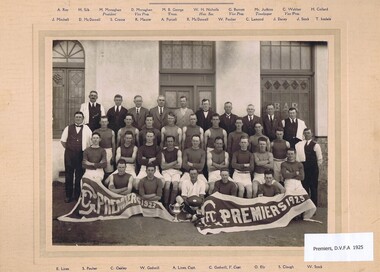
Photograph, Greensborough Football Club, Greensborough Football Club, Premiers, DVFA, 1925, 1925_
... This photo names players in the 1925 team, includes many Greensborough pioneer families. greensborough football club diamond valley football league dvfa premiers 1925 Names of team printed on mount. ...This is the 1925 Premiership team photograph for Greensborough Football Club. Photograph is named: Back Row (L-R): A Roy, H Silk, M Monaghan (President), D Monaghan (Vice President), M B George (Treasurer) W H Nicholls (Honorary Secretary), G Barnett (Vice President), Mr Judkins (Timekeeper), C Webber (Vice President), H Collard. Row 2: J Mitchell, D McDowell, S Creese, R Maurer, A Purcell, R McDowell, W Poulter, C Lamond, J Davey, J Stock, T Iredale. Row 3: E Lines, S Poulter, C Oakley, W Godwill, A Lines (Captain), C Godwill (Vice Captain), O Ely, S Clough, W Stock. Front Row: H Collard, W Santon, C Lovell, L Collard, S Judkins.This photo names players in the 1925 team, includes many Greensborough pioneer families.Sepia team photograph, mounted on light brown card.Names of team printed on mount. Inscription on back: "Oct 2011. Donated to the Greensborough Historical Society by Brian Poulter, son of William Arthur Poulter 1905-1974."greensborough football club, diamond valley football league, dvfa premiers 1925 -
 Orbost & District Historical Society
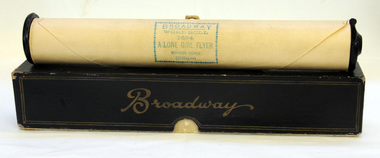
piano roll, Anglo-American Player Roll Co, 1930's
... pioneering English aviator, the first female pilot to fly alone from Britain to Australia. It is an example of musical recreation of the 1930's. pianola lone-girl-flyer johnson-amy music Broadway Brown paper roll of pianola paper (.1) in black box (.2) with lid. Broadway hard roll 1694 - A lone Girl Flyer ( march song O'Hagan). It has a duty stamp attached - Allan & Co Music Co Ltd Melbourne piano roll Anglo-American Player ...To make a piano roll, when the recording artist depresses a key on a specially wired-up piano, a signal is sent to a recording machine, which punches holes in a moving roll of paper. Originally, editing was done by punching extra holes by hand or patching unwanted holes with sticky tape but eventually the process was done by computer.• The music is A Lone Girl Flyer with the words and music by Jack O'Hagan. It was published in Melbourne by Allan's, c1930 and was dedicated to Miss Amy Johnson, a pioneering English aviator, the first female pilot to fly alone from Britain to Australia. It is an example of musical recreation of the 1930's. Brown paper roll of pianola paper (.1) in black box (.2) with lid. Broadway hard roll 1694 - A lone Girl Flyer ( march song O'Hagan). It has a duty stamp attached - Allan & Co Music Co Ltd MelbourneBroadwaypianola lone-girl-flyer johnson-amy music -
 City of Moorabbin Historical Society (Operating the Box Cottage Museum)
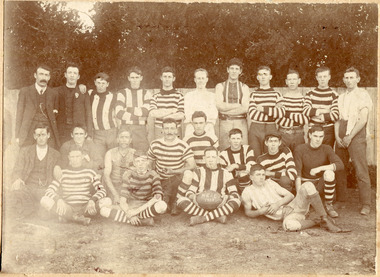
Photograph, 1903 or 1908 Moorabbin Football Club, 1903 or 1908 Moorabbin Football Club, 1903 or 1908
... The club originally intended to seek readmission for the 1965 season, but in July the club committee decided to withdraw permanently from the Association,and disbanded. moorabbin football club 1903 1908 philip jones james jones, early settlers, market gardeners, pioneers, herron john, australian rules foorball, victorian footbal league, victorian football association, moorabbin city council, moorabbin shire, city of moorabbin, st kilda football club, Hewitt, Photographer, 92 Regent St. North Richmond. Photograph is Black and White. Three rows of Australian Rules Football players ...1903 or 1908 Moorabbin Australian Rules Football Club. Philip Jones, a relative of James Jones who was a pioneer settler in Moorabbin Shire, is holding the football. In the late 1850s Melbourne's schools are first recorded organising football games modeled on precedents at English schools The earliest known such match was played on 15 June 1858 between Scotch College and Melbourne Grammar School on the St Kilda foreshore. On 10 July 1858, the Melbourne-based Bell's Life in Victoria and Sporting Chronicle published a letter by prominent Victorian cricketer Tom Wills, calling for the formation of a "foot-ball club" with a "code of laws" to keep cricketers fit during winter. The Melbourne Football Club's rules of 1859 are the oldest surviving set of laws for Australian football. The ten simple rules were drawn up on 17 May at a meeting chaired by Tom Wills and in attendance were journalists W. J. Hammersley and J. B. Thompson, and Thomas H. Smith. The rules were signed by Tom Wills, William Hammersley, J. Sewell, J. B. Thompson, Alex Bruce, T. Butterworth and Thomas H. Smith. Importantly, the rules were widely publicised and distributed. Having been codified in 1859, this means that Australian football is an older sport than most other football codes in the world, including soccer. As Geoffrey Blainey states, "soccer has no club that matches the antiquity of the early Victorian clubs." In 1859 several new football clubs formed including the Castlemaine Football Club, Geelong Football Club and the Melbourne University Football Club. The first football match played at the Melbourne Cricket Ground (MCG) was not until 1876. Cricket authorities soon saw the opportunity to capitalise on the rapid growth of Australian football, however, and soon most grounds in Victoria were expanded to accommodate the dual purpose, a situation that continues to this day. Football matches between 1859 and 1899 were played in a 20-per-side format. n 1896, delegates from the stronger and wealthier Victorian Football Association clubs—Carlton, Collingwood, Essendon, Fitzroy, Geelong, Melbourne, St Kilda and South Melbourne—met to form a breakaway competition and in 1897, the Victorian Football League (VFL), was born as an eight-team competition. Popularity of the VFL grew rapidly and by 1925 with 12 teams, had become the most prominent league in the game and would dominate so many aspects of the sport from that point on. Moorabbin Football Club, nicknamed the Kangaroos, was the name of two distinct Australian rules football clubs which played in the Victorian Football Association (VFA). The first club, founded in the early 20th century, joined the VFA in 1951 and played there until 1963 with great success; they played home matches at Moorabbin Oval and wore royal blue and white hooped jerseys. The second club played in the VFA from 1983 to 1987. Moorabbin played initially in the Federal Football League, making their debut in 1909 and competing until 1950. During this time the club won 12 premierships, including winning all six premierships staged over the nine years between 1940 and 1948 (the competition was in recess from 1942 until 1944). The club entered the VFA in 1951. Its Federal League home ground, the Dane Road Reserve, was not up to VFA standards; so, in 1951 the club played at Cheltenham, and in 1952 moved into the Moorabbin Oval, which the Moorabbin Council had developed during 1951. The Kangaroos made the 1954 and 1955 finals series without success but in 1957 they helped eliminate premiership favourite Williamstown after defeating them by two points in the Semi Final. Moorabbin, who were coached by Bill Faul, took on Port Melbourne in the Grand Final, whom they had not once beaten since joining the league. In another upset, Moorabbin won comfortably to claim their maiden VFA premiership. In the early 1960s, the Moorabbin Council was very keen to bring a Victorian Football League team to Moorabbin Oval. 1964, the Moorabbin City Council secured a deal with St Kilda, who moved to Moorabbin Oval starting in 1965. The club originally intended to seek readmission for the 1965 season, but in July the club committee decided to withdraw permanently from the Association,and disbanded.Photograph is Black and White. Three rows of Australian Rules Football players in a typical team photograph. Some are wearing striped jumpers, either the stripes are going horizontal or parallel. There is a known man in this photo, named Philip Jones, who is holding the football in front row. There are two men wearing suits at the left, on the end of the third row. Hewitt, Photographer, 92 Regent St. North Richmond.moorabbin, football club, 1903, 1908, philip jones, james jones, early settlers, market gardeners, pioneers, herron john, australian rules foorball, victorian footbal league, victorian football association, moorabbin city council, moorabbin shire, city of moorabbin, st kilda football club, -
 Flagstaff Hill Maritime Museum and Village
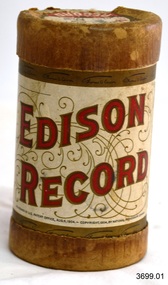
Audio - Gramophone Cylinder, Sandy McNab, 1908
... Edison Records was one of the early record labels that pioneered sound recording and reproduction, and was an important player in the early recording industry. ...Edison Records was one of the early record labels that pioneered sound recording and reproduction, and was an important player in the early recording industry. ...Edison Records was one of the early record labels that pioneered sound recording and reproduction, and was an important player in the early recording industry. The first phonograph cylinders were manufactured in 1888, followed by Edison's foundation of the Edison Phonograph Company in the same year. The recorded wax cylinders, later replaced by Blue Amberol cylinders, and vertical-cut Diamond Discs, were manufactured by Edison's National Phonograph Company from 1896 on, reorganized as Thomas A. Edison, Inc. in 1911. Until 1910 the recordings did not carry the names of the artists. The company began to lag behind its rivals in the 1920s, both technically and in the popularity of its artists, and halted production of recordings in 1929. Thomas A. Edison invented the phonograph, the first device for recording and playing back sound, in 1877. After patenting the invention and benefiting from the publicity and acclaim it received, Edison and his laboratory turned their attention to the commercial development of electric lighting, playing no further role in the development of the phonograph for nearly a decade. Start of the Recording Industry: In 1887, Edison turned his attention back to improving the phonograph and the phonograph cylinder. The following year, the Edison company introduced the ”Perfected Phonograph”. Edison introduced wax cylinders approximately 4+1⁄4 inches (11 cm) long and 2+1⁄4 inches (5.7 cm) in external diameter, which became the industry standard. They had a maximum playing time of about 3 minutes at 120 RPM, but around the turn of the century the standard speed was increased to (first 144) and then 160 RPM to improve clarity and volume, reducing the maximum to about 2 minutes and 15 seconds. Several experimental wax cylinder recordings of music and speech made in 1888 still exist. The wax entertainment cylinder made its commercial debut in 1889 at first, the only customers were entrepreneurs who installed nickel-in-the-slot phonographs in amusement arcades, saloons and other public places. At that time, a phonograph cost the equivalent of several months' wages for the average worker and was driven by an electric motor powered by hazardous, high-maintenance wet cell batteries. After more affordable spring-motor-driven phonographs designed for home use were introduced in 1895, the industry of producing recorded entertainment cylinders for sale to the general public began in earnest. Blank records were an important part of the business early on. Most phonographs had or could be fitted with attachments for the users to make their own recordings. One important early use, in line with the original term for a phonograph as a "talking machine", was in business for recording dictation. Attachments were added to facilitate starting, stopping, and skipping back the recording for dictation and playback by stenographers. The business phonograph eventually evolved into a separate device from the home entertainment phonograph. Edison's brand of business phonograph was called the Ediphone. The collection of three phonograph cylinders are an example of early recorded music use for domestic entertainment. They are significant as they represent the beginnings of the modern recording industry.Cardboard tube-shaped gramophone cylinder box with lid. The printed label on the outside of the box advertises the maker and patent details. The Catalogue Number and Title are either printed or hand written on the cylinder’s lid. This cylinder was made by Edison 1908 and contains Record number 53 by Sandy McNab. c. 1908On label “Edison Record No. 53, Sandy McNab" and "Form no. 1130, April 1908. Patented December 6 1904, No. 2109, and December 6 1904 No. 2110. “This record is sold by the National Phonograph Company of Australia Ltd, at Sydney Australia.” Trade Mark Thomas A. Edison warrnambool, flagstaff hill maritime museum, maritime museum, shipwreck coast, flagstaff hill maritime village, gramophone record, gramophone cylinder, edison cylinder, edison record, home entertainment, music recording, edison laboratory orange nj, usa, national phonograph company of australia ltd sydney, thomas a. edison -
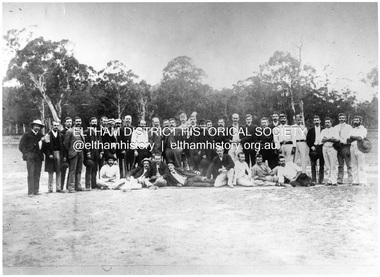 Eltham District Historical Society Inc
Photograph, Eltham Cricket Club at Eltham Sports Oval. E.H. Cameron ninth from left (standing)
... players from various District clubs. The photograph was taken by Mr. Beaumont the then well known photographer of Hawthorn. See attached PDF - Research conducted by Society member Alan Sheehan, 5 August 2014. Originally noted as Kangaroo Ground Cricket Club. Source: Mrs. E.M. Jackson, Pigeon Bank, Kangaroo Ground. This photo forms part of a collection of photographs gathered by the Shire of Eltham for their centenary project book,"Pioneers ...Photo of two teams: Eltham Cricket Club versus a District combined side taken at Eltham Park at the conclusion of a match between Eltham Club and a team made of players from various District clubs. The photograph was taken by Mr. Beaumont the then well known photographer of Hawthorn. Local identities in the photo include Ewen Hugh Cameron, Charles Symons Wingrove who were umpires on the day. Tom Horan a cricketer who had played for Victoria and Australia is also identified. Earlier options were that this photograph was of Kangaroo Ground Cricket Club at Eltham. ..The photograph was taken on 19th February 1887, at the conclusion of a match between Eltham Cricket Club and a team made of players from various District clubs. The photograph was taken by Mr. Beaumont the then well known photographer of Hawthorn. See attached PDF - Research conducted by Society member Alan Sheehan, 5 August 2014. Originally noted as Kangaroo Ground Cricket Club. Source: Mrs. E.M. Jackson, Pigeon Bank, Kangaroo Ground.This photo forms part of a collection of photographs gathered by the Shire of Eltham for their centenary project book,"Pioneers and Painters: 100 years of the Shire of Eltham" by Alan Marshall (1971). The collection of over 500 images is held in partnership between Eltham District Historical Society and Yarra Plenty Regional Library (Eltham Library) and is now formally known as the 'The Shire of Eltham Pioneers Photograph Collection.' It is significant in being the first community sourced collection representing the places and people of the Shire's first one hundred years.Digital image PDF file - Eltham Cricket Club Photograph 1887 sepp, shire of eltham pioneers photograph collection, kangaroo ground, charles symons wingrove, e.h. cameron, eltham cricket club, eltham sports oval, ewen hugh cameron, ewen cameron -
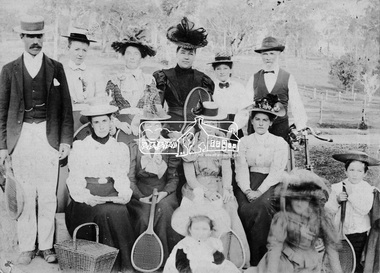 Eltham District Historical Society Inc
Photograph, Eltham tennis group
... It is significant in being the first community sourced collection representing the places and people of the Shire's first one hundred years. sepp shire of eltham pioneers photograph collection eltham tennis tennis players wingrove park Digital image Eltham tennis group Photograph Photograph ...A group of nine women and two men (one holding a bike) and two children pose for a group photograph, some of whom are sitting. Five people hold tennis racquets and there is a picnic basket in the foreground. There are trees in the background. This group may or not be related to photos of the Eltham tennis courts located in what is now known as Wingrove Park.This photo forms part of a collection of photographs gathered by the Shire of Eltham for their centenary project book,"Pioneers and Painters: 100 years of the Shire of Eltham" by Alan Marshall (1971). The collection of over 500 images is held in partnership between Eltham District Historical Society and Yarra Plenty Regional Library (Eltham Library) and is now formally known as the 'The Shire of Eltham Pioneers Photograph Collection.' It is significant in being the first community sourced collection representing the places and people of the Shire's first one hundred years.Digital imagesepp, shire of eltham pioneers photograph collection, eltham, tennis, tennis players, wingrove park -
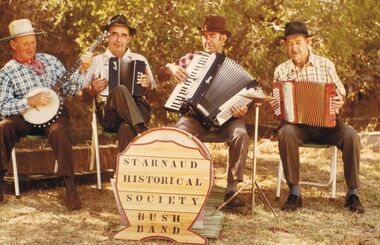 Bendigo Historical Society Inc.
Photograph - PETER ELLIS COLLECTION: ST ARNAUD HISTORICAL SOCIETY BUSH BAND
... Players from left to Right - (Ted) John Wallace- 5 String Banjo; Alf Johns- Button Accordion; Keith McDonald-Piano Accordion Bass drum & symbol; Jim Pritchard-Button accordion. Taken at Australia Day ceremony at Pioneer...Players from left to Right - (Ted) John Wallace- 5 String Banjo; Alf Johns- Button Accordion; Keith McDonald-Piano Accordion Bass drum & symbol; Jim Pritchard-Button accordion. Taken at Australia Day ceremony at Pioneer ...Faded colour photo of the St. Arnaud Historical Society Bush Band. They are all sitting on chairs playing their instruments. A sign in front of the drum has - St. Arnaud Historical Society Bush Band - printed on it. Written on the back is:- the original Historical Bush Band Formed Dec 1979. Players from left to Right - (Ted) John Wallace- 5 String Banjo; Alf Johns- Button Accordion; Keith McDonald-Piano Accordion Bass drum & symbol; Jim Pritchard-Button accordion. Taken at Australia Day ceremony at Pioneer Park St Arnaud 1980.photo, group, st arnaud historical society bush b, peter ellis collection, st arnaud historical society bush band, (ted) john wallace, alf johns, keith mcdonald, jim pritchard -
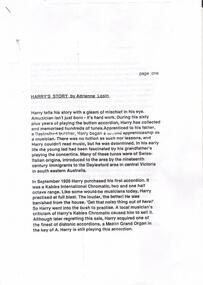 Bendigo Historical Society Inc.
Document - RESEARCH PAPERS: HARRYS STORY, 1910
... pioneer of accordion dance music and was mentored by Billy McGlashan. He played by ear and his preferred instrument was a Mezon Grand Organ in the key of A. He played old time waltzes, bush dances and Scottish reels. He was well known for his double and triple right hand fingering. From 1940-1977 he led "McQueen's Old Time Band" and recorded their music. Harry McQueen Old time dance music Accordian music A biography written by Adrienne Losin about an old time musician and accordian player ...Charles Henry (Harry) McQueen (1910-1994) married Olive May Graham in 1935. He was a butcher by trade (McQueen's Butchers, Castlemaine). He was a pioneer of accordion dance music and was mentored by Billy McGlashan. He played by ear and his preferred instrument was a Mezon Grand Organ in the key of A. He played old time waltzes, bush dances and Scottish reels. He was well known for his double and triple right hand fingering. From 1940-1977 he led "McQueen's Old Time Band" and recorded their music.A biography written by Adrienne Losin about an old time musician and accordian player named Harry McQueen (1910-1994)harry mcqueen, old time dance music, accordian music -
 Kiewa Valley Historical Society
Photos - Dederang Football Club Team Photos - Set of 2 - 1919 and 1923, 1. 1923 2. 1919
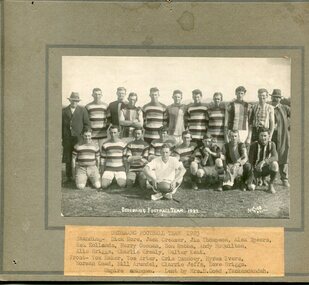
... Dederang Football Club was one of the earliest recorded football clubs in the Kiewa Valley area. Many players came from pioneering farming families in the area and there were often several boys from the same family playing in the team. ...The Dederang-Mt. Beauty Football Club, nicknamed the Bombers, is an Australian rules football club playing in the Tallangatta & District Football League. The club is based in Dederang, Victoria and Mount Beauty, Victoria. It was formed in the early1900s and disbanded in 1976 when it merged with Mount Beauty to form Dederang-Mount Beauty football club. In 1948 the competition received a boost with an influx of new players who came to work on the Kiewa Hydro Scheme. George and Gordon Hobbs were the famous Hobbs brothers of Dederang which two Premierships were built around. Four brothers starred in Dederang’s First Flag in the Tallangatta League in 1958. Dederang Football Club was one of the earliest recorded football clubs in the Kiewa Valley area. Many players came from pioneering farming families in the area and there were often several boys from the same family playing in the team. Dederang won its first flag in the Tallangata League in1958 led by the Hobbs brothers Rex, Colin, Ken and Jack2 original black and white photographs of Dederang football club teams. Mounted on heavy card 1. Dederang Football Team – 1923 2. Dederang Football Team – 1919 Glued underneath photo, Typed names of team players 1. Dederang Football Team – 1923 Standing- Dick Hore, Jack Creamer, Jim Thompson, Alex Speers, Rex Hollands, Harry Goonan, Son Hobbs, Andy McQuilton, Alie Briggs, Charlie Grealy, Walter Keat. Front- Tom Baker, Tom Arter, Chris Quonoey, Hyram Ivers,Norman Coad, Bill Arundel, Clarrie Jeffs, David Briggs. Umpire unknown. Lent by Mrs D Coad Yackandandah 2. Dederang Football Team – 1919 Standing- Tom Hollands, Mick Tooey, Rex Hollands, Charlie Grealey,Jack Charles, HyramIvers, Mr Hewitt, Andy McQuilton, Alex Speers, Jack Creamer, Andrew Nettie. Front- Norman Coad, Bill Goonan, Rex Ellis, Davis, Umpire, V Donaghu, Bev Day, Barny Keegan, Mick Hynes. Lent by Mrs D Coad, Yackandandah dederang, football -
Unions Ballarat
John Macarthur (Don Woodward Collection), Ellis, M.H, 1969
... John Macarthur was a significant pioneer of settlement in Australia. He was a key player in the wool industry that was critical to Australia in the 19th Century....John Macarthur was a significant pioneer of settlement in Australia. He was a key player in the wool industry that was critical to Australia in the 19th Century. ...Famous Australian Lives Series. John Macarthur was a significant pioneer of settlement in Australia. He was a key player in the wool industry that was critical to Australia in the 19th Century.Australia - history and industry.Book; 603 pages. Front cover: red background; gold logo with the words "FIDE ET OPERA". Spine: author's name and title in gold.btlc, ballarat trades hall, ballarat trades and labour council, macarthur, john, history - australia, industry - australia - wool, settlement - australia -
Whitehorse Historical Society Inc.
Article, Doyen of Arts Scene Steps Into The Wings, 1988
... Drama Nunawading Arts Council Mitcham Repertory Group Mitcham Memorial Hall Grant Max Nunawading Arts Centre The Avenue Church Players Maroondah Musical Society Blackburn Players Retirement of Max Grant, foundation member of the Nunawading Arts Council and pioneer of amateur theatre in Nunawading. ...Retirement of Max Grant, foundation member of the Nunawading Arts Council and pioneer of amateur theatre in Nunawading. With photo.drama, nunawading arts council, mitcham repertory group, mitcham memorial hall, grant, max, nunawading arts centre, the avenue church players, maroondah musical society, blackburn players -
 Returned Nurses RSL Sub-branch
Newspaper - Newspaper lift out, The Weekend Australian et al, 100 years of War Nursing : ANZAC Day Special, 19990424
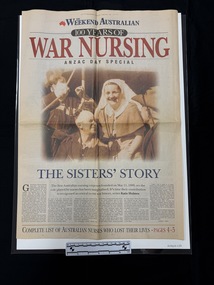
... players such as Nellie Gould and Grace Wilson. '100 years of service, dedication' - p2 - Timeline of armed forces nursing services. 'Wild dogs and 13 patients' by Jan Bassett - p2 - Edited extract from recollections of Julia Anderson who served as a nurse in the Boer War. 'A pioneer...players such as Nellie Gould and Grace Wilson. '100 years of service, dedication' - p2 - Timeline of armed forces nursing services. 'Wild dogs and 13 patients' by Jan Bassett - p2 - Edited extract from recollections of Julia Anderson who served as a nurse in the Boer War. 'A pioneer ...The Weekend Australian lift out from ANZAC Day 1999. Contains article titles as follows: 'The Sisters' story' by Katie Holmes - p1 - Beginning of an article talking about the circumstances of nurses in warfare, duties, conditions, etc. Continued on p8 'Private battles' by Jan Bassett - p2 - Article gives a brief overview of how armed forces nursing services were formed, why and how they developed, including major players such as Nellie Gould and Grace Wilson. '100 years of service, dedication' - p2 - Timeline of armed forces nursing services. 'Wild dogs and 13 patients' by Jan Bassett - p2 - Edited extract from recollections of Julia Anderson who served as a nurse in the Boer War. 'A pioneer called Nellie' by Jan Bassett - p2 - Brief biographical article on Nellie Gould. 'Into the mess' by Jan Bassett - p3 - Article on the conditions faced by WWI nurses serving overseas including memories of various nurses. 'Tragedy made more personal' by Jan Bassett - p3 - Brief biographical article on Grace Wilson. 'The old ship is heaven after the peninsula' - p3 - Edited excerpt from WWI diary of Ella Jane Tucker. 'In Memoriam' - p4-5 - Names of nurses who have died as a result of war service from Boer war to Vietnam war. 'Hell of Banka' by Catherine Kenny - p6 - Article providing basic details on the sinking of the Vyner Brooke, massacre on Banka Island, survival of Vivian Bullwinkel and later surrender to Japanese. 'A will to remember' by Catherine Kenny - p6 - Article providing overview of stories shared by surviving Japanese POW nurses including Betty Jeffrey, Wilma Young (neé Oram), Jessie Hookway (neé Simons), Pat Darling (neé Gunther), Vivian Bullwinkel, Lorna Johnson (neé Whyte), and Mavis Cation (neé Cullen). Article also discussed artistic representations of the stories on stage and screen. 'Making do to survive' by Jessie Simons - p6 - Reprinted excerpt from book by same author 'Japanese Hands Australian Nurses as POWs'. 'Grim miracles' by Siobhan McHugh - p7 - Article on experiences of nurses in the Vietnam war including Colleen Mealy, Anne Hall, Trish Ferguson, Jan McCarthy, Del Waterman, Terrie Roach and Anne Healy. 'Anyone's blood was welcome' by Siobhan McHugh - p7 - Brief article of the working conditions of civilian nurses in Vietnam during the war, including recollections of Jenny James, Fran Sardelich and Kay Collett (radiographer not nurse). 'A long day's journey' - p7 - Brief interview article with Del Waterman an RAAF Nurse who served in Malaysia during the Vietnam war. 'Attitudes changes in the face of suffering' by Siobhan McHugh - p7 - Brief interview article with Anne Hall on her time as an army nurse during the Vietnam war. 'Neglected heroes' by Ken Inglis - p8 - An article on war memorial recognition or lack of for nurses throughout history of memorials in Australia, how some were recognised and others not and how attitudes have changed over time. '100 years of service, skill and sacrifice' by Katie Holmes - p8 - Continuation of article on p1. 'Sisters in arms' - p8 - Box insert of numbers of military nurses who served in major conflicts from Boer - Gulf wars.A large newspaper lift out with text in red, blue and black. Front cover has large headings and a large sepia toned photo featuring a woman in nurses uniform with men in dressing gowns around her. The lift out is made up of two pieces of paper folded to make 8 pages of articles.nursing in warfare, anzac day, memorial -
 Returned Nurses RSL Sub-branch
Newspaper - Newspaper lift out, The Weekend Australian et al, 100 years of War Nursing : ANZAC Day Special, 19990424
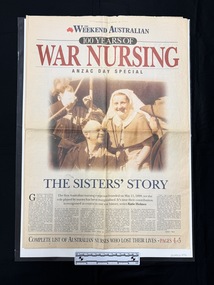
... players such as Nellie Gould and Grace Wilson. '100 years of service, dedication' - p2 - Timeline of armed forces nursing services. 'Wild dogs and 13 patients' by Jan Bassett - p2 - Edited extract from recollections of Julia Anderson who served as a nurse in the Boer War. 'A pioneer...players such as Nellie Gould and Grace Wilson. '100 years of service, dedication' - p2 - Timeline of armed forces nursing services. 'Wild dogs and 13 patients' by Jan Bassett - p2 - Edited extract from recollections of Julia Anderson who served as a nurse in the Boer War. 'A pioneer ...The Weekend Australian lift out from ANZAC Day 1999. Contains article titles as follows: 'The Sisters' story' by Katie Holmes - p1 - Beginning of an article talking about the circumstances of nurses in warfare, duties, conditions, etc. Continued on p8 'Private battles' by Jan Bassett - p2 - Article gives a brief overview of how armed forces nursing services were formed, why and how they developed, including major players such as Nellie Gould and Grace Wilson. '100 years of service, dedication' - p2 - Timeline of armed forces nursing services. 'Wild dogs and 13 patients' by Jan Bassett - p2 - Edited extract from recollections of Julia Anderson who served as a nurse in the Boer War. 'A pioneer called Nellie' by Jan Bassett - p2 - Brief biographical article on Nellie Gould. 'Into the mess' by Jan Bassett - p3 - Article on the conditions faced by WWI nurses serving overseas including memories of various nurses. 'Tragedy made more personal' by Jan Bassett - p3 - Brief biographical article on Grace Wilson. 'The old ship is heaven after the peninsula' - p3 - Edited excerpt from WWI diary of Ella Jane Tucker. 'In Memoriam' - p4-5 - Names of nurses who have died as a result of war service from Boer war to Vietnam war. 'Hell of Banka' by Catherine Kenny - p6 - Article providing basic details on the sinking of the Vyner Brooke, massacre on Banka Island, survival of Vivian Bullwinkel and later surrender to Japanese. 'A will to remember' by Catherine Kenny - p6 - Article providing overview of stories shared by surviving Japanese POW nurses including Betty Jeffrey, Wilma Young (neé Oram), Jessie Hookway (neé Simons), Pat Darling (neé Gunther), Vivian Bullwinkel, Lorna Johnson (neé Whyte), and Mavis Cation (neé Cullen). Article also discussed artistic representations of the stories on stage and screen. 'Making do to survive' by Jessie Simons - p6 - Reprinted excerpt from book by same author 'Japanese Hands Australian Nurses as POWs'. 'Grim miracles' by Siobhan McHugh - p7 - Article on experiences of nurses in the Vietnam war including Colleen Mealy, Anne Hall, Trish Ferguson, Jan McCarthy, Del Waterman, Terrie Roach and Anne Healy. 'Anyone's blood was welcome' by Siobhan McHugh - p7 - Brief article of the working conditions of civilian nurses in Vietnam during the war, including recollections of Jenny James, Fran Sardelich and Kay Collett (radiographer not nurse). 'A long day's journey' - p7 - Brief interview article with Del Waterman an RAAF Nurse who served in Malaysia during the Vietnam war. 'Attitudes changes in the face of suffering' by Siobhan McHugh - p7 - Brief interview article with Anne Hall on her time as an army nurse during the Vietnam war. 'Neglected heroes' by Ken Inglis - p8 - An article on war memorial recognition or lack of for nurses throughout history of memorials in Australia, how some were recognised and others not and how attitudes have changed over time. '100 years of service, skill and sacrifice' by Katie Holmes - p8 - Continuation of article on p1. 'Sisters in arms' - p8 - Box insert of numbers of military nurses who served in major conflicts from Boer - Gulf wars.A large newspaper lift out with text in red, blue and black. Front cover has large headings and a large sepia toned photo featuring a woman in nurses uniform with men in dressing gowns around her. The lift out is made up of two pieces of paper folded to make 8 pages of articles.nursing in warfare, anzac day, memorial -
 Wodonga & District Historical Society Inc
Photograph - Portrait - Mick Morris
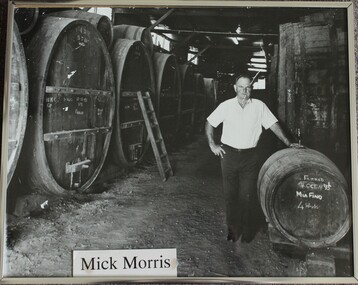
... pioneer of the Durif grape variety. In 1993 Mick’s son, David became a 5th generation winemaker. Morris is famous for producing some of the world’s finest fortified wines. Away from the wine industry Mick has a strong interest in sport, particularly football. Since 1933, the Morris Medal for the Best and Fairest Player...pioneer of the Durif grape variety. In 1993 Mick’s son, David became a 5th generation winemaker. Morris is famous for producing some of the world’s finest fortified wines. Away from the wine industry Mick has a strong interest in sport, particularly football. Since 1933, the Morris Medal for the Best and Fairest Player ...This image is one from a series of portraits taken by Rob Elliott to record the character of the Border District through the faces if its identities. This photo shows Charles Henry “Mick” Morris in the Morris cellar at Mia Mia near Rutherglen, Victoria. Charles Henry “Mick” Morris was born in Rutherglen, Victoria on 1st July 1928, son of Charles Tempest George Morris and Daisy Chambers. The Morris winery was started by Mick’s great grandfather, George Francis Morris who arrived in Australia in 1852. He immediately set off for the goldfields but found more profit from selling supplies to the goldfields. He purchased land in Rutherglen in 1859. By 1894 he had the biggest cellars in Australia. Mick Morris is a 4th generation wine maker. He was educated at Gooramadda Primary School, then at Rutherglen Higher Elementary School before attending Scotch College in Melbourne. He became the first member of his family to gain a university education, gaining a Bachelor of Science Degree at the University of Melbourne in 1950 before completing an Oenology Course at Roseworthy Agricultural College in South Australia. Mick returned to Mia Mia in 1952 where his first role was working in the vineyard. By the end of 1953 he had become the “semi-official” winemaker at Mia Mia. From that time his career as a widely recognised winemaker went from strength to strength, winning many prestigious awards. Mick is recognised as a pioneer of the Durif grape variety. In 1993 Mick’s son, David became a 5th generation winemaker. Morris is famous for producing some of the world’s finest fortified wines. Away from the wine industry Mick has a strong interest in sport, particularly football. Since 1933, the Morris Medal for the Best and Fairest Player in the Ovens and Murray League has been awarded annually. This award was instigated by Charles Hughes Morris, Mick’s grandfather. Mick also played in the league. Morris Wines of Rutherglen were purchased by Casella Family Brands in 2016. Mick passed away on Friday August 21, 2026, at Glenview Nursing Home, Rutherglen aged 98 years. This image depicts a renowned winemaker of Rutherglen who has made an outstanding contribution to the development of the Australian wine industry. He was also involved in his community and his family is recognised in the annual award of the Best and Fairest medal for the Ovens and Murray Football League.A black and white photograph of Charles Henry "Mick" Morris in the cellar at Mia Mia near Rutherglen, Victoria. The photo is in a metal frame.On barrel in foreground: "FILTERED/ 4 OCT '93/ MIA FINO / 4 Hhds"morris wines, northeast victorian wineries, mick morris, winemakers of rutherglen -
Emerald Museum & Nobelius Heritage Park
Emerald Gold Discovery history, K Purdham et al, A Jewel Set in Gold - A Drama and History of Gold Discovery in Emerald, 2008
... Emerald Victoria Australia Anniversaries local history gold mining pioneers performing arts Entertainment writing Gemco Players Community Theatre K Purdham M Speck Book/play written to coincide with the 150th anniversary of gold discovery in Emerald A Jewel Set in Gold - A Drama and History of Gold Discovery in Emerald Emerald Gold Discovery history K Purdham Docucopy Gemco Players Community Theatre M Speck ...Book/play written to coincide with the 150th anniversary of gold discovery in Emeraldemerald, victoria, australia, anniversaries, local history, gold mining, pioneers, performing arts, entertainment, writing, gemco players community theatre, k purdham, m speck -
Emerald Museum & Nobelius Heritage Park
Book - Historical Fiction, K Purdham et al, A Jewel set in Gold: drama and history of gold discovery in Emerald, 2008
... Emerald Victoria Australia Anniversaries local history gold mining pioneers performing arts Entertainment writing Gemco Players Community Theatre K Purdham M Speck Book/play written to coincide with the 150th anniversary of gold discovery in Emerald A Jewel set in Gold: drama and history of gold discovery in Emerald Book Historical Fiction K Purdham Docucopy Gemco Players Community Theatre M Speck ...Book/play written to coincide with the 150th anniversary of gold discovery in Emeraldemerald, victoria, australia, anniversaries, local history, gold mining, pioneers, performing arts, entertainment, writing, gemco players community theatre, k purdham, m speck
