
Showing 7 items matching "the red ribbon agitation (1853)"
-
 Bendigo Historical Society Inc.
Document - Transcript of letter (PROV), 1854
... ...The Red Ribbon Agitation (1853)...BHS Collection history bendigo George Hillier Bryant Sir Charles Hotham sandhurst mining licence The Red Ribbon Agitation (1853) Letter to the Governor General of Victoria, Sir Charles Hotham, K.C.B. from George Hillier Bryant Sandhurst on September the 18th 1854 berating those miners and newspaper editors that are advocating the scrapping of mining licence fees. ...BHS CollectionLetter to the Governor General of Victoria, Sir Charles Hotham, K.C.B. from George Hillier Bryant Sandhurst on September the 18th 1854 berating those miners and newspaper editors that are advocating the scrapping of mining licence fees. Copy of handwritten letter and a typed transcript of it. Both Handwritten and typed copies. history, bendigo, george hillier bryant, sir charles hotham, sandhurst, mining licence, the red ribbon agitation (1853) -
 Bendigo Historical Society Inc.
Textile - Flags
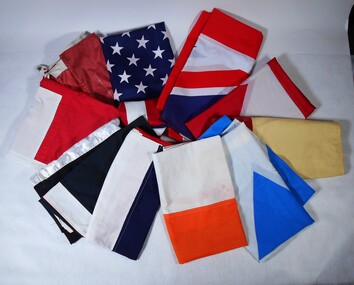
... The Red Ribbon Agitation took place in Sandhurst in 1853 when the miners protested against the Licence fee imposed by the Government....Replicas of various flags used during the Red Ribbon Agitation (1853) re-enactments. There are flags of Scotland, Ireland, France, Germany, Canada, Switzerland, USA, Union Jack and two St Piran's Flag of Cornwall. ...Flags Red Ribbon Agitation Replicas of various flags used during the Red Ribbon Agitation (1853) re-enactments. ...The Red Ribbon Agitation took place in Sandhurst in 1853 when the miners protested against the Licence fee imposed by the Government.Replicas of various flags used during the Red Ribbon Agitation (1853) re-enactments. There are flags of Scotland, Ireland, France, Germany, Canada, Switzerland, USA, Union Jack and two St Piran's Flag of Cornwall. The Red Ribbon replica flag has four segments: Gold Scales, Emu/Kangaroo, Pick/Shovel and Gold Cradle and a Roman bundle of sticks.flags, red ribbon agitation -
 Bendigo Historical Society Inc.
Newspaper - "Gold Rush History Comes to Life", Bendigo Advertiser, November 25 2017
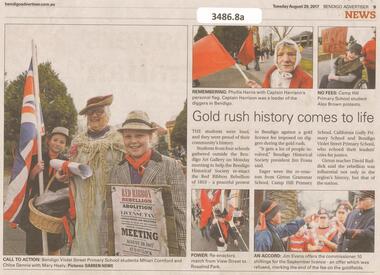
... The Red Ribbon agitation was held in 1853 in opposition to the licence fee imposed on the diggers during the gold rush in Bendigo....The Red Ribbon agitation was held in 1853 in opposition to the licence fee imposed on the diggers during the gold rush in Bendigo. ...The Red Ribbon agitation was held in 1853 in opposition to the licence fee imposed on the diggers during the gold rush in Bendigo.Bendigo Advertiser. Violet Street Primary School students join members of the Bendigo Historical Society for the re-enactment of the Red Ribbon Agitation.red ribbon agitation, re-enactment, violet street primary school, girton -
 Bendigo Historical Society Inc.
Newspaper - Kangaroo Flat Gold Mine Collection: Red Ribbon Rebellion
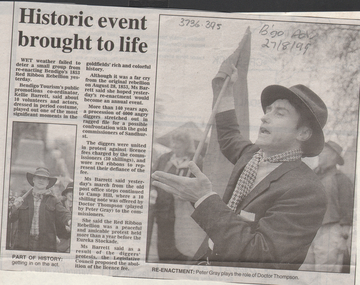
... Red Ribbon Rebelion...Red Ribbon Agitation...re-enactrment...Peter Gray...gold license...1853...Article describes the re-enactment of the Red Ribbon Rebellion, sometimes known as the Red Ribbon Agitation. The miners in Sandhurst rebelled in 1853 against the license fee imposed by the Government. ...Gold mining Bendigo Red Ribbon Rebelion Red Ribbon Agitation re-enactrment Peter Gray gold license 1853 'Bendigo Advertiser' article, 27th December, 1999, 'Historic event brought to life'. ...'Bendigo Advertiser' article, 27th December, 1999, 'Historic event brought to life'. Article describes the re-enactment of the Red Ribbon Rebellion, sometimes known as the Red Ribbon Agitation. The miners in Sandhurst rebelled in 1853 against the license fee imposed by the Government. Two black and white photos in article of participants in the re-enactment: photo of Peter Gray and second image of a man dressed as a miner, holding a pick over his shoulder. gold mining, bendigo, red ribbon rebelion, red ribbon agitation, re-enactrment, peter gray, gold license, 1853 -
 Bendigo Historical Society Inc.
Document - The Red Ribbon Rebellion and the Bendigo Petition
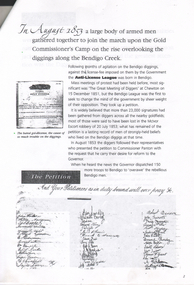
... Red Ribbon movement; description of the Digger's Banner; information on Governor LaTrobe; William Dixon Campbell Denovan and an outline of the proposed project to commemorate the event. The imposition of a license fee imposed upon the miners, by the Government of Victoria, cause a major agitation on the Bendigo diggings and the Anti-License League was born in Bendigo. Signatures were gathered for a petition: 'It is widely believed that more than 23,000 signatures had been gathered from diggers across all the nearby goldfields; most of those were said to have been lost in the McIvor Escort Robbery of 20 July 1853...Red Ribbon movement; description of the Digger's Banner; information on Governor LaTrobe; William Dixon Campbell Denovan and an outline of the proposed project to commemorate the event. The imposition of a license fee imposed upon the miners, by the Government of Victoria, cause a major agitation on the Bendigo diggings and the Anti-License League was born in Bendigo. Signatures were gathered for a petition: 'It is widely believed that more than 23,000 signatures had been gathered from diggers across all the nearby goldfields; most of those were said to have been lost in the McIvor Escort Robbery of 20 July 1853 ...The discovery of gold in Victoria in 1851 initially overwhelmed the Colonial administration. Towns appeared almost overnight and it was challenging to keep law and order. To keep some control over the gold seekers and help pay for the administration of the goldfields, Lieutenant-Governor La Trobe introduced gold licences in September 1851. Miners paid 30 shillings per month (later reduced to £1 per month or £8 per year) for the right to dig a small ‘claim’, usually about eight feet square (2.4m²). Not surprisingly the licence system was unpopular. The licence was expensive – 30 shillings was a substantial sum for most diggers, who might spend months digging for gold without success. Resistance to the licence fee spread throughout the fields. A Miner’s Association was formed at Mount Alexander (Castlemaine) in December 1851 and at Bendigo in 1853 the Red Ribbon Rebellion was led by the Anti-Gold Licence Association. Diggers wore red ribbons in their hats as a sign of protest, refused to pay their licences and collected a ‘monster’ petition which was presented to Lieutenant-Governor La Trobe. The petition demanded immediate reform of government administration, a reduction in the licence fee, the right to vote and land reform (with poor returns from diggings, miners wanted affordable land on or near the goldfields). This proposal to commemorate a significant event in the history of Bendigo, is for the creation of a permanent installation in Bendigo that will commemorate the valour and integrity of the Bendigo diggers, who stood fast against the Government in the early days of protest on the Victorian diggings. Nine page photocopy of document titled: ' The Red Ribbon Rebellion & the Bendigo Petition. A proposal to commemorate a significant event in the history of Bendigo'. Contents includes a brief history of the Red Ribbon movement; description of the Digger's Banner; information on Governor LaTrobe; William Dixon Campbell Denovan and an outline of the proposed project to commemorate the event. The imposition of a license fee imposed upon the miners, by the Government of Victoria, cause a major agitation on the Bendigo diggings and the Anti-License League was born in Bendigo. Signatures were gathered for a petition: 'It is widely believed that more than 23,000 signatures had been gathered from diggers across all the nearby goldfields; most of those were said to have been lost in the McIvor Escort Robbery of 20 July 1853'. The proposal was prepared by Geoff Hocking in consultation with the Bendigo Historical Society and Jim Evans of the Red Ribbon Repertory Co.mining, sandhurst, red ribbon rebellion, agitation, denovan, latrobe, miners, license fee, diggers -
 Bendigo Historical Society Inc.
Photograph - 1853 Bendigo Goldfields Petition, abt 1990-2019
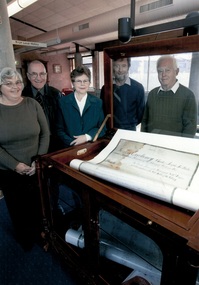
... The Red Ribbon Movement of 1853 represented a significant series of events in the history of Bendigo. During that year there was much agitation on the Bendigo gold fields, particularly during July and August of 1853, directed against the payment of what the miners called a tax - a licence fee of thirty shillings ($3) a month for the right to search for gold on what was declared Crown land. ...The Red Ribbon Movement of 1853 represented a significant series of events in the history of Bendigo. During that year there was much agitation on the Bendigo gold fields, particularly during July and August of 1853, directed against the payment of what the miners called a tax - a licence fee of thirty shillings ($3) a month for the right to search for gold on what was declared Crown land. ...The Red Ribbon Movement of 1853 represented a significant series of events in the history of Bendigo. During that year there was much agitation on the Bendigo gold fields, particularly during July and August of 1853, directed against the payment of what the miners called a tax - a licence fee of thirty shillings ($3) a month for the right to search for gold on what was declared Crown land. They had to pay the licence whether they found gold or not. The miners, or diggers as they were called, also resented the means used by the authorities at the time to collect the gold licence - through so-called 'digger hunts'. The miners were expected to carry their licences with them, and the police, who were often untrained, used harsh methods to check these licences. In Bendigo, the miners took to wearing a red ribbon ‘as a symbol of their protest against the licence. Red was a very common colour in items such as shirts, so was readily available. Shopkeepers too tied red ribbons to their premises as a sign of support for the miners. It should be remembered at that time virtually everyone was a miner. The diggers also had their own banner, designed by William Dexter, a china painter from Devon. This flag showed the pick, shovel and cradle representing labour, the scales representing justice, the Roman bundle of sticks meaning unity and the kangaroo and emu of Australia Many thousands of Bendigo miners signed a petition to La Trobe, the Governor of Victoria, protesting against the licence fee. When the Governor rejected the petition, thousands of diggers marched in peaceful protest. Miners from White Hills, Eaglehawk, Golden Square, Kangaroo Flat as well as from Bendigo Flat, converged on what is now Pall Mall and View Point, surrounding the ~government camp on Camp Hill. The camp had been reinforced with soldiers of the 40 Regiment, as the Government feared bloodshed. The miners then gathered on the hill behind View Point to hear from their leaders - among them George Thomson, Captain Harrison, Captain Brown and W.D.C. Denovan. They resolved to pay a token fee often shillings ($1) for the September licence, whenthey met with Commissioners Panton and Wright on Camp Hill. Although Wright and Panton were sympathetic to the miners, the offer was rejected, but no licence fees were collected for September. Thus a possible bloody conflict was averted by the common sense shown by the miners' leaders and the commissioners. It was a truly democratic protest against arbitrary government and preceded the Eureka Stockade Incident by over a year. Bendigo Historical Society Committee on a Tram, two photos, one of five people standing behind a display cabinet, and the second one a Banner stretched across the tram. On the rear of the photo is "L-R Jim Evans, Terry Davidson, Ron Monro." Second from left is Jim Evans (President) and fourth from the left is Terry Davidson, with extreme right, Ron Munro (Vice President). In the cabinet is the 1853 Bendigo Goldfields Petition (Red Ribbon Rebellion) The society holds the petition in digital form. The diggers had their own banner, designed by William Dexter, a china painter from Devon. This flag showed the pick, shovel and cradle representing labour, the scales representing justice, the Roman bundle of sticks meaning unity and the kangaroo and emu of Australia history, bendigo, tram, 1853 bendigo goldfields petition, red ribbon rebellions -
 Bendigo Historical Society Inc.
Ephemera - RED RIBBON COLLECTION: THREE RED PARTICIPATION RIBBON
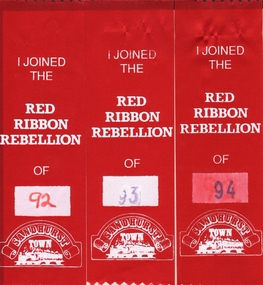
... 1853, Bendigo Miners protested against the 30 shilling miners licence the had to pay the government. They wore red ribbons to show their protest and shopkeepers hung red ribbons outside their premises in support. Thousands of miners signed a petition to Governor LaTrobe to no avail. A protest gathering in Pall Mall marched to the Government camp on Camp Hill but this was a peaceful event again to no real avail. BENDIGO History Red Ribbon Agitation ...In 1853, Bendigo Miners protested against the 30 shilling miners licence the had to pay the government. They wore red ribbons to show their protest and shopkeepers hung red ribbons outside their premises in support. Thousands of miners signed a petition to Governor LaTrobe to no avail. A protest gathering in Pall Mall marched to the Government camp on Camp Hill but this was a peaceful event again to no real avail.Three participation ribbons for Red Ribbon Agitation re-enactments in 1992, 1993 and 1994. Written on ribbons in white print ' I joined the Red Ribbon Rebellion of (year). On bottom, a scroll with Sandhurst Town written.bendigo, history, red ribbon agitation
