
Showing 12 items matching "the socio-economic environment "
-
 Moorabbin Air Museum
Book - Sydney second airport, Department of Aviation Second Sydney Airport Site Selection Programme Draft Environmental Impact Statement
... ...The socio-economic environment & effects of the proposal...Sydney second airport Selection of short listed sites Role & nature of a second airport Possible site locations Site selection methodology Site characteristics The proposal at Badgery's Creek The socio-economic environment & effects of the proposal The physical /biological effects of the proposal The proposal at Wilton Socio-economic/physical/biological effects of the proposal Comparison of both sites Draft environmental impact statement for location of second Sydney airport, circa 1985 Department of Aviation Second Sydney Airport Site Selection Programme Draft Environmental Impact Statement Book Sydney second airport ...Draft environmental impact statement for location of second Sydney airport, circa 1985non-fiction Draft environmental impact statement for location of second Sydney airport, circa 1985 selection of short listed sites, role & nature of a second airport, possible site locations, site selection methodology, site characteristics, the proposal at badgery's creek, the socio-economic environment & effects of the proposal, the physical /biological effects of the proposal, the proposal at wilton, socio-economic/physical/biological effects of the proposal, comparison of both sites -
 Broadmeadows Historical Society & Museum
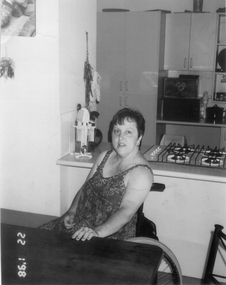
Photograph, Lady in Her Kitchen, Banksia Gardens 1998, 22 January 1998
... This photograph offers a valuable glimpse into the daily life and living conditions during that period, highlighting the socio-economic environment and the role of public housing in providing stability, accessibility, and community support to its residents....This photograph offers a valuable glimpse into the daily life and living conditions during that period, highlighting the socio-economic environment and the role of public housing in providing stability, accessibility, and community support to its residents. ...This image from 1998 depicts a lady sitting in her kitchen within public housing at Banksia Gardens, Broadmeadows. The houses at Banksia Gardens were designed to be accessible for people with disabilities, reflecting a commitment to inclusivity and support for all community members. This photograph offers a valuable glimpse into the daily life and living conditions during that period, highlighting the socio-economic environment and the role of public housing in providing stability, accessibility, and community support to its residents. This photograph of a lady sitting in her kitchen within public housing at Banksia Gardens, Broadmeadows, taken in 1998, holds significant historical value. The houses at Banksia Gardens were designed to be accessible for people with disabilities, reflecting a commitment to inclusivity and support for all community members. The image provides a poignant glimpse into the daily life and living conditions of the time, highlighting the socio-economic environment and the essential role of public housing in offering stability, accessibility, and community support. It serves as a testament to the efforts made to create a more inclusive and supportive community for residents with diverse needs. Black and white photograph on glossy photograph paper. Lady sitting in her kitchen public housing/Broadmeadows 1998 banksia gardens, broadmeadows, accessible housing, 1998 -
 Bendigo Historical Society Inc.
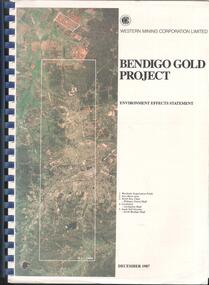
Booklet - Kangaroo Flat Gold Mine Collection: Western Mining Corporation Bendigo Gold Project Environmental Effects Statement December 1987, Western Mining Corporation, Bendigo Office, Western Mining Corporation Limited Bendigo Gold Project Environment Effect Statement December 1987, December 1987
... Planning and land use, socio-economic environment, physical environment and biological environment are examined and discussed. ...Planning and land use, socio-economic environment, physical environment and biological environment are examined and discussed. ...Spiral bound booklet, plastic cover, black plastic binding, On front cover: Western Mining Corporation Bendigo Gold Project, Environment Effects Statement, December 1987. On front page, colour aerial photograph of Bendigo mining areas mentioned in report. Key on front page related to photograph: 1. Woodvale Evaporation Ponds. 2. New Moon area. 3. North New Chum Williams United shaft. 4. Carshalton, Carshalton shaft. 5. South Nell Gwynne, North Bendigo shaft. Contents: historical perspective; Western Mining Corporation Ltd Bendigo activities; project outline, project approvals - controlling factors, elements of the mining project, surface based exploration, underground operations and surface support, mining areas and operations ore and mullock haulage, New Moon area, water management, environmental management. Planning and land use, socio-economic environment, physical environment and biological environment are examined and discussed. bendigo, goldmining, bendigo mining nl, bendigo goldfield, environmental effects statement, bendigo gold project, woodvale evaporation ponds, new moon, north new chum, carshalton, south nell gwynne, western mining corporation -
 Bendigo Historical Society Inc.
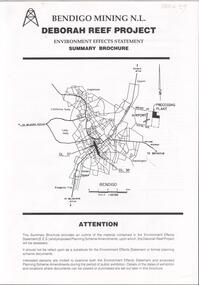
Document - DEBORAH REEF PROJECT ENVIRONMENT EFFECTS STATEMENT
... Page four lists the issues that impact on this submission: planning and land use; socio economic environment; traffic; discharges to air; water management; explosives storage and handling; subsidence; heritage; flora and fauna and landscape and visual assessment. ...Page four lists the issues that impact on this submission: planning and land use; socio economic environment; traffic; discharges to air; water management; explosives storage and handling; subsidence; heritage; flora and fauna and landscape and visual assessment. ...Two page document. On top, first page ' Bendigo Mining N.L., Deborah Reef Project, Environment Effects Statement, Summary Brochure'. Poppet head on top LH corner of document. A map of central Bendigo is drawn on page 1 and shows the location of the proposed processing plant near the Airport. Further maps on page 2 and 3 show the North Deborah Mine Site, the pipeline route and the airfield site. The summary brochure provides an outline of the material contained in the Environment Effects Statement and proposed planning scheme amendments upon which, the Deborah Reef Project will be assessed. Page four lists the issues that impact on this submission: planning and land use; socio economic environment; traffic; discharges to air; water management; explosives storage and handling; subsidence; heritage; flora and fauna and landscape and visual assessment. The 16th March, 1989, is the date given for submissions to be lodged in regard to this project. Bendigo Mining N.L bendigo, mining, deborah reef project -
 Kiewa Valley Historical Society
Decanter Glass, circa mid to late 1900's
... Because of its style it blended in well with any lavish meal and socio economic "upper" class environment. It was a part of social atmosphere of elegance and wealth be it in the city or on a rural property. ...Because of its style it blended in well with any lavish meal and socio economic "upper" class environment. It was a part of social atmosphere of elegance and wealth be it in the city or on a rural property. ...This "art deco" style of containers were very popular by the "art and trendy" socialites, be they in the city or in rural towns and properties. This style was very popular in the 1940's to 1950's. The octagonal shape provided the stability of the decanter with its "expensive" contents. Because of its style it blended in well with any lavish meal and socio economic "upper" class environment. It was a part of social atmosphere of elegance and wealth be it in the city or on a rural property. This is very significant to the Kiewa Valley rural "society" environment. At the time of its use the wealth of Australia was "riding on the sheep's back", that is rural income(primary producers), on the whole, was well above that in the cities (industrial). It was in a period where large wealthy property owners could spend lavishly on trendy domestic items. This octagonal glass decanter with its egg shaped stopper is made in an "art deco" style and reflects the 1950's style of bold design. The decanter "stopper" has been cut in a "diamond" cut to reflect the sunlight as does a diamond ring. The stopper is tapered down to permit easy placement and removal. The Stability of the decanter is increased by the broad base and octagonal (8) sides tapering going up the sides. decanter, glass, art deco glass ware, spirits container -
 Kiewa Valley Historical Society
Badge Boy Scout, circa mid to late 1900's
... socio-economic areas in the Australian population. The scouting group applied the concept of self sufficiency and friendship to all its membership. It was an avenue to cross the boundaries of distance and regional mores. Many of the boys in the Kiewa Valley and its regions would have been more "in tune" with the core principles of the scouting movement because being in a rural environment and "living on the land" was a day to day part of their life. ...This badge, which was used in the mid to late 1900's (Scouts started in Australia in 1909) clearly demonstrates that the families in the Kiewa Valley although slightly remote were still able to participate in one of the prime "boy" only social groups. The Boy Scouting movement brought together boys from all the socio-economic areas in the Australian population. The scouting group applied the concept of self sufficiency and friendship to all its membership. It was an avenue to cross the boundaries of distance and regional mores. Many of the boys in the Kiewa Valley and its regions would have been more "in tune" with the core principles of the scouting movement because being in a rural environment and "living on the land" was a day to day part of their life. What was an important aspect to they was the "mateship" and the belonging to a very large, and international, group of "like minded" boys. This avenue of interacting with a larger group of boys cut through the "small population" mores of a rural and at times isolated environment. This Boy Scouting activity was both mentally and physically significant to growing boys within the Kiewa Valley as it opened up the world to them. This brass badge has a front formed in a half circle base supporting a "Fleur de Leis" in a spear shape with "cut outs" at the appropriate places to provide the emphasis needed to project the form. Attached to the badge is a crescent moon shaped pronged frame for attaching the badge to lapels or collars or button eyelets. On the bottom scroll "BOY SCOUTS" and on the back type fastener "STOKES & SONS" below this "Melb". societies, boy scouts, apparel badges, numismatics badges -
 Kiewa Valley Historical Society
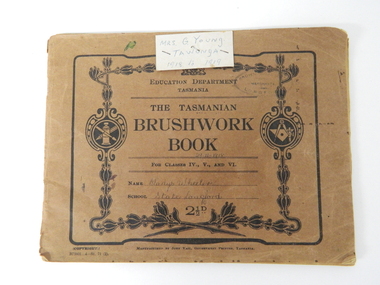
Book - Sketch Book, Circa 1918
... environment of the Kiewa Valley. The skills taught in both regions were still the same and the socio-economic factors and mores were also similar. ...This childhood sketchbook of the 1918 era details the emphasis placed upon a skill of brushwork that portrayed part of the students natural environment both in Tasmanian schools and Victorian schools, especially rural schools. The close bondage between students and their environment was a reflection on the early "hands on" approach in child education. Abstract art or teaching aids which could not be identified with physical properties available to students at this period in time were of lesser value. The ability of the student to identify the artistic value of local nature eg. local plants and flowers was especial important to rural based school children who had limited excursion opportunities available to visit town/city based botanical gardens and museums. This brushwork book is very significant to the Kiewa Valley as it demonstrates that childhood relocations from one State to another were not detrimental to the students overall scholastic development. The rural environment in Tasmania was not that far removed from the rural environment of the Kiewa Valley. The skills taught in both regions were still the same and the socio-economic factors and mores were also similar. This item demonstrates the relocation of one family from Tasmania to the Kiewa Valley. The expansion in population into the Kiewa valley was quite erratic and significant population growth only came after the increase in population brought into the area by the SEC Vic Hydro Scheme introduced to quench the demand for Victoria's electricity. This book has a brown cover with black print and designs on a 150 gsm cardboard. Each page is of the same thickness as the cover but is of paper. On the outside cover and contained within a thick boarder. "EDUCATION DEPARTMENT" and below this in smaller print "TASMANIA" below this "THE TASMANIAN BRUSHWORK BOOK". Below this "FOR CLASSES IV., V., AND VI" Below this "NAME" SCHOOL" At the bottom 2 1/2d 1918's educational sketchbook, 1918 children's sketchbook -
 Kiewa Valley Historical Society
Timer Mechanical, Circa 1950
... socio-economic expansion which permitted other "tourist" based industries into the valley. This Hydro Scheme was instigated by "the Government of the day" as a bold move and was the major force behind the acceptance of World War II refugee and "technical" workforce. Inclusion of skilled and unskilled migration into the Australian environment ...This Timing Relay is quite a large (industrial type) apparatus. The Timer is started by having a voltage of 250 volts direct current (as supplied by batteries). A DC motor then rotates driving into a clockwork mechanism, the output of which is an arm rotating at the same speed as a minute hand on a clock. Attached to this arm is a mercury switch which tips and makes an electrical circuit operate in a sequence control system. The sequences that use these timers are when starting and stopping Hydro Generators. They check that the machine has connected to the power system grid before 20 minutes duration. Brakes must go on for a set time when shutting down a generator slowing at the right speed as measured by this apparatus. These generators are powered by the hydro force of "stored" water at a higher altitude. The establishment of both the NSW and Victorian Hydro schemes was achieved from the mid 1900's to the 1960's. At this point in time the need for additional power sources to quench both an industrial and domestic demand for electricity was purely an economic and not and environmental (carbon reduction) factor. This Timing Relay apparatus is very significant to the Kiewa Valley as its use was introduced during the Kiewa Hydro Scheme. Although only a relay apparatus, it was however part of the explosion of human resources into the valley. This influx of population transformed the region from that of a basically quiet rural region to one which evolved into both an industrial and a larger residential community. This evolution in the valley created a change, not only in the "physical" landscape but also the socio-economic expansion which permitted other "tourist" based industries into the valley. This Hydro Scheme was instigated by "the Government of the day" as a bold move and was the major force behind the acceptance of World War II refugee and "technical" workforce. Inclusion of skilled and unskilled migration into the Australian environment was of a higher priority than a selective quota system of later years.. Although this mass "invasion" of workers with families was thought of in some circles as intrusive, the expansion of population post war years and its integration into the Australian rural sector, produced the multi- lingual, multi-cultural diversity of later years. sec vic kiewa hydro scheme, alternate energy supplies, alpine population growth -
 Sunshine and District Historical Society Incorporated
Administrative record - Sunshine Primary School 2024 Annual Report, Victoria State Government Department of Education, 2025
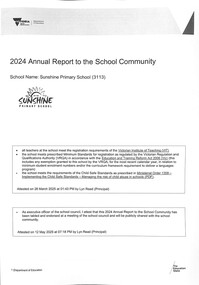
... socio-economic and cultural backgrounds with approximately 42% of the school's students having a language background other than English. Sunshine Primary School has 24 equivalent full-time staff: 2 Principal class, 16 teachers and 8 Education Support staff. The school is driven by strong values and the belief that every student can achieve success. The school culture is focused on ensuring effective and enriched learning for all students through individualised instruction. There is a focus on continuous improvement which is based on research to ensure effective teaching and learning and to improve student learning outcomes. Sunshine Primary School fosters an environment...socio-economic and cultural backgrounds with approximately 42% of the school's students having a language background other than English. Sunshine Primary School has 24 equivalent full-time staff: 2 Principal class, 16 teachers and 8 Education Support staff. The school is driven by strong values and the belief that every student can achieve success. The school culture is focused on ensuring effective and enriched learning for all students through individualised instruction. There is a focus on continuous improvement which is based on research to ensure effective teaching and learning and to improve student learning outcomes. Sunshine Primary School fosters an environment ...Established in 1891, Sunshine Primary School (SPS) is located in the City of Brimbank, west of Melbourne. The local community is diverse in its socio-economic and cultural backgrounds with approximately 42% of the school's students having a language background other than English. Sunshine Primary School has 24 equivalent full-time staff: 2 Principal class, 16 teachers and 8 Education Support staff. The school is driven by strong values and the belief that every student can achieve success. The school culture is focused on ensuring effective and enriched learning for all students through individualised instruction. There is a focus on continuous improvement which is based on research to ensure effective teaching and learning and to improve student learning outcomes. Sunshine Primary School fosters an environment where children share responsibility for their own learning and where all community members work together to ensure all students maximise every educational opportunity possible. Sunshine Primary School enjoys a productive partnership with the local Deer Park / Sunshine school network, working together to build a resilient and productive learning community for all. Together we work as a community of practice to share curriculum ideas and strategies to improve the outcomes for the students in the Deer Park/Sunshine area. The network is continuing to support our focus on improving student learning outcomes in student learning, health and wellbeing. 2024 Annual Report to the School Community School Name: Sunshine Primary School (3113) sunshine primary school, hampshire road, sunshine -
Broadmeadows Historical Society & Museum
Photograph - Group Photo, Classic Studios Victoria, Jacana Primary School - Students and Staff Photograph, 2006, 2006
... By the 1990s and early 2000s, the school had become a vibrant and inclusive environment, welcoming students from a wide range of cultural and socio-economic backgrounds. ...By the 1990s and early 2000s, the school had become a vibrant and inclusive environment, welcoming students from a wide range of cultural and socio-economic backgrounds. ...Jacana Primary School was established in 1959 during a period of rapid suburban expansion in Melbourne’s northern corridor. Situated in the suburb of Jacana, the school was part of a broader post-war initiative aimed at delivering accessible public education to communities shaped by migration, industrial growth, and government housing programs. Over the decades, Jacana Primary evolved alongside its community, reflecting the changing social and cultural landscape of the area. By the 1990s and early 2000s, the school had become a vibrant and inclusive environment, welcoming students from a wide range of cultural and socio-economic backgrounds. This diversity was embraced through inclusive teaching practices, multicultural celebrations, and student leadership initiatives such as the junior student council. The 2006 photograph captures a moment near the end of the school’s operation, showcasing the unity and shared purpose of its students and staff. It highlights the school’s role not only as a place of learning but also as a centre for community building, civic engagement, and social support. Although Jacana Primary School closed in the early 2000s, its legacy endures through archival materials like this photograph. These records offer valuable insights into the role of public education in shaping community identity and fostering social cohesion during a transformative period in Melbourne’s suburban history. The 2006 Students and Staff photograph from Jacana Primary School is a historically significant visual record that captures the final chapter of a school deeply embedded in Melbourne’s northern suburban landscape. Established in 1959 during a wave of post-war development, Jacana Primary was part of a broader initiative to provide accessible public education to communities shaped by migration, industrial growth, and housing expansion. This photograph reflects the school’s enduring commitment to inclusion, diversity, and community engagement. By the early 2000s, Jacana Primary had become a vibrant educational environment, welcoming students and staff from a wide range of cultural and socio-economic backgrounds. The image documents the collaborative spirit and shared purpose that defined the school’s ethos, highlighting its role as both a learning institution and a centre of social cohesion. As one of the final visual records before the school’s closure, the photograph holds particular significance. It offers insight into the lived experiences of students and educators during a transformative period in Melbourne’s suburban history and stands as a testament to the lasting impact of public education in fostering community identity and resilience. A colour photograph mounted on matte Paper with a purple border (Blue Label) PH - 5383 Classic Studios VIC order: p337249 / Frame x Jacana whole school item 4 Kodak Professional / Endura Paper. papier. papel / Professional images are/ copyright protected / Dutch copyright Gerschütz jacana primary school, education, photograph, group photograph, 2006, students and staff, jacana -
 Broadmeadows Historical Society & Museum
Photograph, Lady at Front Door Public Housing/Broadmeadows 1998, 22 January 1998
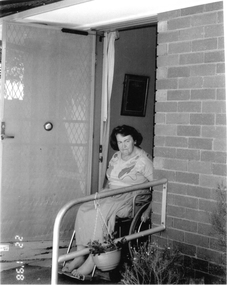
... environment of the time, reflecting the broader social and economic context that shaped the suburb during the late 1990s. This photograph of a woman at the front door of public housing in Broadmeadows, taken in 1998, holds significant historical value. It captures a moment in the social history of the area, illustrating the living conditions and community environment of the time. The image provides insight into the socio ...This image from 1998 captures a moment in the social history of Broadmeadows, showcasing public housing in the area. It offers a glimpse into the living conditions and community environment of the time, reflecting the broader social and economic context that shaped the suburb during the late 1990s. This photograph of a woman at the front door of public housing in Broadmeadows, taken in 1998, holds significant historical value. It captures a moment in the social history of the area, illustrating the living conditions and community environment of the time. The image provides insight into the socio-economic context of the late 1990s, highlighting the importance of public housing in supporting residents and fostering a sense of belonging and stability within the neighbourhood. Black and white photograph on glossy photograph paper. Lady at Front Door Public Housing/Broadmeadows 1998 broadmeadows, social housing, accessible, 1998, lady at front door public housing/broadmeadows 1998 -
 Broadmeadows Historical Society & Museum
Photograph - Group Photo, Fotek School Portraits, Jacana Primary School 1997 Students and Staff Photograph, 1997
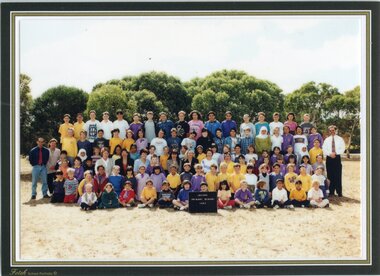
... socio-economic backgrounds. This diversity was not only embraced but actively celebrated through inclusive teaching practices, multicultural events, and student leadership programs such as the junior student council. The 1997 photograph captures a moment in this dynamic environment...socio-economic backgrounds. This diversity was not only embraced but actively celebrated through inclusive teaching practices, multicultural events, and student leadership programs such as the junior student council. The 1997 photograph captures a moment in this dynamic environment ...Jacana Primary School was established in 1959 during a period of rapid suburban expansion in Melbourne’s northern corridor. Located in the suburb of Jacana, the school was part of a broader post-war effort to provide accessible public education to growing communities shaped by migration, industrial development, and housing initiatives. Throughout its operation, Jacana Primary reflected the evolving social fabric of the area. By the 1990s, the school had become a microcosm of Melbourne’s increasing cultural diversity, welcoming students from a wide range of ethnic and socio-economic backgrounds. This diversity was not only embraced but actively celebrated through inclusive teaching practices, multicultural events, and student leadership programs such as the junior student council. The 1997 photograph captures a moment in this dynamic environment, showcasing both staff and students engaged in a shared educational mission. It represents a time when schools were not only places of learning but also key sites of community building, civic engagement, and social support. Jacana Primary closed in the early 2000s as part of broader changes in educational policy and demographic shifts. However, its legacy lives on through archival materials like this photograph, which offer valuable insights into the role of public schools in shaping community identity and fostering social cohesion during a transformative period in Melbourne’s suburban history. This 1997 photograph of staff and students at Jacana Primary School marks a poignant moment in the history of a community-centred educational institution that served Melbourne’s northern suburbs from 1959 until its closure in the early 2000s. More than a conventional group portrait, the image stands as a historical artifact that encapsulates the spirit and values of a school deeply embedded in its local community. Jacana Primary School was distinguished by its commitment to educational equity, inclusivity, and a strong sense of belonging—principles that were actively lived and practiced within its classrooms and broader school culture. The photograph offers insight into the educational ethos and staff dynamics of the time, while also reflecting the broader social and cultural shifts occurring in suburban Melbourne at the close of the 20th century. As part of the school’s visual archive, this image contributes to a richer understanding of how public education shaped community identity, supported diverse student populations, and left a lasting legacy in the lives of generations of children and families. A colour photograph mounted on white card with a black border, is laminated. Back: (Blue Label Top) (Right Corner): PH -2157, Front: (Bottom Left Corner): Fotek School Portraits jacana primary school, education, photograph, group photograph, 1997
