
Showing 32 items matching "the southwest pacific"
-
 Moorabbin Air Museum
Book - AUSTRALIANS AT WAR, Australians at War in the Air 1939 - 1945 Volume Two
... ...The Southwest Pacific...Australias at war Coastal Command Australian Fleet Air Arm Middle East & Mediterranean Southeast Asia The Southwest Pacific Ground staff The Tactical Air Force in Europe Overview of Australian war in the air on non-European fronts, circa 1995 Australians at War in the Air 1939 - 1945 Volume Two Book AUSTRALIANS AT WAR ...Overview of Australian war in the air on non-European fronts, circa 1995non-fictionOverview of Australian war in the air on non-European fronts, circa 1995coastal command, australian fleet air arm, middle east & mediterranean, southeast asia, the southwest pacific, ground staff, the tactical air force in europe -
 Dandenong/Cranbourne RSL Sub Branch
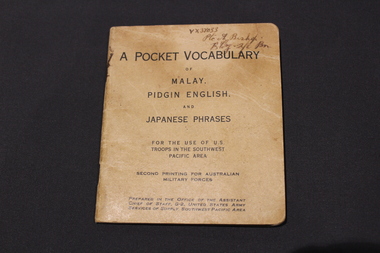
Booklet - Pocket book, Headquarters, United States Army Services of Supply, A Pocket Vocabulary of MALAY PIDGIN ENGLISH and JAPANESE PHRASES, 15 September 1942
... Square pocket book for the use of United States troops in the Southwest Pacific Area. ...Square pocket book for the use of United States troops in the Southwest Pacific Area. A Pocket Vocabulary of MALAY PIDGIN ENGLISH and JAPANESE PHRASES. ...WWII significance.Square pocket book for the use of United States troops in the Southwest Pacific Area. VX37033 Pte A. Bishop B.coy 2/2/Battalion is written in ink on the front cover. -
 B-24 Liberator Memorial Restoration Australia Inc
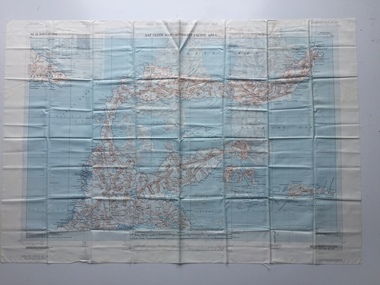
Map - US World War II multi-coloured map- Southwest Pacific Area, No. 23 North Celebes, No. 24 South Celebes, 1942-1943
... US World War II multi-coloured map- Southwest Pacific Area, No. 23 North Celebes, No. 24 South Celebes...AAF Cloth Map - Southwest Pacific Area Side 1 - No. 23 North Celebes Side 2 - No. 24 South Celebes...This map, printed on acetate rayon, is an original US 'escape and evasion' kit map from World War II. world war ii silk maps united states of america a189 AAF Cloth Map - Southwest Pacific Area Side 1 - No. 23 North Celebes Side 2 - No. 24 South Celebes A multi-coloured, contoured, double-sided map printed on acetate rayon Map US World War II multi-coloured map- Southwest Pacific Area, No. 23 North Celebes, No. 24 South Celebes ...Silk and rayon maps were produced by the United States (c. 7.5 million in total), Great Britain (some 1.75 million in total) and Australia during World War II. They were issued to Allied military personnel as part of 'escape and evasion' kits.This map, printed on acetate rayon, is an original US 'escape and evasion' kit map from World War II.A multi-coloured, contoured, double-sided map printed on acetate rayon AAF Cloth Map - Southwest Pacific Area Side 1 - No. 23 North Celebes Side 2 - No. 24 South Celebesworld war ii, silk maps, united states of america, a189 -
 B-24 Liberator Memorial Restoration Australia Inc
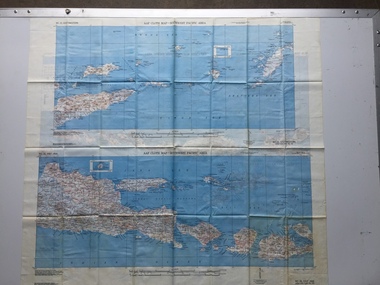
Map - US World War II-coloured map, - Southwest Pacific Area, No.22 Southwestern, No.26 East Java, No.25 Timor, 1943
... US World War II-coloured map, - Southwest Pacific Area, No.22 Southwestern, No.26 East Java, No.25 Timor...AAF Cloth Map - Southwest Pacific Area Side 1 - No. 22 Southwestern and No. 26 East Java Side 2 - No. 25 Timor...This map, printed on acetate rayon, is an original US 'escape and evasion' kit map from World War II. world war ii silk maps united states of america a188 AAF Cloth Map - Southwest Pacific Area Side 1 - No. 22 Southwestern and No. 26 East Java Side 2 - No. 25 Timor A multi-coloured, contoured, double-sided map printed on acetate rayon Map US World War II-coloured map, - Southwest Pacific Area, No.22 Southwestern, No.26 East Java, No.25 Timor ...Silk and rayon maps were produced by the United States (c. 7.5 million in total), Great Britain (some 1.75 million in total) and Australia during World War II. They were issued to Allied military personnel as part of 'escape and evasion' kits.This map, printed on acetate rayon, is an original US 'escape and evasion' kit map from World War II.A multi-coloured, contoured, double-sided map printed on acetate rayon AAF Cloth Map - Southwest Pacific Area Side 1 - No. 22 Southwestern and No. 26 East Java Side 2 - No. 25 Timorworld war ii, silk maps, united states of america, a188 -
Moorabbin Air Museum
Equipment (Item) - J B Ryan Collection Navigator's Equipment and Survival Kit see Description for details
... Slide Rule Navigation Computer Foldable ruler Silk Maps Directories of Airports in Australia and Southwest Pacific Correspondence and photos Compass Bi Focal Lense Mini telescope Heliograph Whistle ...Slide Rule Navigation Computer Foldable ruler Silk Maps Directories of Airports in Australia and Southwest Pacific Correspondence and photos Compass Bi Focal Lense Mini telescope Heliograph Whistle Equipment J B Ryan Collection Navigator's Equipment and Survival Kit see Description for details ... -
 B-24 Liberator Memorial Restoration Australia Inc
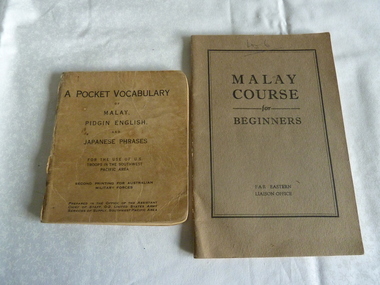
Pocket Vocab. of Malay, Pidgin English and Japanese Phrases and Malay Course for Beginners. M.D. Frecker, Early 1939
... Troops in the Southwest Pacific Area. Second printing for Australian Military Forces. ...Troops in the Southwest Pacific Area. Second printing for Australian Military Forces. ...A Pocket Vocabulary of Malay, Pidgin English and Japanese Phrases for the use of U.S. Troops in the Southwest Pacific Area. Second printing for Australian Military Forces. Malay Course for Beginners. Far Eastern Liaison Office. Used by Military Forces.a22.06 -
Moorabbin Air Museum
Map (Item) - AAF Cloth Map- Southwest Pacific Area: Nos. 22,25 & 26
... AAF Cloth Map- Southwest Pacific Area: Nos. 22,25 & 26....AAF Cloth Map- Southwest Pacific Area: Nos. 22,25 & 26....AAF Cloth Map- Southwest Pacific Area: Nos. 22,25 & 26, three maps on one sheet ,printed both sides 83x93cm. ...AAF Cloth Map- Southwest Pacific Area: Nos. 22,25 & 26. Map AAF Cloth Map- Southwest Pacific Area: Nos. 22,25 & 26. ... -
 8th/13th Victorian Mounted Rifles Regimental Collection
Weapon - Japanese sword
... Common souvenir brought back by returning servicemen from the Southwest Pacific area following the Japanese surrender....Common souvenir brought back by returning servicemen from the Southwest Pacific area following the Japanese surrender. ...Swords were a common item of equipment of Japanese officers and soldiers in WWII. Representative of souvenirs brought back following the end of WWII.Japanese Samuari Sword with 70mm hand guard with wooden handle wrapped with red and white and brown tape - blade length 700mm. Common souvenir brought back by returning servicemen from the Southwest Pacific area following the Japanese surrender.japan, samurai, sword, wwii, world war two -
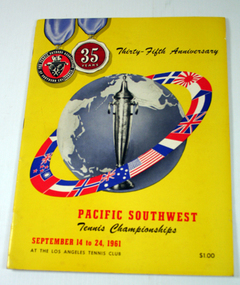 Tennis Australia
Magazine, 1961
... Programme for 35th Pacific Southwest Championships. Materials: Paper, Ink...Tennis Programme for 35th Pacific Southwest Championships. Materials: Paper, Ink Magazine ...Programme for 35th Pacific Southwest Championships. Materials: Paper, Inktennis -
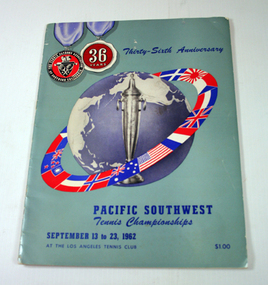 Tennis Australia
Magazine, 1962
... Programme for 36th Pacific Southwest Championships 1962 Materials: Paper, Ink...Tennis Programme for 36th Pacific Southwest Championships 1962 Materials: Paper, Ink Magazine ...Programme for 36th Pacific Southwest Championships 1962 Materials: Paper, Inktennis -
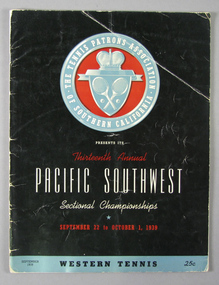 Tennis Australia
Tournament Programme, Sep-39
... Programme for the 1939 Pacific Southwest Tennis Championship. Materials: Ink, Paper, Metal...Tennis Programme for the 1939 Pacific Southwest Tennis Championship. Materials: Ink, Paper, Metal Tournament Programme ...Programme for the 1939 Pacific Southwest Tennis Championship. Materials: Ink, Paper, Metaltennis -
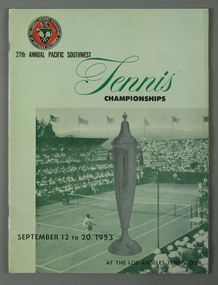 Tennis Australia
Tournament Programme, Sep-53
... Programme for the 1953 Pacific Southwest Tennis Championships. Materials: Ink, Paper, Metal...Tennis Programme for the 1953 Pacific Southwest Tennis Championships. Materials: Ink, Paper, Metal Tournament Programme ...Programme for the 1953 Pacific Southwest Tennis Championships. Materials: Ink, Paper, Metaltennis -
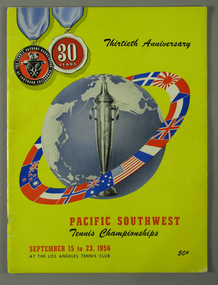 Tennis Australia
Tournament Programme, Sep-56
... Programme for the 1956 Pacific Southwest Tennis Championships. Materials: Ink, Paper, Metal...Tennis Programme for the 1956 Pacific Southwest Tennis Championships. Materials: Ink, Paper, Metal Tournament Programme ...Programme for the 1956 Pacific Southwest Tennis Championships. Materials: Ink, Paper, Metaltennis -
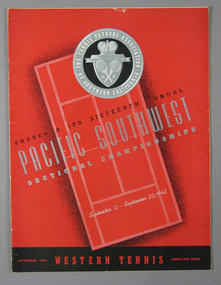 Tennis Australia
Tournament Programme, Sep-42
... Two programmes for the 1942 Pacific Southwest Tennis Championships. Materials: Ink, Paper, Metal...Tennis Two programmes for the 1942 Pacific Southwest Tennis Championships. Materials: Ink, Paper, Metal Tournament Programme ...Two programmes for the 1942 Pacific Southwest Tennis Championships. Materials: Ink, Paper, Metaltennis -
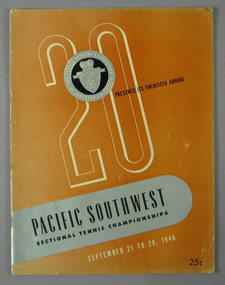 Tennis Australia
Tournament Programme, Sep-46
... Two programmes for the 1946 Pacific Southwest Tennis Championships. Materials: Ink, Paper, Metal...Tennis Two programmes for the 1946 Pacific Southwest Tennis Championships. Materials: Ink, Paper, Metal Tournament Programme ...Two programmes for the 1946 Pacific Southwest Tennis Championships. Materials: Ink, Paper, Metaltennis -
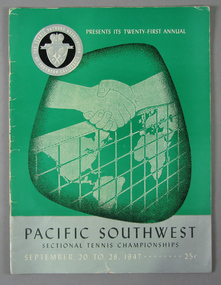 Tennis Australia
Tournament Programme, Sep-47
... Four programmes for the 1947 Pacific Southwest Tennis Championships. Materials: Ink, Paper, Metal...Tennis Four programmes for the 1947 Pacific Southwest Tennis Championships. Materials: Ink, Paper, Metal Tournament Programme ...Four programmes for the 1947 Pacific Southwest Tennis Championships. Materials: Ink, Paper, Metaltennis -
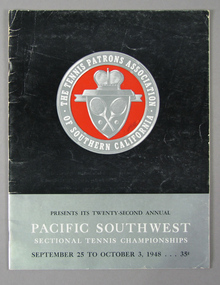 Tennis Australia
Tournament Programme, Sep-48
... Two programmes for the 1948 Pacific Southwest Tennis Championships. Materials: Ink, Paper, Metal...Tennis Two programmes for the 1948 Pacific Southwest Tennis Championships. Materials: Ink, Paper, Metal Tournament Programme ...Two programmes for the 1948 Pacific Southwest Tennis Championships. Materials: Ink, Paper, Metaltennis -
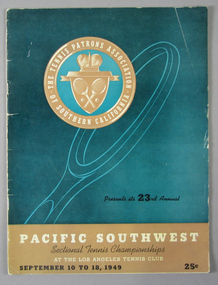 Tennis Australia
Tournament Programme, Sep-49
... Three programmes for the 1949 Pacific Southwest Tennis Championships. Materials: Ink, Paper, Metal...Tennis Three programmes for the 1949 Pacific Southwest Tennis Championships. Materials: Ink, Paper, Metal Tournament Programme ...Three programmes for the 1949 Pacific Southwest Tennis Championships. Materials: Ink, Paper, Metaltennis -
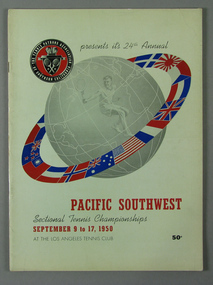 Tennis Australia
Tournament Programme, Sep-50
... Two programmes for the 1950 Pacific Southwest Tennis Championships. Materials: Ink, Paper, Metal...Tennis Two programmes for the 1950 Pacific Southwest Tennis Championships. Materials: Ink, Paper, Metal Tournament Programme ...Two programmes for the 1950 Pacific Southwest Tennis Championships. Materials: Ink, Paper, Metaltennis -
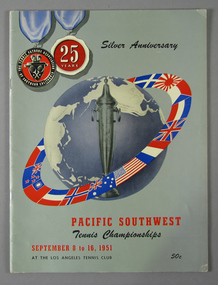 Tennis Australia
Tournament Programme, Sep-51
... Two programmes for the 1951 Pacific Southwest Tennis Championships. Materials: Ink, Paper, Metal...Tennis Two programmes for the 1951 Pacific Southwest Tennis Championships. Materials: Ink, Paper, Metal Tournament Programme ...Two programmes for the 1951 Pacific Southwest Tennis Championships. Materials: Ink, Paper, Metaltennis -
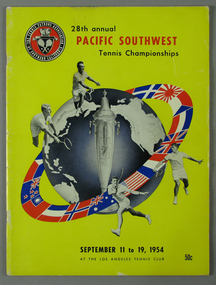 Tennis Australia
Tournament Programme, Sep-54
... Two programmes for the 1954 Pacific Southwest Tennis Championships. Materials: Ink, Paper, Metal...Tennis Two programmes for the 1954 Pacific Southwest Tennis Championships. Materials: Ink, Paper, Metal Tournament Programme ...Two programmes for the 1954 Pacific Southwest Tennis Championships. Materials: Ink, Paper, Metaltennis -
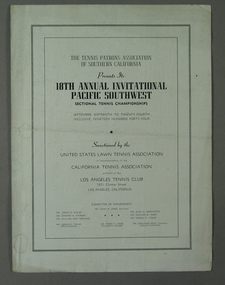 Tennis Australia
Tournament Programme, 1944
... Programme of the 18th Annual Invitational Pacific Southwest Sectional Tennis Championships Materials: Paper, Ink...Tennis Programme of the 18th Annual Invitational Pacific Southwest Sectional Tennis Championships Materials: Paper, Ink Tournament Programme ...Programme of the 18th Annual Invitational Pacific Southwest Sectional Tennis Championships Materials: Paper, Inktennis -
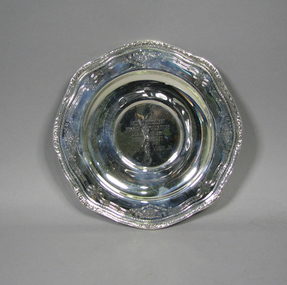 Tennis Australia
Prize dish, 1933
... Silver prize dish. Inscr: 'PACIFIC SOUTHWEST/TENNIS CHAMPIONSHIPS/LOS ANGELES 1933/MIXED DOUBLES/WON BY/ ELLSWORTH VINES JNR.' ...Tennis Silver prize dish. Inscr: 'PACIFIC SOUTHWEST/TENNIS CHAMPIONSHIPS/LOS ANGELES 1933/MIXED DOUBLES/WON BY/ ELLSWORTH VINES JNR.' ...Silver prize dish. Inscr: 'PACIFIC SOUTHWEST/TENNIS CHAMPIONSHIPS/LOS ANGELES 1933/MIXED DOUBLES/WON BY/ ELLSWORTH VINES JNR.' Materials: Silver/Metaltennis -
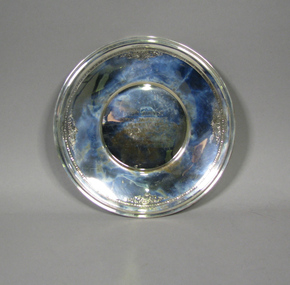 Tennis Australia
Prize dish, 1930
... Silver prize dish. Inscr: 'PACIFIC SOUTHWEST/TENNIS CHAMPIONSHIPS/LOS ANGELES 1930/MIXED DOUBLES/WON BY/E. ...Tennis Silver prize dish. Inscr: 'PACIFIC SOUTHWEST/TENNIS CHAMPIONSHIPS/LOS ANGELES 1930/MIXED DOUBLES/WON BY/E. ...Silver prize dish. Inscr: 'PACIFIC SOUTHWEST/TENNIS CHAMPIONSHIPS/LOS ANGELES 1930/MIXED DOUBLES/WON BY/E. VINES & H. MARLOWE'. Materials: Silver/Metaltennis -
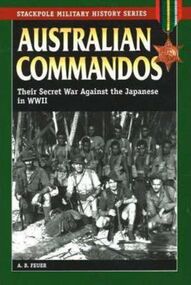 Australian Commando Association - Victoria
Book, A.B.Feure, Australian Commando: Their Secret War against the Japanese in World War II
... In the jungle islands of the southwest Pacific, Australia's elite M/Z commando teams conducted daring rescue, sabotage, and intelligence missions during World War II. ...In the jungle islands of the southwest Pacific, Australia's elite M/Z commando teams conducted daring rescue, sabotage, and intelligence missions during World War II. ...non-fictionww2, australian commandos, australian special operations, australian special forces, world war ii -
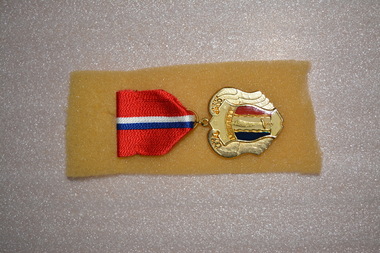 Wangaratta RSL Sub Branch
Medal, Philippine Liberation, c1995
... Robert Hamilton Hutchieson PM 4802 served on HMAS Westralia as a landing craft coxswain in the Southwest Pacific Campaign 1942 to 1945. The Australian Army played virtually no part in the Philippines. ...Robert Hamilton Hutchieson PM 4802 served on HMAS Westralia as a landing craft coxswain in the Southwest Pacific Campaign 1942 to 1945. The Australian Army played virtually no part in the Philippines. ...The Philippine Liberation Medal is intended to recognize military service during the last eleven months of World War II when the military of Japan was driven from the Philippines before their surrender in September 1945. Robert Hamilton Hutchieson PM 4802 served on HMAS Westralia as a landing craft coxswain in the Southwest Pacific Campaign 1942 to 1945. The Australian Army played virtually no part in the Philippines. However, units from the Royal Australian Air Force and the Royal Australian Navy, were involved.The ships that delivered American troops included three Australian landing ships, HMA Ships Kanimbla, Manoora and Westralia. In 1995, fifty years after the liberation of the Philippines from Japanese occupation, the Republic of the Philippines announced the awarding of a Philippines Liberation Medal to Allied veterans who served in the country or its territorial waters during 1944-45. More than 3000 Australians have received this medalGold with white enamel irregular shaped medal attached to orange ribbon with central thin blue and white stripe. Liberty (front) For The Liberation of The Philippines (back)philippine liberation medal, ww2, robert hutchieson -
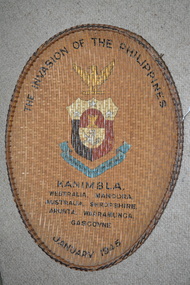 Wangaratta RSL Sub Branch
Memorabilia - Cane Woven Basket Tray, The Invasion of the Philippines, c1945
... Whist not confirmed, this large cane woven oval tray with The Philippines Coat of Arms in the centre above list of Royal Australian Navy ships that were involved in the liberation of the Philippines, is believed to have belonged to Robert Hamilton Hutchieson PM 4802 who served on HMAS Westralia as a landing craft coxswain in the Southwest Pacific Campaign 1942 to 1945. ...Whist not confirmed, this large cane woven oval tray with The Philippines Coat of Arms in the centre above list of Royal Australian Navy ships that were involved in the liberation of the Philippines, is believed to have belonged to Robert Hamilton Hutchieson PM 4802 who served on HMAS Westralia as a landing craft coxswain in the Southwest Pacific Campaign 1942 to 1945. ww2 invasion of the philippines 1945 hmas westralia hmas kanimbla The Invasion of the Philippines Image of Coat of Arms Commonwealth of the Philippines Kanimbla, Westralia, Manoura, Australia, Shropshire, Arunta, Warramunga, Gascoyne January 1945 Large oval shaped cane woven basket tray The Invasion of the Philippines Memorabilia Cane Woven Basket Tray ...In early January 1945, Australian warships took part in their next big naval action of the campaign when American forces were landed at Lingayen Gulf for the invasion of Luzon Island. Their objective was the capital, Manila. The frigates Gascoyne and Warrego carried out survey tasks and escort duties, coming under artillery fire and also attacks from aircraft. The Kanimbla, Manoora and Westralia again transported American troops for the landings and once again the escorts included the cruisers Shropshire and Australia – the latter had undergone repair – and the destroyers Arunta and Warramunga. Whist not confirmed, this large cane woven oval tray with The Philippines Coat of Arms in the centre above list of Royal Australian Navy ships that were involved in the liberation of the Philippines, is believed to have belonged to Robert Hamilton Hutchieson PM 4802 who served on HMAS Westralia as a landing craft coxswain in the Southwest Pacific Campaign 1942 to 1945. Large oval shaped cane woven basket tray The Invasion of the Philippines Image of Coat of Arms Commonwealth of the Philippines Kanimbla, Westralia, Manoura, Australia, Shropshire, Arunta, Warramunga, Gascoyne January 1945ww2, invasion of the philippines, 1945, hmas westralia, hmas kanimbla -
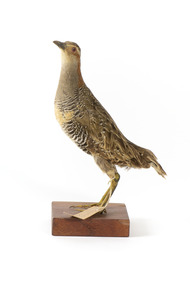 The Beechworth Burke Museum
Animal specimen - Buff-banded rail, Trustees of the Australian Museum, 1860-1880
... This species includes multiple subspecies found across Australasia and the southwest Pacific, with populations in the Philippines, where it is called tikling, and New Guinea, Australia, New Zealand, where it is referred to as the banded rail or moho-pererū in Māori—and various smaller islands. ...This species includes multiple subspecies found across Australasia and the southwest Pacific, with populations in the Philippines, where it is called tikling, and New Guinea, Australia, New Zealand, where it is referred to as the banded rail or moho-pererū in Māori—and various smaller islands. ...The buff-banded rail is a medium-sized bird in the rail family, Rallidae, known for its striking plumage and strong dispersal abilities. This species includes multiple subspecies found across Australasia and the southwest Pacific, with populations in the Philippines, where it is called tikling, and New Guinea, Australia, New Zealand, where it is referred to as the banded rail or moho-pererū in Māori—and various smaller islands. This specimen was misidentified as an Australian Spotted Crake in original catalogue records and is part of a collection of almost 200 animal specimens that were originally acquired as skins from various institutions across Australia, including the Australian Museum and the National Museum of Victoria, as well as individuals such amateur anthropologist Reynell Eveleigh Johns between 1860-1880. These skins were then mounted by members of the Burke Museum Committee and put-on display in the formal space of the Museum’s original exhibition hall where they continue to be on display. This display of taxidermy mounts initially served to instruct visitors to the Burke Museum of the natural world around them, today it serves as an insight into the collecting habits of the 19th century. This specimen is part of a significant and rare taxidermy mount collection in the Burke Museum. This collection is scientifically and culturally important for reminding us of how science continues to shape our understanding of the modern world. They demonstrate a capacity to hold evidence of how Australia’s fauna history existed in the past and are potentially important for future environmental research. This collection continues to be on display in the Museum and has become a key part to interpreting the collecting habits of the 19th century.This specimen is a small, stocky bird with yellow legs and bill. The Buff-banded Rail has grey colouring on its neck and an orange on the nape of its neck. The torso and rear are striped with black and grey/cream colours and have white spots along the rear. The specimen has brown feathers on the wings. It stands on a wooden platform in a standing position with a paper identification tag tied around its left leg. 19c Spotted Water Crake. See Catalogue, Page, 35.taxidermy mount, taxidermy, animalia, burke museum, beechworth, australian museum, skin, reynell eveleigh johns, bird, spotted crake, crake, australian birds, australian spotted crake, buff-banded rail -
 Flagstaff Hill Maritime Museum and Village
Postcard - Local Postcards, Joseph Jordan Photographic Studio, Nov 1908 - early 1909
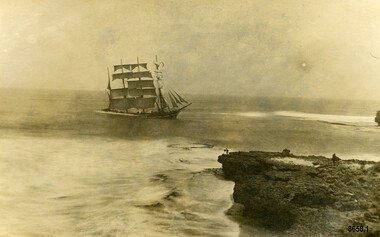
... Size: Length 83.87m x Breadth 12.6m x Depth 7.23m, Gross tonnage 2085 ton Wrecked: the night of 14th November 1908, Curdies Inlet, Peterborough southwest Victoria Crew: 29 The Falls of Halladale was a four-masted sailing ship built-in 1886 in Glasgow, Scotland, for the long-distance cargo trade and was mostly used for Pacific grain trade. ...Size: Length 83.87m x Breadth 12.6m x Depth 7.23m, Gross tonnage 2085 ton Wrecked: the night of 14th November 1908, Curdies Inlet, Peterborough southwest Victoria Crew: 29 The Falls of Halladale was a four-masted sailing ship built-in 1886 in Glasgow, Scotland, for the long-distance cargo trade and was mostly used for Pacific grain trade. ...ABOUT THE ‘FALLS OF HALLADALE’ (1886 - 1908) Built: in1886 by Russell & Co., Greenock shipyards, River Clyde, Scotland, UK. The company was founded in 1870 (or 1873) as a partnership between Joseph Russell (1834-1917), Anderson Rodger and William Todd Lithgow. During the period 1882-92 Russell & Co., they standardised designs, which sped up their building process so much that they were able to build 271 ships over that time. In 1886 they introduced a 3000 ton class of sailing vessel with auxiliary engines and brace halyard winches. In 1890 they broke the world output record. Owner: Falls Line, Wright, Breakenridge & Co, 111 Union Street, Glasgow, Scotland. Configuration: Four masted sailing ship; iron-hulled barque; iron masts, wire rigging, fore & aft lifting bridges. Size: Length 83.87m x Breadth 12.6m x Depth 7.23m, Gross tonnage 2085 ton Wrecked: the night of 14th November 1908, Curdies Inlet, Peterborough southwest Victoria Crew: 29 The Falls of Halladale was a four-masted sailing ship built-in 1886 in Glasgow, Scotland, for the long-distance cargo trade and was mostly used for Pacific grain trade. She was owned by Wright, Breakenridge & Co of Glasgow and was one of several Falls Line ships, all of which were named after waterfalls in Scotland. The lines flag was of red, blue and white vertical stripes. The Falls of Halladale had a sturdy construction built to carry maximum cargo and able to maintain full sail in heavy gales, one of the last of the ‘windjammers’ that sailed the Trade Route. She and her sister ship, the Falls of Garry, were the first ships in the world to include fore and aft lifting bridges. Previous to this, heavily loaded vessels could have heavy seas break along the full length of the deck, causing serious injury or even death to those on deck. The new, raised catwalk-type decking allowed the crew to move above the deck stormy conditions. This idea is still used today in the most modern tankers and cargo vessels and has proved to be an important step forward in the safety of men at sea. On 4th August 1908, with new sails, 29 crew, and 2800 tons of cargo, the Falls of Halladale left New York, bound for Melbourne and Sydney via the Cape of Good Hope. The cargo on board was valued at £35,000 and included 56,763 tiles of American slate roofing tiles (roof slates), 5,673 coils of barbed wire, 600 stoves, 500 sewing machines, 6,500 gallons of oil, 14,400 gallons of benzene, plumbing iron, 117 cases of crockery and glassware and many other manufactured items. The Falls of Halladale had been at sail for 102 days when, at 3 am on the night of 14th November 1908, under full sail in calm seas with a six knots breeze behind and misleading fog along the coast, the great vessel rose upon an ocean swell and settled on top of a submerged reef near Peterborough on south-west Victoria’s coast. The ship was jammed on the rocks and began filling with water. The crew launched the two lifeboats and all 29 crew landed safely on the beach over 4 miles away at the Bay of Islands. The postmistress at Peterborough, who kept a watch for vessels in distress, saw the stranding and sent out an alert to the local people. A rescue party went to the aid of the sailors and the Port Campbell rocket crew was dispatched, but the crew had all managed to reach shore safely by the time help arrived. The ship stayed in full sail on the rocky shelf for nearly two months, attracting hundreds of sightseers who watched her slowly disintegrate until the pounding seas and dynamiting by salvagers finally broke her back, and her remains disappeared back into deeper water. The valuable cargo was largely lost, despite two salvage attempts in 1908-09 and 1910. Further salvage operations were made from 1974-1986, during which time 22,000 slate tiles were recovered with the help of 14 oil drums to float them, plus personal artefacts, ship fittings, reams of paper and other items. The Court of Marine Inquiry in Melbourne ruled that the foundering of the ship was entirely due to Captain David Wood Thomson’s navigational error, not too technical failure of the Clyde-built ship. The shipwreck is a popular site for divers, about 300m offshore and in 3 – 15m of water. Some of the original cargo can be seen at the site, including pieces of roof slate and coils of barbed wire. These 5 postcards have photographic images taken while the Falls of Halladale was stuck on the reef near Peterborough. They are not stamped or dated but four of the images show the ship still in fairly good condition with her stern very low in the water so can be dated to around late November 1908 to January 1909 and the fifth image shows the ship beginning to disintegrate soon after. The image on Postcard 8658.3 was taken by Joseph Jordan (a well-known Warrnambool photographer who had his own studio in Liebig Street, Warrnambool). The other four images were supposedly taken by the sender (Bob) and converted to postcards. Amateur photography in Australia in the early 1900's was becoming very popular (and accessible) to the average person. Many newspapers published advertisements and articles about photography and photographic supplies. In 1903 in America, George Eastman designed and marketed the "Model 3A Folding Pocket Kodak" which used postcard-size negatives and provided the average person with a camera with which to make real photo postcards. As they became popular, George Eastman was able to develop and market a wide range of supplies for the amateur photographer to develop and print their own photographs onto a postcard backing at home. Four of the postcards were addressed to "Miss M. Kerr, Leura, Camperdown". Mary Agnes Kerr (1888 - 1943) was the daughter of William and Mary Ann Kerr (nee Spence) who owned "Leura Farm" at Camperdown. Mary Agnes Kerr went on to marry James Young Caldwell (a local tailor and mercer) in 1917. James Yong Caldwell came to Camperdown around 1908 and was employed as a draper. The postcards were signed "Bob". On postcard 5658.2 he has written his name with quotation marks around it - suggesting "Bob" is a nickname. He writes about the weather, meeting a friend, sending fish to Mary Agnes' family and the cargo expected to be washed up on the beach. On postcard 8658.4 he wrote about being busy after the wreck and supplying the shipwrecked crew with boots and pants which suggests "Bob" may be James Caldwell (the mercer and tailor).The Falls of Halladale shipwreck is listed on the Victorian Heritage Register (No. S255). She was one of the last ships to sail the Trade Routes. She is one of the first vessels to have fore and aft lifting bridges. She is an example of the remains of an International Cargo Ship and also represents aspects of Victoria’s shipping industry. The wreck is protected as a Historic Shipwreck under the Commonwealth Historic Shipwrecks Act (1976). These postcards are significant as examples of the continued interest the locals around the district of Peterborough showed towards the Falls of Halladale wreck and its disintegration during the next few months. Four of the postcards are also significant examples of the new hobby of photography that was available to the average person during the beginning of the 20th century.Set of 5 postcards showing different images of the Falls of Halladale sailing ship after it became stuck on a reef near Peterborough. None of the postcards are dated or stamped. Postcard 8658.1 has a sepia toned image of the Falls of Halladale, with its stern sitting very low in the water. It has many of its sails unfurled and there is a rocky headland in the foreground. A very small figure appears to be on the edge of the cliff. The back of the postcard has a handwritten message addressed to "Miss M Kerr, Leura, Camperdown" and is signed "Love Bob". Postcard 8658.2 has a sepia image of the Falls of Halladale taken some months after it had been stuck on the reef. Its sails are missing and only two broken masts remain. A large rock is visible in the front right hand side of the photo. There is a handwritten message on the back signed by "Bob". Postcard 8658.3 has a black and white image of the Falls of Halladale showing her almost side on with her stern very low in the water and still in full sail. The words "Falls of Halladale. No 1" are printed on the lower left side of the image. The back is labelled "Jordan Series". There is no message written on the back. Postcard 8658.4 has a sepia toned image of the Falls of Halladale facing two rocky headlands. She is showing full sail and the sea appears calm. There is a handwritten note on the back addressed to "Miss M Kerr" from "Bob". Postcard 8658.5 has a sepia image of a side view of the Falls of Halladale with her stern very low in the water and her sails are all up. The sea is calm and a rocky reef can be seen in the foreground. It has a handwritten note on the back from "Bob" to "Miss M Kerr" of Leura, Camperdown.Back of postcard 8658.1- "POST" "EMPIRE" "CARD" "FOR CORRESPONDENCE" "FOR ADDRESS ONLY" "STAMP" "Miss M Kerr / Leura / Camperdown" "Looking forward to letter today" "Hope fish arrived / allright. Don't / know for sure / what day I will / be going to Town / to buy. Some day / this week / Love Bob Back of postcard 8658.2 - "POST CARD"/ "CORRESPONDENCE" "ADDRESS ONLY" "93"/ "Friday / This is a contrast to the first/ I sent you. Having glorious weather / Saw Saw (Saul)? on Thursday at Peterborough / He is having a grand holiday / Expecting letter on /Tuesday Fondest Love / "Bob" Front of postcard 8658.3 - "Falls of Halladale. No 1" Back of postcard 8658.3 -"Post" "Card"/ Printed in Great Britain" /"This space may be used for Communication" "The Address to be written / here" "Jordan Series" Back of postcard 8658.4 -"POST" "EMPIRE" "CARD"/ "FOR CORRESPONDENCE" "FOR ADDRESS ONLY" / "STAMP" "Miss M Kerr/ Leura / Camperdown"/ "We are/ very busy. The / wreck is about / 11/2 other side of / Peterborough./ Fondest Love, Bob "Had to supply sailors with Boots Pants etc/ 25 pairs Boots, good order ah!" Back of postcard 8658.5 - "POST" "EMPIRE" "CARD" / "FOR CORRESPONDENCE" "FOR ADDRESS ONLY" / "STAMP"/ "Miss M Kerr / Leura / Camperdown" "Tuesday / Her estimated / value cargo included/ is (pounds)100,000. When / she breaks up the coast / will be strewn with / wreckage as the cargo / includes Rolls Paper./all sorts machinery thousands / cases Benzine etc/ love Bob flagstaff hill maritime museum and village, warrnambool, peterborough, great ocean road, falls of halladale, shipwreck, postcards, photographic images, mary agnes kerr, leura farm, camperdown, jordan series, handwritten notes, photographs, george eastman, 3a folding pocket kodak camera -
 Queenscliffe Maritime Museum
Painting - Mariposa, Dacre Smyth, SS Mariposa
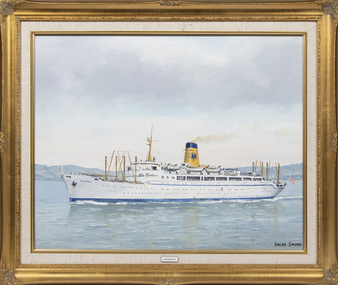
... The thirteen officers selected by the War Department to form the core of what was to become MacArthur's headquarters in the Southwest Pacific Area Command being formed in Australia as United States Army Forces in Australia (USAFIA), known as the "Remember Pearl Harbor" Group, were embarked in Coolidge and Mariposa. ...SS Mariposa was a luxury ocean liner launched in 1931, one of four ships in the Matson Lines "White Fleet", which included SS Monterey, SS Malolo, and SS Lurline. She was later renamed SS Homeric. Mariposa was designed for service in the Pacific Ocean, including regular stops in ports along the West Coast of the United States, Hawaii, Samoa, Fiji, New Zealand, and Australia. On the 12th January 1942 the Mariposa left San Francisco in the "Australian — Suva" convoy escorted by two destroyers and the light cruiser and with two other troopships (destined for Suva). This was the first large convoy to Australia after Pearl Harbor with Mariposa transporting Army personnel, ammunition and fifty P-40 fighters intended for the Philippines and Java.Mrs B SmythAn oil painting of the SS Mariposa in an ornate gold frame. Mariposamigrant ships, ss mariposa, wwii
