
Showing 1443 items matching "the wattles"
-
 Whitehorse Historical Society Inc.
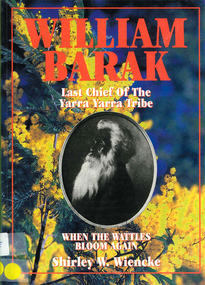
Book, When the wattles bloom again, 1984
... When the wattles bloom again...When the wattles bloom again : the life and times of William Barak, last chief of the Yarra Tribe, by Shirley W. ...Wiencke When the wattles bloom again Book Book ...When the wattles bloom again : the life and times of William Barak, last chief of the Yarra Tribe, by Shirley W. WienckeWhen the wattles bloom again : the life and times of William Barak, last chief of the Yarra Tribe, by Shirley W. WienckeWhen the wattles bloom again : the life and times of William Barak, last chief of the Yarra Tribe, by Shirley W. Wienckebarak, william, aborigines -
 Whitehorse Historical Society Inc.
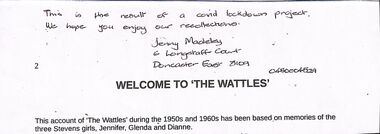
Literary work, The Wattles, 2020
... The Wattles..."The Wattles" was the family home and orchard of the Stevens family, East Burwood. ..."The Wattles" was the family home and orchard of the Stevens family, East Burwood. ...This account of "The Wattles" during the 1950's and 1960's has been based on memories of the 3 Stevens girls, Jennifer, Glenda and Dianne14 pages and 19.5 x 7 notenon-fictionThis account of "The Wattles" during the 1950's and 1960's has been based on memories of the 3 Stevens girls, Jennifer, Glenda and Dianneblue moon fruit cooperative ltd, mount pleasant methodist church, schwerkolt cottage & museum complex, stevens family -
 Victorian Aboriginal Corporation for Languages
Book, Shirley W Wiencke, When the wattles bloom again : the life and times of William Barak, last chief of the Yarra Yarra tribe, 1984
... When the wattles bloom again : the life and times of William Barak, last chief of the Yarra Yarra tribe...Woi wurrung William Barak Yarra Yarra colour photographs, b&w illustrations, document reproductions Biography of William Barak, including cultural notes on the Woi wurrung Wurundjeri people. When the wattles bloom again : the life and times of William Barak, last chief of the Yarra Yarra tribe Book Shirley W Wiencke ...Biography of William Barak, including cultural notes on the Woi wurrung Wurundjeri people.colour photographs, b&w illustrations, document reproductionswoi wurrung, william barak, yarra yarra -
Dandenong & District Historical Society
Book, When The Wattles Bloom Again
... When The Wattles Bloom Again...The Life and Times of William Barak Last Chief of the Yarra Yarra Tribe The Life and Times of William Barak Last Chief of the Yarra Yarra Tribe Soft Cover - Excellent Condition When The Wattles Bloom Again Book ...Soft Cover - Excellent Conditionnon-fiction -
 Warrnambool and District Historical Society Inc.
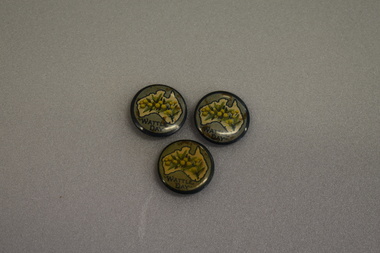
Badges, Wattle Day
... Wattle Day...Wattle Day was established in Melbourne, Sydney and Adelaide in 1910 and the wattle symbol was a strong one for servicemen serving overseas in World War One and wattle badges and pins were used to raise funds for funds such organisations as the Red Cross.....1 circular metal concave badge featuring a cream map of Australia with dark green outline. An image of wattle flowers and leaves is in the centre of the map. ....1 WATTLE DAY .2 WATTLE DAY .3 WATTLE DAY...Wattle Day was established in Melbourne, Sydney and Adelaide in 1910 and the wattle symbol was a strong one for servicemen serving overseas in World War One and wattle badges and pins were used to raise funds for funds such organisations as the Red Cross. ...These badges appear to have been issued as part of Wattle Day celebrations in the period 19910 to 1919. The use of wattle as an Australian symbol was strong during the pre- Federation and Federation days and was particularly promoted by the Australian Natives Association, a prominent campaigner for Federation. Wattle Day was established in Melbourne, Sydney and Adelaide in 1910 and the wattle symbol was a strong one for servicemen serving overseas in World War One and wattle badges and pins were used to raise funds for funds such organisations as the Red Cross.These badges are of interest as an example of the strong national sentiment engendered on Australia by World War One..1 circular metal concave badge featuring a cream map of Australia with dark green outline. An image of wattle flowers and leaves is in the centre of the map. Surrounding the map is a pale green border with text. The edge is dark green. It has a pin clip on the reverse. .2 As above .3 As above .1 WATTLE DAY .2 WATTLE DAY .3 WATTLE DAY -
 Halls Gap & Grampians Historical Society
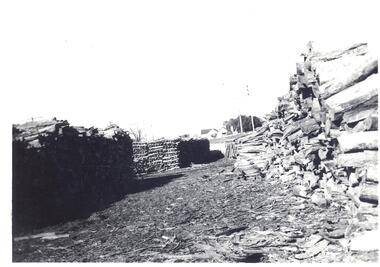
Photograph - B/W
... Reverse----- Stacks of wattle bark bundles...Black and White photo showing stacks of bundled wattle bark ready for transporting to mill. ...Reverse----- Stacks of wattle bark bundles...Reverse----- Stacks of wattle bark bundles TIMBER INDUSTRIES Wattlebark stripping Reverse----- Stacks of wattle bark bundles Black and White photo showing stacks of bundled wattle bark ready for transporting to mill. ...Reverse----- Stacks of wattle bark bundlesBlack and White photo showing stacks of bundled wattle bark ready for transporting to mill. Weather board house in far distance.Reverse----- Stacks of wattle bark bundlestimber industries, wattlebark stripping -
 Whitehorse Historical Society Inc.
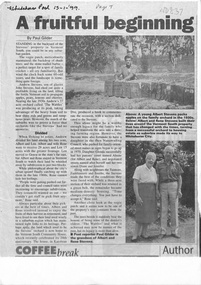
Newspaper - Article, A Fruitful beginning, 13/01/1999
... the wattles...Article on former Stevens orchard are 'The Wattles' in Vermont South. Whitehorse Post 13 January 1999....Article on former Stevens orchard are 'The Wattles' in Vermont South. Whitehorse Post 13 January 1999. ...'A Fruitful beginning' by Paul Gilder. Article on former Stevens orchard are 'The Wattles' in Vermont South. Whitehorse Post 13 January 1999.the wattles, vermont south, stevens, albert, rene, andrew, gilder, paul, alrene court, glenda court, jennifer court, dianne grove -
 Kew Historical Society Inc
Badge - Fundraising Button, Australian Natives Association, Wattle Day, 1914
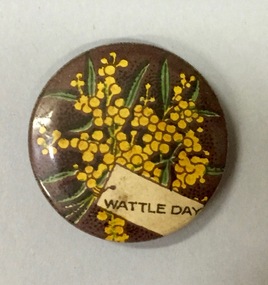
... Wattle Day...wattle day...For each Wattle Day different designs were chosen. This design features sprigs of wattle on a brown background...."Wattle Day"...For each Wattle Day different designs were chosen. This design features sprigs of wattle on a brown background. ...Frances Rigg was a local business identity in Kew, at one stage managing the local branch of the English, Scottish and Australian (ES&A) Bank at 175 High Street from c. 1920 until the 1940s. After Francis Rigg’s death, the collection of buttons and medallions was inherited by his son, Ken Rigg (1922-2014). The collection was subsequently donated to the Kew Historical Society in 2015 by Francis' grandson, Adrian Rigg, at the time of the Gallipoli & Beyond Commemoration in 2015. The collection covers a period of almost 40 years. The majority of the buttons are patriotic buttons, issued and sold during and immediately after the First World World War (1914-1918) to raise funds for national and overseas causes. The collection also includes a number of locally significant sporting event buttons and sporting club medallions, issued in the 1920s and 1930s.Patriotic and other pressed tin buttons and badges were produced in large numbers in the first decades of the twentieth century. By nature, insubstantial and ephemeral, they have not always survived. The collections of badges, buttons and medallions in the Kew Historical Society collection is homogenous and yet diverse, ranging from buttons sold to raise funds for the war efforts in 1914-18 and 1939-45, to those used at festivals and sporting events. Because of the manufacturing process, many surviving buttons and badges have been affected by inadequate storage, suffering from oxidisation and physical damage. These survivors are now historically and socially significant artefacts, revealing much about the attitudes and values of the period in which they were produced. Their widespread distribution means that they are frequently significant at a local, state, national and international level.A circular pressed metal fundraising button that was produced at the beginning of World War 1. ‘Wattle Day’ was celebrated before, during and after the War. For each Wattle Day different designs were chosen. This design features sprigs of wattle on a brown background."Wattle Day"wattle day, patriotic buttons, first world war (1914-18), badges -
 Kew Historical Society Inc
Badge - Fundraising Button, Australian Natives Association, Wattle Day, 1914-1919
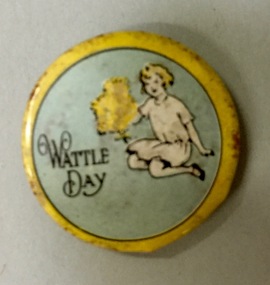
... Wattle Day......wattle day...A yellow and blue ‘Wattle Day’ badge featuring a seated girl holding a bouquet of wattle. ..."Wattle Day"...Their widespread distribution means that they are frequently significant at a local, state, national and international level. patriotic buttons wattle day first world war (1914-18) badges "Wattle Day" A yellow and blue ‘Wattle Day’ badge featuring a seated girl holding a bouquet of wattle. ...Frances Rigg was a local business identity in Kew, at one stage managing the local branch of the English, Scottish and Australian (ES&A) Bank at 175 High Street from c. 1920 until the 1940s. After Francis Rigg’s death, the collection of buttons and medallions was inherited by his son, Ken Rigg (1922-2014). The collection was subsequently donated to the Kew Historical Society in 2015 by Francis' grandson, Adrian Rigg, at the time of the Gallipoli & Beyond Commemoration in 2015. The collection covers a period of almost 40 years. The majority of the buttons are patriotic buttons, issued and sold during and immediately after the First World World War (1914-1918) to raise funds for national and overseas causes. The collection also includes a number of locally significant sporting event buttons and sporting club medallions, issued in the 1920s and 1930s.Patriotic and other pressed tin buttons and badges were produced in large numbers in the first decades of the twentieth century. By nature, insubstantial and ephemeral, they have not always survived. The collections of badges, buttons and medallions in the Kew Historical Society collection is homogenous and yet diverse, ranging from buttons sold to raise funds for the war efforts in 1914-18 and 1939-45, to those used at festivals and sporting events. Because of the manufacturing process, many surviving buttons and badges have been affected by inadequate storage, suffering from oxidisation and physical damage. These survivors are now historically and socially significant artefacts, revealing much about the attitudes and values of the period in which they were produced. Their widespread distribution means that they are frequently significant at a local, state, national and international level.A yellow and blue ‘Wattle Day’ badge featuring a seated girl holding a bouquet of wattle. The first ‘national’ Wattle Day was celebrated in Sydney, Melbourne and Adelaide on 1 September 1910. Public support for Wattle Day peaked during World War I, when it was a potent symbol of home for military personnel serving overseas, and a means of raising money for organisations such as the Red Cross."Wattle Day"patriotic buttons, wattle day, first world war (1914-18), badges -
 Kew Historical Society Inc
Badge - Fundraising Button, Australian Natives Association, Wattle Day, 1914-1919
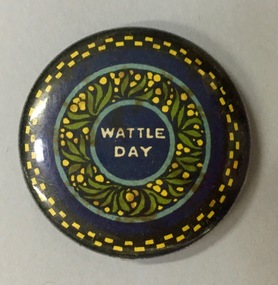
... Wattle Day...wattle day...This round ‘Wattle Day’ button is edged with a green and yellow wattle design. ..."Wattle Day"...Their widespread distribution means that they are frequently significant at a local, state, national and international level. wattle day patriotic buttons first world war (1914-18) "Wattle Day" This round ‘Wattle Day’ button is edged with a green and yellow wattle design. ...Frances Rigg was a local business identity in Kew, at one stage managing the local branch of the English, Scottish and Australian (ES&A) Bank at 175 High Street from c. 1920 until the 1940s. After Francis Rigg’s death, the collection of buttons and medallions was inherited by his son, Ken Rigg (1922-2014). The collection was subsequently donated to the Kew Historical Society in 2015 by Francis' grandson, Adrian Rigg, at the time of the Gallipoli & Beyond Commemoration in 2015. The collection covers a period of almost 40 years. The majority of the buttons are patriotic buttons, issued and sold during and immediately after the First World World War (1914-1918) to raise funds for national and overseas causes. The collection also includes a number of locally significant sporting event buttons and sporting club medallions, issued in the 1920s and 1930s.Patriotic and other pressed tin buttons and badges were produced in large numbers in the first decades of the twentieth century. By nature, insubstantial and ephemeral, they have not always survived. The collections of badges, buttons and medallions in the Kew Historical Society collection is homogenous and yet diverse, ranging from buttons sold to raise funds for the war efforts in 1914-18 and 1939-45, to those used at festivals and sporting events. Because of the manufacturing process, many surviving buttons and badges have been affected by inadequate storage, suffering from oxidisation and physical damage. These survivors are now historically and socially significant artefacts, revealing much about the attitudes and values of the period in which they were produced. Their widespread distribution means that they are frequently significant at a local, state, national and international level.This round ‘Wattle Day’ button is edged with a green and yellow wattle design. It is inscribed with white capital latters on a blue background in the centre. The first ‘national’ Wattle Day was celebrated in Sydney, Melbourne and Adelaide on 1 September 1910. Public support for Wattle Day peaked during World War I, when it was a potent symbol of home for military personnel serving overseas, and a means of raising money for organisations such as the Red Cross."Wattle Day"wattle day, patriotic buttons, first world war (1914-18) -
 Greensborough Historical Society
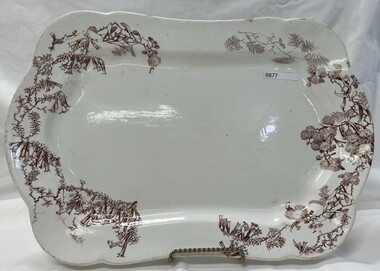
Domestic object - Meat platter, F.G. & Co, Doulton Burslem 'Wattle' Meat Platter, 1892
... Doulton Burslem 'Wattle' Meat Platter...The platter features an Australian theme showing Australian native flowers in 'Wattle' pattern. ...It has a slightly wavy edge with the brown 'wattle' design bordering around the outside of the platter....Marked DOULTON BURSLEM, ENGLAND WATTLE Rg No 188386. Below this is F C & Co. ...The platter features an Australian theme showing Australian native flowers in 'Wattle' pattern. domestic items platter Marked DOULTON BURSLEM, ENGLAND WATTLE Rg No 188386. ...This was manufactured by Doulton at their Burslem factory at Stoke-On-Trent in England and imported by Feldheim Gotthelf & Co who were hardware merchants and importers in Sydney. The registered design number 188386 dates the item to 1892. The platter features an Australian theme showing Australian native flowers in 'Wattle' pattern. White rectangular platter. It has a slightly wavy edge with the brown 'wattle' design bordering around the outside of the platter.Marked DOULTON BURSLEM, ENGLAND WATTLE Rg No 188386. Below this is F C & Co. SYDNEY domestic items, platter -
 Kew Historical Society Inc
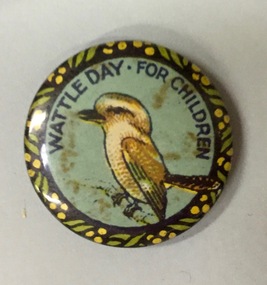
Badge - Fundraising Button, Australian Natives Association, Wattle Day for Children, 1914-1919
... Wattle Day for Children......wattle day...A ‘Wattle Day for Children’ badge, which appropriates national symbols of fauna and flora: a kookaburra and wattle. ..."Wattle Day for Children"...Their widespread distribution means that they are frequently significant at a local, state, national and international level. wattle day for children wattle day francis rigg badge "Wattle Day for Children" A ‘Wattle Day for Children’ badge, which appropriates national symbols of fauna and flora: a kookaburra and wattle. ...Frances Rigg was a local business identity in Kew, at one stage managing the local branch of the English, Scottish and Australian (ES&A) Bank at 175 High Street from c. 1920 until the 1940s. After Francis Rigg’s death, the collection of buttons and medallions was inherited by his son, Ken Rigg (1922-2014). The collection was subsequently donated to the Kew Historical Society in 2015 by Francis' grandson, Adrian Rigg, at the time of the Gallipoli & Beyond Commemoration in 2015. The collection covers a period of almost 40 years. The majority of the buttons are patriotic buttons, issued and sold during and immediately after the First World World War (1914-1918) to raise funds for national and overseas causes. The collection also includes a number of locally significant sporting event buttons and sporting club medallions, issued in the 1920s and 1930s.Patriotic and other pressed tin buttons and badges were produced in large numbers in the first decades of the twentieth century. By nature, insubstantial and ephemeral, they have not always survived. The collections of badges, buttons and medallions in the Kew Historical Society collection is homogenous and yet diverse, ranging from buttons sold to raise funds for the war efforts in 1914-18 and 1939-45, to those used at festivals and sporting events. Because of the manufacturing process, many surviving buttons and badges have been affected by inadequate storage, suffering from oxidisation and physical damage. These survivors are now historically and socially significant artefacts, revealing much about the attitudes and values of the period in which they were produced. Their widespread distribution means that they are frequently significant at a local, state, national and international level.A ‘Wattle Day for Children’ badge, which appropriates national symbols of fauna and flora: a kookaburra and wattle. The circular pressed metal fundraising badge was produced to support the war effort."Wattle Day for Children"wattle day for children, wattle day, francis rigg, badge -
 Kew Historical Society Inc
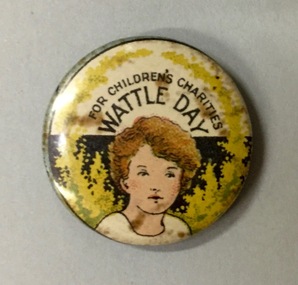
Badge - Fundraising Button, Australian Natives Association, Wattle Day For Children’s Charities, 1914-1920
... Wattle Day For Children’s Charities...wattle day...A ‘Wattle Day’ button featuring the head of a young girl surrounded by sprays of wattle. ...Wattle Day / For Children’s Charities...Their widespread distribution means that they are frequently significant at a local, state, national and international level. wattle day patriotic buttons badges Wattle Day / For Children’s Charities A ‘Wattle Day’ button featuring the head of a young girl surrounded by sprays of wattle. ...Frances Rigg was a local business identity in Kew, at one stage managing the local branch of the English, Scottish and Australian (ES&A) Bank at 175 High Street from c. 1920 until the 1940s. After Francis Rigg’s death, the collection of buttons and medallions was inherited by his son, Ken Rigg (1922-2014). The collection was subsequently donated to the Kew Historical Society in 2015 by Francis' grandson, Adrian Rigg, at the time of the Gallipoli & Beyond Commemoration in 2015. The collection covers a period of almost 40 years. The majority of the buttons are patriotic buttons, issued and sold during and immediately after the First World World War (1914-1918) to raise funds for national and overseas causes. The collection also includes a number of locally significant sporting event buttons and sporting club medallions, issued in the 1920s and 1930s.Patriotic and other pressed tin buttons and badges were produced in large numbers in the first decades of the twentieth century. By nature, insubstantial and ephemeral, they have not always survived. The collections of badges, buttons and medallions in the Kew Historical Society collection is homogenous and yet diverse, ranging from buttons sold to raise funds for the war efforts in 1914-18 and 1939-45, to those used at festivals and sporting events. Because of the manufacturing process, many surviving buttons and badges have been affected by inadequate storage, suffering from oxidisation and physical damage. These survivors are now historically and socially significant artefacts, revealing much about the attitudes and values of the period in which they were produced. Their widespread distribution means that they are frequently significant at a local, state, national and international level.A ‘Wattle Day’ button featuring the head of a young girl surrounded by sprays of wattle. In the design for this fundraising button the purpose of the fundraising – ‘for Children’s Charities’ is emphasised.Wattle Day / For Children’s Charitieswattle day, patriotic buttons, badges -
 Kew Historical Society Inc
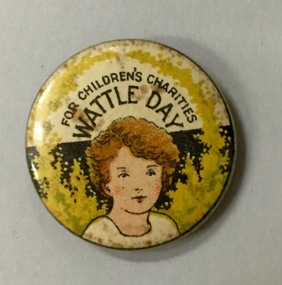
Badge - Fundraising Button, Australian Natives Association, Wattle Day For Children’s Charities, 1914-1920
... Wattle Day For Children’s Charities...wattle day...A ‘Wattle Day’ badge featuring the head of a young girl surrounded by sprays of wattle. ..."Wattle Day: For Children’s Charities"...Their widespread distribution means that they are frequently significant at a local, state, national and international level. wattle day patriotic buttons first world war (1914-18) badges "Wattle Day: For Children’s Charities" A ‘Wattle Day’ badge featuring the head of a young girl surrounded by sprays of wattle. ...Frances Rigg was a local business identity in Kew, at one stage managing the local branch of the English, Scottish and Australian (ES&A) Bank at 175 High Street from c. 1920 until the 1940s. After Francis Rigg’s death, the collection of buttons and medallions was inherited by his son, Ken Rigg (1922-2014). The collection was subsequently donated to the Kew Historical Society in 2015 by Francis' grandson, Adrian Rigg, at the time of the Gallipoli & Beyond Commemoration in 2015. The collection covers a period of almost 40 years. The majority of the buttons are patriotic buttons, issued and sold during and immediately after the First World World War (1914-1918) to raise funds for national and overseas causes. The collection also includes a number of locally significant sporting event buttons and sporting club medallions, issued in the 1920s and 1930s.Patriotic and other pressed tin buttons and badges were produced in large numbers in the first decades of the twentieth century. By nature, insubstantial and ephemeral, they have not always survived. The collections of badges, buttons and medallions in the Kew Historical Society collection is homogenous and yet diverse, ranging from buttons sold to raise funds for the war efforts in 1914-18 and 1939-45, to those used at festivals and sporting events. Because of the manufacturing process, many surviving buttons and badges have been affected by inadequate storage, suffering from oxidisation and physical damage. These survivors are now historically and socially significant artefacts, revealing much about the attitudes and values of the period in which they were produced. Their widespread distribution means that they are frequently significant at a local, state, national and international level.A ‘Wattle Day’ badge featuring the head of a young girl surrounded by sprays of wattle. In the design for this fundraising button the purpose of the fundraising – ‘for Children’s Charities’ is emphasised."Wattle Day: For Children’s Charities"wattle day, patriotic buttons, first world war (1914-18), badges -
Bendigo Historical Society Inc.
Archive - MCCOLL, RANKIN AND STANISTREET COLLECTION: SOUTH WATTLE GULLY COMPANY N/L - MINING BOX, 1930's
... MCCOLL, RANKIN AND STANISTREET COLLECTION: SOUTH WATTLE GULLY COMPANY N/L - MINING BOX...... South Wattle Gully Company N/L...Metal box painted dark blue with South Wattle Gully painted in white on the front. ...South Wattle Gully...MINING Business mining box 15 McColl Rankin & Stanistreet South Wattle Gully Company N/L gold mining mining box South Wattle Gully Mining Box. ...Mining Box. Metal box painted dark blue with South Wattle Gully painted in white on the front. Formerly box number 479 - now South Wattle Gully Mining Box 15. Tag affixed to front 'box 479'. Box contains various documents relating to South Wattle Gully Mine. Documents are individually catalogued within the box.South Wattle Gullymining, business, mining box 15, mccoll, rankin & stanistreet, south wattle gully company n/l, gold mining, mining box -
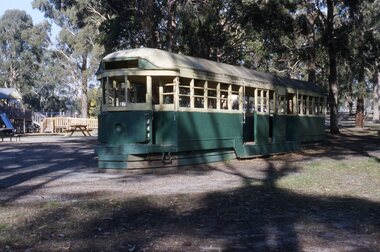 Melbourne Tram Museum
Slide, Ron Scholten, mid 1970's?
... ... Wattle Park...Colour Slide, white black plastic of former tram W2 597 at Wattle Park..."597 Wattle Park"...Trams tramways W2 class Wattle Park Tramcars tram 597 "597 Wattle Park" Colour Slide, white black plastic of former tram W2 597 at Wattle Park Slide Ron Scholten ...Colour Slide, white black plastic of former tram W2 597 at Wattle Park"597 Wattle Park"trams, tramways, w2 class, wattle park, tramcars, tram 597 -
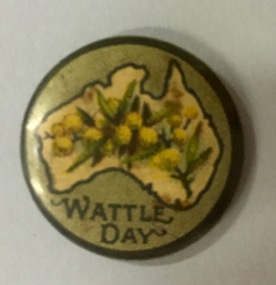 Kew Historical Society Inc
Badge - Fundraising Button, Australian Natives Association, Wattle Day, 1914-1918
... Wattle Day...wattle day...The map includes a symbolic image of wattle sprigs...."Wattle Day"...The map includes a symbolic image of wattle sprigs. Wattle Day Badge Fundraising Button Australian Natives Association ...Frances Rigg was a local business identity in Kew, at one stage managing the local branch of the English, Scottish and Australian (ES&A) Bank at 175 High Street from c. 1920 until the 1940s. After Francis Rigg’s death, the collection of buttons and medallions was inherited by his son, Ken Rigg (1922-2014). The collection was subsequently donated to the Kew Historical Society in 2015 by Francis' grandson, Adrian Rigg, at the time of the Gallipoli & Beyond Commemoration in 2015. The collection covers a period of almost 40 years. The majority of the buttons are patriotic buttons, issued and sold during and immediately after the First World World War (1914-1918) to raise funds for national and overseas causes. The collection also includes a number of locally significant sporting event buttons and sporting club medallions, issued in the 1920s and 1930s.Patriotic and other pressed tin buttons and badges were produced in large numbers in the first decades of the twentieth century. By nature, insubstantial and ephemeral, they have not always survived. The collections of badges, buttons and medallions in the Kew Historical Society collection is homogenous and yet diverse, ranging from buttons sold to raise funds for the war efforts in 1914-18 and 1939-45, to those used at festivals and sporting events. Because of the manufacturing process, many surviving buttons and badges have been affected by inadequate storage, suffering from oxidisation and physical damage. These survivors are now historically and socially significant artefacts, revealing much about the attitudes and values of the period in which they were produced. Their widespread distribution means that they are frequently significant at a local, state, national and international level.‘Wattle Day’ was celebrated nationally for the first time in 1910, even though the term and day had been celebrated in particular states and territories since the 1870s. This patriotic fundraising button depicts a map of Australia on a pale green background. The map includes a symbolic image of wattle sprigs."Wattle Day"wattle day, patriotic buttons, first world war (1914-18), badges -
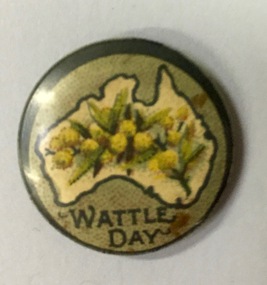 Kew Historical Society Inc
Badge - Fundraising Button, Australian Natives Association, Wattle Day, 1914-1918
... Wattle Day...wattle day...The map includes a symbolic image of wattle sprigs....Wattle Day...The map includes a symbolic image of wattle sprigs. Wattle Day Badge Fundraising Button Australian Natives Association ...Frances Rigg was a local business identity in Kew, at one stage managing the local branch of the English, Scottish and Australian (ES&A) Bank at 175 High Street from c. 1920 until the 1940s. After Francis Rigg’s death, the collection of buttons and medallions was inherited by his son, Ken Rigg (1922-2014). The collection was subsequently donated to the Kew Historical Society in 2015 by Francis' grandson, Adrian Rigg, at the time of the Gallipoli & Beyond Commemoration in 2015. The collection covers a period of almost 40 years. The majority of the buttons are patriotic buttons, issued and sold during and immediately after the First World World War (1914-1918) to raise funds for national and overseas causes. The collection also includes a number of locally significant sporting event buttons and sporting club medallions, issued in the 1920s and 1930s.Patriotic and other pressed tin buttons and badges were produced in large numbers in the first decades of the twentieth century. By nature, insubstantial and ephemeral, they have not always survived. The collections of badges, buttons and medallions in the Kew Historical Society collection is homogenous and yet diverse, ranging from buttons sold to raise funds for the war efforts in 1914-18 and 1939-45, to those used at festivals and sporting events. Because of the manufacturing process, many surviving buttons and badges have been affected by inadequate storage, suffering from oxidisation and physical damage. These survivors are now historically and socially significant artefacts, revealing much about the attitudes and values of the period in which they were produced. Their widespread distribution means that they are frequently significant at a local, state, national and international level.‘Wattle Day’ was celebrated nationally for the first time in 1910, even though the term and day had been celebrated in particular states and territories since the 1870s. This patriotic fundraising button depicts a map of Australia on a pale green background. The map includes a symbolic image of wattle sprigs.Wattle Daywattle day, first world war (1914-18), badges -
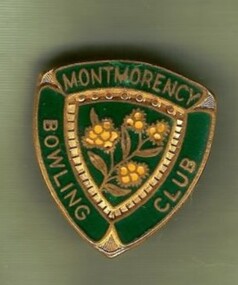 Greensborough Historical Society
Badge - Digital Image, Montmorency Bowling Club, Montmorency Bowling Club badge 1980s, 1980s
... Digital image of enamelled metal badge, green with gold writing and wattle logo. ..."Montmorency Bowling Club" and wattle logo....Part of a collection of miscellaneous historical images with a connection to the local area. badges montmorency bowling club "Montmorency Bowling Club" and wattle logo. Digital image of enamelled metal badge, green with gold writing and wattle logo. ...Digital image of Montmorency Bowling Club badge, circa 1980. Part of a collection of miscellaneous historical images with a connection to the local area.Digital image of enamelled metal badge, green with gold writing and wattle logo. "Montmorency Bowling Club" and wattle logo.badges, montmorency bowling club -
 Northern District School of Nursing. Managed by Bendigo Historical Society Inc.
Photograph - Wattle Street. 1954
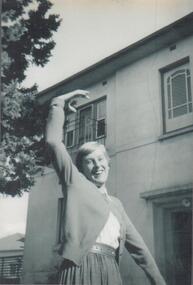
... Wattle Street. 1954...Wattle Street...Photo of PTS nurse at 99 Wattle Street, Bendigo ...Margaret Arnoldt at 99 Wattle St Bendigo 1954 ...It was the first independent school of nursing in Victoria and continued until it closed in 1989. Wattle Street 1954 Margaret Arnoldt at 99 Wattle St Bendigo 1954 Photo of PTS nurse at 99 Wattle Street, Bendigo Photograph Wattle Street. 1954 ...The Northern District School of Nursing opened in 1950 in to address the issues around nurse recruitment, training and education that had previously been hospital based. The residential school was to provide theoretical and in-house education and practical training over three years. The students would also receive practical hands-on training in the wards of associated hospitals. The Northern District School of Nursing operated from Lister House, Rowan Street, Bendigo. It was the first independent school of nursing in Victoria and continued until it closed in 1989.Photo of PTS nurse at 99 Wattle Street, Bendigo Margaret Arnoldt at 99 Wattle St Bendigo 1954 wattle street, 1954 -
 Bay Steamers Maritime Museum
Life Buoy
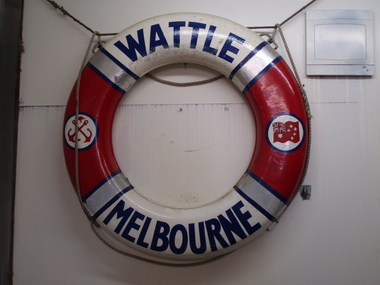
... ...wattle...This ring has either been repainted since Wattle moved from Sydney to Melbourne or was part of the new equipment installed when Wattle was transferred to Melbourne in 1971...Printed on ring "WATTLE / MELBOURNE"...This life saving device was on the steam tug Wattle to be thrown to a person if they fell overboard. ...This life saving device was on the steam tug Wattle to be thrown to a person if they fell overboard. This ring has either been repainted since Wattle moved from Sydney to Melbourne or was part of the new equipment installed when Wattle was transferred to Melbourne in 1971Ring of buoyant material painted in white, red and blue with metal inner rim and metal outer rim with loops for attaching throwing rope. The life buoy is constructed of a foam centre and outer coating of fiberglass. An inner metal rim reinforces the construction while the outer metal rim assists with reinforcement but also provides 4 loops at 2pm, 4pm, 8pm and 10pm locations on the face of a clock. These loops have rope threaded through them to provide hand hold and grips and a method of attaching the life buoy to the boat. Decorated with red and blue lettering and insigniaPrinted on ring "WATTLE / MELBOURNE"melbourne, wattle, insignia, rope, life buoy, life ring, life saving, floating, floatation, steam tug -
 Vision Australia
Award - Text, National Library of Australia, 1996 TDK Australian Audio Book Award: Unabridged Non-Fiction category - Home Before Dark, 1996
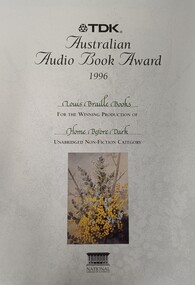
... 1 x A3 sheet with black writing and illustration of wattle...Illustration of wattle by an unknown artist between header and recipient ...Louis Braille Audio Talking books Awards Illustration of wattle by an unknown artist between header and recipient 1 x A3 sheet with black writing and illustration of wattle 1996 TDK Australian Audio Book Award: Unabridged Non-Fiction category - Home Before Dark Award Text National Library of Australia ...To encourage the development of audio books, a series of awards were established by the National Library of Australia in 1988, and sponsored by TDK from 1991 until their demise in 2000. Open to both commercial and non-commercial publishers, it aimed to recognise the quality achievements by individuals and publishing houses and to promote the inclusion of audio books into the mainstream market. In 1996 the winner of the Unabridged Non-Fiction Category was "Home Before Dark" by Louis Braille Books.1 x A3 sheet with black writing and illustration of wattleIllustration of wattle by an unknown artist between header and recipient louis braille audio, talking books, awards -
 Camberwell Historical Society
Drawing (series) - Architectural drawing, 131 Wattle Valley Road, Camberwell, Unknown
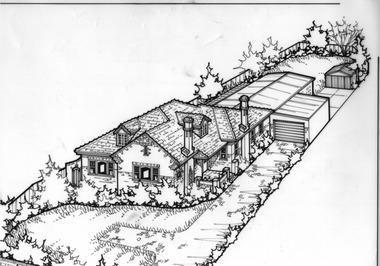
... 131 Wattle Valley Road, Camberwell...Pen and ink architectural drawing on drafting film of 131 Wattle Valley Road, Camberwell by Margaret Picken...131 WATTLE VALLEY RD., CAMBERWELL...The fact that each drawing is dated with the year it was created also proves a valuable record for house historians - since that date a number of the depicted properties have either been altered or demolished. artist architectural drawings margaret picken camberwell houses 131 WATTLE VALLEY RD., CAMBERWELL Pen and ink architectural drawing on drafting film of 131 Wattle Valley Road, Camberwell by Margaret Picken 131 Wattle Valley Road, Camberwell Drawing Architectural drawing ...artist, architectural drawings, margaret picken, camberwell, housesartist, architectural drawings, margaret picken, camberwell, houses -
 Northern District School of Nursing. Managed by Bendigo Historical Society Inc.
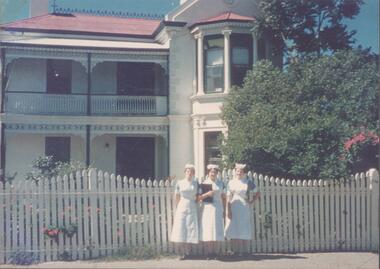
Photograph - Nursing staff outside "Mayfort"
... Three (unnamed) nurses outside "Mayfort", Nurse's accommodation Wattle Street, Bwendigo, the NDSN school's first hostel, View Street. ...Mayfort, Wattle Street...NDSN Nursing Uniforms Mayfort, Wattle Street Three (unnamed) nurses outside "Mayfort", Nurse's accommodation Wattle Street, Bwendigo, the NDSN school's first hostel, View Street. ...The Northern District School of Nursing opened in 1950 in to address the issues around nurse recruitment, training and education that had previously been hospital based. The residential school was to provide theoretical and in-house education and practical training over three years. The students would also receive practical hands-on training in the wards of associated hospitals. The Northern District School of Nursing operated from Lister House, Rowan Street, Bendigo. It was the first independent school of nursing in Victoria and continued until it closed in 1989.Three (unnamed) nurses outside "Mayfort", Nurse's accommodation Wattle Street, Bwendigo, the NDSN school's first hostel, View Street. Colour photograph. Mayfort - nurse's accommodation for trainees during P.T.S. intakes.Mayfort, Wattle Streetndsn, nursing, uniforms -
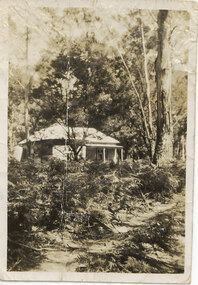 Halls Gap & Grampians Historical Society
Photograph - Sepia, C 1930s - 1940s (?)
... This house was called "The Wattles" and was one of the houses used as "Girls Hut"...."The Wattles" written in pen on rear....This house was called "The Wattles" and was one of the houses used as "Girls Hut". ...The cottage is typical of the holiday houses that could be rented in Halls Gap. This house was called "The Wattles" and was one of the houses used as "Girls Hut".The photo shows a weatherboard cottage set in bush. A sandy path through bracken can be seen in the foreground. There is a tall gum tree in the right of the photo."The Wattles" written in pen on rear.buildings, houses -
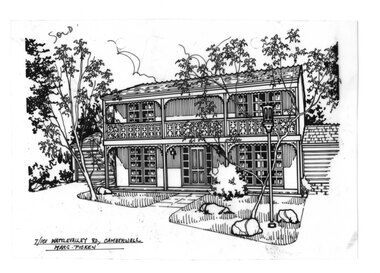 Camberwell Historical Society
Drawing (series) - Architectural drawing, 7/101 Wattle Valley Road, Camberwell, Unknown
... 7/101 Wattle Valley Road, Camberwell...Pen and ink architectural drawing on drafting film of 7/101 Wattle Valley Road, Camberwell by Margaret Picken...7/101 WATTLE VALLEY RD., CAMBERWELL / MARG. PICKEN...The fact that each drawing is dated with the year it was created also proves a valuable record for house historians - since that date a number of the depicted properties have either been altered or demolished. artist architectural drawings margaret picken camberwell houses 7/101 WATTLE VALLEY RD., CAMBERWELL / MARG. PICKEN Pen and ink architectural drawing on drafting film of 7/101 Wattle Valley Road, Camberwell by Margaret Picken 7/101 Wattle Valley Road, Camberwell Drawing Architectural drawing ...artist, architectural drawings, margaret picken, camberwell, housesartist, architectural drawings, margaret picken, camberwell, houses -
 Camberwell Historical Society
Drawing (series) - Architectural drawing, 91 Wattle Valley Road, Camberwell, 2004
... 91 Wattle Valley Road, Camberwell...Pen and ink architectural drawing on drafting film of 91 Wattle Valley Road, Camberwell by Margaret Picken...91 WATTLE VALLEY RD., C'WELL / FLETCHERS / PICKEN (C) 2004...The fact that each drawing is dated with the year it was created also proves a valuable record for house historians - since that date a number of the depicted properties have either been altered or demolished. artist architectural drawings margaret picken camberwell houses 91 WATTLE VALLEY RD., C'WELL / FLETCHERS / PICKEN (C) 2004 Pen and ink architectural drawing on drafting film of 91 Wattle Valley Road, Camberwell by Margaret Picken 91 Wattle Valley Road, Camberwell Drawing Architectural drawing ...artist, architectural drawings, margaret picken, camberwell, housesartist, architectural drawings, margaret picken, camberwell, houses -
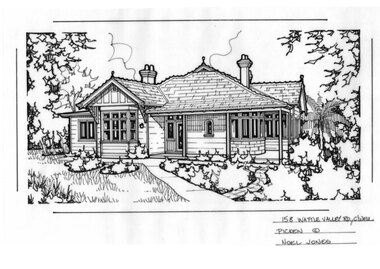 Camberwell Historical Society
Drawing (series) - Architectural drawing, 158 Wattle Valley Road, Camberwell, Unknown
... 158 Wattle Valley Road, Camberwell...Pen and ink architectural drawing on drafting film of 158 Wattle Valley Road, Camberwell by Margaret Picken...158 WATTLE VALLEY RD., C'WELL / PICKEN (C) / NOEL JONES...The fact that each drawing is dated with the year it was created also proves a valuable record for house historians - since that date a number of the depicted properties have either been altered or demolished. artist architectural drawings margaret picken camberwell houses 158 WATTLE VALLEY RD., C'WELL / PICKEN (C) / NOEL JONES Pen and ink architectural drawing on drafting film of 158 Wattle Valley Road, Camberwell by Margaret Picken 158 Wattle Valley Road, Camberwell Drawing Architectural drawing ...artist, architectural drawings, margaret picken, camberwell, housesartist, architectural drawings, margaret picken, camberwell, houses -
 Federation University Art Collection
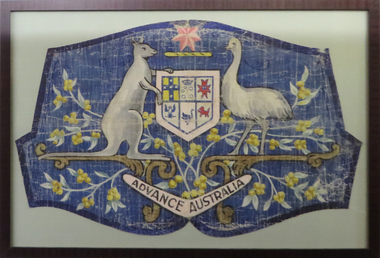
Painting - Acrylic on Canvas, Advance Australia
... ...wattle...Early Wattle Days involved planting wattle trees in school grounds, street decorations of wattle blossom, and wearing sprigs of wattle. ...The Australian coat of arms with wattle, painted onto canvas....Early Wattle Days involved planting wattle trees in school grounds, street decorations of wattle blossom, and wearing sprigs of wattle. ...This artwork was found among items associated with the Ballarat School of Mines. Although its purpose remains unknown, it was possibly painted by a staff member or student for use on Wattle Day. Wattle Day originated in October 1889 by the Wattle Blossom League, and was associated with the Australian Natives Association during the lead up to the Federation of Australian States. The first 'national' Wattle Day was celebrated on 1 September 1910. Early Wattle Days involved planting wattle trees in school grounds, street decorations of wattle blossom, and wearing sprigs of wattle. As public support for Wattle Day peaked, World War I broke out. Wattle took on a new significance during the war years, symbolising home for military personnel serving overseas. Beautifully designed Wattle Day badges, as well as wattle sprigs, were sold as a means of raising money for organisations such as the Red Cross. This item is part of the Federation University Art Collection. The Art Collection features over 1000 works and was listed as a 'Ballarat Treasure' in 2007.The Australian coat of arms with wattle, painted onto canvas.art, artwork, emu, kangaroo, crest, advance australia, wattle day, wattle, coat of arms, patriotic, australian coar of arms, national symbol -
 Camberwell Historical Society
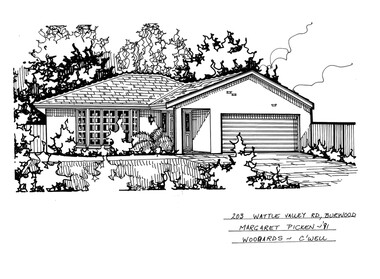
Drawing (series) - Architectural drawing, 203 Wattle Valley Road, Burwood, 2002
... 203 Wattle Valley Road, Burwood...Pen and ink architectural drawing on drafting film of 203 Wattle Valley Road, Burwood by Margaret Picken...203 WATTLE VALLEY RD., BURWOOD / MARGARET PICKEN - '91 / WOODARDS - C'WELL...The fact that each drawing is dated with the year it was created also proves a valuable record for house historians - since that date a number of the depicted properties have either been altered or demolished. artist architectural drawings margaret picken camberwell houses 203 WATTLE VALLEY RD., BURWOOD / MARGARET PICKEN - '91 / WOODARDS - C'WELL Pen and ink architectural drawing on drafting film of 203 Wattle Valley Road, Burwood by Margaret Picken 203 Wattle Valley Road, Burwood Drawing Architectural drawing ...artist, architectural drawings, margaret picken, camberwell, housesartist, architectural drawings, margaret picken, camberwell, houses
