
Showing 93 items matching "the western front 1916"
-
 National Vietnam Veterans Museum (NVVM)
Memorabilia, Australians on the Western Front 1916: 2006 Memorabilia
... Australians on the Western Front 1916: 2006 Memorabilia...Also contains photos of Australian forces on the Western Front in 1916...Memorabilias Australia - Armed Forces - History Also contains photos of Australian forces on the Western Front in 1916 Australians on the Western Front 1916: 2006 Memorabilia Memorabilia Memorabilia Dept. of Veterans Affairs ...Also contains photos of Australian forces on the Western Front in 1916memorabilias, australia - armed forces - history -
 Bendigo Military Museum
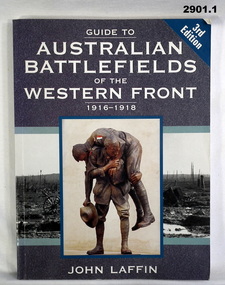
Book - BOOK, BATTLEFIELDS, Kangaroo Press, Australian Battlefields of the Western Front 1916-1918
... Australian Battlefields of the Western Front 1916-1918...Australian Battlefields of the Western Front 1916-1918 Book BOOK, BATTLEFIELDS Kangaroo Press Australian War Memorial ....1) Soft card cover with black & white photo of battlefield on front & back. Coloured photo of soldier carrying a wounded comrade over his shoulder. History of Author, John Laffin on back cover. 204 pages black & white with photos & maps. Complete history covering cemeteries, battlefields, commemorations, etc. .2) - .6) Tourist Information in Belgium, French & English.“3rd Edition on front cover”books - military history, battlefields -
 4th/19th Prince of Wales's Light Horse Regiment Unit History Room
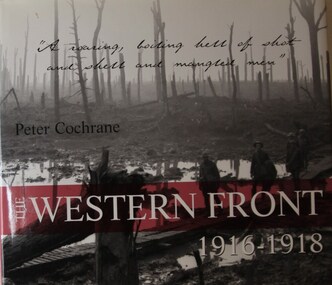
Book, J Williams, Peter Cochrane: The Western Front 1916-1918, 2004 (exact)
... Peter Cochrane: The Western Front 1916-1918,...western front peter cochrane abc books Hardcover Book. A presentation of photography of the Western Front, written and compiled by historian, Peter Cochrane. ABC Books, ISBN 0-7333-1280-2. Published April 2004. Peter Cochrane: The Western Front 1916 ...Hardcover Book. A presentation of photography of the Western Front, written and compiled by historian, Peter Cochrane. ABC Books, ISBN 0-7333-1280-2. Published April 2004.photography, world war 1, australian war memorial, western front, peter cochrane, abc books -
 Eltham District Historical Society Inc
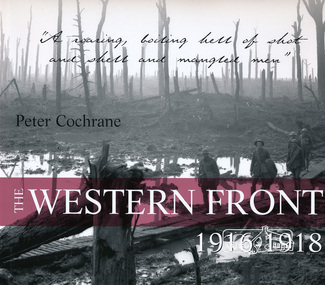
Book, ABC Books for the Australian Broadcasting Corporation, The Western Front 1916-1918 by Peter Cochrane, 2004
... The Western Front 1916-1918 by Peter Cochrane...Western Front, WW1 - the scene of some of the bloodiest horrors and the greatest loss of life. Australian photographer." --Publisher's description. world war 1914-1918 australian imperial force anzacs military campaigns western front ISBN 0733312802 138 pages : illustrations, portraits, map The Western Front 1916-1918 by Peter Cochrane Book ABC Books for the Australian Broadcasting Corporation ..."Using both official and unofficial photos, this is a powerful visual record of the ANZAC experience of the Western Front, WW1 - the scene of some of the bloodiest horrors and the greatest loss of life. Australian photographer." --Publisher's description.138 pages : illustrations, portraits, map ISBN 0733312802world war 1914-1918, australian imperial force, anzacs, military campaigns, western front -
 Monbulk RSL Sub Branch
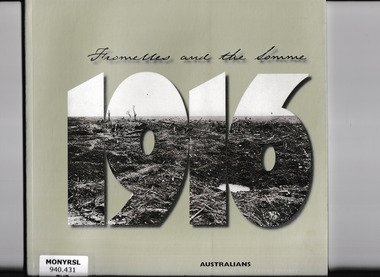
Book, Department of Veterans' Affairs, Fromelles and the Somme: Australians on the Western Front - 1916, 2006
... Fromelles and the Somme: Australians on the Western Front - 1916...Fromelles and the Somme: Australians on the Western Front - 1916 Book Department of Veterans' Affairs Peter Burness ...The first Australians arrived in France in 1916 and were immediately involved in the battles of Fromelles and the Somme.Ill, p.80.non-fictionThe first Australians arrived in France in 1916 and were immediately involved in the battles of Fromelles and the Somme.world war 1914-1917 - western front - australian invilvement, battles of fromelles and somme -
 Bendigo Historical Society Inc.
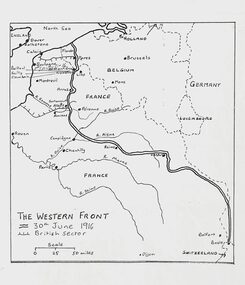
Map - Jack Lockett Collection: Copies of two maps of WW1 Battles
... ...The Western Front 1916...After training in both Australia and Britain, the 38th Battalion crossed to France in late November 1916 and moved into the trenches of the Western Front for the first time on 1 December.The 38th fought in its first major battle at Messines, in Belgium, between 7-9 June 1917. ...One side labeled THE WESTERN FRONT 30th June 1916 British Sector Scale 1 inch to 50 miles. ...One side labeled THE WESTERN FRONT 30th June 1916 British Sector Scale 1 inch to 50 miles. ...John Henry Lockett OAM (22 January 1891 – 25 May 2002) was the oldest man ever in Australia when he died aged 111 years, 123 days. As one of the last surviving veterans of World War I, he was acclaimed as a national hero during the last decade of his life. Lockett was born in the small Victorian town of Waanyarra, near Bendigo. He left school aged nine to work on a local farm. Later, he worked for his uncles in the Mallee. On 24 March 1916, he travelled to Mildura to enlist in the Australian Imperial Force. He served in France with the 38th Battalion, earning promotion to sergeant and was discharged on 20 September 1919. https://en.wikipedia.org/wiki/Jack_Lockett The 38th Battalion was formed on 1 March 1916 at a camp established on the Epsom Racecourse at Bendigo in Victoria. After training in both Australia and Britain, the 38th Battalion crossed to France in late November 1916 and moved into the trenches of the Western Front for the first time on 1 December.The 38th fought in its first major battle at Messines, in Belgium, between 7-9 June 1917. It fought in another two major attacks in this sector - the battle of Broodseinde on 4 October, and the battle of Passchendaele on 12 October. Belgium remained the focus of the 38th Battalion's activities for the next five months, until it was rushed south to France in late March 1918 to meet the German Army's Spring Offensive. The 38th participated in its last major action of the war between 29 September and 2 October 1918 as part of the Australian-American operation that breached the formidable defences of the Hindenburg Line along the St Quentin Canal. It was disbanded in April 1919. Source, Australian War Memorial https://www.awm.gov.au/collection/U51478 After the war, Jack returned to The Mallee and selected a 640 acres (260 ha) block of land in Linga, Victoria, deciding to make his living as a farmer. In 1923, he married Maybell Ingwerson and they had four children together. In 1963, the couple retired to Bendigo, leaving the farmland (which now covered more than 130,000 acres (53,000 ha), in the care of their children and grandchildren. Two photocopies of hand drawn maps on one A4 sheet of paper. One side labeled THE WESTERN FRONT 30th June 1916 British Sector Scale 1 inch to 50 miles. The Western Front spans from the North Sea to Switzerland. The other side is labeled POZIERES scale 1 inch to 500 yards. July to September 1916. There are numerous roads and trench lines. jack lockett, mabel ingwersen, 38th australian infantry battalion, w.w.1, mallee farming, pozieres 1916, the western front 1916 -
 8th/13th Victorian Mounted Rifles Regimental Collection
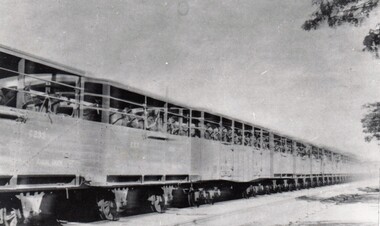
Photograph
... Probably taken in France during the move of the 13 ALH from Marsailles to the Western Front 1916....Probably taken in France during the move of the 13 ALH from Marsailles to the Western Front 1916. Photograph ...The 13th Light Horse Regiment (AIF) was raised t Broadmeadows Victoria in March 1915. Following service at Gallipoli the regiment was broken up with squadrons going to France as Divisional Cavalry Squadrons of 2nd, 4th and 5ht Divisions. The regiment was reformed as firstly 1st Anzac Corps Mounted Troops and lather Australian Corps Mounted TroopsBlack and white photograph of horses in rail wagons. Probably taken in France during the move of the 13 ALH from Marsailles to the Western Front 1916. -
 Uniting Church Archives - Synod of Victoria
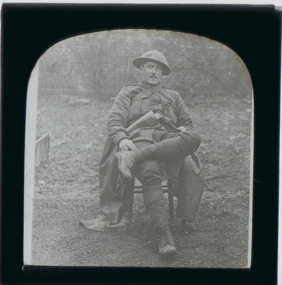
Negative - Glass plate negative, Unknown WWI soldier, 1916 - 1918
... The soldier is wearing the Brodie pattern steel helmet issued to Australian soldiers on the Western Front 1916 - 1918....The soldier is wearing the Brodie pattern steel helmet issued to Australian soldiers on the Western Front 1916 - 1918. Unknown WWI soldier Negative Glass plate negative ...Glass negative with image of unidentified seated soldier. The soldier is wearing the Brodie pattern steel helmet issued to Australian soldiers on the Western Front 1916 - 1918.first world war, ww1, world war one -
 Dandenong/Cranbourne RSL Sub Branch
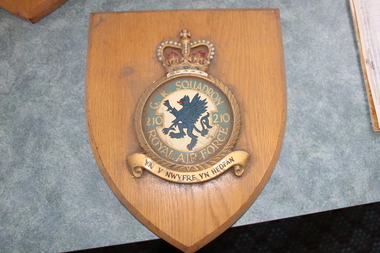
Plaque - 210 Squadron RAF Plaque
... Serving on the Western Front 1916 - 1918. Ypres 1917. Battle of Lys. 1918. ...Serving on the Western Front 1916 - 1918. Ypres 1917. Battle of Lys. 1918. ...The 210 Squadron was founded on the 1st April 1918. Serving on the Western Front 1916 - 1918. Ypres 1917. Battle of Lys. 1918. The Atlantic 1939 - 1945. The Arctic 1945. The unit was disbanded at Ballykelly on the 15th November 1971.Wooden plaque with Squadron badge of No: 210 Squadron R A F.Circular blue coloured badge below Crown. Squadron 210 Royal Air Force around inside of circle. The Welsh phrase " YN Y NWFRE YN HEDFAN " in ribbon below circle. This poetic phrase translates directly to " Hovering in the heavens " or "Flying in the Sky." -
 Whitehorse Historical Society Inc.
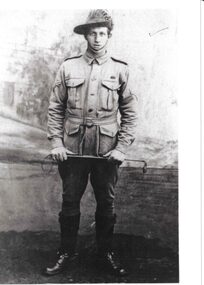
Photograph - Black and white photo, William Lional Schwerkolt
... Served at Gallipoli and Western Front. Died in 1916 in action....Served at Gallipoli and Western Front. Died in 1916 in action. William Lional Schwerkolt Photograph Black and white photo ...William Schwerkolt in WW1 uniform. Served at Gallipoli and Western Front. Died in 1916 in action.william schwerkolt, ww1 -
 Warrnambool RSL Sub Branch
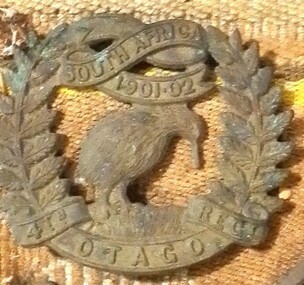
Uniform - Cap Badge, 4th Otago Regiment
... An infantry regiment, it served within the New Zealand Expeditionary Force (NZEF) in World War I during the Gallipoli Campaign (1915) and on the Western Front (1916–1919) ...An infantry regiment, it served within the New Zealand Expeditionary Force (NZEF) in World War I during the Gallipoli Campaign (1915) and on the Western Front (1916–1919) Banner above reads ‘South Africa 1901-1902, banner below reads ‘4th Otago Regt’. ...Banner above reads ‘South Africa 1901-190 (refers to 4th Contingent of NZ Mounted Rifles which served in the Boer War), banner below reads ‘4th Otago Regt’. An infantry regiment, it served within the New Zealand Expeditionary Force (NZEF) in World War I during the Gallipoli Campaign (1915) and on the Western Front (1916–1919) Oval Badge (3.0 X 4.0 cm) Banner above reads ‘South Africa 1901-1902, banner below reads ‘4th Otago Regt’. Centre Kiwi Image. Outside, NZ Ferns Wreath. -
 8th/13th Victorian Mounted Rifles Regimental Collection
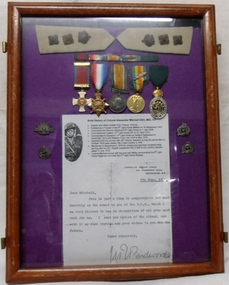
Memorabilia - Mitchell medals etcet
... Commanded B Squadron 13th LH at Gallipoli September - December 1915 and on Western Front July 1916 to May 1918. Seconded to 28th Infantry Battalion AIF western Front May - October 1918. ...Commanded B Squadron 13th LH at Gallipoli September - December 1915 and on Western Front July 1916 to May 1918. Seconded to 28th Infantry Battalion AIF western Front May - October 1918. ...Alexander Mitchell, grazier and citizen soldier of Thoona Victoria. Enlisted as a trooper in 8th Light Horse CMF 14 September 1893. Commissioned second lieutenant 8th LH 1 July 1908. Appointed Captain 13th Light Horse AIF 21 July 1915. Commanded B Squadron 13th LH at Gallipoli September - December 1915 and on Western Front July 1916 to May 1918. Seconded to 28th Infantry Battalion AIF western Front May - October 1918. Awarded DSO and MID. Following the war, served in CMF as commanding officer 8th LH and later 2nd Light Horse Brigade. Collection of medals and memorabilia of distinguished citizen soldier from northeast Victoria who served with both 8th and 13th Light Horse regiments in peace and war. These regiments make up the lineage of 8th/13th Victorian Mounted Rifles.Framed collection of medals and memorabilia of Colonel Alexander Mitchell DSO MID, VD, a grazier of Thoona Victoria. Display includes epaulette boards with Colonel's badges of rank; Ribbon bar and medals: Distinguished Service Order, 1914-15 Star, British War Medal, Victory Medal with oak leaf, Volunteer Decoration; Rising Sun collar badge, 8th Light Horse collar badge, pair 13th Light Horse collar badges; facsimile of letter from General Birdwood dated 9 June congratulating Mitchell on the award of the DSO. Stained wooden frame with glass cover pane. 8th light horse, 2nd light horse brigade, 13th light horse, medal, mitchell -
 8th/13th Victorian Mounted Rifles Regimental Collection
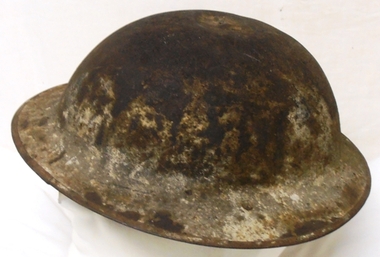
Headwear - Helmet - AIF, WWI, circa 1916
... He served at Gallipoli and Egypt before the regiment moved to the Western Front in March 1916 as Corps cavalry. Steel helmets and gas masks became regular equipment as the regiment engaged in all the major actions involving the Australians. ...He served at Gallipoli and Egypt before the regiment moved to the Western Front in March 1916 as Corps cavalry. Steel helmets and gas masks became regular equipment as the regiment engaged in all the major actions involving the Australians. ...Regimental 543 Trooper Geoff Gilbert of Northcote Victoria enlisted in the 13th Light Horse Regiment AIF aged 21. He served at Gallipoli and Egypt before the regiment moved to the Western Front in March 1916 as Corps cavalry. Steel helmets and gas masks became regular equipment as the regiment engaged in all the major actions involving the Australians. Gilbert brought his helmet home after the war as a souvenir.Rare souvenir of headwear worn by an Australian light horseman of World War 1 (1914-18). Steel helmet worn on the Western Front by Lance Corporal Geoff Gilbert 13th Australian Light Horse during World War 1 (1914-1918).helmet, 13th light horse, wwi, world war one, the great war, first world war, gallipoli, australian imperial forces, aif -
 Kew Historical Society Inc
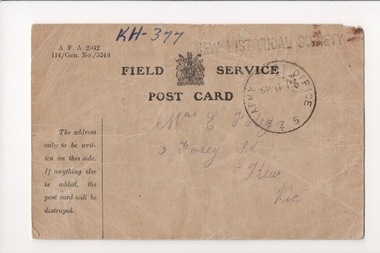
Postcard - Postcard [and Envelope], James Foley, Field Service Postcard from James Leonard Foley, 1915, 1915
... He was to be killed in action on the Western Front on 24 August 1916 and is buried in the Villers-Bretonneux cemetery. ...He was to be killed in action on the Western Front on 24 August 1916 and is buried in the Villers-Bretonneux cemetery. ...James Leonard Foley’s family lived at ‘Warringal’, 3 Foley Street, Kew. Like many other soldiers from Kew, he was educated at the Kew State School. He enlisted at the age of 19 in March 1915. His previous occupation is recorded as 'Blacksmith'. James sent a postcard to his mother in 1915 saying that he was ‘quite well’. He was to be killed in action on the Western Front on 24 August 1916 and is buried in the Villers-Bretonneux cemetery. Poignant card from a Kew soldier in World War 1 who was later to die on the Western Front.Single page Field Service Postcard and Envelope from James Leonard Foley to Mrs Eliza Foley of 3 Foley Street in Kew. Private J.L. Foley (1600) served during World War one with the 24th Battalion. He died on the Western Front. His parents were Edward and Eliza Foley of 3 Foley Street, Kew.Mrs E Foley, 3 Foley Street, Kew, Vic [Signed] JL Foley 8/9/15first world war (1914-18), james foley, world war one, foley street, warringal, villers-bretonneux cemetery, e. foley, edward foley -
4th/19th Prince of Wales's Light Horse Regiment Unit History Room
Diary -Maj R D MCLeish, Believed to be Major R S McLeish, OC D Sqn. 4th LH, 1916 (exact); Entries over period 1916-1936
... Operations of 4th Light Horse Regiment on Western Front in July-August 1916. Includes Regimental key appointments as at July 1916. 2. ...ww1 4th light horse d squadron western front war diary bailleul marseilles strazeele sercus hazebrook staple wallon cappel longuecroix aire merviele boeschem flerbaix estairs doulieu sially appointments 4th light horse cyclists otago mounted rifles 49th division 51st division staughton vale kirks bridge pringles bridge little river ballan bulla royal melbourne show 1936 ARMY BOOK 152, CORRESPONDENCE BOOK, (FIELD SERVICE) Personal diary of - Major R S McLeish (?) containing entries for three periods - 1. Operations of 4th Light Horse Regiment on Western Front in July-August 1916 ...Personal diary of - Major R S McLeish (?) containing entries for three periods - 1. Operations of 4th Light Horse Regiment on Western Front in July-August 1916. Includes Regimental key appointments as at July 1916. 2. Light Horse training in Bulla, Little River area of Victoria (undated) 3. Entries re Dog Pavilion, believed to be Royal Melbourne Show - 17-26 September 1936. ARMY BOOK 152, CORRESPONDENCE BOOK, (FIELD SERVICE)ww1, 4th light horse, d squadron, western front, war diary, bailleul, marseilles, strazeele, sercus, hazebrook, staple, wallon, cappel, longuecroix, aire, merviele, boeschem, flerbaix, estairs, doulieu, sially, appointments 4th light horse, cyclists, otago mounted rifles, 49th division, 51st division, staughton vale, kirks bridge, pringles bridge, little river, ballan, bulla, royal melbourne show 1936 -
 Wangaratta RSL Sub Branch
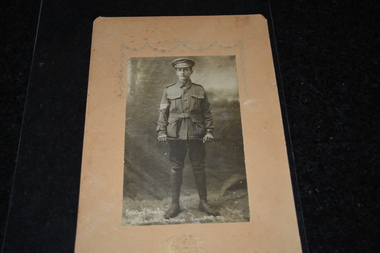
Memorabilia - Unframed Photograph, Courtney's Thelma Studio, Wangaratta, Cyril Buckler
... A postman from Wangaratta, Victoria, prior to enlistment on 16 February 1916 he embarked from Melbourne aboard HMAT Euripides on 4 April 1916 for Egypt. His unit relocated to the Western Front, France, in June 1916. ...A postman from Wangaratta, Victoria, prior to enlistment on 16 February 1916 he embarked from Melbourne aboard HMAT Euripides on 4 April 1916 for Egypt. His unit relocated to the Western Front, France, in June 1916. ...Studio portrait of 5347 Private Cyril Buckler, 14th Battalion. A postman from Wangaratta, Victoria, prior to enlistment on 16 February 1916 he embarked from Melbourne aboard HMAT Euripides on 4 April 1916 for Egypt. His unit relocated to the Western Front, France, in June 1916. Pte Buckler was killed in action near Pozieres, France, on 7 August 1916. He has no known grave and he is commemorated on the Villers-Bretonneux Memorial. This photograph of Cyril Buckler in the rank of Sergeant was probably taken while he was serving in the Senior Cadets or the Citizen Forces prior to enlistment in the AIF.Cyril Buckler was a postman in Wangaratta prior to enlisting in the AIF on February 16 1916 at the age of 19 years 11 months. He was killed in action on August 7th 1916 near Pozieres in France aged 20 years. He has no known grave. His military service record revealed his parents named their property "Pozieres" after his death.Unframed black and white photograph mounted on light brown cardboard of soldier holding whip.Sgt Cyril Buckler Killed in Action in France August 7th 1916wangaratta, kia 7/8/1916, cyril buckler 5347 -
 Wangaratta RSL Sub Branch
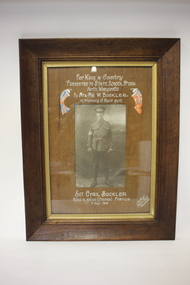
Memorabilia - Framed Photograph, Private Cyril Buckler, c1916
... He embarked from Melbourne aboard HMAT Euripides on 4 April 1916 for Egypt. His unit relocated to the Western Front, France, in June 1916. ...He embarked from Melbourne aboard HMAT Euripides on 4 April 1916 for Egypt. His unit relocated to the Western Front, France, in June 1916. ...Studio portrait of 5347 Private Cyril Buckler, 14th Battalion, presented in his memory as a past student, by his parents to North Wangaratta State School. Cyril was a postman from Wangaratta Victoria, prior to enlistment on 16 February 1916. He embarked from Melbourne aboard HMAT Euripides on 4 April 1916 for Egypt. His unit relocated to the Western Front, France, in June 1916. Private Buckler was killed in action near Pozieres, France, on 7 August 1916. He has no known grave and is commemorated on the Villers-Bretonneux Memorial. This image of Cyril Buckler in uniform with the rank of Sergeant was probably taken while he was serving in the Senior Cadets or Citizen Forces prior to enlistment in the AIF Framed photograph presented to North Wangaratta State School in memory of a past student killed in action at Pozieres, France on 7 Aug 1916 during the First World War. North Wangaratta State School 2391 opened in May 1881 and closed on October 26 1969. Today a plaque commemorates the old site in Eldorado Road North Wangaratta.Wooden frame with gold insert, wooden mount. Coloured paper Union Jack on top left of mounting, Red Ensign on top right of mounting. Inscriptions in white paint. Glass front. Back has wire hangings. Has paper backing has stitching on three sides, some paper backing is ripped.For King and Country. Presented to North Wangaratta State School No 2391 by Mr & Mrs W. Buckler in memory of their son Sgt Cyril Buckler who was killed in action at Pozieres France 7 Aug 1916 world war 1, france, pozieres, north wangaratta state school, cyril buckler -
 Wodonga & District Historical Society Inc
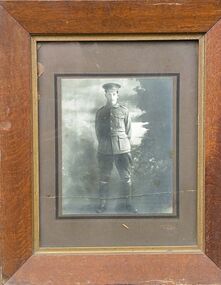
Photograph - Sydney William Phefley
... On 10th November 1915 he embarked from Melbourne on the HMAT Ascanius and saw service in Egypt and on the Western Front. In March 1916 Sydney was promoted to Sergeant. ...On 10th November 1915 he embarked from Melbourne on the HMAT Ascanius and saw service in Egypt and on the Western Front. In March 1916 Sydney was promoted to Sergeant. ...Sydney William Phefley was born in Wodonga, Victoria on 5th November 1896 to Christian Phefley and Martha nee Schultz. He was their third son and eighth child in a family of 17 children. Sydney enlisted in Melbourne on 4th August 1915 and was allocated to 29th Battalion Machine Gun Section. On 10th November 1915 he embarked from Melbourne on the HMAT Ascanius and saw service in Egypt and on the Western Front. In March 1916 Sydney was promoted to Sergeant. During that year he was also hospitalised for a minor case of mumps in Cairo in March and then for a case of trench foot in England in December. In February 1918, Sergeant Phefley was accepted into the Officer Cadet Battalion which included the completion of an Officers Training Course at Oxford. In October 1918 he was transferred to the 32nd Battalion and was promoted to the rank of Lieutenant in December 1918. Lieutenant Phefley returned to Australia on 15th May 1919 and was discharged on 22nd August 1919. Sydney was later employed by the Victorian Railways as an Engine Driver. He married Mary Johanna Hogan on 15th October 1924. Sydney William Phefley died in Moe, Victoria on 16th January 1973.This image is significant because it portrays a member of a prominent Wodonga family who served Australia during World War I.A framed black and white image of Sydney William Phefley in Uniform.private sydney william phefley, phefley family wodonga, world war 1 servicemen -
 Wangaratta RSL Sub Branch
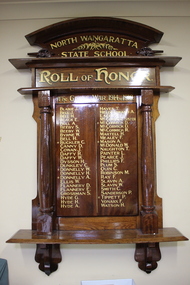
Honour Board, North Wangaratta State School, c1920
... A postman from Wangaratta, Victoria, prior to enlistment on 16 February 1916 he embarked from Melbourne aboard HMAT Euripides on 4 April 1916 for Egypt. His unit relocated to the Western Front, France, in June 1916. ...A postman from Wangaratta, Victoria, prior to enlistment on 16 February 1916 he embarked from Melbourne aboard HMAT Euripides on 4 April 1916 for Egypt. His unit relocated to the Western Front, France, in June 1916. ...North Wangaratta State School 2391 was opened in May 1881 and closed October 26 1969. Today a plaque commemorates the site of the old school in Eldorado Road North Wangaratta. The Honour Board preserves the names of past students who enlisted to serve their country during the First World War and commemorates those who lost their lives. In 1965 after being stored in a woodshed for two years the Honour Board was put on display at The Eldorado Memorial Hall. The Eldorado Memorial Hall Committee became Trustees of the Honour Board and 1992 approved its transfer to the Vine Hotel Museum for public display. In 1996 at a meeting held on February 7, the Wangaratta North State School No 2391 Memorial Committee moved a motion that all memorabilia pertinent to the Wangaratta North State School be displayed at the Vine Hotel Museum under the guardianship of trustees appointed by the Wangaratta North State School Memorial Committee. In 2005 The North Wangaratta State School Trustees donated the Honour Board along with two photographs of WW1 soldiers to the Wangaratta RSL for safe keeping and display to the public. Students who enlisted include:- Private (Shoeing Smith) John BLAIKIE 2341 who was born at Wangaratta. He was a Blacksmith and at the age of 42 enlisted on May 28 1915. He embarked on August 10 1915 and served with the 14th Battalion. He returned to Australia in January 1918 and discharged medically unfit on April 10 1918. 5692 Private William Thomas BYRNE was born on 21/9/1890 at Docker Plains. He was educated at Docker Plains and Wangaratta State schools. A farmer when he enlisted on 13/10/1914. He trained at Broadmeadows and embarked on Hororata on 17/4/1915. He served with the 3rd Light Horse and 12th and/or 27th ASC - Army Service Corps as a Driver. 5347 Private Cyril BUCKLER, 14th Battalion. A postman from Wangaratta, Victoria, prior to enlistment on 16 February 1916 he embarked from Melbourne aboard HMAT Euripides on 4 April 1916 for Egypt. His unit relocated to the Western Front, France, in June 1916. Pte Buckler was killed in action near Pozieres, France, on 7 August 1916. He has no known grave and he is commemorated on the Villers-Bretonneux Memorial 3451A Private Sydney Spencer PLUM 1st Pioneer Battalion A.I.F, Born January 3rd 1894 at Dockers Plains. He was educated at North Wangaratta and Docker's Plains State School. He was a blacksmith when he enlisted June 12th 1915. He was trained at Flemington Racecourse and embarked on SS "Nestor" October 11th 1915. He fought in battles; Peronne, Cambrai, Somme. Being wounded 3 times. He embarked for home per SS "Orontes"; disembarked January 28th 1919 and he was discharged March 16th 1919. He died on July 25 1958. 483 Private Percy Albert TIPPETT served with the 6th Battalion AIF and was wounded on the 25/4/15 during the initial landing at Gallipoli and later died on 28/4/1915. 1981 Private Francis John VONARX Enlisted at Wangaratta on 15/6/1915 aged 33 years and embarked on 26/8/1915. Served with the 23rd Infantry Battalion and 2nd Machine Gun Battalion. Returned to Australia on 8/4/1919 On 13/4/2024 the Honour Board was deaccessioned from the RSL collection for permanent display at North Wangaratta CFA Brigade.Honour Board listing the 52 names of North Wangaratta State School students who enlisted to serve their country during the First World War and commemorates those who lost their lives. Large solid timber Honour Board with two carved minature cannons on top and above side columns."North Wangaratta State School/Roll of Honour/The Great War 1914 to 1919" 52 names in gold paint.north wangaratta state school 2391, honour board ww1 -
 Federation University Historical Collection
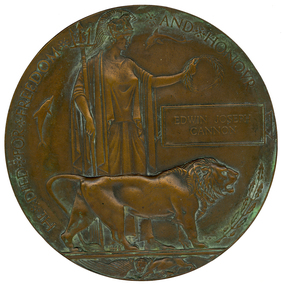
Medal - Numismatics, 'Dead Man's Penny' for Edwin Joseph 'Ted' Cannon, c1919
... During the Battle of Pozieres on the Western Front Ted Cannon worked with the Scout Platoon sketching the enemy's gun emplacements. Ted proved invaluable to the Brigade and brought he came under the attention of the Australian High Command. On 13 September 1916...During the Battle of Pozieres on the Western Front Ted Cannon worked with the Scout Platoon sketching the enemy's gun emplacements. Ted proved invaluable to the Brigade and brought he came under the attention of the Australian High Command. On 13 September 1916 ...The Dead Man’s Penny is a commemorative medallion which was presented to the next-of-kin of the men and women from England and the Empire who died during World War One. The Dead Man’s Penny was accompanied by a letter from King George V, stating ‘I join with my grateful people in sending you this memorial of a brave life given for others in the Great War’.[http://nma.gov.au/blogs/education/2010/11/14/dead-mans-penny/] Popularly known as the "Dead Man’s Penny", because of the similarity in appearance to the somewhat smaller penny coin. 1,355,000 plaques were issued, which used a total of 450 tonnes of bronze, and continued to be issued into the 1930s to commemorate people who died as a consequence of the war. [http://en.wikipedia.org/wiki/Memorial_Plaque_(medallion)] It was decided that the design of the plaque was to be picked from submissions made in a public competition. Over 800 designs were submitted and the competition was won by the sculptor and medallist Edward Carter Preston with his design called Pyramus, receiving a first place prize of £250.[http://en.wikipedia.org/wiki/Memorial_Plaque_(medallion)] They were initially made at the Memorial Plaque Factory, 54/56 Church Road, Acton, W3, London from 1919. Early plaques did not have a number stamped on them but later ones have a number stamped behind the lion's back leg. [http://en.wikipedia.org/wiki/Memorial_Plaque_(medallion)] Ted Cannon's plaquette does not have a stamped number. Ted Cannon was a gifted artist and cartoonist who studied at the Ballarat School of Mines Technical Art School. During the Battle of Pozieres on the Western Front Ted Cannon worked with the Scout Platoon sketching the enemy's gun emplacements. Ted proved invaluable to the Brigade and brought he came under the attention of the Australian High Command. On 13 September 1916 Ted was given a special assignment for General C.B.B. White. Ted was sent out forward of the Old Mill at Verbrandenmolen (in the Ypres Salient) to draw a panorama of the German lines in the area from Hill 60 to The Bluff. It was a hazardous task and Ted was warned to be careful. Tragically he was sniped by an enemy machine-gunner and sustained severe abdominal wounds. Stretcher-bearers rushed him to the 17th Casualty Clearing Station where he was operated on by the doctors at 8.30 that night. With little chance of success, but ever resilient, Ted remained conscious almost to the end. He died early in the morning of the 14 September 1916. His body was buried in the large Military Cemetery at Lijssenthoek. The effects of the late Ted Cannon were returned to his parents. These were an autograph book, three brushes, prayer book, housewife, whistle, book, hymn book, curios. Another listing gives his effects as "identity disc, letters, photos, wallet, 2 books, Mexican Dollar, 1 cent (Ceylon), 3 German Straps, Fountain Pen, Cigarette-holder, Franc Note, 50 centimes Note, devotional book, mirror, rosary, scapula, metal ring, two combs, book of views, nail clippers, badges, tie clip, Egyptian stamp.[http://recordsearch.naa.gov.au/scripts/Imagine.asp?B=3202589] Ted Cannon was an only child. It is not known how the 'Dead Man's Penny' came into the ownership of the donor, but it is thought that it may have been left in a house owned by the donor's mother. Further information on Ted Cannon can be found at http://bih.ballarat.edu.au/index.php/Edwin_J._Cannon and http://www.ballarat.edu.au/about-ub/history/art-and-historical-collection/ub-honour-roll/c/edwin-joseph-ted-cannon-1895-1916Large bronze medallion or plaquette featuring an image of Lady Britannia surrounded by two dolphins (representing Britain’s sea power) and a lion (representing Britain) standing over a defeated eagle (symbolising Germany). Around the outer edge of the medallion are the words ‘He died for freedom and honour’. Next to Lady Britannia is the deceased solider’s name, with no rank provided to show equality in their sacrifice. (http://nma.gov.au/blogs/education/2010/11/14/dead-mans-penny) The plaque was distributed throughout the British Empire, and the first plaques were distributed in Australia in 1922 "Returned home" by W. & O. Mayne, 2013. ted cannon, edwin joseph cannon, cannon, world war 1, world war -
 Federation University Historical Collection
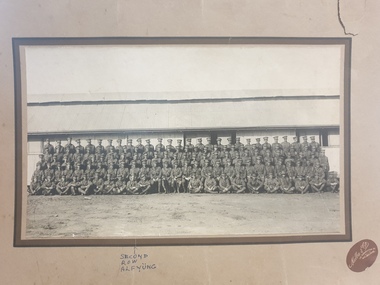
Photograph, Melba & Co, 7th Australian Infantry Training Battalion WW1
... In March 1916, it sailed for France and the Western Front and entered the front line trenches for the first time on 3 May. ...In March 1916, it sailed for France and the Western Front and entered the front line trenches for the first time on 3 May. ...George Alfred Yung, known as Alf, pictured in the second row, 10th from the left, enlisted on 25/02/1916; embarked on 19/02/1917; was killed during the battle of Menin Gate at Yrpres, Belgium on 20/09/1917. https://www.awm.gov.au/collection/U51447 The 7th Battalion was among the first infantry units raised for the AIF during the First World War. Like the 5th, 6th and 8th Battalions, it was recruited from Victoria and, together with these battalions, formed the 2nd Brigade. The battalion was raised by Lieutenant Colonel H. E. "Pompey" Elliott within a fortnight of the declaration of war in August 1914 and embarked just two months later. After a brief stop in Albany, Western Australia, the battalion proceeded to Egypt, arriving on 2 December. It later took part in the ANZAC landing on 25 April 1915, as part of the second wave. Ten days after the landing, the 2nd Brigade was transferred from ANZAC to Cape Helles to help in the attack on the village of Krithia. The attack captured little ground but cost the brigade almost a third of its strength. The Victorian battalions returned to ANZAC to help defend the beachhead, and in August the 2nd Brigade fought at the battle of Lone Pine. While holding positions captured by the 1st Brigade, four members of the 7th Battalion, Corporal A. S. Burton, Acting Corporal W. Dunstan, Lieutenant W. Symons and Captain F. H. Tubb, earned the Victoria Cross - Burton posthumously. The battalion served at ANZAC until the evacuation in December. After the withdrawal from Gallipoli in December 1915, the battalion returned to Egypt. In March 1916, it sailed for France and the Western Front and entered the front line trenches for the first time on 3 May. The battalion's first major action in France was at Pozieres in the Somme valley where it fought between 23-27 July and 15-21 August. After Pozieres the battalion manned trenches in the Ypres salient in Belgium, before returning to the Somme valley. It saw out the horrendous winter of 1916-1917 rotating between training, working parties and duty in the trenches. In early 1917, the Germans withdrew to the Hindenburg Line and the 7th Battalion participated in the brief advance that followed and then came to a grinding halt before Bullecourt. The battalion was withdrawn from the front line for training on 9 May 1917 and did not return to action until the Ypres offensive of September and October. It fought major battles at Menin Road on 20 September and Broodseinde on 4 October, and then spent much of ensuing winter in the Ypres mud. In March and April 1918 the 7th helped stop the German spring offensive in northern France and later participated in the Allies' own great offensive of 1918, that began with the battle of Amiens on 8 August. The advance by British and empire troops on 8 August was the greatest success in a single day on the Western Front, one that German General Erich Ludendorff described as, "the black day of the German Army in this war". The battalion continued operations until late September 1918. At 11 am on 11 November 1918, the guns fell silent. The November armistice was followed by the peace treaty of Versailles signed on 28 June 1919. In November 1918 members of the AIF began to return to Australia for demobilisation and discharge. In March, the battalion was so reduced that it and the 6th Battalion were amalgamated to form a composite battalion. In turn, this battalion was merged with another, formed from the 5th and 8th Battalions, to form the 2nd Brigade Battalion. https://www.awm.gov.au/collection/U51447army, soldier, alf yung, 7th australian infantry battalion -
 Lara RSL Sub Branch
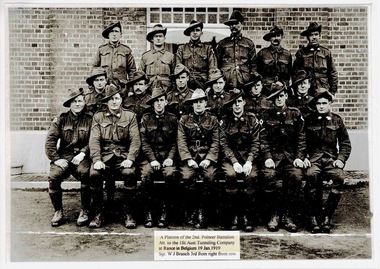
Photograph, A Platoon of the 2nd, Pioneer Battalion Att. to the 1St.Aust. Tunneling Company at Rance in Belgium 19 Jan 1919
... Formed in Egypt in March 1916, the battalion subsequently served on the Western Front in France and Belgium, after being transferred to the European battlefields shortly after its establishment. ...Formed in Egypt in March 1916, the battalion subsequently served on the Western Front in France and Belgium, after being transferred to the European battlefields shortly after its establishment. army, rance belgium,australian army, lara r.s.l. ! ...The 2nd Pioneer Battalion was an Australian infantry and light engineer unit raised for service during the First World War as part of the all volunteer Australian Imperial Force. Formed in Egypt in March 1916, the battalion subsequently served on the Western Front in France and Belgium, after being transferred to the European battlefields shortly after its establishment. Rectangular shaped black and white Photograph.A Platoon of the 2nd, Pioneer Battalion Att. to the 1St.Aust. Tunnelling Company at Rance in Belgium 19 Jan 1919 Sgt. W J Branch 3rd from right front row. army, rance belgium,australian army, lara r.s.l., !st.australian tunnelling company, 2nd pioneer battalion. -
 Lara RSL Sub Branch
Card, Happy Birthday Card
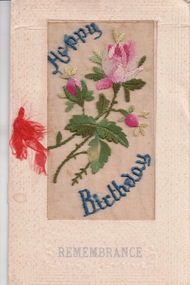
... McIntyre served in the first world war, first arrived in Egypt in 1915, then to the Western front in France in July 1916. He was servery injured during his time in France and was sent to the Hospital in England. ...McIntyre served in the first world war, first arrived in Egypt in 1915, then to the Western front in France in July 1916. He was servery injured during his time in France and was sent to the Hospital in England. ...The silk card were created by French women during the First World War. The women would create these in there homes as a way to earn an income during the tuff times. The silk mesh was embroidered by the women and was later sent to factories to be placed on the cards. According to the Australian war memorial website there were 10 million of the cards made between 1914-1919. This card in particular was sent from John (Jack) McIntyre to his mother for her birthday. J. McIntyre served in the first world war, first arrived in Egypt in 1915, then to the Western front in France in July 1916. He was servery injured during his time in France and was sent to the Hospital in England. After the war finished Jack travelled back to Australia and lived in Lara with his brother and sister.This card is significant as it is a reflection on the communication between families during the First World War. It also is a symbol of the way women in France made their money during the tuff timesA birthday card with silk on the front of the card. It has pink flowers stitched into the silk and says 'happy birthday'On the front it has 'Happy Birthday" "Remembrance" On the first page in the inside "Remembrance" "To mother" "From Jack" "France 1918" On the second page in the inside: "Wishes are nothing; t'is the heart That in the few lines dwells And says to those from us apart More that the greeting tells" birthday card, mother, son, mcintyre, world war 1, ww1, happy birthday, handmade, silk, embroidered -
 Lara RSL Sub Branch
Map, Framed Map of the western front 1914-1918, Map made by G.F.Trudgion R.A.E. circa 1916
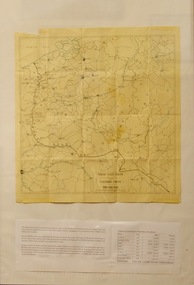
... western front...ww1...world war one...north west europe...1914...1916...Map showing position of western front line in 1914 at the start of WW1 Map is from circa 1916 showing battle area of the Western Front during WW1 map g.f.trudgion r.a.e. western front ww1 world war one north west europe 1914 1916 ww1 casulaties North West Europe Shewing the Western Front 1914-1918 War. ...Map showing position of western front line in 1914 at the start of WW1Map is from circa 1916 showing battle area of the Western Front during WW1Map of the western front 1914-1918North West Europe Shewing the Western Front 1914-1918 War. Below is description of Australian ANZAC's on Western Front and a graph on Comparison of Casualties from Major Western Front Battlesmap, g.f.trudgion, r.a.e., western front, ww1, world war one, north west europe, 1914, 1916, ww1 casulaties -
 Lara RSL Sub Branch
Photograph, Saving Amiens
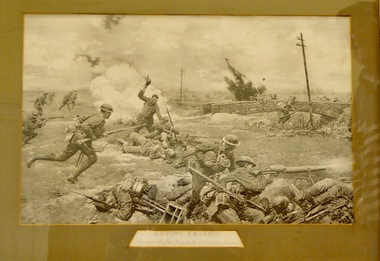
... 1916 and attached to the 3rd Division. Amiens was one of the first major battles involving armoured warfare and marked the end of trench warfare on the Western Front. world war 1,photo, saving amiens, lara r.s.l. 9th australian brigade. ...The battle for Amiens,situated at Picardy, France, began on the 8th August,1918. This was the opening offensive of the "100 DAY Offensive " that ultimately led to the end of WW1. Consisting of four infantry battalions - the 33rd, 34th, 35th and 36th Battalions - the 9th Brigade was formed in 1916 and attached to the 3rd Division.Amiens was one of the first major battles involving armoured warfare and marked the end of trench warfare on the Western Front.Rectangular shaped glass covered photo frame showing the 9th Australian Brigade charging.Saving Amiens. A Brilliant Bayonet Charge by the 9th Australian Brigade.world war 1,photo, saving amiens, lara r.s.l. 9th australian brigade. -
 Geelong RSL Sub Branch
Book - 40th Battalion, A souvenir of the 40th Battalion, Mid 20th Century
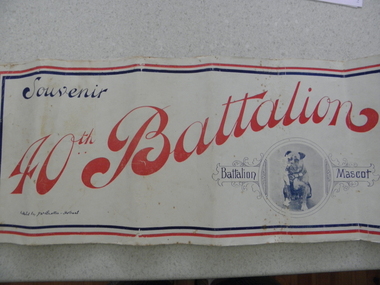
... 1916. The battalion was recruited completely from Tasmanis as part of the 10th Brigade, 3rd Division. The Batalion served during WW1 - along the Western Front, 1919 to 1921 was a CMF unit. ...The 40th Battalion was an Infantry Battalion of the Australian Army raised in 1916. The battalion was recruited completely from Tasmanis as part of the 10th Brigade, 3rd Division.The Batalion served during WW1 - along the Western Front, 1919 to 1921 was a CMF unit. During WW2 the Battalion remained in Australia and was amalgamated with 12th Battalion. The Battalion was merged into 12th/40th Battalion Royal Tasmania Regiment in 1987.An oblong book, buff colour, paper pages, blue and red edging.On the front page Souvenir 40th Battalion, the Battalion Mascot, Published by J W Beatie - Hobart, back page wholly Engraved and Printed by 'The Examiner' and 'Weekly Courier' Offices, 73-75 Patterson Street, Launceston, Tasmania.ww1 ww2 40th battalion tasmania -
 City of Moorabbin Historical Society (Operating the Box Cottage Museum)
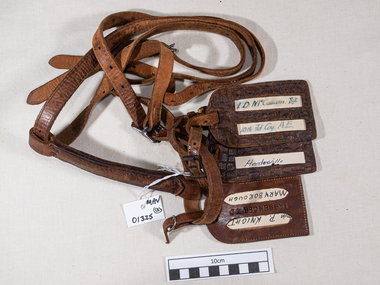
Leather, luggage straps and labels c1916, 20thC
... Originally formed in 1912 as a Militia formation, the brigade was re-raised in 1916 as part of the expansion of the Australian Imperial Force following the end of the Gallipoli campaign. It subsequently saw service on the Western Front in France and Belgium during the First World War. ...Originally formed in 1912 as a Militia formation, the brigade was re-raised in 1916 as part of the expansion of the Australian Imperial Force following the end of the Gallipoli campaign. It subsequently saw service on the Western Front in France and Belgium during the First World War. ...Leather straps were commonly used to secure cases and other forms of luggage when traveling. The labels enabled easy identification when collecting luggage from transport carriages, coaches, buses and trains. 10th Field Company, Australian Engineers WW1 1914-18. The 10th Brigade was an infantry brigade of the Australian Army. Originally formed in 1912 as a Militia formation, the brigade was re-raised in 1916 as part of the expansion of the Australian Imperial Force following the end of the Gallipoli campaign. It subsequently saw service on the Western Front in France and Belgium during the First World War. After the war it was disbanded but was re-raised in 1921 as a part-time formation based in the state of Victoria. During the Second World War the brigade was used in a garrison role in Australia before being disbanded in 1942.These leather straps and labels were attached to the luggage of an Australian soldier during early 20th C who may have been a resident or relative of a resident in City of MoorabbinLeather luggage straps with metal buckles and 3 luggage address labels attached.Label 1 - L.D.McCallum Sgt / 10th Fd Coy AE Label 2 - Healesville Label 3 - Maryborough leather, straps, belts, luggage labels, tools, saddles, wallets, personal effects, horses, drays, world war 1 1914 -18, world war 2 1939-45, army, 1st aif, military, 10th field company australian engineers, western front, france, belgium, -
 The Beechworth Burke Museum
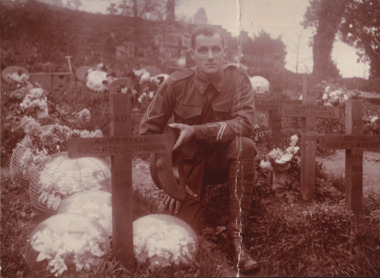
Photograph
... 1916. He was 33 years old. The record is historically significant due to its connection to World War I. This conflict is integral to Australian culture as it was the single greatest loss of life and the greatest repatriation of casualties in the country's history. Australia’s involvement in the First World War began when the Australian government established the Australian Imperial Force (AIF) in August 1914. Immediately, men were recruited to serve the British Empire in the Middle East and on the Western Front ...Taken on an unknown date, depicted is a portrait of a young, unidentified male soldier kneeling beside a grave in a cemetery. He is dressed in an Australian military uniform. The cemetery pictured is the Arnos Vale Cemetery in Bristol, United Kingdom. There are multiple crosses marking graves in this photograph, all marked in memory of different soldiers who fought with the Australian Imperial Force (AIF) during World War I. It is believed that the soldier who is kneeling was also part of the Australian Imperial Force. This can be inferred by the chevron rank insignia visible on the uniform. The placement of this insignia on the sleeve of the right arm suggests that this soldier was either a Warrant Officer or a Non-Commissioned Officer (NCO). Another signifier of the Australian Imperial Force uniform are the three inverted chevron stripes positioned on the lower part of the left sleeve, near the wrist. These are called Good Conduct Stripes and were worn by Warrant Officers and NCOs. This patch consisted of a single chevron stripe for each year of military service meeting certain requirements of good conduct. Additionally, the man in this photograph is also wearing a 'Rising Sun' collar badge on his coat. Australia, unlike most other Commonwealth countries, did not adopt metal regimental badges during the First World War. All units were issued with the Australian Army General Service Badge, better known as the 'Rising Sun’ badge. This insignia is almost always identified with the Australian Imperial Force. Furthermore, the grave that this unidentified soldier is kneeling next to is the resting place of Private John James (J. J.) Simpson. He was born in Stanley, Victoria in 1883. He enlisted in the Australian Imperial Force in Melbourne, Victoria on 12 July, 1915, with the service number 4909. John James Simpson was then posted to the 60th Company Depot at Seymour for military recruit training. John James Simpson was reported wounded in action in France on 19 July, 1916. He was admitted to 13th General Hospital, France with gunshot wounds to his legs. From Boulogne, France, he traveled to the United Kingdom aboard the Hospital Ship 'St. Denis' for medical care. Upon arrival, he was admitted to 2nd Southern General Hospital, Bristol, England on 27 July, 1916. John James Simpson passed away from his wounds on 1 August, 1916. He was 33 years old.The record is historically significant due to its connection to World War I. This conflict is integral to Australian culture as it was the single greatest loss of life and the greatest repatriation of casualties in the country's history. Australia’s involvement in the First World War began when the Australian government established the Australian Imperial Force (AIF) in August 1914. Immediately, men were recruited to serve the British Empire in the Middle East and on the Western Front. The first significant Australian action of the war was the Australian Naval and Military Expeditionary Force’s (ANMEF) landing on Rabaul on 11 September 1914. The ANMEF took possession of German New Guinea at Toma on 17 September 1914 and of the neighbouring islands of the Bismarck Archipelago in October 1914. On 25 April 1915, members of the AIF landed on Gallipoli in Turkey with troops from New Zealand, Britain, and France. This specific event holds very strong significance within Australian history. The record has strong research potential. This is due to the ongoing public and scholarly interest in war, history, and especially the ANZAC legend, which is commemorated annually on 25 April, known as ANZAC Day.Sepia rectangular photograph printed on matte photographic paper mounted on card.Obverse: A.I.F. / AUSTRALIA / 441, PTE.T. / T (?) / 26B (?) / 6.1.17 / (?) / LANGTON RD. / ST. ANNES PK. / BRISTOL / A.I.F. / AUSTRALIA. / 708, GNR B.L.CRAWFORD. / FR / 5 D.A.C. / 13.2.17 / A.I.F. / AUSTRALIA. / 4481, P (?) D.MORRIS. / (?) / 31.12.(?) / A.I.F. / AUSTRALIA. / 4909, PTE J.J.SIMPSON. / 608(?) / 1.8.16 / Winchester / LANGTON RD. / ST. ANNES PK / BRISTOL / Reverse: 2641 /military album, military, war, world war i, wwi, australian imperial force, aif, j. j. simpson, uniform, cemetery -
 Red Cliffs Military Museum
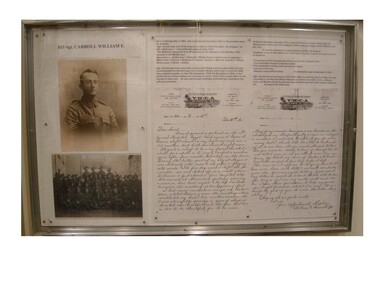
unframed photo, 815 Sgt Carroll William E, (estimated); WW1 approx
... The brief life history lists his locations on the Western Front through to the end of the War. ww1 william aif 815 sgt carroll e 21st batt 6th brigade 1st block 276 red cliffs mutiny None The photo is part of a framed display with a platoon photo, brief history and letter from Sargent Carroll to his Aunt, dated 31st December 1916. ...A copy of the original letter from Sgt. Carroll tells of some of the hardships endured at Gallipoli in clear but matter of fact tone. The brief life history lists his locations on the Western Front through to the end of the War.The photo is part of a framed display with a platoon photo, brief history and letter from Sargent Carroll to his Aunt, dated 31st December 1916. The letter was written while Sargent Carroll was hospitalised in Cairo. Silver metal frame.Noneww1, william, aif, 815, sgt, carroll, e, 21st, batt, 6th, brigade, 1st, block, 276, red, cliffs, mutiny -
 Red Cliffs Military Museum
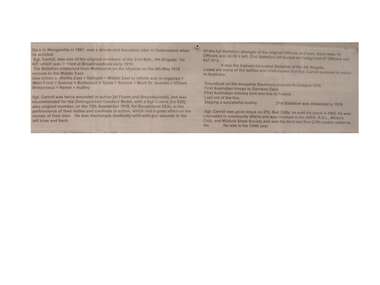
Document, Life history of Sgt. William Carroll, (estimated); early -mid 1990
... Western Front> Somme> Bullecourt> Ypres> Somme> Mont St. Quentin> Villiers Bretonneux> Hamel Mutiny./ Sgt. Carroll was twice wounded in action (at Fluers and Broondseinde)and was recommended for the Distinguished Conduct Medal, with a Sgt Cozens (No 825 also original member, on the 15th September 1916, for exceptional zeal in the performance of their duties and coolness in action, which had a great affect on the moral of their mem. ...Western Front> Somme> Bullecourt> Ypres> Somme> Mont St. Quentin> Villiers Bretonneux> Hamel Mutiny./ Sgt. Carroll was twice wounded in action (at Fluers and Broondseinde)and was recommended for the Distinguished Conduct Medal, with a Sgt Cozens (No 825 also original member, on the 15th September 1916, for exceptional zeal in the performance of their duties and coolness in action, which had a great affect on the moral of their mem. ...This short history is in a display of photos and a copy of a letter written home by Sgt Carroll to his Aunt.A brief written life history from birth to death of William Carroll service Number 815. As written by a member of Red Cliffs R.S.L. in consultation with the family.Born in Wangaratta in 1891, was a drover and boundary rider in Queensland when enlisted.Sgt. Carroll was one of the original members of the 21st Battalion, 6th Brigade, 1st AIF, which was formed at Broadmeadows early 1915. The battalion embarked from Melbourne on the Uylsses on the 8th May 1915 enroute to the Middle East. Saw action Middle East> Gallipoli>Middle East to reform and reorganise > Western Front> Somme> Bullecourt> Ypres> Somme> Mont St. Quentin> Villiers Bretonneux> Hamel Mutiny./ Sgt. Carroll was twice wounded in action (at Fluers and Broondseinde)and was recommended for the Distinguished Conduct Medal, with a Sgt Cozens (No 825 also original member, on the 15th September 1916, for exceptional zeal in the performance of their duties and coolness in action, which had a great affect on the moral of their mem. He was discharged medically unfit with gun wounds to his left knee and back. Of the full Battalion strength of the original Officers and men, there were 16 Officers and 24 Or's left. 21st Battalion left buried on foreign soil 47 Officers and 827 Or's. It was the highest decorated Battalion of the 6th Brigade. Listed are some of the Battles and Misfortunes that Sgt. Carrol survived to return to Australia. Torpedoed on the troop ship Southland enroute to Gallipoli 1915;/ First Australian troops to Garrison Cairo; First Australian Infantry Unit into line in France; Last out of the line; Staging a successful mutiny; 21st Battalion was disbanded in 1918. Sgt. Carroll was given block 276 Red Cliffs, he sold his block in 1982. He was interested in Community affairs and was involved in ADFA, RSL, Mildura Club, and Mildura Show Society and was the third last Red Cliffs Soldier Settler to die. He was in his 100th year.medal, distinguished, battalion, aif, 21st, 6th, brigade, 1st, mutiny, gallipoli, wangaratta, 1891, boundary, rider, ulysses, middle, east, western, front, conduct
