
Showing 112 items matching "theophilus-heugist-serjeant"
-
 Federation University Historical Collection
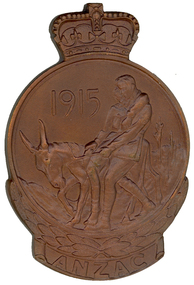
Medal - Numismatics, ANZAC Commemorative Medal for R.M. Serjeant, 1967
... ANZAC Commemorative Medal for R.M. Serjeant...serjeant...Robert M. Serjeant was the only son of Theo and Alice Serjeant, and grandson of famed mine manager Robert Malachy Serjeant (1829-1902). ...The commemorative medal was presented to the family of Robert M. Serjeant. Gift of David Stevens, 2014....Engraved: "1238 R.M. Serjeant"...Robert M. Serjeant was the only son of Theo and Alice Serjeant, and grandson of famed mine manager Robert Malachy Serjeant (1829-1902). ...Robert M. Serjeant was the only son of Theo and Alice Serjeant, and grandson of famed mine manager Robert Malachy Serjeant (1829-1902). Robert Serjeant was a past student of the Ballarat School of Mines (SMB), and at the time of his World War One enlistment he had just finished an electrical course, and was working as a junior member of the SMB Department of Electricity. Robert Serjeant enlisted in December 1914. Corporal Serjeant (2138) of the 8th Battalion, died of wounds received in action at Gallipoli on 28 April 1915, aged 20. He was buried at sea and his name is listed at the Lone Pine Memorial. A brown paper parcel of Robert Serjeant's belongings was returned to his parents. It contained his discs, wrist-watch (damaged), notebook, hymn book and letters. [1] The Ballarat Courier reported: 'He was of quiet disposition, and a great student, devoting himself closely to his work.' Further information on R.M. Serjeant can be found at https://bih.federation.edu.au/index.php/Robert_M._Serjeant_Jnr The following statement on the ANZAC Commemorative Medallion and Badge was made by by Prime Minister Holt in 16 March 1967 when the Minister for Defence announced that it had been decided by the Australian Government, in consultation with the New Zealand Government, to issue a medallion and lapel badge to the veterans of the Gallipoli Campaign. "Last March, the Minister for Defence announced that it had been decided by the Australian Government, in consultation with the New Zealand Government, to issue a medallion and lapel badge to the veterans of the Gallipoli Campaign. I am glad to be able to announce that arrangements have now been completed for the production of the medallion and the badge. The Minister for the Army will be arranging distribution to those wishing to receive them as soon as possible. The Government hopes that production of the medallion and lapel badge will be sufficiently advanced to permit at least some of them to be distributed by ANZAC Day. The medallion (with the name of the recipient inscribed) will be issued to the surviving members of the Australian Defence Force who served on the Gallipoli Peninsula, or in direct support of the operations from close off-shore, at any time during the period from the first ANZAC Day in April, 1915 to the date of final evacuation in January, 1916. Next of kin or other entitled persons will be entitled to receive the medallion on behalf of their relatives, if the relative died on active service or has since died. For surviving members, a lapel badge will also be available for wearing. This will be a replica of the obverse (or front) of the medallion and will be about 1 inch high and 2/3 inch wide - the same size as the RSL badge. The medallion is the work of Mr. Raymond Ewers, the well-known Australian artist, based on a suggestion by Mr. Eric Garrett, a staff artist with the Department of the Army. It has been endorsed by both the Government of New Zealand and ourselves. It will be approximately 3 inches high and 2 inches wide. The obverse of the medallion depicts Simpson and his donkey carrying a wounded soldier to safety. It will be bordered on the lower half by a laurel wreath above the word ANZAC. The reverse (the back) shows a relief map of Australian and New Zealand superimposed by the Southern Cross. The lower half will be bordered by New Zealand fern leaves. The medallion will be cast in bronze and the lapel badge will be metal of a bronze colour. For the information of the honourable members I present also a brief statement setting out the conditions of eligibility which will apply to the medallion and badge and the manner in which those desiring to receive them should apply."(https://www.awm.gov.au/encyclopedia/anzac/medallion/doc.asp, accessed 26/02/2014) Conditions of eligibility. All members of the Australian Defence Force who served during the Gallipoli Campaign are entitled to receive the ANZAC Commemorative medallion. The campaign lasted from April 25, 1915 to January 8, 1916. The award will be made for service on the Gallipoli Peninsula and service in support of the operations in an area off-shore eastward of a line drawn from Yukyeri Point (lat 39 50' 40'' N long 26 9' 45'' E) through a point in lat 39 53' N long 26 0' E thence to Cape Gremea (lat 40 35' N long 26 6' E). The award will also be available to members of philanthropic organisations and the Press who were accredited to the AIF, and to Australian members of the crews of merchant ships or hospital ships which operated in direct support within the defined area. Note: The boundary line would run just off-shore from the land masses north and south of the Dardanelles, and is estimated to be within about 5 miles from the beach at ANZAC Cove. (https://www.awm.gov.au/encyclopedia/anzac/medallion/doc.asp, accessed 26/02/2014) This Item is significance because is was only issued to members of the Australian and New Zealand Defence Force who served at Gallipoli. This Medallion is significant because of its relationship to Robert M. Serjeant who died on 28 April 2015 at Gallipoli of wounds received in Action. Bronze commemorative medal in black presentation case showing Simpson and his donkey carrying a wounded soldier to safety. A crown is situated on top of the medal, and the word ANZAC beneath the medal. The opposite side depicts Australia, New Zealand and the Southern Cross Constellation. The lower half is bordered with New Zealand Fern leaves. The commemorative medal was presented to the family of Robert M. Serjeant. Gift of David Stevens, 2014.Engraved: "1238 R.M. Serjeant"serjeant, r.m. serjeant, robert m. sergeant, anzac, medal, numismatics -
 University of Melbourne, Burnley Campus Archives
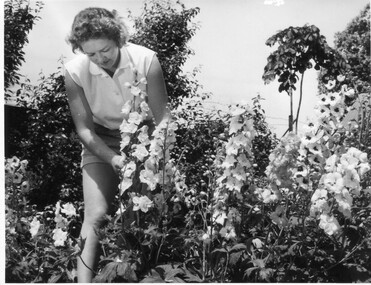
Photograph - Black and white print, Publicity Branch Victorian Department of Agriculture, Judy Serjeant With Delphiniums, c. 1956
... Judy Serjeant With Delphiniums...Kneen 10 June 1992 as Judy Serjeant....Black and white photograph. Judy Serjeant standing in a bed of delphiniums...Kneen 10 June 1992 as Judy Serjeant. delphiniums judy serjeant student working outside pacific giant delphiniums publicity On reverse, "Delphiniums "Pacific Giants," and "Photograph by Publicity Branch Victorian Department Of Agriculture Ref. ...Student identified by T.H. Kneen 10 June 1992 as Judy Serjeant.Black and white photograph. Judy Serjeant standing in a bed of delphiniumsOn reverse, "Delphiniums "Pacific Giants," and "Photograph by Publicity Branch Victorian Department Of Agriculture Ref. No. C.1768.E."delphiniums, judy serjeant, student working outside, pacific giant delphiniums, publicity -
 Ballarat Clarendon College
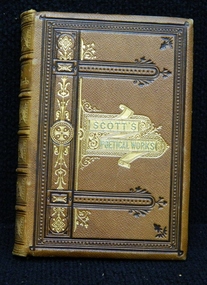
Book, Gall & Inglis, The poetical works of Sir Walter Scott, Prior to the book prize given at Christmas, 1887
... theophilus-heugist-serjeant...This book prize was awarded to Theophilus Heugist Serjeant in the fifth form for first prize for arithmetic. ..../ Awarded to/ Theo. H. Serjeant/ Christmas, 1887....This book prize was awarded to Theophilus Heugist Serjeant in the fifth form for first prize for arithmetic. ...This book prize was awarded to Theophilus Heugist Serjeant in the fifth form for first prize for arithmetic. Theo enrolled at Ballarat College in 1884 at the age of 12. Theo's brother, Alfred George Serjeant, also enrolled at the same time at the age of 17. In the original register parent/guardian is listed as R.M Serjeant and their residence as Yarrowee Hall.Presbyterian educators placed great value on a classical education matched with diligence in study. Book prizes were highly regarded and academic success admired. In the school’s early years prizes were ordered direct from London and had the school crest embossed in gold on the front or back cover. Many of the prizes given in early years were returned to the school to equip the Weatherly Library when it opened in 1936.Bound in brown calf with black and gilt decorations on front cover and black decoration with college crest embossed on back cover. Six raised bands on spine with gilt lettering on second compartment and the remaining compartments with gilt decoration. Slight detachment of spine with foxing on pages. Gilt edged pages, black and white illustrations throughout. 624 pages.Book plate inside front cover: college crest/ Arithmetic/ Fifth Form,/ First Prize./ Awarded to/ Theo. H. Serjeant/ Christmas, 1887.theophilus-heugist-serjeant, book-prize, ballarat-college, 1884, alfred-george-serjeant, r-m-serjeant, yarrowee-hall. -
 Federation University Historical Collection
Image, Robert Malachy Serjeant
... Robert Malachy Serjeant...ROBERT MALACHY SERJEANT (1828-1902) Robert Malachy Serjeant was born on 21 December 1828 at Callington, Cornwall. ...Two photographic portraits of mine manager Robert Malachy Serjeant. Both portraits were purchased by the donor from the State Library of Victoria. ...ROBERT MALACHY SERJEANT (1828-1902) Robert Malachy Serjeant was born on 21 December 1828 at Callington, Cornwall. ...ROBERT MALACHY SERJEANT (1828-1902) Robert Malachy Serjeant was born on 21 December 1828 at Callington, Cornwall. He was the son of Philip Davey Serjeant, a surgeon in the Royal Marines, and Eliza Malachy. Philip Serjeant died in 1834. His mother, Eliza, remarried John Burgh in 1836. He died in 1837. In September 1848 Eliza, Robert and his two sisters, Caroline and Susan, departed Plymouth on the William Moneya for Port Adelaide and arrived in January 1849. Once gold was discovered in Victoria, Serjeant made his way to Forest Creek (near Castlemaine) and he and his mate Mr Victor, were the first party to sink through the basalt in search of a deep lead. In 1854 he moved to Ballarat to work as a miner and enjoyed some success. In 1855 he was with a group that discovered a 500 ounce nugget. With his share of the sale he set himself up with the latest mining equipment, as well as beginning a lifelong interest in the share market. He became the Manager of the Chryseis, Isis and Garibaldi claims and then the Manager of the Band and Albion Consol Company. He held the position for thirty years and only resigned when the company amalgamated with the Sir Henry Loch Mine. Robert Malachy Serjeant became interested in Politics. The first election for Parliament Representatives for Ballarat was in 1855. Robert stood for election for the first time in 1859, representing Ballarat West. He was also elected to represent Ballarat West in 1874 and 1880. Robert Serjeant’s community involvement extended to Education. Years of discussion eventually saw the development of the Ballarat School of Mines, the first school of mines in Australia. The inaugural School Council was formed in 1870 with Sir Redmond Barry, the Chief Justice, as President and Robert Malachy Serjeant as a member of the council. He held a position on the council until illness forced him to retire in 1889. He was elected a Life Governor in 1889. He was also a Life Governor of the Ballarat Hospital. Robert Serjeant showed Prince Albert and Prince George (later King George V) around the Band and Albion Mine. At the age of 42, Robert enrolled as a student at the School of Mines in 1871. He obtained a Certificate of Competency in Assaying (including Metallurgy) in 1875. The first certificate in “Geology as Applied to Mining” was awarded to Robert Serjeant in 1876. Robert Serjeant was an active and generous supporter of the School of Mines. As well as being a financial contributor, he lectured and examined in the Principles and Practice of Mining. He was regarded as an authority on alluvial and quartz mining and was a member of the Ballarat Local Court and mining board. In 1977 Robert, Joseph Flude and Henry Caselli donated the patent rights of a novel Pyrites furnace to the school. The R.M. Serjeant Scholarship at the Ballarat School of Mines resulted after a reward was offered for the first to produce the best method of treating auriferous ores – other than the smelting method. The offer was open for two years but not awarded. The money for this was donated by Robert Serjeant to the amount of 256 Pounds. It was then used to fund the School of Mines Scholarship in Engineering (1889). It was first awarded in 1922. Robert Malachy Serjeant died on 25 October 1902 and was buried at the Ballaarat Old Cemetery. (Sometimes Malachy is incorrectly written as Malachi)Two photographic portraits of mine manager Robert Malachy Serjeant. Both portraits were purchased by the donor from the State Library of Victoria. robert malachy serjeant, r.m. sergeant, robert malachi serjeant, band of hope and albion consols -
 Ballarat Heritage Services
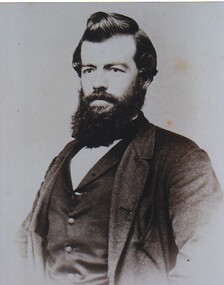
Photograph, Robert Malachi Serjeant
... Robert Malachi Serjeant...Black and white photograph of Robert Malachi Serjeant of Redan (Ballarat)....Robert Malachi Serjeant Mining Black and white photograph of Robert Malachi Serjeant of Redan (Ballarat). ...Black and white photograph of Robert Malachi Serjeant of Redan (Ballarat).robert malachi serjeant, mining -
 University of Melbourne, Burnley Campus Archives
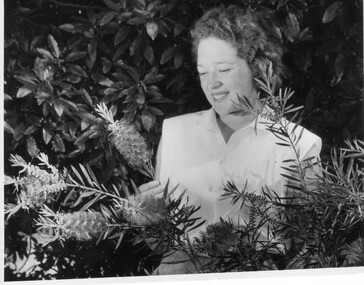
Photograph - Black and white print, Publicity Branch Victorian Department of Agriculture, Judy Serjeant With Callistemon, C 1956
... Judy Serjeant With Callistemon...Black and white photograph. Judy Serjeant standing beside a Callistemon...callistemon judy serjeant bottle brush student working outside publicity 2 copies. ...Black and white photograph. Judy Serjeant standing beside a Callistemon2 copies. On reverse, "Callistemon (Bottle Brush), and, "Photograph by Publicity Branch Victorian Department Of Agriculture Ref. No. c.1769.E."callistemon, judy serjeant, bottle brush, student working outside, publicity -
 University of Melbourne, Burnley Campus Archives
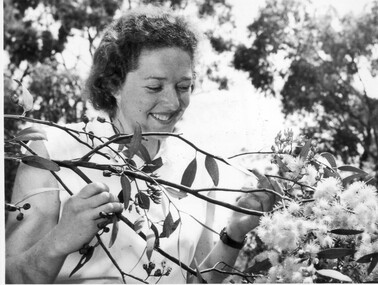
Photograph - Black and white print, Publicity Branch Victorian Department of Agriculture, Judy Serjeant With Eucalyptus torquata, C 1956
... Judy Serjeant With Eucalyptus torquata...Black and white photograph. Judy Serjeant standing next to and holding branch of a Eucalyptus torquata...Black and white photograph. Judy Serjeant standing next to and holding branch of a Eucalyptus torquata Judy Serjeant With Eucalyptus torquata Photograph Black and white print Publicity Branch Victorian Department of Agriculture ...Black and white photograph. Judy Serjeant standing next to and holding branch of a Eucalyptus torquataOn reverse, "Eucalyptus torquata," and, "Photograph by Publicity Branch Victorian Department Of Agriculture Ref. No. C.1767.F."judy serjeant, eucalyptus torquata, student working outside, publicity -
 Federation University Historical Collection
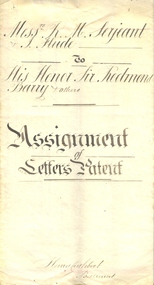
Document, Indenture Between Robert M. Serjeant, Joseph Flude and the Trustees of the Ballarat School of Mines regarding Letters of Patents for the Benefit of the Ballarat School of Mines, 1877, 04/03/1875
... Indenture Between Robert M. Serjeant, Joseph Flude and the Trustees of the Ballarat School of Mines regarding Letters of Patents for the Benefit of the Ballarat School of Mines, 1877......serjeant...R.M. Serjeant was listed as a mining manager and Joseph Flude as a metallurgist. ...Letters Patent for an Invention for Roasting Pyrites to be called 'the Ballarat School of Mines self-Acting Pyrites Furnace" to Robery Malachy Serjeant and Joseph Flude. The large document is on a vellum type paper complete with stamps and seal. ...R.M. Serjeant was listed as a mining manager and Joseph Flude as a metallurgist. ...R.M. Serjeant was listed as a mining manager and Joseph Flude as a metallurgist. In 1875 they were both living in Ballarat. The patent number is A.D.1875, 4th March. No 2031. According to the patent the hearth of the furnace is in the form of a cone revolving horizontally. The feed is supplied to the apex of the cone by an archimedian screw. The crown of the furnace comprises a double covering or roof with an intermediate chamber for receiving heated air. The inner covering is pierced to admit of the heated air being brought into contact with the pyrites on the face of the revolving hearth. The discharge of the roasted substance is affected by means of a scraper at the base of the cone. It was claimed that this was a new mode of introducing heated air, and the exclusion of flame during the operation of roasting pyrites. The self-acting charge and discharge of the furnace and the peculiar construction of the hot air chambers, and the use of perforated bricks through which the supply of air is affected were also new. (http://patentsvictoria.net/002031.html) From the Goulburn Herald, 14 September 1878 "A feature connected with the school of mines is the yet unfinished pyrites works. The extraction of the gold from pyrites and the utilization for commercial purposes of other substances connected with pyrites are peculiarly important to Ballarat, because were a simple and inexpensive method devised there are millions and millions of tons of quartz that would then be made remunerative. With this thought in their minds two scientific gentlemen invented the school of mines self-acting rotatory furnace. This, for lack of funds, has not been completed as yet, but the amount in hand for the purpose is daily increasing, and it will eventually be an accomplished fact. It is in contemplation also to erect machinery shops in connection with the school, and it is purposed to con struct a steam-engine to do at once the work of the pyrites treatment and the ma chine room. A model shaft and mine too are being prepared for on the reserve, so that practical mining of the most thorough character may be taught on the ground.'Large indenture on red bordered vellum. The indenture was regarding a patent for the benefit of the Ballarat School of Mines. Letters Patent for an Invention for Roasting Pyrites to be called 'the Ballarat School of Mines self-Acting Pyrites Furnace" to Robery Malachy Serjeant and Joseph Flude. The large document is on a vellum type paper complete with stamps and seal. The document is signed by Acting-Governor William Stawell. Inscriptions and Markings Written on verso: "Date of Patent 4th March 1875 No 2031 Letters Patent for An invention for roasting pyrities to be called "The Ballarat School of Mines Self-acting Pyrities Furnace" to Robert Malachy Serjeant and Joseph Flude Melbourne, Victoriaballarat school of mines, serjeant, r.m. serjeant, robert m. serjeant, flude, joseph flude, patent, barry, redmond barry, rogers, judge rogers, bland, rivett henry bland, john airy, warrington rogers, establishment, indenture, legal, cuthbert, ballarat school of mines trustees, william stawell, john warrington rogers -
 Federation University Historical Collection
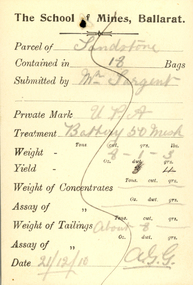
Card, Ballarat School of Mines Assay Card for Robert M. Serjeant, 21/12/1910
... Ballarat School of Mines Assay Card for Robert M. Serjeant......serjeant...Mr Sargent (most probably Robert M. Serjeant) presented 18 bags of sandstone for assaying...The Ballarat School of Mines often conducted assaying for a fee in their Model Mine. ballarat school of mines assay assaying sandstone serjeant r.m. serjeant robert m. serjeant. mining Ballarat School of Mines Assay card. ...The Ballarat School of Mines often conducted assaying for a fee in their Model Mine. Ballarat School of Mines Assay card. Mr Sargent (most probably Robert M. Serjeant) presented 18 bags of sandstone for assayingballarat school of mines, assay, assaying, sandstone, serjeant, r.m. serjeant, robert m. serjeant., mining -
Phillip Island and District Historical Society Inc.
Book, APPLETON, Rev. [James], Theophilus, or, the pupil instructed in the principles, the obligations, and the resources of the Roman Catholic religion, 1794
... Theophilus, or, the pupil instructed in the principles, the obligations, and the resources of the Roman Catholic religion...Inscribed *. *. Gill. Theophilus, or, the pupil instructed in the principles, the obligations, and the resources of the Roman Catholic religion Book APPLETON, Rev. ...From the French, La Doctrine Chretienne. Inscribed *. *. Gill. -
 Flagstaff Hill Maritime Museum and Village
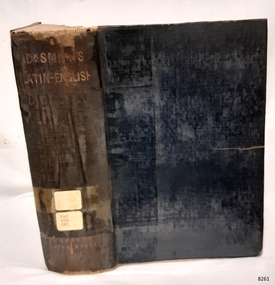
Book - Reference Book Dictionary, William Smith et al, Latin-English Dictionary, 1871
... ...Theophilus D. Hall...Latin-English Dictionary Book Reference Book Dictionary William Smith John Murray Theophilus D. Hall ...This 1871 English-Latin dictionary by William Smith and Theophilus D. Hall is a reference work for translating English words and phrases into Latin, with definitions, usage notes and classical examples to guide correct classical Latin style. It is not a narrative book; it is a scholarly language tool designed for students, teachers and translators.Latin-English Dictionary Author: William Smith Publisher: John Murray Date: 1871 Further Information: Black front cover and brown Spine with gilt lettering and library reference label. non-fictionThis 1871 English-Latin dictionary by William Smith and Theophilus D. Hall is a reference work for translating English words and phrases into Latin, with definitions, usage notes and classical examples to guide correct classical Latin style. It is not a narrative book; it is a scholarly language tool designed for students, teachers and translators.flagstaff hill, warrnambool, shipwrecked coast, flagstaff hill maritime museum, maritime museum, shipwreck coast, flagstaff hill maritime village, great ocean road, book, pattison collection, warrnambool library, warrnambool mechanics’ institute, ralph eric pattison, corangamite regional library service, warrnambool city librarian, mechanics’ institute library, victorian library board, warrnambool books and records, warrnambool children’s library, latin-english dictionary, william smith -
Federation University Historical Collection
Photograph - Image, Yarrowee Hall, Redan, c1883
... ROBERT MALACHY SERJEANT (1828-1902)
Robert Malachy Serjeant was born on 21 December 1828 at Callington, Cornwall. ...An copy of a photo of Yarrowee Hall, the home of of mine manager Robert Malachy Serjeant. ...ROBERT MALACHY SERJEANT (1828-1902)
Robert Malachy Serjeant was born on 21 December 1828 at Callington, Cornwall. ...ROBERT MALACHY SERJEANT (1828-1902) Robert Malachy Serjeant was born on 21 December 1828 at Callington, Cornwall. He was the son of Philip Davey Serjeant, a surgeon in the Royal Marines, and Eliza Malachy. Philip Serjeant died in 1834. His mother, Eliza, remarried John Burgh in 1836. He died in 1837. In September 1848 Eliza, Robert and his two sisters, Caroline and Susan, departed Plymouth on the William Moneya for Port Adelaide and arrived in January 1849. Once gold was discovered in Victoria, Serjeant made his way to Forest Creek (near Castlemaine) and he and his mate Mr Victor, were the first party to sink through the basalt in search of a deep lead. In 1854 he moved to Ballarat to work as a miner and enjoyed some success. In 1855 he was with a group that discovered a 500 ounce nugget. With his share of the sale he set himself up with the latest mining equipment, as well as beginning a lifelong interest in the share market. He became the Manager of the Chryseis, Isis and Garibaldi claims and then the Manager of the Band and Albion Consol Company. He held the position for thirty years and only resigned when the company amalgamated with the Sir Henry Loch Mine. Robert Malachy Serjeant became interested in Politics. The first election for Parliament Representatives for Ballarat was in 1855. Robert stood for election for the first time in 1859, representing Ballarat West. He was also elected to represent Ballarat West in 1874 and 1880. Robert Serjeant’s community involvement extended to Education. Years of discussion eventually saw the development of the Ballarat School of Mines, the first school of mines in Australia. The inaugural School Council was formed in 1870 with Sir Redmond Barry, the Chief Justice, as President and Robert Malachy Serjeant as a member of the council. He held a position on the council until illness forced him to retire in 1889. He was elected a Life Governor in 1889. He was also a Life Governor of the Ballarat Hospital. Robert Serjeant showed Prince Albert and Prince George (later King George V) around the Band and Albion Mine. At the age of 42, Robert enrolled as a student at the School of Mines in 1871. He obtained a Certificate of Competency in Assaying (including Metallurgy) in 1875. The first certificate in “Geology as Applied to Mining” was awarded to Robert Serjeant in 1876. Robert Serjeant was an active and generous supporter of the School of Mines. As well as being a financial contributor, he lectured and examined in the Principles and Practice of Mining. He was regarded as an authority on alluvial and quartz mining and was a member of the Ballarat Local Court and mining board. In 1977 Robert, Joseph Flude and Henry Caselli donated the patent rights of a novel Pyrites furnace to the school. The R.M. Serjeant Scholarship at the Ballarat School of Mines resulted after a reward was offered for the first to produce the best method of treating auriferous ores – other than the smelting method. The offer was open for two years but not awarded. The money for this was donated by Robert Serjeant to the amount of 256 Pounds. It was then used to fund the School of Mines Scholarship in Engineering (1889). It was first awarded in 1922. Robert Malachy Serjeant died on 25 October 1902 and was buried at the Ballaarat Old Cemetery. (Sometimes Malachy is incorrectly written as Malachi)An copy of a photo of Yarrowee Hall, the home of of mine manager Robert Malachy Serjeant. robert malachy serjeant, r.m. sergeant, robert malachi serjeant, band of hope and albion consols, yarrowee hall, redan -
 Federation University Historical Collection
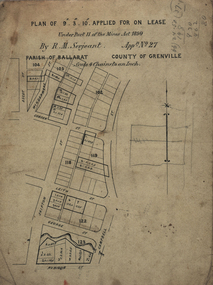
Plan, Lease Applied for by R.M. Serjeant, c1890, c1890
... Lease Applied for by R.M. Serjeant, c1890...serjeant...serjeant r.m.serjeant robert m. serjeant george street skiptn street windermere stret rubicon stret cobdon street ascot street lease redan ballarat robert malachi serjeant band of Hope and Albion mine Plan of a lease showing streets around Skipton and Windermere Streets, Redan. ...Plan of a lease showing streets around Skipton and Windermere Streets, Redan. Scale 4 chains to 1 inch (!:3168)serjeant, r.m.serjeant, robert m. serjeant, george street, skiptn street, windermere stret, rubicon stret, cobdon street, ascot street, lease, redan, ballarat, robert malachi serjeant, band of hope and albion mine -
 Federation University Historical Collection
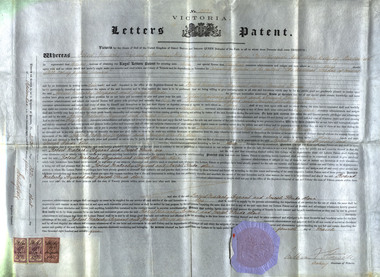
Document, Letters Patent for an Invention for Roasting Pyrites, 1875, 1875
... ...serjeant...R.M. Serjeant was listed as a mining manager and Joseph Flude as a metallurgist. ...Letters Patent for an Invention for Roasting Pyrites to be called 'the Ballarat School of Mines Self-Acting Pyrites Furnace' to Robert Malachy Serjeant and Joseph Flude. The large document is on a vellum type paper complete with stamps and seal. ...Written on verso:
"Date of Patent 4th March 1875
No 2031
Letters Patent
for
An invention for roasting pyrities to be called "The Ballarat School of Mines Self-acting Pyrities Furnace"
to
Robert Malachy Serjeant
and Joseph Flude
Melbourne, Victoria...R.M. Serjeant was listed as a mining manager and Joseph Flude as a metallurgist. ...R.M. Serjeant was listed as a mining manager and Joseph Flude as a metallurgist. In 1875 they were both living in Ballarat. The patent number is A.D.1875, 4th March. No 2031. According to the patent the hearth of the furnace is in the form of a cone revolving horizontally. The feed is supplied to the apex of the cone by an archimedian screw. The crown of the furnace comprises a double covering or roof with an intermediate chamber for receiving heated air. The inner covering is pierced to admit of the heated air being brought into contact with the pyrites on the face of the revolving hearth. The discharge of the roasted substance is affected by means of a scraper at the base of the cone. It was claimed that this was a new mode of introducing heated air, and the exclusion of flame during the operation of roasting pyrites. The self-acting charge and discharge of the furnace and the peculiar construction of the hot air chambers, and the use of perforated bricks through which the supply of air is affected were also new. (http://patentsvictoria.net/002031.html) From the Goulburn Herald, 14 September 1878 "A feature connected with the school of mines is the yet unfinished pyrites works. The extraction of the gold from pyrites and the utilization for commercial purposes of other substances connected with pyrites are peculiarly important to Ballarat, because were a simple and inexpensive method devised there are millions and millions of tons of quartz that would then be made remunerative. With this thought in their minds two scientific gentlemen invented the school of mines self-acting rotatory furnace. This, for lack of funds, has not been completed as yet, but the amount in hand for the purpose is daily increasing, and it will eventually be an accomplished fact. It is in contemplation also to erect machinery shops in connection with the school, and it is purposed to con struct a steam-engine to do at once the work of the pyrites treatment and the ma chine room. A model shaft and mine too are being prepared for on the reserve, so that practical mining of the most thorough character may be taught on the ground.'Letters Patent for an Invention for Roasting Pyrites to be called 'the Ballarat School of Mines Self-Acting Pyrites Furnace' to Robert Malachy Serjeant and Joseph Flude. The large document is on a vellum type paper complete with stamps and seal. The document is signed by Acting-Governor William Stawell.Written on verso: "Date of Patent 4th March 1875 No 2031 Letters Patent for An invention for roasting pyrities to be called "The Ballarat School of Mines Self-acting Pyrities Furnace" to Robert Malachy Serjeant and Joseph Flude Melbourne, Victoriaballarat school of mines, serjeant, r.m. serjeant, robert m. serjeant, flude, joseph flude, richard gibbs, stawell, william stawell, pyrities furnace, philately, statute stamp, seal (victoria), ballarat school of mines self-acting pyrities furnace, ballarat school of mines self-acting pyrites furnace -
Linton and District Historical Society Inc
Certificate of Title, Certificate of Title: Allotment 36, Section 4, Township of Linton
... Title of the land was transferred to James Adolphus Nelson and Theophilus William Nelson in 1955. James and Theo Nelson had already purchased adjacent allotments 27 - 30 in 1929....Most recent holders of the Title recorded as James Adolphus Nelson and Theophilus William Nelson....Title of the land was transferred to James Adolphus Nelson and Theophilus William Nelson in 1955. James and Theo Nelson had already purchased adjacent allotments 27 - 30 in 1929. ...Title of the land was transferred to James Adolphus Nelson and Theophilus William Nelson in 1955. James and Theo Nelson had already purchased adjacent allotments 27 - 30 in 1929.Copy of a Certificate of Title for an allotment of land situated between Grantley Street and Springdallah Creek in Linton. Copy comprised of three photostat sheets held together by tape. Most recent holders of the Title recorded as James Adolphus Nelson and Theophilus William Nelson.certificates of title, allotment 36 section 4 township of linton, james adolphus nelson, theophilus william nelson -
 Ballarat Heritage Services
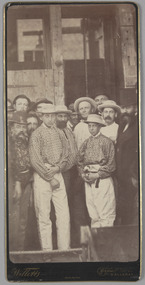
Photograph - Image, Willetts, The Princes Visit the Band of Hope and Albion, 1881
... The Duke of Edinburgh and and his brother, in Mining Costume after descending the Band of Hope Gold Mine, Ballarat. R.M. Serjeant stands to the left. ...ballarat band and albion gold mine mining duke of edinburgh royal visit princes robert malachi serjeant r.m. serjeant royalty Black and white image of H.R.H. ...Black and white image of H.R.H. The Duke of Edinburgh and and his brother, in Mining Costume after descending the Band of Hope Gold Mine, Ballarat. R.M. Serjeant stands to the left. ballarat, band and albion gold mine, mining, duke of edinburgh, royal visit, princes, robert malachi serjeant, r.m. serjeant, royalty -
Port Melbourne Historical & Preservation Society
Photograph - William John Kitchen (1864 -1925), son of Theophilius (Theo) Kitchen, 1910s - 1920s
... Large black and white photograph, in wooden frame of William John Kitchen (1864-1925), son of Theophilus Kitchen of J Kitchen and Sons of Port Melbourne. ...industry manufacturing william john kitchen j kitchen & sons pty ltd symex holdings ltd pental products pty ltd Large black and white photograph, in wooden frame of William John Kitchen (1864-1925), son of Theophilus Kitchen of J Kitchen and Sons of Port Melbourne. ...Large black and white photograph, in wooden frame of William John Kitchen (1864-1925), son of Theophilus Kitchen of J Kitchen and Sons of Port Melbourne. Plus photocopy of information sheet prepared by Symex staff in early 2000sindustry, manufacturing, william john kitchen, j kitchen & sons pty ltd, symex holdings ltd, pental products pty ltd -
 University of Melbourne, Burnley Campus Archives
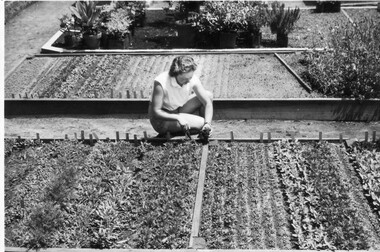
Photograph - Black and white print, Information Branch Victorian Department of Agriculture, Seedling Beds in Nursery, C. 1956
... Kneen 19.11.1991, "Student attending to seedlings is Judy Serjeant (now Hilton)....Kneen 19.11.1991, "Student attending to seedlings is Judy Serjeant (now Hilton). nursery judy hilton (nee serjeant) female student seedling beds students working outside judy serjeant old nursery publicity On reverse, "Seedling beds in Nursery," and, "Photograph by Information Branch Victorian Department Of Agriculture Ref. ...Note by T.H. Kneen 19.11.1991, "Student attending to seedlings is Judy Serjeant (now Hilton).Black and white photograph. Female student attending to seedlings in the Old Nursery. On reverse, "Seedling beds in Nursery," and, "Photograph by Information Branch Victorian Department Of Agriculture Ref. No. C.1767.D."nursery, judy hilton (nee serjeant), female student, seedling beds, students working outside, judy serjeant, old nursery, publicity -
Port Melbourne Historical & Preservation Society
Photograph - Theophilus (Theo) Kitchen (1840 - 1909), second son of John Kitchen, 1900s
... Large black and white photograph, in wooden frame of Theophilus (Theo) Kitchen (1840-1909), second son of John Kitchen of J Kitchen and Sons of Port Melbourne. ...industry manufacturing theophilus (theo) kitchen j kitchen & sons pty ltd symex holdings ltd pental products pty ltd Large black and white photograph, in wooden frame of Theophilus (Theo) Kitchen (1840-1909), second son of John Kitchen of J Kitchen and Sons of Port Melbourne. ...Large black and white photograph, in wooden frame of Theophilus (Theo) Kitchen (1840-1909), second son of John Kitchen of J Kitchen and Sons of Port Melbourne. Plus photocopy of information sheet prepared by Symex staff in early 2000sindustry, manufacturing, theophilus (theo) kitchen, j kitchen & sons pty ltd, symex holdings ltd, pental products pty ltd -
 Stawell Historical Society Inc
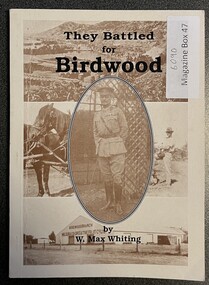
Book, They Battled for Birdwood
... Includes WW1 soldier Theophilus Thomas Walters Soldier Settlers...Includes WW1 soldier Theophilus Thomas Walters Soldier Settlers WW1 Author W Max Whiting A5 Sized Book. ...Includes WW1 soldier Theophilus Thomas Walters Soldier SettlersA5 Sized Book. Fawn with Brown Pictures. Black Title. Author W Max Whitingww1 -
 Warrnambool and District Historical Society Inc.
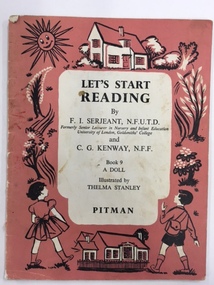
Book, Lets Start Reading - Pitman Book 9 A Doll, 1966
... Written by F I Serjeant and C G Kenway. illustrated by Thelma Stanley. ...Cudgee State School No 105, 1966. Written by F I Serjeant and C G Kenway. illustrated by Thelma Stanley. ...This book is one of a series of 12 which were used in primary schools in prep for children beginning to read. They have a limited and repetitive vocabulary and simple diagrams. This particular book is from Cudgee Primary School No 105 which is situated approximately 15 km east of Warrnambool.A common item which is typical of the era in style and content. Dark pink cover with title in black text inside white rectangle. Diagrams of children, houses, and plants around the outer edge of cove.14 pages. Diagrams in black and white on pink background.Stamp inside front cover. Cudgee State School No 105, 1966. Written by F I Serjeant and C G Kenway. illustrated by Thelma Stanley. Book 9 A Dollwarrnambool,, cudgee, cudgee state school 1966 -
 Victorian Interpretive Projects Inc.
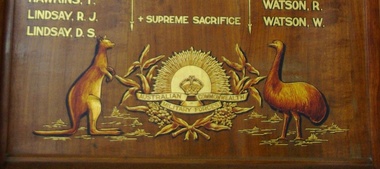
Parwan State School (916) World War One Honour Board, 2014
... ...serjeant...Phillips; J.A. Sweetman; R.H. Serjeant; W.T. Serjeant; T. Shannon; P. Triggs; C.M. ...Phillips; J.A. Sweetman; R.H. Serjeant; W.T. Serjeant; T. Shannon; P. Triggs; C.M. ...This honor roll is held by the Bacchus Marsh RSLThe names on the honour board are: W. Blake; F.G. Blake; A.K. Cumming; A.V. Chapple; W.J. Cocherill; A.P. Cecil; C.R. Edwards; W.B. Edwards; R.W. Edwards; T. Hawkins; R.J. Lindsay; D.S. Lindsay; C.D. Cumming; N.H. Cumming; T.L. Cocherill; W.F. Hehir; N. McLachlan; J. McLachlan; S. Osborne; E.A. Smith; A. Ladhams; T. Phillips; J.A. Sweetman; R.H. Serjeant; W.T. Serjeant; T. Shannon; P. Triggs; C.M. Todd; M. Whelan; R. Watson; W. Watson.parwan, parwan state school, world war, world war 1, honour board, honor board, blake, cumming, chapple, cocherill, cecil, edwards, hawkins, lindsay, hehr, mclachlan, osborne, smith, ladhams, philips, sweetman, serjeant, shannon, triggs, todd, whelan, watson, bacchus marsh rsl, mmm -
 Federation University Historical Collection
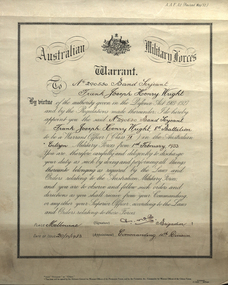
Certificate, Australian Military Forces Warrant (Frank Wright), 01/02/1933
... It is an Australian Military Forces Warrant made out to Frank Joseph Henry Wright (290530) Band Serjeant of the 8th Battalion. The warrant was for the Australian citizen Military Forces from 01 February 1933....It is an Australian Military Forces Warrant made out to Frank Joseph Henry Wright (290530) Band Serjeant of the 8th Battalion. The warrant was for the Australian citizen Military Forces from 01 February 1933. ...Frank Wright was conductor of the Ballarat Soldiers' Memorial Band. Paper warrant with printed and handwritten text. It is an Australian Military Forces Warrant made out to Frank Joseph Henry Wright (290530) Band Serjeant of the 8th Battalion. The warrant was for the Australian citizen Military Forces from 01 February 1933.frank wright, 8th battalion, citizen military forces, warrant, music, band -
Federation University Historical Collection
Booklet, Ballarat School of Mines Annual Report, 1901, 1901
... It includes information on: Alfred Johnston's death during the Boer War, Thomas Bath's bequest to the Ballarat School of Mines, resignation of Theophilus Williams from the School Council, appointment of Richard Maddern and Isaiah Pearce to the School Council, Associateship courses, New mining metallurgical laboratory and a statement of receipts and expenditure ...It includes information on: Alfred Johnston's death during the Boer War, Thomas Bath's bequest to the Ballarat School of Mines, resignation of Theophilus Williams from the School Council, appointment of Richard Maddern and Isaiah Pearce to the School Council, Associateship courses, New mining metallurgical laboratory and a statement of receipts and expenditure Ballarat School of Mines Annual Report, 1901 Booklet ...In 1901 Andrew Anderson was President of the Ballarat School of Mines. At the height of its world wide fame the annual report states: 'That the public recognises and appreciates the importance of the School, is evident by the large additions to the class rolls - (many of the students have come long distances, from England, India, South Africa, new South Wales, Queensland, West Australia, South Australia and Tasmania,) which give ample proof, if such were necessary, of the wide spread reputation of the School.'8 page booklet relating to the Ballarat School of Mines in the year 1901. It includes information on: Alfred Johnston's death during the Boer War, Thomas Bath's bequest to the Ballarat School of Mines, resignation of Theophilus Williams from the School Council, appointment of Richard Maddern and Isaiah Pearce to the School Council, Associateship courses, New mining metallurgical laboratory and a statement of receipts and expenditure ballarat school of mines, andrew anderson, thomas bath, alfred gresham johnston, boer war, rhenoster kop, south africa, richard maddern, isaiah pearce, salariesmining laboratory, metallurgical laboratory, wynne tables, tregurtha tables, halley's percussioina tables, wilfley concentrator, spitzkasten, jig, linkenback table, chilian mill, amalgamator, model agitation plant, slime vats, alfred mica smith, william gurr, thomas hart, museum, fees, mining plant, model mine, allendale excursion, daylesford excursion, botanical excursion, geological excursion, melbourne excursion, itonworkers' association -
 Charlton Golden Grains Museum Inc
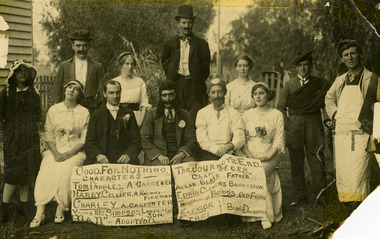
Photograph - Black and White Photo of Charlton Concert Group c1900
... FATHER, EDWIN CLEMENTS . BRIDEGROOM, THEOPHILUS BRIGGS . OLD FRIEND, ELEANOR & ETHEL . ...FATHER, EDWIN CLEMENTS . BRIDEGROOM, THEOPHILUS BRIGGS . OLD FRIEND, ELEANOR & ETHEL . ...Concert Group c1900Black and White Photo of Charlton Concert Group c1900 Two plays mentioned - 'Good For Nothing' and 'The Journey's End' A Caithness photo.'GOOD FOR NOTHING' CHARACTERS - TOM DIBBLES . A GARDENER, HARRY COLLIER . A RAILWAY FIREMAN, CHARLIE . A CARPENTER, YOUNG MR SIMPSON . LANDLORD'S SON, "NAN" . ADOPTED DAUGHTER. 'THE JOURNEY'S END' CHARACTERS - ALLAN BLAIR . FATHER, EDWIN CLEMENTS . BRIDEGROOM, THEOPHILUS BRIGGS . OLD FRIEND, ELEANOR & ETHEL . BLAIR'S DAUGHTERScaithness, concert group c 1900, good for nothing, the journey's end -
Linton and District Historical Society Inc
Certificate of Title, Certificate of Title : Crown Allotments 27, 28, 29, 30, Section 4, Township of Linton
... The land was transferred to Theophilus William Nelson and James Adolphus Nelson in 1929. ...The land was transferred to Theophilus William Nelson and James Adolphus Nelson in 1929. ...The land was transferred to Theophilus William Nelson and James Adolphus Nelson in 1929. James and Theo Nelson later (1955) acquired Allotment 36, Section 4 which adjoins these allotmentsCopy of Certificate of Title for several adjacent blocks of land on the corner of Clyde Street and Grantley Street in Linton. Copy is comprised of photostat sheets held together by tape.theophilus william nelson, james adolphus nelson, certificates of title, allotments 27 - 30 township of linton -
 Federation University Historical Collection
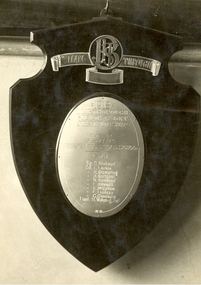
Photograph - Black and White, Ballarat Junior Trophy for the Senior Cadet Championships, 1918, c1918
... Krahnert, I Larkin, H. Siemering, R. Serjeant, H. Beanland, L. Rowsell, A. McCallum; L. ...Krahnert, I Larkin, H. Siemering, R. Serjeant, H. Beanland, L. Rowsell, A. McCallum; L. ...According to Neil Leckie, Manager of the Ballarat Ranger Military Museum: * Originally 12 – 14 year olds went to Junior Cadets attached to their school. * From age 14 – 17 they were Senior Cadets attached to the local militia unit. * After 1 July of the year a Cadet turned 18, the Cadet left the Senior Cadets and became a member of the Citizen Military Force. * In October 1918 the AIF, Militia and Cadets were renamed to give some connection to the AIF battalion raised in the area. Ballarat saw: 8th Australian Infantry Regiment comprising: * 8th Battalion AIF renamed 1st Battalion 8th Australian Infantry Regiment * 70th Infantry Militia renamed 2nd Battalion 8th Australian Infantry Regiment * 70th Infantry Cadets renamed 3rd B, 8th Australian Infantry. 39th Australian Infantry Regiment comprising: * 39th Battalion AIF renamed 1st Battalion 39th Australian Regiment * 71st Infantry Militia renamed 2nd Bn, 39th Australian Infantry Regiment * 71st Infantry Cadets renamed 3rd Bn, 39th Australian Infantry Regiment Prior to the reorganisation in 1918 the 18th Brigade was the 70th, 71st and 73rd Infantry. It is thought that the 18th Brigade Cadet units in 1920 were those that came from the old: * 69th Infantry (Geelong/Queenscliff) * 70th Infantry (Ballarat/Colac) * 71st Infantry (Ballarat West) * 72nd Infantry Warrnambool) * 73rd Infantry (NW Vic) The next name change came in 1921!Black and white photograph of a timber shield with engraving on silver metal. The trophy is the 1918 Maryborough Senior Cadet Championship which was won by the Ballarat Junior Technical School. The winning team comprised Sgt T. Krahnert, I Larkin, H. Siemering, R. Serjeant, H. Beanland, L. Rowsell, A. McCallum; L. Lindsay, C. Chambers. The instructor was Lieutenant Harold Wakeling.ballarat junior technical school, cadets, trophy, shield -
 Linton and District Historical Society Inc
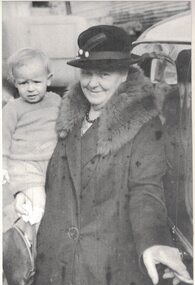
Photograph, Priscilla Nelson with her grandson Theo Nelson
... This photograph shows Priscilla Nelson with her grandson Theo (son of Theophilus Nelson). The photograph is understood to have been taken in 1939. ...This photograph shows Priscilla Nelson with her grandson Theo (son of Theophilus Nelson). The photograph is understood to have been taken in 1939. ...Priscilla Nelson, born 1869, grew up at Happy Valley and married James Nelson (the second son of Robert Simeon Nelson and Mary Ann Dawe) in 1890. Priscilla and James had six children - James, Theophilus, Norman, Pearl, Mary and Violet. James established a carpentry/undertaking business on "Church Hill" in Linton (near the Presbyterian Church), but after his brother John Nelson died in 1900, he inherited the Nelson premises in Sussex Street which had been built by his father, and he moved his business and family to this location. This photograph shows Priscilla Nelson with her grandson Theo (son of Theophilus Nelson). The photograph is understood to have been taken in 1939. Priscilla Nelson died in 1941.Enlarged black and white copy of original photograph which has been mounted on white card. The photograph shows an older lady wearing a had and a coat with a fur trim. In one arm she is holding a young child and a handbag. She appears to be about to climb into a car, as her other hand is on the car's door handle.priscilla nelson (née gribble), theo nelson [b. 1939] -
 Federation University Historical Collection
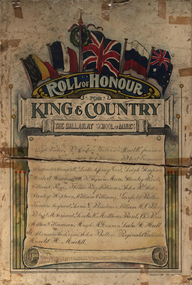
Poster - Honour Roll, Tulloch and King, Ballarat School of Mines Honour Roll, c1915, c1915
... Serjeant (Jnr); Leslie W. Matthews, Basil N. ...Serjeant (Jnr); Leslie W. Matthews, Basil N. ...Printers Tullock and King possibly produced an honour roll for organisations to fill in. A World War One Honour Roll lithograph on card featuring flags of the allied countries. The words 'Ballarat School of Mines' and a list of names have been handwritten onto the poster: Virgil Tucker; P. Sinclair Anderson; Carl W. Janssen, [illegible], H. S. Thomas; Robert Tremaine; Alexander Campbell; Leslie De Jersey Grut; Leigh Timpson; Herbert Hawkesworth; R. Ingrame Moore; Stanley Roots; William E. Figgis; Thomas Rhys Williams; John R. Sides; Stanley Hepburn; William WIlliams; Garfield Bolton; Theodore Serjeant; Louis G Buchner; William H. O'Bern; Robert M. Serjeant (Jnr); Leslie W. Matthews, Basil N. D. Ross; Milton Williamson; Hugh M. Conran; Leslie C. Hall; E. Sleeman Anderson, John Bolton, Reginald Callister and Harold H. Martell.ballarat school of mines, world war, world war 1, virgil tucker, p. sinclair anderson, h. s. thomas, robert tremaine, alexander campbell, leslie de jersey grut, leigh timpson, herbert hawkesworth, r. ingrame moore, stanley roots, william e. figgis, thomas rhys williams, john r. sides, stanley hepburn, william williams, garfield bolton, theodore serjeant, louis g. buchner, carl w. janssen, william h. o'bern, robert m. serjeant (jnr, leslie w. matthews, basil n. d. ross, milton williamson, hugh m. conran, leslie c. hall, e. sleeman anderson, john bolton, reginald callister, harold h. martell, william figgis, roll of honour, honour roll -
Federation University Historical Collection
Booklet, Ballarat School of Mines President's Annual Report, 1902, 1902
... Pinnock, Mr Abraham James and Mr Robert M. Serjeant, Opening of new buildings as a mining laboratory by th Hon J. ...Pinnock, Mr Abraham James and Mr Robert M. Serjeant, Opening of new buildings as a mining laboratory by th Hon J. ...In 1902 Andrew Anderson was President of the Ballarat School of Mines. Part of his report states: 'As in former years many of the students have come long distances, from England, India, South Africa, new South Wales, Queensland, West Australia, South Australia and Tasmania'. Statement of Receipts and Expenditure for the year 1902.8 page booklet relating to the Ballarat School of Mines in the year 1901. It includes information on: the deaths of Dr R. D. Pinnock, Mr Abraham James and Mr Robert M. Serjeant, Opening of new buildings as a mining laboratory by th Hon J. B. Burton, Minister of Mines - among the visitors was the Acting Prime Minister the Hon. Alfred Deakin and a statement of receipts and expenditure ballarat school of mines, andrew anderson, dr r. d. pinnock, mr abraham james, mr robert serjeant, mr w. p. wynne, geo. fitches, dr william morrison, cr. j. m. bickett, chemical department, metallurgical department, engineering department, mining department, hon. j. b. burton, hon. alfred deakin, senator drake, jon. w. h. irvine, hon. john james, mr james travis
