
Showing 59 items matching "tie bars"
-
 Frankston RSL Sub Branch
Unknown - RAAF Tie Bar/Trench Art, RAAF Tie Bar
... RAAF Tie Bar/Trench Art...RAAF Tie Bar...Decorative tie bar to be worn socially and to signify a present or past association with the RAAF...Silvered tie bar with silver suspension chain attached either end. ...Centrally attached to the chain is a small RAAF badge with extended wings. RAAF Tie Bar Unknown RAAF Tie Bar/Trench Art ...Decorative tie bar to be worn socially and to signify a present or past association with the RAAFSilvered tie bar with silver suspension chain attached either end. Centrally attached to the chain is a small RAAF badge with extended wings. -
 Melbourne Tram Museum
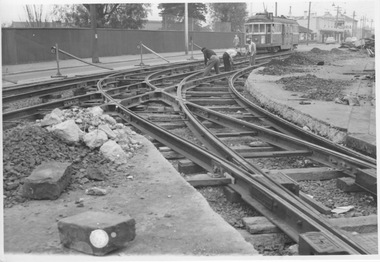
Photograph - New run out track Essendon Depot, Melbourne & Metropolitan Tramways Board MMTB or VicRail or Ministry of Transport, Sept 1960
... ...tie bars...Three workmen in civilian clothes are tightening tie bars; W2 class tram 552 has cleared the new works bound for Essendon Aerodrome route 59 with weather blinds down; three motor vehicles are shown in the distance, two with the distinctive shape of a Holden. ...Three workmen in civilian clothes are tightening tie bars; W2 class tram 552 has cleared the new works bound for Essendon Aerodrome route 59 with weather blinds down; three motor vehicles are shown in the distance, two with the distinctive shape of a Holden. ...Photograph shows the laying of a new northern exit/entry road for Essendon Depot. Grooved tramway rail and turnouts are in place supported by timber sleepers. Part of the footpath and a section roadway on Mt Alexander Road are excavated for these works. Three workmen in civilian clothes are tightening tie bars; W2 class tram 552 has cleared the new works bound for Essendon Aerodrome route 59 with weather blinds down; three motor vehicles are shown in the distance, two with the distinctive shape of a Holden. The high fence and tennis court opposite the depot are part of a Catholic convent and teachers college. Records suggest the date is September 1960 when the single northern exit/entry track to the southbound line was replaced with this double track. Until this time, a separate crossover provided a connection to the northbound line. This new arrangement meant that trams running out or in from the northbound track no longer had to negotiate a crossover, thus reducing motor traffic congestion. The obsolete crossover was removed. It is likely that in the following days mass concrete was used to rebuild the roadway. As tramway rail with a flangeway was no longer produced in Australia from the 1960s, railway-type rail without a flangeway was used instead and the flangeway provided by a groove in the concrete. This photograph is likely an official M&MTB photograph.Yields information about Essendon Depot and track improvements c1960 Black and white photographs with no note on rear. official m&mtb photograph, essendon depot, exit road, mt alexander road, tie bars, w2 class, 552, weather blinds, essendon aerodrome, route 59, holden, catholic convent, teachers college, crossover, turnout, mass concrete, railway type rail, flangeway -
 Moorabbin Air Museum
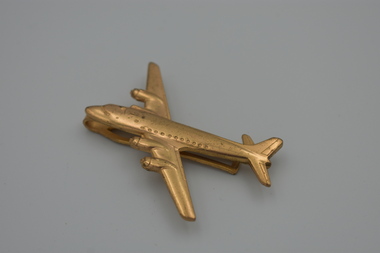
Souvenir (item) - Douglas DC-4 Vintage Brass Tie Bar
... Douglas DC-4 Vintage Brass Tie Bar....Douglas DC-4 Vintage Brass Tie Bar....Douglas DC-4 Vintage Brass Tie Bar....Douglas DC-4 Vintage Brass Tie Bar. Douglas DC-4 Vintage Brass Tie Bar. ... -
Moorabbin Air Museum
Badge (item) - Cuff Links & Tie Bar Gold Tone Australian Airlines
... Cuff Links & Tie Bar Gold Tone Australian Airlines....Cuff Links & Tie Bar Gold Tone Australian Airlines....Cuff Links & Tie Bar Gold Tone Australian Airlines....Cuff Links & Tie Bar Gold Tone Australian Airlines. Cuff Links & Tie Bar Gold Tone Australian Airlines. ... -
 Moorabbin Air Museum
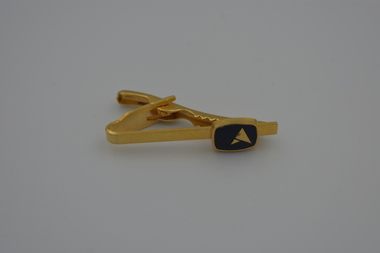
Badge (item) - Ansett Australia Tie Bar
... Ansett Australia Tie Bar....Ansett Australia Tie Bar....Ansett Australia tie bar, features the airlines "Delta logo" with alligator attachment....Ansett Australia Tie Bar. Badge Ansett Australia Tie Bar. ... -
 8th/13th Victorian Mounted Rifles Regimental Collection
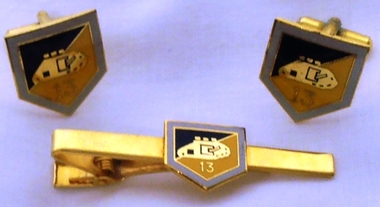
Tie bar and cuff links
... Tie bar and cuff links...Gilt tie bar and pair of matching cuff links with enamel colour patch of the 13th Armoured Regiment AIF. ...Tie bar and cuff links ...In August 1940, 13th Light Horse (Gippsland) converted from horse to mechanised initially as 13th Motor Regiment then 13th Armoured Regiment. Trained in Victoria and as the Japanese threat to the mainland declined the regiment was disbanded in October 1943. It is likely these fashion items were made after the war and worn by a member of the regimental association.A fine example and in excellent condition of regimental memorabilia intended to identify a former member of a World War II armoured regiment.Gilt tie bar and pair of matching cuff links with enamel colour patch of the 13th Armoured Regiment AIF. 13th armoured regiment, fashion -
 Moorabbin Air Museum
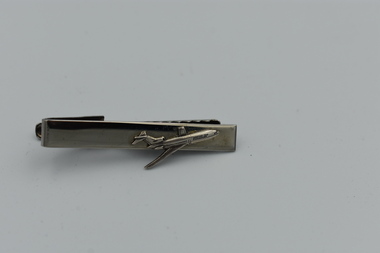
Badge (item) - Tie Clip Bar "Boeing 727"
... Tie Clip Bar "Boeing 727"...Tie Clip Bar "Boeing 727"...Tie Clip Bar "Boeing 727"...Tie Clip Bar "Boeing 727" Tie Clip Bar "Boeing 727" Badge Tie Clip Bar "Boeing 727" ... -
 Bendigo Historical Society Inc.
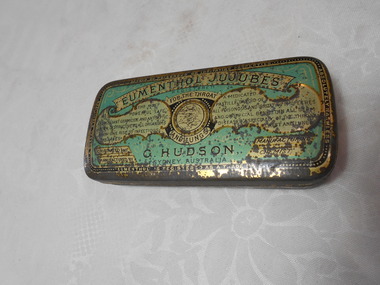
Container - JUJUBES TIN
... G Hudson Eumenthol JuJubes tin containing assortement of items including shirt studs, tie bar, buttons, gold & blue tin with black print, medicated pastille for the throat and lungs....G Hudson Eumenthol JuJubes tin containing assortement of items including shirt studs, tie bar, buttons, gold & blue tin with black print, medicated pastille for the throat and lungs. ...G Hudson Eumenthol JuJubes tin containing assortement of items including shirt studs, tie bar, buttons, gold & blue tin with black print, medicated pastille for the throat and lungs.Originated and manufactured by G Hudson Sydney Australia Manufacturing Chemist.medicine, pharmacy, cold preventive -
 Ballarat Tramway Museum
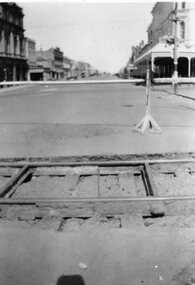
Photograph - Phoenix Foundry crossing of the Sturt St, Wal Jack, 1935
... Track has been dug out, exposing the sleepers and one tie bar. There are road barriers in the background. ...Track has been dug out, exposing the sleepers and one tie bar. There are road barriers in the background. ...Photo of the former Phoenix Foundry railway line in Armstrong St., Ballarat, crossing the Sturt St. (north side) tram line, looking south. Has Town Hall and Myer (formerly Snows) building in the background, along with a tram stop on the corner. Track has been dug out, exposing the sleepers and one tie bar. There are road barriers in the background. Photo taken 1935, during the reconstruction of the tramway system. On Velox photo paper.Yields information about the former Phoenix Foundry - rail / tram crossing in Sturt St at Armstrong St.Black and white photograph with notes on the rear.On rear in top right hand corner in blue ink "12004". Above main writing in pencil is the number "74". On bottom half in light black ink "The old piece of Rly line in Armstrong St. crossing Sturt St. tram line Ballarat (1935)" In Wal Jack's handwriting.trams, tramways, phoenix foundry, armstrong st, sturt st, railway siding -
 Ballarat Tramway Museum
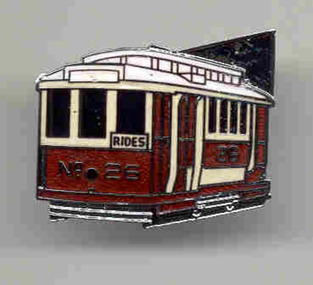
Badge - Tram 26 - red, R. E. V Gomm, c1996
... 2773.1 - Metal lapel badge - image of Ballarat Tramway Museum No. 26 in a ESCo red and white livery - stamped metal badge with a clip on rear, nickel plated finish, with hand painted red and white paint infilling the detail. 2773.2 - as above but with a tie bar clip on rear. Made by R. E. V. Gomm, England to order for Travis Jeffrey c1996....Tramways trams Badges Lapel Badge BTM Tie Clip ESCo 2773.1 - Metal lapel badge - image of Ballarat Tramway Museum No. 26 in a ESCo red and white livery - stamped metal badge with a clip on rear, nickel plated finish, with hand painted red and white paint infilling the detail. 2773.2 - as above but with a tie bar clip on rear. Made by R. E. V. Gomm, England to order for Travis Jeffrey c1996. ...2773.1 - Metal lapel badge - image of Ballarat Tramway Museum No. 26 in a ESCo red and white livery - stamped metal badge with a clip on rear, nickel plated finish, with hand painted red and white paint infilling the detail. 2773.2 - as above but with a tie bar clip on rear. Made by R. E. V. Gomm, England to order for Travis Jeffrey c1996.tramways, trams, badges, lapel badge, btm, tie clip, esco -
 Bendigo Military Museum
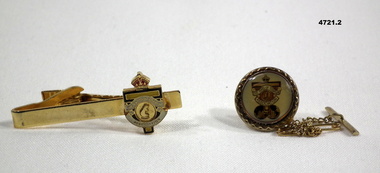
Accessory - TIE PINS, Rats of Tobruk Association, c.1980
... The enamelled badge of Rats of Tobruk Association is mounted at one end. The rear of tie bar has a spring loaded clamp. 2. Gold tie pin with mini chains. ...The rear of tie bar has a spring loaded clamp. 2. Gold tie pin with mini chains. ...See Dean Cat 4575P1. Gold metallic bar. The enamelled badge of Rats of Tobruk Association is mounted at one end. The rear of tie bar has a spring loaded clamp. 2. Gold tie pin with mini chains. This is of circular design with the badge of Rats of Tobruk Association sealed in it behind an acrylic layer. Below the Rats badge are two world spheres. Small chains and two pins come away from rear of badge.tie pins, rats of tobruk -
 Federation University Historical Collection
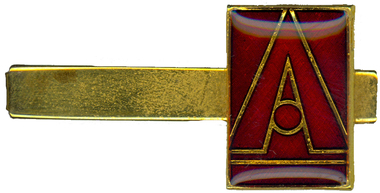
Costume - Numismatics, Ararat Technical School Tie Pin, 1984
... Box 668 Ballarat 2250 Dear Miss Scanlon, In response to a letter received from Mr Peter Shiells, I have pleasure in enclosing a tie bar from the Ararat Technical School. We wish you well with your exhibit and look forward to seeing the display the next time we visit the Ballarat School of Mines and Industries. ...Box 668 Ballarat 2250 Dear Miss Scanlon, In response to a letter received from Mr Peter Shiells, I have pleasure in enclosing a tie bar from the Ararat Technical School. We wish you well with your exhibit and look forward to seeing the display the next time we visit the Ballarat School of Mines and Industries. ...Red enamel tie pin featuring the logo to the Ararat Technical School. The pin is clipped onto a covering letter from Principal A.L. Johnson21st May, 1984. Miss Therese Scanlon P.O. Box 668 Ballarat 2250 Dear Miss Scanlon, In response to a letter received from Mr Peter Shiells, I have pleasure in enclosing a tie bar from the Ararat Technical School. We wish you well with your exhibit and look forward to seeing the display the next time we visit the Ballarat School of Mines and Industries. Thank you for giving us the opportunity to participate Yours faithfully signed A.L. Johnson Principal ararat technical school, ballarat school of mines, therese scanlon, a.l. johnson, peter shiells, logo, numismatics, tiepin, tie pin -
 Ballarat Tramway Museum
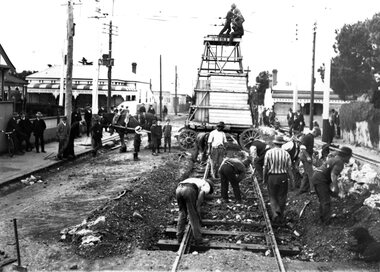
Photograph - Geelong Tramway - relaying tram tracks in Aphrasia St., Newtown
... Note that sleepers are being used in the construction, as seen in items 9271 and 9214, with tie bars and continuous concrete about 50cm wide under each rail. ...Note that sleepers are being used in the construction, as seen in items 9271 and 9214, with tie bars and continuous concrete about 50cm wide under each rail. ...Relaying tram tracks at the eastern end of Aphrasia St., Newtowwn, looking east. The location is immediately west of the Pleasant St. intersection, soon after Aphrasia St. was extended from Pleasant St. to Pakington St., so that the three sharp curves for trams into Retreat Road, Pleasant St., and then Aphrasia St., were reduced to one, from Pakington into Aphrasia St. May 1914. Note that sleepers are being used in the construction, as seen in items 9271 and 9214, with tie bars and continuous concrete about 50cm wide under each rail. The overhead is being worked on in two ways; safely with the horse drawn tower wagon, or less so by ladder.,Black and white print on paper.GRS710/.25/1/7 and 25-7 written on the reverse in pencil. The No. 1 in a circle written on reverse in ink.geelong tramway, relaying tram tracks in geelong, sleeper and concrete tram track base -
 Ballarat Tramway Museum
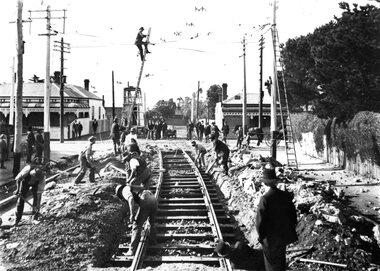
Photograph - Geelong Tramway relaying tracks, Melbourne Electric Supply Co. (MESCo), 5/1914
... All the original tracks were laid as a "stringer" construction, as seen in items 9271 and 9214, with tie bars and continuous concrete about 50cm wide under each rail. ...All the original tracks were laid as a "stringer" construction, as seen in items 9271 and 9214, with tie bars and continuous concrete about 50cm wide under each rail. ...Relaying tram tracks at the eastern end of Aphrasia St., Newtown, looking east. The location is immediately west of the Pleasant St. intersection, soon after Aphrasia St. was extended from Pleasant St. to Pakington St. so that the three sharp curves for trams into Retreat Road, Pleasant St. and then Aphrasia St. were reduced to one, from Pakington into Aphrasia St. May 1914. Note that sleepers are being used in the construction. All the original tracks were laid as a "stringer" construction, as seen in items 9271 and 9214, with tie bars and continuous concrete about 50cm wide under each rail. The overhead is being worked on in two ways; safely with the horse drawn tower wagon, or less so by ladder.Yields information about the reconstruction of tram tracks and infrastructure in Aphrasia St Newtown.Black and white print on paper. Two copies held.GSR710/25/1/8 and 25-8, written on the reverse in pencil. The No. 1 in a circle written on reverse in ink. Second copy has in writing "extending track Aprhrasia St to Pakington St 1913" in ink and a stamp with a notation.geelong tramway, relaying stringer tram tracks in geelong, stringer tram tracks, aphrasia st., newtown, track work, overhead -
 Ballarat Tramway Museum
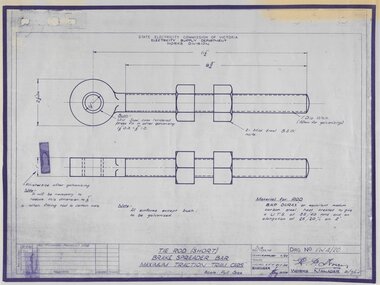
Drawing - VW4/20, State Electricity Commission of Victoria (SECV), Tie Rod (Short). Brake Spreader Bar. Maximum Traction Tram Cars, 21/07/1954
... Tie Rod (Short). Brake Spreader Bar. Maximum Traction Tram Cars....Produced by the SECV to document the Tie Rod/Brake Spreader Bar for Maximum Traction Tramcars....SEC drawing number VW4/20, "Tie Rod (Short). Brake Spreader Bar. Maximum Traction Tram Cars.". ...Produced by the SECV to document the Tie Rod/Brake Spreader Bar for Maximum Traction Tramcars. ...Produced by the SECV to document the Tie Rod/Brake Spreader Bar for Maximum Traction Tramcars.Yields information regarding the dimensions and materials of the Tie Rod/Brake Spreader Bar.SEC drawing number VW4/20, "Tie Rod (Short). Brake Spreader Bar. Maximum Traction Tram Cars.". Drawn 21/07/1954. Beige paper copy of original dyeline print. Copy of original.electricity supply department, secv, works division, provincial tramways, tramway tyres, tramways, flanges -
 8th/13th Victorian Mounted Rifles Regimental Collection
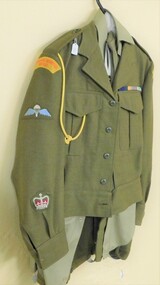
Uniform - VMR battledress
... Khaki battledress jacket and trousers uniform complete with braces, shirt and tie. Jacket has ribbon bar, Warrant Officer Class Two badges of rank and Parachute qualification badge....In 1977 8/13 VMR Regiment was reduced to an independent squadron A Squadron 8th/13th Victorian Mounted Rifles and in 1991 was linked with 4th/19th Prince of Wales’s Light Horse forming the VMR Squadron of that regiment. vmr uniform Khaki battledress jacket and trousers uniform complete with braces, shirt and tie. Jacket has ribbon bar, Warrant Officer Class Two badges of rank and Parachute qualification badge. ...The 8th/13th Victorian Mounted Rifles was raised as a regiment of the Royal Australian Armoured Corps on 1 May 1948 with Headquarters in Melbourne and squadrons in Sale, Benalla/Wangaratta and Albury. In 1955 Regimental Headquarters moved to Wangaratta and a second squadron was located at Albury. The Sale squadron transferred to 4th/19th Prince of Wales’s Light Horse. In 1977 8/13 VMR Regiment was reduced to an independent squadron A Squadron 8th/13th Victorian Mounted Rifles and in 1991 was linked with 4th/19th Prince of Wales’s Light Horse forming the VMR Squadron of that regiment.Khaki battledress jacket and trousers uniform complete with braces, shirt and tie. Jacket has ribbon bar, Warrant Officer Class Two badges of rank and Parachute qualification badge.vmr, uniform -
 Ballarat and Queen's Anglican Grammar School
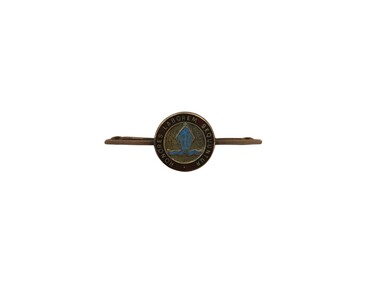
Accessory - Tie pin
... bar - both 9CT. Mitre in centre, surrounded by motto. Significant brooch?? Post 1903 Accessory Tie pin ...Gold badge on gold bar - both 9CT. Mitre in centre, surrounded by motto. Significant brooch?? Post 1903 -
 The Beechworth Burke Museum
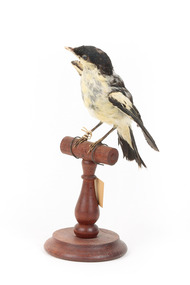
Animal specimen - White Winged Triller, 1860-1880
... bar and white under-wings. This specimen stands upon a wooden post, attached to a wooden post and has an identification tag tied around its leg. ...bar and white under-wings. This specimen stands upon a wooden post, attached to a wooden post and has an identification tag tied around its leg. ...The White Winged Triller is a small member of the Campephagidae family. They can be found all over the Australian mainland, but there have also been sightings in Tasmania, Papua New Guinea and Indonesia. Their breeding season is from September to December, when they migrate to southern Australia for the warmer months. The males can be very noisy during this time, when they 'trill' all day, granting them their name. Throughout the winter they can be found in northern Australia. This species can be found in open areas with shrub and lots of ground cover, in woodlands, forests, scrub and waterways. The males and females are noticeably different, particularly when breeding. Breeding males are the most conspicuous, with black on their heads, bodies and wing coverts, with a white body, lower face and lower wings. Females are brown, with a light body, a faint brow and a dark line through their eyes. When not in the breeding season, males are similar to females, though they have a greyer rump. These birds have a netted pattern on their wings. When in flight they undulate, and when they land they often shuffle and re-fold their wings. This species predominantly forage for insects on the ground or tree foliage, but also 'hawks' insects from higher perches. They build nests on horizontal branches or forks, and can be found sometimes using empty nests of other birds. Many of these birds can be found nesting in the same tree as a colony, and both parents incubate and brood their two to three nestlings. This specimen is a male White Winger Triller, which is apparent from his black and white colouring. While missing some plumage, the distinction between black wings, tail, cap and wing covert are still clear against his white body and under-wings. This specimen is part of a collection of almost 200 animal specimens that were originally acquired as skins from various institutions across Australia, including the Australian Museum in Sydney and the National Museum of Victoria (known as Museums Victoria since 1983), as well as individuals such as amateur anthropologist Reynell Eveleigh Johns between 1860-1880. These skins were then mounted by members of the Burke Museum Committee and put-on display in the formal space of the Museum’s original exhibition hall where they continue to be on display. This display of taxidermy mounts initially served to instruct visitors to the Burke Museum of the natural world around them, today it serves as an insight into the collecting habits of the 19th century.This specimen is part of a significant and rare taxidermy mount collection in the Burke Museum. This collection is scientifically and culturally important for reminding us of how science continues to shape our understanding of the modern world. They demonstrate a capacity to hold evidence of how Australia’s fauna history existed in the past and are potentially important for future environmental research. This collection continues to be on display in the Museum and has become a key part to interpreting the collecting habits of the 19th century.This male White Winged Triller has a black cap on its head. It has black wings with black wing coverts, and a black tail. It has a white lower face and body, a white shoulder bar and white under-wings. This specimen stands upon a wooden post, attached to a wooden post and has an identification tag tied around its leg. Swing-tag: 22a / White shouldered Campephagidae/ See catalogue, page 11. /taxidermy mount, taxidermy, animalia, burke museum, beechworth, australian museum, skin, reynell eveleigh johns, bird, triller, white winged triller, campephagidae, australian birds -
 The Beechworth Burke Museum
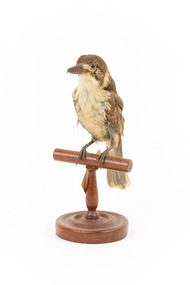
Animal specimen - Grey Butcher Bird, Trustees of the Australian Museum, 1860-1880
... The bird stands on a brown, wooden perch with a circular bar, curved stand, and circular base. It has an identification tag tied around its right leg....The bird stands on a brown, wooden perch with a circular bar, curved stand, and circular base. It has an identification tag tied around its right leg. ...Grey Butcherbirds live in wooded habitats, including suburban areas, from the north of Western Australia, across different parts of the top of the country, through to mid-eastern Queensland, and then south along the eastern side of the country all the way down to Tasmania. They have a 'lovely, lilting song', and are fiercely protective of their nests and chicks, swooping at presumed attackers with enough strength to sometimes draw blood. Adult Grey Butcher Birds are typically a light grey colour with dark heads and white underparts. The brown colouring on this animal suggests that it is a young bird, with its grey adult feathers coming in. This bird appears thinner than most Grey Butcher Birds, but it is unclear if this is because of its age or because of inaccurate taxidermy. This specimen is part of a collection of almost 200 animal specimens that were originally acquired as skins from various institutions across Australia, including the Australian Museum in Sydney and the National Museum of Victoria (known as Museums Victoria since 1983), as well as individuals such as amateur anthropologist Reynell Eveleigh Johns between 1860-1880. These skins were then mounted by members of the Burke Museum Committee and put-on display in the formal space of the Museum’s original exhibition hall where they continue to be on display. This display of taxidermy mounts initially served to instruct visitors to the Burke Museum of the natural world around them, today it serves as an insight into the collecting habits of the 19th century.This specimen is part of a significant and rare taxidermy mount collection in the Burke Museum. This collection is scientifically and culturally important for reminding us of how science continues to shape our understanding of the modern world. They demonstrate a capacity to hold evidence of how Australia’s fauna history existed in the past and are potentially important for future environmental research. This collection continues to be on display in the Museum and has become a key part to interpreting the collecting habits of the 19th century. This specimen is particularly special in the Burke Museum Collection as it is part of a male/female pair (see Relationships). Many birds in the collection were originally donated in male/female pairs, but at least one specimen has been lost, leaving these as one of the few surviving sets.This Grey Butcher Bird (likely female, based on size) has a light grey and brown bill with a sharp hook. The majority of the feathers on its back and tail are an olive-brown colour. The feathers of its underparts, the patches on either side of its bill, and two stripes coming up either side of its neck are a yellow-white colour. There are some light grey feathers coming through in small patches, particularly across the back, the top of the underparts, and along the upper half of the legs. The eyes are brown. The bird stands on a brown, wooden perch with a circular bar, curved stand, and circular base. It has an identification tag tied around its right leg.18a. / Collared Crow. Shrike / See Catalogue; Page 10. /taxidermy mount, taxidermy, animalia, burke museum, beechworth, australian museum, skin, australian birds, butcher bird, butcherbird, grey butcher bird, collared crow-shrike, australian butcherbird, tasmanian butcherbird, tasmania, bird pair -
 The Beechworth Burke Museum
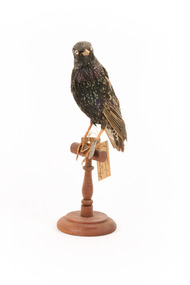
Animal specimen - Common Starling, Trustees of the Australian Museum, 1860-1861
... The specimen stands on a brown, wooden perch with a circular bar, curved stand, and circular base. The left leg has a metal tag and a swing-tag tied around it and the right leg has two swing-tags tied around it, one of which is torn....The specimen stands on a brown, wooden perch with a circular bar, curved stand, and circular base. The left leg has a metal tag and a swing-tag tied around it and the right leg has two swing-tags tied around it, one of which is torn. ...Common Starlings are a noisy bird that typically inhabit urban and rural areas, especially those with short grass for easy foraging, though can occasionally be found in open forests or along costal areas. They are native to a wide area of Eurasia and the North of Africa, though have been introduced to North America, some nations in South America, Fiji, South Africa, Australia, and New Zealand. They live in large flocks that fly together in strong unison, and have a range of loud calls. Male Common Starlings usually have brown eyes, in contrast to the light coloured eyes of the taxidermy mount. Otherwise, the specimen bears a reasonable resemblance to a typical Common Starlings. This specimen is part of a collection of almost 200 animal specimens that were originally acquired as skins from various institutions across Australia, including the Australian Museum in Sydney and the National Museum of Victoria (known as Museums Victoria since 1983), as well as individuals such as amateur anthropologist Reynell Eveleigh Johns between 1860-1880. These skins were then mounted by members of the Burke Museum Committee and put-on display in the formal space of the Museum’s original exhibition hall where they continue to be on display. This display of taxidermy mounts initially served to instruct visitors to the Burke Museum of the natural world around them, today it serves as an insight into the collecting habits of the 19th century.This specimen is part of a significant and rare taxidermy mount collection in the Burke Museum. This collection is scientifically and culturally important for reminding us of how science continues to shape our understanding of the modern world. They demonstrate a capacity to hold evidence of how Australia’s fauna history existed in the past and are potentially important for future environmental research. This collection continues to be on display in the Museum and has become a key part to interpreting the collecting habits of the 19th century.This male Common Starling is covered in black feathers that each have a metallic orange edge. This gives the appearance of small dots across its head and neck, larger dots along its underbelly and back, and lines along the outer feathers of the wings. Its beak is yellow and its eyes are a light blue with a black pupil. The bird is stretched tall with its head turned towards the left and slightly tilted right. The specimen stands on a brown, wooden perch with a circular bar, curved stand, and circular base. The left leg has a metal tag and a swing-tag tied around it and the right leg has two swing-tags tied around it, one of which is torn.Metal Tag: 4256 Swing-Tag 1: Sturnus vulga[illegible]is / male, adult / 25 January 1861 / near Leiden / Swing-Tag 2: Tris grey-brown / Feet black - brown / Bill brown / 4256 / Swing-Tag 3 (torn): ng / e Page 58taxidermy mount, taxidermy, animalia, burke museum, beechworth, australian museum, skin, reynell eveleigh johns, bird, starling, european starling, common starling, european bird -
 The Beechworth Burke Museum
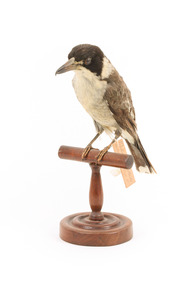
Animal specimen - Grey Butcherbird, Trustees of the Australian Museum, 1860-1880
... The bird stands on a brown, wooden perch with a circular bar, curved stand, and circular base. It has an identification tag tied around its left leg....The bird stands on a brown, wooden perch with a circular bar, curved stand, and circular base. It has an identification tag tied around its left leg. ...Grey Butcherbirds live in wooded habitats, including suburban areas, from the north of Western Australia, across different parts of the top of the country, through to mid-eastern Queensland, and then south along the eastern side of the country all the way down to Tasmania. They have a 'lovely, lilting song', and are fiercely protective of their nests and chicks, swooping at presumed attackers with enough strength to sometimes draw blood. Adult Grey Butcher Birds are typically a light grey colour with dark heads and white underparts, while their young are typically olive-brown. The mix of these two types of colouring on this animal suggests that it is a younger bird. This bird appears thinner than most Grey Butcher Birds, but it is unclear if this is because of its age or because of inaccurate taxidermy. This specimen is part of a collection of almost 200 animal specimens that were originally acquired as skins from various institutions across Australia, including the Australian Museum in Sydney and the National Museum of Victoria (known as Museums Victoria since 1983), as well as individuals such as amateur anthropologist Reynell Eveleigh Johns between 1860-1880. These skins were then mounted by members of the Burke Museum Committee and put-on display in the formal space of the Museum’s original exhibition hall where they continue to be on display. This display of taxidermy mounts initially served to instruct visitors to the Burke Museum of the natural world around them, today it serves as an insight into the collecting habits of the 19th century.This specimen is part of a significant and rare taxidermy mount collection in the Burke Museum. This collection is scientifically and culturally important for reminding us of how science continues to shape our understanding of the modern world. They demonstrate a capacity to hold evidence of how Australia’s fauna history existed in the past and are potentially important for future environmental research. This collection continues to be on display in the Museum and has become a key part to interpreting the collecting habits of the 19th century. This specimen is particularly special in the Burke Museum Collection as it is part of a male/female pair (see Relationships). Many birds in the collection were originally donated in male/female pairs, but at least one specimen has been lost, leaving these as one of the few surviving sets.This Grey Butcherbird (likely male, based on size) has a bill that is dark grey at the front with a sharp hook but becomes lighter towards the face. The majority of the feathers on its back are light brown with some grey feathers around the lower half. It's crown area is a dark black colour and its tail is a dark grey. The feathers of its underparts and a small patch on either side of the neck are a yellow-white colour. There are also grey feathers coming through on its underparts. The eyes are brown. The bird stands on a brown, wooden perch with a circular bar, curved stand, and circular base. It has an identification tag tied around its left leg.19a / Collared Crow. Shrike / See Catalogue, Page 10 /taxidermy mount, taxidermy, animalia, burke museum, beechworth, australian museum, skin, australian birds, butcher bird, butcherbird, grey butcherbird, collared crow-shrike, australian butcherbird, tasmanian butcherbird, tasmania, bird pair -
 The Beechworth Burke Museum
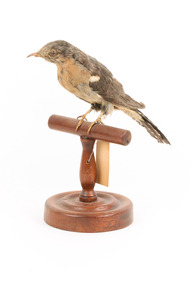
Animal specimen - Fan-tailed Cuckoo, Trustees of the Australian Museum, 1860-1880
... The bird stands on a brown, wooden perch with a circular bar, curved stand, and circular base. It has an identification tag tied around its right leg. ...The bird stands on a brown, wooden perch with a circular bar, curved stand, and circular base. It has an identification tag tied around its right leg. ...Fan-tailed Cuckoos are found throughout eastern and south-western Australia. They are also sometimes found in nearby small island nations as far as New Caledonia. Their call is a distinct, descending trill, which they are known to make even outside their breeding season. The neck is thin compared to a typical Fan-tailed Cuckoo - potentially a taxidermy error or damage. Otherwise, the specimen is reasonably representative. This specimen is part of a collection of almost 200 animal specimens that were originally acquired as skins from various institutions across Australia, including the Australian Museum in Sydney and the National Museum of Victoria (known as Museums Victoria since 1983), as well as individuals such as amateur anthropologist Reynell Eveleigh Johns between 1860-1880. These skins were then mounted by members of the Burke Museum Committee and put-on display in the formal space of the Museum’s original exhibition hall where they continue to be on display. This display of taxidermy mounts initially served to instruct visitors to the Burke Museum of the natural world around them, today it serves as an insight into the collecting habits of the 19th century.This specimen is part of a significant and rare taxidermy mount collection in the Burke Museum. This collection is scientifically and culturally important for reminding us of how science continues to shape our understanding of the modern world. They demonstrate a capacity to hold evidence of how Australia’s fauna history existed in the past and are potentially important for future environmental research. This collection continues to be on display in the Museum and has become a key part to interpreting the collecting habits of the 19th century.This fan-tailed cuckoo has a dark grey/brown back and a pale rufous (a yellowy brown) underside. The tail is also brown with white spots on some of the feather tips. The front of the face is pale rufous and blends into the black at the top of the head and neck. Some of the feathers around the neck are grey. There is a patch of white on halfway down the body on the left wing. The eyes are brown, the feet are yellow, and the beak, which is missing at the bottom, is yellow. The bird stands on a brown, wooden perch with a circular bar, curved stand, and circular base. It has an identification tag tied around its right leg. There is a swing-tag on the left leg.Swing-tag: 71a. / Fan-tailed Cuckoo / See Catalogue, Page 21 /taxidermy mount, taxidermy, animalia, burke museum, beechworth, skin, reynell eveleigh johns, bird, fan-tailed cuckoo, cuckoo, australian bird, australian museum, australian animal -
 The Beechworth Burke Museum
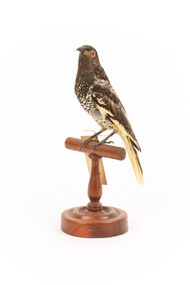
Animal specimen - Regent Honeyeater, Trustees of the Australian Museum, 1860-1880
... The bird stands on a brown, wooden perch with a circular bar, curved stand, and circular base. It has an identification tag tied around its right leg....The bird stands on a brown, wooden perch with a circular bar, curved stand, and circular base. It has an identification tag tied around its right leg. ...Regent Honeyeaters get their name from their striking yellow-and-black plumage . Previously found across the south east of Australia far as Adelaide and Rockhampton in central Queensland, over the last thirty years their population has dwindled. Regent Honeyeaters are now only found between north-eastern Victoria and south-eastern Queensland, with only three known breeding grounds. Regent Honeyeaters typically live in eucalypt forests and woodlands. The yellow edging on the specimen's wings is duller than the bright yellow typical of most Regent Honeyeaters. The specimen is also stretched taller than most Regent Honeyeaters, resulting in a thinner neck and chest compared to the plumpness typically expected. This specimen is part of a collection of almost 200 animal specimens that were originally acquired as skins from various institutions across Australia, including the Australian Museum in Sydney and the National Museum of Victoria (known as Museums Victoria since 1983), as well as individuals such as amateur anthropologist Reynell Eveleigh Johns between 1860-1880. These skins were then mounted by members of the Burke Museum Committee and put-on display in the formal space of the Museum’s original exhibition hall where they continue to be on display. This display of taxidermy mounts initially served to instruct visitors to the Burke Museum of the natural world around them, today it serves as an insight into the collecting habits of the 19th century.The Regent Honeyeater is a critically endangered Australian bird due to the clearing of their natural habitat, particularly around the Yellow Box-White Box-Blakely's Red Gum Woodlands in New South Wales. This specimen is part of a significant and rare taxidermy mount collection in the Burke Museum. This collection is scientifically and culturally important for reminding us of how science continues to shape our understanding of the modern world. They demonstrate a capacity to hold evidence of how Australia’s fauna history existed in the past and are potentially important for future environmental research. This collection continues to be on display in the Museum and has become a key part to interpreting the collecting habits of the 19th century.This Regent Honeyeater has a dark brown/black crown with a distinct orange patch under each red-coloured eye. Its back and upper chest are also a dark brown but with a white scalloped pattern. At the lower are of its belly, the white colour dominates the brown. Its wings and tail are brown edged with yellow. Its beak is a short, dark brown curl and its legs are brown. The bird stands on a brown, wooden perch with a circular bar, curved stand, and circular base. It has an identification tag tied around its right leg.57a. / Warty-faced Honey-eater ./ See Catalogue, Page 18 ./taxidermy mount, taxidermy, animalia, burke museum, beechworth, australian museum, skin, reynell eveleigh johns, bird, regent honeyeater, honeyeater, warty-faced honeyeater, australian birds, endangered birds, endangered animals -
 The Beechworth Burke Museum
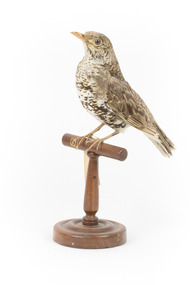
Animal specimen - Bassian Thrush, Trustees of the Australian Museum, 1860-1880
... bars on the back, rump and head. The paler underparts all have brown-black scalloping. It has a white eye-ring which surrounds glass eyes which have been included by the taxidermist to replace the originals. This specimen stands upon a wooden platform and has an identification tag tied...bars on the back, rump and head. The paler underparts all have brown-black scalloping. It has a white eye-ring which surrounds glass eyes which have been included by the taxidermist to replace the originals. This specimen stands upon a wooden platform and has an identification tag tied ...The Bassian Thrush is a secretive bird, often difficult to see, as it is an unobtrusive species that forages among dense vegetation. When disturbed, it sometimes crouches on the ground and freezes, relying on its scalloped plumage to conceal its presence. The Bassian Thrush feeds on the ground, scratching under the leaf-litter for small invertebrates. This specimen has been mounted in an accurate and yet stylised fashion. This specimen is part of a collection of almost 200 animal specimens that were originally acquired as skins from various institutions across Australia, including the Australian Museum in Sydney and the National Museum of Victoria (known as Museums Victoria since 1983), as well as individuals such as amateur anthropologist Reynell Eveleigh Johns between 1860-1880. These skins were then mounted by members of the Burke Museum Committee and put-on display in the formal space of the Museum’s original exhibition hall where they continue to be on display. This display of taxidermy mounts initially served to instruct visitors to the Burke Museum of the natural world around them, today it serves as an insight into the collecting habits of the 19th century. This specimen is part of a significant and rare taxidermy mount collection in the Burke Museum. This collection is scientifically and culturally important for reminding us of how science continues to shape our understanding of the modern world. They demonstrate a capacity to hold evidence of how Australia’s fauna history existed in the past and are potentially important for future environmental research. This collection continues to be on display in the Museum and has become a key part to interpreting the collecting habits of the 19th century.The plumage of this Bassian Thrush specimen is a mottled brown to olive-brown colour, heavily scalloped with black crescent-shaped bars on the back, rump and head. The paler underparts all have brown-black scalloping. It has a white eye-ring which surrounds glass eyes which have been included by the taxidermist to replace the originals. This specimen stands upon a wooden platform and has an identification tag tied around its leg.Swing Tag: 44a / mountain Thrush / See Catalogue Page 15 taxidermy mount, taxidermy, animalia, burke museum, beechworth, australian museum, skin, bird, australian birds, bassian thrush, thrush, zoothera lunulata -
 Morongo Old Collegians
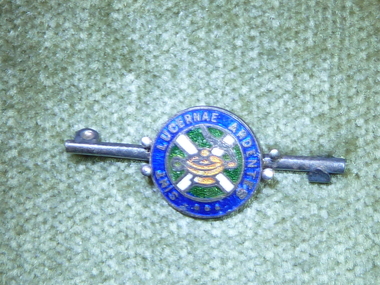
Tie Pin
... education school morongo geelong girls boarding presbyterian uniting history badges private-girls-school 1920-1994 kindergarten-year-12 sint-lucernae-ardentes lucy shaw gertrude pratt dulcie brookshaw tie-pin Coloured enamelled badge featuring the School Crest, consisting of royal blue circle, with white diagonal cross, with dark green background and golden lantern with white flame on top of cross, on a silver cross-bar Tie Pin ...Coloured enamelled badge featuring the School Crest, consisting of royal blue circle, with white diagonal cross, with dark green background and golden lantern with white flame on top of cross, on a silver cross-bareducation, school, morongo, geelong, girls, boarding, presbyterian, uniting, history, badges, private-girls-school, 1920-1994, kindergarten-year-12, sint-lucernae-ardentes, lucy shaw, gertrude pratt, dulcie brookshaw, tie-pin -
Bendigo Military Museum
Uniform - UNIFORM, NURSES WW2, 1939 - 1946
... bar. Service ribbons on right breast. Upper back section & fronts lined with rayon. Hanging tab centre back neck. .2) Shirt. Long sleeved cream cotton shirt with tail, epaulette tabs on shoulders fastened with a button. Front button fastening semi stiff collar. .3) Skirt. Fastens at side with hooks & eyes & 1 button on waist band. .4) Tie...bar. Service ribbons on right breast. Upper back section & fronts lined with rayon. Hanging tab centre back neck. .2) Shirt. Long sleeved cream cotton shirt with tail, epaulette tabs on shoulders fastened with a button. Front button fastening semi stiff collar. .3) Skirt. Fastens at side with hooks & eyes & 1 button on waist band. .4) Tie ...The uniform belonged to CAPT GLADYS MOLE VFX17199 AAMC 2nd AIF. Refer 1901.4 for Service History. Items were all numbered 215.01 from a previous institution. See also Reg No 1899 & 1900.2P.WRANC .1) Jacket. Grey, fine wool tailored jacket & skirt. Jacket has full belt fastened with press studs. Front fastened with military buttons, also pocket flaps & 2 buttons on each sleeve. Shoulder epaulettes of dark brown felt with a button 'Australia' badge & 3 captain's pips. Colour patch on each sleeve - brown square on light grey square with central angled blue bar. Service ribbons on right breast. Upper back section & fronts lined with rayon. Hanging tab centre back neck. .2) Shirt. Long sleeved cream cotton shirt with tail, epaulette tabs on shoulders fastened with a button. Front button fastening semi stiff collar. .3) Skirt. Fastens at side with hooks & eyes & 1 button on waist band. .4) Tie. Made of dark brown crepe with silver Rising Sun badge pinned to it. .5) Hat. Grey/green felt velour with band of brown edged both sides with narrow stripes of pale grey & red. Unlined with petersham sweat band & black hat elastic double chin strap. Signs of wear at inner front. .6) & .7) Gloves. Pair, dark brown leather with stitching detail in 3 decorative lines on backs. Previous number 215.01 has been inked inside. .8) & .9) Shoes. Pair, brown leather lace up with stitched soles by Duncan. .2) Self coloured label: V109 MADE IN AUSTRALIA 1942 Inside back neck in ink: G? HOLLOW .5) On label in black: V558 Made in 1943 Australia Size 6-3/4"uniforms, costumes - female uniform, essential services - hospital, nurses -
 Waverley RSL Sub Branch
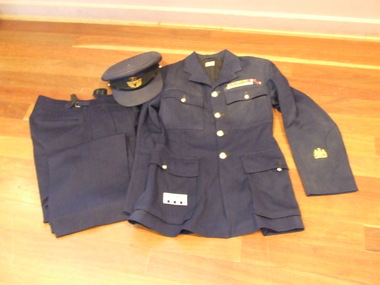
R.A.A.F. Uniform Complete
... Size 15 R.A.A.F. uniform consisting of Coat (great outer) Jacket Trousers Tie Cap all with insignia and ribbon bars ? J Beutler...Size 15 R.A.A.F. uniform consisting of Coat (great outer) Jacket Trousers Tie Cap all with insignia and ribbon bars ? J Beutler R.A.A.F. ...Size 15 R.A.A.F. uniform consisting of Coat (great outer) Jacket Trousers Tie Cap all with insignia and ribbon bars ? J Beutler -
 Bendigo Military Museum
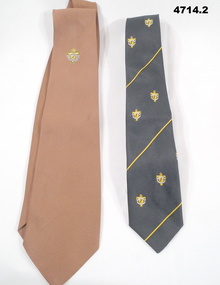
Clothing - TIES, Rats of Tobruk Association
... TIE. Dark Green. It has a pattern of Rats of Tobruk Assocation badge, in gold and silver, interspersed with a diagnol gold bar....TIE. Dark Green. It has a pattern of Rats of Tobruk Assocation badge, in gold and silver, interspersed with a diagnol gold bar. ...See Dean 4575P1. TIE. Brown with a logo of Rats of Tobruk Association. 2. TIE. Dark Green. It has a pattern of Rats of Tobruk Assocation badge, in gold and silver, interspersed with a diagnol gold bar.two, ties -
 Kiewa Valley Historical Society
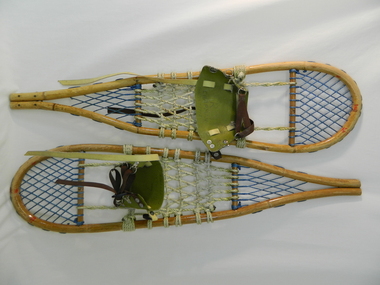
Snow Shoes
... Between the bars, in the middle is cream coloured rope tied to form a strong basket. ...Between the bars, in the middle is cream coloured rope tied to form a strong basket. ...Snow shoes were used to move between places on the snow fields at Falls Creek and the Bogong High Plains especially during the construction of the Kiewa Hydro Scheme.Historical: Snow shoes were used on the Bogong High Plains during winter. The body is made of light wood 'bamboo' with a back and front wooden cross bar. Between the front cross bar and toe, blue nylon is tied to form diamonds 'lacing', similarly the back. Between the bars, in the middle is cream coloured rope tied to form a strong basket. A shoe harness made of olive green vinyl to which is clipped brown strong woven material tape with a circular steel loop through which the tape is threaded. There are 3 steel fasteners on 1 side and 2 on the other with a black plastic fastener. At the front between the cream and blue woven baskets there is a gap called the toe hole. The rope is attached either side of the toe hole to the front wooden bar.snow. falls creek. bogong high plains. transport. victorian alps. -
 Bendigo Historical Society Inc.
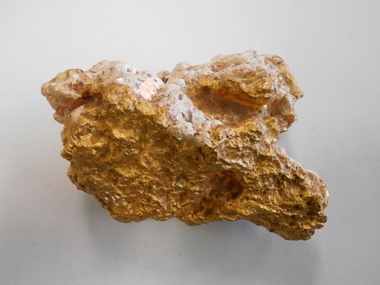
Memorabilia - GOLD NUGGET COLLECTION: THE GEM, 1906
... By tying a number of large weights together, and suspending them from a steel bar, a fairly accurate weight was obtained, and it just balanced 80 lb., or 960 oz. ...By tying a number of large weights together, and suspending them from a steel bar, a fairly accurate weight was obtained, and it just balanced 80 lb., or 960 oz. ...The Gem The Poseidon Rush. Tarnagulla, Saturday. Article - The Albury Banner and Wodonga Express (NSW : 1871 - 1938)Friday 8 February 1907 - Page 43 The Poseidon Rush. Tarnagulla, Saturday. Several indicators and quartz leaders on the Woolshed Hill have received considerable attention during the last fortnight. In some claims the stone looks very promising, and nice tracings of gold have been obtained. Wragg Brothers struck it rich yesterday. At a depth of 12ft. on the bedrock they discovered a nugget specimen 206oz. in weight, which has been christened the 'Port Arthur. The party also had the good fortune to find two other specimens close, by, one weighing 23oz. 15dwt. and the other 24oz.These were named 'The Twins,' the Wragg Brothers bearing that distinction. In this claim about eight weeks ago the Gem (88oz.) was unearthed. THE POSEIDON RUSH. Article Illustrated - Leader (Melbourne, Vic. : 1862 - 1918, 1935)Saturday 29 December 1906 - Page 33 THE POSEIDON RUSH. It is only about five weeks since this rush was opened by John Porter, but since that time a marvellous change has taken place. The quietness of the bush has given place to a scene of wild excitement, and each week this is intensified by the discovery of large nuggets. When Smith, Rogers and Stephenson picked out their slug on election day, no one dreamed that larger ones were lying only a few feet away, but such was the fact. On Tuesday afternoon two immense slugs, one of which weighed 960 oz., and the other 373 oz., were found in adjoining claims within a few minutes of each other. The finding of these created a scene which it is difficult to describe. "I've got one, “was shouted from the claim of Bert Williamson and T. Stephenson, two men just entering into manhood. They were seen excitedly digging round a lump of gold, one of them with a double-ended pick, the point-of which he broke in his anxiety to unearth it. This slug is nine inches long by seven inches by 43 inches, and is very similar in appearance and size to the big nugget got previously in the adjoining claim. It has been cleaned and smelted, and has yielded 306 oz. of pure gold of the best sample. Before the excitement caused by the discovery of the last nugget had sub-sided, there was a shout from an adjoining claim. Sam Woodall, a Llanelly miner, felt his pick strike a hard yielding sub-stance, and, satisfied that he had struck a nugget, called the attention of his mates to the fact. He soon levered it out of the ground with his pick. Taking it up in his arms he staggered out of the claim with it, and in a minute or two was sur-rounded by hundreds of men who rushed from all over the field to view it, and to feel its weight. It was certainly a magnificent specimen, and the fortunate miners were congratulated on all sides. Its weight was guessed to be a hundredweight, and probably in its then dirty state it would nave turned the scales at that. In a few minutes the crowd was so dense that it was impossible to get a close inspection. The nugget was first taken to Newbridge under escort, then through Llanelly to Tarnagulla, where it was lodged in the Union Bank. It was found that the bank scales were not sufficiently large to weigh the mass. By tying a number of large weights together, and suspending them from a steel bar, a fairly accurate weight was obtained, and it just balanced 80 lb., or 960 oz. The nugget measures 16 in. x 10 in. x 5 in. The party was cheered as it drove up the main street here, and the sight of an armed escort was quite a novelty. The nugget was held aloft in a tin dish for inspection by the crowd. These nuggets were found in the shallow workings, and neither of them were a foot under the surface. The ground is a black loamy soil; there was no appearance of wash whatever, and no one knowing anything of alluvial mining would think of searching for gold in such a spot. All those who have claims on the hillside are breaking out all the dirt in a face from the surface to the reef, which is a mixture of lime and sunstone, and searching for nuggets. The ground is carefully pulverised so that nothing shall be missed. Some are puddling the whole of it, but it is hardly payable. Where the big nuggets are now being found, the ground has been pegged out and abandoned more than once since the rush started, and shares in the claims have been purchased for small amounts. Smith was given a third share in the claim where the first nugget was found for puddling the dirt big lump was discovered, by Woodall, Condron, Brooks and Eva, two of them sold a sixth share for £5 a few days ago to a man named Woods, who only worked a few days and sold out again for 50/. Some fancy prices are now being offered for shares in the claims in the vicinity. Woodall holds a third share, Condron and Brooks three-quarters of a share each, and Eva a sixth share. The largest nugget has been christened "The Poseidon." The names given to the other nuggets obtained previously are as follow: — Wragg Bros., 88 oz. nugget, "The Gem"; Smith and party's 378 oz. nugget, which was unearthed on election day, has been fittingly named "The Federal"; Jackson and Hughes 152 oz.specimen, "The Little. Beu"; Williamson and Stephenson's 373 oz. nugget is said to be called "The Christmas Box." A representative from the (Mines department has been at the bank during, the week taking models for the museums and schools of mines. )A replica of the "Gem" gold nugget that was discovered on 29.11.1906 on the Poseidon Lead at Tarnagulla at the depth of 9 feet. Found on the bedrock by the Wragge Bros. Weight 88 ozs. Value of $126,358 in 2016. (See additional Research.)mining, models, plaster model of victorian gold nugget
