
Showing 4 items matching "timber lectern"
-
 Clunes Museum
Ceremonial object - LECTERN
... TIMBER LECTERN...TIMBER FREE STANDING LECTERN FROM ST ANDREW'S CHURCH CLUNES...ECCLESIASTIC OBJECTS TIMBER LECTERN ST ANDREWS CHURCH WESLEY TIMBER FREE STANDING LECTERN FROM ST ANDREW'S CHURCH CLUNES Ceremonial object LECTERN ...ECCLESIASTIC OBJECTS TIMBER FREE STANDING LECTERN FROM ST ANDREW'S CHURCH CLUNEStimber lectern, st andrews church, wesley -
 Victorian Interpretive Projects Inc.
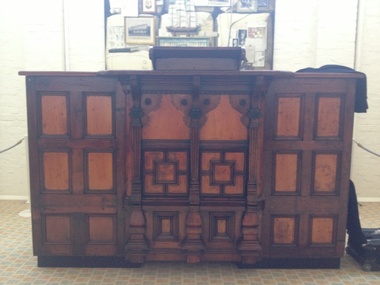
Photograph - colour, Auction Room Lectern at National Wool Museum
... Photograph of a timber lectern used to auction wool in Geelong. ...(http://www.geelongaustralia.com.au/nwm/about/article/item/8cbcc313afa77a5.aspx) wool Geelong auction Auction Room National Wool Museum Photograph of a timber lectern used to auction wool in Geelong. ...This photograph on an iPhone 4 during the Museums Australia (Vic) Conference at the National Wool Museum, Geelong. Since the arrival of sheep with the First Fleet in 1788, the wool industry has dominated our economy, our agriculture and our reputation as a quality wool-growing nation throughout the world. Geelong is a city synonymous with wool and the wool industry – sheep farming began here in 1835 and the first of many woollen mills opened here in 1868. For many years the city was known as the 'wool centre of the world'. Two hundred years later, in 1988, the National Wool Museum was established as Australia’s only comprehensive museum of wool. (Since the arrival of sheep with the First Fleet in 1788, the wool industry has dominated our economy, our agriculture and our reputation as a quality wool-growing nation throughout the world. Geelong is a city synonymous with wool and the wool industry – sheep farming began here in 1835 and the first of many woollen mills opened here in 1868. For many years the city was known as the 'wool centre of the world'. Two hundred years later, in 1988, the National Wool Museum was established as Australia’s only comprehensive museum of wool. (Since the arrival of sheep with the First Fleet in 1788, the wool industry has dominated our economy, our agriculture and our reputation as a quality wool-growing nation throughout the world. Geelong is a city synonymous with wool and the wool industry – sheep farming began here in 1835 and the first of many woollen mills opened here in 1868. For many years the city was known as the 'wool centre of the world'. Two hundred years later, in 1988, the National Wool Museum was established as Australia’s only comprehensive museum of wool. (http://www.geelongaustralia.com.au/nwm/about/article/item/8cbcc313afa77a5.aspx)Photograph of a timber lectern used to auction wool in Geelong. It is found in the auction room on the top floor of Geelong's national wool museum.wool, geelong, auction, auction room, national wool museum -
 Bendigo Historical Society Inc.
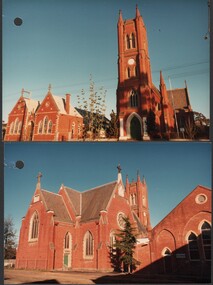
Photograph - National Trust Collection: St Paul's Church of England, Bendigo, 23/06/2025
... timber fixtures and fittings. The interior is also noteworthy for the high quality of its stained glass, especially the twelve apostle windows by Ferguson, Urie and Lyon. The cathedral also features a number of important movable objects such as the finely carved eagle lectern in oak, the ornately carved timber chair in the sanctuary, the two baptismal fonts, the ornately carved canons' stalls with eagle motifs in the sanctuary and the two large candle holders. ...timber fixtures and fittings. The interior is also noteworthy for the high quality of its stained glass, especially the twelve apostle windows by Ferguson, Urie and Lyon. The cathedral also features a number of important movable objects such as the finely carved eagle lectern in oak, the ornately carved timber chair in the sanctuary, the two baptismal fonts, the ornately carved canons' stalls with eagle motifs in the sanctuary and the two large candle holders. ...Victorian Heritage Database: St Paul's Cathedral, Bendigo was built in stages. The nave was built in 1868, the tower in 1872-73 and the transepts and sanctuary in 1926-27. Robert Love was the architect, although the final stage was supervised by architects Gawler and Drummond. Cathedral status was transferred from the original cathedral All Saints to St Paul's in 1981. The Gothic style cathedral is constructed of red brick with stone dressings. It has a simple cruciform plan comprising a six bay nave, transepts and sanctuary. A tall tower centrally located at the west end dominates the exterior. The peal of eight bells was cast by Meares and Co of London and installed in 1873. The interior features elaborately cusped roof principals; an organ by Alfred Fuller built in 1883 with a console and pipes added later from St Andrew's Cathedral, Sydney; and notable stained glass by Ferguson, Urie and Lyon. St Paul's Rectory was built in 1885 to a design by the architect WC Vahland. The Parish Office and Hall was built as a Sunday School in 1898 to a design by FW Lehmann. St Paul's Cathedral is of architectural, aesthetic and historical significance to the state of Victoria. The cathedral is a significant example of the Early English Gothic style. The tower, with its distinctively detailed pinnacles, its spiral staircase and carillon of eight bells, is a notable feature and a town landmark. The interior is aesthetically important for its decorative detail. The roof structure, rising some 18.3 metres from the 11 metre walls in suspended semi-circles from the pillarless nave, is highly significant for both its considerable technical achievement and its aesthetic appeal. The interior features fine examples of carved timber fixtures and fittings. The interior is also noteworthy for the high quality of its stained glass, especially the twelve apostle windows by Ferguson, Urie and Lyon. The cathedral also features a number of important movable objects such as the finely carved eagle lectern in oak, the ornately carved timber chair in the sanctuary, the two baptismal fonts, the ornately carved canons' stalls with eagle motifs in the sanctuary and the two large candle holders. Important works of art include the opus sectile reredos in mosaic; the sculpture of Madonna and Child in Queensland birch by sculptress Leopoldine Mimovich; and the carved figures of St Peter and St Paul at the high altar by the sculptress Ola Cohn. St Paul's Cathedral complex has historical associations with the Anglican church in Bendigo, particularly the rivalry between St Paul's and the original cathedral, All Saints, and the long and controversial debate about 'High Church versus Low Church'. It has associations with individuals important to the history of the Anglican church in Bendigo including John Christian MacCullagh, the first Dean of Bendigo, after whom the MacCullagh Chapel was named, and Canon David Anthony, a former rector of the church. https://vhd.heritagecouncil.vic.gov.au/places/3695National Trust Collection: St Paul's Church of England, Bendigo Church constructed of red brick with contrasting brick features. Church entry/ bell tower is a feature of Bendigo skyline. 3084.102A frontage of the Church and Church Hall onto Myers Street, Bendigo 3084.102B St Paul's C of E, rear of Church and Church Hall facing Bush's Lane, Bendigost paul's church of england -
Otway Districts Historical Society
portable pulpit or lectern, first decade of 20th Century
... A blackwood timber pulpit with folding side panels, designed to be portable. Simple carving on centre front panel, and a lectern stand for Bible or other book. ...Small metal plaque reads "Lectern 1910 Lavers Hill Pres. Church. Local Timber by Tom Parsons Esq."...Small metal plaque reads "Lectern 1910 Lavers Hill Pres. Church. Local Timber by Tom Parsons Esq." ...The lectern is said to have been used by John Flynn ('Flynn of the Inland' - 1880 - 1951) when he was stationed in the Beech Forest - Lavers Hill area prior to his being ordained as a minister of the Presbyterian Church. Flynn arrived in Beech Forest in 1903 as a home missionary, and for around two years he conducted services in homes, camps and public halls in the Otways. In 1912 Flynn established the Australian Inland Mission, setting up hospitals and hostels across inland Australia, and inspiring the Royal Flying Doctor ServiceThis item was purported to have been used by Reverend John Flynn for services in various locations during his time in the Otways area prior to his more well know work in inland Australia.A blackwood timber pulpit with folding side panels, designed to be portable. Simple carving on centre front panel, and a lectern stand for Bible or other book. Simple trefoil engraving on centre front panel. Small metal plaque reads "Lectern 1910 Lavers Hill Pres. Church. Local Timber by Tom Parsons Esq."john flynn, churches, pulpit
