
Showing 15 items matching "tin for bandages"
-
 Emerald Museum & Nobelius Heritage Park
Container - Bandages tin, T. J. Smith & Nephew Pty. Ltd, 1939-1946
... tin for bandages...Tin for Elastoplast Elastic Adhesive Bandages made in Britain at time of WWII. ...Round metal tin. Container Bandages tin T. J. Smith & Nephew Pty. ...The tin is a reminder of the period of WWII which that demographic lived through.Tin for Elastoplast Elastic Adhesive Bandages made in Britain at time of WWII. Round metal tin.On front: 'Elastoplast / Plastic Adhesive / Bandage / Made in England by / T. J. Smith & Nephew Ltd. / London, Hull, Manchester / Glasgow' On back: 'Elastoplast / British made / Elastic / Adhesive / Bandage / 3 ins. wide / 5-6 yards when stretched' On side: 'War time container'tin for bandages, elastoplast, t. j. smith & nephew pty. ltd., world war ii, alexander, emerald, victoria, australia -
 Ballarat RSL Sub-Branch Inc.
First Aid Kit - US Army
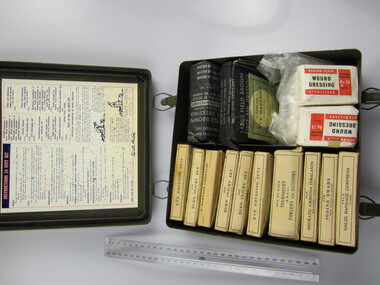
... Metal Tin containing bandages, dressings etc...Medical Ballarat RSL Ballarat Metal Tin containing bandages, dressings etc First Aid Kit - US Army ...Metal Tin containing bandages, dressings etcmedical, ballarat rsl, ballarat -
 Clunes Museum
Equipment - MEDICAL ITEM
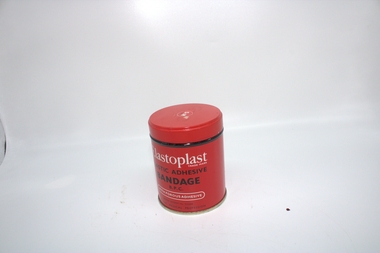
... .1 Red circular tin .2 Elastoplast bandage inside...Bandage Medical Item Lid: "S&N" Side: Elastoplast trade mark/Elastic Adhesive/Bandage/B.P.C. with porous adhesive/British Patent No. 713 838/for the medical profession/Directions for use enclosed/width 3in (7,6cm) Length unstretched 3yd (2.70m)/Length stretched 5/6yd (450/550m) Order No. 1003 Made in England by T.W. Smith & Nephew ltd., Hall & Welwyn Garden City. Keep in a cool place .1 Red circular tin ....1 Red circular tin .2 Elastoplast bandage insideLid: "S&N" Side: Elastoplast trade mark/Elastic Adhesive/Bandage/B.P.C. with porous adhesive/British Patent No. 713 838/for the medical profession/Directions for use enclosed/width 3in (7,6cm) Length unstretched 3yd (2.70m)/Length stretched 5/6yd (450/550m) Order No. 1003 Made in England by T.W. Smith & Nephew ltd., Hall & Welwyn Garden City. Keep in a cool place bandage, medical item -
 City of Moorabbin Historical Society (Operating the Box Cottage Museum)
Containers, tin, 'Cellona' Plaster of Paris, mid 20thC
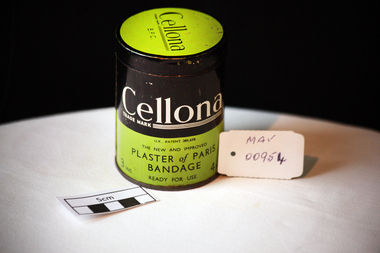
... A tin cylinder with a lift off lid for ‘Cellona’ Plaster of Paris bandage, 3 inches wide x 4 yards long, made by Smith & Nephew Ltd, Hull, England mid 20thC...BANDAGE / READY FOR USE / 3INS. 4 YDS. Back - ADVANTAGES …….. / DIRECTIONS………/ Made in England by T.J.SMITH & NEPHEW LTD. / LONDON, HULL, MANCHESTER, GLASGOW/ MAKERS OF ELASTOPLAST. A tin ...Thomas James Smith opened a small pharmacy in Hull, England in 1856. On his death in 1896, his nephew Horatio Nelson Smith took over the management of the business. Smith & Nephew plc is a British-based multinational medical equipment manufacturing company headquartered in London, United Kingdom. It is the world's largest producer of arthroscopy products, second-largest producer of advanced wound management products, third-largest producer of trauma and clinical therapy products and fourth-largest producer of orthopaedic reconstruction products. Its products are sold in over 90 countries with 11,000 employees. In 1928 the company developed the wound management product Elastoplast, recorded in Medical Journals worldwide. Since 1998 Smith & Nephew operates in three market segments through separate "global business units" under the Smith & Nephew brand name: Advanced wound management: advanced treatments for difficult wounds. Endoscopy: products for minimally invasive surgery, based in Andover, Massachusetts. Orthopaedics: hip and knee implants and trauma products, based in Memphis, Tennessee. Smith & Nephew was incorporated and listed on the London Stock Exchange in 1937 and in 1999 the Group was also listed on the New York Stock Exchange. In 2001, Smith & Nephew became a constituent member of the FTSE-100 index in the UK. This means that Smith & Nephew is included in the top 100 companies traded on the London Stock Exchange measured in terms of market capitalisation. .Today, Smith & Nephew is a public limited company incorporated and headquartered in the UK and doing business in 90 countries around the world. A tin cylinder with a lift off lid for ‘Cellona’ Plaster of Paris bandage, 3 inches wide x 4 yards long, made by Smith & Nephew Ltd, Hull, England mid 20thCLid - CELLONA / BPC Front - CELLONA / TRADE MARK / U.K. PATENT 385,658 / THE NEW AND IMPROVED / PLASTER of PARIS / BANDAGE / READY FOR USE / 3INS. 4 YDS. Back - ADVANTAGES …….. / DIRECTIONS………/ Made in England by T.J.SMITH & NEPHEW LTD. / LONDON, HULL, MANCHESTER, GLASGOW/ MAKERS OF ELASTOPLAST.* pharmacy, medicines, smith & nephew pty ltd, hull england, london england, plaster of paris, elastoplast, hospitals, nursing, wound dressings, orthopaedics, glassware, bottles, moorabbin, bentleigh, cheltenham -
 Kiewa Valley Historical Society
Functional object - Pocket First Aid, Circa mid 1900s
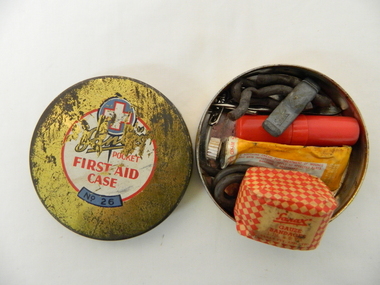
... tin, gold in colour with red and white print. It's contents are: one small tube of Sanax antiseptic cream, one small one inch x six yards of gauze bandages, rubber band type ligatures with a cast iron tightener., one small tweezers three safety pins, and one lancet....tin, gold in colour with red and white print. It's contents are: one small tube of Sanax antiseptic cream, one small one inch x six yards of gauze bandages, rubber band type ligatures with a cast iron tightener., one small tweezers three safety pins, and one lancet. ...This pocket First Aid kit is small and compact which became available to those venturing out in the outback and required an easily managed first aid kit. It was manufactured in the mid 1900s well before vinyl and or plastic pouches or bags where used. It was in an era where valuable items were stored in durable containers due to the harsh and rugged conditions of the Australian bush. Cheaper and less durable containers from Asian manufacturers had been kept out by the heavy Tariff imposed on their goods. This changed in the 1980's when the Tariff Board was dismantled by a then Labour Government. The Australian manufacturing industry was severely reduced by the Influx of cheaper goods. This item was made by an Australian company when the motto "true blue" was the catch cry for quality Australian made goods. This was in the period where the isolation of many rural communities required the basic first aid kits to be of a tougher quality than those offered in large cities and towns.This pocket first aid kit was very compact and would have been easy to carry without taking up too much space for bush walkers, camping scouts, drovers and independent miners and cattlemen. The Kiewa Valley and surrounding rural settlements did not have the medical backup that the larger cities and towns had up until the mid 1900s when the Hydro Electricity Schemes were built and the additional influx of workers made it feasible to have a hospital and better local health facilities. This influx of the construction workers associated with the Hydro Scheme. also brought European workers who where more inclined to go bush walking and climbing the Victorian alps than the average Australian rural worker. This item is a Sanax pocket first aid round tin, gold in colour with red and white print. It's contents are: one small tube of Sanax antiseptic cream, one small one inch x six yards of gauze bandages, rubber band type ligatures with a cast iron tightener., one small tweezers three safety pins, and one lancet.On the lid there are: are outlined white cross on a blue circular background. underneath is a whiite circle encased with a red line with the following printed "Sanax pocket first aid case" (in red print underneath this is a small curved blue background and in black print "No. 26"medicine, first aid tin, camping medical supplies, personal first aid, sanax -
 Bendigo Military Museum
Equipment - FIRST AID KIT, Possibly post WW2
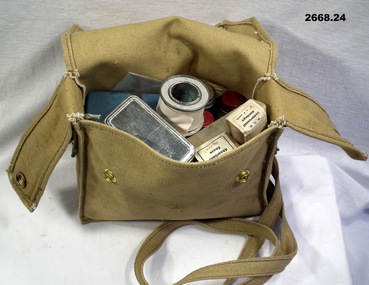
... Canvas bag with strap, khaki, brass press studs. .3) - .8) Group 3 bandages & 3 dressings in paper wrapping. .9) - .13) Cardboard box with lid containing 3 ampoules of tincture of iodine. .14) Sealed paper pocket containing safety pins. .15) - .17) x 3 bottles containing tablets. .18) Metal tin with attached lid. .19) Roll of adhesive tape. .20 - .21) Tube of Tannic of Acid Jelly in cardboard box. .22) Small brush. .23) Dressing fabric. .24) Gauze bandage. ...Canvas bag with strap, khaki, brass press studs. .3) - .8) Group 3 bandages & 3 dressings in paper wrapping. .9) - .13) Cardboard box with lid containing 3 ampoules of tincture of iodine. .14) Sealed paper pocket containing safety pins. .15) - .17) x 3 bottles containing tablets. .18) Metal tin with attached lid. .19) Roll of adhesive tape. .20 - .21) Tube of Tannic of Acid Jelly in cardboard box. .22) Small brush. .23) Dressing fabric. .24) Gauze bandage. ....1) - 2.) Canvas bag with strap, khaki, brass press studs. .3) - .8) Group 3 bandages & 3 dressings in paper wrapping. .9) - .13) Cardboard box with lid containing 3 ampoules of tincture of iodine. .14) Sealed paper pocket containing safety pins. .15) - .17) x 3 bottles containing tablets. .18) Metal tin with attached lid. .19) Roll of adhesive tape. .20 - .21) Tube of Tannic of Acid Jelly in cardboard box. .22) Small brush. .23) Dressing fabric. .24) Gauze bandage. medicine-first aid, military history - equipment, passchendaele barracks trust -
 Kiewa Valley Historical Society
Box - First Aid Kit - S.E.C
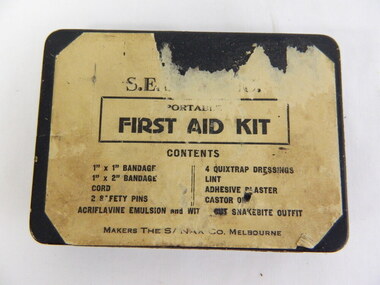
... .' / (In a black lined border) 'Portable / First Aid Kit' / (Underneath) 'Contents' /(In 2 columns): '1" x 1" Bandage /1' x 2" bandage / Cord / 2 *'Fey pins' / (next column) '4 Quixtrap Dressings / Lint / Adhesive Plaster / Castor Oil' / (Underneath both columns): 'Acriflavine Emulsion and Wit(h) Out ('Out' is crossed out) Snakebite Outfit' / 'Makers The Sanax Co. Melbourne' Under the lid: '10 Jan. 1941' Black tin ...Issued to S.E.C. workers on the Kiewa Hydro Scheme.Historical: Shows the development of the treatment of snakebite and first aid equipment especially as the workers were in a remote area.Black tin box with grubby white label with black writing on the lid. The box is hinged on the long side. Under the lid is stamped in black the date.Label: 'S.E.C.' / (In a black lined border) 'Portable / First Aid Kit' / (Underneath) 'Contents' /(In 2 columns): '1" x 1" Bandage /1' x 2" bandage / Cord / 2 *'Fey pins' / (next column) '4 Quixtrap Dressings / Lint / Adhesive Plaster / Castor Oil' / (Underneath both columns): 'Acriflavine Emulsion and Wit(h) Out ('Out' is crossed out) Snakebite Outfit' / 'Makers The Sanax Co. Melbourne' Under the lid: '10 Jan. 1941'state electricity commission of victoria, kiewa hydro electric scheme, first aid kit, sanax co. -
 J. Ward Museum Complex
Container - First Aid in Accidents Kit, The Sanax Company – Melbourne Vic
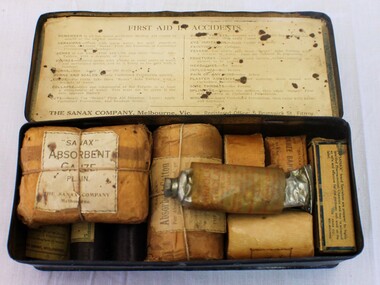
... tin container. Inside lid shows printed instructions regarding treating various ailments. Contains: Absorbent gauze Canister of castor oil Petroleum jelly First Aid dressing Absorbent dressing Salvolatile ointment Gauze bandage x 3 Ache tablets x 25 3 loose metal safety pins The contents are not dissimilar to items used in first aid kits today. ...tin container. Inside lid shows printed instructions regarding treating various ailments. Contains: Absorbent gauze Canister of castor oil Petroleum jelly First Aid dressing Absorbent dressing Salvolatile ointment Gauze bandage x 3 Ache tablets x 25 3 loose metal safety pins The contents are not dissimilar to items used in first aid kits today. ...This small, portable 1930’s Sanax First Aid in Accidents Kit has been strongly constructed, the case reinforced with metal to take knocks and bumps as it was transported to the site of an emergency. Having these supplies organised into a kit made them easily accessible and reduces time to take them to the accident site. The text of the printed brand “Sanax - First Aid” embossed on the lid. In Aradale Mental Hospital and J Ward, people are well aware of the institutions remoteness and of the importance of quick treatment when accidents occur. However, prior to the first commercial First Aid Kit being produced in 1888 by Johnson & Johnson, there was limited knowledge about treating injuries and about medical supplies to have ready for emergencies. A quote from Johnson’s & Johnson’s 1888 price list states, “It is a fact ... that many lives are lost and much suffering entailed in such accidents on account of the lack of the simple but necessary articles required to afford prompt assistance to the wounded.” [cited Flagstaff Hill Maritime Village]The kit is significance because it illustrates the first aid paraphernalia used in the care of staff and patients at Aradale Mental Hospital and J Ward. Black tin container. Inside lid shows printed instructions regarding treating various ailments. Contains: Absorbent gauze Canister of castor oil Petroleum jelly First Aid dressing Absorbent dressing Salvolatile ointment Gauze bandage x 3 Ache tablets x 25 3 loose metal safety pins The contents are not dissimilar to items used in first aid kits today. Due to its portable nature, the kit contains many dents and scratches. first aid, medical supplies, sanax -
 Warrnambool and District Historical Society Inc.
Medicine, First aid kit, Early 20th century
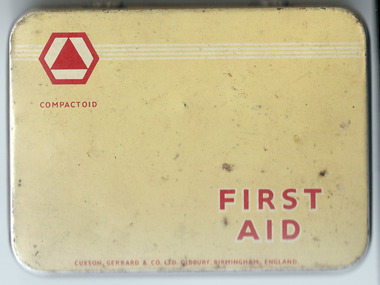
... It contains items that may be of use in an emergency – a bandage, a finger burn dressing, boracic lint, self-adhesive plaster, safety pins, ointment, jelly for gauze dressings. The items in the tin...It contains items that may be of use in an emergency – a bandage, a finger burn dressing, boracic lint, self-adhesive plaster, safety pins, ointment, jelly for gauze dressings. The items in the tin ...This is a pocket first aid kit suitable for personal use – hikers, travellers, home and business areas. It contains items that may be of use in an emergency – a bandage, a finger burn dressing, boracic lint, self-adhesive plaster, safety pins, ointment, jelly for gauze dressings. The items in the tin would have been in common use in the 1930s and 40s. This item has no known local provenance but is of historical interest and may be useful for display.This is a metal tin with a yellow lid with red and white markings. Inside are eight items suitable for first aid use. There is also a sheet listing the original items. The tin is rusted in several placesfirst aid kit, warrnambool, cuxson, gerrard & co. ltd -
Tatura Irrigation & Wartime Camps Museum
Tin box, First Aid Kit
... Contents still inside (3 unknown measuring devises, Zain Buk ointment, APC Bottle, Rexona ointment, tin of Zonas adhesive plaster (small roll inside), 2 small rolls of gauze bandage, piece of wadding, 3 different size finger stalls, temperature gauge, tweezers)....Contents still inside (3 unknown measuring devises, Zain Buk ointment, APC Bottle, Rexona ointment, tin of Zonas adhesive plaster (small roll inside), 2 small rolls of gauze bandage, piece of wadding, 3 different size finger stalls, temperature gauge, tweezers). first aid kits reilly's flour mill Black tin box with catch and oval handle, hinged lid. ...Used as a first aid tin for Reilly's Flour Mill. Contents still inside (3 unknown measuring devises, Zain Buk ointment, APC Bottle, Rexona ointment, tin of Zonas adhesive plaster (small roll inside), 2 small rolls of gauze bandage, piece of wadding, 3 different size finger stalls, temperature gauge, tweezers).Black tin box with catch and oval handle, hinged lid.first aid kits, reilly's flour mill -
 Kew Historical Society Inc
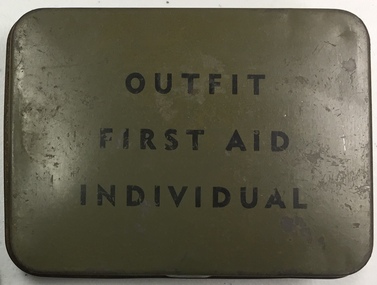
Equipment, Outfit First Aid Individual, 1939-1945
... tin. On the lid in black writing is 'OUTFIT / FIRST AID / INDIVIDUAL'. On the inside of the lid written in black on a gold back ground is the 'DIRECTIONS OF USE'. Below the title is: 'BANDAGE...tin. On the lid in black writing is 'OUTFIT / FIRST AID / INDIVIDUAL'. On the inside of the lid written in black on a gold back ground is the 'DIRECTIONS OF USE'. Below the title is: 'BANDAGE ...First Aid Tin issued to military personnel engaged on the war front in World War 2.Olive green first aid tin. On the lid in black writing is 'OUTFIT / FIRST AID / INDIVIDUAL'. On the inside of the lid written in black on a gold back ground is the 'DIRECTIONS OF USE'. Below the title is: 'BANDAGE 2 INCH Cut fingers and small wounds. / PLASTER ADHESIVE Cuts. / ANTISEPTIC PENCIL Apply to cuts and abrasions. / ANTISEPTIC JELLY Apply to burns. / TAB APC Take 2 tablets to relieve pain. / TAB ATEBRIN Directions on inside of Atebrin tin. / APERIENT PILLS 1 tablet to relieve constipation.' Remaining in the kit though not named in the list is a box of Sulphanilamide tablets with directions of use on the front. Also two used tubes of antiseptic jelly. first aid pack, australia - second world war 1939-1945 -
 Whitehorse Historical Society Inc.
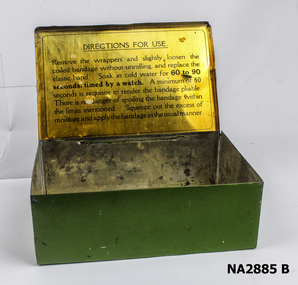
Container - Tin box for plaster of Paris bandages
... Green tin container for plaster of Paris bandages...Item was donated from the estate of the late Mary Cruickshank per Peter Simmenauer medicine pharmacy Perfect Plaster of Paris bandages. Patent Green tin container for plaster of Paris bandages Container Tin box for plaster of Paris bandages ...Item was donated from the estate of the late Mary Cruickshank per Peter SimmenauerGreen tin container for plaster of Paris bandagesPerfect Plaster of Paris bandages. Patentmedicine, pharmacy -
 Clayton RSL Sub Branch
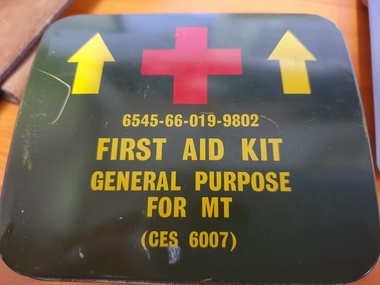
Memorabilia - First Aid Kit, 1944
... Dated 1944, the kit contains some original issue items. first aid kit World War Two Second World War WWII WW2 6545-66-019-9802 Red Cross Logo First Aid Kit General Purpose for MT (CES 6007) Inside lid is a list of contents along with the matching serial no, unit of issue and quantity required in tin General First Aid Kit containing: 3inch x 6yd bandage Sanax Antiseptic cream First Field Dressing Kaolin Powder sachet Electrolyte Powder sachet Triangular bandage 2inch x 6yd bandages x 2 Detergent impregnated cloth Memorabilia First Aid Kit Sanax ...Dated 1944, the kit contains some original issue items.General First Aid Kit containing: 3inch x 6yd bandage Sanax Antiseptic cream First Field Dressing Kaolin Powder sachet Electrolyte Powder sachet Triangular bandage 2inch x 6yd bandages x 2 Detergent impregnated cloth 6545-66-019-9802 Red Cross Logo First Aid Kit General Purpose for MT (CES 6007) Inside lid is a list of contents along with the matching serial no, unit of issue and quantity required in tinfirst aid kit, world war two, second world war, wwii, ww2 -
 Wodonga & District Historical Society Inc
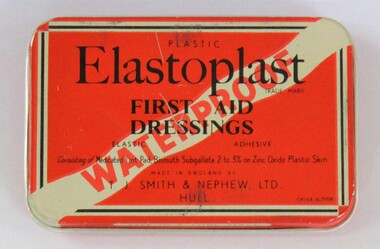
Functional object - Elastoplast First Aid Dressings Tin Mid-Twentieth Century, Smith & Nephew
... Band-aid Elastoplast Medical History Bandages Medical Medicine On lid of tin: "Plastic/Elastoplast/First Aid/Dressings" A red Elastoplast First Aid Dressings tin with hinged lid upon which manufacture information is printed. ...Elastoplast is the brand name for a type of bandage with an absorbent centre and sticky edges, also known in Australia as a Band-Aid. The inventor of the Band-Aid was Earle Dickson, a cotton buyer for the American company Johnson & Johnson. Dickson’s wife Josephine often acquired small injuries while doing housework, and Dickson tired of helping her dress wounds. He came up with the idea of sticking pieces of gauze a length of sticky tape so she could self-apply dressings. Johnson & Johnson began producing this type of dressing, branded as ‘Band-Aid’ in 1921. In 1928 Smith & Nephew of the UK began producing similar bandages branded as ‘Elastoplast’. This item is significant for its rarity due to age. It provides potential for interpretation as a part of Wodonga's social history.A red Elastoplast First Aid Dressings tin with hinged lid upon which manufacture information is printed.On lid of tin: "Plastic/Elastoplast/First Aid/Dressings"band-aid, elastoplast, medical history, bandages, medical, medicine -
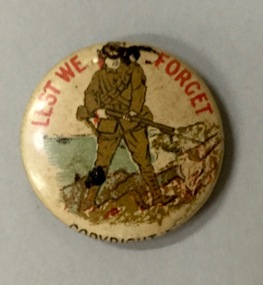 Kew Historical Society Inc
Badge - Fundraising Button, Lest We Forget, 1916-1919
... A circular pressed tin fundraising badge showing an armed soldier advancing through a rocky landscape. The soldier’s head is bandaged and spots of red indicate that the soldier has sustained wounds to the head and hand. ...Their widespread distribution means that they are frequently significant at a local, state, national and international level. patriotic buttons first world war (1914-18) numismatics lest we forget world war one wwi memorials Lest We Forget A circular pressed tin fundraising badge showing an armed soldier advancing through a rocky landscape. The soldier’s head is bandaged and spots of red indicate that the soldier has sustained wounds to the head and hand. ...Frances Rigg was a local business identity in Kew, at one stage managing the local branch of the English, Scottish and Australian (ES&A) Bank at 175 High Street from c. 1920 until the 1940s. After Francis Rigg’s death, the collection of buttons and medallions was inherited by his son, Ken Rigg (1922-2014). The collection was subsequently donated to the Kew Historical Society in 2015 by Francis' grandson, Adrian Rigg, at the time of the Gallipoli & Beyond Commemoration in 2015. The collection covers a period of almost 40 years. The majority of the buttons are patriotic buttons, issued and sold during and immediately after the First World World War (1914-1918) to raise funds for national and overseas causes. The collection also includes a number of locally significant sporting event buttons and sporting club medallions, issued in the 1920s and 1930s.Patriotic and other pressed tin buttons and badges were produced in large numbers in the first decades of the twentieth century. By nature, insubstantial and ephemeral, they have not always survived. The collections of badges, buttons and medallions in the Kew Historical Society collection is homogenous and yet diverse, ranging from buttons sold to raise funds for the war efforts in 1914-18 and 1939-45, to those used at festivals and sporting events. Because of the manufacturing process, many surviving buttons and badges have been affected by inadequate storage, suffering from oxidisation and physical damage. These survivors are now historically and socially significant artefacts, revealing much about the attitudes and values of the period in which they were produced. Their widespread distribution means that they are frequently significant at a local, state, national and international level.A circular pressed tin fundraising badge showing an armed soldier advancing through a rocky landscape. The soldier’s head is bandaged and spots of red indicate that the soldier has sustained wounds to the head and hand. The badge bears the word ‘Copyright’ on the border.Lest We Forgetpatriotic buttons, first world war (1914-18), numismatics, lest we forget, world war one, wwi, memorials
