
Showing 46 items matching "tool roll"
-
 Bendigo Military Museum
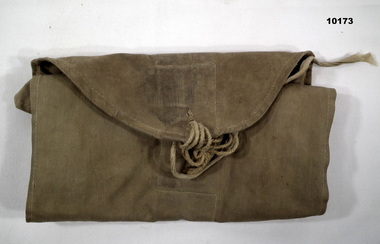
Equipment - TOOL ROLL, c.1939-45
... TOOL ROLL......Tool Roll...Tool roll, small, cotton drill. When opened it reveals that right side has 2 simple pockets with 8 smaller slots for small tools. ...Refer Cat No 10159 Equipment Tool Roll Written on one of the tool slots is “R.A.A.F. 41707” Tool roll, small, cotton drill. ...Frederick Simons collection. Refer Cat No 10159Tool roll, small, cotton drill. When opened it reveals that right side has 2 simple pockets with 8 smaller slots for small tools. The top and bottom have 4 cm flaps that fold over to keep the tools in place. The left end has a curved flap that shuts the tool roll. There are two cotton cords sewn into the end of the closing flap. There is a four string cord stuck through the closing flap in an ad hoc manner. It forms a c.100mm loop. There has been some hand stitching at the end of the tool 'slots'.Written on one of the tool slots is “R.A.A.F. 41707”equipment, tool roll -
 Ringwood RSL Sub-Branch
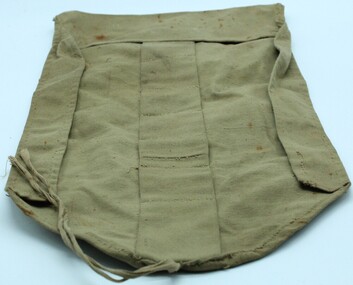
Equipment - Cotton Tool Roll cover
... Cotton Tool Roll cover...Cotton Drill Tool roll...Cotton Drill Tool roll Equipment Cotton Tool Roll cover ...Cotton Drill Tool roll -
 Ringwood RSL Sub-Branch
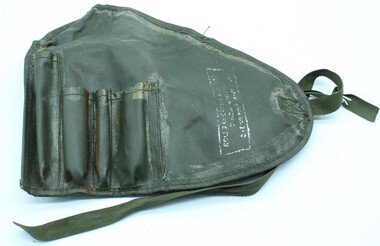
Equipment, Cleaning kit folder
... Waterproof fabric tool roll missing contents...Waterproof fabric tool roll missing contents Cleaning kit folder Equipment ...Waterproof fabric tool roll missing contents -
 City of Moorabbin Historical Society (Operating the Box Cottage Museum)
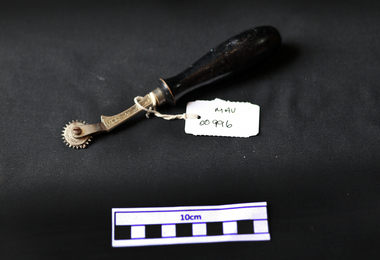
Craftwork, leatherwork marking tool, c1900
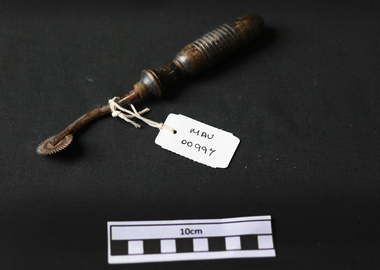
... This leather marking tool is rolled along leather to mark the spacing of stitches for smooth, even results. ...This leather marking tool is rolled along leather to mark the spacing of stitches for smooth, even results. ...This leather marking tool is rolled along leather to mark the spacing of stitches for smooth, even results. Early settlers and pioneers had to be self reliant and made and repaired their own equipment eg Saddles, reins, as well as wallets, pouches and bags. A leather working marking tool with a steel wheel and shaft and a carved wooden handle. craftwork, pioneers, early settlers, moorabbin, bentleigh, cheltenham, leather, tools, saddles, wallets, personal effects, horses, drays, -
 City of Moorabbin Historical Society (Operating the Box Cottage Museum)
Craftwork, leatherwork marking tool, c1900
... This leather marking tool is rolled along leather to mark the spacing of stitches for smooth, even results. ...This leather marking tool is rolled along leather to mark the spacing of stitches for smooth, even results. ...This leather marking tool is rolled along leather to mark the spacing of stitches for smooth, even results. Early settlers and pioneers had to be self reliant and made and repaired their own equipment eg Saddles, reins, as well as wallets, pouches and bags. A leather working tool marker with steel wheel and shaft and a carved wooden handlecraftwork, cheltenham, moorabbin, early settlers, pioneers, leather, tools, saddles, wallets, personal effects, horses, drays, -
 Flagstaff Hill Maritime Museum and Village
Domestic object - Wooden Rolling Pin, First half of 20th Century
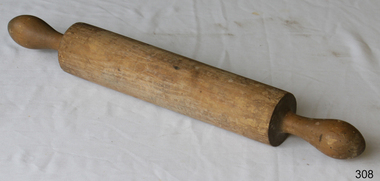
... tools, including the rolling pin. Although written recipes did not exist until the fourth century B.C., the Etruscans documented their love of food and its preparation in murals, on vases, and on the walls of their tombs. Cooking wares are displayed with pride; rolling pins appear to have been used first to thin-roll...tools, including the rolling pin. Although written recipes did not exist until the fourth century B.C., the Etruscans documented their love of food and its preparation in murals, on vases, and on the walls of their tombs. Cooking wares are displayed with pride; rolling pins appear to have been used first to thin-roll ...A rolling pin is a simple tool used to flatten dough. The first civilisation known to have used the rolling pin was the Etruscans. Their advanced farming ability, along with a tendency to cultivate many plants and animals never before used as food and turn them into sophisticated recipes, were passed to invading Greeks, Romans, and Western Europeans. Thanks to the Etruscans, these cultures are associated with gourmet cooking. To prepare their inventive foods, the Etruscans also developed a wide range of cooking tools, including the rolling pin. Although written recipes did not exist until the fourth century B.C., the Etruscans documented their love of food and its preparation in murals, on vases, and on the walls of their tombs. Cooking wares are displayed with pride; rolling pins appear to have been used first to thin-roll pasta that was shaped with cutting wheels. They also used rolling pins to make bread (which they called puls) from the large number of grains they grew. Natives of the Americas used more primitive bread-making tools that are favoured and unchanged in many villages. Chefs who try to use genuine methods to preserve recipes are also interested in both materials and tools. Hands are used as "rolling pins" for flattening dough against a surface, but also for tossing soft dough between the cook's two hands until it enlarges and thins by handling and gravity. Tortillas are probably the most familiar bread made this way. Over the centuries, rolling pins have been made of many different materials, including long cylinders of baked clay, smooth branches with the bark removed, and glass bottles. As the development of breads and pastries spread from Southern to Western and Northern Europe, wood from local forests was cut and finished for use as rolling pins. The French perfected the solid hardwood pin with tapered ends to roll pastry that is thick in the middle; its weight makes rolling easier. The French also use marble rolling pins for buttery dough worked on a marble slab. Glass is still popular; in Italy, full wine bottles that have been chilled make ideal rolling pins because they are heavy and cool the dough. Countries known for their ceramics make porcelain rolling pins with beautiful decorations painted on the rolling surface; their hollow centres can be filled with cold water (the same principle as the wine bottle), and cork or plastic stoppers cap the ends. Designs for most rolling pins follow long-established practices, although some unusual styles and materials are made and used. Within the family of wooden rolling pins, long and short versions are made as well as those that are solid cylinders (one-piece rolling pins) instead of the familiar style with handles. Very short pins called mini rolling pins make use of short lengths of wood and are useful for one-handed rolling and popular with children and collectors. Mini pins ranging from 5 to 7 in (12.7-17.8 cm) in length are called texturing tools and are produced to create steam holes and decorations in pastry and pie crusts; crafters also use them to imprint clay for art projects. These mini pins are made of hardwoods (usually maple) or plastic. Wood handles are supplied for both wood and plastic tools, however. Blown glass rolling pins are made with straight walls and are solid or hollow. Ceramic rolling pins are also produced in hollow form, and glass and ceramic models can be filled with water and plugged with stoppers. Tapered glass rolling pins with stoppers were made for many centuries when salt imports and exports were prohibited or heavily taxed. The rolling pin containers disguised the true contents. The straight-sided cylinder is a more recent development, although tapered glass pins are still common craft projects made by cutting two wine bottles in half and sealing the two ends together so that the necks serve as handles at each end.Tiny rolling pins are also twisted into shape using formed wire. The pins will not flatten and smooth pastry, and the handles do not turn. The metal pins are popular as kitchen decorations and also to hang pots, pans, and potholders. https://www.encyclopedia.com/sports-and-everyday-life/food-and-drink/food-and-cooking/rolling-pinThe use of the rolling pin to make thin pastry or pasta.Wooden rolling pin with some damage on cylinder section.None.flagstaff hill, warrnambool, shipwrecked-coast, flagstaff-hill, flagstaff-hill-maritime-museum, maritime-museum, shipwreck-coast, flagstaff-hill-maritime-village, rolling pin, cooking, pastry -
 Flagstaff Hill Maritime Museum and Village
Domestic object - Can Opener, Bottle Opener & Corkscrew
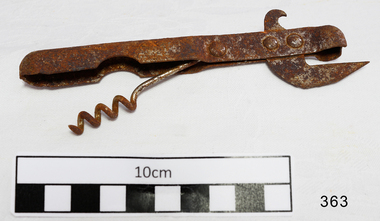
... tool yet, so early cans had to open themselves. In other words, they came with built-in openers. The result was a confusing but pleasing free-for-all, in terms of product engineering. Each type of food came with its own kind of can, and each kind of can came with its own kind of opener. Tinned fish and meat were often sold in rectangular cans. These cans were fitted with a "key" that would roll...tool yet, so early cans had to open themselves. In other words, they came with built-in openers. The result was a confusing but pleasing free-for-all, in terms of product engineering. Each type of food came with its own kind of can, and each kind of can came with its own kind of opener. Tinned fish and meat were often sold in rectangular cans. These cans were fitted with a "key" that would roll ...It took 15 years to invent the can. It took 100 more to invent a standard way to open it. In the 19th century, decades after the invention of canning, there were virtually no can openers. Canned food, such as sardines, came with its own "key" to peel back the tin lid. Birth of the can One of the oddest things about the can opener is that the can predates it by almost 150 years. Though common today, cans were once military-grade technology. In 1795, Napoleon, to whom the phrase "an army marches on its stomach" is attributed, offered 12,000 francs to anyone who could find a way to preserve food. Without any knowledge of bacteria or their role in food spoilage, scientists didn't even know where to begin. It took 15 years before a chef named Nicholas Appert claimed the prize after successfully jarring food. Soon after that, his countryman Philippe de Girard came up with a variant on Appert's method—metal tins—and sold the idea to the British. Spoiled food, and the sickness it caused, was a widespread problem. The public would have benefited from canned food, but for decades cans were almost exclusively for the army and the navy. The canning process, with its hours of boiling and steaming, its scrupulous cleanliness, its heated metal, and its need for a great deal of disposable material, made canned food far too expensive for anyone but the military. No can openers were needed or even possible. The metal of early cans was too thick to make openers practical. Soldiers and sailors had plenty of sharp objects on hand and made ample use of them when they wanted to eat. During the 19th century, the process of canning was refined and mechanised, and the metal wall of the average can slimmed down enough that a civilian could get it open—if that civilian had the right tool. No one had that tool yet, so early cans had to open themselves. In other words, they came with built-in openers. The result was a confusing but pleasing free-for-all, in terms of product engineering. Each type of food came with its own kind of can, and each kind of can came with its own kind of opener. Tinned fish and meat were often sold in rectangular cans. These cans were fitted with a "key" that would roll down the top of the can. Coffee, beans, and other types of meat were packaged in cylinders with metal strips that could be peeled back with their own kinds of built-in keys. Cans of milk, which didn't need to be completely opened, came with puncture devices. As tinned food became more common, its containers became more regular. A nice cylindrical can became the norm, and, as these cans filled kitchens, more engineers put their minds to finding a convenient way to open all of them. The first standalone can opener worked on a simple principle: point, stab, and pull. From the mid-19th century to the end of World War I, the typical can opener looked roughly like a wrench, if the lower 'jaw' of the wrench were replaced with a blade. People used the blade to puncture the top of the can near its edge, push the upper jaw against the side of the can, and drag the blade through the metal along the rim. Because meat was the first and most popular canned substance, these can openers were often shaped to look like cows and given the nickname 'bully beef can openers'. The bully beef can opener, popular in the mid-19th century, resulted in many lost fingers. Later, a corkscrew was added that was seated in the handle, and could be pulled out for use. Bully beef can openers were so common, effective, and sturdy that they are still frequently available on collectors' sites. Some are advertised as “still working,” and every last one of them is, without a doubt, soaked in the blood of our ancestors. Dragging a sharp blade along the edge of a can is certain to cause injury sooner or later. So once people got a reliable can shape and a reliable way to get the can open, the search was on for a reliable way to get a can open without the possibility of losing a finger. The answer came in 1925, from the Star Can Opener Company of San Francisco. This is probably the first can opener that resembles the one people have in their kitchens today. Instead of using a blade to pry open a metal can, buyers could clamp the edge of the can between two wheels and twist the handle of one of the wheels to move the blade around the lip. The Star can openers weren't perfect. Compared to the bully beef model, they were flimsy and breakable, but they probably prevented a few injuries. Six short years after the Star model came to market, the first electric can opener was invented. It was patented in 1931 by the Bunker Clancey Company of Kansas City, who had already been sued by the Star Can Opener Company for trying sell a double-wheeled can opener like the Star model (the case was dismissed). The electric can opener must have seemed like the wave of the future and a sure-fire seller, but it proved to be too far ahead of its time. In 1931 not that many households had electricity, and those that did weren't interested in buying can openers. The Bunker Clancey Company was subsequently bought by the Rival Company, which still makes small appliances like can openers today. It took another 25 years for electrically powered can openers to become practical. In the 1950s, Walter Hess Bodle and his daughter, Elizabeth Bodle, developed an electric can opener in the family garage. Walter came up with the opener's blades and motor, and Elizabeth sculpted the outside. Their can opener was a free-standing unit that could sit on the kitchen counter. The Udico brand of the Union Die Casting Company put it on the market in time for Christmas in 1956 and had great success with it. Over the next few years it came out in different styles and colours, and, like the bully beef can opener, has become a collector's item. Also like the bully beef model, Udico can openers often still work. They don't make 'em like they used to. Although there have been some design changes and refinements over the last sixty years, there have yet to be any more leaps forward in can opener technology. If you're resentfully opening a can, you are almost certainly doing it using the Star design, manually forcing the can between two wheels, or the Bodle design, clamping the can into a free-standing electrical opener. Whether or not you enjoy your holiday meals, at least you can be happy that you are not getting poisoned by your own food or cutting open your hand with the blade you use to get at it. That's something, right?The can opener, Bottle opener and the corkscrew are still very important and essential items in most kitchens.Metal can opener, chromed, with bottle opener, and a corkscrew seated in the handle.None.flagstaff hill, warrnambool, shipwrecked-coast, flagstaff-hill, flagstaff-hill-maritime-museum, maritime-museum, shipwreck-coast, flagstaff-hill-maritime-village, canning, can opener, corkscrew, bottle opener, kitchen equipment -
 Flagstaff Hill Maritime Museum and Village
Domestic object - Can Opener
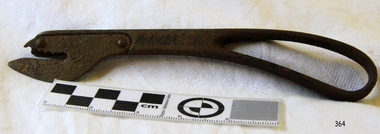
... tool yet, so early cans had to open themselves. In other words, they came with built-in openers. The result was a confusing but pleasing free-for-all, in terms of product engineering. Each type of food came with its own kind of can, and each kind of can came with its own kind of opener. Tinned fish and meat were often sold in rectangular cans. These cans were fitted with a "key" that would roll...tool yet, so early cans had to open themselves. In other words, they came with built-in openers. The result was a confusing but pleasing free-for-all, in terms of product engineering. Each type of food came with its own kind of can, and each kind of can came with its own kind of opener. Tinned fish and meat were often sold in rectangular cans. These cans were fitted with a "key" that would roll ...It took 15 years to invent the can. It took 100 more to invent a standard way to open it. In the 19th century, decades after the invention of canning, there were virtually no can openers. Canned food, such as sardines, came with its own "key" to peel back the tin lid. Birth of the can One of the oddest things about the can opener is that the can predates it by almost 150 years. Though common today, cans were once military-grade technology. In 1795, Napoleon, to whom the phrase "an army marches on its stomach" is attributed, offered 12,000 francs to anyone who could find a way to preserve food. Without any knowledge of bacteria or their role in food spoilage, scientists didn't even know where to begin. It took 15 years before a chef named Nicholas Appert claimed the prize after successfully jarring food. Soon after that, his countryman Philippe de Girard came up with a variant on Appert's method—metal tins—and sold the idea to the British. Spoiled food, and the sickness it caused, was a widespread problem. The public would have benefited from canned food, but for decades cans were almost exclusively for the army and the navy. The canning process, with its hours of boiling and steaming, its scrupulous cleanliness, its heated metal, and its need for a great deal of disposable material, made canned food far too expensive for anyone but the military. No can openers were needed or even possible. The metal of early cans was too thick to make openers practical. Soldiers and sailors had plenty of sharp objects on hand and made ample use of them when they wanted to eat. During the 19th century, the process of canning was refined and mechanised, and the metal wall of the average can slimmed down enough that a civilian could get it open—if that civilian had the right tool. No one had that tool yet, so early cans had to open themselves. In other words, they came with built-in openers. The result was a confusing but pleasing free-for-all, in terms of product engineering. Each type of food came with its own kind of can, and each kind of can came with its own kind of opener. Tinned fish and meat were often sold in rectangular cans. These cans were fitted with a "key" that would roll down the top of the can. Coffee, beans, and other types of meat were packaged in cylinders with metal strips that could be peeled back with their own kinds of built-in keys. Cans of milk, which didn't need to be completely opened, came with puncture devices. As tinned food became more common, its containers became more regular. A nice cylindrical can became the norm, and, as these cans filled kitchens, more engineers put their minds to finding a convenient way to open all of them. The first standalone can opener worked on a simple principle: point, stab, and pull. From the mid-19th century to the end of World War I, the typical can opener looked roughly like a wrench, if the lower 'jaw' of the wrench were replaced with a blade. People used the blade to puncture the top of the can near its edge, push the upper jaw against the side of the can, and drag the blade through the metal along the rim. Because meat was the first and most popular canned substance, these can openers were often shaped to look like cows and given the nickname 'bully beef can openers'. The bully beef can opener, popular in the mid-19th century, resulted in many lost fingers. Bully beef can openers were so common, effective, and sturdy that they are still frequently available on collectors' sites. Some are advertised as “still working,” and every last one of them is, without a doubt, soaked in the blood of our ancestors. Dragging a sharp blade along the edge of a can is certain to cause injury sooner or later. So once people got a reliable can shape and a reliable way to get the can open, the search was on for a reliable way to get a can open without the possibility of losing a finger. The answer came in 1925, from the Star Can Opener Company of San Francisco. This is probably the first can opener that resembles the one people have in their kitchens today. Instead of using a blade to pry open a metal can, buyers could clamp the edge of the can between two wheels and twist the handle of one of the wheels to move the blade around the lip. The Star can openers weren't perfect. Compared to the bully beef model, they were flimsy and breakable, but they probably prevented a few injuries. Six short years after the Star model came to market, the first electric can opener was invented. It was patented in 1931 by the Bunker Clancey Company of Kansas City, who had already been sued by the Star Can Opener Company for trying sell a double-wheeled can opener like the Star model (the case was dismissed). The electric can opener must have seemed like the wave of the future and a sure-fire seller, but it proved to be too far ahead of its time. In 1931 not that many households had electricity, and those that did weren't interested in buying can openers. The Bunker Clancey Company was subsequently bought by the Rival Company, which still makes small appliances like can openers today. It took another 25 years for electrically powered can openers to become practical. In the 1950s, Walter Hess Bodle and his daughter, Elizabeth Bodle, developed an electric can opener in the family garage. Walter came up with the opener's blades and motor, and Elizabeth sculpted the outside. Their can opener was a free-standing unit that could sit on the kitchen counter. The Udico brand of the Union Die Casting Company put it on the market in time for Christmas in 1956 and had great success with it. Over the next few years it came out in different styles and colours, and, like the bully beef can opener, has become a collector's item. Also like the bully beef model, Udico can openers often still work. They don't make 'em like they used to. Although there have been some design changes and refinements over the last sixty years, there have yet to be any more leaps forward in can opener technology. If you're resentfully opening a can, you are almost certainly doing it using the Star design, manually forcing the can between two wheels, or the Bodle design, clamping the can into a free-standing electrical opener. Whether or not you enjoy your holiday meals, at least you can be happy that you are not getting poisoned by your own food or cutting open your hand with the blade you use to get at it. That's something, right?The can opener is still a very important and essential item in most kitchens.Can opener, right handed, metal, upper blade section serrated, inscription 'Peerless Pat.Feb 11-90'.Peerless Pat.Feb 11-90flagstaff hill, warrnambool, shipwrecked-coast, flagstaff-hill, flagstaff-hill-maritime-museum, maritime-museum, shipwreck-coast, flagstaff-hill-maritime-village, cannning, can opener, kitchen equipment -
 Orbost & District Historical Society
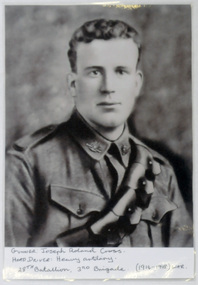
laminated photograph, This copy-April 2015
... Joseph Roland Page Cross ; Service Number: 35864: Rank: Gunner; Roll title: FAB [Field Artillery Brigade] - 27 to 35 Reinforcements (November 1917 - June 1918) Conflict / Operation: First World War, 1914-1918; Date of embarkation: 9 November 1917; Place of embarkation: Melbourne; Ship embarked on: HMAT Port Sydney A15 (from First World War Embarkation Rolls). This photograph was used in the WW1 exhibition held in Orbost April 2015. This is a useful reference tool ...Joseph Roland Page Cross ; Service Number: 35864: Rank: Gunner; Roll title: FAB [Field Artillery Brigade] - 27 to 35 Reinforcements (November 1917 - June 1918) Conflict / Operation: First World War, 1914-1918; Date of embarkation: 9 November 1917; Place of embarkation: Melbourne; Ship embarked on: HMAT Port Sydney A15 (from First World War Embarkation Rolls). This photograph was used in the WW1 exhibition held in Orbost April 2015.This is a useful reference tool.A laminated b/w photograph of Gunner Joseph Roland Cross. It is a head and shoulders photograph of a soldier in uniform.GUNNER;Joseph Roland Cross HEAD DRIVER ; Heavy Artillery 28th Batallion, 3rd Brigade (1914-1918) WARcross-joseph-roland ww1 -
 Orbost & District Historical Society
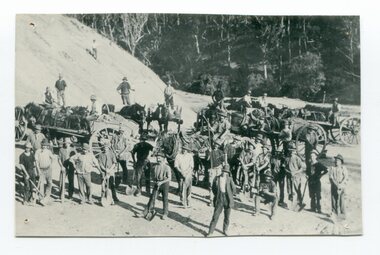
black and white photograph, C1914
... tool struck a percussion cap, and fired the charge. He and Sullivan were killed instantly, Carroll being literally blown to pieces. Fragments of his body and garments were recovered from the surrounding bush, and the main portion of the trunk, with leg attached, was hurled a distance of 200 yards. Peter Car roll...tool struck a percussion cap, and fired the charge. He and Sullivan were killed instantly, Carroll being literally blown to pieces. Fragments of his body and garments were recovered from the surrounding bush, and the main portion of the trunk, with leg attached, was hurled a distance of 200 yards. Peter Car roll ...This photograph shows men working in the gravel pit at Newmerella just outside Orbost. Not long after this photograph was taken an accidental explosion killed three workers. In the newspaper, The Hobart Mercury on Saturday March 1914, There was this report: "EXPLOSION OF BLASTING CHARGE. THREE MEN KILLED. MELBOURNE, March 13 A fatal accident occurred this after- noon on the railway construction works at Hagen's Cutting, about two miles from Orbost, three men being killed. The victims were John Carroll, contractor, his son, Peter Carroll, and John Sullivan, a navvy. The gang had just finished work, and the three stayed behind to draw a blasting charge, which had missed fire yesterday. J. Carroll was using a pick, and it is presumed that the tool struck a percussion cap, and fired the charge. He and Sullivan were killed instantly, Carroll being literally blown to pieces. Fragments of his body and garments were recovered from the surrounding bush, and the main portion of the trunk, with leg attached, was hurled a distance of 200 yards. Peter Car roll was terribly- injured, and he died before medical aid arrived. ' This is a pictorial record of construction workers associated with the Orbost - Bairnsdale railway. This item is associated with the history of the Orbost-Bairnsdale railway line and therefore reflects the role that the rail line played in the social and economic history of Orbost. The Bairnsdale-Orbost railway was opened in 1916 to serve the agricultural and timber industry. Because of the decline in traffic and heavy operating costs, the line was finally closed in August, 1987. A black / white photograph of a large group of men with horses and wagons. Most are holding tools - picks, spades and shovels. Some of the wagons are loaded with soil.railway-construction east-gippsland-railway orbost-railway quarry-gravel-newmerella -
 Orbost & District Historical Society
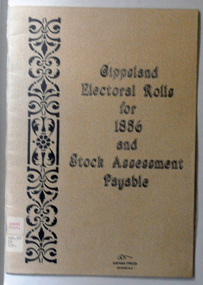
book, E-Gee Printers, Gippsland Electoral Rolls for 1856 and Stock Assessment Payable, 1985
... tool. voting-registers-victoria A 16 pp paper back book which has a clear plastic cover. The covers are beige coloured with the title "Gippsland Electoral Rolls for 1856 and Stock Assessment Payable" in blak print. On the left hand side is a vertical pattern in black print. The book contains an alphabetical list of persons claiming or supposed to be entitled to Vote in the Election of a Member for the District. It lists the needed qualifications of electors followed by the Voters Roll ...The Electoral Act 1856 was passed through Parliament o March 13, 1856. Victoria was the first Australian colony, and the first legislature anywhere in the world, to adopt the practice of the secret ballot. Victoria's constitution prescribed that the Parliament was to be bicameral, consisting of an upper house, the Legislative Council and a lower house, Legislative Assembly. Men were entitled to vote according to the qualifications described in this book - the right to vote in each house was dependent on status - educational qualifications, income and for either literacy. Two names are registered for the Orbost district: James Dickson and J.C. McLeod.This item is a useful research tool.A 16 pp paper back book which has a clear plastic cover. The covers are beige coloured with the title "Gippsland Electoral Rolls for 1856 and Stock Assessment Payable" in blak print. On the left hand side is a vertical pattern in black print. The book contains an alphabetical list of persons claiming or supposed to be entitled to Vote in the Election of a Member for the District. It lists the needed qualifications of electors followed by the Voters Roll for Legislative Assembly, 1856 and the Voters Roll for Legislative Council, 1856 . It then lists the Stock Assessments, 1856.voting-registers-victoria -
 Flagstaff Hill Maritime Museum and Village
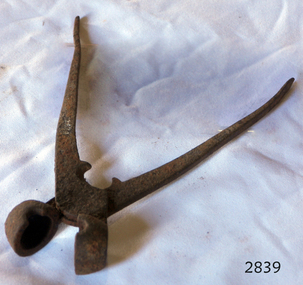
Tool - Bullet Mould, From 1600s to early 19th century
... These needed to be filed off before being used inside a musket, so some soldiers would pop a few in their mouths and roll them around, chewing off the excess until the ball was smooth. The obvious downside to this method is that lead is poisonous. A tool ...Musket balls are the ammunition used in muskets the weapons used during the English and American Civil Wars. The balls could be made from any metal alloy, but many were made from lead. Lead can be melted at reasonably low temperatures and so lead musket balls could be made over a camp fire. Lead could be readily sourced from such places like church roofs or even coffins, and recast from old musket balls, so it was an easy material to work with while preparing for battle. The soldier would carry a crucible in which to melt the lead, he would put the material into it and place it over the fire until it had formed into a liquid. Musket ball moulds like the subject item, had a small hole above one of the domes where the liquid could be poured into once the two domes were closed together. The soldier would wait until it cooled then opened the mould to reveal a solid lead ball inside. Because these were cast in halves even though pressed together, there would always be a small amount of liquid lead leakage which would form a thin crust around the ball. These needed to be filed off before being used inside a musket, so some soldiers would pop a few in their mouths and roll them around, chewing off the excess until the ball was smooth. The obvious downside to this method is that lead is poisonous. A tool used to make ammunition for black powder firearms either muskets or pistols from the early part of the 18th to mid 19th century. After this time enclosed brass cartridges that held the propellent powder and bullet were starting to come into wide spread use, negating the need for a firearm to first have black powder placed in a barrel then the ball rammed on top and finally the firearm primed with powder or a percussion cap.Musket rifle/ pistol bullet mold. Makes .50 -caliber- round balls with a sprew cutter to cut off excess lead.Marked 50flagstaff hill, warrnambool, shipwrecked coast, flagstaff hill maritime museum, maritime museum, shipwreck coast, flagstaff hill maritime village, great ocean road, shot pliers, lead shot, shot, armoury, firearms, bullet, cast bullet, lead ball, lead shot, scissor mould -
 Orbost & District Historical Society
poster, Chronological Record Great War 1914 -19, 1920s?
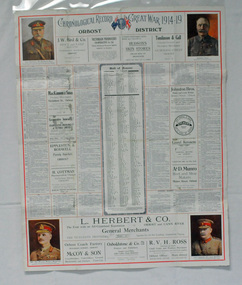
... roll of honour is surrounded by collector’s cards depicting battle scenes. It also contains the dates and details of war events from 1914 to 1919 and advertisements for several local businesses such as J.W.Bird & cO.; Victorian Producers Co-Operative; Tomlis & Gall; McKinnon & Sons; Co-Operative Insurance Co of Victoria; Epplestun & Rodwell This item is a useful research tool. ww! ...This poster was one of a set produced for towns in Australia. It was adapted to suit the requirements of the location. It contains not only the names of soldiers, but also photographs of war leaders, such as Lieutenant-General Sir John Monash, Field Marshall Sir Douglas Hay, Marshall Ferdinand Foch and General Sir William Birdwood. The roll of honour is surrounded by collector’s cards depicting battle scenes. It also contains the dates and details of war events from 1914 to 1919 and advertisements for several local businesses such as J.W.Bird & cO.; Victorian Producers Co-Operative; Tomlis & Gall; McKinnon & Sons; Co-Operative Insurance Co of Victoria; Epplestun & RodwellThis item is a useful research tool.A poster, titled, "Chronological Record Great War 1914 - 19". It has a sub - heading - "Orbost District" beneath two crossed flags, an Australian and a British. The roll of honour is surrounded by collector’s cards depicting battle scenes. It also contains the dates and details of war events from 1914 to 1919 and advertisements for several local businesses. In each corner is a coloured photograph of a man in a military uniform.ww!-roll-of-honour-orbost -
 Ringwood and District Historical Society
Flyer - Catalogue, Public Auction - Brick Residence and Contents of Dwelling, "Wyncliff", Whitehorse Road, Ringwood. 1935
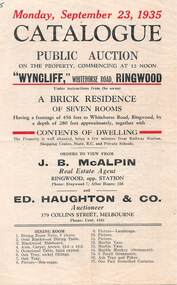
... .; Grass Catcher; 8 Pieces Garden Tools; Barrow; Quantity of Timber; Quantity of Flower Pots; Quantity of Wire; 4 Egg & 1 Fowl Crates Feed Room; 1 Gallon Demijohn Feed Room; Quantity of Shelving Feed Room; Quantity of Cement, Lime; Six Small Doors; Roll of Perforated Cardboard; Boot Rack; Coat Rack; 3 Automatic Sanitary Disinfectant; Pair Neck Straps and Rope; One Chimney Top & 3 Vent Bks.; Desk; Large Pump; Large Safe; Pair Sliding Door Rollers & Fittings; Two Wooden Doors; Box Sundries; Wooden Frame and Glass; 2 Vienna Chairs; Delivery Cart; Five Boxes Tiles; Quantity Agricultural Pipes; Wooden Bench; Wood Horse; Earthenware Drain Pipe; Wooden Tool Box; New Brass Spray "Rego"; Two Wood Planes. ....; Grass Catcher; 8 Pieces Garden Tools; Barrow; Quantity of Timber; Quantity of Flower Pots; Quantity of Wire; 4 Egg & 1 Fowl Crates Feed Room; 1 Gallon Demijohn Feed Room; Quantity of Shelving Feed Room; Quantity of Cement, Lime; Six Small Doors; Roll of Perforated Cardboard; Boot Rack; Coat Rack; 3 Automatic Sanitary Disinfectant; Pair Neck Straps and Rope; One Chimney Top & 3 Vent Bks.; Desk; Large Pump; Large Safe; Pair Sliding Door Rollers & Fittings; Two Wooden Doors; Box Sundries; Wooden Frame and Glass; 2 Vienna Chairs; Delivery Cart; Five Boxes Tiles; Quantity Agricultural Pipes; Wooden Bench; Wood Horse; Earthenware Drain Pipe; Wooden Tool Box; New Brass Spray "Rego"; Two Wood Planes. ...Double-sided A5 size advertisement for public auction under instructions from the owner on Monday, September 23, 1935 on the property - seven room brick residence with frontage 456 feet by approximately 280 feet and contentents of dwelling fully listed over 4 pages. Agent - J.B. McAlpin, Ringwood, opp. station. Phone Ringwood 7; after houres 236. Auctioneer - ED. Haughton & Co., 379 Collins Street, Melbourne. Phone Central 4101.Contents of Dwelling List - includes: DINING ROOM - Dining Room Suite - 6 pieces; Oval Blackwood Dining Table; Blackwood Sideboard; Axminster Carpet, Occasional Table hand carved; Oak Trays; Seascape, Landscape and other Pictures; 2 Marble Vases; Marble Monkey and 3 other Small Ornaments; Ash Tray and Poker; One Pair Stencilled Curtains. Two Large Vases, 1 with floral design; Salad Bowl and Servers; One Dozen Dessert Knives; Nine Stainless Teaspoons (new); Plated Vases; Plated Jam Dishes; Plated Cream Bowl; Silver Plated Cake Dish; One Pair Plated Shell Butter Dishes; Lino Border. LOUNGE ROOM - 2 Pictures and 1 pair with Circular Frames; Floral Jardinere and Pot Plant; Cabinet Gramophone "Singola"; Records; Player Piano "Cable"; Piano Stool; 31 Rolls; Roll Cabinet; Quantity of Music; Music Case, Leather; Portable Gramophone "Decca"; Floral Design Jardinere; Wicker Occasional Table; 2 Wicker Chairs; Cane Lounge Settee; Blackwood Bookcase; 9 Volumes Universal Encyclopedia; 10 Vols Children's Encyclopedia; Floral Vase; Black and Gold Vase; One pair Plated Vases; Ash Pan; Lino Border (Lounge Room); One Carpet, green 13.6 x 10.6; One Cushion; Hall Stand; Pedestal; Floral Design Jardinere; Painting on Canvas (Landscape); Hall Runner Carpet 25 feet; Hall Lino 29ft 5 in.; Five Door Mats (small). FIRST BEDROOM - Arm Chair (Leather); English Oak Dressing Table; English Oak Wash Stand Marble Top; Toilet Set (Four pieces); Silk Fire Screen; Blackwood Occasional Table; Black and Gold Vase; Pair China Vases; Pair Glass Vases; Single Glass Vase; One Kewpie Lavender Bag; Bedroom Lino 15.6 x 13.6. SECOND BEDROOM - Arm Chair (Leather); Dressing Table; Wash Stand; 3 Piece Toilet Set; One Vase (Pink Cameo Design); Two Ornaments (one round); Bedroom Lino 13.5 x 12.10; 3 Pictures; 2 Pairs Curtains (applique, stenc'ld); Pair Curtain Poles. THIRD BEDROOM - Lino approx 14ft x 10ft; Two Green Mohair Mats; Pair Pictures (White frames); One Picture ("The Mourners"); Picture ("The Wanderer Found"); Small Picture; Wicker Chair. FOURTH BEDROOM - Duchess Chest 5 drawers; Corner Wardrobe and Curtains; One Single Bed & Wire Mattress; Single Bedding; Lino on floor 14ft x 6ft 6in.; Occasional Table; 3 Pictures; Two Door Mats; Hall Runner (Carpet) 21ft. BREAKFAST ROOM - Two Wicker Chairs; Cushion; Brown Cushion; Four Vienna Chairs; Jardinere; Kerb (Wooden). 3 Pictures; Oil Painting (Canvas); 2 Pictures; Lino 14ft x 14ft; Brown Table Cover; Fruit Set; Robur Tea Pot; Plaque; China Biscuit Barrel; Glass Fruit Bowl; Pair Pickle Jars and Stand; Wooden Inkstand; Pair Ash Trays; Two Marble Vases; Glass Vase; Electric Jug and Electric Toaster (practically new); Picture; Cushion; Pair Lace Curtains; Curtain Rod; Three Lace Curtains; Brass Curtain Rods (3); Lino in Vestibule 10ft x 8 ft; Lino in Kitchen 12.6 x8.6; Coal Scuttle; Two Small Tables (1 Baize Cover). STORE ROOM - Briquette Grate; Three Coir Mats (one new); Three Small Door Mats (new); Glass Fire Screen; 2 Alm Pot Stands; Steel Pot Stand; Lady's Bicycle; 2 Electric Radiators (one large); White Cabinet; Stretcher Bed; Large Cot with Wire Mattress; Kerb; Fender and Irons; Lino on floor 12ft x 12ft; Lino in Storeroom 6ft x 6ft; Three Large Window Blinds; Clothes Horse; Dressmaker's Fitting Stand; Dressmaker's Bust; Window Display Bust; Blouse Stand; Small Display Stand; Meat Cover (Metal); Leather Portmantau; Leather Kit Bag; Four Large Wooden Drawers; Picnic Basket; Mattress, Bolster and Pillow; Cot Quilt; One Long-handled Feather Duster; Feather Duster; Wicker Lounge; Cane Soiled Linen Basket; One New Washing Tub; Copper Preserving Pan; Lino in Laundry 8 x 6 approx; Carpet Sweeper; Small Jardinere; 2 Shopping Baskets; Kitchen Safe; Kitchen Table; Three Buckets; 1 Horse Rub patent (prac new); Wooden Pot Plant Stand; Bird Cage and Stand; Pair Steps; Pair Small Steps; Metal Meat Safe; Wooden Safe; Hand worked Table Cover; Pair Poplin Silk Curtains (new); Leather Table Centre. VERANDAH - 12ft Shelving with doors; 35ft Shelving; Wooden Stand; Axe Stand (wooden); Nine feet Wooden Shop Fittings; Small Filing Cabinet; Three Window Frames & Glass; 38 Pot Plants Fernery; 9 Hanging Baskets Fernery; Electric Shop Sgn Storeroom; 2 Small Electric Shop Signs Storeroom; 2 Garden Sprays; Doll's Pram and Doll; Two Boxes Paint and Slate; Crystal Radio Set; New Canvas Blind & Roller 6ft.; Electric Light Reflectors (two); Two pieces of Painted Baize; Small Vice; Sprinkler; One Gallon Tin of Spray Oil; 2 Packets of "Aresto"; Two Hurricane Lamps; One Pair Spring Balance Scales; Small Pair Spring Balance Scales. WASH HOUSE - Pair Heavy Tracers (2); Pair Reins; Back Band; One Tug; Pair Hames; One Pair Neck Bands (2); Four Manger Balls; Pair Knee Pads; Kicking Strap complete; Leather Head Stall; Collar Pad; Knife Board and Tin Polish; Fork Cleaner; Foot Spray Pump. TOOL SHED - One Stewart Horse Clipper; Approx 120ft Ribbed Hose; 100ft ½in Hose; Child's Scooter; Tin Box; Ferret Box; One Tool Box; Tomato Hoe; Sprinkler; Two Large Augers; Large Watering Can; Medium Watering Can; Small Watering Can; Wooden Tool Chest; Rope, Tackle and two Pulleys; Six pieces of Lino; Three Small Canvas Blinds; Lawn Mower 14in.; Lawn Mower 12in.; Grass Catcher; 8 Pieces Garden Tools; Barrow; Quantity of Timber; Quantity of Flower Pots; Quantity of Wire; 4 Egg & 1 Fowl Crates Feed Room; 1 Gallon Demijohn Feed Room; Quantity of Shelving Feed Room; Quantity of Cement, Lime; Six Small Doors; Roll of Perforated Cardboard; Boot Rack; Coat Rack; 3 Automatic Sanitary Disinfectant; Pair Neck Straps and Rope; One Chimney Top & 3 Vent Bks.; Desk; Large Pump; Large Safe; Pair Sliding Door Rollers & Fittings; Two Wooden Doors; Box Sundries; Wooden Frame and Glass; 2 Vienna Chairs; Delivery Cart; Five Boxes Tiles; Quantity Agricultural Pipes; Wooden Bench; Wood Horse; Earthenware Drain Pipe; Wooden Tool Box; New Brass Spray "Rego"; Two Wood Planes. YARD - Pair Hedge Clippers; Box Containing 2 prs Secateurs & Punch; Box Tools seven pieces; Box Sundries; Lawn Weeder and Seed Sower; Box Tools 6 pieces; Two Saws; Bundle Files; Three Braces; Box of 13 pieces Gimlets etc.; Five Spanners; Box Tools 4 pieces; Four Coal Chisels; Box 7 pieces of Tools; Box of 5 pieces of Tools; Box of Docket Books; One Printing set; Large Figure Printing Set; Small Figure Printing set; Price Ticket Box; Air Brush Writing Set Complete; Six Shelves & Brackets, one Hat Rack, in store room; Box of Three Hammers; Two Boot Lasts; Tin of Polishing Oil; Box of Gardening Sundries; 2 Bicycle Pumps Saddle & Clips; One Covered Baking Dish; 200 c.p. Globe (Vestibule); Two "Dimolite" Fittings; Set of Five Canisters; Earthernware Jar; Two shopping Cases; Dinner Set 11 pieces; Box of Sundry Tins; Alm Fish Pan and Drainer; Two Ventilators; Knife Board & 3 Bread Saws; Soap Box and Jewel Case; Three Glass Articles. OFFICE FURNITURE - Steel Safe (Office Safe); Office Table five drawers; Cabinet 8 drawers; Cupboard three shelves; Selves 2ft3in x 1ft6in; Cheque Protector; Remington Typewriter; Typewriter Adjustable Table; Burroughs Bookkeeping Machine and Stand Complete; Small Office Table; Glass Show Case3ft9 x 2ft.; Four Sheets M. Glass; Five Sheets P. Glass; Gent's Overcoat new; Boy's Pullover New; Small Show Case; Duplicator (complete); Webster's Dictionary; Family doctor's Book. Two Dictionaries; Bundle of Three Books; Art Decorating Book; Bundle of Three Books; Bundle of Three Books; Two Books (Children's); (Multiple) Bundles each containing Three Books; Leather Riding Whip; Tort-shell Inkstand & Calendar; Tort-shell Folding Letter Rack; Water Filter; Thermos Flask and Case; Two Waste Paper Baskets. -
 Eltham District Historical Society Inc
Telegram, Telegram, Victoria Barracks, Melbourne to Mrs Annie Castledine, Old Eltham Road, Lower Plenty, 3 May 1941, 3 May 1941
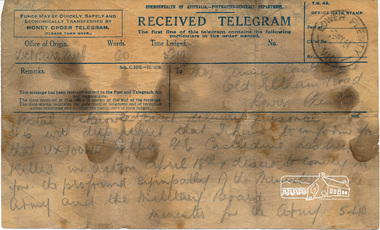
... The telegram is oil stained as it was kept by George's brother Sid in his toolbox. 2/2 Field Company, AIF, Annie Castledine, Arthur Frederick Castledine, Eltham War Memorial, George Ernest Castledine, Military, Minister for the Army, Roll of Honour, Second Word War, Sid Castledine, Telegram Original bears oil stains from being stored in a tool box Digital image of original held in private collection of Joan Castledine (niece of George Ernest Castledine and daughter of Sid and Polly (nee Arrowsmith) Castledine). ..."Postal acknowledgement delivery personal" "It is with deep regret that I have to inform you that VX10044 Sapper G. E. Castledine has been killed in action April 18th & desire to convey to you the profound sympathy of the Minister for the Army and the Military Board. - Minister for the Army" Sapper George Ernest Castledine (1914-1941), son of Arthur Frederick and Annie Castledine, enlisted 23 January 1940 at Lower Plenty and was assigned to the 2/2 Field Company. He is buried in the Phaleron War Cemetery, Athens, Greece and is remembered on the Roll of Honour at Eltham.George was the first soldier from the Shire of Eltham to be killed in the Second World War. The telegram is oil stained as it was kept by George's brother Sid in his toolbox.Digital image of original held in private collection of Joan Castledine (niece of George Ernest Castledine and daughter of Sid and Polly (nee Arrowsmith) Castledine).Original bears oil stains from being stored in a tool box2/2 field company, aif, annie castledine, arthur frederick castledine, eltham war memorial, george ernest castledine, military, minister for the army, roll of honour, second word war, sid castledine, telegram -
 Eltham District Historical Society Inc
Photograph, Opening of Andrew Ross Museum, Kangaroo Ground, 20 Nov 1994, 20/11/1994
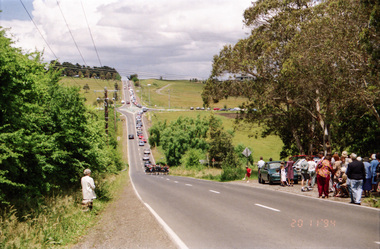
... tools. He proposed that this might present an opportunity to set up a museum with the Society's objects. It was proposed that a board be appointed containing representatives of the Society, the School Council, Shire of Eltham and "Friends of the Andrew Ross Museum." As a consequence, most of the Society's objects were transferred to the museum and the Society became more focused on documents, maps and photographs, etc. shire of eltham historical society Fuji 100 Roll of 35mm colour negative film, 3 strips Opening of Andrew Ross Museum, Kangaroo Ground, 20 Nov 1994 Photograph ...In 1992 Shire of Eltham Historical Society member and Kangaroo Ground resident, Bruce Ness became aware that the old school teacher residence at Kangaroo Ground School was no longer being used. Over the years Bruce had been storing a growing collection of the Society's artifacts and objects including various machinery and farm tools. He proposed that this might present an opportunity to set up a museum with the Society's objects. It was proposed that a board be appointed containing representatives of the Society, the School Council, Shire of Eltham and "Friends of the Andrew Ross Museum." As a consequence, most of the Society's objects were transferred to the museum and the Society became more focused on documents, maps and photographs, etc.Roll of 35mm colour negative film, 3 stripsFuji 100shire of eltham historical society -
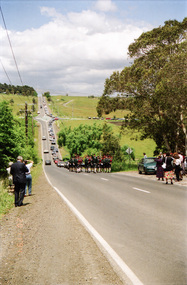 Eltham District Historical Society Inc
Photograph, Opening of Andrew Ross Museum, Kangaroo Ground, 20 Nov 1994, 20/11/1994
... tools. He proposed that this might present an opportunity to set up a museum with the Society's objects. It was proposed that a board be appointed containing representatives of the Society, the School Council, Shire of Eltham and "Friends of the Andrew Ross Museum." As a consequence, most of the Society's objects were transferred to the museum and the Society became more focused on documents, maps and photographs, etc. shire of eltham historical society Fuji 100 Roll of 35mm colour negative film, 3 strips Opening of Andrew Ross Museum, Kangaroo Ground, 20 Nov 1994 Photograph ...In 1992 Shire of Eltham Historical Society member and Kangaroo Ground resident, Bruce Ness became aware that the old school teacher residence at Kangaroo Ground School was no longer being used. Over the years Bruce had been storing a growing collection of the Society's artifacts and objects including various machinery and farm tools. He proposed that this might present an opportunity to set up a museum with the Society's objects. It was proposed that a board be appointed containing representatives of the Society, the School Council, Shire of Eltham and "Friends of the Andrew Ross Museum." As a consequence, most of the Society's objects were transferred to the museum and the Society became more focused on documents, maps and photographs, etc.Roll of 35mm colour negative film, 3 stripsFuji 100shire of eltham historical society -
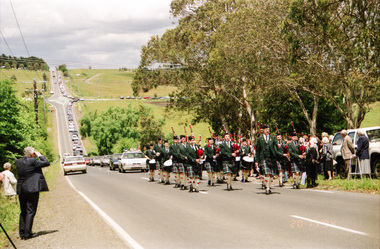 Eltham District Historical Society Inc
Photograph, Opening of Andrew Ross Museum, Kangaroo Ground, 20 Nov 1994, 20/11/1994
... tools. He proposed that this might present an opportunity to set up a museum with the Society's objects. It was proposed that a board be appointed containing representatives of the Society, the School Council, Shire of Eltham and "Friends of the Andrew Ross Museum." As a consequence, most of the Society's objects were transferred to the museum and the Society became more focused on documents, maps and photographs, etc. shire of eltham historical society Fuji 100 Roll of 35mm colour negative film, 3 strips Opening of Andrew Ross Museum, Kangaroo Ground, 20 Nov 1994 Photograph ...In 1992 Shire of Eltham Historical Society member and Kangaroo Ground resident, Bruce Ness became aware that the old school teacher residence at Kangaroo Ground School was no longer being used. Over the years Bruce had been storing a growing collection of the Society's artifacts and objects including various machinery and farm tools. He proposed that this might present an opportunity to set up a museum with the Society's objects. It was proposed that a board be appointed containing representatives of the Society, the School Council, Shire of Eltham and "Friends of the Andrew Ross Museum." As a consequence, most of the Society's objects were transferred to the museum and the Society became more focused on documents, maps and photographs, etc.Roll of 35mm colour negative film, 3 stripsFuji 100shire of eltham historical society -
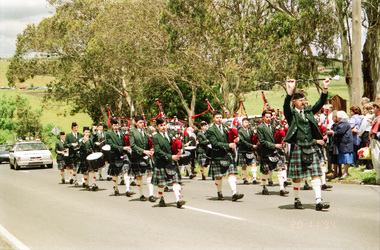 Eltham District Historical Society Inc
Photograph, Opening of Andrew Ross Museum, Kangaroo Ground, 20 Nov 1994, 20/11/1994
... tools. He proposed that this might present an opportunity to set up a museum with the Society's objects. It was proposed that a board be appointed containing representatives of the Society, the School Council, Shire of Eltham and "Friends of the Andrew Ross Museum." As a consequence, most of the Society's objects were transferred to the museum and the Society became more focused on documents, maps and photographs, etc. shire of eltham historical society Fuji 100 Roll of 35mm colour negative film, 3 strips Opening of Andrew Ross Museum, Kangaroo Ground, 20 Nov 1994 Photograph ...In 1992 Shire of Eltham Historical Society member and Kangaroo Ground resident, Bruce Ness became aware that the old school teacher residence at Kangaroo Ground School was no longer being used. Over the years Bruce had been storing a growing collection of the Society's artifacts and objects including various machinery and farm tools. He proposed that this might present an opportunity to set up a museum with the Society's objects. It was proposed that a board be appointed containing representatives of the Society, the School Council, Shire of Eltham and "Friends of the Andrew Ross Museum." As a consequence, most of the Society's objects were transferred to the museum and the Society became more focused on documents, maps and photographs, etc.Roll of 35mm colour negative film, 3 stripsFuji 100shire of eltham historical society -
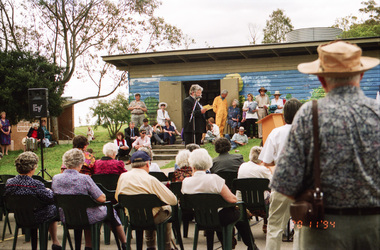 Eltham District Historical Society Inc
Photograph, Opening of Andrew Ross Museum, Kangaroo Ground, 20 Nov 1994, 20/11/1994
... tools. He proposed that this might present an opportunity to set up a museum with the Society's objects. It was proposed that a board be appointed containing representatives of the Society, the School Council, Shire of Eltham and "Friends of the Andrew Ross Museum." As a consequence, most of the Society's objects were transferred to the museum and the Society became more focused on documents, maps and photographs, etc. shire of eltham historical society Fuji 100 Roll of 35mm colour negative film, 3 strips Opening of Andrew Ross Museum, Kangaroo Ground, 20 Nov 1994 Photograph ...In 1992 Shire of Eltham Historical Society member and Kangaroo Ground resident, Bruce Ness became aware that the old school teacher residence at Kangaroo Ground School was no longer being used. Over the years Bruce had been storing a growing collection of the Society's artifacts and objects including various machinery and farm tools. He proposed that this might present an opportunity to set up a museum with the Society's objects. It was proposed that a board be appointed containing representatives of the Society, the School Council, Shire of Eltham and "Friends of the Andrew Ross Museum." As a consequence, most of the Society's objects were transferred to the museum and the Society became more focused on documents, maps and photographs, etc.Roll of 35mm colour negative film, 3 stripsFuji 100shire of eltham historical society -
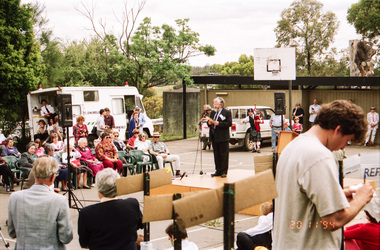 Eltham District Historical Society Inc
Photograph, Opening of Andrew Ross Museum, Kangaroo Ground, 20 Nov 1994, 20/11/1994
... tools. He proposed that this might present an opportunity to set up a museum with the Society's objects. It was proposed that a board be appointed containing representatives of the Society, the School Council, Shire of Eltham and "Friends of the Andrew Ross Museum." As a consequence, most of the Society's objects were transferred to the museum and the Society became more focused on documents, maps and photographs, etc. shire of eltham historical society Fuji 100 Roll of 35mm colour negative film, 3 strips Opening of Andrew Ross Museum, Kangaroo Ground, 20 Nov 1994 Photograph ...In 1992 Shire of Eltham Historical Society member and Kangaroo Ground resident, Bruce Ness became aware that the old school teacher residence at Kangaroo Ground School was no longer being used. Over the years Bruce had been storing a growing collection of the Society's artifacts and objects including various machinery and farm tools. He proposed that this might present an opportunity to set up a museum with the Society's objects. It was proposed that a board be appointed containing representatives of the Society, the School Council, Shire of Eltham and "Friends of the Andrew Ross Museum." As a consequence, most of the Society's objects were transferred to the museum and the Society became more focused on documents, maps and photographs, etc.Roll of 35mm colour negative film, 3 stripsFuji 100shire of eltham historical society -
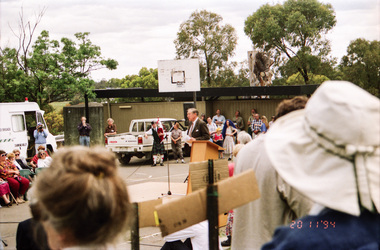 Eltham District Historical Society Inc
Photograph, Opening of Andrew Ross Museum, Kangaroo Ground, 20 Nov 1994, 20/11/1994
... tools. He proposed that this might present an opportunity to set up a museum with the Society's objects. It was proposed that a board be appointed containing representatives of the Society, the School Council, Shire of Eltham and "Friends of the Andrew Ross Museum." As a consequence, most of the Society's objects were transferred to the museum and the Society became more focused on documents, maps and photographs, etc. shire of eltham historical society Fuji 100 Roll of 35mm colour negative film, 3 strips Opening of Andrew Ross Museum, Kangaroo Ground, 20 Nov 1994 Photograph ...In 1992 Shire of Eltham Historical Society member and Kangaroo Ground resident, Bruce Ness became aware that the old school teacher residence at Kangaroo Ground School was no longer being used. Over the years Bruce had been storing a growing collection of the Society's artifacts and objects including various machinery and farm tools. He proposed that this might present an opportunity to set up a museum with the Society's objects. It was proposed that a board be appointed containing representatives of the Society, the School Council, Shire of Eltham and "Friends of the Andrew Ross Museum." As a consequence, most of the Society's objects were transferred to the museum and the Society became more focused on documents, maps and photographs, etc.Roll of 35mm colour negative film, 3 stripsFuji 100shire of eltham historical society -
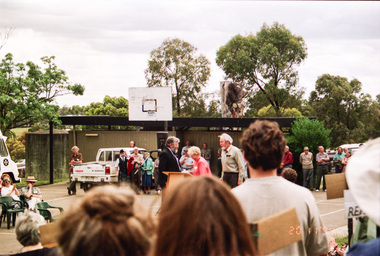 Eltham District Historical Society Inc
Photograph, Opening of Andrew Ross Museum, Kangaroo Ground, 20 Nov 1994, 20/11/1994
... tools. He proposed that this might present an opportunity to set up a museum with the Society's objects. It was proposed that a board be appointed containing representatives of the Society, the School Council, Shire of Eltham and "Friends of the Andrew Ross Museum." As a consequence, most of the Society's objects were transferred to the museum and the Society became more focused on documents, maps and photographs, etc. shire of eltham historical society Fuji 100 Roll of 35mm colour negative film, 3 strips Opening of Andrew Ross Museum, Kangaroo Ground, 20 Nov 1994 Photograph ...In 1992 Shire of Eltham Historical Society member and Kangaroo Ground resident, Bruce Ness became aware that the old school teacher residence at Kangaroo Ground School was no longer being used. Over the years Bruce had been storing a growing collection of the Society's artifacts and objects including various machinery and farm tools. He proposed that this might present an opportunity to set up a museum with the Society's objects. It was proposed that a board be appointed containing representatives of the Society, the School Council, Shire of Eltham and "Friends of the Andrew Ross Museum." As a consequence, most of the Society's objects were transferred to the museum and the Society became more focused on documents, maps and photographs, etc.Roll of 35mm colour negative film, 3 stripsFuji 100shire of eltham historical society -
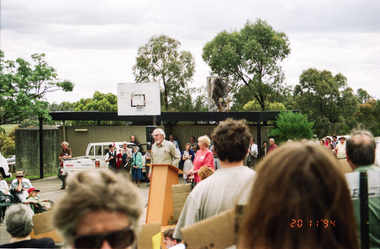 Eltham District Historical Society Inc
Photograph, Opening of Andrew Ross Museum, Kangaroo Ground, 20 Nov 1994, 20/11/1994
... tools. He proposed that this might present an opportunity to set up a museum with the Society's objects. It was proposed that a board be appointed containing representatives of the Society, the School Council, Shire of Eltham and "Friends of the Andrew Ross Museum." As a consequence, most of the Society's objects were transferred to the museum and the Society became more focused on documents, maps and photographs, etc. shire of eltham historical society Fuji 100 Roll of 35mm colour negative film, 3 strips Opening of Andrew Ross Museum, Kangaroo Ground, 20 Nov 1994 Photograph ...In 1992 Shire of Eltham Historical Society member and Kangaroo Ground resident, Bruce Ness became aware that the old school teacher residence at Kangaroo Ground School was no longer being used. Over the years Bruce had been storing a growing collection of the Society's artifacts and objects including various machinery and farm tools. He proposed that this might present an opportunity to set up a museum with the Society's objects. It was proposed that a board be appointed containing representatives of the Society, the School Council, Shire of Eltham and "Friends of the Andrew Ross Museum." As a consequence, most of the Society's objects were transferred to the museum and the Society became more focused on documents, maps and photographs, etc.Roll of 35mm colour negative film, 3 stripsFuji 100shire of eltham historical society -
 Eltham District Historical Society Inc
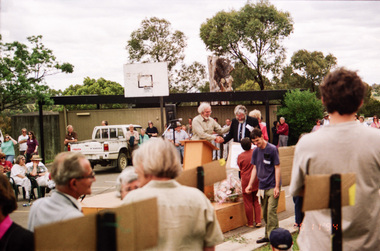
Photograph, Opening of Andrew Ross Museum, Kangaroo Ground, 20 Nov 1994, 20/11/1994
... tools. He proposed that this might present an opportunity to set up a museum with the Society's objects. It was proposed that a board be appointed containing representatives of the Society, the School Council, Shire of Eltham and "Friends of the Andrew Ross Museum." As a consequence, most of the Society's objects were transferred to the museum and the Society became more focused on documents, maps and photographs, etc. shire of eltham historical society Fuji 100 Roll of 35mm colour negative film, 3 strips Opening of Andrew Ross Museum, Kangaroo Ground, 20 Nov 1994 Photograph ...In 1992 Shire of Eltham Historical Society member and Kangaroo Ground resident, Bruce Ness became aware that the old school teacher residence at Kangaroo Ground School was no longer being used. Over the years Bruce had been storing a growing collection of the Society's artifacts and objects including various machinery and farm tools. He proposed that this might present an opportunity to set up a museum with the Society's objects. It was proposed that a board be appointed containing representatives of the Society, the School Council, Shire of Eltham and "Friends of the Andrew Ross Museum." As a consequence, most of the Society's objects were transferred to the museum and the Society became more focused on documents, maps and photographs, etc.Roll of 35mm colour negative film, 3 stripsFuji 100shire of eltham historical society -
 Eltham District Historical Society Inc
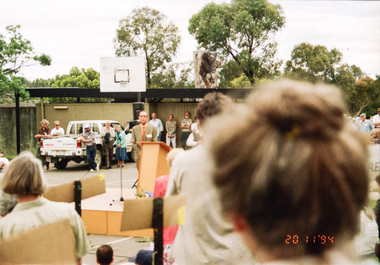
Photograph, Opening of Andrew Ross Museum, Kangaroo Ground, 20 Nov 1994, 20/11/1994
... tools. He proposed that this might present an opportunity to set up a museum with the Society's objects. It was proposed that a board be appointed containing representatives of the Society, the School Council, Shire of Eltham and "Friends of the Andrew Ross Museum." As a consequence, most of the Society's objects were transferred to the museum and the Society became more focused on documents, maps and photographs, etc. shire of eltham historical society Fuji 100 Roll of 35mm colour negative film, 3 strips Opening of Andrew Ross Museum, Kangaroo Ground, 20 Nov 1994 Photograph ...In 1992 Shire of Eltham Historical Society member and Kangaroo Ground resident, Bruce Ness became aware that the old school teacher residence at Kangaroo Ground School was no longer being used. Over the years Bruce had been storing a growing collection of the Society's artifacts and objects including various machinery and farm tools. He proposed that this might present an opportunity to set up a museum with the Society's objects. It was proposed that a board be appointed containing representatives of the Society, the School Council, Shire of Eltham and "Friends of the Andrew Ross Museum." As a consequence, most of the Society's objects were transferred to the museum and the Society became more focused on documents, maps and photographs, etc.Roll of 35mm colour negative film, 3 stripsFuji 100shire of eltham historical society -
 Kiewa Valley Historical Society
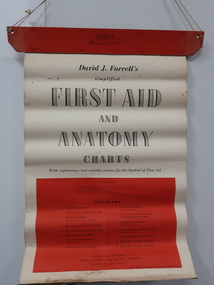
Roll of Charts - First Aid and Anatomy
... tool for the study of the human body. Prior to digital pictures - wall charts were used. Used as a teaching aid in the Kiewa Valley before digitisation First aid education anatomy wall charts health 15 sheets held together by red very thick cardboard with string for hanging attached. For educating people on the human body by displaying on the wall. Roll ...An educational tool for the study of the human body. Prior to digital pictures - wall charts were used.Used as a teaching aid in the Kiewa Valley before digitisation15 sheets held together by red very thick cardboard with string for hanging attached. For educating people on the human body by displaying on the wall.first aid, education, anatomy, wall charts, health -
 Eltham District Historical Society Inc
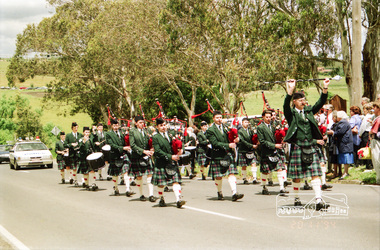
Photograph, Opening of Andrew Ross Museum, Kangaroo Ground, 20 Nov 1994, 20/11/1994
... tools. He proposed that this might present an opportunity to set up a museum with the Society's objects. It was proposed that a board be appointed containing representatives of the Society, the School Council, Shire of Eltham and "Friends of the Andrew Ross Museum." As a consequence, most of the Society's objects were transferred to the museum and the Society became more focused on documents, maps and photographs, etc. shire of eltham historical society Fuji 100 Roll of 35mm colour negative film, 3 strips Opening of Andrew Ross Museum, Kangaroo Ground, 20 Nov 1994 Photograph ...In 1992 Shire of Eltham Historical Society member and Kangaroo Ground resident, Bruce Ness became aware that the old school teacher residence at Kangaroo Ground School was no longer being used. Over the years Bruce had been storing a growing collection of the Society's artifacts and objects including various machinery and farm tools. He proposed that this might present an opportunity to set up a museum with the Society's objects. It was proposed that a board be appointed containing representatives of the Society, the School Council, Shire of Eltham and "Friends of the Andrew Ross Museum." As a consequence, most of the Society's objects were transferred to the museum and the Society became more focused on documents, maps and photographs, etc.Roll of 35mm colour negative film, 3 stripsFuji 100shire of eltham historical society -
 Bendigo Historical Society Inc.
Tool - PITTOCK COLLECTION: STEEL DRILL BITS FOR BRACE & BIT SET
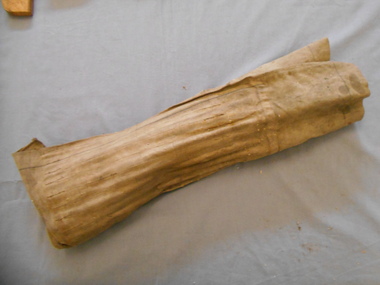
... nil Set of 22 various drill bits for a hand "Brace & Bit Set" in canvas rolled bag Sizes vary between5 to 50 mm Tool PITTOCK COLLECTION: STEEL DRILL BITS FOR BRACE & BIT SET ...Set of 22 various drill bits for a hand "Brace & Bit Set" in canvas rolled bag Sizes vary between5 to 50 mmnil -
 Coal Creek Community Park & Museum
Equipment - Pharmacist Pill Roller
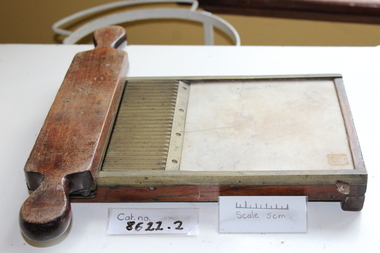
... tools used by pharmacists in the 18th and 19th centuries to handcraft pills. These devices typically consisted of wooden or metal plates with grooves and a matching roller. Pharmacists would mix powdered medications with binding agents, roll...tools used by pharmacists in the 18th and 19th centuries to handcraft pills. These devices typically consisted of wooden or metal plates with grooves and a matching roller. Pharmacists would mix powdered medications with binding agents, roll ...Pill rollers are fascinating historical tools used by pharmacists in the 18th and 19th centuries to handcraft pills. These devices typically consisted of wooden or metal plates with grooves and a matching roller. Pharmacists would mix powdered medications with binding agents, roll the mixture into uniform strands, and cut them into precise pill sizes. Pill rollers showcase the craftsmanship and ingenuity of early pharmaceutical practices, offering insight into the evolution of modern drug manufacturing techniques.- 6 - 12 - 18 - 24
