
Showing 49 items matching "training exercises."
-
 Bendigo Military Museum
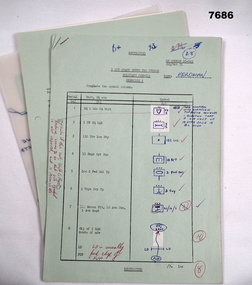
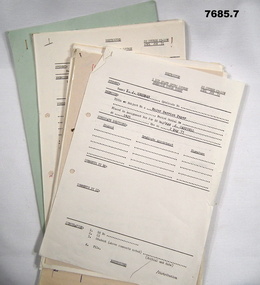
Document - TRAINING EXERCISES, WRITTEN, ARMY
... TRAINING EXERCISES, WRITTEN, ARMY...3rd Division Officers Training Course - Military Symbols - Exercises 1-4. Dates: 1971 and 1972....Pages have two holes punched on LHS for inclusion in a ring binder. Document TRAINING EXERCISES, WRITTEN, ARMY ...3rd Division Officers Training Course - Military Symbols - Exercises 1-4. Dates: 1971 and 1972.Collection of four multipage documents on green and cream coloured paper. Printing on one side of each page in black type. handwritten answers and anecdotes in blue and red ink. Pages have two holes punched on LHS for inclusion in a ring binder.Various handwritten anecdotes on paper in blue and red ink.military symbols, officer training, army, kevin john herdman -
 National Vietnam Veterans Museum (NVVM)
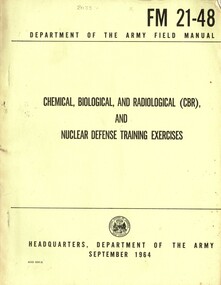
Booklet, Department of the Army Field Manual; Chemical, Biological, and Radiological (CBR) and Nuclear Defense Training Exercises, 1964
... Department of the Army Field Manual; Chemical, Biological, and Radiological (CBR) and Nuclear Defense Training Exercises...At the bottom of the cover under a black line reads Headquaters, Department of the Army September 1964 Department of the Army Field Manual; Chemical, Biological, and Radiological (CBR) and Nuclear Defense Training Exercises Booklet United States Army ...A cream coloured cover with black writing on it. Top right hand corner in larger print is FM 21-48. Under this reads Department of the Army Field Manual. At the bottom of the cover under a black line reads Headquaters, Department of the Army September 1964united states - armed forces - service manuals, chemicals, biological, rodiological, nuclear defense training -
 National Vietnam Veterans Museum (NVVM)
Booklet, Chemical, biological & radiological (CBR) and nuclear defense training exercises, 1964
... Chemical, biological & radiological (CBR) and nuclear defense training exercises...United States - Armed Forces - Service manuals Chemical, biological & radiological (CBR) and nuclear defense training exercises Booklet Booklet United States Army ...united states - armed forces - service manuals -
 4th/19th Prince of Wales's Light Horse Regiment Unit History Room
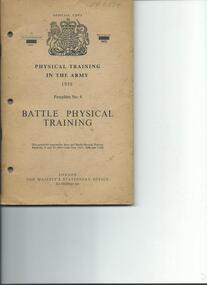
Booklet, Battle Physical Training Pamphlet No 4, 1958, 1958
... Contains line drawings of various individual and team training exercises and lessons...Contains line drawings of various individual and team training exercises and lessons Battle Physical Training Pamphlet No 4, 1958 Booklet Blake & Mackenzie Ltd ...Soft covered booklet on physical training in the Army. Contains line drawings of various individual and team training exercises and lessonsWO Code No 9470physical training army -
 Bendigo Military Museum
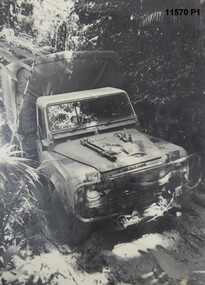
Photograph - PHOTOGRAPH, ARMY LANDROVERS, Unknown
... ...Training Exercises....Passchendaele Barracks Trust PBT 0 Photographs Land Rovers Training Exercises. 3. "Land rover One Ten 4 x 4". ...Black and white photographs. 1. Land Rover with tarped rear tray. 2. Land Rover Driving through water way. 3. Land Rover parked on sandy area.3. "Land rover One Ten 4 x 4".passchendaele barracks trust, pbt 0, photographs, land rovers, training exercises. -
 Bendigo Military Museum
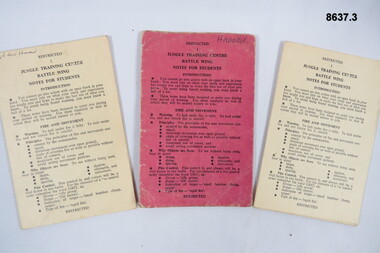
Manual - JUNGLE TRAINING CENTRE, Australian Armed Forces - Jungle Training Centre, Unknown
... Small pocket size instructional aid for the use during training exercises. 1. Battle Wing notes for students in training. 2. ...Small pocket size instructional aid for the use during training exercises. 1. Battle Wing notes for students in training. 2. ...Small pocket size instructional aid for the use during training exercises. 1. Battle Wing notes for students in training. 2. As above. Pink in colour. 3. As above.1. Nil, 2. HADDEN, 3. Sgt Ian Hadden.passchendaele barracks trust, training manuals, students, jungle -
 8th/13th Victorian Mounted Rifles Regimental Collection
Photograph
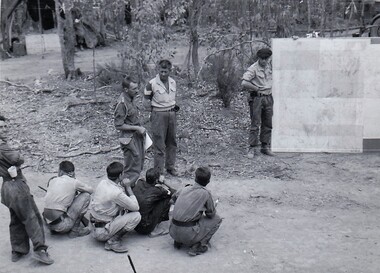
... This procedure was practiced by 8/13 Victorian Mounted Rifles during training exercises....This procedure was practiced by 8/13 Victorian Mounted Rifles during training exercises. Black and white photograph of an Officers orders group ( O Group ).. ...O Groups were an essential element in battle procedure. This procedure was practiced by 8/13 Victorian Mounted Rifles during training exercises.Black and white photograph of an Officers orders group ( O Group ).. Captain Jim Greathead standing centre with Sergeant Lou Madjeric at his left hand and Lieutenant Ian Docking at mapboard. Section commander squatting and taking notes. -
Moorabbin Air Museum
Manual - Aviation training, Flight Training Guide
... Flight training syllabus...Air exercises...Aviation training Flight training syllabus Air exercises Training briefings for student pilots, circa 1979. 2 copies. x 2 copies Flight Training Guide Manual Aviation training ...Training briefings for student pilots, circa 1979. 2 copies.x 2 copiesnon-fictionTraining briefings for student pilots, circa 1979. 2 copies. flight training syllabus, air exercises -
![Vehicle - HMAS Lonsdale [HMVS], Built in 1884](/media/collectors/4f729f7e97f83e03086018d1/items/4fd575aa2162ef0ecc023165/item-media/613b16c26b487cd5e2ab7cba/item-fit-380x285.jpg?cb=6) Queenscliffe Maritime Museum
Queenscliffe Maritime MuseumVehicle - HMAS Lonsdale [HMVS], Built in 1884
... This vessel was ordered by Government of Victoria and was only used in training exercises in Port Philip and had become outmoded by the time the Royal Australian Navy was formed in 1911....This vessel was ordered by Government of Victoria and was only used in training exercises in Port Philip and had become outmoded by the time the Royal Australian Navy was formed in 1911. ...Transported to Victoria as deck cargo aboard s.s. Port Darwin. This vessel was ordered by Government of Victoria and was only used in training exercises in Port Philip and had become outmoded by the time the Royal Australian Navy was formed in 1911.Buried by sand in the grounds of the Queenscliffe Maritime Museum. There is no known record of how the "Lonsdale" ended abandoned on the beach at Queenscliff. Originally the land where the QMM is situated was the foreshore at the back of the houses in Beach Street, Queenscliff. There were two Torpedo boats built in 1884, the Lonsdale and the Nepean.Site of the buried remains of the Torpedo Boat HMAS Lonsdale [HMVS]hmas lonsdale, hmvs lonsdale, victorian navy, port phillip, royal australian navy -
 Creswick Campus Historical Collection - University of Melbourne
Instrument - Abney level - Clinometer, Abney level - A.E. Parsons Melbourne
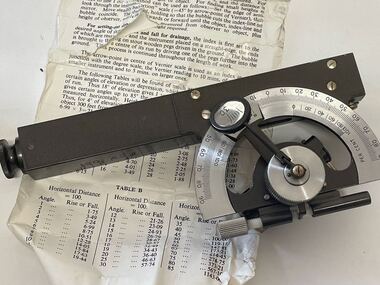
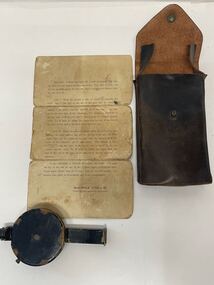
... Training Forest mensuration exercises...Training Forest mensuration exercises A.E.Parsons Melbourne. ...Training Forest mensuration exercisesAn Abney level and clinometer is an instrument used in surveying which consists of a fixed sighting tube, a movable spirit level that is connected to a pointing arm, and a protractor scale. An internal mirror allows the user to see the bubble in the level while sighting a distant target.A.E.Parsons Melbourne. FCV 051 -
 Creswick Campus Historical Collection - University of Melbourne
Instrument - Abney level - Clinometer, Abney level - E.R Watts & Sons Ltd
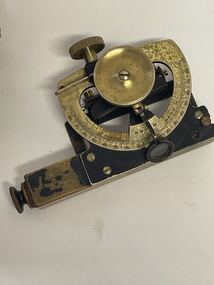
... Training Forest mensuration exercises...Training Forest mensuration exercises E.R. Watts & Sons, Ltd. ...Training Forest mensuration exercisesAn Abney level and clinometer is an instrument used in surveying which consists of a fixed sighting tube, a movable spirit level that is connected to a pointing arm, and a protractor scale. An internal mirror allows the user to see the bubble in the level while sighting a distant target.E.R. Watts & Sons, Ltd. No. 39931 -
 Creswick Campus Historical Collection - University of Melbourne
Instrument - Abney level - Clinometer, Abney level - Max Wolz
... Training Forest mensuration exercises...Training Forest mensuration exercises Max Wolz, Bonn. Surveying and engineering instruments An Abney level and clinometer is an instrument used in surveying which consists of a fixed sighting tube, a movable spirit level that is connected to a pointing arm, and a protractor scale. ...Training Forest mensuration exercisesAn Abney level and clinometer is an instrument used in surveying which consists of a fixed sighting tube, a movable spirit level that is connected to a pointing arm, and a protractor scale. An internal mirror allows the user to see the bubble in the level while sighting a distant target.Max Wolz, Bonn. Surveying and engineering instruments -
 Melbourne Legacy
Photograph - Junior legatee outing, Horse riding, 1990
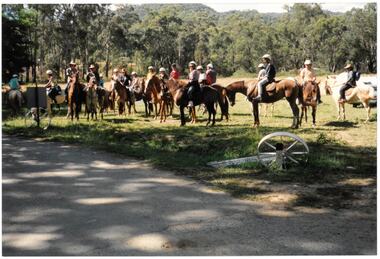
... The caption in the report says: 'Youth activities including horse riding, snow skiing, sailing and adventure training exercises are regularly arranged by Legatees.'...The caption in the report says: 'Youth activities including horse riding, snow skiing, sailing and adventure training exercises are regularly arranged by Legatees.' ...A photo of gathering junior Legatees on horse back (same roll of film as hike). Names unknown. The photo was used in the Highlights from 67th Annual Report in 1990 so we assume the date was 1990. The caption in the report says: 'Youth activities including horse riding, snow skiing, sailing and adventure training exercises are regularly arranged by Legatees.'A record of the one of the outings provided for Junior Legatees.Colour photo of youths on horses.junior legatee outing, junior legatee -
 8th/13th Victorian Mounted Rifles Regimental Collection
Photograph - TST
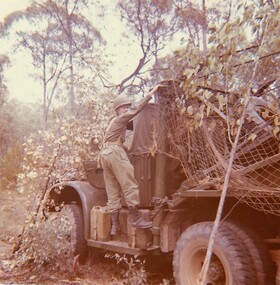
... 8/13 VMR conducted numerous weekend training exercises in Chiltern Forest, Victoria.The 8th/13th Victorian Mounted Rifles was raised as a regiment of the Royal Australian Armoured Corps on 1 May 1948 with Headquarters in Melbourne and squadrons in Sale, Benalla/Wangaratta and Albury. ...8/13 VMR conducted numerous weekend training exercises in Chiltern Forest, Victoria.The 8th/13th Victorian Mounted Rifles was raised as a regiment of the Royal Australian Armoured Corps on 1 May 1948 with Headquarters in Melbourne and squadrons in Sale, Benalla/Wangaratta and Albury. ...8/13 VMR conducted numerous weekend training exercises in Chiltern Forest, Victoria.The 8th/13th Victorian Mounted Rifles was raised as a regiment of the Royal Australian Armoured Corps on 1 May 1948 with Headquarters in Melbourne and squadrons in Sale, Benalla/Wangaratta and Albury. In 1955 Regimental Headquarters moved to Wangaratta and a second squadron was located at Albury. The Sale squadron transferred to 4th/19th Prince of Wales’s Light Horse. In 1977 8/13 VMR Regiment was reduced to an independent squadron A Squadron 8th/13th Victorian Mounted Rifles and in 1991 was linked with 4th/19th Prince of Wales’s Light Horse forming the VMR Squadron of that regiment.Coloured photograph of vehicle of 8/13 VMR Technical Support Troop ( RAEME) camouflaged on exercise in Chiltern Forest. Standing on running board is Craftsman Ben Niuwerth.vmr, military, training, chiltern -
 Warrnambool and District Historical Society Inc.
Album - Family photo album, Photograph album, Circa 1954
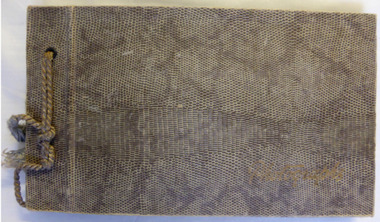
... There are photos of soldiers in parade drills and in training exercises as well as social events. One is labelled D Craven & Rab, Munster 1954. ...There are photos of soldiers in parade drills and in training exercises as well as social events. One is labelled D Craven & Rab, Munster 1954. ...This album shows a collection of photographs some of which are labelled as Munster Services Club. Some show the Bookshop at the TOC H building. There are photos of soldiers in parade drills and in training exercises as well as social events. One is labelled D Craven & Rab, Munster 1954. Another is labelled London bus 2 RTR Munster. The 2 RTR was a tank regiment in the British Army and was stationed at the Swinton Barracks in Munster from 1952-1959. There are also a number of loose photos showing local scenes such as London Bridge and Needle Rock at Childers Cove. Others depict floats in a parade showing Peace Woollen Mill. Others are small postcards of MaryBorough and Brisbane Queensland. There is also a photograph of the Nestanglo basketball team, Victorian champions circa 1940’s. This collection of photographs has limited local relevance as there is limited provenance. However it depicts quite well the activities of the RTR and their activities in Munster in the post WW era.Brown and fawn snake skin patterned card cover with fawn cord binding. Photographs written in gold on front cover. Pages are brown card. Photographs are black and white.Munster Services Club.warrnambool, swinton barracks munster, munster services club 1952-1959, 2rtr munster -
 8th/13th Victorian Mounted Rifles Regimental Collection
Photograph
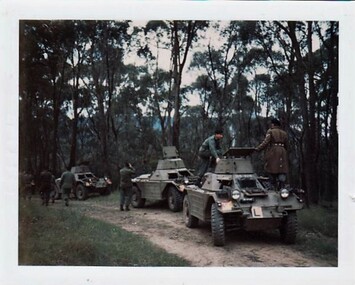
... Weekend training so as to have trained crewmen available for tactical training at Annual Exercises....Weekend training so as to have trained crewmen available for tactical training at Annual Exercises. Collection of photographs showing an armoured regiment of the Citizen Forces in the 1960s as it transitioned from wheeled armoured vehicles to tanks to M113 armoured personal carriers. " Ferret Driving Course around Granya ( Victoria ) area. ...In 1965, 8th/`3th Victorian Mounted Rifles was equipped with wheeled armoured vehicles and undertook its own driver instruction training. Weekend training so as to have trained crewmen available for tactical training at Annual Exercises.Collection of photographs showing an armoured regiment of the Citizen Forces in the 1960s as it transitioned from wheeled armoured vehicles to tanks to M113 armoured personal carriers.Coloured photograph of three Ferret Scout Cars on bush road. Vehicles have " L " plates displayed." Ferret Driving Course around Granya ( Victoria ) area. Cpl. Halliday in overcoat. " -
 Flagstaff Hill Maritime Museum and Village
Book - Instruction Manual, British War Office, Manual of Siege and Garrison Artillery Exercises Vol 1, ca 24-06-1882
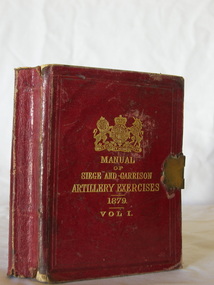
... exercises...military training...Flagstaff Hill Flagstaff Hill Maritime Museum and Village Warrnambool Maritime Museum Maritime Village Great Ocean Road Shipwreck Coast training manual book British garrison garrison artillery siege exercises British Government training book technical book pocket book Manual of Siege and Garrison Artillery Exercises Vol 1 garrison exercises military training defense training British Artillery Royal Artillery Gunnery Gun Drill brass book lock British War Office locking clip reference book Manual of Siege and Garrison Artillery Exercises Vol 1 [Parts I, II, III, IV] Publisher Her Majestys Stationery Office Date 1879, Corrected June 24th 1882 Small, red, hard-cover book with embossed gold letters and British Coat of Arms on the front. ...This little book has been designed to fit into a small space such as a pocket, backpack or trunk. The brass book lock helps keep the pages and covers together, preserving them from being bent, torn or damaged in handling.The book includes four of ten parts of the Manual, published for use in training the garrison troops, including the placement and firing of cannon. The four parts included in this Volume I are: - Part 1 - Gunnery Part 2 - Ammunition Part 3 - Siege Artillery Part 4 - Garrison Gun Drills The remaining six of then parts are: - Part 5 - Material and Appliances Part 6 - Elementary Instruction Part 7 - Machines Part 8 - Mounting and Dismounting Ordnance Part 9 - Sleighs Part 10 - Sheers and DerricksThe book is significant to both British and Australian history, being issued for the training of the garrison defense of both countries in the late 10th Century. It is also significant for its connection with other historical military items within the Collection at Flagstaff Hill Maritime Museum and Village.Manual of Siege and Garrison Artillery Exercises Vol 1 [Parts I, II, III, IV] Publisher Her Majestys Stationery Office Date 1879, Corrected June 24th 1882 Small, red, hard-cover book with embossed gold letters and British Coat of Arms on the front. The book has a brass closure or locking clip across the text block. There are diagrams and a foldout table within the text. flagstaff hill, flagstaff hill maritime museum and village, warrnambool, maritime museum, maritime village, great ocean road, shipwreck coast, training manual, book, british garrison, garrison artillery, siege exercises, british government training book, technical book, pocket book, manual of siege and garrison artillery exercises vol 1, garrison exercises, military training, defense training, british artillery, royal artillery, gunnery, gun drill, brass book lock, british war office, locking clip, reference book -
 Lara RSL Sub Branch
Photograph, Set 4 photographs. and others for Torquay Light Horse camp, 1940
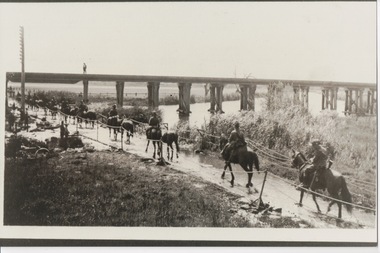
... Light Horse, Training Camp, Torquay, WW2 Tent city By the end of January 1940 the camp at Torquay accommodated some 5000 men and 2500 horses of the Second Cavalry Division. The rows of horses, tents and huts near Blackgate Road were quite a sight. While the cavalrymen engaged in exercises...Light Horse, Training Camp, Torquay, WW2 Tent city By the end of January 1940 the camp at Torquay accommodated some 5000 men and 2500 horses of the Second Cavalry Division. The rows of horses, tents and huts near Blackgate Road were quite a sight. While the cavalrymen engaged in exercises ...These images capture for all time Light Horsemen travelling through Geelong on their way to camp at Torquay for the last Group meeting in Australia . information following - details obtained from .........https://torquayhistory.com/light-horse-brigade/ On Australia Day, 1997, Sir John Young unveiled this plaque on Point Danger, Torquay. Torquay history, Light Horse Training Camp, WW2 Plaque at Pt. Danger Note----- (See images to view plaque) The plaque identifies a significant event in Torquay’s history and the sentiments of ‘change’ for the Light Horse Brigade – from horses to machines. In 1940 the four Light Horse Regiments (4th, 8th, 13th and 20th), some 5000 Light Horse and 2000 horses camped and trained at Torquay. Three other regiments, formerly mounted on horses, were also at Torquay ‘mounted’ on privately owned trucks and cars. Division troops included Artillery, Engineers, Signals, Field Ambulance and other branches of the Army necessary to enable a Division to function. It wasn’t just the sheer numbers of men coming to this little town that made the event significant, it was also the fact that the men of the Light Horse were dramatic, almost glamorous figures and it is easy to see their exploits as some splendid adventure. Horses have played a special role in the story of Australia. They were the only means of transport across this huge country, so it was necessary for everyone to have the ability to ride a horse. When war broke out in 1899 between Britain and the Boers of South Africa (“Boer” was Dutch for “farmer”) Australia sent troops to fight. At first Britain was wary of using untried, unprofessional colonial cavalrymen but soon saw that the slouch-hatted Australian “bushmen” were a match for the fast-moving and unconventional mounted commandos of the Boers. The Australians proved themselves to be expert rough-riding horsemen and good shots. Bush life had hardened them to go for long periods with little food and water. They also showed remarkable ability to find their way in a strange country and use its features for cover, in both attack and defence. By 1914, when Australia joined the war against Germany, there were 23 Light Horse regiments of militia volunteers. Many men from these units joined the Light Horse regiments of the Australian Imperial Force (AIF). Men were given remounts (if not using their own horses) – army horses bought by Commonwealth purchasing officers from graziers and breeders. These were called “walers” because they were a New South Wales stockhorse type – strong, great-hearted animals with the strains of the thoroughbred and semi-draught to give them speed, strength and stamina. On 1st November, 1914, Australia’s First Infantry Division and the first four Light Horse regiments sailed for England in a fleet of transport ships. The first of the Light Horse arrived at Gallipoli in May without their horses. Back with their horses after Gallipoli, they were formidable combatants across the Sinai and Palestine. Some British commanders observed that the light horseman moved with a “lazy, slouching gait, like that of a sleepy tiger” but described how the promise of battle “changes that careless gait, into a live athletic swing that takes him over the ground much quicker than other troops”. They had Light Horse, Torquay, training campdeveloped a reputation as formidable infantrymen. The Turks called them “the White Ghurkas” – a reference to their deadly skill with the bayonet. The Arabs called them “The Kings of the Feathers”. The plume had originally been a battle honour of the Queensland Mounted Infantry for their work in the shearer’s strike of 1891. During WW1 it was adopted by almost all the Light Horse Regiments. It was the proud badge of the light horseman. The most famous of their battles was the attack on Beersheba- the charge of the 4th Light Horse Brigade. Mounted infantrymen and their superb walers had carried out one of the most successful cavalry charges in history – against what seemed impossible odds. They surprised the Turks by charging cavalry-style, when they would normally have ridden close to an objective then dismounted to fight. The fall of Beersheba swung the battle tide against the Turks in Palestine; and changed the history of the Middle East. While 19 men from the Surf Coast Shire served with the 4th Light Horse over the course of WW1, only four were involved in the charge of Beersheba- John GAYLARD, Philip QUINN.(Winchelsea); Wallace FINDLAY (Anglesea); Harry TRIGG (Bambra). After the war, Light Horse units played a key role in the Australian Government’s compulsory military training programme. The Citizen Military Forces (C.M.F.) thrived on the glamour of the wartime Light Horse tradition, ignoring the possibility that motor vehicles would soon replace the horses. When training was no longer compulsory, the C.M.F. regiments declined and horses became more of a luxury during the 1930s depression years of poverty and unemployment. Some regiments were motorised. Then, in 1939, Australia joined Britain in another world war. Training was increased for the militia at both home bases and regional training camps. The camp at Torquay in 1940, commanded by Major General Rankin, was at Divisional strength. By the end of the camp some felt that the Division was ready for active service. Gradually, over the next four years, the Australian Light Horse units were mounted on wheels and tracks and the horses were retired. Six men enlisted at the Torquay camp and another 57 men and women enlisted at Torquay for service in WW2. Those who served in the Militia provided valuable Officers and NCOs and men for the armed services during the war. Each infantry division of the 2nd AIF had a Light Horse regiment attached to it. But the day of the Australian mounted soldier hadn’t quite passed. During World War II, Australia’s 6th Cavalry Regiment formed a mounted unit they called “The Kelly Gang” which did valuable scouting work. In New Guinea, a mounted Light Horse Troop did patrol duty and helped carry supplies. Some fully equipped walers were flown into Borneo for reconnaissance in rugged mountain country. But by the end of the war, in 1945, the horse had disappeared from the Australian Army. References: Australian Light Horse Association www.lighthorse.org.au National Australia Archives Australian War Memorial Surf Coast Shire WW1 memorials www.togethertheyserved.com The Light horse- a Cavalry under Canvas Light Horse, Training Camp, Torquay, WW2 Late in 1939 it was decided to set up a Lighthorse training camp in Torquay to train both men and horses for the battles of the Second World War. Horses, men and equipment came on special trains from all over Victoria and NSW, and as you would expect horseman came from areas such as Omeo and Sale, the Wimmera and the Western District. They arrived at the Geelong racecourse for watering in the Barwon River and then were ridden across the ford at the breakwater and began their 11 mile trek to Torquay. Light Horse, Training Camp, Torquay, WW2 Tent city By the end of January 1940 the camp at Torquay accommodated some 5000 men and 2500 horses of the Second Cavalry Division. The rows of horses, tents and huts near Blackgate Road were quite a sight. While the cavalrymen engaged in exercises on the land and on the beaches, many of the troops took over the Torquay School for special training of men and officers. Mr Bob Pettit local farmer and Councillor for the Barrabool Shire, wrote about the Light horse in the Surf Coast Community News in 1985 saying “They used to travel about the district riding four abreast in one long convoy. To my annoyance they went through my property and shut all the gates behind them. I had certain gates open to let stock in to the water holes and it would take me three -quarters of an hour to follow the horsemen up and put all the gates right again” he continued “the men from the Light Horse were here when the fire went through in March 1940. He recalled an incident when early one morning, as some one blew the bugle, a soldier putting a white sheet on the line frightened the horses. They panicked and ran off in all directions. Six went over the cliff near Bird Rock, five were never found, and the rest were gathered up after nearly a fortnight in the bush around Addiscott and Anglesea" Light Horse, Training Camp, Torquay, WW2, Geelong Parade Geelong parade The training camp culminated in a parade through the streets of Geelong on March 12th 1940. The salute was given at the Town Hall and the troops continued on a route to the You Yang’s for a training exercise. Note-----(see media section for photograph) The Camp was abandoned in mid 1940 as it was deemed unsuitable for training during winter and the cost of a permanent camp could not be justified if it could not be used all year. Historic.......Rare,,,Interpretive.Sepia photographs.set of four ....post card size ....Horses &LighthorsemenNo 1, Lighthorsemen Regiment Geelong 1940......No 2 Light Horse at Breakwater Geelong 1938 to 1940....No 3 Light Horse at Breakwater Geelong 1938 to 1940.....No 4 Light Horse crossing Breakwater camped at Geelong Showgrounds. These markings are on reverse of photographs.light horsemengeelong 1940., world war 2 -
 Bendigo Military Museum
Manual - LAND WARFARE, DRILL, ARMY, HEADQUARTERS TRAINING COMMAND, 3 May 1979
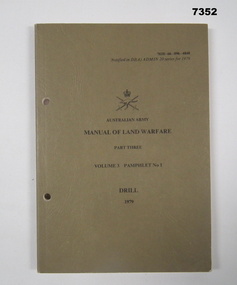
... exercises at the halt and on the march. 6. Rifle drill for funerals. 7. Pistol drill - 9mm Browning. 8. Sentry Drill. 9. Quarter guards and sentries. 10. Sword Drill. 11. Drill with the cane. 12. Drill with the pace stick. 12. Unit drill - platoon drill. 14. Unit Drill - Company drill. 15. Unit drill - non-ceremonial. Plus list of illustrations, figures and tables. Part of the collection of KEVIN JOHN HERDMAN, No. 397661. See Cat. No. 5942P for details of his service record. Drill movements Australian Army Training ...Manual consists of fiteen chapters related to drill movements. 1. Information for the Instructor. 2. Squad drill without arms - at the halt. 3. Marching. 4. Marching in line and changing direction and formation. 5. Rifle exercises at the halt and on the march. 6. Rifle drill for funerals. 7. Pistol drill - 9mm Browning. 8. Sentry Drill. 9. Quarter guards and sentries. 10. Sword Drill. 11. Drill with the cane. 12. Drill with the pace stick. 12. Unit drill - platoon drill. 14. Unit Drill - Company drill. 15. Unit drill - non-ceremonial. Plus list of illustrations, figures and tables. Part of the collection of KEVIN JOHN HERDMAN, No. 397661. See Cat. No. 5942P for details of his service record.Khaki coloured, textured soft covered manual with two punched holes for attaching to a ring binder. Title on front, cover in black type. Army logo in black. Pages are white in colour with black type. Black and white photographs and diagrams. Fifteen chapters. Pages glued to spine.drill movements, australian army, training manual, kevin john herdman -
 Bendigo Military Museum
Document - TRAINING NOTES, ARMY
... Documents consist of question and answer exercises related to Officer training - 3rd Division Staff Officers Courses. ...Documents consist of question and answer exercises related to Officer training - 3rd Division Staff Officers Courses. date range: May 1970 and June 1972. ...Documents consist of question and answer exercises related to Officer training - 3rd Division Staff Officers Courses. date range: May 1970 and June 1972.Collection of printed and handwritten documents on foolscap and A4 paper. Text on printed documents is in black type. Handwritten text in red and blue ink. Document stapled on top LHC. Holes punched along LHS for inclusion in a ring binder.Various handwritten comments in black and red ink and pencil.training notes, army, kevin john herdman -
 Bendigo Military Museum
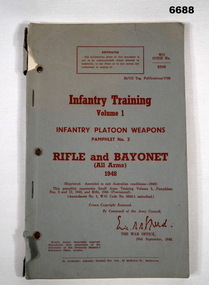
Manual - INFANTRY TRAINING - VOL 1 RIFLE AND BAYONET 1948, British War Office, 29 Sep 1948
... training .303 rifle Inside front cover is written 333T-1. This book has a grey cardboard cover. Printing is in red ink. It has phrase WO Code No.8368 top right corner. It has 3 holes on left side and is fastened with two staples. The book has 123 pages of text, photos and drawings. It covers subjects of aiming and shooting, bayonet drills, exercises ...This book has a grey cardboard cover. Printing is in red ink. It has phrase WO Code No.8368 top right corner. It has 3 holes on left side and is fastened with two staples. The book has 123 pages of text, photos and drawings. It covers subjects of aiming and shooting, bayonet drills, exercises and cleaning.Inside front cover is written 333T-1.passchendaele barracks trust, infantry training, .303 rifle -
4th/19th Prince of Wales's Light Horse Regiment Unit History Room
Order of Ceremony, The Royal Australian Amored (sic) Corps the Keeffe Family & Eoghan McDonald Celebrates (sic) the Unveiling of a Commemorative Plaque 16 November 2014, 2014
... C Squadron's training program involved a night driving exercise where a column of armoured and B vehicles would depart camp at 0245 hours and proceed to a site to the East of Seymour and set up a bivouac between Whiteheads Creek and Highlands Road. Numerous army camps surrounded the Seymour area; and much of the surrounding farm land had been acquired for military purposes. By November 1942 exercises...C Squadron's training program involved a night driving exercise where a column of armoured and B vehicles would depart camp at 0245 hours and proceed to a site to the East of Seymour and set up a bivouac between Whiteheads Creek and Highlands Road. Numerous army camps surrounded the Seymour area; and much of the surrounding farm land had been acquired for military purposes. By November 1942 exercises ...The 13th Australian Armoured Regiment was a Gippsland militia unit that had been called up for full time duty in December 1941 as a traditional light horse regiment. The early months of 1942 had seen the regiment lose its horses, a conversion to a motor regiment and finally to an armoured regiment in May. During this period there were considerable changes in personnel, however the regiment maintained its strong links to Gippsland and its former identity. Between May and November 1942, individual soldiers had become proficient in their trade training and the regiment changed its focus to troop and squadron activities. On 16 November 1942, the unit was located at the Puckapunyal Army Camp. C Squadron's training program involved a night driving exercise where a column of armoured and B vehicles would depart camp at 0245 hours and proceed to a site to the East of Seymour and set up a bivouac between Whiteheads Creek and Highlands Road. Numerous army camps surrounded the Seymour area; and much of the surrounding farm land had been acquired for military purposes. By November 1942 exercises such as C Squadron's were commonplace and had been repeated on numerous occasions since 1939. At 0400 hrs, C Squadron's vehicles reached O'Sullivan's Paddock on the Kobyboyn Road; prior to reaching the Old Telegraph Road the column turned to the North towards a known crossing point on Whiteheads Creek. The column consisted of seven M3 Medium Tanks and four Universal Carriers. In the case of Corporal McLeod's vehicle, there were seven crewmen rather than the usual five man crew. On arrival at the creek crossing, Captain C.M.I. 'Sandy' Pearson dismounted and with the assistance of Sergeant R.J. Ball began to guide individual tanks across the creek. Four tanks had crossed the creek without difficulty when Corporal McLeod's tank, ARN 24652, began its descent. Captain Pearson stated at the Coroner's Inquiry in December 1942, "Whilst climbing out of the ford the vehicle swerved to the left, apparently striking the tree. It was not the portion of the tank (front) that struck the tree. The tank straightened and appeared to be well under control, suddenly the bank on the left collapsed to the extent of 3ft by 12ft by15ft long causing the vehicle to slide into the creek and turn upside down." Captain Pearson and Sergeant Ball were faced with a nightmarish situation: The Grant had come to rest upside down in soft mud, six crew members were unaccounted for, escape hatches could not be opened and the weight of the tank was settling deeper into the water and mud. Compounding the problem was that the location of the tank did not allow for the other tanks to safely conduct a recovery. It was truly the darkest night.Single A4 card. folded, Contains an account of the raising of 13 Armoured Regiment in December 1941and a tank accident during a night creek crossing in which six crewmen were killed, and, Order of Ceremony for plaque unveiling, Guest of Honour LtCol Stuart Cree CO/CI School of Armour13 armored regiment, tank accident, puckapunyal -
4th/19th Prince of Wales's Light Horse Regiment Unit History Room
Booklet, Queen City Printers, Shoot to Kill. Part X Basic and battle physical training 1944, 1944
... Rifle training Soft covered booklet describing physical exercises with the rifle to enable a soldier to acquire complete mastery over his weapon Shoot to Kill. ...Soft covered booklet describing physical exercises with the rifle to enable a soldier to acquire complete mastery over his weaponrifle training -
4th/19th Prince of Wales's Light Horse Regiment Unit History Room
Booklet, B & M Ltd, Infantry Training Vol 1 Infantry Platoon Weapons Pam 11 Trained Soldiers Exercises in Handling Weapons, 1955
... Infantry Training Vol 1 Infantry Platoon Weapons Pam 11 Trained Soldiers Exercises in Handling Weapons...Infantry weapons training WO Code No 8930 Adhesive label: "Sgt P W A Fernleigh" A soft covered booklet with suggestions for sub-unit commanders in ways of exercising their trained soldiers in the handling of infantry weapons Infantry Training Vol 1 Infantry Platoon Weapons Pam 11 Trained Soldiers Exercises in Handling Weapons Booklet B & M Ltd ...A soft covered booklet with suggestions for sub-unit commanders in ways of exercising their trained soldiers in the handling of infantry weaponsWO Code No 8930 Adhesive label: "Sgt P W A Fernleigh"infantry weapons training -
 Bendigo Military Museum
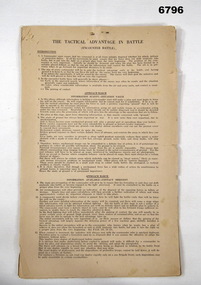
Manual - TACTICAL TRAINING ADVANTAGE, Unknown
... Training Manual Lt. Col. Swatton. Titled "The Tactical Advantage of Battle". 20 page booklet, loose leaf attached with a pin. Faded yellow paper with contents outlining approach when encountering battle, tactical admin within the Brigade, ammunition systems and noted on conduct of Tactical exercises. ...Training Manual aimed at senior officers to outline practices and procedures in relation to the tactical advantage in battle. Items in the collection re "Lt. Col. Swatton", refer Cat No 6719.2P for his service details. 20 page booklet, loose leaf attached with a pin. Faded yellow paper with contents outlining approach when encountering battle, tactical admin within the Brigade, ammunition systems and noted on conduct of Tactical exercises. Also on battle procedure.Titled "The Tactical Advantage of Battle".passchendaele barracks trust, training manual, lt. col. swatton. -
 National Vietnam Veterans Museum (NVVM)
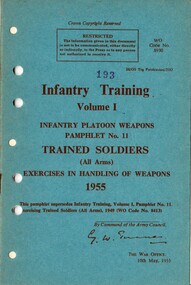
Booklet, Australian Army, Infantry Training Volume 1, Infantry Platoon Weapons Pamphlet No.11, Trained Soldiers (All Arms) Exercises in Handling of Weapons 1955 (Copy 1)
... Infantry Training Volume 1, Infantry Platoon Weapons Pamphlet No.11, Trained Soldiers (All Arms) Exercises in Handling of Weapons 1955 (Copy 1)...Infantry Training Volume 1, Infantry Platoon Weapons Pamphlet No.11, Trained Soldiers (All Arms) Exercises in Handling of Weapons 1955 (Copy 1) Booklet Australian Army ...A blue colour cover with red details. there are seven punch holes down the left hand side.australia - armed forces - service manuals, drill manual, infantry training, infantry platoon weapons, handling of weapons -
 National Vietnam Veterans Museum (NVVM)
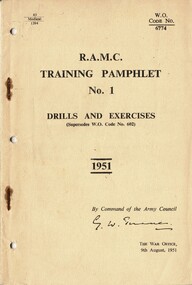
Booklet, British Army, R.A.M.C. Training Pamphlet No. 1 Drills And Exercises, 1951
... Training Pamphlet No. 1 Drills And Exercises...Exercises A crfeam coloured cardboard cover with black information on the font. Top right hand corner reads W.O. code No. 6774. There are three punch holes and two metal staples down the left hand side of the booklet. R.A.M.C. Training ...A crfeam coloured cardboard cover with black information on the font. Top right hand corner reads W.O. code No. 6774. There are three punch holes and two metal staples down the left hand side of the booklet.australia - armed forces - service manuals, r.a.m.c., royal army medical corps, drills, exercises -
 National Vietnam Veterans Museum (NVVM)
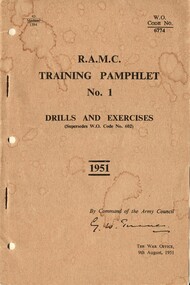
Booklet, British Army, British Army: R.A.M.C. Training Pamphlet No. 1, Drills And Exercises, 1951, 1951
... Training Pamphlet No. 1, Drills And Exercises, 1951...Training Pamphlet...Drills and Exercises...British Army R.A.M.C. Training Pamphlet Drills and Exercises A brown cover whish has some water stains on it. ...A brown cover whish has some water stains on it. The information on the cover is in black. Top right hand corner reads W.O. Code No. 6774. There are three punch holes and tow metal staples down the left hand side of the booklet.british army, r.a.m.c., training pamphlet, drills and exercises -
National Vietnam Veterans Museum (NVVM)
Booklet, Australian Army: Infantry training, Vol. 1: Infantry platoon weapons pamphlet No. 11, trained soldiers (all arms): exercises in handling of weapons, 1955, 1955
... Australian Army: Infantry training, Vol. 1: Infantry platoon weapons pamphlet No. 11, trained soldiers (all arms): exercises in handling of weapons, 1955...Australia - Armed Forces - Service manuals Australian Army: Infantry training, Vol. 1: Infantry platoon weapons pamphlet No. 11, trained soldiers (all arms): exercises in handling of weapons, 1955 Booklet Booklet Australian Army ...australia - armed forces - service manuals -
Moorabbin Air Museum
Book (Item) - Examples & Exercises In Elementary Air Navigation
... By M.J.Hearley , B.Sc For Use Of Air Crews Of The RAF Army Co-Operation Fleet Arm, Cadets In The Air Training Corps Examples & Exercises In Elementary Air Navigation Book Examples & Exercises In Elementary Air Navigation ...By M.J.Hearley , B.Sc For Use Of Air Crews Of The RAF Army Co-Operation Fleet Arm, Cadets In The Air Training Corps
