
Showing 4 items matching "transferware"
-
 Coal Creek Community Park & Museum
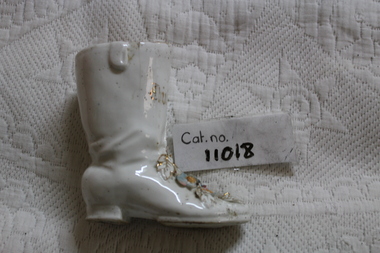
Porcelain 'boot' vase with flowers and 'think of me' motif, circa 1920s
... Hand-painted gold details and a transferware motif 'think of me'. ...Hand-painted gold details and a transferware motif 'think of me'. Porcelain 'boot' vase with flowers and 'think of me' motif, circa 1920s ...Prior to the outbreak of WWII, Germany had an extensive porcelain export trade. Mass-produced and affordable, it was instrumental in developing home decor within the middle and lower classes. This particular example has a sentimental edge - gifting such trinkets as a token of affection was common in the late 19th and early 20th centuries. Porcelain 'boot' vase, circa 1920s. White gloss glaze, applied flowers of blue, pink, yellow and orange. Hand-painted gold details and a transferware motif 'think of me'. Stamped underneath 'Made In Germany'. Applied 'Think of Me' quote on front of boot cuff. -
 Flagstaff Hill Maritime Museum and Village
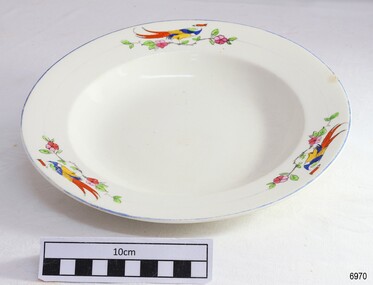
Domestic object - Plate, W. H. GRINDLEY & Co. Ltd, 1914-1925
... ...transferware...The design on this plate is transferware. The company used this more economical process of adding a transfer rather than employing artists to handprint them onto their dinnerware. ...GRINDLEY English plateware bird of paradise transferware On underside; logo "[green wreath] above W. ...The Maker’s Mark stamped on the back of this plate, a green laurel wreath with “W. H. Gringley & Co. Ltd, England” below, was used by the company between 1914-1925, according to Kroker and Goundry, authors of a paper “ARCHAEOLOGICAL MONITORING AND MITIGATION OF THE ASSINIBOINE RIVERFRONT QUAY”. The company used different Marks at other times during their operation. The design on this plate is transferware. The company used this more economical process of adding a transfer rather than employing artists to handprint them onto their dinnerware. William Henry Grindley and Alfred Meakin established the company at Tunstall, Stoke-on-Trent, in 1880. The company produced their wares for export to countries that included Australia.This ceramic plate is an example of dinnerware imported from England. The plate was made between 1914 and 1925 . The popular 'bird of paradise' design on the plate is an example of transferware, which made decorative dinnerware more affordable. China plate, earthenware, round, off-white colour with fine blue rim and three transfer decals spaced around the rim. Decals each have a bird of paradise on a flowering branch. The centre of the plate is plain. The maker’s stamp is an open green laurel wreath enclosing a decorative horizontal line, above the name. Made by W H Grindley & Co. Ltd of England.On underside; logo "[green wreath] above W. H. GRINDLEY & Co. Ltd. ENGLAND"flagstaff hill, warrnambool, shipwrecked coast, flagstaff hill maritime museum, maritime museum, shipwreck coast, flagstaff hill maritime village, great ocean road, plate, dinnerware, w. h. grindley, english, plateware, bird of paradise, transferware -
 Flagstaff Hill Maritime Museum and Village
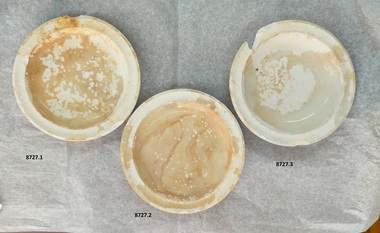
Domestic object - Dinner plate, circa 1878
... Three dinner plates with an initial glaze but no painted or transferware decoration. Plate 8727.1 has a blotchy cream surface with some of the initial glaze remaining. ...Three dinner plates with an initial glaze but no painted or transferware decoration. Plate 8727.1 has a blotchy cream surface with some of the initial glaze remaining. ...These earthenware dinner plates were recovered from the wreck of the Loch Ard, on the southwest coast of Victoria and donated by a friend of the diver. They have had an initial glaze but have no transfer work or painted decoration and may have been imported by a firm who wished to add their own designs. As the initial glaze has disintegrated, the underlying clay base has become pitted. The ship Loch Ard was built on the River Clyde in Scotland in 1873 for the prestigious Loch Line of colonial clipper ships, designed for the Australian run. It sailed from England on 1st March 1878 carrying 37 crew, 17 passengers and a load of cargo. The general cargo reflected the affluence of Melbourne at the time. On board were straw hats, umbrellas, perfumes, clay pipes, pianos, clocks, confectionary, linen and candles, as well as a heavier load of railway irons, cement, lead and copper. There were items included that were intended for display in the Melbourne International Exhibition in 1880 - a diverse general cargo ranging from luxury items to bulk railway iron. On 1 June 1878, emerging from fog and hearing too late the sound of breakers against the tall limestone cliffs, the vessel struck the southern foot of Mutton Bird Island and sank in 23 metres of water. Of the fifty-four people on board only two survived, one young male crewman, Tom Pearce, and one young female passenger, Eva Carmichael. Ten days after the Loch Ard tragedy, salvage rights to the wreck were sold at auction for £2,120. Cargo valued at £3,000 was salvaged and placed on the beach, but most washed back into the sea when another storm developed. The wreck of Loch Ard still lies at the base of Mutton Bird Island. Much of the cargo has now been salvaged and some was washed up into what is now known as Loch Ard Gorge. Cargo and artefacts have also been illegally salvaged over many years before protective legislation was introduced. One of the most unlikely pieces of cargo to have survived the shipwreck was a Minton porcelain peacock - one of only seven in the world. The peacock was destined for the Melbourne International Exhibition in 1880. It had been well packed, which gave it adequate protection during the violent storm. Today, the Minton peacock can be seen at the Flagstaff Hill Maritime Museum in Warrnambool. From Australia's most dramatic shipwreck it has now become Australia's most valuable shipwreck artefact and is one of very few 'objects' on the Victorian State Heritage Register.Flagstaff Hill’s collection of artefacts from LOCH ARD is significant for being one of the largest collections of artefacts from this shipwreck in Victoria. It is significant for its association with the shipwreck, which is on the Victorian Heritage Register (VHR S417). The collection is significant because of the relationship between the objects, as together they have a high potential to interpret the story of the LOCH ARD. The LOCH ARD collection is archaeologically significant as the remains of a large international passenger and cargo ship. The LOCH ARD collection is historically significant for representing aspects of Victoria’s shipping history and its potential to interpret sub-theme 1.5 of Victoria’s Framework of Historical Themes (living with natural processes). The collection is also historically significant for its association with the LOCH ARD, which was one of the worst and best known shipwrecks in Victoria’s history.Three dinner plates with an initial glaze but no painted or transferware decoration. Plate 8727.1 has a blotchy cream surface with some of the initial glaze remaining. The surface of the underneath of the plate is very pitted and there are two chips in the rim. Plate 8727.2 is in better condition with much of the initial glaze remaining in the body of the plate (but not on the rim). The glaze has extensive "crazing". The maker's stamp on the bottom of the plate, is quite clear. Plate 8727.3 has a large chunk missing from the rim and a smaller chip, plus much of the glazing is missing from both sides leaving a chalky, pitted surface.The bottom of plate 8727.2 has a stamped design which appears to be an oval shape topped with a crown.flagstaff hill maritime museum and village, great ocean road, warrnambool, shipwreck coast, loch ard, wreck of the loch ard, plates, domestic plates, earthenware plates, salvage, dinner plates -
 Queenscliffe Maritime Museum
Domestic object - China crockery recovered from wreck of Light of the age
... Huge amounts of intact crockery were removed from the wreck by boatloads of divers, including distinctive brown glazed teapots with legs (one diving author named it 'the Teapot Wreck' (Denmead, 1973: 78-82), 'Greek Key' patterned transferware, Cooper & Wood Portobello black glass three piece bottles, and sauce, preserve and condiment bottles often with contents (gooseberries, raspberries, olives) and seals intact. ...Huge amounts of intact crockery were removed from the wreck by boatloads of divers, including distinctive brown glazed teapots with legs (one diving author named it 'the Teapot Wreck' (Denmead, 1973: 78-82), 'Greek Key' patterned transferware, Cooper & Wood Portobello black glass three piece bottles, and sauce, preserve and condiment bottles often with contents (gooseberries, raspberries, olives) and seals intact. ...Subsequent to the wrecking of the Light of the Age marine concretions and corrosion products formed a cement capping over the cargo, stabilising and protecting it. The site of the Light of the Age was found by divers in late 1960s, and soon became a popular diving site. Huge amounts of intact crockery were removed from the wreck by boatloads of divers, including distinctive brown glazed teapots with legs (one diving author named it 'the Teapot Wreck' (Denmead, 1973: 78-82), 'Greek Key' patterned transferware, Cooper & Wood Portobello black glass three piece bottles, and sauce, preserve and condiment bottles often with contents (gooseberries, raspberries, olives) and seals intact. Larger items including a signal cannon and an anchor were removed from the site, while divers seeking souvenirs commonly used cold chisels to chip objects free of the concretion 'cap' which had stabilised and protected the remaining cargo for so long. In 1982 this situation was drastically changed when someone used explosives to further break concretions. However the charge was too powerful resulting in the site's complete destruction and the remaining items to become scattered and broken. Abraded and worn ceramic objects washed up on the beach are invariably collected by beachgoers, including fragments of crockery, figurines and animal figures used for 19th century household decoration and toys. The Light of the Age is archaeologically significant as the wreck of an international immigrant ship with an inward bound cargo. It is historically significant for its association with both the Black Ball and White Star Lines which carried thousands of immigrants to Australia. Built in 1855 and lost on 16 January 1868 now lies at Point Lonsdale Beach, half a mile west from Point Lonsdale, Port Phillip Heads.01- 1 shallow bowl, 02- 1 sweet bowl, 03- 1 willow pattern service dish, 04- 2 ladle cups [no handles], 05 06- 2 egg cups, 07- 2 bread and butter plates, 08- 1 condiment bowl lidWedgwood deep saucer; Pearl stone china, Ribbon, Wedgewood Willow Pattern service dish, Staffordshire Stone China, Fenton, No10shipwrecks, salvage, crockery, light of the age, clippers
