
Showing 3 items matching "treatment of -- congresses. | australia -- race relations -- congresses."
-
 Koorie Heritage Trust
Book, Olbrei, Erik, Black Australians : the prospects for change, 1982
... ...Treatment of -- Congresses. | Australia -- Race relations -- Congresses....Australians. Race relations. Conference proceedings | Aboriginal Australians -- Land tenure -- Congresses. | Aboriginal Australians Treatment of -- Congresses. | Australia -- Race relations -- Congresses. ...Contents: THE LEGACY OF THE PAST. Henry Reynolds: European justification for taking the land; Noel Loos & Jane Thomson: Black resistance past & present: An overview. FEDERAL POLICIES IN THE SEVENTIES. Lyndall Ryan: Federal policies on land rights: an overview of the seventies; Commentary: H.C. Coombs. LAND RIGHTS IN THE NORTHERN TERRITORY. Bob Collins: The march backwards; Proposed liquor laws & a draft criminal code for the Northern Territory. A TREATY & THE NAC. H.C. Coombs: The case for a treaty; Les Malezer: NAC proposals for a Makarrata; Marcia Langton: The international lobby and Makarrata; Judith Wright: In defence of a treaty. QUEENSLAND GOVERNMENT POLICIES. Garth Nettheim: The Queensland Acts & human rights; Jim Keeffe: DAIA: The role of the protector - then & now. QUEENSLAND RESERVES AND COMMUNITIES. Kenny Jacobs, Roberta Felton & Darwin Mudunathi: Mornington Island perspectives; Delphine Geia: Life on Palm Island; Eric Kyle: Changes on Palm Island; Shorty O'Neill : The effects of Queensland policies on grass roots Aborigines; Granny Dolly speaks; Les Collins: The significance of the Aboriginal flag. TORRES STRAIT ISLANDER PERSPECTIVES. Eddie Koiki Mabo: Land rights in the Torres Strait; Nonie Sharp: The seafaring peoples of the Cape York region: Themes in a quest for homelands; Ben Mills: Islanders' response to proposed repeal of the Torres Strait Islanders Act. POSSIBILITIES FOR COMMONWEALTH ACTION. Garth Nettheim: The possibilities for Commonwealth action in Queensland. THE RACIAL DISCRIMINATION ACT. Al Grassby: Combatting racism in Australia. A HIGH COURT CHALLENGE? Barbara Hocking: Is might right? An argument for the recognition of traditional Aboriginal title to land in the Australian courts; Greg McIntyre: Aboriginal land rights - a definition at common law.xvii, 255 p. ; maps; 21 cm.Contents: THE LEGACY OF THE PAST. Henry Reynolds: European justification for taking the land; Noel Loos & Jane Thomson: Black resistance past & present: An overview. FEDERAL POLICIES IN THE SEVENTIES. Lyndall Ryan: Federal policies on land rights: an overview of the seventies; Commentary: H.C. Coombs. LAND RIGHTS IN THE NORTHERN TERRITORY. Bob Collins: The march backwards; Proposed liquor laws & a draft criminal code for the Northern Territory. A TREATY & THE NAC. H.C. Coombs: The case for a treaty; Les Malezer: NAC proposals for a Makarrata; Marcia Langton: The international lobby and Makarrata; Judith Wright: In defence of a treaty. QUEENSLAND GOVERNMENT POLICIES. Garth Nettheim: The Queensland Acts & human rights; Jim Keeffe: DAIA: The role of the protector - then & now. QUEENSLAND RESERVES AND COMMUNITIES. Kenny Jacobs, Roberta Felton & Darwin Mudunathi: Mornington Island perspectives; Delphine Geia: Life on Palm Island; Eric Kyle: Changes on Palm Island; Shorty O'Neill : The effects of Queensland policies on grass roots Aborigines; Granny Dolly speaks; Les Collins: The significance of the Aboriginal flag. TORRES STRAIT ISLANDER PERSPECTIVES. Eddie Koiki Mabo: Land rights in the Torres Strait; Nonie Sharp: The seafaring peoples of the Cape York region: Themes in a quest for homelands; Ben Mills: Islanders' response to proposed repeal of the Torres Strait Islanders Act. POSSIBILITIES FOR COMMONWEALTH ACTION. Garth Nettheim: The possibilities for Commonwealth action in Queensland. THE RACIAL DISCRIMINATION ACT. Al Grassby: Combatting racism in Australia. A HIGH COURT CHALLENGE? Barbara Hocking: Is might right? An argument for the recognition of traditional Aboriginal title to land in the Australian courts; Greg McIntyre: Aboriginal land rights - a definition at common law.aboriginal australians. land rights. conference proceedings | aboriginal australians. race relations. conference proceedings | aboriginal australians -- land tenure -- congresses. | aboriginal australians, treatment of -- congresses. | australia -- race relations -- congresses. -
 National Vietnam Veterans Museum (NVVM)
Document, National Congress
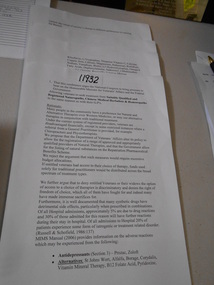
... Document Medical References to vartious books available Typewritten proposal regarding alternative treatment for Veterans, listing alternatives to Western Merdicine in favour of Natural & Alternative Therapies seeking permission from the Hon Minister of Veteran Affairs and the Federal Court. Page referring to War Graves of Veterans (dec). National Congress ...Typewritten proposal regarding alternative treatment for Veterans, listing alternatives to Western Merdicine in favour of Natural & Alternative Therapies seeking permission from the Hon Minister of Veteran Affairs and the Federal Court. Page referring to War Graves of Veterans (dec).References to vartious books availabledocument, medical -
Bendigo Historical Society Inc.
Ephemera - Mike Butcher Collection: Bendigo Regional Photographic Library, 1976
... Congress in 1846, attributed to Nicholas H. Shepard To make the image, a daguerreotypist polished a sheet of silver-plated copper to a mirror finish; treated it with fumes that made its surface light-sensitive; exposed it in a camera for as long as was judged to be necessary, which could be as little as a few seconds for brightly sunlit subjects or much longer with less intense lighting; made the resulting latent image on it visible by fuming it with mercury vapor; removed its sensitivity to light by liquid chemical treatment; rinsed and dried it; and then sealed the easily marred result behind glass in a protective enclosure. ...Congress in 1846, attributed to Nicholas H. Shepard To make the image, a daguerreotypist polished a sheet of silver-plated copper to a mirror finish; treated it with fumes that made its surface light-sensitive; exposed it in a camera for as long as was judged to be necessary, which could be as little as a few seconds for brightly sunlit subjects or much longer with less intense lighting; made the resulting latent image on it visible by fuming it with mercury vapor; removed its sensitivity to light by liquid chemical treatment; rinsed and dried it; and then sealed the easily marred result behind glass in a protective enclosure. ...Daguerreotype was the first publicly available photographic process, widely used from the 1830s to 1850s. "Daguerreotype" also refers to an image created through this process. Invented by Louis Daguerre and introduced worldwide in 1839, the daguerreotype was almost completely superseded by 1856 with new, less expensive processes, such as the ambrotype (collodion process), that yield more readily viewable images. Since the late 20th century, some photographers interested in making artistic use of early photographic processes have revived the daguerreotype process. The earliest authenticated image of Abraham Lincoln, taken soon after his election to Congress in 1846, attributed to Nicholas H. Shepard To make the image, a daguerreotypist polished a sheet of silver-plated copper to a mirror finish; treated it with fumes that made its surface light-sensitive; exposed it in a camera for as long as was judged to be necessary, which could be as little as a few seconds for brightly sunlit subjects or much longer with less intense lighting; made the resulting latent image on it visible by fuming it with mercury vapor; removed its sensitivity to light by liquid chemical treatment; rinsed and dried it; and then sealed the easily marred result behind glass in a protective enclosure. The image is on a mirror-like silver surface and will appear either positive or negative, depending on the angle at which it is viewed, how it is lit and whether a light or dark background is being reflected in the metal. The darkest areas of the image are simply bare silver; lighter areas have a microscopically fine light-scattering texture. The surface is very delicate, and even the lightest wiping can permanently scuff it. Some tarnish around the edges is normal. Several types of antique photographs, most often ambrotypes and tintypes, but sometimes even old prints on paper, are commonly misidentified as daguerreotypes, especially if they are in the small, ornamented cases in which daguerreotypes made in the US and the UK were usually housed. The name "daguerreotype" correctly refers only to one very specific image type and medium, the product of a process that was in wide use only from the early 1840s to the late 1850s.A4 pages x2. Photocopied pages. Single sided. Appears to be from a publication titled 'The Daguerreotype in America', by Beaumont Newhall. friends of the bendigo library, photography, daguerreotype
