
Showing 116 items matching "two levers"
-
 Melbourne Tram Museum
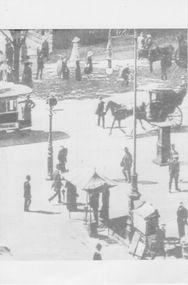
Photograph - Signalman Collins and Swanston Streets, c1900
... ...two levers...Under the canopy were two levers: one to depress and release the Collins Street cable only metres from him to prevent it from rising up through the slot onto the roadway; the other a lever to operate the tramway signal on the pole close by at the very edge of the intersection. ...Under the canopy were two levers: one to depress and release the Collins Street cable only metres from him to prevent it from rising up through the slot onto the roadway; the other a lever to operate the tramway signal on the pole close by at the very edge of the intersection. ...This is a cropped segment of a larger photograph of the intersection of Collins and Swanston Streets that includes cable trams, horse drawn vehicles and pedestrians. The photograph looks north east across the intersection toward the Melbourne Town Hall. It is possible that the subject of this cropped segment is the cable tramway signalman standing beneath a small canopy on the south east corner. Under the canopy were two levers: one to depress and release the Collins Street cable only metres from him to prevent it from rising up through the slot onto the roadway; the other a lever to operate the tramway signal on the pole close by at the very edge of the intersection. The signalman's role was an essential one and he was authorised to direct and report all rule breaking by the gripmen passing through this intersection.Yields information about cable tramway operations. Black and white photograph and nothing on rear.pedestrians, collins and swanston streets, cable trams, horse drawn vehicles, melbourne town hall, segment of a larger photograph, cable tramway signalman, canopy, two levers, authorised to direct and report -
 Sunshine and District Historical Society Incorporated
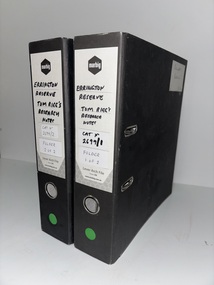
Archive - Errington Reserve Tom Rigg's Research Notes
... Two Lever Arch files of Tom Rigg's research notes on the history of Errington Reserve...Albans Errington Reserve Tom Rigg's Research Notes Two Lever Arch files of Tom Rigg's research notes on the history of Errington Reserve Archive Errington Reserve Tom Rigg's Research Notes ...Errington Reserve Tom Rigg's Research Noteserrington reserve, main road east, st. albans -
 4th/19th Prince of Wales's Light Horse Regiment Unit History Room
Specifications, Specifications Army (Aust) 5368 and 368, (estimated); abt 1969-1980
... Specifications for Australian Army metal badges and insignia in two lever arch foolscap files. The drawings are appendices to Specifications 5368 and 368 ...Specifications for Australian Army metal badges and insignia in two lever arch foolscap files. The drawings are appendices to Specifications 5368 and 368 Specifications Army (Aust) 5368 and 368 Specifications Army Design Establishment ...Manufacturing drawings. Specifications for Australian Army metal badges and insignia in two lever arch foolscap files. The drawings are appendices to Specifications 5368 and 368 insignia, badges, specification 5368, manufacturing drawings, defence contracts -
 Eltham District Historical Society Inc
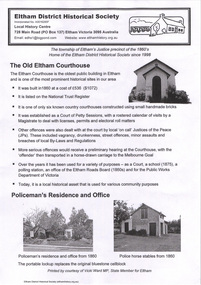
Document - Binder, Eltham Justice Precinct, 1969-2020
... Two ring lever arch binder, white with various photocopies, printouts, newspaper clippings...Kaylock Patrick Clark Elsie May Graham Franco and Co James Wallace Graham Surveyor Field Notes HG Folders 15/52/59 integrated Two ring lever arch binder, white with various photocopies, printouts, newspaper clippings Eltham Justice Precinct Document Binder ...EDHS_04863 - Binder: Eltham Justice Precinct Report: Conservation Management Plan (draft) for Justice Precinct Eltham, 5 August 2005; prepared for Nillumbik Shire by Ivar Nelsen and Janette Hodgson, Land Stewardship and Biodiversity - Historic Places, Department of Sustainability and Environment 1. Courthouse 1. Eltham Courthouse interesting facts i. Photocopy (2 pages) of extract from Petty Sessions at Eltham before C.S. Strutt Esq., Chairman; and (indecipherable) on the 12th day of September 1871; Case numbers 117 to 127. Details listed include Complainant, Defendant, Fees, Cause, Decision, Remarks. Defendants listed include Edward Bettison and John McCall, N.J. Keylock [Kaylock], Patrick Clark, Michael Keenan, Ann Hayden, Henry Edelman, Alexander Falkiner, Charles Long, Joseph Morris, Daniel Ryan ii. Photocopy (2 pages) of list of Convictions for surnames commencing with ‘B’ from 23 December 1890 to December 1905. 2. Plan and elevation drawings 3. Other courthouse plans and fittings 1880s – Brunswick, Maffra, Dunolly , Sunbury, Landsborough and Wodonga 4. Newspaper articles: i. ELTHAM POLICE COURT. (1892, April 1). Evelyn Observer, and South and East Bourke Record (Vic. : 1882 - 1902), p. 2 (MORNING.). Retrieved July 5, 2022, from http://nla.gov.au/nla.news-article60667022 ii. BREAKING A PUBLICAN'S LEG. (1900, July 13). Evelyn Observer, and South and East Bourke Record (Vic. : 1882 - 1902), p. 2 (MORNING.). Retrieved July 5, 2022, from http://nla.gov.au/nla.news-article60688367 iii. ELTHAM COURT. (1901, March 1). Mercury and Weekly Courier (Vic. : 1878 - 1903), p. 3. Retrieved July 5, 2022, from http://nla.gov.au/nla.news-article58578953 iv. ANNIE CHASES A TINKER. (1902, October 3). Evelyn Observer, and South and East Bourke Record (Vic. : 1882 - 1902), p. 2 (MORNING.). Retrieved July 5, 2022, from http://nla.gov.au/nla.news-article64029968 v. ELTHAM POLICE COURT. (1927, May 6). Advertiser (Hurstbridge, Vic. : 1922 - 1939), p. 4 (AFTERNOON). Retrieved July 5, 2022, from http://nla.gov.au/nla.news-article57754748 vi. ELTHAM POLICE COURT. (1927, May 20). Advertiser (Hurstbridge, Vic. : 1922 - 1939), p. 3 (AFTERNOON). Retrieved July 5, 2022, from http://nla.gov.au/nla.news-article57754814 vii. Eltham Police Court (1931, January 9). Advertiser (Hurstbridge, Vic. : 1922 - 1939), p. 4. Retrieved July 5, 2022, from http://nla.gov.au/nla.news-article56734073 viii. Repairs to Eltham Police Station, The Advertiser (1929, May 24). Advertiser (Hurstbridge, Vic. : 1922 - 1939), p. 2 (AFTERNOON.). Retrieved July 5, 2022, from http://nla.gov.au/nla.news-article57759907 ix. ELTHAM COURT. (1929, August 2). Advertiser (Hurstbridge, Vic. : 1922 - 1939), p. 4 (AFTERNOON.). Retrieved July 5, 2022, from http://nla.gov.au/nla.news-article57760345 x. See also Trove list https://trove.nla.gov.au/list/116634 5. Letter: Shire of Eltham Historical Society to Shire of Eltham, 1 July 1969 regarding potential replacement of Eltham Courthouse and the building’s historical significance and acknowledgement 10 July 1969 6. Letter: Shire of Eltham Historical Society to Law Department, 26 May 1972, re preservation of Eltham Courthouse and potential classification and acknowledgement 7 June 1972 7. Newspaper article: Strangers around, so Eltham sought protection by Marguerite Marshall, Diamond Valley News, Tuesday, April 6, 1982, p2 (On reverse side, Top job for our Pauline, p1) 8. Eltham Courthouse Colour Scheme, Public Works Department, 10 September 1983 9. Newspaper article: Eltham Courthouse under threat of closure by Helen Gillman, Diamond Valley News, October 16, 1984 10. Newspaper article: Courthouse to close by Helen Gillman, Diamond Valley News, Tuesday, November 20, 1984, p1 (also on p2 an article about Diamond Valley Shire festivities for the State’s 150th) 11. We will keep your court – Kennett, Diamond Valley News (probable), c.Dec. 1984 12. Letter: Shire of Eltham to Shire of Eltham Historical Society, 15 March 1985, regarding potential for use of building as a museum and reply dated 17 April 1985 regarding Society’s interest in use of the building 13. Letter: Department of Conservation Forests & Lands to Shire of Eltham, August 1987, regarding expressions of interest in the building and letter from Shire (18 August 1987) to Society advising of same 14. Letter: Department of Conservation Forests & Lands to Shire of Eltham, 30 March 1988, advising Courthouse to be used by Eltham Youth Resources Centre and the rear section by other community groups. Noted that the historical society was suggested by Council as a future user of the adjoining police residence when Council first sought management of the building and that should be investigated. Includes Schedule of Repair and Maintenance Work (4 pages), Existing Conditions Survey 30/7/1987 (6 pages) and 1 page plan view diagram 15. Memo: Historic Places Section to Eltham Youth Resource Centre re paint analysis of Courthouse, 17/5/1988, (6 pages) 16. Newspaper article: Courthouse renovation by Jodie Haythorne, Diamond Valley News, November 23, 1992 17. National Trust of Australia Registration (classified 20 Oct 1977), printed March 2000 18. Letter: Heritage Victoria 28 Feb 2002 regarding the replacement of the Courthouse Stand (Witness Box) 19. Article: There’s still order in this stately court house, Eltham Shire (magazine), date unk., p22-23 20. Eltham Court House, Statement of Significance, Heritage Victoria Register, printed Nov 2004 21. Eltham 1860 Former Court House 730 Main Road Eltham, collated by Eltham District Historical Society Incorporated 2005 (4 pages) 22. Book Extract: Eltham, Historical Court Houses of Victoria by Michael Challinger, Palisade Press, 2001 23. Newspaper article: Courthouse rich with history by Harry Gilham, Nillumbik Mail, c.2001 (see also EDHS_03333) 24. Notes on history of site from Crown Reserve File Rs 12128, Municipal Buildings (Local Community Welfare Reserve) at Eltham, Department of Sustainability and Environment, April 2005 (4 pages) 25. Newspaper article: Historic building upgrade, Diamond Valley Leader, August 3, 2005, p17 26. Newspaper article: Courthouse regeneration secures boost, Valley Weekly, August 10, 2005 with picture of Harry Gilham, Steve Herbert and Greg Johnson 27. Newspaper article: Poets are summonsed, Diamond Valley Leader February 22, 2006, p37 features picture of Helen Lucas at the Eltham Courthouse 28. Newspaper article: Sharing a love of legalities, Diamond Valley Leader, March 1, 2006, p7 features a picture of Rob Hulls and Steve Herbert talking to students in the courthouse 29. Newspaper advertisement: Nillumbik Tender No. 2021-33, Building Restoration Works, Old Eltham Courthouse, The Age, November 7, 2020 30. Form: Police Officer’s Return To A Warrant Of Distress 31. Handwritten notes: three pages listing all 48 of the pigeon hole form listings in the cabinet in the courthouse 32. Newspaper article: Historic Eltham Courthouse reopens, Manningham and Nillumbik Bulletin, April 2022, p22 33. Expression of Interest, Eltham Courthouse, 730 Main Road, Eltham; Nillumbik Shire Council Living and Learning Centres Eltham & Panton Hill, 8 May 2000 (Committee of Management) 2. Police Quarters 1. 1971 Surveyors Plan of 728 Main Road and the Adjoining Courthouse. Also includes notes (1963) on Lots 4 and 5 southeast corner of Main Road and Brougham Street owned by James Wallace Graham, Contractor, and Elsie May Graham. 2. Letter: Shire of Eltham to Shire of Eltham Historical Society, 5 June 1981, requesting the society give consideration to the suitability of the existing buildings (former Vermin and Noxious Weeds Office, Department of Crown Lands and Survey) for historical purposes such as a museum 3. Minutes: Shire of Eltham Historical Society Committee Meeting, 10 June 1981 (2 pages) includes reference to possible use of building as a museum (also reference to Bills Horse trough to be retained) 4. Extract from Victoria Police Gazette 1930 with details of building and site 5. Newspaper article: Cubby haven, Diamond Valley News, October 28, 1991 about replica Police Station with picture of replica along with Monika Roitinger and Garry Bartlett outside the Police Station 6. Environment office up for sale? Mountain Views, Monday, June 12, 1995 (Nillumbik Shire Council proposing to sell property. Did not proceed as ownership held by the State of Victoria) 7. Extract from National Trust February 1998 edition, “Police Rescue” which states Heidelberg and Eltham Police Residences are the oldest known Police Residences in the Melbourne Metropolitan district 8. Newspaper article: The first police office by Harry Gilham, Nillumbik Mail, December 13, 2000 (also photocopy with notations on picture identifying buildings and Harry’s typed draft) 9. Fax Memo: Victoria Police List of Officers in Charge, Eltham Police Station, 1857-1991 onward, 21 Jan 2003 10. Former Police Quarters, Statement of Significance, Heritage Victoria Register, printed Nov 2004 11. Eltham 1860 Former Police Quarters 728 Main Road Eltham, collated by Eltham District Historical Society Incorporated 2005 (5 pages) 12. Report: Eltham District Historical Society to Living and Learning Nillumbik, 14 April 2010 regarding the poor state of condition of the former Police Residence 13. Photocopy of three photos of the former Police Residence, former Police Station (relocated to rear of site) and Stables, October 18, 1991 3. Lockup 1. Newspaper article: Heritage permit bid, Diamond Valley News, January 17, 2001 (also article “Eltham library tops”) includes picture of lockup located in Youth Road 2. Newspaper article: Old lockup in new site, Diamond Valley Leader, March 21, 2001, p15. Includes picture of Harry Gilham with lockup at justice Precinct 3. Letter: Victoria Police to Eltham District Historical Society, 20 March 1991 including laser print photo of lockup in 1963 at 23 Pryor Street 4. Fax: Graham Clark, Associated Crane Trucks Pty Ltd, 833 Main Road Hurstbridge; Quote 26.2.99 for $1,080 to move lockup from Youth Road to 728 Main Road 4. Local History Centre 1. Victoria Government Gazette: Photocopy, No. 165, Tuesday, December 7, 1858, establishment of a Court of Petty Sessions at Eltham, 7 December 1858 2. Victoria Government Gazette: Photocopy, September 16, 1859, contract issued for Police buildings at Eltham to Langridge and Co., McCarter, Baillie, Nicol and Co, Chadley, Amos and Co., Cameron, Payne, £1,150.7.0 3. Victoria Government Gazette: Photocopy, October 2, 1860, contract issued for Court of Petty Sessions at Eltham to James Duncan, £600 4. President’s Report, Eltham District Historical Society, Annual General Meeting, Wednesday, March 11, 1998 – covers the establishment of the Local History Centre and new home for the Society 5. Extract for EDHS Newsletter July 1998 – Eltham Local History Centre – Official Opening 6. Unveiling of 728 Street Sign, Speech notes by Cr Dianne Bullen, December 2000, includes invoice from John Sharp Signs Pty Ltd, 24/10/2000 and planning approval drawing dated 24/3/1999 reproduced in Newsletter No. 135 November 2000 7. Letter: Eltham District Historical Society to Living and Learning Centre, undated draft regarding being a member of the committee reviewing the development of the site 8. Notes from Rod Grant re funding of site development under the Community Jobs Program 9. Letter: Eltham District Historical Society to Nillumbik Living and Learning, 28 October 2004 re inclusion of the Society in enhancing the site under the Community Jobs Program 10. Letter: Department of Sustainability and Environment to Eltham District Historical Society, 28 February 2005 re preparing draft Conservation Plan and copy of cover letter in response 2 April 2005 11. Levels and Layout Plan, Nillumbik Shire Council, September 2005, AO copy 12. Letter: Department of Sustainability and Environment to Eltham District Historical Society, 12 September 2005 re Eltham Justice Precinct Conservation Management Plan 13. Letter: Living and Learning Nillumbik, 2 February 2006 to Eltham District Historical Society re forming a Committee to advise on the use, maintenance, management and preservation of the Justice Precinct 14. Minutes: Meeting of a Task group to explore the establishment of a Committee to manage the Eltham Justice Precinct, 20 December 2005 (with hand written notes) 15. President’s notes (EDHS), General Meeting item, 11 May 2006 pertaining to use and condition of the Eltham Justice Precinct 16. Paint estimates, Old Eltham Court House, undated 17. Notes from meeting 26 September (2006), Eltham Justice Precinct Committee 18. Notes from meeting 27 November (2006), Eltham Justice Precinct Committee 19. Terms of Reference for the Eltham Justice Precinct Committee, Draft for Living and Learning Committee Meeting 24 Jan 2007 (4 pages) 20. Newspaper article: Panel set up, Diamond Valley Leader, 7 March 2007 21. Minutes: Meeting of Eltham Justice Precinct Subcommittee, 10 May 2007 22. Minutes: Meeting of Eltham Justice Precinct Subcommittee, 5 July 2007 23. Minutes: Meeting of Eltham Justice Precinct Subcommittee, 11 October 2007 24. Minutes: Meeting of Eltham Justice Precinct Subcommittee, 7 February 2008 25. Minutes: Meeting of Eltham Justice Precinct Subcommittee, 10 April 2008 26. Minutes: Meeting of Eltham Justice Precinct Subcommittee, 14 August 2008 27. Letter: EDHS (Sue Law) to Living and Learning, 6 September 2008 re proposed signage 28. Agenda: Meeting of Eltham Justice Precinct Subcommittee, 16 October 2008 29. Suggested guidelines for use of the Court House for exhibitions 30. Handwritten note re Ken Eckersal and Uniting Church of possible donation of church organ for sale, proceeds to be used for activities at the Justice precinct 31. One page typed notes on each of the buildings in the Eltham Justice Precinct 32. Newspaper article: Historic Eltham Courthouse reopens, Manningham and Nillumbik Bulletin, April 2022, p22 5. Miscellaneous 1. Photocopy from Pioneers & Painters (2 pages) covering the establishment of Police and Court of Petty Sessions at Eltham 2. Photocopy of photo looking northeast across Little Eltham buildings c.1910 with notes 3. Photocopy of J.H Clarke photo looking up Maria Street from near Dalton Street with notes identifying precinct buildings 4. Photocopy of photo of Court House and Police Quarters with cow outside from Heather Jenkins scrapbook with notes identifying buildings 5. Sketch and notes with dimensions for blue stone lockup including other miscellaneous handwritten notes 6. Unidentified heritage review details of Justice Precinct (c.2004) 7. Hand written notes of telephone conversation held with Dennis McKay (6 May 1997) re Council use of site 8. Flyer: Victoria Police Historical Unit 9. Photocopy of thumbnail images of various Justice Precincts (not identified) 10. Email correspondence, 4 and 10 January 2008; J. Connor to Council and Councillors pertaining to proposed new toilet facilities at rear of Courthouse annexe. Two ring lever arch binder, white with various photocopies, printouts, newspaper clippingsHG Folders 15/52/59 integratedharry gilham collection, eltham courthouse, eltham justice precinct, eltham police residence, lockup, eltham community festival, eltham festival, eltham, heritage assessment, police residence, conservation, alexander falkiner, ann hayden, charles long, court of petty sessions, daniel ryan, edward bettison and john mccall, eltham court house, henry edelman, joseph morris, michael keenan, n.j. kaylock, patrick clark, elsie may graham, franco and co, james wallace graham, surveyor field notes -
Federation University Historical Collection
Book - Book - Scrapbook, University of Ballarat: Media Releases; January to December 1997
... Black A4 two ring lever folder. Items in reverse order. Divided into months by coloured paper ...Media items printed in the press Items appeared during the time from 18 January 1997 to 18 December 1997. university of ballarat ub Black A4 two ring lever folder. Items in reverse order. Divided into months by coloured paper University of Ballarat: Media Releases; January to December 1997. ...Media items printed in the press Items appeared during the time from 18 January 1997 to 18 December 1997.Black A4 two ring lever folder. Items in reverse order. Divided into months by coloured paper university of ballarat, ub -
Federation University Historical Collection
Document, Robert Le Poer Trench Research Notes
... Two lever arch folders with pages relating to Robert Le Poer Trench. .1) Robert Le Poer Trench (geneaology) Henry Charles Darvall , Sadlier .2) John Sadlier, Robert Le Poer Trench, marriage certificate of Sophie Le Poer Trench, William Grant, Exiles from Erin...Dianne Campbell Goldfield Lawyers Collection Robert La Poer Trench Sadlier Bury William Smith O'Brien Hall Castieux Darvall Henry Charles Darvall Francis Sadlier Irish William O'Brien John Hall John Buckley Castieu family history genealogy Two lever arch folders with pages relating to Robert Le Poer Trench. .1) Robert Le Poer Trench (geneaology) Henry Charles Darvall , Sadlier .2) John Sadlier, Robert Le Poer Trench, marriage certificate of Sophie Le Poer Trench, William Grant, Exiles from Erin Robert Le Poer Trench Research Notes Document ...Two lever arch folders with pages relating to Robert Le Poer Trench. .1) Robert Le Poer Trench (geneaology) Henry Charles Darvall , Sadlier .2) John Sadlier, Robert Le Poer Trench, marriage certificate of Sophie Le Poer Trench, William Grant, Exiles from Erindianne campbell goldfield lawyers collection, robert la poer trench, sadlier, bury, william smith o'brien, hall, castieux, darvall, henry charles darvall, francis sadlier, irish, william o'brien, john hall, john buckley castieu, family history, genealogy -
Federation University Historical Collection
Book - Book - Scrapbook, Federation TAFE: Newspaper Clippings, 1993 - 2006
... Black A4 , two ring arch lever folder. Divided into years. ...Black A4 , two ring arch lever folder. Divided into years. Federation TAFE: Newspaper Clippings, 1993 - 2006 Book Book - Scrapbook ...Newspaper clippings - articles and advertisements - collected by the Federation TAFE Sector for the years 1993 - 2006.Black A4 , two ring arch lever folder. Divided into years. newspaper clippings, advertisements, tafe, federation, 1993, 2006. -
Federation University Historical Collection
Book - Book - Scrapbook, Federation TAFE: Newspaper Clippings, 2007 - 2013
... Black A4 , two ring arch lever folder. Divided into years. ...Newspaper clippings - articles and advertisements - collected by the Federation TAFE Sector for the years 2007 - 2013. newspaper clippings advertisements tafe federation 2007 2013 Black A4 , two ring arch lever folder. Divided into years. Federation TAFE: Newspaper Clippings, 2007 - 2013 Book Book - Scrapbook ...Newspaper clippings - articles and advertisements - collected by the Federation TAFE Sector for the years 2007 - 2013.Black A4 , two ring arch lever folder. Divided into years. newspaper clippings, advertisements, tafe, federation, 2007, 2013 -
Tatura Irrigation & Wartime Camps Museum
Folio, Dunera Recollections, Varied
... Black two ring lever arch folder with printed material in plastic sleeves, containing personal accounts of experiences in internment in Tatura Camps...."dunera" hay internment camp tatura internment camps 2 3 and 4 documents biography Black two ring lever arch folder with printed material in plastic sleeves, containing personal accounts of experiences in internment in Tatura Camps. ...Individual accounts given to Tatura Museum by the author or their descendant.Black two ring lever arch folder with printed material in plastic sleeves, containing personal accounts of experiences in internment in Tatura Camps."dunera", hay internment camp, tatura internment camps 2, 3, and 4, documents, biography -
 Vision Australia
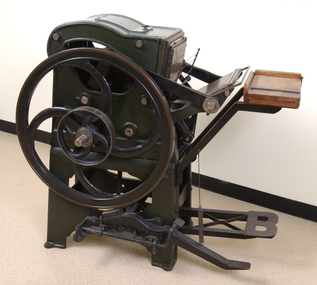
Machine - Object, Minnie Crabbe, Braille printing press, 1934
... Steel and cast iron printing press with two wheels on left hand side and two foot levers to operate a wheel on the right hand side....Victorian Association of Braille Writers Braille equipment Minnie Crabb Steel and cast iron printing press with two wheels on left hand side and two foot levers to operate a wheel on the right hand side. ...In 1934, the Victorian Association of Braille Writers annual report advised that it had acquired a Crabb-Hulme Braille Printing Press. Two years in development, the Press was designed by Miss Minnie Crabb (the librarian) and built to her specifications by Mr Hulme. Invented to produce ephemeral material quickly, such as programs, catalogues and newsletters, and provided more opportunities for information to be quickly sent out to Braille readers.Steel and cast iron printing press with two wheels on left hand side and two foot levers to operate a wheel on the right hand side.victorian association of braille writers, braille equipment, minnie crabb -
 Mont De Lancey
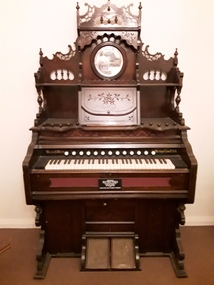
Furniture - Organ, Wilcox and White, 1885
... USA.There are two brass patterned pump foot pedals below: the left one has 'WILCOX' stamped on it, the right pedal has '& WHITE' stamped on it and the metal is damaged from use. There are two carved levers underneath the keyboard: the left one has a sticker saying "Grand Organ", the right one's sticker says, "Knee Swell". ...The brass covered left foot pump pedal has 'WHITE' stamped on it, the right pedal has '......' stamped on it. There are two carved levers underneath the keyboard: the left one has a sticker saying 'Grand Organ', the right one's sticker says, 'Knee Swell'. ...Parlour Organs Cabinet Organs Harmoniums Pump Organs The brass covered left foot pump pedal has 'WHITE' stamped on it, the right pedal has '......' stamped on it. There are two carved levers underneath the keyboard: the left one has a sticker saying 'Grand Organ', the right one's sticker says, 'Knee Swell'. ...There is a brass plaque that states: THIS PLAQUE IS IN MEMORY OF DORA CHAPMAN daughter of William and Estelle Chapman CALLED HOME WHILE PLAYING THE ORGAN ON THE OCCASION OF THE 30TH ANNIVERSARY OF THE SILVAN CHURCH. SEPTEMBER, 27TH 1936 DORA WAS A SISTER TO MR ERNEST CHAPMAN On another plaque it states: THIS ORGAN WAS A WEDDING PRESENT TO ERN AND BERYL CHAPMAN AND WAS DONATED TO MONT DE LANCEY IN THE YEAR 1994 BY MAVIS, BOB, LES AND ALBERT CHAPMAN The organ was a present from Mr Ernest Chapman and his bride on the occasion of their wedding on October 26th 1927. The organ was made in Meriden Connecticut USA by Wilcox and White in 1885. A date inside the organ indicates that it was last tuned June 16th 1900. A highly decorated, delicate ornate carved wooden pump organ with a round mirror set back into the front panel. It has a sheet music rest or shelf with an opening lid to store sheet music inside the cupboard. There are two side shelves with five knobs on each at the front. It has a keyboard with thirteen stops below. Next to the key stops above the keyboard is gold lettering with 'Wilcox & White Meriden. Connecticut. USA.There are two brass patterned pump foot pedals below: the left one has 'WILCOX' stamped on it, the right pedal has '& WHITE' stamped on it and the metal is damaged from use. There are two carved levers underneath the keyboard: the left one has a sticker saying "Grand Organ", the right one's sticker says, "Knee Swell". There is no stool.The brass covered left foot pump pedal has 'WHITE' stamped on it, the right pedal has '......' stamped on it. There are two carved levers underneath the keyboard: the left one has a sticker saying 'Grand Organ', the right one's sticker says, 'Knee Swell'. The manufacturer : WILCOX AND WHITE is printed in gold letters on ......The thirteen 'stops' all have different musical terms printed in a sticker. e.g...............parlour organs, cabinet organs, harmoniums, pump organs -
Federation University Historical Collection
Book - Book - Scrapbook, University of Ballarat: Newspaper Clippings, January to June, 2000
... Black A4 , two ring arch lever folder. Divided into months by coloured dividers. ...The items relate to activities related to the University and individual student achievements. university of ballarat newspaper clippings january to june 2000 ballarat courier wimmera mail times ararat advertiser stawell times weekly advertiser the age the australian horsham & district weekly advertiser Black A4 , two ring arch lever folder. Divided into months by coloured dividers. ...Newspaper clippings collected by the University during the months January to June 2000. These come from several sources in Ballarat, Horsham, Ararat, Stawell and the Melbourne Press. The items relate to activities related to the University and individual student achievements.Black A4 , two ring arch lever folder. Divided into months by coloured dividers. university of ballarat, newspaper clippings, january to june, 2000, ballarat courier, wimmera mail times, ararat advertiser, stawell times, weekly advertiser, the age, the australian, horsham & district weekly advertiser -
Federation University Historical Collection
Book - Book - Scrapbook, University of Ballarat: Newspaper Clippings, July to December, 2000
... Black A4 , two ring arch lever folder. Divided into months by coloured dividers. ...The items relate to activities related to the University and individual student achievements. university of ballarat newspaper clippings 2000 ballarat courier wimmera mail times ararat advertiser stawell times weekly advertiser the age the australian horsham & district weekly advertiser july to december Black A4 , two ring arch lever folder. Divided into months by coloured dividers. ...Newspaper clippings collected by the University during the months July to December, 2000. These come from several sources in Ballarat, Horsham, Ararat, Stawell and the Melbourne Press. The items relate to activities related to the University and individual student achievements.Black A4 , two ring arch lever folder. Divided into months by coloured dividers. university of ballarat, newspaper clippings, 2000, ballarat courier, wimmera mail times, ararat advertiser, stawell times, weekly advertiser, the age, the australian, horsham & district weekly advertiser, july to december -
Clunes Museum
Tool - BICYCLE KIT
... .1 LEATHER CASE WITH STRAP TO FASTEN .2 TIN WITH PATCHES, SCREW AND USED TUBE .3 USED EMERY PAPER .4 TWO TYRE LEVERS .5 SPANNER...BICYC LE KIT REPAIR KIT .2 POCKET VULCANISER CYCLE TUBES, SYRO, A SYRO PRODUCT .1 LEATHER CASE WITH STRAP TO FASTEN .2 TIN WITH PATCHES, SCREW AND USED TUBE .3 USED EMERY PAPER .4 TWO TYRE LEVERS .5 SPANNER Tool BICYCLE KIT ....1 LEATHER CASE WITH STRAP TO FASTEN .2 TIN WITH PATCHES, SCREW AND USED TUBE .3 USED EMERY PAPER .4 TWO TYRE LEVERS .5 SPANNER.2 POCKET VULCANISER CYCLE TUBES, SYRO, A SYRO PRODUCTbicyc le kit, repair kit -
Federation University Historical Collection
Document - Document - Media items, Newspaper items related to University of Ballarat and Federation University: 2003 to Present Day
... Black two-ring arch-lever folder. Items grouped in to years - reverse order. ...Not all years have items. university of ballarat federation university the age the australian herald-sun ballarat courier ballarat times Black two-ring arch-lever folder. Items grouped in to years - reverse order. ...Items related to the University of Ballarat and Federation University that have appeared in the print media. Ballarat Courier and Ballarat Times are major sources, with Melbourne and other country publications - The Age, The Australian, Herald/Sun, Daylesford and Gippsland. The articles are grouped by year and in reverse order - 2003 to present day. Not all years have items.Black two-ring arch-lever folder. Items grouped in to years - reverse order. Coloured dividers.university of ballarat, federation university, the age, the australian, herald-sun, ballarat courier, ballarat times -
 Bendigo Military Museum
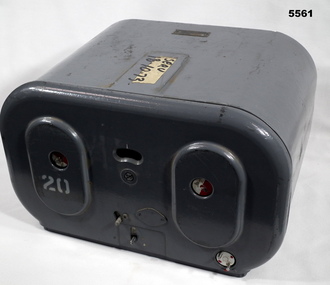
Magazine - MAGAZINE, FILM, Williamson Manufacturing Co Ltd
... Below the ovals are two levers connected to the internal mechanism. ...Below the ovals are two levers connected to the internal mechanism. ...This photographic magazine attaches to the gear box universal ( see cat 4531). As an assembly, the type F22 aerial camera came into RAF and RAAF service c1942. It was used by the RAF over Europe and by the RAAF extensively through the Sth. West Pacific area of operations, during WW2. This type of camera was used through the Vietnam war up to the early 1980's. The F22 camera assembly when mounted in the reliable Canberra aircraft, did aerial survey work in PNG, Indonesia, Malaysia and Sumatra and the Australian mainland. This type of camera was used in Spitfires, Mosquitos, Avro Lincolns and Canberra aircraft.This is a heavy metal container painted in a grey colour. The label is on the top. One side has two enlarged oval sections. in those two ovals is one hole of 22 mm diameter. In those holes is a disc painted half red and half white. Below the ovals are two levers connected to the internal mechanism. Bottom RHS has a disc with 2 pins, red dots are printed on it. Nearly level with the top of ovals is a kidney shaped hole. In that hole is a rotating disc with graduations and numbers. the action side of magazine has a rectangular opening size 83/4" x 7/16". It is covered with a black soft material.Top has “serv 18-10-73” The number '20' has been stenciled on two surfaces.aerial photography, magazine, ww2, raaf -
 Whitehorse Historical Society Inc.
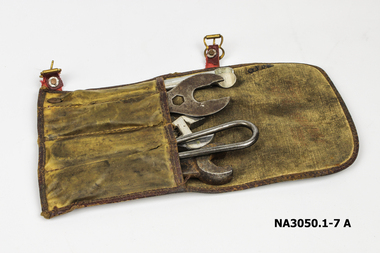
Tool - Bicycle Repair Kit
... Bicycle Repair Kit enclosed in a canvass carrier which has four slots for the tools and two straps with buckle to secure it when it is rolled up. Includes two tyre levers, block spanner, screw driver, cone spanner with a hex shaped spanner in centre and a centre bracket shifting spanner at the end....This tool kit was purchased by Bob Gardiner in the 1950s to maintain his bicycle when he used to ride to work in ringwood. transport bicycles Deeland Bicycle Repair Kit enclosed in a canvass carrier which has four slots for the tools and two straps with buckle to secure it when it is rolled up. Includes two tyre levers, block spanner, screw driver, cone spanner with a hex shaped spanner in centre and a centre bracket shifting spanner at the end. ...This tool kit was purchased by Bob Gardiner in the 1950s to maintain his bicycle when he used to ride to work in ringwood.Bicycle Repair Kit enclosed in a canvass carrier which has four slots for the tools and two straps with buckle to secure it when it is rolled up. Includes two tyre levers, block spanner, screw driver, cone spanner with a hex shaped spanner in centre and a centre bracket shifting spanner at the end.Deelandtransport, bicycles -
 Melbourne Tram Museum
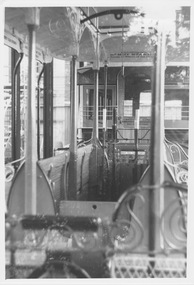
Photograph - Cable tram gripman's compartment with levers, K McCarthy
... The photograph shows the gripman's compartment with two brake levers and the central grip lever. At the top of the photo above the levers is curved metal beam to which a block and tackle were fastened to lift and lower the grip into the tunnel. ...The photograph shows the gripman's compartment with two brake levers and the central grip lever. At the top of the photo above the levers is curved metal beam to which a block and tackle were fastened to lift and lower the grip into the tunnel. ...Photograph shows part of the preserved cable grip car number 1 and trailer car number 1 in a large glass covered display case in Russell Street behind the (then) Melbourne Museum and State Library. The photograph shows the gripman's compartment with two brake levers and the central grip lever. At the top of the photo above the levers is curved metal beam to which a block and tackle were fastened to lift and lower the grip into the tunnel. At either end of the compartment is a knee high board with whole at the top that fitted into slots between the end traverse seats to stop winter drafts blowing across the gripman's feet. Yields information about cable tram componentsBlack and white photograph with note on rearIn ink "29" and "K McC"cable trams, russell street, melbourne museum, state library, draw bar, tie rod, pin, safety chain, trailer coupling -
 City of Moorabbin Historical Society (Operating the Box Cottage Museum)
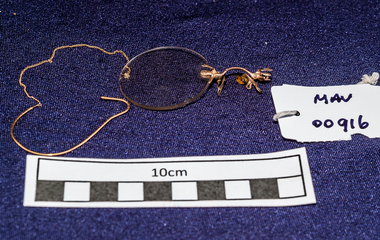
Personal Effects, lady’s Pince-nez ½ with fine gold chain, c1900
... They are anchored onto the bridge of the nose via two small spring-loaded clips terminating in special nose-pads made from bone or tortoise shell on metal called plaquettes, which are tweezered apart for placement on the face through applying pressure to two small lever-like finger-pieces located on the front of the bridge. ...They are anchored onto the bridge of the nose via two small spring-loaded clips terminating in special nose-pads made from bone or tortoise shell on metal called plaquettes, which are tweezered apart for placement on the face through applying pressure to two small lever-like finger-pieces located on the front of the bridge. ...Glasses, also known as eyeglasses or spectacles, are frames bearing lenses worn in front of the eyes. They are normally used for vision correction or eye protection. Pince-nez is a French style of spectacles, popular in the 19th century, that are supported without earpieces, by pinching the bridge of the nose. The name comes from French pincer, "to pinch", and nez, "nose". Although pince-nez were used in Europe in the 15th, 16th, and 17th centuries, modern ones appeared in the 1840s and reached their peak popularity around 1880 to 1900 A solid bridge piece is moulded to fit the curvature of the bridge of the nose. They are anchored onto the bridge of the nose via two small spring-loaded clips terminating in special nose-pads made from bone or tortoise shell on metal called plaquettes, which are tweezered apart for placement on the face through applying pressure to two small lever-like finger-pieces located on the front of the bridge. Plaquettes could be either hinged and flexible, permitting a better fit, or static as in the older examples of this type.. They were popular from the 1890s through to the 1950s, One half of a pair of lady’s Pince-nez eyeglasses with 1 gold rimmed glass lens , a gold style bridge and a fine gold chain that is attached to the side of the lens frame and to a shaped over- ear metal piece. eyes, spectacles, eye glasses, optometry, moorabbin, bentleigh, cheltenham, market gardeners, pioneers, early settlers, pince-nez -
 Flagstaff Hill Maritime Museum and Village
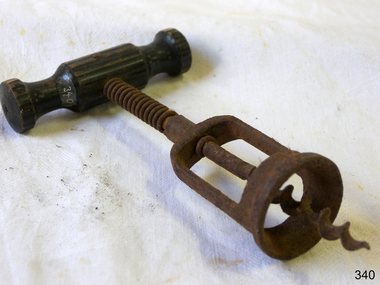
Domestic object - Corkscrew
... The winged corkscrew, sometimes called a cork extractor, butterfly corkscrew, owl corkscrew, Indian corkscrew, or angel corkscrew, has two levers, one on either side of the worm. As the worm is twisted into the cork, the levers are raised. ...The winged corkscrew, sometimes called a cork extractor, butterfly corkscrew, owl corkscrew, Indian corkscrew, or angel corkscrew, has two levers, one on either side of the worm. As the worm is twisted into the cork, the levers are raised. ...The design of the corkscrew may have been derived from the gun worm, which was a device from at least the early 1630s, used by men to remove unspent charges from a musket's barrel in a similar fashion. The corkscrew is possibly an English invention, due to the tradition of beer and cider, and the 'Treatise on Cider' by John Worlidge in 1676 describes "binning of tightly corked cider bottles on their sides", although the earliest reference to a corkscrew is, "steel worm used for the drawing of Corks out of Bottles" from 1681. In 1795, the first corkscrew patent was granted to the Reverend Samuel Henshall, in England. The clergyman affixed a simple disc, now known as the Henshall Button, between the worm and the shank. The disc prevents the worm from going too deep into the cork, forces the cork to turn with the turning of the crosspiece, and thus breaks the adhesion between the cork and the neck of the bottle. The disc is designed and manufactured slightly concave on the underside, which compresses the top of the cork and helps keep it from breaking apart. The winged corkscrew, sometimes called a cork extractor, butterfly corkscrew, owl corkscrew, Indian corkscrew, or angel corkscrew, has two levers, one on either side of the worm. As the worm is twisted into the cork, the levers are raised. Pushing down the levers draws the cork from the bottle in one smooth motion. The most common design has a rack and pinion connecting the levers to the body. The head of the central shaft is frequently modified to form a bottle opener, or foil cutter, increasing the utility of the device. Corkscrews of this design are particularly popular in household use. In 1880, William Burton Baker was issued British Patent No. 2950 for his double lever corkscrew, with both levers sliding onto the upper end of the shank. The first American patent was in 1930 granted to the Italian Domenico Rosati who emigrated to Chicago, Illinois, to work as bartender before prohibition. Rosati's design had an exposed rack and pinion mechanism. Such design was adapted by other brands as the wine-market grew in popularity. The winged owl version, with two side-plates covering the rack and pinion mechanism, was first designed and manufactured in 1932 by the Spanish industrial designer David Olañeta for his brand BOJ and was later adopted by others, such as the 1936 US Patent No. 98,968 by Richard Smythe marked HOOTCH-OWL https://en.wikipedia.org/wiki/CorkscrewThis object is significant as an example of an item in common use in the 19th and early 20th centuries, and that was developed further in the 1930s.Winged corkscrew with a T-shaped wooden handle, metal spring and worm-wheel screw section.None.flagstaff hill, flagstaff hill maritime museum and village, warrnambool, maritime museum, maritime village, great ocean road, shipwreck coast, corkscrew, beverages, kitchen equipment, bottle opener -
 Melbourne Tram Museum
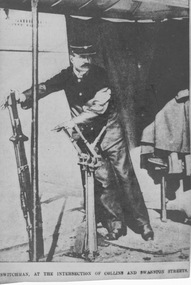
Photograph - Signalman at Collins and Swanton Streets, 1910s
... Photograph shows uniformed MTOC signalman standing under a canopy operating two large levers (which may be the reason the newspaper mistakenly described him as a switchman). ...Photograph shows uniformed MTOC signalman standing under a canopy operating two large levers (which may be the reason the newspaper mistakenly described him as a switchman). ...Photograph shows uniformed MTOC signalman standing under a canopy operating two large levers (which may be the reason the newspaper mistakenly described him as a switchman). He stands under a canopy supported by poles with a partial curtain at the rear along with his overcoat. The canopy was located on the footpath on the southeast corner of the intersection of Collins and Swanston Streets. This was the busiest cable tramway intersection in Melbourne and one of the busiest for pedestrian and vehicle traffic. The tram tracks crossed each other at right angles with no curved tracks to permit turns. The signalman's job was twofold: to directed which trams had right of way by use of mechanical signals and to depress the Collins Street cable so that the upward incline did not cause the cable to rise out of the slot onto the roadway. The depression gear was located under both Collins Street tracks adjacent to the Town Hall and was only released momentarily to allow a Collins Street tram to pass over it. This was a demanding job requiring constant vigilance: working with the policeman controlling the intersection, trams approaching from four directions, horse and motor traffic and pedestrians. The signalman's rules provided a specific order of steps each time the signals and depression gear were reset, which occurred many times per hour. He was also authorised to stop trams with the use of his whistle and a red hand lamp and to report gripmen who disobey his directions. Traffic lights were gradually introduced to Melbourne from 1928 after cable trams were replaced in Swanston Street and just before they were replaced in Collins Street. This is a photograph taken of a newsprint photograph from an unnamed newspaper. Yields information about signalman's work. Black and white photograph with note below photograph. Printed below photograph: "Switchman [sic] at the intersection of Collins and Swanston Streets."newsprint, mtoc, switchman, canopy, levers, collins street, swanston street, busiest intersection, traffic lights, 1928, policeman, signalman, mechanical signals, right of way, depression gear, twon hall, slot, vigilance -
 Whitehorse Historical Society Inc.
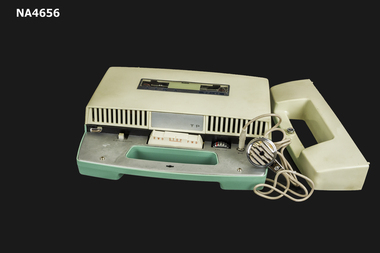
Audio - Recorder - Tape, 1960s
... Window on case shows two tape reels and has name in grey on silver AIWA TP-40. Two metal levers releases tape cover for access to reel to reel tapes. ...Window on case shows two tape reels and has name in grey on silver AIWA TP-40. Two metal levers releases tape cover for access to reel to reel tapes. ...Item bought and used by Gordon Hoskin who was a business manager at Mitcham Technical School and when schools merged and became Mullauna he was Administration Manager.A transistor tape recorder with two motors and knock switch. Portable in a green and cream square plastic case - design includes carrying handle which removes when unlocked to reveal working buttons.Buttons - Play and Record. Central push down lever - RWD -STOP-FWD. Metal volume control. Two fittings for Mic and E-P-H. Push down/pull up button. LOCK/OPEN button on handle. Window on case shows two tape reels and has name in grey on silver AIWA TP-40. Two metal levers releases tape cover for access to reel to reel tapes. Recorder inserts into styrene foam box which contains an insert for the round metal microphone with clip on rear and beige plastic cord. In plastic bag is a one earpiece in cream.foam contained within cardboard tray inside sleeve. Front ends and sides of box says AIWA TP40 Transistor tape recorder 2 Motor and Knock Switch Japan. Plastic bag encasing recorder includes blue folded instruction and specifications sheet, and handwritten signature of owner, Gordon Hoskin. Covered battery compartment undrneath. 7.8mm plastic tape reels. One containing 5mm magnetic tape. The base of the reels is metal and rubber. A total of 9 items.electrical technology, appliances & accessories -
4th/19th Prince of Wales's Light Horse Regiment Unit History Room
Specifications, Army Insignia, Badges and Buttons, 1951 - 1980
... Set of manufacturing specifications for Australian Army insignia, badges and buttons - on foolscap in two lever arch files Specifications include: VOLUME 1 Badges, head dress & collar, AMF Insignia, shoulder, title, AUSTRALIA Insignia, metal, AUSTRALIAN ARMY Button, insignia, AMF Badge, metal, qualification, skill-at-arms Medallion & lapel badge, ANZAC commemorative Badge, lapel, metal, Army Reserve Lapel badge, Returned from Active Service Insignia, metal, Royal Cipher, Queen Elizabeth II Badge, metal, retired officers Button, insignia, general officer Link, button Insignia, metal, rank, womens, Warrant Officer & NCO tropical Insignia, metal, rank, officer, sword & baton crossed (1975) Insignia, metal, rank, officer, sword & baton crossed (1969) Insignia, metal, rank, officers, crown Insignia, metal, rank, NCO, crown Insignia, metal, rank, Warrant Officer, crown Palm leaf device for Vietnamese Cross of Gallantry Medal, service, Vietnamese campaign Button, insignia, Corps of Staff Cadets Insignia, metal, RAAC, beret/collar Insignia, metal, 1 AR, beret/collar Insignia, metal, 1/15 RNSWL, beret/collar Insignia, metal, 2 Cav, beret/collar Insignia, metal, 2/14 QMI Insignia, metal, 3 Cav, beret/collar Insignia, metal, 3/9 SAMR Insignia, metal, 4 Cav, beret/collar 4/19 PWLH Regt badge, head dress or collar Insignia, metal, 4/19 PWLH 8/13 VMR badges, head dress or collar Insignia, 10 LH, collar, silver plated 12/16 HRL, badges, head dress or collar Insignia, metal, RAA, officers, cap/hat, collar Insignia, metal, RAA, other ranks Button, insignia, RAA Button, insignia, RAE Insignia, metal, RAE cap/hat collar Button, Insignia, Royal Aust Survey Corps Insignia, metal, Royal Aust Survey Corps Insignia, metal, Royal Aust Corps of Signals, cap/collar Button, insignia, Royal Aust Corps of Signals Button, insignia, R Aust Inf Insignia, metal, R Aust Inf, cap/hat, collar Insignia, metal, Commando Insignia, metal, RSAR, cap/hat collar Insignia, metal, RAR, cap/hat collar Insignia, metal, RNSWR Insignia, metal, RVR, cap/hat Insignia, metal, RQR ,cap/hat collar Insignia, metal, RWAR, cap/hat collar Badge, qualification, Infantry Combat Button, insignia, Chaplains, Christian Insignia, metal, Chaplains, Christian, cap/hat collar Insignia, metal, RACT Button, insignia RACT Button, insignia, RAAMC Insignia, metal, RAAMC, cap/hat collarl, Insignia, metal, RAADC, cap/hat collar Button, insignia, RAAOC Insignia, metal, RAAOC' VOLUME 2 Button, insignia, RAEME RAEME, badges, collar Insignia, metal, R Aust Army Educational Corps, cap/hat collar Button, insignia, AACC Insignia, metal, AACC, cap/hat collar Button insignia, R Aust Army Pay Corps Insignia, metal, R Aust Army Pay Corps, cap/hat collar Insignia, metal, Aust Army Legal Corps, cap/hat collar Insignia, metal, R Aust Army Provost Corps, cap/hat collar Button, insignia, R Aust Corps of MP Button, insignia, Aust Army Psych Corps Insignia, metal, Aust Army Psych Corps Button, insignia, Aust Army Nursing Corps Insignia, metal, R Aust Army Nursing Corps Button, insignia, WRAAC Insignia, metal, rank, mess undress, brooch type, RAAMC Insignia, metal, WRAAC Insignia, shoulder, Apprentice Insignia, metal, Army Apprentices School Button, insignia, OCS Button, insignia, OCS ,blazer Insignia, metal, OCS, cap/hat collar Button, insignia, RMC, blazer Insignia, metal, RMC Medallion, RMC Insignia, metal, AUR, cap/hat collar Button, insignia, MonUR Insignia, metal, MUR, cap/hat collar Button, insignia, MonUR Insignia, metal, MonUR, cap/hat collar Insignia, metal, UNSWR , cap/hat collar Insignia, metal, SUR, cap/hat collar Button, insignia, SUR Insignia, metal, QUR, cap/hat collar Button, insignia, QUR Insignia, metal, WAUR, cap/hat collar Button, insignia, WAUR Badge, metal, qualification, flying, Army pilot, Aust Army Aviation Corps Insignia, metal, Aust Army Aviation Corps Button, insignia, Aust Army Aviation Corps Badge, metal, qualification , bandsman Badge, metal, qualification, Drum Major Button, insignia, Aust Army Band Corps Insignia, metal, Aust Army Band Corps, cap/hat collar ...specifications Rubber stamp of Engineering Design Establishment giving conditions of issue to contractors Set of manufacturing specifications for Australian Army insignia, badges and buttons - on foolscap in two lever arch files Specifications include: VOLUME 1 Badges, head dress & collar, AMF Insignia, shoulder, title, AUSTRALIA Insignia, metal, AUSTRALIAN ARMY Button, insignia, AMF Badge, metal, qualification, skill-at-arms Medallion & lapel badge, ANZAC commemorative Badge, lapel, metal, Army Reserve Lapel badge, Returned from Active Service Insignia, metal, Royal Cipher, Queen Elizabeth II Badge, metal, retired officers Button, insignia, general officer Link, button Insignia, metal, rank, womens, Warrant Officer & NCO tropical Insignia, metal, rank, officer, sword & baton crossed (1975) Insignia, metal, rank, officer, sword & baton crossed (1969) Insignia, metal, rank, officers, crown Insignia, metal, rank, NCO, crown Insignia, metal, rank, Warrant Officer, crown Palm leaf device for Vietnamese Cross of Gallantry Medal, service, Vietnamese campaign Button, insignia, Corps of Staff Cadets Insignia, metal, RAAC, beret/collar Insignia, metal, 1 AR, beret/collar Insignia, metal, 1/15 RNSWL, beret/collar Insignia, metal, 2 Cav, beret/collar Insignia, metal, 2/14 QMI Insignia, metal, 3 Cav, beret/collar Insignia, metal, 3/9 SAMR Insignia, metal, 4 Cav, beret/collar 4/19 PWLH Regt badge, head dress or collar Insignia, metal, 4/19 PWLH 8/13 VMR badges, head dress or collar Insignia, 10 LH, collar, silver plated 12/16 HRL, badges, head dress or collar Insignia, metal, RAA, officers, cap/hat, collar Insignia, metal, RAA, other ranks Button, insignia, RAA Button, insignia, RAE Insignia, metal, RAE cap/hat collar Button, Insignia, Royal Aust Survey Corps Insignia, metal, Royal Aust Survey Corps Insignia, metal, Royal Aust Corps of Signals, cap/collar Button, insignia, Royal Aust Corps of Signals Button, insignia, R Aust Inf Insignia, metal, R Aust Inf, cap/hat, collar Insignia, metal, Commando Insignia, metal, RSAR, cap/hat collar Insignia, metal, RAR, cap/hat collar Insignia, metal, RNSWR Insignia, metal, RVR, cap/hat Insignia, metal, RQR ,cap/hat collar Insignia, metal, RWAR, cap/hat collar Badge, qualification, Infantry Combat Button, insignia, Chaplains, Christian Insignia, metal, Chaplains, Christian, cap/hat collar Insignia, metal, RACT Button, insignia RACT Button, insignia, RAAMC Insignia, metal, RAAMC, cap/hat collarl, Insignia, metal, RAADC, cap/hat collar Button, insignia, RAAOC Insignia, metal, RAAOC' VOLUME 2 Button, insignia, RAEME RAEME, badges, collar Insignia, metal, R Aust Army Educational Corps, cap/hat collar Button, insignia, AACC Insignia, metal, AACC, cap/hat collar Button insignia, R Aust Army Pay Corps Insignia, metal, R Aust Army Pay Corps, cap/hat collar Insignia, metal, Aust Army Legal Corps, cap/hat collar Insignia, metal, R Aust Army Provost Corps, cap/hat collar Button, insignia, R Aust Corps of MP Button, insignia, Aust Army Psych Corps Insignia, metal, Aust Army Psych Corps Button, insignia, Aust Army Nursing Corps Insignia, metal, R Aust Army Nursing Corps Button, insignia, WRAAC Insignia, metal, rank, mess undress, brooch type, RAAMC Insignia, metal, WRAAC Insignia, shoulder, Apprentice Insignia, metal, Army Apprentices School Button, insignia, OCS Button, insignia, OCS ,blazer Insignia, metal, OCS, cap/hat collar Button, insignia, RMC, blazer Insignia, metal, RMC Medallion, RMC Insignia, metal, AUR, cap/hat collar Button, insignia, MonUR Insignia, metal, MUR, cap/hat collar Button, insignia, MonUR Insignia, metal, MonUR, cap/hat collar Insignia, metal, UNSWR , cap/hat collar Insignia, metal, SUR, cap/hat collar Button, insignia, SUR Insignia, metal, QUR, cap/hat collar Button, insignia, QUR Insignia, metal, WAUR, cap/hat collar Button, insignia, WAUR Badge, metal, qualification, flying, Army pilot, Aust Army Aviation Corps Insignia, metal, Aust Army Aviation Corps Button, insignia, Aust Army Aviation Corps Badge, metal, qualification , bandsman Badge, metal, qualification, Drum Major Button, insignia, Aust Army Band Corps Insignia, metal, Aust Army Band Corps, cap/hat collar Specifications, Army Insignia, Badges and Buttons ...Set of manufacturing specifications for Australian Army insignia, badges and buttons - on foolscap in two lever arch files Specifications include: VOLUME 1 Badges, head dress & collar, AMF Insignia, shoulder, title, AUSTRALIA Insignia, metal, AUSTRALIAN ARMY Button, insignia, AMF Badge, metal, qualification, skill-at-arms Medallion & lapel badge, ANZAC commemorative Badge, lapel, metal, Army Reserve Lapel badge, Returned from Active Service Insignia, metal, Royal Cipher, Queen Elizabeth II Badge, metal, retired officers Button, insignia, general officer Link, button Insignia, metal, rank, womens, Warrant Officer & NCO tropical Insignia, metal, rank, officer, sword & baton crossed (1975) Insignia, metal, rank, officer, sword & baton crossed (1969) Insignia, metal, rank, officers, crown Insignia, metal, rank, NCO, crown Insignia, metal, rank, Warrant Officer, crown Palm leaf device for Vietnamese Cross of Gallantry Medal, service, Vietnamese campaign Button, insignia, Corps of Staff Cadets Insignia, metal, RAAC, beret/collar Insignia, metal, 1 AR, beret/collar Insignia, metal, 1/15 RNSWL, beret/collar Insignia, metal, 2 Cav, beret/collar Insignia, metal, 2/14 QMI Insignia, metal, 3 Cav, beret/collar Insignia, metal, 3/9 SAMR Insignia, metal, 4 Cav, beret/collar 4/19 PWLH Regt badge, head dress or collar Insignia, metal, 4/19 PWLH 8/13 VMR badges, head dress or collar Insignia, 10 LH, collar, silver plated 12/16 HRL, badges, head dress or collar Insignia, metal, RAA, officers, cap/hat, collar Insignia, metal, RAA, other ranks Button, insignia, RAA Button, insignia, RAE Insignia, metal, RAE cap/hat collar Button, Insignia, Royal Aust Survey Corps Insignia, metal, Royal Aust Survey Corps Insignia, metal, Royal Aust Corps of Signals, cap/collar Button, insignia, Royal Aust Corps of Signals Button, insignia, R Aust Inf Insignia, metal, R Aust Inf, cap/hat, collar Insignia, metal, Commando Insignia, metal, RSAR, cap/hat collar Insignia, metal, RAR, cap/hat collar Insignia, metal, RNSWR Insignia, metal, RVR, cap/hat Insignia, metal, RQR ,cap/hat collar Insignia, metal, RWAR, cap/hat collar Badge, qualification, Infantry Combat Button, insignia, Chaplains, Christian Insignia, metal, Chaplains, Christian, cap/hat collar Insignia, metal, RACT Button, insignia RACT Button, insignia, RAAMC Insignia, metal, RAAMC, cap/hat collarl, Insignia, metal, RAADC, cap/hat collar Button, insignia, RAAOC Insignia, metal, RAAOC' VOLUME 2 Button, insignia, RAEME RAEME, badges, collar Insignia, metal, R Aust Army Educational Corps, cap/hat collar Button, insignia, AACC Insignia, metal, AACC, cap/hat collar Button insignia, R Aust Army Pay Corps Insignia, metal, R Aust Army Pay Corps, cap/hat collar Insignia, metal, Aust Army Legal Corps, cap/hat collar Insignia, metal, R Aust Army Provost Corps, cap/hat collar Button, insignia, R Aust Corps of MP Button, insignia, Aust Army Psych Corps Insignia, metal, Aust Army Psych Corps Button, insignia, Aust Army Nursing Corps Insignia, metal, R Aust Army Nursing Corps Button, insignia, WRAAC Insignia, metal, rank, mess undress, brooch type, RAAMC Insignia, metal, WRAAC Insignia, shoulder, Apprentice Insignia, metal, Army Apprentices School Button, insignia, OCS Button, insignia, OCS ,blazer Insignia, metal, OCS, cap/hat collar Button, insignia, RMC, blazer Insignia, metal, RMC Medallion, RMC Insignia, metal, AUR, cap/hat collar Button, insignia, MonUR Insignia, metal, MUR, cap/hat collar Button, insignia, MonUR Insignia, metal, MonUR, cap/hat collar Insignia, metal, UNSWR , cap/hat collar Insignia, metal, SUR, cap/hat collar Button, insignia, SUR Insignia, metal, QUR, cap/hat collar Button, insignia, QUR Insignia, metal, WAUR, cap/hat collar Button, insignia, WAUR Badge, metal, qualification, flying, Army pilot, Aust Army Aviation Corps Insignia, metal, Aust Army Aviation Corps Button, insignia, Aust Army Aviation Corps Badge, metal, qualification , bandsman Badge, metal, qualification, Drum Major Button, insignia, Aust Army Band Corps Insignia, metal, Aust Army Band Corps, cap/hat collar Rubber stamp of Engineering Design Establishment giving conditions of issue to contractorsspecifications -
 Flagstaff Hill Maritime Museum and Village
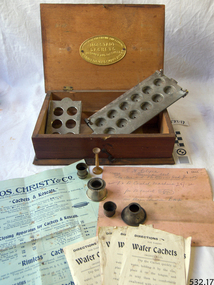
Equipment - Cachet Machine, Christy & Co, Early 20th Century
... Each machine consists of two plates with openings to fit the capsules. The two levers at the front allow the upper plate to be raised or lowered. ...Each machine consists of two plates with openings to fit the capsules. The two levers at the front allow the upper plate to be raised or lowered. ...Cachets Unpalatable drugs were cached using gelatine or a similar compound. The standard cachet machine consisted of three metal plates drilled with holes of different diameter for the size of the cachet used. The first half of the cachet was then fitted in the base plate. The centre plate was then used to mask the rims of the cachets to prevent powder deposit. Funnels were then used to deposit an appropriate dose of the powdered drug into the lower part of the cachet. Tampers were used if the drug had to be compressed. When the cachets were filled, moisture was applied to the rims of the cachet halves in the top plate. The centre plate was then removed and the two cachet halves brought together. After a few minutes the cachets were dry and could be removed. Capsules Another option was to use capsules. Again mechanisation supplanted the earlier models. The early models however are still used in clinical studies using the “double blind” method, where neither the clinician or the patient are aware which capsule contains the active agent or the placebo, as identical capsules are used for both. Each machine consists of two plates with openings to fit the capsules. The two levers at the front allow the upper plate to be raised or lowered. In the first instance the upper plate is raised half way and the empty lower halves of the capsules are inserted. This allows the operator to ensure that all the openings contain empty capsule halves. The upper plate is then raised to the maximum and the well is filled with a previously determined dose of the drug. A similar technique is used for the placebo. The upper plate is then lowered to half way, and the empty top half of the capsule is inserted in order to close and seal the previously filled half of the capsule. The upper plate is then lowered fully and the capsules can then be removed. https://www.samhs.org.au/Virtual%20Museum/Medicine/drugs_nonsurg/capsule/capsule.htm This cachet machine was donated to Flagstaff Hill Maritime Village by the family of Doctor William Roy Angus, Surgeon and Oculist. It is part of the “W.R. Angus Collection” that includes historical medical equipment, surgical instruments and material once belonging to Dr Edward Ryan and Dr Thomas Francis Ryan, (both of Nhill, Victoria) as well as Dr Angus’ own belongings. The Collection’s history spans the medical practices of the two Doctors Ryan, from 1885-1926 plus that of Dr Angus, up until 1969. ABOUT THE “W.R.ANGUS COLLECTION” Doctor William Roy Angus M.B., B.S., Adel., 1923, F.R.C.S. Edin.,1928 (also known as Dr Roy Angus) was born in Murrumbeena, Victoria in 1901 and lived until 1970. He qualified as a doctor in 1923 at University of Adelaide, was Resident Medical Officer at the Royal Adelaide Hospital in 1924 and for a period was house surgeon to Sir (then Mr.) Henry Simpson Newland. Dr Angus was briefly an Assistant to Dr Riddell of Kapunda, then commenced private practice at Curramulka, Yorke Peninsula, SA, where he was physician, surgeon and chemist. In 1926, he was appointed as new Medical Assistant to Dr Thomas Francis Ryan (T.F. Ryan, or Tom), in Nhill, Victoria, where his experiences included radiology and pharmacy. In 1927 he was Acting House Surgeon in Dr Tom Ryan’s absence. Dr Angus had become engaged to Gladys Forsyth and they decided he further his studies overseas in the UK in 1927. He studied at London University College Hospital and at Edinburgh Royal Infirmary and in 1928, was awarded FRCS (Fellow from the Royal College of Surgeons), Edinburgh. He worked his passage back to Australia as a Ship’s Surgeon on the Australian Commonwealth Line’s T.S.S. Largs Bay. Dr Angus married Gladys in 1929, in Ballarat. (They went on to have one son (Graham 1932, born in SA) and two daughters (Helen (died 12/07/1996) and Berenice (Berry), both born at Mira, Nhill ) According to Berry, her mother Gladys made a lot of their clothes. She was very talented and did some lovely embroidery including lingerie for her trousseau and beautifully handmade baby clothes. Dr Angus was a ‘flying doctor’ for the A.I.M. (Australian Inland Ministry) Aerial Medical Service in 1928 . Its first station was in the remote town of Oodnadatta, where Dr Angus was stationed. He was locum tenens there on North-South Railway at 21 Mile Camp. He took up this ‘flying doctor’ position in response to a call from Dr John Flynn; the organisation was later known as the Flying Doctor Service, then the Royal Flying Doctor Service. A lot of his work during this time involved dental surgery also. Between 1928-1932 he was surgeon at the Curramulka Hospital, Yorke Peninsula, South Australia. In 1933 Dr Angus returned to Nhill and purchased a share of the Nelson Street practice and Mira hospital (a 2 bed ward at the Nelson Street Practice) from Dr Les Middleton one of the Middleton Brothers, the current owners of what previously once Dr Tom Ryan’s practice. Dr Tom and his brother had worked as surgeons included eye surgery. Dr Tom Ryan performed many of his operations in the Mira private hospital on his premises. He had been House Surgeon at the Nhill Hospital 1902-1926. Dr Tom Ryan had one of the only two pieces of radiology equipment in Victoria during his practicing years – The Royal Melbourne Hospital had the other one. Over the years Dr Tom Ryan had gradually set up what was effectively a training school for country general-practitioner-surgeons. Each patient was carefully examined, including using the X-ray machine, and any surgery was discussed and planned with Dr Ryan’s assistants several days in advance. Dr Angus gained experience in using the X-ray machine there during his time as assistant to Dr Ryan. When Dr Angus bought into the Nelson Street premises in Nhill he was also appointed as the Nhill Hospital’s Honorary House Surgeon 1933-1938. His practitioner’s plate from his Nhill surgery is now mounted on the doorway to the Port Medical Office at Flagstaff Hill Maritime Village, Warrnambool. When Dr Angus took up practice in the Dr Edward and Dr Tom Ryan’s old premises he obtained their extensive collection of historical medical equipment and materials spanning 1884-1926. A large part of this collection is now on display at the Port Medical Office at Flagstaff Hill Maritime Village in Warrnambool. In 1939 Dr Angus and his family moved to Warrnambool where he purchased “Birchwood,” the 1852 home and medical practice of Dr John Hunter Henderson, at 214 Koroit Street. (This property was sold in1965 to the State Government and is now the site of the Warrnambool Police Station. and an ALDI store is on the land that was once their tennis court). The Angus family was able to afford gardeners, cooks and maids; their home was a popular place for visiting dignitaries to stay whilst visiting Warrnambool. Dr Angus had his own silk worm farm at home in a Mulberry tree. His young daughter used his centrifuge for spinning the silk. Dr Angus was appointed on a part-time basis as Port Medical Officer (Health Officer) in Warrnambool and held this position until the 1940’s when the government no longer required the service of a Port Medical Officer in Warrnambool; he was thus Warrnambool’s last serving Port Medical Officer. (Masters of immigrant ships arriving in port reported incidents of diseases, illness and death and the Port Medical Officer made a decision on whether the ship required Quarantine and for how long, in this way preventing contagious illness from spreading from new immigrants to the residents already in the colony.) Dr Angus was a member of the Australian Medical Association, for 35 years and surgeon at the Warrnambool Base Hospital 1939-1942, He served with the Australian Department of Defence as a Surgeon Captain during WWII 1942-45, in Ballarat, Victoria, and in Bonegilla, N.S.W., completing his service just before the end of the war due to suffering from a heart attack. During his convalescence he carved an intricate and ‘most artistic’ chess set from the material that dentures were made from. He then studied ophthalmology at the Royal Melbourne Eye and Ear Hospital and created cosmetically superior artificial eyes by pioneering using the intrascleral cartilage. Angus received accolades from the Ophthalmological Society of Australasia for this work. He returned to Warrnambool to commence practice as an ophthalmologist, pioneering in artificial eye improvements. He was Honorary Consultant Ophthalmologist to Warrnambool Base Hospital for 31 years. He made monthly visits to Portland as a visiting surgeon, to perform eye surgery. He represented the Victorian South-West subdivision of the Australian Medical Association as its secretary between 1949 and 1956 and as chairman from 1956 to 1958. In 1968 Dr Angus was elected member of Spain’s Barraquer Institute of Barcelona after his research work in Intrasclearal cartilage grafting, becoming one of the few Australian ophthalmologists to receive this honour, and in the following year presented his final paper on Living Intrasclearal Cartilage Implants at the Inaugural Meeting of the Australian College of Ophthalmologists in Melbourne In his personal life Dr Angus was a Presbyterian and treated Sunday as a Sabbath, a day of rest. He would visit 3 or 4 country patients on a Sunday, taking his children along ‘for the ride’ and to visit with him. Sunday evenings he would play the pianola and sing Scottish songs to his family. One of Dr Angus’ patients was Margaret MacKenzie, author of a book on local shipwrecks that she’d seen as an eye witness from the late 1880’s in Peterborough, Victoria. In the early 1950’s Dr Angus, painted a picture of a shipwreck for the cover jacket of Margaret’s book, Shipwrecks and More Shipwrecks. She was blind in later life and her daughter wrote the actual book for her. Dr Angus and his wife Gladys were very involved in Warrnambool’s society with a strong interest in civic affairs. He had an interest in people and the community They were both involved in the creation of Flagstaff Hill, including the layout of the gardens. After his death (28th March 1970) his family requested his practitioner’s plate, medical instruments and some personal belongings be displayed in the Port Medical Office surgery at Flagstaff Hill Maritime Village, and be called the “W. R. Angus Collection”.Cachet machines were in widespread use in earlier days when doctors would make their own cachets and capsules. Cachet machine for making Cachets or Koseals of pharmaceuticals such as quinine or sulphanol. Materials contained in wooden box. Manufactured by Thos Christy & Co, Old Swan Lane, Upper Thames Street London.Metal plague on inside of lid reads: ‘Morstadt Cachets Improved & patented Christy & Co Old Swan Lane EC’. flagstaff hill, warrnambool, shipwrecked-coast, flagstaff-hill, flagstaff-hill-maritime-museum, maritime-museum, shipwreck-coast, flagstaff-hill-maritime-village, medical equipment, tablet making set, cachet machine, pharmaceuticals, chemist equipment, medication -
 Puffing Billy Railway
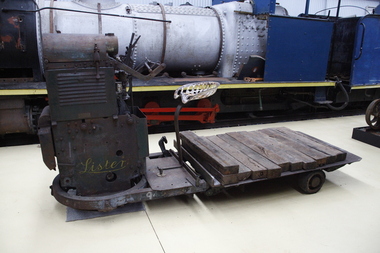
Lister Auto Truck
... Controls included a hand throttle, a gear lever with two forward and one reverse gears, and a large handbrake lever. ...Controls included a hand throttle, a gear lever with two forward and one reverse gears, and a large handbrake lever. ...The Lister Auto-Truck was a small monowheel tractor built for moving light loads around factories, railway yards and similar sites. They were built by R A Lister and Company of Dursley, Gloucestershire, well known for their range of small stationary engines The Auto-Truck was one of several monowheel tractors to appear in the 1920s and '30s, with the availability of small, reliable petrol engines, as developed for motorcycles and the stationary engines for which Lister were already known. These were tricycle vehicles, with the single leading wheel used for both drive and steering. Their simple construction carried most of the mechanism on this wheel as a single unit, the chassis with the trailing wheels being little more than a trailer for balance. Simplicity was a key feature. The engines were single-cylinder and air-cooled. Ignition was by magneto, rather than requiring a battery and electrical system. One of these designs was produced in the 1920s by George Grist of the Auto Mower Co., Norton St Philip, Somerset. The engine was a JAP 600 cc four-stroke air-cooled sidevalve, a typical small engine of the time. The Auto Mower Co. were Lister agents and when Lister heard of this 'Auto-Truck' they bought one for use in their own factory. It was used to carry heavy engine castings from the foundry to the machine shop. Lister customers saw them and there was such interest in wanting to buy them that Lister negotiated with Auto Mower to build them under licence. Although Lister were already well known for their small petrol stationary engines, these were heavy cast-iron engines with water hopper cooling and unsuitable for vehicle use. Lister remained with the JAP engine for the Auto-Truck. The Auto-Truck was designed for use in factories or other places with smooth surfaces of concrete or tarmac. This allowed the use of small solid-tyred wheels with only simple suspension, making the vehicle simple, cheap and lightweight. They had little ability on soft surfaces though and could even topple over if driven carelessly across slopes. Their design was a compromise between the top-heavy nature of the tall engine grouping above its wheel and a well thought-out chassis for stability. The bearing between them was a large diameter ring roller bearing, mounted at the lowest part of the chassis. This gave rigidity and stability, even after long wear. A ring of rolled channel girder was attached to the engine group and rollers on the chassis carried the load upon this. On early Auto-Trucks this bearing is set very low, in line with the chassis members, and is covered by thin steel plates. The front panel of the engine cover is distinctive with large ventilation holes and a Lister signature cut through it. Strangely this panel is made of thick cast iron, providing substantial weight high on the engine and only adding to its top heaviness. To improve visibility of moving vehicles in noisy factories, this panel was often painted white, the rest of the vehicle being Lister's usual brunswick green. The driver was seated on a Brooks bicycle saddle, which in recognition of the lack of vehicle suspension, was carried on the end of a cantilevered bar that acted as a leaf spring. A wide handlebar on the engine group was used for steering. A squeeze bar the width of this handlebar engaged the clutch. Controls included a hand throttle, a gear lever with two forward and one reverse gears, and a large handbrake lever. The engine unit rotated freely for a full 360° rotation. When used in reverse, the Auto-Truck could either be driven from the saddle, looking backwards over the driver's shoulder; or they could dismount, swivel the engine unit around and control it as a pedestrian-controlled truck from behind. Under the engine cover were two equal diameter tanks, a fuel tank for petrol and a shorter oil tank. Engine and chain-drive lubrication used a total-loss oil system, controlled by a small pump and needle valve. Info Ref: Lister Auto-Truck - Wikipedia https://en.wikipedia.org/wiki/Lister_Auto-TruckHistoric - Industrial monowheel tractor for moving light loads around factories, railway yards and similar sites.The Lister Auto-Truck - small monowheel tractor Made of steel with three wheels. Powered by a J.A.P single cylinder petrol motor which is Hand Cranked to start.Lister puffing billy, lister, lister auto truck, monowheel tractor -
 Flagstaff Hill Maritime Museum and Village
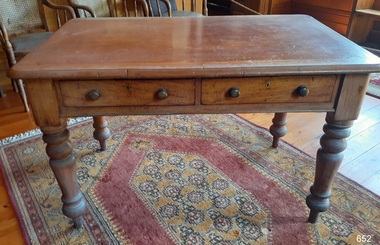
Furniture - Desk, Foy & Gibson, Circa 1880s
... Each drawer has two round wooden knob handles, a keyhole and a fitted, heavy brass lever lock. ...Each drawer has two round wooden knob handles, a keyhole and a fitted, heavy brass lever lock. ...The design of this small disc is from the Australian Colonial period. The cedar wood desk was made in Australian by Foy & Gibson in the 1880s, most probably in the business’s works in Collingwood, Victoria. The heavy brass locks fitted into the desk drawers were made by the famous Hobbs & Co of London, mid-late 19th century. In 1860 the business changed hands but the locks were still branded Hobbs & Co. The desk is branded with the symbol of Victoria’s Public Works Department. There is currently no information on when, where and by whom this desk was used. However, a very similar desk with Hobbs & Co. locks is on site at the Point Hicks Lightstation in Victoria and was formerly used by the Point Hicks head light keeper there. Other light stations also have similar desks from the P.W.D. (see also ‘Desk, Parks Victoria – Point Hicks Lightstation, Victorian Collections’.) HOBBS & CO., LONDON Alfred Charles Hobbs, 1812-1891, was American born. He became an executive salesman in 1840 for renowned lock manufacturer Day & Newell. His technique of exposing the weaknesses of people’s current locks was very successful in generating sales. He represented Day & Newell at London’s Great Exhibition of 1851, competing with other lock makers. Through the Exhibition he became famous for picking the best trusted Bramah and Chubb locks. Hobbs’ fame led him to found his own company in 1851 then register it in 1852 as Hobbs & Co., London. Hobbs was awarded the Telford Medal by the British Institution of Civil Engineers in 1854 for his paper 'On the Principles and Construction of Locks'. In 1855 the very successful company added partners and became Hobbs, Ashley and Co. In 1860, it traded under the name of Hobbs, Hart & Co. and was based in Cheapside London, where the business remained. Hobbs then returned to America, having sold the complete company to John Mathias Hart. He briefly returned to attend the 21st anniversary celebrations of the successful business in 1872. Hobbs kept himself busy in America, inventing and manufacturing firearm ammunition, for which he held several patents. He passed away there in 1891, a month after his 70th birthday. FOY & GIBSON Mark Foy wan an Irish draper who migrated to Bendigo, Victoria in 1858, attracted by the gold rush. He lived and worked in the area, establishing a drapery business. In the 1870s he moved to Melbourne where there were better prospects for expansion. He chose a place in Smith Street, Collingwood, a suburb of Melbourne, and started his business at the rear. In 1883 Foy retired, bringing in William Gibson as a partner, and then transferred his own share of the company to his son Francis Foy. Not long afterwards Francis sold his half share to Gibson, and the business continued under the name of Foy & Gibson. Francis Foy and he and his brother Mark Foy (junior) moved to Sydney. They established a business there in 1885, named after their father, Mark Foy. Gibson added to his business by starting his own manufacturing works from 1887, producing clothing, millinery, furniture, bedding and hardware for his stores. The factories, warehouses and stores complex became one of Victoria’s largest employers. He set up branches of his stores in Perth, Brisbane and Adelaide and two more branches in Melbourne. Foy & Gibson (usually referred to as Foys) became one of Australia’s largest retail department stores. In 1931 Foy’s little house in Collingwood was still part of the entrance to Foy & Gibson Emporium. In 1955 the company was bought out by Cox Brothers. Later on the stores were sold to various businesses such as David Jones, Woolworths and Harris Scarfe. In 1968 Cox Brothers went into receivership, ending almost 100 years of the business known as Foy’s. The former Foy & Gibson Complex is registered by Heritage Council Victoria. “Designed by William Pitt, this magnificent 19th and early 20th century complex of factories, warehouses and showrooms saw the production of a remarkable range of goods for Foy & Gibson, Melbourne’s earliest department store chain”. (Quoted from the Plaque erected by the Collingwood Historical Society 2007) P.W.D. – Public Works Department, Victoria The desk is stamped “P.W.D,” signifying that it is from the Public Works Department in Victoria, which operated from 1855-1987. The department was responsible for, among other things, the design and supply of office furniture and equipment for public buildings and organisations. This desk is significant historically as it originated from Foy & Gibson, a colonial Australian company that had a positive and strong impact on employment, manufacturing and retailing in Melbourne, Victoria and Australia. The significance of Foy & Gibson to Victoria’s and Australia’s history is marked by the Collingwood Complex being registered in both Heritage Victoria Register (H0755, H0897 and H0896) and National Trust Register (B2668). This locks on this desk are significant for their connection with their manufacturer, Hobbs & Co, who invented a lock that surpassed the security of any other locks produced in the mid-19th century. Desk; Australian Colonial cedar desk, honey coloured. Desktop has a wooden border with a rolled edge and a fitted timber centrepiece. The four tapered legs are tulip turned. Two half-width drawers fit side by side and extend the full depth of the desk. The drawers have dovetail joints. Each drawer has two round wooden knob handles, a keyhole and a fitted, heavy brass lever lock. Inscriptions are on the desktop, drawers, desk leg and lock. Made in Australia circa 1880 by Foy & Gibson, lock made by Hobbs & Co, London.Impressed into timber frame of one drawer “FOY & GIBSON” Impressed into lock “HOBBS & CO / LONDON”, “MACHINE MADE”, “LEVER” Impressed along the front edge of the desktop [indecipherable] text. Impressed into the timber of right front leg “P. W. D.” below a ‘crown’ symbol Handwritten in white chalk under a drawer “206” flagstaff hill, warrnambool, shipwrecked coast, flagstaff hill maritime museum, maritime museum, shipwreck coast, flagstaff hill maritime village, great ocean road, desk, cedar desk, colonial desk, 1880s desk, australian colonial furniture, furniture, office furniture, office equipment, australian made furniture, colonial furniture, colonial hardware, foy & gibson, alfred charles hobbs, hobbs & co london, hobs & co lever lock, cabinetry lock, machine made lever lock, p.w.d., public works department victoria, day & newell, great exhibition of 1851, bramah lock, chubb lock, telford medal 1854, cheapside london, mark foy, mark foy – bendigo draper, smith street collingwood, william gibson, foy & gibson emporium, foy & gibson complex, cox brothers -
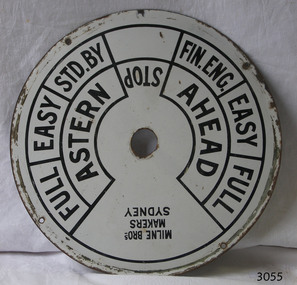 Flagstaff Hill Maritime Museum and Village
Equipment - Ships' Telegraph section, Milne Brothers, Copper and Brass Works, Early-to mid-20th century
... two parts, the Bridge Section and the Engine Room Section. The Bridge Section is usually mounted on top of a pedestal, and the Engine Room Section is often attached to a vertical surface. The standard commands printed or stamped onto the dial are the directions of AHEAD and ASTERN, and the speeds of STOP, FULL, EASY, STD. BY. and FIN. ENG. The ship’s pilot on the Bridge of a vessel sends his Orders for speed and direction to the to the Engine Room with the E.O.T. He moves the lever...two parts, the Bridge Section and the Engine Room Section. The Bridge Section is usually mounted on top of a pedestal, and the Engine Room Section is often attached to a vertical surface. The standard commands printed or stamped onto the dial are the directions of AHEAD and ASTERN, and the speeds of STOP, FULL, EASY, STD. BY. and FIN. ENG. The ship’s pilot on the Bridge of a vessel sends his Orders for speed and direction to the to the Engine Room with the E.O.T. He moves the lever ...This Engine Room section of a ship's telegraph system was part of the equipment of the Ports and Harbour ship the SS Rip. The vessel serviced and maintained the lights and buoys at Port Phillip Bay and Queenscliffe. The SS Rip was possibly the former gunboat "Albert". The ship’s communication system that was used from the late 19th century to early-to-mid-20th-century is called an Engine Order Telegraph (E.O.T.) or ship’s telegraph. The system has two parts, the Bridge Section and the Engine Room Section. The Bridge Section is usually mounted on top of a pedestal, and the Engine Room Section is often attached to a vertical surface. The standard commands printed or stamped onto the dial are the directions of AHEAD and ASTERN, and the speeds of STOP, FULL, EASY, STD. BY. and FIN. ENG. The ship’s pilot on the Bridge of a vessel sends his Orders for speed and direction to the to the Engine Room with the E.O.T. He moves the lever or levers, depending on the number of engines the ship has, to change the indicator on the Bridge Section’s dial to point in the new direction and speed of travel. This change causes the Orders to be duplicated on the Engine Room Section’s dial and a bell to signal the change simultaneously. The engineer then adjusts the ship’s engines and steering equipment to follow the pilot’s Order. The manufacturer, Mulne Bros., was a copper and brass works at 166 Sussex Street Sydney, in December 1892, and previously from 1870 at 128 to 130 Sussex Street. The company made and sold a wide range of equipment including machinery and gauges for the Railways.The Engine Room section is significant for being part of the communications system on the ship SS Rip, owned by Melbourne's Ports & Harbours department and used to service and maintain the navigation signals of Port Phillip Bay and at Queenscliffe in the mid-20th century. The dial is an example of marine equipment made in Australia and used for the safety of Victorian vessels. It is also significant for being made by an early Australian manufacturer, Milne Brothers of Sydney.Engine Room Section of a ship’s telegraph or Engine Order Telegraph (E.O.T.). The round metal dial has inscriptions stamped around the edges. The inscriptions are nautical terms for direction and speed and include the maker’s details. The dial was made by Milne Bros. of Sydney. It was part of the equipment on the "SS Rip" in Victoria.Black paint around dial: "MILNE BROS. / MAKERS / SYDNEY" "FULL EASY STD. BY " "FIN ENG. EASY FULL" ""ASTERN" "STOP" "AHEAD"flagstaff hill, warrnambool, maritime museum, maritime village, great ocean road, shipwreck coast, marine technology, marine communications, engine order telegraph, e.o.t., ship’s telegraph, bridge section, engine room section, ship’s engine telegraph section, marine telegraph, milne bros., milne brothers, sydney, copper and brass works, ports & harbours ship, ss rip, gunboat albert, service ship, maintenance ship -
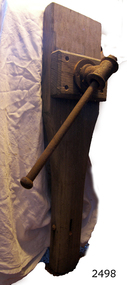 Flagstaff Hill Maritime Museum and Village
Tool - Leg Vice, Prior to 1950
... Vices generally have two parallel jaws, one fixed and the other movable, threaded in and out by a screw and lever. ...Vices generally have two parallel jaws, one fixed and the other movable, threaded in and out by a screw and lever. ...A leg vice is a mechanical apparatus used to secure an object to allow work to be performed on it by a carpenter or cooper such a planning wood. Vices generally have two parallel jaws, one fixed and the other movable, threaded in and out by a screw and lever. A leg vice gives greater holding power or force to a piece of material while a carpenter works on the timber.The subject item at this time cannot be associated with an historical event, person or place, provenance is unknown, item assessed as a collection asset as it is believed to have been produced before 1950.Leg Vice metal attached to cooper's bench Noneflagstaff hill, warrnambool, flagstaff-hill-maritime-museum, maritime-museum, shipwreck-coast, flagstaff-hill-maritime-village, vice, leg vice, coopers tools, workbench vice, carpenters tools, woodworking tools -
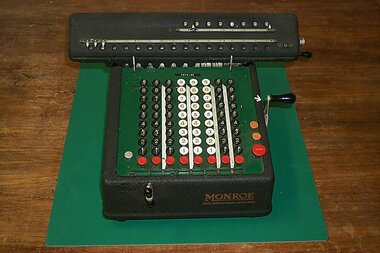 Federation University Historical Collection
Calculator, Monroe High Speed Adding-Calculator
... Addition and subtraction were perfomed by turning the larger side mounted crank forward or backward. the smaller crank lever zeros the two registers. Two buttons are provided to set the machine either to clear the number entry with each revolution of the crank or to repeat the entry. ...Addition and subtraction were perfomed by turning the larger side mounted crank forward or backward. the smaller crank lever zeros the two registers. Two buttons are provided to set the machine either to clear the number entry with each revolution of the crank or to repeat the entry. ...Used before the invention of electronic calculators, mechanical adding machines were most often used for long calculations. This calculator was used in the Ballarat School of Mines Physics Department. Addition and subtraction were perfomed by turning the larger side mounted crank forward or backward. the smaller crank lever zeros the two registers. Two buttons are provided to set the machine either to clear the number entry with each revolution of the crank or to repeat the entry. The largest button resets the keybord to all 0s.A calculator with shiftable carriage and digit separator rods between each row of keys.ballarat school of mines, calculator -
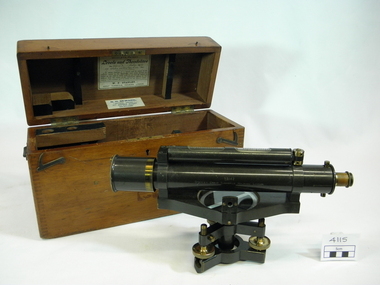 Federation University Historical Collection
Instrument, W. H. Stanley, Surveying level, July 1899
... LEVER (engraved on RHS of brass plate) *Maker's mark is engraved along the length of the telescope barrel: 99142 Stanley. Great Turnstile Holborn, London. Surveyor's level caste in metal with brass trimmings. Features external focus, twin inclined vertical crosshairs with stadia wires. With ray-shade clinomenter. Three levelling screws. Without transverse level (mounting provided). dust shield for object. Features glass lens x 2. Timber carry case features dovetailed joints, separate lid attached to body of case with two ...Used by students attending surveying classes at the School of Mines & Industries, Ballarat.Surveyor's level caste in metal with brass trimmings. Features external focus, twin inclined vertical crosshairs with stadia wires. With ray-shade clinomenter. Three levelling screws. Without transverse level (mounting provided). dust shield for object. Features glass lens x 2. Timber carry case features dovetailed joints, separate lid attached to body of case with two brass piano hinges along back side. Case has a metal carry handle screwed to each end. Matches tripod Item 4116 Item's serial number: 99142*The timber lid of the carry case has 'L3' painted on it in white paint. *The paper label glued to reverse side lid of inside carry box reads: STANLEY'S PATENT LEVELS AND THEODOLITES No.99142 July 1899 STADIA POINTS SET=1 : 100. In taking readings of a distant staff by means of the subtense points in the diaphragm, read every 1/100 foot (or metre) on the staff as being equal to one foot (or metre) of distance from the centre of the instrument adding to the reading of plus constant of 18 3/4 inchess from any distance shown. W.F. Stanley, Great Turnstile, Holborn, London. *The paper label glued to lower edge inside lid of carry box reads: N. H. SEWARD, "Optical House" 457 BOURKE STREET (Near Queen Street) MELBOURNE *Engraving on brass plate encompassing the catch on front edge of the timber carry case reads: H&C L (inside an engraved heart on LSH) EUCHRE LEVER (engraved on RHS of brass plate) *Maker's mark is engraved along the length of the telescope barrel: 99142 Stanley. Great Turnstile Holborn, London. level, theodolite, surveying instrument, surveying, scientific instruments
