
Showing 5 items matching "two masted yacht"
-
 Phillip Island and District Historical Society Inc.
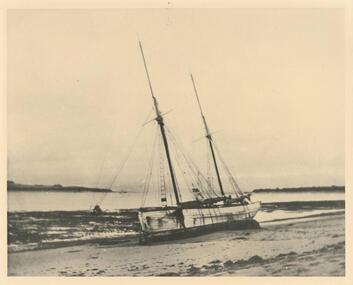
Photograph, c 1950's
... ...two masted yacht...Photograph of a two masted yacht aground on the beach. Seems undamaged....Photograph donated by John Jansson yacht two masted yacht john jansson Photograph of a two masted yacht aground on the beach. ...Photograph donated by John JanssonPhotograph of a two masted yacht aground on the beach. Seems undamaged.yacht, two masted yacht, john jansson -
 Williamstown Historical Society Inc
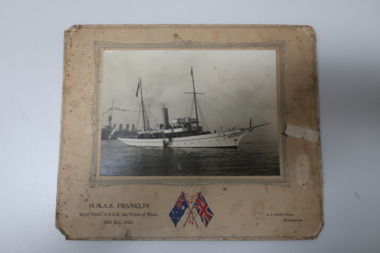
Photograph - Steam Yacht HMAS Franklin, A.C. Green, HMAS Franklin, 1920
... Franklin was a steam yacht with one funnel and two masts. Yacht is under steam. Coloured image of crossed flags of Australia and Britain (symbol of friendship and cooperation) displayed at bottom of frame....Franklin was a steam yacht with one funnel and two masts. Yacht is under steam. Coloured image of crossed flags of Australia and Britain (symbol of friendship and cooperation) displayed at bottom of frame. ...The yacht HMAS Franklin was built in Leith, Scotland. It was acquired by the Royal Australian Navy in 1915 and served as a temporary Royal Yacht for the Prince of Wales (later King Edward V11) during his tour of Australia in 1920, for day trips on Port Phillip Bay.Royal yacht on Port Phillip BayCardboard framed black and white photograph of HMAS Franklin, most probably on Port Phillip Bay. Franklin was a steam yacht with one funnel and two masts. Yacht is under steam. Coloured image of crossed flags of Australia and Britain (symbol of friendship and cooperation) displayed at bottom of frame."H.M.A,S. Franklin/Royal Yacht to HRH the Prince of Wales/28th May, 1920" "A.C. Green, Photo, Williamstown"king edward, hms franklin -
 Flagstaff Hill Maritime Museum and Village
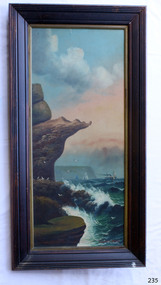
Painting - Oil painting, W. Langley-Taylor, Eagle Rock, Warrnambool, Vic, Late 19th to early 20th century
... Seascape of rock formation and cliffs, two yachts, a two-masted steamboat with red funnel and smoke, flying birds, high waves breaking onto rocks, blue sky with clouds, some tinted pink. ...Seascape of rock formation and cliffs, two yachts, a two-masted steamboat with red funnel and smoke, flying birds, high waves breaking onto rocks, blue sky with clouds, some tinted pink. ...This painting is one of a pair of large works by W. Langley-Taylor in our collection. Further information about the artist has not yet been identified. The pair depicts coastal sites on either side of Port Phillip Bay, south of Melbourne. This work represents Eagle Rock, Warrnambool, on the bay’s western side. Eagle Rock lies about 400 metres west of Thunder Point, near Shelly Beach. The painting shows the cliff formations looking east towards the Warrnambool Breakwater. The site is well known locally, appears in many photographs, and is also a recognised dive location in calm conditions. This stretch of Warrnambool coastline is exposed to the Southern Ocean. In the painting, the breaking waves and northerly drift of smoke from the steamship suggest a strong southerly wind. THE INSCRIPTIONS “Mrs M Irby” and “980/Regency”:- The significance of the inscription “Mrs M Irby”, which appears on the reverse of both paintings, has not been determined. It may refer to the ship or shipping company Irby. Irby was a four-masted iron ship built in Liverpool in 1881. It later traded between London and Australia, including visits to Melbourne and Hobart, before being destroyed by a mine in 1919 while en route to England. Alternatively, “Mrs M Irby” and the pencil inscription “980/Regency” may refer to a delivery address, perhaps an apartment or hotel. This painting is geographically significant for its depiction of Victoria’s coastal scenery. It is also significant as one of a pair of seascapes depicting sites on either side of Port Phillip Bay. Historically, the painting is significant as an example of the late nineteenth- and early twentieth-century methods and materials used in frame construction.Painting oil on board in a dark wooden frame, portrait orientation. Seascape of rock formation and cliffs, two yachts, a two-masted steamboat with red funnel and smoke, flying birds, high waves breaking onto rocks, blue sky with clouds, some tinted pink. The title is painted on the lower left corner, and the artist, W. Langley-Taylor, has signed his name on the lower right. The inscription on the back is handwritten script in red crayon or thick red pencil. The board is held in place inside the timber frame with small, dark metal tacks around all sides. Metal eyes join the wire to the frame. Small, round, dark metal nail heads are dispersed around the frame, and there is a change of colour on both the board and the wood of the frame. Painted on front “W.LANGLEY-TAYLOR.” and “EAGLE ROCK, WARRNAMBOOL, VIC.” Handwritten on back “Mrs. M. Irby” and “980 [underlined] Regency”flagstaff hill, warrnambool, shipwrecked coast, flagstaff hill maritime museum, maritime museum, shipwreck coast, flagstaff hill maritime village, great ocean road, eagle rock warrnambool, w. langley-taylor, oil painting, wall decoration, seascape of victoria's coast, mrs m irby, art, seascape, pair of paintings -
 Melbourne Legacy
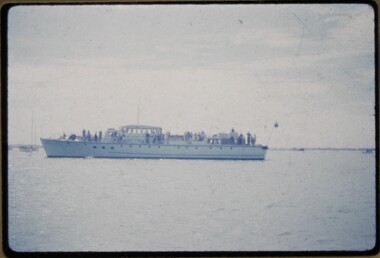
Slide, Operation Float 1960, 1960
... Two colour slides of Operation Float in 1960. One is a large motor boat with children on board. The captions says the ship is the "Commissioner" belonging to the Harbour Trust. The other is a large yacht with two masts...Two colour slides of Operation Float in 1960. One is a large motor boat with children on board. The captions says the ship is the "Commissioner" belonging to the Harbour Trust. The other is a large yacht with two masts ...Two colour slides of Operation Float in 1960. One is a large motor boat with children on board. The captions says the ship is the "Commissioner" belonging to the Harbour Trust. The other is a large yacht with two masts. Operation Float was an event run by Melbourne Legacy to take Junior legatees on an outing. It could have been to naval boats such as HMAS Cerberus or to a Yacht club. It gave the junior legatees the opportunity to see a naval boat in action, spend time on the water or try sailing. Was with many other slides taken in the 1950s and 1960s. The slides have been photographed to make digital images and moved to archive quality sleeves. In many cases the original images were not well focussed and the digital image the best available.A record of outings being organised for children.Colour slide x 2 of ships with children on board in 1960 in Kodachrome off-white cardboard mount with yellow and red print.02997.1 Printed on front 'Made in Australia' and '30' in red ink. Handwritten in blue ink 'Harbour Trusts 'Commissioner' with Legacy Children on board / Operation Float. 27/3/60'. 02997.2 Printed on front 'Made in Australia' and '31' in red ink. Handwritten in blue ink 'Legacy's Operation Float Mar 27 60'. Printed on reverse "Kodachrome Transparency / Processed by Kodak" in red inkoperation float, junior legatee outings -
 Parks Victoria - Gabo Island Lightstation
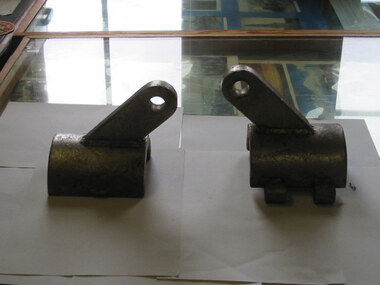
Brackets
... mast or bowsprit. The comparatively recent relics have a reliable provenance to the yacht Gipsy Moth V, which ran ashore on rocks under the lighthouse on 18 December 1982. It was the yacht that carried Sir Francis Chichester (1901-1972) on his second world voyage in 1971. While sailing the 19m (63.5ft) vessel in the 1972 Transatlantic Race, Chichester became weakened by cancer and had to abandon the competition and died two...mast or bowsprit. The comparatively recent relics have a reliable provenance to the yacht Gipsy Moth V, which ran ashore on rocks under the lighthouse on 18 December 1982. It was the yacht that carried Sir Francis Chichester (1901-1972) on his second world voyage in 1971. While sailing the 19m (63.5ft) vessel in the 1972 Transatlantic Race, Chichester became weakened by cancer and had to abandon the competition and died two ...Stainless steel brackets off the wreck of the Gypsy Moth V, wrecked near the lighthouse on 19 December 1982. These brackets were used to hold wire stays to the mast or bowsprit. The comparatively recent relics have a reliable provenance to the yacht Gipsy Moth V, which ran ashore on rocks under the lighthouse on 18 December 1982. It was the yacht that carried Sir Francis Chichester (1901-1972) on his second world voyage in 1971. While sailing the 19m (63.5ft) vessel in the 1972 Transatlantic Race, Chichester became weakened by cancer and had to abandon the competition and died two months later. His son Giles sailed the yacht back to England. In December 1982 British skipper, Desmond Hampton chartered the yacht for the around the world, single handed race. He had been running second and was nearing the end of the second leg of the competition from Cape Town, South Africa to Sydney when the accident happened. After going to bed he set the yacht on self steering and it wedged itself into a crevice just below the lighthouse and broke up. Everything was salvaged except for the masts and the engine. Twenty five years later, in 2007, items salvaged from the wreck surfaced in regional Victoria in a display of the ‘Gipsy Moth V Collection’, which included wreckage as well as photographs. The information from the ‘Sail World’ website did not provide any further details about the exhibition or its organisers.Two similar stainless steel brackets; half tubes with diagonally protruding flat section with hole at end. End is rounded.
