
Showing 150 items matching "type face"
-
 Bendigo Historical Society Inc.
Equipment - Type Face
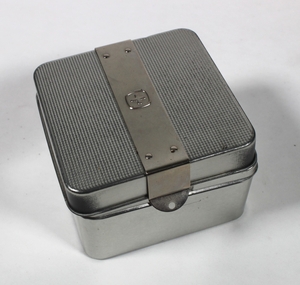
... Type Face ...Type Face...Type Face was used for headings or head lines in a Ludlow machine. ...Inside the box there are eight type faces made of brown coloured metal with gold coloured upper case letters. ...Type Face was used for headings or head lines in a Ludlow machine. ...Type Face was used for headings or head lines in a Ludlow machine. Ron Penna was bornin Bendigo in 1935. He worked at the Bendigo Advertiser newspaper from 1952 as a printer and foreman from 1968. He retired in 1995.A silver coloured metal box, written under the lid - MAKER OF THE GENUINE SWISS ARMY KNIFE and an image of the Swiss flag. Inside the box there are eight type faces made of brown coloured metal with gold coloured upper case letters. The letters spell RON PENNAtype face, ludlow machine, ron penna, bendigo advertiser -
 Flagstaff Hill Maritime Museum and Village
Decorative object - Wall Decoration, Late 19th to early 20th centuries
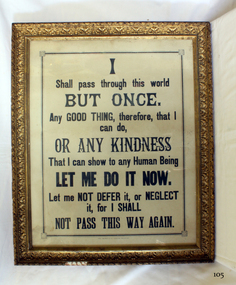
... Printed proverb+ with Varied type face each line....The Giles family collection has social significance at a local level, because it illustrates the level of material support the Warrnambool community gave to Flagstaff Hill when the Museum was established. warrnambool shipwrecked coast flagstaff hill maritime museum wall decoration print of proverb scripture decoration giles collection henry giles tower hill cooramook warrnambool breakwater mailor’s flat wangoom 19th century household goods Printed proverb+ with Varied type face each line. Wall decoration gilded gold ornate frame under glass Decorative object Wall Decoration ...There are many 19th century items of furniture, linen and crockery donated to Flagstaff Hill Maritime Village by Vera and Aurelin Giles. The items are associated with the Giles Family and are known as the “Giles Collection”. These items mostly came from the simple home of Vera’s parents-in-law, Henry Giles and his wife Mary Jane (nee Freckleton), whose photos are in the parlour. They married in 1880. Henry Giles was born at Tower Hill in 1858. He was a labourer on the construction of the Breakwater before leaving in 1895 to build bridges in N.S.W. for about seven years. Mary Jane was born in 1860 at Cooramook. She attended Mailor’s Flat State School where she was also a student teacher before, as family legend has it, she became a governess at “Injemiara” where her grandfather, Francis Freckleton, once owned land. Henry and Mary’s family of six, some of whom were born at Mailor’s Flat and later children at Wangoom, lived with their parents at Wangoom and Purnim west, where Henry died in 1933 and Mary Jane in 1940. The Giles family collection has social significance at a local level, because it illustrates the level of material support the Warrnambool community gave to Flagstaff Hill when the Museum was established.Wall decoration gilded gold ornate frame under glassPrinted proverb+ with Varied type face each line.warrnambool, shipwrecked coast, flagstaff hill maritime museum, wall decoration, print of proverb, scripture decoration, giles collection, henry giles, tower hill, cooramook, warrnambool breakwater, mailor’s flat, wangoom, 19th century household goods -
 Yarrawonga and Mulwala Pioneer Museum
Medallion
... Rectangle shape glass type face set into a metal casing. Hole at the top for attaching....ADI Mulwala Facility "Golden Jubilee" 1944-1999 Rectangle shape glass type face set into a metal casing. Hole at the top for attaching. ...Rectangle shape glass type face set into a metal casing. Hole at the top for attaching.ADI Mulwala Facility "Golden Jubilee" 1944-1999 -
 Wodonga & District Historical Society Inc
Functional object - Haeusler Collection Figsen Laxative Tin, Nyal Company
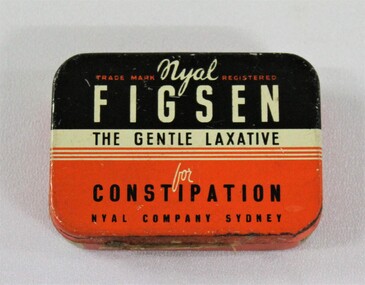
... The tin is white, orange and black with type face on lid. ...The tin is white, orange and black with type face on lid. Haeusler Collection Figsen Laxative Tin Functional object Haeusler Collection Figsen Laxative Tin Nyal Company ...The Wodonga Historical Society Haeusler Collection provides invaluable insight into life in late nineteenth and early twentieth century north east Victoria. The collection comprises manuscripts, personal artefacts used by the Haeusler family on their farm in Wodonga, and a set of glass negatives which offer a unique visual snapshot of the domestic and social lives of the Haeusler family and local Wodonga community. The Haeusler family migrated from Prussia (Germany) to South Australia in the 1840s and 1850s, before purchasing 100 acres of Crown Land made available under the Victorian Lands Act 1862 (also known as ‘Duffy’s Land Act’) in 1866 in what is now Wodonga West. The Haeusler family were one of several German families to migrate from South Australia to Wodonga in the 1860s.This item has well documented provenance and a known owner. It forms part of a significant and representative historical collection which reflects the local history of Wodonga. It contributes to our understanding of domestic and family life in early twentieth century Wodonga, as well as providing interpretative capacity for themes including social history and medical history. A Figsen brand laxative tin manufactured by Sydney company Nyal. The tin is white, orange and black with type face on lid. Text on face of tin reading: "TRADE MARK NYAL REGISTERED/FIGSEN/THE GENTLE LAXATIVE/for/CONSTIPATION/NYAL COMPANY SYDNEY"medicine, medication, medical history, wodonga, haeusler collection, haeusler -
 Flagstaff Hill Maritime Museum and Village
Document - Sheet Music
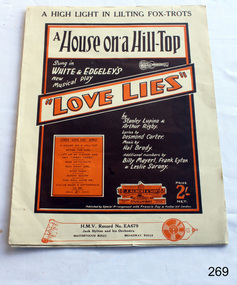
... Features orange and brown cover of various type faces...Features orange and brown cover of various type faces Document Sheet Music ...Sheet music A House on a Hill. Music by Billy Mayerl, words by Frank Eyton. Features orange and brown cover of various type facesflagstaff hill, warrnambool, shipwrecked-coast, flagstaff-hill, flagstaff-hill-maritime-museum, maritime-museum, shipwreck-coast, flagstaff-hill-maritime-village -
 Flagstaff Hill Maritime Museum and Village
Instrument - Clock, 1920s
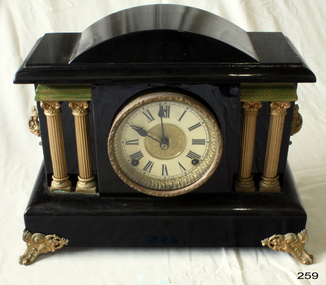
... Clock mantle type face set in a painted black case designed to represent a Greek building with gold decorative pillars. ...Yet it was perhaps inevitable with the advent of electricity along with stiff competition from other clock manufactures that would ultimately herald the end in 1935 of the Sessions company's ability to continue manufacturing mechanical clocks. flagstaff hill warrnambool shipwrecked-coast flagstaff-hill flagstaff-hill-maritime-museum maritime-museum shipwreck-coast flagstaff-hill-maritime-village sessions mantel clock clock clock industries No markings or inscriptions on clock case or mechanism Clock mantle type face set in a painted black case designed to represent a Greek building with gold decorative pillars. ...In 1902, William E Sessions and other family members purchased a controlling interest in the E.N. Welch Company, a clock manufacturer located in Forestville, Connecticut. Sessions' father owned a foundry located in the town of Bristol, Connecticut that produced cases for E.N Welch Co. On January 9, 1903, the company was reorganized and registered as The “Sessions Clock Company”. Within a few years the Sessions Clock Company was producing clock movements, cases, dials, artwork and castings for their line of mechanical clocks. Between 1903 and 1933 Sessions produced 52 models of mechanical clocks, ranging from Advertisers, large and small clocks with logos of various businesses, to wall, or regulator clocks, and shelf or mantel clocks, designed for the home. Many of the Session clocks from this period are prized by collectors. In 1930, the company expanded to produce electric clocks and timers for radios, while continuing to produce traditional brass mechanical movements. Beginning at the end of World War II Sessions W Model (electric) was widely used by various casting companies for their clocks. The dial of the W Model read Movement by Sessions. In the early 1950s Sessions begin to produce timers for television. In 1956, Sessions was absorbed by a company interested mainly in their timing devices. In 1959, William K. Sessions, grandson of William E. Sessions left the Sessions Clock Company and formed the New England Clock Company. In 1960, one of the Sessions Clock buildings was sold to the Bristol Instrument Gears Company. Kept as the Sessions Company, the new owners ran the operation until 1969 when changes in the market forced the Sessions Company into liquidation. In 1970, the remaining buildings were sold to Dabko Industries, a machine parts manufacturer.The item marks a time when clock production in America was at it’s peak producing clocks for sale in many countries, they were keenly priced, mass produced and available to all. The company had a relatively short life span life regards clock manufacture later diversifying into electric timer mechanisms. Yet it was perhaps inevitable with the advent of electricity along with stiff competition from other clock manufactures that would ultimately herald the end in 1935 of the Sessions company's ability to continue manufacturing mechanical clocks. Clock mantle type face set in a painted black case designed to represent a Greek building with gold decorative pillars. Free standing with decorative feet. No markings or inscriptions on clock case or mechanism flagstaff hill, warrnambool, shipwrecked-coast, flagstaff-hill, flagstaff-hill-maritime-museum, maritime-museum, shipwreck-coast, flagstaff-hill-maritime-village, sessions, mantel clock, clock, clock industries -
 Flagstaff Hill Maritime Museum and Village
Document - Sheet Music
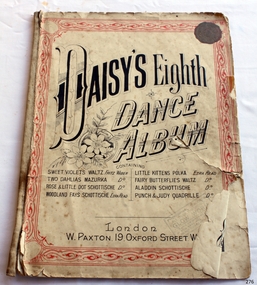
... Sheet music Daisy's Eighth Dance Album Contains other songs. Type face has interesting variations. Cover has red decorative border....flagstaff hill warrnambool shipwrecked-coast flagstaff-hill flagstaff-hill-maritime-museum maritime-museum shipwreck-coast flagstaff-hill-maritime-village Sheet music Daisy's Eighth Dance Album Contains other songs. Type face has interesting variations. Cover has red decorative border. ...Sheet music Daisy's Eighth Dance Album Contains other songs. Type face has interesting variations. Cover has red decorative border.flagstaff hill, warrnambool, shipwrecked-coast, flagstaff-hill, flagstaff-hill-maritime-museum, maritime-museum, shipwreck-coast, flagstaff-hill-maritime-village -
 Bendigo Historical Society Inc.
Document - COHN BROTHERS COLLECTION: MENU, 1968
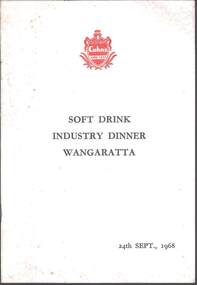
... Cream coloured cover with black type face and crest of Cohn soft drink manufacturers. ...Cream coloured cover with black type face and crest of Cohn soft drink manufacturers. ...Menu for soft drink industry dinner held at Wangaratta 24th September 1968. Cream coloured cover with black type face and crest of Cohn soft drink manufacturers. The dinner was held at the Pinsent Hotel, Reid St. to celebrate the opening of the new Cohn factory and office blockCohn Brothersorganization, business, cohn bros. limited, cohn brothers wangaratta, pinsent hotel, reid st. -
 Ballarat Tramway Museum
Pamphlet, William. F. Scott, Ballarat Vintage Tramway, Jan. 1985
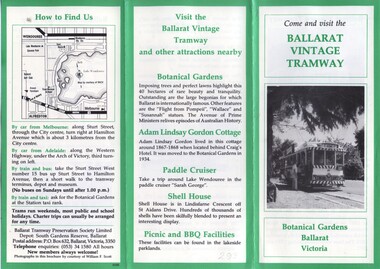
... Printed 6 page fold out pamphlet on Ballarat Vintage Tramway, Featuring 4 black and white photos, 2 maps; one of old Ballarat system, and one part of Lake Wendouree with green boarders and some type face in green ink. Prepared by W.Scott for BTPS in 1984/85. 2nd copy added 1/1/2012...Trams tramways BTPS Ballarat Vintage Tramway Botanical Gardens Printed 6 page fold out pamphlet on Ballarat Vintage Tramway, Featuring 4 black and white photos, 2 maps; one of old Ballarat system, and one part of Lake Wendouree with green boarders and some type face in green ink. Prepared by W.Scott for BTPS in 1984/85. 2nd copy added 1/1/2012 Ballarat Vintage Tramway Pamphlet William. ...Yields information about how the BTPS promoted the tramway, with the Design by the printer and William F Scott.Printed 6 page fold out pamphlet on Ballarat Vintage Tramway, Featuring 4 black and white photos, 2 maps; one of old Ballarat system, and one part of Lake Wendouree with green boarders and some type face in green ink. Prepared by W.Scott for BTPS in 1984/85. 2nd copy added 1/1/2012trams, tramways, btps, ballarat vintage tramway, botanical gardens -
 Heidelberg Theatre Company Inc..
Program Review Articles, Claudia by Rose Franken directed by Mel Morgan
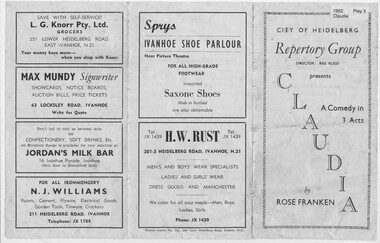
... All items in good condition 1_Photocopy on white A4 paper from scanned original program that is printed on both sides of single sheet. 3_1 photocopy of cutting from unidentified newspaper article. 3_2 Cutting from unidentified newspaper article. Black type face on newsprint paper which has an ecru tone. ...Increased size of audience and detail of the staging and favourable descriptions of the actors and producer. elaine robinson reg morkham stella guererro esme kopman ken proctor elaine hill lois james joyce carthew thora berg reg rudd claudia city of heidelberg repertory group eistdford hall directed by mel morgan All items in good condition 1_Photocopy on white A4 paper from scanned original program that is printed on both sides of single sheet. 3_1 photocopy of cutting from unidentified newspaper article. 3_2 Cutting from unidentified newspaper article. Black type face on newsprint paper which has an ecru tone. ...1_Program contains advertisements from local retailers in Ivanhoe and Eaglemont advertises the forthcoming play, lists the cast and crew, with details of the cast, synopsis of scenes and when each act occurs. 3_1 Refers to detail of staging with ‘average’ acting, with best performance by Lois James. 3_2 Detailed Review, includes performance dates; Thursday 1st and Friday 2nd May, 1952. Increased size of audience and detail of the staging and favourable descriptions of the actors and producer. All items in good condition 1_Photocopy on white A4 paper from scanned original program that is printed on both sides of single sheet. 3_1 photocopy of cutting from unidentified newspaper article. 3_2 Cutting from unidentified newspaper article. Black type face on newsprint paper which has an ecru tone. The Review is glued onto paper. 6_Photocopy of cuttings from unidentified newspaper articles elaine robinson, reg morkham, stella guererro, esme kopman, ken proctor, elaine hill, lois james, joyce carthew, thora berg, reg rudd, claudia, city of heidelberg repertory group, eistdford hall, directed by mel morgan -
 Ballarat Tramway Museum
Pamphlet, Ballarat Tramway Preservation Society (BTPS), Ballarat Tramway Preservation Society, 1971
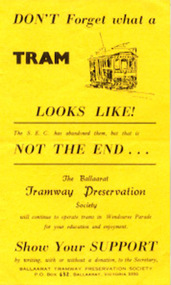
... Has post office box number, but with box number in a different type face, almost handwritten. A large number printed but not used by the BTPS due to the spelling of the word "Ballarat". ...Has post office box number, but with box number in a different type face, almost handwritten. A large number printed but not used by the BTPS due to the spelling of the word "Ballarat". ...Printed single sheet pamphlet, advertising the formation of the BTPS following the end of the SEC system and seeking support. Has a sketch of a bogie tram in the top right hand corner. References to Ballarat spelt with 'aa'. Has post office box number, but with box number in a different type face, almost handwritten. A large number printed but not used by the BTPS due to the spelling of the word "Ballarat". Were used in the depot for many years as scrap paper.trams, tramways, btps, pamphlets, advertisements -
 Whitehorse Historical Society Inc.
Functional object - Printing Press, c 1980
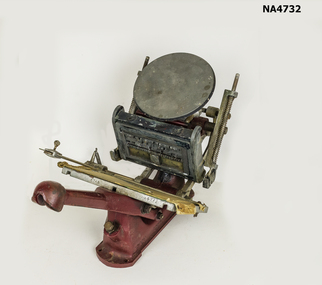
... Lever also operates a mechanism to move a roller to apply ink to the type face. Roller is missing. The press also has a circular plate on top, possibly to hold an ink pad for the roller. ...Lever also operates a mechanism to move a roller to apply ink to the type face. Roller is missing. The press also has a circular plate on top, possibly to hold an ink pad for the roller. ...Last used by 8th Nunawading Boy ScoutsHand operated, single copy press|Red coloured base and lever. Lever operates a grey coloured plate that moves to contact another plate with typeset inserted. Lever also operates a mechanism to move a roller to apply ink to the type face. Roller is missing. The press also has a circular plate on top, possibly to hold an ink pad for the roller. Type on plate reads: 8th Nunawading Boy Scouts, Quarterly Bottle Drive. We will see you Feb 8. Please use Cochrane Street Depot. With Boy Scout logo at bottom. ADANALondon on base of press.ADANALONDON, also number 8746trades, printing -
 Kiewa Valley Historical Society
Resusci-Anne and Equipment
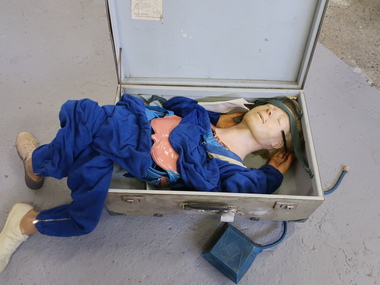
... See KVHS 0542 for Resusci-Anne Repair Kit Doll type model with face, arms and legs folded into a 1950s carrying case. ...Wikipedia Used in the Kiewa Valley by Educators of First Aid and emergency workers Resusci Anne first aid emergency education See KVHS 0542 for Resusci-Anne Repair Kit Doll type model with face, arms and legs folded into a 1950s carrying case. ...Resusci Anne was used for teaching both emergency workers and members of the general public. Developed by Asmund S. Laerdal, Peter Safar, and James Elam and produced by the company Laerdal Medical.The first version of rescue Annie was presented by Laerdal in 1960. Later the design was refined and included a simulated carotid pulse, eye pupils that could dilate and constrict and a system for recording the trainee's resuscitation performance on a paper tape. Ref. WikipediaUsed in the Kiewa Valley by Educators of First Aid and emergency workersSee KVHS 0542 for Resusci-Anne Repair Kit Doll type model with face, arms and legs folded into a 1950s carrying case. The model has blue clothing. Enclosed are the instructions for packing the model and papers for treatment of an unconscious patient.resusci anne, first aid, emergency education -
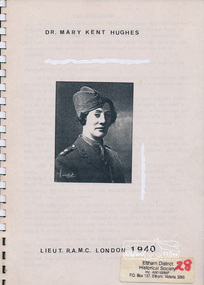 Eltham District Historical Society Inc
Document - Folder, Warrandyte Historical Society, Kent Hughes, 1986
... London 1940; photocopy, 6 typed pages and illustrated face sheet with additional alternate face page and hand written note from author Bruce Bence 2. ...London 1940; photocopy, 6 typed pages and illustrated face sheet with additional alternate face page and hand written note from author Bruce Bence 2. ...Dr Mary Kent Hughes (nee Cantwell) lived in Warrandyte. She served in the second world war and published several books. The manuscript was written by Bruce Bence for the Warrandyte Historical SocietyContents: 1. Manuscript: Dr. Mary Kent Hughes, Lieut. R.A.M.C. London 1940; photocopy, 6 typed pages and illustrated face sheet with additional alternate face page and hand written note from author Bruce Bence 2. Copy of catalogue record: MS 4856 Papers of Sir Wilfrid Kent Hughes (1895-1970), 2 pages A4 inkjet printout detailing scope and content of papers held by National Library of Australia including biographical noteskent hughes, mary, mary kent hughes, sir wilfrid kent hughes -
 Bendigo Historical Society Inc.
Book - BUSH COLLECTION - LEDGER NO 154 - 11/9/1902
... Has description, numbers on Debentures and Total Face Value typed on Receipt. Not signed or dated. ...Has description, numbers on Debentures and Total Face Value typed on Receipt. Not signed or dated. ...a. 546 page ledger book for a General Produce Merchant. No identification but could be Albert Bush? Alphabetical index at front. Approx half the pages are blank. Entries in black ink & Date from Feb 1909 to 1920. Sticker inside front cover with Reference Number - No 154 - 11/9/1902 and the name of the printer Andrew Jack & Co.,347 and 349 Flinders Lane Melbourne. Book has a brown leather cover with a red sticker with gold printing and border and the name Ledger printed on it. Inside the front and back covers is a dark blue, lighter blue and red marble pattern. b. Deposit slip but from The National Bank of Australasia Limited, stamped Bendigo in purple for a deposit of £50 and signed S A Bush. Receipt for Debentures left for Safe Custody, Bairnsdale Branch, due 1923 and 1927. Has description, numbers on Debentures and Total Face Value typed on Receipt. Not signed or dated. Also an unsigned and undated form that the Bank incurs no liability whatever in the event of destruction, theft, miscarriage or loss of the documents in transfer from Bairnsdale to Melbourne. Description of document, their number, value and due date are typed on the form.business, retail, bushs, bush collection - ledger no 154 - 11/9/1902, aust jam coy, bairnsdale district farmers' co-op coy ltd, berry henry, blogg bros, brockoff & coy, bush albert, bush s a, bush f w, bush a estate, bendigo residence 251 view st, bush amy, cordan & co, crosby & co, cannon j e, cockatoo preserves ltd, drevermann & co, dudgeon and arnell, dyason prop ltd, eclipse soap & candle co, felton grimwade & co, fisher j and coy, groves mcvitty & co, gans de saxe coy, harper and co, hagemann j, hawkins a, jack & co a, jefferson miss, kitchen and sons prop ltd, king bros, lewis and whitty, long and coy, levy bros & coy, mitchell and coy, maffra sugar factory, macrobertson, mckenzie j f and coy, mclintock and co a, mcleod's soap coy, noske bros, national bank, peterson and coy, phoenix biscuit coy, power patrick joseph, parsons bros & co, parkin a c and co, potter a, robur tea coy, ross bros, russo bros, ryan w, reid bros james, sutherland & sons, swallow and ariell, saunders a, sniders i & b, sargood bros, sims j & co, k vogt, victoria soap & candle coy, united soap and perfumery co ltd, mcleod's soap coy, war bonds, yates and coy a, yeates jas, the national bank of australasia limited bendigo, commonwealth treasurey bonds -
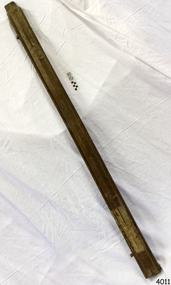 Flagstaff Hill Maritime Museum and Village
Tool - Wood Sample, Before 1878
... The front or upper face is moulded and routed to a regular, linear (skirting board type) design along its entire length, the two sides flat planed. ...The front or upper face is moulded and routed to a regular, linear (skirting board type) design along its entire length, the two sides flat planed. ...On a piece of paper subsequently glued near one end of its curved upper face, this length of planed and polished hardwood timber bears the inscription: “A [p]iece of w[r]ec[k] of the Loch Ard wrecked near Sherbroke River”. The timber is carefully worked with rich dark colouring and a uniformly moulded design, suggesting that it was part of a fitting or furnishing that was publicly visible and prominent. If the artefact is what it is declared to be, then it is possible that it formed part of the ship’s railings or companionway stairs. The LOCH ARD was a 1,693 ton, 3 masted barque, built on the Clyde in 1873. In an age of increasing competition for the emigrant passenger trade from steam-driven vessels, special attention was paid to her wooden furnishings and fittings. The Loch Line owners prided themselves on their attractive, distinctively painted, sailing ships. Below decks, where cargo and third class passengers were stowed, was made of iron. But everything above deck, and on show to the saloon and second class passengers, was carved and varnished timber. Captain Daish’s 1878 report for the ship’s underwriters notes “a quantity of general Cargo washed up in a confused mass” in the cove and “a number of Cases, Casks and Bales; also deals and boards floating about in some of the gorges” further west of the shipwreck. Contemporary newspaper accounts also reported a large quantity of cargo and timber washed ashore in the days following the LOCH ARD shipwreck, adding “but those were speedily removed by persons who came down from Port Campbell, Scott’s Creek and other places with carts and pack horses”. The appearance and good condition of this wood artefact, and the aged patina and dated hand-writing style of its pasted on inscription, support the suggestion that it was ‘souvenired’ from the floating debris of the LOCH ARD at or near the 1878 date of its foundering off Mutton Bird Island. HISTORY OF THE LOCH ARD The LOCH ARD belonged to the famous Loch Line which sailed many ships from England to Australia. Built in Glasgow by Barclay, Curdle and Co. in 1873, the LOCH ARD was a three-masted square rigged iron sailing ship. The ship measured 262ft 7" (79.87m) in length, 38ft (11.58m) in width, 23ft (7m) in depth and had a gross tonnage of 1693 tons. The LOCH ARD's main mast measured a massive 150ft (45.7m) in height. LOCH ARD made three trips to Australia and one trip to Calcutta before its final voyage. LOCH ARD left England on March 2, 1878, under the command of Captain Gibbs, a newly married, 29 year old. She was bound for Melbourne with a crew of 37, plus 17 passengers and a load of cargo. The general cargo reflected the affluence of Melbourne at the time. On board were straw hats, umbrella, perfumes, clay pipes, pianos, clocks, confectionary, linen and candles, as well as a heavier load of railway irons, cement, lead and copper. There were items included that intended for display in the Melbourne International Exhibition in 1880. The voyage to Port Phillip was long but uneventful. At 3am on June 1, 1878, Captain Gibbs was expecting to see land and the passengers were becoming excited as they prepared to view their new homeland in the early morning. But LOCH ARD was running into a fog which greatly reduced visibility. Captain Gibbs was becoming anxious as there was no sign of land or the Cape Otway lighthouse. At 4am the fog lifted. A man aloft announced that he could see breakers. The sheer cliffs of Victoria's west coast came into view, and Captain Gibbs realised that the ship was much closer to them than expected. He ordered as much sail to be set as time would permit and then attempted to steer the vessel out to sea. On coming head on into the wind, the ship lost momentum, the sails fell limp and LOCH ARD's bow swung back. Gibbs then ordered the anchors to be released in an attempt to hold its position. The anchors sank some 50 fathoms - but did not hold. By this time LOCH ARD was among the breakers and the tall cliffs of Mutton Bird Island rose behind the ship. Just half a mile from the coast, the ship's bow was suddenly pulled around by the anchor. The captain tried to tack out to sea, but the ship struck a reef at the base of Mutton Bird Island, near Port Campbell. Waves broke over the ship and the top deck was loosened from the hull. The masts and rigging came crashing down knocking passengers and crew overboard. When a lifeboat was finally launched, it crashed into the side of LOCH ARD and capsized. Tom Pearce, who had launched the boat, managed to cling to its overturned hull and shelter beneath it. He drifted out to sea and then on the flood tide came into what is now known as LOCH ARD Gorge. He swam to shore, bruised and dazed, and found a cave in which to shelter. Some of the crew stayed below deck to shelter from the falling rigging but drowned when the ship slipped off the reef into deeper water. Eva Carmichael had raced onto deck to find out what was happening only to be confronted by towering cliffs looming above the stricken ship. In all the chaos, Captain Gibbs grabbed Eva and said, "If you are saved Eva, let my dear wife know that I died like a sailor". That was the last Eva Carmichael saw of the captain. She was swept off the ship by a huge wave. Eva saw Tom Pearce on a small rocky beach and yelled to attract his attention. He dived in and swam to the exhausted woman and dragged her to shore. He took her to the cave and broke open case of brandy which had washed up on the beach. He opened a bottle to revive the unconscious woman. A few hours later Tom scaled a cliff in search of help. He followed hoof prints and came by chance upon two men from nearby Glenample Station three and a half miles away. In a state of exhaustion, he told the men of the tragedy. Tom returned to the gorge while the two men rode back to the station to get help. By the time they reached LOCH ARD Gorge, it was cold and dark. The two shipwreck survivors were taken to Glenample Station to recover. Eva stayed at the station for six weeks before returning to Ireland, this time by steamship. In Melbourne, Tom Pearce received a hero's welcome. He was presented with the first gold medal of the Royal Humane Society of Victoria and a £1000 cheque from the Victorian Government. Concerts were performed to honour the young man's bravery and to raise money for those who lost family in the LOCH ARD disaster. Of the 54 crew members and passengers on board, only two survived: the apprentice, Tom Pearce and the young woman passenger, Eva Carmichael, who lost all of her family in the tragedy. Ten days after the LOCH ARD tragedy, salvage rights to the wreck were sold at auction for £2,120. Cargo valued at £3,000 was salvaged and placed on the beach, but most washed back into the sea when another storm developed. The wreck of LOCH ARD still lies at the base of Mutton Bird Island. Much of the cargo has now been salvaged and some was washed up into what is now known as LOCH ARD Gorge. Cargo and artefacts have also been illegally salvaged over many years before protective legislation was introduced. One of the most unlikely pieces of cargo to have survived the shipwreck was a Minton porcelain peacock - one of only nine in the world. The peacock was destined for the Melbourne International Exhibition in 1880. It had been well packed, which gave it adequate protection during the violent storm. Today, the Minton peacock can be seen at the Flagstaff Hill Maritime Museum in Warrnambool. From Australia's most dramatic shipwreck it has now become Australia's most valuable shipwreck artefact and is one of very few 'objects' on the Victorian State Heritage Register. The Loch Ard wreck is of state significance – Victorian Heritage Register S417. However there is a lack of documented provenance that limits the interpretive value of this piece of timber (for example, its potential to interpret nineteenth century souveniring and scavenging from shipwrecks along the south west coast of Victoria). Flagstaff Hill’s collection of artefacts from LOCH ARD is significant for being one of the largest collections of artefacts from this shipwreck in Victoria. It is significant for its association with the shipwreck, which is on the Victorian Heritage Register (VHR S417). The collection is significant because of the relationship between the objects, as together they have a high potential to interpret the story of the LOCH ARD. The LOCH ARD collection is archaeologically significant as the remains of a large international passenger and cargo ship. The LOCH ARD collection is historically significant for representing aspects of Victoria’s shipping history and its potential to interpret sub-theme 1.5 of Victoria’s Framework of Historical Themes (living with natural processes). The collection is also historically significant for its association with the LOCH ARD, which was one of the worst and best known shipwrecks in Victoria’s history. A length of hardwood timber, planed and varnished to smooth finish on three sides, with two unfinished tongues protruding from each end (one broken off), possibly from the wreck of the LOCH ARD. The front or upper face is moulded and routed to a regular, linear (skirting board type) design along its entire length, the two sides flat planed. One side contains two inserted dowel rods that have been broken off. The bottom face has not been finished to the same standard. The sample is good quality wood that has retained its density and weight and shows no evidence of having been submerged in seawater for any length of time. Glued on to the upper face of the length of timber near the right hand end is a deteriorated square of paper bearing an inscription. The paper, peeling back and with torn edges, is stuck over an original wood stain but under a subsequent layer of varnish. The faded ink words are indecipherable where paper is missing, but written carefully in an old fashioned cursive script.The inscription on the paper reads: “A [p]iece of w[r]ec[k] of the Loch Ard wrecked near Sherbroke River”. flagstaff hill, warrnambool, shipwrecked coast, flagstaff hill maritime museum, maritime museum, shipwreck coast, flagstaff hill maritime village, great ocean road, loch line, loch ard, captain gibbs, eva carmichael, tom pearce, glenample station, mutton bird island, loch ard gorge, nineteenth-century souveniring, shipwreck scavenging, loch line sailing ships, wood sample -
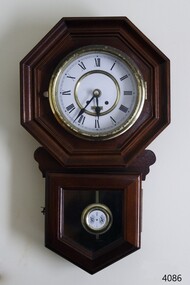 Flagstaff Hill Maritime Museum and Village
Functional object - Wall Clock
... Clock, wall type, octagonal shape wood case, glass face, pendulum, Roman numerals, hinged door, battery operated. ...Inside case "Made in Japan" Clock, wall type, octagonal shape wood case, glass face, pendulum, Roman numerals, hinged door, battery operated. ...This clock is of modern manufacture, replicating the design of early 20th century kitchen clocks.The kitchen wall clock is displayed as an example of an early 20th-century clock. It is used to demonstrate the progression of clock design over the past century. Clock, wall type, octagonal shape wood case, glass face, pendulum, Roman numerals, hinged door, battery operated. Inscription on dial and inside battery compartment. Japanese manufacture.On dial :"Security". Inside case "Made in Japan"flagstaff hill, warrnambool, shipwrecked-coast, flagstaff-hill-maritime-museum, maritime-museum, shipwreck-coast, flagstaff-hill-maritime-village, wall clock, replica, japan, kitchen clock, security, horology, time keeping, roman numerals -
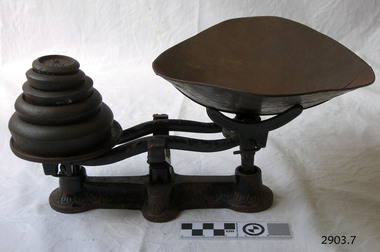 Flagstaff Hill Maritime Museum and Village
Instrument - Scale, Early 20th century
... face. The ease of use of spring scales over balance scales. One of the most common types of spring scales was the kitchen scale also known as a family or dial scale. ...face. The ease of use of spring scales over balance scales. One of the most common types of spring scales was the kitchen scale also known as a family or dial scale. ...The basic balance scale has been around for thousands of years and its accuracy has improved dramatically over the last several centuries, the principle behind this tool remains unchanged. Its parts include a fulcrum, a beam that balances on it, a pan at the end of the beam to hold the materials to be weighed, and a flat platform at the other for the counter-balancing weights. Balance scales that require equal weights on each side of the fulcrum have been used by everyone from apothecaries and assayers to jewellers and postal workers. Known as an unequal arm balance scale, this variety builds the counterweight into the device. Counter scales used in dry-goods stores and domestic kitchens often featured Japanned or (blackened) cast iron with bronze trims. Made by companies such as Howe and Fairbanks, the footed tin pans of these scales were often oblong, some encircled at one end so bulk items could be easily poured into a bag. Seamless pans were typically stamped from brass and given style names like Snuff (the smallest) and Birmingham (the largest). Some counter scales were designed for measuring spices, others for weighing slices of cake. In the 18th century, spring scales began to appear and would use the resistance of spring to calculate weights, which are read automatically on the scale’s face. The ease of use of spring scales over balance scales. One of the most common types of spring scales was the kitchen scale also known as a family or dial scale. Designed for horizontal surfaces, these vintage kitchen scales used the weight of goods in a pan at the top of the scale to force the spring down rather than the balance system. Such scales were common in early 20th century households and were sold by many companies. Many had flat weighing surfaces but some were topped by shallow pans. Companies such as Salters, Chatillon, and Fairbanks were the most popular brands used. These scales are significant as they identify one of the basic preparation items for the weighing of foodstuff in the family kitchen to prepare everyday meals. This item is significant as it gives a snapshot into domestic life within the average home in Australia around the turn of the twentieth century and is, therefore, an item with social relevance. Black cast iron, medium weighing scales, with a fulcrum which the beam that balances on, there is as scoop at one end for the material to be weighted and a flat circular disc at the other end that holds the weights. Around the cast iron base is an embossed leaf pattern. All the weights have their weight embossed within the casting.There are 5 weights, marked 2 oz, 4 oz,8 oz,1 lb,2 lb, This scale does not have any visual markings on the arms to identify a maker or true balance. It is therefore assumed that these scales were made for domestic use only.flagstaff hill, warrnambool, shipwrecked-coast, flagstaff-hill, flagstaff-hill-maritime-museum, maritime-museum, shipwreck-coast, flagstaff-hill-maritime-village, spring scale, scale -
 Flagstaff Hill Maritime Museum and Village
Parallel Rule, Early 20th Century
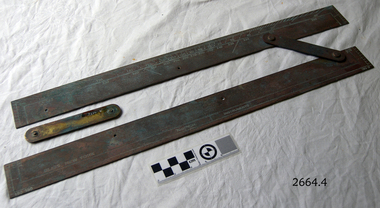
... The item was made by a well known American maker of nautical instruments and is significant in regards to it's provenience and history of the maker and his family who over the years had been innovators and makers of various types of nautical instruments since 1795. flagstaff hill warrnambool shipwrecked-coast flagstaff-hill flagstaff-hill-maritime-museum maritime-museum shipwreck-coast flagstaff-hill-maritime-village parallel rule map reading nautical object navigation instrument Bliss of New York & Nautical instruments engraved on face of ruler, ruler divided into degrees for use on nautical maps Parallel map ruler. ...John Bliss (1795-1857) was born in Norwich Connecticut, trained as a silversmith and clockmaker in Vermont, and began in business as a jeweller in New York around 1830. In 1834, now trading as Bliss & Creighton, he made and marketed a range of nautical instruments. The business subsequently became John Bliss & Son in 1855 and John Bliss & Co. in 1857. It remained in business until 1957 when it was acquired by West Marine. The Bliss company used to make a range of instruments supplied to a variety of customers including the US Navy. An object made as an aid for marine navigation, to plot a course on a nautical map for a vessel to follow. The item was made by a well known American maker of nautical instruments and is significant in regards to it's provenience and history of the maker and his family who over the years had been innovators and makers of various types of nautical instruments since 1795. Parallel map ruler. Bliss of New York & Nautical instruments engraved on face of ruler, ruler divided into degrees for use on nautical mapsflagstaff hill, warrnambool, shipwrecked-coast, flagstaff-hill, flagstaff-hill-maritime-museum, maritime-museum, shipwreck-coast, flagstaff-hill-maritime-village, parallel rule, map reading, nautical object, navigation instrument -
 Flagstaff Hill Maritime Museum and Village
Cap Liner, Between 1870 and 1908
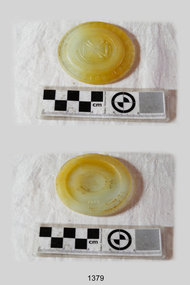
... The different emblems of triangles, circles, and crosses embossed on the front face of the liners are assumed to signify mould or model types rather than the company that produced them. ...The different emblems of triangles, circles, and crosses embossed on the front face of the liners are assumed to signify mould or model types rather than the company that produced them. ...This Zinc Cap Porcelain Liner was recovered from the (1908) shipwreck site of the FALLS OF HALLADALE. The purpose of cap liners was to assist with the safe preserving and storage of perishable foodstuffs in an age when refrigeration was generally unavailable. These round, coarse-glass inserts formed part of the screw lids used with the Ball Mason style of canning fruit jars. The liner was placed inside the zinc cap to stop the contents of the jar reacting with the zinc. It prevented the metallic tainting of food as well as the corrosion of the metallic lid. On March 30, 1869, Lewis R Boyd was issued with patent # 88439 for an “Improved Mode of Preventing Corrosion in Metallic Caps”. From the 1870s to the 1950s, large quantities of these liners were produced by a number of glass manufacturing companies. They are consequently difficult to date or identify. “It is assumed that most of the earlier versions of these liners have the name ‘BOYD’S’ or ‘BOYD’ embossed on them. Later versions may or may not have the name included in the lettering”. (http://www.glassbottlemarks.com). Only a few were made of porcelain, the great majority being made first of transparent and later of translucent or opaque glass. The different emblems of triangles, circles, and crosses embossed on the front face of the liners are assumed to signify mould or model types rather than the company that produced them. This particular artefact is one of 14 cap liners that were retrieved from the shipwreck site and are now part of the Flagstaff Hill Maritime Village collection. The Maltese Cross and “BOYD’S GENUINE PORCELAIN LINED” lettering are unique to this piece. However, it is evident from the markings and materials of the other cap liners, that they originally formed sets or series. Six are larger (8 mm depth x 85mm diameter), of greenish hue with ground glass texture, and support the raised emblem of a compass needle. Two are medium-sized (75mm diameter) with two raised dots in a central circle and the lettering “Patd. APR 25.82”. This particular cap liner is likely to have also been one of a mass-produced line being imported from America. The iron-hulled sailing ship FALLS OF HALLADALE was a bulk carrier of general cargo en route from New York to Melbourne and Sydney. In her hold, along with 56,763 tiles of unusual beautiful green American slates (roofing tiles), 5,673 coils of barbed wire, 600 stoves, 500 sewing machines, 6500 gallons of oil, 14400 gallons of benzene, and many other manufactured items, were 117 cases of crockery and glassware. The FALLS OF HALLADALE came aground on a reef off the Peterborough headland at 3 am on the morning of the 15th of November, 1908. The captain and 29 crew members all survived, but her valuable cargo was largely lost, despite two salvage attempts in1908-09 and 1910. The iron-hulled, four-masted barque, the Falls of Halladale, was a bulk carrier of general cargo. She left New York in August 1908 on her way to Melbourne and Sydney. In her hold, along with 56,763 tiles of unusual beautiful green American slates (roofing tiles), 5,673 coils of barbed wire, 600 stoves, 500 sewing machines, 6500 gallons of oil, 14400 gallons of benzene, and many other manufactured items, were 117 cases of crockery and glassware. Three months later and close to her destination, a navigational error caused the Falls of Halladale to be wrecked on a reef off the Peterborough headland at 3 am on the morning of the 15th of November, 1908. The captain and 29 crew members all survived, but her valuable cargo was largely lost, despite two salvage attempts in 1908-09 and 1910. ABOUT THE ‘FALLS OF HALLADALE’ (1886 - 1908) Built: in1886 by Russell & Co., Greenock shipyards, River Clyde, Scotland, UK. The company was founded in 1870 (or 1873) as a partnership between Joseph Russell (1834-1917), Anderson Rodger and William Todd Lithgow. During the period 1882-92 Russell & Co., they standardised designs, which sped up their building process so much that they were able to build 271 ships over that time. In 1886 they introduced a 3000 ton class of sailing vessel with auxiliary engines and brace halyard winches. In 1890 they broke the world output record. Owner: Falls Line, Wright, Breakenridge & Co, 111 Union Street, Glasgow, Scotland. Configuration: Four masted sailing ship; iron-hulled barque; iron masts, wire rigging, fore & aft lifting bridges. Size: Length 83.87m x Breadth 12.6m x Depth 7.23m, Gross tonnage 2085 ton Wrecked: the night of 14th November 1908, Curdies Inlet, Peterborough south west Victoria Crew: 29 The Falls of Halladale was a four-masted sailing ship built-in 1886 in Glasgow, Scotland, for the long-distance cargo trade and was mostly used for Pacific grain trade. She was owned by Wright, Breakenridge & Co of Glasgow and was one of several Falls Line ships, all of which were named after waterfalls in Scotland. The lines flag was of red, blue and white vertical stripes. The Falls of Halladale had a sturdy construction built to carry maximum cargo and able to maintain full sail in heavy gales, one of the last of the ‘windjammers’ that sailed the Trade Route. She and her sister ship, the Falls of Garry, were the first ships in the world to include fore and aft lifting bridges. Previous to this, heavily loaded vessels could have heavy seas break along the full length of the deck, causing serious injury or even death to those on deck. The new, raised catwalk-type decking allowed the crew to move above the deck stormy conditions. This idea is still used today on the most modern tankers and cargo vessels and has proved to be an important step forward in the safety of men at sea. On 4th August 1908, with new sails, 29 crew, and 2800 tons of cargo, the Falls of Halladale left New York, bound for Melbourne and Sydney via the Cape of Good Hope. The cargo on board was valued at £35,000 and included 56,763 tiles of American slate roofing tiles (roof slates), 5,673 coils of barbed wire, 600 stoves, 500 sewing machines, 6,500 gallons of oil, 14,400 gallons of benzene, plumbing iron, 117 cases of crockery and glassware and many other manufactured items. The Falls of Halladale had been at sail for 102 days when, at 3 am on the night of 14th November 1908, under full sail in calm seas with a six knots breeze behind and misleading fog along the coast, the great vessel rose upon an ocean swell and settled on top of a submerged reef near Peterborough on south-west Victoria’s coast. The ship was jammed on the rocks and began filling with water. The crew launched the two lifeboats and all 29 crew landed safely on the beach over 4 miles away at the Bay of Islands. The postmistress at Peterborough, who kept a watch for vessels in distress, saw the stranding and sent out an alert to the local people. A rescue party went to the aid of the sailors and the Port Campbell rocket crew was dispatched, but the crew had all managed to reach shore safely by the time help arrived. The ship stayed in full sail on the rocky shelf for nearly two months, attracting hundreds of sightseers who watched her slowly disintegrate until the pounding seas and dynamiting by salvagers finally broke her back, and her remains disappeared back into deeper water. The valuable cargo was largely lost, despite two salvage attempts in 1908-09 and 1910. Further salvage operations were made from 1974-1986, during which time 22,000 slate tiles were recovered with the help of 14 oil drums to float them, plus personal artefacts, ship fittings, reams of paper and other items. The Court of Marine Inquiry in Melbourne ruled that the foundering of the ship was entirely due to Captain David Wood Thomson’s navigational error, not too technical failure of the Clyde-built ship. The shipwreck is a popular site for divers, about 300m offshore and in 3 – 15m of water. Some of the original cargo can be seen at the site, including pieces of roof slate and coils of barbed wire. The Falls of Halladale shipwreck is listed on the Victorian Heritage Register (No. S255). She was one of the last ships to sail the Trade Routes. She is one of the first vessels to have fore and aft lifting bridges. She is an example of the remains of an International Cargo Ship and also represents aspects of Victoria’s shipping industry. The wreck is protected as a Historic Shipwreck under the Commonwealth Historic Shipwrecks Act (1976). A circular translucent glass disc in good condition with raised upper case lettering around 8mm rim – “BOYD’S GENUINE PORCELAIN LINED” - and a raised central emblem of a Maltese Cross. On the reverse face in the centre of the disc, there is a raised numeral “3”. falls of halladale, wright, breakenridge & co of glasgow, unusual beautiful green american slates (roofing tiles), warrnambool, shipwrecked-coast, flagstaff-hill, flagstaff-hill-maritime-museum, maritime-museum, shipwreck-coast, flagstaff-hill-maritime-village, shipwrecked-artefact, zinc cap porcelain liner, boyd’s genuine porcelain lined, glass lid, opaque disc, food preserving, fruit bottling, cap liner, shipwrecked coast, flagstaff hill maritime museum, shipwreck artefact, 1908 shipwreck -
 Flagstaff Hill Maritime Museum and Village
Domestic object - Vanity Jar, 1920s
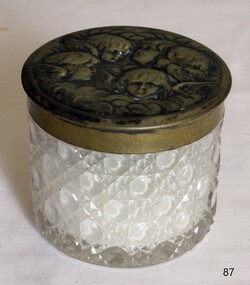
... An item used to store face cream from the 1920s when face creams and other cosmetics started to become available to all classes of women and no longer were these types of preparations only available to women of financial means. flagstaff hill warrnambool shipwrecked coast flagstaff hill maritime museum maritime museum shipwreck coast flagstaff hill maritime village great ocean road glass jar cosmetics jar toilet article Lid decorated with a relief design of 5 cherub heads and clouds Clear glass jar with "hobnail" pattern and brass lid used to hold face cream cosmetics. ...Skincare cosmetics used for ageing skin have been a priority for over 3000 years, in ancient times masks were used to cleanse and maintain the moisture of the skin. The Egyptians used anti-wrinkle creams made with the essential oil of frankincense which claimed to possess anti-inflammatory properties. Thick creams use on the face were created to preserve moisture on mature skin. And were formulated from resin, wax, oil, grass, and plant juice, In the 1700s, face toners and scented water were popular. Cold cream made with scented oils, spermaceti, and wax mixed with rose water and ambergris was a common toilette preparation. But it was the 20th century when face cosmetics entered their golden era and mass production made cosmetics available to women of all classes. An item used to store face cream from the 1920s when face creams and other cosmetics started to become available to all classes of women and no longer were these types of preparations only available to women of financial means.Clear glass jar with "hobnail" pattern and brass lid used to hold face cream cosmetics.Lid decorated with a relief design of 5 cherub heads and cloudsflagstaff hill, warrnambool, shipwrecked coast, flagstaff hill maritime museum, maritime museum, shipwreck coast, flagstaff hill maritime village, great ocean road, glass jar, cosmetics jar, toilet article -
 Flagstaff Hill Maritime Museum and Village
Instrument - Chronometer
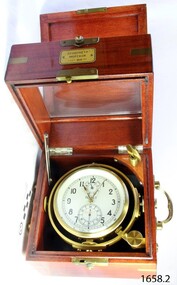
... type regarded as very accurate and well made. The maker, First Watch Factory, has a dept that is still producing the "8916" standard Chronometer for horologists and collectors. flagstaff hill warrnambool shipwrecked-coast flagstaff-hill flagstaff-hill-maritime-museum maritime-museum shipwreck-coast flagstaff-hill-maritime-village chonometer russian watch factory marine navigational instrument Inscription on box are in Russian & translate as follows: ХРОНОМЕТР, = CHRONOMETER МОРСКОЙ, = NAUTICAL ГОСТ, 8916-77 = Gost ЛОЛ ЕТ, on dial face = LOL ET Marine chronometer of Russian make in wooden case, metal handles on sides, inscription on a metal plaque on the front of the case. ...First State Watch Factory: This factory was founded in 1930 under orders from Joseph Stalin, the "First State Watch Factory" was the first large-scale Soviet watch and mechanical movement manufacturer in the USSR. Via its USA-based trading company (Amtorg), the Soviet government bought the defunct Ansonia Clock Company of Brooklyn, New York in 1929, and the "Dueber-Hampden Watch Company of Canton", based in Ohio. The soviets moved twenty-eight freight cars full of machinery and parts from the USA to Moscow in order to establish the factory. Twenty-one former "Dueber-Hampden" watchmakers, engravers and various other technicians helped to train the Russian workers in the art of watchmaking as part of the Soviet's first five-year plan. The movements of very-early products were still stamped "Dueber-Hampden, Canton, Ohio, USA" (examples of these watches are very collectible today). In 1935 the factory was named after the murdered Soviet official Sergei Kirov. During the second world war, as the Germans closed in on Moscow in 1941, the factory was hurriedly evacuated to (Zlatoust USSR). By 1943 the Germans were in retreat, and the factory was moved back to Moscow, adopting the "First Moscow Watch Factory" name. In 1947 the first wristwatches under the brand name "Pobeda" and the first Marine Chronometers and Deck watches were produced. By 1951 the production of wristwatches had increased to 1.1 million. In 1975 new machinery and equipment for manufacturing complex watches were imported from Switzerland. The first chronograph called "Okean" (3133) was produced for the space station "Soyuz-23."The Chronometer is of recent manufacture and an excellent example of the type of instrument used to navigate the seas in the 19th century. It is of good quality and of a type regarded as very accurate and well made. The maker, First Watch Factory, has a dept that is still producing the "8916" standard Chronometer for horologists and collectors. Marine chronometer of Russian make in wooden case, metal handles on sides, inscription on a metal plaque on the front of the case. Polished square wooden outer case with green felt lining and, a leather carrying strap and buckle. Outer case is hinged and has a metal latch on the front. Outer case has a red velvet covering with a button and loop closure. Inscription on box are in Russian & translate as follows: ХРОНОМЕТР, = CHRONOMETER МОРСКОЙ, = NAUTICAL ГОСТ, 8916-77 = Gost ЛОЛ ЕТ, on dial face = LOL ETflagstaff hill, warrnambool, shipwrecked-coast, flagstaff-hill, flagstaff-hill-maritime-museum, maritime-museum, shipwreck-coast, flagstaff-hill-maritime-village, chonometer, russian, watch factory, marine, navigational instrument -
 Mission to Seafarers Victoria
Container - Small Wood Drawer
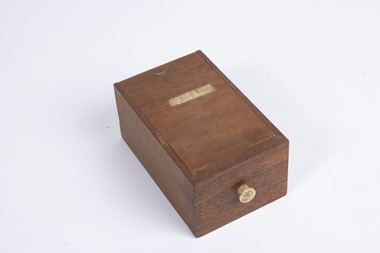
... Rochelle salts, or potassium sodium tartrate, are a type of tartaric acid which was used medically as a laxative similar to sena and tartar Emetic. volum collection medicine Rochelle Salts The right one of two marching small sized wood drawers. Each drawer features one sliding lid on their top face ...Rochelle salts, or potassium sodium tartrate, are a type of tartaric acid which was used medically as a laxative similar to sena and tartar Emetic.The right one of two marching small sized wood drawers. Each drawer features one sliding lid on their top face which has a corresponding paper label depending on its contents as well as a small semi-circle notch, these lids slide vertically in one direction. These drawers are found in the front storage location of the parent item and bellow a row of medium sized drawers.Rochelle Saltsvolum collection, medicine -
 Federation University Historical Collection
Object, Synchronome Co. Ltd, Synchronome Frequency Checking Master Clock No. 2191, c1930
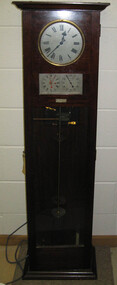
... Face of main clock: "Synchronome Electric" Two clocks in a timber case. Both are electric, one is powered by the main pendulum mechanism, the other is a self contained electric clock. The main mechanism is of the gravity arm and roller type ...Information from Norman F. Dalton: Ballarat had a reticulated DC supply in the early part of last century and in 1905 had sufficient generating capacity to enable the trams to be changed from horse drawn to DC electricity. The use of electricity increased with the main power station located on Wendouree Parade, near Webster Street, under the ownership of The Electric Supply Company of Victoria. AC generating plant was installed in 1925 and conversion to AC proceeded. In 1934 the company was taken over by the State Electricity Commission Victoria (SECV) and more AC generation was installed and the changeover of customers was accelerated. This is around the time that the Synchronome Frequency Checking Mast Clock was installed at the Wendouree Parade Power Station. The SECV Annual Report of 1921 states: ::Section 11 of the act directed the COmmission to enquire into the question of securing the adoption of such standards of plant and equipment of a system, frequency and pressure for the generation and distribution of electricity as will admit of the efficient interconnection of undertakings throughout the State. In 1934 when the SECV took over the Ballarat operations the question of linking with the State grid had been a planned operation for some years but due to financial considerations had hindered it and in fact would continue to do so for a further 10 years. So while the need for close frequency control for interconnection was hardly an issue, the need to keep electric clocks correct was important, particularly as this item was a frequent sales point to cover the inconvenience and sometimes expense of converting from DC to AC. The clock is a very accurate pendulum clock with provision for varying effective length during operation for precise time regulation. There are two normal time dials and one is controlled by the pendulum and the other is operated by the system frequency. When the clock was in use it was installed by the MEter and Tests Laboratory and the time was checked daily by radio time signals. The two dials were repeated in the operators control panel in the Power Station. A maximum deviation between the two dials was set in the operating instructions (eg 5 seconds) and the operator would correct this when necessary by remote manual alteration of the turbine governor set point. The clock was used to drive and regulate a system of "slave" clocks which were used to display the time in various locations around the power station. A slave clock is a simple clock which is driven by a small electric motor, its accuracy is regulated by the master clock every 30 seconds to ensure that it and all the other slave clocks in the station are on exactly the right time; slave clocks were placed in various locations, from common rooms to workshops. A master clock could potentially run thousands of slave clocks at one plant. The clock also contains a rectifier. A rectifier is a device that is used to convert AC power to more stable DC current.Two clocks in a timber case. Both are electric, one is powered by the main pendulum mechanism, the other is a self contained electric clock. The main mechanism is of the gravity arm and roller type, which sends an impulse to the slave clocks every 30 seconds. The This Synchronome Frequency Checking Master Clock was used at the Ballarat Power Station. Below the main section of the case is a smaller cabinet containing a rectifier to provide consistent DC power for the clock. The rectifier was made by the Victorian company Hilco, which was located in Burwood. There is a high chance this is not the original rectifier from this clock as there appears to be brackets to hold a larger device in the space the rectifier occupies.Front below main clock face on front of case: "Patented Sychronome Brisbane" Lower left-hand clock face: "Frequency time" Lower right-hand clock face: "Standard Seconds" Synchronous electric clock mechanism on door (Frequency time clock): >200/250 V. 50~ >"Synchronomains" Made in England >Direction indicator for clock starting switch >"To start move lever in direction of arrow and release" >"Patent applied for" Mechanism for "standard seconds" clock: >"English Made" >"Patented" >Serial number "321" >0 above right-hand pillar on front-plate Mechanism for "standard seconds" clock: >"English Made" >"Patented" >Serial number "321" >0 above right-hand pillar on front-plate Mechanism for main clock face: >"English Made" >"Patented" >Serial number "8751" >0 above right-hand pillar on front-plate Inside case, back panel, top enamel plate: >Seconds Battery + Pos. > Battery Common or - Neg. >1/2 min dials Inside case, back panel, bottom enamel plate: external seconds dial Inside case, right hand side, electrical knobs: two switches, both "A.C. mains" Pendulum rod, below suspension spring: Serial number (?) 0000005 Rectifier in bottom cabinet: >"Hilco Rectifier" >"A.C. Volts 230/240" >"Model 1060/S" >"A.C. Amperes" >"Serial No. 1060/S >"Phases 1" >"D.C. Volts 6" >"C.P.S. 50" >"D.C. Amperes 1" >"Made in Australia by Hilco Transformers McIntyre St., Burwood, Victoria." Bakelite electrical plug: makers mark Lower cabinet, RH side panel, pressed tin plate: "AC" (upside down) Brass speed adjustment, outer right RH side: "S" and "F" Ivory and wood pendulum beat ruler: >Ruler, with 0 in centre and numbers 1-5 in ascending order from centre on left and right. > "Synchronome Patent." Steel plate, back panel, inside case, right hand side: >N R A" (descending) >"2191" serial number/part number Face of main clock: "Synchronome Electric" synchronome frequency checking master clock, electricity, state electricity commission, wendouree parade power station, secv, clock, time, pendulum, electric supply company of victoria, norman f. dalton, ballarat power station, rectifier, slave clock -
 Nhill Aviation Heritage Centre
Radio Receiver CR-6B, Amalgamated Wireless Australiasia, Early 1960s
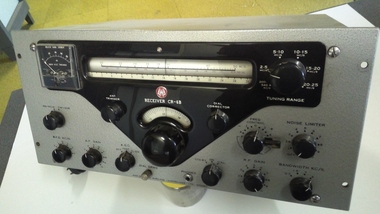
... This radio receiver type was used in Aeradio radio receiver, awa, aeradio, cr 6 Amalgamated Wireless (Australiasia) Ltd Sydney CR-6B Metalic grey colour, with bakerlite face with dial. 12 adjusting knobs and 2 frequency instrument meters. ...This type was used in the later period of Aeradio in the 1960s Sometimes in later years for monitoring NDB operation.This radio receiver type was used in AeradioMetalic grey colour, with bakerlite face with dial. 12 adjusting knobs and 2 frequency instrument meters.Amalgamated Wireless (Australiasia) Ltd Sydney CR-6Bradio receiver, awa, aeradio, cr 6 -
 Flagstaff Hill Maritime Museum and Village
Book - Reference Book, Gracius J Broinowski, The Birds of Australia Vol 3-4, 1890-1891
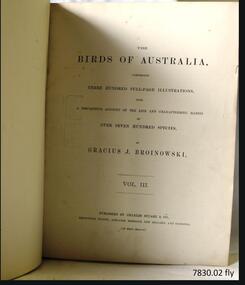
... faced hardships in Europe and London before sailing to Australia. He initially worked rural jobs in Victoria, then joined a Melbourne publishing firm, traveling across Victoria, New South Wales, and Queensland to paint landscapes and sell art via "art unions." Label on spine cover with typed ...Gracius Joseph Broinowski was a Polish-born artist and ornithologist who became a key figure in documenting Australian wildlife. Born on 7 March 1837 near Wielun, Poland, he studied languages, classics, and art at Munich University before emigrating to Australia around 1857 to avoid conscription. Broinowski faced hardships in Europe and London before sailing to Australia. He initially worked rural jobs in Victoria, then joined a Melbourne publishing firm, traveling across Victoria, New South Wales, and Queensland to paint landscapes and sell art via "art unions."The Birds of Australia Vol 3-4 Author and Illustrator: Gracius J Broinowski Publisher: Charles Stuart & Co Date: 1890 - 1891non-fictionGracius Joseph Broinowski was a Polish-born artist and ornithologist who became a key figure in documenting Australian wildlife. Born on 7 March 1837 near Wielun, Poland, he studied languages, classics, and art at Munich University before emigrating to Australia around 1857 to avoid conscription. Broinowski faced hardships in Europe and London before sailing to Australia. He initially worked rural jobs in Victoria, then joined a Melbourne publishing firm, traveling across Victoria, New South Wales, and Queensland to paint landscapes and sell art via "art unions." the birds of australia vol 1-2, flagstaff hill, warrnambool, shipwrecked coast, flagstaff hill maritime museum, maritime museum, shipwreck coast, flagstaff hill maritime village, great ocean road, the birds of australia, gracius joseph broinowski, charles stuart & co, joseph archibald, warrnambool public museum, warrnambool museum, warrnambool library, warrnambool art gallery, warrnambool city librarian, pattison collection, ralph eric pattison, samuel hannaford, warrnambool mechanics’ institute and free library, mechanics’ institute library, victorian library board, warrnambool books and records, rare books, australian bird illustrations, australian bird text, australian natural history -
 Flagstaff Hill Maritime Museum and Village
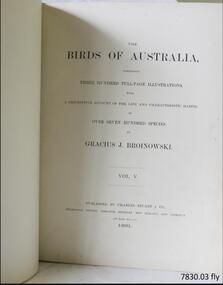
Book - Reference Book, Gracius J Broinowski, The Birds of Australia Vol 5-6, 1890-1891
... faced hardships in Europe and London before sailing to Australia. He initially worked rural jobs in Victoria, then joined a Melbourne publishing firm, traveling across Victoria, New South Wales, and Queensland to paint landscapes and sell art via "art unions." Label on spine cover with typed ...Gracius Joseph Broinowski was a Polish-born artist and ornithologist who became a key figure in documenting Australian wildlife. Born on 7 March 1837 near Wielun, Poland, he studied languages, classics, and art at Munich University before emigrating to Australia around 1857 to avoid conscription. Broinowski faced hardships in Europe and London before sailing to Australia. He initially worked rural jobs in Victoria, then joined a Melbourne publishing firm, traveling across Victoria, New South Wales, and Queensland to paint landscapes and sell art via "art unions."The Birds of Australia Vol 5-6 Author and Illustrator: Gracius J Broinowski Publisher: Charles Stuart & Co Date: 1890 - 1891non-fictionGracius Joseph Broinowski was a Polish-born artist and ornithologist who became a key figure in documenting Australian wildlife. Born on 7 March 1837 near Wielun, Poland, he studied languages, classics, and art at Munich University before emigrating to Australia around 1857 to avoid conscription. Broinowski faced hardships in Europe and London before sailing to Australia. He initially worked rural jobs in Victoria, then joined a Melbourne publishing firm, traveling across Victoria, New South Wales, and Queensland to paint landscapes and sell art via "art unions." the birds of australia vol 1-2, flagstaff hill, warrnambool, shipwrecked coast, flagstaff hill maritime museum, maritime museum, shipwreck coast, flagstaff hill maritime village, great ocean road, the birds of australia, gracius joseph broinowski, charles stuart & co, joseph archibald, warrnambool public museum, warrnambool museum, warrnambool library, warrnambool art gallery, warrnambool city librarian, pattison collection, ralph eric pattison, samuel hannaford, warrnambool mechanics’ institute and free library, mechanics’ institute library, victorian library board, warrnambool books and records, rare books, australian bird illustrations, australian bird text, australian natural history -
 Flagstaff Hill Maritime Museum and Village
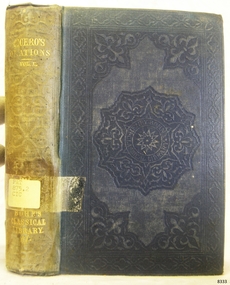
Book - Reference Book / Classics, Charles Duke Yonge (Translator), The Orations of Marcus Tullius Cicero Vol 1, 1856
... He exercised judicial integrity with his struggle to keep Rome's legal courts fair when faced with political bribery and intimidation. Label on spine cover with typed text PAT 875.2 CIC Paste down front end paper has sticker from Warrnambool Mechanics Institute and Free Library covered by a sticker from Corangamite Regional Library Service Front loose end paper has a stamp from Corangamite Regional Library Service The Orations of Marcus Tullius Cicero Vol 1 Translated by C D Yonge Publisher: Henry G Bohn Date: 1856 The Orations of Marcus Tullius Cicero Vol 1 Book Reference Book / Classics Charles Duke Yonge (Translator) Marcus Tullius Cicero Henry George Bohn ...Volume 1 of The Orations of Marcus Tullius Cicero is the beginning in the widely published 4-volume English translation by Charles Duke Yonge for Bohn's Classical Library series and focuses on Cicero's earliest legal masterpieces. The volume captures his meteoric rise from a brilliant young defense attorney to Rome's leading forensic advocate, culminating in his famous take down of a corrupt governor. The core contents in this volume contains several pivotal legal cases, which can be divided into his early legal defenses and his massive prosecution of Verres. Included is Cicero’s very first surviving public speech (delivered in 81 BC). It is a civil partnership dispute regarding property and debt. Notably, Cicero had to argue against Rome's greatest orator of the time, Quintus Hortensius. Key themes in this volume is his fight against corruption and the exposure of provincial extortion and the greed of the Roman senatorial class. He exercised judicial integrity with his struggle to keep Rome's legal courts fair when faced with political bribery and intimidation.The Orations of Marcus Tullius Cicero Vol 1 Translated by C D Yonge Publisher: Henry G Bohn Date: 1856non-fictionVolume 1 of The Orations of Marcus Tullius Cicero is the beginning in the widely published 4-volume English translation by Charles Duke Yonge for Bohn's Classical Library series and focuses on Cicero's earliest legal masterpieces. The volume captures his meteoric rise from a brilliant young defense attorney to Rome's leading forensic advocate, culminating in his famous take down of a corrupt governor. The core contents in this volume contains several pivotal legal cases, which can be divided into his early legal defenses and his massive prosecution of Verres. Included is Cicero’s very first surviving public speech (delivered in 81 BC). It is a civil partnership dispute regarding property and debt. Notably, Cicero had to argue against Rome's greatest orator of the time, Quintus Hortensius. Key themes in this volume is his fight against corruption and the exposure of provincial extortion and the greed of the Roman senatorial class. He exercised judicial integrity with his struggle to keep Rome's legal courts fair when faced with political bribery and intimidation.warrnambool, shipwrecked-coast, flagstaff-hill, flagstaff-hill-maritime-museum, maritime-museum, shipwreck-coast, flagstaff-hill-maritime-village, shipwrecked-artefact, book, pattison collection, warrnambool library, warrnambool mechanics’ institute, ralph eric pattison, corangamite regional library service, warrnambool city librarian, mechanics’ institute library, victorian library board, warrnambool books and records, warrnambool children’s library, great ocean road, the orations of marcus tullius cicero vol 1, the orations of marcus tullius cicero, c d yonge -
 Flagstaff Hill Maritime Museum and Village
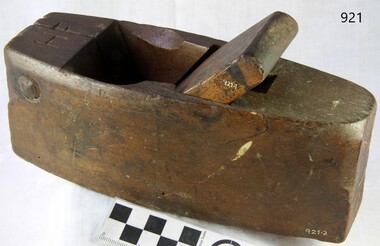
Tool - Wood smoothing plane coffin pattern, Mathieson and Son, Late 19th to early 20th Century
... "H F" carved on top face. Smoothing, coffin type. Wedge but no blade, cracked section held together by bolt and nut. ...In 1792 John Manners had set up a workshop making woodworking planes at 14 Saracens Lane Glasgow. He also had employed an apprentice Alexander Mathieson (1773-1851). But in the following year at Saracen's Lane, the 1841 census describes Alexander Mathieson as a master plane-maker now at 38 Saracen Lane with his son Thomas Adam working with him as a journeyman plane-maker. Presumably, Alexander must have taken over the premises and business of John Manners. Now that the business had Thomas Adam Mathieson working with his father it gradually grew and became more diversified, and it is recorded at the time by the Post-Office Glasgow Annual Directory that by 1847-1848 Alexander Mathieson was a “plane, brace, bit, auger & edge tool maker” In 1849 the firm of James & William Stewart at 65 Nicolson Street, Edinburgh was taken over and Thomas was put in charge of the business, trading under the name Thomas A. Mathieson & Co. as plane and edge-tool makers. Thomas's company went on to acquire the Edinburgh edge-tool makers “Charles & Hugh McPherson” and took over their premises in Gilmore Street. In the Edinburgh directory of 1856/7, the business is recorded as being Alexander Mathieson & Son, plane and edge-tool makers at 48 Nicolson Street and Paul's Work, Gilmore Street Edinburgh. The 1851 census Alexander is recorded as working as a tool and plane-maker employing eight men. Later that year Alexander died and his son Thomas took over the business. Under the heading of an edge-tool maker in the 1852/3 Post-Office Glasgow Annual Directory the firm is now listed as Alexander Mathieson & Son, with further entries as "turning-lathe and vice manufacturers". By the early 1850s, the business had moved to 24 Saracen Lane. The directory for 1857/8 records that the firm had moved again only a few years later to East Campbell Street, off the Gallowgate area, and that through further diversification was also manufacturing coopers' and tinmen's tools. The ten-yearly censuses report the firm's growth in 1861 stating that Thomas was a tool manufacturer employing 95 men and 30 boys; in 1871 he had 200 men working for him and in 1881 300 men. By 1899 the firm had been incorporated as Alexander Mathieson & Sons Ltd, even though only Alexander's son Thomas appears ever to have joined the firm so the company was still in his fathers' name. In September 1868 Thomas Mathieson put a notice in the newspapers of the Sheffield & Rotherham Independent and the Sheffield Daily Telegraph stating that his firm had used the trade-mark of a crescent and star "for some time" and that "using or imitating the Mark would be proceeded against for infringement". The firm had acquired its interest in the crescent-and-star mark from the heirs of Charles Pickslay, the Sheffield cutler who had registered it with the Cutlers' Company in 1833 and had died in 1852. The year 1868 seems also to be the one in which the name Saracen Tool Works was first adopted; not only does it figure at the foot of the notice in the Sheffield press, it also makes its first appearance in the firm's entry in the Post-Office Glasgow Annual Directory in the 1868/9 edition. As Thomas Mathieson's business grew, so too did his involvement in local public life and philanthropy. One of the representatives of the third ward on the town council of Glasgow, he became a river bailie in 1868, a magistrate in 1870 and a preceptor of Hutcheson's Hospital in 1878. He had a passion for books and was an "ardent Ruskinian". He served on the committee handling the bequest for the setting up of the Mitchell Library in Glasgow. When he died at Coulter Maynes near Biggar in 1899, he left an estate worth £142,764. Company's later years: Both Thomas's sons, James Harper and Thomas Ogilvie were involved in the continuing life of the firm. James followed in his father's footsteps in becoming a local public figure. He was appointed Deputy Lieutenant of the County of the City of Glasgow and was made a deacon of the Incorporation of the Hammermen of Glasgow in 1919. His brother Thomas Ogilvie was recorded as tool manufacturer and employer in the 1911 census. Thomas Ogilvie's son Thomas Alastair Sutherland Ogilvie Mathieson was born in 1908 took a rather different approach to engineering, however, by becoming a racing driver. In 1947 he wed the French film actress Mila Parély. The firm had won many awards at world fairs for their goods. At the Great Exhibition, London, 1851. Prize medal for joiners' tools in the class of Cutlery & Edge Tools, Great London Exposition, 1862. Prize medal honoris causa. International Exhibition, Melbourne, 1880. Gold medal International Exhibition of Industry, Science and Art, Edinburgh, 1886. Prize medalThe firm of Alexander Mathieson & Son was one of the leading makers of hand tools in Scotland. Its success went hand in hand with the growth of the shipbuilding industries on the Firth of Clyde in the nineteenth century and the emergence of Glasgow as the "second city of the Empire". It also reflected the firm's skill in responding to an unprecedented demand for quality tools by shipyards, cooperages and other industries, both locally and far and wide.Smoothing, coffin type. Wedge but no blade, cracked section held together by bolt and nut. Imprinted "A Mathieson & Son, Glasgow Best Warranted" and "2in" on other end. "H F" carved on top face.flagstaff hill, warrnambool, shipwrecked-coast, flagstaff-hill, flagstaff-hill-maritime-museum, maritime-museum, shipwreck-coast, flagstaff-hill-maritime-village -
 Flagstaff Hill Maritime Museum and Village
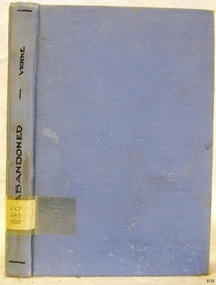
Book - A Fictional Adventure Story, Jules Verne, Abandoned, 1892
... faces natural and human threats that test their survival and moral choices. The story blends adventure, technology, and social Utopian themes, showing how rational cooperation can triumph over hardship and moral degeneration. The label on the spine with typed ..."Abandoned" is the second part of Jules Verne’s “The Mysterious Island trilogy”, continuing the story of a group of castaways testing their ingenuity and courage on a remote Pacific island. The 1892 Sampson Low, Marston, Searle & Rivington edition is an early English language reprint of this work.This novel is not among Verne’s absolute core masterpieces like “Twenty Thousand Leagues Under the Seas” or “Around the World in Eighty Days”. Abandoned (also known as its original French title, "L’Île mystérieuse: Deuxième partie L’Abandonné" picks up the narrative of five or six men (including the engineer Cyrus Harding and the sailor Pencroff) who have already survived a balloon crash and built a rudimentary civilisation on a seemingly uninhabited island. As they explore the island further, they discover signs of a mysterious benefactor and eventually meet the “abandoned” character Ayrton, a former convict who has lived in isolation while the island itself faces natural and human threats that test their survival and moral choices. The story blends adventure, technology, and social Utopian themes, showing how rational cooperation can triumph over hardship and moral degeneration.Hard cover book, Abandoned. Author: Jules Verne Publisher: Sampson Low Marston Searle and Rivington, St. Dunstans House, Fetter Lane Fleet Street, London. EC. Date: 1892 Light blue hardcover with the title on the spine having lettering to spine in black hand written text pen. fiction"Abandoned" is the second part of Jules Verne’s “The Mysterious Island trilogy”, continuing the story of a group of castaways testing their ingenuity and courage on a remote Pacific island. The 1892 Sampson Low, Marston, Searle & Rivington edition is an early English language reprint of this work.This novel is not among Verne’s absolute core masterpieces like “Twenty Thousand Leagues Under the Seas” or “Around the World in Eighty Days”. Abandoned (also known as its original French title, "L’Île mystérieuse: Deuxième partie L’Abandonné" picks up the narrative of five or six men (including the engineer Cyrus Harding and the sailor Pencroff) who have already survived a balloon crash and built a rudimentary civilisation on a seemingly uninhabited island. As they explore the island further, they discover signs of a mysterious benefactor and eventually meet the “abandoned” character Ayrton, a former convict who has lived in isolation while the island itself faces natural and human threats that test their survival and moral choices. The story blends adventure, technology, and social Utopian themes, showing how rational cooperation can triumph over hardship and moral degeneration.warrnambool, shipwrecked-coast, flagstaff-hill, flagstaff-hill-maritime-museum, maritime-museum, flagstaff-hill-maritime-village, shipwrecked-artefact, book, warrnambool mechanics’ institute, pattison collection, warrnambool library, corangamite regional library service, warrnambool city librarian, mechanics’ institute library, victorian library board, warrnambool books and records, warrnambool children’s library, ralph eric pattison, jules verne, voyages extraordinaire series, l’école des robinson's
