
Showing 13 items matching "under seventeen"
-
 Emerald Museum & Nobelius Heritage Park
Photograph - Emerald Footbal Club, 1987, U15s, Unknown photographer, 1987
... ...under seventeen...An inscription on the reverse of the image indicates the group depicted is the Under Seventeen team, 1987....Australian Rules Football sports football emerald football club Redlegs 1987 1980s youth junior under seventeen under 17 Obverse: EMER / Reverse: VEMU P 815 / U-17 - 1987 / Colour rectangular photograph printed on photographic paper. ...Emerald Football Club was formed in 1905, one of the first teams in the Mountain District Football Association (renamed the Yarra Valley Mountain District Football League in 1967). The club has changed its official colours three times, playing firstly under blue and white colours, then green and gold before adopting the red and black colours shown in the photograph and still used today. The club has also been known variously as the 'Emites', the 'Redlegs' and the current 'Bombers.' A joint Australian Football League (AFL) and La Trobe University Centre for Sport and Social Impact study discusses the importance of local football teams for fostering community cohesion and relationships and distributing information and health and social issues to local people. Local football and other sporting teams are integral to the economic and social development of an area and are therefore significant far beyond the immediate players or families associated with the club.The photograph is significant for its insights into the history of sports and recreation in the Emerald region in the 1980s. Australian Rules Football has a long history in the region and played a fundamental role in community life.Colour rectangular photograph printed on photographic paper. The photograph depicts twenty-five men standing in four main rows outside a building that may be a football clubhouse. There are nineteen younger men wearing red and black sports jerseys and six adults wearing casual clothes. An inscription on the reverse of the image indicates the group depicted is the Under Seventeen team, 1987.Obverse: EMER / Reverse: VEMU P 815 / U-17 - 1987 /australian rules football, sports, football, emerald football club, redlegs, 1987, 1980s, youth, junior, under seventeen, under 17 -
 Lakes Entrance Historical Society
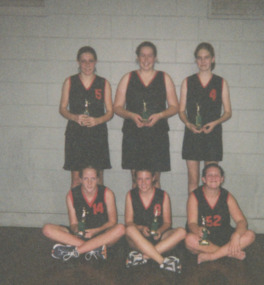
Photograph - C Lancaster ,M Milburn, A Schaarschmidt, D McKean ,J LeMaitre , T Mills, Lakes Post Newspaper, 1/05/2001 12:00:00 AM
... Under Seventeen Girls Basketball team C Lancaster M Milburn A Schaarschmidt D McKean J LeMaitre T Mills winners of recent competition Lakes Entrance Victoria...Colour photograph of Under Seventeen Girls Basketball team C Lancaster M Milburn A Schaarschmidt D McKean J LeMaitre T Mills winners of recent competition Lakes Entrance Victoria...Under Seventeen Girls Basketball team C Lancaster M Milburn A Schaarschmidt D McKean J LeMaitre T Mills winners of recent competition Lakes Entrance Victoria Sports Basketball Recreation Clubs Colour photograph of Under Seventeen Girls Basketball team C Lancaster M Milburn A Schaarschmidt D McKean J LeMaitre T Mills winners of recent competition Lakes Entrance Victoria Photograph C Lancaster ,M Milburn, A Schaarschmidt, D McKean ,J LeMaitre , T Mills Lakes Post Newspaper ...Under Seventeen Girls Basketball team C Lancaster M Milburn A Schaarschmidt D McKean J LeMaitre T Mills winners of recent competition Lakes Entrance VictoriaColour photograph of Under Seventeen Girls Basketball team C Lancaster M Milburn A Schaarschmidt D McKean J LeMaitre T Mills winners of recent competition Lakes Entrance Victoriasports, basketball, recreation, clubs -
 Glenelg Shire Council Cultural Collection
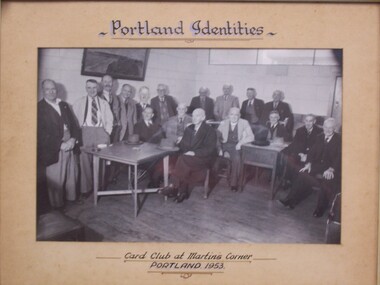
Photograph - Photograph - Portland Identities, 1953
... Black and white photograph of seventeen men standing and sitting around table. Framed in a mount with a description of scene. Framed under...(black text, above and below image) Black and white photograph of seventeen men standing and sitting around table. Framed in a mount with a description of scene. Framed under ...Displayed in History House (in window recess).Black and white photograph of seventeen men standing and sitting around table. Framed in a mount with a description of scene. Framed under glass in wooden decorative frame with white paint. Frame decorations deteriorating.Front: Portland Identities/Card Club at Martin's Corner/Portland 1953. (black text, above and below image) -
 Flagstaff Hill Maritime Museum and Village
Award - Medal, ca. 1872
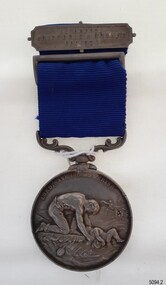
... seventeen bronze medals, the last being in 1945. This Bromley-Moore medal was awarded to Peter Carmody for his bravery in saving lives on the Newfield shipwreck. The Newfield was a three-masted iron and steel barque, built in Dundee, Scotland, in 1889 by Alexander Stephen and Sons. It was owned by the Newfield Ship Company in 1890 and later that year It was registered in Liverpool to owners Brownells and Co. The Newfield left Sharpness, Scotland, on 28th May 1892 with a crew of 25 under...seventeen bronze medals, the last being in 1945. This Bromley-Moore medal was awarded to Peter Carmody for his bravery in saving lives on the Newfield shipwreck. The Newfield was a three-masted iron and steel barque, built in Dundee, Scotland, in 1889 by Alexander Stephen and Sons. It was owned by the Newfield Ship Company in 1890 and later that year It was registered in Liverpool to owners Brownells and Co. The Newfield left Sharpness, Scotland, on 28th May 1892 with a crew of 25 under ...This medal is the Liverpool Shipwreck and Humane Society’s “Bramley-Moore medal for saving life at sea 1872”. The Society was formed in 1839. In 1872 Mr John Bramley-Moore donated £500 on condition that the medal have the specific inscription above on its reverse. The Bramley Morre medal was first awarded in 1874 and records show that since that time only one gold medal has been awarded, twenty-two silver medals and seventeen bronze medals, the last being in 1945. This Bromley-Moore medal was awarded to Peter Carmody for his bravery in saving lives on the Newfield shipwreck. The Newfield was a three-masted iron and steel barque, built in Dundee, Scotland, in 1889 by Alexander Stephen and Sons. It was owned by the Newfield Ship Company in 1890 and later that year It was registered in Liverpool to owners Brownells and Co. The Newfield left Sharpness, Scotland, on 28th May 1892 with a crew of 25 under the command of Captain George Scott and on 1st June left Liverpool. She was bound for Brisbane, Australia, with a cargo of 1850 tons of fine rock salt, the main export product of Sharpness. At about 9pm on 28th August 1892, in heavy weather, Captain Scott sighted, between heavy squalls, the Cape Otway light on the mainland of Victoria but, due to a navigational error (the ship’s chronometers were wrong), he assumed it to be the Cape Wickham light on King Island, some 40 miles south. He altered his course to the north, expecting to enter Bass Strait. The ship was now heading straight for the south west Victorian coast. At about 1:30am the Newfield ran aground on a reef about 100 yards from shore and one mile east of Curdie’s Inlet, Peterborough. The ship struck heavily three times before grounding on an inner shoal with 6 feet of water in the holds. Rough sea made the job of launching lifeboats very difficult. The first two lifeboats launched by the crew were smashed against the side of the ship and some men were crushed or swept away. The third lifeboat brought eight men to shore. It capsized when the crew tried to return it to the ship for further rescue The rescue was a difficult operation. The Port Campbell Rocket Crew arrived and fired four rocket lines, none of which connected with the ship. Peter Carmody, a local man, volunteered to swim about one mile off shore to the ship with a line to guide the fourth and final lifeboat safely to shore. He was assisted by James McKenzie and Gerard Irvine. Seventeen men survived the shipwreck but the captain and eight of his crew perished. The Newfield remained upright on the reef with sails set for a considerable time as the wind slowly ripped the canvas to shreds and the sea battered the hull to pieces. The Marine Board inquiry found the wreck was caused by a "one man style of navigation" and that the Captain had not heeded the advice of his crew. According to Jack Loney ‘… when the drama was over . . the Newfield was deserted except for the Captain’s dog and two pigs.’ Peter Carmody was awarded the Bramley-Moore medal by the Liverpool Shipwreck and Humane Society for Saving Life at Ssea, which he received by mail on January 21st 1893. The medal and a letter of congratulations were donated to Flagstaff Hill Maritime Museum by Peter Carmody’s grand-daughter Norma Bracken and her son Stuart Bracken on 25th May 2006. The Medal and Letter of Congratulations join other items in the Newfield collection.The Carmody Medal recognises the bravery of Peter Carmody in risking his life to rescue crew members of the Barque Newfield when it was wrecked near Curdies Inlet in August 1892. The ‘Bramley-Moore medal for saving life at sea, 1872’ was presented by the Liverpool Shipwreck and Humane Society. The medal and accompanying letter have local and international historic significance as they demonstrate both the difficulties associated with navigation and the dangers of shipping along the South West Coast of Victoria in the 19th century and the medal’s association with the Liverpool Shipwreck and Humane Society and John Bramley-Moore, who provided £500 to found the Bramley-Moore medal. The medal is socially significant. It emphasises the importance of Peter Carmody in rescuing victims of shipwrecks with little thought for his own safety. The medal reminds us of the importance of local people to Victoria’s maritime history. The Carmody Medal and Humane Society letter were in the Carmody family until they were presented to Flagstaff Hill Maritime Village, by the grand-daughter and great-grandson of Peter Carmody, on the 25th May 2006. The medal is significant for its complete provenance recorded in the donation documentation. The medal is in very good condition and relatively rare with only 22 silver medals awarded between 1874 and 1945. The Carmody Medal and letter add a human element to the story of the shipwrecks. They give life and significance to the Newfield, its victims and its artefacts. Bramley-Moore medal from the Liverpool Shipwreck and Humane Society, awarded to Peter Carmody. The round,silver medal is attached to a looped blue ribbon by a decorative, swivelling silver connector. The top of the ribbon has a silver pin bar threaded through it. The obverse of the medal has a design of a man kneeling on a floating part of a wreck. He is rescuing a child from the sea. There is a manned boat in the distance rescuing someone from the sea. In the far background there is a sailing ship. The top third of the medal has an inscription around it. The reverse shows a long-legged hen cormorant with extended wings holding an olive branch in its beak. The bird is surrounded by a wreath of oak leaves made from two branches. There is an inscription between the design and the rim that goes all the way around the circumference. There is a name engraved around the edge of the medal. The medal in embedded in a purple velvet panel that rests inside a brown, leather-covered case. The lid of the case has a gold embossed emblem in the cemtre. Both the lid and base have a rectangular gold border. The lid is attached to the base with two brass hinges. The base has a brass push-button catch. The box is lined with padded cream silk. The lining inside the lid has a gold emblem in the centre.The obverse has the words "LORD, SAVE US, WE PERISH". The reverse has the words "BRAMLEY-MOORE MEDAL FOR SAVING LIFE AT SEA" and "1872". Around the edge of the medal are the words "PETER CARMODY, FOR HAVING BEEN MAINLY INSTRUMENTAL IN RESCUING THE CREW OF THE BARQUE NEWFIELD, AUG 29 1892" The pin bar has the words “LIVERPOOL SHIPWRECK & HUMANE SOCIETY” written across it. The gold embossed emblem on the lid of the box has the words in the centre "SHIPWRECK AND …. …. ….FOUNDED 1839" The gold emblem on the cream silk lining has the words “BY APPOINTMENT ELKINGTON & CO” printed on it.medal, shipwrecked coast, flagstaff hill, flagstaff hill maritime museum, maritime museum, flagstaff hill maritime village, shipwreck coast, warrnambool, peter, peter carmody, carmody, bramley moore, newfield, liverpool shipwreck and humane society, 1892, 28 august 1892, august 1892, port campbell, bravery, shipwreck, rescue, nineteenth century, ship, curdie s river, victorian shipwrecks, barque, stuart bracken, norma bracken, gerard irvine, james mckenzie -
 Flagstaff Hill Maritime Museum and Village
Machine - Steering Gear, 1889
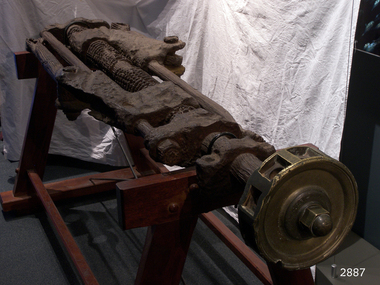
... under the impression it was the King Island light. The ship’s chronometers were wrong, and orders were given to tack the ship away from the light, which headed it straight for the cliffs of the Victorian coast. The vessel struck rocks about 100 yards from shore, and five feet of water immediately filled the holds. The captain gave orders to lower the boats which caused a disorganised scramble for safety among the crew. The panic resulted in the deaths of nine men, including the captain when they drowned after the boats capsized in heavy seas. The seventeen...under the impression it was the King Island light. The ship’s chronometers were wrong, and orders were given to tack the ship away from the light, which headed it straight for the cliffs of the Victorian coast. The vessel struck rocks about 100 yards from shore, and five feet of water immediately filled the holds. The captain gave orders to lower the boats which caused a disorganised scramble for safety among the crew. The panic resulted in the deaths of nine men, including the captain when they drowned after the boats capsized in heavy seas. The seventeen ...Steering Gear Operation: All steering was done from the stern of the ship and a steering mechanism was used to connect the rudder to the ship's wheel, often housed in a box-like construction behind the helm. The rudder was, in turn, mounted on a pintle or stern-post held in place by gudgeon's (sockets). The steering was activated with lines attached to the blocks on the two threads (half left hand, half right hand) of the steering gear. As the helmsman turned the helm in the direction in which he wished the ship to travel, the central screw of the steering gear, which was attached to the back of the helm, turned horizontally. This caused the rods on either side of the gear to move backwards or forwards at the same time, which then turned the pintle and rudder to port or starboard. A brief history of the Newfield (1889-1892): - The Newfield was an iron and steel sailing barque of 1306 tons, built in 1889 by Alexander Stephen & Sons Dundee (Yard No 89) for Brownelles & Co., Liverpool. The Newfield was on a voyage from Sharpness to Brisbane on 29 August 1892, with a cargo of 1850 tons of fine rock salt. The Cape Otway light had been sighted in squally, bumpy weather, but the captain was under the impression it was the King Island light. The ship’s chronometers were wrong, and orders were given to tack the ship away from the light, which headed it straight for the cliffs of the Victorian coast. The vessel struck rocks about 100 yards from shore, and five feet of water immediately filled the holds. The captain gave orders to lower the boats which caused a disorganised scramble for safety among the crew. The panic resulted in the deaths of nine men, including the captain when they drowned after the boats capsized in heavy seas. The seventeen men who regained the ship decided to wait until daylight and rowed to Peterborough in the ship’s jolly boat and gig after locals had failed to secure a rocket apparatus line to the ship. The Marine Board inquiry found the wreck was caused by a "one-man style of navigation" and that the captain had not heeded the advice of his crew.The Newfield wreck and its collection of recovered items are heritage listed and are regarded as historically significant. They represent aspects of Victoria’s shipping history and their potential for us today to interpret the maritime history and social themes of the time. The assemblage of various Newfield artefacts held in the Flagstaff Hill Museum is not only significant for its association with the shipwreck but helps archaeologists when examining the relationship between the objects to better understand our colonial marine past.Ship’s steering gear, cast iron, consists of a long round metal rod into which gears have been machined. The thread of the gear from one end to almost the centre winds in a left hand direction while the thread of the gear from the other end to almost the centre winds in the right hand direction. Each end of the rod has a metal coupler attached and two narrower round rods are also attached to the coupling, one each side of the gear rod, the same length as it and parallel to it. Two more ‘S’ shaped couplers are joined to the gear rod. Each of these have an opening through which the gear rod is threaded and can move along. There is another opening in these couplers through which one of the narrower rods is threaded. The other end of this coupler has half length metal rod attached to it by a bolt through the ring at the end of the rod. One end of the steering gear still has the brass hub of the ship’s wheel solidly attached. The hub no longer has its wooden spokes but the ten holes for the spokes can be easily recognised.Noneflagstaff hill, maritime museum, shipwreck coast, warrnambool, peter carmody, carmody, newfield, shipwreck, peterborough, south west victoria, rocket, rocket crew, shipwreck artefact, flagstaff hil maritime museum, steering, steering gear, screw steering gear, sailing ship -
 Flagstaff Hill Maritime Museum and Village
Award - Document, 21/1/1893
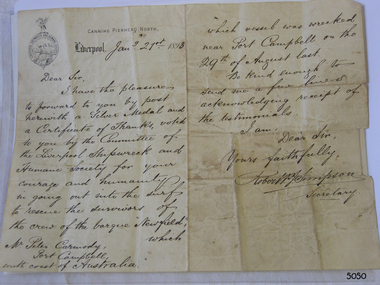
... seventeen bronze medals, the last being in 1945. This Bromley-Moore medal was awarded to Peter Carmody for his bravery in saving lives on the Newfield shipwreck. The Newfield was a three-masted iron and steel barque, built in Dundee, Scotland, in 1889 by Alexander Stephen and Sons. It was owned by the Newfield Ship Company in 1890 and later that year It was registered in Liverpool to owners Brownells and Co. The Newfield left Sharpness, Scotland, on 28th May 1892 with a crew of 25 under...seventeen bronze medals, the last being in 1945. This Bromley-Moore medal was awarded to Peter Carmody for his bravery in saving lives on the Newfield shipwreck. The Newfield was a three-masted iron and steel barque, built in Dundee, Scotland, in 1889 by Alexander Stephen and Sons. It was owned by the Newfield Ship Company in 1890 and later that year It was registered in Liverpool to owners Brownells and Co. The Newfield left Sharpness, Scotland, on 28th May 1892 with a crew of 25 under ...The name on the letterhead, “Canning Pierhead North” is the name of the Liverpool Pilot Authority, which was situated in 1883 at Cannon Pier on the River Mersey where ships entered to travel to Liverpool. The logo on the letterhead belongs to the Liverpool Shipwreck and Humane Society. The letter is addressed to “Mr Peter Carmody, Port Campbell, south coast of Australia”, and reads as follows: “January 21st 1893, Dear Sir, I have the pleasure to forward to you by post herewith a Silver Medal and a Certificate of Thanks, voted to you by the Committee of the Liverpool Shipwreck and Humane Society for your courage and humanity in going out into the surf to rescue the survivors of the crew of the barque “Newfield” which vessel was wrecked near Port Campbell on the 29th of August last. Be kind enough to send a few lines acknowledging receipt of the testimonials. I am Dear Sir, Yours Faithfully, Robert P. J. Simpson, Secretary.” The medal accompanying the letter is the Liverpool Shipwreck and Humane Society’s “Bramley-Moore medal for saving life at sea 1872”. The Society was formed in 1839. In 1872 Mr John Bramley-Moore donated £500 on condition that the medal have the specific inscription above on its reverse. The Bramley Morre medal was first awarded in 1874 and records show that since that time only one gold medal has been awarded, twenty-two silver medals and seventeen bronze medals, the last being in 1945. This Bromley-Moore medal was awarded to Peter Carmody for his bravery in saving lives on the Newfield shipwreck. The Newfield was a three-masted iron and steel barque, built in Dundee, Scotland, in 1889 by Alexander Stephen and Sons. It was owned by the Newfield Ship Company in 1890 and later that year It was registered in Liverpool to owners Brownells and Co. The Newfield left Sharpness, Scotland, on 28th May 1892 with a crew of 25 under the command of Captain George Scott and on 1st June left Liverpool. She was bound for Brisbane, Australia, with a cargo of 1850 tons of fine rock salt, the main export product of Sharpness. At about 9pm on 28th August 1892, in heavy weather, Captain Scott sighted, between heavy squalls, the Cape Otway light on the mainland of Victoria but, due to a navigational error (the ship’s chronometers were wrong), he assumed it to be the Cape Wickham light on King Island, some 40 miles south. He altered his course to the north, expecting to enter Bass Strait. The ship was now heading straight for the south west Victorian coast. At about 1:30am the Newfield ran aground on a reef about 100 yards from shore and one mile east of Curdie’s Inlet, Peterborough. The ship struck heavily three times before grounding on an inner shoal with 6 feet of water in the holds. Rough sea made the job of launching lifeboats very difficult. The first two lifeboats launched by the crew were smashed against the side of the ship and some men were crushed or swept away. The third lifeboat brought eight men to shore. It capsized when the crew tried to return it to the ship for further rescue The rescue was a difficult operation. The Port Campbell Rocket Crew arrived and fired four rocket lines, none of which connected with the ship. Peter Carmody, a local man, volunteered to swim about one mile off shore to the ship with a line to guide the fourth and final lifeboat safely to shore. He was assisted by James McKenzie and Gerard Irvine. Seventeen men survived the shipwreck but the captain and eight of his crew perished. The Newfield remained upright on the reef with sails set for a considerable time as the wind slowly ripped the canvas to shreds and the sea battered the hull to pieces. The Marine Board inquiry found the wreck was caused by a "one man style of navigation" and that the Captain had not heeded the advice of his crew. According to Jack Loney ‘… when the drama was over . . the Newfield was deserted except for the Captain’s dog and two pigs.’ Peter Carmody was awarded the Bramley-Moore medal by the Liverpool Shipwreck and Humane Society for Saving Life at Ssea, which he received by mail on January 21st 1893. The medal and letter of congratulations were donated to Flagstaff Hill Maritime Museum by Peter Carmody’s grand-daughter Norma Bracken and her son Stuart Bracken on 25th May 2006. The Medal and Letter of Congratulations join other items in the Newfield collectionlFlagstaff Hill’s collection of artefacts from the Newfield is significant for its association with the shipwreck Newfield, which is listed on the Victorian Heritage Registry. The collection is significant because of the relationship between the objects. The Newfield collection is archaeologically significant as the remains of an international cargo ship. The Newfield collection is historically significant for representing aspects of Victoria’s shipping history and its association with the shipwreck. The Letter accompanying the Medal for Bravery awarded to Peter Carmody is significant because the attempt to save lives is associated with the shipwreck Newfield.A copy of a letter from the Liverpool Shipwreck and Humane Society to Peter Carmody in reference to the bravery of Peter Carmody over the wreck of the "Newfield". The letter is divided into 2 columns and is written in longhand using black ink on both columns. There is a letterhead in the centre of the left hand page and a round logo printed or stamped on the top of left of the left hand page. The centre of the logo shows a design of a man kneeling on a floating part of a wreck. He is rescuing a child from the sea. On the top of the circle of the logo a design shows a long-legged hen cormorant with extended wings holding an olive branch in its beak. There is also the name of a city printed onto the page under the letterhead. The letter has been folded into half along its long side, then in half again along its long side then into thirds. The letter is dated January 21st 1893. “CANNING, PIERHEAD, NORTH” and “LIVERPOOL” are printed on the top left hand page. The logo “LIVERPOOL SHIPWRECK AND HUMANE SOCIETY” is printed or embossed on the paper.28 august 1892, bramley moore, carmody, certificate of thanks, curdie's river, flagstaff hill, flagstaff hill maritime museum, gerard irvine, james mckenzie, liverpool shipwreck and humane society, maritime museum, medal, newfield, nineteenth century, norma bracken, peter carmody, port campbell, rescue, robert simpson,, shipwreck, ship wreck, stuart bracken, victorian shipwrecks -
 Bendigo Military Museum
Photograph - AUSTRALIAN CHINESE SERVICEMEN, WW1 & WW2, Bendigo & District RSL Club, WW1 & WW2
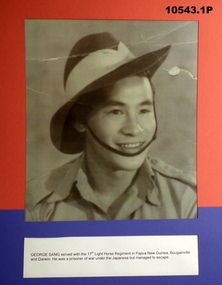
... under the Japanese but managed to escape. 2. “SAM TONGWAY”enlisted on the 6th June 1917. He tried to enlist in 1916, but was rejected in medical grounds (regulations against those of a Chinese background). He embarked with Reinforcements to A.M.C. on the 6th May 1918. As an Army Signaller he transferred in Egypt to the Division Signalling Company in France in France with his brother Hedley. During World War 2 he served in the Air Training Corps. 3. “COLLIN YOUNG” shown here with his brother ELLIS, joined up in 1842 when he was seventeen...under the Japanese but managed to escape. 2. “SAM TONGWAY”enlisted on the 6th June 1917. He tried to enlist in 1916, but was rejected in medical grounds (regulations against those of a Chinese background). He embarked with Reinforcements to A.M.C. on the 6th May 1918. As an Army Signaller he transferred in Egypt to the Division Signalling Company in France in France with his brother Hedley. During World War 2 he served in the Air Training Corps. 3. “COLLIN YOUNG” shown here with his brother ELLIS, joined up in 1842 when he was seventeen ...Australian Chinese Servicemen from WW1 & WW2 photographs. Exhibition held at the Bendigo & District RSL, post 2010.1.2.3. Photographs on photographic paper, enlarged black and white portrait. Mount - red and blue colour cardboard, double mount with top area containing the photograph, lower area printed information. 1. Serviceman in uniform, portrait. 2. Serviceman in uniform, portrait. 3. Two Servicemen in uniform, full length informal portrait, WW1.Printed information - black ink print. 1. “GEORGE SANG” - served with the 17th Light Horse Regiment in Papua New Guinea, Bougainville and Darwin. He was a prisoner of war under the Japanese but managed to escape. 2. “SAM TONGWAY”enlisted on the 6th June 1917. He tried to enlist in 1916, but was rejected in medical grounds (regulations against those of a Chinese background). He embarked with Reinforcements to A.M.C. on the 6th May 1918. As an Army Signaller he transferred in Egypt to the Division Signalling Company in France in France with his brother Hedley. During World War 2 he served in the Air Training Corps. 3. “COLLIN YOUNG” shown here with his brother ELLIS, joined up in 1842 when he was seventeen and a half. He served in an artillery unit as an anti-tank gunner. With another artillery unit, he toured Queensland and New South Wales, then was posted to an anti-aircraft gun station in Darwin. photographs, australian/chinese, ww1, ww2 -
 Bendigo Historical Society Inc.
Photograph - Kangaroo Flat Gold Mine Collection: Deadhorse Gully, Sydney Flat Creek March 1986
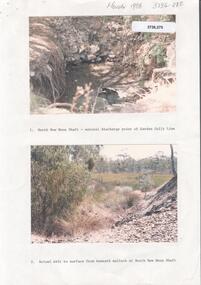
... seventeen images on nine page. Images labelled as follows : 1. North New Moon shaft - natural discharge point of Garden Gullly line 2. Actual exit to surface from beneath mullock at North New Moon shaft. 3. Looking into Deadhorse Gully from mullock heap at North New Moon site. 4. Deadhorse Gully downstream of WMC Weir. 5. Sydney Creek track crossing - impassable ford. 6. Sydney Creek looking downstream from ford. 7. Sydney Creek looking upstream from road near Recreation Reserve (12 inch pipe under...seventeen images on nine page. Images labelled as follows : 1. North New Moon shaft - natural discharge point of Garden Gullly line 2. Actual exit to surface from beneath mullock at North New Moon shaft. 3. Looking into Deadhorse Gully from mullock heap at North New Moon site. 4. Deadhorse Gully downstream of WMC Weir. 5. Sydney Creek track crossing - impassable ford. 6. Sydney Creek looking downstream from ford. 7. Sydney Creek looking upstream from road near Recreation Reserve (12 inch pipe under ...Colour photographs, seventeen images on nine page. Images labelled as follows : 1. North New Moon shaft - natural discharge point of Garden Gullly line 2. Actual exit to surface from beneath mullock at North New Moon shaft. 3. Looking into Deadhorse Gully from mullock heap at North New Moon site. 4. Deadhorse Gully downstream of WMC Weir. 5. Sydney Creek track crossing - impassable ford. 6. Sydney Creek looking downstream from ford. 7. Sydney Creek looking upstream from road near Recreation Reserve (12 inch pipe under road). 8. Sydney Creek looking downstream from same point. 9. Sydney Creek - Camp Road, looking upstream.. 10. Sydney Creek - Camp Road, looking downstream. 11. Sydney Creek - Camp Road Culverts. 12. Sydney Creek - Pyramid Road Bridge, looking upstream. 13. Sydney Creek - Pyramid Road Crossing looking downsteam. 14. Sydney Creek - rail crossing, looking upstream. 15. Sydney Creek - rail crossing, looking downstream. 16. Sydney Creek - Airstrip road, looking upstream. 17. Sydney Creek - Airstrip Road, looking downstream 12 inch pipe under road. Lined paper, in blue pen 'Deadhorse Gully-Sydney Flat Creek, March 1986, Photos of Deadhorse Gully/Sydney Flat Creek'kangaroo flat gold mine, deadhorse gully, sydney flat creek, unity mining, water discharge, north new moon, camp road, pyramid hill road, eaglehawk -
 Bendigo Historical Society Inc.
Photograph - GROUP OF SEVENTEEN MALES DRESSED IN SUITS, IN PARK, 8 Feb, 1928
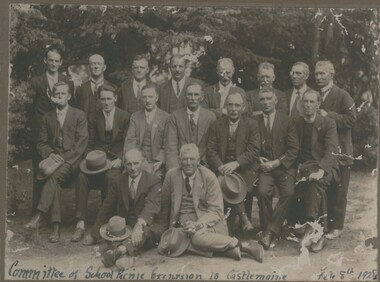
... Seventeen adult males dressed in suits, ties and hats, arranged in three rows in front of trees. Male at R C row wearing clerical collar. Inscriptions: in image - handwritten at bottom 'Committee of School Picnic Excursion to Castlemaine Feb 8th 1928' At BR corner of mount 'of Arms, Under Royal and Vice Regal Patronage, Lorraine Pty Ltd, Castlemaine', at TR corner 'GP 72', On back TR 'GP 72', 'Royal Historical Society of Victoria, Bendigo Branch, circular stamp. ...Seventeen adult males dressed in suits, ties and hats, arranged in three rows in front of trees. Male at R C row wearing clerical collar. Inscriptions: in image - handwritten at bottom 'Committee of School Picnic Excursion to Castlemaine Feb 8th 1928' At BR corner of mount 'of Arms, Under Royal and Vice Regal Patronage, Lorraine Pty Ltd, Castlemaine', at TR corner 'GP 72', On back TR 'GP 72', 'Royal Historical Society of Victoria, Bendigo Branch, circular stamp. ...Sepia photograph mounted on brown board. Seventeen adult males dressed in suits, ties and hats, arranged in three rows in front of trees. Male at R C row wearing clerical collar. Inscriptions: in image - handwritten at bottom 'Committee of School Picnic Excursion to Castlemaine Feb 8th 1928' At BR corner of mount 'of Arms, Under Royal and Vice Regal Patronage, Lorraine Pty Ltd, Castlemaine', at TR corner 'GP 72', On back TR 'GP 72', 'Royal Historical Society of Victoria, Bendigo Branch, circular stamp. Red ballpoint '12'.Bendigo Advertiserperson, group -
 National Vietnam Veterans Museum (NVVM)
Memorabilia, A Collection of Newspaper Clippings
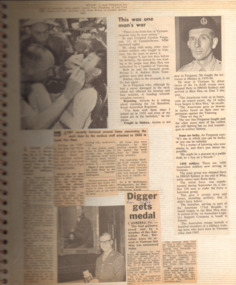
... under the photograph starting with the words A RAAMC Officer now in Britain. The third article is titled 'Digger gets medal' is about the bravery of L/Cpl David Maxwell Munday who was awarded a Military Medal. These are on page seventeen...under the photograph starting with the words A RAAMC Officer now in Britain. The third article is titled 'Digger gets medal' is about the bravery of L/Cpl David Maxwell Munday who was awarded a Military Medal. These are on page seventeen ...Cpl Gordon Maxwell Ferguson served with the Royal Australian Infantry Corps and he served in Vietnam from June 1965 to August 1965 with 1st Battalion, The Royal Australian Regiment. Copt/Major Peter John Naughton served with the Royal Australian Army Dental Corps. He did two tours of Vietnam, the first from May 1965 to May 1966 with Australian Logistics Support Company and the second from March 1968 to April 1968 with Ships Army Staff (HMAS Sydney). L/Cpl David Maxwell Munday served with the Royal Australian Infantry Corps and served in Vietnam from May 1965 to July 1965 with the 1st Battalion, The Royal Australian Regiment when he was badly wounded. He was awarded the Military Medal.A Collection of Newspaper Clippings from three separate donors. The first is titled "this Was one Man's War" which is a story on Cpl Gordon Maxwell Ferguson describing part of his time serving. Also mention in the article is Pte L.A. Bakker. The second article is a photograph of a small Vietnamese boy being treated by Australian Army dentist Capt Peter Naughton with is assistant Sgt Brian Wilson. There is an article under the photograph starting with the words A RAAMC Officer now in Britain. The third article is titled 'Digger gets medal' is about the bravery of L/Cpl David Maxwell Munday who was awarded a Military Medal. These are on page seventeen of Personal Collections 5.newspaper clippings, cpl gordon maxwell ferguson, ferguson gordon maxwell, 212779, royal australian infantry corps, 1st battalion, the royal australian regiment, major peter john naughton, capt peter john naughton, sgt brian wilson, 215193, royal australian army dental corps, australian logistics support company, ships army staff (hmas sydney), munday david maxwell, l/cpl david maxwell munday, 214922, military medal -
 National Wool Museum
Clothing - Outfit by Iordanes Spyridon Gogos x Akira Isogawa 'Look 33', Jordan Gogos, 2022-2023
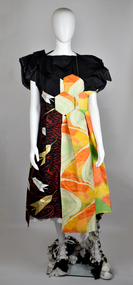
... under each shoulder strap. Shoes are lace up boots with black, white and yellow patchwork fabric, with rubber soles and vinyl lining. This record includes seventeen...under each shoulder strap. Shoes are lace up boots with black, white and yellow patchwork fabric, with rubber soles and vinyl lining. This record includes seventeen ...This outfit from Sydney-based wearables label Iordanes Spyridon Gogos (ISG), was designed by Founder and Creative Director Jordan Gogos in collaboration with Akira Isogawa and other creative partners. The shoes are by Julia Baldini. The outfit comes from the ISG x Akira 2023 Afterpay Australian Fashion Week (AAFW) collection show presented at Carriageworks, Sydney 16 May 2023. Jordan Gogos is one of Australia's most innovative multidisciplinary artists. Preferring to describe his current designs as 'non normative', 'wearables for the imaginative' Gogos' work and practices have been influential in changing the conversation around clothing design, production and presentation by embedding co-collaboration, sustainability, diversity, and inclusivity in all aspects of his label. Born and raised in Tokyo, Japan before immigrating to Australia in 1987, Akira Isogawa is regarded as one of Australia's most innovative and successful fashion designers. In a career spanning over 25 years, Akira is perhaps best known for his contemporary interpretations of traditional Japanese clothing, and the quality of his craftsmanship. Isogawa has worked on a range of creative collaboration projects over the course of his career and was named Australian Designer of the Year at the Australian Fashion Industries Awards in 1999. The ISG x Akira collection show presented at AAFW resulted in a collection of 40 looks featuring digitally printed, compressed and patchworked garments with applique, embroidery, beading and origami. Made from deadstock and archival fabrics, accessorised with unique headpieces and footwear designs, the looks were presented in a theatrical collection show amid a colourful runway piled high with upcycled textile artworks and trojan horses signifying Gogo's Greek heritage, signed by Akira in red calligraphy. The models included people with diverse gender identities and body shape and size. - Kristina StankovskiOutfit consisting of a dress, underskirt and shoes (pair). The underskirt is made of tulle, while the dress is origami style with black, red, white, gold, green, yellow and orange fabric. The dress has two sets of press studs under each shoulder strap. Shoes are lace up boots with black, white and yellow patchwork fabric, with rubber soles and vinyl lining. This record includes seventeen pieces of test/sample fabric. 9013.1 Dress 9013.2 Underskirt 9013.3 Boots & White laces 9013.4 Fabric samplesjordan gogos, iordanes spyridon gogos, akira isogawa, 2023 afterpay australian fashion week, design, fashion, art, sustainability, innovation, trojan horse -
 Royal District Nursing Service (now known as Bolton Clarke)
Photograph - Photograph, black and white, Barry Sutton, 1974
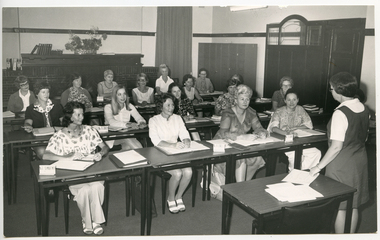
... Rowley, was evaluated as successful, and Home Health Aides were employed and worked in RDNS Centres under the supervision of the RDNS Sisters. royal district nursing service (1966-2017) rdns rdns education sister ethel fullerton sister barbara lovell sister shirley lewis sister jane ball sister pat (paddy) rowley sister ann greenwood sister judy peter Barry Sutton Stamp. Quote LY 68 This black and white photograph shows Royal District Nursing Service (RDNS) Sister Pat (Paddy) Rowley and seventeen ...Sr. Pat (Paddy) Rowley is the Principal Nurse Educator at RDNS and is giving a lecture to RDNS Sisters in the Education Department at 452 St. Kilda Rd, Melbourne. She is wearing the RDNS summer uniform of a white short sleeve blouse under a royal blue V neck tunic style frock with the RDNS insignia on the upper left.Education was an integral part of Melbourne District Nursing Society (MDNS), from its inception in 1885, later, in 1966, called Royal District Nursing Service, (RDNS). From 1885, only Trained Nurses (Nurses), through the Hospital training system, were employed by the Society, and on visits to patients they taught the necessity of hygiene and cleanliness, as well as the need for a good diet, to bring about good health. Doctor’s lectures were later given at the MDNS home to instruct patients and their families on prevention of disease. Education to patients continued throughout the years regarding health care and the use of equipment in the home. In 1961, Education programs commenced at MDNS with Trained nurses (Sisters) receiving In-service education. Sr. Pat (Paddy) Rowley was a leader in In-service Education and established the RDNS Department of Community Nursing Education in 1962. Staff could also apply for scholarships to further their education outside of RDNS. Many of their senior Sisters received Postgraduate diplomas from the College of Nursing in Community Health Nursing, Education, and Administration, and several travelled overseas visiting nursing organizations viewing their public health and District nursing systems. At RDNS many programs were run, including: a Post Basic Course, Cardiac Rehabilitation Nursing, Haematology/Oncology Nursing, Palliative Care program, Diabetic Stabilization Program, Leg Ulcer Management Program, Wound Care Specialist Program, HIV/AIDS Nursing Care, Cystic Fibrosis Home Support, Veterans Home Care Program, Breast Cancer Support Program, Continence Management Program, Stomal Therapy Program, In-Home Lactation Support Program and the Homeless Persons Program. RDNS Sisters attended several hospitals to observe and learn special care needed to some patients, e.g. to the Austin Hospital to learn the care required for paraplegic and quadriplegic patients at home, and to Mount Royal Hospital to observe the care of patients in the Rehabilitation ward. A Community Nursing Education Program was extended to student nurses from hospitals and to other nursing organizations. These Education programs kept the RDNS Sisters abreast of new techniques, such as changes in technology for e.g. new testing methods in detecting glucose levels in Diabetic patients. Sr. Nan Deakin obtained a Post Basic Certificate in Psychiatric Nursing and included this area in her Education lectures. Sr. Daphne Geldard specialized in the area of Alzheimer’s disease and Dementia. These Sisters visited patients in District areas with the regular RDNS Sister when required. Every member of staff, both professional and non professional staff, received regular education in the Education Department. In 1980, a Home Health Aide pilot study, funded by the Federal Government, the Brotherhood of St. Laurence and RDNS, with the program written and taught by Sr. Rowley, was evaluated as successful, and Home Health Aides were employed and worked in RDNS Centres under the supervision of the RDNS Sisters. This black and white photograph shows Royal District Nursing Service (RDNS) Sister Pat (Paddy) Rowley and seventeen (some partly hidden), Royal District Nursing Service (RDNS) Sisters. The bulk of the photograph shows the front view of three rows of RDNS Sisters sitting at tables which have books and sheets of paper on them. The Sisters are wearing a variety of day clothes. In the right foreground of the Photograph is a table containing papers, and standing to its right, facing the group, is the back view of Sr. Rowley, who has short dark hair and glasses. She has her left hand on a sheet of paper on the table. She is wearing her RDNS uniform of a white short sleeve blouse under a dark tunic style frock. In the rear of the photograph a brick fireplace can be seen with some books and a vase of flowers on the mantelpiece. On the right is a long curtain, some lockers and an open wooden door with glass panel. Some of the Sisters named are:- Ann Greenwood, Judy Peter, Ethel Fullarton, Barbara Lovell, Shirley Lewis, Jane Ball..Barry Sutton Stamp. Quote LY 68royal district nursing service (1966-2017), rdns, rdns education, sister ethel fullerton, sister barbara lovell, sister shirley lewis, sister jane ball, sister pat (paddy) rowley, sister ann greenwood, sister judy peter -
 Royal District Nursing Service (now known as Bolton Clarke)
Photograph - Photograph, black and white, c.1930
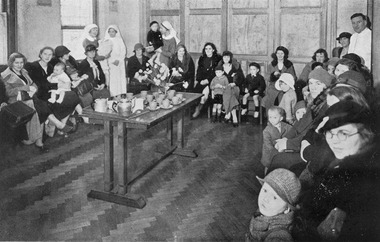
... under unsuitable conditions. In 1957 the Hospital and Charities Commission decided to take over the After-Care Hospital, so the Melbourne District Nursing Society and After-Care Hospital separated and the Melbourne District Nursing Service was formed, setting up Headquarters at 452 St. Kilda Road, Melbourne. On the 5th of October 1966 the name changed to Royal District Nursing Service (RDNS) after being granted Royal patronage. after-care home mdns melbourne district nursing society ante-natal clinic Black and white photograph showing seventeen seated ladies, some partly hidden, six small children, and the Matron and two Sisters of the Melbourne District Nursing Society After Care Home. ...The photograph is taken in the Waiting room of the Ante-natal Clinic at the Melbourne District Nursing Society After-Care Home at 45 Victoria Parade, Collingwood. On the 23rd of September 1930 the Ante-Natal Clinic opened at the MDNS After- Care Home. This photograph also shows Matron and Sister's uniforms in the 1930sThe Melbourne District Nursing Society (MDNS) were pioneers in recognizing the need for premises where patients too ill to be in their own home, but not ill enough to go to hospital, was needed, and the Society built, then opened, the After-Care Home, (later called After-Care Hospital), in 1926, for these patients, and patients from Hospitals. Many children were nursed there, some long term during the Polio epidemic and the Society employed two School Teachers. The Society now ran two divisions, the After-Care with its own Trained nurses and the District division. The Society were the first in Melbourne, in early 1928, to recognize some patients leaving the After-Care, and many at home, needed further social care and they set up ‘Almoners’ from their committee to visit these patients and be intermediaries in getting them social assistance. It was late the following year before the first training of Almoners took place in Melbourne. In 1930 the Society employed a full time kindergarten teacher to visit poor children in their homes. That year the Society were pioneers in opening an Ante-Natal Clinic at the After-Care, setting a high standard with equipment, keeping records and providing leaflets with instructions in how to keep healthy during pregnancy, what complications to look for and what to do when labour commenced. In 1934 the Society were pioneers again when they opened the first Women’s Welfare Clinic in Melbourne giving advice on birth-control, at first attended by their own patients, but then accepting patients from public hospitals until their own clinics were opened. A Social Service Officer was employed at the After-Care who successfully gained better housing from the Housing Commission for families living under unsuitable conditions. In 1957 the Hospital and Charities Commission decided to take over the After-Care Hospital, so the Melbourne District Nursing Society and After-Care Hospital separated and the Melbourne District Nursing Service was formed, setting up Headquarters at 452 St. Kilda Road, Melbourne. On the 5th of October 1966 the name changed to Royal District Nursing Service (RDNS) after being granted Royal patronage. Black and white photograph showing seventeen seated ladies, some partly hidden, six small children, and the Matron and two Sisters of the Melbourne District Nursing Society After Care Home. The Matron is wearing a white uniform and veil, and the two Sisters are wearing grey uniforms with white collars and veils, one is holding a baby and the other a small child dressed in dark clothing, they are on the far left and rear of the photograph. The ladies are wearing either grey or black clothing, several are wearing hats and some are wearing berets. They have short or shoulder length dark or lighter coloured hair. A Doctor, with short dark hair and wearing a white coat, is standing at the far right on the photograph. On the left, a window can be seen behind one of the Sisters. The wall at the rear of the room is paneled. after-care home, mdns, melbourne district nursing society, ante-natal clinic
