
Showing 175 items matching "unit association"
-
 Australian Commando Association - Victoria
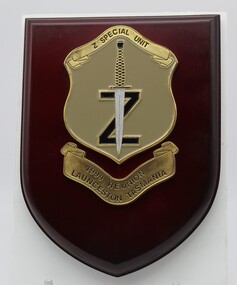
Plaque - Commemorative Plaque Z Special Unit Association 1999 Reunion in Launceston
... Commemorative Plaque Z Special Unit Association 1999 Reunion in Launceston...Z Special Unit Association 1999 Reunion in Launceston...Z Special Unit Association 1999 Reunion in Launceston Timber shield with metal emblems Plaque Commemorative Plaque Z Special Unit Association 1999 Reunion in Launceston ...Timber shield with metal emblemsZ Special Unit Association 1999 Reunion in Launceston -
 Australian Commando Association - Victoria
Label Badges- Z Special Unit Association and 200 Flight Association
... Label Badges- Z Special Unit Association and 200 Flight Association...Label Badges- Z Special Unit Association and 200 Flight Association ... -
 Australian Commando Association - Victoria
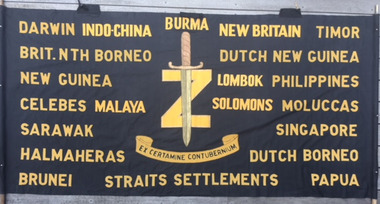
Banner- WW2 Z Special Unit Association
... Banner- WW2 Z Special Unit Association...Banner- WW2 Z Special Unit Association ... -
 Australian Commando Association - Victoria
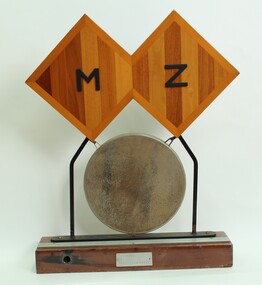
Memorabilia - Dinner Gong- M & Z Special Unit Association
... Dinner Gong- M & Z Special Unit Association ...Memorabilia Dinner Gong- M & Z Special Unit Association ... -
 Bendigo Military Museum
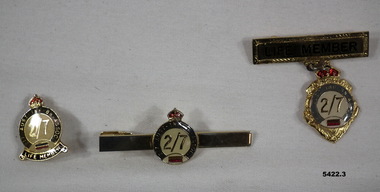
Accessory - BADGES, UNIT ASSOCIATION, Post WW2
... BADGES, UNIT ASSOCIATION...Accessory BADGES, UNIT ASSOCIATION ...Items relating to John Eric Wiles VX16067, refer Cat No 5410P for his service details..1) 2/7th Bn Association Life Members badge, centre has “2/7” with colour patch under brown over red. .2) Tie pin 2/7th BN with colour patch. .3) 2/7th Assoc Life members badge in 2 sections, top has “Life Member” bottom section of badge has 2/7 centre with colour patch.badges, life member, 2/7th, wiles -
Koorie Heritage Trust
Journal - Serials, Aboriginal Law Research Unit in association with the Legal Service Bulletin Co-operative Ltd., 1981-1997, Aboriginal Law Bulletin, 1981
... Aboriginal Law Research Unit in association with the Legal Service Bulletin Co-operative Ltd., 1981-1997...Aboriginal Law Bulletin Journal Serials Aboriginal Law Research Unit in association with the Legal Service Bulletin Co-operative Ltd., 1981-1997 ...Aboriginal Law Bulletin began in 1981 as one of the first projects of the Aboriginal Law Research Centre at the University of NSW. The Centre became the Aboriginal Law Centre in 1986 and the Indigenous Law Centre in 1997; journal title changed to Indigenous law bulletin from Vol. 4 no. 1 (Apr. 1997)v. ; 29cm.Aboriginal Law Bulletin began in 1981 as one of the first projects of the Aboriginal Law Research Centre at the University of NSW. The Centre became the Aboriginal Law Centre in 1986 and the Indigenous Law Centre in 1997; journal title changed to Indigenous law bulletin from Vol. 4 no. 1 (Apr. 1997)law -- australia -- periodicals | aboriginal australians -- legal status, laws, etc. -- periodicals | torres strait islanders -- legal status, laws, etc. -- periodicals | race discrimination -- law and legislation -- australia | discrimination in law enforcement -- australia -- periodicals | government policy | law - indigenous | law - international law - human rights | law - legal system | law - legal aid services | race relations - racial discrimination - legislative | politics and government - social justice -
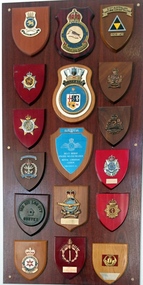 Kew RSL
Mounted plaques, January 2018
... multiple unit & association plaques mounted on veneered baord...multiple unit & association plaques mounted on veneered baord Mounted plaques ...multiple unit & association plaques mounted on veneered baord -
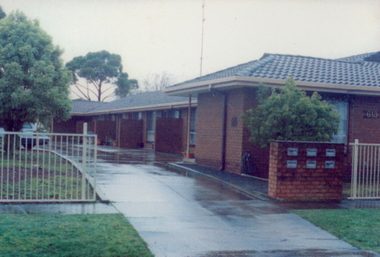 Old Colonists' Association of Ballarat Inc.
Photograph - Image, Ballarat Old Colonists' Association Residence - Unit 1-6 Ascot Street, Ballarat, c2000
... Ballarat Old Colonists' Association Residence - Unit 1-6 Ascot Street, Ballarat...These units were built in 1991. One of the first objectives of the Association was "to provide the shelter of a hose for those Pioneers of the Goldfields whom the reverses of fortune have deprived of the means of procuring the comforts of life in their declining years." ...Ballarat Old Colonists' Association Residence - Unit 1-6 Ascot Street, Ballarat Photograph Image ...These units were built in 1991. One of the first objectives of the Association was "to provide the shelter of a hose for those Pioneers of the Goldfields whom the reverses of fortune have deprived of the means of procuring the comforts of life in their declining years." The first home at Charles Anderson Grove was built in 1925. Before that time the Association provided relief for needy pioneers. relief included monthly monetary payments, loads of firewood, medical assistance and distribution of Christmas bosed of groceries to deserving pensioners, and in some cases payment of burial costs. ::a) The dominant purpose of the Association is to give public benevolent relief as a charity, but providing independent living accommodation in our Retirement Village for person in need who are over 65. ::b) To raise funds by membership subscription, commercial and residential rents, donations, gifts and voluntary work, for the purpose of providing direct relief of poverty, distress, misfortune or helplessness. ::c) To maintain the important heritage and ongoing viability of the Old Colonists' Association. (Revised Rules of the Old Colonists' Association of Ballarat Inc., 2016) Colour photograph of the former Old Colonists' Association of Ballarat Inc homes in Ascot Street, Ballarat.ballarat old colonists' association, homes, ascot street units -
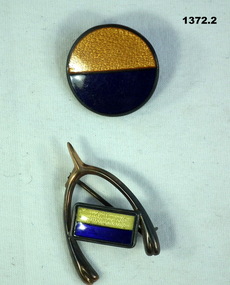 Bendigo Military Museum
Badge - ASSOCIATION BADGES, post WWI
... ...Unit association...Badges were in the collection of Edwin James Jones No 3511 AIF. refer 1367.5 for his service history. societies-service clubs metalcraft-brassware Unit association jones .1) Brass civilian badge with yellow and blue enamelled face and pin attachment on rear. 46th Batt AIF. .2) Brass civilian wishbone shaped badge with yellow and blue enamelled rectangular section and attachment pin on rear. ...The top Association badge is 46th Batt AIF. The bottom badge appears to be 14th Batt AIF. When the AIF was doubled in Egypt in 1916 the 14th Batt was split to form the 46th Batt. Badges were in the collection of Edwin James Jones No 3511 AIF. refer 1367.5 for his service history..1) Brass civilian badge with yellow and blue enamelled face and pin attachment on rear. 46th Batt AIF. .2) Brass civilian wishbone shaped badge with yellow and blue enamelled rectangular section and attachment pin on rear.societies-service clubs, metalcraft-brassware, unit association, jones -
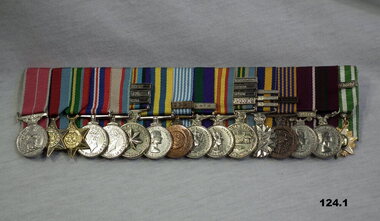 Bendigo Military Museum
Award - MEDAL SET WW2 TO VIETNAM, NAME BADGE, Post 1945
... .1) Medal set, miniatures, brass plate mounted, set of (16) re F.W Dean BEM. .2) Name badge - battalion badge for unit associations. Black plastic backing with pin, black name on gold background. ...Frank passed away on 11.2.2005 age 79 years. numismatics medals military badges metalcraft .2) "Frank Dean 1RAR" .1) Medal set, miniatures, brass plate mounted, set of (16) re F.W Dean BEM. .2) Name badge - battalion badge for unit associations. Black plastic backing with pin, black name on gold background. ....1) The first medal on the left is the BEM. There are 9 clasps denoting overseas service and 3 clasps denoting Long Service. Francis William (Dinky) Dean (born Kerang) enlisted in the 2nd AIF No VX93960 on 16.12.43 age 18 years. He went on to serve with the 2nd/2nd Pioneers in the islands ending up on Morotai at wars end. At the end of 1945 while still overseas 3 new Battalions were formed for service wth BCOF in Japan. They were the 65th, 66th and 67th Bn’s made up from 3 Aust Divisions 6th, 7th and 9th. Frank was one of the first to sign up in the 65th Bn with same Regt No. They moved to Japan in early 1946. While still in Japan in 1947 there was a period called the Interim Army while the 65th, 66th and 67th Bn’s were designated 1st, 2nd and 3rd Bn’s R.A.R, Aust Regular Army. His Regt No changed to 3742 and the 65th became the 1st Batt of the R.A.R. He then served with 1 RAR in Korea 7.4.52 to 28.2.53, 3.3.54 to 24.3.56. Malaya during the Emergency/ Confrontation Oct 1959 to Oct 1961. Vietnam 1.6.65 to 7.6. 66, 18.3.68 to 11.2.69. Malaya 1969-70. Frank was discharged from the Army on 19.12.1975 with the rank of Quarter Master Sergeant with a total of 32 years service. He was the longest serving member of 1 RAR, he had a final posting to RMC prior to discharge. BEM (British Empire Medal) For service in Korea. BCOF (British Commonwealth Occupation Force Japan) RAR ( Royal Australian Regiment) RMC (Royal Military College Duntroon) In 2004 Frank was the guest of honour at the new Coral Lines Lavarack Barracks Townsville, a street was named “Dean drive” after him. Frank passed away on 11.2.2005 age 79 years. .1) Medal set, miniatures, brass plate mounted, set of (16) re F.W Dean BEM. .2) Name badge - battalion badge for unit associations. Black plastic backing with pin, black name on gold background. .2) "Frank Dean 1RAR"numismatics, medals, military, badges, metalcraft -
 Bendigo Military Museum
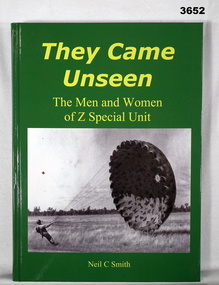
Book - BOOK, WW2, Neil C Smith, They Came Unseen, 2010
... Back cover has colour photo of 2 Special Unit Association ANZAC Day March. 264 cut, plain, white pages. ...Back cover has colour photo of 2 Special Unit Association ANZAC Day March. 264 cut, plain, white pages. ...They Came Unseen - The men and women of 2 Special Unit. From back cover: Secret operations behind enemy lines in the Pacific War during World War Two were vital in winning he war against the Japanese. Author: Lieutenant Colonel Neil C Smith, AM” Hard cardboard cover, gloss paper. Yellow print on front spine & back. Green background, illustrated front cover, black / white photo of soldier with parachute. Back cover has colour photo of 2 Special Unit Association ANZAC Day March. 264 cut, plain, white pages. Illustrated black / white photos & maps. Handwritten on title page in black ink: “Neil Smith”book, z special, came unseen -
 Merbein RSL Sub Branch
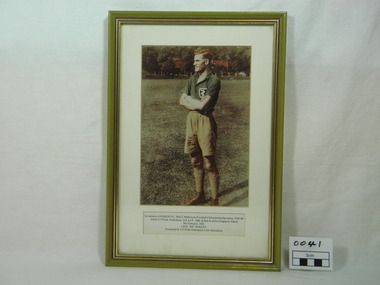
Photo, Portrait In Memory of Harold C. Ball
... Killed in action Singapore Island/,9th February,1942/ LEST WE FORGET/ Presented by 2/9 Field Ambulance Unit Association"...Killed in action Singapore Island/,9th February,1942/ LEST WE FORGET/ Presented by 2/9 Field Ambulance Unit Association" Black and white photograph colourized- photo, rectangular, wooden frame, Man standing, Wearing shorts and unit football jersey Portrait In Memory of Harold C. ...Harold played football for Merbein before playing for Melbourne.Black and white photograph colourized- photo, rectangular, wooden frame, Man standing, Wearing shorts and unit football jerseyPlaque underneath photograph "In memory of Harold C.Ball Melbourne Football Club premiership teams,1939/40/.Joined 2/9 A.I.F 1940. Killed in action Singapore Island/,9th February,1942/ LEST WE FORGET/ Presented by 2/9 Field Ambulance Unit Association"melbourne, football, merbein, firsts -
 Bendigo Military Museum
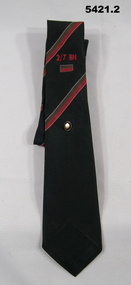
Accessory - TIE, 2/7TH BN, Post ww2
... .1) 2/7th Bn Unit Association tie, green with 6 by bands across being the unit colours brown over red, centre has sewn on 2/7th BN, there colour patch brown over red rectangular shape. .2) small metal tie pin, dome top purple back ground with an RSL badge inset, small chain and clip on rear....Ties Association 2/7th wiles .1) 2/7th Bn Unit Association tie, green with 6 by bands across being the unit colours brown over red, centre has sewn on 2/7th BN, there colour patch brown over red rectangular shape. .2) small metal tie pin, dome top purple back ground with an RSL badge inset, small chain and clip on rear. ...Purchased by John Eric Wiles VX 16067, refer Cat No 5410P for his service details..1) 2/7th Bn Unit Association tie, green with 6 by bands across being the unit colours brown over red, centre has sewn on 2/7th BN, there colour patch brown over red rectangular shape. .2) small metal tie pin, dome top purple back ground with an RSL badge inset, small chain and clip on rear.ties, association, 2/7th, wiles -
 Bendigo Military Museum
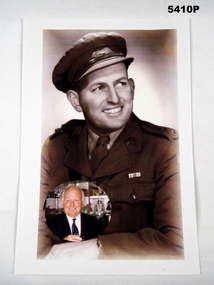
Photograph - PHOTOGRAPH WW2, Post 9.11.1942
... Post war he became very involved in his Unit Association and the RSL and became in time a Life Member of both. ...Post war he became very involved in his Unit Association and the RSL and became in time a Life Member of both. ...John Eric Wiles VX16067 enlisted on 26.2.1940 age 24 years in the 2/7th Bn, embark for Eygpt 15.4.1940, disembark 17.5.1940, embark for Greece 30.3.1941, reported missing then as located, disembark Eygpt (no date but appears to be June). Hospital 10.6.1941 with Gastritis, rejoin unit 13.7.1941, promoted Cpl 6.12.1941, Sgt 12.1.1942, embark for Australia 12.7.1942, disembark 4.8.1942, embark for New Guinea 13.10.1942, appointed Lieutenant 9.11.1942, during period hospital with Malaria, disembark Australia 3.8.1943, hospital again with Malaria then Debility. Embark 11.11.1944 for Aitape, WIA remains on duty, prompted T/Capt 4.8.1945, disembark Australia 28.9.1945, appointment terminated in the 2nd AIF. Post war he became very involved in his Unit Association and the RSL and became in time a Life Member of both. He was also a President of Mitchum RSL.Photo copy of original on A4 size paper showing a portrait colour enhanced of an Officer wearing a peak cap and has one ribbon on jacket, there is an oval shape colour photo inserted at the bottom LH side of the Person in later life. The rear has a typed stuck on label with details.On rear typed, “Jack Wiles 2/7th INF BN VX16067 20.03.15 - 19.07.2005”photograph, ww2, wiles -
 Melbourne Legacy
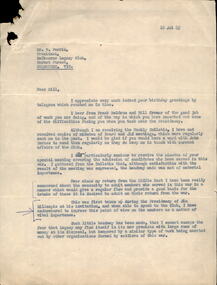
Letter, Legatee Savige to Legatee W Perrin, 1945
... Quite recently I have met men who know about Legacy, but are more concerned about their own Unit Associations taking up our type of work in its application to the widows and orphans of the men killed within their units."...Quite recently I have met men who know about Legacy, but are more concerned about their own Unit Associations taking up our type of work in its application to the widows and orphans of the men killed within their units." ...A letter from Legatee Savige to Legatee Bill Perrin dated 16 July 1945. Stan Savige was serving in World War 2 at the time. Bill Perrin was Legacy President that year. It discusses the importance of allowing admission of new legatees from the ranks of the servicemen from World War 2. He is concerned there might be conflict with other organisations if they are created to perform a similar role as Legacy. Part of the letter says: "When the opportunity presents itself I speak to men, who are the right type for membership, of the necessity to consider the Club as an avenue of service after the war. Quite recently I have met men who know about Legacy, but are more concerned about their own Unit Associations taking up our type of work in its application to the widows and orphans of the men killed within their units."A record of Stan Savige's concerns about the future of Legacy and including new members from World War 2.White letter with blue type x 4 pages dated 16 July 1945 from Stan Savige to Bill Perrin.stan savige, aaron beattie -
Glen Eira Historical Society
Document - KOOYONG ROAD, 75, CAULFIELD NORTH
... The pamphlet includes a brief history of the unit’s association with the City of Caulfield, a list of individuals holding posts within the Unit, text of the scroll conferring the Freedom of Entry on the Unit, a program of the ceremony, a brief history of the Royal Australian Army Ordnance Corps including the Unit’s use of 75 Kooyong Road as their premises, a brief history of the City of Caulfield from 1937-postwar years, and an explanation of the tradition of conferring Freedom of Entry to a city. ...The pamphlet includes a brief history of the unit’s association with the City of Caulfield, a list of individuals holding posts within the Unit, text of the scroll conferring the Freedom of Entry on the Unit, a program of the ceremony, a brief history of the Royal Australian Army Ordnance Corps including the Unit’s use of 75 Kooyong Road as their premises, a brief history of the City of Caulfield from 1937-postwar years, and an explanation of the tradition of conferring Freedom of Entry to a city. ...Two copies of a pamphlet for the ceremony of the Third Ordnance Services Unit ‘Exercising the Right of the Freedom of Entry to the City of Caulfield’ held on 23/10/1983. The pamphlet includes a brief history of the unit’s association with the City of Caulfield, a list of individuals holding posts within the Unit, text of the scroll conferring the Freedom of Entry on the Unit, a program of the ceremony, a brief history of the Royal Australian Army Ordnance Corps including the Unit’s use of 75 Kooyong Road as their premises, a brief history of the City of Caulfield from 1937-postwar years, and an explanation of the tradition of conferring Freedom of Entry to a city. The pamphlet includes also: 1/A black and white photograph (47x35mm) of the Mayor of Caulfield, W.R. Walters, undated and unattributed. 2/A black and white photograph (81x69mm) of Major A.G. Storen, Commanding Officer of the Third Ordnance Services Unit, undated and unattributed. 3/A color photograph (88x84mm) of the Sovereign’s Banner, undated and unattributed. 4/A black and white copy (137x87mm) of the scroll conferring Freedom of Entry into the City of Caulfield, which was seated August 4 1978. 5/A color illustration (30x32mm) of the City of Caulfield Coat of Arms. 6/A color illustration (40x32mm) of the Third Ordnance Services Unit, Royal Australian Army Ordnance Corps Coat of Arms. 7/A black and white illustration (21x24mm) of the city of Caulfield Coat of Arms. 8/A black and white illustration (19x14mm) of the City of Caulfield badge. 9/A black and white illustration (22x31mm) of the City of Caulfield banner.walters w.r., storen a.g. major, finning d.j. captain, hately p.g. major, davidson j. (captain), swendson r. (second lieutenant), caulfield, city of caulfield, australian army, the third ordnance services unit royal australian army ordnance corps, caulfield park, caulfield council, north caulfield, campton e.j. (brigadier), walters w.r. mrs., calder g.k., calder g.k. mrs., mahon j. (chief superintendent), city hall, balaclava road, hawthorn road, glen eira road, hartley avenue, kooyong road, caulfield racecourse, caulfield town hall, alma road, red cheques cab company, army headquarters printing press, searchlight company, amenities store, armoured replacement unit, first base printing company r.a.a.o.c., garden vale, caulfield railway station, paddy’s swamp, great dandenong road, glen ferrie road, dandenong road, east caulfield reserve, caulfield military hospital, ‘glen eira’, town hall, ‘war office’, caulfield district road board, shire of caulfield, caulfield recruiting committee for volunteers, city repatriation committee, red cross emergency service, women’s national service, mayor’s patriotic fund, promotions committee for war savings certificates, war savings group scheme, ‘the gazette’, air raid precautions committee, orrong road, armed forces, world war 1939-1945, local government, parades and processions, military reserves, world war 1914-1918, councillors, events and activities, historic events, official events, caulfield john, wyne agar, murphy (mayor), hale p., ison (captain), fisher andrew, morris t.w. (mayor) -
Glen Eira Historical Society
Document - KOOYONG ROAD, 75, CAULFIELD NORTH
... The pamphlet includes a brief history of the Unit’s association with the City of Caulfield, a list of individuals holding posts within the unit, text of the scroll conferring the Freedom of Entry on the Unit, a program of the ceremony, a brief history of the Royal Australian Army Ordnance Corps, including the Unit’s use of 75 Kooyong Road as their premises, a brief history of the city of Caulfield and an explanation of the tradition of conferring Freedom of Entry to a city. ...The pamphlet includes a brief history of the Unit’s association with the City of Caulfield, a list of individuals holding posts within the unit, text of the scroll conferring the Freedom of Entry on the Unit, a program of the ceremony, a brief history of the Royal Australian Army Ordnance Corps, including the Unit’s use of 75 Kooyong Road as their premises, a brief history of the city of Caulfield and an explanation of the tradition of conferring Freedom of Entry to a city. ...Three copies of a pamphlet for the ceremony of the Third Ordnance Services Unit ‘Exercising the Right of the Freedom of Entry to the City of Caulfield’, held on 13/07/1986. The pamphlet includes a brief history of the Unit’s association with the City of Caulfield, a list of individuals holding posts within the unit, text of the scroll conferring the Freedom of Entry on the Unit, a program of the ceremony, a brief history of the Royal Australian Army Ordnance Corps, including the Unit’s use of 75 Kooyong Road as their premises, a brief history of the city of Caulfield and an explanation of the tradition of conferring Freedom of Entry to a city. The pamphlet includes also: 1/A black and white photograph (61x66mm) of the Mayor of Caulfield, Maxwell Blair, undated and unattributed. 2/A black and white photograph (70x51mm) of Major P.G. Hateley, Commanding Officer of the Third Ordnance Services Unit, undated and unattributed. 3/A black and white photograph (91x90mm) of the Sovereign’s Banner, undated and unattributed. 4/A black and white copy (137-87) of the scroll conferring Freedom of Entry into the City of Caulfield which was seated August 4 1978. 5/A color illustration (30x32mm) of the City of Caulfield Coat of Arms. 6/A colour illustration (40x32mm) of the Third Ordnance Services Unit, Royal Australian Army Ordnance Corps Coat of Arms. 7/A black and white illustration (21x24mm) of the City of Caulfield Coat of Arms. 8/A black and white illustration (19x19mm) of the City of Caulfield badge. 9/A black and white illustration (22x31mm) of the City of Caulfield banner.blair maxwell (mayor), hateley p.g. (major), finning d.j. (captain), lowe g. (captain), barker l.a. (lieutenant), blair mrs., aylen d.r., aylan d.r. mrs., goltz m.h., compton e.j. (brigadier), goltz m.h. (chief superintendant), caulfield john, wynne agar, murphy (mayor), hate p., ison (captain), fisher andrew, morris t.w. (mayor), caulfield, kooyong road, caulfield park, north caulfield, city of caulfield, city hall, balaclava road, hawthorn road, glen eira road, hartley avenue, caulfield racecourse, caulfield town hall, alma road, orrong road, garden vale, caulfield railway station, paddy’s swamp, great dandenong road, glen ferrie road, dandenong road, east caulfield reserve, caulfield military hospital, ‘glen eira’, town hall, ‘war office’, red chequer cab company, caulfield council, third ordnance services unit royal australian army ordnance corps, australian army, army headquarters printing press, searchlight company, amenities store, armoured replacement unit, first base printing company r.a.a.o.c., caulfield district road board, shire of caulfield, caulfield recruiting committee for volunteers, city repatriation committee, red cross emergency service, women’s national service, mayor’s patriotic fund, promotions committee for war savings certificates, war savings group scheme, ‘the gazette’, air raid precautions committee, armed forces, world war 1939-1945, local government, parades and processions, military reserves, world war 1914-1918, councillors, events and activities, historic events, official events -
 Bendigo Military Museum
Literary work - MEMORIAL WALLS & WALKWAY
... The recommendations in brief were: Five central plaques on the north wall with Unit/Association/Conflict/Service based plaques placed equally out on each side of the five central. ...The recommendations in brief were: Five central plaques on the north wall with Unit/Association/Conflict/Service based plaques placed equally out on each side of the five central. ...The Memorial Walls & Walkway came about as part of the Re Developement of the Forecourt of the Soldiers Memorial Institute (Bendigo Military Museum) and completed in 2008.There was a Wall on the north and south side of the building. Discussions re some sort of Memorial(s) had gone on for several years with a number of plans and ideas being put forward. A final Sub Committee was appointed in April 2010 of 4 people being Richards, Ball, Poustie and Harding. The first meeting was on May 20th with one apology and Ball chairing and over 3 hours a final plan was put together from all the previous plans and ideas. On the 21st measurements and photos were taken to draw up the final recommendations to Committee BDRSL. The recommendations in brief were: Five central plaques on the north wall with Unit/Association/Conflict/Service based plaques placed equally out on each side of the five central. On both the north & south walls at one end would be the lettering in large brass “Lest We Forget”. Application for a plaque would be via a form, all plaques the same size and no individual names on. The folder holds the minutes of the meeting and plans that would go to BDRSL for approval. A briefer version that would go to the Members of BDRSL for final approval. Two more copies used on the day. The application form. One page with initial plaque costs. Three pages with 6 photos per page showing the time line re placement of the plaques. Brief time line. April 2010. Final Sub Committee formed. May 20/21st. First meeting of the Sub Committee. May 24th.Plans approved by Committee BDRSL June 21st. Plans approved by Members of BDSL. June 23rd. Letters/forms go out to Associations,some 10 were eligible City of Greater Bendigo Council approves plans. Sept 2010. Ball & Poustie to now carry out the process. April 2011. Over 3 days the 5 main plaques and 5 Association plaques are placed. April 2011. Over 2 days the Lettering “Lest We Forget” is placed. 11.11.2011. The walls are dedicated. 2013 - 2025. Seven more plaques placed with last being so far on 27.3.2025. The Walls remained equal each side of the Main 5 central until the Redevelopment of the Soldiers Memorial Institute and Museum in 2016 - 18 with the RH end plaque being removed for steps to be placed. This plaque was then placed on the LH end making uneven.Folder A4with plastic inserts, contents include Sub Committee minutes, plans & details of plaques and inscriptions to go on, photos showing proposed viewing, chronology of events & times, photo history showing plaques as placed on the walls.brsl, smirsl, memorial walls, walkway -
 Flagstaff Hill Maritime Museum and Village
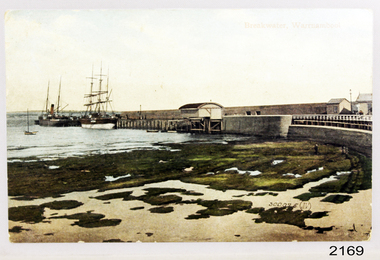
Postcard - Coastal Scene, Joseph Jordan Photographic Studio, Breakwater, Warrnambool, circa 1907
... association with the Port of Warrnambool and the Warrnambool Breakwater as it shows a point in time when shipping activities were an important part of Warrnambool's commerce and social development. It is also a record of the Warrnambool Lifeboat and Rocket house which was important in aiding ordinary citizens, harbour employees and the volunteer boat and rescue crew in saving the lives of sailors and passengers due to the high number of shipwrecks that occurred along the coastline. Joseph Jordan is a significant figure in Warrnambool history as he helped to establish early units ...The Port of Warrnambool - In the early years the Port of Warrnambool was a busy port. Steamships and sailing ships were frequent visitors to the port. Steam navigation companies were plentiful, carrying passengers and freighting cargo such as coal, timber, food, livestock, furniture, hardware and haberdashery between Melbourne and the ports along the southwest coast of Victoria, including Warrnambool. The carts would take their loads into the township for distribution. The Breakwater was built (using 32 ton blocks of concrete) between 1874 and 1890 to provide ships with greater protection from the Southern Ocean. The Lifeboat and Rocket House - The coastline of South West Victoria has had over 600 shipwrecks and many lost lives; even in Warrnambool’s Lady Bay there were around 16 known shipwrecks between 1850 and 1905, with eight lives lost. In 1859 the first Government-built lifeboat arrived at Warrnambool Harbour and a shed was soon built to house it, followed in 1864 by a rocket house to safely store the Rocket Rescue equipment. In 1878 the buildings were moved to the Breakwater area, and in 1910 the new Lifeboat Warrnambool arrived with its ‘self-righting’ design. For almost one hundred years the lifeboat and rocket crews, mostly local volunteers, trained regularly to maintain and improve their skills, summoned when needed by alarms, gunshots, ringing bells and foghorns. Some became local heroes but all served an important role. By the end of the 1950s the lifeboat and rescue equipment had become obsolete. Joseph Jordan - Joseph Jordan was born in 1841 in Leicester England. When he was 16 he joined the 7th Queen's Own Hussars and was sent to India at the outbreak of the mutiny. He took part in the relief of Lucknow and remained in India for eleven years. It was during this time, he became interested in photography. He was posted to New Zealand and later came to Victoria, becoming a sergeant major of the Mounted Rifles. In the mid 1880s he came to the Western district where he was responsible for establishing units of the Mounted Rifles in various country towns such as Dunkeld, Mortlake, Panmure, Bushfield, Koroit etc. He resigned from the army in 1889 and set up a professional photography studio in Liebig Street, Warrnambool. He became very well known in the Western District for family photographs, official photographs of local councillors and groups as well as views of local scenery. In 1891 he photographed the wrecked barque "Fiji" at "Wrecks Beach" near Princetown. His business was taken over by his son Arthur around 1917. Joseph was a keen rifle shot and in 1924 he donated the "Jordan Shield" as a prize to the Victorian Rifle Association. He was made a "Life Honorary Member" of the Warrnambool Returned Soldiers League and in 1933 he was recognised as being the oldest living soldier in Victoria. Joseph died in 1935 aged 95. Valentine Publishing Company Pty. Ltd. Valentine and Sons was a printing and photography business based in Dundee, Scotland and Canada. In the early 1900's, at the height of the postcard craze, they published large numbers of postcards in the U.K., Canada, U.S., Australia and South Africa. Valentine postcards have a 6 digit serial number on the view side with the initials "J. V." in a circle adjacent to the number. The 300,000's related to views of Australia. From around 1900 (or earlier) the firm bought many images for their postcards from local and national photographers who sold publishing rights to Valentines.This postcard is significant for its association with the Port of Warrnambool and the Warrnambool Breakwater as it shows a point in time when shipping activities were an important part of Warrnambool's commerce and social development. It is also a record of the Warrnambool Lifeboat and Rocket house which was important in aiding ordinary citizens, harbour employees and the volunteer boat and rescue crew in saving the lives of sailors and passengers due to the high number of shipwrecks that occurred along the coastline. Joseph Jordan is a significant figure in Warrnambool history as he helped to establish early units of the Mounted Rifles (G Company) in local towns during the late 1880's and later, photographed local scenes, groups and citizens of early Warrnambool. It is also a culturally significant example of the type of postcards that were very popular in the early part of the 20th century.Photograph of breakwater from beachFront of card - Breakwater, Warrnambool / 300,025 J.V [in a circle] Back of card - POSTCARD / VALENTINE'S SERIES / - This space may be used for communication / The address only to be written here - Miss Alice Griffen / Howard St / Warrnambool - How are you enjoying your holiday we are grand. / from / Dodo, Dodo, Dodo with love - Leura? / Marjory Craig? / BL006 / R99A / REG NO 2169flagstaff hill, warrnambool, shipwrecked-coast, flagstaff-hill, flagstaff-hill-maritime-museum, maritime-museum, photograph, warrnambool breakwater, breakwater, shipwreck-coast, flagstaff-hill-maritime-village, warrnambool harbour, postcard, joseph jordan, valentine and sons, valentine publishing company, lady bay, life boat house, rocket house, steam ship, barque, jordan photography -
 Greensborough Historical Society
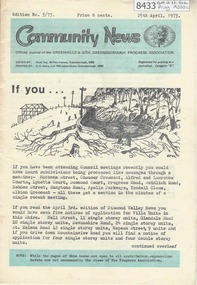
Newsletter, Greenhills and North Greensborough Progress Association, Community News: official journal of the Greenhills and Nth. Greensborough Progress Association. 25th April, 1973. Edition No. 3/73, 25/04/1973
... This edition includes a report on the Progress Association's April 1973 meeting, Councillor's report, If you... : on flats and units, Women's Electoral Lobby, School and kinder news, Letter to the Editor, The Leichhardt experiment, Recent happenings. ...This edition includes a report on the Progress Association's April 1973 meeting, Councillor's report, If you... : on flats and units, Women's Electoral Lobby, School and kinder news, Letter to the Editor, The Leichhardt experiment, Recent happenings. ...This edition includes a report on the Progress Association's April 1973 meeting, Councillor's report, If you... : on flats and units, Women's Electoral Lobby, School and kinder news, Letter to the Editor, The Leichhardt experiment, Recent happenings. A digital copy of this Newsletter is available from Greensborough Historical Society.Newsletter, 24 p., illus.greenhills and north greensborough progress association, greenhills -
 Greensborough Historical Society
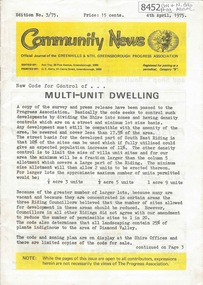
Newsletter, Greenhills and North Greensborough Progress Association, Community News: official journal of the Greenhills and Nth. Greensborough Progress Association. 4th April, 1975. Edition No. 3/75, 04/04/1975
... This edition includes a report on the Progress Association's March 1975 meeting, Councillor's report, Progress Association President's report 1975, New code for control of multi-unit dwelling, Community News closes down, This and that, From the Council Chamber, Films in the Diamond Valley, The proper use of backyard incinerators, Supplement to "Community News". ...This edition includes a report on the Progress Association's March 1975 meeting, Councillor's report, Progress Association President's report 1975, New code for control of multi-unit dwelling, Community News closes down, This and that, From the Council Chamber, Films in the Diamond Valley, The proper use of backyard incinerators, Supplement to "Community News". ...This edition includes a report on the Progress Association's March 1975 meeting, Councillor's report, Progress Association President's report 1975, New code for control of multi-unit dwelling, Community News closes down, This and that, From the Council Chamber, Films in the Diamond Valley, The proper use of backyard incinerators, Supplement to "Community News". No. 3/75. Meet the natives. A digital copy of this Newsletter is available from Greensborough Historical Society.Newsletter, 24 p., illus.greenhills and north greensborough progress association, greenhills -
 Federation University Historical Collection
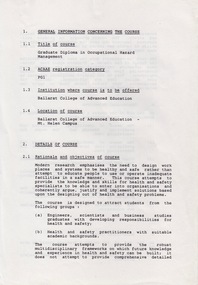
Document - Document - Course Outline, VIOSH: Ballarat College of Advanced Education; General Information - Graduate Diploma in Occupational Hazard Management, c1986
... Unit Descriptions, Staff, Student Workloads. Student Enrolment Statistics for 1979 to 1985 show the numbers from each state and overseas, employments areas such as government, industry, manufacturing, health, and associations, plus the total applications and enrolments. ...Unit Descriptions, Staff, Student Workloads. Student Enrolment Statistics for 1979 to 1985 show the numbers from each state and overseas, employments areas such as government, industry, manufacturing, health, and associations, plus the total applications and enrolments. viosh victorian institute of occupational safety and health ballarat college of advanced education graduate diploma in occupational hazard management pg1 objectives of course admission requirements structure of course unit descriptions student workloads assessment methods k brown dennis else r gillis tom norwood max brooke r kemp j harvey p kelly l roberts m torode derek viner eric wigglesworth g fernandez b lees r maud p swan j blitvich g bradley j castleman r lang j lowinger p reid Thirteen A4 sheets - typed on both sides. ...Victorian Institute of Occupational Safety and Health (VIOSH) Australia is the Asia-Pacific centre for teaching and research in occupational health and safety (OHS) and is known as one of Australia's leaders in the field. VIOSH has a global reputation for its innovative approach within the field of OHS management. VIOSH had its first intake of students in 1979. At that time the Institution was known as the Ballarat College of Advanced Education. In 1990 it became known as Ballarat University College, then in 1994 as University of Ballarat. It was 2014 that it became Federation University. VIOSH Australia students are safety managers, senior advisors and experienced OHS professionals. They come from all over Australia and industry. Students are taught active research and enquiry; rather than textbook learning and a one-size fits all approach. VIOSH accepts people into the Graduate Diploma of Occupational Hazard Management who have no undergraduate degree - on the basis of extensive work experience and knowledge. Document is General Information on the Graduate Diploma in Occupational Hazard Management. Sections are from a larger fully detailed document. Outlines the structure of the course, Unit Descriptions, Staff, Student Workloads. Student Enrolment Statistics for 1979 to 1985 show the numbers from each state and overseas, employments areas such as government, industry, manufacturing, health, and associations, plus the total applications and enrolments. Thirteen A4 sheets - typed on both sides.viosh, victorian institute of occupational safety and health, ballarat college of advanced education, graduate diploma in occupational hazard management, pg1, objectives of course, admission requirements, structure of course, unit descriptions, student workloads, assessment methods, k brown, dennis else, r gillis, tom norwood, max brooke, r kemp, j harvey, p kelly, l roberts, m torode, derek viner, eric wigglesworth, g fernandez, b lees, r maud, p swan, j blitvich, g bradley, j castleman, r lang, j lowinger, p reid -
Federation University Historical Collection
Book, Tourism & Marketing Unit, Ballarat University College, Grampians Tourist Survey - Summary Results January-December, 1991, 1991
... Tourism & Marketing Unit, Ballarat University College, Students' Project. ballarat university college grampians stawell introduction methodology results conclusion stawell and grampians economic development association halls gap grampians national park great ocean road victorian otways mckenzie falls wonderland forest brambuk cultural centre grampians/gariwerd region White bound book of 12 pages plus 15 tables and 1 appendix. ...Grampians Tourist Survey - Summary Results January-December, 1991. Tourism & Marketing Unit, Ballarat University College, Students' Project.White bound book of 12 pages plus 15 tables and 1 appendix.ballarat university college, grampians, stawell, introduction, methodology, results, conclusion, stawell and grampians economic development association, halls gap, grampians national park, great ocean road, victorian otways, mckenzie falls, wonderland forest, brambuk cultural centre, grampians/gariwerd region -
 Marysville & District Historical Society
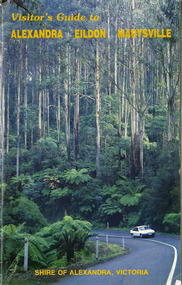
Ephemera (Item) - Visitor's Guide, Shire of Alexandra, Visitor's Guide to ALEXANDRA EILDON MARYSVILLE, Unknown
... A tourist guide for Alexandra, Eildon and Marysville produced by the Shire of Alexandra. alexandra eildon marysville victoria australia tourist guide the cumberland tudor lodge road house the hermitage narbethong blue views ski hire and holiday units narbethong blackwood lodges marysville marysville hotel motel kufstein inn marysville lake mountain mary-lyn resort marysville kooringa resort and conference centre marysville mary's ville marysville marysville crafts & gifts geoffrey pope & associates nanda binya lodge marysville crossways country inn marysville steavenson falls scenic motel marylands guest house marysville holiday cottages marysville newsagency & general store el kanah roseleigh holiday units restaurant tirol olde yarra track shoppe marysville caravan park dalrymples guest cottages danish coffee garden maryton park tower motel marysville golf and bowls club taggerty general store the camel farm and zoo buxton buxton trout farm yarrolyn holiday park riverland lodge marysville mountain view horse hire beauty spot walk tree fern gully walk michaeldene track keppel track woods lookout track A tourist guide for Alexandra, Eildon and Marysville produced by the Shire of Alexandra. Visitor's Guide to ALEXANDRA EILDON MARYSVILLE Ephemera Visitor's Guide Shire of Alexandra Eildon-Alexandra Tourist Association ...A tourist guide for Alexandra, Eildon and Marysville produced by the Shire of Alexandra.A tourist guide for Alexandra, Eildon and Marysville produced by the Shire of Alexandra.alexandra, eildon, marysville, victoria, australia, tourist guide, the cumberland, tudor lodge road house, the hermitage narbethong, blue views ski hire and holiday units narbethong, blackwood lodges marysville, marysville hotel motel, kufstein inn marysville, lake mountain, mary-lyn resort marysville, kooringa resort and conference centre marysville, mary's ville marysville, marysville crafts & gifts, geoffrey pope & associates, nanda binya lodge marysville, crossways country inn marysville, steavenson falls, scenic motel, marylands guest house, marysville holiday cottages, marysville newsagency & general store, el kanah, roseleigh holiday units, restaurant tirol, olde yarra track shoppe, marysville caravan park, dalrymples guest cottages, danish coffee garden, maryton park, tower motel, marysville golf and bowls club, taggerty general store, the camel farm and zoo buxton, buxton trout farm, yarrolyn holiday park, riverland lodge, marysville mountain view horse hire, beauty spot walk, tree fern gully walk, michaeldene track, keppel track, woods lookout track -
 Marysville & District Historical Society
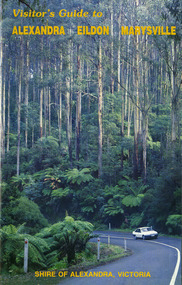
Ephemera (Item) - Visitor's Guide, Shire of Alexandra, Visitor's Guide to ALEXANDRA EILDON MARYSVILLE, Unknown
... A tourist guide for Alexandra, Eildon and Marysville produced by the Shire of Alexandra. alexandra eildon marysville victoria australia tourist guide the cumberland tudor lodge road house the hermitage narbethong blue views ski hire and holiday units narbethong blackwood lodges marysville marysville hotel motel kufstein inn marysville lake mountain mary-lyn resort marysville kooringa resort and conference centre marysville mary's ville marysville marysville crafts & gifts geoffrey pope & associates nanda binya lodge marysville crossways country inn marysville steavenson falls scenic motel marylands guest house marysville holiday cottages marysville newsagency & general store el kanah roseleigh holiday units restaurant tirol olde yarra track shoppe marysville caravan park dalrymples guest cottages danish coffee garden maryton park tower motel marysville golf and bowls club taggerty general store the camel farm and zoo buxton buxton trout farm yarrolyn holiday park riverland lodge marysville mountain view horse hire beauty spot walk tree fern gully walk michaeldene track keppel track woods lookout track A tourist guide for Alexandra, Eildon and Marysville produced by the Shire of Alexandra. Visitor's Guide to ALEXANDRA EILDON MARYSVILLE Ephemera Visitor's Guide Shire of Alexandra Eildon-Alexandra Tourist Association ...A tourist guide for Alexandra, Eildon and Marysville produced by the Shire of Alexandra.A tourist guide for Alexandra, Eildon and Marysville produced by the Shire of Alexandra.alexandra, eildon, marysville, victoria, australia, tourist guide, the cumberland, tudor lodge road house, the hermitage narbethong, blue views ski hire and holiday units narbethong, blackwood lodges marysville, marysville hotel motel, kufstein inn marysville, lake mountain, mary-lyn resort marysville, kooringa resort and conference centre marysville, mary's ville marysville, marysville crafts & gifts, geoffrey pope & associates, nanda binya lodge marysville, crossways country inn marysville, steavenson falls, scenic motel, marylands guest house, marysville holiday cottages, marysville newsagency & general store, el kanah, roseleigh holiday units, restaurant tirol, olde yarra track shoppe, marysville caravan park, dalrymples guest cottages, danish coffee garden, maryton park, tower motel, marysville golf and bowls club, taggerty general store, the camel farm and zoo buxton, buxton trout farm, yarrolyn holiday park, riverland lodge, marysville mountain view horse hire, beauty spot walk, tree fern gully walk, michaeldene track, keppel track, woods lookout track -
 Marysville & District Historical Society
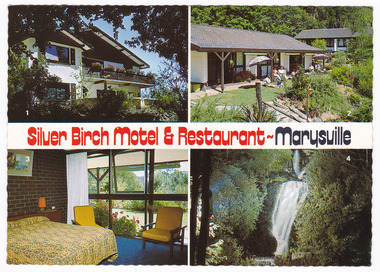
Postcard (item) - Colour postcard, Nucolorvue Productions Pty. Ltd, Silvery Birch Motel & Restaurant-Marysville, Unknown
... A colour postcard from the Silver Birch Motel and Restaurant in Marysville. marysville victoria australia kerami guesthouse sister elizabeth glover wood's point road kerami house pack road murchison street marysville & district tourist & progress association sister helena brayshay marion bethia curdie sister margaret vincent thomas sister elsie rose beatrice bolam mbe lesley archibald elinor macgowan mary lodge silver birch motel kufstein inn the birches kerami gardens resort nucolorvue productions pty. ltd. postcard souvenir NU-COLOR-VUE/ OF/ AUSTRALIA MAC 1/ NCV 2767 NUCOLORVUE PRODUCTIONS PTY. LTD./ COPYRIGHT PRINTED IN AUSTRALIA SILVER BIRCH MOTEL &/ RESTAURANT/ Cumberland Road, Marysville/ 3779/ Phone (059) 63 3392 Situated 500 metres out of town/ in lovely garden setting. Double &/ Family units ...A colour postcard from the Silver Birch Motel and Restaurant in Marysville.A colour postcard from the Silver Birch Motel and Restaurant in Marysville.NU-COLOR-VUE/ OF/ AUSTRALIA MAC 1/ NCV 2767 NUCOLORVUE PRODUCTIONS PTY. LTD./ COPYRIGHT PRINTED IN AUSTRALIA SILVER BIRCH MOTEL &/ RESTAURANT/ Cumberland Road, Marysville/ 3779/ Phone (059) 63 3392 Situated 500 metres out of town/ in lovely garden setting. Double &/ Family units are equipped with all/ modern facilities. 1. RESTAURANT 2. UNITS 3. INTERIOR 4. STEAVENSON FALLS Became/ KUFSTEIN INN/ EDITH + RON HANNANmarysville, victoria, australia, kerami guesthouse, sister elizabeth glover, wood's point road, kerami house, pack road, murchison street, marysville & district tourist & progress association, sister helena brayshay, marion bethia curdie, sister margaret vincent thomas, sister elsie rose beatrice bolam mbe, lesley archibald elinor macgowan, mary lodge, silver birch motel, kufstein inn, the birches, kerami gardens resort, nucolorvue productions pty. ltd., postcard, souvenir -
 Lara RSL Sub Branch
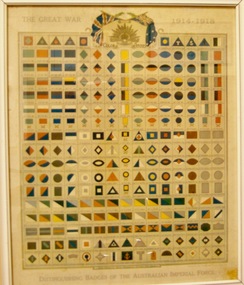
Distinguishing Badges of the Australian Forces, The Great War-1914/18 colour patches
... Through their identification with AIF units came the authority for militia units to wear the colour patches of their associated AIF units; other colour patches were approved for units outside the AIF association. ww1 the great war middle east 1914/18 lara r.s.l. colour patches THE GREAT WAR-1914/18 Distinguishing Badges and Patches of the Australian Forces. ...The Australian army's system of colour patches arose from the need to solve an immediate problem. When the first Australian Imperial Force (AIF) set off for the Middle East in 1914, the only badge it wore was on headgear and jacket collars: the Australian "Rising Sun" emblem, inscribed with the words "Australian Commonwealth Military Forces" (ACMF). Nothing distinguished one regiment from another. Divisional Order No. 81(A) Administration was issued at Mena, Egypt, on 8 March 1915 to overcome the problem:After the First World War the use of colour patches continued in the Citizens Military Forces (CMF), also known as militia. The CMF were reorganised into a divisional structure similar to that of the AIF. Units were generally renamed to provide a direct numerical association with AIF units raised from the same states and districts. Through their identification with AIF units came the authority for militia units to wear the colour patches of their associated AIF units; other colour patches were approved for units outside the AIF association.Rectangular shaped glass covered Picture Frame showing colour patches and badges of the Australian Imperial Forces.THE GREAT WAR-1914/18 Distinguishing Badges and Patches of the Australian Forces.ww1, the great war, middle east 1914/18, lara r.s.l., colour patches -
 Lara RSL Sub Branch
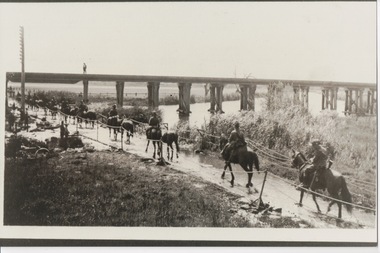
Photograph, Set 4 photographs. and others for Torquay Light Horse camp, 1940
... unit they called “The Kelly Gang” which did valuable scouting work. In New Guinea, a mounted Light Horse Troop did patrol duty and helped carry supplies. Some fully equipped walers were flown into Borneo for reconnaissance in rugged mountain country. But by the end of the war, in 1945, the horse had disappeared from the Australian Army. References: Australian Light Horse Association...unit they called “The Kelly Gang” which did valuable scouting work. In New Guinea, a mounted Light Horse Troop did patrol duty and helped carry supplies. Some fully equipped walers were flown into Borneo for reconnaissance in rugged mountain country. But by the end of the war, in 1945, the horse had disappeared from the Australian Army. References: Australian Light Horse Association ...These images capture for all time Light Horsemen travelling through Geelong on their way to camp at Torquay for the last Group meeting in Australia . information following - details obtained from .........https://torquayhistory.com/light-horse-brigade/ On Australia Day, 1997, Sir John Young unveiled this plaque on Point Danger, Torquay. Torquay history, Light Horse Training Camp, WW2 Plaque at Pt. Danger Note----- (See images to view plaque) The plaque identifies a significant event in Torquay’s history and the sentiments of ‘change’ for the Light Horse Brigade – from horses to machines. In 1940 the four Light Horse Regiments (4th, 8th, 13th and 20th), some 5000 Light Horse and 2000 horses camped and trained at Torquay. Three other regiments, formerly mounted on horses, were also at Torquay ‘mounted’ on privately owned trucks and cars. Division troops included Artillery, Engineers, Signals, Field Ambulance and other branches of the Army necessary to enable a Division to function. It wasn’t just the sheer numbers of men coming to this little town that made the event significant, it was also the fact that the men of the Light Horse were dramatic, almost glamorous figures and it is easy to see their exploits as some splendid adventure. Horses have played a special role in the story of Australia. They were the only means of transport across this huge country, so it was necessary for everyone to have the ability to ride a horse. When war broke out in 1899 between Britain and the Boers of South Africa (“Boer” was Dutch for “farmer”) Australia sent troops to fight. At first Britain was wary of using untried, unprofessional colonial cavalrymen but soon saw that the slouch-hatted Australian “bushmen” were a match for the fast-moving and unconventional mounted commandos of the Boers. The Australians proved themselves to be expert rough-riding horsemen and good shots. Bush life had hardened them to go for long periods with little food and water. They also showed remarkable ability to find their way in a strange country and use its features for cover, in both attack and defence. By 1914, when Australia joined the war against Germany, there were 23 Light Horse regiments of militia volunteers. Many men from these units joined the Light Horse regiments of the Australian Imperial Force (AIF). Men were given remounts (if not using their own horses) – army horses bought by Commonwealth purchasing officers from graziers and breeders. These were called “walers” because they were a New South Wales stockhorse type – strong, great-hearted animals with the strains of the thoroughbred and semi-draught to give them speed, strength and stamina. On 1st November, 1914, Australia’s First Infantry Division and the first four Light Horse regiments sailed for England in a fleet of transport ships. The first of the Light Horse arrived at Gallipoli in May without their horses. Back with their horses after Gallipoli, they were formidable combatants across the Sinai and Palestine. Some British commanders observed that the light horseman moved with a “lazy, slouching gait, like that of a sleepy tiger” but described how the promise of battle “changes that careless gait, into a live athletic swing that takes him over the ground much quicker than other troops”. They had Light Horse, Torquay, training campdeveloped a reputation as formidable infantrymen. The Turks called them “the White Ghurkas” – a reference to their deadly skill with the bayonet. The Arabs called them “The Kings of the Feathers”. The plume had originally been a battle honour of the Queensland Mounted Infantry for their work in the shearer’s strike of 1891. During WW1 it was adopted by almost all the Light Horse Regiments. It was the proud badge of the light horseman. The most famous of their battles was the attack on Beersheba- the charge of the 4th Light Horse Brigade. Mounted infantrymen and their superb walers had carried out one of the most successful cavalry charges in history – against what seemed impossible odds. They surprised the Turks by charging cavalry-style, when they would normally have ridden close to an objective then dismounted to fight. The fall of Beersheba swung the battle tide against the Turks in Palestine; and changed the history of the Middle East. While 19 men from the Surf Coast Shire served with the 4th Light Horse over the course of WW1, only four were involved in the charge of Beersheba- John GAYLARD, Philip QUINN.(Winchelsea); Wallace FINDLAY (Anglesea); Harry TRIGG (Bambra). After the war, Light Horse units played a key role in the Australian Government’s compulsory military training programme. The Citizen Military Forces (C.M.F.) thrived on the glamour of the wartime Light Horse tradition, ignoring the possibility that motor vehicles would soon replace the horses. When training was no longer compulsory, the C.M.F. regiments declined and horses became more of a luxury during the 1930s depression years of poverty and unemployment. Some regiments were motorised. Then, in 1939, Australia joined Britain in another world war. Training was increased for the militia at both home bases and regional training camps. The camp at Torquay in 1940, commanded by Major General Rankin, was at Divisional strength. By the end of the camp some felt that the Division was ready for active service. Gradually, over the next four years, the Australian Light Horse units were mounted on wheels and tracks and the horses were retired. Six men enlisted at the Torquay camp and another 57 men and women enlisted at Torquay for service in WW2. Those who served in the Militia provided valuable Officers and NCOs and men for the armed services during the war. Each infantry division of the 2nd AIF had a Light Horse regiment attached to it. But the day of the Australian mounted soldier hadn’t quite passed. During World War II, Australia’s 6th Cavalry Regiment formed a mounted unit they called “The Kelly Gang” which did valuable scouting work. In New Guinea, a mounted Light Horse Troop did patrol duty and helped carry supplies. Some fully equipped walers were flown into Borneo for reconnaissance in rugged mountain country. But by the end of the war, in 1945, the horse had disappeared from the Australian Army. References: Australian Light Horse Association www.lighthorse.org.au National Australia Archives Australian War Memorial Surf Coast Shire WW1 memorials www.togethertheyserved.com The Light horse- a Cavalry under Canvas Light Horse, Training Camp, Torquay, WW2 Late in 1939 it was decided to set up a Lighthorse training camp in Torquay to train both men and horses for the battles of the Second World War. Horses, men and equipment came on special trains from all over Victoria and NSW, and as you would expect horseman came from areas such as Omeo and Sale, the Wimmera and the Western District. They arrived at the Geelong racecourse for watering in the Barwon River and then were ridden across the ford at the breakwater and began their 11 mile trek to Torquay. Light Horse, Training Camp, Torquay, WW2 Tent city By the end of January 1940 the camp at Torquay accommodated some 5000 men and 2500 horses of the Second Cavalry Division. The rows of horses, tents and huts near Blackgate Road were quite a sight. While the cavalrymen engaged in exercises on the land and on the beaches, many of the troops took over the Torquay School for special training of men and officers. Mr Bob Pettit local farmer and Councillor for the Barrabool Shire, wrote about the Light horse in the Surf Coast Community News in 1985 saying “They used to travel about the district riding four abreast in one long convoy. To my annoyance they went through my property and shut all the gates behind them. I had certain gates open to let stock in to the water holes and it would take me three -quarters of an hour to follow the horsemen up and put all the gates right again” he continued “the men from the Light Horse were here when the fire went through in March 1940. He recalled an incident when early one morning, as some one blew the bugle, a soldier putting a white sheet on the line frightened the horses. They panicked and ran off in all directions. Six went over the cliff near Bird Rock, five were never found, and the rest were gathered up after nearly a fortnight in the bush around Addiscott and Anglesea" Light Horse, Training Camp, Torquay, WW2, Geelong Parade Geelong parade The training camp culminated in a parade through the streets of Geelong on March 12th 1940. The salute was given at the Town Hall and the troops continued on a route to the You Yang’s for a training exercise. Note-----(see media section for photograph) The Camp was abandoned in mid 1940 as it was deemed unsuitable for training during winter and the cost of a permanent camp could not be justified if it could not be used all year. Historic.......Rare,,,Interpretive.Sepia photographs.set of four ....post card size ....Horses &LighthorsemenNo 1, Lighthorsemen Regiment Geelong 1940......No 2 Light Horse at Breakwater Geelong 1938 to 1940....No 3 Light Horse at Breakwater Geelong 1938 to 1940.....No 4 Light Horse crossing Breakwater camped at Geelong Showgrounds. These markings are on reverse of photographs.light horsemengeelong 1940., world war 2 -
 Federation University Historical Collection
Book - Handbook, University of Ballarat Handbook, 1995, 1995
... The University of Ballarat was formed in 1994, and is a predecessor organisation of Federation University Australia. university of ballarat handbook courses sTUDENT association Marg Thorne mary rhyne vicki anwyl jenny geddes wendy keyte lynne billstone-convery toni palmer mary williams Steve blomeley jenny gallagher tracey fox White covered book with blue and maroon printing and logo. Information includes staff, admission policies and procedures, fees, Aboriginal and Torres Strait Islander Students, Scholarships, accomodation, International Students, courses, units, academic regulations, E.J. ...The University of Ballarat was formed in 1994, and is a predecessor organisation of Federation University Australia. White covered book with blue and maroon printing and logo. Information includes staff, admission policies and procedures, fees, Aboriginal and Torres Strait Islander Students, Scholarships, accomodation, International Students, courses, units, academic regulations, E.J. Barker Library Regulations, Appeals, Non-Sexist language, Student discipline, Academic Board Policy, Student Union, Enrolment, Parking, Campus plan, Locality map.university of ballarat handbook, courses, student association, marg thorne, mary rhyne, vicki anwyl, jenny geddes, wendy keyte, lynne billstone-convery, toni palmer, mary williams, steve blomeley, jenny gallagher, tracey fox -
 Flagstaff Hill Maritime Museum and Village
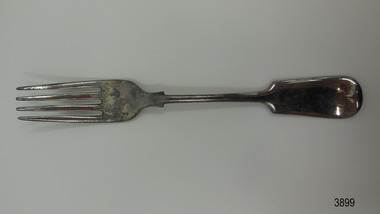
Domestic object - Fork, c. 1878
... Unit recovered loose artefact material. The fork is recognised as being historically significant as an example of cutlery either as part of the flatware service of the ship ‘Loch Ard’ or part of the ship’s cargo, imported for use in Colonial Victoria in the 19th to early 20th century. Flagstaff Hill’s collection of artefacts from LOCH ARD is significant for being one of the largest collections of artefacts from this shipwreck in Victoria. It is significant for its association ...This fork was recovered from the wreck of the Loch Ard. It is the Old English design that has been very popular since the 19th century. It has been restored to resemble its original state prior to the disaster in 1878. The for was originally plated with silver, which is when a base metal such as nickel or nickel alloy with copper and/or zinc has been plated or coated with a thin layer of silver. Wear on the metal will cause the base metals to appear through the silver plating. Some manufacturers gave a warranty that the cutlery was ‘white throughout’ but didn’t necessarily say it was solid silver. LOCH ARD 1873-1878 – The Scottish-built clipper ship Loch Ard was bound for Melbourne in 1878 with 54 people on board. The mixed cargo it carried included items for the 1880 International Exhibition in Melbourne, one of which was the now famous Majorca ware Minton ‘Peacock’ statue. The Loch Ard was wrecked on June 1st when the ship crashed into Mutton Bird Island, east of Port Campbell. The only survivors were Tom Pearce, a crew member, and Eva Carmichael, a young passenger who was rescued by Pearce. The Gibsons, owners of nearby Glenample Homestead, cared for Tom, and for Eva who stayed longer before returning to Ireland. The wreck of the Loch Ard was discovered in 1967, before the introduction of the Victorian historic shipwreck legislation. In 1969 it was decided that all recovered material should be lodged with the Receiver of Wrecks. In 1980 Flagstaff Hill Maritime Museum Divers received a permit to recover artefacts from the wreck to safeguard them from looters. In 1982 the site was listed as a Historic Shipwreck, and the Maritime Archaeology Unit recovered loose artefact material. The fork is recognised as being historically significant as an example of cutlery either as part of the flatware service of the ship ‘Loch Ard’ or part of the ship’s cargo, imported for use in Colonial Victoria in the 19th to early 20th century. Flagstaff Hill’s collection of artefacts from LOCH ARD is significant for being one of the largest collections of artefacts from this shipwreck in Victoria. It is significant for its association with the shipwreck, which is on the Victorian Heritage Register (VHR S417). The collection is significant because of the relationship between the objects, as together they have a high potential to interpret the story of the LOCH ARD. The LOCH ARD collection is archaeologically significant as the remains of a large international passenger and cargo ship. The LOCH ARD collection is historically significant for representing aspects of Victoria’s shipping history and its potential to interpret sub-theme 1.5 of Victoria’s Framework of Historical Themes (living with natural processes). The collection is also historically significant for its association with the LOCH ARD, which was one of the worst and best known shipwrecks in Victoria’s history. Fork; silver plated. The fork is the Old English design and is embossed with several marks. it has recently been restored. Shipwreck artefact from the Loch Ard. 3 letters within an oval (- - S) 4 letters within circles (E) (P) (N) (S) 1 letter within a shield appears to be a [B] flagstaff hill, warrnambool, shipwrecked coast, flagstaff hill maritime museum, maritime museum, shipwreck coast, flagstaff hill maritime village, great ocean road, shipwreck artefact, loch ard, victoria, eva carmichael, tom pearce, cutlery, silver flatware, silver plate, antique, old english flatware pattern, eating utensil, fork, silverware, dining utensil
