
Showing 11 items matching "uruguay"
-
 Mission to Seafarers Victoria
Letter - Correspondence, Allan Charles Quinn, 1949
... 0806.b bears one green Uruguay stamp and is addressed to Mrs S Quinn, 5 Pollington Street, St Kilda. ...Quinn Collection letters-from-abroad quinn ms fenris 1949 0806.b bears one green Uruguay stamp and is addressed to Mrs S Quinn, 5 Pollington Street, St Kilda. ...Quinn CollectionTwo and a half page letter written on one and a half sheets of unlined white paper (0806.a1-2), headed MS Fenris, Montevideo and dated 21.03.49. The air-mail envelope (0806.b) is duck-egg blue with a green lining and a 5cm border of diagonal, repeating stripes of green, white, yellow, white.0806.b bears one green Uruguay stamp and is addressed to Mrs S Quinn, 5 Pollington Street, St Kilda. The postmark is indistinct. letters-from-abroad, quinn, ms fenris, 1949 -
 Uniting Church Archives - Synod of Victoria
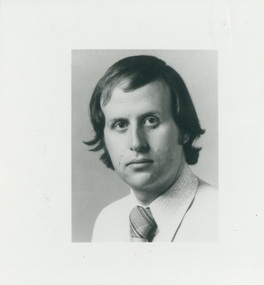
BW photo, November 1977
... Reverend Bruce Grindlay was ordained in 1971 and served at Mount Gambier, Elizabeth United, Methodist Church of Uruguay, Horsham, and Glenelg. ...Reverend Bruce Grindlay was ordained in 1971 and served at Mount Gambier, Elizabeth United, Methodist Church of Uruguay, Horsham, and Glenelg. Rev. Bruce Grindlay; Mount Gambier; Elizabeth United; Methodist Church of Uruguay; Horsham; Glenelg Church & Nation 30/11/1977 page 14; Rev. ...Reverend Bruce Grindlay was ordained in 1971 and served at Mount Gambier, Elizabeth United, Methodist Church of Uruguay, Horsham, and Glenelg. Head and shoulders portrait of Rev. Bruce Grindlay.Church & Nation 30/11/1977 page 14; Rev. Bruce Grindlayrev. bruce grindlay; mount gambier; elizabeth united; methodist church of uruguay; horsham; glenelg -
Mission to Seafarers Victoria
Letter - Correspondence, 1949
... The blue airmail envelope (0816.b) has a 4cm border of diagonal green and yellow stripes. There are two Uruguayan stamps, one blue, one green. The postmark is indistinct. ...The blue airmail envelope (0816.b) has a 4cm border of diagonal green and yellow stripes. There are two Uruguayan stamps, one blue, one green. The postmark is indistinct. ...Allan writes of his two-weeks in Buenos Aires where he witnessed a "..great parade.." on Independence Day and heard Peron speak in the city. He also attended several orchestral concerts and saw 'Gone with the Wind' for the fourth time. He writes "The papers have been full of the coal strike in Australia down here....".Quinn CollectionSingle-sided letter written on two sheets of unlined blue air-letter paper (0816.a1-2) headed M.S.Fenris, Montevideo, and dated 22.07.49. The blue airmail envelope (0816.b) has a 4cm border of diagonal green and yellow stripes. There are two Uruguayan stamps, one blue, one green. The postmark is indistinct. The letter from Allan to his mother is written in blue ink. letters-from-abroad, quinn, 1949, m s fenris, independence day, buenos aires, australian coal strike -
 Federation University Art Collection
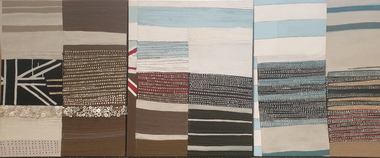
Textile, Paula Do Prado, Flagwork #1, 2009
... Paula DO PRADO Born Montevide, Uruguay Arrived Australia September 1986 Paula Do Prado holds a Bachelor of Fine Arts (Textiles) with First Class Honours and a Master of Fine Arts from Art & Design at the University of New South Wales.Her works are compelling, multi-layered and rich with cultural references surrounding concepts of identity, race and gender. ...Paula DO PRADO Born Montevide, Uruguay Arrived Australia September 1986 Paula Do Prado holds a Bachelor of Fine Arts (Textiles) with First Class Honours and a Master of Fine Arts from Art & Design at the University of New South Wales.Her works are compelling, multi-layered and rich with cultural references surrounding concepts of identity, race and gender. ...Paula DO PRADO Born Montevide, Uruguay Arrived Australia September 1986 Paula Do Prado holds a Bachelor of Fine Arts (Textiles) with First Class Honours and a Master of Fine Arts from Art & Design at the University of New South Wales.Her works are compelling, multi-layered and rich with cultural references surrounding concepts of identity, race and gender. Her practice draws on materials, sayings and imagery collected from many different sources including the generations of her family history. By sharing her own personal stories, her work creates a dialogue around issues of immigration and multiculturalism, which are just as relevant now as ever. Triptych flag, textiles, button, available -
 Wangaratta RSL Sub Branch
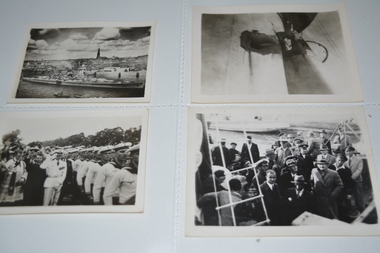
Photograph - Photographs, Admiral Graf Spee
... One of the hunting groups sent by the British Admiralty to search for Graf Spee, comprising three Royal Navy cruisers, HMS Exeter, Ajax and Achilles (the last from the New Zealand Division), found and engaged their quarry off the estuary of the River Plate close to the coast of Uruguay in South America. ...One of the hunting groups sent by the British Admiralty to search for Graf Spee, comprising three Royal Navy cruisers, HMS Exeter, Ajax and Achilles (the last from the New Zealand Division), found and engaged their quarry off the estuary of the River Plate close to the coast of Uruguay in South America. admiral graf spee ww2 montevideo battle of the river plate Inscription in pencil on rear of each photograph 12 black and white unframed photographs of ship at sea Admiral Graf Spee Photograph Photographs ...Photographs of the German ship Admiral Graf Spee which was involved in the Battle of the River Plate, the first naval battle in the Second World War and the first one of the Battle of the Atlantic in South American waters. The German panzerschiff Admiral Graf Spee had cruised into the South Atlantic a fortnight before the war began, and had been commerce raiding after receiving appropriate authorisation on 26 September 1939. One of the hunting groups sent by the British Admiralty to search for Graf Spee, comprising three Royal Navy cruisers, HMS Exeter, Ajax and Achilles (the last from the New Zealand Division), found and engaged their quarry off the estuary of the River Plate close to the coast of Uruguay in South America. 12 black and white unframed photographs of ship at seaInscription in pencil on rear of each photographadmiral graf spee, ww2, montevideo, battle of the river plate -
 Flagstaff Hill Maritime Museum and Village
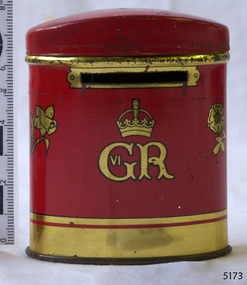
Souvenir - Money box, OXO Ltd, ca. 12-5-1937
... Chemist Justus von Liebig worked with engineer George Gilbert of Uruguay to produce Liebig’s Extract of Meat, the forerunner of OXO . ...Chemist Justus von Liebig worked with engineer George Gilbert of Uruguay to produce Liebig’s Extract of Meat, the forerunner of OXO . ...Metal money boxes shaped like common familiar objects became popular in the 18th century. In the 20th century, they were used to promote and advertise events and businesses. In the 1950s metal money boxes shaped like a bank building were given away to children by their parents' bank to encourage them to save money. This metal money box was produced for the company of OXO Ltd of London. It was made specifically as a souvenir of the Coronation of King George VI of England, which happened on May 12, 1937. OXO Ltd. still makes OXO stock cubes, which contain a concentrated meat extract. The cubes are used to flavour soups, gravy, casseroles and other food recipes to enhance their flavour. The cubes are removed from their foil wrapper then crumbled into the dish and mixed with the ingredients. Chemist Justus von Liebig worked with engineer George Gilbert of Uruguay to produce Liebig’s Extract of Meat, the forerunner of OXO . In the late 1890s, OXO produced a liquid form of the meat extract and in 1899 registered the OXO trademark worldwide, and in 1900 in the UK. In 1910 the OXO 'penny' cube was in production and proved very popular. The money box is significant for its connection to British Monarch, King George IV, who reigned from 1932-1952. It is also significant for its connection to the OXO cube, a very well knon brand of food additive from the mid-19th century to current times.Souvenir money box, oval cylinder with domed, pull-off lid and framed coin slot, with seams on each side. It once contained six OXO Cubes. The red tin with gold tin has the Royal Insignia of King George VI and Elizabeth on one side and the Royal medallion-style portrait of King George VI and Elizabeth on the other side. There is an inscription on the base and floral decorations on the sides. It was produced for OXO Ltd, Thames House, London, England, to commemorate the coronation of King George V1 and Elizabeth on May 12th 1937.Logo, Royal Insignia: "[Crown] over "G VI R" Medallion-style Portrait image: "GEORGE VI AND ELIZABETH MAY 12TH 1937" around " (Image of King George VI and Elizabeth) " Printed on base: "CORONATION / SOUVENIR MONEY BOX / CONTAINING / 6 OXO CUBES / BRAND / OXO LTD., THAMES HOUSE, / LONDON, ENGLAND."flagstaff hill, flagstaff hill maritime museum and village, warrnambool, maritime museum, maritime village, great ocean road, shipwreck coast, money box, money safe, commemorative money box, coronation king george iv, 1937, vintage money box, oxo cube, numismatics -
 Eltham District Historical Society Inc
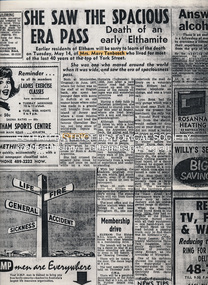
Document - Folder, Tenbosch, Mary
... ...Uruguay...Garage Millett's Foodland Montevideo Newsagency obituary Police Station Post Office Table Talk telephone exchange Uruguay W.B. Bassett-Smith York Street Newspaper clippings, A4 photocopies, etc Tenbosch, Mary Document Folder ...Mary Tenbosch lived in Eltham for 40 years and died 1968. Contents Newspaper article: "She saw the spacious era pass: Death of an early Elthamite", Diamond Valley News, 21 May 1968. Life of Mary Tenbosch. - Obituary for Mrs Mary Tenbosch, former wife of W.B. Bassett-Smith who lived for 40 years at the top of York Street.Newspaper clippings, A4 photocopies, etcmary tenbosch, york street eltham, bridge street eltham, brougham street eltham, eltham telephone exchange, lyon brothers eltham, millette's eltham, research hotel, eltham fire brigade, percy leason, wiregrass cartoons, henry street eltham, blue gum milk bar (eltham), brougham steet, eltham, eltham public hall, eltham shops, ford model t, ford wagonette, henry street, lyon bros. garage, millett's foodland, montevideo, newsagency, obituary, police station, post office, table talk, telephone exchange, uruguay, w.b. bassett-smith, york street -
 Victoria Police Museum
Photograph (Frederick Deeming)
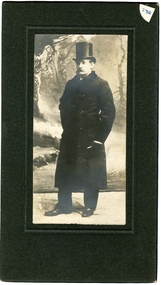
... Eventually found in Uruguay, he spent time in prison in England for fraud. ...Eventually found in Uruguay, he spent time in prison in England for fraud. ...In March 1892, Melbourne Butcher John Stamford took a prospective tenant to a house he owned at 57 Andrew Street Windsor. He noticed a 'disagreeable smell' coming from the front rooms. Suspecting foul play, Stamford called the police who quickly discovered a decomposing body and partially clad body of a young woman in a shallow grave under the fireplace. 'Her skull had been shattered and her throat cut'. Two detectives, Sergeants Considine and Cawsey, began investigations. The previous tenant, a 'Mr. Druin' who had rented the house had since disappeared was the main suspect. 'Druin' had arrived in Australia from England as 'Albert Williams' in December 1891 with his 24 year old wife Emily Mather. The body was Emily's. The crime scene investigation proved difficult as the suspect - whatever his real name- had cleaned up the scene very carefully. Much later it was discovered that the suspect was in fact Frederick Bayley Deeming, a former sailor born in Birkenhead, Cheshire, in 1854. In 1881, Deeming deserted his ship and lived in Sydney where he married and had a family. Deeply in debt, he later burned his business down to claim its insurance value and fled to South Africa before he could be arrested. He is believed to have committed numerous frauds and murders in Africa. Eventually found in Uruguay, he spent time in prison in England for fraud. After being released he married Emily and returned to Australia. After leaving England, British police began investigating him over the murder of Mrs Marie Deeming and her four children. Now using another alias, 'Baron Swanston', Deeming was arrested in Western Australia before he left the country in the company of a young woman, Kate Rounsefell, whom he planned to marry. It seems Kate would have been his next murder victim. Brought back to Victoria, in May 1892, Deeming went on trail for the murder of Emily Mather. Despite a strong defense conducted by a brilliant young barrister and 3 times Australian Prime Minister Alfred Deakin, the evidence against Deeming was overwhelming and he was found guilty. Deeming was hanged at Melbourne Gaol on 23 May 1892. He was known to be responsible for at least 6 murders and may have committed others. Black and white photograph backed onto black backing board showing a man in a long coat and top hat with his hands in his pockets and a moustachefrederick deeming, emily mather, murders -
 Victoria Police Museum
Photograph (Emily Mather)
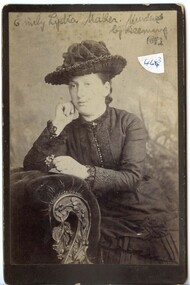
... Eventually found in Uruguay, he spent time in prison in England for fraud. ...Eventually found in Uruguay, he spent time in prison in England for fraud. ...In March 1892, Melbourne Butcher John Stamford took a prospective tenant to a house he owned at 57 Andrew Street Windsor. He noticed a 'disagreeable smell' coming from the front rooms. Suspecting foul play, Stamford called the police who quickly discovered a decomposing body and partially clad body of a young woman in a shallow grave under the fireplace. 'Her skull had been shattered and her throat cut'. Two detectives, Sergeants Considine and Cawsey, began investigations. The previous tenant, a 'Mr. Druin' who had rented the house had since disappeared was the main suspect. 'Druin' had arrived in Australia from England as 'Albert Williams' in December 1891 with his 24 year old wife Emily Mather. The body was Emily's. The crime scene investigation proved difficult as the suspect - whatever his real name- had cleaned up the scene very carefully. Much later it was discovered that the suspect was in fact Frederick Bayley Deeming, a former sailor born in Birkenhead, Cheshire, in 1854. In 1881, Deeming deserted his ship and lived in Sydney where he married and had a family. Deeply in debt, he later burned his business down to claim its insurance value and fled to South Africa before he could be arrested. He is believed to have committed numerous frauds and murders in Africa. Eventually found in Uruguay, he spent time in prison in England for fraud. After being released he married Emily and returned to Australia. After leaving England, British police began investigating him over the murder of Mrs Marie Deeming and her four children. Now using another alias, 'Baron Swanston', Deeming was arrested in Western Australia before he left the country in the company of a young woman, Kate Rounsefell, whom he planned to marry. It seems Kate would have been his next murder victim. Brought back to Victoria, in May 1892, Deeming went on trail for the murder of Emily Mather. Despite a strong defense conducted by a brilliant young barrister and 3 times Australian Prime Minister Alfred Deakin, the evidence against Deeming was overwhelming and he was found guilty. Deeming was hanged at Melbourne Gaol on 23 May 1892. He was known to be responsible for at least 6 murders and may have committed others. Black and white photograph backed onto black board showing a lady in dark clothing and hat resting with her right elbow on the arm of a lounge. Woman is holding a small sprig of flowers in her left handEmily Lydia Mather. Murdered by Deeming 1892 (in black ink along top of photograph)frederick deeming, emily mather, murders -
 Victoria Police Museum
Photograph (Frederick Deeming)
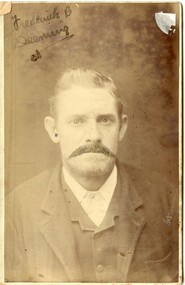
... Eventually found in Uruguay, he spent time in prison in England for fraud. ...Eventually found in Uruguay, he spent time in prison in England for fraud. ...In March 1892, Melbourne Butcher John Stamford took a prospective tenant to a house he owned at 57 Andrew Street Windsor. He noticed a 'disagreeable smell' coming from the front rooms. Suspecting foul play, Stamford called the police who quickly discovered a decomposing body and partially clad body of a young woman in a shallow grave under the fireplace. 'Her skull had been shattered and her throat cut'. Two detectives, Sergeants Considine and Cawsey, began investigations. The previous tenant, a 'Mr. Druin' who had rented the house had since disappeared was the main suspect. 'Druin' had arrived in Australia from England as 'Albert Williams' in December 1891 with his 24 year old wife Emily Mather. The body was Emily's. The crime scene investigation proved difficult as the suspect - whatever his real name- had cleaned up the scene very carefully. Much later it was discovered that the suspect was in fact Frederick Bayley Deeming, a former sailor born in Birkenhead, Cheshire, in 1854. In 1881, Deeming deserted his ship and lived in Sydney where he married and had a family. Deeply in debt, he later burned his business down to claim its insurance value and fled to South Africa before he could be arrested. He is believed to have committed numerous frauds and murders in Africa. Eventually found in Uruguay, he spent time in prison in England for fraud. After being released he married Emily and returned to Australia. After leaving England, British police began investigating him over the murder of Mrs Marie Deeming and her four children. Now using another alias, 'Baron Swanston', Deeming was arrested in Western Australia before he left the country in the company of a young woman, Kate Rounsefell, whom he planned to marry. It seems Kate would have been his next murder victim. Brought back to Victoria, in May 1892, Deeming went on trail for the murder of Emily Mather. Despite a strong defense conducted by a brilliant young barrister and 3 times Australian Prime Minister Alfred Deakin, the evidence against Deeming was overwhelming and he was found guilty. Deeming was hanged at Melbourne Gaol on 23 May 1892. He was known to be responsible for at least 6 murders and may have committed others. Medium sized photograph of Frederick Deeming with a moustache drawn on the image in inkFrederick B. Deeming (on image in black ink)frederick deeming, emily lydia mather, murders -
 Brimbank City Council
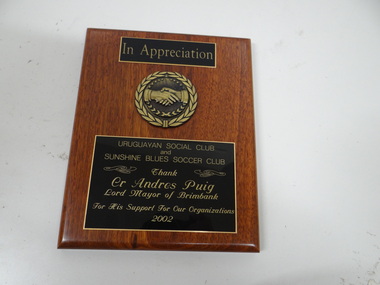
Wooden Plaque, Uruguayan Social Club
... Uruguayan Social Club Wooden Plaque ...
