
Showing 14 items matching "utopia"
-
 Federation University Art Collection
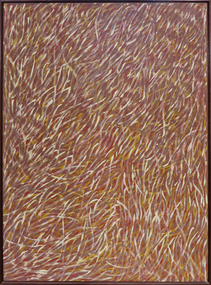
Painting - Artwork - painting, 'Grass Seeds' by Barbara Weir, 1999
... Barbara Weir (b. 1945-03/01/2023) Born: In the region of Utopia, North East of Alice Springs, formerly known as Derry Downs Station Language: Anmatyerre and Alywarr Country: Atnwengerrp, Utopia Region, North East of Alice Springs, Northern Territory One of the Stolen Generation, Barbara Weir was removed from her Aboriginal family at the age of nine, and she was raised in a series of foster homes. ...The people of Utopia were still using this seed as late as the 1950s. ...Utopia, Australia...The people of Utopia were still using this seed as late as the 1950s. ...Barbara Weir (b. 1945-03/01/2023) Born: In the region of Utopia, North East of Alice Springs, formerly known as Derry Downs Station Language: Anmatyerre and Alywarr Country: Atnwengerrp, Utopia Region, North East of Alice Springs, Northern Territory One of the Stolen Generation, Barbara Weir was removed from her Aboriginal family at the age of nine, and she was raised in a series of foster homes. Reuniting with her mother, Minnie Pwerle, in the 1960s, Weir eventually returned to her family territory of Utopia, 300 kilometres northeast of Alice Springs. Active in the local land rights movement of the 1970s Barbara Weir was elected the first woman president of the Indigenous Urapunta Council in 1985. Barbara’s career as an artist was inspired by the dynamic community of artists at Utopia and the work of her adopted auntie Emily Kame Kngwarreye. Highly experimental in her approach, Barabara Weir tried many mediums before travelling to Indonesia in 1994 with other artists to explore batik technique. She returned full of ideas on how to develop her own style which has since evolved to a more expressive abstract form. Grass Seed is part of her Dreamings and is associated with women’s ceremony and the activity of food gathering of local seeds, grasses, berries, potato, plum, banana, flowers and yams. This item is part of the Federation University Art Collection. The Art Collection features over 1000 works and was listed as a 'Ballarat Treasure' in 2007.Barbara Weir's paintings include representations of particular plants and "dreamings". Inspired by a small grass found in Utopia called Lyaw, Munyeroo or Pigsweed, Barbara's Grass Seed paintings consist of a series of small brush strokes that overlap and weave to create a swaying effect. This Dreaming tells the story of grass seed that is part of the bush tucker found in the region of Utopia. This seed is collected, crushed to a fine powder and is then used to make a bread, very similar to damper. The people of Utopia were still using this seed as late as the 1950s. During that time the seed grew in abundance but as the years passed there were very few good seeds to be found due to bullocks roaming the land and eating the grasses. The people then began to eat a substitute that the white man provided, and today very few Aboriginal people collect these seeds. art, artwork, barbara weir, aboriginal, dreaming, stolen generation, acrylic on linen -
 Robin Boyd Foundation
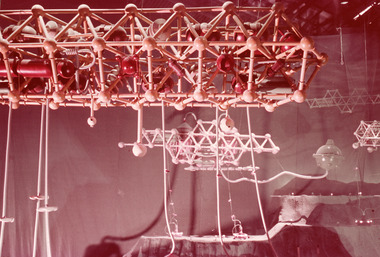
Slide, Commercial, 1970
... Colour slide in a mount. Utopia under the sea, Expo '70, Osaka, Japan...Expo'70 / Utopia under the Sea / 31 (Handwritten)...Utopia under the sea, Expo '70, Osaka, Japan Slide Commercial ...Robin Boyd was appointed Exhibits Architect for the Australian Pavilion at Expo ‘70 in Osaka and travelled to Osaka several times in 1969-1970. Boyd designed the innovative Space Tube, which had over 25 exhibition boxes, projecting from it. Amongst the topics covered were Australian scientific innovation (including brain research, immunology, Antarctic research, Snowy Mountains Hydro-Electric Power Scheme, rainmaking, and the night sky), Australian sport, house interiors, car manufacturing, Australian music and art, and Japanese-Australian relations.Colour slide in a mount. Utopia under the sea, Expo '70, Osaka, JapanExpo'70 / Utopia under the Sea / 31 (Handwritten)expo 70, osaka, robin boyd, slide -
 Robin Boyd Foundation
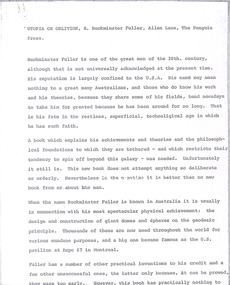
Document - Manuscript, Robin Boyd, Utopia or Oblivion, c. 1971
... Utopia or Oblivion...Buckminster Fuller Utopia or Oblivion robin boyd manuscript Typewritten (p/copy), quarto, 4 pages Utopia or Oblivion Document Manuscript Robin Boyd ...Book review of a series of talks by Buckminster Fuller.Original manuscript of an article published as 'Last Leonardo' in The Bulletin, 23.01.1971.Typewritten (p/copy), quarto, 4 pagesbuckminster fuller, utopia or oblivion, robin boyd, manuscript -
 Thompson's Foundry Band Inc. (Castlemaine)
Sheet Music, Utopia
... Utopia...Utopia Sheet Music ... -
Federation University Bookplate Collection
Work on paper - Bookplate, The Forest of Utopia
... The Forest of Utopia...Entered in the International Bookplate Design section of the the Australian Bookplate Society's 'Australian Bookplate Design competition for 2020. The Forest of Utopia Work on paper Bookplate ...After a quiet period, interest in bookplates in Australia began to increase in the early 1970s, Entrepreneurial art and book collectors such as Edwin Jewell and others commissioned multiple Bookplate designs from a range of well known fine artists. At a 1997 meeting in Melbourne of the Ephemera Society of Australia Edwin Jewell and others announced the formation of the Australian Bookplate Society. The society was instrumental in promoting the art of the bookplate through establishment of the Australian Bookplate Design competition. The competition includes a design award for International bookplate designers and graphic artists. -
 Federation University Historical Collection
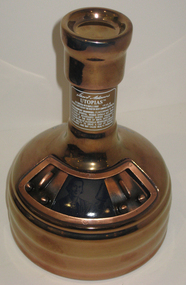
Bottle, Ceramarte, Utopias Beer, 2007, 2007
... The history of Samuel Adams Utopias comes from the extreme beers of Triple Bock and Millenium that came before it. ...Gold ceramic unopened bottle containing Utopias beer vintage 2007 brewed by the Boston Beer Company. ...The history of Samuel Adams Utopias comes from the extreme beers of Triple Bock and Millenium that came before it. ...The history of Samuel Adams Utopias comes from the extreme beers of Triple Bock and Millenium that came before it. With those brews The Boston Beer Company began the exploration of aging beer in barrels for a different flavor contribution. In 2002 the first batch of Samuel Adams Utopias was introduced with a complex flavor profile unlike any other beer, and an ABV of 24-29%, making it the strongest naturally-fermented beer to date. Samuel Adams Utopias was brewed in 2003, 2005, 2007, 2009 and 2011. The beer is uncarbonated and ruby black in color with sweet flavors of honey, toffee, caramel, cocoa and vanilla balanced by distinct notes of molasses, raisins, plums and berries imparted from aging batches in a variety of barrels over the years. (http://www.samueladams.com/enjoy-our-beer/beer-detail.aspx?name=utopias) This brew is only released every two years,Gold ceramic unopened bottle containing Utopias beer vintage 2007 brewed by the Boston Beer Company. The beer is a limited 2007 edition with the number 08939. The decanter was handcrafted by Ceramarte of Brazil exclusively or the Boston Beer Company. Samuel Adams is depicted on the bottle. beer, beer awards, utopias, brazil, samuel adams -
 Federation University Art Collection
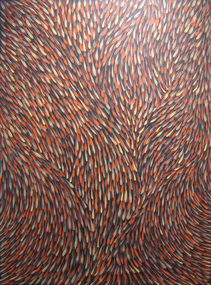
Painting, Gloria Petyarre, 'Bush Medicine' by Gloria Petyarre
... ...utopia...The artistic tradition in Utopia started in the Utopia Women's Silk Batik Group introduced in 1977. ...The artistic tradition in Utopia started in the Utopia Women's Silk Batik Group introduced in 1977. ...Gloria PETYARRE (c.1942 - 2021) Born: Mosquito Bore, Utopia, Northern Territory Language Group: Anmatyerre Community: Utopia, Northern Territory Gloria Petyarre's depiction of the Kurrajong bush medicine leaves with her layered, swirling brushstrokes is her iconic motif. In 1999 Gloria Petyarre became the first Indigenous Australian artist to win the 'Wynne Prize for Landscape' at the New South Wales Gallery. She is credited with being the creator of this popular style, which was adopted and adapted by several generations of her family members over Gloria's retirement in 2019. The artistic tradition in Utopia started in the Utopia Women's Silk Batik Group introduced in 1977. Gloria Petyarre and her aunt Emily Karne Kngwarrye were found members of this group. Gloria Petyarre started painting on canvas in 1988 with her brushstrokes and layered paint having foundations in the batik tradition. This item is part of the Federation University Art Collection. The Art Collection features over 2000 works and was listed as a 'Ballarat Treasure' in 2007.Utopian Art Movement‘Bush Medicine Dreaming’ depicts the leaves of a special plant that is used to aid in the healing process. The leaves are collected and then boiled to extract the resin. Following this, the resin is mixed with kangaroo fat collected from the kangaroo’s stomach. This creates a paste that can be stored for up to six months in bush conditions. This medicine is used to heal cuts, wounds, bites, rashes and as an insect repellent. The Dreaming that is the basis for Petyarre’s paintings comes from the important ceremonies and traditions held by the people of Atnwengerrp. art, artwork, gloria petyarre, aboriginal, utopia -
 Glenelg Shire Council Cultural Collection
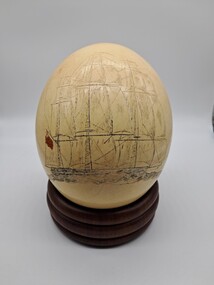
Artwork, other - Scrimshaw Ostrich Egg, Captain William Wilkinson, c. 1840
... ...Utopia...The immigrant ship Utopia sailed under a Captain Wilkinson arriving at Portland in 1854. ...The immigrant ship Utopia sailed under a Captain Wilkinson arriving at Portland in 1854. ...Scrimshaw was a leisure activity for whalers and sailors. The egg is etched with two sailing ships. The markings in scrimshaw were made with the crude needles used for sail making and a black substance, possibly soot or tobacco juice was rubbed into the inscribed markings to bring the etched images into view. This egg belonged to Captain William Wilkinson. The immigrant ship Utopia sailed under a Captain Wilkinson arriving at Portland in 1854. Stacey Longstaff, Captain Wilkinson's great-great-grandson now living in Germany had inherited several items with associations to the Utopia. These included Captain Wilkinson’s sword; a decorative cut-paper memorial card acknowledging Captain Wilkinson’s death from cholera in Calcutta in 1855; an 1854 insurance certificate for Utopia; and a ship’s cabinet reputed to have housed the ship’s log. With no direct descendants to pass these items on to, Mr. Longstaff was looking for a suitable future home for them. Mr Longstaff found Glenelg Shire’s museum listings on the Culture Victoria website where he contacted Eleanor who in turn contacted us. Mr Longstaff decided that Portland was an appropriate home for the objects and negotiations commenced to transfer them to Portland and for their subsequent donation to Glenelg Shire Council’s Cultural Collection. The items were sent in two consignments - the sword, card and certificate initially, and once they had arrived in Portland, Mr Longstaff forwarded the cabinet. All items were sent at his own expense. During the time the parcels were in transit, emails were sent back and forth between Mr Longstaff and myself as we tracked the progress of the parcels from Rahden, Northern Germany to Portland. Utopia was one of the 37 ships that brought assisted immigrants to Portland in the 1850s. From 1851 to 1857, 11,395 immigrants first set foot on Australian soil at Portland. Arriving in Portland Bay on January 25, 1854, Captain Wilkinson was publicly praised by the passengers for the safe and speedy passage aboard the Utopia to Australia. Three testimonials written by the passengers appeared in the Portland Guardian on January 26. Also, making the Utopia’s arrival in Portland a memorable event, 13 of crew deserted ship and headed for the Victorian goldfields. Only two were captured by the local mounted police near Mount Clay, north of Portland. During the 83 day passage from Liverpool (UK) to Portland there were 5 births and 5 deaths aboard Utopia. The sword, certificate and memorial card will be exhibited at Portland’s History House in Cliff Street in a revamp of the display relating to assisted immigration into Portland in the 1850s. The ship’s cabinet will undergo conservation treatment before going on public display.Large egg with images of a ship carved into each side of the egg. There is red colouring over the flags on the ship. The ship is a sailing ship in full sail with water underneath. The egg has a crack and a hole in the top. It sits on a wooden rest.sailing, captain wilkinson, scrimshaw, egg, maritime, glenelg shire cultural collection, utopia -
Unions Ballarat
The Paraguayan experiment, Wilding, Michael, 1984
... ...utopia...The group sought a socialist utopia and their chosen site was Paraguay. The pathway for the new community was not smooth, but the colony is still in existence. ...The group sought a socialist utopia and their chosen site was Paraguay. The pathway for the new community was not smooth, but the colony is still in existence. ...A fictional account of the New Australia Movement, founded by William Lane in 1892. The group sought a socialist utopia and their chosen site was Paraguay. The pathway for the new community was not smooth, but the colony is still in existence. Some people formed colonies elsewhere and others returned to either Britain or Australia.Relevant to the history and development of left-wing politics and socialism in Australia.Paper; book. Front cover: white and yellow text on red background; dominant image is of the settlers amongst flowers with a hut and palm trees in the background.Front cover: author's name and title.btlc, ballarat trades and labour council, ballarat trades hall, lane, william, socialism, paraguay, utopia, new australia movement, nueva australia, politics, collective settlements, new australia co-operative settlement association -
 University of Melbourne, Burnley Campus Archives
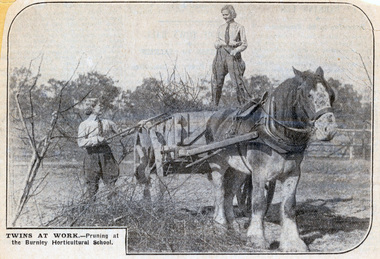
Newspaper - Newspaper Cutting, Twins at Work and Doing Time, 1930-1940
... Two newspaper cuttings. 1. two female students with a horse and cart, with the caption: "Twins at work - Pruning at the Burnley Horticultural School." 2. a story about egg production at the College, featuring a hen called Matilda Jane, and with an interview with Mr AW Jessep, with the sub-titles "Doing Time" and" Utopia."...burnley horticultural college female students pruning a.w. jessep poultry egg-laying competition horses students working outside draught horses orchard Two newspaper cuttings. 1. two female students with a horse and cart, with the caption: "Twins at work - Pruning at the Burnley Horticultural School." 2. a story about egg production at the College, featuring a hen called Matilda Jane, and with an interview with Mr AW Jessep, with the sub-titles "Doing Time" and" Utopia." Twins at Work and Doing Time Newspaper Newspaper Cutting ...Two newspaper cuttings. 1. two female students with a horse and cart, with the caption: "Twins at work - Pruning at the Burnley Horticultural School." 2. a story about egg production at the College, featuring a hen called Matilda Jane, and with an interview with Mr AW Jessep, with the sub-titles "Doing Time" and" Utopia."burnley horticultural college, female students, pruning, a.w. jessep, poultry, egg-laying competition, horses, students working outside, draught horses, orchard -
 Nillumbik Shire Council
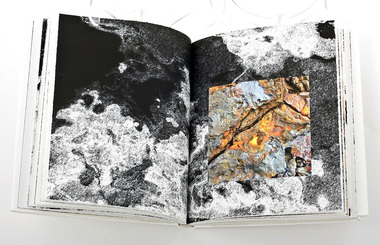
Artist Book: Tommaso DURANTE (b.1956 ITA, arrived. 2001 AUS) with text by Chris WALLACE-CRABBE (b.1934 AUS), Skin, Surfaces and Shadows, 2007
... Set in digital typefaces Utopia STD Display, Italic and Bold, Frutiger 57 Condensed, 67 Bold Condensed, and 56 Italic. ...Set in digital typefaces Utopia STD Display, Italic and Bold, Frutiger 57 Condensed, 67 Bold Condensed, and 56 Italic. ...'Skin, Surfaces and Shadows' was created by Tommaso Durante in 2004 during his stay in Bundanon (gifted to the Australian people by Arthur & Yvonne Boyd - South East Australia) as international artist in residence and it was enriched during the artist’s stay in Broome (Western Australia) in 2005. On that occasion he collected the raw materials that were subsequently wrought to develop the actual bookwork.On the edge of artistic practice and philosophical inspiration, 'Skin, Surfaces and Shadows' pushes the boundaries of art, craft and design by combining digital technologies with traditional techniques and materials. Durante visually explores the surfaces of organic things (trees, surface textures, etc.) and the figurative dividing line of the shadow. The poet Wallace-Crabbe responds to these images in words. The poet and the artist flit in and out of shadows, skin and the surfaces of paper and life.(a) prints, artist's book (80 pages), ink; Somerset Book White paper (175gsm), digital images, printed in eight inkjet colour pigments, from digital files. Set in digital typefaces Utopia STD Display, Italic and Bold, Frutiger 57 Condensed, 67 Bold Condensed, and 56 Italic. Section sewn around 3 tapes. Full paper binding with blind blocking on front cover handmade head and tail bands. (b) CD of slide presentation to accompany bookwork on display Primary Insc: In black biro, signed and editioned by Tommaso Durante and Chris Wallace-Crabbe (last page '8/25 T DURANTE CWallace-Crabbe')prints, artist book, skin, surface, shadow, poetry, durante, wallace-crabbe -
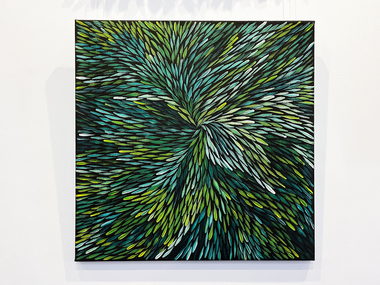 Geoffrey Kaye Museum of Anaesthetic History
Painting, Jeannie Petyarre, Medicine Leaves, 2005
... A renowned Anmatyerre artist from Utopia, Northern Territory, Petyarre’s work carries more than pigment—it holds a lineage of care. ...A renowned Anmatyerre artist from Utopia, Northern Territory, Petyarre’s work carries more than pigment—it holds a lineage of care. ...An unframed square acrylic-on-canvas painting in tones of green and white forming an abstract botanical pattern that radiates out from the centre. A renowned Anmatyerre artist from Utopia, Northern Territory, Petyarre’s work carries more than pigment—it holds a lineage of care. These sweeping, rhythmic brushstrokes represent Kurrajong leaves and other medicinal plants traditionally gathered and prepared by women healers. Passed from grandmother to granddaughter, these practices are a form of medicine beyond the clinical. They speak of country, ceremony, and community. They evoke breath, movement, and the cyclical nature of wellbeing. Hand painted on reverse. "JEANNIE PETYARRE 60X60" Handwritten on reverse. "(Sister of Gloria Petyarre) / "Medicine Leaves" 2005. / Presented to ANZCA by Prof. Michael Cousins 16/6/06"oil paint, acrylic paint, floral, floral design, botanical design, abstract art, indigenous artists, first nations artists, australian artists, australian art -
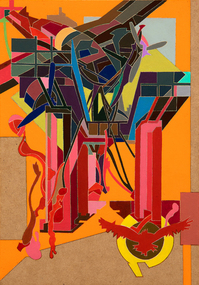 Merri-bek City Council
Oil on MDF, Raafat Ishak, Cairo, 2020-21
... His artistic practice is situated at the crossroads of the personal and the political, delving into themes of utopia through the use of romanticised imagery. ...His artistic practice is situated at the crossroads of the personal and the political, delving into themes of utopia through the use of romanticised imagery. ...Raafat Ishak is a Melbourne-based artist working across painting, installation and site-specific drawing. His work delves into the exploration of identity and the challenges of navigating life between two cultures, particularly influenced by his teenage emigration from Cairo, Egypt. Ishak employs a graphic visual language in his art, drawing inspiration from both architecture and his Arabic heritage. His artistic practice is situated at the crossroads of the personal and the political, delving into themes of utopia through the use of romanticised imagery. Through his work, Ishak seeks to scrutinize and interpret the complexities of cross-cultural dialogue. -
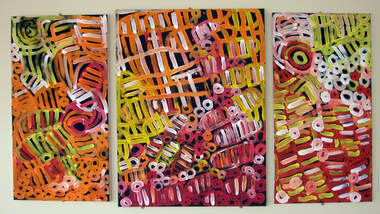 Federation University Art Collection
artwork, Pwerle, Minnie, 'Untitled' by Minnie Pwerle
... Minnie PWERLE (c1910-2006) Atnwengerrp/Utopia Minnie Pwerle's Dreamings consist of elements of 'Bush Melon' and 'Awelye'. ...Minnie PWERLE (c1910-2006) Atnwengerrp/Utopia Minnie Pwerle's Dreamings consist of elements of 'Bush Melon' and 'Awelye'. ...Minnie PWERLE (c1910-2006) Atnwengerrp/Utopia Minnie Pwerle's Dreamings consist of elements of 'Bush Melon' and 'Awelye'. Awelys-Atnwengerrp' is depicted by a series of lines painted in varying widths and colours. These patters represent the lines painted on the top had of women's bodies during ceremonies in Minnie's country of Atnwengerrp. 'Bush Melon' is depicted using linear design of curves and circles in different colours creating a very loose and bold design. This dreaming tells the story of this lovely sweet food that comes from a very small bush and is only found in Atnwengerrp. Once very abundant and fruiting in the summer season, the Bush Melon is now hard to find. Minnie and other women used to collect this fruit (that was green in colour and then ripened to a brown colour) and scrape out the small black seeds. They would then eat the fruit straight away or cut it in pieces and skewer them onto a piece of wood to dry then to be eaten in the coming months when bush tucker was scarce. These artistic symbols carry potent spiritual meanings.. The physical creation of these Dreamings in an important part of the continuation of an ancient and rich cultural heritage. This item is part of the Federation University Art Collection. The Art Collection features over 1000 works and was listed as a 'Ballarat Treasure' in 2007.Awelye & Bush Melon Dreaming, 2004 Acrylic on canvas, over three panels art, artwork, minnie pwerle, aboriginal, anmatyerre language, atnwengerrp country
